

Submitted:
10 April 2026
Posted:
13 April 2026
You are already at the latest version
Abstract
Introduction: Artisanal pineapple juice is widely consumed in Guinea, yet data on its physicochemical quality and compliance with international standards remain limited. Methods: A cross-sectional analytical study was conducted on 60 artisanal pineapple juice samples collected in Maferinyah (n = 30) and Friguiagbé (n = 30). Organoleptic characteristics (taste, color, stability) were assessed, and physicochemical parameters (pH, density, total soluble solids (°Brix), titratable acidity, dry matter, and sulfur dioxide (SO₂)) were determined using standard methods. Results: All samples showed acceptable sensory quality, with 100% presenting pleasant taste and stability at rest. pH values were within the acceptable Codex range in 83% of Maferinyah samples and 100% of Friguiagbé samples. Density was the main deviation, with only 20% compliance in Maferinyah and none in Friguiagbé. Total soluble solids exhibited moderate variability between sites, while titratable acidity and SO₂ levels were within recommended limits for all samples. Discussion: Overall, artisanal pineapple juices from the two areas displayed satisfactory organoleptic quality and generally acceptable chemical stability. However, consistent deviations in density and partial variability in °Brix suggest heterogeneity in artisanal processing practices, underscoring the need for improved standardization to enhance consistency and align with Codex expectations.
Keywords:
artisanal pineapple juice
; physicochemical quality
; Codex Alimentarius
; Guinea
; pH
; density
; total soluble solids (°Brix)
1. Introduction
Pineapple (Ananas comosus L. Merr.) is one of the most important tropical fruits and is widely consumed due to its pleasant flavor, balanced sweetness–acidity profile, and nutritional value. Pineapple is processed into a wide range of products, including juices, concentrates, and derived beverages, and both cultivar characteristics and maturity stage strongly influence juice composition and sensory quality [11,16]. In fruit beverages, physicochemical attributes such as pH, total soluble solids (°Brix), density, and titratable acidity are key determinants of product identity, consumer acceptance, processing behavior, and stability [15,16].
In many low- and middle-income countries, artisanal and informal food production—including fruit juices—plays an important role in local diets and household economies. However, informal processing often lacks standardization, leading to substantial batch-to-batch variability in physicochemical quality. In addition, evidence from street-vended food systems indicates that hygiene practices and handling conditions can affect product safety, underscoring the importance of quality assessment and adherence to good practices [5,6,19]. Although pineapple juice is widely consumed in Guinea, data documenting its physicochemical quality and compliance with international benchmarks remain limited.
The Codex Alimentarius provides internationally recognized standards that define fruit juices and their compositional requirements, emphasizing the preservation of the essential physical and chemical characteristics of the source fruit [1]. Within this framework, monitoring of key parameters such as pH, soluble solids, and other indicators supports authenticity and comparability of products across contexts [1]. Therefore, generating baseline quality data for artisanal pineapple juices is relevant for both consumer protection and the development of feasible quality improvement strategies.
This study aimed to evaluate the organoleptic and physicochemical characteristics of artisanal pineapple juices produced in Maferinyah and Friguiagbé (Guinea) and to assess their compliance with Codex Alimentarius standards. Particular attention was given to parameters that reflect process consistency (density and °Brix) and chemical stability (pH and titratable acidity) to identify the main sources of variability and inform future standardization efforts [1,15].
2. Materials and Methods
2.1. Study Area
The study was conducted in the sub-prefectures of Maferinyah and Friguiagbé (Guinea), where artisanal pineapple juice production and sale are common.
2.2. Study Design and Sampling
A cross-sectional analytical study was conducted on 60 artisanal pineapple juice samples, including 30 from Maferinyah and 30 from Friguiagbé. Samples were purchased from different vendors/producers to capture typical market variability. Each sample was collected in clean containers, transported under cooled conditions, and analyzed shortly after collection.
2.3. Organoleptic Evaluation
Organoleptic assessment was conducted by direct sensory observation focusing on (i) taste (pleasantness/sweetness), (ii) color (light yellow versus deep yellow), and (iii) physical stability at rest (absence/presence of phase separation or sedimentation). To improve consistency of descriptors, the evaluation followed a structured descriptive approach consistent with recommendations for sensory profiling of liquid and semi-liquid food systems [17].
2.4. Physicochemical Analyses
All physicochemical determinations were performed using standardized approaches.
2.4.1. pH
pH was measured using a calibrated pH meter, following the potentiometric method described in ISO 1842 [2] for fruit and vegetable products.
2.4.2. Total Soluble Solids (°Brix)
2.4.3. Density
Density was determined gravimetrically (mass/volume) and expressed in g/mL at laboratory temperature. Density was interpreted against Codex compositional expectations for fruit juices [1].
2.4.4. Titratable Acidity
Titratable acidity was determined by titration and expressed as a percentage (%) based on citric acid equivalence. Results were interpreted using Codex benchmark criteria applied in the present study [1].
2.4.5. Dry Matter
Dry matter (dry extract) was determined using standard laboratory procedures and expressed according to the reporting format used in the study dataset.
2.4.6. Sulfur Dioxide (SO₂)
Sulfur dioxide content was determined and interpreted using Codex-recommended analytical frameworks for sulfites/sulfur dioxide in foods (CXS 234-1999) [4]. In this study, SO₂ values < 0.1 mg/L were considered negligible.
2.5. Codex Compliance Criteria
2.6. Statistical Analysis
Data were summarized as mean ± standard deviation (SD), and min–max values were reported where appropriate. Differences between Maferinyah and Friguiagbé were assessed using Student’s t-test with statistical significance set at p < 0.05. Compliance rates were calculated as percentages relative to the applicable criteria.
3. Results
3.1. Organoleptic Characteristics
All artisanal pineapple juice samples exhibited acceptable organoleptic quality. Taste was described as pleasant and sweet, and physical stability at rest was observed in 100% of samples from both Maferinyah and Friguiagbé. Differences were observed only in juice color. As shown in Figure 1a, light yellow juices predominated in both locations, representing 57% of samples in Maferinyah and 67% in Friguiagbé, whereas deep yellow juices accounted for 43% and 33%, respectively.
3.2. Physicochemical Characteristics
The distribution of pH, total soluble solids (°Brix), and density is illustrated in Figure 2, and mean values are summarized in Table 1.
3.2.1. pH
3.2.2. Total Soluble Solids (°Brix)
Total soluble solids exhibited moderate variability between the two study areas (Figure 2b). Categorization of °Brix values (Figure 1d; Table 2) showed that most samples were within the 10–12 °Brix range, particularly in Friguiagbé. In contrast, samples from Maferinyah displayed a wider distribution, including values below 10 °Brix.
3.2.3. Density
Density values were generally higher than Codex recommended limits in both localities (Figure 2c) [1]. Compliance analysis identified density as the main non-conforming parameter, with only 20% of samples compliant in Maferinyah and none in Friguiagbé (Figure 1c; Table 2).
The relationship between density and total soluble solids is shown in Figure 1e. No clear linear association was observed, suggesting that density variations were not solely related to sugar content.
3.2.4. Other Physicochemical Parameters
3.3. Overall Quality Profile
Taken together, Figure 1 and Figure 2 and Table 1 and Table 2 indicate that artisanal pineapple juices from Maferinyah and Friguiagbé generally present satisfactory organoleptic quality and acceptable physicochemical characteristics with respect to pH, acidity, and sulfur dioxide content. However, density consistently exceeded Codex recommendations [1], highlighting variability in artisanal processing practices and representing the principal physicochemical deviation observed in this study.
4. Discussion
The present study provides an assessment of the organoleptic and physicochemical quality of artisanal pineapple juices produced in Maferinyah and Friguiagbé. Overall, the results indicate satisfactory sensory attributes (Figure 1a) and acceptable chemical stability with respect to pH and titratable acidity (Figure 2a; Table 2), in line with Codex expectations for fruit juices [1]. However, the variability observed for density and total soluble solids (Figure 2b,c; Table 2) suggests heterogeneity in artisanal processing steps and/or raw material characteristics.
All samples were considered acceptable in terms of taste and stability, supporting the notion that artisanal production can yield consumer-acceptable juices even without industrial standardization. Color differences (Figure 1a) may reflect differences in cultivar composition, ripening stage, oxidation during extraction, and suspended pulp content, which are commonly described in pineapple production and processing references [11,16]. In addition, structured, descriptive sensory approaches have been recommended to improve the reproducibility of sensory reporting in beverage studies, thereby supporting the use of standardized descriptors in artisanal juice assessments [17].
pH values were largely within Codex limits (Figure 2a; Table 2) [1], and titratable acidity met the study criterion (Table 2). pH is routinely measured following standardized potentiometric procedures for fruit and vegetable products (ISO 1842) [2]. Together, pH and titratable acidity reflect the sweet–acid balance perceived during tasting and are consistent with pineapple’s naturally acidic profile [11,16]. From a safety perspective, low pH can reduce the growth of many pathogens, but it does not replace hygienic controls in informal production systems [5,6,18,19]. Standard food microbiology references further emphasize that intrinsic factors (e.g., acidity) interact with handling and storage conditions in determining microbial risk [21,22].
Brix values showed partial compliance (Table 2) and moderate variability between sites (Figure 2b; Figure 1d). Refractometric measurement of soluble solids is supported by AOAC official methodology (AOAC 983.17) [3], and broader AOAC collections are widely used as reference methods in food analysis [28]. Variability in °Brix is expected in artisanal contexts due to differences in fruit maturity, cultivar, seasonal effects, and potential dilution. Maturity-dependent changes in physicochemical quality have been documented in pineapple, including changes in soluble solids and acidity [12]. In addition, blending and formulation practices can influence soluble solids and perceived sweetness, reinforcing the need for standardization when consistent °Brix targets are desired [14]. Codex criteria provide an internationally recognized benchmark for juice identity and compositional expectations [1].
Density was the least compliant parameter (Figure 2c; Figure 1c; Table 2) [1] and did not show a clear linear association with °Brix (Figure 1e). This suggests that density variations were not driven solely by dissolved sugars but were likely influenced by suspended solids and pulp load. Food processing references highlight that the physical properties of juices are sensitive to unit operations such as extraction, filtration/clarification, and solids management [15]. Studies on pineapple juice clarification by microfiltration/ultrafiltration show that removal of colloids and pulp components can substantially modify physicochemical characteristics [7,8]. Similar conclusions are reported for pulpy fruit juices clarified by crossflow microfiltration, where suspended solids concentration and process conditions strongly affect permeate/retentate properties [9]. Moreover, the density of clarified pineapple juice has been modeled as a function of soluble solids concentration and temperature, supporting density’s sensitivity as a process and quality indicator [13]. Taken together, these references support treating density as a sensitive marker of processing heterogeneity (clarification/filtration/dilution/pulp retention) rather than a single cause defect.
SO₂ concentrations were consistently low (Table 1), and all samples met the study criterion for negligible SO₂ (Table 2). Codex CXS 234-1999 compiles recommended methods of analysis (including sulfites) and can be used as a harmonized framework for laboratory monitoring [4]. This complements the compositional expectations of Codex CXS 247-2005 for fruit juices [1] and strengthens methodological comparability across studies.
Although microbiological analyses were not performed in this study, the literature on street-vended and informal food systems consistently shows that hygiene practices, water/ice quality, and handling conditions can strongly influence microbiological risk. Studies in Nairobi and Johannesburg reported hygiene and sanitation gaps and microbial hazards in street food environments, supporting the relevance of hygienic training and basic sanitary control for artisanal juice chains [5,6,18,19].
The findings suggest that improvements in processing consistency could focus on (i) raw material maturity selection to reduce °Brix variability and (ii) clarification/filtration consistency to address density deviations. Mild heat treatment has been investigated as a practical approach for extending shelf life while maintaining sensory acceptability in pineapple juice systems, indicating a potential pathway for small producers where feasible [10]. More broadly, pasteurization and storage studies on fruit juices demonstrate that processing and storage conditions can affect physicochemical and nutritional quality parameters, reinforcing the relevance of controlled thermal treatments and storage management [27]. Alternative treatment strategies for preserving fresh pineapple juice have also been assessed and may inform future work on preservation options compatible with local constraints [26].
Pineapple processing generates byproducts and side streams with potential for valorization. Studies on pineapple side-stream syrup and the characterization of pineapple processing waste highlight the presence of valuable components and techno-functional properties that can support local innovation and waste reduction strategies [23,24]. While not central to Codex compliance, this framing can support broader development of local pineapple processing systems.
Quality differences among pineapple varieties during storage and microbial activity have been documented for fresh-cut pineapple, supporting the principle that varietal selection and post-processing conditions influence quality outcomes [25]. Finally, regulatory science frameworks illustrate evidence-based evaluation approaches for processing aids and enzymes in food production chains; although not directly applied here, they underscore the importance of standardized assessment when new aids are introduced [20].
5. Conclusion
This study provides baseline evidence on the organoleptic and physicochemical quality of artisanal pineapple juices produced in Maferinyah and Friguiagbé, Guinea. Overall, the juices displayed satisfactory sensory acceptability, with pleasant taste and stability at rest in all samples, and a predominance of light-yellow juices in both localities. From a physicochemical standpoint, pH and titratable acidity were largely within the study’s Codex-aligned criteria, indicating generally acceptable chemical stability. However, density emerged as the principal physicochemical deviation, with low compliance in Maferinyah and no compliant samples in Friguiagbé, and no clear linear relationship with °Brix, suggesting that density variability is likely driven by heterogeneous artisanal processing practices (e.g., pulp retention, clarification and/or dilution). Total soluble solids (°Brix) showed partial compliance and moderate variability between sites. Sulfur dioxide concentrations were consistently negligible, supporting the absence of intentional sulfitation in the analyzed juices. Taken together, these findings highlight that artisanal pineapple juices in the two study areas are generally acceptable in sensory quality and chemical stability markers, but would benefit from simple standardization measures aimed at improving process consistency—particularly those affecting density and soluble solids. Future work should include microbiological assessments and evaluation of seasonal and varietal effects to better characterize overall quality and safety of artisanal pineapple juices in Guinea.
Author Contributions
Dr. Ismaël WAGUÉ and Dr. Jean Séllé BAVOGUI contributed equally to the conception and design of the study, data collection, analysis, interpretation, drafting, and revision of the manuscript. All authors have read and agreed to the published version of the manuscript.
Funding
This research received no external funding.
Data Availability Statement
The data presented in this study are available from the corresponding author upon reasonable request.
Acknowledgments
The authors thank all artisanal juice producers who agreed to participate in this study and facilitated sample collection.
Conflicts of Interest
The authors declare no conflict of interest.
References
- Codex Alimentarius Commission. General Standard for Fruit Juices and Nectars (CXS 247-2005); FAO/WHO: Rome, Italy, 2005; amended 2022–2024. [Google Scholar]
- Codex Alimentarius Commission. Recommended Methods of Analysis and Sampling (CXS 234-1999); FAO/WHO: Rome, Italy, 1999; last amendment 2025. [Google Scholar]
- ISO. ISO 1842:1991—Fruit and Vegetable Products—Determination of pH; International Organization for Standardization: Geneva, Switzerland, 1991; (confirmed 2023). [Google Scholar]
- AOAC INTERNATIONAL. Solids (Soluble) in Citrus Fruit Juices: Refractometer Method (AOAC Official Method 983.17). In Official Methods of Analysis of AOAC INTERNATIONAL, 22nd ed.; Latimer, G.W., Jr., Ed.; Oxford University Press: New York, NY, USA, 2023. [Google Scholar] [CrossRef]
- Muinde, O.K.; Kuria, E. Hygienic and sanitary practices of vendors of street foods in Nairobi, Kenya. Afr. J. Food Agric. Nutr. Dev. 2005, 5(1). [Google Scholar] [CrossRef]
- Mosupye, F.M.; von Holy, A. Microbiological hazard identification and exposure assessment of street food vending in Johannesburg, South Africa. Int. J. Food Microbiol. 2000, 61, 137–145. [Google Scholar] [CrossRef] [PubMed]
- Mosupye, F.M.; von Holy, A. Microbiological quality and safety of ready-to-eat street-vended foods in Johannesburg, South Africa. J. Food Prot. 1999, 62, 1278–1284. [Google Scholar] [CrossRef] [PubMed]
- Barro, N.; Bello, A.R.; Itsiembou, Y.; Savadogo, A.; Ouattara, C.A.T.; de Souza, C.A.; Traore, A.S.; Nikiema, A.P. Street-vended foods improvement: Contamination mechanisms and application of food safety objective strategy: Critical review. Pak. J. Nutr. 2007, 6, 1–10. [Google Scholar] [CrossRef]
- Bhardwaj, R.L.; Pandey, S. Juice blends—A way of utilization of under-utilized fruits, vegetables, and spices: A review. Crit. Rev. Food Sci. Nutr. 2011, 51, 563–570. [Google Scholar] [CrossRef] [PubMed]
- Fellows, P.J. Food Processing Technology: Principles and Practice, 4th ed.; Woodhead Publishing/Elsevier: Cambridge, UK, 2016/2017. [Google Scholar]
- Bartholomew, D.P.; Paull, R.E.; Rohrbach, K.G. (Eds.) The Pineapple: Botany, Production and Uses; CABI: Wallingford, UK, 2003. [Google Scholar] [CrossRef]
- Bartolomé, A.P.; Rupérez, P.; Fúster, C. Pineapple fruit: Morphological characteristics, chemical composition and sensory analysis of red Spanish and Smooth Cayenne cultivars. Food Chem. 1995, 53, 75–79. [Google Scholar] [CrossRef]
- Garza, S.; Ibarz, A. Effect of temperature and concentration on the density of clarified pineapple juice. Int. J. Food Prop. 2010, 13, 913–920. [Google Scholar] [CrossRef]
- de Carvalho, L.M.J.; Bento da Silva, C.A.; Pierucci, A.P.T.R. Clarification of pineapple juice (Ananas comosus L. Merryl) by ultrafiltration and microfiltration: Physicochemical evaluation of clarified juices. J. Agric. Food Chem. 1998, 46, 2185–2189. [Google Scholar] [CrossRef]
- de Carvalho, L.M.J.; de Castro, I.M.; da Silva, C.A.B. A study of retention of sugars in the process of clarification of pineapple juice by micro- and ultrafiltration. J. Food Eng. 2008, 87, 447–454. [Google Scholar] [CrossRef]
- Vaillant, F.; Millan, A.; Dornier, M.; Decloux, M.; Reynes, M. Strategy for economical optimization of the clarification of pulpy fruit juices using crossflow microfiltration. J. Food Eng. 2001, 48, 83–90. [Google Scholar] [CrossRef]
- Leneveu-Jenvrin, C.; Quentin, B.; Assemat, S.; Remize, F. Maintaining physicochemical, microbiological, and sensory quality of pineapple juice (Ananas comosus, var. ‘Queen Victoria’) through mild heat treatment. Processes 2020, 8, 1186. [Google Scholar] [CrossRef]
- Ding, P.; Syazwani, S. Physicochemical quality, antioxidant compounds, and activity of MD-2 pineapple fruit at five ripening stages. Int. Food Res. J. 2016, 23(2), 549–555. [Google Scholar]
- Oppermann, A.K.L.; Piqueras-Fiszman, B.; de Graaf, C.; Scholten, E.; Stieger, M. Descriptive sensory profiling of double emulsions with gelled and non-gelled inner water phase. Food Res. Int. 2016, 85, 215–223. [Google Scholar] [CrossRef] [PubMed]
- EFSA Panel on Food Contact Materials, Enzymes and Processing Aids (CEP). Safety evaluation of the food enzyme preparation isomaltulose synthase from Serratia plymuthica strain Z12A. EFSA J. 2021, 19(4), e06432. [Google Scholar] [CrossRef] [PubMed]
- Frazier, W.C.; Westhoff, D.C. Food Microbiology, 4th ed.; McGraw-Hill: New York, NY, USA, 1988. [Google Scholar]
- Jay, J.M. Modern Food Microbiology, 6th ed.; Aspen Publishers: Gaithersburg, MD, USA, 2000; ISBN 083421671X. [Google Scholar]
- Tortoe, C.; Johnson, P.-N.T.; Slaghek, T.; Miedema, M.; Timmermans, T. Physicochemical, proximate and sensory properties of pineapple (Ananas sp.) syrup developed from its organic side-stream. Food Nutr. Sci. 2013, 4, Article 27722. [Google Scholar] [CrossRef]
- Sengar, A.S.; Sunil, C.K.; Rawson, A.; Venkatachalapathy, N. Identification of volatile compounds, physicochemical and techno-functional properties of pineapple processing waste (PPW). J. Food Meas. Charact. 2022, 16, 1146–1158. [Google Scholar] [CrossRef]
- Xing, Y.; Liao, X.; Wu, H.; Qiu, J.; Wan, R.; Wang, X.; Yi, R.; Xu, Q.; Liu, X. Comparison of different varieties on quality characteristics and microbial activity of fresh-cut pineapple during storage. Foods 2022, 11, 2788. [Google Scholar] [CrossRef] [PubMed]
- Leneveu-Jenvrin, C.; Aboudia, A.; Assemat, S.; Remize, F. A three-step approach to assess efficacy of alternative chemical treatments to preserve fresh fruit juices: Application to pineapple (Ananas comosus ‘Queen Victoria’). LWT 2022, 155, 112959. [Google Scholar] [CrossRef]
- Mandha, J.; Shumoy, H.; Matemu, A.O.; Raes, K. Characterization of fruit juices and effect of pasteurization and storage conditions on their microbial, physicochemical, and nutritional quality. Food Biosci. 2023, 51, 102335. [Google Scholar] [CrossRef]
- AOAC INTERNATIONAL. Official Methods of Analysis (OMA), 22nd Edition—Overview and access information; AOAC INTERNATIONAL: Rockville, MD, USA, 2023. [Google Scholar]
Figure 1.
Organoleptic characteristics, compliance with Codex Alimentarius standards, and density–°Brix relationship of artisanal pineapple juices from Maferinyah and Friguiagbé: (a) distribution of juice color; (b) pH compliance with Codex range (3.3–5.2); (c) density compliance with Codex reference limit (≤1.045 g/mL); (d) °Brix category distribution (<10, 10–12, >12); (e) scatter plot of density versus total soluble solids (°Brix). (n = 30 per locality).
Figure 1.
Organoleptic characteristics, compliance with Codex Alimentarius standards, and density–°Brix relationship of artisanal pineapple juices from Maferinyah and Friguiagbé: (a) distribution of juice color; (b) pH compliance with Codex range (3.3–5.2); (c) density compliance with Codex reference limit (≤1.045 g/mL); (d) °Brix category distribution (<10, 10–12, >12); (e) scatter plot of density versus total soluble solids (°Brix). (n = 30 per locality).
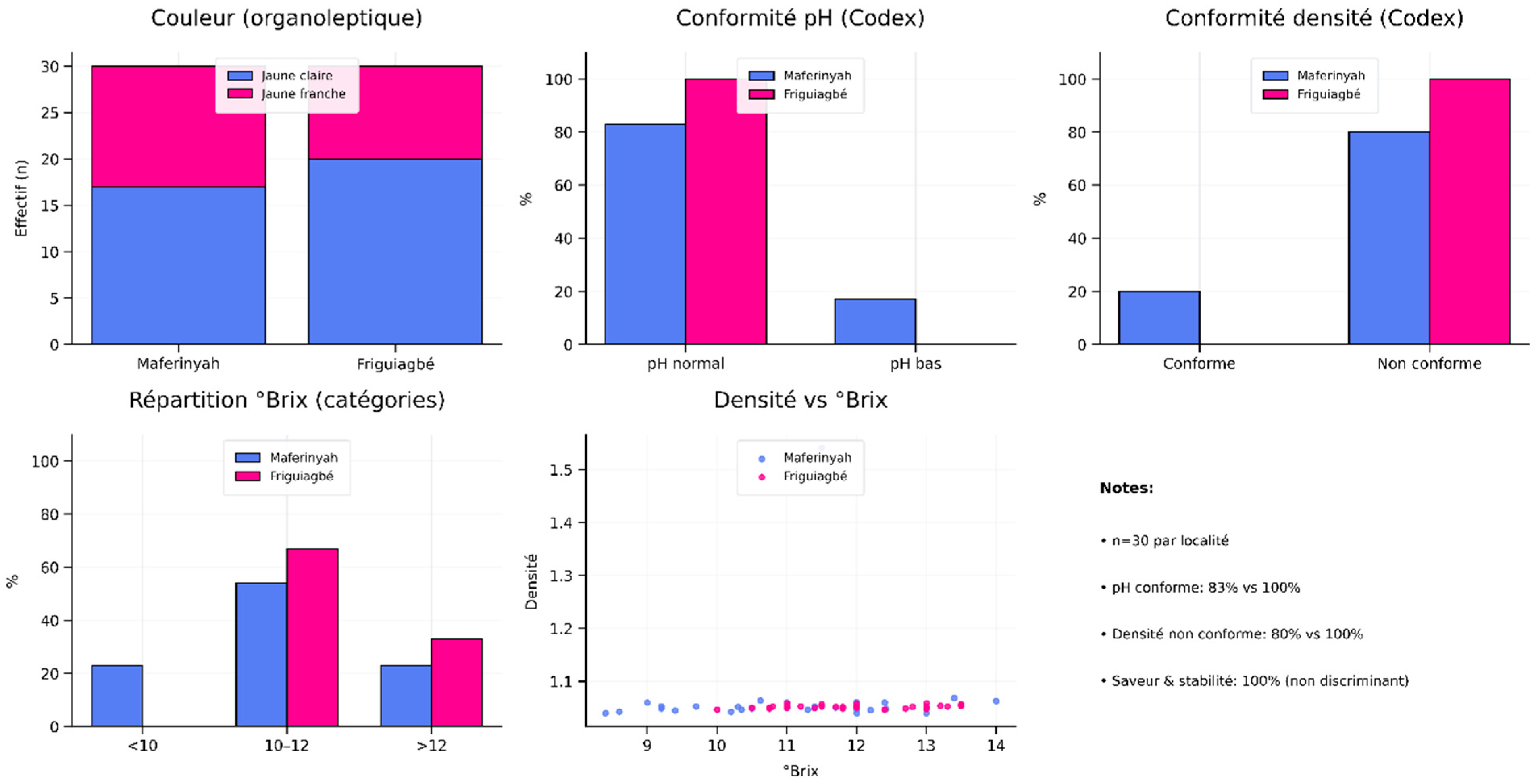
Figure 2.
Boxplot distribution of physicochemical parameters of artisanal pineapple juices from Maferinyah and Friguiagbé: (a) pH; (b) total soluble solids (°Brix); (c) density (g/mL). The horizontal line within each box represents the median, boxes indicate the interquartile range (IQR), and whiskers represent variability outside the upper and lower quartiles. (n = 30 per locality).
Figure 2.
Boxplot distribution of physicochemical parameters of artisanal pineapple juices from Maferinyah and Friguiagbé: (a) pH; (b) total soluble solids (°Brix); (c) density (g/mL). The horizontal line within each box represents the median, boxes indicate the interquartile range (IQR), and whiskers represent variability outside the upper and lower quartiles. (n = 30 per locality).
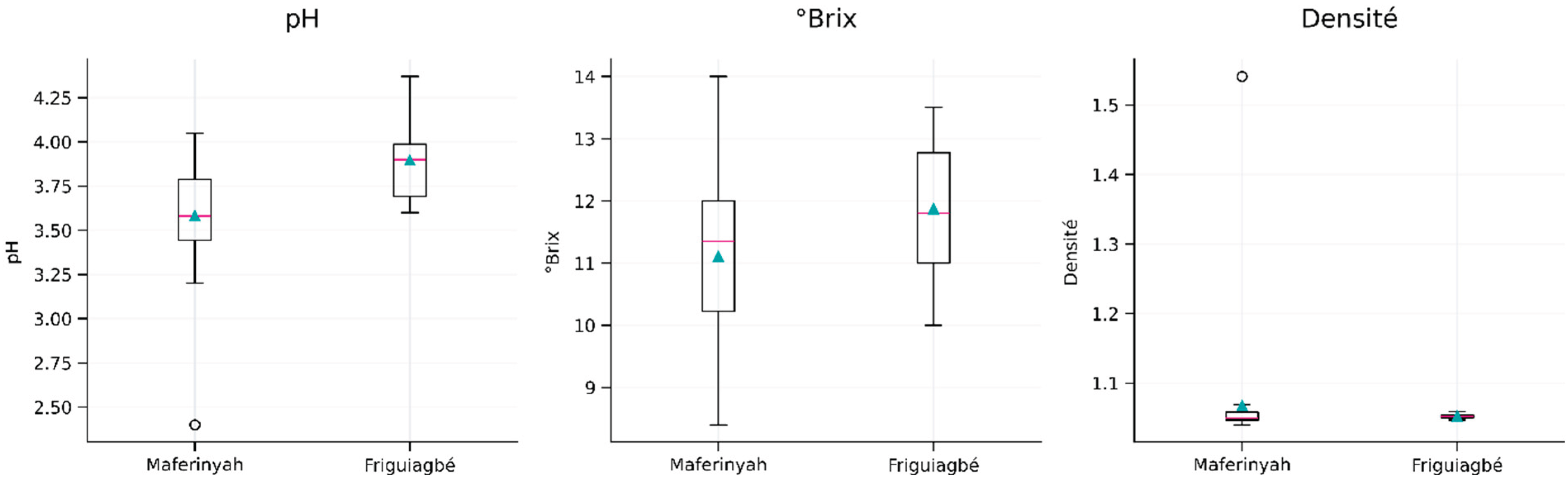

Table 1.
Physicochemical characteristics of artisanal pineapple juices from Maferinyah and Friguiagbé (values expressed as mean ± SD, with min–max).
Table 1.
Physicochemical characteristics of artisanal pineapple juices from Maferinyah and Friguiagbé (values expressed as mean ± SD, with min–max).
| Parameter | Codex standard | Maferinyah (n = 30) Mean ± SD (Min–Max) | Friguiagbé (n = 30) Mean ± SD (Min–Max) |
|---|---|---|---|
| pH | >3.3–5.2 | 3.58 ± 0.33 (2.40–4.05) | 3.90 ± 0.21 (3.60–4.37) |
| Total soluble solids (°Brix) | ≥12 | 11.11 ± 1.46 (8.40–14.00) | 11.87 ± 0.98 (10.00–13.50) |
| Density (g/mL) | ≤1.045 | 1.067 ± 0.090 (1.040–1.541) | 1.052 ± 0.003 (1.047–1.059) |
| Titratable acidity (%) | ≤4.0 | 3.26 ± 0.67 (1.77–4.06) | 2.95 ± 0.74 (1.71–4.00) |
| Dry matter | — | 152.54 ± 52.66 (77.16–341.56) | 142.04 ± 31.66 (79.72–285.44) |
| SO₂ (mg/L) | <0.1 (negligible) | 0.071 ± 0.025 (0.012–0.099) | 0.043 ± 0.024 (0.003–0.089) |
Note: Codex limits are based on CODEX STAN 247-2005; SO₂ levels <0.1 mg/L were considered negligible.
Table 2.
Compliance of artisanal pineapple juices with Codex Alimentarius standards (aligned with manuscript criteria).
Table 2.
Compliance of artisanal pineapple juices with Codex Alimentarius standards (aligned with manuscript criteria).
| Parameter (criterion) | Maferinyah (%) | Friguiagbé (%) |
|---|---|---|
| pH compliance (>3.3–5.2) | 83.3 | 100.0 |
| Density compliance (≤1.045 g/mL) | 20.0 | 0.0 |
| °Brix compliance (≥12) | 36.7 | 46.7 |
| Titratable acidity compliance (≤4.0%) | 96.7 | 100.0 |
| SO₂ negligible (<0.1 mg/L) | 100.0 | 100.0 |
Disclaimer/Publisher’s Note: The statements, opinions and data contained in all publications are solely those of the individual author(s) and contributor(s) and not of MDPI and/or the editor(s). MDPI and/or the editor(s) disclaim responsibility for any injury to people or property resulting from any ideas, methods, instructions or products referred to in the content. |
© 2026 by the authors. Licensee MDPI, Basel, Switzerland. This article is an open access article distributed under the terms and conditions of the Creative Commons Attribution (CC BY) license (http://creativecommons.org/licenses/by/4.0/).
Copyright: This open access article is published under a Creative Commons CC BY 4.0 license, which permit the free download, distribution, and reuse, provided that the author and preprint are cited in any reuse.


