
Submitted:
09 April 2026
Posted:
11 April 2026
You are already at the latest version
Abstract
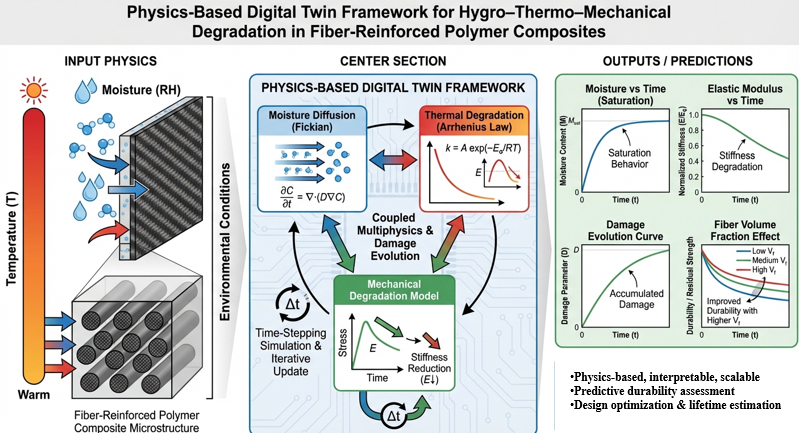
Polymer composites used in structural applications are frequently exposed to combined thermal and moisture environments, which gradually degrade their mechanical performance over time. Predicting this behavior remains challenging due to the complex interaction between moisture diffusion, thermally activated degradation, and evolving mechanical response. In this study, a physics-based digital twin framework is developed to model the coupled hygro–thermo–mechanical degradation of fiber-reinforced polymer composites. The approach integrates moisture diffusion based on Fickian principles, temperature-dependent degradation described using Arrhenius kinetics, and a coupled modulus evolution model to represent time-dependent material behavior. The results capture key physical trends, including moisture saturation behavior, gradual stiffness reduction, and stable damage evolution under moderate environmental conditions. In addition, the influence of fiber volume fraction and temperature is systematically examined, highlighting their important roles in governing degradation resistance and long-term durability. Rather than relying on data-driven methods, the proposed framework is grounded in physically interpretable mechanisms, providing a transparent and computationally efficient tool for durability assessment. The model is presented as a qualitative benchmarking framework in the absence of system-specific calibration, with clear potential for future experimental validation and probabilistic extensions.
Keywords:
digital twin
; polymer composites
; hygro–thermo–mechanical degradation
; moisture diffusion
; arrhenius kinetics
; fiber-reinforced composites
; damage evolution
; mechanical degradation
; multi-physics modelling
; lifetime prediction
Copyright: This open access article is published under a Creative Commons CC BY 4.0 license, which permit the free download, distribution, and reuse, provided that the author and preprint are cited in any reuse.


