

Submitted:
09 April 2026
Posted:
11 April 2026
You are already at the latest version
Abstract
The growing emphasis on environmental sustainability within the European Union raises important questions about the nature and internal structure of corporate envi-ronmental effort. This study examines environmental expenditures - measured as in-termediate consumption of environmental protection services - and environmental investments - measured as gross fixed capital formation for environmental protection - in ten EU member states over the period 2015-2022, using data from the Eurostat En-vironmental Protection Expenditure Accounts. The analysis is conducted at both the national and sectoral levels and covers four NACE Rev.2 sectors: agriculture, mining, manufacturing, and electricity. The results reveal a pronounced asymmetry, with en-vironmental expenditures consistently exceeding environmental investments, sug-gesting that environmental effort is more strongly oriented towards maintenance than transformation. This asymmetry varies substantially across countries and even more across sectors: agriculture displays a strongly expenditure-dominated profile, whereas the electricity sector shows a more balanced pattern. On the basis of the relative inten-sity of expenditures and investments, the study proposes an interpretative four-quadrant typology of environmental strategies, distinguishing active transfor-mation, investment focus, maintenance mode, and passive profiles. The findings high-light the importance of sectoral disaggregation and show that the internal composition of environmental effort is as informative as its overall level.
Keywords:
environmental expenditures
; environmental investments
; environmental protection
; investment-to-expenditure ratio
; sectoral analysis
; comparative analysis
; environmental strategy typology
1. Introduction
In the context of the accelerating ecological transformation of the economy, the question of the nature and structure of environmental protection expenditure is gaining increasing importance. European Union policies impose ever higher requirements on enterprises with regard to emissions reduction, waste management and the enhancement of resource efficiency. In this context, it is not sufficient merely to track the overall level of environmental efforts. It is also necessary to analyse their internal structure, since different forms of environmental expenditure reflect different economic rationales and different strategic orientations.
Of particular importance is the distinction between environmental expenditure and environmental investment. The former are predominantly of a current and operational nature and are associated with the maintenance of existing environmental functions and compliance with regulations. The latter represent capital outlays in technologies, equipment and infrastructure that can alter production processes and create conditions for a longer-term reduction of environmental pressure. For this reason, the two indicators should not be regarded as interchangeable, but rather as different yet interrelated dimensions of environmental efforts.
The existing literature most commonly examines environmental expenditure and environmental investment in the context of broader debates on environmental compliance costs, regulatory pressure and eco-innovation, without placing the ratio between current and capital environmental efforts at the centre of the analysis [1,2,3]. This makes it difficult to distinguish between sustaining and transformational environmental efforts. A large proportion of studies remain at the national level and do not sufficiently account for sectoral differences, despite the fact that environmental pressure, technological structure and investment incentives differ substantially across industries [4,5,6]. As a result, an incomplete picture of environmental behaviour is often obtained, in which different patterns of action remain hidden behind national averages.
The present study aims to contribute to bridging this gap through a joint analysis of environmental expenditure and environmental investment in ten EU Member States, at both the national and sectoral levels. The analysis is based on data from the Eurostat environmental economic accounts for the period 2015-2022 and covers four sectors according to NACE Rev.2 - agriculture, mining and quarrying, manufacturing, and electricity supply.
The study is organised around three principal questions. First, what are the trends in environmental expenditure and environmental investment at the national level during the period under review? Second, what sectoral differences are observed with regard to the intensity and structure of environmental efforts? And third, can a typology of environmental strategies be derived on the basis of the joint examination of the intensity of environmental investment and environmental expenditure, which would allow a more precise interpretation of the differences between countries and sectors?
To address these questions, the article combines a structured literature review with a descriptive and comparative empirical analysis. First, a conceptual framework is constructed that substantiates the distinction between the two principal components of environmental efforts. This is followed by a review of the relevant literature and the identification of the main research gaps. In the subsequent sections, the data and methodological approach are presented, the national and sectoral patterns are analysed, and on this basis a typology of environmental strategies is proposed.
The contribution of the study is threefold. First, it examines environmental expenditure and environmental investment within a common analytical framework, rather than treating them in isolation. Second, it combines the national and sectoral levels of analysis, which makes it possible to reveal differences that remain invisible when aggregated indicators are used. Third, it proposes an interpretive typology of environmental strategies based on the joint analysis of the intensity of environmental expenditure and environmental investment as expressions of sustaining and transformational environmental efforts. In this way, the article contributes to a more nuanced understanding of environmental behaviour within the EU - not merely in terms of the volume of expenditure, but in terms of its structure and strategic orientation.
2. Conceptual Framework
The present study is based on the distinction between two principal components of environmental efforts - environmental expenditure and environmental investment. This distinction is analytically necessary, as the two indicators reflect different economic mechanisms and different strategic rationales of environmental behaviour. When considered in aggregate, they may create a misleading impression of the true nature of environmental efforts.
Environmental expenditure, measured by the indicator intermediate consumption of environmental protection services (env_ac_cepsgc1), reflects the current consumption of environmental protection services. It encompasses activities such as waste treatment, wastewater purification, pollution monitoring and control, as well as other services related to the fulfilment of environmental requirements. In this sense, it may be regarded as a proxy for operational environmental expenditure (OPEX). Its function is predominantly sustaining, as it ensures the functioning of existing environmental systems and compliance with regulations, without necessarily expanding the capacity for environmental protection.
Environmental investment, measured by the indicator gross fixed capital formation for environmental protection (env_ac_epiap1), reflects capital outlays in fixed assets intended for the reduction of pollution and the enhancement of resource efficiency. It encompasses investment in equipment, technologies and infrastructure that enable structural change in production processes. For this reason, it may be interpreted as the environmental equivalent of capital expenditure (CAPEX). In contrast to current expenditure, its function is transformational - it expands the capacity for environmental protection and creates preconditions for a longer-term effect.
The difference between the two indicators may be summarised along three principal dimensions: time horizon, function and strategic orientation. Environmental expenditure is more closely associated with the short-term maintenance of environmental compliance, whereas environmental investment is linked to long-term improvement and technological adaptation. The former reflects current functioning, whilst the latter reflects structural development. It is precisely for this reason that the ratio between investment and expenditure (I/E ratio) is analytically significant: it makes it possible to assess whether environmental efforts are oriented predominantly towards the maintenance of existing environmental functions or towards the transformation of production capacity.
The sectoral dimension is an essential element of this framework. Different economic sectors are characterised by different environmental footprints, technological structures and regulatory pressures, which implies a different combination of environmental expenditure and investment. The energy sector is capital-intensive and heavily regulated, which makes it more likely to concentrate a higher share of environmental investment. Agriculture is associated with more dispersed sources of impact and with high current compliance costs, which implies a relatively stronger presence of operational expenditure. Manufacturing and mining and quarrying occupy intermediate positions, in which the ratio between expenditure and investment depends both on the technological base and on the environmental profile of production.
Analysis at the national level alone is insufficient. National aggregates may conceal significant differences between sectors and make it difficult to distinguish between structural features of the economy and genuine differences in environmental strategy. Sectoral disaggregation is necessary in order to establish not only how many resources are directed towards environmental protection, but also what their internal structure is.
In this sense, the conceptual framework of the study (Figure 1) considers environmental expenditure and environmental investment as two interrelated yet functionally distinct components of environmental efforts. It is precisely this logic that underpins the subsequent empirical analysis and the attempt to identify different patterns of environmental strategy across countries and sectors.
3. Literature Review
3.1. Principal Directions in the Literature
The existing literature may be systematised into several principal directions, which reflect different aspects of the environmental efforts of enterprises and economies.
3.1.1. Environmental Expenditure as an Operational Component of Environmental Efforts (OPEX)
The first direction in the literature considers environmental expenditure primarily as a current component of environmental efforts, associated with compliance with environmental standards and regulatory requirements. In earlier studies, it is most commonly interpreted as part of compliance costs, which may raise production costs, reduce productivity and weaken the competitiveness of firms, particularly in polluting and capital-intensive industries [1,7,8].
Subsequently, this perspective was elaborated under the influence of the Porter hypothesis, according to which well-designed environmental regulations may not only increase costs but also stimulate innovation, organisational improvements and more efficient use of resources, such that part of the initial burden may be offset in the long term [9,10]. Nevertheless, environmental expenditure in this body of literature is typically considered predominantly through the relationship between regulations, innovation and competitiveness, rather than as an independent element of the internal structure of environmental efforts.
Empirical studies demonstrate that the level and effect of environmental expenditure depend on sectoral affiliation, the technological base, the age of capital and the institutional environment. Gray & Shadbegian [11] associate environmental requirements with higher costs and the reallocation of resources, particularly in the case of older production facilities. Becker & Henderson [12] show that air quality regulations affect the location and dynamics of polluting industries. Similar conclusions are drawn by Berman & Bui [13] and Johnstone et al. [14], who emphasise that the impact of environmental regulation varies according to sectoral and technological characteristics.
More recent studies extend the analysis to the relationship between environmental expenditure, firm adaptation, innovation and sustainability. Nevertheless, a large proportion of the literature continues to treat them primarily as compliance costs or as an indirect indicator of regulatory pressure, rather than in comparison with environmental investment [15,16]. In parallel, studies have emerged that link them to innovation activity and sustainable firm development [17,18,19]. Other analyses, at the macro and meso levels, assess the effects of environmental policy on competitiveness and structural adaptation [3,20].
The literature most commonly treats environmental expenditure as a short-term and operational element of environmental behaviour - a cost of compliance, a mechanism for maintaining environmental functions, or a factor influencing the current efficiency of enterprises. Considerably less frequently are they analysed in direct conjunction with environmental investment, which limits the possibility of assessing the internal structure and strategic orientation of environmental efforts.
3.1.2. Environmental Investment as a Capital Component of Environmental Efforts (CAPEX)
The second direction in the literature considers environmental investment as a capital component of environmental efforts. In contrast to current environmental expenditure, which is associated primarily with the maintenance of compliance, investment is interpreted as a vehicle for technological modernisation, structural change and the long-term improvement of environmental outcomes. For this reason, it occupies a central place in the literature on eco-innovation, the green transition and competitiveness [21,22].
A substantial part of this literature is based on the understanding that environmental regulations do not act solely as a constraint but may also create incentives for investment in cleaner technologies and production solutions. The Porter hypothesis fits within this logic, according to which well-designed environmental policies may provoke an innovation response that partially or fully offsets the initial compliance costs. Later survey studies show that empirical support for this thesis is mixed, but is stronger with regard to the stimulation of innovation than with regard to lasting improvements in competitiveness [6,23,24].
Empirical studies demonstrate that the investment response of firms and sectors is not unequivocal. Some find that stricter environmental requirements are associated with higher investment in pollution abatement technologies and the modernisation of existing facilities, whilst others emphasise that the effect depends on the type of investment, the sector and the manner in which regulatory stringency is measured. Leiter, Parolini, & Winner [25] establish a link between environmental regulation and investment activity in European industry, whilst Rubashkina, Galeotti, & Verdolini [4] show that the effects on innovation and competitiveness differ across individual industries.
Another part of the literature focuses on the role of subsidies and other forms of public support for green investment. These studies show that incentives may encourage environmental investment by reducing the cost of the transition and alleviating financial constraints, but their effect depends on firm characteristics and the institutional environment [14,26]. In more recent literature, environmental investment is increasingly linked to broader processes of eco-innovation, investment efficiency and green growth, which presents it not merely as a reaction to regulations but also as part of a strategic restructuring of firms and sectors [27,28].
The literature most commonly treats environmental investment as a transformational component of environmental efforts - a mechanism for technological adaptation, modernisation and the long-term improvement of environmental outcomes. Considerably less frequently, however, is it analysed in direct conjunction with environmental expenditure. It is precisely this that limits the possibility of assessing not only the level but also the internal structure and strategic orientation of environmental efforts.
3.1.3. Comparative Cross-Country Analyses of Environmental Expenditure and Outcomes
The third direction in the literature encompasses comparative cross-country analyses that examine differences in environmental policies, the level of environmental expenditure and the outcomes of their implementation. These studies typically work with aggregated national indicators and seek common patterns of convergence, efficiency or strategic interaction between countries. Within this perspective, environmental efforts are most commonly treated as a single aggregate, without a clear distinction between their individual components [2,29].
This approach is valuable because it makes it possible to trace cross-country differences in the overall level of environmental efforts and their outcomes, as well as to compare different models of policy response. At the same time, aggregated national analysis rarely distinguishes between current expenditure for the maintenance of environmental compliance and capital outlays in technological change. For this reason, even when a link is established between environmental policy, innovation or emissions outcomes, it often remains unclear which component of the environmental effort lies behind the observed effects [30,31].
More recent studies extend this perspective by linking environmental efforts with technological change, innovation activity and differences in the policy instruments employed. They show that the effects of environmental policy depend on the institutional environment, the type of instrument and the economic structure of the country in question [14,32]. In these cases too, however, the analysis typically remains at the nationally aggregated level, which makes it difficult to distinguish between different types of environmental efforts and conceals internal sectoral differences.
The comparative cross-country approach is well developed but remains limited by the predominant use of aggregated indicators. In most studies, environmental expenditure and environmental investment are not considered as separate yet interrelated dimensions of environmental effort, and sectoral differences remain in the background. This limits the possibility of assessing not only the level but also the internal structure of environmental efforts across different countries.
3.1.4. Sectoral Differences in Environmental Expenditure and Investment
The fourth direction in the literature is concerned with sectoral differences in environmental expenditure and investment. It proceeds from the understanding that the environmental behaviour of enterprises depends to a considerable extent on the characteristics of the specific industry. Different sectors are distinguished by their environmental footprint, technological structure, degree of regulatory pressure and access to resources, which leads to significant differences both in the level and in the structure of environmental efforts [33,34].
Sectors with high capital intensity and concentrated sources of pollution - such as energy and mining and quarrying - are typically subject to stricter environmental regulations and accordingly exhibit a greater propensity to invest in technologies for emissions reduction and efficiency enhancement. In these industries, environmental efforts more frequently take the form of modernisation of production facilities, energy efficiency and the introduction of cleaner technologies, with their scale depending on the technological characteristics and innovation capacity of the sector [27,35].
By contrast, sectors with more dispersed sources of impact and lower capital intensity, such as agriculture, are more frequently characterised by a higher relative share of current environmental expenditure. This is associated with the need for continuous compliance activities under conditions of diffuse environmental pressure, particularly on water and soil [36]. In this sense, sectoral structure influences not only the level of environmental efforts but also their internal composition between expenditure and investment [34,37].
Manufacturing occupies an intermediate position. It combines both investment and expenditure elements but is also characterised by considerable internal heterogeneity across individual subsectors. Some industries are highly sensitive to environmental regulations, energy prices and technological requirements, whilst in others environmental efforts manifest more limitedly or predominantly in the form of process and organisational improvements. Owing to the large economic scale of the sector, the absolute values of environmental efforts do not always translate into equally high relative intensity measured against gross value added, which complicates the interpretation of aggregated sectoral indicators [38,39].
Despite the existence of sectorally oriented studies, the literature remains fragmented. Part of it focuses on individual industries, and another part on eco-innovation at the firm level. Considerably less frequently, however, is a systematic comparative analysis offered that simultaneously covers multiple sectors and more than one country. Even more rarely are sectoral differences examined through the ratio between environmental expenditure and investment as an indicator of strategic orientation [40].
The sectoral dimension is key to understanding environmental efforts, since it is at this level that differences in environmental pressure, technological possibilities and investment incentives are most clearly manifested. Analysis at the national level alone often conceals these differences, particularly in economies with a highly diversified structure.
3.1.5. Environmental Expenditure, Investment and Policy Instruments
The fifth direction in the literature examines the relationship between environmental expenditure and investment, on the one hand, and policy instruments - environmental taxes, regulations and subsidies - on the other. This group of studies is important because it focuses on the mechanisms through which public policy influences the environmental behaviour of firms and sectors. In most cases, however, the analysis remains one-sided and concentrates either on current environmental expenditure or on environmental investment [41,42].
One part of the literature examines the impact of environmental regulations and environmental taxes on investment behaviour and green innovation. Studies show that regulatory pressure and price signals may stimulate investment in clean technologies, energy efficiency and green innovation, but the strength of this effect depends on the type of instrument, the characteristics of the firm and the sector, and the institutional environment [43,44,45,46]. This means that policy instruments may encourage capital outlays, but their effect is neither automatic nor uniform across all contexts.
Another line in the literature places emphasis on the role of subsidies and other economic incentives for environmental investment. Studies show that public support may encourage corporate green investment and innovation by alleviating financial constraints and facilitating the adoption of environmental technologies [47,48]. At the same time, the effect of such incentives depends on firm size, ownership structure, access to financing and the regulatory environment [49,50]. Similar conclusions are found in the broader literature on green finance, where it is likewise emphasised that policy and financial instruments may activate the investment response of enterprises, but this response remains heterogeneous and highly context-dependent [51,52,53,54].
With regard to environmental expenditure, the literature more frequently treats it as an indicator of the intensity of regulatory compliance or as an input element in assessing the effectiveness of environmental policy [55,56]. Comparative studies on environmental expenditure and emissions show that higher expenditure may be associated with better environmental outcomes, though not in the same manner across all countries. Akdag, Yildirim, & Alola [57] reach the conclusion that environmental expenditure has a significant effect on limiting greenhouse gas emissions and in some cases proves more effective than environmental taxes. In this line too, however, expenditure is typically considered independently, without systematic comparison with environmental investment [56,58].
More recent studies increasingly seek interaction between different policy instruments - for instance, between environmental regulations and subsidies, or between environmental taxes and green innovation [59,60,61]. This literature shows that the combined effect of instruments may be stronger or more complex than the effect of each individual instrument on its own. For example, some studies show that subsidies for research and development may amplify the effect of environmental regulations, whilst others point to possible side effects, including crowding-out effects with respect to other firms [62]. Nevertheless, here too the focus typically remains on innovation or investment rather than on the ratio between investment and expenditure-based environmental efforts.
The literature shows that environmental taxes, regulations and subsidies do indeed influence the environmental behaviour of enterprises and sectors. This effect, however, is most commonly analysed in a one-sided manner - either through the prism of expenditure or through the prism of investment. Considerably less frequently is it investigated how policy instruments affect the ratio between environmental expenditure and environmental investment, that is, the strategic orientation of environmental efforts.
3.2. Identified Gaps in the Literature and Positioning of the Study
The analysis of the existing literature shows that research on environmental expenditure and environmental investment has developed along several relatively independent directions, which are rarely integrated within a unified analytical perspective. Despite the accumulated empirical findings, several significant gaps remain.
First, environmental expenditure and environmental investment are most commonly considered in isolation. Expenditure is typically interpreted as current costs for compliance and the maintenance of environmental functions, whilst investment is associated with technological change and long-term transformation. This makes it difficult to consider them simultaneously as two interrelated components of environmental effort and limits the possibility of using their ratio as an indicator of strategic orientation. Second, comparative cross-country studies predominantly employ aggregated national indicators. Although this approach makes it possible to identify general trends, it conceals internal differences arising from the sectoral structure of the economy. As a result, it often remains unclear whether the observed differences between countries reflect different environmental strategies or differences in economic specialisation. Third, the sectoral dimension remains underdeveloped in a comparative context. Although studies on individual industries exist, a systematic analysis that simultaneously covers multiple sectors and multiple countries is offered comparatively rarely. This is a significant omission, since it is precisely at the sectoral level that differences in environmental pressure, technological possibilities and investment incentives are most clearly manifested. Fourth, despite the rich literature on environmental policies, the relationship between policy instruments and the internal structure of environmental efforts remains insufficiently clarified. Existing studies typically analyse the effect of taxes, regulations or subsidies on expenditure or investment separately, but rarely examine how these instruments affect the ratio between them and, correspondingly, the orientation of environmental strategy.
The present study addresses these gaps through an integrated approach. It considers environmental expenditure and environmental investment as two interrelated yet functionally distinct components of environmental efforts, combines the national and sectoral levels of analysis, and introduces the ratio between environmental investment and environmental expenditure (I/E ratio) as an indicator of strategic orientation. On this basis, a typology of environmental strategies is proposed, which allows a more nuanced interpretation of environmental behaviour in the European Union. The contribution of the study does not consist in the introduction of new indicators but rather in a new way of combining and interpreting existing data. In this way, the article considers environmental efforts not merely as a level of expenditure but as a structure and strategic orientation.
4. Materials and Methods
4.1. Selection of Countries, Sectors and Period
The present study analyses environmental protection expenditure and environmental investment in ten European Union Member States: Belgium, Bulgaria, Estonia, Spain, France, Croatia, Italy, Austria, Romania and Slovenia. The selection of countries is determined by data availability. A systematic review of the Eurostat Environmental Protection Expenditure Accounts (EPEA) showed that these ten countries are the only ones in the EU that provide complete sectoral data for both environmental investment (dataset env_ac_epiap1) and environmental expenditure (dataset env_ac_cepsgc1) for all four sectors under consideration according to NACE Rev.2 for the period 2015-2022.
The resulting sample is characterised by considerable diversity with regard to economic scale (from Estonia with a GDP of approximately 21 billion euros to France with over 2.3 trillion euros in 2015 prices), geographical location (Western, Southern, Central and Eastern Europe) and level of economic development.
The analysis covers four sectors according to NACE Rev.2: A - Agriculture, forestry and fishing; B - Mining and quarrying; C - Manufacturing; D - Electricity, gas, steam and air conditioning supply. These sectors were selected because they represent the primary and secondary sectors of the economy, where environmental pressure is strongest and where enterprises carry out ancillary environmental protection activities. The study period is 2015-2022, which forms a balanced panel of 320 observations (10 countries × 4 sectors × 8 years).
4.2. Data Sources and Variables
All data were extracted from Eurostat. The principal variables and their sources are summarised in Table 1.
All monetary variables were deflated to constant 2015 prices using the implicit GDP price deflator, obtained from the ratio of nominal GDP to the chain-linked volume index (2015 = 100) from nama_10_gdp. This approach ensures comparability across countries and over time by removing the effect of different inflation rates across the ten Member States.
4.3. Derived Indicators
In addition to absolute values, several relative indicators were calculated in order to ensure comparability between countries and sectors of different scales. The intensity of eco-investment and eco-expenditure is expressed as a percentage of sectoral gross value added (GVA), which reflects environmental efforts relative to the economic output of the respective sector. For analysis at the national level, the same indicators were also calculated as a percentage of GDP.
The investment-to-expenditure ratio (I/E ratio) was calculated as the ratio between eco-investment and eco-expenditure for each observation (country-sector-year) and serves as a summary indicator of the strategic orientation of environmental efforts. Values above unity indicate a predominantly investment-based (transformational) approach, whilst values below unity are indicative of an expenditure-based orientation (sustaining model).
5. Results
5.1. Comparative Analysis at the National Level
5.1.1. Descriptive Statistics of the Principal Variables
Table 2 presents the descriptive statistics of the principal variables for the entire panel of 320 observations.
The panel is characterised by considerable heterogeneity. Sectoral gross value added ranges from 87.7 million euros (mining and quarrying in Croatia) to over 277 billion euros (manufacturing in Italy), which reflects the different economic scales of the observations included. The mean value of eco-investment is 176.4 million euros per observation, with the standard deviation more than twice the mean, indicating a highly skewed distribution influenced by the large economies. Eco-expenditure is on average approximately four times higher than eco-investment (736.4 compared with 176.4 million euros), which suggests that within the sample, enterprises direct considerably more resources towards the current consumption of environmental services than towards capital outlays for environmental protection. The median I/E ratio of 0.58 confirms this pattern at the observation level - in more than half of the observations by country, sector and year, expenditure exceeds investment.
5.1.2. National Profiles
Table 3 presents the mean annual values of eco-investment, eco-expenditure and their ratio for each country, aggregated across all four sectors. The countries are ranked by the I/E ratio.
A clearly pronounced dominance of the expenditure-oriented model is observed. Eight of the ten countries have an I/E ratio below 0.8, which means that their current environmental expenditure significantly exceeds capital investment in environmental protection. Only Estonia (I/E = 1.46) and Slovenia (I/E = 0.87) approach or surpass equilibrium between the two types of environmental efforts.
The variation in the absolute and relative levels of environmental efforts is also substantial. Austria allocates the largest share of GDP to eco-expenditure (1.19%), followed by Spain (0.60%) and Italy (0.45%). By contrast, eco-investment as a share of GDP is comparatively low across all countries, ranging from 0.054% (Italy) to 0.407% (Slovenia). These results show that in the countries under consideration, environmental protection efforts are directed predominantly towards current expenditure rather than towards capital investment in cleaner technologies or pollution abatement infrastructure.
5.1.3. Dynamics over Time
Table 4 presents the total values of eco-investment and eco-expenditure (sum across the four sectors) at the beginning and at the end of the period under review, together with the percentage change.
During the period 2015-2022, two distinct development trajectories stand out. With regard to environmental expenditure, almost all countries record real growth. The only exception is Croatia. The strongest growth is registered by Austria - +879%. This result, however, is partly attributable to a structural break in the reporting methodology in 2018. The remaining countries show more moderate growth, ranging from 23% in France to 134% in Slovenia.
With regard to environmental investment, the picture is considerably more heterogeneous. Five countries - Austria, Spain, Slovenia, Belgium and France - increase their real eco-investment during the period. The largest growth is in Austria (+198%) and Spain (+152%). At the same time, five other countries record substantial declines. These are Romania (−81%), Estonia (−72%), Italy (−62%), Croatia (−54%) and Bulgaria (−17%).
This divergence points to a growing separation between two groups of countries. The first group comprises those that are expanding capital investment in environmental protection. The second comprises those in which investment is declining despite an increase in current expenditure. The latter pattern - rising expenditure accompanied by simultaneously declining investment - may be interpreted as a shift from transformational to sustaining environmental strategies. This is observed in a number of countries in Eastern and Southern Europe.
5.2. Sectoral Analysis
5.2.1. Sectoral Profiles
Table 5 presents the mean values of the intensity of eco-investment and eco-expenditure by sector, averaged across all ten countries for the period 2015-2022. The four sectors are characterised by substantially differing profiles of environmental efforts.
Agriculture stands out as the sector with the highest expenditure intensity. Eco-expenditure amounts to an average of 16.75% of sectoral gross value added. This value is an order of magnitude higher than that in the remaining three sectors. It reflects the substantial costs borne by agricultural enterprises for environmental protection services, including waste management, water purification and compliance with environmental regulations. By contrast, the intensity of eco-investment in agriculture is considerably lower - 2.34% of GVA. This yields an approximate I/E ratio of 0.14, which is the lowest among the sectors under consideration. In this sense, agriculture emerges as a typical sector with a sustaining model of environmental strategy.
The electricity sector presents the most balanced profile. The intensity of eco-investment in this sector is 2.24% of GVA, whilst the intensity of eco-expenditure is 2.11% of GVA. This is the only sector in which, on average, capital investment in environmental protection matches or exceeds current expenditure. This result corresponds to the capital-intensive nature of the energy sector and to the ongoing investment in emissions reduction, particularly in the areas of air pollution control and wastewater management.
Manufacturing accounts for the largest absolute volumes of both investment and expenditure. Nevertheless, it exhibits the lowest relative intensities - 0.50% and 0.91% of GVA, respectively. The large economic scale of the sector leads to a “dilution” of environmental efforts when they are expressed as a share of value added. Mining and quarrying is characterised by moderate intensity values - 1.19% and 1.49% of GVA - and displays a near-equilibrium between investment and expenditure.
5.2.2. Cross-Country Differences in Sectoral Investment Intensity
Table 6 presents the distribution of eco-investment intensity by country and sector, revealing considerable heterogeneity behind the averaged sectoral values.
The cross-country differences within individual sectors are substantial. In agriculture, Belgium directs 9.92% of sectoral gross value added towards eco-investment. This is considerably more than the next country - Slovenia at 5.52%. At the same time, Spain records zero values. In the electricity sector, Slovenia (8.51%) and Estonia (5.38%) invest at levels that are several times higher than the sample average. This reflects the importance of environmental compliance in the energy sector in smaller economies with a concentrated production structure. In manufacturing, the variation is more limited, ranging from 0.16% to 1.03%. This suggests more homogeneous behaviour across countries with regard to environmental investment in this sector. In mining and quarrying, Romania stands out with an investment intensity of 4.41%. This value is driven by investment directed towards environmental compliance in the extractive sector.
5.2.3. Cross-Country Differences in Sectoral Expenditure Intensity
Table 7 presents the corresponding values of eco-expenditure intensity.
The intensity of expenditure in agriculture reveals particularly large differences between countries. Austria records an average of 71.02% of sectoral gross value added directed towards eco-expenditure. This value probably reflects both the structural break in 2018 and the broad scope of environmental services utilised in Austrian agriculture, including a significant share of organic production and costs for agro-environmental compliance. Belgium (28.65%), Spain (18.82%), France (16.01%) and Italy (16.21%) also record high levels of expenditure intensity in agriculture. By contrast, Estonia (0.12%) and Croatia (0.16%) show negligibly low values. These differences may be partly explained by differences in national reporting methodologies and by differences in the scope of activities classified as environmental protection services.
In the electricity sector, Slovenia (9.86%) and Romania (6.66%) stand out with high expenditure intensity. By contrast, Belgium (0.10%) and Spain (0.24%) record minimal values in this sector. These differences probably reflect variations in the energy mix, the age of the production infrastructure and the extent to which environmental protection costs are borne internally by the energy sector.
5.2.4. Investment-to-Expenditure Ratio by Country and Sector
Table 8 presents the I/E ratio for each country-sector combination, providing the most detailed view of the orientation of environmental efforts.
Table 8 shows that the orientation of environmental efforts varies to the same extent within individual countries as between them. For example, Austria is clearly expenditure-oriented in agriculture (I/E = 0.01) and manufacturing (0.24), but strongly investment-oriented in the electricity sector (17.39). In a similar manner, Estonia combines a high investment orientation in electricity (13.80) and agriculture (4.32) with an expenditure-oriented model in manufacturing (0.38). This within-country variation underscores the importance of sectoral disaggregation - national averages conceal substantially differing environmental strategies at the sectoral level.
In cross-sectoral terms, a clear pattern emerges. Agriculture is dominated by expenditure in most countries, with the exception of Croatia (5.15) and Estonia (4.32). The electricity sector is more investment-oriented, with six of the nine countries recording an I/E ratio above unity. Manufacturing is predominantly expenditure-oriented, with only Bulgaria (1.85) and Slovenia (1.00) reaching or exceeding equilibrium between investment and expenditure. Mining and quarrying presents a mixed picture, with ratios ranging from 0.03 (Croatia) to 2.65 (Estonia).
5.3. Towards a Typology of Environmental Strategies
On the basis of the results from the preceding sections, this part proposes a typology of environmental strategies built upon two dimensions - the intensity of eco-investment and the intensity of eco-expenditure, measured as a share of gross value added. The aim of this typology is not to rank countries normatively but to reveal differences in the structure of environmental efforts and in the prevailing orientation of environmental behaviour.
The typology is derived directly from the conceptual distinction already introduced between environmental investment and environmental expenditure. The joint examination of the two indicators makes it possible not only to assess the level of environmental efforts but also to identify their internal profile. In this way, it becomes apparent whether the environmental strategy is oriented to a greater extent towards transformation and expansion of capacity, or towards the maintenance of current environmental functioning and compliance.
For each country, the mean value for the period 2015-2022 was calculated for both indicators - the intensity of eco-investment and the intensity of eco-expenditure. On this basis, the countries were positioned within four quadrants defined by the median values of the sample. The use of the median is of a pragmatic and analytical nature - it allows a clear distinction between relatively high and relatively low values whilst at the same time limiting the influence of extreme observations. In this sense, the proposed classification should be regarded as relative to the specific sample and as an interpretive tool rather than as a universal scheme with fixed boundaries.
5.3.1. Conceptual Logic of the Typology
The combination of the two dimensions - the intensity of eco-investment and the intensity of eco-expenditure - makes it possible to distinguish four principal strategic profiles.
The first profile encompasses countries with high intensity in both dimensions. Here, environmental efforts combine substantial current expenditure with active investment in new capacity, which is why this quadrant may be defined as a model of active transformation.
The second profile includes countries with high investment but low expenditure intensity. In these countries, the environmental orientation is more strongly directed towards capital construction and modernisation than towards current maintenance, which is why this model is defined as investment focus.
The third profile is characterised by high expenditure but low investment intensity. It reflects a dominance of current environmental compliance activities and the maintenance of existing systems, without a corresponding expansion of capacity. This quadrant is defined as a sustaining model.
The fourth profile includes countries with low intensity in both dimensions. Here, environmental efforts are limited in both current and investment terms, which is why this model is designated as passive.
5.3.2. Characterisation of the Four Quadrants
Quadrant 1: Active Transformation (high investment, high expenditure). Slovenia, Belgium and France combine above-median intensities in both dimensions, which distinguishes them as the countries with the highest overall intensity of environmental efforts in the sample. This profile implies the simultaneous maintenance of substantial current expenditure on environmental services and active investment in environmental protection capacity. Among the three countries, Slovenia displays the most balanced model, with an I/E ratio of 0.87, indicating a relative equilibrium between the investment and expenditure components. Belgium and France also fall within this quadrant, but their environmental profile is more clearly expenditure-oriented, with I/E ratios of 0.49 and 0.48, respectively. This means that even within the group of the most active countries, current expenditure remains higher than capital investment. Consequently, belonging to the active transformation quadrant does not signify investment dominance but rather high intensity in both indicators. The position of these countries may be linked to comparatively developed environmental policy frameworks, which simultaneously create sustained pressure for compliance and incentives for long-term investment in environmental infrastructure and cleaner technologies.
Quadrant 2: Investment Focus (high investment, low expenditure). Romania and Estonia are distinguished by above-median eco-investment intensity coupled with below-median eco-expenditure intensity. This profile points to an environmental strategy in which capital outlays carry greater weight than the current maintenance of existing systems. In both countries, the high investment intensity is concentrated in specific sectors. In Estonia, it is associated primarily with the electricity sector, whilst in Romania it is linked to mining and quarrying. This shows that the investment focus does not stem from evenly distributed environmental efforts but from specific sectoral needs and regulatory requirements. At the same time, the dynamic analysis reveals a sharp decline in real eco-investment during the period 2015-2022 - by 72% in Estonia and by 81% in Romania. This calls into question the sustainability of this model and suggests that the classification reflects a residual effect of an earlier investment cycle rather than a durably established strategic orientation. Should this trend persist, both countries could shift towards a more passive environmental profile.
Quadrant 3: Sustaining Model (low investment, high expenditure). Austria and Spain are characterised by above-median eco-expenditure values and below-median eco-investment values. This delineates a profile of environmental orientation dominated by the current functioning of existing environmental protection systems. The I/E ratios are the lowest in the sample - 0.08 for Austria and 0.09 for Spain. This means that capital investment represents less than one-tenth of current expenditure - a pronounced disproportion that has no analogue in the other quadrants. In the case of Austria, this profile is strongly influenced by the exceptionally high expenditure intensity in agriculture - 71.02% of GVA. Before 2018, Austrian agricultural eco-expenditure was approximately 150 million euros per year. After 2018, it rose to over 5 billion euros. This probably reflects a fundamental change in the scope of classified activities, including agro-environmental payments and a broader spectrum of environmental services, rather than an actual tenfold increase in operational costs. In the case of Spain, the profile is shaped by more evenly distributed but likewise substantial expenditure intensities, which are particularly visible in agriculture, where they reach 18.82% of GVA. The sustaining model admits a dual interpretation. On the one hand, it may reflect mature environmental systems that have already been constructed and are functioning effectively. In such a situation, the need for new capital outlays is objectively lower. On the other hand, this model may signal a structural deficit of investment in the renewal and modernisation of environmental infrastructure. In the long term, this could lead to the ageing of existing systems and a decline in their effectiveness. Distinguishing between the two interpretations requires additional information that lies beyond the scope of the present study, including data on the age and technical condition of environmental infrastructure, as well as on the specific policy instruments that determine the balance between current expenditure and capital investment.
Quadrant 4: Passive Model (low investment, low expenditure). Bulgaria, Italy and Croatia are characterised by below-median values in both dimensions. This positions them as the countries with the most limited relative environmental efforts in the sample. This profile does not necessarily signify a disregard for environmental concerns in absolute terms - this applies particularly to Italy, which is the third largest economy in the sample and generates substantial absolute volumes of eco-investment and eco-expenditure. The position in this quadrant rather reflects the fact that when environmental efforts are related to the economic scale of the respective sectors, these three countries allocate relatively fewer resources compared with the rest.
The position of Italy is particularly illustrative. The intensity of eco-investment is 0.85% of GVA, whilst the intensity of eco-expenditure is 4.57% of GVA. Both indicators remain below the median values for the sample, despite the fact that in absolute terms Italian eco-expenditure, averaging 7,651 million euros per year, is the second highest after France. This case illustrates an important methodological feature: the absolute size of environmental efforts and their relative intensity may lead to substantially different classifications. This underscores the need for analysis of both dimensions. Bulgaria and Croatia, as smaller economies, show limited environmental efforts in both absolute and relative terms. Bulgarian eco-investment intensity is 1.04% of GVA - immediately below the median threshold of 1.315%, which makes the country a borderline case. With a slightly higher investment intensity, Bulgaria could be reclassified into Quadrant 2. Croatia shows the lowest values in the sample in both dimensions - 0.47% for investment and 1.55% for expenditure - which positions it furthest from the active transformation model. The dynamic analysis further compounds the picture for this quadrant. All three countries record a decline in real eco-investment during the period 2015-2022. The decrease is 62% for Italy, 54% for Croatia and 17% for Bulgaria. At the same time, eco-expenditure grows moderately - by 27% for Italy and 33% for Bulgaria - or declines slightly - by 9% for Croatia. This pattern, in which investment contracts whilst expenditure remains stable or grows, may be interpreted as a gradual transition from residual investment activity to an entirely sustaining regime. Should this trend persist, it raises concerns about the long-term capacity of these countries to modernise their environmental infrastructure and to meet the growing requirements of European environmental policy, including the objectives of the European Green Deal.
5.3.3. Sectoral Typology
The same analytical logic may be applied at the sectoral level. When averaged across all ten countries, the four sectors under consideration occupy clearly distinct positions in the investment-expenditure space. Agriculture falls consistently within the sustaining model quadrant, displaying the highest expenditure intensity - 16.75% of GVA - coupled with moderate investment intensity - 2.34%. This confirms that in this sector, environmental efforts are oriented primarily towards current maintenance and compliance.
The electricity sector is closest to the active transformation quadrant, with comparatively balanced values of eco-investment and eco-expenditure - 2.24% and 2.11% of GVA, respectively. This profile is consistent with the capital-intensive nature of the sector, the high degree of regulatory pressure and the need for technological modernisation.
Manufacturing falls within the passive quadrant, with the lowest values in both dimensions - 0.50% for investment and 0.91% for expenditure. This result is particularly important, as it shows that the significant environmental footprint of the sector in absolute terms does not necessarily translate into high relative environmental intensity. A “dilution” effect, generated by the large value added, is probably at work here.
Mining and quarrying occupies an intermediate position with moderate values - 1.19% for investment and 1.49% for expenditure. It does not display a clearly pronounced predominance of either component but remains closer to a balanced profile than to an extreme dominance of expenditure or investment.
The sectoral typology confirms that environmental efforts are highly unevenly distributed across the economy. Sectors with high capital intensity and concentrated sources of pollution, such as electricity and mining and quarrying, are more inclined towards more balanced or investment-oriented profiles. By contrast, sectors with dispersed impacts and high current compliance costs, such as agriculture, are dominated by the expenditure component. In this way, the sectoral analysis further develops the national typology and shows that the structure of environmental efforts depends to a considerable extent on the technological and regulatory characteristics of the specific industry.
5.3.4. Limitations of the Typology
The proposed typology has analytical value but should be interpreted with several important caveats. First, the boundaries between quadrants are defined on the basis of the median values within the specific sample. This means that the classification is relative rather than absolute. Should the composition of the sample change, the median thresholds would also change, which could lead to the reclassification of certain borderline cases. Second, the typology is based on mean values for the entire period 2015-2022 and therefore does not capture within-period dynamic changes. It is possible for a given country to have an investment-oriented average profile whilst at the same time recording a decline in investment towards the end of the period. Third, the indicator used for eco-expenditure covers the intermediate consumption of environmental protection services and does not encompass all possible forms of current environmental expenditure. Consequently, the expenditure dimension may be partially underestimated for some countries and sectors. Fourth, the typology is of a descriptive and interpretive rather than normative nature. It does not presuppose that one quadrant is by definition superior to another. The optimal ratio between eco-investment and eco-expenditure depends on a range of factors, including the degree of development of environmental infrastructure, the sectoral structure of the economy, the phase of technological adaptation and the specific design of public policies.
6. Discussion
6.1. Principal Results and Their Interpretation
The empirical analysis reveals a clearly pronounced asymmetry between environmental expenditure and environmental investment in the countries under consideration. The dominance of expenditure over investment shows that environmental efforts in most cases are of a sustaining rather than transformational nature. This result is consistent with studies according to which environmental policies often lead to an increase in compliance costs without stimulating capital investment to the same degree [2,62]. The present study shows, however, that this asymmetry is not homogeneous but varies substantially between countries and even more so between sectors, which calls into question interpretations based solely on aggregated indicators.
The temporal dynamics are particularly illustrative. In some countries, a simultaneous increase in both environmental expenditure and investment is observed, whilst in others investment declines amid a continuing rise in expenditure. This pattern may be interpreted through the lens of investment cycles, dependence on public financing and the differing maturity of environmental policies. Previous studies show that environmental investment is often tied to programming periods and to access to public resources, particularly in less developed economies [64]. In this sense, the decline in investment may reflect not only a weakening of investment activity but also a transition from a construction phase to an operational phase. Nevertheless, the results show that investment orientation may be unstable over time, which calls into question the sustainability of the transformational processes.
6.2. The Significance of the Sectoral Dimension
One of the most substantial results is that the sectoral dimension is critical for understanding environmental strategies. National aggregates conceal significant internal differences, since one and the same country may demonstrate different models of environmental behaviour across different sectors. This confirms the arguments in the literature that the effects of regulations and policies depend to a considerable extent on sectoral characteristics, including capital intensity, technological structure and the type of pollution [65,66].
The expenditure-dominated profile of agriculture may be explained by the dispersed sources of pollution and the need for continuous compliance activities, whilst the more balanced profile of the energy sector reflects its high capital intensity and the concentration of emissions. This shows that the structure of environmental efforts is closely linked to the technological and economic specificities of the sectors. Consequently, analysis at the national level alone is insufficient when the aim is to explain the actual logic of environmental behaviour.
6.3. Interpretation of the Typology
The proposed typology makes it possible to distinguish different models of environmental behaviour that remain hidden when general expenditure indicators are used. Its principal advantage is that it renders visible the difference between sustaining and transformational strategies. In this sense, it does not merely group countries and sectors but offers an interpretive framework for considering environmental efforts as a structured rather than a unidimensional phenomenon.
This approach is consistent with studies that consider environmental policy not only as an instrument for pollution abatement but also as a factor influencing investment decisions and technological change [9,21]. The results show that similar levels of environmental expenditure may reflect different strategic orientations depending on the ratio between expenditure and investment. This casts doubt on interpretations that use the overall level of expenditure as a sufficient indicator of environmental commitment.
At the same time, the typology must be interpreted with caution. Some of the observed differences, particularly the extreme values, may be influenced by data particularities and national reporting practices. For this reason, the results should be regarded not as an absolute measurement of environmental efforts but as a comparative indicator of their structure and orientation.
6.4. Policy Significance of the Results
The results suggest that existing policies are more effective at generating compliance costs than at stimulating investment. This is consistent with studies showing that regulations often lead to short-term costs, whilst the effects on investment are weaker and more strongly context-dependent [67]. In this sense, the distinction between expenditure and investment is key to the assessment of environmental policy. Policies that lead to high current expenditure do not necessarily engender transformational change if they do not also stimulate capital outlays.
From this standpoint, the assessment of environmental policy should not be based solely on the overall level of expenditure but also on its internal structure. It is precisely here that the present study offers added value, by showing that the strategic orientation of environmental efforts depends not only on their volume but also on the balance between sustaining and transformational components.
7. Conclusion
The present study aimed to analyse the relationship between environmental expenditure and environmental investment in ten EU Member States at the national and sectoral levels for the period 2015-2022. By combining a structured literature review with a comparative empirical analysis based on Eurostat data, the article contributes to the literature in three principal directions.
First, the results show that the dominant model of corporate environmental efforts in the countries analysed is sustaining rather than transformational. In most cases, environmental expenditure significantly exceeds environmental investment, which indicates that environmental adaptation is accomplished predominantly through current compliance costs rather than through capital outlays in new environmental capacity.
Second, the study reveals a deepening divergence between individual groups of countries. Whilst some countries increase both environmental expenditure and investment simultaneously, others record a decline in investment amid rising operational costs. This pattern raises the question of the sustainability of environmental convergence within the EU and suggests that in some of the newer Member States the investment impetus may be weakening.
Third, the article proposes a four-quadrant typology of environmental strategies based on the relative intensity of environmental expenditure and investment. This typology makes it possible to distinguish different strategic orientations - active transformation, investment focus, sustaining model and passive model - and shows that countries and sectors occupy substantially different positions within this space. The results clearly confirm that sectoral disaggregation is not a supplement but an analytical necessity.
The study has several limitations. The sample covers only ten countries, albeit representing the maximum number of countries with complete and comparable data for the period under review. The indicator for environmental expenditure functions as a proxy for operational environmental costs and does not encompass all forms of current environmental efforts. Some of the observed values are also influenced by differences in national reporting practices, which limits full comparability between countries. Furthermore, the typology is based on mean values for the period and does not capture dynamic changes over time. Finally, the analysis is of a descriptive nature and does not permit the derivation of causal relationships.
From these limitations, several directions for future research also arise. It would be useful for the typology to be developed into a dynamic framework that traces the movement of countries and sectors between different strategic positions over time. Likewise, linking the typology with indicators of environmental performance would allow an assessment of whether different structures of environmental efforts lead to different environmental outcomes. Extending the analysis to more countries and sectors as data availability improves would also enhance the explanatory power of the approach. Finally, an econometric investigation of the determinants of the ratio between environmental expenditure and investment would make it possible to build upon the present descriptive analysis with stronger explanatory conclusions.
The results show that the assessment of environmental efforts should not be based solely on their overall volume. Their internal structure is also of essential significance, since it is precisely this that reveals whether economies confine themselves to the maintenance of environmental compliance or are genuinely building a foundation for deeper environmental transformation.
Funding
This research received no external funding.
Institutional Review Board Statement
Not applicable.
Informed Consent Statement
Not applicable.
Data Availability Statement
The data presented in this study are available within the article.
Conflicts of Interest
The author declares no conflicts of interest.
Abbreviations
The following abbreviations are used in this manuscript:
| CAP | Common Agricultural Policy |
| CAPEX | Capital Expenditure |
| EPEA | Environmental Protection Expenditure Accounts |
| EP | Environmental Protection |
| EU | European Union |
| GDP | Gross Domestic Product |
| GVA | Gross Value Added |
| I/E ratio | Investment-to-Expenditure Ratio |
| NACE | Nomenclature of Economic Activities |
| OPEX | Operating Expenditure |
References
- Palmer, K.; Oates, W.E.; Portney, P.R. Tightening environmental standards: The benefit-cost or the no-cost paradigm? J. Econ. Perspect. 1995, 9, 119–132. [Google Scholar] [CrossRef]
- Dechezleprêtre, A.; Sato, M. The impacts of environmental regulations on competitiveness. Rev. Environ. Econ. Policy 2017, 11, 183–206. [Google Scholar] [CrossRef]
- Benatti, N.; Groiss, M.; Kelly, P.; Lopez-Garcia, P. The impact of environmental regulation on clean innovation: are there crowding out effects? ECB Work. Pap. Ser. 2024, No. 2946; European Central Bank: Frankfurt am Main, Germany.
- Rubashkina, Y.; Galeotti, M.; Verdolini, E. Environmental regulation and competitiveness: Empirical evidence on the Porter Hypothesis from European manufacturing sectors. Energy Policy 2015, 83, 288–300. [Google Scholar] [CrossRef]
- Marin, G.; Vona, F. Climate policies and skill-biased employment dynamics: Evidence from EU countries. J. Environ. Econ. Manag. 2019, 98, 102253. [Google Scholar] [CrossRef]
- Fabrizi, A.; Gentile, M.; Guarini, G.; Meliciani, V. The impact of environmental regulation on innovation and international competitiveness. J. Evol. Econ. 2024, 34, 169–204. [Google Scholar] [CrossRef]
- Jaffe, A.B.; Peterson, S.R.; Portney, P.R.; Stavins, R.N. Environmental regulation and the competitiveness of U.S. manufacturing: What does the evidence tell us? J. Econ. Lit. 1995, 33, 132–163. [Google Scholar]
- Gray, W.B. The cost of regulation: OSHA, EPA and the productivity slowdown. Am. Econ. Rev. 1987, 77, 998–1006. [Google Scholar]
- Ambec, S.; Cohen, M.A.; Elgie, S.; Lanoie, P. The Porter Hypothesis at 20: Can Environmental Regulation Enhance Innovation and Competitiveness? Rev. Environ. Econ. Policy 2013, 7, 2–22. [Google Scholar] [CrossRef]
- Lanoie, P.; Laurent-Lucchetti, J.; Johnstone, N.; Ambec, S. Environmental policy, innovation and performance: New insights on the Porter hypothesis. J. Econ. Manag. Strategy 2011, 20, 803–842. [Google Scholar] [CrossRef]
- Gray, W.B.; Shadbegian, R.J. Plant vintage, technology, and environmental regulation. J. Environ. Econ. Manag. 2003, 46, 384–402. [Google Scholar] [CrossRef]
- Becker, R.; Henderson, V. Effects of air quality regulations on polluting industries. Journal of Political Economy 2000, 108(2), 379–421. [Google Scholar] [CrossRef]
- Berman, E.; Bui, L.T.M. Environmental Regulation and Productivity: Evidence from Oil Refineries. Rev. Econ. Stat. 2001, 83, 498–510. [Google Scholar] [CrossRef]
- Johnstone, N.; Haščič, I.; Popp, D. Renewable energy policies and technological innovation: Evidence based on patent counts. Environ. Resour. Econ. 2010, 45, 133–155. [Google Scholar] [CrossRef]
- Cohen, M.A.; Tubb, A. The impact of environmental regulation on firm and country competitiveness: A meta-analysis of the Porter hypothesis. J. Assoc. Environ. Resour. Econ. 2018, 5, 371–399. [Google Scholar] [CrossRef]
- Purcel, A.-A. Environmental protection expenditures and EU ETS: Evidence from Romania. Financ. Res. Lett. 2023, 58, 104418. [Google Scholar] [CrossRef]
- Wang, C.; Naveed, A. Innovation and environmental protection: An EU perspective. Appl. Energy 2024, 366, 123260. [Google Scholar] [CrossRef]
- Liu, M.; Liu, L.; Feng, A. The impact of green innovation on corporate performance: An analysis based on substantive and strategic green innovations. Sustainability 2024, 16(6), 2588. [Google Scholar] [CrossRef]
- Niu, B. Government environmental protection expenditure and national ESG performance: Global evidence. Innovation and Green Development 2024, 3(2). [Google Scholar] [CrossRef]
- You, Z.; Hou, G.; Wang, M. Heterogeneous relations among environmental regulation, technological innovation, and environmental pollution. Heliyon 2024, 10, e28196. [Google Scholar] [CrossRef]
- Porter, M.E.; van der Linde, C. Toward a new conception of the environment-competitiveness relationship. J. Econ. Perspect. 1995, 9, 97–118. [Google Scholar] [CrossRef]
- Shao, S.; Hu, Z.; Cao, J.; Yang, L.; Guan, D. Environmental regulation and enterprise innovation: A review. Bus. Strategy Environ. 2020, 29, 1465–1478. [Google Scholar] [CrossRef]
- Jaffe, A. B.; Palmer, K. Environmental regulation and innovation: A panel data study. Review of Economics and Statistics 1997, 79(4), 610–619. [Google Scholar] [CrossRef]
- Li, Y.; Li, J.; Gan, L. A meta-analysis of the relationship between environmental regulations and competitiveness and conditions for its realization. Int. J. Environ. Res. Public Health 2022, 19, 7968. [Google Scholar] [CrossRef] [PubMed]
- Leiter, A.M.; Parolini, A.; Winner, H. Environmental regulation and investment: Evidence from European industry data. Ecol. Econ. 2011, 70, 759–770. [Google Scholar] [CrossRef]
- Fabrizi, A.; Guarini, G.; Meliciani, V. Green patents, regulatory policies and research network policies. Res. Policy 2018, 47, 1018–1031. [Google Scholar] [CrossRef]
- Doran, J.; Ryan, G. The importance of the diverse drivers and types of environmental innovation for firm performance. Bus. Strategy Environ. 2016, 25, 102–119. [Google Scholar] [CrossRef]
- Hille, E.; Althammer, W.; Diederich, H. Environmental regulation and innovation in renewable energy technologies: Does the policy instrument matter? Technol. Forecast. Soc. Change 2020, 153, 119921. [Google Scholar] [CrossRef]
- Jaffe, A.B.; Newell, R.G.; Stavins, R.N. Technological change and the environment. In Handbook of Environmental Economics; Mäler, K.-G., Vincent, J.R., Eds.; Elsevier: Amsterdam, The Netherlands, 2003; Vol. 1, pp. 461–516. [Google Scholar] [CrossRef]
- Fankhauser, S.; Sehlleier, F.; Stern, N. Climate change, innovation and jobs. Climate Policy 2008, 8(4), 421–429. [Google Scholar] [CrossRef]
- Bettarelli, L.; Yarveisi, K. Climate change policies and emissions in European regions: disentangling sources of heterogeneity. Reg. Stud. Reg. Sci. 2023, 10, 723–734. [Google Scholar] [CrossRef]
- Stucki, T.; Woerter, M.; Arvanitis, S.; Peneder, M.; Rammer, C. How different policy instruments affect green product innovation: A differentiated perspective. Energy Policy 2018, 114, 245–261. [Google Scholar] [CrossRef]
- Marin, G.; Lotti, F. Productivity effects of eco-innovations using data on eco-patents. Ind. Corp. Change 2017, 26, 125–148. [Google Scholar] [CrossRef]
- Cainelli, G.; De Marchi, V.; Grandinetti, R. Does the development of environmental innovation require different resources? Evidence from Spanish manufacturing firms. J. Clean. Prod. 2015, 94, 211–220. [Google Scholar] [CrossRef]
- Ketata, I.; Sofka, W.; Grimpe, C. The role of internal capabilities and firms’ environment for sustainable innovation: Evidence for Germany. R D Manag. 2015, 45, 60–75. [Google Scholar] [CrossRef]
- European Environment Agency. Europe’s State of Water 2024: The Need for Improved Water Resilience; EEA Report 07/2024; Publications Office of the European Union: Luxembourg, Luxembourg, 2024. [Google Scholar] [CrossRef]
- Triguero, A.; Moreno-Mondéjar, L.; Davia, M.A. Drivers of different types of eco-innovation in European SMEs. Ecol. Econ. 2013, 92, 25–33. [Google Scholar] [CrossRef]
- Aldieri, L.; Kotsemir, M.; Vinci, C.P. The role of environmental innovation through the technological proximity in the implementation of the sustainable development. Bus. Strategy Environ. 2020, 29, 493–502. [Google Scholar] [CrossRef]
- Kiefer, C.P.; Del Río González, P.; Carrillo-Hermosilla, J. Drivers and barriers of eco-innovation types for sustainable transitions: A quantitative perspective. Bus. Strategy Environ. 2019, 28, 155–172. [Google Scholar] [CrossRef]
- Tapaninaho, R.; Heikkinen, A. Value creation in circular economy business for sustainability: A stakeholder relationship perspective. Bus. Strategy Environ. 2022, 31, 2728–2740. [Google Scholar] [CrossRef]
- Christensen, H.B.; Hail, L.; Leuz, C. Mandatory CSR and sustainability reporting: Economic analysis and literature review. Rev. Account. Stud. 2021, 26, 1176–1248. [Google Scholar] [CrossRef]
- Ren, S.; Li, X.; Yuan, B.; Li, D.; Chen, X. The effects of three types of environmental regulation on eco-efficiency: A cross-region analysis in China. Journal of Cleaner Production 2018, 173, 245–255. [Google Scholar] [CrossRef]
- Feng, Z.; Chen, W. Environmental Regulation, Green Innovation, and Industrial Green Development: An Empirical Analysis Based on the Spatial Durbin Model. Sustainability 2018, 10, 223. [Google Scholar] [CrossRef]
- Song, P.; Gu, Y.; Su, B.; Tanveer, A.; Peng, Q.; Gao, W.; Wu, S.; Zeng, S. The Impact of Green Technology Research and Development (R&D) Investment on Performance: A Case Study of Listed Energy Companies in Beijing, China. Sustainability 2023, 15(16), 12370. [Google Scholar] [CrossRef]
- Georgieva, V. Do Environmental Taxes Stimulate Eco-Investments? Evidence from Seven EU Member States and the EU-27. J. Risk Financ. Manag. 2026, 19, 256. [Google Scholar] [CrossRef]
- Wang, D.; Zhang, X.; Kwon, D. Environmental Regulation and Corporate Performance: Evidence from Chinese Heavily Polluting Firms. Systems 2026, 14(4), 373. [Google Scholar] [CrossRef]
- Shi, H.; Zhou, Q. Government R&D subsidies, environmental regulation and corporate green innovation performance. Financ. Res. Lett. 2024, 69, 106088. [Google Scholar] [CrossRef]
- Han, F.; Mao, X.; Yu, X.; Yang, L. Government environmental protection subsidies and corporate green innovation: Evidence from Chinese microenterprises. Journal of Innovation & Knowledge 2024, 9, 100458. [Google Scholar] [CrossRef]
- Bai, R.; Lin, B.; Liu, X. Government subsidies and firm-level renewable energy investment: New evidence from partially linear functional-coefficient models. Energy Policy 2021, 159, 112610. [Google Scholar] [CrossRef]
- Diaconu, L.; Krastev, B.; Georgieva, E.; Krasteva-Hristova, R. Environmental auditing, public finance, and risk: Evidence from Moldova and Bulgaria. J. Risk Financ. Manag. 2025, 18, 683. [Google Scholar] [CrossRef]
- Bacchiocchi, A.; Bellocchi, A.; Giombini, G. Green Investment Challenges in European Firms: Internal vs. External Resources. Sustainability 2024, 16, 496. [Google Scholar] [CrossRef]
- Cui, X.; Mohd Said, R.; Abdul Rahim, N.; Ni, M. Can green finance lead to green investment? Evidence from heavily polluting industries. Int. Rev. Financ. Anal. 2024, 95, 103445. [Google Scholar] [CrossRef]
- Zhang, W.; Ke, J.; Ding, Y.; Chen, S. Greening through finance: Green finance policies and firms’ green investment. Energy Econ. 2024, 131, 107401. [Google Scholar] [CrossRef]
- Krastev, B.; Krasteva-Hristova, R. Challenges and trends in green finance in the context of sustainable development: A bibliometric analysis. J. Risk Financ. Manag. 2024, 17, 301. [Google Scholar] [CrossRef]
- Caglar, A.E.; Yavuz, E. The role of environmental protection expenditures and renewable energy consumption in the context of ecological challenges: Insights from the European Union with the novel panel econometric approach. J. Environ. Manag. 2023, 331, 117317. [Google Scholar] [CrossRef]
- Yilmaz, S. The impact of environmental protection expenditures on reducing greenhouse gas emissions. Sustainability 2025, 17, 3192. [Google Scholar] [CrossRef]
- Akdag, S.; Yildirim, H.; Alola, A.A. Comparative benefits of environmental protection expenditures and environmental taxes in driving environmental quality of the European countries. Natural Resources Forum 2025, 49(1). [Google Scholar] [CrossRef]
- Tang, Y.; Yang, Y.; Qiu, Y. How do environmental protection expenditure and green technology innovation affect synergistically the financial performance of heavy polluting enterprises? New evidence from China. Environmental Science and Pollution Research 2022, 29, 55522–55539. [Google Scholar] [CrossRef]
- Zheng, Q.; Li, J.; Duan, X. The Impact of Environmental Tax and R&D Tax Incentives on Green Innovation. Sustainability 2023, 15(9), 7303. [Google Scholar] [CrossRef]
- Wei, B.; Chenxi, L.; Shanshan, L. Environmental regulation, R&D subsidies, and industrial green total factor productivity. Sustainable Futures 2024, 8, 100333. [Google Scholar] [CrossRef]
- Su, X.; Huang, C.; Mirza, S.S.; et al. From pollution to solution: How environmental protection tax shapes green technological innovation? Clean Technologies and Environmental Policy 2025, 27, 7339–7371. [Google Scholar] [CrossRef]
- Xie, X.; Wang, M. Dark side of green subsidies: Do green subsidies to a focal firm crowd out peers’ green innovation? Technovation 2025, 143, 103221. [Google Scholar] [CrossRef]
- Jaffe, A.B.; Newell, R.G.; Stavins, R.N. Environmental policy and technological change. Environ. Resour. Econ. 2002, 22, 41–70. [Google Scholar] [CrossRef]
- Dechezleprêtre, A.; Neumayer, E.; Perkins, R. Environmental regulation and the cross-border diffusion of new technology: Evidence from automobile patents. Research Policy 2015, 44(1), 244–257. [Google Scholar] [CrossRef]
- Aghion, P.; Dechezleprêtre, A.; Hémous, D.; Martin, R.; van Reenen, J. Carbon Taxes, Path Dependency, and Directed Technical Change: Evidence from the Auto Industry. J. Polit. Econ. 2016, 124, 1–51. [Google Scholar] [CrossRef]
- Martin, R.; Muûls, M.; de Preux, L.B.; Wagner, U.J. Industry compensation under relocation risk: A firm-level analysis of the EU Emissions Trading Scheme. Am. Econ. Rev. 2014, 104, 2482–2508. [Google Scholar] [CrossRef]
- Popp, D. Environmental policy and innovation: A decade of research. Int. Rev. Environ. Resour. Econ. 2019, 13, 265–337. [Google Scholar] [CrossRef]
Figure 1.
Conceptual framework: environmental expenditures vs. environmental investments.
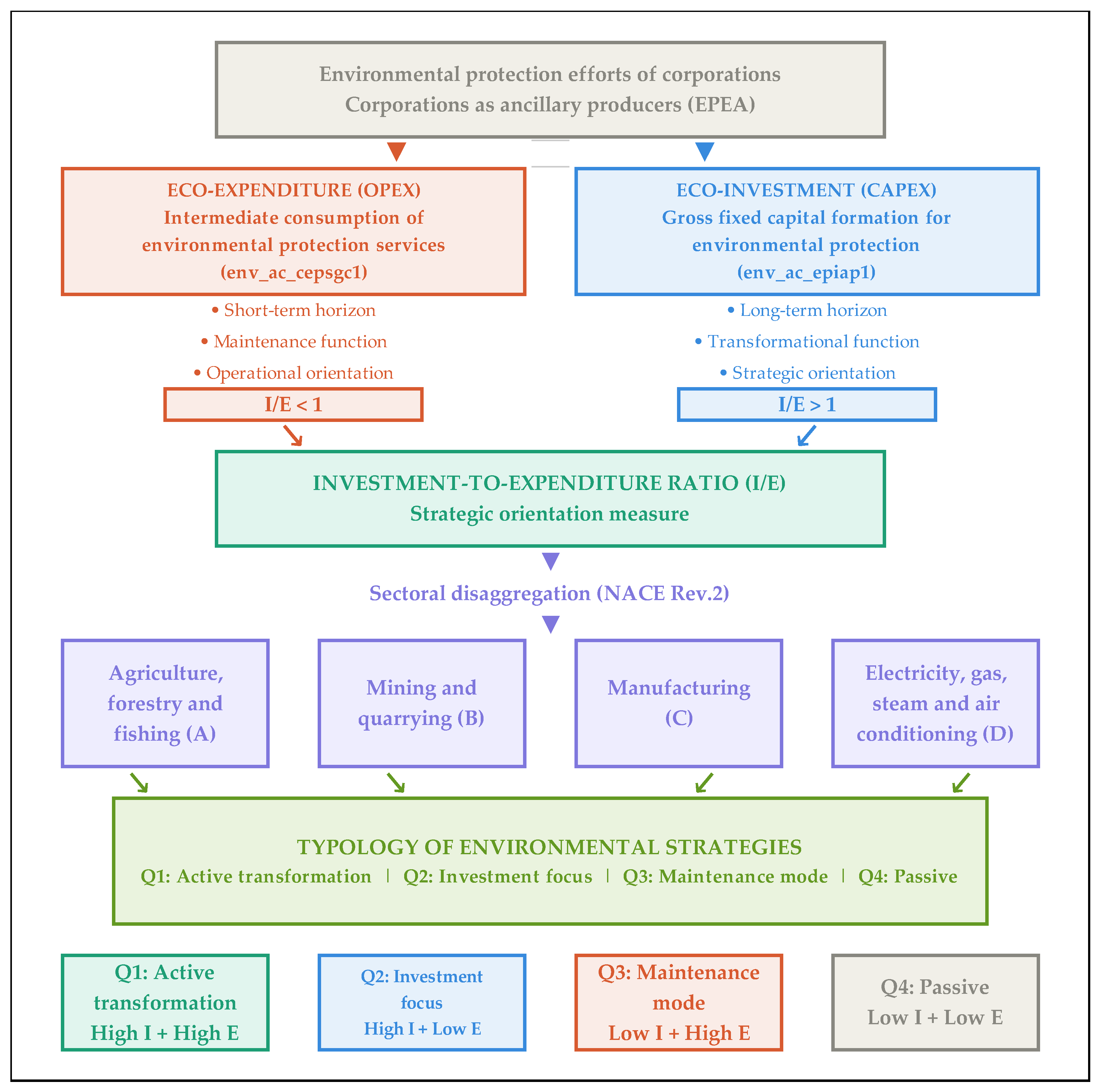
Figure 2.
Typology of environmental strategies: intensity of eco-investment versus intensity of eco-expenditure (% of GVA), mean values for the period 2015-2022.
Figure 2.
Typology of environmental strategies: intensity of eco-investment versus intensity of eco-expenditure (% of GVA), mean values for the period 2015-2022.
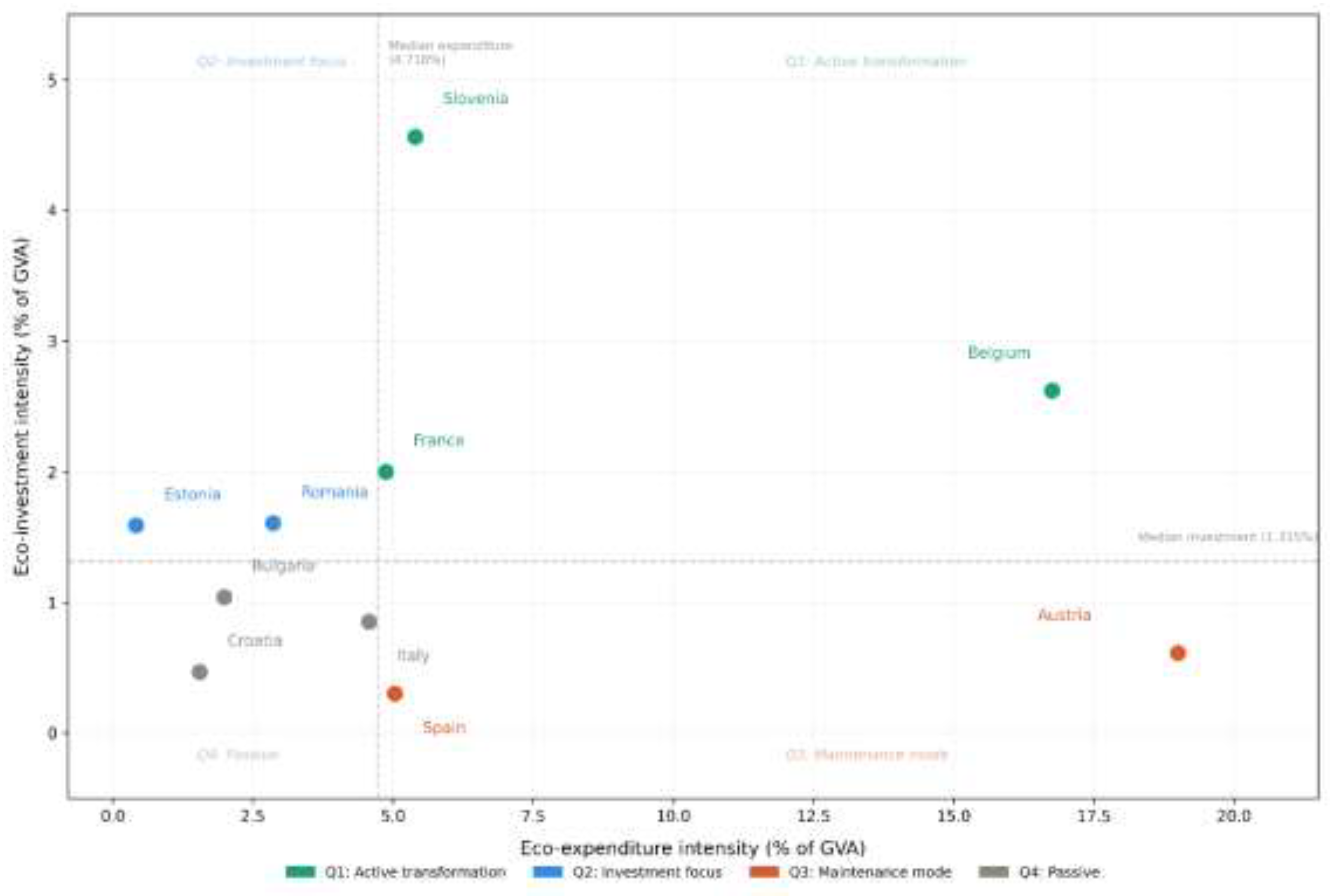

Table 1.
Data sources and key variables.
| Variable | Description | Eurostat Code | Unit |
| Eco-investment | EP investments of corporations as ancillary producers, by NACE activity | env_ac_epiap1 | Million EUR |
| Eco-expenditure | Use of EP services by corporations as ancillary producers, by NACE activity | env_ac_cepsgc1 | Million EUR |
| Environmental taxes | Environmental taxes by NACE Rev.2 economic activity | env_ac_taxind2 | Million EUR |
| Sectoral GVA | Gross value added at basic prices by NACE A*64 activity (B1G) | nama_10_a64 | Million EUR |
| GDP | Gross domestic product at market prices (B1GQ) | nama_10_gdp | Million EUR |
| GDP deflator | Implicit price deflator, derived from nominal GDP and volume index (2015 = 100) | nama_10_gdp | Index |
Table 2.
Descriptive statistics of key variables (real 2015 prices).
| Variable | N | Mean | Std. Dev. | Min | Median | Max |
| Sectoral GVA (Million EUR) | 320 | 25,028.0 | 54,593.8 | 87.7 | 4,073.6 | 277,290.3 |
| Eco-investment (Million EUR) | 320 | 176.4 | 399.8 | 0.0 | 28.6 | 2,605.0 |
| Eco-expenditure (Million EUR) | 320 | 736.4 | 1,571.2 | 0.0 | 44.4 | 6,815.2 |
| Env. taxes (Million EUR) | 320 | 594.9 | 1,104.3 | 2.2 | 142.4 | 6,807.4 |
| Eco-invest (% of GVA) | 320 | 1.57 | 2.73 | 0.00 | 0.57 | 20.27 |
| Eco-expend (% of GVA) | 320 | 5.31 | 14.94 | 0.00 | 0.95 | 129.28 |
| I/E ratio | 292 | 1.90 | 5.49 | 0.00 | 0.58 | 60.00 |
Note: The I/E ratio excludes 28 observations where either eco-investment or eco-expenditure equals zero, yielding N = 292.
Table 3.
National profiles: mean annual eco-investment and eco-expenditure (2015-2022, real 2015 prices, Million EUR).
Table 3.
National profiles: mean annual eco-investment and eco-expenditure (2015-2022, real 2015 prices, Million EUR).
| Country | GDP | Invest. | Expend. | I (% GDP) | E (% GDP) | I/E Ratio | Orientation |
| Estonia | 23,654 | 41.2 | 28.2 | 0.174 | 0.119 | 1.458 | Balanced |
| Slovenia | 43,335 | 176.2 | 202.1 | 0.407 | 0.466 | 0.872 | Balanced |
| Bulgaria | 50,310 | 119.0 | 173.0 | 0.237 | 0.344 | 0.688 | Expend.-oriented |
| Croatia | 50,058 | 38.5 | 56.1 | 0.077 | 0.112 | 0.687 | Expend.-oriented |
| Belgium | 435,949 | 597.6 | 1,231.9 | 0.137 | 0.283 | 0.485 | Expend.-oriented |
| France | 2,279,081 | 3,971.0 | 8,237.5 | 0.174 | 0.361 | 0.482 | Expend.-oriented |
| Romania | 185,881 | 216.7 | 747.8 | 0.117 | 0.402 | 0.290 | Expend.-oriented |
| Italy | 1,702,064 | 914.2 | 7,650.6 | 0.054 | 0.449 | 0.120 | Expend.-oriented |
| Spain | 1,145,607 | 643.3 | 6,839.0 | 0.056 | 0.597 | 0.094 | Expend.-oriented |
| Austria | 361,042 | 339.8 | 4,287.9 | 0.094 | 1.188 | 0.079 | Expend.-oriented |
Note: I/E Ratio = investment-to-expenditure ratio. Orientation: Balanced (I/E > 0.8), Expenditure-oriented (I/E < 0.8).
Table 4.
Temporal dynamics: total eco-investment and eco-expenditure, 2015 and 2022 (real 2015 prices, Million EUR).
Table 4.
Temporal dynamics: total eco-investment and eco-expenditure, 2015 and 2022 (real 2015 prices, Million EUR).
| Country | Inv. 2015 | Inv. 2022 | Δ (%) | Exp. 2015 | Exp. 2022 | Δ (%) |
| Austria | 199.9 | 595.1 | +197.7 | 663.6 | 6,495.8 | +878.9 |
| Spain | 459.1 | 1,157.3 | +152.1 | 5,816.5 | 8,168.0 | +40.4 |
| Slovenia | 127.7 | 196.1 | +53.5 | 134.7 | 315.3 | +134.0 |
| Belgium | 515.7 | 687.3 | +33.3 | 1,106.9 | 1,481.1 | +33.8 |
| France | 3,675.0 | 4,834.1 | +31.5 | 7,371.0 | 9,086.2 | +23.3 |
| Bulgaria | 153.9 | 127.3 | −17.3 | 159.6 | 212.0 | +32.8 |
| Croatia | 50.5 | 23.1 | −54.3 | 56.8 | 52.0 | −8.5 |
| Italy | 1,115.0 | 422.5 | −62.1 | 6,961.7 | 8,847.6 | +27.1 |
| Estonia | 127.3 | 35.6 | −72.0 | 22.8 | 31.5 | +38.0 |
| Romania | 619.7 | 119.4 | −80.7 | 764.1 | 1,058.4 | +38.5 |
Note: Values are the sum across the four NACE sectors. Δ (%) = percentage change from 2015 to 2022.
Table 5.
Sectoral profiles: mean values across all countries (2015-2022, real 2015 prices).
| Sector | GVA (Million EUR) | Invest. (Million EUR) | Expend. (Million EUR) | Invest. (% GVA) | Expend. (% GVA) |
| Agriculture (A) | 11,641.8 | 210.9 | 2,047.5 | 2.34 | 16.75 |
| Mining (B) | 1,290.1 | 15.5 | 15.5 | 1.19 | 1.49 |
| Manufacturing (C) | 77,511.7 | 365.9 | 797.3 | 0.50 | 0.91 |
| Electricity (D) | 9,668.3 | 113.5 | 85.2 | 2.24 | 2.11 |
Table 6.
Eco-investment intensity (% of GVA) by country and sector (mean 2015-2022).
| Country | Agriculture (A) | Mining (B) | Manufacturing (C) | Electricity (D) | Mean |
| Belgium | 9.92 | 0.00 | 0.56 | 0.00 | 2.62 |
| Slovenia | 5.52 | 3.48 | 0.75 | 8.51 | 4.56 |
| France | 4.79 | 0.80 | 0.87 | 1.55 | 2.00 |
| Bulgaria | 1.15 | 0.45 | 1.03 | 1.54 | 1.04 |
| Estonia | 0.47 | 0.23 | 0.27 | 5.38 | 1.59 |
| Romania | 0.41 | 4.41 | 0.16 | 1.45 | 1.61 |
| Croatia | 0.82 | 0.11 | 0.34 | 0.60 | 0.47 |
| Italy | 0.24 | 1.31 | 0.18 | 1.69 | 0.85 |
| Austria | 0.13 | 0.73 | 0.41 | 1.18 | 0.61 |
| Spain | 0.00 | 0.35 | 0.40 | 0.45 | 0.30 |
Note: Values of 0.00 indicate either the absence of the sector or zero reported investment. Countries ranked by mean intensity.
Table 7.
Eco-expenditure intensity (% of GVA) by country and sector (mean 2015-2022).
| Country | Agriculture (A) | Mining (B) | Manufacturing (C) | Electricity (D) | Mean |
| Austria | 71.02 | 1.89 | 1.96 | 1.13 | 19.00 |
| Belgium | 28.65 | 0.56 | 0.67 | 0.10 | 7.49 |
| Spain | 18.82 | 0.25 | 0.80 | 0.24 | 5.03 |
| France | 16.01 | 1.24 | 1.15 | 1.07 | 4.87 |
| Slovenia | 8.72 | 2.26 | 0.74 | 9.86 | 5.39 |
| Bulgaria | 6.73 | 0.18 | 0.55 | 0.48 | 1.98 |
| Italy | 16.21 | 1.12 | 0.95 | 0.00 | 4.57 |
| Romania | 1.09 | 2.87 | 0.82 | 6.66 | 2.86 |
| Croatia | 0.16 | 4.22 | 0.62 | 1.19 | 1.55 |
| Estonia | 0.12 | 0.30 | 0.80 | 0.44 | 0.41 |
Note: Values of 0.00 indicate zero reported expenditure. Countries ranked by mean intensity.
Table 8.
Investment-to-expenditure ratio by country and sector (mean 2015-2022).
| Country | Agriculture (A) | Mining (B) | Manufacturing (C) | Electricity (D) |
| Austria | 0.01 | 0.40 | 0.24 | 17.39 |
| Belgium | 0.35 | n/a | 0.85 | 0.02 |
| Bulgaria | 0.17 | 2.59 | 1.85 | 3.57 |
| Croatia | 5.15 | 0.03 | 0.54 | 0.52 |
| Estonia | 4.32 | 2.65 | 0.38 | 13.80 |
| France | 0.30 | 0.66 | 0.75 | 1.49 |
| Italy | 0.01 | 1.25 | 0.19 | n/a |
| Romania | 0.40 | 1.82 | 0.18 | 0.31 |
| Slovenia | 0.63 | 1.60 | 1.00 | 1.40 |
| Spain | n/a | 1.37 | 0.50 | 2.01 |
Note: n/a = not available (zero values in either numerator or denominator). Values > 1 indicate investment-oriented approach; values < 1 indicate expenditure-oriented approach.
Table 9.
Classification of countries by environmental strategy typology.
| Quadrant | Strategy | Countries |
| Q1 | Active transformation | Slovenia, Belgium, France |
| Q2 | Investment focus | Romania, Estonia |
| Q3 | Maintenance mode | Austria, Spain |
| Q4 | Passive | Bulgaria, Italy, Croatia |
Disclaimer/Publisher’s Note: The statements, opinions and data contained in all publications are solely those of the individual author(s) and contributor(s) and not of MDPI and/or the editor(s). MDPI and/or the editor(s) disclaim responsibility for any injury to people or property resulting from any ideas, methods, instructions or products referred to in the content. |
© 2026 by the authors. Licensee MDPI, Basel, Switzerland. This article is an open access article distributed under the terms and conditions of the Creative Commons Attribution (CC BY) license (http://creativecommons.org/licenses/by/4.0/).
Copyright: This open access article is published under a Creative Commons CC BY 4.0 license, which permit the free download, distribution, and reuse, provided that the author and preprint are cited in any reuse.


