

Submitted:
10 April 2026
Posted:
10 April 2026
You are already at the latest version
Abstract
Dental pain due to dentine hypersensitivity or pulpitis is characterized by short or lasting episodes of pain triggered by normally innocuous stimuli originating from exposed dentine. Both represent the most frequent pain of the orofacial region. Transient receptor potential (TRP) superfamily of ion channels participates in the detection of different modalities of sensibility in the mammalian sensory teeth system, i.e., trigeminal neurons and odontoblasts. In particular, some members of the melastatin family (TRPM) serve as molecular thermal sensors, and temperature is one of the most potent stimuli in triggering dentine hypersensitivity. Here we review and update the information about the distribution of TRPM channels in the trigeminal ganglion and dental pulp cells, especially odontoblast, in humans and animal models. In addition to the well know sensory roles of TRPM, other functions such as in development and mineralization of teeth are considered.
Keywords:
melastatin transient-receptor potential channels
; trigeminal neurons
; odontoblasts
; thermal sensitivity
; dentine hypersensitivity
; pulpitis
1. Introduction
Dentine hypersensitivity is a common odontogenic condition, with a prevalence ranging from 3-98% [1], that is the one of most frequent pain of the orofacial region [2]. It is characterized by short episodes of pain triggered by normally innocuous stimuli, due to exposition of dentine, and therefore dental pulp, that cannot be ascribed to any other teeth damage [3]. The stimuli that can directly or indirectly affect the dental pulp include mechanical, chemical or thermal irritation, dental caries, infiltration of bonding materials, trauma and orthodontic movements [4].
It is well known that dental pain may occur when intense thermal stimuli are applied on the surface of a normal intact tooth: drinking/eating of cold or hot drink/food can induce dental pain [5,6]. As a rule noxious cold induces transient pain while noxious heat causes lasting pain [7,8].
The stimuli initiating dentine hypersensitivity, and toothache, are detected by sensory nerves arising from neurons localized in the trigeminal ganglion (TG) [9] that express different molecules that detect more or less selectively specific stimuli [7,10,11,12]. In this context, attention has been focused on ion channels of different families [7] specially members of transient receptor potential (TRP) family. Within the dental pulp trigeminal nerve fibers innervate the odontoblasts through Aδ myelinated and C unmyelinated nerve fibers (see [9]). The Aδ fibers are principally located at the pulp-dentin border and reach the basal odontoblast layer, while the C fibers enter the dentin tubules [10,11,12,13]. Furthermore, a very small number of Aβ-fibers myelinated enter the dental pulp too [12]. Classically it was assumed that the stimuli initiating dentine hypersensitivity are detected by sensory nerves arising from neurons localized in the trigeminal ganglion (TG) [13]. They express different molecules that detect more or less selectively specific stimuli [7,14,15,16]. In this context, attention has been focused on ion channels of different families [7] specially members of transient receptor potential (TRP) family. In addition, the role of odontoblasts as dentine sensors is now currently accepted since they express ion channels related to different modalities of sensitivity [15,16,17,18,19]. Gating of ion channels present in odontoblasts induces release of ATP which is the transmitter between odontoblasts and nerve fibers thus initiating the transmission of a given sensory modality to the central nervous system [20,21,22].
Currently there are three hypotheses proposed to explain dental pain and dentinal hypersensitivity: The first hypothesis, known as nervous theory, refers to direct stimulation of dental nerves by different stimuli. The second hypothesis is the so-called hydrodynamic theory, and attributes dental pain to fluid movement within dentinal tubules. The third hypothesis involves the odontoblasts as sensory cells and supported by functional expression of ion channels of different families by these pulpal cells. According to Solé-Magdalena et al [7] “These three hypotheses are not mutually exclusive and cannot be considered separately because of the presence of nerves and odontoblast processes within the dentinal tubules, bathing in the dentinal fluid, and the close apposition of the odontoblasts to the dentinal or basal nerves terminals”. Thus, external stimuli inducing dentinal fluid movement stimulate directly the nerves present in in the tubules the nerves, or the odontoblasts which via odontoblast-nerve complexes transmit the stimuli to the nerves.
While different mechanisms have been proposed to explain tooth sensitivity (see for a review [7,15]) the key role of ion channels is now undeniable. In recent decades, members of the transient receptor potential (TRP) superfamily of ion channels have been detected in dental primary afferent neurons and odontoblasts where transduce external stimuli into several signals in the tooth [23]. The detection and transmission of thermal stimuli depend on the activity of various ion channels in the plasma membrane of sensory nerves, including voltage-gated K+ channels, voltage-gated Na+ channels and depolarizing ion channels that open in response to changes in temperature [24]. This latter type of ion channel is often considered as the primary molecular sensor. As such, the actual contribution of temperature-sensitive ion channels to thermosensation is highly dependent on the cellular context, which may explain why some highly thermosensitive ion channels are also found in cell types that are not involved in thermosensory processes. According to García-Ávila and Islas [25] “thermosensation is the ability of organisms to detect and codify both environmental and internal temperature”.
This review focuses on the melastatin family, which mediate different modalities of sensibility but especially thermosensitibity. Some TRPM channels serve as molecular thermal sensors for cold, warm, and noxious heat [26], and temperature changes are potent stimuli in triggering dentine hypersensitivity [1,4,27].
Thermal pulp testing (applying heat or cold onto the tooth surface) is routinely used to test the vitality of the dental pulp of a tooth since it is a localized sharp pain in the tooth being tested.
Odontogenic pain or toothache refers to pain initiating from the teeth or their supporting structures and has multiple etiologies. Most frequently is due to pulpitis, i.e. inflammation of the dental pulp, as a result of dental caries causing enamel erosion and exposure of dentin and pulp chamber. Irritation of the dental pulp by bacterial molecules, mechanical, chemical, thermal or electrical stimuli cause pulpal inflammation, which can be an extremely painful condition and is often associated with intense lingering pain to thermal stimuli [1].
2. The Superfamily of TRP Channels
TRP superfamily consists of 28 integral transmembrane proteins that function as non-selective cation channels; few are highly Ca2+-selective and some are permeable for highly hydrated Mg2+. TRP channels are subdivided into seven subfamilies according to amino acid sequence homology: TRPA (ankyrin), TRPC (canonical), TRPM (melastatin), TRPML (mucolipin), TRPP (polycystin) and TRPV (vanilloid). On the other hand, based on their sequence and topological features, TRP genes are divided into Group 1 (TRPC, TRPV, TRPM, TRPA, and TRPN), and Group 2 (TRPP and TRPML). TRP channels show a variety of gating mechanisms with modes of activation ranging from ligand binding, voltage and changes in temperature to covalent modifications of nucleophilic residues [28,29,30,31].
TRP channels are composed of four subunits resulting in homomeric or heteromeric channels [32]. They share some structural characteristics including a three-dimensional structure with six transmembrane segments (S1 to S6), N- and C-terminal cytoplasmic domains, and a small α-helix loop between S5 and S6 segments that form the channel pore, S4 corresponds to a voltage-sensor-like domain, capable of sensing changes in in intracellular ion concentration [33,34,35,36]. The N- and C-terminal cytoplasmic domains are of variable length and contain residues and regulatory motifs unique for each family [35,37,38]. TRP differs from other voltage-gated channels by the aminoacidic sequence of their subunits, which confers to them differential biophysical characteristics and response to different exogenous and endogenous modulators [35,39].
Furthermore, TRP channels have a ubiquitous expression in tissues that involved in very heterogeneous physiological processes as well as in several pathological conditions.
3. TRP Melastatin (TRPM) Ion Channels: A Summary
The TRPM channel subfamily consists of eight members grouped in four pairs: TRPM1 and TRPM3; TRPM2 and TRPM8; TRPM4 and TRPM5; and TRPM6 and TRPM7 [40,41] (Figure 1). All of them share common structural characteristics with other TRP channels but have a larger cytosolic domain particularly variable and have a unique N-terminal [41,42,43,44].
TRPM activation mechanisms vary greatly among subfamily members. However, more than half of the members are sensitive to a wide range of temperatures, from cold to hot, and exhibit distinct thermal activation thresholds: <17ᵒC for TRPM1, 38ᵒC for TRPM2, >40°C for TRPM3, 15ᵒC to 35ᵒC for TRPM4 and TRPM5, and <20-28°C for TRPM8 [45,46,47,48,49]. Furthermore, some channels in this subfamily also respond to mechanical stimuli [50], redox status, intracellular calcium (with TRPM4 and TRPM5 being the only non-calcium conducting channels [51,52]), or ligands such as menthol [53]. Intense thermal stimulation of the tooth surface may cause vasodilation and changes in pulpal blood flow. A study using dogs found that pulpal blood flow increased slightly and gradually when the tooth surface temperature was raised from 35 to 40 °C, and that it increased sharply when the temperature was raised from 35 to 55 °C. The increase of pulpal blood flow by thermal stimulation can increase the pressure within the pulpal tissue, which can excite mechanoreceptors, including TRP channels, in the pulpal nerves. When intense thermal stimuli are applied on the tooth surface, they can increase the temperature at the dentine–pulp border, which may stimulate the thermosensitive TRP channels on odontoblasts and DPAs. Indeed, a slow increase in temperature to >43 °C on the tooth surface activates intra-pulpal C-fibers in the cat [54]. Another study showed that intra-dental A-δ and C-fibers respond to intense cooling of the tooth surface [4].
Some TRPM ion channels, like TRPM7, have a ubiquitous expression in tissues while some others are more restricted to different tissues and organs. They have been detected in the central and periphery nervous system, including the retina. Outside the nervous system were detected in the prostate, ovary, kidney, intestine, pancreas, heart and blood vessels, melanocytes, pituitary, bone, and adipose tissue [55,56,57].
Interestingly, the expression of TRPA1 and TRPM8 channels was lower than that of TRPV1 in dental primary afferent (DPA) neurons. TRPA1 and TRPM8 were, moreover, co-expressed in some of the TRPV1-positive DPA neurons, suggesting an ambiguity between cold and hot stimuli-induced tooth pain. A recent study suggested that acute heat sensation requires any of functional TRPV1, TRPA1, and TRPM3 ion channels, and only triple knock-out mice showed a lack of acute withdrawal response to noxious heat compared to the intact normal response to cold stimuli, which suggests a redundant mechanism for heat detection. Whether dental sensory systems utilize a similar mechanism is unclear.
The preceding paragraphs intend only a brief presentation of TRPM channels. There are excellent recent reviews regarding TRPM channels under normal and pathological conditions [23,25,50,57,58,59,60,61], including those contained in this special issue of International Journal of Molecular Science, and to them we refer to those interested in the field. The pages that follow relate directly to the distribution and function of TRPM channels in the tooth and in the nervous structures related to it.
4. Distribution of TRPM Ion Channels in Teeth and Trigeminal System
The trigeminal sensory neurons supplying the dental pulp express, at the mRNA or protein levels, some members of the TRPM family of ion channels. Importantly, although each ion channel is associated with the detection of one quality of sensibility, most neurons and sensory cell express more than one channel. Thus, the capacity exhibited by the different functional types of sensory cells, to preferentially detect specific stimuli is the result of a characteristic combinatorial expression of different ions. This is the case for the trigeminal neurons or the odontoblasts [7]. Furthermore, large differences have been found in the expression of those channels among species.
4.1. Trigeminal Ganglion and Pulpal Nerve Fibers
The expression of TRPM channels in the trigeminal ganglion is highly variable (Table 1 and Figure 2).
In mouse, among the 28 TRP channel genes that have been identified in mammals by real-time PCR, 17 have been detected in the mouse trigeminal ganglion at the mRNA level, including all members of the TRPM family with the exception of TRPM1 [62]. Individual TRPM channels were also found in mice. They include TRPM3 [47], and TRPM8 which is present in 5.7% of neurons innervating the dental pulp [63] highly colocalized with TRPV1 and Piezo2 [64].
In the rat trigeminal ganglion about 50% of neurons, mostly of small to medium-sized cell bodies, express TRM3 but only 20% approximately innervate the tooth pulp [66]. TRPM8 is also expressed in small-diameter neurons the percentage of which being 15% and sometimes co-localized with TRPA1 [14,67,68,69,70].
Finally, many TRP channel genes have also been identified in the human trigeminal ganglion, including TRPM2, TRPM3, TRPM7 and TRPM8 [65].
4.2. Odontoblasts and Pulpal Cells
The detection of TRPM channels in odontoblast and other pulpal cells has been largely studied in the human teeth, different animal models and isolated cells (Table 2 and Figure 2).
TRPM3 is expressed in primary cultured mouse odontoblasts [71] as well as TRPM5 was obtained from mouse odontoblasts; it is asymmetrically distributed with distinct localization to regions proximal to and within odontoblast processes [72]. Also, TRPM7 has been detected in most odontoblasts of adult rats, predominantly in the odontoblastic process region [71,72,73,74,75]. Results on TRPM8 are the more contradictory. While TRPM8 was not detected in both acutely isolated rat odontoblasts and in pulpal slice-derived odontoblasts [71,76], another study showed TRPM8 in acutely isolated adult rat odontoblasts cultured from pulpal slices [77].
Regarding humans, TRPM2 was detected in the dental pulp fibroblasts and odontoblasts [78]. In cultured odontoblast-like cells, in native human odontoblasts and dental pulp fibroblasts TRPM8 has been detected [79,80]. TRPM8 channel expression on primary cultured cells derived from human dental pulp cells, mouse odontoblast-lineage cells and acutely isolated rat odontoblasts. In freshly isolated native human odontoblasts expression of TRPM8 but was observed, being significantly lower in the dental pulp than those in the odontoblasts [81]. Nevertheless, using human immortalized dental pulp cells derived toward an odontoblast phenotype in vitro do not detected TRPM8 in odontoblasts [82,83].
Most of those channels, but not all [71,76] were found to be functional in pulpal fibroblasts and odontoblasts they may contribute as cold sensor in tooth since increased intracellular calcium ([Ca(2+)](i)) was observed in response to the agonist or temperature stimuli, and the responses were blocked with specific antagonists [71,77].
4.3. Other Sensibilities
The odontoblasts presumably mediate early stage of sensory processes, playing a key role in tooth mechanical, thermal, and chemical sensing, thus in dental pain [7,11,19]. Although this review was centered in the thermal role of TRPM channels, several members of this family exhibit mechanosensitivity. TRPM3 [71] and TRPM7 [75] mediate osmo- and mechano- sensitivity in odontoblasts. TRPM8 is also involved in hyperosmolar sweet foods dentin hypersensitivity [66]. Importantly, an intriguing relationship exists between thermal and mechanical stimuli in tooth. Thermal stimulation on the tooth surface can induce fluid movement in the dentinal tubules because of thermal expansion or contraction of the fluid. Tooth structures expand or contract because of this thermal gradient, which produces mechanical stresses in these structures. Mechanical deformation of the dentine (including pulpal wall dentine) precedes the temperature changes in the dentine/dentine–enamel junction following thermal stimulation of the surface a tooth [84]. These observations suggest that intense thermal stimulation-induced mechanical deformation of the dentine may exert mechanical stress on the odontoblasts as well as on the pulpal tissues. In turn, the mechanical stresses may directly activate the mechanosensitive TRP channels and other mechanoreceptors present in the odontoblasts and pulpal nerve fibers. Temperature changes in the dentine caused by thermal stimulation of the surface of an intact tooth or a tooth with exposed dentine may also cause expansion/contraction and movement of dentinal tubular fluid, which can activate mechanosensitive TRP channels (along with other mechanoreceptors) on odontoblasts and nerve fibers within/near the dentinal tubules. While the molecular mechanisms underlying dentin hypersensitivity have not been fully elucidated, one promising hypothesis—the hydrodynamic theory—states that external stimuli cause the movement of the dentin tubular fluid to, ultimately, excite nerve fibers in the pulp to initiate pain (see for references [7]). This provides the most plausible explanation for dental cold hypersensitivity of all the hypotheses that have been proposed. although not without controversy. Another example is the pulsating nature of tooth pain often described by chronic pulpitis patients. This phenomenon is presumed to be caused by hydrostatic pressure applied to the edematous tooth pulp in the restricted space within the dentin and enamel. Both the pulsating pain associated with pulpal inflammation and the hydrodynamic theory of dental hypersensitivity require a mechanosensitive receptor as a key molecule.
5. Non-Sensory Functions of TRPM Channels in Teeth
In addition to the abovementioned roles for TRPM channels in tooth sensibility, they also play roles in teeth biology. This is evident because TRPM channels are expressed in odontoblast and other dental pulp cells (including stem cells) which support a wide range of functions. Odontoblasts organize and regulate the synthesis of the mineralized dentin matrix [85,86,87]. So, TRPM7 in odontoblasts play an important role in dentine mineralization by regulating intracellular Mg2+ and alkaline phosphatase activity [75,88].
TRPM4 is expressed in rat dental follicle stem cells and its molecular suppression results in impacted by TRPM4 during dental follicle stem cells differentiation an inhibitory role for TRPM4 on osteogenesis and also provide a potential link between the Ca(2+) signaling pattern and gene expression during stem cell differentiation [89].
On the other hand, TRPM7 is highly expressed in ameloblasts during tooth development. Consistently, TRPM7 kinase-inactive knock-in mutant mice show small enamel volume with opaque, white-colored incisors, suggesting it plays a role in ameloblast function [90].
TRPM7 expression is widespread in human dental pulp especially human dental pulp stem cells and the suppression of TRPM7 inhibited both the proliferation and the migratory capacity of those cells. Furthermore, TRPM7 mRNA expression is elevated during osteogenic differentiation of human dental pulp stem cells. TRPM7-specific shRNA inhibited osteogenic differentiation of human dental pulp stem cells with downregulated mRNA expression of the osteogenic markers. All together these data strongly suggest that TRPM7 was involved in the regulation of human dental pulp stem cells proliferation, migration and osteogenic differentiation and may play a role in the dental pulp repair process [91].
Microarray analyses of varying stages of differentiating ameloblasts showed that Trpm7 is upregulated in secretory ameloblasts as compared to presecretory ameloblasts [92], and in maturation as compared to secretory ameloblasts [93] suggesting that TRPM7 potentially contributes to the enamel matrix mineralization. Furthermore, TRPM7 in odontoblasts may serve as main Mg2+ regulators in odontoblasts regulating apical dentin formation or mineralization [74].
6. TRPM Channels and Dental Pathologies
There is still scarce evidence for the role of TRPMs in dental pathologies. TRPM2 may be interesting in dental pulp pathologies since it is involved including cytokine production, cell death, oxidative stress response and fibrosis [94]. Pulpitis pain might be triggered by the direct activation of cold-responsive thermoreceptors [95]. Nevertheless, there is no evidence for an involvement of in cold-mediated noxious pulpal pain mechanism [96]. In healthy conditions, humans typically perceive temperatures ≥ 43 °C as painful [29]. However, under pathological conditions such as inflammation, sunburn, or tissue injury, the pain threshold is often lowered and the intensity of the heat pain response increases. This can give rise to heat hyperalgesia (an increased pain response to noxious heat), heat allodynia (when moderate temperatures evoke a pain response), and spontaneous burning pain without any obvious stimulus [29]. Therefore, elucidating the cellular and molecular bases of noxious heat sensing is of great importance, not only to understand the basis of a fundamental and conserved biological process essential for survival but also to allow the development of therapies that counteract persistent pain under pathological conditions.
TRPM2 is activated by cellular stress and participates in various cellular functions, including cytokine production, cell motility and cell death [97,98]. This channel is implicated in pathogenic pain [99]. Fibroblasts in the dental pulp are also reported to be involved in pulpitis, and they are responsible for the synthesis of extracellular matrix and the maintenance of the structural integrity of the dental pulp and also reported to produce pro-inflammatory cytokines, including interleukin (IL)-1β, IL-6 and IL-8, in response to bacterial stimulation [100,101]. TRPM2 expression is also increased in the pulpal fibroblasts of teeth with signs of irreversible pulpitis [78], thus suggesting a role of this channel in pulpitis.
TRPM3 is involved in the inflammatory hyperalgesia and consequent heat-associated inflammation [102] is thought to be a heat-sensing system in nociceptive neurons in conjunction with other ionic channels, such as TRPV1 and TRPA1 [103,104]. However, triple-negative mice can still respond to temperature changes, suggesting that other channels and proteins are involved in thermoperception [105] whereas TRPM3 knockout mice exhibit significant attenuation of thermal hyperalgesia under inflammatory conditions [47]. TRPM3 is also involved in mediating the orofacial antinociceptive effects of nifedipine. Using a rodent model of acute and chronic neuropathic (nerve transection) orofacial pain in different orofacial regions it was observed that nifedipine produced significant antinociceptive effects in most of the acute nociceptive behaviors which were attenuated TRPM3 antagonists. Unfortunately, this model was not assessed in acute or chronic teeth pain [106].
TRPM8 participates in the painful hypersensitivity that is a worrying symptom in inflammation and neuropathy. Moreover, functional and anatomical studies also demonstrated a direct role of TRPM8 in inflammation; however, this needs to be further elucidated [107]. A large body of studies has demonstrated that TRPM8 antagonists are effective in reducing thermal and mechanical hyperalgesia, suggesting for this channel an important role in pain perception [108,109,110]. In this study, we demonstrated that both direct antagonism and the excess dose of agonist, led to the inactivation of this channel that is necessary to decrease pain perception in a model of orofacial pain [111]. Several other studies showed apparently controversial results. For example, selective TRPM8 inhibitors were able to reduce allodynia and hyperalgesia, suggesting that this channel significantly contributes to neuropathic pain modulation [110,111]. On the other hand, some other evidence has established the analgesic properties of TRPM8 agonists [112,113]. TRPM8 is involved in neuropathic cold allodynia, in some animal models of nerve injury peripheral and central activation of TRPM8 is followed by analgesia. A variety of inflammatory mediators, including bradykinin and prostaglandin E2, modulate TRPM8 by inhibiting the channel and shifting its activation threshold to colder temperatures, most likely counteracting the analgesic action of TRPM8 [114]. Several studies indicate the contribution of TRPM8 in the pathophysiology of cold allodynia and nociception [109,115,116]. In support of these findings, we have recently shown that novel TRPM8 inhibitors remarkably reduced cold and mechanical allodynia in acute and chronic pain models [108]. These results clearly indicate that TRPM8 inhibition has an analgesic effect; however, other studies showed in some animal models of nerve injury, that peripheral and central activation of TRPM8 is also followed by analgesia [117]. TRPM8 is activated by innocuous cooling (~26−15 °C) as well as by noxious cooling (<15 °C) and by a number of cooling agents, such as menthol and ilicin [118,119].
Probably also TRPM8 participates in controlling noxious cold associated to pulpal diseases since deletion of TRPM8 reduce cold sensitivity in physiological, inflammatory and neuropathic conditions [112,120]. Interestingly, bacterial components can directly activate neurons before bacterial-induced immune response matured. lipopolysaccharide LPS can directly activate TRPM8 present in the sensory neurons [121]. These findings suggest that bacterial products can directly activate sensory nerve fibers before the development of neurogenic inflammation secondary to the immune response to infection [122].
7. Concluding Remarks
TRPM channels are widely distributed in the sensory system of the teeth, both in the neurons of the trigeminal ganglion and in the odontoblasts [15]. Furthermore, the use of pharmacological molecules that interact with TRPM channels both in animal models and humans [38] have provided evidence that modulation of those channels will provide new therapeutic approach in the treatment of some pathologies [50]. However, more research is still needed to assess the therapeutic potential of these channels as targets in the pathologies of the dental pulp.
Author Contributions
All authors contributed equally to the preparation of the review and have read and agreed to the published version of the manuscript.
Funding
This research received no external funding.
Institutional Review Board Statement
Not applicable.
Informed Consent Statement
Not applicable.
Data Availability Statement
Not applicable.
Conflicts of Interest
The authors declare no conflicts of interest.
References
- Splieth, C.H.; Tachou, A. Epidemiology of dentin hypersensitivity. Clin. Oral Investig. 2013, 17, S3–S8. [Google Scholar] [CrossRef] [PubMed]
- Estrela, C.; Guedes, O. A.; Silva, J. A.; Leles, C. R.; Estrela, C. R.; Pécora, J.D. Diagnostic and clinical factors associated with pulpal and periapical pain. Braz. Dent. J. 2011, 22, 306–311. [Google Scholar] [CrossRef] [PubMed]
- Solé-Magdalena, A.; Martínez-Alonso, M.; Coronado, C.A.; Junquera, L.M.; Cobo, J.; Vega, J.A. Molecular basis of dental sensitivity: The odontoblasts are multisensory cells and express multifunctional ion channels. Ann. Anat. 2018, 215, 20–29. [Google Scholar] [CrossRef] [PubMed]
- Tikhonova, S.; Booij, L.; D’Souza, V.; Crosara, K.T.B.; Siqueira, W.L.; Emami, E. Investigating the association between stress, saliva and dental caries: a scoping review. BMC. Oral. Health 2018, 18, 41. [Google Scholar] [CrossRef]
- Cooper, P.R.; Holder, M.J.; Smith, A.J. Inflammation and regeneration in the dentin-pulp complex: A double-edged sword. J. Endod. 2014, 40, S46–S51. [Google Scholar] [CrossRef]
- Jyvasjarvi, E.; Kniffki, K.D. Cold stimulation of teeth: A comparison between the responses of cat intradental A delta and C fibres and human sensation. J. Physiol. 1987, 391, 193–207. [Google Scholar] [CrossRef]
- Henry, M.A.; Hargreaves, K.M. Peripheral mechanisms of odontogenic pain. Dent. Clin. N. Am. 2007, 51, 19–44. [Google Scholar] [CrossRef]
- Ahn, D.K.; Doutova, E.A.; Mcnaughton, K.; Light, A.R.; Narhi, M.; Maixner, W. Functional properties of tooth pulp neurons responding to thermal stimulation. J. Dent. Res. 2012, 91, 401–406. [Google Scholar] [CrossRef]
- Allard, B.; Magloire, H.; Couble, M.L.; Maurin, J.C.; Bleicher, F. Voltage-gated sodium channels confer excitability to human odontoblasts: possible role in tooth pain transmission. J. Biol. Chem. 2006, 281, 29002–29010. [Google Scholar] [CrossRef]
- Carda, C.; Peydro, A. Ultrastructural patterns of human dentinal tubules, odontoblasts processes and nerve fibres. Tissue Cell 2006, 38, 141–150. [Google Scholar] [CrossRef]
- Paik, S.K.; Park, K.P.; Lee, S.K.; Ma, S.K.; Cho, Y.S.; Kim, Y.K.; Rhyu, I.J.; Ahn, D.K.; Yoshida, A.; Bae, Y.C. Light and electron microscopic analysis of the somata and parent axons innervating the rat upper molar and lower incisor pulp. Neuroscience 2009, 162, 1279–1286. [Google Scholar] [CrossRef]
- Fried, K.; Sessle, B.J.; Devor, M. The paradox of pain from tooth pulp: low-threshold “algoneurons”? Pain 2011, 52, 2685–2689. [Google Scholar] [CrossRef]
- Emrick, J.J.; von Buchholtz, L.J.; Ryba, N.J.P. Transcriptomic Classification of Neurons Innervating Teeth. J. Dent. Res. 2020, 99, 1478–1485. [Google Scholar] [CrossRef] [PubMed]
- Abe, J.; Hosokawa, H.; Okazawa, M.; Kandachi, M.; Sawada, Y.; Yamanaka, K.; Matsumura, K.; Kobayashi, S. TRPM8 protein localization in trigeminal ganglion and taste papillae. Brain. Res. 2005, 136, 91–98. [Google Scholar] [CrossRef] [PubMed]
- Lee, K.; Lee, B.M.; Park, C.K.; Kim, Y.H.; Chung, G. Ion Channels Involved in Tooth Pain. Int. J. Mol. Sci. 2019, 20, 2266. [Google Scholar] [CrossRef] [PubMed]
- Giniatullin, R. Ion Channels of Nociception. Int. J. Mol. Sci. 2020, 21, pii, E3553. [Google Scholar] [CrossRef]
- Gibbs, J.L.; Melnyk, J.L.; Basbaum, A.I. Differential TRPV1 and TRPV2 channel expression in dental pulp. J. Dent. Res. 2011, 90, 765–770. [Google Scholar] [CrossRef]
- Solé-Magdalena, A.; Revuelta, E.G.; Menénez-Díaz, I.; Calavia, M.G.; Cobo, T.; García-Suárez, O.; Pérez-Piñera, P.; De Carlos, F.; Cobo, J.; Vega, J.A. Human odontoblasts express transient receptor protein and acid-sensing ion channel mechanosensor proteins. Microsc. Res. Tech. 2011, 74, 457–63. [Google Scholar] [CrossRef]
- Hossain, M.Z.; Bakri, M.M.; Yahya, F.; Ando, H.; Unno, S.; Kitagawa, J. The role of transient receptor potential (Trp) channels in the transduction of dental pain. Int. J. Mol. Sci. 2019, 20, 526. [Google Scholar] [CrossRef]
- Sato, M.; Furuya, T.; Kimura, M.; Kojima, Y.; Tazaki, M.; Sato, T.; Shibukawa, Y. Intercellular odontoblast communication via ATP mediated by pannexin-1 channel and phospholipase C-coupled receptor activation. Front. Physiol. 2015, 6, 326. [Google Scholar] [CrossRef]
- Shibukawa, Y.; Sato, M.; Kimura, M.; Sobhan, U.; Shimada, M.; Nishiyama, A.; Kawaguchi, A.; Soya, M.; Kuroda, H.; Katakura, A.; Ichinohe, T.; Tazaki, M. Odontoblasts as sensory receptors: transient receptor potential channels, pannexin-1, and ionotropic ATP receptors mediate intercellular odontoblast-neuron signal transduction. Pfluger’s. Arch. 2015, 467, 843–863. [Google Scholar] [CrossRef] [PubMed]
- Shiozaki, Y.; Sato, M.; Kimura, M.; Sato, T.; Tazaki, M.; Shibukawa, Y. Ionotropic P2X ATP Receptor Channels Mediate Purinergic Signaling in Mouse Odontoblasts. Front. Physiol. 2017, 8, 3. [Google Scholar] [CrossRef] [PubMed]
- Luo, Y.; Suttle, A.; Zhang, Q.; Wang, P.; Chen, Y. Transient Receptor Potential (TRP) Ion Channels in Orofacial Pain. Mol Neurobiol. 2021, 58, 2836–2850. [Google Scholar] [CrossRef] [PubMed]
- Vriens, J.; Nilius, B.; Voets, T. Peripheral thermosensation in mammals. Nat. Rev. Neurosci. 2014, 15, 573–589. [Google Scholar] [CrossRef]
- García-Ávila, M.; Islas, L.D. What is new about mild temperature sensing? A review of recent findings. Temperature 2019, 6, 132–141. [Google Scholar] [CrossRef]
- Yarmolinsky, D.A.; Peng, Y.; Pogorzala, L.A.; Rutlin, M.; Hoon, M.A.; Zuker, C.S. Coding and plasticity in the mammalian thermosensory system. Neuron 2016, 92, 1079–1092. [Google Scholar] [CrossRef]
- Le Fur-Bonnabesse, A.; Bodéré, C; Hélou, C.; Chevalier, V.; Goulet, J.P. Dental pain induced by an ambient thermal differential: pathophysiological hypothesis. J. Pain Res. 2017, 10, 2845–2851. [Google Scholar] [CrossRef]
- Montell, C. The TRP superfamily of cation channels. Sci. STKE 2005, 272. [Google Scholar] [CrossRef]
- Zheng, J. Molecular mechanism of TRP channels. Compr. Physiol. 2013, 3, 221–242. [Google Scholar] [CrossRef]
- Vangeel, L.; Voets, T. Transient Receptor Potential Channels and Calcium Signaling. Cold Spring Harb. Perspect. Biol. 2019, 11, pii: a035048. [Google Scholar] [CrossRef]
- Cheng, W. TRP ion channels: from distribution to assembly. In Ion channels in health and sickness; Shad, KF, Ed.; InTechOpen: London, 2018. [Google Scholar] [CrossRef]
- Catterall, W.A. From ionic currents to molecular mechanisms: The structure and function of voltage-gated sodium channels. Neuron 2000, 26, 13–25. [Google Scholar] [CrossRef] [PubMed]
- Hofmann, T.; Chubanov, V.; Gudermann, T.; Montell, C. TRPM5 is a voltage-modulated and Ca2+-activated monovalent selective cation channel. Curr. Biol. 2003, 13, 1153–1158. [Google Scholar] [CrossRef] [PubMed]
- Voets, T.; Owsianik, G.; Janssens, A.; Talavera, K.; Nilius, B. TRPM8 voltage sensor mutants reveal a mechanism for integrating thermal and chemical stimuli. Nat. Chem. Biol. 2007, 3, 174–182. [Google Scholar] [CrossRef] [PubMed]
- Hellmich, U.A.; Gaudet, R. Structural biology of TRP channels. Handb. Exp. Pharmacol. 2014, 223, 963–990. [Google Scholar] [CrossRef]
- Nilius, B.; Szallasi, A. Transient receptor potential channels as drug targets: from the science of basic research to the art of medicine. Pharmacol. Rev. 2014, 66, 676–814. [Google Scholar] [CrossRef]
- Gaudet, R. TRP channels entering the structural era. J. Physiol. 2008, 586, 3565–3575. [Google Scholar] [CrossRef]
- Wortley, M.A.; Birrell, M.A.; Belvisi, M.G. Drugs affecting TRP channels. Handb. Exp. Pharmacol. 2017, 237, 213–241. [Google Scholar] [CrossRef]
- Zubcevic, L.; Lee, S.Y. The role of π-helices in TRP channel gating. Curr. Opin. Struct. Biol. 2019, 58, 314–323. [Google Scholar] [CrossRef]
- Fleig, A.; Penner, R. The TRPM ion channel subfamily: molecular, biophysical and functional features. Trends. Pharmacol. Sci. 2004, 25, 633–639. [Google Scholar] [CrossRef]
- Fujiwara, Y.; Minor, D.L. X-ray Crystal structure of a TRPM assembly domain reveals an antiparallel four-stranded coiled-coil. J. Mol. Biol. 2008, 383, 854–870. [Google Scholar] [CrossRef]
- Huang, Y.; Fliegert, R.; Guse, A.H.; Lü, W.; Du, J. A structural overview of the ion channels of the TRPM family. Cell Calcium 2020, 85, 102–111. [Google Scholar] [CrossRef] [PubMed]
- Samanta, A.; Hughes, T.E.T.; Moiseenkova-Bell, V.Y. Transient receptor potential (TRP) channels. Subcell. Biochem. 2018, 87, 141–165. [Google Scholar] [CrossRef]
- Zouharova, M.; Herman, P.; Hofbauerová, K.; Vondrasek, J.; Bousova, K. TRPM6 N-terminal CaM- and S100A1-binding domains. Int. J. Mol. Sci. 2019, 20, 4430. [Google Scholar] [CrossRef] [PubMed]
- Talavera, K.; Yasumatsu, K.; Voets, T.; Droogmans, G.; Shigemura, N.; Ninomiya, Y.; Margolskee, R.F.; Nilius, B. Heat activation of TRPM5 underlies thermal sensitivity of sweet taste. Nature 2005, 438, 1022–1025. [Google Scholar] [CrossRef] [PubMed]
- Yao, J.; Liu, B.; Qin, F. Modular thermal sensors in temperature-gated transient receptor potential (TRP) channels. Proc. Natl. Acad. Sci. U.S.A. 2011, 108, 11109–11114. [Google Scholar] [CrossRef]
- Vriens, J.; Owsianik, G.; Hofmann, T.; Philipp, S.E.; Stab, J.; Chen, X.; Benoit, M.; Xue, F.; Janssens, A.; Kerselaers, S.; Oberwinkler, J.; Vennekens, R.; Gudermann, T.; Nilius, B.; Voets, T. Trpm3 is a nociceptor channel involved in the detection of noxious heat. Neuron 2011, 70, 482–494. [Google Scholar] [CrossRef]
- Mccoy, D.D.; Knowlton, W.M.; Mckemy, D.D. Scraping through the ice: Uncovering the role of TRPM8 in cold transduction. Am. J. Physiol. Regul. Integr. Comp. Physiol. 2011, 300, 1278–1287. [Google Scholar] [CrossRef]
- Andersen, H.H.; Olsen, R.V.; Møller, H.G.; Eskelund, P.W.; Gazerani, P.; Arendt-Nielsen, L. A review of topical high-concentration L-menthol as a translational model of cold allodynia and hyperalgesia. Eur. J. Pain. 2014, 18, 315–325. [Google Scholar] [CrossRef]
- Jimenez, I.; Prado, Y.; Marchant, F.; Otero, C.; Eltit, F.; Cabello-Verrugio, C.; Cerda, O.; Simon, F. TRPM Channels in Human Diseases. Cells 2020, 9, pii: E2604. [Google Scholar] [CrossRef]
- Launay, P.; Fleig, A.; Perraud, A.L.; Scharenberg, A.M.; Penner, R.; Kinet, J.P. TRPM4 is a Ca2+-activated nonselective cation channel mediating cell membrane depolarization. Cell 2002, 109, 397–407. [Google Scholar] [CrossRef]
- Ullrich, N.D.; Voets, T.; Prenen, J.; Vennekens, R.; Talavera, K.; Droogmans, G.; Nilius, B. Comparison of functional properties of the Ca2+-activated cation channels TRPM4 and TRPM5 from mice. Cell Calcium 2005, 37, 267–278. [Google Scholar] [CrossRef]
- Oancea, E.; Wicks, N.L.; Gene, M. TRPM7, the Mg²⁺ inhibited channel and kinase. In Advances in Experimental Medicine and Biology; Islam, M., Ed.; Springer: Dordrecht, The Netherlands, 2011. [Google Scholar] [CrossRef]
- Narhi, M.; Jyvasjarvi, E.; Virtanen, A.; Huopaniemi, T.; Ngassapa, D.; Hirvonen, T. Role of intradental A- and C-type nerve fibres in dental pain mechanisms. Proc. Finn. Dent. Soc. 1992, 88, 507–516. [Google Scholar] [PubMed]
- Fonfria, E.; Murdock, P.R.; Cusdin, F.S.; Benham, C.D.; Kelsell, R.E.; McNulty, S. Tissue distribution profiles of the human TRPM cation channel family. J. Recept. Signal Transduct. 2006, 26, 159–178. [Google Scholar] [CrossRef] [PubMed]
- Bernardini, M.; Fiorio Pla, A.; Prevarskaya, N.; Gkika, D. Human transient receptor potential (TRP) channels expression profiling in carcinogenesis. Int. J. Dev. Biol. 2015, 59, 399–406. [Google Scholar] [CrossRef] [PubMed]
- Mickle, A. D.; Shepherd, A. J.; Mohapatra, D. P. Sensory TRP channels: the key transducers of nociception and pain. Prog. Mol. Biol. Transl. Sci. 2015, 131, 73–118. [Google Scholar] [CrossRef]
- Tominaga, M. The role of TRP channels in thermosensation. In TRP Ion Channel Function in Sensory Transduction and Cellular Signaling Cascades; Liedtke, W.B., Heller, S., Eds.; CRC Press/Taylor & Francis: Boca Raton, FL, USA, 2007; p. Chapter 20. Available online: https://www.ncbi.nlm.nih.gov/books/NBK5244/.
- Zholos, A. Pharmacology of transient receptor potential melastatin channels in the vasculature. Br. J. Pharmacol. 2010, 159, 1559–1571. [Google Scholar] [CrossRef]
- Zhang, X. Molecular sensors and modulators of thermoreception. Channels (Austin). 2015, 9, 73–81. [Google Scholar] [CrossRef]
- Luo, Y.; Suttle, A.; Zhang, Q.; Wang, P.; Chen, Y. Transient Receptor Potential (TRP) Ion Channels in Orofacial Pain. Mol. Neurobiol. 2021, 58, 2836–2850. [Google Scholar] [CrossRef]
- Vandewauw, I.; Owsianik, G.; Voets, T. Systematic and quantitative mRNA expression analysis of trp channel genes at the single trigeminal and dorsal root ganglion level in mouse. Bmc. Neurosci. 2013, 14, 1. [Google Scholar] [CrossRef]
- Michot, B.; Lee, C.S.; Gibbs, J.L. TRPM8 and TRPA1 do not contribute to dental pulp sensitivity to cold. Sci. Rep. 2018, 8, 13198. [Google Scholar] [CrossRef]
- Lee, P.R.; Lee, J.Y.; Kim, H.B.; Lee, J.H.; Oh, S.B. TRPM8 Mediates Hyperosmotic Stimuli-Induced Nociception in Dental Afferents. J. Dent. Res. 2020, 99, 107–114. [Google Scholar] [CrossRef]
- Flegel, C.; Schobel, N.; Altmuller, J.; Becker, C.; Tannapfel, A.; Hatt, H.; Gisselmann, G. RNA-Seq Analysis of Human Trigeminal and Dorsal Root Ganglia with a Focus on Chemoreceptors. PLoS ONE 2015, 10, e0128951. [Google Scholar] [CrossRef]
- Yajima, T.; Sato, T.; Shimazaki, K.; Ichikawa, H. Transient receptor potential melastatin-3 in the rat sensory ganglia of the trigeminal, glossopharyngeal and vagus nerves. J Chem. Neuroanat. 2019, 96, 116–125. [Google Scholar] [CrossRef] [PubMed]
- Thut, P.D.; Wrigley, D.; Gold, M.S. Cold transduction in rat trigeminal ganglia neurons in vitro. Neuroscience 2003, 119, 1071–1083. [Google Scholar] [CrossRef] [PubMed]
- Kobayashi, K.; Fukuoka, T.; Obata, K.; Yamanaka, H.; Dai, Y.; Tokunaga, A.; Noguchi, K. Distinct expression of TRPM8, TRPA1, and TRPV1 mRNAs in rat primary afferent neurons with adelta/c-fibers and colocalization with trk receptors. J. Comp. Neurol. 2005, 493, 596–606. [Google Scholar] [CrossRef] [PubMed]
- Park, C.K.; Kim, M.S.; Fang, Z.; Li, H.Y.; Jung, S.J.; Choi, S.Y.; Lee, S.J.; Park, K.; Kim, J.S.; Oh, S.B. Functional expression of thermo-transient receptor potential channels in dental primary afferent neurons: Implication for tooth pain. J. Biol. Chem. 2006, 281, 17304–17311. [Google Scholar] [CrossRef]
- Kim, H.Y.; Chung, G.; Jo, H.J.; Kim, Y.S.; Bae, Y.C.; Jung, S.J.; Kim, J.S.; Oh, S.B. Characterization of dental nociceptive neurons. J. Dent. Res. 2011, 90, 771–776. [Google Scholar] [CrossRef]
- Son, A.R.; Yang, Y.M.; Hong, J.H.; Lee, S.I.; Shibukawa, Y.; Shin, D.M. Odontoblast trp channels and thermo/mechanical transmission. J. Dent. Res. 2009, 88, 1014–1019. [Google Scholar] [CrossRef]
- Khatibi Shahidi, M.; Krivanek, J.; Kaukua, N.; Ernfors, P.; Hladik, L.; Kostal, V.; Masich, S.; Hampl, A.; Chubanov, V.; Gudermann, T.; Romanov, R.A.; Harkany, T.; Adameyko, I.; Fried, K. Three-dimensional Imaging Reveals New Compartments and Structural Adaptations in Odontoblasts. J. Dent. Res. 2015, 94, 945–54. [Google Scholar] [CrossRef]
- Kwon, M.; Baek, S.H.; Park, C.K.; Chung, G.; Oh, S.B. Single-cell RT-PCR and immunocytochemical detection of mechanosensitive transient receptor potential channels in acutely isolated rat odontoblasts. Arch. Oral. Biol. 2014, 59, 1266–1271. [Google Scholar] [CrossRef]
- Won, J.; Kim, J.H.; Oh, S.B. Molecular expression of Mg2+ regulator TRPM7 and CNNM4 in rat odontoblasts. Arch. Oral. Biol. 2018, 96, 182–188. [Google Scholar] [CrossRef] [PubMed]
- Won, J.; Vang, H.; Kim, J.H.; Lee, P.R.; Kang, Y.; Oh, S.B. Trpm7 mediates mechanosensitivity in adult rat odontoblasts. J. Dent. Res. 2018, 97, 1039–1046. [Google Scholar] [CrossRef] [PubMed]
- Yeon, K.Y.; Chung, G.; Shin, M.S.; Jung, S.J.; Kim, J.S.; Oh, S.B. Adult rat odontoblasts lack noxious thermal sensitivity. J. Dent. Res. 2009, 88, 328–332. [Google Scholar] [CrossRef] [PubMed]
- Tsumura, M.; Sobhan, U.; Sato, M.; Shimada, M.; Nishiyama, A.; Kawaguchi, A.; Soya, M.; Kuroda, H.; Tazaki, M.; Shibukawa, Y. Functional expression of Trpm8 and Trpa1 channels in rat odontoblasts. PLoS ONE 2013, 8, 82233. [Google Scholar] [CrossRef]
- Rowland, K.C.; Kanive, C.B.; Wells, J.E.; Hatton, J.F. TRPM2 immunoreactivity is increased in fibroblasts, but not nerves, of symptomatic human dental pulp. J. Endod. 2007, 33, 245–8. [Google Scholar] [CrossRef]
- El Karim, I.A.; Linden, G.J.; Curtis, T.M.; About, I.; Mcgahon, M.K.; Irwin, C.R.; Lundy, F.T. Human odontoblasts express functional thermo-sensitive trp channels: Implications for dentin sensitivity. Pain 2011, 152, 2211–2223. [Google Scholar] [CrossRef]
- El Karim, I.A.; Linden, G.J.; Curtis, T.M.; About, I.; McGahon, M.K.; Irwin, C.R.; Killough, S.A.; Lundy, F.T. Human dental pulp fibroblasts express the "cold-sensing" transient receptor potential channels TRPA1 and TRPM8. J. Endod. 2011, 37, 473–8. [Google Scholar] [CrossRef]
- Tokuda, M.; Tatsuyama, S.; Fujisawa, M.; Morimoto-Yamashita, Y.; Kawakami, Y.; Shibukawa, Y.; Torii, M. Dentin and pulp sense cold stimulus. Med. Hypotheses. 2015, 84, 442–4. [Google Scholar] [CrossRef]
- Tazawa, K.; Ikeda, H.; Kawashima, N.; Okiji, T. Transient receptor potential melastatin (TRPM) 8 is expressed in freshly isolated native human odontoblasts. Arch. Oral. Biol. 2017, 0, 55–61. [Google Scholar] [CrossRef]
- Egbuniwe, O.; Grover, S.; Duggal, A.K.; Mavroudis, A.; Yazdi, M.; Renton, T.; Di Silvio, L.; Grant, A.D. TRPA1 and TRPV4 activation in human odontoblasts stimulates ATP release. J. Dent. Res. 2014, 93, 911–917. [Google Scholar] [CrossRef]
- Linsuwanont, P.; Palamara, J.E.; Messer, H.H. An investigation of thermal stimulation in intact teeth. Arch. Oral Biol. 2007, 52, 218–227. [Google Scholar] [CrossRef]
- Arana-Chavez, V.E.; Massa, L.F. Odontoblasts: the cells forming and maintaining dentine. Int. J. Biochem. Cell. Biol. 2004, 36, 1367–1373. [Google Scholar] [CrossRef] [PubMed]
- Bleicher, F. Odontoblast physiology. Exp. Cell. Res. 2014, 325, 65–71. [Google Scholar] [CrossRef] [PubMed]
- Kawashima, N.; Okiji, T. Odontoblasts: Specialized hard-tissue-forming cells in the dentin-pulp complex. Congenit. Anom (Kyoto) 2016, 56, 144–153. [Google Scholar] [CrossRef] [PubMed]
- Nakano, Y.; Le, M.H.; Abduweli, D.; Ho, S.P.; Ryazanova, L.V.; Hu, Z.; Ryazanov, A.G.; Den Besten, P.K.; Zhang, Y. A Critical Role of TRPM7 As an Ion Channel Protein in Mediating the Mineralization of the Craniofacial Hard Tissues. Front. Physiol. 2016, 7, 258. [Google Scholar] [CrossRef]
- Nelson, P.; Ngoc Tran, T.D.; Zhang, H.; Zolochevska, O.; Figueiredo, M.; Feng, J.M.; Gutierrez, D.L.; Xiao, R.; Yao, S.; Penn, A.; Yang, L.J.; Cheng, H. Transient receptor potential melastatin 4 channel controls calcium signals and dental follicle stem cell differentiation. Stem Cells 2013, 31, 167–77. [Google Scholar] [CrossRef]
- Ogata, K.; Tsumuraya, T.; Oka, K.; Shin, M.; Okamoto, F.; Kajiya, H.; Katagiri, C.; Ozaki, M.; Matsushita, M.; Okabe, K. The crucial role of the TRPM7 kinase domain in the early stage of amelogenesis. Sci. Rep. 2017, 22, 18099. [Google Scholar] [CrossRef]
- Cui, L.; Xu, S.M.; Ma, D.D.; Wu, B.L. The effect of TRPM7 suppression on the proliferation, migration and osteogenic differentiation of human dental pulp stem cells. Int. Endod. J. 2014, 47, 583–593. [Google Scholar] [CrossRef]
- Liu, C.; Niu, Y.; Zhou, X.; Xu, X.; Yang, Y.; Zhang, Y.; Zheng, L. Cell cycle control, DNA damage repair, and apoptosis-related pathways control pre-ameloblasts differentiation during tooth development. BMC Genomics 2015, 16, 592. [Google Scholar] [CrossRef]
- Zhang, Y.; Kim, J.Y.; Horst, O.; Nakano, Y.; Zhu, L.; Radlanski, R.J.; Sunita, H.; Den Besten, P.K. Fluorosed mouse ameloblasts have increased satb1 retention and galphaq activity. PLoS ONE 2014, 9, e103994. [Google Scholar] [CrossRef]
- Zhang, W.; Hirschler-Laszkiewicz, I.; Tong, Q.; Conrad, K.; Sun, S.C.; Penn, L.; Barber, D.L.; Stahl, R.; Carey, D.J.; Cheung, J.Y.; Miller, B.A. TRPM2 is an ion channel that modulates hematopoietic cell death through activation of caspases and PARP cleavage. Am. J. Physiol. Cell. Physiol. 2006, 290, 1146–1159. [Google Scholar] [CrossRef] [PubMed]
- Behrendt, M. Transient receptor potential channels in the context of nociception and pain - recent insights into TRPM3 properties and function. Biol. Chem. 2019, 400, 917–926. [Google Scholar] [CrossRef]
- Alvarado, L.T.; Perry, G.M.; Hargreaves, K.M.; Henry, M.A. TRPM8 Axonal expression is decreased in painful human teeth with irreversible pulpitis and cold hyperalgesia. J. Endod. 2007, 33, 1167–71. [Google Scholar] [CrossRef]
- Sumoza-Toledo, A.; Penner, R. TRPM2: A multifunctional ion channel for calcium signalling. J. Physiol. 2011, 589, 1515–1525. [Google Scholar] [CrossRef] [PubMed]
- Aarts, M.M.; Tymianski, M. TRPMs and neuronal cell death. Pflug. Arch. 2005, 451, 243–249. [Google Scholar] [CrossRef] [PubMed]
- Jang, Y.; Cho, P.S.; Yang, Y.D.; Hwang, S.W. Nociceptive Roles of TRPM2 Ion Channel in Pathologic Pain. Mol. Neurobiol. 2018, 55, 6589–6600. [Google Scholar] [CrossRef]
- Yang, L.C.; Huang, F.M.; Lin, C.S.; Liu, C.M.; Lai, C.C.; Chang, Y.C. Induction of interleukin-8 gene expression by black-pigmented Bacteroides in human pulp fibroblasts and osteoblasts. Int. Endod. J. 2003, 36, 774–779. [Google Scholar] [CrossRef]
- Coil, J.; Tam, E.; Waterfield, J.D. Proinflammatory cytokine profiles in pulp fibroblasts stimulated with lipopolysaccharide and methyl mercaptan. J. Endod. 2004, 30, 88–91. [Google Scholar] [CrossRef]
- Held, K.; Voets, T.; Vriens, J. TRPM3 in temperature sensing and beyond. Temperature 2015, 2, 201–213. [Google Scholar] [CrossRef]
- Vriens, J.; Voets, T. Heat sensing involves a TRiPlet of ion channels. Br. J. Pharm. 2019, 176, 3893–3898. [Google Scholar] [CrossRef]
- Vandewauw, I.; De Clercq, K.; Mulier, M.; Held, K.; Pinto, S.; Van Ranst, N.; Segal, A.; Voet, T.; Vennekens, R.; Zimmermann, K.; Vriens, J.; Voets, T. A trp channel trio mediates acute noxious heat sensing. Nature 2018, 555, 662–666. [Google Scholar] [CrossRef] [PubMed]
- Paricio-Montesinos, R.; Schwaller, F.; Udhayachandran, A.; Rau, F.; Walcher, J.; Evangelista, R.; Vriens, J.; Voets, T.; Poulet, J.F.A.; Lewin, G.R. The sensory coding of warm perception. Neuron 2020, 106, 830–841. [Google Scholar] [CrossRef] [PubMed]
- de Oliveira, B.A.; Alves Rodrigues Santos, S.A.; Menezes Pereira, E.W.; Nogueira, A.B.; Vieira Neto, A.E.; de Melo, J.M.A., Jr.; Damasceno, M.B.M.V.; Quintans-Júnior, L.J.; Sessle, B.J.; Magalhães, F.E.A.; Campos, A.R. Orofacial Antinociceptive Effect of Nifedipine in Rodents Is Mediated by TRPM3, TRPA1, and NMDA Processes. J. Oral Facial Pain Headache 2020, 34, 74–186. [Google Scholar] [CrossRef] [PubMed]
- Dhaka, A.; Earley, T.J.; Watson, J.; Patapoutian, A. Visualizing cold spots: TRPM8-expressing sensory neurons and their projections. J. Neurosci. 2008, 28, 566–575. [Google Scholar] [CrossRef]
- de Caro, C.; Russo, R.; Avagliano, C; Cristiano, C.; Calignano, A.; Aramin, i A.; Bianchin, i G.; Allegretti, M.; Brandolini, L. Antinociceptive effect of two novel transient receptor potential melastatin 8 antagonists in acute and chronic pain models in rat. Br. J. Pharmacol. 2018, 175, 1691–1706. [Google Scholar] [CrossRef]
- Knowlton, W.M.; Bifolck-Fisher, A.; Bautista, D.M.; McKemy, D.D. TRPM8, but not TRPA1, is required for neural and behavioral responses to acute noxious cold temperatures and cold-mimetics in vivo. Pain 2010, 150, 340–350. [Google Scholar] [CrossRef]
- Knowlton, W.M.; Daniels, R.L.; Palkar, R.; McCoy, D.D.; McKemy, D.D. Pharmacological blockade of TRPM8 ion channels alters cold and cold pain responses in mice. PLoS ONE 2011, 6, e25894. [Google Scholar] [CrossRef]
- de Caro, C.; Cristiano, C.; Avagliano, C.; Bertamino, A.; Ostacolo, C.; Campiglia, P.; Gomez-Monterrey, I.; La Rana, G.; Gualillo, O; Calignano, A; Russo, R. Characterization of New TRPM8 Modulators in Pain Perception. Int. J. Mol. Sci. 2019, 20, pii: E5544. [Google Scholar] [CrossRef]
- Liu, B.; Fan, L.; Balakrishna, S.; Sui, A.; Morris, J.B.; Jordt, S.E. TRPM8 is the principal mediator of menthol-induced analgesia of acute and inflammatory pain. Pain 2013, 154, 2169–2177. [Google Scholar] [CrossRef]
- Patel, R.; Gonçalves, L.; Newman, R.; Jiang, F.L.; Goldby, A.; Reeve, J.; Hendrick, A.; Teall, M.; Hannah, D.; Almond, S.; Brice, N.; Dickenson, A.H. Novel TRPM8 antagonist attenuates cold hypersensitivity after peripheral nerve injury in rats. J. Pharmacol. Exp. Ther. 2014, 349, 47–55. [Google Scholar] [CrossRef]
- Babes, A.; Ciobanu, A.C.; Neacsu, C.; Babes, R.M. TRPM8, a sensor for mild cooling in mammalian sensory nerve endings. Curr Pharm Biotechnol. 2011, 12, 78–88. [Google Scholar] [CrossRef] [PubMed]
- Colburn, R.W.; Lubin, M.L.; Stone, D.J., Jr.; Wang, Y.; Lawrence, D.; D’Andrea, M.R.; Brandt, M.R.; Liu, Y.; Flores, C.M.; Qin, N. Attenuated cold sensitivity in TRPM8 null mice. Neuron 2007, 54, 379–386. [Google Scholar] [CrossRef] [PubMed]
- Caspani, O.; Zurborg, S.; Labuz, D.; Heppenstall, P.A. The contribution of TRPM8 and TRPA1 channels to cold allodynia and neuropathic pain. PLoS ONE 2009, 4, e7383. [Google Scholar] [CrossRef]
- Proudfoot, C.J.; Garry, E.M.; Cottrell, D.F.; Rosie, R.; Anderson, H.; Robertson, D.C.; Fleetwood-Walker, S.M.; Mitchell, R. Analgesia mediated by the TRPM8 cold receptor in chronic neuropathic pain. Curr. Biol. 2006, 16, 1591–1605. [Google Scholar] [CrossRef] [PubMed]
- McKemy, D.D.; Neuhausser, W.M.; Julius, D. Identification of a cold receptor reveals a general role for TRP channels in thermosensation. Nature 2002, 416, 52–58. [Google Scholar] [CrossRef]
- Peier, A.M.; Moqrich, A.; Hergarden, A.C.; Reeve, A.J.; Andersson, D.A.; Story, G.M.; Earley, T.J.; Dragoni, I.; McIntyre, P.; Bevan, S.; Patapoutian, A. A TRP channel that senses cold stimuli and menthol. Cell 2002, 108, 705–715. [Google Scholar] [CrossRef]
- Knowlton, W.M.; Palkar, R.; Lippoldt, E.K.; McCoy, D.D.; Baluch, F.; Chen, J.; McKemy, D.D. A sensory-labeled line for cold: TRPM8-expressing sensory neurons define the cellular basis for cold, cold pain, and cooling-mediated analgesia. J. Neurosci. 2013, 33, 2837–2848. [Google Scholar] [CrossRef]
- Boonen, B.; Alpizar, Y.A.; Sanchez, A.; Lopez-Requena, A.; Voets, T.; Talavera, K. Differential effects of lipopolysaccharide on mouse sensory TRP channels. Cell Calcium 2018, 73, 72–81. [Google Scholar] [CrossRef]
- Boonen, B.; Alpizar, Y.A.; Meseguer, V.M.; Talavera, K. TRP Channels as Sensors of Bacterial Endotoxins. Toxins 2018, 10, 326. [Google Scholar] [CrossRef]
Figure 1.
Channel structure of the transient receptor potential melastatin (TRPM) subfamily. The channel domain contains six transmembrane segments (1–6), 1–4 corresponding to a voltage-sensor-like domain; the pore is formed by the loop between the 5 and 6 segments. The N-terminus is composed of four melastatin homology regions and the C-terminus is composed of TRP and the coiled-coil. Based on the homology sequence of the coiled-coil in the C-terminus, the TRPM subfamily is divided into four groups: TRPM1/TRPM3 (red box), TRPM2/TRPM8 (yellow box), TRPM4/TRPM5 (blue box) and TRPM6/TRPM7 (green box).
Figure 1.
Channel structure of the transient receptor potential melastatin (TRPM) subfamily. The channel domain contains six transmembrane segments (1–6), 1–4 corresponding to a voltage-sensor-like domain; the pore is formed by the loop between the 5 and 6 segments. The N-terminus is composed of four melastatin homology regions and the C-terminus is composed of TRP and the coiled-coil. Based on the homology sequence of the coiled-coil in the C-terminus, the TRPM subfamily is divided into four groups: TRPM1/TRPM3 (red box), TRPM2/TRPM8 (yellow box), TRPM4/TRPM5 (blue box) and TRPM6/TRPM7 (green box).
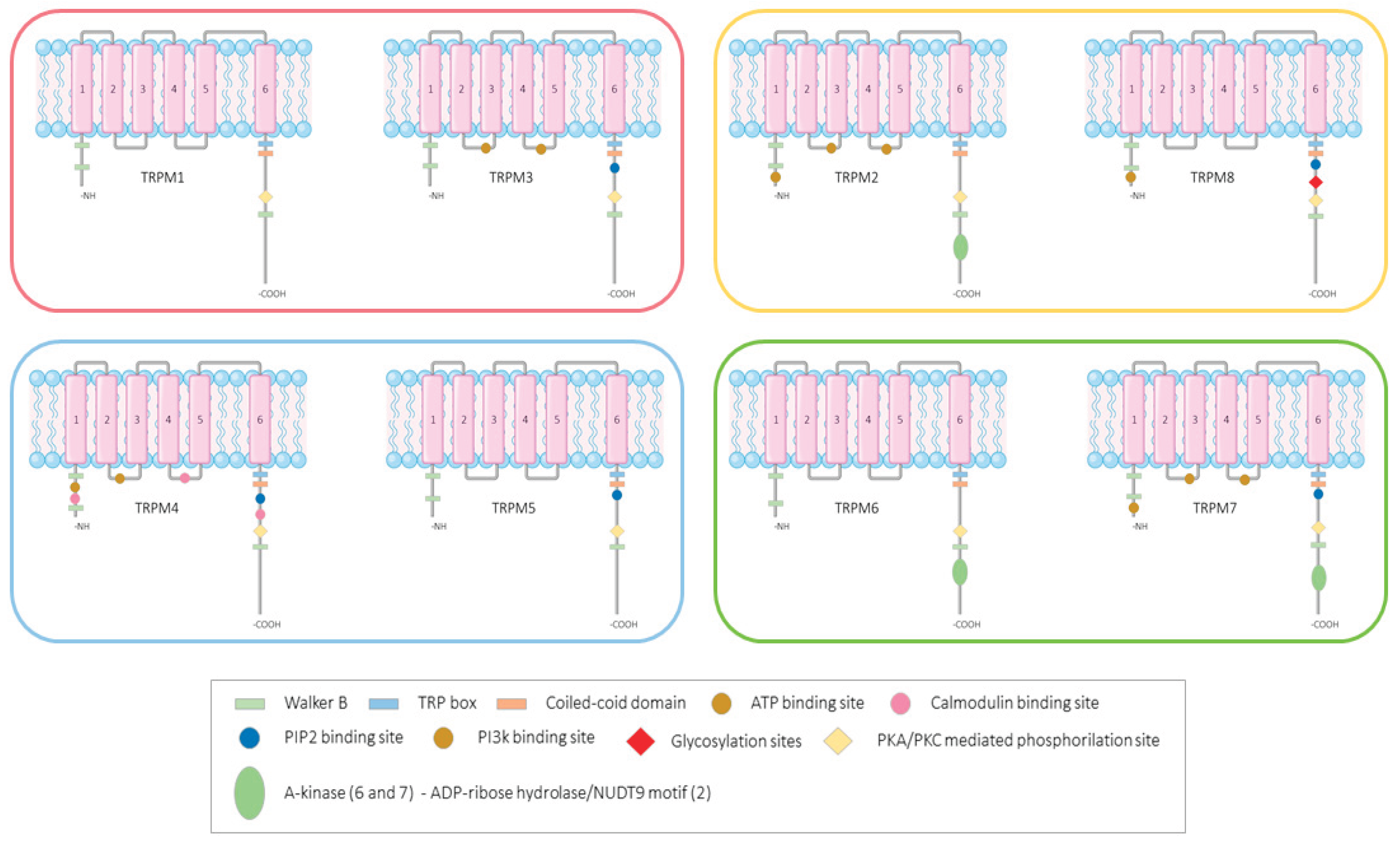
Figure 2.
Schematic representation of tooth innervation and expression of TRPM ion channels in the trigeminal ganglion (TG) neurons, odontoblasts and fibroblasts of the tooth pulp. The channels indicated in red have been detected in humans. O: odontoblasts, pc: pulpal fibroblasts, dn: dentinal nerves, pn: pulpal nerves, pbv: pulpal blood vessels. The photographs on the right correspond to sections of human teeth showing the expression of TRPM3 and TRPM8 in the odontoblasts; M3 was also detected in nerve profiles of the dental pulp. d: dentin, o: odontoblats, p: dental pulp.
Figure 2.
Schematic representation of tooth innervation and expression of TRPM ion channels in the trigeminal ganglion (TG) neurons, odontoblasts and fibroblasts of the tooth pulp. The channels indicated in red have been detected in humans. O: odontoblasts, pc: pulpal fibroblasts, dn: dentinal nerves, pn: pulpal nerves, pbv: pulpal blood vessels. The photographs on the right correspond to sections of human teeth showing the expression of TRPM3 and TRPM8 in the odontoblasts; M3 was also detected in nerve profiles of the dental pulp. d: dentin, o: odontoblats, p: dental pulp.
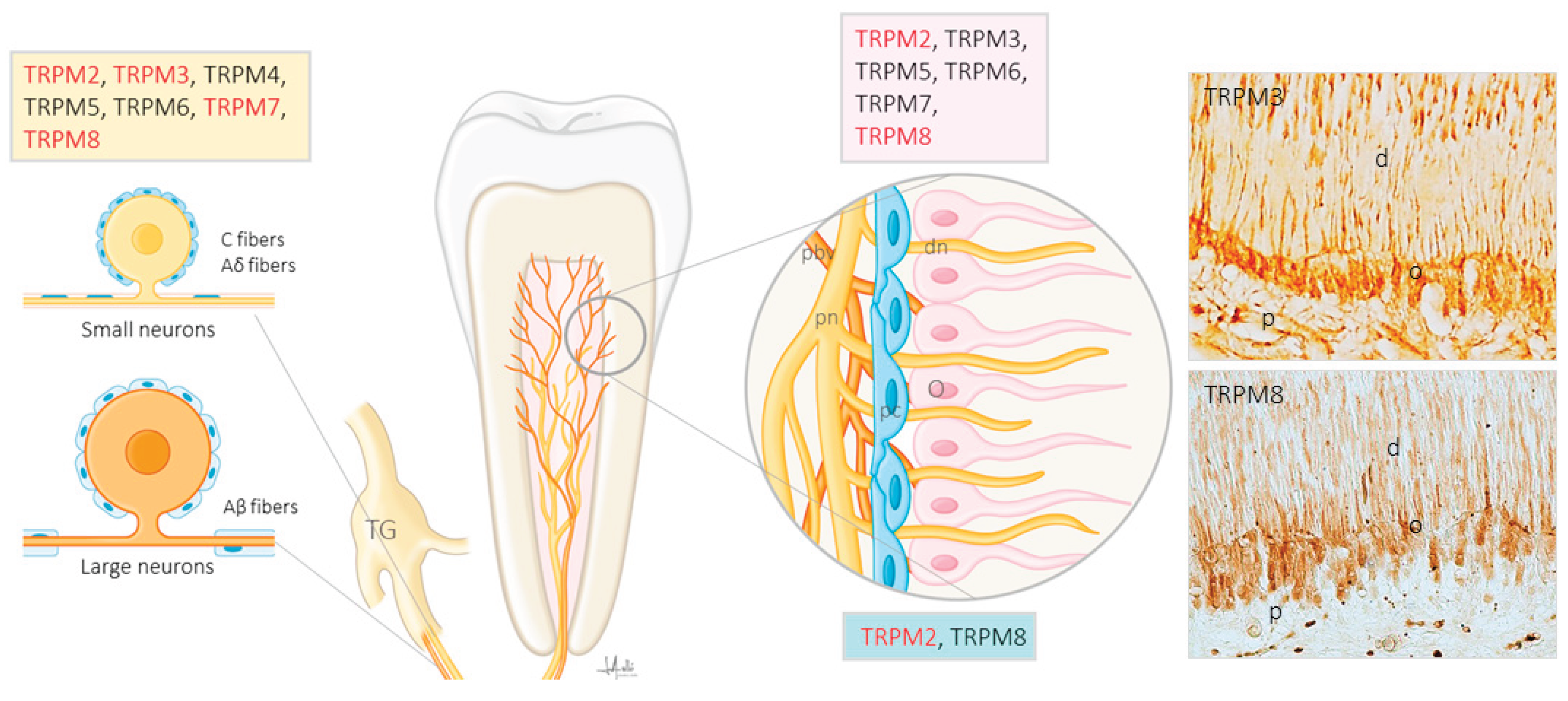

Table 1.
Trigeminal ganglion: dental afferent neurons.
| Channel | Percent | Species | Methods | Reference |
|---|---|---|---|---|
| TRPM2 | Mouse | PCR | Vandewauw et al. (2013) [62] | |
| Human | PCR, Ma, IIHC | Flegel et al. (2015) [65] | ||
| TRPM3 | Subset sØ | Mouse | PCR, Ih | Vriens et al. (2011) [47] |
| 20% | Rat | IHC | Yajima et al. (2019) [66] | |
| Mouse | PCR | Vandewauw et al. (2013) [62] | ||
| Human | PCR, Ma, IIHC | Flegel et al. (2015) [65] | ||
| TRPM4 | Mouse | PCR | Vandewauw et al. (2013) [62] | |
| TRPM5 | Mouse | PCR | Vandewauw et al. (2013) [62] | |
| TRPM6 | Mouse | PCR | Vandewauw et al. (2013) [62] | |
| TRPM7 | Mouse | PCR | Vandewauw et al. (2013) [62] | |
| Human | PCR, Ma, IIHC | Flegel et al. (2015) [65] | ||
| TRPM8 | Rat | Ca2+m | Thut et al. (2003) [67] | |
| Small neurons | Rat | IHC | Abe et al. (2005) [14] | |
| Rat | ih, IHC | Kobayashi et al. (2005) [68] | ||
| 13% | Rat | PCR, IHC | Park et al. (2006) [69] | |
| 58% | Rat | RL, IHC | Kim et al. (2011) [70] | |
| Mouse | PCR | Vandewauw et al. (2013) [62] | ||
| Human | PCR, Ma, IIHC | Flegel et al. (2015) [65] | ||
| 5,7% | Mouse | RL, IF | Michot et al. (2018) [63] | |
| Subset | Mouse | PCR | Lee et al. (2020) [64] |
Ca2+m: Ca2+ microfluorimetry; IF: immunofluorescence; ih: in situ hybridization; IHC: immunohistochemistry; ma: microarray; RL: retro labelling, sØ: small diameter .
Table 2.
Odontoblast and other dental pulp cells.
| Channel | Cell-s | Species | Methods | Reference |
|---|---|---|---|---|
| TRPM2 | Od, df | Human | IHC | Rowland et al. (2007) [78] |
| TRPM3 | Od | Mouse | PCR, Ca2+m, EF | Son et al. (2009) [71] |
| Od | Rat | PA | Won et al. (2018) [74] | |
| TRPM5 | Od | Mouse | FC-CGT | Khatibi Shahidi et al. (2015) [72] |
| TRPM6 | Od | Rat | PCR | Won et al. (2018) [75] |
| TRPM7 | Od (87%) | Rat | PCR, IHC | Kwon et al. (2014) [73] |
| Od | Rat | PCR | Won et al. (2018) [75] | |
| TRPM8 | ObC | Mouse | PCR, Ca2+m, EF | Son et al. (2009) [71] |
| Od | Rat | PCR | Yeon et al. (2009) [76] | |
| Od,df | Human | IHC, WB, ME | El Karim et al. (2011a,b) [79.80] | |
| Od | Rat | PA, IHC | Tsumura et al. (2013) [77] | |
| HDPCs | Human | PCR, IHC | Tokuda el al (2015) [81] | |
| Od | Rat | PCR, IHC | Tokuda el al (2015) [81] | |
| MOLCs | Mouse | PCR, IHC | Tokuda el al (2015) [81] | |
| Od | Human | PCR | Tazawa et al. (2017) [82] |
HDPCs: human dental pulp cells; MOLCs: mouse odontoblast lineage cells; Od: odontoblast; pf: pulpal fibroblasts - Ca2+m: Ca2+ microfluorimetry; EF: electrophysiology; EM: electron microscopy; FC-CGT: fluorescent color-coding genetic tracing; IHC: immunohistochemistry; PA: pharmacological approach; RL: retro labelling, sØ: small diameter; Wb: Wester botting.
Disclaimer/Publisher’s Note: The statements, opinions and data contained in all publications are solely those of the individual author(s) and contributor(s) and not of MDPI and/or the editor(s). MDPI and/or the editor(s) disclaim responsibility for any injury to people or property resulting from any ideas, methods, instructions or products referred to in the content. |
© 2026 by the authors. Licensee MDPI, Basel, Switzerland. This article is an open access article distributed under the terms and conditions of the Creative Commons Attribution (CC BY) license (http://creativecommons.org/licenses/by/4.0/).
Copyright: This open access article is published under a Creative Commons CC BY 4.0 license, which permit the free download, distribution, and reuse, provided that the author and preprint are cited in any reuse.


