
Submitted:
09 April 2026
Posted:
10 April 2026
You are already at the latest version
Abstract
Pancreatic cystic lesions (PCLs) represent a growing clinical challenge due to their diverse biological behaviors and the substantial overlap in imaging features between benign, premalignant, and malignant entities. Traditional diagnostic approaches relying on cross-sectional imaging or isolated morphologic criteria frequently fail to achieve adequate risk discrimination. Advances in endoscopic ultrasound (EUS) now permit detailed morphologic assessment complemented by cyst-fluid biochemical markers, proteomic signatures, and comprehensive genomic profiling using next-generation sequencing. Parallel progress in artificial intelligence (AI) further strengthens diagnostic precision by integrating EUS features with multimodal biomarker data to reduce subjectivity and support individualized clinical decision-making. This review introduces an EUS-based multimodal diagnostic framework of PCLs that integrates morphological evaluation, cyst-fluid biochemical testing, molecular profiling, and AI-assisted analysis. By synthesizing current evidence, we outline how the integrative approach enhances diagnostic accuracy, biological interpretability, and individualized risk stratification for PCLs.
Keywords:
endoscopic ultrasound
; pancreatic cystic lesions
; CE-EUS
; elastography
; CEA
; KRAS
; NGS
; artificial intelligence
1. Background
Pancreatic cystic lesions (PCLs) are increasingly identified in clinical practice, largely due to the widespread use of high-resolution cross-sectional imaging modalities. Although many PCLs are incidentally discovered and remain biologically indolent, a clinically relevant subset represents precursor lesions to pancreatic ductal adenocarcinoma, including mucinous neoplasms capable of progressing to high-grade dysplasia or invasive malignancy [1,2,3]. Accurately assessing the nature and biological potential of a pancreatic cyst at the time of detection therefore remains critical for determining surveillance intervals, the need for further diagnostic evaluation, and the appropriateness of surgical intervention.
Despite advances in computed tomography (CT) and magnetic resonance imaging (MRI), the non-invasive characterization of PCLs remains challenging. Overlapping morphological features—such as septations, mural nodules, wall thickening, or ductal communication—limit the ability of standard imaging to reliably distinguish mucinous from non-mucinous lesions or to detect features indicative of advanced neoplasia [4,5]. Furthermore, cytology from cyst-fluid aspirates is often nondiagnostic due to low cellularity, and substantial variation in guideline algorithms underscores the persistent uncertainty surrounding optimal diagnostic pathways [6]. Collectively, these limitations highlight the need for more refined diagnostic strategies capable of integrating multiple dimensions of information.
Endoscopic ultrasound (EUS) has emerged as a pivotal modality in this context. By offering superior spatial resolution and the ability to visualize internal cystic architecture, mural nodules, septations, and subtle ductal changes, EUS substantially improves lesion characterization beyond what is achievable with cross-sectional imaging alone [7,8,9]. Moreover, EUS uniquely enables the acquisition of cyst fluid or targeted tissue for biochemical, cytologic, and molecular analyses, providing key information for distinguishing neoplastic potential, identifying mucinous differentiation, and assessing dysplasia-related changes [10,11,12]. These combined capabilities establish EUS as the central platform for comprehensive evaluation of PCLs.
As diagnostic paradigms continue to evolve, growing evidence suggests that integrating EUS morphology with cyst-fluid biochemical biomarkers, molecular profiling, and emerging artificial intelligence (AI) may substantially enhance diagnostic precision and individual risk stratification. This review synthesizes current evidence on EUS-based structural assessment, cyst-fluid and tissue-based biomarker analysis, and the emerging role of AI-supported evaluation. Building on this foundation, we propose a comprehensive multi-modal diagnostic framework designed to improve accuracy, minimize unnecessary interventions, and support individualized management strategies for patients with pancreatic cystic lesions.
2. Overview of Pancreatic Cystic Lesions
PCLs comprise a heterogeneous set of entities with distinct epithelial origins, clinical behavior, and malignant potential. They are broadly classified into non-neoplastic and neoplastic lesions [13,14]. Non-neoplastic cysts are predominantly pseudocysts, which lack an epithelial lining and typically occur after acute or chronic pancreatitis or pancreatic ductal disruption [15,16]. Although usually benign, pseudocysts may resemble true neoplasms on imaging and warrant differentiation when the clinical history is unclear. Neoplastic cysts, by contrast, are epithelial lesions with variable risk of malignant transformation. They are subdivided into mucinous and non-mucinous neoplasms. Mucinous cystic neoplasms (MCNs) and intraductal papillary mucinous neoplasms (IPMNs) represent the principal mucin-producing lesions. MCNs are characterized by ovarian-type stroma and occur almost exclusively in women, typically within the pancreatic body or tail. IPMNs arise from the main pancreatic duct and/or its side branches and are classified into main-duct, branch-duct, and mixed-type subtypes based on ductal involvement. Main-duct and mixed-type IPMNs carry the highest likelihood of harboring high-grade dysplasia or invasive carcinoma, whereas most branch-duct IPMNs follow a more indolent course but still warrant surveillance due to variable progression risk [17,18,19]. Non-mucinous neoplastic cysts include serous cystic neoplasms (SCNs), solid pseudopapillary neoplasms (SPNs), and cystic neuroendocrine tumors (cNETs). SCNs demonstrate characteristic microcystic architecture and are overwhelmingly benign, although differentiation from mucinous cysts is often required to avoid unnecessary surgery. SPNs occur predominantly in young women and, despite being low-grade malignancies, require accurate identification because surgical resection is typically curative. cNETs and cystic degeneration of pancreatic ductal adenocarcinoma comprise a smaller but clinically important subset in which imaging alone may be insufficient for reliable diagnosis [20,21,22].
Although CT and MRI remain foundational in identifying PCLs, their diagnostic accuracy is limited by overlapping morphological features. For example, mural nodules, septations, wall thickening, and ductal communication may appear in both benign and premalignant lesions, reducing the reliability of purely morphology-based classification. Recent studies indicate that cross-sectional imaging alone misclassifies a substantial proportion of mucinous and high-risk cysts, reinforcing the need for higher-resolution, biologically informed assessment modalities [23,24]. These diagnostic limitations underscore the increasingly central role of EUS, which enables detailed evaluation of internal cystic structure while facilitating cyst-fluid and tissue acquisition for biochemical, cytologic, and molecular profiling.
3. Comprehensive EUS Evaluation of Pancreatic Cystic Lesions
3.1. Morphological Evaluation of PCLs
EUS provides high-resolution morphological information that enables detailed assessment of PCLs. Key morphological parameters include cyst size, wall thickness, septations, mural nodules, and communication with the main pancreatic duct. The identification of mural nodules and solid components is particularly important, as these features are associated with a higher risk of malignancy in IPMNs and MCNs. EUS also allows for precise measurement of cyst dimensions and ductal relationships, which aids in distinguishing between branch-duct and main-duct IPMNs. The visualization of debris, internal septations, and cyst wall enhancement further contributes to differentiating inflammatory pseudocysts from neoplastic lesions [14,25]. Overall, EUS-based morphological evaluation constitutes the foundation for PCLs characterization and subsequent risk stratification.
3.2. Functional Evaluation of PCLs
Recent advances in EUS technology have enabled functional evaluation of PCLs through contrast-enhanced EUS (CE-EUS) and EUS elastography, which provide additional information beyond structural imaging. CE-EUS improves the visualization of mural nodules, septa, and cyst walls by assessing microvascular perfusion. Enhanced mural nodules or vascularized cyst walls on CE-EUS are strongly associated with neoplastic or malignant lesions, whereas non-enhancing septations are typically observed in benign cysts [26]. EUS elastography evaluates the stiffness of cystic and peri-cystic tissue, offering insights into underlying fibrosis and potential invasive components. Studies have demonstrated its value in distinguishing malignant from benign pancreatic cysts by quantitatively measuring tissue elasticity [27,28]. Combined morphological and functional EUS assessments can enable more accurate differentiation between low and high-risk lesions prior to invasive sampling.
3.3. EUS-Guided Tissue and Fluid Acquisition
Although morphologic and functional EUS assessment provides essential information for characterizing PCLs, imaging alone often lacks the ability to determine epithelial phenotype, mucinous differentiation, or the degree of dysplasia. EUS-guided cystic fluid acquisition therefore represents a critical extension of cyst evaluation, bridging structural assessment with downstream cytologic, biochemical, and molecular analysis [29,30].
EUS-guided fine-needle aspiration (EUS-FNA) remains widely used to obtain cyst fluid for cytology and biochemical evaluation. EUS-FNA fluid analysis is currently one of the most comprehensive methods for classifying and assessing the risk of PCLs. The fluid obtained through EUS-FNA can be subjected to multi-parametric analysis at the physical, chemical and molecular levels simultaneously [31,32,33]. The string sign test is a direct bedside method for assessing viscosity. During the operation, if the fluid-filled sac is stretched between the fingers to form a string ≥ 1 cm in length, it can be judged as positive, indicating a mucinous cyst (MCNs or IPMNs). This test reflects the mucin content of the fluid, with a specificity of up to 95% and a positive predictive value of 94%. It is of great significance in quickly diagnosing mucinous lesions. The main limitation of the string sign is the operator dependence, as stretching force varies across observers [34,35,36]. The cytological analysis of the fluid obtained by EUS-FNA can improve the accuracy of SPNs diagnosis, but the diagnostic sensitivity is low [37]. Even in the absence of malignant cells on cytology, malignancy cannot be definitively excluded due to limited cellularity.
To overcome these challenges, EUS-guided fine-needle biopsy (EUS-FNB) and EUS through-the-needle micro-forceps biopsy (EUS-TTNB) have emerged as superior sampling modalities. Both techniques provide histological architecture rather than isolated cell fragments, significantly increasing diagnostic adequacy. Recent prospective and multicenter studies demonstrate that TTNB yields diagnostic histology in 70–90% of sampled lesions, outperforming FNA for identifying mucinous epithelium, ovarian-type stroma in MCNs, and dysplasia in IPMNs [38,39,40]. Two independent comparative studies further show that FNB needles (e.g., Franseen or fork-tip designs) improve tissue yield and diagnostic accuracy for cystic neuroendocrine tumors, solid pseudopapillary neoplasms, and cystic degeneration of ductal adenocarcinoma—pathologies in which architectural integrity is pivotal for classification [41,42].
EUS-guided sampling is particularly valuable when morphological features remain equivocal, even after advanced functional imaging. For example, targeted sampling of mural nodules identified on CH-EUS enables differentiation between vascularized neoplastic nodules and avascular mucin globules, thereby refining dysplasia assessment and avoiding misclassification. In addition, TTNB has demonstrated utility in cysts with unclear imaging characteristics, such as atypical septations or thickened walls, improving diagnostic accuracy. Importantly, EUS-guided sampling is the procedural foundation for subsequent biochemical, cytologic, and molecular analysis. The diagnostic yield of these downstream modalities is directly dependent on the quality and quantity of samples obtained via EUS.
4. Molecular Profiling and Biomarker Characterization of Pancreatic Cystic Lesions
Cyst fluid obtained via EUS-FNA or, less frequently, during surgical resection, serves as a valuable substrate for biomarker testing. These biomarkers reflect epithelial secretion, ductal communication, inflammatory signaling, and underlying genetic alterations [43,44]. Based on their biological characteristics and clinical applicability, cyst-related biomarkers can be broadly classified into three major categories: conventional biochemical biomarker, cyst-fluid biomarkers with potential clinical application value and Emerging genomic/molecular testing (Table 1).
4.1. Conventional Biochemical Biomarkers
These include carcinoembryonic antigen (CEA), glucose, and amylase, which remain fundamental for initial cyst characterization. They are simple, reproducible, and widely available, representing the earliest biochemical basis for distinguishing mucinous from non-mucinous cysts.
4.1.1. CEA
CEA is the most widely used and well-validated biochemical marker for differentiating mucinous from non-mucinous pancreatic cysts. A commonly used cutoff is approximately 192 ng/mL, providing a specificity of 82–92% and a sensitivity of 45%–71%. But CEA cannot distinguish benign from malignant mucinous lesions. Recent guidelines continue to endorse cyst-fluid CEA as a primary discriminator, although they also recommend integrating it with additional parameters to improve reliability [13,29].
4.1.2. Cyst-Fluid Glucose
Cyst-fluid glucose has recently emerged as a low-cost and reliable discriminator, showing accuracy comparable to or exceeding that of CEA in several prospective studies. The test requires minimal fluid volume and can be rapidly performed with bedside glucometers during EUS-FNA. Glucose levels in mucinous pancreatic cysts are usually below 50 mg/dL, a cutoff that provides a specificity of about 89% (83%–95%) and a sensitivity of 93% (89%–97%). The combination assessment of glucose and CEA is particularly useful in cases with indeterminate CEA values [45,46,47].
4.1.3. Cyst-Fluid Amylase
Another useful cyst fluid marker is amylase: Cyst-fluid amylase reflects ductal communication rather than epithelial neoplastic potential. High level indicates a pseudocyst or IPMN. When the concentration is below 250 U/L, a pseudocyst can be effectively ruled out, and it is highly specific (although the sensitivity is relatively low at 44%) [15].
4.2. Cyst-Fluid Biomarkers with Potential Clinical Application Value
4.2.1. Mucin-Related Glycoproteins
MUC1 is highly expressed in most malignant mucinous cysts. SCNs is mainly manifested as cystic formations, but sometimes it is present as solid lesions. In such cases, immunohistochemical testing is helpful for differential diagnosis. Neuron-specific enolase, α-inhibin and mucin-related glycoprotein (MUC1 and MUC6) are specific immune-profiles for SCNs [48].
4.2.2. CA19-9
Among tumor markers evaluated in PCLs, CA19-9 is the most extensively studied biomarker after CEA. Elevated serum or cyst fluid CA19-9 levels are often associated with malignant or high-grade dysplastic cystic neoplasms, particularly IPMNs and MCNs. Several studies have demonstrated that CA19-9 exhibits moderate diagnostic performance in distinguishing benign from malignant cystic lesions, with reported sensitivity and specificity values around 72% and 75%, respectively, when cyst fluid concentrations exceed approximately 364.55 ng/mL [25,49]. However, the diagnostic utility of CA19-9 remains limited due to its relatively low sensitivity and potential elevation in non-malignant pancreatic diseases or obstructive jaundice. Its specificity for differentiating mucinous from non-mucinous cysts is also inferior to that of CEA [50,51]. Consequently, current guidelines and reviews recommend that CA19-9 be used as an adjunctive marker, rather than a standalone diagnostic tool, ideally interpreted in conjunction with cyst morphology, cytology, and biochemical markers such as CEA.
4.2.3. VEGF-A
Vascular endothelial growth factor (VEGF), particularly VEGF-A, has emerged as a highly accurate biomarker in distinguishing SCNs from other PCLs. Carr et al. demonstrated that VEGF-A levels in pancreatic cyst fluid are markedly elevated in SCNs compared to all other cyst types (median 35,598 pg/mL vs. 2,149 pg/mL, p < 0.0001). A VEGF-A threshold of >5,000 pg/mL achieved 100% sensitivity and 83.7% specificity for identifying SCNs, and when combined with a CEA level ≤10 ng/mL, diagnostic performance improved to 95.5% sensitivity and 100% specificity, approaching the accuracy of pathological diagnosis [52,53].
4.3. Emerging Genetic Molecular Testing
Molecular and genomic profiling has recently become an integral component in the diagnostic evaluation of PCLs. Unlike biochemical or protein-based markers that reflect secretory and metabolic activity, molecular biomarkers directly characterize the underlying genomic alterations. The application of next-generation sequencing (NGS) to cyst-fluid samples has markedly enhanced the sensitivity, specificity, and breadth of preoperative cyst characterization [54].
4.3.1. Diagnostic Mutations for Cyst Typing
KRAS is the "initiating mutation" of mucinous cysts (IPMNs, MCNs), with a positive rate of approximately 60%-70% in IPMNs and about 40% in MCNs. It has a specificity of up to 95%-100% for differentiating mucinous from non-mucinous lesions, but its sensitivity remains relatively low (47%-67%) [55]. GNAS mutations are mainly found in IPMNs (31%-40%) and are almost negative in MCNs. Its specificity is close to 100%, and combined with KRAS detection, the diagnostic specificity of mucinous cysts can be increased to nearly 100% [56]. Progression mutations such as TP53, SMAD4, CDKN2A, and PIK3CA usually occur at the high-grade dysplasia (HGD) or invasive cancer (IC) stage. Although the sensitivity is relatively low (9%–42%), the specificity is extremely high (92%–98%), and can be used as an important molecular marker for the risk of malignancy [2]. Based on the multi-gene combined analysis of NGS, the diagnostic efficacy has been further improved: the combined detection of KRAS/GNAS and TP53, PIK3CA, PTEN, etc. has a sensitivity of up to 89% for mucinous lesions and a specificity of 100%, and has a sensitivity of about 88%–89% for HGD [57].
4.3.2. NGS-Based Platforms
NGS-based diagnostic platforms have substantially improved the molecular characterization and clinical triage of PCLs. The PancreaSeq system, including its updated DNA/RNA-based Genomic Classifier (PancreaSeq GC), integrates mutations (KRAS, GNAS, RNF43, VHL, TP53, SMAD4, PIK3CA, PTEN), gene fusions, copy-number alterations, and RNA expression data. This platform can accurately classifies cyst types and identifies advanced neoplasia. PancreaSeq GC achieved 95% sensitivity and 100% specificity for mucinous precursor lesions and 82% sensitivity/100% specificity for advanced neoplasia, outperforming guideline-based criteria. In a prospective multi-institutional cohort, PancreaSeq GC also demonstrated high accuracy for mucinous cysts (MAPK/GNAS mutations: 90% sensitivity/100% specificity) and for detecting high-grade dysplasia using TP53/SMAD4/MTOR-pathway alterations, with performance superior to AGA and Fukuoka guidelines [58,59].
4.3.3. Liquid-Biopsy Markers
Recent studies have also explored cell-free DNA (cfDNA) and microRNA (miRNA) signatures as noninvasive molecular indicators of neoplastic potential. cfDNA concentrations are significantly higher in IPMNs, improving detection of key mutations such as GNAS R201C/H, which show strong diagnostic specificity (71%) for mucinous cysts. Epigenetic cfDNA markers remain less well characterized but represent an emerging area of interest [60]. MicroRNA profiling shows clearer value: a validated cyst-fluid panel (miR-31-5p, miR-483-5p, miR-99a-5p, miR-375) accurately distinguishes serous from mucinous or malignant lesions, with high sensitivity and specificity; additional miRNAs (miR-200 family, miR-224, miR-363) help differentiate IPMNs subtypes and grades [61].
5. Artificial Intelligence in the Assessment of PCLs
5.1. Imaging-Based Artificial Intelligence for PCLs Evaluation
EUS remains the cornerstone for the diagnostic evaluation of PCLs because of its superior spatial resolution and ability to visualize cyst morphology, mural nodules, and ductal communication. However, the interpretation of EUS images is inherently operator-dependent, subject to interobserver variability and qualitative bias. The integration of AI into EUS imaging aims to overcome these limitations by facilitating objective, reproducible image interpretation through quantitative pattern recognition and automated feature extraction [62,63]. Recent studies have demonstrated that convolutional neural networks (CNNs) and radiomics-based models can distinguish PCLs subtypes and identify high-risk lesions with diagnostic accuracy comparable to experienced EUS operators. Leang et al. reported that a CNN trained on EUS images achieved an area under the curve (AUC) of 0.93 for differentiating IPMNs from mucinous cystic neoplasms MCNs [64].
Similarly, Yashika et al. applied radiomics feature analysis to CE-EUS, achieving 90% sensitivity in identifying mural nodules suggestive of high-grade dysplasia [65]. Beyond classification, AI algorithms have shown potential for automated quantification of cyst wall irregularity, septation, and main pancreatic duct dilation—features strongly correlated with malignant transformation risk. Complementary applications have also emerged in EUS elastography and contrast-enhanced harmonic imaging, where AI aids in differentiating cystic from solid components and assessing tissue stiffness. In a retrospective study, Lee et al. developed a deep learning model incorporating both B-mode and elastography signals, yielding improved discrimination of high-risk IPMNs compared with standard image review [66]. These advancements illustrate the promise of multimodal EUS-AI systems capable of integrating multiple imaging parameters to achieve comprehensive lesion assessment.
While EUS remains the principal imaging modality for PCLs, similar AI frameworks have been explored for CT and MRI, primarily in radiomics-based risk prediction. Cui et al. utilized MRI radiomic signatures combined with clinical features to predict high-grade dysplasia in IPMNs with an AUC of 0.92, surpassing traditional morphological criteria [67]. Such cross-modality models highlight the potential of AI to unify EUS and cross-sectional imaging data into a cohesive, quantitative diagnostic platform.
Despite these advances, significant challenges persist before AI can be routinely integrated into clinical EUS practice. Model performance is often limited by small, single-center datasets and heterogeneous image acquisition parameters. The lack of external validation and standardized image repositories restricts generalizability. Moreover, explainability remains a concern, most deep learning models act as “black boxes,” offering limited insight into decision pathways. Emerging research into explainable AI (XAI) using Grad-CAM or SHAP-based visualization may enhance clinical reliability and transparency [68,69,70].
In summary, imaging-based AI, particularly within EUS, has demonstrated substantial potential in refining PCLs classification, identifying high-risk features, and reducing diagnostic subjectivity. As multi-institutional datasets and federated learning frameworks mature, EUS-AI models are expected to evolve from proof-of-concept systems into validated, clinically deployable tools, forming a critical component of precision diagnostics for PCLs.
5.2. AI-Assisted Analysis of Biomarkers and Molecular Profiles in PCLs
5.2.1. AI in Biochemical Biomarker Evaluation
CEA, glucose, and amylase are widely analyzed in pancreatic cyst fluid obtained via EUS-FNA to differentiate between mucinous and non-mucinous cystic lesions. However, the diagnostic utility of these biochemical markers is often limited due to significant overlap in biomarker levels across different cyst types. AI provides a valuable tool to address this limitation by integrating multiple biochemical markers to improve diagnostic accuracy. Machine learning (ML) models, particularly random forests and support vector machines (SVM), have been employed to analyze multi-biomarker data. These AI-based models can identify complex, non-linear patterns that are not easily discernible by traditional statistical methods [71]. Huang et al. demonstrated that an AI model integrating CEA, glucose, and amylase achieved an AUC of 0.90 for distinguishing MCNs from SCNs [72]. These findings suggest that AI can enhance the diagnostic performance of biochemical markers, offering more reliable and objective risk stratification for PCLs.
5.2.2. AI in Emerging Molecular and Genomic Biomarker Analysis
NGS has led to significant advances in the molecular analysis of PCLs, revealing important genomic alterations such as mutations in KRAS, GNAS, TP53, and SMAD4, which are particularly associated with mucinous cysts and higher malignancy potential. The integration of AI with genomic data allows for better interpretation and risk prediction in PCLs by combining genetic mutations with clinical and imaging features.
AI has emerged as a key tool in the analysis of emerging molecular biomarkers, including genetic mutations and epigenetic changes, which are critical in PCL characterization. Models that combine genomic data, such as those used in CompCyst and PancreaSeq-ML, have significantly improved diagnostic accuracy. For example, the CompCyst model uses machine learning to integrate molecular, clinical, and imaging data, which has helped reduce unnecessary surgeries while maintaining high sensitivity for identifying high-risk cysts. Similarly, PancreaSeq-ML integrates DNA and RNA sequencing data with AI to achieve an AUC of 0.95 in distinguishing high-risk IPMNs from benign cysts [73].
In addition to genomic markers like KRAS and GNAS, proteomic profiling has been used to identify biomarkers that may indicate malignant transformation. AI models have been applied to proteomic data to identify patterns that would be difficult for clinicians to detect manually. Studies by Yoon et al. have demonstrated that AI can analyze proteomic profiles to predict malignant transformation with high diagnostic accuracy [74]. This integration of emerging molecular data with AI may transform how PCLs are assessed, offering more precise and individualized risk stratification.
6. Multi-Model Approach for Risk Stratification and Personalized Evaluation of PCLs
The inherent heterogeneity of PCLs and the significant overlap in their imaging features have highlighted the limitations of single-modality diagnostic approaches. As contemporary practice moves toward biologically grounded and precision-oriented evaluation, a multi-model integrated framework, anchored in EUS and enriched by biochemical, molecular, and computational data, has emerged as a more comprehensive and clinically adaptive strategy. This framework does not merely combine disparate diagnostic tools; rather, it establishes a coherent architecture in which each modality contributes a distinct and complementary insight to cyst characterization.
At the core of this model, EUS provides high-resolution morphological and functional assessment, allowing precise visualization of mural nodules, septations, surface irregularities, and ductal communication. Morphologic cues guide procedural decision-making, particularly when identifying targets for EUS-guided sampling, ensuring that subsequent analyses are performed on the most biologically relevant material. Biochemical markers and protein signatures derived from cyst fluid add an additional layer of phenotypic information, reflecting mucin production, inflammatory activity, or ductal anatomy that cannot be fully appreciated from imaging alone.
Genomic profiling further deepens diagnostic resolution by defining lineage-specific mutations and detecting high-grade dysplasia–associated alterations. These molecular signatures not only refine histological prediction but also offer a mechanistic understanding of cyst behavior and malignant potential. Importantly, the growing availability of NGS platforms enables the simultaneous interrogation of multiple genomic pathways, facilitating a more nuanced interpretation of cyst evolution.
A central innovation of the multi-model paradigm is the incorporation of AI-driven analysis systems capable of integrating these heterogeneous inputs. Machine-learning models can quantify subtle EUS-derived textural patterns, interpret complex biomarker interactions, and classify genomic trajectories indicative of progression. By synthesizing multimodal signals, AI reduces subjectivity, improves reproducibility, and supports probabilistic risk stratification that surpasses traditional rule-based criteria. This integration is especially valuable for lesions with equivocal features, where conventional assessments often struggle to provide actionable clarity.
Beyond enhancing initial diagnostic accuracy, the multi-model framework also introduces a crucial capacity for dynamic and individualized longitudinal assessment. As cyst morphology and biological markers evolve over time, updated EUS findings, repeated biochemical measurements, and new genomic data can be assimilated to refine malignancy risk in real time. This temporal adaptability represents a significant advancement over static guideline-based management, enabling surveillance intervals and intervention thresholds to be personalized based on evolving biological risk rather than fixed morphologic criteria.
Taken together, the multi-model framework represents a unified diagnostic ecosystem that aligns structural imaging, biochemical profiling and molecular characterization, and AI-enhanced analysis into a single, clinically coherent pathway. By leveraging the unique strengths of each modality and integrating them through advanced computational methods, this strategy enhances diagnostic precision, supports more rational patient selection for surgery or surveillance, and provides a scalable foundation for incorporating future biomarker innovations and computational technologies (Figure 1). Ultimately, this paradigm marks a substantive shift toward precision evaluation of PCLs and holds considerable promise for improving clinical outcomes.
7. Summary
The proposed multi-modal framework represents a conceptual evolution in the evaluation of PCLs, integrating EUS-based comprehensive assessment, biomarkers and genomic profiling, and AI-driven analysis into a unified diagnostic workflow. This approach facilitates an individualized interpretation of cystic lesion behavior, addressing the limitations of morphology-only assessment and improving precision in malignancy risk stratification. The key strength of this approach lies in the ability to synthesize diverse data streams (structural, biochemical and molecular) into clinically interpretable outputs, improving early detection and malignant potential assessment. Current evidence has demonstrated that EUS-guided cyst-fluid analysis, combined with NGS and computational interpretation, markedly improves diagnostic accuracy, reduces unnecessary surgical interventions and enables dynamic tracking of PCLs malignant transformation during surveillance [75,76].
Despite these advances, the multi-model framework still faces several limitations: heterogeneity in imaging quality and biomarker assay protocols reduces the reproducibility in different clinical centers; AI models often rely on retrospective or small datasets, limiting generalizability; and the interpretability of deep-learning algorithms remains insufficient for routine clinical applications. Furthermore, molecular analysis such as NGS and proteomics, though powerful, are costly and not universally accessible, creating disparities in implementation across medical institutions due to resource variability [77,78].
8. Future Directions
Future success depends on addressing challenges related to data standardization, clinical accessibility, and AI interpretability. Addressing these limitations is essential for transforming the existing conceptual framework into a robust, reproducible, and scalable diagnostic paradigm.
One of the foremost prerequisites for broader implementation is the establishment of unified standards across imaging acquisition, cyst-fluid biomarker characterization and NGS sequencing workflows. However, current variability in EUS platforms and molecular profiling data form introduce substantial inter-institutional inconsistency, limiting the external validity of integrated diagnostic models. Future direction should prioritize the development of consistent reporting frameworks, shared reference datasets, and consensus-based standard of quality. Multicenter initiatives utilizing privacy-preserving data curation may facilitate the generation of large, heterogeneous training cohorts. Such standardization will form the foundation for regulatory approval, benchmarking, and global adoption of multimodal diagnostic systems.
Despite strong diagnostic performance, the widespread use of multimodal molecular and AI-supported frameworks remains constrained by resource-dependent barriers. NGS, proteomic assays, and advanced computational tools are predominantly available in specialized centers, limiting equitable access across healthcare institutions. To broaden clinical applicability, future strategies should emphasize streamlined biomarker panels with validated diagnostic utility, cost-effective sequencing approaches, and cloud-based or embedded AI systems capable of providing real-time decision support. Prospective research and cost-effectiveness analysis will be essential to guide policymakers, inform reimbursement pathways, and define appropriate clinical thresholds for deploying multimodal diagnostic tools in routine practice.
While AI-driven interpretation has demonstrated considerable promise, insufficient interpretability continues to impede clinical confidence and regulatory endorsement. The incorporation of XAI techniques (e.g., feature attribution maps, model-agnostic interpretability frameworks, and uncertainty quantification) will be essential to align algorithmic predictions with clinical reasoning. Developing transparent validation workflow, reporting standards, and clinician-AI interaction guidelines will further support safe and responsible integration. In long term, a ‘‘human-in-the-loop” paradigm where AI augments but does not replace expert diagnostic judgment may offer the most viable model for integrating computational tools into PCL risk assessment (Figure 2).
Collectively, the future of PCLs evaluation lies in the convergence of the refinement of data uniformity, the expansion of practical implementation pathways and the maturation of interpretable AI system. These complementary innovations promise to reshape risk assessment into a highly refined, dynamically adaptive, and biologically driven process. As these innovations mature and undergo rigorous validation, they hold substantial promise for reshaping PCL risk assessment into a dynamically adaptive and biologically guided process.
Author Contributions
Enshuo Liu was responsible for writing the original draft preparation, Fei Yang contributed to review and editing the paper. All authors have read and agreed to the published version of the manuscript.
Funding
This review received no external funding support.
Institutional Review Board Statement
Not applicable.
Informed Consent Statement
Not applicable.
Data Availability Statement
No new data were created or analyzed in this review.
Conflicts of Interest
There are no conflicts of interest.
Abbreviations
The following abbreviations are used in this manuscript:
| PCLs EUS AI CT MRI IPMNs MCNs SCNs SPNs cNETs CE-EUS EUS-FNA EUS-FNB EUS-TTNB CEA MUC VEGF NGS HGD IC cfDNA miRNA CNNs AUC XAI ML SVM |
Pancreatic Cystic Lesions Endoscopic Ultrasound Artificial Intelligence Computed Tomography Magnetic Resonance Imaging Intraductal Papillary Mucinous Neoplasms Mucinous Cystic Neoplasms Serous Cystic Neoplasms Solid Pseudopapillary Neoplasms cystic Neuroendocrine Tumors Contrast-Enhanced EUS EUS-guided Fine-needle Aspiration EUS-guided Fine-needle Biopsy EUS through-the-needle micro-forceps Biopsy Carcinoembryonic Antigen Mucin-related glycoprotein Vascular Endothelial Growth Factor Next-generation Sequencing High-grade Dysplasia Invasive Cancer cell-free DNA microRNA Convolutional Neural Networks Area Under the curve Explainable AI Machine Learning Support Vector Machines |
| MDPI PCLs EUS AI CT MRI IPMNs MCNs SCNs SPNs cNETs CE-EUS EUS-FNA EUS-FNB EUS-TTNB CEA MUC VEGF NGS HGD IC cfDNA miRNA CNNs AUC XAI ML SVM |
Multidisciplinary Digital Publishing Institute Pancreatic Cystic Lesions Endoscopic Ultrasound Artificial Intelligence Computed Tomography Magnetic Resonance Imaging Intraductal Papillary Mucinous Neoplasms Mucinous Cystic Neoplasms Serous Cystic Neoplasms Solid Pseudopapillary Neoplasms cystic Neuroendocrine Tumors Contrast-Enhanced EUS EUS-guided Fine-needle Aspiration EUS-guided Fine-needle Biopsy EUS through-the-needle micro-forceps Biopsy Carcinoembryonic Antigen Mucin-related glycoprotein Vascular Endothelial Growth Factor Next-generation Sequencing High-grade Dysplasia Invasive Cancer cell-free DNA microRNA Convolutional Neural Networks Area Under the curve Explainable AI Machine Learning Support Vector Machines |
| MDPI PCLs EUS AI CT MRI IPMNs MCNs SCNs SPNs cNETs CE-EUS EUS-FNA EUS-FNB EUS-TTNB CEA MUC VEGF NGS HGD IC cfDNA miRNA CNNs AUC XAI ML SVM |
Multidisciplinary Digital Publishing Institute Pancreatic Cystic Lesions Endoscopic Ultrasound Artificial Intelligence Computed Tomography Magnetic Resonance Imaging Intraductal Papillary Mucinous Neoplasms Mucinous Cystic Neoplasms Serous Cystic Neoplasms Solid Pseudopapillary Neoplasms cystic Neuroendocrine Tumors Contrast-Enhanced EUS EUS-guided Fine-needle Aspiration EUS-guided Fine-needle Biopsy EUS through-the-needle micro-forceps Biopsy Carcinoembryonic Antigen Mucin-related glycoprotein Vascular Endothelial Growth Factor Next-generation Sequencing High-grade Dysplasia Invasive Cancer cell-free DNA microRNA Convolutional Neural Networks Area Under the curve Explainable AI Machine Learning Support Vector Machines |
| MDPI PCLs EUS AI CT MRI IPMNs MCNs SCNs SPNs cNETs CE-EUS EUS-FNA EUS-FNB EUS-TTNB CEA MUC VEGF NGS HGD IC cfDNA miRNA CNNs AUC XAI ML SVM |
Multidisciplinary Digital Publishing Institute Pancreatic Cystic Lesions Endoscopic Ultrasound Artificial Intelligence Computed Tomography Magnetic Resonance Imaging Intraductal Papillary Mucinous Neoplasms Mucinous Cystic Neoplasms Serous Cystic Neoplasms Solid Pseudopapillary Neoplasms cystic Neuroendocrine Tumors Contrast-Enhanced EUS EUS-guided Fine-needle Aspiration EUS-guided Fine-needle Biopsy EUS through-the-needle micro-forceps Biopsy Carcinoembryonic Antigen Mucin-related glycoprotein Vascular Endothelial Growth Factor Next-generation Sequencing High-grade Dysplasia Invasive Cancer cell-free DNA microRNA Convolutional Neural Networks Area Under the curve Explainable AI Machine Learning Support Vector Machines |
References
- Galgano, S.J.; Kambadakone, A.R.; van der Pol, C.B. A Review of Pancreatic Cystic Lesions on Imaging. Advances in Clinical Radiology 2024, 6, 19–30. [Google Scholar] [CrossRef]
- Pan, Y.; Ran, T.; Zhang, X.; Qin, X.; Zhang, Y.; Zhou, C.; Zou, D. Adequacy of EUS–guided fine-needle aspiration and fine-needle biopsy for next-generation sequencing in pancreatic malignancies: A systematic review and meta-analysis. Endoscopic Ultrasound 2024, 13, 366–375. [Google Scholar] [CrossRef]
- Jiang, M.; Peng, L.; Sun, Y.; Li, S.; Li, Z.; Sun, L.; Huang, H.; Zhendong, J. EUS-guided ablation for pancreatic cystic lesions: An updated review. Endoscopic Ultrasound 2025, 10, 1097. [Google Scholar] [CrossRef]
- Quingalahua, E.; Al-Hawary, M.M.; Machicado, J.D. The role of magnetic resonance imaging (MRI) in the diagnosis of pancreatic cystic lesions (PCLs). Diagnostics 2023, 13, 585. [Google Scholar] [CrossRef]
- Yasrab, M.; Kwak, S.J.; Khoshpouri, P.; Fishman, E.K.; Zaheer, A. Misdiagnosis of pancreatic intraductal papillary mucinous neoplasms and the challenge of mimicking lesions: imaging diagnosis and differentiation strategies. Abdominal Radiology 2025, 50, 2241–2257. [Google Scholar] [CrossRef] [PubMed]
- Zhang, M.L.; Pitman, M.B. Cytology of cystic lesions of the pancreas: Practical insights, pearls, and pitfalls. Cancer Cytopathology 2025, 133, e70011. [Google Scholar] [CrossRef] [PubMed]
- Cheng, B.; Du, C.; He, Z.; Feng, X.; Li, H.; Wang, Z.; Gao, F.; Zhao, Y.; Chai, N.; Linghu, E. Value of EUS-guided through-the-needle biopsy in the diagnosis of pancreatic cystic neoplasms: An 8-year experience. Endoscopic Ultrasound 2024, 13, 345–350. [Google Scholar] [CrossRef] [PubMed]
- Krishna, S.; Abdelbaki, A.; Hart, P.A.; Machicado, J.D. Endoscopic ultrasound-guided needle-based confocal endomicroscopy as a diagnostic imaging biomarker for intraductal papillary mucinous neoplasms. Cancers 2024, 16, 1238. [Google Scholar] [CrossRef]
- Dahiya, D.S.; Shah, Y.R.; Ali, H.; Chandan, S.; Gangwani, M.K.; Canakis, A.; Ramai, D.; Hayat, U.; Pinnam, B.S.M.; Iqbal, A. Basic principles and role of endoscopic ultrasound in diagnosis and differentiation of pancreatic cancer from other pancreatic lesions: a comprehensive review of endoscopic ultrasound for pancreatic cancer. Journal of Clinical Medicine 2024, 13, 2599. [Google Scholar] [CrossRef]
- Moond, V.; Mohan, B.P.; Diehl, D.; Adler, D.G. EUS-guided through-the-needle microforceps biopsy for pancreatic cysts: Why no widespread adoption? Endoscopic Ultrasound 2024, 13, 127–128. [Google Scholar] [CrossRef]
- Hickman, K.; Sadler, T.; Zhang, T.; Boninsegna, E.; Majcher, V.; Godfrey, E. Pancreatic cystic lesions and the role of contrast enhanced endoscopic ultrasound. Clinical Radiology 2022, 77, 418–427. [Google Scholar] [CrossRef]
- Lipkin, J.; McGrath, K. EUS for pancreatic cysts. Endoscopic Ultrasonography 2024, 150–160. [Google Scholar]
- Pușcașu, C.I.; Rimbaş, M.; Mateescu, R.B.; Larghi, A.; Cauni, V. Advances in the diagnosis of pancreatic cystic lesions. Diagnostics 2022, 12, 1779. [Google Scholar] [CrossRef]
- Rogowska, J.; Semeradt, J.; Durko, Ł.; Małecka-Wojciesko, E. Diagnostics and Management of Pancreatic Cystic Lesions—New Techniques and Guidelines. Journal of Clinical Medicine 2024, 13, 4644. [Google Scholar] [CrossRef]
- Singh, R.R.; Gopakumar, H.; Sharma, N.R. Diagnosis and management of pancreatic cysts: a comprehensive review of the literature. Diagnostics 2023, 13, 550. [Google Scholar] [CrossRef]
- Ciaravino, V.; Calbi, R.; Giugliano, A.; Geraci, L.; Tomaiuolo, L.; Longo, C.; De Robertis, R.; D’Onofrio, M. Pseudocysts and Other Cystic Lesions. In Imaging and Pathology of Pancreatic Neoplasms: A Pictorial Atlas; Springer, 2022; pp. 393–413. [Google Scholar]
- Ozcan, K.; Klimstra, D.S. A review of mucinous cystic and Intraductal neoplasms of the Pancreatobiliary tract: recent advances. Archives of Pathology & Laboratory Medicine 2022, 146, 298–311. [Google Scholar]
- Coban, S.; Basar, O.; Brugge, W.R. Pancreatic cystic neoplasms. Gastroenterology Clinics 2022, 51, 537–559. [Google Scholar] [CrossRef] [PubMed]
- Chen, W.; Ahmed, N.; Krishna, S.G. Pancreatic cystic lesions: a focused review on cyst clinicopathological features and advanced diagnostics. Diagnostics 2022, 13, 65. [Google Scholar] [CrossRef] [PubMed]
- Gupta, A.; Chennatt, J.J.; Mandal, C.; Gupta, J.; Krishnasamy, S.; Bose, B.; Solanki, P.; Singh, S.K.; Gupta, S.; Bose, B., Sr. Approach to cystic lesions of the pancreas: Review of literature. Cureus 2023, 15. [Google Scholar] [CrossRef]
- Aunan, J.R.; Al-Saiddi, M.S.; Stutchfield, B.; Jamieson, N.B.; Søreide, K. Pancreatic cystic lesions and risk of cancer. In Textbook of pancreatic cancer: principles and practice of surgical oncology; Springer, 2021; pp. 777–797. [Google Scholar]
- Buerlein, R.C.; Shami, V.M. Management of pancreatic cysts and guidelines: What the gastroenterologist needs to know. Therapeutic Advances in Gastrointestinal Endoscopy 2021, 14, 26317745211045769. [Google Scholar] [CrossRef]
- Ogura, T.; Hijioka, S.; Hara, K.; Nishioka, N.; Okuda, A.; Ueno, S.; Nishikawa, H.; Yamada, M.; Nagashio, Y.; Hisada, Y.; et al. Multicenter, randomized controlled trial of EUS-guided fine-needle biopsy using a fork-tip needle with macroscopic or rapid on-site evaluation for pancreatic lesions (H2O trial). Endoscopic Ultrasound 2024, 13, 300–305. [Google Scholar] [CrossRef]
- Yang, S.; Chen, T.; Cui, M.; Hu, Y. Genomic alterations in pancreatic cystic neoplasms: from molecular characterization to precision clinical management-conventional review. International Journal of Surgery 2025, 10, 7053–7071. [Google Scholar] [CrossRef]
- Pawłowski, W.; Stefański, M.; Włodarczyk, B.; Durko, Ł.; Małecka-Wojciesko, E. Pancreatic Cancer Detection in Intraductal Papillary Mucinous Neoplasm (IPMN)—New Insights. Cancers 2025, 17, 3341. [Google Scholar] [CrossRef]
- Mulqui, M.V.; Caillol, F.; Ratone, J.P.; Hoibian, S.; Dahel, Y.; Meunier, É.; Archimbaud, C.; Giovannini, M. Detective flow imaging versus contrast-enhanced EUS in solid pancreatic lesions. Endoscopic Ultrasound 2024, 13, 248–252. [Google Scholar] [CrossRef]
- Conti, C.B.; Mulinacci, G.; Salerno, R.; Dinelli, M.E.; Grassia, R. Applications of endoscopic ultrasound elastography in pancreatic diseases: From literature to real life. World Journal of Gastroenterology 2022, 28, 909. [Google Scholar] [CrossRef] [PubMed]
- Bruni, A.; Tuccillo, L.; Dell’Anna, G.; Mandarino, F.V.; Lisotti, A.; Maida, M.; Ricci, C.; Fuccio, L.; Eusebi, L.H.; Marasco, G. Endoscopic Ultrasound-Guided Pancreatic Cystic Fluid Biochemical and Genetic Analysis for the Differentiation Between Mucinous and Non-Mucinous Pancreatic Cystic Lesions. Journal of Clinical Medicine 2025, 14, 3825. [Google Scholar] [CrossRef] [PubMed]
- Rift, C.V.; Scheie, D.; Toxværd, A.; Kovacevic, B.; Klausen, P.; Vilmann, P.; Hansen, C.P.; Lund, E.L.; Hasselby, J.P. Diagnostic accuracy of EUS-guided through-the-needle-biopsies and simultaneously obtained fine needle aspiration for cytology from pancreatic cysts: A systematic review and meta-analysis. Pathology-Research and Practice 2021, 220, 153368. [Google Scholar] [CrossRef] [PubMed]
- Iwashita, T.; Uemura, S.; Shimizu, M. Endoscopic ultrasound-guided fine-needle aspiration for pancreatic cystic lesions: a comprehensive review. Journal of medical ultrasonics 2024, 51, 219–226. [Google Scholar] [CrossRef]
- Yousri, M.; Abusinna, E.; Tahoun, N.; Okasha, H.H.; El-Habashi, A.H. A comparative study of the diagnostic utility of endoscopic ultrasound-guided fine needle aspiration cytology (EUS-FNA) versus endoscopic ultrasound-guided fine needle biopsy (EUS-FNB) in pancreatic and non-pancreatic lesions. Asian Pacific Journal of Cancer Prevention: APJCP 2022, 23, 2151. [Google Scholar] [CrossRef]
- Ding, C; Yang, J-f; Wang, X; Zhou, Y-f; Gu, Y; Liu, Q; Shen, H-z; Zhang, X-f. Diagnostic yield of endoscopic ultrasound-guided fine-needle aspiration-based cytology for distinguishing malignant and benign pancreatic cystic lesions: A systematic review and meta-analysis. PloS one 2025, 20, e0314825. [Google Scholar] [CrossRef]
- Mota, J.; Ribeiro, T.; Bellocchi, M.C.C.; De Pretis, N.; Frulloni, L.; Lopes, J.; Sina, S.; Dhar, J.; Samanta, J.; Macedo, G. Endoscopic Ultrasound Through-The-Needle Biopsy of Pancreatic Cystic Neoplasms: Update on Indications, Safety Profile, and Research Directions. Best Practice & Research Clinical Gastroenterology 2025, 102058. [Google Scholar] [CrossRef]
- Sbeit, W.; Kadah, A.; Shahin, A.; Khoury, T. The yield of string sign in differentiating mucinous from non-mucinous pancreatic cysts: A retrospective cross-sectional study. Medicina 2021, 57, 716. [Google Scholar] [CrossRef] [PubMed]
- Triantopoulou, C.; Gourtsoyianni, S.; Karakaxas, D.; Delis, S. Intraductal papillary mucinous neoplasm of the pancreas: a challenging diagnosis. Diagnostics 2023, 13, 2015. [Google Scholar] [CrossRef]
- Nista, E.C.; Schepis, T.; Candelli, M.; Giuli, L.; Pignataro, G.; Franceschi, F.; Gasbarrini, A.; Ojetti, V. Humoral predictors of malignancy in IPMN: a review of the literature. International Journal of Molecular Sciences 2021, 22, 12839. [Google Scholar] [CrossRef] [PubMed]
- Du, C.; He, Z.; Gao, F.; Li, L.; Han, K.; Feng, X.; Wang, X.; Tang, P.; Chai, N.; Linghu, E. Factors affecting the diagnostic value of liquid-based cytology by EUS-FNA in the diagnosis of pancreatic cystic neoplasms. Endoscopic Ultrasound 2024, 13, 94–99. [Google Scholar] [CrossRef]
- Rogowska, J.O.; Durko, Ł.; Malecka-Wojciesko, E. The latest advancements in diagnostic role of endosonography of pancreatic lesions. Journal of Clinical Medicine 2023, 12, 4630. [Google Scholar] [CrossRef]
- Oppong, K.W.; Bekkali, N.L.; Leeds, J.S.; Johnson, S.J.; Nayar, M.K.; Darné, A.; Egan, M.; Bassett, P.; Haugk, B. Fork-tip needle biopsy versus fine-needle aspiration in endoscopic ultrasound-guided sampling of solid pancreatic masses: a randomized crossover study. Endoscopy 2020, 52, 454–461. [Google Scholar] [CrossRef] [PubMed]
- Noh, D.H.; Choi, K.; Gu, S.; Cho, J.; Jang, K.-T.; Woo, Y.S.; Lee, K.T.; Lee, J.K.; Lee, K.H. Comparison of 22-gauge standard fine needle versus core biopsy needle for endoscopic ultrasound-guided sampling of suspected pancreatic cancer: a randomized crossover trial. Scandinavian Journal of Gastroenterology 2018, 53, 94–99. [Google Scholar] [CrossRef]
- Luthra, A.K.; Krishna, S.G. Through-the-needle forceps biopsy for pancreatic cystic lesions: multiple meta-analyses but limited prospective data. Endoscopy International Open 2020, 8, E1134–E1136. [Google Scholar] [CrossRef]
- Facciorusso, A.; Ramai, D.; Gkolfakis, P.; Shapiro, A.; Arvanitakis, M.; Lisotti, A.; Triantafyllou, K.; Fusaroli, P.; Papanikolaou, I.S.; Crinò, S.F. Through-the-needle biopsy of pancreatic cystic lesions: Current evidence and implications for clinical practice. Expert Review of Medical Devices 2021, 18, 1165–1174. [Google Scholar] [CrossRef]
- Deris Zayeri, Z.; Parsi, A.; Shahrabi, S.; Kargar, M.; Davari, N.; Saki, N. Epigenetic and metabolic reprogramming in inflammatory bowel diseases: diagnostic and prognostic biomarkers in colorectal cancer. Cancer Cell International 2023, 23, 264. [Google Scholar] [CrossRef]
- Shockley, K.E.; To, B.; Chen, W.; Lozanski, G.; Cruz-Monserrate, Z.; Krishna, S.G. The role of genetic, metabolic, inflammatory, and immunologic mediators in the progression of intraductal papillary mucinous neoplasms to pancreatic adenocarcinoma. Cancers 2023, 15, 1722. [Google Scholar] [CrossRef] [PubMed]
- Faias, S.; Cravo, M.; Chaves, P.; Pereira, L. Comparative analysis of glucose and carcinoembryonic antigen in the diagnosis of pancreatic mucinous cysts: a systematic review and meta-analysis. Gastrointestinal endoscopy 2021, 94, 235–247. [Google Scholar] [CrossRef] [PubMed]
- Gorris, M.; Dijk, F.; Farina, A.; Halfwerk, J.B.; Hooijer, G.K.; Lekkerkerker, S.J.; Voermans, R.P.; Wielenga, M.C.; Besselink, M.G.; van Hooft, J.E. Validation of combined carcinoembryonic antigen and glucose testing in pancreatic cyst fluid to differentiate mucinous from non-mucinous cysts. Surgical Endoscopy 2023, 37, 3739–3746. [Google Scholar] [CrossRef]
- Williet, N.; Caillol, F.; Karsenti, D.; Abou-Ali, E.; Camus, M.; Belle, A.; Chaput, U.; Levy, J.; Ratone, J.-P.; Tournier, Q.; et al. The level of glucose in pancreatic cyst fluid is more accurate than carcinoembryonic antigen to identify mucinous tumors: A French multicenter study. Endoscopic Ultrasound 2023, 12, 377–381. [Google Scholar] [CrossRef] [PubMed]
- Krasinskas, A.M.; Oakley, G.J.; Bagci, P.; Jang, K.-T.; Kuan, S.-F.; Reid, M.D.; Erbarut, I.; Adsay, V. “Simple mucinous cyst” of the pancreas: a clinicopathologic analysis of 39 examples of a diagnostically challenging entity distinct from intraductal papillary mucinous neoplasms and mucinous cystic neoplasms. The American Journal of Surgical Pathology 2017, 41, 121–127. [Google Scholar] [CrossRef]
- You, L.; Ma, L.; Zhao, W.; Zhao, Y.; Dai, M. Emerging role of tumor markers and biochemistry in the preoperative invasive assessment of intraductal papillary mucinous neoplasm of the pancreas. Clinica Chimica Acta 2016, 454, 89–93. [Google Scholar] [CrossRef]
- Goonetilleke, K.; Siriwardena, A. Systematic review of carbohydrate antigen (CA 19-9) as a biochemical marker in the diagnosis of pancreatic cancer. European Journal of Surgical Oncology (EJSO) 2007, 33, 266–270. [Google Scholar] [CrossRef]
- Keane, M.G. The development of novel diagnostic markers and treatments for cystic lesions of the pancreas. UCL (University College London) 2025. [Google Scholar]
- Carr, R.A.; Yip-Schneider, M.T.; Dolejs, S.; Hancock, B.A.; Wu, H.; Radovich, M.; Schmidt, M.C. Pancreatic cyst fluid vascular endothelial growth factor A and carcinoembryonic antigen: a highly accurate test for the diagnosis of serous cystic neoplasm. Journal of the American College of Surgeons 2017, 225, 93–100. [Google Scholar] [CrossRef]
- Yip-Schneider, M.T.; Wu, H.; Dumas, R.P.; Hancock, B.A.; Agaram, N.; Radovich, M.; Schmidt, C.M. Vascular endothelial growth factor, a novel and highly accurate pancreatic fluid biomarker for serous pancreatic cysts. Journal of the American College of Surgeons 2014, 218, 608–617. [Google Scholar] [CrossRef] [PubMed]
- Singhi, A.D.; McGrath, K.; Brand, R.E.; Khalid, A.; Zeh, H.J.; Chennat, J.S.; Fasanella, K.E.; Papachristou, G.I.; Slivka, A.; Bartlett, D.L. Preoperative next-generation sequencing of pancreatic cyst fluid is highly accurate in cyst classification and detection of advanced neoplasia. Gut 2018, 67, 2131–2141. [Google Scholar] [CrossRef]
- Ribeiro, P.M.G.M. The Contribution of Endoscopic Ultrasound and Biomarkers in the Management of Pancreatic Adenocarcinoma and its Precursor Lesions. In Universidade do Porto (Portugal); 2022. [Google Scholar]
- McCarty, T.R.; Paleti, S.; Rustagi, T. Molecular analysis of EUS-acquired pancreatic cyst fluid for KRAS and GNAS mutations for diagnosis of intraductal papillary mucinous neoplasia and mucinous cystic lesions: a systematic review and meta-analysis. Gastrointestinal Endoscopy 2021, 93, 1019–1033. e1015. [Google Scholar] [CrossRef] [PubMed]
- Nikas, I.P.; Mountzios, G.; Sydney, G.I.; Ioakim, K.J.; Won, J.-K.; Papageorgis, P. Evaluating pancreatic and biliary neoplasms with small biopsy-based next generation sequencing (NGS): doing more with less. Cancers 2022, 14, 397. [Google Scholar] [CrossRef]
- Baydogan, S.; Mohindroo, C.; Hasanov, M.; Montiel, M.F.; Quesada, P.; Cazacu, I.M.; Luzuriaga Chavez, A.A.; Mork, M.E.; Dong, W.; Feng, L.; et al. New-onset diabetes is a predictive risk factor for pancreatic lesions in high-risk individuals: An observational cohort study. Endoscopic Ultrasound 2024, 13, 83–88. [Google Scholar] [CrossRef] [PubMed]
- Jones, A.R.; Bardhi, O.; Polanco, P.; Ellis, D.; Bishop, C.; Coleman, V.; Foley, B.; Khatri, G.; Goldschmiedt, M.; Mansour, J.; et al. Clinical utility of incorporating next-generation sequencing results in the management algorithm of pancreatic cysts. Gastrointestinal Endoscopy 2025, 102, 223–232.e3. [Google Scholar] [CrossRef]
- Paziewska, A.; Polkowski, M.; Goryca, K.; Karczmarski, J.; Wiechowska-Kozlowska, A.; Dabrowska, M.; Mikula, M.; Ostrowski, J. Mutational mosaics of cell-free DNA from pancreatic cyst fluids. Digestive Diseases and Sciences 2020, 65, 2294–2301. [Google Scholar] [CrossRef]
- Lee, L.S.; Szafranska-Schwarzbach, A.E.; Wylie, D.; Doyle, L.A.; Bellizzi, A.M.; Kadiyala, V.; Suleiman, S.; Banks, P.A.; Andruss, B.F.; Conwell, D.L. Investigating microRNA expression profiles in pancreatic cystic neoplasms. Clinical and translational gastroenterology 2014, 5, e47. [Google Scholar] [CrossRef]
- Seyithanoglu, D.; Durak, G.; Keles, E.; Medetalibeyoglu, A.; Hong, Z.; Zhang, Z.; Taktak, Y.B.; Cebeci, T.; Tiwari, P.; Velichko, Y.S. Advances for Managing Pancreatic Cystic Lesions: Integrating Imaging and AI Innovations. Cancers 2024, 16, 4268. [Google Scholar] [CrossRef]
- Alnaggar, O.A.M.F.; Jagadale, B.N.; Saif, M.A.N.; Ghaleb, O.A.; Ahmed, A.A.; Aqlan, H.A.A.; Al-Ariki, H.D.E. Efficient artificial intelligence approaches for medical image processing in healthcare: comprehensive review, taxonomy, and analysis. Artificial Intelligence Review 2024, 57, 221. [Google Scholar] [CrossRef]
- Nguon, L.S.; Seo, K.; Lim, J.-H.; Song, T.-J.; Cho, S.-H.; Park, J.-S.; Park, S. Deep learning-based differentiation between mucinous cystic neoplasm and serous cystic neoplasm in the pancreas using endoscopic ultrasonography. Diagnostics 2021, 11, 1052. [Google Scholar] [CrossRef]
- Yashika, J.; Ohno, E.; Ishikawa, T.; Iida, T.; Suzuki, H.; Uetsuki, K.; Yamada, K.; Yoshikawa, M.; Gibo, N.; Shimoyama, Y. Utility of multiphase contrast enhancement patterns on CEH-EUS for the differential diagnosis of IPMN-derived and conventional pancreatic cancer. Pancreatology 2021, 21, 390–396. [Google Scholar] [CrossRef]
- Lee, L.S.; Andersen, D.K.; Ashida, R.; Brugge, W.R.; Canto, M.I.; Chang, K.J.; Chari, S.T.; DeWitt, J.; Hwang, J.H.; Khashab, M.A. Endoscopic ultrasound and related technologies for the diagnosis and treatment of pancreatic disease-Research gaps and opportunities: Summary of a National Institute of Diabetes and Digestive and Kidney Diseases Workshop. Pancreas 2017, 46, 1242–1250. [Google Scholar] [CrossRef]
- Cui, S.; Tang, T.; Su, Q.; Wang, Y.; Shu, Z.; Yang, W.; Gong, X. Radiomic nomogram based on MRI to predict grade of branching type intraductal papillary mucinous neoplasms of the pancreas: a multicenter study. Cancer Imaging 2021, 21, 26. [Google Scholar] [CrossRef]
- Ma, Z. Towards reliable radiomics modeling: a multi-institutional multi-modality feature repeatability study on head and neck cancer patients. 2025. [Google Scholar]
- Alharthi, A.; Alqurashi, A.; Alharbi, T.; Alammar, M.; Aldosari, N.; Bouchekara, H.; Shaaban, Y.; Shahriar, M.S.; Ayidh, A.A. The Role of Explainable AI in Revolutionizing Human Health Monitoring: A Review. arXiv. 2024.
- Mahajan, S.; Siyu, S.; Bhutani, M.S. What can artificial intelligence do for EUS? Endoscopic Ultrasound 2025, 14, 1–3. [Google Scholar] [CrossRef] [PubMed]
- Sahoo, K.; Lingasamy, P.; Khatun, M.; Sudhakaran, S.L.; Salumets, A.; Sundararajan, V.; Modhukur, V. Artificial Intelligence in cancer epigenomics: a review on advances in pan-cancer detection and precision medicine. Epigenetics & Chromatin 2025, 18, 35. [Google Scholar] [PubMed]
- Huang, W.; Xu, Y.; Li, Z.; Li, J.; Chen, Q.; Huang, Q.; Wu, Y.; Chen, H. Enhancing noninvasive pancreatic cystic neoplasm diagnosis with multimodal machine learning. Scientific Reports 2025, 15, 16398. [Google Scholar] [CrossRef] [PubMed]
- Tacelli, M.; Lauri, G.; Tabacelia, D.; Tieranu, C.G.; Arcidiacono, P.G.; Săftoiu, A. Integrating artificial intelligence with endoscopic ultrasound in the early detection of bilio-pancreatic lesions: Current advances and future prospects. Best Practice & Research Clinical Gastroenterology 2025, 74, 101975. [Google Scholar] [CrossRef]
- Yoon, J.; Yang, J.; Lee, H.S.; Kim, M.J.; Park, V.Y.; Rho, M.; Yoon, J.H. AI analytics can be used as imaging biomarkers for predicting invasive upgrade of ductal carcinoma in situ. Insights into Imaging 2024, 15, 100. [Google Scholar] [CrossRef] [PubMed]
- Shipley, L.C.; Ahmed, A.M. New and emerging technology in the diagnosis and treatment of pancreatic cysts. Translational Gastroenterology and Hepatology 2022, 7, 15. [Google Scholar] [CrossRef] [PubMed]
- Giannone, F.; Crippa, S.; Aleotti, F.; Palumbo, D.; Belfiori, G.; Partelli, S.; Lena, M.S.; Capurso, G.; Petrone, M.C.; De Cobelli, F. Improving diagnostic accuracy and appropriate indications for surgery in pancreatic cystic neoplasms: the role of EUS. Gastrointestinal Endoscopy 2022, 96, 648–656. e642. [Google Scholar] [CrossRef] [PubMed]
- Overbeek, K.A.; Cahen, D.L.; Bruno, M.J. The role of endoscopic ultrasound in the detection of pancreatic lesions in high-risk individuals. Familial Cancer 2024, 23, 279–293. [Google Scholar] [CrossRef]
- Gonda, T.A.; Cahen, D.L.; Farrell, J.J. Pancreatic cysts. New England Journal of Medicine 2024, 391, 832–843. [Google Scholar] [CrossRef]
Figure 1.
Conceptual framework of an EUS-anchored, AI-driven multi-modal approach for personalized evaluation of PCLs: Comprehensive EUS evaluation of PCLs, followed by molecular profiling and biomarker characterization and then AI-driven multi-model integration yields a probabilistic real-time risk stratification and individualized recommendations, with bidirectional feedback enabling dynamic re-evaluation for patients with PCLs.
Figure 1.
Conceptual framework of an EUS-anchored, AI-driven multi-modal approach for personalized evaluation of PCLs: Comprehensive EUS evaluation of PCLs, followed by molecular profiling and biomarker characterization and then AI-driven multi-model integration yields a probabilistic real-time risk stratification and individualized recommendations, with bidirectional feedback enabling dynamic re-evaluation for patients with PCLs.
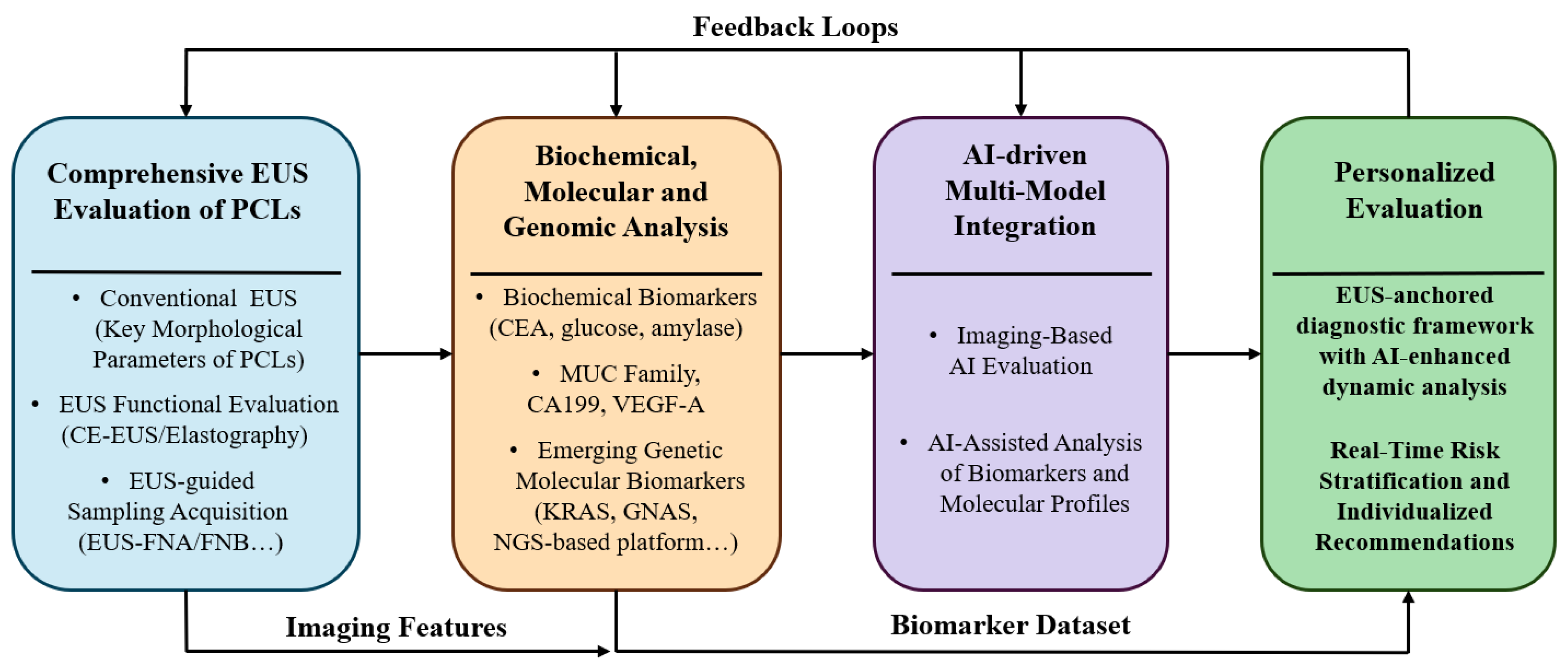
Figure 2.
Key systemic challenges and future transformation pathways for EUS-based, multi-modal approach for evaluation of PCLs: This schematic summarizes the major barriers limiting the implementation of EUS-based multimodal frameworks, variability in data acquisition and annotation (data standardization), uneven availability of advanced biomarker and molecular platforms (clinical accessibility), and the limited transparency of current AI-driven analysis models (AI interpretability). Corresponding future directions include harmonized multicenter strategies to unify imaging and molecular data standards, federated AI collaborations to enable secure inter-institutional model training, and the development of explainable deep learning architectures to enhance model transparency and clinical acceptance.
Figure 2.
Key systemic challenges and future transformation pathways for EUS-based, multi-modal approach for evaluation of PCLs: This schematic summarizes the major barriers limiting the implementation of EUS-based multimodal frameworks, variability in data acquisition and annotation (data standardization), uneven availability of advanced biomarker and molecular platforms (clinical accessibility), and the limited transparency of current AI-driven analysis models (AI interpretability). Corresponding future directions include harmonized multicenter strategies to unify imaging and molecular data standards, federated AI collaborations to enable secure inter-institutional model training, and the development of explainable deep learning architectures to enhance model transparency and clinical acceptance.
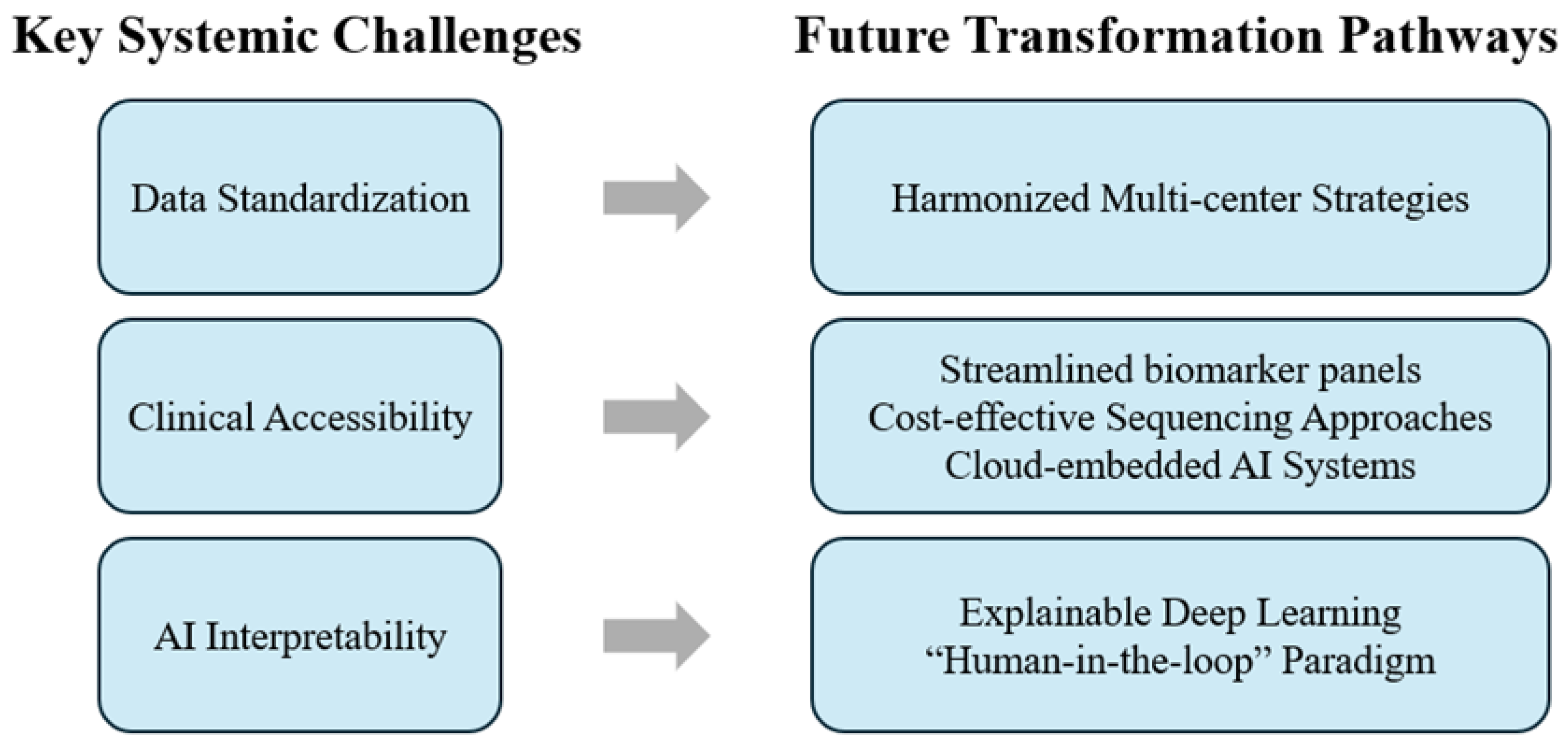

Table 1.
Clinical, Imaging, and Molecular Characteristics of Major Pancreatic Cystic Lesions.
| Features | BD-IPMNs | MD-IPMN or MT- IPMNs |
MCNs | SCNs | cNETs | SPNs |
|---|---|---|---|---|---|---|
| Age (years) | 50-70 | 50-70 | 30-50 | 60-80 | 50-60 | 20-40 |
| Gender | F=M | F=M | F (>95%) | F (70%) | M>F | F (>80%) |
| Location in pancreas | 50% in head and uncinate |
Any | 90% in body and tail |
Any | Any | Any |
| Clinical symptoms | Mostly no symptom when lesions are small | Mostly no symptom when lesions are small | Up to 50% of cases (might associate with compressive symptoms) | Up to 50% of cases (might associate compressive symptoms) | 90% asymptomatic. Functional symptoms (depend on secreted hormone) |
Mostly no. Abdominal pain or discomfort (37%) |
| Calcification | No | No | Rare peripheral calcification | Central calcification in 30-40% | No | Irregular |
| Malignant potential | Yes | Yes | Yes | None | Irregular | Irregular |
| EUS morphological features | Anechoic multiloculated lesion |
MD-IPMN: dilation of MPD (segmental or diffuse) MT-IPMN: dilation of MPD and BD- IPMN |
Single well- defined round shape with visible wall (pseudocapsule) and clear contours ‘orange-like’ or ‘cyst-in-cyst’ |
Multi- loculated lesions with irregular thin capsule |
Round and well-demarcated hypoechoic solid lesions with an anechoic area of cystic degeneration |
Single well- defined encapsulated with regular margins, hypoechoic solid or mixed |
| Glucose | Low | Low | Low | Normal | - | - |
| Amylase(U/L) | >250 | >250 | <250 | <250 | - | >250 |
| CEA (ng/mL) | >192 | >192 | >192 | <5 | <5 | <5 |
| KRAS mutation | Yes | Yes | Yes | Very rare | None | |
| GNAS mutation | - | Yes | Yes | - | - | - |
This table summarizes the clinical, imaging, and molecular characteristics of major pancreatic cystic lesions and supports differential diagnosis based on imaging patterns, morphologic features on EUS, biochemical markers, and key genomic alterations. (Abbreviations: BD-IPMNs: Branch-duct intraductal papillary mucinous neoplasms; MD-IPMNs: Main-duct intraductal papillary mucinous neoplasms; MT-IPMNs: Mixed-type intraductal papillary mucinous neoplasms; MCNs: Mucinous cystic neoplasms; SCNs: Serous cystic neoplasms; cNETs: Cystic neuroendocrine tumors; SPNs: Solid pseudopapillary neoplasms; CEA: Carcinoembryonic antigen; MPD: Main pancreatic duct.
Disclaimer/Publisher’s Note: The statements, opinions and data contained in all publications are solely those of the individual author(s) and contributor(s) and not of MDPI and/or the editor(s). MDPI and/or the editor(s) disclaim responsibility for any injury to people or property resulting from any ideas, methods, instructions or products referred to in the content. |
© 2026 by the authors. Licensee MDPI, Basel, Switzerland. This article is an open access article distributed under the terms and conditions of the Creative Commons Attribution (CC BY) license (http://creativecommons.org/licenses/by/4.0/).
Copyright: This open access article is published under a Creative Commons CC BY 4.0 license, which permit the free download, distribution, and reuse, provided that the author and preprint are cited in any reuse.


