

Submitted:
09 April 2026
Posted:
10 April 2026
You are already at the latest version
Abstract
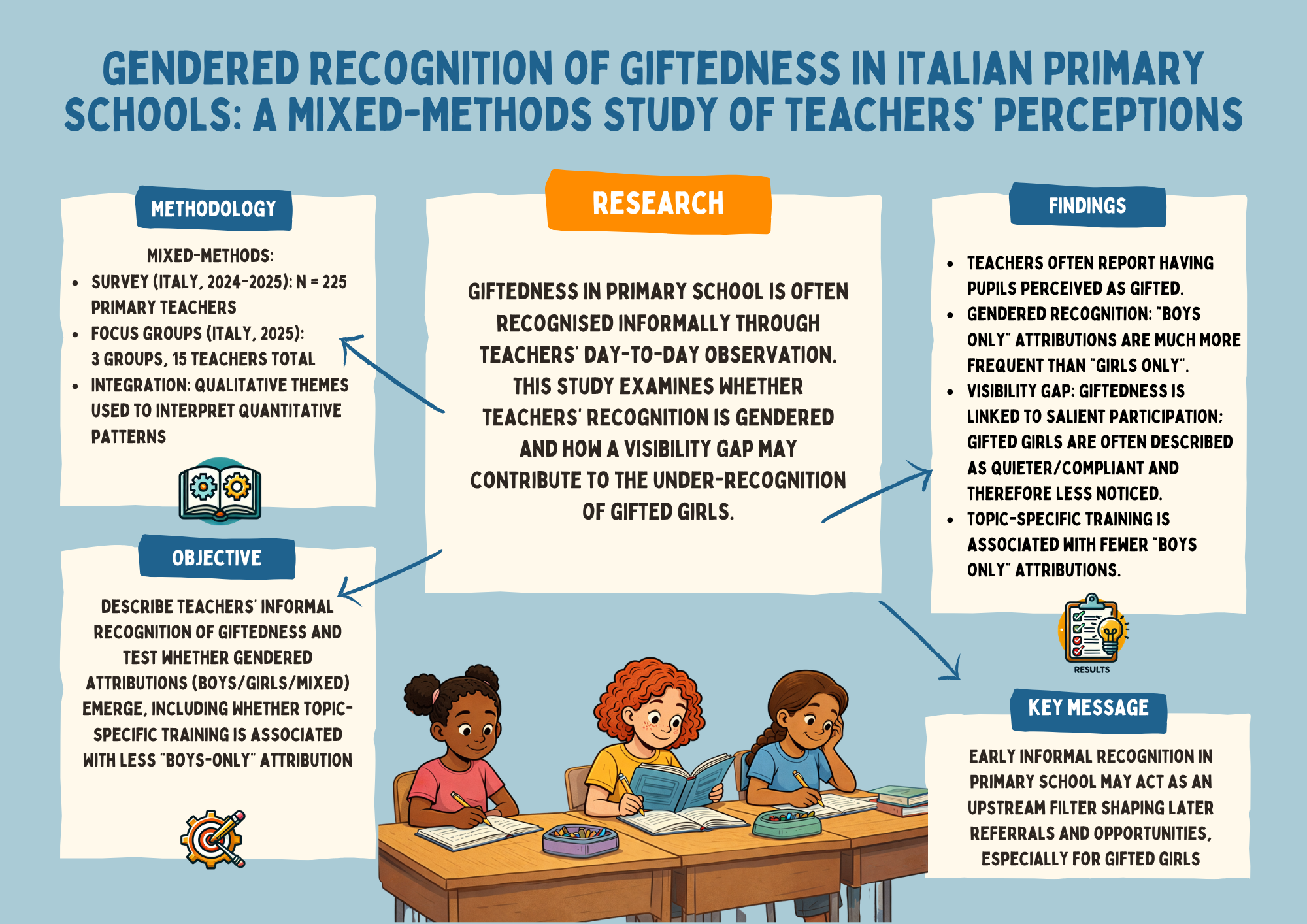
This mixed-methods study investigates primary school teachers’ perceptions of giftedness in girls and how gendered recognition processes may contribute to their under-identification in everyday educational practice. International research suggests that teachers’ professional judgement can be shaped by cognitive biases and gendered classroom norms, while many gifted girls may appear less visible because they tend to adapt to school expectations and remain under the radar. Against this background, the study examines whether similar dynamics emerge in the Italian context, where early recognition often relies on teachers’ classroom observation and educational decision-making. Quantitative data were collected through an online questionnaire administered to Italian primary school teachers in 2024. The survey explored teachers’ reported experience with pupils perceived as gifted (not formally assessed), their estimates of how many such pupils are present in their class, and the gender distribution they attributed to these pupils. Qualitative data were collected in 2025 through three focus groups, designed to deepen understanding of the observational criteria teachers use and the instructional decisions associated with recognising giftedness. Focus group transcripts were analysed using thematic analysis. Across the Italian sample, teachers widely reported having taught pupils they considered gifted; however, recognition was disproportionately attributed to boys, with girls mentioned substantially less often. Focus group discussions corroborated this pattern and helped clarify its educational mechanisms: teachers frequently linked giftedness to behavioural salience and participation styles (e.g., visibility, assertiveness, and, at times, disruptiveness), whereas gifted girls were more often described as compliant, discreet, and therefore less likely to be identified through the same informal criteria. Overall, the findings point to a visibility gap in early classroom recognition and underscore the need for teacher education and practical, gender-responsive observational tools that broaden conceptions of giftedness beyond overt performance and support more equitable differentiated instruction, reducing the risk of missed recognition of gifted girls in primary school.
Keywords:
giftedness
; gender bias
; primary school
; visibility gap
; informal identification
1. Introduction
In primary school, the early recognition of giftedness is a strategically important educational step, as it enables the implementation of differentiated teaching, enrichment, and support aligned with pupils’ learning needs (Brussino, 2021; Global Education Monitoring Report Team, 2020; Tomlinson, 2014). In the absence of systematic screening procedures or readily available specialist assessments, schools often rely on what is closest to everyday classroom life: teachers’ professional observation. In this context, recognising giftedness does not mean making a diagnosis, but rather interpreting educationally meaningful indicators (e.g., rapid learning, quality of reasoning, creativity, advanced interests, and linguistic or logical-mathematical competence) and deciding whether and how to adapt instruction. Moreover, teachers’ professional judgement also acts as a connecting step within identification processes, as it may trigger referrals to services, involve specialist professionals, and support school-family collaboration (National Association for Gifted Children, n.d.). For these reasons, the identification of possible giftedness can be understood as an educational practice of informal recognition and instructional decision-making, shaped by experience, training, and professional culture.
From an educational equity perspective, a central issue concerns the role of gender in school-based recognition processes. Research indicates that gifted girls may be less visible in the initial stages of recognition and referral, not because they are less capable, but because the cues that lead teachers to notice potential may be filtered through gendered expectations and implicit models of what a “typical” gifted pupil looks like. An expanding body of literature has examined the influence of gender on the identification and development of gifted girls, showing how recognition mechanisms and expectations may contribute to their under-identification (Biber et al., 2021; Salas-Guadiana & Gallardo-Córdova, 2022).
Studies on referral and nomination further suggest that teachers can become, often unintentionally, a critical point in the pathway: for comparable levels of potential, girls may be referred less frequently or interpreted through different criteria than their male peers (Bianco et al., 2011; Siegle, 2001; Siegle & Reis, 1998). In parallel, quantitative syntheses on identification and participation in gifted programmes report gender differences sufficiently consistent to suggest that the issue is not merely individual, but also linked to procedures and school practices (Petersen, 2013). From an educational standpoint, this raises a concrete concern: if primary school is a key setting for the early recognition of needs and potential, gender bias in recognition may produce unequal learning opportunities from the very first stages of schooling.
To support this perspective, descriptive models help explain how giftedness may take different forms and, in some cases, be less readily recognised in class. The notion of gifted profiles suggests that not all high-potential pupils express their competence in a uniform or consistently visible way; some trajectories may involve strategies of adaptation, concealment, or reduced visibility in order to fit in with peer-group dynamics (Betts & Neihart, 1988, 2010). In the case of girls, the literature has highlighted how social pressures and gender-role expectations may encourage more compliant and less demonstrative behaviour, with the risk that potential is interpreted mainly through indicators of “goodness” and diligence rather than as a need for cognitive challenge and enrichment (Reis, 1987; Siegle & Reis, 1998). From an educational perspective, the point is not to attribute psychological traits to girls, but to recognise that certain manifestations of potential may align less well with the informal criteria that typically guide teachers’ attention in everyday practice.
In recent years, studies on teachers’ and pre-service teachers’ beliefs have also shown that stereotypes can operate in combination: not only gender stereotypes, but also stereotypes about what a gifted student should be like. When these two frames overlap, they may shape educational expectations, behavioural interpretations, and ultimately the likelihood that a pupil is recognised as needing differentiated provision (Matheis et al., 2020). This is particularly relevant in primary school, where educational decisions are often based on observation and where specific preparation in gifted education is not always an integral part of professional training.
Within the international literature, research on teachers’ perceptions of high ability has found that professional training and prior experience are closely related to how teachers define, recognise, and interpret giftedness in the classroom (García Barrera et al., 2021). At the same time, recent contributions have drawn attention to the invisibility of gifted girls at school, suggesting that gender factors and dimensions such as self-concept may interact with school dynamics and the educational recognition of potential (Nogueira et al., 2025). Together, these findings support the need to investigate in primary school not only how many pupils are perceived as gifted, but also how such perceptions may be gendered and associated with conditions that make some girls less visible in informal recognition processes.
Despite the breadth of discussion on gender bias in gifted education, empirical gaps remain in everyday primary school contexts, particularly when the aim is to describe recognition patterns from teachers’ perspectives. In Italy, recent contributions have explored gifted education in primary school mainly in relation to teachers’ perceptions and training needs, without focusing specifically on gender attributions within informal recognition (Torello et al., 2024; Torello et al., 2025). In many systems, research concentrates on already-identified students or structured programmes; less common are studies that quantify how primary teachers estimate the presence of particularly able pupils in class and what gender they attribute to such profiles. From an educational standpoint, such information does not measure the true prevalence of high potential; rather, it captures the first link in the chain—what teachers notice, name, and consider worthy of differentiated provision.
The present study, conducted in the Italian context, uses a quantitative survey of primary school teachers and aims to describe and analyse patterns of educational recognition of giftedness and possible gender asymmetries in teachers’ attributions. In the context examined, the recognition of giftedness in primary school is often entrusted to observational–didactic practices and teachers’ professional decision-making, within procedures that are not always uniform. Analysing teachers’ attributions therefore provides an informative indicator of potential biases that may operate in the early stages of recognition.
The study objectives are to: (1) estimate the frequency with which teachers report having taught pupils who, because of perceived superior abilities, would require differentiated instruction; (2) describe how many “particularly able” pupils teachers believe they currently have in their class; (3) analyse how teachers distribute these attributions by gender (boys, girls, mixed groups), assessing whether there is a possible imbalance disadvantaging girls; and (4) explore the association between specific training on the topic and more or less balanced perception patterns.
From an applied perspective, the findings may offer concrete guidance for teacher education and the development of more equitable school practices: more explicit observational criteria, greater attention to less “noisy” and less overt profiles, and identification tools consistent with inclusive pedagogy and differentiated provision in primary school. In this sense, the focus of the study is not on pupils’ psychological characteristics, but on the educational conditions that facilitate, or at times hinder, the timely recognition of potential, particularly in girls.
2. Materials and Methods
The study adopts a mixed-methods design, shown in Figure 1, centred on primary school teachers’ professional practices and their role in the informal, school-based recognition of giftedness.The quantitative component (survey) describes the distribution of teachers’ perceptions and gender attributions; the qualitative component (focus groups) explores the observational criteria and interpretative frameworks that guide classroom recognition, with particular attention to the visibility of gifted girls.
Quantitative data were collected through an online questionnaire administered via Google Forms to primary school teachers in Italy. Data collection took place during the 2024-2025 period and yielded 225 responses distributed across all Italian regions. The questionnaire included items on teachers’ reported experience with pupils perceived as gifted, estimates of how many such pupils are present in the class, and gender attribution for pupils perceived as gifted (boys/girls/mixed), as well as background variables (age, years of service, school context, topic-specific training). Quantitative analyses included descriptive statistics and the examination of associations between gender attributions and professional variables using tests for categorical data and effect sizes (e.g., Cramer’s V/φ), and, where appropriate, odds ratio estimates. For interpretative comparison with the international literature, a synthetic indicator was also calculated based on the ratio between “boys only” and “girls only” attributions, excluding the “mixed” category, to be discussed as a measure of a perceptual pattern rather than true prevalence. For each analysis, the valid N was reported. The survey dataset was also used in a previous publication with different aims; in the present study it is re-analysed with a specific focus on gender bias in teachers’ attributions (Torello et al., 2024).
The qualitative component is based on three focus groups conducted with 15 primary school teachers (five per group) from different Italian regions. Participants were selected from the 225 teachers who completed the Italian survey through purposive sampling, based on interest and willingness to take part. Sessions (approximately 90 minutes) were moderated using a semi-structured guide and audio-recorded with informed consent; discussions were fully transcribed and anonymised. Transcripts were analysed using thematic analysis (Braun & Clarke, 2006), with coding oriented towards identifying teachers’ implicit prototypes of giftedness, the observational indicators used for recognition, references to gender differences in the expression/visibility of potential, and related educational and training implications. Integration between the two components was conducted at the interpretative level: focus-group findings were used to explain and contextualise the quantitative patterns by clarifying how teachers describe giftedness in everyday practice, which cues make potential more or less visible in the classroom, and how gendered expectations and norms may shape these processes. The focus-group corpus was also analysed in a previous publication with a different focus; here it is used exclusively to support interpretation of the quantitative findings on gender bias (Torello et al., 2025).
Participation in both the survey and the focus groups was voluntary and based on informed consent. Data were handled in anonymised form (or pseudonymised, where applicable), preventing the identification of individual teachers or schools.
3. Results
3.1. Quantitative Results
The quantitative component is based on 225 primary school teachers in Italy. The sample composition is consistent with the typical demographic and professional profile of the primary teaching workforce, characterised by substantial teaching experience and a predominance of middle-aged and older teachers. In particular, the age distribution shows a sizeable proportion of respondents aged over 50 (45.3%), followed by the 40-50 age group (36.0%), 30-40 (13.3%), and under 30 (5.3%). Similarly, years of service indicate a prevalence of teachers with more than ten years’ experience (70.2%), whereas 16.9% reported 1-5 years and 12.9% reported 6-10 years. Most respondents held a permanent contract (83.1%) and worked in settings differing in territorial size (village/town 53.3%, small city 31.1%, large city 15.6%). Regarding declared familiarity with the construct, most teachers reported knowing what giftedness is (91.1%). However, training-related data suggest that specific pathways are less common: only a minority reported having studied giftedness within their formal teacher education (18.7%) or having attended a dedicated course (21.3%).
A first indicator concerns teachers’ reported experience of teaching pupils perceived as gifted or, in educational terms, pupils considered “particularly able” and in need of differentiated teaching/enrichment. Overall, 146 teachers out of 225 (64.9%) reported having had pupils with these characteristics in their classes, whereas 79 (35.1%) did not report such experience. The estimate remains consistent when considering a 95% confidence interval: 64.9% (95% CI: 58.4%-70.8%). This result indicates that, in teachers’ professional perceptions, giftedness, understood here as a perceived need for differentiation linked to higher-than-average abilities, is commonly encountered in classroom practice.
When asked to estimate how many “particularly able” pupils are currently present in their class (a current, perception-based estimate), responses clustered clearly around one or a few pupils. The most frequent category was “one” (94/225; 41.8%), followed by “two to three” (85/225; 37.8%). Smaller proportions reported “none” (27/225; 12.0%), “four to five” (11/225; 4.9%), and “more than five” (8/225; 3.6%). Here too, confidence intervals indicate adequate precision for the main categories: “one” 41.8% (95% CI: 35.5%-48.3%) and “two to three” 37.8% (95% CI: 31.7%-44.3%), while “none” was 12.0% (95% CI: 8.4%-16.9%). Overall, teachers tend to locate perceived giftedness within a limited range (typically one or two to three pupils per class), consistent with a selective representation of the phenomenon.
The most quantitatively relevant result for the aims of this study is presented in Figure 2 and concerns the gender distribution attributed to pupils perceived as gifted. For this variable, the valid N was 224 (one missing response). Most teachers indicated mixed-gender groups (117/224; 52.2%; 95% CI: 45.7%-58.7%), but a substantial proportion attributed recognition to boys only (86/224; 38.4%; 95% CI: 32.3%-44.9%), whereas a markedly smaller proportion indicated girls only (21/224; 9.4%; 95% CI: 6.2%-13.9%).
This distribution is particularly informative because, despite a majority of “mixed” responses, the gap between “boys only” and “girls only” attributions is large and systematic. To construct a synthetic indicator comparable with discussions in the literature, while recognising that these are perceptual attributions rather than formal identification, we calculated the ratio between “boys only” and “girls only” attributions, excluding the “mixed” category. Within this subset, the ratio was 86/21 ≈ 4.10, that is, approximately four “boys only” attributions for every “girls only” attribution. This value provides an immediate measure of asymmetry in teachers’ attributions, as can be seen in Figure 3, and offers a starting point for discussing a potential visibility gap for gifted girls within informal classroom recognition practices.
Taken together, the quantitative findings depict a pattern in which: (1) many teachers report encountering pupils perceived as gifted over the course of their professional experience; (2) estimated numbers tend to cluster around one or a few pupils per class; and (3) gender attribution shows a marked imbalance in favour of boys when giftedness is attributed exclusively (“boys only” vs “girls only”). Because the measures used reflect professional perceptions rather than formal identifications, these results do not allow inferences about the true prevalence of giftedness by gender; however, they provide useful quantitative evidence for examining how informal recognition may display gendered patterns in Italian primary schools.
In addition, we explored the association between participation in a giftedness-specific course (yes/no) and selecting “boys only” in the gender-attribution variable for pupils perceived as gifted. As can be seen in Table 1, among teachers who had not attended a course, 73 out of 176 selected “boys only” (41.5%), whereas among those who had attended a course the same response was reported by 13 out of 48 teachers (27.1%).
The association was small in magnitude and close to conventional thresholds of statistical significance, χ²(1) = 3.30, p = 0.069 (Yates’ correction: χ²(1) = 2.72, p = 0.099), with φ = 0.12. In terms of odds, the odds ratio for selecting “boys only” was OR = 1.91 (95% CI [0.94, 3.86]) in favour of the no-course group compared with the course group.
3.2. Qualitative Results
Across the focus groups, a coherent picture emerged that aligns with the idea of giftedness being less visible in girls and with teachers’ informal recognition being shaped by behavioural salience and expected classroom norms. Teachers reported encountering pupils perceived as potentially gifted predominantly among boys, attributing this impression not to a true difference in ability, but to the fact that girls tend to appear more “well-adjusted” to the school context and therefore less noticeable. One teacher stated that “girls are generally more suited to the school context, but they do not stand out particularly”, and another remarked that “they are always more well-mannered, and this makes them less noticeable”. In multiple accounts, teachers described girls as generally “good”, compliant, and oriented towards doing what is required, noting that “they adapt to the context, they do not disturb, they do everything they are asked to do”, whereas the most visible forms of excellence were more often associated with boys characterised by greater exposure and, at times, oppositional or rebellious behaviour, which makes them more salient and easier to name as “gifted”. When referring to boys, teachers described “some very rebellious pupils”, who “tend to take over the scene, even by slightly overpowering others”, and who “stand out more”.
A particularly informative passage concerned teachers’ cultural interpretation of the phenomenon: some explicitly framed the observed difference as culturally shaped, noting that girls tend to invest in order, careful completion of tasks and turn-taking, whereas boys continue to intervene and “express their thinking”, increasing the likelihood that their potential will be noticed in discussion and oral participation. Overall, these qualitative findings suggest that, in everyday practice, giftedness is often recognised through a prototype centred on visibility, assertiveness and “bursts” of excellence, and that such a prototype may contribute to a perceptual flattening of gifted girls, with implications for teacher education and the adoption of observational indicators that are more sensitive to less overt female profiles.
3.3. Integration of Quantitative and Qualitative Findings
Overall, integrating the survey and focus-group findings reveals a clear convergence. Quantitative results indicate that, despite a prevalence of “mixed” responses, “boys only” attributions are far more frequent than “girls only” attributions, pointing to a potential visibility gap in informal classroom recognition of giftedness. The qualitative findings help to explain how this gap may arise in everyday school practice: teachers described girls as generally more adapted to the school context and less likely to stand out, and therefore less noticeable through salient cues, whereas boys were associated with greater communicative exposure and, at times, a more dominant or oppositional presence that makes them easier to name as “excellent”. From this perspective, the observed imbalance should not be interpreted as a difference in true prevalence, but rather as the outcome of an interaction between implicit prototypes of giftedness (centred on visibility and participation) and behaviour styles that are socially expected and reinforced in the classroom, with the risk that high-potential female profiles remain under the radar and are identified less often.
An additional element emerging from the quantitative data suggests that topic-specific training may attenuate this perceptual gap, at least to some extent: among teachers who reported having attended a giftedness-specific course, the proportion of “boys only” attributions was lower than among those who had not (27.1% vs 41.5%), indicating a small effect consistent with greater sensitivity to less salient profiles when broader interpretative tools are available. This pattern aligns with focus-group accounts, where recognition often appeared to be guided by “noisy” cues and visibility-oriented prototypes of excellence: teacher education may therefore contribute to widening such prototypes and making less overt female trajectories more observable.
4. Discussion
The present study, conducted in Italian primary schools and based on a mixed-methods design, examined how teachers perceive and recognise giftedness in everyday classroom practice, with a specific focus on the possible presence of gender bias in their attributions. A central finding from the survey is that, despite a majority of “mixed” responses, “boys only” attributions are substantially more frequent than “girls only” attributions, yielding a perceptual ratio (boys-only/girls-only) of approximately 4:1. Considered alongside the focus-group evidence, this quantitative pattern suggests that a non-trivial share of the gender gap observed at later stages, such as formal identification and participation in dedicated programmes, may have roots in the very first link in the chain: the informal, everyday, and often non-standardised recognition that takes place in the classroom.
A defining feature of the present work is the assumption that informal identification of giftedness in primary school is, first and foremost, an educational practice: teachers do not diagnose, but observe cues, interpret them, and decide whether to activate differentiated provision, enrichment, appropriately challenging tasks, cognitively demanding responsibilities, or strategies for extending the curriculum. This practical level is crucial because it shapes opportunities, expectations and school trajectories long before any formal assessment might occur. Research on referral and nomination has shown that teachers can represent a critical point in the identification process: small judgement biases may translate into systematic differences in access to opportunities (Bianco et al., 2011; Siegle & Powell, 2004). The specific contribution of our study is to show that, even without entering the domain of gifted programmes, this critical point is already observable as a perceptual pattern in primary teachers’ discourse and attributions.
A key interpretative anchor is the comparison with Petersen’s (2013) findings, which report a boys/girls ratio of approximately 1.19 in identification and participation in gifted programmes. Our measure is not directly comparable: it captures teachers’ attributions and informal school-based recognition rather than true prevalence or programme access. However, this difference in level makes the comparison theoretically informative: if the average downstream gap is moderate (1.19), but upstream, within teachers’ perceptions, appears more pronounced (around 4:1 when considering “boys only” versus “girls only” attributions), this is compatible with an educational hypothesis of early amplification and invisibility in the initial stages of the process. In other words, before formal criteria, tests, procedures and institutional decisions come into play, the asymmetry may already be shaped by informal observation practices and implicit prototypes of giftedness. This interpretation aligns with the view that aggregate outcomes result from a cumulative chain of decisions and selections, and that the first filter - teachers’ attention and classroom interpretation - may contribute substantially to producing gendered differences.
Integrating the focus groups makes it possible to give educational substance to the concept of a visibility gap. In the discussions, teachers often described giftedness in terms of indicators that increase salience: visibility in oral participation, initiative, assertiveness, the ability to “take over the scene”, and, at times, oppositional or disruptive behaviour. Such cues attract attention and tend to be remembered; as a result, they are more readily named as signs of excellence. By contrast, when speaking about girls, teachers frequently referred to more compliant and adaptive styles associated with greater discretion and lower exposure, which reduces the likelihood that potential will emerge through the same channels (Lee, 2002; Reis & Callahan, 1996). This dynamic does not require assuming innate differences; it is sufficient to recognise that primary school classrooms are environments shaped by implicit behavioural norms and that gender and socialisation can influence participation styles.
From a theoretical perspective, this aligns with the “Underground” profile described by Betts and Neihart (1988), which refers to gifted pupils who reduce the visibility of their talent for relational and adaptive reasons. Although it is a descriptive model rather than a causal test, it provides a useful frame for interpreting why some gifted girls may not be detected through noisy and highly visible cues. In addition, Reis (1987) highlighted that gifted girls may face specific pressures linked to social and school expectations, with a risk of underachievement or invisibility: while our study does not directly measure underachievement, it points to a plausible educational antecedent, namely, a lower likelihood of being recognised as gifted within teachers’ discourse. Complementary evidence in primary-school age groups also suggests that gender differences in psycho-educational variables such as self-esteem may indirectly contribute to different self-presentation styles, with potential implications for the classroom visibility of potential (García Perales et al., 2019). In this light, the literature on gifted females has also described internal barriers and personal decisions that may reduce the visibility of girls’ talent, particularly in contexts that reinforce compliance and the ethic of caring (Reis, n.d.).
A further key issue, with direct relevance for teacher education and classroom practice, concerns implicit prototypes: what counts as giftedness for a teacher? The literature shows that stereotypes about giftedness, for example, the idea of “brilliance” associated with certain outward manifestations, may interact with gender stereotypes, shaping educational expectations and the interpretation of behaviour (Matheis et al., 2020; Siegle et al., 2010). When this occurs, teachers may evaluate similar behaviours differently or attribute female excellence more to effort and diligence than to ability. This aligns with classic findings on gender differences in teacher and student perceptions of gifted pupils’ ability and effort, whereby girls are more often associated with higher effort (Siegle & Reis, 1998). From an educational standpoint, the risk is twofold: on the one hand, gifted girls may be recognised primarily as “good” and meticulous; on the other, they may receive fewer opportunities for cognitive challenge because their excellence is interpreted as conformity rather than as a need for enrichment.
The qualitative material suggests that giftedness is often identified through a prototype centred on performance and visibility. When this prototype is narrow, some profiles remain at the margins. The consequence is not only a missed label, but potentially a failure to activate appropriate instructional strategies - such as enrichment, authentic tasks, partial acceleration, and curriculum compacting - with implications for motivation and school well-being. Complementarily, research with pre-service teachers shows that representations of gifted pupils may include dimensions that are not strictly cognitive, contributing to a stereotyped profile that guides attention and interpretation (Ferrándiz et al., 2025). In our study, the focus groups suggest that behavioural salience and “noisy” participation function as privileged cues for naming giftedness, making plausible a mechanism of perceptual selection that disadvantages more compliant or less visible female profiles.
A further element consistent with a visibility/referral-bias interpretation concerns the role of topic-specific training. In the sample, teachers who had not attended a giftedness-specific course were more likely to attribute giftedness exclusively to boys than those who had attended a course (41.5% vs 27.1%; OR = 1.91, 95% CI [0.94, 3.86]). The association was small in magnitude and close to conventional thresholds of statistical significance (χ²(1) = 3.30, p = 0.069; Yates’ correction p = 0.099; φ = 0.12), but it is pedagogically informative in suggesting that training may help to broaden implicit prototypes of giftedness and make less salient profiles more recognisable, thereby attenuating gender imbalance in teachers’ attributions. Put differently, training may operate as an intervention on teacher noticing, what teachers attend to and what they value. This implication aligns with the Italian experience of LabTalento (University of Pavia), which emphasises the importance of preparing teachers and equipping them with instructional tools and observational criteria to recognise heterogeneous high-potential profiles, including those that are less “noisy” (Zanetti, 2017; Zanetti & Tamburnotti, 2020). A practical implication follows: it is not sufficient simply to “explain what giftedness is”; teacher education needs to address differentiated observational indicators, examples of heterogeneous profiles (including female profiles), and guided reflection on implicit bias, as also suggested by experimental work on pre-service teachers’ beliefs (Matheis et al., 2020). In this perspective, attenuating visibility/referral bias requires systematically designed training interventions - clear objectives, content, instructional strategies, and impact evaluation - consistent with models for planning and developing teacher education programmes described in the teacher education literature (Medina Rivilla et al., 2014). The training goal should be to broaden the prototype of giftedness by recognising less overt cues as well, such as the quality of pupils’ questions, conceptual connections, originality in solutions, rapid generalisation, and metacognitive capacities.
The findings allow implications to be articulated at three levels. At the teacher level, there is a need to strengthen systematic observation competences for recognising giftedness, distinguishing between good conduct/accuracy and a genuine need for cognitive challenge; this is particularly important for girls, who may be valued as “good” without any substantive differentiated provision being activated. At the classroom level, if visibility shapes recognition, teaching can be designed to offer multiple channels for the expression of potential: not only competitive oral participation, but also authentic tasks, creative products, small-group problem-solving, metacognitive journals, and structured discussions with equitable turn-taking, so that potential does not depend solely on the ability to “take centre stage”. At the organisational level, brief observational protocols and periodic rubrics can be introduced to ensure that a wider range of indicators is considered; from this perspective, teacher nomination should not be the only entry route, as the literature on nomination bias suggests (Siegle & Powell, 2004).
The results may also be interpreted in light of work that views the under-representation of girls in gifted pathways as the cumulative outcome of educational practices and selection processes that reproduce inequalities (dos Reis & Gomes, 2011). In this view, small differences in visibility or participation styles can be amplified by gendered educational practices - such as expectations, encouragement, opportunities and pathways - contributing over time to more pronounced differences in recognition and talent development trajectories (Kerr et al., 2012). It is therefore pertinent to situate our findings within a broader system-level pattern consistent with referral/visibility bias. Data disseminated by LabTalento indicate a marked gender imbalance among children who reach assessment (e.g., 2010-2015: 187 cases assessed, 170 boys and 17 girls), which does not speak to population prevalence but suggests a potential upstream bottleneck in access and referral (LabTalento, 2016a). Similarly, a press release referring to a sample of 111 children assessed (2009-2014) reports that, among those identified as high potential, the composition was 86 boys and 9 girls, while also highlighting the need to work with schools and to train teachers (Istituto di Ortofonologia, 2014; LabTalento, 2016b). Integrated with our evidence, these data reinforce the educational interpretation that what is noticed and named in the classroom may influence whether subsequent steps are activated (referral, assessment) and, therefore, the likelihood that girls’ giftedness is recognised and supported in a timely manner. This leads to operational implications consistent with an inclusive approach to fostering potential in primary school: making observational criteria more explicit, broadening prototypes of giftedness beyond overt visibility, and designing gender-responsive teacher education and practical identification tools that can capture less salient female profiles.
Finally, it is essential to reiterate that our study measures teachers’ attributions and estimates, not true prevalence or formal identification. The sample is non-probabilistic and may reflect self-selection; moreover, the “girls only” category is small, limiting the precision of some estimates. The focus groups are interpretative in nature: thematic analysis (Braun & Clarke, 2006) does not aim to “validate” statistically, but to understand meaning-making frameworks and educational criteria. That said, convergence between quantitative and qualitative evidence strengthens the argument: a quantitative pattern of imbalance is accompanied by coherent qualitative explanations in terms of visibility, behavioural norms, and implicit prototypes.
5. Conclusions
The present study, conducted in Italian primary schools using a mixed-methods design, highlights a critical issue that is often overlooked in debates on giftedness: early recognition depends to a large extent on teachers’ day-to-day practices of observation and interpretation, and it is precisely at this initial, informal stage that markedly gendered recognition patterns may emerge. The survey shows that, despite many “mixed” responses, attributing giftedness to “boys only” is far more frequent than attributing it to “girls only”, yielding a strongly unbalanced perceptual ratio. This evidence cannot be interpreted as a difference in true prevalence, but it is highly informative educationally because it captures what schools notice and label as gifted and, consequently, what they tend to activate, or fail to activate, in terms of differentiated teaching, enrichment, and opportunities for cognitive challenge.
Integrating the focus groups clarifies that this gap can be interpreted as a visibility issue. Teachers often associate giftedness with salient cues such as marked presence, assertiveness, intense participation and, at times, oppositional behaviour, which make certain profiles more noticeable and memorable. By contrast, many gifted girls are described as more compliant, rule-adherent and less exposed, with the risk of remaining under the radar and being recognised primarily as “good” and diligent rather than as learners with a specific educational need for enrichment and complexity. In this sense, the main conclusion is that the under-identification of gifted girls may be fuelled not only by factors external to school, but also by implicit criteria and professional prototypes that shape teacher noticing in primary classrooms.
A second relevant finding concerns training. In this sample, teachers who reported having attended a giftedness-specific course showed a lower tendency to attribute giftedness exclusively to boys. Although this result requires further confirmation, it is pedagogically meaningful in suggesting that training may function as a lever for equity by broadening observational indicators and making less salient profiles more recognisable. This aligns with the view that bias is not simply an individual error, but a professional and systemic phenomenon that can be reduced through instructional tools, shared criteria and targeted training pathways. From this perspective, teacher education should not be limited to general definitions of giftedness; it should include case-based work, heterogeneous profiles (including female profiles), practical indicators, and guided reflection on the gendered expectations that permeate classroom life.
Situating these findings in the Italian context also makes the connection with LabTalento’s service-access data particularly relevant, as these show a marked gender imbalance among children who reach assessment. Such figures do not estimate true prevalence, but they are compatible with the existence of a referral/visibility bias along the school-family-services chain: if girls’ giftedness is less visible in everyday recognition practices, it is plausible that girls are also referred less often and less frequently routed into further assessment pathways. A key operational implication follows: intervening in school-based observation and recognition practices is not a peripheral matter, but a decisive step towards reducing under-identification and ensuring more equitable educational opportunities.
Finally, the evidence points to several concrete directions for primary schooling: promoting a conception of giftedness that is less dependent on behavioural salience and more attentive to cognitive indicators that may also be observable in “quiet” profiles; structuring multiple opportunities for cognitive visibility in the classroom that do not rely solely on competitive oral participation; introducing light-touch but systematic procedures for observation and monitoring so that identification is not left only to memory or impression; and integrating these practices with training pathways focused on prototypes, bias, and gender-responsive indicators. From a research perspective, it will be important to test these hypotheses with larger samples and designs that triangulate teachers’ perceptions with more structured observational tools and educational outcome measures, in order to determine the extent to which broadening recognition criteria translates into more appropriate educational provision and a tangible reduction in gender gaps in the recognition of giftedness.
Author Contributions
Conceptualisation, E.D.T., E.P.N., and E.B.; methodology, E.D.T., E.P.N., and E.B.; validation, E.D.T., E.P.N., and E.B.; formal analysis, E.D.T., E.P.N., and E.B.; investigation, E.D.T., E.P.N., and E.B.; writing—original draft preparation, E.D.T., E.P.N., and E.B.; writing—review and editing, E.D.T., E.P.N., and E.B. All authors have read and agreed to the published version of this manuscript.
Funding
This research received no external funding.
Institutional Review Board Statement
Ethical review and approval were waived for this study due to the non-invasive nature of the procedures and the anonymity of participants. This study involved adult volunteers (teachers), and no sensitive personal data were collected.
Informed Consent Statement
Informed consent was obtained from all participants involved in this study. In accordance with the GDPR, all data were collected and processed in aggregated form, without including any personal or sensitive information.
Data Availability Statement
The data are not publicly available due to privacy and ethical restrictions.
Conflicts of Interest
The authors declare no conflicts of interest.
References
- (Betts & Neihart, 1988) Betts, G. T., & Neihart, M. (1988). Profiles of the gifted and talented. Gifted Child Quarterly, 32(2), 248-253. [CrossRef]
- (Betts & Neihart, 2010) Betts, G. T., & Neihart, M. (2010). Revised profiles of the Gifted & Talented. [Revised profiles matrix]. Queensland Association for Gifted and Talented Children. https://www.qagtc.org.au/sites/www.qagtc.org.au/files/media/documents/Neihart%26Betts_PROFILES-BEST-REVISED-MATRIX-2010.pdf.
- (Bianco et al., 2011) Bianco, M., Harris, B., Garrison-Wade, D., & Leech, N. (2011). Gifted girls: Gender bias in gifted referrals. Roeper Review, 33(3), 170-181. [CrossRef]
- (Biber et al., 2021) Biber, M., Biber, S. K., Ozyaprak, M., Kartal, E., Can, T., & Simsek, I. (2021). Teacher nomination in identifying gifted and talented students: Evidence from Turkey. Thinking Skills and Creativity, 39, 100751. [CrossRef]
- (Braun & Clarke, 2006) Braun, V., & Clarke, V. (2006). Using thematic analysis in psychology. Qualitative Research in Psychology, 3(2), 77-101.
- (Brussino, 2021) Brussino, O. (2021). Building capacity for inclusive teaching: Policies and practices to prepare all teachers for diversity and inclusion (OECD Education Working Papers No. 256). OECD. [CrossRef]
- (dos Reis & Gomes, 2011) dos Reis, A. P. Z., & Gomes, C. A. (2011). Educational practices leading to the reproduction of inequality: The underrepresentation of girls among gifted students. Revista Estudos Feministas, 19(2), 503-520. [CrossRef]
- (Ferrándiz et al., 2025) Ferrándiz, C., Ferrando, M., Infantes-Paniagua, Á., Fernández-Vidal, M. C., & Pons, R. M. (2025). Pre-service teachers’ perceptions of physical, socioemotional and cognitive traits in gifted students: Unveiling bias? Frontiers in Sports and Active Living, 6, 1472880. [CrossRef]
- (García Barrera et al., 2021) García Barrera, A., Monge López, C., & Gómez Hernández, P. (2021). Percepciones docentes hacia las altas capacidades intelectuales: relaciones con la formación y experiencia previa. Revista Electrónica Interuniversitaria de Formación del Profesorado, 24(1), 239-251. [CrossRef]
- (García Perales et al., 2019) García Perales, R., Canuto González, I., & Cebrián Martínez, A. (2019). Alta capacidad y género: La autoestima como factor influyente en las diferencias entre sexos. Contextos Educativos: Revista de Educación, (24), 77-93.
- (Global Education Monitoring Report Team, 2020) Global Education Monitoring Report Team. (2020). Global education monitoring report 2020: Inclusion and education: All means all. UNESCO.
- (Istituto di Ortofonologia, 2014) Istituto di Ortofonologia. (2014, October 18). Minori. A Pavia dal 2010 LabTalento (UNIPV) individua plusdotati. A Roma IDO attiva laboratorio per scuole e famiglie Centro Sud [Press release]. https://www.ortofonologia.it/allegati/plusdotati/Comunicato_stampa_plusdotati.pdf.
- (Kerr et al., 2012) Kerr, B. A., Vuyk, M. A., & Rea, C. (2012). Gendered practices in the education of gifted girls and boys. Psychology in the Schools, 49(7), 647-655. [CrossRef]
- (LabTalento, 2016a) LabTalento. (2016a, February 19). Startupitalia.it - “Bambini plusdotati, nasce la rete a sostegno di famiglie e insegnanti” [Webpage]. Laboratorio Italiano di Ricerca e Sviluppo del Talento, del Potenziale e della Plusdotazione, Università di Pavia. https://labtalento.unipv.it/startupitalia-it-bambini-plusdotati-nasce-la-rete-a-sostegno-di-famiglie-e-insegnanti/.
- (LabTalento, 2016b) LabTalento. (2016b, January 10). Cittadeibimbi.it - “Plusdotati, la scuola italiana deve educare il talento” [Webpage]. Laboratorio Italiano di Ricerca e Sviluppo del Talento, del Potenziale e della Plusdotazione, Università di Pavia. https://labtalento.unipv.it/cittadeibimbi-it-plusdotati-la-scuola-italiana-deve-educare-il-talento/.
- (Lee, 2002) Lee, S.-Y. (2002). Young gifted girls and boys: A comparison of their views of self and the perceptions of others. Contemporary Issues in Early Childhood, 3(3), 383-399. [CrossRef]
- (Matheis et al., 2020) Matheis, S., Keller, L. K., Kronborg, L., Schmitt, M., & Preckel, F. (2020). Do stereotypes strike twice? Giftedness and gender stereotypes in pre-service teachers’ beliefs about student characteristics in Australia. Asia-Pacific Journal of Teacher Education, 48(2), 213-232. [CrossRef]
- (Medina Rivilla et al., 2014) Medina Rivilla, A. M., Pérez Sánchez, L., & Campos Barrionuevo, B. (Coords.). (2014). Elaboración de planes y programas de formación del profesorado en didácticas especiales. UNED.
- (National Association for Gifted Children, n.d.) National Association for Gifted Children. (n.d.). Identification. Retrieved March 13, 2026, from https://portal.nagc.org/page/identification.
- (Nogueira et al., 2025) Nogueira Raquel Cordeiro Sormani, da Silva, D. & Duarte Nogueira, M. T. (2025). La invisibilidad de las niñas superdotadas en la escuela: Un diálogo entre género y autoconcepto. TALINCREA: Talento, Inteligencia y Creatividad, 11(3), Article 214. [CrossRef]
- (Petersen, 2013) Petersen, J. (2013). Gender differences in identification of gifted youth and in gifted program participation: A meta-analysis. Contemporary Educational Psychology, 38(4), 342-348. [CrossRef]
- (Reis, n.d.) Reis, S. M. (n.d.). Internal barriers, personal issues & decisions faced by gifted and talented females. Renzulli Center for Creativity, Gifted Education, and Talent Development, University of Connecticut. Retrieved March 14, 2026, from https://gifted.uconn.edu/schoolwide-enrichment-model/internal_barriers_gifted_females/.
- (Reis, 1987) Reis, S. M. (1987). We can’t change what we don’t recognize: Understanding the special needs of gifted females. Gifted Child Quarterly, 31(2), 83-89.
- (Reis & Callahan, 1996) Reis, S. M., & Callahan, C. M. (1996). My boyfriend, my girlfriend, or me: The dilemma of talented teenagers. Journal of Secondary Gifted Education, 7(4), 434-46.
- (Salas-Guadiana & Gallardo-Córdova, 2022) Salas-Guadiana, E., & Gallardo-Córdova, K. (2022). Revisión de la literatura sobre el tema de la influencia del género en la identificación y desarrollo de alumnas talentosas. Revista Brasileira de Educação Especial, 28, e0025. [CrossRef]
- (Siegle, 2001) Siegle, D. (2001). Teacher bias in identifying gifted and talented students. Paper presented at the Annual Meeting of the Council for Exceptional Children, Kansas City, MO.
- (Siegle et al., 2010) Siegle, D., Moore, M., Mann, R. L., & Wilson, H. E. (2010). Factors that influence in-service and pre-service teachers’ nominations of students for gifted and talented programs. Journal for the Education of the Gifted, 33(3), 337-360. [CrossRef]
- (Siegle & Powell, 2004) Siegle, D., & Powell, T. (2004). Exploring teacher biases when nominating students for gifted programs. Gifted Child Quarterly, 48(1), 21-29. [CrossRef]
- (Siegle & Reis, 1998) Siegle, D., & Reis, S. M. (1998). Gender differences in teacher and student perceptions of gifted students’ ability and effort. Gifted Child Quarterly, 42(1), 39-47. [CrossRef]
- (Tomlinson, 2014) Tomlinson, C. A. (2014). The differentiated classroom: Responding to the needs of all learners (2nd ed.). ASCD.
- (Torello et al., 2024) Torello, E. D., Pérez Navío, E., & Bocciolesi, E. (2024). Gifted education in primary school. The training needs of teaching / Plusdotazione nella scuola primaria. I bisogni formativi della docenza. QTimes - Journal of Education, Technology and Social Studies, 16(3). [CrossRef]
- (Torello et al., 2025) Torello, E. D., Pérez Navío, E., & Bocciolesi, E. (2025). Gifted Education and Primary School: A Qualitative Analysis of Italian Teachers’ Perceptions. Education Sciences, 15(11), 1420. [CrossRef]
- (Zanetti, 2017) Zanetti, M. A. (Ed.). (2017). Bambini e ragazzi ad alto potenziale: Una guida per educatori e famiglie. Carocci.
- (Zanetti & Tamburnotti, 2020) Zanetti, M. A., & Tamburnotti, E. (2020). Famiglie ad alto potenziale: Comprendere e accompagnare la crescita dei figli. Carocci.
Figure 1.
Methodological framework adopted.
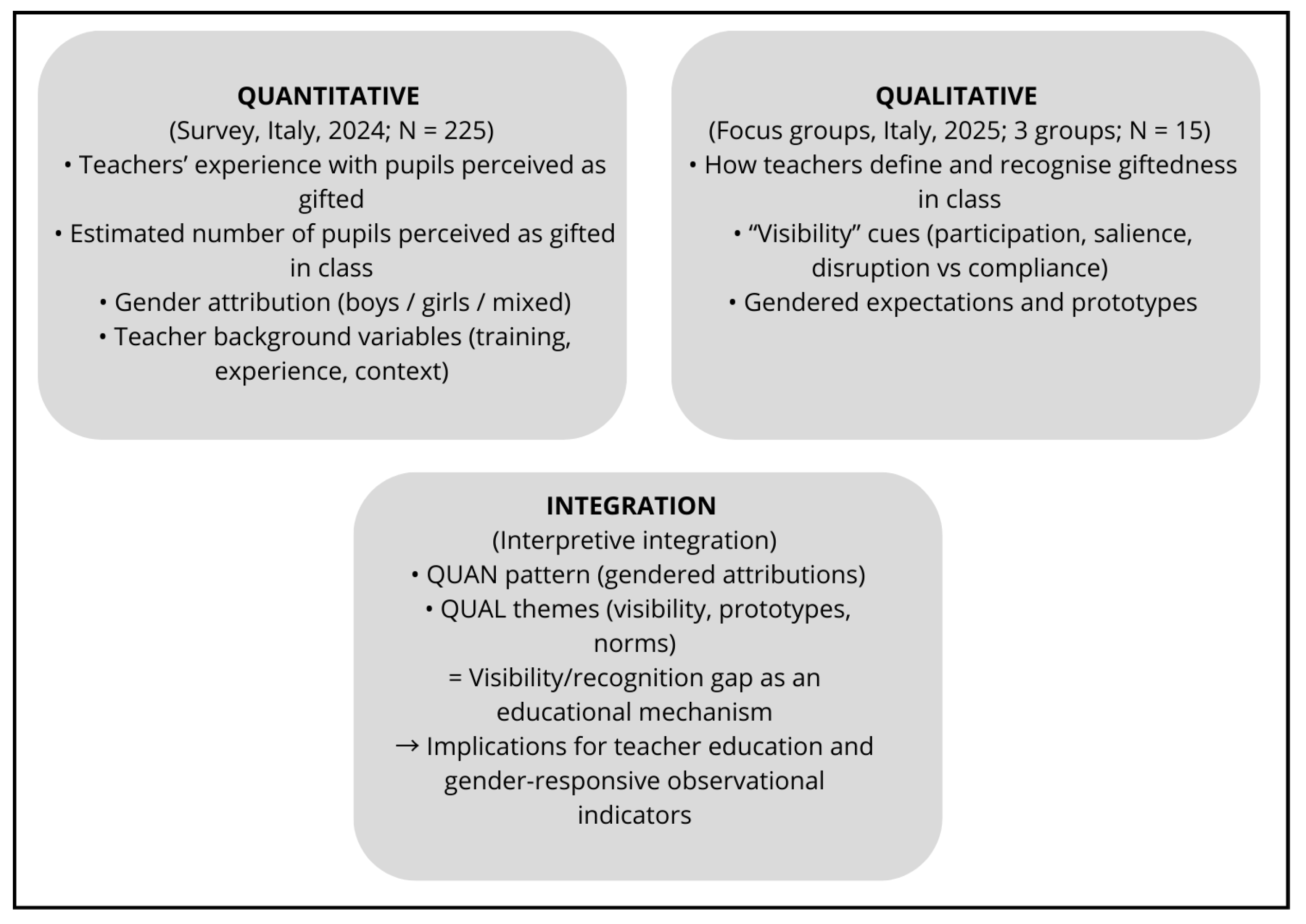
Figure 2.
Main outcomes on teachers’ perceptions of giftedness.
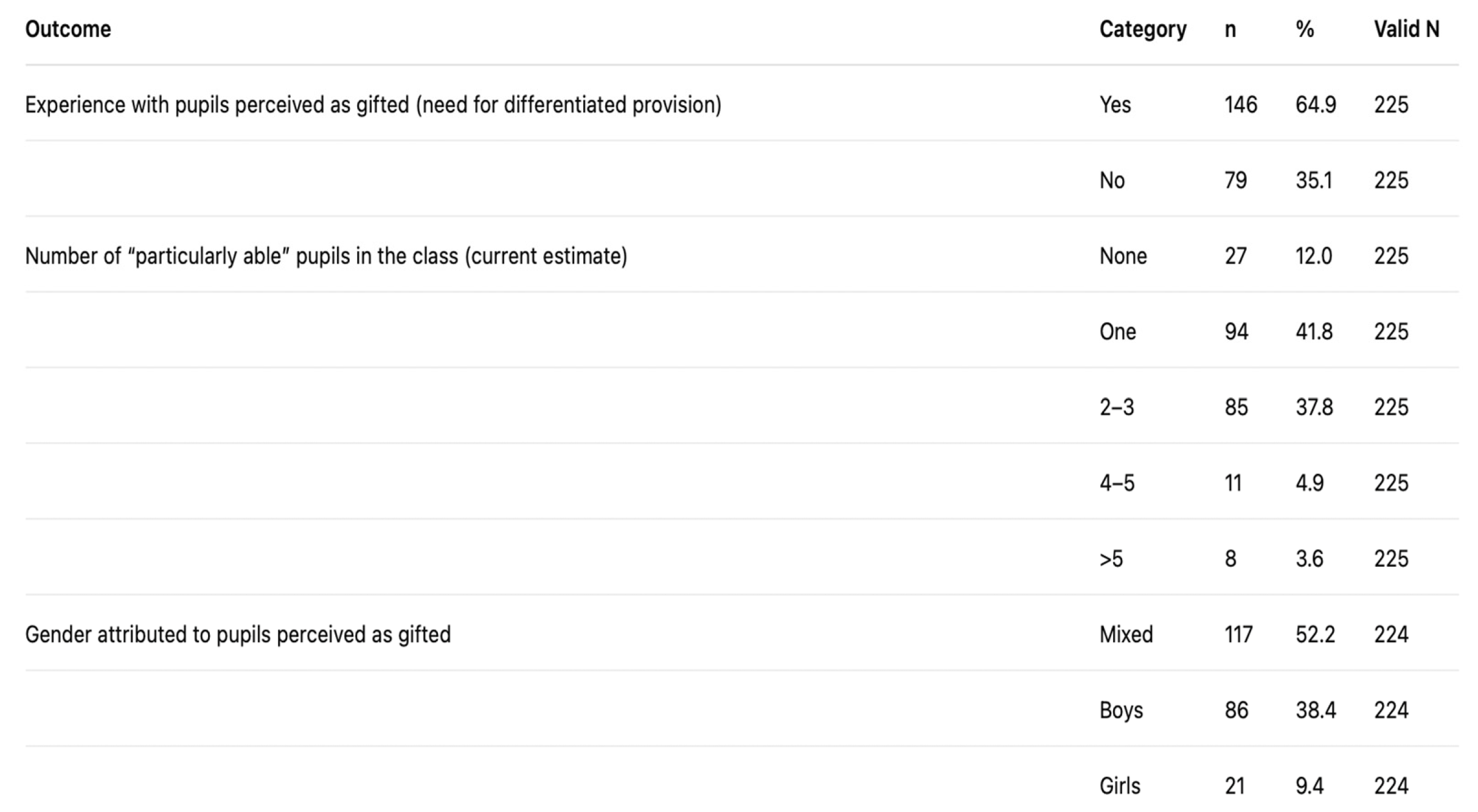
Figure 3.
Teachers’ gender attribution for pupils perceived as gifted (boys only, girls only, mixed). Percentages are calculated on valid responses (N = 224); values above bars indicate % and n/N.
Figure 3.
Teachers’ gender attribution for pupils perceived as gifted (boys only, girls only, mixed). Percentages are calculated on valid responses (N = 224); values above bars indicate % and n/N.
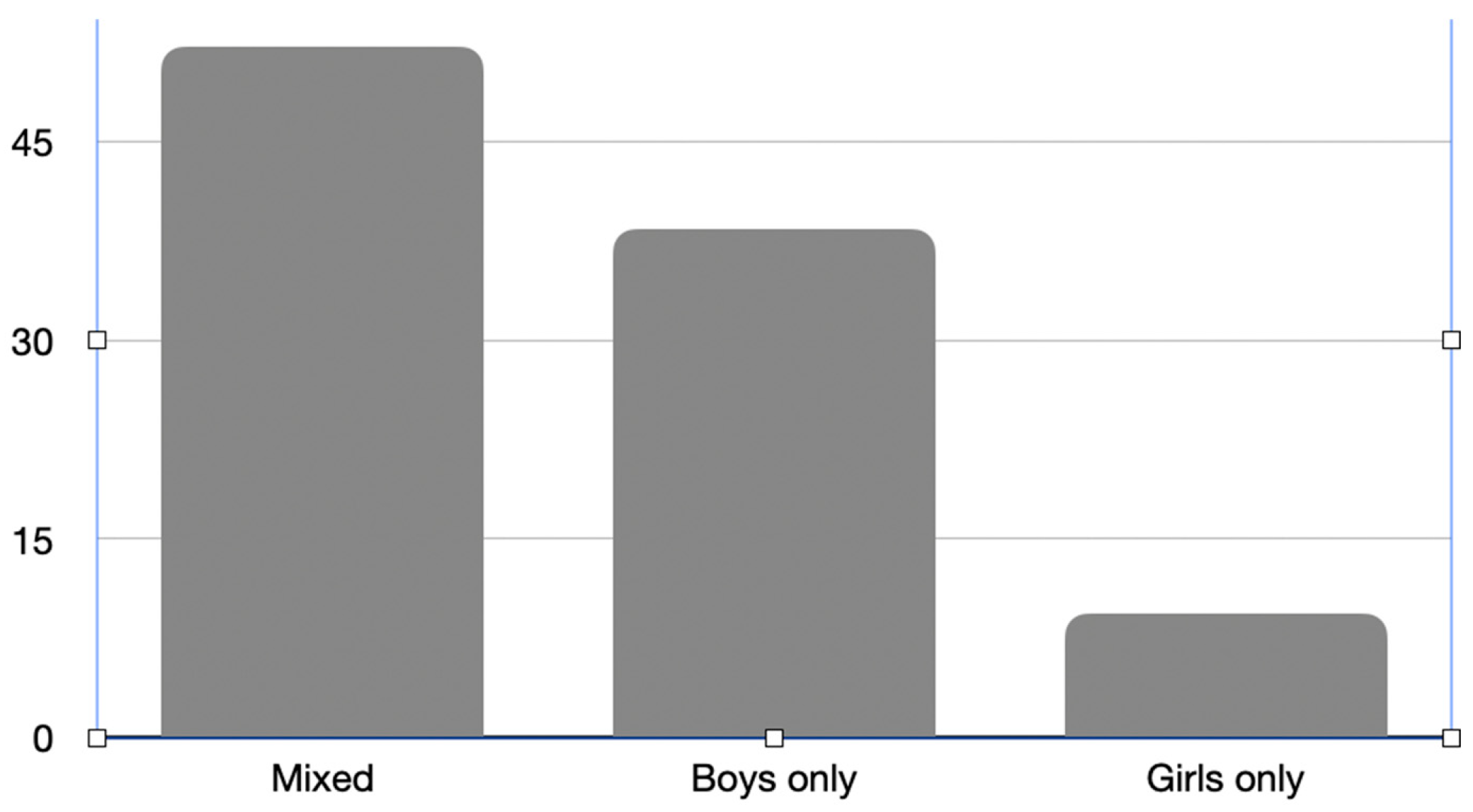

Table 1.
Percentage of teachers attributing giftedness to boys only (“Maschi”) by participation in a giftedness-specific course (Yes/No). Percentages computed on valid responses (N = 224).
Table 1.
Percentage of teachers attributing giftedness to boys only (“Maschi”) by participation in a giftedness-specific course (Yes/No). Percentages computed on valid responses (N = 224).
| Giftedness specific course |
“Boys only” (n) | Valid total (N) | “Boys only” percentage |
|---|---|---|---|
| No | 73 | 176 | 41,5% |
| Yes | 13 | 48 | 27,1% |
Disclaimer/Publisher’s Note: The statements, opinions and data contained in all publications are solely those of the individual author(s) and contributor(s) and not of MDPI and/or the editor(s). MDPI and/or the editor(s) disclaim responsibility for any injury to people or property resulting from any ideas, methods, instructions or products referred to in the content. |
© 2026 by the authors. Licensee MDPI, Basel, Switzerland. This article is an open access article distributed under the terms and conditions of the Creative Commons Attribution (CC BY) license (http://creativecommons.org/licenses/by/4.0/).
Copyright: This open access article is published under a Creative Commons CC BY 4.0 license, which permit the free download, distribution, and reuse, provided that the author and preprint are cited in any reuse.


