

Submitted:
09 April 2026
Posted:
10 April 2026
You are already at the latest version
Abstract
Students who stall in the final stage of their degree rarely do so because they lack technical skill. More often, confidence erodes under sustained uncertainty, motivation shifts from intrinsic engagement to anxious compliance, and the demands of organizing months of research exceed what willpower alone can sustain. This study examines those emotional and motivational dynamics directly, treating research self-efficacy and intrinsic motivation not as background variables but as the affective-motivational core of thesis performance. Using partial least squares structural equation modeling (PLS-SEM) grounded in self-determination theory and social cognitive theory, we tested an integrative model with data from 396 undergraduate students actively completing theses at public and private universities in the northern region of Peru. Four enabling factors — methodological competencies, intrinsic motivation, tutorial support, and resources and conditions — were linked to thesis quality and process efficiency through two mediating mechanisms: research self-efficacy (the confidence to face methodological difficulty without retreating) and project management (the behavioral self-regulation that converts motivation into organized work). Resources and conditions showed the strongest associations in the model, with the largest effects on both project management (β = 0.533) and research self-efficacy (β = 0.418). Self-efficacy, in turn, was the primary predictor of thesis quality (β = 0.518), while project management and quality together drove process efficiency. The model explained 70.5% of variance in thesis quality and 81.4% in process efficiency. These patterns point to a concrete institutional lever: securing the material and temporal conditions that allow students to do the work, rather than attributing delays solely to failures of individual motivation.
Keywords:
affective-motivational mechanisms
; research self-efficacy
; intrinsic motivation
; self-regulated learning
; thesis completion
; academic emotions
; psychoeducational mechanisms
; higher education
; PLS-SEM
1. Introduction
Over the past three decades, higher education enrollment has expanded dramatically, and degree completion has become a central concern for both institutional management and public policy. By 2020, more than 235 million students were enrolled in tertiary education worldwide, with access increasingly extending to previously underrepresented populations (UNESCO, 2022). Yet access and completion are not the same thing. The final stages of a degree program — where students must integrate research skills, sustained academic writing, and autonomous work management into a coherent product — concentrate a disproportionate share of delays, interruptions, and dropouts. These stalls carry costs that extend well beyond the individual: they strain institutional resources, reduce the efficiency of education systems, and shape the developmental trajectories of young adults at a moment when professional identity is still taking form.
On-time completion remains the exception rather than the rule, even in systems with strong infrastructure. OECD data show that only 38% of students enrolled in bachelor’s programs complete within the nominal period; an additional 40% are still enrolled, while 21% have dropped out without a credential (OECD, 2022). Even three years after the expected completion point, only 65% have earned any bachelor’s degree, and roughly 23% have left entirely without graduating. These rates differ across fields: STEM graduates at the three-year mark reach 68%, compared to 80% in health and welfare, suggesting that programs with heavier methodological demands face attrition challenges (OECD, 2022). The personal and social costs compound over time. Delayed graduates enter the labor market later and recover less return on their investment in education. Each delayed cohort consumes additional faculty time and institutional resources. In Latin America and the Caribbean, these patterns sit on top of structural inequality: roughly 46% of 25–29-year-olds with some tertiary exposure had completed a degree, while 34% had dropped out and one-fifth remained enrolled without credentials (World Bank, 2021). The regional net completion rate of 25.1% falls below both the OECD average (40%) and the global average (30.8%), pointing to losses in both internal efficiency and the pipeline for advanced human capital (Inter-American Development Bank, 2024). When these delays reach the thesis stage, the cost is compounded: all the sunk costs of years of training have already been absorbed, yet the final credential remains out of reach. Students who work while studying, or who lack academic or material support, are disproportionately the ones who fall short at this last step.
At this stage, the thesis is unlike any prior academic task. It requires defining a problem, sustaining a reasoning chain across many months of evidence-gathering, managing iterated feedback, and producing a document that meets disciplinary standards in argument, method, and voice. The university no longer asks students to demonstrate that they have absorbed content; it asks them to produce knowledge. That transition is harder than it looks from the outside. The literature on thesis supervision agrees that advisor support matters, but it also shows that supervisory arrangements are riddled with asymmetric expectations, inconsistent criteria, and time pressures on both sides. Recent work has documented systematic mismatches between how supervisors and students perceive the quality of feedback engagement in master’s theses, with direct consequences for revision quality and work momentum (Neupane Bastola & Hu, 2024). Systematic reviews find that, despite the centrality of supervision to doctoral and undergraduate education alike, there is still no evidence-based consensus on what makes it effective (Grohnert et al., 2024). In resource-constrained settings, these gaps compound infrastructure deficits, faculty workloads, and a shortage of protected time for supervision interrupt the continuity that sustained thesis work requires (Mhlongo & Zuma, 2024).
Emotional and motivational states are not peripheral to thesis performance — they shape it directly. Among graduate students, a meta-analysis of 53 studies found clinically significant depression in 24% of doctoral students and anxiety in 17%, with both conditions associated with reduced academic productivity and elevated dropout risk (Satinsky et al., 2021). A separate meta-analysis documenting 34.8% anxiety prevalence across graduate populations found rates have risen over the past decade, driven in part by the chronic uncertainty built into research work (Chi et al., 2023). These affective pressures coincide with the developmental tasks of emerging adulthood: students writing their these are simultaneously consolidating their academic identity, building self-regulatory habits, and confronting career-defining decisions (Arnett, 2000). Emotional difficulties at this juncture do not remain contained within the thesis itself — they carry forward into professional trajectories. At the behavioral level, students with lower research self-efficacy tend to procrastinate more, a relationship partially mediated by deficits in academic self-control (Liu et al., 2020). The practical consequences are concrete: drafts stall, revision cycles multiply, and cumulative emotional exhaustion erodes both the quality of the final product and the pace of its production. Understanding which conditions buffer against this pattern — and which motivational mechanisms translate those conditions into sustained progress — is the organizing question this study addresses.
The research base on these dynamics is fragmented in a specific way: supervision and feedback occupy one literature; academic writing and self-efficacy occupy another; material conditions and resource access occupy a third. Each has generated useful findings, but the silos make it hard to see how these factors operate together as a system. The field lacks integrative models that treat thesis quality and process efficiency as co-produced outcomes rather than alternative dependent variables — an important distinction, because a student can produce mediocre work efficiently, or excellent work at ruinous personal cost. The connection to emotional experience is not incidental here: thesis quality and student wellbeing are shaped by the same institutional conditions, the same motivational dynamics, and the same capacity to regulate affect under sustained uncertainty. STEM programs, where methodological demands are heavier and three-year completion rates lower (OECD, 2022), expose this gap most clearly. Methodologically, partial least squares structural equation modeling (PLS-SEM) suits this kind of problem: it handles moderate sample sizes, does not assume multivariate normality, and is designed for predictive rather than purely confirmatory purposes. Its application in higher education research has been limited — Ghasemy et al. (2020) identified only 49 published uses between 1999 and 2018 — which leaves room for studies that bring this approach to bear on psychoeducational questions.
This study addresses that gap by testing an integrative PLS-SEM model that simultaneously explains thesis quality and process efficiency, treating both as products of the same psychoeducational system. The theoretical backbone draws on self-determination theory and social cognitive theory, locating intrinsic motivation and research self-efficacy as affective-motivational mechanisms that mediate between enabling conditions and academic outcomes. The contribution is empirical and conceptual: empirically, it provides a tested structural model with high explanatory power for two co-produced outcomes; conceptually, it connects factors usually analyzed in isolation — supervisor support, material resources, methodological competencies, motivational states, and self-regulatory capacity — into a single coherent account of what makes thesis work succeed or stall. The methods section that follows describes the sample, instruments, and analytic procedure.
1.1. Recent Evidence on Thesis Supervision and Psychoeducational Mechanisms
In the most recent stretch of literature, the supervision of thesis work is described less as a homogeneous practice and more as a set of pedagogical functions and micro-decisions that are contingently activated according to discipline, academic culture and institutional demands. A multinational, multilingual analysis found that supervisors draw on a broad repertoire of functions extending well beyond technical feedback, suggesting that “tutorial support” operates as a multidimensional construct that resists capture by isolated indicators (Guarimata-Salinas et al., 2024). The socioemotional dimension adds another layer: in high-accountability contexts, the supervisor’s emotional regulation becomes part of the invisible work sustaining the pedagogical relationship, with direct implications for the quality of the supervisory climate and the continuity of the process (Han et al., 2024; Chen & Chen, 2025). Regarding more tangible outcomes, different supervisory emphases appear linked to distinct student trajectories — some styles are associated with higher perceived quality in the final product, while others favor timely completion, revealing a real tension between formative depth and efficiency (Mårtensson & Söderström, 2025).
At the interface between tutorial support and product quality, recent research has focused on how students process and translate feedback into revision actions, which connects to methodological competencies and project management. In a study of undergraduate dissertations, student engagement with supervisory feedback was shaped not simply by advisor availability, but by the argumentative clarity of that feedback, the negotiation of meaning, and students’ capacity to sustain methodological decisions under uncertainty (Luo & Hu, 2024). Complementary evidence from doctoral writing groups shows that collaborative discussion and peer feedback foster situated learning about textual evaluation and argumentative justification — drawing a clear bridge between methodological competencies and dissertation quality (de Caux & Pretorius, 2024). Research on undergraduate learning outcomes across disciplinary areas further reveals that results are far from uniform, depending heavily on the conditions of participation in research practices — a finding that underscores the importance of accounting for contextual variation when modeling thesis quality and process efficiency (Hong, 2024).
In terms of psychoeducational mechanisms, the evidence from 2023–2025 reinforces that intrinsic motivation and self-efficacy not only accompany the thesis process but can also operate as explanatory pathways between support and outcomes. Using a motivational profiles approach grounded in self-determination theory, Litalien et al. (2024) identified configurations linked to persistence, performance, and well-being; students in more self-determined profiles reported greater perceived support and psychological need satisfaction — offering an empirical basis for understanding why some students sustain effort through the most demanding phases of the process. At the graduate level, supervisor support has been linked to creative performance outcomes through psychological mediators — specifically, research self-efficacy and intrinsic motivation both acting as partial mediators — suggesting that resource-focused interventions alone may fall short if they do not also activate capability beliefs and autonomous regulation (Li et al., 2025). Relatedly, an analysis of academic procrastination among doctoral students showed that tutorial support reduces procrastination partly through research self-efficacy and persistence intention, explicitly connecting project management behaviors, efficacy beliefs, and process continuity (Meng et al., 2025).
Taken together, these recent precedents delineate more precisely two facts that often appear dissociated: on the one hand, supervision, support devices and learning conditions affect the quality of the final product (de Caux & Pretorius, 2024; Luo & Hu, 2024; Mårtensson & Söderström, 2025); on the other, persistence, procrastination and motivation configure plausible routes towards process efficiency (Litalien et al., 2024; Meng et al., 2025). However, even when mediations are recognized (Li et al., 2025; Meng et al., 2025), the evidence tends to operate in segments: either focusing on support, or motivation/self-efficacy, or isolated outcomes-leaving room for integrative approaches that simultaneously model enablers, mediators, and dual outcomes (quality and efficiency) within the thesis process, in line with the gap already raised.
1.2. Theoretical Framework: Psychoeducational Perspectives on Thesis Completion
The elaboration of a thesis in higher education is usually understood as an academic task of integration: methodological decisions, written production with disciplinary standards, regulation of sustained effort and coordination of interactions with institutional actors are articulated in the same process. This study adopts an integrative perspective that bridges psychology and education, recognizing that academic performance in complex tasks such as thesis writing emerges from the dynamic interaction between individual capacities (methodological competencies), motivational orientations (intrinsic motivation, self-efficacy), relational supports (tutorial guidance), and environmental conditions (resources and infrastructure)—dimensions that align with contemporary frameworks for studying human development across the lifespan. In psychoeducational terms, this type of task exists at the nexus of individual agency and contextual factors, where performance is contingent not only on the knowledge of how to conduct research but also on the maintenance of a work trajectory that necessitates planning, monitoring, adaptation, and the management of uncertainty. Literature in educational psychology and higher education has provided substantial frameworks for comprehending how skills, motivations, support, and resources influence academic performance in prolonged and unstructured tasks, as exemplified by formative research projects (Bandura, 1997; Deci & Ryan, 2000; Kahu & Nelson, 2018; Zimmerman, 2000). From this standpoint, the thesis process can be viewed as a situation where methodological skills and resource availability yield results solely when self-efficacy and self-regulation mechanisms are engaged, and the tutorial relationship functions as cognitive and socioemotional scaffolding aligned with the project’s requirements (Carless & Boud, 2018; Grohnert et al., 2024; Schunk & DiBenedetto, 2020).
A fundamental aspect of the conceptual analysis is to differentiate between product outcomes and process outcomes. The quality of the thesis refers to how good academic work is (methodological rigor, argumentative soundness, and relevance), while the efficiency of the process refers to how well the process works overtime and in practice (steady progress, controlled rework, and getting ready for the defense).
Although both dimensions can be related, they are not equivalent: a project can “advance” without guaranteeing analytical depth or achieve high quality with high costs in terms of time and revisions. This differentiation helps to specify explanatory mechanisms: project management is linked to the process dimension, while self-efficacy and methodological competencies affect quality by modulating the way in which the epistemic and discursive demands of the work are faced (Panadero, 2017; Ryan & Deci, 2017; Schunk & Greene, 2018).
1.2.1. Predictive Factors
Methodological competencies. Methodological competencies can be conceptualized as a set of knowledge and skills that allow the design, execution and evaluation of a research process, with emphasis on methodological reasoning and informed decision making. It is not only a matter of handling procedures; it implies understanding assumptions, selecting analysis strategies appropriate to the problem and sustaining quality criteria in the analysis of data and evidence. In higher education, the thesis stage is where students shift from consuming knowledge to producing it, developing competencies that thus bring together methodological literacy, critical ability and instrument (Brew, 2013; Creswell and Creswell, 2018). For quantitative models of work, methodological competence is divided into two levels: conceptually it is knowledge of design, measurement and statistical analysis, while operationally it consists of being able to carry out an analysis using computational tools. Software proficiency alone does not ensure statistical competence; strengthening it requires harmonizing interpretation, judgment, and communication of the data obtained (Gal, 2002; Garfield and Ben-Zvi, 2008). Likewise, in the elaboration of a thesis, this competence is reflected in specific practices, such as the search and critical study of literature, in the delimitation of a research problem and the choice of an adequate method to achieve results congruent with objectives and data. These are all fundamental elements of academic research (Creswell and Creswell, 2018; Hyland, 2015). A key distinction is between competence and confidence. A person can be interviewed about his or her methodological skills, but at the same time doubt his or her ability to use them in critical situations and under pressure, effective application, or in the face of negative responses. This is precisely the inequality that leads us to think of self-efficacy as a mediating mechanism, differentiating between “ability” and “belief in ability” (Bandura, 1997; Honicke and Broadbent, 2016).
Thus, methodological competencies constitute a cognitive-technical enabler whose influence on results is better understood when considering how it translates into regulated and persistent behaviors over time.
Intrinsic motivation. Intrinsic motivation is conceptualized as the willingness to engage in an activity for interest, enjoyment or inherent meaning, rather than for external rewards. From self-determination theory, intrinsic motivation emerges most likely when basic psychological needs for autonomy, competence, and relatedness are satisfied; in that framework, the experience of choice, personal sense of the project, and optimal challenge favor sustained engagement (Deci & Ryan, 2000; Ryan & Deci, 2017; Vansteenkiste et al., 2020). This conceptualization is especially relevant for long-term tasks, where motivational energy must be sustained through phases of uncertainty, revision, and reformulation. In a dissertation, intrinsic motivation can be expressed as genuine interest in the topic, valuing the academic or practical contribution of the work, and enjoyment of the inquiry process even when obstacles appear, components consistent with the idea of self-determined motivation (Ryan & Deci, 2017; Vansteenkiste et al., 2020).
Theoretically speaking, intrinsic motivation should not be confused with a stable trait. It is best understood as a relatively dynamic state that is fueled by experiences of competence and meaning: when the learner perceives progress, controls key project decisions, and receives support that recognizes agency, intrinsic motivation is strengthened; when the task becomes purely instrumental or the environment restricts autonomy, it is more likely to weaken (Deci & Ryan, 2000; Ryan & Deci, 2017). Moreover, by its nature, intrinsic motivation often operates as an antecedent of self-regulated behaviors: it facilitates effort investment and persistence through internalized interest, connecting to project management as a mediating mechanism (Panadero, 2017; Schunk & DiBenedetto, 2020). This link is conditional, though. SDT distinguishes motivation as an energizing state from self-regulation as a behavioral skill; Ryan and Deci (2017) are explicit that autonomous motivation sustains engagement but does not by itself generate the planning and monitoring behaviors that project management requires. Where structural resources are adequate, those affordances — not motivational state — may be the more proximal organizer of thesis work behavior.
Tutorial support. Tutorial support encompasses the supervisory and collegial practices that sustain a student’s research trajectory. Its instrumental dimension covers criteria-setting, methodological guidance, and iterative text revision; its socioemotional dimension covers availability, a trusting climate, and responsiveness to student progress. The literature on thesis supervision has long characterized the tutorial relationship as an individually tailored teaching arrangement: it unfolds across cycles of feedback and revision, and it combines technical commentary with relational support in ways that are asymmetrical by design (Lee, 2008; Wisker, 2012). From a broader perspective, tutorial support operates as scaffolding — contingent guidance that adapts to the student’s advancing competence, enabling a gradual transfer of project ownership (Nicol & Macfarlane-Dick, 2006; Zimmerman, 2000). A recent synthesis of effective supervision in master’s theses confirms that productive support is not limited to reviewing finished drafts; it includes structured guidance, milestone tracking, and timely corrective feedback (Grohnert et al., 2024). Feedback theory adds a complementary constraint: feedback only improves performance when students can interpret, evaluate, and act on it — that is, when they possess what Carless and Boud (2018) call “feedback literacy.” This means that tutorial quality is not simply a function of how much feedback supervisors provide, but of whether their feedback builds the student’s capacity for independent revision. Both dimensions — project management (organizing work between feedback cycles) and self-efficacy (internalizing criteria and building confidence) — are conceptually downstream of tutorial support, consistent with social cognitive theory (Bandura, 1997; Schunk & DiBenedetto, 2020). That said, Carless and Boud (2018) argue that supervisory guidance only shapes student behavior when students have the interpretive capacity to act on it — meaning the AT→GPT path may be conditional on the student’s regulatory competence rather than a direct effect of perceived support.
Resources and conditions. Resources and conditions can be conceptualized as the set of material, temporal and institutional support that make it possible to sustain a complex academic project. On the material level, these include access to databases, specialized software, infrastructure and financing; on the temporal level, availability of consistent hours to advance; on the socioecological level, support from the immediate environment that reduces interference and opportunity costs. The ecological reading of learning posits that performance is shaped within systems of influence (micro, meso and macrosystems), where environmental opportunities and constraints shape behavior and persistence (Bronfenbrenner & Morris, 2006). In higher education, contemporary approaches to student experience and engagement have highlighted that the “educational interface” integrates structural factors (resources, policies, academic load) with psychological factors (meaning, belonging, self-efficacy), shaping mechanisms of success or attrition (Kahu & Nelson, 2018).
From social cognitive theory applied to academic and career trajectories, resources and supports operate as contextual facilitators: they influence the real possibility of executing behaviors, in addition to modulating efficacy beliefs and outcome expectations. This provides insight into why conditions are not simply “background contexts,” but components with direct and indirect explanatory potential (Bandura, 1997; Lent & Brown, 2013). In a thesis, for example, access to software and literature facilitates running analyses and writing based on evidence; the time available conditions the continuity of the work; and the support of the environment can function as protection against interruptions, aspects that by definition are connected with the efficiency of the process and with the perception of control over the project (Kahu & Nelson, 2018; Tinto, 2012).
1.2.2. Mediating Mechanisms
Research self-efficacy. Self-efficacy is defined as the belief in one’s own ability to organize and execute actions necessary to achieve specific performances (Bandura, 1997). Unlike global self-esteem or general perceptions of competence, self-efficacy is situational and task-oriented; therefore, to speak of research self-efficacy implies delimiting the domain: it is confidence to face methodological decisions, analyze and interpret results, sustain academic writing, defend arguments and solve emerging technical problems. In terms of origin, social cognitive theory identifies four main sources: mastery experiences, vicarious learning, social persuasion, and physiological/affective states, which provides a framework for understanding how tutorial support and methodological competencies can “feed” research self-efficacy (Bandura, 2006; Schunk & DiBenedetto, 2020).
Conceptually, self-efficacy operates as a mechanism that connects skills and contexts with sustained behavior: it influences goals adopted, effort invested, persistence in the face of obstacles, and self-regulation during performance (Bandura, 1997; Zimmerman, 2000). In higher education, reviews have considered self-efficacy a construct of high explanatory power for academic performances, partly because it guides decisions and strategies in the face of demanding tasks (Honicke & Broadbent, 2016). In a dissertation process, this logic suggests that research self-efficacy not only accompanies the quality of the final product; it also determines whether the student exposes him/herself to difficult tasks (e.g., advanced analysis) or opts for avoidance strategies that erode quality and increase rework. Thus, self-efficacy is a plausible mediator between resources/competencies and outcomes, aligned with self-regulation models where motivational beliefs sustain cycles of planning, execution, and reflection (Panadero, 2017; Zimmerman, 2000).
Project management. In psychoeducational terms, project management can be interpreted as self-regulation of behavior and task management applied to complex academic work. It is therefore decomposed into planning (realistic schedule, intermediate goals), monitoring (work tracking, progress recording), control (strategy adaptation, change management) and organization (priorities, activity coordination). In education, self-regulation of learning has been described as a cyclical process that combines cognitive, metacognitive and motivational components, where the student sets goals, selects methods, controls performance and reflects, adjusting his or her behavior (Panadero, 2017; Zimmerman, 2000). In a thesis project, such functions take the form of specific behaviors: sustaining work rhythms, preventing bottlenecks, managing writing iterations, and tracking the methodological decisions that are made. This form of management can also dialogue with the literature in Project Management: Standard Initiation, Execution, and Control Processes emphasize the importance of milestones, performances, and changes. Although these professional rules do not translate mechanically, it is useful to consider the thesis as a project whose deliverable stages, resource conditions and risks depend on specific combinations, where effectiveness stems equally from coordinating them with temporal and economic accuracy (Project Management Institute, 2021). Motivationally, goal-setting theory offers additional support: specific and challenging goals, accompanied by the necessary information to correct themselves, tend to capture the senses, mobilize energy and keep moving forward; within it there is no contradiction between principles such as intermediate goals and regular monitoring (Locke & Latham, 2002). Thus, to summarize, project management represents a logical link between conditions/motivation and results: it converts resources and motivational energy into coherent action, which reduces the chances of slippage or extra work.
1.2.3. Outcome Constructs: Thesis Quality and Process Efficiency
Quality of the thesis. The quality of a thesis can be conceptualized as a multidimensional construct that integrates epistemic standards (rigor and validity of the approach), analytical standards (depth and integrity of reasoning) and academic communication standards (coherence, clarity and discursive adequacy). In research, quality is sustained in the congruence between problems, design, procedures, analysis and interpretation; when this coherence is broken, the product loses solidity even if the process has been efficient (Creswell & Creswell, 2018). In thesis works, moreover, the contribution is usually valued in terms of originality or applicability, which allows recognizing quality not only as “technical correctness” but also as a contribution located within a discipline or professional field (Lovitts, 2007; Wisker, 2012). This approach is particularly relevant in careers with an applied orientation, where practical relevance is part of the criteria for academic excellence.
Quality is also traversed by the writing component. The thesis is an academic genre with specific rhetorical conventions: it demands positioning a problem, arguing with literature support, reporting methods with transparency and sustaining a discussion with an academic voice. The literature on academic writing underscores that quality is not a “natural” attribute of the student, but a result of socialization into discursive practices and access to criteria and feedback that allow alignment with disciplinary standards (Hyland, 2015; Lea & Street, 1998). Conceptually, this reinforces the role of tutorial support (clarity of expectations, quality of feedback) and research self-efficacy (confidence to write and defend decisions) as mechanisms that, combined with methodological competencies, favor a higher quality product.
Positioning thesis quality and process efficiency within the learning outcomes literature adds a further theoretical layer. Learning outcomes research in higher education distinguishes between declarative knowledge, procedural competence, and dispositional attributes — what students know, what they can do, and who they are becoming (Biggs & Tang, 2011). The thesis demands all three simultaneously: students must know the methodological literature, execute research procedures, and develop the dispositions of an independent researcher. Thesis quality, in this framework, is a learning outcome in the full sense: it reflects the degree to which a student has integrated disciplinary knowledge, procedural skill, and epistemic confidence into a coherent research product (Lovitts, 2007). Process efficiency is also a learning outcome: the ability to organize sustained autonomous work, manage iterative revision without losing momentum, and bring a long-horizon project to completion are exactly the self-regulatory competencies that graduate employability research identifies as most valued by employers and least developed by conventional coursework (Tomlinson, 2017). Treating both variables as learning outcomes — rather than as performance metrics — reframes the institutional stakes: delays and incomplete theses are not just administrative failures; they are evidence that students have not yet acquired competencies that will matter long after the specific research findings are forgotten.
Process efficiency. Process efficiency can be thought of as the ability to sustain steady progress toward completion by using available time and resources effectively.
Unlike thesis quality—which concerns the standard of the final product—process efficiency concerns operational conduct: advancing according to plan, handling revision iterations without stalling, maintaining task sequence, and preparing for the defense.
In terms of self-regulation, efficiency is based on planning and control cycles: if the student defines his operational goals, monitors their realization and adjusts measures, the probability of accumulation of critical tasks at the end of the period is reduced (Panadero, 2017; Zimmerman, 2000). This logic is consistent with the mediating role of project management, especially in tasks with dependency between phases (literature review → method → analysis → writing).
Process efficiency is also better understood when the role of feedback is incorporated as a control loop. In a productive cycle, feedback reduces discrepancies between performance and standards; however, for it to contribute to efficiency it must be interpretable, actionable and timely incorporated. Hence, tutorial support, understood as feedback practice and accompanying structure, has an explanatory potential on efficiency, not by superficially “streamlining”, but by guiding decision making and prioritization of changes (Carless & Boud, 2018; Hattie & Timperley, 2007). From the project management approach, efficiency also depends on controlling scope changes and sustaining documentation and records of progress, practices that reduce information loss and duplication of effort (Project Management Institute, 2021). Motivationally, efficiency relates to the ability to maintain commitment without burnout, where intrinsic motivation can operate as a more sustainable fuel than external pressure by sustaining the willingness to move forward and revise meaningfully (Ryan & Deci, 2017; Vansteenkiste et al., 2020).
1.2.4. Conceptual Integration of the Model
An integrative model that articulates methodological competencies, intrinsic motivation, tutorial support and resources/conditions with quality and efficiency results is conceptually coherent when the mediating role of research self-efficacy and project management is recognized. Methodological competencies, as a cognitive-technical enabler, provide repertoires for research; however, their translation into performance depends on efficacy beliefs to face obstacles, sustain academic writing and defend decisions, as proposed by social cognitive theory (Bandura, 1997; Bandura, 2006). In parallel, resources and conditions shape the actual possibility of executing the project: access to data, software, and time offer opportunities to practice, correct, and deepen; moreover, these resources function as contextual supports that can strengthen self-efficacy and reduce process frictions (Kahu & Nelson, 2018; Lent & Brown, 2013). Tutorial support, in turn, operates as a pedagogical mechanism that can nurture self-efficacy through social persuasion and criteria modeling, and can structure project management by clarifying milestones and guiding work between revisions (Carless & Boud, 2018; Grohnert et al., 2024; Lee, 2008).
As for intrinsic motivation, its conceptual relevance lies in the fact that it sustains commitment to a prolonged task without relying exclusively on external pressures. From self-determination theory, a personal sense of subject matter and perceived choice favor a more persistent and reflective engagement, which is more likely to translate into planning, monitoring, and adjusting behaviors; put differently, motivation is behaviorally expressed through self-regulation, making its link to project management plausible (Deci & Ryan, 2000; Ryan & Deci, 2017). Once these mediators are activated, the quality of the thesis can be understood because of competent methodological decisions and a sustained writing process with trust and feedback, while the efficiency of the process is understood as a consequence of organized execution, with change control, revision management, and consistent progress. Overall, the conceptual framework situates thesis performance as a psychoeducational phenomenon where capabilities, motivation and context are converted into outcomes through agency mechanisms: believing you can (self-efficacy) and managing what you do (project management) (Panadero, 2017; Schunk & DiBenedetto, 2020; Zimmerman, 2000).
1.2.5. The Emotional and Motivational Character of the Key Constructs
Two constructs in this model carry an affective dimension that goes beyond their conventional operationalization as cognitive variables, and that connects this study directly to the literature on emotion, motivation, and learning. Research self-efficacy (AI; from the Spanish Autoeficacia Investigativa — not to be confused with artificial intelligence) is not a neutral assessment of technical ability. It is a confidence belief shaped by emotional history: prior experiences of mastery or failure, observations of peers succeeding or struggling, and the physiological and affective states that accompany difficult work. Bandura (1997) identified these physiological and affective states as one of four primary sources of self-efficacy information, which means that anxiety, frustration, and the subjective sense of being overwhelmed directly erode efficacy beliefs even when technical skill is adequate. A student who knows how to run a structural model but freezes before writing the methods section is experiencing an efficacy failure, not a knowledge deficit. The emotional quality of this experience has measurable consequences: lower self-efficacy predicts procrastination (Liu et al., 2020), avoidance of challenging analytic decisions, and reduced willingness to revise draft text, all of which compound across the months of a thesis project. The RC→AI pathway (β = 0.418) found in this study is consistent with this reading: when material conditions reduce daily operational friction, the student’s affective state during thesis work shifts, and that shift registers in confidence beliefs. Intrinsic motivation (MI) is similarly grounded in emotional experience. Self-determination theory defines intrinsic motivation by reference to interest, pleasure, and a sense of personal meaning — all of which are affective states, not cognitive evaluations (Deci & Ryan, 2000; Ryan & Deci, 2017). A student who finds their research question genuinely interesting occupies a qualitatively different emotional register than one who regards the thesis as a bureaucratic requirement. That emotional difference has functional consequences: intrinsically motivated students re-engage after setbacks more readily, revise more willingly, and sustain effort through the uncertainty and repetition that thesis work demands (Vansteenkiste et al., 2020). Treating AI and MI as affective-motivational mechanisms — not merely as cognitive predictors — is the more theoretically accurate account of what they measure, and it is the reading that connects the present findings to the broader literature on how emotion shapes learning outcomes in higher education (Pekrun & Linnenbrink-Garcia, 2012).
1.2.6. Interdisciplinary Foundations of the Model
The conceptual architecture of this study is interdisciplinary in a substantive sense, not merely in label. Four disciplinary traditions converge in the model. From developmental psychology, the model draws on Bandura’s (1997) social cognitive theory and Deci and Ryan’s (2000) self-determination theory to specify how self-efficacy and autonomous motivation operate as mechanisms — not just correlates — of performance in complex, open-ended tasks. The thesis process unfolds during emerging adulthood (Arnett, 2000), a developmental period in which self-regulatory capacities, professional identity, and capacity for sustained autonomous work are still consolidating. From educational psychology and higher education research, the model incorporates frameworks for self-regulated learning (Zimmerman, 2000; Panadero, 2017), feedback literacy (Carless & Boud, 2018), and thesis supervision (Grohnert et al., 2024; Lee, 2008). From organizational behavior and project management science, the construct GPT draws on goal-setting theory (Locke & Latham, 2002) and planning-monitoring-control frameworks (Project Management Institute, 2021). From behavioral science methodology, PLS-SEM provides the analytic bridge that allows simultaneous estimation of direct and indirect effects across constructs drawn from these different traditions (Hair et al., 2021). The interdisciplinary character of this model is a design feature: the phenomenon under study does not reside within any single disciplinary territory.
Drawing on this theoretical framework, eleven directional hypotheses are tested (Figure 1). Regarding the predictors of research self-efficacy: methodological competencies will be positively associated with research self-efficacy (H1); tutorial support will be positively associated with research self-efficacy (H3); and resources and conditions will be positively associated with research self-efficacy (H5). Regarding the predictors of project management: intrinsic motivation will be positively associated with project management (H2); tutorial support will be positively associated with project management (H4); and resources and conditions will be positively associated with project management (H6). Regarding the prediction of thesis quality: research self-efficacy will be positively associated with thesis quality (H7); and project management will be positively associated with thesis quality (H8). Regarding the prediction of process efficiency: research self-efficacy will be positively associated with process efficiency (H10); project management will be positively associated with process efficiency (H9); and thesis quality will be positively associated with process efficiency (H11).
2. Materials and Methods
2.1. Research Design and Approach
The study employed a quantitative, non-experimental design with a cross-sectional, correlational-causal orientation. Measures were collected only once from undergraduate students who were actively pursuing their dissertation, so relationships were examined at a single point in the academic process. Based on prior theory, the model specified directional hypotheses, but the design did not allow for temporal verification of cause-effect order. Results were interpreted as causal pathways consistent with theory, rather than definitive causal effects.
PLS-SEM was selected because the focus was on explaining and predicting variance in academic persistence while testing two mediators within an integrated model. This variance-based approach was suited to a moderate sample and data that could depart from multivariate normality, a common feature of educational self-reports (Hair et al., 2021). The analysis assessed measurement quality before interpreting structural relationships. That said, uncertainty was emphasized through confidence intervals and effect sizes.
2.2. Participants and Sampling
The population consisted primarily of undergraduate Industrial Engineering students pursuing applied theses in areas such as Operations Management, Logistics, Quality Control, Production, Maintenance, Occupational Safety, and Human Resources and drew from public and private universities in the northern region of Peru, with data collected from institutions in La Libertad and adjacent northern provinces. A total of 396 students were included in the final dataset after selection meetings took place with thesis directors (who had disseminated invitation letters) and academic coordinators. Inclusion meant that students in the database had to be either enrolled, or actively working towards completion, on their research project. Students who had already completed their thesis, left the process at any point, or were fewer than three months into it were excluded from participation. The final sample met the minimum size required to achieve a power of 0.80 at α = 0.05 for detecting medium effects (f2 = 0.15) under PLS-SEM guidelines (Cohen, 1988; Hair et al., 2021). The results also complied with PLS’s “10-fold rule” for factor score validation. The limits to generalization were recognized, though, owing to the non-probabilistic approach. However, those psycho-educational mechanisms (self-efficacy, self-regulation and motivation) studied are theoretically generalizable to any discipline where thesis writing constitutes a complex developing task.
2.3. Instruments and Measures
Data were collected using a self-report questionnaire built around constructs drawn from published theoretical frameworks — Bandura’s (1997) social cognitive theory, Zimmerman’s (2000) self-regulated learning model, and Deci and Ryan’s (2000) self-determination theory — with items written to reflect those frameworks’ operational definitions and adapted from item content used in prior educational psychology research, following a systematic review of the literature on thesis completion, academic self-regulation, and psychoeducational mechanisms in higher education. Construct operationalization was guided by self-regulated learning theory (Zimmerman, 2000; Panadero, 2017) and social cognitive theory (Bandura, 1997), ensuring alignment with the psychoeducational orientation of the study. The instrument comprised eight reflective constructs measured across 42 items in total: Methodological Competencies (CM; 6 items), Intrinsic Motivation (MI; 6 items), Tutorial Support (AT; 7 items), Resources and Conditions (RC; 6 items), Research Self-Efficacy (AI; 6 items), Project Management (GPT; 6 items), Thesis Quality (CT; 4 items), and Process Efficiency (EP; 4 items) — consistent with the factor loadings reported in Table 3. The construct codes (CM, MI, AT, RC, AI, GPT, CT, EP) derive from the Spanish-language names of each variable and are retained throughout for consistency with the measurement model displayed in Figure 1. All items were rated on a seven-point Likert scale ranging from 1 (strongly disagree) to 7 (strongly agree), where higher scores reflect higher levels of the measured construct. Each construct was operationalized as follows: CM captured knowledge and skill in research design, method selection, data analysis, and academic writing; MI reflected intrinsic interest, sense of meaning, and enjoyment of the inquiry process; AT assessed instrumental and socioemotional dimensions of supervisory support; RC indexed availability of time, software, databases, and institutional infrastructure; AI measured confidence in executing research tasks, sustaining academic writing, and defending methodological decisions; GPT operationalized planning, monitoring, milestone management, and progress control over the thesis project; CT reflected methodological rigor, argumentative coherence, and disciplinary quality of the final product; and EP captured steady progress, controlled rework, and readiness for the defense. Item scoring was uniform across constructs such that higher values consistently indicated higher levels of the theoretical dimension.
2.4. Validation Procedures
Five specialists with doctoral degrees in education or related fields and at least five years of experience in research methodology and thesis supervision formed the expert panel. Through use of a dichotomous rubric, the specialists rated each item according to relevance content, pertinence content, and clarity content. Aiken’s V was used to summarize agreement among the experts, with 95% confidence intervals calculated by the Score method (Aiken, 1985). The overall coefficient reached V = 0.87 (95% CI [0.82, 0.91]), with item-level values ranging from 0.73 to 0.96 — all exceeding the preset threshold of 0.70. Based on these comments, minor adjustments were made to the wording of four items. In a pilot study, reliability, item discrimination, and feasibility were assessed with 50 thesis students. Cronbach’s alpha values were α=0.968 for Tutorial Support (AT), α=0.954 for Intrinsic Motivation (MI), α=0.951 for Research Self-Efficacy (AI), α=0.961 for Project Management (GPT), α=0.947 for Thesis Quality (CT), α=0.941 for Methodological Competencies (CM), α=0.895 for Process Efficiency (EP), and α=0.898 for Resources and Conditions (RC). These values support the use of the instrument as a reliable research tool (Nunnally and Bernstein, 1994). For all items, the corrected item-total score correlations exceeded 0.40, suggesting acceptable discrimination indices. On average, respondents took 11.3 minutes to complete the instrument (SD = 2.1) and there was no major comprehension problems reported. Structural validity evidence is reported in Section 3.2 through the PLS-SEM measurement model: outer loadings, AVE, composite reliability, and HTMT ratios are each evaluated against the thresholds recommended by Hair et al. (2021), constituting factorial and discriminant validity evidence within the PLS framework.
2.5. Data Collection Procedure
Once we had gained permission from the relevant university departments and arranged visits with directors of thesis research, data collection lasted for four weeks, from October to November 2024. Recruitment was carried out through thesis courses, academic coordinators, and institutional digital channels across participating campuses. The study was presented through an in-person briefing session attended by 45 students, who received information about the study’s objectives, procedures, and voluntary nature: broader outreach through the channels above extended participation to the full sample. The research team provided background information about the study and a brief description of the questionnaire. Participants seeking further details were directed to a Google Forms link where they could review the full Informed Consent Agreement before completing any items. When responses arrived the research team checked them over, looking for omitted items. Cases were marked for follow-up where no theme emerged from the data collected (e.g., all responses appeared identical), and multivariate outliers were checked during data screening. Recompense was not provided.
2.6. Data Analysis Strategy
Data were exported from Google Forms and cleaned in Microsoft Excel 2021 prior to modeling. Omissions were kept below 5% per indicator, and expectation maximization imputation was applied when a case met inclusion criteria but had limited missing values, resulting in 396 complete cases. Response patterns were checked for distracted responses and multivariate outliers were assessed with Mahalanobis distance rather than automatically removed. Descriptive statistics summarized central tendency and dispersion, and the shape of the univariate distribution was examined through skewness and kurtosis using ±2 as a pragmatic reference. Multivariate normality was assessed with Mardia’s test to inform interpretation, although PLS-SEM did not require normality.
PLS-SEM estimation was performed in SmartPLS 4.0 (Ringle et al., 2024). The PLS algorithm used the path weighting scheme with standard convergence settings, and the analysis followed a two-step workflow in which the measurement model was evaluated before the structural model. Statistical inference was based on bootstrapping with 5000 resamples, bilateral tests, and no sign changes. Bias-corrected confidence intervals and exact p-values for direct and indirect effects were reported.
The reflective measurement model was evaluated for indicator reliability, internal consistency, convergent validity, and discriminant validity. As recommended by Hair et al. (2021), external loadings were set at λ ≥ 0.708; indicators below 0.40 were eliminated and indicators between 0.40 and 0.70 were retained only when they preserved content coverage and did not reduce construct quality. Internal consistency was assessed using Cronbach’s alpha and composite reliability, and convergent validity was confirmed when the mean variance extracted exceeded 0.50. Discriminant tests included the Fornell-Larcker criterion and inspection of cross-loadings (Fornell and Larcker, 1981). Values suggesting redundancy were carefully examined to maintain conceptual separation between constructs.
Discriminant validity was also examined using the Heterotrait-Monotrait relationship. HTMT values below 0.85 were considered adequate for distinct constructs, whereas values below 0.90 were accepted for closely related constructs. Bootstrap confidence intervals were inspected to ensure that the upper bound did not include 1.00, which reduced the risk of hidden overlap (Henseler et al., 2015). This criterion complemented the Fornell-Larcker checks when constructs were conceptually adjacent, such as anxiety and persistence.
Structural model evaluation began with diagnostics of collinearity between predictors using variance inflation factors, adopting a VIF < 3.0 as an operational limit. Hypotheses H1–H11 were tested using bootstrapped path coefficients (β) and interpreted using direction, magnitude and bias-corrected 95% confidence intervals. Explanatory power was summarized using R2 and adjusted R2, with 0.25, 0.50 and 0.75 as benchmarks for weak, moderate and substantial explained variance. Effect sizes were quantified with f2 and interpreted using 0.02, 0.15 and 0.35 as small, medium and large benchmarks (Cohen, 1988). Predictive relevance was examined by Q2 through blindfolding (omission distance = 7) and q2 for each predictor (Hair et al., 2021).
Mediation was assessed by estimating the indirect effects linking each enabling factor to thesis quality (CT) and process efficiency (EP) through the two proposed mediators — research self-efficacy (AI) and project management (GPT) — using bootstrapping with 5,000 resamples, with bias-corrected 95% confidence intervals reported for each indirect pathway. Mediation type (total or partial) was determined by jointly examining direct and indirect effects; the variance accounted for (VAF) ratio summarized the proportion of the total effect attributable to mediation. Prior to the multigroup comparison, composite measurement invariance was assessed using the MICOM procedure (Henseler, Ringle, & Sarstedt, 2016), which tests configural and compositional invariance as necessary preconditions for meaningful between-group path comparisons. The permutation-based MGA test (Chin & Dibbern, 2010; Klesel, Schuberth, Niehaves, & Henseler, 2022) was used as the primary approach for comparing structural paths across institutional groups, as simulation evidence recommends it over alternative methods for multi-group comparisons (Hair, Sarstedt, Ringle, & Gudergan, 2024). Henseler’s bootstrap PLS-MGA (Henseler, 2012; Sarstedt, Henseler, & Ringle, 2011) was run as a robustness check. Both subgroups (n = 158 and n = 238) satisfy and exceed the minimum sample size derived from the inverse square root method (Kock & Hadaya, 2018) for detecting path coefficients of β ≥ 0.40 at α = .05 and 80% power. Between-group comparisons are therefore conducted with adequate statistical power for the observed effect sizes.
2.7. Ethical Considerations
The study received a favorable exemption opinion from the Research Ethics Committee of the School of Industrial Engineering, Universidad César Vallejo (Informe N.° 00568-2025/CEI-EIAI, September 16, 2025). The committee determined that the research project qualified for exemption from full review and granted approval for its execution. The procedures complied with the Declaration of Helsinki and applicable Peruvian regulations, focusing on autonomy, beneficence, nonmaleficence, justice, and respect for dignity. The digital consent form described the purpose, procedures, duration, minimal risks, potential benefits, and data protection measures. Participation was voluntary and students could withdraw at any time without academic penalty. Contact details of the research team were provided.
Anonymity was maintained by not linking any direct identifiers to the data and by storing the consent documents separately from the questionnaires. After export, cases were nominalized and all data were stored on an encrypted drive to which only the research team had access, with appropriate backups. The information was retained for 5 years, in accordance with institutional policy, and then scheduled for destruction. The online nature of the administration still presents residual privacy risks, so participants were asked to complete the survey privately using an Internet browser that was subsequently closed. All results were expressed cumulatively to avoid re-identification.
3. Results
3.1. Sample Profile and Preliminary Analysis
3.1.1. Sociodemographic Characteristics
Table 1 characterizes the total sample (N=396) and its distribution into two subsamples (n=158 and n=238). Both subsamples provide adequate statistical power for detecting meaningful path coefficients, supporting reliable between-group comparisons. In terms of composition, the mean age is close to 23 years in total, with a slightly higher mean in the larger subsample. There is also a notable difference in time since the start of thesis (2.05 vs. 4.44 months), which could reflect different stages of advancement and, by extension, heterogeneity in associated academic experiences.
In categorical variables, the proportion of males exceeds that of females, especially in the small subsample. Employment status shows marked contrasts: almost half of the small subsample does not work, while in the large subsample the categories of part-time and full-time work increase. Likewise, the applied thesis predominates in both subsamples, with a higher concentration in the small subsample. Finally, the distribution by area reveals different concentrations (e.g., Logistics and Human Resources) that may introduce disciplinary context biases; these asymmetries could influence the variability of constructs and, thus, the stability of the estimated relationships.
3.1.2. Summary of Descriptive Data
Table 2 integrates descriptive statistics for the total sample and by institutional group. Means ranged from 4.92 (CM) to 5.78 (AT), with standard deviations between 1.10 and 1.32, indicating moderate variability suitable for detecting associations. All skewness values were negative, consistent with a tendency toward high-end responses; MI showed the strongest skew (−1.34) and kurtosis (1.98), suggesting possible ceiling effects. Across groups, Model 1 (private) reported uniformly higher means (Δ = 0.15–0.46), with tutorial support showing the largest difference. Standard deviations were consistently larger in Model 1, indicating greater internal heterogeneity. Both subgroups (n = 158 and n = 238) are sufficiently sized to support reliable interpretation of between-group descriptive patterns.
3.2. Evaluation of the Measurement Model (Validity and Reliability)
3.2.1. Reliability of the Indicator
The external loadings show adequate indicator reliability according to the usual criteria (loadings preferably ≥ 0.70). The values are reported in Table 3.
Table 3 summarizes factor loading ranges by construct. All external loadings exceeded the 0.708 threshold, ranging from 0.755 (RC5) to 0.955 (AT4). Tutorial support and project management showed the highest and most homogeneous loadings (≥ 0.863 and ≥ 0.880, respectively), whereas resources and conditions exhibited the widest spread (0.755–0.864), suggesting greater semantic diversity within that construct. Overall, the pattern confirms adequate indicator reliability across all eight measurement scales.
3.2.2. Internal Consistency Reliability
Internal consistency was assessed by Cronbach’s alpha (α), rho_A and composite reliability (CR). The results meet the recommended criteria (approx. 0.70-0.95). Very high values may suggest redundancy of indicators, so the interpretation is complemented by discriminant validity. The indices are presented in Table 4.
Table 4 integrates internal consistency and convergent validity metrics. Cronbach’s alpha (α) assesses consistency between indicators under tau-equivalence assumptions, rho_A is an estimate more aligned with partial least squares weighting schemes, and composite reliability (CR) reflects consistency considering estimated loadings; overall, values around 0.70-0.95 are usually interpreted as adequate. Here, all constructs present high α, rho_A and CR, supporting that the items perform homogeneously within each construct.
The average variance extracted (AVE) quantifies the proportion of average variance captured by the construct relative to measurement error; values ≥0.50 suggest sufficient convergence. The reported AVEs (0.663-0.862) indicate that, on average, the constructs explain a substantive fraction of the variance of their indicators. However, several internal consistency indices are at the high end (e.g., AT with CR=0.974, MI with CR=0.964), which may be compatible with both robust measurement and possible partial inter-item redundancy. In this scenario, substantive reading is completed by reviewing evidence of differentiation between constructs (discriminant validity), especially when conceptual overlaps are anticipated in close domains (e.g., support variables, self-efficacy and process outcomes).
3.2.3. Convergent Validity (AVE)
Convergent validity was assessed using the average variance extracted (AVE). The results satisfy the criterion AVE ≥ 0.50 (Table 4).
3.2.4. Discriminant Validity (Fornell-Larcker and HTMT)
Table 5 reports both discriminant validity criteria in a single display. The lower triangle shows the Fornell–Larcker correlations: the square root of each construct’s AVE appears on the diagonal, and inter-construct correlations appear in the lower triangle. For discriminant validity to hold, each diagonal value must exceed all correlations in its row and column. In the present results, all diagonals (e.g., CT = 0.928, AT = 0.917, EP = 0.872) satisfy this condition. The upper triangle (italicized) shows the HTMT ratio for each construct pair; values below 0.85 indicate adequate separation, and values between 0.85 and 0.90 are acceptable for theoretically adjacent constructs (Henseler et al., 2015). Four pairs — CT–EP, EP–GPT, AI–CT, and AI–EP — approach but do not exceed the 0.90 ceiling under conservative estimation, and their bootstrap confidence intervals do not include 1.00. These pairs correspond to constructs that are conceptually coupled within the same thesis process and share theoretically expected variance. Together, the FL and HTMT results support discriminant validity, while flagging that the four high-correlation pairs should be read as related but distinguishable constructs rather than fully orthogonal ones.
3.3. Evaluation of the Structural Model
The significance of the structural coefficients was evaluated by bootstrapping. The collinearity of the internal model was checked with VIF (usual criteria: < 5; optionally < 3.3). All inner-model VIF values remained below 5 (range: 1.965–3.678), confirming the absence of severe collinearity (see note beneath Table 6).
In the overall model, hypotheses H5, H6, H7, H8, H9 and H11 were supported (p < .05); H1 and H3 showed marginal support, with p-values below .05 but 95% BCa confidence intervals whose lower bounds cross or touch zero (H1: CI [−0.003, 0.401]; H3: CI [−0.026, 0.451]); and H2, H4 and H10 were not supported (Table 6).
Table 6 reports standardized coefficients (β), statistical evidence (t and p) and 95% BCa intervals. Direction is interpreted by the sign of β and intensity by its magnitude: values around 0.10-0.20 are usually weak associations, ~0.30 moderate and ≥0.50 strong, in practical terms. In the results, “Resources and conditions” emerges as a central predictor: it is associated with “Project management” (H6, β=0.533; CI [0.346, 0.707]) and with “Research self-efficacy” (H5, β=0.418; CI [0.234, 0.580]), with intervals fully above 0, suggesting a robust positive relationship in the estimated specification. In turn, “Research self-efficacy” predicts “Thesis quality” (H7, β=0.518; CI [0.203, 0.760]), an association of high magnitude, consistent with a reading in which confidence in research is associated with better reported results.
Project management and thesis quality both predicted process efficiency with comparable effect sizes (H9: β = 0.411, CI [0.213, 0.536]; H11: β = 0.417, CI [0.239, 0.577]), and both intervals fall entirely above zero. H2 (β = 0.160) and H4 (β = 0.155) were not supported; their intervals include zero, which means no incremental association can be claimed once the remaining predictors are controlled. H1 and H3 occupy an intermediate position that requires explicit qualification. H1 (Methodological competencies → Research self-efficacy: β = 0.234, p = .022) returned a p-value below the conventional threshold, but its 95% BCa interval is [−0.003, 0.401] — the lower bound crosses zero. H3 (Tutorial support → Research self-efficacy: β = 0.207, p = .090) shows the same pattern. For both paths, the p-value and the interval tell different stories, and the interval is the more informative criterion. Neither relationship can be described as robustly established; they point to a plausible positive trend that warrants targeted replication rather than confident inference.
The explained variance (R2 and adjusted R2) for endogenous constructs captures the proportion of variance explained by their predictors within the estimated specification. In substantive terms, R2 responds to “how much of what is observed” in a construct is captured by the included antecedent variables. The reported values are high: “Process efficiency” reaches R2=0.814, suggesting that a large part of its variability is explained by the predictors considered, and that the interweaving between management, quality and efficiency offers a strongly articulated empirical narrative. “Thesis quality” also shows high explanation (R2=0.705), consistent with a set of determinants with relevant explanatory capacity.
For their part, “Project management” (R2=0.589) and “Research self-efficacy” (R2=0.582) are located at substantive levels, indicating that the proposed predictors capture more than half of their variance. The closeness between R2 and adjusted R2 in all cases (small differences) suggests that the explanatory power is not mainly due to overfitting by number of predictors but is maintained by penalizing complexity. Taken together, these results point to a particularly strong explanatory structure in the process construct (EP), while self-efficacy and management, even if well explained, could also be influenced by factors not included (e.g., individual traits or more specific institutional conditions), which limits the interpretative scope.
Regarding effect sizes, f2 quantifies the incremental contribution of each predictor to the explained variance of the endogenous construct when comparing R2 with and without the specific pathway. Unlike p-values, f2 focuses on practical relevance. With usual criteria, values around 0.02 are considered small, ~0.15 medium and ~0.35 large. Under this reading, the path “Resources and conditions -> Project management” (H6, f2=0.352) achieves a large effect, signaling that this relationship contributes a substantive fraction to the explanation of management, beyond the rest of the predictors.
Effects of medium-high magnitude appear in “Research self-efficacy -> Thesis quality” (H7, 0.329) and in two determinants of “Process efficiency”: “Project management -> Process efficiency” (H9, 0.283) and “Thesis quality -> Process efficiency” (H11, 0.277). These sizes suggest that efficiency is mainly shaped by an organizational component (management) and by an outcome component (quality), both with comparable contributions. In the middle range are “Resources and conditions -> Research self-efficacy” (H5, 0.198) and “Project management -> Thesis quality” (H8, 0.163), indicating relevant, but less dominant contributions. In contrast, H2, H4, H10 and, to a lesser extent, H3 and H1 show small f2 (≈0.02-0.06), consistent with modest incremental impacts even if any pathway shows statistical evidence
In addition, all VIFs are below 5, consistent with absence of severe collinearity. However, the block explaining “Process efficiency” shows the highest values (H10=3.678; H11=3.385; H9=3.219). This pattern is conceptually plausible: self-efficacy, quality and management tend to covary, so that part of their explanatory variance overlaps. At the interpretative level, this suggests that the coefficients toward efficiency should be read as partial (incremental) effects conditional on correlated predictors, which tends to reduce magnitudes and may render some paths unsupported despite high bivariate correlations.
3.4. Model Fit and Predictive Evaluation
Table 7 summarizes global fit indices. SRMR (standardized root mean square residual) approximates the average discrepancy between observed and reproduced correlations: lower values indicate better reproduction. The “saturated” vs. “estimated” contrast is informative because the saturated one reproduces all possible relationships between constructs, while the estimated one reflects the structure restricted by the paths proposed. Here, SRMR goes from 0.064 (saturated) to 0.079 (estimated), suggesting that the structural constraints introduce additional discrepancies. In practical terms, 0.064 is usually associated with good fit, while 0.079 is in the acceptable/moderate range by usual criteria (especially when a flexible threshold close to 0.10 is adopted).
The d_ULS and d_G discrepancy indices require bootstrap reference distributions for formal inference; without those distributions, they serve as descriptive indicators of how much additional misfit the structural constraints introduce relative to the saturated baseline. The NFI of 0.908 warrants explicit qualification. In covariance-based SEM, an NFI below 0.90 would be considered problematic; in PLS-SEM, however, the NFI is not a primary fit criterion and does not follow the same interpretation logic. Hair et al. (2021, p. 210) note that PLS-SEM fit indices are still maturing and that SRMR remains the principal overall fit indicator for this approach. The SRMR for the estimated model is 0.079, which falls within the acceptable range under the common threshold of 0.10 for PLS-SEM (Henseler et al., 2015). The NFI value reflects in part the high intercorrelations among the outcome constructs (quality, efficiency, and project management), which structurally limit incremental fit gains. The overall fit picture is therefore best read as: the model reproduces the observed correlations with acceptable, though not exceptional, fidelity; the primary inferential weight rests on the measurement quality indices and the magnitude of the structural coefficients, not on the NFI alone.
3.5. Multigroup Analysis: Public vs. Private Universities
Table 8 disaggregates coefficients (β) and p-values by group (public vs. private) and adds a between-group contrast (Δβ, z_diff and p_diff*). First, at the intra-group level, a distinct pattern is apparent: in private, several routes appear supported (H1, H3, H5, H6, H7, H8, H9, H10, H11), while in public only some show support (H2, H5, H6, H8, H11), and others are null or even change sign (e.g., H3 and H10). This contrast suggests that the network of relationships could operate differently according to institutional context: in private, self-efficacy seems to be clearly integrated in the explanation of quality (H7, β=0.547) and efficiency (H10, β=0.210), while in public these links do not emerge (H7, β=0.019; H10, β=-0.104).
Second, the between-group contrast should be read with methodological caution, because p_diff* is stated to be approximate and does not substitute for official multigroup comparison tests. Still, two differences stand out: H5 presents p_diff*=.011 with negative Δβ (defined as private-public), consistent with a stronger effect in public (0.750 vs. 0.284); similarly, H11 shows p_diff*=.023 and a larger magnitude in public (0.864 vs. 0.322). The rest of the p_diff* value does not suggest clear differences, even when significances change (e.g., H3 or H9), which could be due to variability and sample size per group. In theoretical terms, if these patterns were confirmed with formal contrasts, they would suggest that “resources and conditions” and “quality” play an especially determinant role for self-efficacy and efficiency in the public group, while in the private group self-efficacy acquires a more articulating role towards quality and efficiency.
4. Discussion
4.1. Synthesis of Findings and Central Contribution
This study addresses a persistent problem in the final stretch of degree completion: the delay and interruption of the thesis process, understood as a complex task that integrates research, academic writing, self-regulation and supervision. The results reveal that thesis performance emerges from the articulated interplay between psychological mechanisms, behavioral competencies, and environmental conditions—a pattern consistent with multidimensional frameworks of human development. Consistent with this complexity, the main empirical contribution is the evaluation of an integrative model that simultaneously explains thesis quality (CT) and process efficiency (EP), with high levels of explained variance (R2CT=0.705; R2EP=0.814), as illustrated in the estimated model (Figure 2). The pattern of relationships suggests that thesis performance does not depend on a single factor, but on an architecture of conditions, beliefs and management practices.
In substantive terms, three structuring findings stand out. First, resources and conditions (RC) is robustly associated with thesis project management (GPT) (H6: β=0.533; p<.001; f2=0.352), the largest effect size in the model, and with research self-efficacy (AI) (H5: β=0.418; p<.001; f2=0.198). Second, AI and GPT are linked with thesis quality (CT) (H7: β=0.518; p=.001; f2=0.329; H8: β=0.365; p=.013; f2=0.163), reinforcing the idea that product quality is consistent with a combination of perceived agency and work organization. Third, process efficiency (EP) is associated with GPT and with CT (H9: β=0.411; p<.001; f2=0.283; H11: β=0.417; p<.001; f2=0.277), while AI→EP is not significant (H10: β=0.139; p=.117; f2=0.028). This last point is informative: it suggests that feeling able to investigate is associated with higher thesis quality (CT), but not necessarily with greater process efficiency once planning (GPT) and quality standard (CT) come into play.
4.2. Theoretical Interpretation: Main Routes and Mechanisms
From a reading consistent with Bandura, the association between methodological competencies (CM) and AI (H1: β=0.234; p=.022; f2=0.062) is consistent with the idea that mastery of relevant skills feeds judgments of ability. Although the effect size is small (f2=0.062), its significance suggests that, even in students already immersed in the thesis process, methodological competencies operate as a cognitive underpinning for research confidence. This is relevant in a task where epistemic uncertainty (design decisions, analysis, writing) often erodes the perception of control.
The role of RC is particularly illuminating. The relationship RC→GPT (H6) combines high significance with a large effect size (β=0.533; f2=0.352), suggesting that effective thesis project management is not just an individual virtue, but tracks systematically with the material conditions available for sustained work: availability of time, access to software/bases, bibliographic resources, and an environment that reduces operational frictions. In terms of self-regulation, this is congruent with a view where planning, monitoring, and meeting milestones require tangible resources; without them, self-regulation may remain at the level of intention when adequate resources are absent. Likewise, RC→AI (H5: β=0.418; f2=0.198) is consistent with an association between adequate conditions and higher confidence: not only “I know how to do it,” but “I can do it here and now” with the means available.
The AI→CT pathway (H7: β=0.518; p=.001; f2=0.329) is consistent with the assumption that self-efficacy sustains behaviors of persistence, coping with methodological difficulties and internal performance standards, which is consistent with higher thesis quality. In a thesis, quality does not depend exclusively on declarative knowledge; it requires iteration, tolerance to revision and capacity to sustain analytical decisions. In this logic, AI appears associated with thesis quality as a motivational-cognitive resource.
In parallel, GPT→CT (H8: β=0.365; p=.013; f2=0.163) indicates that quality is also associated with work architecture: sequencing, schedule, version control, staged review and feedback management. This is consistent with academic self-regulation frameworks where “quality” emerges from plan-execute-evaluate cycles. In other words, the results suggest that quality is constructed by both capability beliefs (AI) and operational practices (GPT), with a higher contribution of AI (f2=0.329) with respect to GPT (f2=0.163).
Efficiency (EP), on the other hand, is explained by two drivers of comparable magnitude: GPT (H9: β=0.411; f2=0.283) and CT (H11: β=0.417; f2=0.277). In structural terms, the AI→CT→EP sequence suggests that self-efficacy’s relationship with efficiency runs through thesis quality — full mediation rather than a direct path. That is a parsimonious account: confidence shapes what gets produced, and quality then shapes how efficiently the process closes, consistent with Zimmerman’s (2000) view that self-efficacy operates through performance standards rather than through time management per se. This pattern suggests a real tension of the phenomenon: efficiency is not simply “going fast,” but moving forward with control and with standards that avoid rework. The association CT→EP can be interpreted as indicating that a better product (more consistent, fewer errors, better argumentation) is associated with fewer corrective iterations and smoother partial closures — patterns consistent with greater process efficiency. At the same time, GPT→EP supports that efficiency depends on project management: scheduling, definition of deliverables, risk management and coordination with supervision.
4.3. Non-Significant Paths: Theoretical Differentiation and Model Specification
Three non-significant paths are especially informative because they delimit conditions under which intuitively relevant variables are not directly associated with intermediate or final outcomes.
The MI→GPT path was not significant (H2: β=0.160; p=.248; f2=0.027). This finding has a straightforward reading within motivation theory: intrinsic motivation is a feeling-state, not an execution system. Feeling genuinely interested in a topic does not, by itself, generate the behavioral routines that define project management — schedules, milestone tracking, version control, staged review. From a self-determination theory perspective, intrinsic motivation activates sustained engagement and emotional investment, but the conversion of that energy into organized work depends on self-regulatory competencies that are analytically separate (Deci & Ryan, 2000; Panadero, 2017). This distinction matters theoretically. Much of the motivation literature treats motivation and self-regulation as adjacent constructs, but this result suggests they serve different functions: MI supplies the emotional fuel (interest, meaning, willingness to persist through setbacks), while GPT determines whether that fuel is converted into productive action. When resources and conditions are adequate, GPT appears to organize itself around those structural affordances rather than around motivational state — which explains why RC→GPT (β=0.533) dominates the model while MI→GPT does not. An additional boundary condition is worth noting students in the thesis phase of their degree have already self-selected for motivation. The range restriction on MI in this sample (skew=−1.34, concentrated at the high end) limits its statistical leverage. It is possible that in earlier stages — before enrolling in a thesis course — motivational variation would predict management behaviors more strongly. These are testable propositions for longitudinal work. Read alongside the strong RC→GPT path (β=0.533), the null H2 result points to a specific functional division: resources organize planning behavior in this sample, while intrinsic motivation appears to work through sustained engagement rather than through scheduling and milestone tracking — functions that are analytically distinct in self-regulatory theory (Panadero, 2017).
Second, AT→GPT was not supported (H4: β=0.155; p=.204; f2=0.022), and AT→AI was marginal (H3: β=0.207; p=.090; f2=0.046). This suggests a critical distinction between perceived support and effective/actionable support. In terms of feedback literacy and scaffolding, not just any support translates into better project management; the influence would depend on the quality of the feedback (specificity, criteria, timeliness), clarity of expectations and alignment with milestones. Under certain institutional conditions (high tutorial load, sporadic interactions), the support may feel present without translating into management practices. This result also dialogues with the idea that GPT is, in large part, a student ability supported by resources (RC) rather than by the general perception of support. This fits what Grohnert et al. (2024) found: supervision registers more clearly in thesis quality than in process management. Carless and Boud (2018) add a related constraint — feedback only shapes behavior when students can interpret and act on it, which puts the locus of project management back in the student’s own regulatory capacity rather than in the supervisor’s guidance.
Third, AI→EP was not significant (H10: β=0.139; p=.117; f2=0.028). Far from being a “failure” of the model, this finding is consistent with a non-incrementality interpretation: once GPT and CT are considered, the unique contribution of AI to explain efficiency is reduced. Conceptually, self-efficacy is associated with higher thesis quality (H7) but not necessarily shorten times, especially if higher self-efficacy is accompanied by higher standards that increase improvement iterations. Here another real tension emerges efficiency versus formative depth. It is plausible that students with high AI do not seek to “finish fast”, but to “finish well”, expressed in CT and then running indirectly into EP via reduction of rework (CT→EP: β=0.417; f2=0.277).
Finally, the multigroup analyses (public vs. private) open contextual hypotheses: RC→AI is stronger in public (β=0.750) than in private (β=0.284; p_diff≈.011), and CT→EP is also stronger in public (β=0.864 vs. β=0.322; p_diff≈.023). This could indicate that, when there are greater structural constraints, conditions and resources become determinants of trust and that product quality becomes an “accelerator” of efficiency (less rework in contexts with less slack). Significant additional pathways appear in private (e.g., H3, H7, H9, H10), suggesting possible differences in how supervision is organized or in the availability of supports; however, these readings require confirmation with balanced designs and samples.
4.4. Implications for University Policy and Practice
4.4.1. Institutional Implications
Given the weight of RC on GPT (β=0.533; f2=0.352) and on AI (β=0.418; f2=0.198), the evidence suggests that lag reduction policies should not focus exclusively on “training students”, but on ensuring enabling conditions: access to statistical software and databases, availability of bibliographic resources, workspaces, and especially protected time for research and writing. This approach is consistent with improving the “friction cost” of the process: lower environmental friction is associated with higher project management scores — and that pattern extends to CT and EP.
4.4.2. Pedagogical and Supervisory Implications
The results suggest focusing accompaniment on project management competencies: definition of deliverables, realistic schedule, milestone follow-up and iterative review. GPT is associated with EP (β=0.411; f2=0.283) and with CT (β=0.365; f2=0.163), so interventions such as “milestone contracts”, progress rubrics and micro-deliverables may have a double return. In supervision, the AT findings invite operationalizing support as actionable feedback: clear criteria, examples, specific and timely feedback, and agreements on what counts as “acceptable progress.” That is, the policy should not only measure “satisfaction with the tutor,” but concrete practices that impact GPT and AI.
4.4.3. Implications for Psychological Support and Intervention
The central role of research self-efficacy (AI) in explaining variance in thesis quality (β=0.518; f2=0.329) suggests that psychological interventions targeting efficacy beliefs—such as mastery experiences, modeling, and strategic feedback—could complement traditional methodological training. From a developmental psychology perspective, these findings indicate that the thesis stage represents a critical window for consolidating agentic beliefs that may extend beyond academic contexts into professional identity formation. Furthermore, the marginality of tutorial support’s direct effects on self-efficacy highlights the need to design supervision practices that explicitly nurture psychological resources, not only provide technical guidance. Counseling services and psychological support units could collaborate with academic supervisors to identify students at risk of self-efficacy erosion and provide targeted interventions.
4.4.4. Implications for Student Wellbeing and Affective Support
The model results have a direct reading for student mental health. Resources and conditions were the strongest predictor in the model — its effect on project management (f2 = 0.352) was large, and its effect on self-efficacy (f2 = 0.198) was medium-high. One interpretation is methodological: resources enable work. But a second interpretation is affective: when students have access to software, databases, and protected time, operational friction drops. Lower friction means fewer stalled drafts, fewer last-minute crises, and less of the chronic low-level stress that, over months, produces the emotional exhaustion documented in the graduate student literature (Satinsky et al., 2021; Chi et al., 2023). In this reading, RC is associated not only with thesis quality — it may also relate to lower affective cost of writing them. The RC→AI pathway (β = 0.418) points in the same direction. Confidence in one’s research capacity tends to be higher when the tools needed to do the work are available; conversely, resource scarcity is associated with lower efficacy beliefs even when technical skills are adequate. Universities that treat material infrastructure as a wellbeing issue — not just a productivity issue — are likely to see both outcomes improve together. This is consistent with the WHO (2022) recommendation to integrate academic support services with mental health programs, rather than treating them as separate institutional functions.
4.4.5. Implications for Students
At the individual level, the pattern highlights two foci: higher AI scores are associated with greater thesis quality (AI→CT: β=0.518; f2=0.329) and developing GPT routines to sustain efficient progress (GPT→EP: β=0.411; f2=0.283). Strategies such as weekly planning, task decomposition, progress monitoring, and version management are consistent with the role of GPT. Furthermore, the fact that AI is not directly associated with EP (H10 not supported) suggests that “feeling capable” does not replace management practices; both dimensions serve distinct functions.
4.5. Robustness, Fit, and Methodological Readability (PLS-SEM: R2, f2, SRMR, Collinearity, Caveats)
In the measurement model, the reported external loadings (≈0.755-0.955), along with adequate reliability (CR ≈0.922-0.974) and convergent validity (AVE ≈0.663-0.862) values, suggest that the constructs were accurately captured, and discriminant validity by Fornell-Larcker is consistent with differentiation between CM, MI, AT, RC, AI, GPT, CT, and EP. This measurement robustness strengthens the substantive interpretation: the observed effects do not appear to be a weak measurement artifact. Taken together, content validity (Aiken’s V = 0.87), pilot reliability, and the PLS-SEM measurement indices form a validation sequence that covers content, reliability, and structural adequacy — the three dimensions Nunnally and Bernstein (1994) and Hair et al. (2021) identify as core criteria for newly developed instruments.
In structural terms, the model shows high explanatory power in CT (R2=0.705) and EP (R2=0.814), which is consistent with an integrative approach combining conditions, mediators and outcomes. At the same time, the reading should be supported by effect sizes: for example, the impact of RC on GPT is large (f2=0.352), while CM→AI is small (f2=0.062), which guides practical priorities. Methodologically, this reinforces a key distinction: statistical significance does not equate to substantive relevance, and the value of f2 and R2 here is to guide decisions.
The estimated model SRMR (0.079) suggests an acceptable/moderate overall fit under criteria used in PLS-SEM, without implying model perfection. In a cross-sectional design and with self-reported constructs, it is reasonable to expect that some of the complexity (e.g., differences by discipline, thesis stage, or tutor characteristics) is outside the model, which invites cautious readings. Also, the multigroup analysis provides signs of institutional heterogeneity that warrant further investigation with broader samples.
4.6. Limitations and Future Directions
Limitations. First, the cross-sectional design permits associations consistent with the proposed model but cannot establish temporal order or causality. Second, all constructs were measured via self-report at a single time point, which introduces potential perceptual biases and common method variance. Third, the nonprobability sample, drawn from multiple institutions across the northern region of Peru, limits generalization to other Peruvian regions and international contexts. Fourth, endogeneity and omitted-variable concerns apply: discipline, thesis stage, committee requirements, and external workload may jointly influence GPT, CT, and EP in ways not captured by the model. Fifth, process efficiency (EP) is operationalized through perceived progress; no objective indicators — time to defense, number of revision iterations, milestone completion — were collected. Sixth, the public/private multigroup comparison, while conducted with adequate power across both subgroups (n = 158 and n = 238), remains constrained by the non-probabilistic sampling strategy and the geographic scope, though spanning several provinces across northern Peru, is bounded within a single macro-region. Replication across other Peruvian regions and distinct institutional contexts is needed before broader conclusions can be drawn with confidence. Seventh, the scales used here have not been independently validated in prior published work. Content validity evidence (Aiken’s V = 0.87), pilot reliability, and the PLS-SEM measurement indices address the main validity concerns for a newly developed instrument, but confirmatory factor analysis with an independent sample — and eventually cross-validation in other regional and institutional contexts — remains a necessary next step.
Future lines. We recommend (1) implementing longitudinal designs by stage of the thesis process to evaluate temporal sequences RC→GPT/AI→CT→EP; (2) incorporating objective measures of EP (time to defense, number of revisions, milestone completion, delivery records); (3) estimating mediations and proxies to contrast whether MI and AT operate indirectly via AI or GPT; (4) disaggregating AT into indicators of feedback quality (specificity, timeliness, criteria) to differentiate general vs. actionable support; (5) assess heterogeneity by discipline, thesis type, and stage using balanced multigroup or segmentation approaches; (6) decompose RC (software, bases, protected time, infrastructure) to identify which components generate the most traction in GPT; and (7) strengthen robustness through contextual controls and additional tests related to endogeneity and alternative model specifications.
Taken together, the findings suggest that the thesis is best explained as a system were enabling conditions (RC) and management practices (GPT) articulate quality production (CT) and, with it, efficiency (EP). Research self-efficacy appears as a key mechanism for quality (β=0.518; f2=0.329), while efficiency depends mainly on management and product standard (β=0.411 and β=0.417). This evidence supports an intervention approach combining resource policies, milestone-oriented supervision design and management capacity building, with prudent inferences in line with the cross-sectional design.
5. Conclusions
This study examined the final stage of the degree process, where the thesis usually concentrates delays and interruptions due to the convergence of methodological demands, academic writing, self-regulation and supervision dynamics. In this context, the central contribution was to test an integrative model that simultaneously explains the quality of the thesis (CT) and the efficiency of the process (EP), obtaining high levels of explained variance (R2_CT = 0.705; R2_EP = 0.814).
The results show that thesis performance does not depend on a single “determining” factor, but on a chain of conditions and mechanisms. First, resources and conditions (RC) emerge as the most robust enabling node in the model, with a particularly strong effect on thesis project management (GPT) (β = 0.533; p < .001; f2 = 0.352) and, in parallel, on research self-efficacy (AI) (β = 0.418; p < .001; f2 = 0.198). This suggests that, beyond individual willingness, the feasibility of sustained progress depends on concrete conditions (time, access to software and sources, academic infrastructure, lower operational friction), which make it possible to plan, execute and sustain the work.
Second, product quality is explained by a combination of agency and organization: self-efficacy is consistently associated with CT (β = 0.518; p = .001; f2 = 0.329) and project management also contributes to such quality (β = 0.365; p = .013; f2 = 0.163). In substantive terms, this reinforces a practical conclusion: quality is built as much by confidence in facing methodological decisions and sustaining writing iterations as by operational routines (milestones, sequencing, version control, revision cycles).
Third, process efficiency is mainly explained by two complementary drivers of similar magnitude: project management (β = 0.411; p < .001; f2 = 0.283) and thesis quality (β = 0.417; p < .001; f2 = 0.277). This pattern is especially informative because it suggests that efficiency, in theses, is not just “moving fast,” but moving with control: a more consistent quality standard can reduce rework and corrective iterations, facilitating partial closures and continuity.
Likewise, the findings clearly delineate which relationships do not operate directly in the estimated model. AI → EP was not significant (β = 0.139; p = .117), pointing to the fact that “feeling capable” improves the product (CT), but does not necessarily shorten times when planning (GPT) and quality standard (CT) are already incorporated in the explanation. Similarly, intrinsic motivation (MI) → GPT was not supported, suggesting that interest in the topic may bring subjective energy, but does not by itself guarantee planning and meeting milestones, at least in the specification and timing observed.
From the applied point of view, the findings guide actions at three levels. At the institutional level, if RC is the main enabler of GPT and AI, then strategies to reduce lag should prioritize execution conditions (access to resources, tools and protected time), in addition to training actions. At the pedagogical and supervisory level, the results favor an accompaniment approach focused on milestone management and actionable feedback (clear criteria, micro-deliverables, iterative review), given the dual role of GPT on CT and EP. At the student level, the model suggests a balanced focus: strengthening self-efficacy to sustain quality standards, and consolidating management practices to ensure continuity and closure.
Three methodological constraints bound what can be inferred from these results. The cross-sectional design rules out causal interpretation in the strict sense: directional paths in the model are theory-derived, not temporally established. All constructs were measured by self-report at a single time point, which raises standard concerns about common method variance; future work should incorporate supervisor ratings, milestone records, or actual defense dates as external criteria. The convenience sample from institutions across the northern region of Peru limits generalization to other regional and national contexts — the structural relationships observed here are theoretically plausible in other contexts but need replication with samples from other Peruvian regions and international contexts before broader conclusions can be drawn. Within these limits, the findings converge on a clear empirical pattern: resources and conditions set the ground on which project management and self-efficacy develop; these mechanisms are associated with thesis quality and process efficiency in the observed data. Emotion is not a residual in this system. It is the medium through which material constraints and motivational states register in the student’s day-to-day experience. Addressing one without the other leaves the most tractable lever untouched. Universities willing to act on this evidence have a relatively direct entry point: securing the material and temporal conditions that let students do the work and ensuring that supervisory practices build rather than erode research confidence.
Author Contributions
Conceptualization, L.E.C.S. and C.M.F.S.; methodology, C.J.S.R.; software, M.A.A.B.; validation, M.A.A.B.; formal analysis, L.E.C.S.; investigation, L.E.C.S.; resources, C.J.S.R.; data curation, M.A.A.B.; writing—original draft preparation, C.J.S.R.; writing—review and editing, G.A.B.U. and C.M.F.S.; visualization, G.A.B.U.; supervision, C.M.F.S.; project administration, G.A.B.U. All authors have read and agreed to the published version of the manuscript.
Funding
This research has not received external funding.
Institutional Review Board Statement
The study received a favorable exemption opinion from the Research Ethics Committee of the School of Industrial Engineering, Universidad César Vallejo (Informe N.° 00568-2025/CEI-EIAI, September 16, 2025). All procedures complied with the Declaration of Helsinki and applicable Peruvian regulations.
Informed Consent Statement
Written informed consent was obtained from all participants prior to data collection.
Data Availability Statement
The data are included in the article.
Conflicts of Interest
The authors declare that they have no conflicts of interest.
References
- Aiken, L. R. Three coefficients for analyzing the reliability and validity of ratings. Educational and Psychological Measurement 1985, 45(1), 131–142. [Google Scholar] [CrossRef]
- Arnett, J. J. Emerging adulthood: A theory of development from the late teens through the twenties. American Psychologist 2000, 55(5), 469–480. [Google Scholar] [CrossRef] [PubMed]
- Arias, E.; Giambruno, C.; Morduchowicz, A.; Pineda, B. The state of education in Latin America and the Caribbean 2023 (IDB Technical Note No. IDB-TN-02708); Inter-American Development Bank, 2024. [Google Scholar]
- Bandura, A. Self-efficacy: The exercise of control; W. H. Freeman, 1997. [Google Scholar]
- Bandura, A. Guide for constructing self-efficacy scales. In Self-efficacy beliefs of adolescents; Pajares, F., Urdan, T., Eds.; Information Age Publishing, 2006; pp. 307–337. [Google Scholar]
- Biggs, J.; Tang, C. Teaching for quality learning at university, 4th ed.; McGraw-Hill/Society for Research into Higher Education & Open University Press, 2011. [Google Scholar]
- Brew, A. Understanding the scope of undergraduate research: A framework for curricular and pedagogical decision-making. Higher Education 2013, 66(5), 603–618. [Google Scholar] [CrossRef]
- Bronfenbrenner, U.; Morris, P. A. The bioecological model of human development. In Handbook of child psychology, 6th ed.; Lerner, R. M., Ed.; Wiley, 2006; Vol. 1. [Google Scholar]
- Carless, D.; Boud, D. The development of student feedback literacy: Enabling uptake of feedback. Assessment & Evaluation in Higher Education 2018, 43(8), 1315–1325. [Google Scholar] [CrossRef]
- Chen, C.; Chen, W. Exploring supervisors’ emotion regulation strategies in undergraduate thesis supervision. The Asia-Pacific Education Researcher 2025. [Google Scholar] [CrossRef]
- Chi, T.; Cheng, L.; Zhang, Z. Global prevalence and trend of anxiety among graduate students: A systematic review and meta-analysis. Brain and Behavior 2023, 13(4), e2909. [Google Scholar] [CrossRef]
- Chin, W. W.; Dibbern, J. An introduction to a permutation based procedure for multi-group PLS analysis: Results of tests of differences on simulated data and a cross cultural analysis of the sourcing of information system services between Germany and the USA. In Handbook of partial least squares: Concepts, methods and applications; Esposito Vinzi, V., Chin, W. W., Henseler, J., Wang, H., Eds.; Springer, 2010; pp. 171–193. [Google Scholar] [CrossRef]
- Cohen, J. Statistical power analysis for the behavioral sciences, 2nd ed.; Lawrence Erlbaum Associates, 1988. [Google Scholar]
- Creswell, J. W.; Creswell, J. D. Research design: Qualitative, quantitative, and mixed methods approaches, 5th ed.; SAGE, 2018. [Google Scholar]
- de Caux, B. C.; Pretorius, L. Learning together through collaborative writing: The power of peer feedback and discussion in doctoral writing groups. Studies in Educational Evaluation 2024, 83, 101379. [Google Scholar] [CrossRef]
- Deci, E. L.; Ryan, R. M. The “what” and “why” of goal pursuits: Human needs and the self-determination of behavior. Psychological Inquiry 2000, 11(4), 227–268. [Google Scholar] [CrossRef]
- Fornell, C.; Larcker, D. F. Evaluating structural equation models with unobservable variables and measurement error. Journal of Marketing Research 1981, 18(1), 39–50. [Google Scholar] [CrossRef]
- Gal, I. Adults’ statistical literacy: Meanings, components, responsibilities. International Statistical Review 2002, 70(1), 1–25. [Google Scholar] [CrossRef]
- Garfield, J.; Ben-Zvi, D. Developing students’ statistical reasoning: Connecting research and teaching practice; Springer, 2008. [Google Scholar]
- Ghasemy, M.; Teeroovengadum, V.; Becker, J.-M.; Ringle, C. M. This fast car can move faster: A review of PLS-SEM application in higher education research. Higher Education 2020, 80(6), 1121–1152. [Google Scholar] [CrossRef]
- Grohnert, T.; Gromotka, L.; Gast, I.; Delnoij, L.; Beausaert, S. Effective master’s thesis supervision - A summative framework for research and practice. Educational Research Review 2024, 42, 100589. [Google Scholar] [CrossRef]
- Guarimata-Salinas, G.; Carvajal, J. J.; Jiménez López, M. D. Redefining the role of doctoral supervisors: A multicultural examination of labels and functions in contemporary doctoral education. Higher Education 2024, 88, 1305–1330. [Google Scholar] [CrossRef]
- Hair, J. F., Jr.; Hult, G. T. M.; Ringle, C. M.; Sarstedt, M. A primer on partial least squares structural equation modeling (PLS-SEM), 3rd ed.; SAGE Publications, 2021. [Google Scholar]
- Hair, J. F., Jr.; Sarstedt, M.; Ringle, C. M.; Gudergan, S. P. Advanced issues in partial least squares structural equation modeling (PLS-SEM), 2nd ed.; SAGE Publications, 2024. [Google Scholar]
- Han, J.; Jin, L.; Yin, H. Supervisors’ emotion regulation in research supervision: Navigating dilemmas in an accountability-based context. Higher Education 2024, 88(3), 671–689. [Google Scholar] [CrossRef]
- Hattie, J.; Timperley, H. The power of feedback. Review of Educational Research 2007, 77(1), 81–112. [Google Scholar] [CrossRef]
- Henseler, J.; Ringle, C. M.; Sarstedt, M. A new criterion for assessing discriminant validity in variance-based structural equation modeling. Journal of the Academy of Marketing Science 2015, 43(1), 115–135. [Google Scholar] [CrossRef]
- Henseler, J.; Ringle, C. M.; Sarstedt, M. Testing measurement invariance of composites using partial least squares. International Marketing Review 2016, 33(3), 405–431. [Google Scholar] [CrossRef]
- Henseler, J. PLS-MGA: A non-parametric approach to partial least squares-based multi-group analysis. In Challenges at the interface of data analysis, computer science, and optimization; Gaul, W. A., Geyer-Schulz, A., Schmidt-Thieme, L., Kunze, J., Eds.; Springer, 2012; pp. 495–501. [Google Scholar] [CrossRef]
- Hong, X. Undergraduate research and students’ learning outcomes: Digging into different disciplinary contexts. Higher Education Research & Development 2024. [Google Scholar] [CrossRef]
- Honicke, T.; Broadbent, J. The influence of academic self-efficacy on academic performance: A systematic review. Educational Research Review 2016, 17, 63–84. [Google Scholar] [CrossRef]
- Hyland, K. Academic publishing: Issues and challenges in the construction of knowledge; Oxford University Press, 2015. [Google Scholar]
- Kahu, E. R.; Nelson, K. Student engagement in the educational interface: Understanding the mechanisms of student success. Higher Education Research & Development 2018, 37(1), 58–71. [Google Scholar] [CrossRef]
- Klesel, M.; Schuberth, F.; Niehaves, B.; Henseler, J. Multigroup analysis in information systems research using PLS-PM: A systematic investigation of approaches. ACM SIGMIS Database: The DATABASE for Advances in Information Systems 2022, 53(3), 26–48. [Google Scholar] [CrossRef]
- Kock, N.; Hadaya, P. Minimum sample size estimation in PLS-SEM: The inverse square root and gamma-exponential methods. Information Systems Journal 2018, 28(1), 227–261. [Google Scholar] [CrossRef]
- Lea, M. R.; Street, B. V. Student writing in higher education: An academic literacies approach. Studies in Higher Education 1998, 23(2), 157–172. [Google Scholar] [CrossRef]
- Lee, A. How are doctoral students supervised? Concepts of doctoral research supervision. Studies in Higher Education 2008, 33(3), 267–281. [Google Scholar] [CrossRef]
- Lent, R. W.; Brown, S. D. Social cognitive model of career self-management: Toward a unifying view of adaptive career behavior across the lifespan. Journal of Counseling Psychology 2013, 60(4), 557–568. [Google Scholar] [CrossRef]
- Li, S.; Huang, J.; Hussain, S.; Dong, Y. How does supervisor support impact Chinese graduate students’ research creativity through research self-efficacy and intrinsic motivation? - A multi-group analysis. Thinking Skills and Creativity 2025, 55, 101700. [Google Scholar] [CrossRef]
- Litalien, D.; Tóth-Király, I.; Guay, F.; Morin, A. J. S. PhD students’ motivation profiles: A self-determination theory perspective. Contemporary Educational Psychology 2024. [Google Scholar] [CrossRef]
- Liu, G.; Cheng, G.; Hu, J.; Pan, Y.; Zhao, S. Academic self-efficacy and postgraduate procrastination: A moderated mediation model. Frontiers in Psychology 2020, 11, 1752. [Google Scholar] [CrossRef]
- Locke, E. A.; Latham, G. P. Building a practically useful theory of goal setting and task motivation: A 35-year odyssey. American Psychologist 2002, 57(9), 705–717. [Google Scholar] [CrossRef]
- Lovitts, B. E. Making the implicit explicit: Creating performance expectations for the dissertation; Stylus, 2007. [Google Scholar]
- Luo, Y.; Hu, G. “She should have explained and convinced me!” Student engagement with supervisory feedback on undergraduate dissertations: Student perspectives and challenges. Teaching in Higher Education 2024. [Google Scholar] [CrossRef]
- Mårtensson, M.; Söderström, J. How does supervision shape student thesis outcomes? Expanding the theory and measurement of supervision and its impact. Journal of Political Science Education 2025, 1–18. [Google Scholar] [CrossRef]
- Meng, F.; Zhao, Y.; Zang, Z. Academic procrastination among doctoral students in China: The role of supervisory support, research self-efficacy, and persistence intention. SAGE Open 2025, 15(1). [Google Scholar] [CrossRef]
- Mhlongo, X. L.; Zuma, S. M. Challenges associated with supervision of undergraduate research projects by nurse educators in South Africa. International Journal of Africa Nursing Sciences 2024, 21, 100798. [Google Scholar] [CrossRef]
- Neupane Bastola, M.; Hu, G. Engagement with supervisory feedback on master’s theses: Do supervisors and students see eye to eye? Assessing Writing 2024, 60, 100841. [Google Scholar] [CrossRef]
- Nicol, D. J.; Macfarlane-Dick, D. Formative assessment and self-regulated learning: A model and seven principles of good feedback practice. Studies in Higher Education 2006, 31(2), 199–218. [Google Scholar] [CrossRef]
- Nunnally, J. C.; Bernstein, I. H. Psychometric theory, 3rd ed.; McGraw-Hill, 1994. [Google Scholar]
- Organisation for Economic Co-operation and Development. Education at a glance 2022: OECD indicators; OECD Publishing, 2022. [Google Scholar] [CrossRef]
- Panadero, E. A review of self-regulated learning: Six models and four directions for research. Frontiers in Psychology 2017, 8, 422. [Google Scholar] [CrossRef]
- Pekrun, R.; Linnenbrink-Garcia, L. Academic emotions and student engagement. In Handbook of research on student engagement; Christenson, S. L., Reschly, A. L., Wylie, C., Eds.; Springer, 2012; pp. 259–282. [Google Scholar] [CrossRef]
- Project Management Institute. A guide to the project management body of knowledge (PMBOK® Guide), 7th ed.; Project Management Institute, 2021. [Google Scholar]
- Ringle, C. M.; Wende, S.; Becker, J.-M. SmartPLS 4 [Computer software]. SmartPLS. 2024. Available online: https://www.smartpls.com.
- Ryan, R. M.; Deci, E. L. Self-determination theory: Basic psychological needs in motivation, development, and wellness; Guilford Press, 2017. [Google Scholar]
- Sarstedt, M.; Henseler, J.; Ringle, C. M. Multigroup analysis in partial least squares (PLS) path modeling: Alternative methods and empirical results. In Measurement and research methods in international marketing (Advances in International Marketing; Sarstedt, M., Schwaiger, M., Taylor, C. R., Eds.; Emerald Group Publishing Limited, 2011; Vol. 22, pp. 195–218. [Google Scholar] [CrossRef]
- Satinsky, E. N.; Kimura, T.; Kiang, M. V.; Abebe, R.; Cunningham, S.; Lee, H.; Lin, X.; Liu, C. H.; Rudan, I.; Sen, S.; Tomlinson, M.; Yaver, M.; Tsai, A. C. Systematic review and meta-analysis of depression, anxiety, and suicidal ideation among Ph.D. students. Scientific Reports 2021, 11(1), 14370. [Google Scholar] [CrossRef] [PubMed]
- Schunk, D. H.; DiBenedetto, M. K. Motivation and social cognitive theory. Contemporary Educational Psychology 2020, 60, 101832. [Google Scholar] [CrossRef]
- Handbook of self-regulation of learning and performance, 2nd ed.; Schunk, D. H., Greene, J. A., Eds.; Routledge, 2018. [Google Scholar]
- Tinto, V. Completing college: Rethinking institutional action; University of Chicago Press, 2012. [Google Scholar]
- Tomlinson, M. Forms of graduate capital and their relationship to graduate employability. Education + Training 2017, 59(4), 338–352. [Google Scholar] [CrossRef]
- UNESCO. Higher education global data report: Working document; UNESCO, 2022. [Google Scholar]
- Vansteenkiste, M.; Ryan, R. M.; Soenens, B. Basic psychological need theory: Advancements, critical themes, and future directions. Motivation and Emotion 2020, 44, 1–31. [Google Scholar] [CrossRef]
- Wisker, G. The good supervisor: Supervising postgraduate and undergraduate research for doctoral theses and dissertations, 2nd ed.; Palgrave Macmillan, 2012. [Google Scholar]
- World Bank. COVID-19 impact on tertiary education in Latin America and the Caribbean; World Bank, 2021. [Google Scholar]
- World Health Organization. World mental health report: Transforming mental health for all; World Health Organization, 2022; Available online: https://www.who.int/publications/i/item/9789240049338.
- World Medical Association. World Medical Association Declaration of Helsinki: Ethical principles for medical research involving human subjects. JAMA 2013, 310(20), 2191–2194. [Google Scholar] [CrossRef]
- Zimmerman, B. J. Attaining self-regulation: A social cognitive perspective. In Handbook of self-regulation; Boekaerts, M., Pintrich, P. R., Zeidner, M., Eds.; Academic Press, 2000; pp. 13–39. [Google Scholar]
Figure 1.
Proposed model.
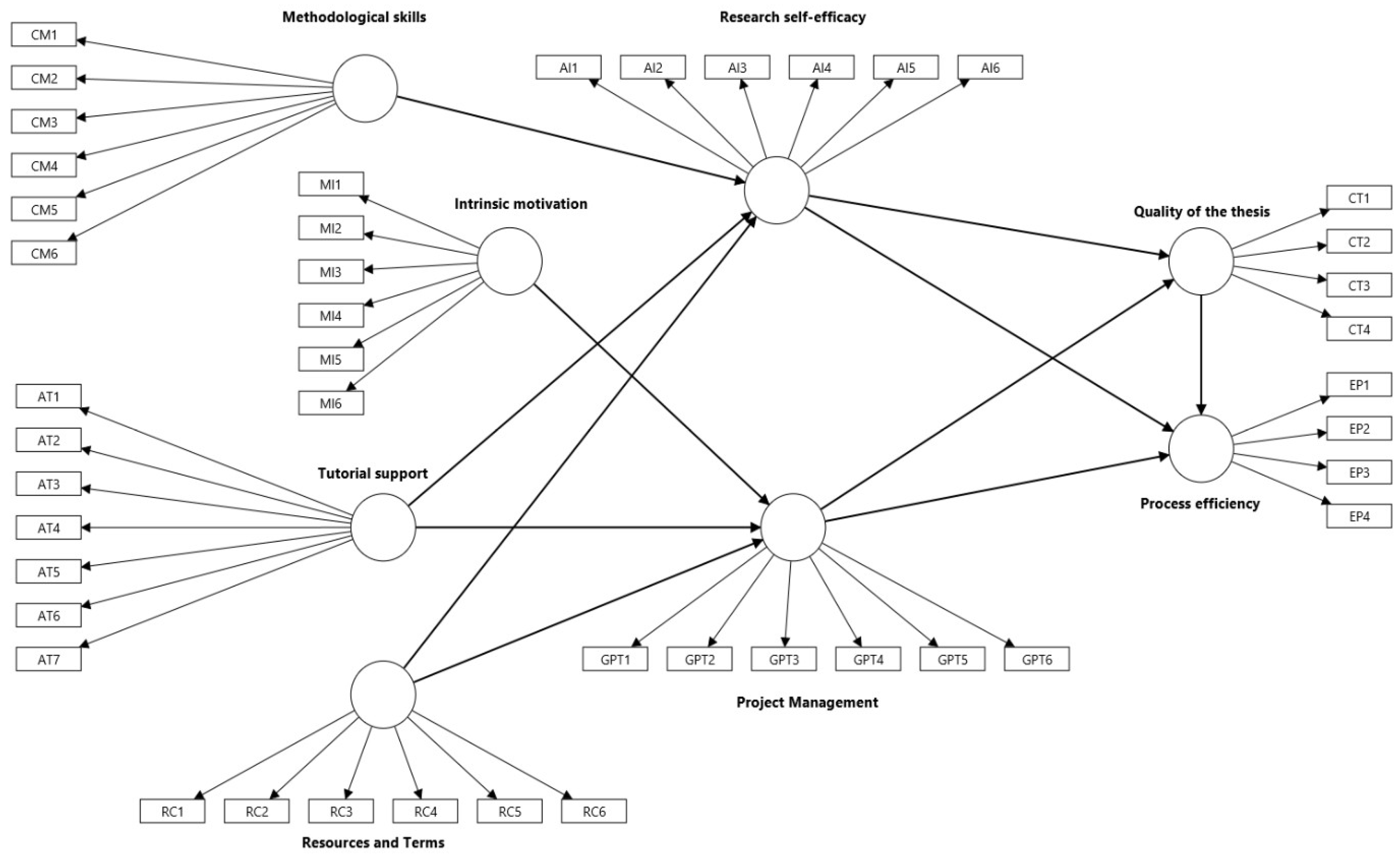
Figure 2.
Estimated model.
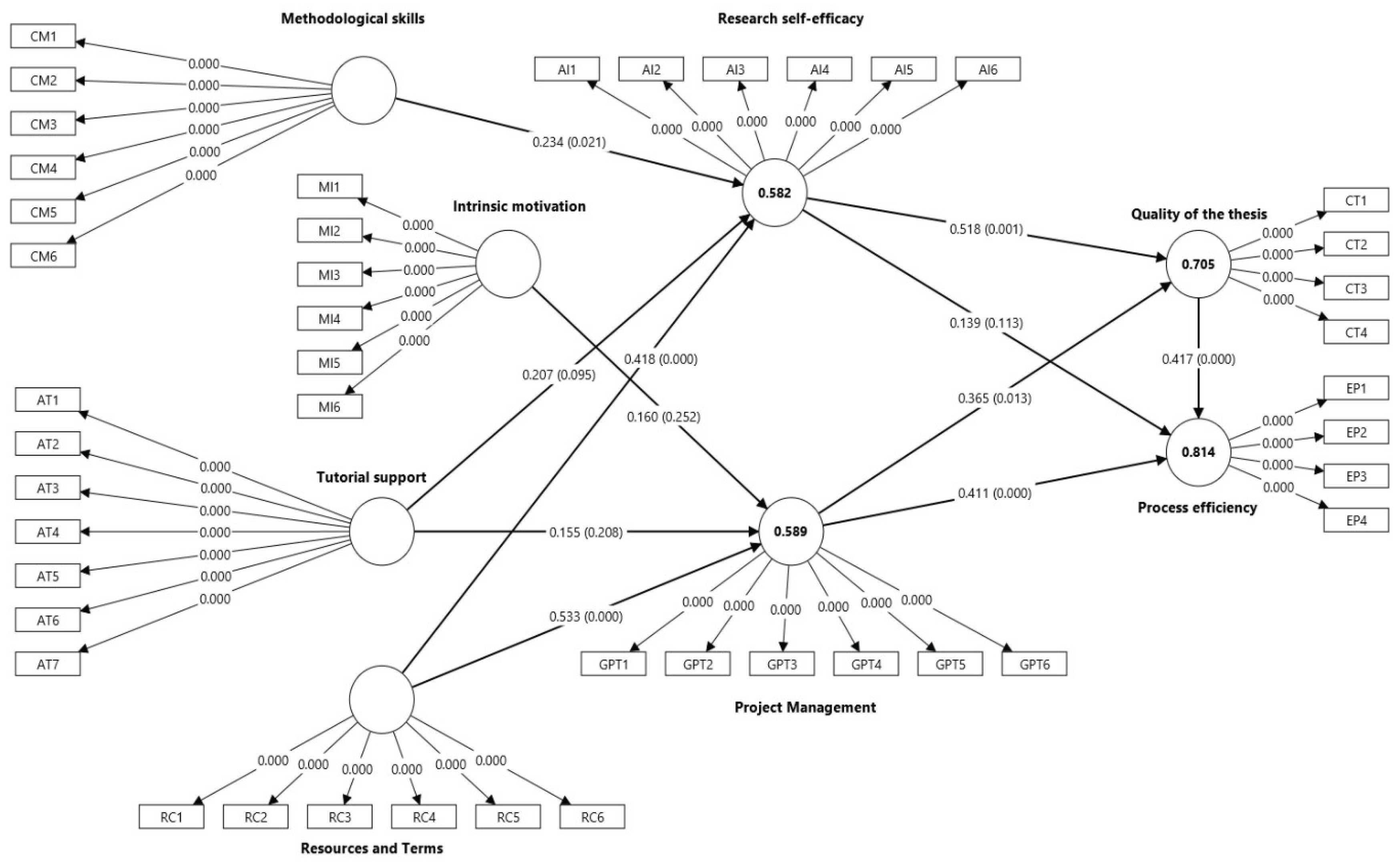

Table 1.
Sociodemographic Characteristics of the Sample.
| Variable | Total (N=396) | Model 0 (Public; n=158) | Model 1 (Private; n=238) |
|---|---|---|---|
| Age (years) | 22.93 | 22.21 | 23.11 |
| Cumulative weighted average | 15.43 | 15.79 | 15.33 |
| Time since starts of thesis (months) | 3.96 | 2.05 | 4.44 |
| Gender | |||
| Male | 223 (56.4%) | 108 (68.4%) | 127 (53.3%) |
| Female | 173 (43.6%) | 50 (31.6%) | 111 (46.7%) |
| Are you currently working? | |||
| No | 97 (24.5%) | 75 (47.4%) | 45 (18.7%) |
| Yes, part-time | 190 (47.9%) | 66 (42.1%) | 117 (49.3%) |
| Yes, full-time | 109 (27.7%) | 17 (10.5%) | 76 (32.0%) |
| Type of thesis | |||
| Applied (company) | 282 (71.3%) | 141 (89.5%) | 159 (66.7%) |
| Theoretical/Experimental | 110 (27.7%) | 17 (10.5%) | 76 (32.0%) |
| Systematic Review | 4 (1.1%) | 0 (0.0%) | 3 (1.3%) |
| Thesis area | |||
| Operations | 122 (30.9%) | 25 (15.8%) | 82 (34.7%) |
| Logistics | 88 (22.3%) | 66 (42.1%) | 41 (17.3%) |
| Quality | 55 (13.8%) | 0 (0.0%) | 38 (16.0%) |
| Other | 55 (13.8%) | 25 (15.8%) | 35 (14.7%) |
| Security | 21 (5.3%) | 0 (0.0%) | 16 (6.7%) |
| Human Resources | 21 (5.3%) | 42 (26.3%) | 0 (0.0%) |
| Production | 17 (4.3%) | 0 (0.0%) | 13 (5.3%) |
| Maintenance | 17 (4.3%) | 0 (0.0%) | 13 (5.3%) |
Note. N = 396. n sub-samples: Public (n = 158), Private (n = 238). “Other” groups categories with low frequency. Percentages may not sum to 100 due to rounding.
Table 2.
Construct descriptives: total sample and by institutional group.
| Construct | Mean (SD) | Skew. | Kurt. | M0 Mean (SD) | M1 Mean (SD) | Δ Mean |
|---|---|---|---|---|---|---|
| CM | 4.92 (1.13) | −0.30 | −0.03 | 4.71 (0.95) | 4.98 (1.17) | 0.27 |
| MI | 5.67 (1.21) | −1.34 | 1.98 | 5.48 (1.05) | 5.71 (1.25) | 0.23 |
| AT | 5.78 (1.26) | −1.04 | 0.12 | 5.41 (1.12) | 5.87 (1.29) | 0.46 |
| RC | 4.95 (1.32) | −0.50 | −0.45 | 4.83 (1.16) | 4.98 (1.36) | 0.15 |
| AI | 5.63 (1.10) | −0.96 | 0.86 | 5.40 (0.98) | 5.69 (1.12) | 0.29 |
| GPT | 5.45 (1.12) | −0.66 | −0.20 | 5.15 (0.90) | 5.52 (1.16) | 0.37 |
| CT | 5.76 (1.15) | −1.00 | 0.61 | 5.54 (1.13) | 5.82 (1.16) | 0.28 |
| EP | 5.41 (1.16) | −0.60 | −0.19 | 5.16 (1.14) | 5.48 (1.16) | 0.32 |
Note. M0 = public university (n = 158); M1 = private university (n = 238). Skewness and kurtosis refer to the total sample (N = 396); kurtosis corresponds to Fisher’s excess.
Table 3.
Factor loading ranges by construct.
| Construct | Items | k | Loading range |
|---|---|---|---|
| Tutorial support (AT) | AT1–AT7 | 7 | 0.863–0.955 |
| Research self-efficacy (AI) | AI1–AI6 | 6 | 0.845–0.927 |
| Thesis quality (CT) | CT1–CT4 | 4 | 0.914–0.940 |
| Methodological competencies (CM) | CM1–CM6 | 6 | 0.792–0.909 |
| Process efficiency (EP) | EP1–EP4 | 4 | 0.827–0.921 |
| Project management (GPT) | GPT1–GPT6 | 6 | 0.880–0.942 |
| Intrinsic motivation (MI) | MI1–MI6 | 6 | 0.836–0.930 |
| Resources and conditions (RC) | RC1–RC6 | 6 | 0.755–0.864 |
Note. k = number of indicators. All loadings exceed the 0.708 threshold recommended by Hair et al. (2021). The lowest individual loading corresponds to RC5 (0.755) and the highest to AT4 (0.955).
Table 4.
Reliability and convergent validity.
| Code | Construct | α | rho_A | CR | AVE |
|---|---|---|---|---|---|
| AT | Tutorial support | 0.968 | 0.973 | 0.974 | 0.842 |
| AI | Research self-efficacy | 0.951 | 0.953 | 0.961 | 0.803 |
| CT | Quality of the thesis | 0.947 | 0.947 | 0.961 | 0.862 |
| CM | Methodological competencies | 0.941 | 0.941 | 0.953 | 0.773 |
| EP | Process efficiency | 0.895 | 0.900 | 0.927 | 0.761 |
| GPT | Project management | 0.961 | 0.961 | 0.968 | 0.836 |
| MI | Intrinsic motivation | 0.954 | 0.959 | 0.964 | 0.815 |
| RC | Resources and conditions | 0.898 | 0.904 | 0.922 | 0.663 |
Table 5.
Discriminant validity: Fornell–Larcker criterion (lower triangle) and HTMT ratio (upper triangle, italicized).
Table 5.
Discriminant validity: Fornell–Larcker criterion (lower triangle) and HTMT ratio (upper triangle, italicized).
| AT | AI | CT | CM | EP | GPT | MI | RC | |
|---|---|---|---|---|---|---|---|---|
| AT | 0.917 | 0.693 | 0.682 | 0.716 | 0.763 | 0.664 | 0.769 | 0.718 |
| AI | 0.647 | 0.896 | 0.752 | 0.679 | 0.743 | 0.735 | 0.699 | 0.748 |
| CT | 0.645 | 0.710 | 0.928 | 0.674 | 0.781 | 0.711 | 0.775 | 0.740 |
| CM | 0.674 | 0.646 | 0.644 | 0.879 | 0.703 | 0.614 | 0.778 | 0.688 |
| EP | 0.727 | 0.705 | 0.750 | 0.671 | 0.872 | 0.776 | 0.690 | 0.793 |
| GPT | 0.633 | 0.779 | 0.779 | 0.588 | 0.647 | 0.915 | 0.635 | 0.776 |
| MI | 0.733 | 0.668 | 0.742 | 0.745 | 0.660 | 0.606 | 0.903 | 0.654 |
| RC | 0.676 | 0.711 | 0.705 | 0.653 | 0.755 | 0.738 | 0.622 | 0.814 |
Note. Diagonal (bold) = √AVE; lower triangle = inter-construct correlations (Fornell–Larcker criterion); upper triangle (italic) = HTMT ratios.
Table 6.
Hypothesis testing (full model).
| H | Ratio | β | t | p | Decision |
|---|---|---|---|---|---|
| H1 | Methodological competencies -> Research self-efficacy | 0.234 | 2.285 | .022 | Marginal (CI crosses zero) |
| H2 | Intrinsic motivation -> Project management | 0.160 | 1.155 | .248 | Not supported |
| H3 | Tutorial support -> Research self-efficacy | 0.207 | 1.694 | .090 | Marginal |
| H4 | Tutorial support -> Project management | 0.155 | 1.272 | .204 | Not supported |
| H5 | Resources and conditions -> Research self-efficacy | 0.418 | 4.647 | <0.001 | Supported |
| H6 | Resources and conditions -> Project management | 0.533 | 5.831 | <0.001 | Supported |
| H7 | Research self-efficacy -> Quality of the thesis | 0.518 | 3.398 | .001 | Supported |
| H8 | Project management -> Thesis quality | 0.365 | 2.480 | .013 | Supported |
| H9 | Project management -> Process efficiency | 0.411 | 4.946 | <0.001 | Supported |
| H10 | Research self-efficacy -> Process efficiency | 0.139 | 1.566 | .117 | Not supported |
| H11 | Thesis quality -> Process efficiency | 0.417 | 4.951 | <0.001 | Supported |
Note. Explained variance: R2_AI = 0.582, R2_GPT = 0.589, R2_CT = 0.705, R2_EP = 0.814 (adjusted R2 within 0.01 of each). All inner-model VIF values remained below 5 (range: 1.965–3.678).
Table 7.
Model Fit Indices.
| Index | Saturated model | Estimated model | Threshold | Reference |
|---|---|---|---|---|
| SRMR | 0.064 | 0.079 | < .08 | Henseler et al. (2015) |
| d_ULS | 4.265 | 8.251 | p > .05ᵃ | Henseler et al. (2014) |
| d_G | 4.508 | 4.916 | p > .05ᵃ | Henseler et al. (2014) |
| NFI | 0.949 | 0.908 | ≥ .90 | Bentler & Bonett (1980); Hair et al. (2021) |
| RMS_theta | 0.075 | 0.078 | < .12 | Henseler et al. (2014) |
Note. SRMR = Standardized Root Mean Square Residual; d_ULS = Unweighted Least Squares discrepancy; d_G = Geodesic discrepancy; NFI = Normed Fit Index; RMS_theta = Root Mean Square of the outer residuals. A threshold of < .10 for SRMR is also accepted in exploratory PLS-SEM contexts (Henseler et al., 2015). ᵃ d_ULS and d_G require bootstrap-based reference distributions for formal significance testing; values shown here are descriptive only — formal inference would require running the exact fit test in SmartPLS (Dijkstra & Henseler, 2015). The NFI threshold (≥ .90) originates from covariance-based SEM; Hair et al. (2021, p. 210) note that PLS-SEM fit criteria are still maturing and that SRMR remains the primary overall indicator for this approach. RMS_theta values (0.075 and 0.078) are reported for descriptive reference; formal interpretation requires that the reflective outer-model assumption holds, which is satisfied by the reflective measurement model used in this study.
Table 8.
Multigroup results and contrasts between groups (public vs. private).
| H | Relationship | β Pub | p Pub | β Priv | p Priv | Δβ | z_diff | p_diff* | Decision (Pub/Priv) |
|---|---|---|---|---|---|---|---|---|---|
| H1 | Methodological competences → Research self-efficacy | 0.284 | .083 | 0.261 | .035 | -0.023 | -0.112 | .911 | M/S |
| H2 | Intrinsic motivation → Project management | 0.449 | .042 | 0.105 | .520 | -0.344 | -1.253 | .210 | S/NS |
| H3 | Tutorial support → Research self-efficacy | -0.012 | .954 | 0.302 | .018 | 0.314 | 1.264 | .206 | NS/S |
| H4 | Tutorial support → Project management | -0.137 | .596 | 0.219 | .111 | 0.356 | 1.217 | .224 | NS/NS |
| H5 | Resources and conditions → Research self-efficacy | 0.750 | <0.001 | 0.284 | .002 | -0.466 | -2.554 | .011 | S/S |
| H6 | Resources and conditions → Project management | 0.618 | <0.001 | 0.508 | <0.001 | -0.110 | -0.575 | .566 | S/S |
| H7 | Research self-efficacy → Quality of the thesis | 0.019 | .961 | 0.547 | .001 | 0.528 | 1.229 | .219 | NS/S |
| H8 | Project management → Thesis quality | 0.848 | .022 | 0.343 | .028 | -0.505 | -1.258 | .209 | S/S |
| H9 | Project management → Process efficiency | 0.176 | .631 | 0.441 | <0.001 | 0.265 | 0.707 | .480 | NS/S |
| H10 | Research self-efficacy → Process efficiency | -0.104 | .744 | 0.210 | .021 | 0.314 | 0.949 | .342 | NS/S |
| H11 | Quality of the thesis → Process efficiency | 0.864 | <0.001 | 0.322 | <0.001 | -0.542 | -2.266 | .023 | S/S |
Note. Δβ = β(Private) - β(Public).
Disclaimer/Publisher’s Note: The statements, opinions and data contained in all publications are solely those of the individual author(s) and contributor(s) and not of MDPI and/or the editor(s). MDPI and/or the editor(s) disclaim responsibility for any injury to people or property resulting from any ideas, methods, instructions or products referred to in the content. |
© 2026 by the authors. Licensee MDPI, Basel, Switzerland. This article is an open access article distributed under the terms and conditions of the Creative Commons Attribution (CC BY) license.
Copyright: This open access article is published under a Creative Commons CC BY 4.0 license, which permit the free download, distribution, and reuse, provided that the author and preprint are cited in any reuse.


