

Submitted:
09 April 2026
Posted:
10 April 2026
You are already at the latest version
Preprints on COVID-19 and SARS-CoV-2
Abstract
Background: The continued evolution of severe acute respiratory syndrome coronavirus 2 (SARS-CoV-2) created ongoing challenges for molecular diagnostics and variant surveillance. Reliable assays capable of maintaining diagnostic sensitivity across emerging variants while providing rapid variant information remain essential for clinical management and public health monitoring. This study evaluated the performance of the GXT96 X3 extraction kit in combination with the FluoroType® SARS-CoV-2 varID Q version 1.0 assay (Hain LifeScience SA (Pty) Ltd, South Africa) for the detection, semi-quantitative assessment, and variant characterization of SARS-CoV-2. Methods: A total of 220 samples were evaluated, including residual nasopharyngeal clinical specimens (n = 183), reference materials, and cultured SARS-CoV-2 virus dilutions. Residual specimens collected during multiple COVID-19 waves in South Africa (wild type, Beta, Delta, and Omicron) were compared against standard-of-care (SOC) molecular assays used for routine diagnosis. RNA extraction was performed using the automated GXT96 X3 platform, followed by amplification on the FluoroCycler® XT using the FluoroType® SARS-CoV-2 varID Q assay targeting RdRp and N genes, with additional spike gene mutation detection for variant identification. Diagnostic accuracy, agreement (Cohen’s kappa), precision, linearity, and limit of detection (LoD) were assessed. Results: The assay demonstrated a sensitivity of 98.4% (95% CI: 94.2–99.8) and specificity of 100% (95% CI: 95.9–100.0) compared with SOC assays, with an overall agreement of κ = 0.981. Precision analysis showed acceptable reproducibility with standard deviation ≤1.49 and coefficient of variation ≤3.83%. Regression analysis demonstrated strong linearity across dilution series (R² = 0.9882 for RdRp and 0.994 for N genes). The LoD was ≤100 copies/mL for the RdRp gene and 250 copies/mL for the N gene. Variant-associated spike mutations detected by the assay corresponded broadly with epidemiological wave patterns observed in South Africa. Conclusions: The GXT96 X3 extraction platform combined with the FluoroType® SARS-CoV-2 varID Q assay demonstrated high diagnostic accuracy, reproducibility, and reliable SARS-CoV-2 detection across a range of viral loads. The assay additionally provides rapid mutation-based variant information, supporting its utility for routine diagnostic testing and complementary variant surveillance.
Keywords:
SARS-CoV-2
; molecular diagnostics
; RT-PCR detection
; variant identification
; diagnostic performance evaluation
1. Introduction
Severe acute respiratory syndrome coronavirus 2 (SARS-CoV-2), the causative agent of Coronavirus disease 2019 (COVID-19), emerged in late 2019 and rapidly evolved into a global pandemic. SARS-CoV-2 is an enveloped, single stranded, positive-sense RNA virus that is transmitted between humans, predominantly via respiratory droplets and aerosols [1,2,3,4]. During the pandemic, SARS-CoV-2 exhibited substantial genetic diversity driven by ongoing viral replication and selective pressure, resulting in the continual emergence of novel variants with altered transmissibility, virulence, and immune escape properties. To support global surveillance and risk assessment, the World Health Organization (WHO) classified SARS-CoV-2 variants into variants of concern (VOCs) or variants of interest (VOIs) based on their epidemiological and biological characteristics [5,6,7].
Successive pandemic waves were dominated by the Alpha, Beta, Gamma, Delta, and Omicron VOCs [8], each demonstrating increased transmissibility compared with the ancestral Wuhan strain [7,8,9]. The Omicron variant, first identified in southern Africa in November 2021 [10], rapidly became the globally dominant lineage and subsequently diversified into numerous sub-lineages. This extensive diversification posed challenges for diagnostic accuracy and highlighted the need for robust molecular detection methods capable of maintaining sensitivity across evolving variants, as well as for scalable and timely variant surveillance strategies [11].
Nucleic acid amplification tests (NAATs) performed on upper or lower respiratory tract specimens remain the reference standard for the laboratory diagnosis of SARS-CoV-2 infection [2]. These tests include real-time reverse transcription polymerase chain reaction (RT-PCR), loop-mediated isothermal amplification (RT-LAMP), and sequencing-based approaches [12,13,14]. Most molecular assays target conserved regions of the SARS-CoV-2 genome, including the E, S, N, RdRp, and ORF1ab genes [4,13], to minimize the impact of viral genetic variation on assay performance. With regards to viral load estimation, cycle threshold (Ct) values are commonly used as a proxy for viral load, however, they are highly assay and platform-dependent, limiting comparability and clinical interpretability. Despite these limitations, viral load has been associated with disease severity, transmission risk, and clinical outcomes, particularly among immunocompromised and other high-risk populations [15,16].
Whole-genome sequencing (WGS) is the gold standard for comprehensive SARS-CoV-2 variant characterization and surveillance; however, its widespread implementation is limited by cost, turnaround time, and the requirement for specialized infrastructure and technical expertise [4]. Maintaining diagnostic readiness remains essential, necessitating continued development and performance monitoring of molecular assays capable of reliable SARS-CoV-2 detection and concurrent identification of clinically relevant variants to inform public health responses and clinical decision-making.
This laboratory-based study aimed to evaluate the diagnostic performance of the GXT96 X3 extraction kit in combination with the Fluorotype® SARS-CoV-2 varID Q version 1.0 assay (Hain LifeScience SA (Pty) Ltd, South Africa) for the detection, semi-quantitative assessment, and characterization of SARS-CoV-2 nucleic acid in residual nasopharyngeal and oropharyngeal specimens, as well as for variant identification. The findings of this study provide evidence to support sustained diagnostic accuracy in the context of viral evolution and contribute to strengthening laboratory preparedness for future respiratory pandemic.
2. Materials and Methods
2.1. Study Setting
This study was conducted at the National Health Laboratory Service Main Branch Laboratory Gqeberha, Eastern Cape, South Africa. Ethics approval was granted by the University of the Witwatersrand Human Research Ethics Committee (reference number M1911201) to access residual clinical specimens following routine testing conducted for patient management.
2.2. Sample Size
A total of 220 samples were tested in this study which consisted of residual patient specimens, reference material, and live viral cultures.
2.3. Residual Clinical Specimens
Residual clinical nasophryngeal swabs (n=183), preserved at −80°C in phosphate-buffered saline (PBS) (Gibco, Life Technologies, The Netherlands), universal transport medium (UTM), or viral transport medium (VTM) were collected during the four COVID-19 waves across South Africa namely wave 1 (wild type strain), wave 2 and early wave 3 (Beta variants), wave 3 peak (Delta variants) and wave 4 (Omicron variants). These specimens were obtained from patients visiting healthcare centers for routine SARS-CoV-2 testing, and were tested on the standard of care (SOC) assay available at the time immediately upon arrival at a testing facility (Cobas® SARS-CoV-2 (Roche Molecular, Pleasanton, CA, USA), Xpert® Xpress SARS-CoV-2 (Cepheid, CA, USA), Allplex™ 2019-nCoV Assay (Seegene Inc., Seoul, Republic of Korea), Alinity m SARS-CoV-2 AMP Kit (Abbott Laboratories, Chicago, IL, USA), and TaqPath™ Covid-19 CE-IVD RT-PCR Kit (Thermofisher Scientific, Waltham, MA USA)). The specimens were retrieved from -80oC storage and thawed. RNA was extracted as described below on the automated GXT 96 X3 (Hain LifeScience Pty Ltd, South Africa). Positive specimens were selected across a range of viral loads (VL) based on the SOC comparator method Ct values used for initial SOC testing (E gene range: 14.90-37; N gene range: 10.90-34.80; S gene range: 10.60-33.30; ORF1ab gene range: 10.0-35.40).
2.4. Reference Material
Accuplex wild type SARS-CoV-2 whole genome reference material (SeraCare, Milford, MA, USA) consisting of an undiluted sample (5000 copies/mL) was tested in singlicate. Thereafter, four dilutions (1000 copies/mL, 500 copies/mL, 250 copies/mL and 100 copies/mL) were each tested in triplicate (n=13). A negative Accuplex reference sample was also included (n=1). In addition, known Accuplex reference of UK, SA and Brazil variants (all of SeraCare, Milford, MA, USA) at a concentration of 1000 copies/mL were tested in duplicate each (n=6). RNA extraction was carried out on the automated GXT 96 X3 platform as described below.
2.5. SARS-CoV-2 Viral Culture Samples
SARS-CoV-2 viral cultures were obtained through collaborations with Professor Wolfgang Preiser from the Department of Medical Virology, Stellenbosch University, South Africa, and Professor Bavesh Kana from CBTBR, University of the Witwatersrand, South Africa. The original viral culture concentration was calculated using semiquantitative PCR in the laboratory, yielding an estimate of 1 × 10⁵ copies/μL. In a biosafety level 3 laboratory, four serial dilutions of the viral supernatant in PBS were prepared: 1:1,000, 1:10,000, 1:100,000, and 1:1,000,000 (approximately log 5.0, log 4.4, log 3.4, and log 2.5 viral copies per milliliter [cp/mL]). These were prepared in 15 mL Falcon tubes (Thermo Fisher Scientific). Nest Biotechnology oropharyngeal specimen collection swabs (Whitehead Scientific Pty., Ltd.) were used to prepare swabs of the different dilutions via a swab capture technique. Each swab was immersed and swirled in the designated dilution for 30 seconds (15 seconds clockwise, 15 seconds counterclockwise). Swabs were then placed into labelled cryovials and sealed. Each swab was resuspended in 1 mL of PBS, vortexed vigorously for 1 minute, and left at room temperature for 10 minutes before testing on a standard care assay and further evaluation. Each dilution was tested in triplicates (n=12).
2.6. FluoroType® SARS-CoV-2 varID Q Assay
The FluoroType® SARS-CoV-2 varID Q Ver 1.0 kit (Hain LifeScience SA (Pty) Ltd, South Africa) is an in vitro, quantitative test for the detection of two independent SARS-CoV-2 viral RNA targets (RdRP and/or N genes) while simultaneously differentiating SARS-CoV-2 variants from the wild type virus by detecting mutations in the spike gene which include del69-70, N501Y, D80A and E484K. The kit includes Amplification Mix A (AM-A), Amplification Mix B (AM-B), low and high positive standard set and Positive Control DNA (C+). The assay makes use of a separate Universal Internal Control 2 VER 1.0 kit (U-IC2), which is an encapsulated polynucleotide RNA Internal Control (IC), and mimics lysis of viral particles and serves as an extraction, reverse transcription and amplification control. The kit uses real time PCR technology to amplify RNA from upper respiratory specimens such as nasopharyngeal swabs and lower respiratory specimens such as bronchoalveolar lavages and tracheal aspirates.
2.7. Nucleic Acid Extraction
Nucleic acid extraction on residual clinical specimens, accuplex reference material and live viral culture dilutions was performed according to the manufacturer’s instructions, using the GXT96 X3 extraction kit (Hain LifeScience Pty Ltd, South Africa) on the GXT96 X3 automated extraction platform. Briefly, a total of 800µL of each sample was extracted and eluted in 50µL of elution buffer. An extraction negative control was included in each run to monitor for carry-over contamination during the extraction process, using nuclease free water as the template.
2.8. Nucleic Acid Amplification
Amplification of the extracted RNA was performed using the FluoroType® SARS-CoV-2 varID Q Ver 1.0 kit on the real time FluoroCycler ® XT real-time PCR machine (both of Hain LifeScience Pty Ltd, South Africa). PCR was performed according to the manufacturer’s instructions. Briefly, the PCR reaction was prepared by combining 8µl of mastermix (3µl AM-A and 5µl AM-B) and 12µl of extracted RNA sample to give a total volume of 20µl. Samples, negative and positive controls were put in the respective wells of a 96-well plate. For the Positive control, 12µl of C+ was used. The plate was sealed and centrifuged at 3000 g for 30 seconds. The plate was then loaded onto the FluoroCycler for real time PCR amplification. The amplification results were analysed manually according to the manufacturer’s instructions. The FluoroType® SARS-CoV-2 varID Q ver 1.0 assay comes with positive and negative controls to assess extraction efficiency and high and low positive controls tested in triplicate, to determine the viral loads.
2.9. Statistical Analysis
The results obtained on the FluoroType SARS-CoV-2 assay were compared to those obtained on the SOC primary comparator assays listed above. The statistical analysis, including the accuracy (sensitivity and specificity) and percentage agreement analyses (Cohen’s kappa coefficient) was carried out using Stata version 14 (StataCorp, College Station, TX, USA).
3. Results
3.1. Overall Results
As per manufacturers instruction, results are classified as positive if the RdRP and or N genes have a CT value of ≤40. Agreement data as well as Ct values for each gene target are provided in Supplementary Table 1. Of the 183 residual specimens tested, five specimens produced invalid results and were excluded from the analysis (n = 183-5 =178). One of the positive specimens with a high Ct of 30 and 33 on ORF1 and E genes respectively, tested previously on the Roche instrument yielded a negative result on the real time Fluorocycler.
All the positive Accuplex reference material tested positive, and no COVID nucleic acid was detected in the negative reference material. Of the live culture dilutions, one of the 1:1000000 (log 2.5) culture dilution was negative.
3.2. Accuracy and Agreement (Cohen’s Kappa Coefficient)
Accuracy of the of the GXT and the FluoroType® SARS-CoV-2 varID Q Ver 1.0 assay was determined using results obtained from clinically relevant specimens (n=178/183), Accuplex reference positive and negative material (n=14), Country variants (n=6), viral culture dilutions (n=12) and assay (positive and negative) controls (n=10). An overall error rate of 2.0% (5/225) was observed.
Table 1 provides the overall accuracy and agreement data. The fluorotype assay showed a specificity of 100% and a sensitivity of ≥90% compared to the SOC assays. An almost perfect overall agreement with a Cohen kappa coefficient of ≥0.9 (95% CI) was observed.
3.3. Precision Analysis (Reproducibility) and Linearity
Assay precision (standard deviation (SD) and percentage coefficient of variation (%CV)) and linearity were calculated using the reported Ct values of viral culture dilutions that were tested in triplicate (Table 2). For the RdRp gene, only 2/3 replicates were detected at 1:1000,000 (log 2.5) culture dilution and for the N gene, no replicates were detected at this concentration. Mean Ct for N gene therefore could not be calculated at 1:1000,000 dilution. The FluoroType® SARS-CoV-2 varID Q Ver 1.0 showed an acceptable precision with a SD≤1.49, and CV%≤3.83%. Regression analysis (Figure 1) showed a good linearity with R2 =0.9882 and 0.994 for the RdRP and N genes respectively.
3.4. Limit of Detection (LOD)
The LoD was investigated using the Accuplex reference control material. The FluoroType® SARS-CoV-2 varID Q Ver 1.0 assay was able to detect the SeraCare Accuplex reference material (for both the RdRP and N genes) at 5000, 1000, 500, 250 copies/ml and with variability at 100 copies/ml dilution. One replicate at 100 copies/ml dilution tested negative on the N gene. This indicates that the LOD for RdRP is ≤ 100 copies/mL and 250 copies/mL for N genes
3.5. Variant Detection
Of the 13 specimens collected during the Delta wave, 7 were detected without any mutation (MUT-), and 1 was positive for mutations consistent with Beta variant. For 5 specimens, the mutation status of the locus could not be determined. Since the FluoroType® SARS-CoV-2 varID Q Ver 1.0 kit is unable to detect mutations from Delta variant, the specimens with undetected mutations could have been from the Delta wave. For the 11 specimens collected during wave 1(WT), 8 were mutation negative (MUT-), 2 had mutations consistent with Beta variant and 1 came up as negative. In the case of 14 Beta wave specimens, 12 had mutations consistent with Beta variants, one was mutation negative, and one had unknown mutation status. Of the remaining presumptive Omicron wave specimens, 10 had del 69/70 mutation consistent with Alpha and Omicron variants. Gene mutation targets for SARS-CoV-2 variants is provided in Table 3.
4. Discussion
This study evaluated the diagnostic performance of the GXT96 X3 extraction kit combined with the FluoroType® SARS-CoV-2 varID Q Ver 1.0 assay for the detection, semi-quantitative assessment, and variant identification of SARS-CoV-2 in clinical specimens. Our findings demonstrate that this assay system exhibits excellent sensitivity (98.4%), specificity (100%), and near-perfect agreement (Cohen's kappa coefficient = 0.981) when compared to standard of care molecular assays currently used in South African diagnostic laboratories.
The observed sensitivity of 98.4% (94.2–99.8) and specificity of 100% (95.9–100.0) meet the minimum performance criteria established by the South African Health Products Regulatory Authority (SAHPRA) for molecular COVID-19 RT-PCR kits, which require sensitivity ≥95% and specificity ≥98% [17]. These performance characteristics are comparable to those reported for other commercially available SARS-CoV-2 molecular assays. For instance, the Cobas® SARS-CoV-2 test demonstrated 100% sensitivity and 97.9% specificity in a clinical evaluation [18], while the Alinity m SARS-CoV-2 assay showed 100% positive percent agreement and 96.9% negative percent agreement [19]. The near-perfect agreement (κ = 0.981) observed in our study indicates that the GXT96 X3 extraction and FluoroType® varID Q assay combination can be reliably implemented as an alternative diagnostic platform without compromising clinical accuracy.
The assay demonstrated acceptable precision with standard deviations ≤1.49 and coefficient of variation ≤3.83% across the dilution series for both gene targets. These values are within acceptable limits for molecular diagnostic assays, where CV% below 5% is generally considered indicative of good reproducibility [20,21]. The linear regression analysis revealed excellent linearity with R2 values of 0.9882 and 0.994 for the RdRP and N genes respectively, confirming the assay's capacity for reliable semi-quantitative viral load estimation across a dynamic range of approximately 2.5 to 5.0 log copies/mL.
The differential LoD observed between the RdRP and N genes in our study (100 vs. 250 copies/mL) suggests that the RdRP target may be more analytically sensitive at very low viral loads. This was further evidenced by the detection of RdRP in 2/3 replicates at the 1:1,000,000 dilution, whereas the N gene was not detected at this dilution. The inclusion of two independent gene targets (RdRP and N) in the assay design provides a diagnostic safeguard, as the failure to detect one target at very low concentrations does not compromise overall positivity, consistent with international recommendations for molecular assay design [14].
A key feature of the FluoroType® SARS-CoV-2 varID Q Ver 1.0 assay is its capacity for simultaneous variant differentiation through detection of specific spike gene mutations (del69-70, N501Y, D80A, and E484K). Our analysis of residual specimens collected across successive COVID-19 waves in South Africa demonstrated the assay's ability to identify variants consistent with epidemiological expectations for each wave period. Specimens from wave 1 (wild type predominant) were predominantly mutation-negative (8/11), while those from the Beta wave (waves 2 and early 3) showed mutations consistent with Beta variant in 12/14 specimens. Notably, among specimens collected during the Delta wave, only one showed mutations consistent with Beta variant, and the majority (7/13) were mutation-negative, reflecting the known mutation profile of the Delta variant which is not captured by the assay's current target panel [22,23]. The Omicron wave specimens demonstrated the del69/70 mutation in 10 cases, consistent with both Alpha and Omicron variants [10,24]. These findings highlight both the utility and limitations of targeted mutation detection approaches. While the assay provides rapid variant information without the need for whole genome sequencing, its variant identification capacity is inherently limited to the specific mutations included in the design.
The inclusion of viral culture dilutions and reference materials in our study design allowed for robust analytical characterization under controlled conditions. The use of the swab capture technique for preparing culture dilutions simulated clinical specimen collection more realistically than direct spiking of liquid samples, potentially providing a more accurate assessment of assay performance with actual clinical specimens. The invalid result rate of 2.0% (5/225) is within acceptable limits for molecular diagnostic workflows and may be attributable to factors such as inhibitors in residual specimens, degradation during freeze-thaw cycles, or extraction inefficiencies. The single false-negative result among positive specimens (a sample with high Ct values of 30 and 33 on Roche platform) likely reflects viral RNA degradation during storage or viral concentrations near the assay's LoD, rather than a systematic assay deficiency [14].
This study has several limitations. First, the use of residual frozen specimens, while practical, may have resulted in some RNA degradation and could underestimate the assay's performance with fresh specimens. Second, the standard of care assays used as comparators varied across specimens, reflecting the real-world evolution of diagnostic platforms during the pandemic but introducing heterogeneity in the reference standard. Third, the sample size for certain variant categories was limited, precluding robust statistical comparisons of variant-specific sensitivity. Fourth, the variant identification capability of the assay was assessed against epidemiological wave data rather than whole genome sequencing, which remains the gold standard for variant confirmation [4,12]. Future studies should include direct comparison with sequencing data to validate the accuracy of mutation detection.
The continued evolution of SARS-CoV-2 and the potential emergence of future respiratory viruses with pandemic potential underscore the importance of maintaining diagnostic readiness [7,8]. Assays that combine reliable detection with variant surveillance capabilities, such as the FluoroType® SARS-CoV-2 varID Q system, offer practical advantages for laboratories seeking to maximize information yield from routine diagnostic testing. The ability to generate both qualitative (positive/negative) and semi-quantitative (Ct value) results, together with variant-associated mutation data, supports both clinical management and public health surveillance objectives.
In conclusion, this study demonstrates that the GXT96 X3 extraction kit combined with the FluoroType® SARS-CoV-2 varID Q Ver 1.0 assay provides accurate, reproducible, and clinically reliable detection of SARS-CoV-2 across a range of viral loads and variants. The assay meets regulatory performance criteria, exhibits excellent agreement with established comparator methods, and offers the added value of variant-associated mutation detection. These findings support the implementation of this assay system in diagnostic laboratories, contributing to strengthened laboratory capacity for SARS-CoV-2 detection and surveillance in the context of ongoing viral evolution.
Author Contributions
Conceptualization, L.E.S, R.M; Data curation, R.M, O.L.A; Funding acquisition, L.E.S. and W.S.S.; Investigation, O.L.A, R.M; Methodology, R.M, O.L.A; Project administration, R.M.; Writing, O.L.A, R.M; All authors have read and agreed to the published version of the manuscript.
Funding
This study was supported by funding received from the Bill and Melinda Gates Foundation through the Innovation in Laboratory Engineered Accelerated Diagnostics investment (grant number INV006726 and OPP1171455).
Institutional Review Board Statement
The study was approved by the University of the Witwatersrand Human Research Ethics Committee (M1911201 to access residual clinical specimens, 23 January 2025).
Data Availability Statement
The data presented in this study is available on request from the contact author.
Acknowledgments
We wish to acknowledge the National Health Laboratory Service of South Africa for the provision of the SARS-CoV-2 residual patient specimens and the SOC results. We also acknowledge Bavesh Kana and Bhavna Gordhan of the University of the Witwatersrand as well as Wolfgang Preiser and Tasnim Suliman of the University of Stellenbosch for the viral culture supernatants.
Conflicts of Interest
The other authors declare no conflicts of interest.
References
- Jin, Y; Yang, H; Ji, W; Wu, W; Chen, S; Zhang, W; et al. Virology, epidemiology, pathogenesis, and control of COVID-19. Viruses 2020, 12(4), 372. [Google Scholar] [CrossRef]
- Hu, B; Guo, H; Zhou, P; Shi, Z-L. Characteristics of SARS-CoV-2 and COVID-19. Nature reviews microbiology 2021, 19(3), 141–54. [Google Scholar] [CrossRef]
- Shereen, MA; Khan, S; Kazmi, A; Bashir, N; Siddique, R. COVID-19 infection: Emergence, transmission, and characteristics of human coronaviruses. Journal of advanced research 2020, 24, 91–8. [Google Scholar] [CrossRef] [PubMed]
- Feng, W; Newbigging, AM; Le, C; Pang, B; Peng, H; Cao, Y; et al. Molecular diagnosis of COVID-19: challenges and research needs. Analytical chemistry 2020, 92(15), 10196–209. [Google Scholar] [CrossRef] [PubMed]
- Choi, JY; Smith, DM. SARS-CoV-2 variants of concern. Yonsei medical journal 2021, 62(11), 961. [Google Scholar] [CrossRef] [PubMed]
- Sanyaolu, A; Okorie, C; Marinkovic, A; Haider, N; Abbasi, AF; Jaferi, U; et al. The emerging SARS-CoV-2 variants of concern. Therapeutic advances in infectious disease 2021, 8, 20499361211024372. [Google Scholar] [CrossRef]
- Lin, L; Liu, Y; Tang, X; He, D. The disease severity and clinical outcomes of the SARS-CoV-2 variants of concern. Frontiers in public health 2021, 9, 775224. [Google Scholar] [CrossRef]
- Gupta, P; Gupta, V; Singh, CM; Singhal, L. Emergence of COVID-19 variants: an update. Cureus 2023, 15(7). [Google Scholar] [CrossRef]
- Farahat, RA; Abdelaal, A; Umar, TP; El-Sakka, AA; Benmelouka, AY; Albakri, K; et al. The emergence of SARS-CoV-2 Omicron subvariants: current situation and future trends. Le infezioni in medicina 2022, 30(4), 480. [Google Scholar]
- Viana, R; Moyo, S; Amoako, DG; Tegally, H; Scheepers, C; Althaus, CL; et al. Rapid epidemic expansion of the SARS-CoV-2 Omicron variant in southern Africa. Nature 2022, 603(7902), 679–86. [Google Scholar] [CrossRef] [PubMed]
- Xu, A; Hong, B; Lou, F; Wang, S; Li, W; Shafqat, A; et al. Sub-lineages of the SARS-CoV-2 Omicron variants: Characteristics and prevention. MedComm 2022, 3(3), e172. [Google Scholar] [CrossRef]
- Kevadiya, BD; Machhi, J; Herskovitz, J; Oleynikov, MD; Blomberg, WR; Bajwa, N; et al. Diagnostics for SARS-CoV-2 infections. Nature materials 2021, 20(5), 593–605. [Google Scholar] [CrossRef]
- Afzal, A. Molecular diagnostic technologies for COVID-19: Limitations and challenges. Journal of advanced research 2020, 26, 149–59. [Google Scholar] [CrossRef] [PubMed]
- Rai, P; Kumar, BK; Deekshit, VK; Karunasagar, I; Karunasagar, I. Detection technologies and recent developments in the diagnosis of COVID-19 infection. Applied microbiology and biotechnology 2021, 105(2), 441–55. [Google Scholar] [CrossRef]
- Boan, P; Jardine, A; Pryce, TM. Clinical associations of SARS-CoV-2 viral load using the first WHO international standard for SARS-CoV-2 RNA. Pathology 2022, 54(3), 344–50. [Google Scholar] [CrossRef] [PubMed]
- Dadras, O; Afsahi, AM; Pashaei, Z; Mojdeganlou, H; Karimi, A; Habibi, P; et al. The relationship between COVID-19 viral load and disease severity: A systematic review. Immunity, inflammation and disease 2022, 10(3), e580. [Google Scholar] [CrossRef]
- Specification criteria for COVID-19 molecular Meril COVID-19 One-step RT-PCR Kits MD018: SAHPRA; SAHPRA: South Africa, 2025; Available online: https://www.sahpra.org.za/medical-devices/medical-devices-and-in-vitro-diagnostics-test-kits/.
- Poljak, M; Korva, M; Knap Gašper, N; Fujs Komloš, K; Sagadin, M; Uršič, T; et al. Clinical evaluation of the cobas SARS-CoV-2 test and a diagnostic platform switch during 48 hours in the midst of the COVID-19 pandemic. Journal of Clinical Microbiology 2020, 58(6). [Google Scholar] [CrossRef]
- Perchetti, GA; Pepper, G; Shrestha, L; LaTurner, K; Kim, DY; Huang, M-L; et al. Performance characteristics of the Abbott Alinity m SARS-CoV-2 assay. Journal of Clinical Virology 2021, 140, 104869. [Google Scholar] [CrossRef] [PubMed]
- Newman, H; Maritz, J. Basic overview of method validation in the clinical virology laboratory. Reviews in Medical Virology 2017, 27(5), e1940. [Google Scholar] [CrossRef] [PubMed]
- Pum, J. A practical guide to validation and verification of analytical methods in the clinical laboratory. Advances in clinical chemistry 2019, 90, 215–81. [Google Scholar]
- Subramoney, K; Mtileni, N; Giandhari, J; Naidoo, Y; Ramphal, Y; Pillay, S; et al. Molecular epidemiology of SARS-CoV-2 during five COVID-19 waves and the significance of low-frequency lineages. Viruses 2023, 15(5), 1194. [Google Scholar] [CrossRef] [PubMed]
- Furusawa, Y; Kiso, M; Iida, S; Uraki, R; Hirata, Y; Imai, M; et al. SARS-CoV-2 delta variants, Spike-P681R and D950N promote membrane fusion, Spike-P681R enhances spike cleavage, but neither substitution affects pathogenicity in hamsters. EBioMedicine 2023, 91. [Google Scholar] [CrossRef] [PubMed]
- Gangavarapu, K; Latif, AA; Mullen, JL; Alkuzweny, M; Hufbauer, E; Tsueng, G; et al. Outbreak. info genomic reports: scalable and dynamic surveillance of SARS-CoV-2 variants and mutations. Nature Methods 2023, 20(4), 512–22. [Google Scholar] [CrossRef] [PubMed]
Figure 1.
Linear regression of mean Ct (triplicate) of viral culture lysates tested across a range of dilutions (1000 – 100 000 copies/ml) for the RdRP and N gene targets using the FluoroType® SARS-CoV-2 plus Ver 1.0 assay from RNA extracted using the automated GenoXtract® 96 instrument and GXT96 X3 extraction kit. Equations of the line are represented in the graph (R2: RdRP = 0.994 and N= 0.988).
Figure 1.
Linear regression of mean Ct (triplicate) of viral culture lysates tested across a range of dilutions (1000 – 100 000 copies/ml) for the RdRP and N gene targets using the FluoroType® SARS-CoV-2 plus Ver 1.0 assay from RNA extracted using the automated GenoXtract® 96 instrument and GXT96 X3 extraction kit. Equations of the line are represented in the graph (R2: RdRP = 0.994 and N= 0.988).
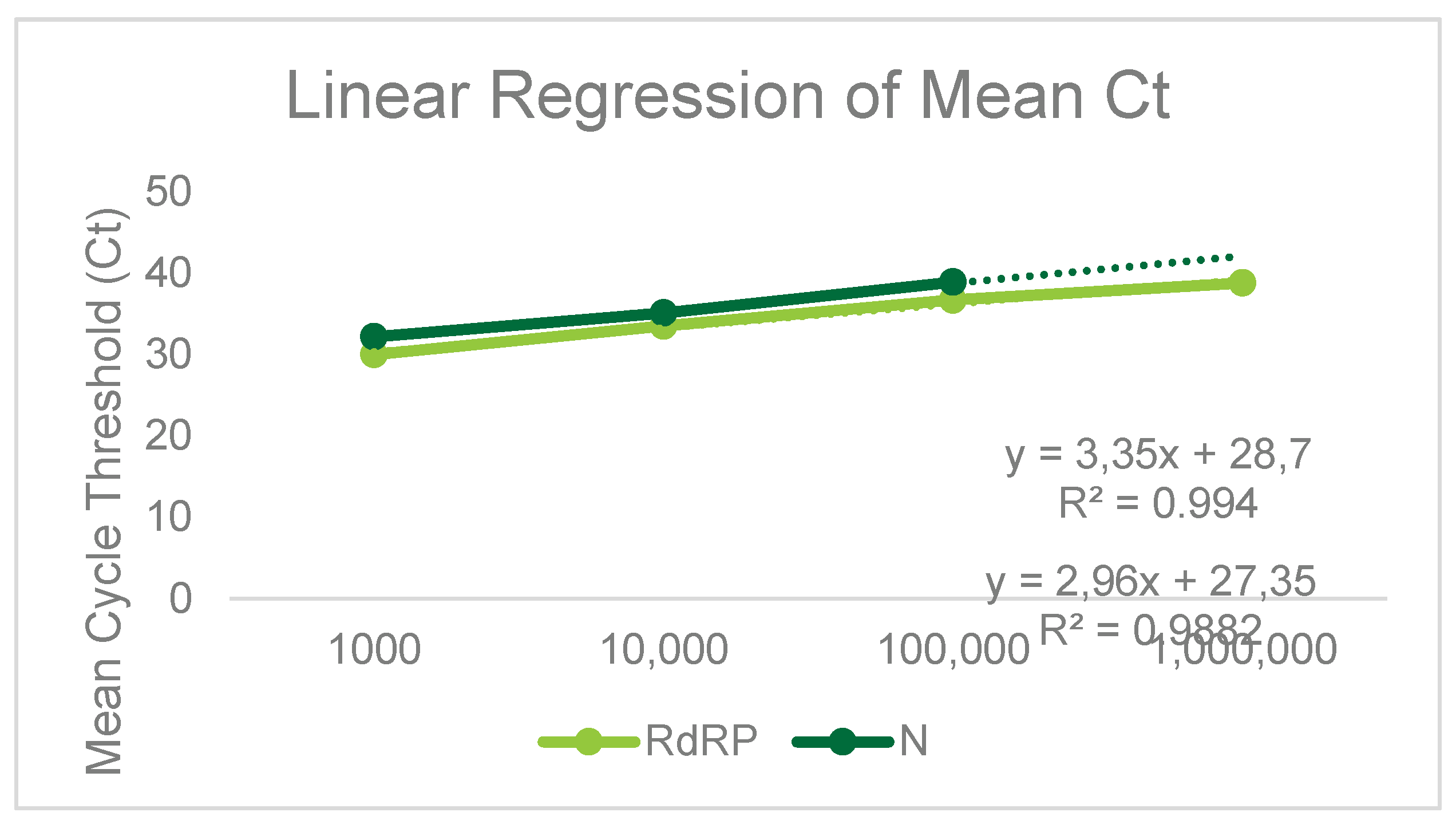

Table 1.
Accuracy (sensitivity, specificity) and agreement (Cohen’s kappa coefficient) of the FluoroType SARS-CoV-2 varID Q Ver 1.0 assay.
Table 1.
Accuracy (sensitivity, specificity) and agreement (Cohen’s kappa coefficient) of the FluoroType SARS-CoV-2 varID Q Ver 1.0 assay.
| Type | n | Sensitivity/Specificity (CI) | PPV/NPP (CI) | Cohen Kappa (CI) |
|---|---|---|---|---|
| As described above | 220 | 98.4% (94.2 – 99.8)/ 100% (95.9 – 100.0) |
100%/ 97.8% (91.8 – 99.4) |
0.981 (0.954 – 1.000) |
Table 2.
Precision overview of the FluoroType SARS-CoV-2 assay.
| Viral Culture (run in quadruplicate) | RdRP gene (mean, SD, CV%) | N gene (mean, SD, CV%) |
|---|---|---|
| 1:1000 | 30.0, 0.24, 0.96 | 32.2, 0.45, 1.4 |
| 1:10000 | 33.5, 0.15, 0.46 | 35.1, 0.47, 1.35 |
| 1:100000 | 36.7, 0.82, 2.23 | 38.9, 0.95, 2.45 |
| 1:1000000 | 38.75, 1.49, 3.83 | - |
Table 3.
SARS-CoV-2 variants profiles for gene targets included in the FluoroType SARS-CoV-2 assay.
| VOC | del69-70 | E484K | N501Y | D80A |
|---|---|---|---|---|
| Alpha | ||||
| Beta | ||||
| Gamma | ||||
| Delta | ||||
| Omicron |
The blue shaded areas under each mutation indicate the variants in which the mutations will be detected. A sample with E484K, N501Y and D80A mutations will indicate it is a Beta variant. The FluoroType® SARS-CoV-2 varID Q Ver 1.0 assay is unable to detect Delta variants.
Disclaimer/Publisher’s Note: The statements, opinions and data contained in all publications are solely those of the individual author(s) and contributor(s) and not of MDPI and/or the editor(s). MDPI and/or the editor(s) disclaim responsibility for any injury to people or property resulting from any ideas, methods, instructions or products referred to in the content. |
© 2026 by the authors. Licensee MDPI, Basel, Switzerland. This article is an open access article distributed under the terms and conditions of the Creative Commons Attribution (CC BY) license (http://creativecommons.org/licenses/by/4.0/).
Copyright: This open access article is published under a Creative Commons CC BY 4.0 license, which permit the free download, distribution, and reuse, provided that the author and preprint are cited in any reuse.


