

Submitted:
09 April 2026
Posted:
10 April 2026
You are already at the latest version
Abstract
The rapid proliferation of digital technologies has transformed the landscape of gen-der-based violence globally. This quantitative study used an online survey to explore the experiences of women with disabilities in relation to technology facilitated gender-based violence (TFGBV) in South Africa. Findings from 204 participants highlight patterns across age, province, education, employment, income, disability type, and forms of TFGBV experienced. They show that cyberbullying, hacking, and hate speech were the most prevalent forms of TFGBV, disproportionately affecting women with various disa-bilities. The study further reveals how socioeconomic disadvantage manifested in limited access to secure technologies, digital literacy, and support systems intensifies exposure to harm and constrains access to justice. The study calls for inclusive, power-conscious ap-proaches to research, policy and interventions that centre lived experiences of women with disabilities. Addressing TFGBV in LMICs therefore requires not only legal reform and digital safety initiatives but also broader strategies for socioeconomic empowerment and systemic transformation to end gendered-disability violence in both the material and virtual world.
Keywords:
digital violence
; South Africa
; gender based violence
; technology
; disability
1. Introduction
Described as the first major pandemic of the social media age, the COVID pandemic prompted an even greater reliance on digital technologies thus affording perpetrators with different avenues to commit conventional and novel forms GBV (Bansal et al., 2024; Dunn, 2020; Henry & Powell, 2015; Plan International, 2020; UN Women, 2020). This includes introducing entirely new and distinct forms of harm that were previously unimaginable or offline in nature (Bansal et al., 2024; Barter & Koulu, 2021; Dunn, 2020; Hinson et al., 2018). Following this, many countries reported increasing online abuse and an increased traffic to the government helpline for adults reporting intimate abuse was noted (UN Women, 2020; Economist Intelligence Unit, 2021). Additionally, more women and girls reported some form of online abuse and violence or online harassment including cyberstalking and online sexual harassment (UN Women, 2015; Plan International, 2020). Notably, these have come to be known as technology-facilitated gender-based violence (TFGBV), also referred to as technology-facilitated violence against women (TFVAW) (UN Women, 2022).
While there is limited consensus on what constitutes TFGBV, in this paper, TFGBV encompasses “any act that is committed, assisted, aggravated or amplified by the use of ICTs or other digital tools, that results in or is likely to result in physical, sexual, psychological, social, political or economic harm, or other infringements of rights and freedoms” (UN Women & WHO, 2023, p 3). This includes a range of behaviours perpetrated through everyday technological advances, such as mobile devices, social media platforms, interactive computer games, text messaging, email or any other related technologies. Common tactics used by perpetrators include hacking, doxing (posting personal and sensitive information including home and work addresses, telephone numbers, email addresses and family names without permission), image-based abuse (any use of imagery, often sexual in nature, to objectify, exploit, humiliate or harass), impersonation, threats, and unwanted messaging and posting (Backe et al., 2018; Dunn, 2020; Henry et al., 2020; Hinson et al., 2018; UN Women & WHO, 2023; UNFPA, 2022). Manifestations of TFGBV may include combinations of tactics perpetrated online or continued offline (Hinson. et al., 2018; Posetti et al., 2021).
Global estimates of the prevalence of TFGBV are consistently high, although the numbers vary depending on the specific forms of TFGBV. A recent global study conducted in 45 countries, with a sample of 100 per country, found that 38% of women surveyed had personally experienced online violence (Economist Intelligence Unit, 2021). Similarly, a 2020 survey conducted across 22 countries found that 58% of girls have experienced online abuse, with most girls reporting their first experience of social media harassment between ages 14 and 16 (Plan International, 2020). It is however likely that this existing prevalence data underrepresents the true scope of the problem due to widespread underreporting, a common issue across all forms of gender-based violence, as well as the absence of consistent definitions, measurement tools, and other methodological limitations (UN Women & WHO, 2023).
The current state of evidence, as report by UN Women and WHO (2023), reveals that TFGBV, is still relatively nascent with certain aspects of TFGBV more studied than others. For example, this report reveals that most research focuses on the forms and prevalence of TFGBV as well its harmful impacts (primary because this information is integral to convincing policy makers), with fewer articles studying risk factors, drivers as well as contexts of TFGBV. Regarding forms of violence, many qualitative studies often analyse technology-facilitated sexual violence, harassment, bullying, coercion, stalking and exploitation. In contrast, quantitative studies are often limited conceptualizations of TFGBV and very few studies compare how different technology-based tactics are used for perpetrating TFGBV. The report also shows that a large share of reviewed articles analyse the gendered impact of different forms of TFGBV (using a range of qualitative and quantitative research methods). Regarding context, social networking sites are the most studied contexts of TFGBV followed by communication technologies and personal online accounts, with fewer research studies investigating violence on dating or entertainment sites, as well as GPS-based and ‘smart home’ technologies. However, there remains little evidence on potential risk factors or drivers of TFGBV, primarily because studies often lack the good sample sizes, diversity of study participants, and/or collection of variables needed to identify which groups are at greatest risk of which types of technology-facilitated violence or compare risk factors across contexts is missing. At the same time, most population-based studies lack an intersectional analysis in the presentation of their findings. For example, while data findings are often disaggregated by age and sex, fewer studies include variables like sexual orientation, gender identity, income, race, ethnicity, dis/ability or migrant status in their analysis.
For people with disabilities, increased digital inclusion offers greater opportunities for self-representation, communication and participation (Hameed et al., 2025). However, this inclusion also exposes them to entrenched forms of discrimination, harmful stereotypes, and subtle forms of ableism, dynamics that, according to emerging evidence, are especially pronounced for women and girls with disabilities (Hameed et al., 2025). However, the limited TFGBV research among people with disabilities presents a significant gap. There are currently no prevalence estimates of TFGBV among people with disabilities in South Africa- a population that comprises 7.7% of the general population. South Africa is already known for its high rates of offline violence. For example, in the first three months of 2023, for example, 6289 people were violently killed (969 of whom were women), 10 512 women were raped, and 15 000 women were violently assaulted in gender-based violence incidents (South African Police Service, 2023). Even these striking statistics are likely an underrepresentation, due to underreporting. In a study of “developed” countries, more than half of women with disabilities had experienced sexual exploitation by the time they reached adulthood (Brownridge, 2006), and small-scale ID studies from South Africa suggest that similar vulnerabilities exist in this context (Dickman & Roux, 2005; Phasha & Nyokangi, 2012). Yet, despite strong evidence of an elevated risk of violence for disabled people internationally and the high national prevalence of violence generally, the intersection between disability and GBV is relatively under-reported. It is thus likely that the same violence is experienced in the digital spaces, primarily because, as emerging international evidence indicates, TFGBV is a by-product of deeply-rooted gender norms and systemic inequalities that may intersect with racism, homophobia, transphobia, ableism, and other discriminatory structural dynamics (Barter & Koulu, 2021; Dunn, 2020; Henry et al., 2020; UN Women & WHO, 2023). Consequently, women, young people, people with disabilities, sexual, gender, religious and ethnic minorities, First Nations peoples and those with intersecting marginalised identities are more vulnerable to online violence (Afrouz, 2023; Bansal et al., 2023; Dunn, 2020; Henry et al., 2020; Lenhart et al., 2016; Plan International, 2020; UN Women, 2022; WHO, 2020).
In South Africa, women with disabilities navigate intersecting oppressions shaped by race, class, geography, and access to services. The digital divide further exacerbates their vulnerability, limiting access to secure technologies and safe online environments (Hameed et a., 2025). However, data that exists on TFGBV is not aggregated according to disability, and African data is especially limited. For example, the existing TFGBV studies in the region (Sam et al., 2019; Mooketsi, 2018; Mulisa & Getahun, 2018; Edwards et al., 2018; Internet Sans Frontières, 2019; Idongesit, 2014; Makinde et al., 2016) are not clear if any of them included women and girls with disabilities. Our recent scoping review of literature in LMICs found only two articles from South Africa – which also did not include those with disabilities, though some participants on the latter study were labelled as having “behavioural problems”. (Tyabashe-Phume et al., 2025). The first study tested if digital, interactive chatbots could help young women across South Africa stay safer by changing their attitudes and skills (De Filippo et al., 2023). The second study explored the impact of social networking sites on adolescent females, risks involved in online dating, and detrimental effects (Alberts & Kheswa, 2017). Only one disability-focused intervention study was found in South Africa. The study used an eight-week WhatsApp programme to educate participants with intellectual disabilities on safe and responsible digital practices, aiming to mitigate risks of abuse (Marnewick et al., 2022). These study outcomes highlighted the importance of tailored digital literacy programs for vulnerable populations.
What can be deduced from the review is that, extant research primarily emerges from high-income countries (HICs), usually focuses on certain forms of online violence such as cyberbullying and sexual harassment, and/or does not include people with disabilities (Afrouz, 2023; Backe et al., 2018; Dunn, 2020; Kim & Ferraresso, 2023). In addition, in LMICs the vast majority of research about the intersection of disability and digital technology has focused on access and accessibility (Ellis & Kent, 2011; Trevisan, 2014), especially in relation to online government platforms for accessing disability specialist service provision (Goggin & Soldatić, 2022). There is little evidence on the various manifestations of TFGBV and its intersections with disability in the context of low- and middle-income countries, such as South Africa. Our study endeavoured to fill this gap of incomplete understanding of a complex and rapidly growing phenomenon. Specifically, the aim of this paper is to explore how intersecting identities namely, disability, age, race, geographic location, level of education, and socio-economic status shape the types and frequency of TFGBV experienced.
2. Methods
This paper is part of a broader mixed-methods research study aimed at understanding the nature, scope, and impact of TFGBV against women with disabilities in South Africa. The research comprises three phases, including: (1) a completed scoping review of the literature on TFGBV against women with disabilities in low- and middle-income countries (Hameed et al., 2025; Tyabashe-Phume et al., 2025); (2) a quantitative online survey distributed nationally throughout South Africa, aimed to characterize patterns of TFGBV among women with disabilities; and (3) semi-structured qualitative interviews with survivors of TFGBV with disability. This paper focuses on the online survey data.
The study adopted a participatory action research (PAR) approach (Cornish et al., 2023). Conducting participatory action research on GBV for women with disabilities in South Africa required a systematic approach that prioritized their voices and experiences. We conducted the project in a collaborative, inclusive, and empowering manner that promotes disability justice, rights, and transformative change. For this quantitative phase, we co-developed all relevant and accessible data collection tools with one GBV organisation and two user-led organisations of people with disabilities (OPDs), as partners for both framing the study and conducting data collection, analysis and interpretation of findings. This methodological approach of ‘lived expertise’ was critical to the overall study design. These research partners were identified from the conceptualization of the project and funding application stages. In addition to contributing to the co-design process, these partner organisations also engaged in checking the accessibility of the co-designed survey content, format and accessibility. Each section of the final co-designed survey was extensively tested by a team of researchers with and without disabilities, and partner organizations. This form of co-design was informed by the engaged participatory action research approach, and was oriented to ensure that community stakeholder voices were prioritized to ensure that the survey was able to appropriately capture experiences of TFGBV, as well as essential questions to assess current TFGBV reporting and response methods (Cornish et al., 2023; Zelenko et al., 2021).
2.1. Study Population and Sample
The population of interest in this study was women with disabilities who are above the age of 18 in South Africa, and who have experienced gender-based violence online. We initially planned to have 200-300 participants for the survey. While, for statistical purposes, we wanted to hear from 5-10% of the possible population, this was not possible due to significant issues related to accessing this population group. Issues of digital accessibility and affordability are prominent issues faced by people with disabilities and compound their access to the digital realm. The call for participation in the online survey was sent to all research partner organisations and shared on the most common social media platforms. The partner organisations further distributed the call to participate via their communication lists, newsletters and social media pages. We estimated on this front that these organisations would each have the capacity to draw in around 3-5% of their membership base, premised upon a newsletter dissemination lists and membership and/or client reach of a total of around 5000 people with disabilities, with a gendered disability population of approximately 167 to 300 participants. Additionally, research also conducted educational information meetings to raise awareness of TFGBV in community settings (including libraries and community events). After these community information sessions, the survey was made available to community members who identified as having experienced TFGBV.
The sample in this online survey comprised of 411 responses, with a final sample of 204 responses, once duplicate participants (indicated by participants providing multiples survey responses) and incomplete surveys were excluded.
By including all women (cis-gendered and transwomen with disability), we hoped this survey would allow us to establish an estimate of the community prevalence of TFGBV that would enable the results to be rigorously disaggregated across the complexity of gendered-disability lines within the South African context. As part of their dissemination and recruitment roles, partner organisations were asked to share the survey link via their social media pages. Dissemination materials provided all participants with detailed information about the purpose of the study, their rights as participants, and the voluntary nature of their participation.
2.2. Data Collection and Analysis
The online survey was hosted on REDCap from January 2025 to May 2025 and was available in five commonly spoke languages in South Africa, including English, IsiXhosa, IsiZulu, Sesotho and Afrikaans. The survey included both closed-ended and open-ended questions, covering experiences of TFGBV, socio-demographic information, and disability-related characteristics. The introductory section of the survey asked users about the perspective from which they are responding to questions from. For example, as a survivor of violence, or as someone who witnessed and/or reported violence or as a caregiver of a survivor - this option gave us the opportunity to evaluate responses with awareness of potential biases of proxy respondents informing results (Dagne et al., 2025). Subsequently, demographic questions regarding age, gender, and disability status screened participants (women identifying persons with disabilities who were 18 years-old and above) to continue to the main survey body, which asked for details about disability type, as well as forms of violence experienced, platforms through which TFGBV occurred, and responses of survivors.
Participants were asked about their experiences of TFGBV. For each form of TFGBV, there was a combination of a standardized definition, followed by a series of closed-ended and open-ended questions to capture the key characteristics of the experience. For example, cyberbullying was first defined for respondents as repeated and intentional attempts to harm another person online, including physical, social, or emotional harm, often involving a power imbalance in which the targeted individual feels vulnerable or unable to stop the behaviour. Providing definitions ensured a shared understanding of the construct before participants responded.
These preceding questions included listing the year or years in which the violence occurred (with the option to leave the item blank if unsure), indicating the frequency of the violence (once, more than once but fewer than five times, more than five times, or unsure), and identifying the context or platform where the violence occurred. For context, respondents could select multiple options from a predefined list of online platforms and communication channels (e.g., email, social media platforms, online games, text or video chat rooms, messaging applications), with an option to specify another platform or indicate uncertainty. Participants were also asked to identify who perpetrated the violence using a multiple-response checklist which included categories such as stranger, friend or peer, family member, employer or supervisor, acquaintance, other (with space to specify), or unsure.
To complement the closed-ended items, the survey concluded with an open-ended prompt inviting participants to describe their experience in their own words, if they wished to do so. This narrative response option allowed respondents to provide additional context, elaborate on the nature of the violence, and share details not captured by the predefined response categories. Together, the combination of closed-ended and open-ended questions enabled both systematic measurement and richer qualitative insight into participants’ experiences of cyberbullying.
Data were analysed using SPSS (version 30). Descriptive statistics were first analysed to summarize the sample’s demographic characteristics (e.g., age, gender identity, educational level) and the distribution of key outcome variables related to trans and gender-diverse-based violence. Descriptive analyses, including frequencies, percentages, means, and standard deviations, provide essential context for understanding the composition of the study population and the prevalence of experiences of TFGBV. Cross-tabulations were used to examine associations between demographic variables and experiences of TFGBV. Logistic regression was used to explore predictors of high-risk TFGBV experiences.
2.3. Ethics
This study was conducted in accordance with ethical standards governing research with human participants, particularly those from vulnerable populations as required by two research institutions, Stellenbosch University (approval reference: N24/07/091) and Toronto Metropolitan University (approval reference: CERC-2022-00097) respectively. Completion of the survey in full afforded participants a voucher of 100 South African rands as a token of thanks for their time, as guided by Stellenbosch University guidelines on payment of participants. Due to the sensitive nature of the topic and the potential risks of re-traumatization, the survey was designed to minimize participant distress which was reviewed through the co-design and piloting with civil society partners. Participants were not required to answer all questions and were able to withdraw at any point without any consequence. To ensure accessibility, the survey was designed using plain language and compatibility with screen readers, and assistance was offered to participants upon request. In addition, the survey was translated to five commonly spoke languages in South Africa, including English, IsiXhosa, IsiZulu, Sesotho and Afrikaans.
Informed consent was obtained electronically before participants accessed the full questionnaire. Confidentiality and anonymity were strictly maintained, and no identifying information was collected. Data were securely stored on a password-protected server in compliance with the Protection of Personal Information Act (POPIA) of South Africa (Republic of South Africa, 2013). At the end of the survey, participants were given an option to select whether they required counselling services. For those who needed such support, there was an option, on the survey, to place their contact details while protecting their anonymity from the research team, yet generated automated access to professionally trained GBV counsellors through one of the partner organisations.
3. Results
3.1. Participants’ Demographics
Data were collected from 204 participants who ranged in age from 18 to 74 years. The largest proportion fell within the 18-29 age group (59.3%, n=121), followed by those aged 30-39 (31.4%, n=64) and 40-49 (5.9%, n=12). Smaller proportions were found in the 50 and above (3.4%, n=7), age groups. Overall, the sample was predominantly concentrated among younger adults, particularly those in their mid- to late twenties. The majority of participants identified as African/Black (n=138), Coloured participants constituted 20.1% of the sample, while White participants accounted for 8.8%, and a smaller proportion of respondents (3.4%) identified as Indian. Xhosa was the most commonly reported main language, spoken by 48.5% of participants. English was reported by 32.7%, followed by Afrikaans at 9.6%. Sotho and Zulu were each reported by 3.6%, while Tswana accounted for 1.2%. Pedi and Tshivenda were each reported by 0.4%.
Most participants resided in the Western Cape, representing 57.8% (n=118) of the sample. The Eastern Cape followed at 25% (n=51). Smaller proportions were from KwaZulu-Natal (n=13), Northern Cape (n=8), Gauteng (n=5), Limpopo and Mpumalanga (each n=3), Free State (n=2), and North West (n=1). Majority of participants (58.8%) lived in townships, with 11.3% living in informal settlements, and the least number of participants 7.4% reported living in rural areas.
3.1.1. Types of Disabilities
Among the 204 participants, multiple disability types were reported, with some individuals experiencing more than one. The most frequently reported disability type was psychosocial disability (31.9%), followed by pain-related (30.9%), mobility/dexterity (25%), hearing (19.6%), and vision (16.2%). Memory-related (13.7%), learning (6.9%), developmental/neurodivergence (6.9%), and other self-identified disabilities (0.5%) were also reported. This distribution highlights a high prevalence of psychosocial, cognitive, and pain-related conditions within the sample, with considerable overlap between disability types.
Across the different residential areas, disability types varied notably, with some patterns emerging. Among township residents, psychosocial disabilities were particularly prevalent (20.1%), followed by memory difficulties (10.3%) and pain-related disabilities (13.2%). Township participants also had the highest numbers for hearing (10.8%) and vision (7.4%) disabilities. In informal settlements, mobility or dexterity disabilities were most common (5.9%), alongside pain-related disabilities (3.4%). Rural areas had fewer cases overall, with vision disabilities (3.9%) being the most reported. In suburbs, pain-related disabilities were the most frequent (7.4%), followed by psychosocial disabilities (5.9%). Urban participants showed relatively even distribution across disability types, with mobility or dexterity (3.9%) and pain-related disabilities (3.9%) being most common.
3.1.2. Level of Education
The largest group (41.7%) had completed secondary schooling, with some tertiary education (TVET certificate, college diploma, or bachelor’s degree), followed by those with only a secondary school certificate (27%). Participants who did not complete secondary school accounted for 26% and those with postgraduate qualifications accounted for 4.9%. One participant (0.4%) reported an alternative form of education.
3.1.3. Socio-Economic Status
Nearly half of respondents (46.1%) reported being unable to work or involved in unpaid vocation, volunteer or unpaid caregiving work. While 43.1% of the participants reported being unemployed. A small number (10.8%) indicated that they were employed. Some participants did not disclose their income, of those who did 147 participants had an income of less than R5000, while 24 participants earned between R6000 – R20 000, five participants had an income above R21 000 and only two participants earned more than R31 000. Additionally, two participants were unsure if they received any social assistance money (e.g., disability grant) in the last 12 months, while 41 did not receive the grant a majority of the participants (n= 161) received a social assistance grant.
3.2. Prevalence of TFGBV
Participants reported experiencing multiple forms of technology-facilitated gender-based violence, with cyberbullying being the most prevalent (n=88, 43.1%). This was followed by image-based sexual abuse (n=51, 25.0%), hate speech (n=49, 24.0%), and exploitation (n=39, 19.1%). Defamation was reported by 31 participants (15.2%), while technology restriction and isolation affected 28 participants (13.7%). Cyberstalking was experienced by 25 participants (12.3%), and hacking by 19 participants (9.3%). Less common forms included online impersonation (n=16, 7.8%), doxxing (n=15, 7.4%), threats (n=7, 3.4%), and cybergrooming (n=3, 1.5%). These findings reveal that while certain forms of TFGBV such as cyberbullying and image-based sexual abuse are widespread, a substantial proportion of participants are subjected to multiple, overlapping types of online violence.
3.3. Intersectionality
3.3.1. Disability Type and Type of TFGBV Experienced
Figure 1 below illustrates the forms of TFGBV experienced by participants per disability type. The most frequently reported type TFGBV across all disability types was cyberbullying, with the highest proportion among participants with mobility disabilities (n=33) and pain-related disabilities (n=31). This was followed by hacking, particularly among participants with pain-related disabilities (n=23) and psychosocial disabilities (n=18). Hate speech was also prevalent, most notably among participants with mobility disabilities (n=18) and psychosocial disabilities (n=15). Cybergrooming was reported most frequently among those with pain-related disabilities (n=21), while threats were particularly common among mobility disabilities (n=12) and hearing disabilities (n=9). The least frequently reported forms of TFGBV were technology restriction and isolation, with the highest proportion among psychosocial disabilities (n=11) and memory disabilities (n=3), and image-based sexual abuse, which was highest among psychosocial disabilities (n=6).
The mean number of cases per TFGBV type across disability groups ranged from 2.38 (technology restriction) to 22.25 (cyberbullying). The widest range in case counts across disability types was observed for cybergrooming (range = 21), followed by hacking (range = 20), while technology restriction had the smallest range (range = 11). A chi-square test of independence indicated no statistically significant association between disability type and the distribution of TFGBV types, χ2(77) = 83.07, p = 0.298.
3.3.2. Race and Type of TFGBV Experienced
Across all racial groups, cyberbullying was the most prevalent incident, followed by hate speech and hacking. TFGBV incidences are concentrated among African/Black respondents (65.5%), followed by Coloured respondents (24.8%), then White (7.55%) and Indian respondents (2.16%). African/Black respondents account for the largest percent (63.64%) for cyberbullying, followed by Coloured respondents (29.55%), White respondents (4.55%), and Indian respondents (2.27%) experiencing the least percentage of cyberbullying. African/Black respondents had stacked shares throughout all incidents often exceeding half of all cases in those incident types. In contrast, other racial groups contribute smaller fractions; their category means and medians are correspondingly lower, and their modes sit at the minimum values observed across the distribution, these are highlighted in Table 1.
Central tendency across race groups highlights this concentration – where the overall incident medians for cyberbullying and hacking sit in the mid-to-high single digits within categories, African/Black group medians are above those benchmarks, while some other groups cluster near the lower quartiles. Modes for several incidents are close to 1 in smaller groups (indicating many low-count cells), whereas higher modes in African/Black categories reflect a greater mid-distribution of cases rather than sparse, isolated spikes. Range is also widest for categories with larger totals, indicating both more frequent and more varied exposure.
The incident profile by race displays three concurrent features, a) concentration – majority of incidents borne by African/Black respondents, b) breadth – elevated exposure across multiple incident types, not just cyberbullying, c) and dispersion- wider ranges and higher means within high-burden categories. The correlation structure suggests that once exposure is elevated in a race group, it tends to generalize across incident types, particularly in the pairing of cyberbullying with hate speech and hacking, indicating compounding risk rather than isolated vulnerability.
3.3.3. Education Level and Type of TFGBV Experienced
Analysis of the dataset shows that Secondary school certificate holders reported the highest number of TFGBV cases at 30.2% of the total, followed by college diploma holders (22.1%) and those with Some secondary school education (20.5%). Bachelor’s degree holders accounted for 12.1% of the cases, while TVET certificate holders reported 6.7% cases. Lower prevalence was found among participants with Primary school education (4.0%) and those with Postgraduate (Honours, Masters & Doctoral) degrees (4.3%). Across all education levels, the most frequently reported TFGBV type was Cyberbullying (n=88), followed by Hate speech (n=51), Hacking (n=49), and Threats (n=28). Less frequently reported categories included Online impersonation (n=16), Doxxing (n=15), Technology restriction and isolation (n=16), Image-based sexual abuse (n=12), and Cyberstalking (n=7).
The mean number of cases per TFGBV type across education groups ranged from 1.00 (Cyberstalking) to 12.57 (Cyberbullying). The range (max–min) was highest for Cyberbullying (34) and Hate speech (16), suggesting substantial variation across education levels, and lowest for Cyberstalking (3). A chi-square test of independence indicated a statistically significant association between education level and TFGBV type (χ2 = 106.82, df = 66, p = 0.00110). A Welch’s t-test comparing counts for Cyberbullying versus Hacking across education groups found no statistically significant difference in their means (t = 1.05, p = 0.325), suggesting that although Cyberbullying is numerically higher overall, its variation across education levels is not significantly greater than that of Hacking.
3.3.4. Socio-Economic Status and Type of TFGBV Experienced
Findings in this section highlight the socio-economic status data comprised of the employment, income and social security grant data, in relation to the types of TFGBV experienced by participants. Across incident types, respondents outside stable full-time employment carry a disproportionate share of cases. In the employment breakdown, cyberbullying is the top exposure across all groups, but the steepest burden sits with unemployed (n=181) and precariously employed respondents (n=115), who consistently register multiples of the totals observed among full-time workers (n=22). In several incident categories, their counts are roughly 1.5x to 3x higher than those in stable jobs, indicating a strong positive correlation between employment instability and TFGBV. As employment security decreases, exposure to TFGBV increases.
Figure 2.
Employment and TFGBV.
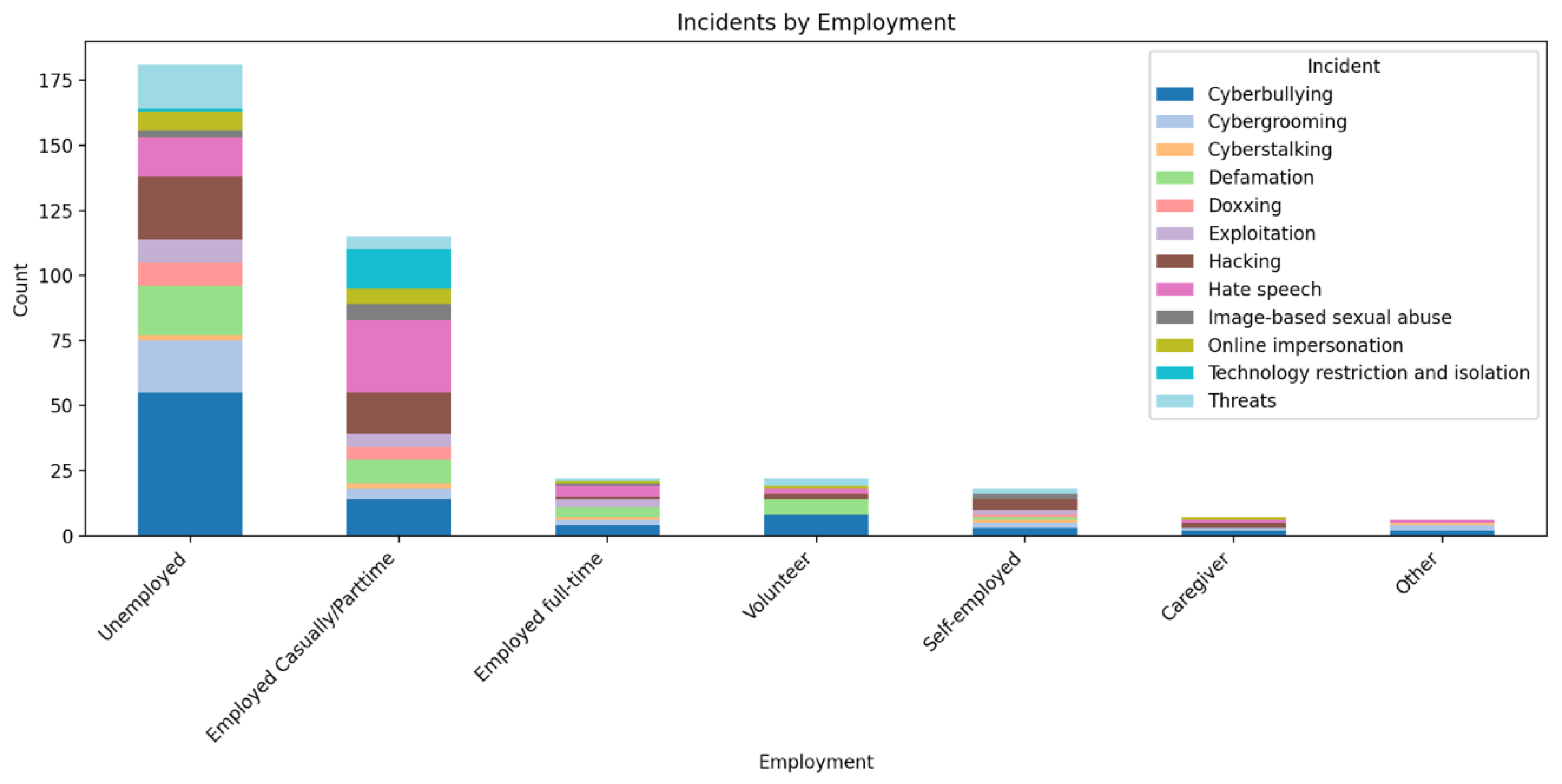
The income distribution shows a striking concentration among the lowest income respondents. The respondents who earn less than R5000 account for the overwhelming majority of incidents across categories (n=245), followed by those who earn between R6000– R20000 (n=55), those who were unsure about how much they make monthly accounted for 37 cased and followed by those who earn between R21000 – R30000 (n=21), and only one participant who earns more than R31000 reported a case of cybergrooming. The lowest income group commonly holds well over three-quarters of the total burden for major incident types, with the next band adding a small additional share. This pattern indicates that financial insecurity substantially elevates risk and visibility to offenders, as well as the likelihood of account compromise and reputational attacks. Additionally, social security grant recipients indicated substantially higher incident percentages than non-recipients across every major category (78% vs. 22%). Grant recipients reported a significantly higher numbers for cyberbullying (n=64), hate speech (n=40), hacking (n=41), and defamation (n=30). Recipients comprise most incidents compared to non-recipients across categories, capturing well over two-thirds of exposure. This suggests that grant status is a strong proxy for economic vulnerability, tracking closely with elevated TFGBV risk.
Findings indicate that lower socio-economic status correlates with more frequent and more varied TFGBV. Employment instability, low-income, and grant receipt each independently align with higher exposure. Where these factors intersect (e.g., unemployed grant recipients in the lowest income band), there’s cumulative risk. The distribution of incident types adds nuance; that is, broadening of harm types at lower socio-economic status indicates not only more harassment, but more complex safety challenges, such as account security, identity and protection.
Converging evidence across Employment, Income, and Grant status shows a consistent correlation, lower socio-economic status including unemployment, precarious work, low income and grant receipt corresponds with substantially higher counts of all major TFGBV incidents. The magnitude is large and consistent often 2-5x higher for low-income groups and sometimes an order of magnitude higher in the lowest income band. The steepest gradients are observed for cyberbullying and hate speech, which together account for the majority share of incidents. However, hacking and exploitation also scale with socio-economic hardship, indicating that risk is not only social (harassment, threats) but also technical/economic.
4. Discussion
This study reveals a concerning prevalence of TFGBV among women with disabilities that is shaped by intersecting factors of disability, race, socio-economic status, and geographic location in South Africa. We argue that TFGBV compounds existing social inequalities. When viewed through an intersectional lens, TFGBV is not distributed evenly as factors such as disability type, race, socioeconomic status, and grant dependency all shape the likelihood to various forms of harm.
This study reveals that TFGBV exposure cross disability types is not monolithic. For example, individuals with physical, mobility and pain-related disabilities appear to experience higher aggregate exposure across incident types than those with sensory or intellectual disabilities. This mirrors what has been found in various studies, that women with visible (physical disabilities) are most likely to experience violence than those with invisible disabilities (Ledingham et al., 2022; Clements et al., 2024; Wolbers & Boxall, 2024). However, the types of violence subjected to varies across disability types. For example, while cyberbullying is consistently the most prevalent category, mobility and pain-related groups show elevated distributions across multiple harms, including hate speech, hacking, and threats. Furthermore, while harassment is the most commonly reported form of cyberbullying among individuals with intellectual disabilities (Clements et al., 2024) other types such as stalking, and shaming remain common among people with intellectual disabilities. This suggests a broader surface exposure and possibly higher online participation coupled with contentious social interactions or greater dependency on connected services.
The above noted differences likely reflect a blend of external and structural factors, such as prior experiences with traditional bullying, increased internet use, and minority status (Waller et al., 2018). The visibility of disability and how it is perceived in online spaces can draw targeted harassment (Waller et al., 2018). Care-related and access-related dependencies may increase online footprint and the number of digital interactions, raising exposure to both opportunistic and targeted abuse (Waller et al., 2018; Huang & Wang, 2023; Wolbers & Boxall, 2024).
Findings further highlight the pronounced racial disparities, especially for cyberbullying and hate speech. These racial disparities highlight how systemic inequality and access to technology intersect with TFGBV. Communities identified as African/Black and Coloured in the data show high relative counts across multiple categories of TFGBV. This distribution across racial categories indicates well-documented patterns in literature (Bailey & Burkell, 2021; Bansal et al., 2023; Hameed et al., 2025). Women with disabilities who also belong to racial, ethnic, or other minority groups are at increased risk of TFGBV due to intersecting oppressions such as racism, ableism, and sexism (Hameed et al., 2025). Racially marginalized communities face not merely higher counts, but cumulative harms that can silence participation, shape mental health outcomes, and curtail professional opportunities (Bansal et al., 2023).
This study also highlights that low-socioeconomic status, including low education levels, low-income and dependency on social security grants is strongly tied to risk of TFGBV. Lower formal education levels correlate with higher exposure for several TFGBV categories, while higher education levels show lower counts and narrower spread across incident types. This is consistent with broader literature that indicates that higher educational attainment is a strong protective factor (Arenas et al., 2023). Women with disabilities who have a university degree or higher education are less likely to experience abuse, including psychological and sexual abuse, compared to those with little or no education (Kwagala & Galande, 2022; Arenas et al., 2023). Lower-income brackets exhibit markedly higher totals across TFGBV incident types, and grant recipients show substantially greater exposure than non-recipients.
Several mechanisms may be at play. The first mechanism is that access and gatekeeping, where lower-income users may rely on lower-cost devices, shared connections, or public Wi-Fi, increase susceptibility to hacking, doxxing, and impersonation through weaker security and exposure to untrusted networks (Jain & Agrawal, 2020; Bansal et al., 2023). The second mechanism is that fraud and exploitation targeting is likely to increase – where the lack of economic resources is a known risk factor for grooming, exploitation, and scam-adjacent harms that escalate into TFGBV, particularly where gendered dynamics intersect with caregiver responsibilities and financial stress (Henry & Flynn, 2019). Thirdly, platform vulnerability exists, where lower digital literacy and fewer resources for premium moderation/verification features can exacerbate exposure and reduce recovery (Jain & Agrawal, 2020). Grant recipients, a proxy for socioeconomic vulnerability and dependency on state support, face elevated risk across almost every category, suggesting a broader vulnerability pattern. Paradoxically, receiving public economic aid is associated with a higher risk of abuse. Consistent with literature, women with disabilities who rely on financial assistance are more likely to experience domestic and sexual violence than those who do not receive such aid (Arenas et al., 2023).
This study shows that TFGBV is deeply intersectional. Individuals navigating multiple marginalized identities, especially where disability, race, and low income intersect, face broader and more frequent harm. Cyberbullying dominance is only the most visible part of a multiplex risk environment that includes hate speech, threats, doxxing, impersonation, and hacking. The patterns that emerge are both intuitively coherent and actionable, pointing to urgent needs for targeted interventions, platform accountability, and policy safeguards calibrated to specific vulnerabilities. The path forward is both technical and social. We recommend that safety-by-design must meet community-informed moderation and targeted policy support, with specific attention to those most impacted. By aligning platform design, public policy, and community practice to the patterns revealed herein, exposure can be reduced.
Limitations
While this study offers important insights into the intersectional experiences of TFGBV among women with disabilities, several limitations must be acknowledged.
First, although this is a national survey, there were challenges with recruiting participants from across the country. The researchers are situated in the Western Cape province and conducted information sharing sessions as an additional means for recruitment, hence the larger number of participants from this province. Moreover, issues around digital connectivity and affordability may be unevenly distributed across the South African context which need to be taken into account in future TFGBV research associated with this particular population group.
Secondly, the use of an online survey, though appropriate for the topic, may have excluded women with disabilities who lack consistent access to digital technologies, the internet, or accessible devices. This may have led to an underrepresentation of certain groups, particularly those living in rural areas, older women, and those with higher support needs or lower digital literacy.
Thirdly, the self-report nature of the survey introduces potential biases, including underreporting due to stigma, fear of retaliation, or uncertainty about whether an experience qualifies as violence. Conversely, some participants with greater digital awareness may have been more likely to recognize and report TFGBV experiences.
Fourthly, while the study applied an intersectional lens, the survey’s structure limited the depth of qualitative insights into the lived experiences behind the statistical patterns.
Lastly, the sample size, though national in scope, was relatively small and may not fully capture the heterogeneity of experiences among women with different types of disabilities across South Africa. The uneven geographic distribution of respondents constrains the interpretation of the spatial analysis. Spatial patterns observed in the data may reflect differential recruitment reach, internet accessibility, and organizational presence rather than true geographic variation in TFGBV experiences. Consequently, spatial findings should be interpreted as exploratory and descriptive, rather than as precise estimates of regional prevalence or risk. These limitations highlight the need for future research employing stratified or regionally representative sampling approaches and enhanced outreach strategies to strengthen spatial inference and generalizability. Despite these limitations, the findings provide a valuable baseline for understanding TFGBV among women with disabilities and highlight the urgency of further research and action in this area.
5. Conclusions
This study demonstrates that TFGBV against women with disabilities in LMICs is shaped by intersecting inequalities that amplify both risk and exclusion. Disability, gender, race and socioeconomic status combine to produce unique vulnerabilities, limiting access to digital safety, justice, and support. The findings emphasize that interventions must go beyond individual responses to address the structural, institutional, and economic factors that underpin TFGBV. An intersectional, power-conscious framework is critical to developing equitable, inclusive strategies that centre the voices and experiences of women with disabilities. Such an approach enables not only the prevention of online violence but also the dismantling of broader systems of inequality that perpetuate exclusion, advancing both gender justice and disability rights. Future policy interventions must centre disabled women’s experiences and address the structural inequalities that make them disproportionately vulnerable online.
Author Contributions
Conceptualization, Lieketseng Ned and Karen Soldatic.; methodology, Liketseng Ned, Karen Soldatic, Eunice Tunggal and Babalwa Tyabashe-Phume; software, Karen Soldatic and Eunice Tunggal.; validation, Eunice Tunggal and Babalwa Tyabashe-Phume; Eunice Tunggal, Babalwa Tyabashe-Phume, Lieketseng Ned and Karen Soldatic; investigation, Liketseng Ned, Karen Soldatic, Babalwa Tyabashe-Phume and Eunice Tunggal; resources, Lieketseng Ned and Karen Soldatic.; data curation, Eunice Tunggal, Babalwa Tyabashe-Phume, Lieketseng Ned and Karen Soldatic; writing—original draft preparation, Babalwa Tyabashe-Phume; writing—review and editing, Lieketseng Ned, Eunice Tunggal and Karen Soldatic; visualization, Eunice Tunggal; supervision, Karen Soldatic and Lieketseng; project administration, Lieketseng Ned.; funding acquisition, Lieketseng Ned and Karen Soldatic. All authors have read and agreed to the published version of the manuscript.
Funding
This research was funded by Sexual Violence Research Institute (SVRI), grant number: S009253. The APC was funded by the Canada Excellence Research Chair in Health Equity & Community Wellbeing, grant number: CERC-2022-00097.
Institutional Review Board Statement
The study was conducted in accordance with the Declaration of Helsinki, and approved by the Ethics Committee of Stellenbosch University (approval reference: N24/07/091, 21 October 2024) and Toronto Metropolitan University (approval reference: CERC-2022-00097, 16 January 2025).
Informed Consent Statement
Informed consent was obtained from all subjects involved in the study.
Data Availability Statement
In line with institutional ethics approval for this research, no data is publicly available.
Acknowledgments
We would like to thank the research participants for their time in completing the survey. We also want to acknowledge the role of the project’s community partner organisations who supported the development of the survey and provided disability accessibility audit of the survey prior to public release, supported the recruitment of participants via their community networks, and supported the interpretative analysis of the survey results. The authors have reviewed and edited the output and take full responsibility for the content of this publication.
Conflicts of Interest
The authors declare no conflicts of interest. The funders had no role in the design of the study; in the collection, analyses, or interpretation of data; in the writing of the manuscript; or in the decision to publish the results.
Abbreviations
The following abbreviations are used in this manuscript:
| GBV | Gender-Based Violence |
| ICTs | Information and Communication Technologies |
| LMIC | Low- and Middle- Income Countries |
| TFGBV | Technology Facilitated Gender-Based Violence |
References
- Afrouz, R. (2023). The Nature, Patterns and Consequences of Technology-Facilitated Domestic Abuse: A Scoping Review. Trauma, Violence, & Abuse, 24(2), 913–927. [CrossRef]
- Alberts, C., & Kheswa, J. G. (2017). Social networks and sexual behaviour amongst adolescent females in one secondary school in Eastern Cape, South Africa. African Population Studies, 31(2). [CrossRef]
- Arenas, J., Jiménez, A., & Bote, M. (2023). Health and Socioeconomic Determinants of Abuse among Women with Disabilities. International Journal of Environmental Research and Public Health, 20. [CrossRef]
- Backe, E. L., Lilleston, P. & McCleary-Sills, J. (2018). Networked Individuals, Gendered Violence: A Literature Review of Cyberviolence. Violence and Gender, 5(3), 135–146. [CrossRef]
- Bailey, J., & Burkell, J. (2021). Tech-facilitated violence: thinking structurally and intersectionally. Journal of Gender-Based Violence. [CrossRef]
- Bansal, V., Rezwan, M., Iyer, M., Leasure, E., Roth, C., Pal, P., & Hinson, L. (2023). A Scoping Review of Technology-Facilitated Gender-Based Violence in Low- and Middle-Income Countries Across Asia. Trauma, Violence, & Abuse, 25, 463 - 475. [CrossRef]
- Barter, C., & Koulu, S. (2021). Digital technologies and gender-based violence – mechanisms for oppression, activism and recovery. J Gend Based Violence, 5(3):367–75. [CrossRef]
- Clements, F., Orchard, L., & Chadwick, D. (2024). A scoping review investigating the perspectives of people with mild to moderate intellectual disabilities on experiences of cyberbullying victimisation and its subtypes.. Journal of intellectual disabilities, 17446295241252214. [CrossRef]
- Cornish, F., Nyutsem Breton, N., Moreno-Tabarez, U., Rua, M., & Hodgetts, D. (2023). Participatory action research. Nature Reviews Methods Primers, 3(1). [CrossRef]
- Dagne, Henok, Kathleen Doherty, Julie Campbell, Alice Saul, and Jessica Roydhouse. 2025. “Proxy Reporting in Health: A Scoping Review of Instructions, Perspectives, and Reporting Experiences.” Quality of Life Research 34 (7): 1835–47. [CrossRef]
- De Filippo, A., Bellatin, P., Tietz, N., Grant, E., Whitefield, A., Nkopane, P., Devereux, C., Crawford, K., Vermeulen, B., & Hatcher, A. M. (2023). E&ects of digital chatbot on gender attitudes and exposure to intimate partner violence among young women in South Africa. PLOS Digit Health, 2(10), e0000358. [CrossRef]
- Dickman, B. J. & Roux, A. J. (2005). Complainants with learning disabilities in sexual abuse cases: a 10-year review of a psycho-legal project in Cape Town, South Africa. British Journal of Learning Disabilities, 33(3), 138–144. [CrossRef]
- Dunn, S. (2020). Technology-facilitated gender-based violence: An overview (Centre for International Governance Innovation: Supporting a Safer Internet Paper, Issue. https://www.cigionline.org/publications/technology-facilitated-gender-based-violence-overview/.
- Economist Intelligence Unit (2021). Measuring the prevalence of online violence against women, Economist Intelligence Unit. https://onlineviolencewomen.eiu.com/.
- Edwards, M., Suarez-Tangil, G., Peersman, C., Stringhini, G., Rashid, A. & Whitty, M. (2018). The Geography of Online Dating Fraud. Workshop on Technology and Consumer Protection. https://research-information.bris.ac.uk/en/publications/the-geography-of-online-dating-fraud.
- Ellis, K. & Kent, M. (2011). Disability and New Media. Routledge. [CrossRef]
- Goggin, G. & Soldatić, K. (2022). Automated decision-making, digital inclusion and intersectional disabilities. New Media & Society, 24(2), 384–400. [CrossRef]
- Hameed, S., Tyabashe-Phume, B., Tunggal, E., Hunt, X., Ned, L., & Soldatić, K. (2025). Technology-facilitated gender-based violence against women with disabilities in low- and middle-income countries: a scoping review protocol. BMJ Open, 15. [CrossRef]
- Henry, N., & Flynn, A. (2019). Image-Based Sexual Abuse: Online Distribution Channels and Illicit Communities of Support. Violence Against Women, 25(16), 1932-1955. [CrossRef]
- Henry, N., Flynn, A. & Powell, A. (2020). Technology-Facilitated Domestic and Sexual Violence: A Review. Violence Against Women, 26(15–16), 1828–1854. [CrossRef]
- Henry, N., & Powell, A. (2015). Embodied harms: Gender, shame, and technology-facilitated sexual violence. Violence Against Women, 21(6), 758–779. [CrossRef]
- Hinson, L., Mueller, J., O’Brien-Milne, L., & Wandera, N. (2018). Technology-facilitated gender-based violence: what is it, and how do we measure it? https://www.svri.org/sites/default/files/attachments/2018-07-24/ICRW_TFGBVMarketing_Brief_v8-Web.pdf.
- Huang, S., & Wang, Y. 2023. How People with Physical Disabilities Can Obtain Social Support through Online Videos: A Qualitative Study in China. International Journal of Environmental Research and Public Health, 20(3), 2423. [CrossRef]
- Idongesit, E. (2014). Youths, social media and gender-based violence: an emerging trend in Nigeria. International Journal of Economy, Management and Social Sciences, 3(1), 21–27.
- Internet Sans Frontières. (2019). #IWD2019: Online gender-based violence affects 45% of women on social media in West and Central Africa. Internet Sans Frontières Webpage. https://internetwithoutborders.org/iwd2019-online-gender-based-violence-affects-45-of-women-on-social-media-in-west-and-central-africa/.
- Jain, S., & Agrawal, S. (2020). Perceived vulnerability of cyberbullying on social networking sites: Effects of security measures, addiction and self-disclosure. Indian Growth and Development Review, 14(2), 149–171. [CrossRef]
- Kim, C. & Ferraresso, R. (2023). Examining Technology-Facilitated Intimate Partner Violence: A Systematic Review of Journal Articles. Trauma, Violence, & Abuse, 24(3), 1325–1343. [CrossRef]
- Kwagala, B., & Galande, J. (2022). Disability status, partner behavior, and the risk of sexual intimate partner violence in Uganda: An analysis of the demographic and health survey data. BMC Public Health, 22. [CrossRef]
- Ledingham, E., Wright, G., & Mitra, M. (2022). Sexual Violence Against Women With Disabilities: Experiences With Force and Lifetime Risk.. American journal of preventive medicine. [CrossRef]
- Makinde, O. A., Odimegwu, C. O., Abdulmalik, J. O., Babalola, S. O. & Fawole, O. I. (2016). Gender-based violence following social media acquaintance in Nigeria. African Journal of Reproductive Health, 20(4), 67–76.
- Marnewick, C., Meda, L., Condy, J., & Phillips, H. (2022). Using an intervention programme to empower intellectually disabled learners to use WhatsApp in a special needs unit in Cape Town, South Africa. Cogent.
- Mooketsi, B. E. (2018). An investigation on the prevalence of cyberbullying amongst undergraduate students in the University of Botswana. Mosenodi Journal, 21(2), 44–54.
- Mulisa, F. & Getahun, D. A. (2018). Perceived Benefits and Risks of Social Media: Ethiopian Secondary School Students’ Perspectives. Journal of Technology in Behavioral Science, 3(4), 294–300. [CrossRef]
- Phasha, T. N. & Nyokangi, D. (2012). School-Based Sexual Violence Among Female Learners With Mild Intellectual Disability in South Africa. Violence Against Women, 18(3), 309–321. [CrossRef]
- Plan International. (2020). Free to Be Online? A report on girls’ and young women’s experiences of online harassment. Plan International. https://plan-international.org/publications/free-to-be-online/.
- Posetti, J., Shabbir, N., Maynard, D., Bontcheva, K. & Aboulez, N. (2021). The Chilling: Global trends in online violence against women journalists (Research Discussion Paper). UNESCO. https://en.unesco.org/publications/thechilling.
- Republic of South Africa. (2013). Protection of Personal Information Act. Government Gazette. RSA: Pretoria. https://www.gov.za/sites/default/files/gcis_document/201409/3706726-11act4of2013protectionofpersonalinforcorrect.pdf.
- Sam, D. L., Bruce, D., Agyemang, C. B., Amponsah, B. & Arkorful, H. (2019). Cyberbullying Victimization among High School and University Students in Ghana. Deviant Behavior, 40(11), 1305–1321. [CrossRef]
- South African Police Service. (2023). Speaking Notes for Police Minister General Bheki Cele on the occasion of the release of Quarter 4 crime statistics in Cape Town, 30 May 2023. South African Government Website. https://www.gov.za/speeches/minister-bheki-cele-release-quarter-4-crime-statistics.
- Trevisan, F. (2014). Scottish Disability Organizations and Online Media: A Path to Empowerment or “Business as Usual”? Disability Studies Quarterly, 34(3). [CrossRef]
- Tyabashe-Phume, B. P., Tunggal, E., Hameed, S., Hunt, X., Soldatić, K., & Ned, L. (2025). Scoping review on technology-facilitated gender-based violence against women with disabilities and LGBTQI+ persons in low-and middle-income countries. African Journal of Disability, 14, 11.
- United Nations Population Fund, 2022, The virtual is real: A forum addressing technology-facilitated violence against women and girls, viewed 20 July 2024, from https://www.unfpa.org/thevirtualisreal.
- United Nations Women, 2015, Urgent action needed to combat online violence against women and girls, viewed 12 September 2024, from https://www.unwomen.org/en/news/stories/2015/9/cyber-violence-report-press-release.
- United Nations Women. (2020). Online and ICT-facilitated violence against women and girls during COVID-19. Digital Library: UN Women. https://www.unwomen.org/sites/default/files/Headquarters/Attachments/Sections/Library/Publications/2020/Brief-Online-and-ICT-facilitated-violence-against-women-and-girls-during-COVID-19-en.pdf.
- United Nations Women. (2022). Accelerating efforts to tackle online and technology-facilitated violence against women and girls. United Nations Women. https://www.unwomen.org/en/digital-library/publications/2022/10/accelerating-efforts-to-tackle-online-and-technology-facilitated-violence-against-women-and-girls.
- United Nations Women, & WHO. (2023). Technology-facilitated violence against women: Taking stock of evidence and data collection. https://www.unwomen.org/en/digital-library/publications/2023/04/technology-facilitated-violence-against-women-taking-stock-of-evidence-and-data-collection.
- Waller, A., Lokhande, A., Ekambaram, V., Deshpande, S., & Ostermeyer, B. (2018). Cyberbullying: An Unceasing Threat in Today’s Digitalized World. Psychiatric Annals. [CrossRef]
- Wolbers, H., & Boxall, H. (2024). Online dating app facilitated sexual violence victimisation among people with disability. Trends & issues in crime and criminal justice no. 695. Canberra: Australian Institute of Criminology. [CrossRef]
- World Bank Group. (2025). Disability Inclusion. https://www.worldbank.org/en/topic/disability#:~:text=Persons%20with%20disabilities%20are%20more,of%20living%20with%20a%20disability.
- World Health Organization (2012). Disability: Report by the Secretariat. https://apps.who.int/gb/ebwha/pdf_files/EB132/B132_10-en.pdf.
- Zelenko, Oksana, Rafael Gomez, and Nick Kelly. (2021). “Research Co-Design: Meaningful Collaboration in Research.” In How to Be a Design Academic. CRC Press.
Figure 1.
Disability Type and TFGBV Experienced.
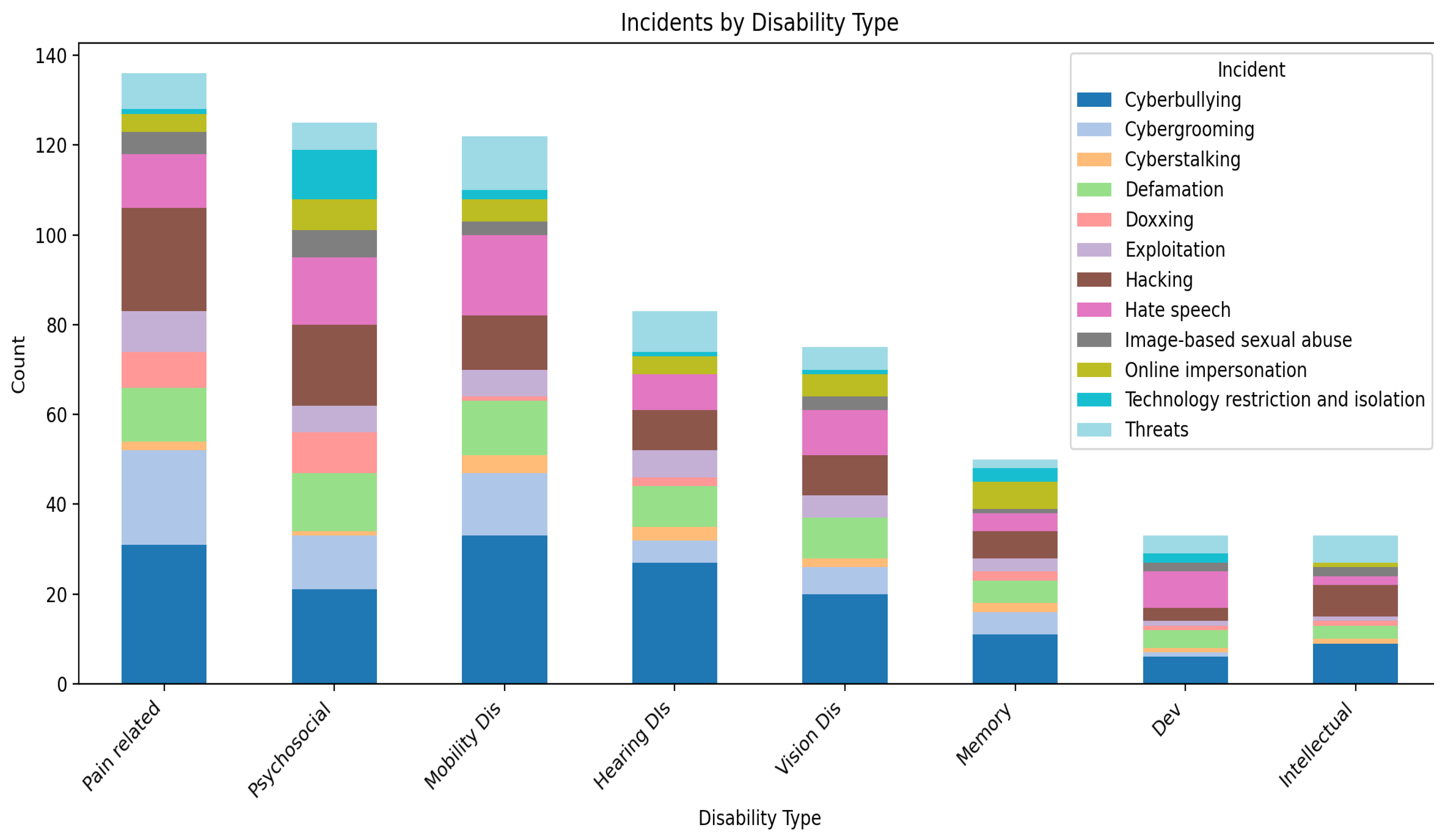

Table 1.
TFGBV incidents across racial groups.
| Category | Mean | Median | Mode | Range | Total |
|---|---|---|---|---|---|
| African/Black | 20,25 | 13,5 | 12 | 50 | 243 |
| Coloured | 7,666667 | 6 | 6 | 26 | 92 |
| White | 2,333333 | 2,5 | 1 | 4 | 28 |
| Indian | 0,666667 | 0,5 | 0 | 2 | 8 |
Disclaimer/Publisher’s Note: The statements, opinions and data contained in all publications are solely those of the individual author(s) and contributor(s) and not of MDPI and/or the editor(s). MDPI and/or the editor(s) disclaim responsibility for any injury to people or property resulting from any ideas, methods, instructions or products referred to in the content. |
© 2026 by the authors. Licensee MDPI, Basel, Switzerland. This article is an open access article distributed under the terms and conditions of the Creative Commons Attribution (CC BY) license (http://creativecommons.org/licenses/by/4.0/).
Copyright: This open access article is published under a Creative Commons CC BY 4.0 license, which permit the free download, distribution, and reuse, provided that the author and preprint are cited in any reuse.