

Submitted:
08 April 2026
Posted:
10 April 2026
You are already at the latest version
Abstract
This is the second article on the mechanical mechanism of laminar turbulent transition in pipe Poiseuille flow, which is one of the most important topics in turbulence research [1,2], as a representative of a large category of wall-bounded flows [3]. Traditional fluid mechanics stability research focuses on the effects of different disturbances and pays less attention to the mechanical properties of flow structures [4]. In this paper, the tensile energy flux, which is renamed from the viscous energy flux vector [5], and its divergence are deduced and visualized in pipe Poiseuille flow. The tensile energy flux vector is both zero at wall and in the center, and at a critical position 0.707R, the divergence of tensile energy flux vector is zero. Once the tensile force flow reaches its critical value [4], the critical position 0.707R is just the local position where onset of turbulence occurs, consistent with some experimental results [6]. This predicted position has a zenith angle of 45° if membrane theory of spherical shell is applied on the fluid [4], and this angle may be analogous to the cracks angle in the uniaxial compressive strength experiment of rock specimen subjected to uniaxial compression [7]. This article also proves that the critical Reynolds number during laminar turbulent transition in a circular tube is not a constant, but the ratio of critical tensile energy flux to average kinetic energy flux inside the tube is inversely proportional to the Reynolds number, similar to the inverse relationship between laminar flow resistance coefficient and Reynolds number.
Keywords:
viscous fluid flow
; Reynolds numbers
; laminar-turbulent transition
; viscous energy flux
; pipe Poiseuille flow
; divergence of tensile energy flux vector
; tensile force flow
; onset of turbulence
; membrane theory
; spherical shell
; rock specimen
; uniaxial compression
; resistance coefficient
Introduction
The physical mechanism of laminar turbulent transition in a pipe Poiseuille is an essential part of fluid mechanics [1,2,3]. Experimentally, in all flows including Couette flow, channel flow, pipe flow, and boundary layer flow, turbulence initially appears in the form of localized patches, which are transient [8]. As a flow with clear interface and relatively easy detection, the turbulent slugs that appear during the transition process in pipe flow are the most suitable for studying the detailed information of turbulent-non-turbulent interface and entrainment [9]. Theoretically, the efforts to unify the parameterization description of the location and mechanism of laminar turbulent transition have been ongoing for decades [10,11,12,13,14]. In order to find a more general criterion to characterize the flow regime and to test in application to non-Newtonian fluids, a local stability parameter, Zmax, a function of the ratio of input energy to energy dissipation for an element of fluid was proposed, and it has a maximum value of 0.385 times the critical Reynolds number, i.e., , or 808, as being applied to a Newtonian fluid in laminar pipe flow [10]. Furthermore, a generalized stability parameter K was proposed, representing the ratio of energy gradient in the transverse direction to viscous force or pressure gradient in the streamwise direction [11]. Here, K independent of the geometry of the flow system, is proportional to the Reynolds number for Newtonian flow, and contains Ryan and Johnson’s results [10] for pipe flows in general as a special case [11]. The experiments reported in [15] indicated that the breakdown of initially streamline motion into turbulent one first occurs at a distance of approximately 0.60 of the radius of the pipe from the centerline of the pipe. From this point the turbulence spreads inwards to the centerline and outwards to the walls. A stability parameter named χ was proposed in [16], which combines the velocity gradient, density, viscosity, and wall distance for boundary layer flow, taking zero at the wall (wall distance is zero) and in the main stream (velocity gradient is zero), reaching a maximum at some intermediate distance, where eddies will develop once a disturbance of sufficient magnitude occurs. A theory for flow instability and turbulent transition is proposed for parallel shear flows [12]. In this theory, the total energy gradient in the transverse direction and that in the streamwise direction of the main flow dominate the disturbance amplification or decay, leading to a new dimensionless parameter K for characterizing flow instability for wall bounded shear flows, which is expressed as the ratio of the energy gradients in the two directions. The flow instability would first occur at the position of Kmax, which is confirmed by Nishioka et al.’s experimental data [17].
A set of new momentum and energy dissipation equations for viscous fluid flow has been published by the present corresponding author [5], which can replace the Navier-Stokes (N-S) equation, although it was not explicitly stated inside the paper. In this paper [5], a viscous shear vector is defined as a vector component of gradient vector of local velocity magnitude, in perpendicular direction of the velocity vector. Then, a local viscous energy flux vector is defined as a product of the viscous shear vector, the viscosity and the velocity magnitude. The divergence of the viscous energy flux vector results in new expressions on viscous force and loss of viscous energy [5]. Recently, a membrane force model for liquid layer under capillary meniscus in cylindrical tubes has been reported by the present author group [18]. In the first paper on this topic by the present author group [4], the membrane force model in structural mechanics [19] was further inspired to establish a new force model for a fluid shell with a hemispherical shell shape inside a laminar pipe flow. As the Reynolds number increases, the curvature radius of the virtual, hemispherical liquid layer shell decreases, and finally becomes equal to and even less than the pipe radius R, the stable liquid layer collapses, and the laminar flow becomes turbulent with a critical tensile force flow of [4]. In the present paper, the concept of viscous energy flux vector [5] is renamed to a more accurate one called as local tensile energy flux vector, and it is applied to the study of the transition from laminar to turbulent flow in a circular tube, and the variation of tensile energy flux along with the radius of the tube was derived. The local maximum value of tensile energy flux corresponds to a location point where stable fluid layer failure is most likely to occur, namely the local onset location point of transition from laminar to turbulent flow.
Derivation of Theoretical Model
The laminar, incompressible and steady flow through pipe can be completely analyzed by Newton’s law of viscosity and Newton’s second law of motion [20]. As shown in Figure 1, the velocity direction is set to be the z direction. The viscosity of fluid in this case is a constant, and the flow is laminar: , , , where . Let then, For the pipe Poiseuille flow in Figure 1, the velocity vector is
and the magnitude of velocity is
In a recent paper by the corresponding author [5], a viscous shear vector (from now on, it is renamed as tensile vector) was defined as the vector component of gradient vector of local velocity magnitude, in perpendicular direction of the velocity vector. The gradient vector of velocity magnitude is
The tensile vector defined in [5] is then obtained as
since the gradient vector of velocity magnitude (, Eq. (3)) is perpendicular to the velocity vector (, Eq. (2)), and . It can be evaluated that:
which is the fundamental characteristic of the tensile vector [5].
The tensile energy flux vector defined in [5] is deduced from the tensile vector as below:
And the divergence of the tensile energy flux vector is given as below
According to the theory presented in [5],
in Eq. (7), the square term of partial derivative of velocity magnitude, , corresponds to irreversible energy loss, which means
It is identical to that deduced from the N.S equation [21]. It is assumed in [5] that the viscous force (it is now also renamed as tensile force) is always parallel to the fluid velocity vector inside the flow, then, from Eq. (8),
Since , then
From ,
It is confirmed that the tensile force in the above equation for the present flow derived by the theory in [5] is correct.
We use to denote
and , renamed from c in [5], clearly refers to the mechanical work done by the tensile force. From Eqs. (8,9,13) we have
We also have,
Since the average flux of the kinetic energy in the pipe is , and the tensile energy flux vector becomes
Given a specific parameter setting for a water flow in a circular tube with inner radius of 0.0464 m, maximum velocity of 0.05 ms-1, viscosity of 1.0087×10⁻³ Ns/m2, density of 1000 kg/m3, the profiles of the irreversible energy loss, the mechanical work done by the tensile force, the tensile energy flux vector, and the divergence of the tensile energy flux vector, are all plotted in Figure 2. The Reynolds number is around 2300 at the critical point of transition from laminar to turbulent flow. The irreversible energy loss is always positive, and since it is proportional to the square of the radial gradient of fluid velocity magnitude, it has the smallest at the center of the pipe (where the velocity gradient is zero) and the largest at the pipe wall. Because the tensile force here acts in the opposite direction of the fluid flow, it does negative work for the fluid. The sum of the two forms the divergence of the tensile energy flux vector as in Eq. (8), has the maximum positive value at the pipe wall and the maximum negative value at the pipe center.
As shown in Figure 2, the tensile energy flux vector, , is negative with ϵ, and it is zero at and . This tensile energy flux is caused by the tensile force of the boundary, acting in the opposite direction of flow motion. So, the peak of the tensile energy flux vector can be given by setting the divergence of the tensile energy flux vector, Eq. (14), to be equal to zero, that is, Then,
and finally we get the critical radial position,
Then the critical velocity at the critical position is
The tensile energy flux at the critical position is got as
The tensile energy applied to the fluid by the pipe wall through tensile force acts as a kind of potential energy, being zero closing to the wall and increasing inwards. At a certain location point, the variation of tensile energy flux inside a circular space, that is its divergence, reaches zero at a certain radius , which is the key point for analyzing turbulent transition.
As described in [4], the virtual fluid layer of a hemispherical shell shape inside the laminar pipe flow is also shown in the left part of Figure 1, and as the curvature radius of the hemispherical liquid layer is equal to the pipe radius R, the stable liquid layer collapses, and the critical tensile force flow is given as [4]. According to Eq. (16), at ,
Primarily, it is confirmed that the transition state from laminar to turbulent flow is related to the Reynolds number from an energy perspective, not from the viscous force perspective as described in fluid mechanics textbooks. For laminar flow through a circular pipe, expressed by Hagen-Poiseuille equation and Darcy’s formula, f =16/Re is the relationship between coefficient of friction f and the Reynolds number Re [20]. On the overall trend, Eq. (21) is similar to f =64/Re, indicating that they both represent a relationship between viscous dissipation energy and mechanical energy. The critical tensile energy flux, , in Eq. (21), is not constant, and is proportional to the velocity. After incorporating the concept of the critical tensile force flow, , critical Re number can be rewritten as,
For a certain fluid, the critical tensile force flow is regarded as a property parameter, which means that it has a constant value [4]. Then the above equation indicates that is proportional to the square of the circular tube radius, and also proportional to the square of the maximum flow velocity in pipe Poiseuille flow transition.
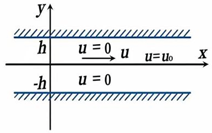
The analysis method for plane Poiseuille flow is similar to that of a circular tube, and the comparison of the analysis results between these two is listed in Table 1. It should be stated that the critical position for the pipe flow and that between flat plates are and , respectively. Although the velocity distribution curves of laminar flows in a circular tube and that between flat plates are all parabolic, the difference in the relative position of the critical points reflects the influence of the differences in the two flow cross-sections: one is a closed circle and the other is an open rectangle. This is because the viscous tensile stress applied from the boundary wall is the decisive factor in the distributions of fluid velocity and tensile energy flux inside the fluid.
Experimental Verifications Cited from Literature
For pipe Poiseuille flows, the ratio of the mechanical energy gradient to the viscous force term, K, was proposed by Eq. (4.24) in [14], i.e., The maximum point of K has derived a critical radius , which is different from in this paper. It is obvious that the importance levels of Reynolds numbers in and are similar, even though the physical meaning involved in the present paper differs from that in Dou [14].
In order to investigate the randomness in time of naturally occurring slug formation in laminar-to-turbulent transition of pipe flows with sufficiently high Reynolds numbers, a special test facility was developed and built for detailed investigation of deterministically generated slugs in pipe flows [6]. With increasing of Reynolds number, ‘puff splitting’ was observed and the split puffs developed into slugs. The typical axial velocity at different radial position r/R with time is shown in Figure 3a, when the control system of disturbance operated at Re = 2450. The cross-sectional velocity profiles measured at the exit of the pipe for the puff structures are shown in Figure 3b. The structures reveal that the velocity oscillation first appears at r/R=0.47-0.73 at time of 4.25 s. Yellow bar at , drawn in Dou [14], and red bar at , given in the present work, are both the onset point predictions of turbulence transition.
Figures 23 and 24 in [9] provided ensemble-averaged velocity profiles near the leading interface and trailing interface with Re=1·9×104, x/D=505, ULE/U=1.5 and 3.5, respectively. Since the flowrate in the pipe is constant a deceleration in the central region is accompanied by a corresponding acceleration near the wall, and a single radial location (r/R≈2/3) separates the fluid under-going acceleration from the decelerating fluid [9]. It was also stated in [15] that the breakdown may be related to the rate of variation of energy across a diameter of the pipe, and if some slight deviation of the particles from linear axial flow to be produced by some initial disturbance, this will likely have its maximum disturbing effect if it occurs at a radius where the radial variation of energy is the maximum. By this consideration, in streamline flow through a pipe of radius a, the kinetic energy has a maximum when r=a [15].
Stability experiments also were made on plane Poiseuille flow generated in a long channel of a rectangular cross-section with a width-to-depth ratio of 27.4 [17]. As shown in Figure 4, the base flow is laminar and the instantaneous distribution of the velocity breaks at the position y/h =0.50 (T=4-6) to 0.62 (T =8-9) by showing an oscillation of velocity in y/h =0.50-0.62 [17]. This coincides to the position of Kmax proposed in [14] which occurs at y/h =0.58 and is the most dangerous point. In this paper, we also deduce a same critical position of , and the rationality of the prediction of the transition point from laminar to turbulent flow in this paper is confirmed.
Discussion on the Fracture Mechanism of Laminar Fluid Layers
The blue semicircle represents the liquid force element of the spherical shell during transition [4], as shown in Figure 3b, and the predicted transition position in this semicircle occurs at an zenith angle of φ=45°. This 45° angle is very similar to the angle at which fracturing cracks appear on cylindrical rock specimen under compression conditions [7]. The uniaxial compressive strength of a cylindrical rock specimen, as shown in Figure 5a, subjected to uniaxial compression, denoted usually as UCS or σ and expressed in MPa, is used in many experimental studies which were conducted to establish the influence of various factors on the compressive strength and the complete stress–strain curve in uniaxial compression [7]. As shown in Figure 5b, five specimens show somewhat similar results for the final failure modes. It is noticed that the crack directions in all five samples were close to the 45° direction, which is similar to the extreme situation of the critical tensile energy flux for laminar flow in the circular tube in this article, when the zenith angle of the radial position appearing in the 45° direction as shown in Figure 3b.
Figure 6a reveals the stress-strain curves for the rocks to the local variation in micro-structure for five specimens with the same overall statistical distribution of local mechanical properties [7]. As shown in the figure, from the start of loading to 90% of the sample strength, the stress-strain characteristics for the rocks are approximately the same, and that the overall deformation in the specimen is statistically uniform. With the sample strength over 90%, the specimen tends to deform non-uniformly [7]. Generally, many materials behave in a linear elastic manner in technically relevant load ranges, and the typical stress-strain diagram is similar to that in Figure 6a. Typically, there will be a proportional relationship between the applied tensile stress and the resulting normal strain until the so-called proportionality limit is reached. If the stress is increased above this value, an overproportional increase of the normal strain occurs, until at a certain point the specimen breaks [22].
Nikuradse presented his famous experimental results on the variation of fluid flow resistance coefficient with Reynolds number and roughness in rough circular pipes (as shown in Figure 6b [23]. Within the range of low Reynolds numbers, the roughness had no effect on the resistance. As long as laminar flow exists, the resistance factor may be expressed as: λ=64/Re. The behavior in this range is similar to the stress-strain characteristics for the rocks from the start of loading to 90% of the sample strength shown in Figure 6a. With the increase of Reynolds number, it is just the process of increasing the tensile load on the fluid layer in this article, as shown in Figure 6b, laminar flow becomes turbulent, and flow resistance significantly increase. This corresponds to the process of gradual failure of the cylindrical rock sample under pressure in Figure 5b. There is also a shrunk stress-strain curve in size in Figure 6a, which is flipped vertically, and is similar to the fluid resistance coefficient curve in Figure 6b. It is guessed that some similar mechanical properties exist between the transition of laminar flow to turbulence process and the compressive failure process of solid specimen.
Concluding Remarks
In this paper, tensile energy flux vector [5] and its divergence are deduced and visualized in pipe Poiseuille flow. Once the tensile force flow reaches a critical value [4], and the divergence of tensile energy flux vector is zero, onset of turbulence occurs at a critical position , consistent with some experimental results [6]. This predicted position has a zenith angle of 45° if membrane theory of spherical shell is applied on the fluid, and this angle may be analogous to the cracks angle in the uniaxial compressive strength experiment of rock specimen subjected to uniaxial compression [7].
Specially, it must be emphasized that we did not consider the disturbances experienced by fluid motion. In the field of hydrodynamic stability analysis, disturbances are typically placed in a nearly decisive position [6,8,9,10,16,24,25,26,27,28,29]. This is not the analysis mechanism in structural mechanics; basically, the stability of structural mechanics primarily depends on the structure itself and its mechanical properties [30]. The theory of energy [30] is based on the work (external work) done by a structure under external forces acting on its corresponding displacement, which will be stored in the form of energy within the structure, this energy is called strain energy (elastic strain energy). When the external forces gradually decrease, the strain energy is released again to do work (internal work). In fluid mechanics, only compressive potential energy was previously recognized, while tensile potential energy [5] was not; the release of tensile potential energy to do work brings disturbances to fluid motion, which may be the main physical mechanism to explain the formation of turbulence. It can be confirmed that when fluid motion encounters different disturbances, the analysis of the combined effect of disturbances on the tensile force flow and tensile energy flux transfer in the fluid layer will provide a more reasonable and scientific understanding. This is a complex topic, which needs to be studied further.
Funding Declaration
Y.Y. acknowledge the financial support from Special Project for the Construction of Research Bases (Interdisciplinary Research on Frontiers of Applied Mechanics) of the Fundamental Research Funds for the Central Universities, China University of Mining and Technology under Grant No. 2024KYJD1013, and H.Z. acknowledges the financial support from the National Natural Science Foundation of China under Grant No. 51827808, High-level Talent Introduction Plan of Xihua University under Grant No. ZX20250126.
Author Contributions
H.Z. proposed the concept, Y.Y. and H.Z. performed the theoretical analysis and wrote the manuscript. All authors have reviewed and discussed the results in the manuscript.
Data Availability
The datasets used and/or analysed during the current study available from the corresponding author on reasonable request.
Competing Interests
The authors declare no competing interests.
References
- Eckert, M. Pipe flow: a gateway to turbulence. Archive for History of Exact Sciences 2020, 75, 249–282. [Google Scholar] [CrossRef]
- Avila, M.; Barkley, D.; Hof, B. Transition to Turbulence in Pipe Flow. Annual Review of Fluid Mechanics 2023, 55, 575–602. [Google Scholar] [CrossRef]
- Barkley, D. Theoretical perspective on the route to turbulence in a pipe. Journal of Fluid Mechanics 2016, 803. [Google Scholar] [CrossRef]
- Yang, Y.; Yu, B.; Zhou, H. On the localized transition of pipe Poiseuille flow. Part I: The role of tensile force flow. Scientific Reports submitted. 2025. [Google Scholar]
- Zhou, H. Does shear viscosity play a key role in the flow across a normal shock wave? Thermal Science 2024, 28, 3343–3353. [Google Scholar] [CrossRef]
- Nishi, M.; ÜNsal, B.; Durst, F.; Biswas, G. Laminar-to-turbulent transition of pipe flows through puffs and slugs. Journal of Fluid Mechanics 2008, 614, 425–446. [Google Scholar] [CrossRef]
- Tang, C. a.; Hudson, J. A. Rock Failure Mechanisms, Explained and Illustrated; CRC Press, 2012. [Google Scholar]
- Avila, K.; et al. The Onset of Turbulence in Pipe Flow. Science 2011, 333, 192–196. [Google Scholar] [CrossRef] [PubMed]
- Wygnanski, I. J.; Champagne, F. H. On transition in a pipe. Part 1. The origin of puffs and slugs and the flow in a turbulent slug. Journal of Fluid Mechanics 2006, 59, 281–335. [Google Scholar] [CrossRef]
- Ryan, N. W.; Johson, M. M. Transition from Laminar to Turbulent Flow in Pipes. AIChE Journal 1959, 5, 433–435. [Google Scholar] [CrossRef]
- Hanks, R. W. The Laminar-Turbulent Transition for Flow in Pipes, Concentric Annuli, and Parallel Plates. AIChE Journal 1963, 9, 45–48. [Google Scholar] [CrossRef]
- Dou, H.-S. The third international conference on nonlinear science (Singapore). 2004. [Google Scholar]
- Dou, H.-S. Physics of flow instability and turbulent transition inshear flows. International Journal of the Physical Sciences 2011, 6, 1411–1425. [Google Scholar]
- Dou, H.-S. Origin of Turbulence-Energy Gradient Theory; Springer Nature Singapore Pte Ltd., 2022. [Google Scholar]
- Gibson, A. H. The breakdown of streamline motion at the higher critical velocity in pipes of circular cross section The London, Edinburgh, and Dublin. Philosophical Magazine and Journal of Science 1933, 15, 637–647. [Google Scholar] [CrossRef]
- Rouse, H. Elementary Mechanics of Fluids; Dover Publication, 1978. [Google Scholar]
- Nishioka, M.; Iida, S.; Ichikawa, Y. An experimental investigation of the stability of plane Poiseuille flow. Journal of Fluid Mechanics 1975, 72, 731–751. [Google Scholar] [CrossRef]
- Guo, H.; Li, K.; Yang, Y.; Yu, B.; Zhou, H. High precision measurement of meniscus profile on liquid column in cylindrical capillary based on telecentric imaging technology. Optics Express Accepted 2025. [Google Scholar] [CrossRef] [PubMed]
- Mittelstedt, C. Theory of Plates and Shells; Springer-Verlag GmbH Germany, 2023. [Google Scholar]
- Kumar, Shiv. Fluid Mechanics. In - Basic Concepts and Principles, Fourth Edition edn; Springer, 2023; Vol. 2. [Google Scholar]
- Batchelor, G. K. An Introduction to Fluid Dynamics; Cambridge University Press, 2000. [Google Scholar]
- Mittelstedt, C. Engineering Mechanics 2: Strength of Materials, An introduction with many examples. In Springer Vieweg; 2023. [Google Scholar]
- Nikuradse, J. Laws of flow in rough pipes; National Advisory Committee for Aeronautics, 1950. [Google Scholar]
- Dou, H.-S. Singular solution of the Navier–Stokes equation for plane Poiseuille flow. Physics of Fluids 2025, 37. [Google Scholar] [CrossRef]
- Eliahou, S.; Tumin, A.; Wygnanski, I. Laminar–turbulent transition in Poiseuille pipe flow subjected to periodic perturbation emanating from the wall. Journal of Fluid Mechanics 1998, 361, 333–349. [Google Scholar] [CrossRef]
- Leite, R. J. An experimental investigation of the stability of Poiseuille flow. Fluid Mechanics 1958, 5, 81–96. [Google Scholar] [CrossRef]
- Tani, I. Review of Some Experimental Results on Boundary-Layer Transition. Physics of Fluids 1967, 10, S11–S16. [Google Scholar] [CrossRef]
- Tumin, A.; Fasel, ed H. F. Laminar-Turbulent Transition; Springer-Verlag, 2000; pp. 377–382. [Google Scholar]
- Eckhardt, B. A Critical Point for Turbulence. Science 2011, 333, 165–166. [Google Scholar] [CrossRef] [PubMed]
- Zhang, P. Energy theory structural mechanics(Nengliang Lilun Jiegou Lixue); Shanghai Scientific and Technical Publishers, 2010. [Google Scholar]
Figure 1.
Steady laminar flow in a transition state through a pipe with no slip at the wall with the fluid layer of a hemispherical shell shape with a spherical shell radius of RS when equal to the pipe radius R [4]. The shear stress τ is a component of the tensile force flow along the flow direction, , where , φ is the zenith angle. If φ = 90°, the shear stress at wall () becomes .
Figure 1.
Steady laminar flow in a transition state through a pipe with no slip at the wall with the fluid layer of a hemispherical shell shape with a spherical shell radius of RS when equal to the pipe radius R [4]. The shear stress τ is a component of the tensile force flow along the flow direction, , where , φ is the zenith angle. If φ = 90°, the shear stress at wall () becomes .
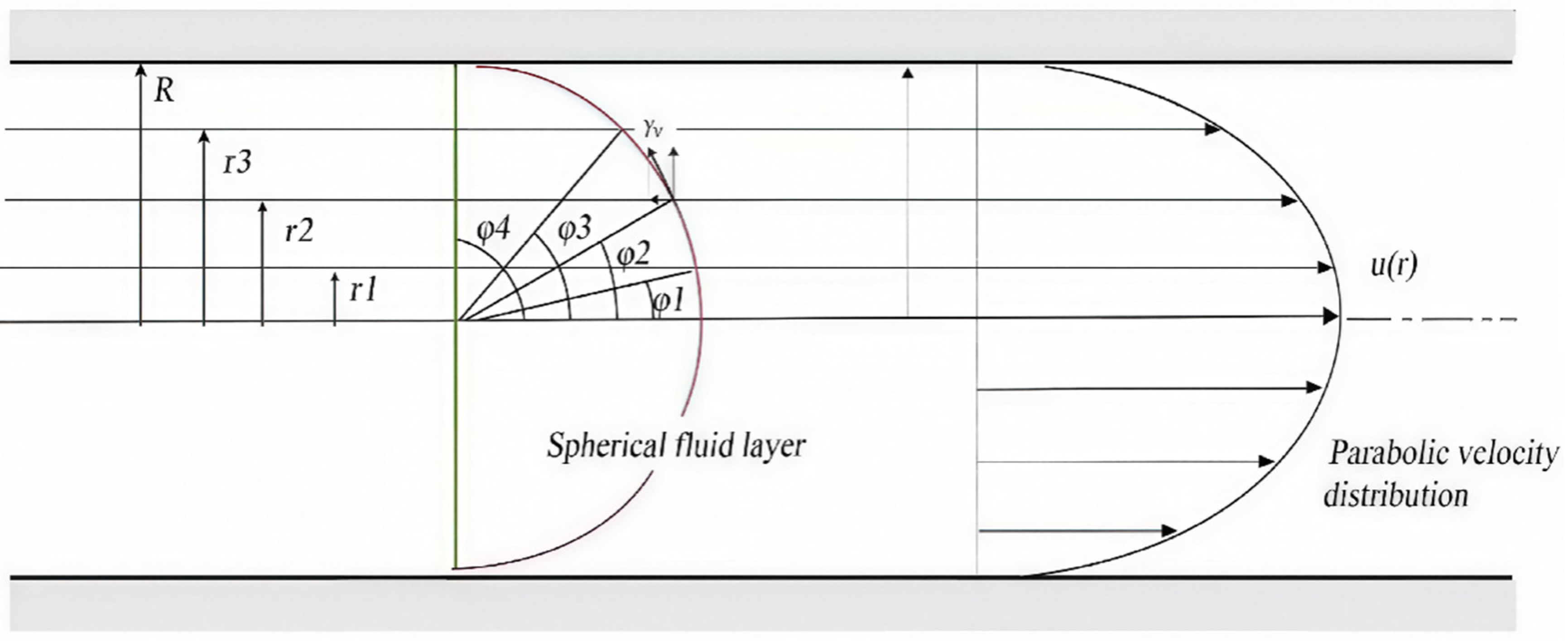
Figure 2.
The profiles of the irreversible energy loss, or called viscous loss, the mechanical work done by the tensile force (viscous force), the tensile energy flux vector, and the divergence of the tensile energy flux vector, for a water flow in a circular tube. The point where the divergence of the tensile energy flux is zero appears at point A, the radial position , which is guessed as the onset point of turbulent transition. The point where the variation of tensile energy flux reaches its maximum value appears at point B, , as predicted for the onset point of turbulent transition by Dou [14].
Figure 2.
The profiles of the irreversible energy loss, or called viscous loss, the mechanical work done by the tensile force (viscous force), the tensile energy flux vector, and the divergence of the tensile energy flux vector, for a water flow in a circular tube. The point where the divergence of the tensile energy flux is zero appears at point A, the radial position , which is guessed as the onset point of turbulent transition. The point where the variation of tensile energy flux reaches its maximum value appears at point B, , as predicted for the onset point of turbulent transition by Dou [14].
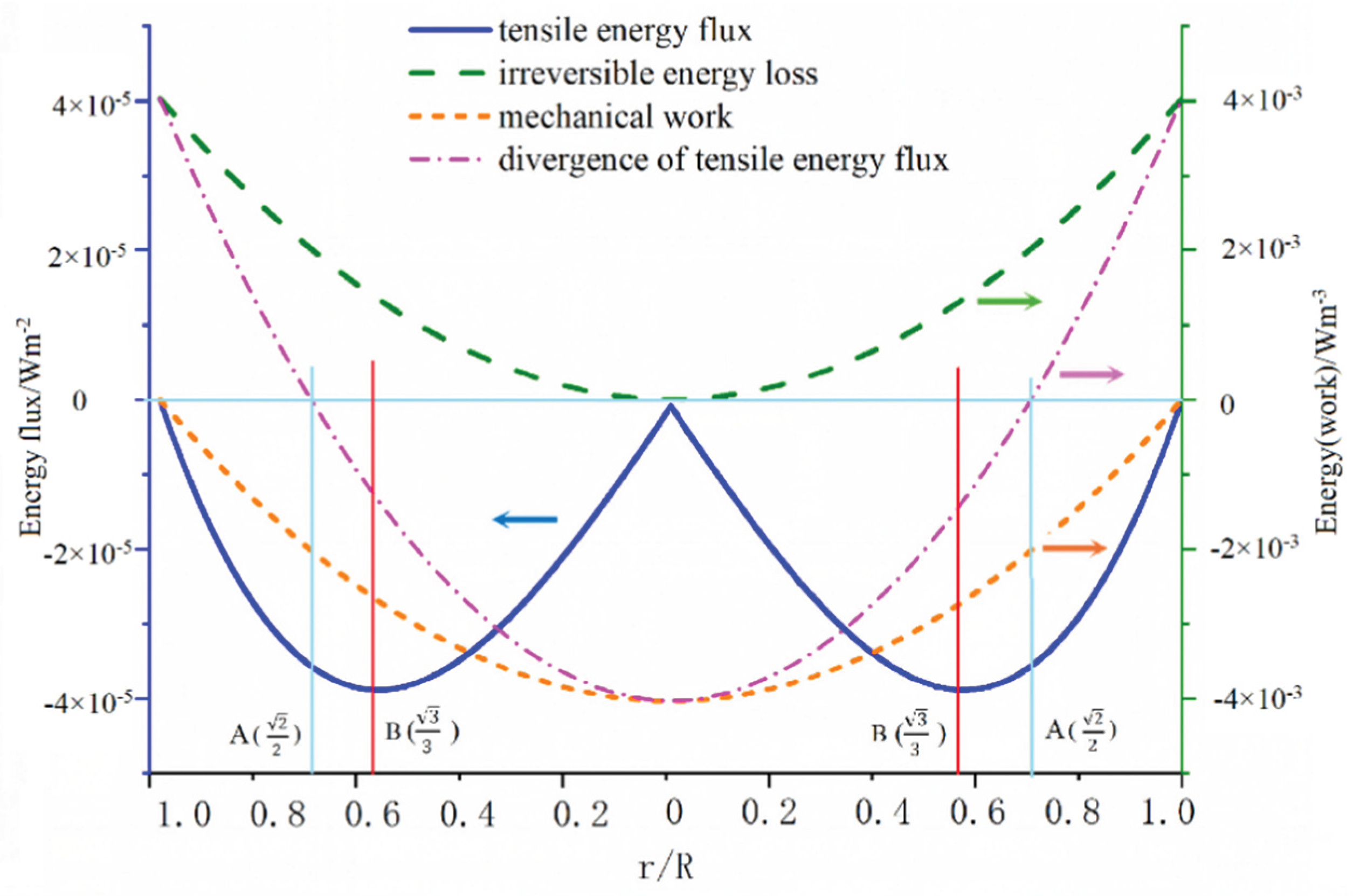
Figure 3.
Axial velocity at different radial position r/R versus time which was shown from the time when the iris diaphragm was operated at Re =2450 [6]. (a) The oscillation first started in r/R=0.53-0.73. Use permission by Cambridge University Press. (b) Axial velocity as a function of different radial position r/R at different time originated from (a) [6]. Use permission by Cambridge University Press. Yellow line at and red line at are given by Dou [14] and present work, respectively. The blue semicircle represents the liquid force element of the spherical shell during transition, and the predicted transition position in this semicircle occurs at φ=45° [4].
Figure 3.
Axial velocity at different radial position r/R versus time which was shown from the time when the iris diaphragm was operated at Re =2450 [6]. (a) The oscillation first started in r/R=0.53-0.73. Use permission by Cambridge University Press. (b) Axial velocity as a function of different radial position r/R at different time originated from (a) [6]. Use permission by Cambridge University Press. Yellow line at and red line at are given by Dou [14] and present work, respectively. The blue semicircle represents the liquid force element of the spherical shell during transition, and the predicted transition position in this semicircle occurs at φ=45° [4].
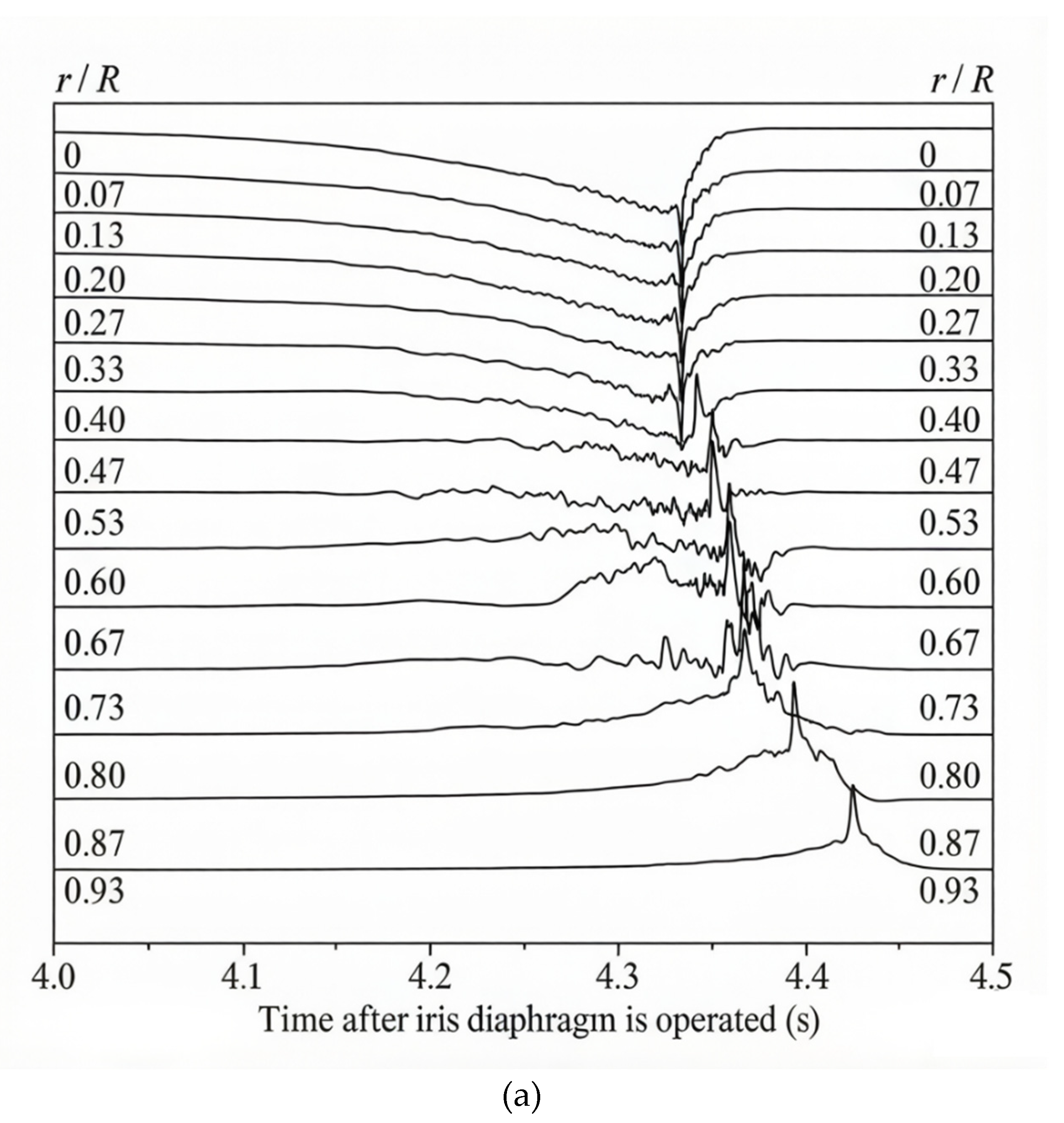
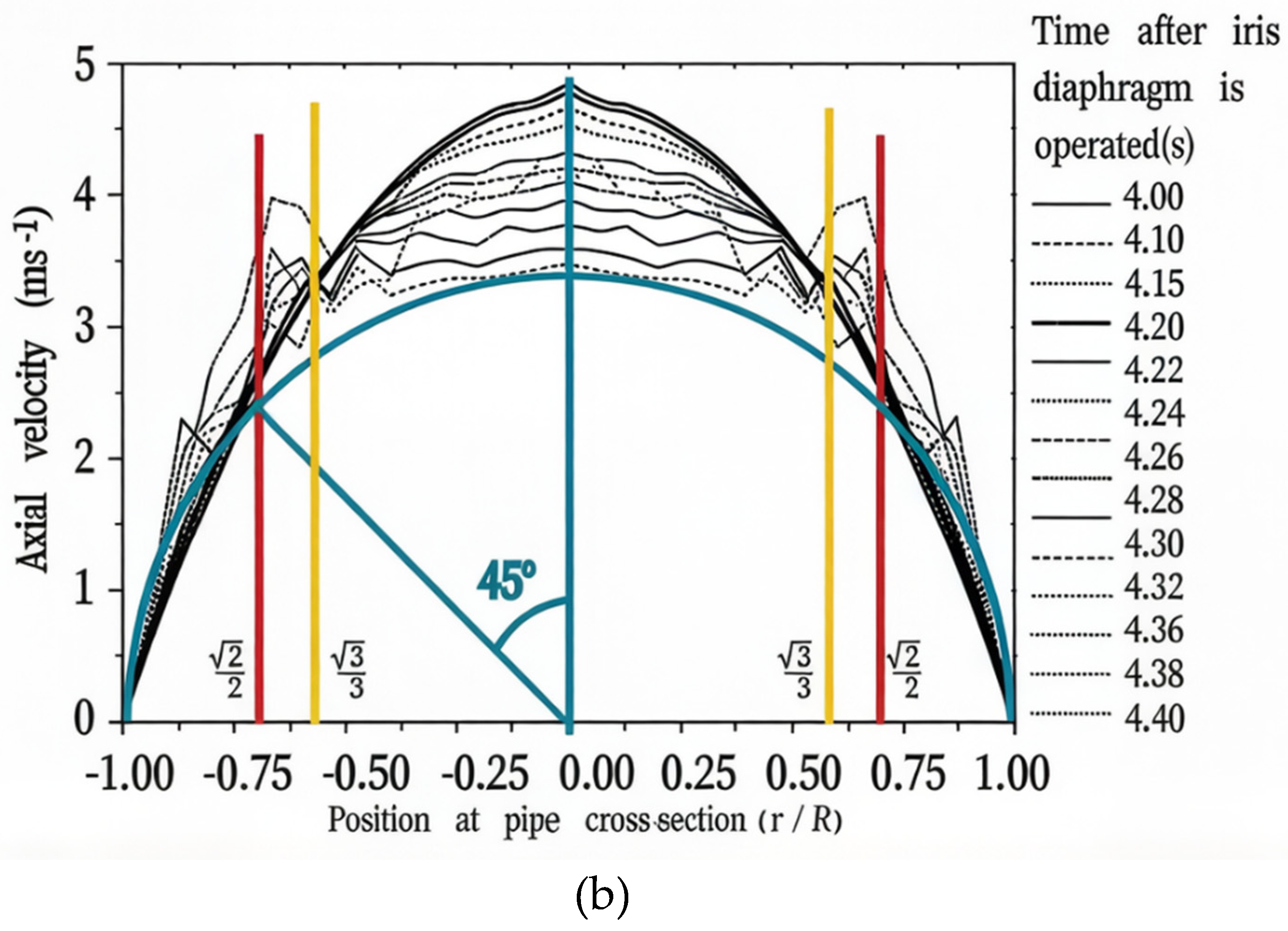
Figure 4.
Instantaneous velocity distributions in a plane Poiseuille flow [17]. y/h=0 is at the center-plane and y/h=1 is at the wall. Use permission by Cambridge University Press. The base flow is laminar and the instantaneous distribution of the velocity breaks at the position y/h =0.50 (T=4-6) to 0.62 (T =8-9) by showing an oscillation of velocity in y/h =0.50-0.62 [17]. This coincides to the position of Kmax [14] which occurs at y/h =0.58 and is the most dangerous point. In this paper, we also deduce a same critical position of .
Figure 4.
Instantaneous velocity distributions in a plane Poiseuille flow [17]. y/h=0 is at the center-plane and y/h=1 is at the wall. Use permission by Cambridge University Press. The base flow is laminar and the instantaneous distribution of the velocity breaks at the position y/h =0.50 (T=4-6) to 0.62 (T =8-9) by showing an oscillation of velocity in y/h =0.50-0.62 [17]. This coincides to the position of Kmax [14] which occurs at y/h =0.58 and is the most dangerous point. In this paper, we also deduce a same critical position of .
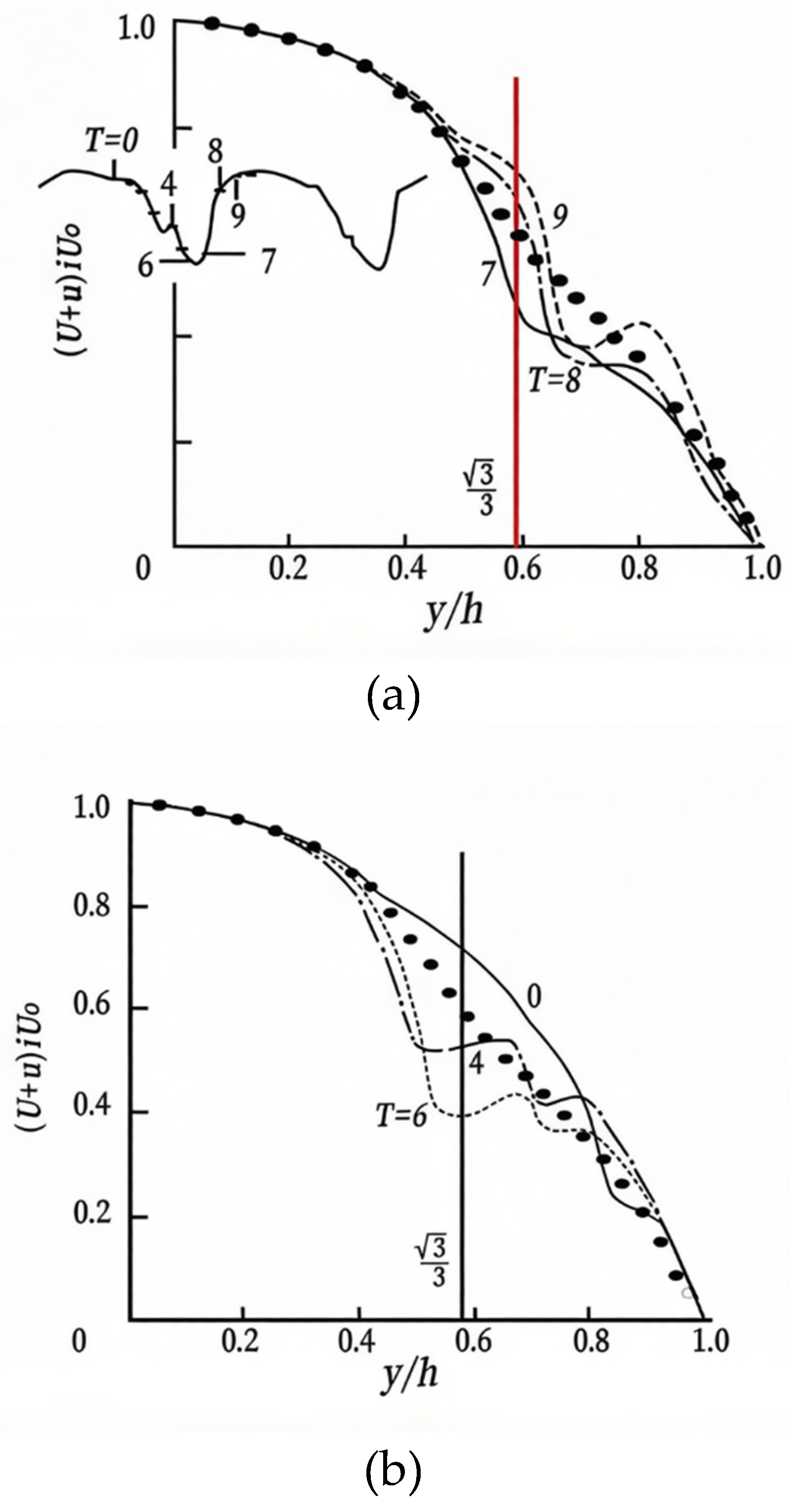
Figure 5.
Experiment of the rock specimen subjected to uniaxial compression, and compared with flow resistance coefficient. (a) Sectional portion of a Tennessee marble specimen unloaded just after the peak of the complete stress-strain curve in uniaxial compression, illustrating the development of axial cracks which are the precursor to the eventual coalescence of micro-fractures and the specimen collapse(Specimen width 25 mm). The uniaxial compressive strength of the rock specimen subjected to uniaxial compression, denoted usually as UCS or σ and expressed in MPa [7]. (b) Five specimens show somewhat similar results for the final failure modes [7]. It is noticed that the crack directions in all five samples were close to the 45° direction, which is similar to the extreme situation of the critical tensile energy flux for laminar flow in the circular tube in this article, when the zenith angle of the radial position appearing in the 45° direction as shown in Figure 3b.
Figure 5.
Experiment of the rock specimen subjected to uniaxial compression, and compared with flow resistance coefficient. (a) Sectional portion of a Tennessee marble specimen unloaded just after the peak of the complete stress-strain curve in uniaxial compression, illustrating the development of axial cracks which are the precursor to the eventual coalescence of micro-fractures and the specimen collapse(Specimen width 25 mm). The uniaxial compressive strength of the rock specimen subjected to uniaxial compression, denoted usually as UCS or σ and expressed in MPa [7]. (b) Five specimens show somewhat similar results for the final failure modes [7]. It is noticed that the crack directions in all five samples were close to the 45° direction, which is similar to the extreme situation of the critical tensile energy flux for laminar flow in the circular tube in this article, when the zenith angle of the radial position appearing in the 45° direction as shown in Figure 3b.
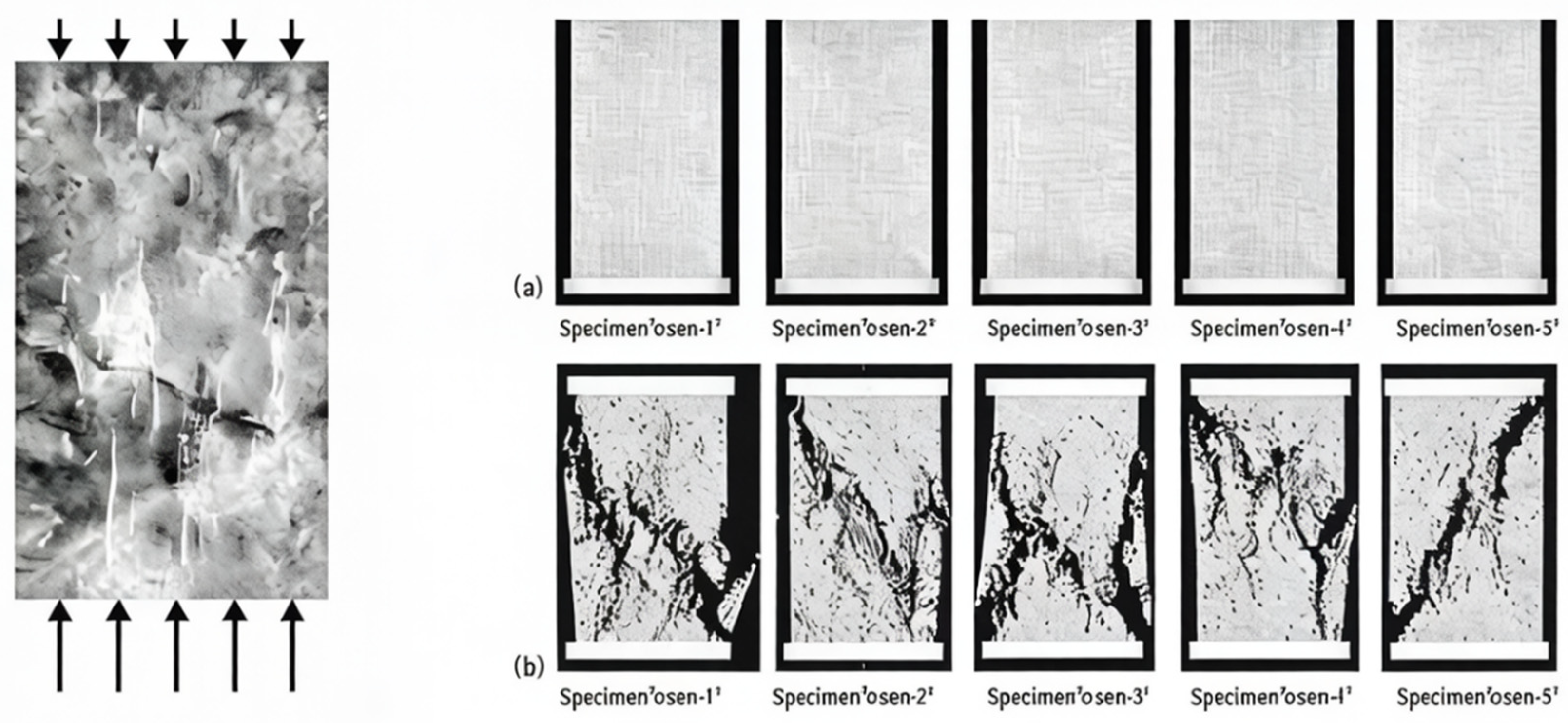
Figure 6.
(a) Sensitivity of stress-strain curves to the local variation in micro-structure for five specimens with the same overall statistical distribution of local mechanical properties [7]. From the start of loading to 90% of the sample strength, the stress-strain characteristics for the rocks are approximately the same, and that the overall deformation in the specimen is statistically uniform. With the sample strength over 90%, the specimen tends to deform non-uniformly [7]. (b) Variation of fluid flow resistance coefficient with Reynolds number and roughness in rough circular pipes by Nikuradse [23]. There is a shrunk stress-strain curve in size in (a), which is flipped vertically, and similar to the fluid resistance coefficient curve in (b).
Figure 6.
(a) Sensitivity of stress-strain curves to the local variation in micro-structure for five specimens with the same overall statistical distribution of local mechanical properties [7]. From the start of loading to 90% of the sample strength, the stress-strain characteristics for the rocks are approximately the same, and that the overall deformation in the specimen is statistically uniform. With the sample strength over 90%, the specimen tends to deform non-uniformly [7]. (b) Variation of fluid flow resistance coefficient with Reynolds number and roughness in rough circular pipes by Nikuradse [23]. There is a shrunk stress-strain curve in size in (a), which is flipped vertically, and similar to the fluid resistance coefficient curve in (b).
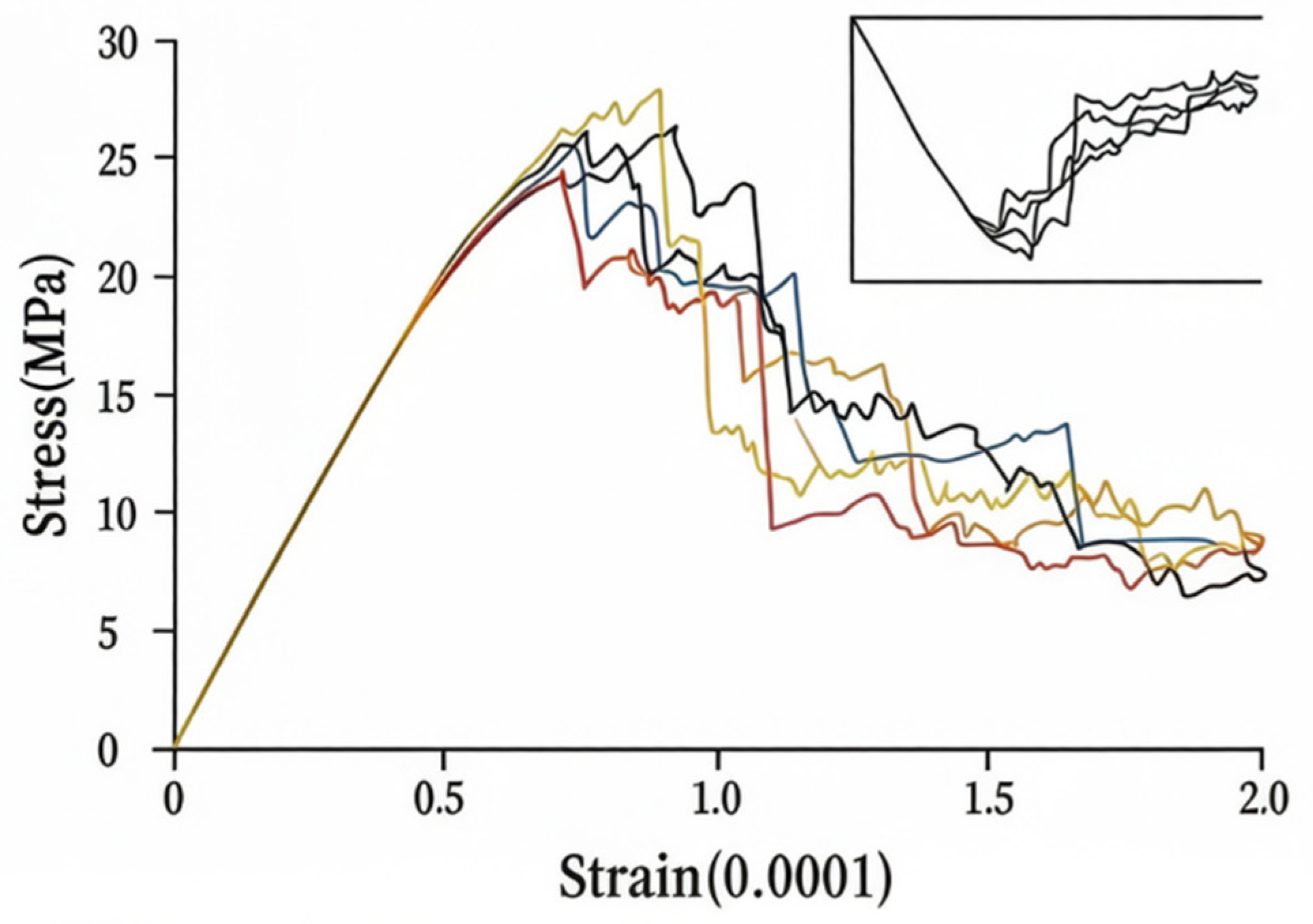
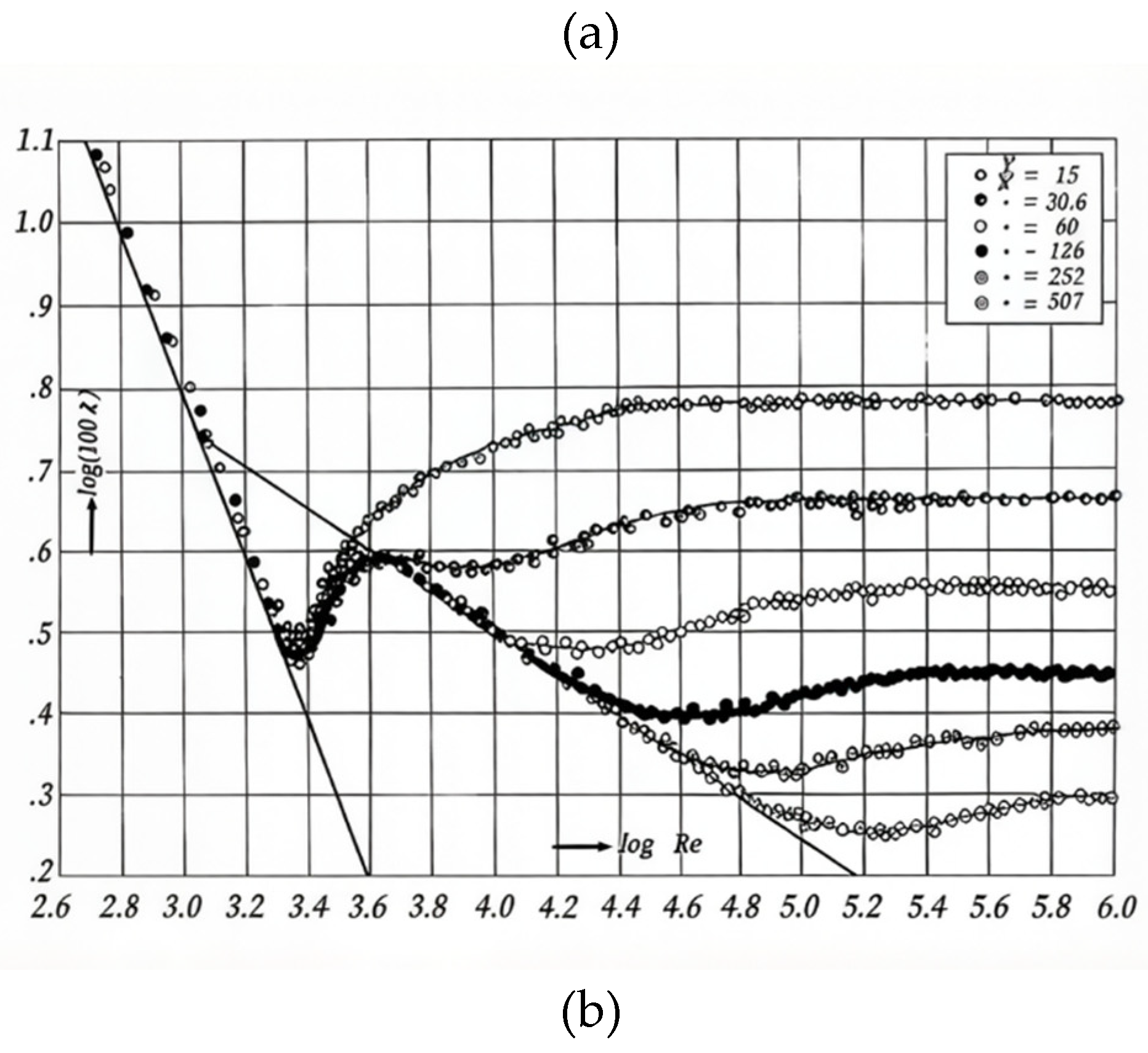

Table 1.
Comparison between pipe Poiseuille flow and plane Poiseuille flow.
| pipe Poiseuille flow | plane Poiseuille flow | |
| Configurations | 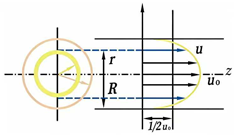 |
 |
| Velocity profiles | ||
| Velocity magnitude | ||
| Velocity vector | ||
| Maximum velocity | ||
| Pressure gradient | ||
| Viscous shear vector (tensile vector) | ||
| Mechanical work | ||
| Irreversible energy loss | ||
| Tensile energy flux vector | ||
| Divergence of tensile energy flux vector | ||
| Critical positions |
Disclaimer/Publisher’s Note: The statements, opinions and data contained in all publications are solely those of the individual author(s) and contributor(s) and not of MDPI and/or the editor(s). MDPI and/or the editor(s) disclaim responsibility for any injury to people or property resulting from any ideas, methods, instructions or products referred to in the content. |
© 2026 by the authors. Licensee MDPI, Basel, Switzerland. This article is an open access article distributed under the terms and conditions of the Creative Commons Attribution (CC BY) license (http://creativecommons.org/licenses/by/4.0/).
Copyright: This open access article is published under a Creative Commons CC BY 4.0 license, which permit the free download, distribution, and reuse, provided that the author and preprint are cited in any reuse.


