

Submitted:
08 April 2026
Posted:
10 April 2026
You are already at the latest version
Abstract
Urban water systems are increasingly challenged by climate change, population growth, and resource scarcity, requiring a shift from centralised, supply-oriented models to decentralised, resilience-based approaches. While energy transition policies have successfully promoted Nearly Zero-Energy Buildings (NZEB) and Renewable Energy Communities (REC), similar concepts for water management remain underdeveloped. This study proposes adapting these energy-based frameworks to the water sector through the concepts of Nearly Zero-Water Buildings (NZWB) and Urban Water Communities (UWC). A structured literature review is combined with a quantitative water balance analysis to evaluated the potential for reducing potable water demand through efficiency measures, greywater reuse, rainwater harvesting, and alternative local renewable sources. Results indicate that potable water consumption in residential buildings can be reduced by 53–100% depending on system configurations and local resources availability. Extending these strategies from building-scale solutions to district scale through water communities enhances system redundancy, flexibility, and adaptive capacity. The study further discusses the integration of decentralised water systems with smart city frameworks, highlighting the role of hybrid infrastructures in improving urban resilience. The findings demonstrate that decentralised and circular water strategies can play a key role in enabling sustainable, climate-adaptive, and smart urban environments, while also identifying regulatory and governance challenges for large-scale implementation.
Keywords:
urban water resilience
; nearly zero-water buildings
; urban water communities
; smart cities
1. Introduction
Water is a constantly renewed natural resource, but its availability is under increasing pressure [1,2]. It is well known that the growth of the world’s population and industrial development are factors contributing to the reduction in the availability of fresh water in many countries, in terms of quantity and quality, affecting, in particular, human consumption [3,4]. However, the impact of climate change must also be increasingly considered in this context, since in some regions of the planet it is already the leading cause of the reduction in available volumes of freshwater in the terrestrial water cycle and of changes in natural regimes, exacerbating droughts, incrementing the intensity and frequency of extreme rainfall, and potentially causing increased pollution or salinization of aquifers [5,6,7,8,9].
For these reasons, establishing strategies for water resilience is becoming imperative in many countries. In Europe, in particular, which is being progressively affected by climate change, especially in southern countries, the European Commission recently developed a Water Resilience Strategy, aiming at restoring and protecting the water cycle, securing clean and affordable water for all and creating a sustainable, resilient, innovative and competitive water economy in Europe. This strategy was launched in June 2025, in the form of a “Communication from the Commission to the European Parliament, the Council, the European Economic and Social Committee and the Committee of the Regions” [10].
In the urban sector, strategies tend to focus primarily on the supply side (and the European strategy is no exception), proposing management measures for supply systems while forgetting that, in reality, buildings can be part of the solution. Regarding other resources, such as energy, this global vision already exists, essentially aimed at reducing emissions and contributing to increased resilience. Indeed, strategies such as the creation of local hybrid energy systems, for example, integrating existing urban infrastructures with decentralised solutions based on renewables, promote progressive resilience in the face of emerging challenges.
Taking Europe as an example, legislation already exists for the self-generation of renewable energy in buildings. This practice is expanding rapidly, aiming to achieve zero-emission buildings (ZEB) by 2050, requiring energy renovations and the integration of renewables. 2030 targets include 49% renewables in the building sector and the mandatory installation of solar panels in new buildings. The zero-emission buildings (ZEB), which the EU intends to implement from 2028, will be an evolution of the current well-known Nearly-Zero Energy Building (NZEB) concept, implemented in 2020, seeking to establish a more rigorous and comprehensive standard for decarbonization [11,12,13].
Furthermore, other solutions, such as Energy Communities, which the European Commission cites as citizen-led initiatives that contribute to the energy transition, increase efficiency in urban environments. In the current European regulatory framework, there are two approaches associated with energy communities: Renewable Energy Communities (REC) and Citizens’ Energy Communities (CEC). The former are the most interesting in this context, as they focus on local and shared renewable energy projects. At the same time, CEC is a broader EU concept for local energy sharing (renewable or not), potentially focused on economic benefits.
Regarding Nearly Zero-Energy Buildings (NZEB) or Renewable Energy Communities (REC), it’s easy to draw analogies for water. Indeed, in the same way as for energy, Nearly Zero-Water Buildings (NZWB) and Urban Water Communities (UWC) can be considered, the latter from a decentralized management perspective at a district level.
This study contributes to the existing literature in three main ways:
- a)
- Formalizing the concept of Near Zero Water Buildings (NZWB) as a parallel to solutions adopted for energy;
- b)
- Introducing Urban Water Communities (UWC) as a scalable model for decentralized water management at the district level;
- c)
- Providing a quantitative assessment of the water savings potential associated with different technological configurations.
2. Materials and Methods
For the development of this article, a bibliographic search was conducted on the concepts of Nearly Zero Water Buildings and Urban Water Communities (or district-scale water management), but the scientific references obtained revealed a minimal number of articles [14,15,16,17,18], unlike what happens with Nearly Zero Energy Buildings (NZEB), for which an extensive list of references is easily found. This result demonstrates that these concepts of NZWB and UWC, despite being very important and well-developed in terms of their energy parallels, are still relatively novel and have not received due attention and analysis from the scientific community.
However, several articles have been published on the issue of urban water resilience and its relationship with the decentralization of urban water systems [19,20,21,22,23,24,25,26,27], which were also analysed, given that the concept of decentralization is implicit in UWC, although they are not necessarily analogous concepts. Some publications related with water resilience and sustainability in urban environments were also analysed [28,29,30,31,32,33,34,35,36,37,38,39].
Given the link between water and energy, it was expected that water conservation or water efficiency measures in buildings could be referred to in the context of contributions to reducing energy consumption in buildings, allowing for more information of interest for the present article. However, most studies on NZEB and REC focus exclusively on solutions to reduce grid energy needs through improved thermal insulation, energy self-sufficiency, increased efficiency of use, etc., without addressing possible interconnections with other resources, such as water [40,41,42].
Despite the link between water and energy, the development of this article took into account that, for water, there may be different minimum quality levels depending on the uses in urban areas, a situation that does not occur for energy [43]. Thus, consumption balances were carried out, based on specific bibliography, seeking to relate quality requirements with quantity requirements in buildings.
The methodological approach adopted in this study thus combines three complementary components:
- a)
- Structured literature review, focusing on urban water resilience, decentralised systems, and analogies with energy-based frameworks (NZEB and REC);
- b)
- Quantitative water balance modelling, based on representative consumption values (L/person/day), allowing the estimation of potable water reduction potentials associated with different technical solutions (efficiency measures, reuse, and alternative sources);
- c)
- Analysis based on a typical scenario, in which Near-Zero Water Building (NZWB) and Urban Water Communities (UWC) configurations are evaluated in terms of their potential contribution to reducing dependence on centralized water supply systems.
This approach enables a systematic assessment of the technical feasibility and resilience contribution of decentralised water strategies, while providing a replicable framework for future applications at building and district scales.
3. Results
The results presented in this section should be interpreted as representative scenario-based estimates, providing an order-of-magnitude assessment of the potential impact of decentralised water strategies, rather than exact predictions for specific case studies.
3.1. Adaptation of Strategies Already Implemented for Energy
As mentioned earlier, taking Europe as an example, it is possible to identify two strategies already implemented in the energy sector that aim to increase emissions reductions and resilience, particularly in urban areas. The first strategy concerns the creation of a legal framework for the self-production of renewable energy in buildings. This practice is expanding rapidly, driven by EU directives such as the EPBD (Energy Performance of Buildings Directive). The other relevant strategy in the context of this article concerns Renewable Energy Communities (REC), which aim to support local and shared renewable energy projects in accordance with EU Directive 2018/2001 [11,12,13].
The concepts of Zero-Energy Buildings and Renewable Energy Communities can be adapted to resources beyond energy, such as freshwater, to reduce consumption of drinking water from the mains and to increase the water resilience of urban environments. It is important to highlight that the concept of Zero Buildings (ZB) in terms of resource use is generally linked to circular use. Still, when energy and water are analysed, some differences emerge.
In the case of energy, Zero-Energy Buildings do not imply a circular use of the resource, but rather that the total energy used by the building is approximately equal to the amount of renewable resources produced or available locally. Regarding water, part of the resource can be used effectively in buildings through recycling or reuse. Still, alternative renewable sources, such as rainwater, can also be considered. In any case, the priority measure to increase urban resilience should always be the reduction of critical resource consumption, through conservation measures and greater efficiency in their use [17].
3.2. Nearly Zero-Water Buildings (NZWB)
For the development of an NZWB building, the 5R principle can be used: Reduce consumption, reduce losses and waste, reuse water, recycle water, and resort to alternative sources (rainwater, etc.) [17]. The first R—Reduce consumption, includes the adoption of technical measures (efficient products and devices), awareness actions or even economic measures, without compromising user comfort, public health, or the performance of building networks. The second R—Reduce losses and waste—can involve interventions such as monitoring losses in building networks and devices (flushing toilets, garden watering, etc.) or installing hot-water circulation and return circuits.
The third and fourth Rs—Reuse and Recycling of water—are essential measures for the design of NZWB and are distinguished by the fact that reuse is a serial use and recycling is the reintroduction of the same water at the beginning of the building circuit, in both cases after appropriate treatment. Reuse of greywater in buildings has developed in recent years, especially for flushing cisterns and watering, with effluents from baths and washbasins being reused. Recycling has also been considered, but essentially at the industrial level. The use of wastewater treatment plant (WWTP) effluents has also been considered for agricultural use, such as irrigating golf courses or washing/cleaning public spaces. However, this use is generally not of interest in buildings, given other options that generally exist [38,39].
The absence of water consumption from the main, which is the ultimate goal of Zero-Water Buildings, presents significant limitations, given that, as a rule, buildings require water of drinking quality for consumption. While its production at a local level from used water or alternative sources is technically feasible, it is only economically viable in certain situations.
The use of water-efficient products can significantly reduce water consumption from the public network in buildings. Studies by the European Commission, for example, show that consumption can be reduced by around 30% compared to the current scenario simply by the widespread adoption of more efficient building products (the first R), a very relevant value with significant implications for increasing resilience in the urban environment.
Considering a consumption of 110 litres per inhabitant per day, which is the United Nations estimate for basic human needs and also a regulatory standard for new sustainable housing in countries such as the United Kingdom [44], Table 1 presents a water balance of the quantities needed for each specific use and the effluents produced in a standard dwelling, from a greywater reuse perspective [45]. This table presents average reference values that, naturally, may vary depending on several factors, such as consumption habits, the presence and size of a garden, and climatic conditions. However, it constitutes a general reference standard, considered adequate for this study.
Table 1 also allows assessment of potential rainwater consumption in the building, given that this use is competitive with regenerated water consumption [46]. Looking at the table, it can be concluded that the possible reduction in potable water consumption, which is equivalent to the potential for water reuse in the building, will be between 40 and 58 litres per inhabitant per day.
In addition to greywater reuse, global wastewater recirculation (including blackwater) can be considered after appropriate treatment. However, it requires more stringent treatment and sanitary control requirements, which usually reduce its viability. Within the context of renewable water sources, several options can be considered, with varying treatment requirements depending on the intended uses at the site. Some of these sources are listed below, which, as is evident, may not be available in all locations.
- the use of seawater in coastal buildings, desalinated or not;
- the use of groundwater (when access to renewable aquifers is possible);
- the use of air conditioning condensate;
- the capture of atmospheric water;
- the use of foundation drainage water;
- stormwater harvesting;
This list is not exhaustive, and other local sources may be included. Thus, without prejudice to the possible existence of other solutions besides those mentioned above, this article will focus on replacing the public supply of potable water with the alternatives mentioned, in a technical and quantitative approach, without developing complementary aspects such as maintenance and operating costs of the facilities, energy consumption, technical and economic feasibility in each particular situation, etc. whose complexity only allows for a case-by-case approach [18,47,48].
In the case of rainwater (and stormwater) harvesting, it is necessary to consider the irregularity of rainfall and, in some regions, the potential need for supply from other sources during critical periods. However, it is important to highlight that rainwater harvesting in buildings has other beneficial effects, such as mitigating flood peaks in urban environments. [49,50,51,52]. On the other hand, introducing reuse or recirculation in buildings can have negative consequences for existing public sewage systems due to reduced flow [47].
In addition to the feasibility of producing the necessary water volumes locally as an alternative to public supply, aiming to increase water resilience in urban environments, the set of factors listed above should determine, in each case, the choice of the most appropriate solution [47,53]. Taking into account the values in Table 1, the previously mentioned alternative solutions, and the fact that different building uses require different levels and qualities of water, Table 2 was constructed. This table summarises the potential to replace potable water from the mains for the scenarios considered most practicable. The table does not include some sources whose use, for most applications, is rarely considered nowadays because less costly alternatives pose fewer health risks or are available in many situations, as is the case with wastewater, stormwater, or air conditioning condensate.
3.3. Urban Water Communities (UWC)
Just like renewable energy communities (REC), urban water communities (UWC) can contribute to more resilient and sustainable urban water systems. These communities (also called district-scale water management systems) extend NZWB solutions to city neighbourhoods or districts [14,18].
Table 2 shows that, with reuse and the use of alternative local sources, such as rainwater, there may be a surplus of available water compared to water needs. This surplus can be managed and stored in central tanks, where it can later be used for:
- a)
- Supplying non-potable water to buildings with a local availability deficit (for irrigation, flushing toilets and/or washing machines);
- b)
- Irrigating urban green areas;
- c)
- Cleaning/washing public spaces (streets, etc.);
- d)
- Supplying blue infrastructure and/or recharging underground aquifers;
- e)
- Establishing reserves for fighting urban fires.
Figure 1 schematically illustrates an example of an urban water community. In the figure, only greywater and rainwater were considered as alternatives to the water main, but, considering Table 2, other local sources could eventually be added to the buildings, such as drainage water from the foundations.
One of the requirements of the concept shown in Figure 1 is the presence of separate drainage systems for greywater and blackwater, as well as individual water supply pipes in the buildings for potable and non-potable water. As with energy in Renewable Energy Communities, these communities generally need to translate into hybrid systems, maintaining some potable water supply from the water main and connections to public drainage ant treatment systems. These networks are not represented in Figure 1 for better readability. However, considering the feasibility of NZWB, it can be concluded that UWC without any external connection to public water supply or drainage systems will be equally technically feasible.
As is evident, numerous configurations are possible, depending on local renewable water sources. Whatever the solution, the resilience of the local urban system is obviously far superior to that resulting from the sole supply of water from a public network. The numerous possibilities for alternative sources and the balance that can be made, based on cisterns, of needs/availability in each building and in public uses, allow for increased resilience in dealing with drought events or failures in the public network.
Water retained in public infrastructure can also be considered in the model. This is the case, for example, with the integration of retention basins, the use of test water from fire suppression systems in some large public buildings, the utilization of stormwater collected in large parking lots, etc.
4. Discussion
a) It is assumed that the reference value or global per capita consumption considered, of 110 L/person/day, already takes into account the use of efficient equipment in buildings. As mentioned earlier, the use of efficient water-using products (WuP) in buildings should be the priority measure for water conservation, as consumption reductions can reach 30% compared to conventional scenarios (at least in Europe).
b) Regarding atmospheric water, its use was considered limited, given that the equipment available on the market for domestic use generally does not exceed a production of 20 to 30 litres/day. The production of air conditioning condensate follows a similar process, allowing for the availability of larger volumes, and, in its origin, is similar to distilled water. However, this water is not always readily available and, within the production and collection circuit, can be subject to significant physical-chemical and/or biological contamination by heavy metals, Legionella, etc.
c) Regarding the use of rainwater, it is considered that there are no volume limitations, regardless of the rainfall regime, even with significant monthly variations. This premise assumes that the system can be equipped with a cistern of adequate dimensions, enabling a balance between availability and demand throughout the year without excessive retention periods, which can last up to 3 months, according to some technical documents.
d) Rainwater harvesting and greywater reuse are generally competing uses; therefore, in many situations, it is not justified to do both. However, in the case of watering extensive gardens, for example, both uses may be justified simultaneously. For some uses, rainwater may not require treatment, unlike greywater.
e) Groundwater extraction may be subject to specific regulations in many countries, but the use of foundation drainage water can be fascinating. Given that it may be an inherent need of the building, its use can have a low marginal cost. However, it is not always available, and its quality can vary widely. With good filtration in thick, porous layers of soil and rock (such as sand, gravel, or sandstone), which act as physical and biological filters that retain organic impurities, groundwater quality can be excellent. However, the existence of nearby polluting sources (or proximity to the groundwater) can significantly alter its quality. In some regions, the use of foundation water requires, for example, analyses of Volatile Organic Compounds (VOC), which can remain and persist in groundwater;
f) Utilizing stormwater requires more complex treatments than rainwater harvesting and, as with foundation drainage water or groundwater, can lead to significant pollution depending on the level of pollution in the pavements where it flows.
g) In buildings, the use or recirculation of wastewater (with blackwater) requires advanced treatment, generally using membrane filtration and reverse osmosis. However, in urban areas, constructed wetlands can be considered, which can simultaneously support wastewater treatment and make cities greener, reducing water consumption from mains.
The foregoing considerations reveal directions for future research. They also show that this is a very broad research domain, requiring articulation, dialogue, and integration between different areas of knowledge and scientific fields.
With regard to UWC, the difficulties in development are revealed, from the outset, in the complexity of the engineering approach. It is necessary, for example, to assess the needs of each building, determine the available local renewable sources and their potential contribution, determine the treatment requirements for each intended use and assess the characteristics of the collected or reused water, as well as the best combination of solutions from a technical-economic point of view.
However, at the current level of knowledge, there is already sufficient experience to develop these communities, and their implementation could likely promote the development and commercialization of new technologies. But it will certainly require changes in governance models [54] and the drawn up of new technical regulations. The first factor, in particular, could create resistance to the implementation of UWC, given that existing governance models, focused on centralized solutions, are generally well established, as well as the inertia that could exist in the profound alteration of the numerous laws involved.
The implementation of NZWB and UWC concepts can be significantly enhanced through their integration with smart city technologies. Digital monitoring systems, including IoT-based sensors, enable real-time tracking of water consumption, leak detection, and quality control at building and district scales.
In addition, data-driven management platforms and digital twins can support predictive analysis, optimisation of storage and reuse strategies, and adaptive responses to climate variability. These tools allow for dynamic balancing between supply and demand, increasing system efficiency and resilience.
Furthermore, the integration of decentralised water systems with other urban infrastructures, such as energy and data networks, contributes to the development of holistic and interconnected smart city ecosystems. In this context, NZWB and UWC can be seen not only as water management solutions but also as key components of future smart and resilient urban systems.
5. Conclusions
Currently, conventional urban water supply systems are based on the premise that supply can continually be expanded to meet demand, promoting large centralized systems. However, the social and climatic changes we have witnessed in recent decades, and the need to increase water resilience in urban environments, require an urgent paradigm shift, with demand management rather than supply management, rethinking the scale of infrastructure, and emphasising the importance of local alternative sources.
Regarding NZWB, their technical viability has been confirmed, and Table 2 shows possible alternative renewable sources that can be considered, which clearly translate into greater resilience and a significant contribution to greater sustainability in resource management. For example, using rainwater with simple treatment (to achieve bathing water quality) and atmospheric water can easily meet 100% of a building’s consumption. The same objective can be achieved with commercially available water purification equipment (domestic water treatment plants for low-pollutant loads) that can operate on rainwater (or groundwater), or even desalinated seawater.
Regarding urban water communities, these are clearly more resilient solutions that contribute to more sustainable water use. However, these communities imply a significant paradigm shift from conventional solutions, introducing new technical solutions into the systems and altering the relationships between consumers, management entities, and the urban environment. Their implementation will not be without significant resistance, as it requires new economic, social, and governance arrangements and the publication of new regulations and legislation.
Author Contributions
Conceptualization, A.S.-A. and C.P.-R.; methodology, A.S.-A.; validation, C.P.-R.; formal analysis, A.S.-A.; investigation, A.S.-A. and C.P.-R.; writing—original draft preparation, A.S.-A.; writing—review and editing, C.P.-R.; visualization, A.S.-A. and C.P.-R.; supervision, A.S.-A. All authors have read and agreed to the published version of the manuscript.
Funding
This research received no external funding.
Data Availability Statement
The original contributions presented in this study are included in the article material. Further inquiries can be directed to the corresponding author.
Conflicts of Interest
The authors declare no conflicts of interest.
Abbreviations
The following abbreviations are used in this manuscript:
| NZEB | Nearly Zero-Energy Buildings |
| NZWB | Nearly Zero-Water Buildings |
| REC | Renewable Energy Communities |
| UWC | Urban Water Communities |
| CEC | Citizens’ Energy Communities |
| EU | European Union |
| VOC | Volatile Organic Compounds |
References
- Mekonnen, M.; Hoekstra, A. Four billion people facing severe water scarcity. Science Advances 2016, 2, e1500323. [CrossRef]
- Jones, E.; Bierkens, M.; van Vliet, M. Current and future global water scarcity intensifies when accounting for surface water quality. Nat. Clim. Chang. 2024, 14, 629–635. [CrossRef]
- United Nations. The Human Right to Water and Sanitation; UN General Assembly: New York, NY, USA, 2010.
- Veloso, S.; Tam C.; Oliveira T. Effects of extreme drought and water scarcity on consumer behaviour—The impact of water consumption awareness and Consumers’ choices, Journal of Hydrology 2024, Volume 639, 131574, ISSN 0022-1694. [CrossRef]
- European Environment Agency. Water resources across Europe — confronting water stress: an updated assessment—EEA Report 12, 2021. [CrossRef]
- Pimentel-Rodrigues, C.; Silva-Afonso, A. Contributions of Water-Related Building Installations to Urban Strategies for Mitigation and Adaptation to Face Climate Change. Applied Sciences 2019. MDPI. ISSN 2076-3417, 9, 3575, 2019. [CrossRef]
- Wilby, R. A review of climate change impacts on the built environment. Built Environment Journal 2011, 33 (1), 31–45. [CrossRef]
- Rogers, P.; de Silva, R.; Bhatia, R. Water is an essential but overlooked part of climate change mitigation. Water International 2012, 37, 10–15. [CrossRef]
- Abalasei, M.; Toma, D.; Dorus, M.; Teodosiu, C. The Impact of Climate Change on Water Quality: A Critical Analysis. Water 2025, 17, 3108. [CrossRef]
- European Commission. (2025). Communication from the Commission to the European Parliament, the Council, the European Economic and Social Committee and the Committee of the Regions: European Water Resilience Strategy (COM/2025/280 final).
- European Parliament; Council of the European Union. Directive 2010/31/EU on the energy performance of buildings (recast). Official Journal of the European Union 2010, L153, 13–35.
- European Parliament; Council of the European Union. Directive (EU) 2018/2001 on the promotion of the use of energy from renewable sources. Official Journal of the European Union 2018, L328, 82–209.
- European Union. (2024). Directive (EU) 2024/1275 of the European Parliament and of the Council of 24 April 2024 on the energy performance of buildings (recast). Official Journal of the European Union, L 2024/1275.
- Bona, S.; Silva-Afonso, A.; Gomes, R.; Pimentel-Rodrigues, C.; Rodrigues, F. From Nearly Zero Water Buildings to Urban Water Communities: The Need to Define Parameters to Support the New Paradigms. Appl. Sci. 2025, 15, 2566. [CrossRef]
- Cheng, C.; Kawamura, S. Toward near-zero water consumption grade labelling and evaluation benchmarks for residential buildings. Journal of Asian Architecture and Building Engineering 2023, 22(4), 2365–2375. [CrossRef]
- Cheng C.; Sadahico K., Wei-Che C. Research on a zero-water consumption operation model and feasibility for office buildings. Water Policy 2024. 26 (10): 1002–1019. https//:doi: . [CrossRef]
- Pimentel-Rodrigues, C.; Silva-Afonso, A. Nearly Zero Water Buildings. INCREaSE 2019. Springler Cham 2019 (Eds. Monteiro J. et al.). ISBN 978-3-030-30937-4, 2020. http://doi.org/10.1007/978-3-030-30938-1_52.
- International Water Association. Alternative Water Supply Systems; IWA: eBook (Eds: Fayyaz Ali Memon and Sarah Ward), 2019.
- Ghimire, S.; Lubczynski, M.W.; Sharma, A. Impacts of decentralized water systems on urban water resilience: A critical review. Sustainable Cities and Society 2022, 79, 103647. [CrossRef]
- Larsen, T.A.; Udert, K.M.; Lienert, J. Source Separation and Decentralization for Wastewater Management; IWA Publishing: London, UK, 2013.
- Keller, J. Why are decentralised urban water solutions still rare given all the claimed benefits, and how could that be changed? Water Research X 2023, Volume 19,100180, ISSN 2589-9147, . [CrossRef]
- Vázquez-Rowe, I.; Kahhat, R.; Lorenzo-Toja, Y. Natural disasters and climate change call for the urgent decentralization of urban water systems, Science of The Total Environment 2017, Volumes 605–606, Pages 246-250, ISSN 0048-9697. [CrossRef]
- Baserba, M.; Sedlak, D.; Barnosell, I.; et al. Using Water and Wastewater Decentralization to Enhance the Resiliency and Sustainability of Cities, Research Square 2023, PREPRINT (Version 1). [CrossRef]
- Arnaud, N.; Poch, M.; Popartan, L.A.; Corominas, L.; Verdaguer, M. How Scale Influences the Resilience of Urban Water Systems: A Literature Review of Trade-Offs and Recommendations. Water 2024, 16, 1571. [CrossRef]
- Poch, M.; Aldao, C.; Godo-Pla, L.; Monclús, H.; Popartan, L.A.; Comas, J.; Cermerón-Romero, M.; Puig, S.; Molinos-Senante, M. Increasing resilience through nudges in the urban water cycle: An integrative conceptual framework to support policy decision-making. Chemosphere 2023, 317, 137850. [CrossRef]
- Sapkota, M.; Arora, M.; Malano, H.; Moglia, M.; Sharma, A.; George, B.; Pamminger, F. An overview of hybrid water supply systems in the context of urban water management: Challenges and opportunities. Water 2015, 7, 153–174. [CrossRef]
- Arora, M.; Malano, H.; Davidson, B.; Nelson, R.; George, B. Interactions between centralized and decentralized water systems in urban context: A review. WIREs Water 2015, 2, 623–634. [CrossRef]
- Rodriguez, D.; Sotomayor, M.A.; Mark, F. The City Water Resilience Approach 2019; Arup: New York, NY, USA.
- Niu, H.; Omitaomu, O.A.; Cao, Q.C. Machine Committee Framework for Power Grid Disturbances Analysis Using Synchrophasors Data. Smart Cities 2021, 4, 1-16. [CrossRef]
- Radu, L.-D. Disruptive Technologies in Smart Cities: A Survey on Current Trends and Challenges. Smart Cities 2020, 3, 1022-1038. [CrossRef]
- Siano, P.; Shahrour, I.; Vergura, S. Introducing Smart Cities: A Transdisciplinary Journal on the Science and Technology of Smart Cities. Smart Cities 2018, 1, 1-3. [CrossRef]
- Yuan Y.; Yan Z.; Xiankai H.; Jianqing Z. Climate resilience of urban water systems: A case study of sponge cities in China, Journal of Cleaner Production 2024, Volume 451, 141781, ISSN 0959-6526. [CrossRef]
- International Water Association. Principles for Water-Wise Cities; IWA: London, UK, 2016.
- Perera, S.; Ranasinghe, R.; Neupane, S.; et al. Climate adaptive urban water system planning under deep uncertainty—Conceptual framework and review of methods. Water Research 2022, 231, 119420. [CrossRef]
- Bertone, E.; Hilty, L.M.; Schäfer, M.; et al. Smart water system technologies and approaches for urban water sustainability. Environmental Science & Technology 2021, 55, 11331–11349. [CrossRef]
- Silva-Afonso, A., Pimentel-Rodrigues, C. The importance of water efficiency in buildings in Mediterranean countries: The Portuguese experience. International Journal of Systems Applications, Engineering & Development 2019. WSEAS, United Kingdom, Issue 2, Volume 5, 17-24.
- United Nations Environment Programme. Becoming #GenerationRestoration: Ecosystem-Based Approaches to Water Resilience; UNEP: Nairobi, Kenya, 2021.
- Salgot, M.; Huertas, E.; Weber, S. Reuse of low-quality water to reduce urban consumption and enhance resilience. Water Science and Technology 2012, 66, 1239–1245. [CrossRef]
- Li, S.; Xu, Y.; Chen, L.; Liu, D. Potentials and challenges of urban water reuse for building resilience: A global review. Resources, Conservation & Recycling 2023, 191, 106697. [CrossRef]
- Silva-Afonso, A.; Rodrigues, F.; Pimentel-Rodrigues, C. Water efficiency in buildings: Assessment of its impact on energy efficiency and reducing GHG emissions. In Proceedings of the 6th IASME/WSEAS International Conference on Energy & Environment—EE’11, Cambridge, UK, 23–25 February 2011; WSEAS Press: Cambridge, UK, 2011; pp. 191–195.
- United Nations World Water Assessment Programme. The United Nations World Water Development Report 2014: Water and Energy; UNESCO: Paris, France, 2014.
- International Energy Agency. The Water–Energy Nexus; IEA: Paris, France, 2016.World Health Organization. Guidelines for the Safe Use of Wastewater, Excreta and Greywater; WHO: Geneva, Switzerland, 2006.
- World Health Organization. Guidelines for Drinking-Water Quality, 4th ed.; WHO: Geneva, Switzerland, 2017.
- Welsh Government. (2023). Amendments to Approved Document G—Sanitation, hot water safety and water efficiency. [Online]. Available: https://www.gov.wales/sites/default/files/publications/2023-05/archived-building-regulations-guidance-part-g-sanitation-hot-water-safety-and-water-efficiency-amendments_0.pdf (Accessed on January 20, 2026).
- ANQIP. Technical Specification ETA 0905—Systems for the use of greywater in buildings (Version 4) 2024, ANQIP, Aveiro, Portugal. Available: https://www.anqip.pt/en (Accessed on January 23, 2026).
- Pimentel-Rodrigues C., Silva-Afonso A. Water conservation measures in buildings: a comparative study between rainwater harvesting and greywater use. Front. Environ. Sci. 2015, 13:1587050. [CrossRef]
- Zhang, H.; Chen, X.; Huang, G. Multi-objective optimization of urban water reuse systems considering resilience and cost. Journal of Environmental Management 2021, 289, 112540. [CrossRef]
- Campisano, A.; Modica, C.; Uricchio, V.F. Urban rainwater harvesting systems: Research, implementation and future perspectives. Water Research 2017, 115, 195–209. [CrossRef]
- Domènech, L.; Saurí, D. A comparative appraisal of the use of rainwater harvesting in single and multi-family buildings of the metropolitan area of Barcelona. Journal of Cleaner Production 2011, 19, 598–608. [CrossRef]
- Saghir, J.; Santoro, D.; Al-Abbasi, M.; et al. Impact of extreme rainfall on urban water systems in the context of climate change: A European perspective. Journal of Hydrology 2020, 588, 125030. [CrossRef]
- Akter, A., Tanim, A., Islam, M. Possibilities of urban flood reduction through distributed-scale rainwater harvesting. Water Science and Engineering 2020, 13: 95–105. [CrossRef]
- Santosh, G., Johnston, J., Garland, J., Edelen, A., Ma, X., Jahne, M. Life cycle assessment of a rainwater harvesting system compared with an AC condensate harvesting system. Resources, Conservation & Recycling 2019, 146, 536-548, 2019. [CrossRef]
- Bakker, K. Neoliberalizing water governance: Finance, management, and ontology. Economy and Society 2010, 39, 475–499. [CrossRef]
Figure 1.
—Schematic representation of an Urban Water Community.
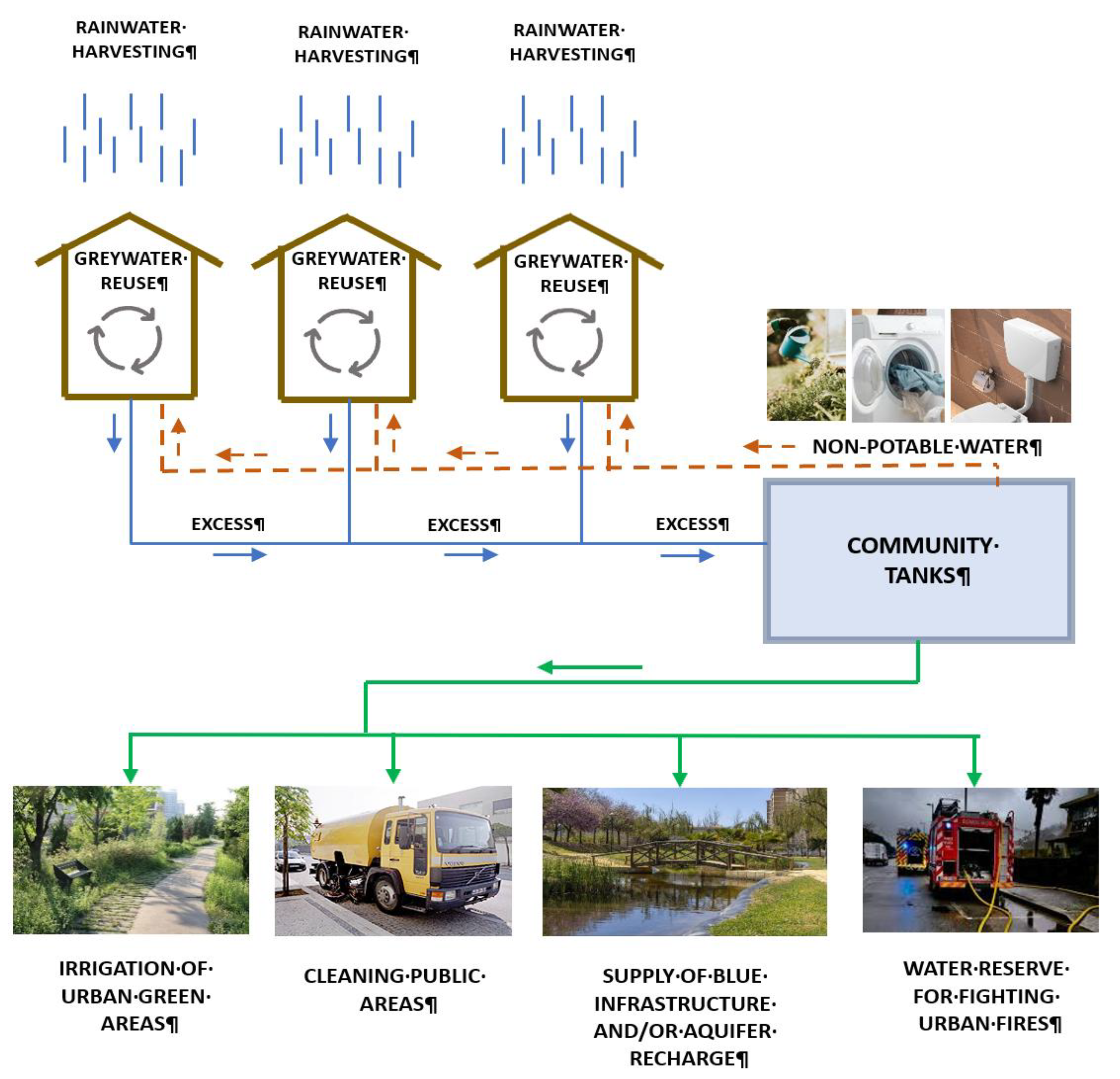

Table 1.
Water balance in residential buildings with efficient devices (average values in litres per inhabitant per day) [45].
Table 1.
Water balance in residential buildings with efficient devices (average values in litres per inhabitant per day) [45].
| Volumes and water quality | Water use | Greywater production | Destination of greywater (after regeneration treatment) | |
| 52 litres of drinking water |
40 litres for showers, bathtubs and wash basins |
70 litres of greywater |
40 (to 58) litres of regenerated greywater for reuse | |
| 12 litres for kitchen |
||||
| 12 (to 30) litres of greywater discharged | ||||
| 40 (to 58) litres of regenerated water |
5 litres for cleaning | |||
| 13 litres for the washing machine |
||||
| 35 litres for flushing cisterns |
35 litres of blackwater |
35 litres of blackwater were discharged | ||
| 5 litres for watering | - | Soil infiltration |
Table 2.
Potential to replace mains drinking water in buildings with alternative sources or water reuse (for a reference consumption of 110 litres per inhabitant per day).
Table 2.
Potential to replace mains drinking water in buildings with alternative sources or water reuse (for a reference consumption of 110 litres per inhabitant per day).
| Source | Possible uses | Volumes “per capita” | Global reduction in water consumption | Reduction in water consumption from the main |
| Atmospheric water | Kitchen and wash basins | 17 L | - | 15% |
| Rainwater harvesting | Washing machines, toilet flushes, small waterings and cleanings | 58 L | - | 53% |
| Greywater use after regeneration | Washing machines, toilet flushes, small waterings and cleanings | 58 L | 53% | 53% |
| Rainwater harvesting with simple treatment | Washing machines, toilet flushes, small waterings and cleanings, showers and bathtubs | 93 L | - | 85% |
| Purified rainwater | All | 110 L | - | 100% |
| Saltwater (not desalinated) | Toilet flushes | 35 L | - | 32% |
| Desalinated saltwater | All | 110 L | - | 100% |
| Groundwater or foundation drainage water | Washing machines, toilet flushes, small waterings and cleanings | 58 L | - | 53% |
| Groundwater or foundation drainage water with simple treatment | Washing machines, toilet flushes, small waterings and cleanings, showers and bathtubs | 93 L | - | 85% |
| Purified groundwater or foundation drainage water | All | 110 L | - | 100% |
Disclaimer/Publisher’s Note: The statements, opinions and data contained in all publications are solely those of the individual author(s) and contributor(s) and not of MDPI and/or the editor(s). MDPI and/or the editor(s) disclaim responsibility for any injury to people or property resulting from any ideas, methods, instructions or products referred to in the content. |
© 2026 by the authors. Licensee MDPI, Basel, Switzerland. This article is an open access article distributed under the terms and conditions of the Creative Commons Attribution (CC BY) license (http://creativecommons.org/licenses/by/4.0/).
Copyright: This open access article is published under a Creative Commons CC BY 4.0 license, which permit the free download, distribution, and reuse, provided that the author and preprint are cited in any reuse.


