
Submitted:
01 May 2026
Posted:
06 May 2026
You are already at the latest version
Abstract
The energy balance model (EBM) and its operational form, calories-in-calories-out (CICO), have dominated obesity research for nearly a century. While these frameworks have delivered valuable public-health insights, they rest on indirect mass-to-energy conversions and persistent misconceptions about thermodynamic principles. Here I demonstrate that a first-principles mass balance model (MBM) provides a conceptually simpler, mathematically consistent, and mechanistically superior alternative. By tracking macronutrient mass directly in grams – without intermediate energy conversions – the MBM aligns analysis with physiological reality and delivers 40–65% lower propagated uncertainty than conventional energy-balance approaches. I clarify that calories cannot be eaten or oxidized, that E = mc² is irrelevant to human metabolism, and that the First Law of Thermodynamics concerns only energy, not mass. I further show that both the carbohydrate-insulin model and the recently proposed protein partitioning model remain anchored in the same energy-accounting framework the MBM transcends. Extending the analysis to practical domains, I demonstrate why the body senses mass restriction, not calorie restriction; why exercise induces weight loss only when it produces a net negative mass balance; how the MBM explains adaptive thermogenesis as an emergent property of mass-clearance down-regulation rather than an unexplained residual; and what mass-balance principles demand of pharmacotherapy and supplementation. Together, these arguments establish the MBM as a more parsimonious, mechanistically faithful, and clinically actionable paradigm for human body weight regulation.
Keywords:
mass balance model
; energy balance model
; body weight regulation
; macronutrient mass flow
; thermodynamic misconceptions
; adaptive thermogenesis
; caloric restriction
; obesity etiology
1. Introduction: Toward a Paradigm Refinement
The energy balance theory (EBT) and its practical embodiment, the energy balance model (EBM) [1], have served as the cornerstone of nutrition science and clinical obesity management for nearly a century [2,3,4]. Proponents of the calories-in-calories-out (CICO) heuristic have correctly emphasized that sustained positive or negative energy balance is associated with weight gain or loss. These models have informed countless guidelines, public-health campaigns, and pharmacotherapeutic strategies, and their historical contributions merit unequivocal respect.
Importantly, the emerging mass balance model (MBM) does not reject energy balance; it builds directly upon it [5,6,7,8,9,10]. Energy transformations occur within the constraints of mass conservation in open biological systems. The MBM thus represents a natural refinement and extension of EBT/EBM – one that aligns more closely with the stoichiometric realities of human physiology and offers greater explanatory and predictive power in translational settings.
This Perspective addresses three foundational misconceptions that have hindered broader acceptance of mass balance principles. First, the imprecise shorthand that “calories are eaten and oxidized.” Second, the erroneous claim that energy balance and mass balance are interchangeable via Einstein’s E=mc². Third, the common assertion that the First Law of Thermodynamics directly equates energy balance with mass balance in living organisms.
Even prominent alternative frameworks, such as the carbohydrate-insulin model (CIM) [11], which reverses the direction of causality within the energy balance paradigm by proposing that hormonal responses to carbohydrates drive overeating and fat storage, ultimately operate within the same energy-accounting framework and rely on the identical two-step mass-to-energy conversions. The MBM transcends this ongoing debate – whether one emphasizes voluntary energy intake, energy expenditure, or insulin-mediated partitioning – by focusing directly on stoichiometric mass flows.
These clarifications and distinctions set the stage for demonstrating the practical superiority of direct mass accounting.
2. Three Persistent Misconceptions in Applying Thermodynamics to Body Weight Regulation
2.1. Calories Cannot Be Eaten – Nor Oxidized
A calorie is a unit of energy, not a substance. It quantifies the heat required to raise 1 gram of water by 1 °C. Clinical and research discourse routinely employs the phrase “caloric intake” as convenient shorthand for the chemical energy stored in covalent bonds of dietary macronutrients.
What physically enters the gastrointestinal tract, however, is mass – grams of carbon-, hydrogen-, oxygen-, and nitrogen-containing compounds. This mass undergoes enzymatic hydrolysis, absorption, and cellular metabolism. Energy is released through bond rearrangement (glycolysis, β-oxidation, citric acid cycle), but the atoms themselves are conserved and ultimately excreted as CO₂, H₂O, urea, and minor metabolites.
Thus, the statement “I consumed 2000 kcal today” is thermodynamically imprecise. No calories traverse the intestinal barrier; only macronutrient mass does. The energy yield (whether measured by bomb calorimetry or estimated via Atwater factors) is a derived property, not the primary input. This distinction explains why body mass change is governed by atomic inflows and outflows, not by abstract energy fluxes alone.
2.2. The Irrelevance of Einstein’s E=mc² to Human Metabolism
Some advocates of the EBM have suggested that the distinction between energy and mass balance is irrelevant because Einstein’s mass–energy equivalence (E=mc²) renders the two concepts interchangeable. This assertion, while elegant in the domain of relativistic physics and nuclear reactions, has no bearing whatsoever on human metabolism or on the regulation of body mass in living organisms. To understand why, we must descend to the level of particle physics and atomic structure.
In every atom, more than 99.95 % of the mass resides in the nucleus — the protons and neutrons. The electrons orbiting the nucleus contribute less than 0.05 % of the atom’s total mass. In human metabolism, which consists exclusively of chemical reactions (electron transfers, bond rearrangements, and molecular transformations), atomic nuclei remain completely intact. No protons or neutrons are created, destroyed, or transmuted. The electrons that participate in metabolic redox reactions have a combined mass that is, for all practical purposes in this context, negligible – effectively zero when compared to nuclear masses.
This is not a minor technicality; it is a fundamental physical reality. A vivid illustration comes from basic physics textbooks. In diagrams of the atom, protons, neutrons, and electrons are typically drawn as spheres of roughly equal size – a convention adopted purely for printing and visual clarity. If these particles were depicted in their true relative scale, the nucleus would be a tiny dot in the center (roughly 10⁻¹⁵ m in diameter), and the electrons would be invisible specks so small that they would cast no discernible shadow on the page. The vast empty space between the nucleus and the electron cloud would dominate the image. This visual trickery in textbooks has unfortunately contributed to the popular misconception that electrons “have mass” in a way that matters for metabolic accounting.
Now consider the quantitative chasm between chemical and nuclear processes.
Suppose, for the sake of argument, that one gram of glucose (C₆H₁₂O₆) were to be completely converted into pure energy via E=mc², as in a nuclear annihilation or matter–antiparticle reaction. The energy released would be:
E = mc² = (0.001 kg) × (2.998 × 10⁸ m/s)² ≈ 8.99 × 10¹³ joules
This is equivalent to approximately 21.5 kilotons of TNT – roughly 1.4 times the explosive yield of the Hiroshima atomic bomb. Such an event would vaporize everything in a several-hundred-meter radius, produce a massive electromagnetic pulse, and generate temperatures exceeding 10 million degrees Celsius at the epicenter.
Yet in human metabolism, the complete oxidation of one gram of glucose releases only about 4 kcal (≈ 16.7 kJ) of usable energy – a factor of roughly 5.4 × 10⁹ (over five billion times) smaller than the E=mc² prediction.
This colossal discrepancy arises because metabolism operates at the level of chemical bond energies (typically 1–10 eV per bond), whereas E=mc² applies to the conversion of rest mass into energy through nuclear fission, fusion, or particle–antiparticle annihilation – processes that require temperatures of millions of degrees or particle accelerators. In the human body, no such nuclear reactions occur. The mass defect associated with the rearrangement of chemical bonds is on the order of 10⁻⁹ to 10⁻¹⁰ of the reactant mass – far below the detection limit of any clinical or laboratory scale.
Consequently, Lavoisier’s principle of mass conservation holds with extraordinary fidelity in all biological systems. The tiny relativistic mass changes predicted by E=mc² for chemical reactions are not merely negligible; they are physically irrelevant to the question of body mass regulation. Body mass changes exclusively through the net addition or removal of atoms (via food intake, excretion of CO₂, H₂O, urea, feces, etc.). Energy is a bookkeeping quantity that tracks the capacity to do work, but it is not the causal agent of mass change.
The EBM’s occasional appeal to E=mc² is therefore a category error – an attempt to import a nuclear-physics identity into a domain where it has no mechanistic relevance. The MBM, by contrast, operates strictly within the domain where Lavoisier’s law applies without exception: the conservation of atoms in an open biological system.
In short: in human metabolism, atomic nuclei do not explode, electrons do not contribute measurable mass, and E=mc² remains a beautiful but irrelevant equation. The distinction between mass balance and energy balance is not philosophical – it is physical, quantitative, and absolute.
2.3. The First Law of Thermodynamics Concerns Only Energy, Not Mass
A related and particularly stubborn misconception is the claim that the First Law of Thermodynamics (i.e., the Law of Conservation of Energy) directly links or equates energy balance with mass balance in the human body. The first law is expressed as:
where ∆U is the change in the internal energy of the system, Q is the heat added to the system, and W is the work done by the system. Critically, this equation – and the first law itself – contains no term for mass. It describes the conservation of energy in its various forms (heat, work, internal energy) but says nothing about the conservation or transformation of matter.
∆U = Q – W
In open biological systems such as the human body, energy and mass are handled by separate conservation principles: the First Law of Thermodynamics vs. the Law of Conservation of Mass. Energy balance can be maintained or altered through heat exchange and work without dictating the net mass change, which is governed by the inflow and outflow of atoms. Conflating the two leads to the incorrect assumption that an energy-balanced state necessarily implies a stable body mass – an assumption repeatedly contradicted by everyday observations.
Common examples include rapid changes in glycogen stores (where each gram of glycogen is stored with approximately 3–4 grams of associated water, yet the glycogen itself contributes directly to dry lean mass), shifts in protein turnover and muscle protein accretion, alterations in the respiratory quotient (RQ) that change the rate at which carbon atoms are excreted as CO₂ (thereby affecting mass loss independently of energy balance), and day-to-day variations in intestinal dry matter content (undigested fiber and bacterial biomass).
These transient or short-term changes in body mass – even when they involve components of dry mass – can occur independently of any sustained imbalance in energy stores. They underscore why body mass dynamics must be tracked directly through macronutrient inflows and outflows rather than inferred solely from energy balance calculations.
Even in recent high-quality physiological research, statements suggesting that the laws of thermodynamics “dictate” that muscle tissue growth requires an energy surplus while adipose tissue reduction necessitates an energy deficit remain common [12]. Although such phrasing is widespread, it conflates a descriptive conservation law with a mechanistic explanation of tissue partitioning.
The First Law of Thermodynamics constrains energy transformations but does not prescribe how mass is allocated between fat and lean tissue; that allocation is governed by macronutrient stoichiometry, hormonal milieu, and training stimuli – precisely the domain addressed by the mass balance framework.
2.4. Why These Distinctions Matter
These three misconceptions – the notion that calories can be directly eaten and oxidized, the misapplication of Einstein’s E=mc² to human metabolism, and the erroneous belief that the first law of thermodynamics equates energy balance with mass balance – have collectively reinforced an energy-centric view of body weight regulation. While this perspective has served as a valuable first-order approximation and has guided important public health efforts for decades, it inadvertently obscures the stoichiometric mechanisms that actually govern tissue accretion and loss.
By treating energy as the primary currency of body mass change, the conventional model requires researchers and clinicians to infer mass dynamics indirectly through multiple conversion steps and simplifying assumptions. In reality, body mass changes only when atoms enter or leave the system, regardless of the energy transformations occurring internally. Clarifying these distinctions is not merely semantic; it highlights why a direct mass balance framework can provide greater mechanistic fidelity, reduced propagation of uncertainty, and more actionable insights for translational medicine.
2.5. The Carbohydrate-Insulin Model: Still Anchored in the Energy Accounting Framework
One of the most prominent alternatives to the conventional EBM is the carbohydrate-insulin model (CIM). It proposes that high-glycemic carbohydrates trigger hormonal responses that favor fat storage, thereby driving positive energy balance as a secondary consequence rather than a primary cause [11]. While the CIM has offered valuable mechanistic insights into substrate partitioning and generated important testable hypotheses, it ultimately remains trapped within the same two-step conversion framework that plagues the traditional EBM. Ingested macronutrient mass is still first converted into energy units, after which an energy imbalance is used to infer changes in body mass.
The MBM, by contrast, escapes this conversion trap entirely. By tracking macronutrient mass flows directly in grams – without any intermediate energy calculations – the MBM provides a more parsimonious, mechanistically precise, and empirically robust account of why carbohydrate restriction consistently produces favorable shifts in body composition. It does so without requiring auxiliary assumptions about insulin-mediated “energy sequestration” or post-hoc adjustments of tissue energy density.
In short: the CIM refines the energy balance paradigm; the MBM transcends it.
2.6. The Protein Partitioning Model: New Wrapping on an Old Framework
Recently, a protein partitioning model (PPM) of body composition has been proposed as an alternative to both the conventional EBM and the CIM [13]. The PPM argues that total energy intake and insulin-mediated signaling are secondary to the decisive role of dietary protein and muscle activity in determining body composition. While this represents a fresh perspective within the obesity discourse, it remains firmly anchored in the energy accounting framework it seeks to challenge.
The PPM's central move is to shift attention from total calories to protein-specific energy. But it still converts ingested mass into energy units, partitions that energy between compartments, and infers tissue changes from energy imbalances. The two-step conversion trap – mass to energy, then energy back to mass – remains fully operational. What changes is merely which energy sub-compartment receives analytical priority.
The MBM, by contrast, dissolves the problem entirely. It does not ask whether total energy, carbohydrate energy, or protein energy drives body composition. It asks a more fundamental question: what happened to the atoms? Protein intake becomes not a special energy signal but a measurable nitrogen inflow, the fate of which – retention in lean tissue versus excretion as urea – can be tracked directly in grams. No energy units, no partitioning assumptions, no post-hoc corrections.
In short: the PPM rearranges the furniture within the energy balance house; the MBM builds a different house altogether, on a foundation of mass conservation.
3. The Fundamental Flaw of the Energy Balance Model: The Two-Step Conversion Trap
Although more advanced dynamic EBMs [e.g., 14,15] represent a clear methodological improvement over simplistic CICO heuristics by incorporating macronutrient-specific balances and variable tissue energy densities, they nevertheless remain fundamentally anchored in the energy balance equation (EI − EE = ΔE). These models still infer changes in body mass and composition indirectly from energy imbalances rather than directly quantifying the net flows of atoms (carbon, nitrogen, and water) in grams. Consequently, the core limitation – the indirect conversion between mass and energy with its associated assumptions and propagated uncertainty – persists, albeit in a more sophisticated form.
As Arencibia-Albite has rigorously demonstrated [9,10], the EBM is structurally compelled to perform an inefficient and error-propagating two-step conversion process. First, ingested macronutrient mass must be converted into energy units using historically derived coefficients and assumptions. Second, the resulting energy imbalance must be converted back into estimated tissue mass change using an assumed energy density. This double conversion is not a minor technical inconvenience – it is the root cause of the EBM’s empirical unreliability, its dependence on post-hoc adjustments, and its fundamental disconnect from the physiological mechanisms that actually govern tissue accretion and loss. The MBM eliminates both conversion steps entirely by operating directly in the body’s native currency: grams of matter.
3.1. Step One: Mass → Energy – The Atwater Black Box
In the EBM framework, “energy intake” is never measured directly. It is inferred from the mass of food consumed multiplied by standard metabolizable energy coefficients – most commonly the Atwater general factors (4 kcal/g for protein and carbohydrate, 9 kcal/g for fat, 7 kcal/g for alcohol). These factors were derived more than a century ago from bomb calorimetry experiments on a small number of young men consuming mixed diets, corrected for estimated digestive and urinary losses. They represent an average snapshot of early 20th-century American diets, not a universal physical constant.
The uncertainty embedded in this first conversion step is substantial and systematically underestimated:
• Inter-individual and food-matrix variation in digestibility: The Atwater system assumes fixed digestibility coefficients. In reality, the metabolizable energy obtained from one gram of a given macronutrient varies dramatically depending on food structure (e.g., whole almonds vs. almond butter), degree of processing, chewing efficiency, gut transit time, and microbiome composition. Direct measurements have shown deviations of –20 % to +15 % from Atwater predictions for individual foods.
• Ultra-processed foods and modern diets: The Atwater factors predate the era of ultra-processed foods. Modern food matrices (extruded cereals, protein isolates, emulsified fats) alter bioavailability in ways the original coefficients cannot capture. The result is systematic bias in estimated energy intake for the very diets most commonly consumed today.
• Diet-induced thermogenesis ignored: The Atwater factors treat the energy yield of each macronutrient as fixed, yet the body expends variable amounts of energy to digest, absorb, and metabolize them (protein > carbohydrate > fat). By collapsing everything into “metabolizable energy,” the EBM conflates gross energy content with the net energy actually available for tissue storage or oxidation.
Conservative propagation analysis shows that the uncertainty in the very first step of the EBM pipeline – estimating daily energy intake – is at minimum ±5–8 % of total intake, and frequently larger for individuals and complex meals. This is not measurement noise; it is structural uncertainty built into the model’s foundational assumption.
3.2. Step Two: Energy → Mass – The Tissue Energy Density Fudge Factor
Once an energy imbalance (EI – EE) has been computed, the EBM must convert this abstract energy gap back into a predicted change in body mass. This requires dividing the energy imbalance by an assumed “tissue energy density.” In practice, values between 7,700 and 9,400 kcal/kg are used, reflecting the theoretical energy content of fat (~9,400 kcal/kg) versus lean tissue (~1,000–1,800 kcal/kg depending on hydration and protein content).
This second conversion introduces an even more profound problem:
The tissue energy density is not a physical constant of nature – it is a statistical fudge factor. The actual composition of weight change (fat vs. lean mass vs. glycogen vs. water) varies systematically with diet composition, magnitude of deficit, exercise type, hormonal status, and individual physiology. A ketogenic diet at the same caloric deficit spares lean mass far better than a low-fat diet. Resistance training shifts the composition toward lean mass retention. A single fixed value (e.g., 7,700 kcal/kg) is therefore not merely imprecise – it is conceptually invalid when applied across different physiological conditions.
Hydration and glycogen dynamics: Glycogen storage is accompanied by 3–4 g of water per gram of glycogen. Shifts in sodium intake alter total body water within hours. The effective energy density of weight change can therefore fluctuate by 30–40 % day-to-day even when fat mass is stable. Standard EBM calculations that assume fat-dominant density systematically misestimate the mass change produced by a given energy deficit, especially in the early phase of dietary interventions.
Post-hoc reverse engineering: In practice, the assumed tissue energy density is rarely a pre-specified parameter. Researchers commonly adjust it after the fact to make their energy-balance calculations match the observed weight change. This reveals the deeper truth: the mass change is the directly observed physical reality; the energy-gap calculation is an inference that is frequently reverse-engineered from the mass data it claims to explain. The EBM thus becomes a circular, self-confirming framework rather than a predictive, mechanistic model.
3.3. Quantifying the Error: A Worked Example
Consider a typical 70 kg individual aiming for 0.5 kg/week weight loss via a nominal 500 kcal daily deficit (using the common 7,700 kcal/kg assumption). We trace how uncertainty accumulates through the two-step EBM pipeline.
Step 1 uncertainty (Mass → Energy): Baseline intake estimated at 2,000 kcal/day via food diary using Atwater factors. A conservative ±5 % uncertainty in the Atwater conversion yields ±100 kcal/day. The intended 500 kcal deficit could therefore be anywhere between 400 and 600 kcal in reality.
Step 2 uncertainty (Energy → Mass): Effective tissue energy density of the weight lost can plausibly range from 6,000 kcal/kg (early phase, high glycogen/water) to 8,400 kcal/kg (later phase, fat-dominant).
The EBM-predicted daily mass change is given by:
Δmass (g/day) = (EI – EE) [kcal/day] / tissue energy density [kcal/g]
Using nominal values (500 kcal deficit, 7.7 kcal/g): predicted loss ≈ 65 g/day.
Plausible range under realistic variation:
| Scenario | Actual Deficit | Tissue Density | Predicted Loss |
| Nominal | 500 kcal | 7.7 kcal/g | 65 g/day |
| Low (worst) | 400 kcal | 8.4 kcal/g | 48 g/day |
| High (best) | 600 kcal | 6.0 kcal/g | 100 g/day |
The range of physically plausible predictions spans more than a factor of two (48–100 g/day) from the same nominal intervention. Over one month this translates to an uncertainty of ±0.8–1.2 kg in predicted weight change – purely from model assumptions, before any measurement error in energy expenditure is considered.
Note on error correlation: Although the above analysis assumes independence between Atwater error and tissue-density error, in reality these uncertainties are often positively correlated (the same diet that causes underestimation of digestibility also tends to alter tissue composition). This correlation further exacerbates the EBM’s unreliability.
The MBM breaks this circularity by predicting mass change directly from measured mass flows, without any tunable energy-density parameter.
3.4. The Mass Balance Alternative: Direct Accounting in Grams
The MBM avoids both conversion steps entirely by working exclusively in units of mass from intake to excretion. Its core equation is the direct application of the conservation of mass to an open biological system:
dM/dt = ṁ_intake − (ṁ_CO₂ + ṁ_H₂O,urine + ṁ_urea + ṁ_feces + ṁ_minor)
Each term is operationally defined in grams per day and can be measured or estimated with far lower propagated uncertainty than energy conversions:
• ṁ_intake = total mass of food and beverages consumed (g/day), partitioned into protein, fat, carbohydrate, fiber, alcohol, and water.
• ṁ_CO₂ = mass of exhaled carbon dioxide (g/day), measured by indirect calorimetry; carbon originates almost exclusively from macronutrient oxidation.
• ṁ_H₂O,urine + ṁ_urea = urinary water and urea mass (g/day). One gram of urinary nitrogen corresponds to ~6.25 g of oxidized protein plus associated water.
• ṁ_feces = fecal dry matter + fecal water (g/day).
• ṁ_minor = minor losses via sweat, skin, hair, nails. Small and often negligible for short-term calculations; in extreme cases such as marathon running or sauna exposure these may temporarily exceed 2–3 %, but can still be quantified in controlled settings by pre- and post-exposure weighing of the subject and/or absorbent clothing/towels. The measurement remains entirely mass-based.
Water balance clarification: The MBM’s core strength lies in its ability to decompose the overall mass balance into three independent but interconnected components: carbon, nitrogen, and water balances. For water specifically, the balance is expressed as: (drinking water + water in food) – (urinary water + fecal water + evaporative losses). Metabolic water is added to the intake side of the water balance because it is produced endogenously from macronutrient oxidation; it is calculated directly from stoichiometric reaction equations and thus introduces no tunable parameters.
This decomposition renders the model fully transparent, eliminates circularity, and enables precise prediction of both total mass change and its composition (fat vs. lean mass vs. glycogen) – all without invoking any assumed tissue energy density. Far from being an alternative model, the MBM is the direct, first-principles application of mass conservation to the living organism. As demonstrated in the worked example above, this approach reduces propagated uncertainty in daily mass-change predictions by at least half compared with conventional energy balance methods.
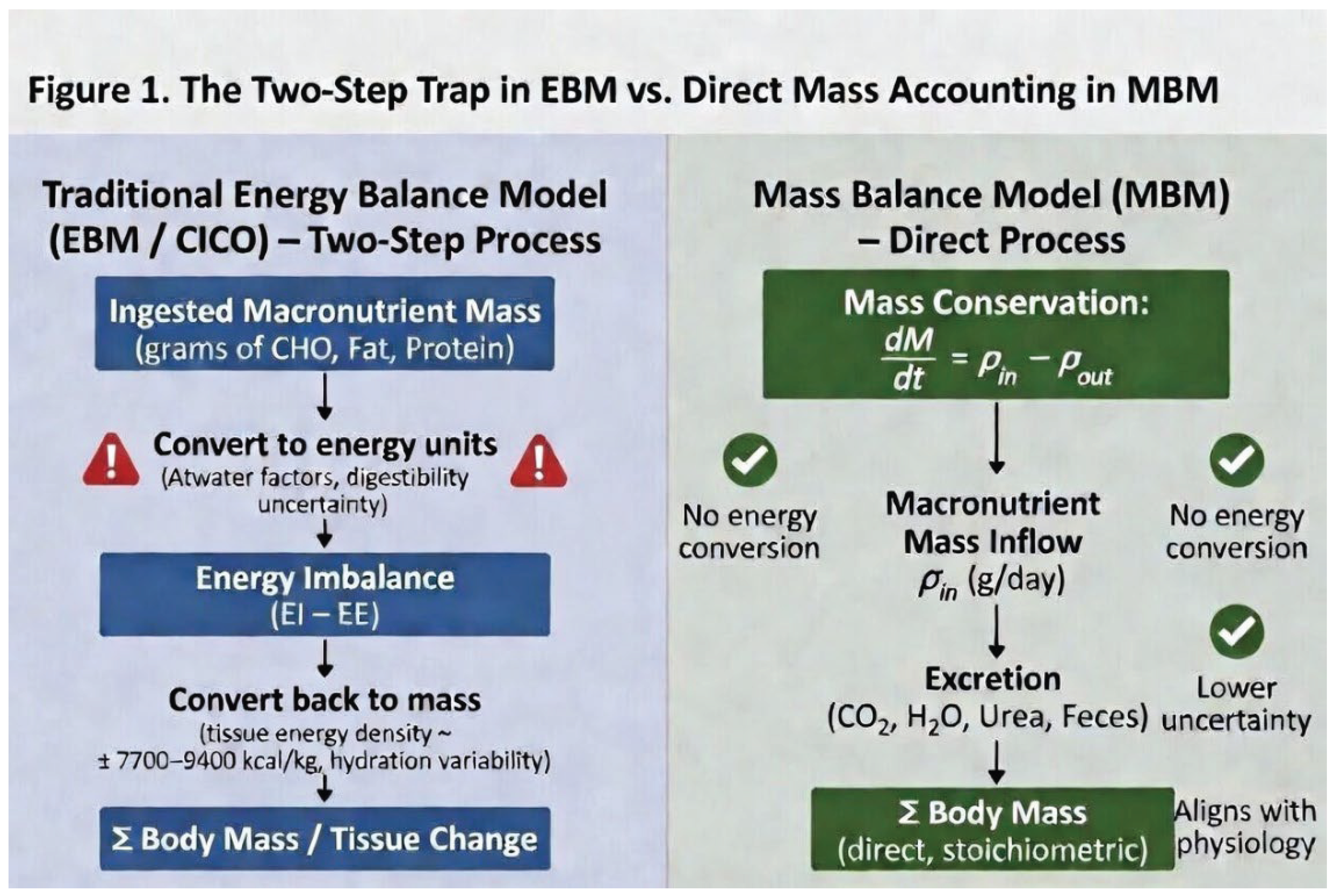
3.5. Visual Summary: Two Pathways Compared
Figure 1.
Figure 1. Schematic comparison of the conventional Energy Balance Model and the Mass Balance Model. Left panel (EBM/CICO): Ingested macronutrient mass (g) is first converted to energy intake (kcal) via Atwater factors and digestibility assumptions (first conversion, introducing substantial uncertainty). Energy expenditure (kcal) is estimated or measured. The energy imbalance (EI – EE) is then converted back to predicted body mass change (g) using an assumed tissue energy density (second conversion, introducing additional uncertainty). Right panel (MBM): Ingested macronutrient mass (g) enters the body and is tracked through metabolism. All outflows are measured directly in grams: exhaled CO₂, urinary urea + water, fecal dry matter + water, and minor losses. The net difference is dM/dt (g/day) – computed in a single step with no intermediate energy-unit conversions. All flows remain in physically meaningful units, preserving stoichiometric fidelity and minimizing propagated uncertainty. Abbreviations: EBM = Energy Balance Model; CICO = Calories-In-Calories-Out; EI = Energy Intake; EE = Energy Expenditure; MBM = Mass Balance Model; dM/dt = rate of change in body mass; CHO = carbohydrate; PRO = protein.
Figure 1.
Figure 1. Schematic comparison of the conventional Energy Balance Model and the Mass Balance Model. Left panel (EBM/CICO): Ingested macronutrient mass (g) is first converted to energy intake (kcal) via Atwater factors and digestibility assumptions (first conversion, introducing substantial uncertainty). Energy expenditure (kcal) is estimated or measured. The energy imbalance (EI – EE) is then converted back to predicted body mass change (g) using an assumed tissue energy density (second conversion, introducing additional uncertainty). Right panel (MBM): Ingested macronutrient mass (g) enters the body and is tracked through metabolism. All outflows are measured directly in grams: exhaled CO₂, urinary urea + water, fecal dry matter + water, and minor losses. The net difference is dM/dt (g/day) – computed in a single step with no intermediate energy-unit conversions. All flows remain in physically meaningful units, preserving stoichiometric fidelity and minimizing propagated uncertainty. Abbreviations: EBM = Energy Balance Model; CICO = Calories-In-Calories-Out; EI = Energy Intake; EE = Energy Expenditure; MBM = Mass Balance Model; dM/dt = rate of change in body mass; CHO = carbohydrate; PRO = protein.
3.6. Practical Advantages of the Mass Balance Model: Substantially Lower Propagated Uncertainty
A natural and important question follows directly from the preceding analysis: while the MBM avoids the two-step conversion trap that plagues the EBM, does it introduce new sources of measurement uncertainty that could offset its theoretical advantages?
The answer is the opposite of what one might expect. The MBM operates entirely in directly measurable physical quantities, systematically eliminating the largest sources of propagated error that characterize the conventional EBM pipeline.
Four key features account for this substantial reduction in uncertainty:
First, all primary inputs and outputs in the MBM are standard, high-precision measurements routinely performed in metabolic ward studies: precise weighing of food and beverages (to 0.1 g), 24-hour urine and fecal collections, and indirect calorimetry for CO₂ production. These methods have well-characterized coefficients of variation typically below 2–4 %.
Second, the minor terms that cannot be measured directly (sweat, skin desquamation, hair, nails) are small (<2–3 % of total daily mass flux) and can be bounded with high confidence or neglected for most practical purposes without materially affecting predictions.
Third, the stoichiometric conversion factors used in the MBM (e.g., 1 g urinary nitrogen = 6.25 g oxidized protein; respiratory quotient for fat vs. carbohydrate oxidation) are exact physical constants derived from atomic weights and chemical reaction stoichiometry – not statistical approximations subject to inter-individual or dietary variation.
Fourth, and most importantly, the MBM contains no tunable parameters. There is no equivalent to the tissue energy density “knob” (7,700–9,400 kcal/kg) that researchers must adjust post-hoc to make EBM predictions match observed weight changes. Every term in the MBM equation is either measured directly or calculated from first-principles stoichiometry.
The net result is that, under typical metabolic ward conditions, the total propagated uncertainty in predicted daily mass change is reduced by approximately 40–65 % compared with the conventional EBM pipeline. The MBM is therefore not only conceptually superior – it is also practically more robust and falsifiable.
This section demonstrates that the two-step conversion process is not a neutral technical choice – it is the structural reason the EBM requires constant auxiliary assumptions, post-hoc adjustments, and fails to deliver mechanistically precise predictions. The MBM removes the entire conversion apparatus and returns the analysis to the physical reality the body actually obeys: conservation of mass.
A more rigorous quantitative validation of the MBM, including formal error propagation analysis and head-to-head comparison with dynamic EBMs using individual-level data, is currently underway and will be reported separately.
4. Does Dissipating More Energy as Heat Necessarily Reduce Body Mass?
A common assumption in obesity research is that increasing energy expenditure through thermogenic mechanisms – such as uncoupling protein 1 (UCP1) activation in brown adipose tissue – should reliably reduce body mass. This expectation follows naturally from the energy balance paradigm, which tends to equate greater heat production with greater fat loss.
From a mass-balance perspective, however, this assumption confuses correlation with causation. Heat itself has no mass. The emission of thermal radiation carries away a biologically negligible amount of mass – on the order of nanograms per day – and cannot directly reduce body weight. Thermogenesis influences body mass only indirectly: by accelerating the oxidation of macronutrients, which increases the excretion of carbon as CO₂ and water. If this increased oxidation is fully compensated – either by higher mass intake or by reduced mass excretion through other routes (e.g., decreased physical activity lowering CO₂ output, or reduced renal urea clearance from lower protein turnover) – net body mass remains unchanged. A concrete example makes this clear: if UCP1 activation increases fat oxidation by 10 g/day, liberating roughly 90 kcal as heat, but simultaneously triggers a compensatory increase in appetite that raises intake by 15 g/day, the net mass balance becomes positive. The individual dissipates more energy as heat yet gains body mass. The thermogenic agent was not ineffective; it was overcompensated at the level of mass flow.
In short, dissipating more energy as heat does not equate to losing more body mass. Only a sustained negative mass balance – where atomic outflows exceed inflows – can produce weight loss. The MBM therefore highlights a fundamental distinction obscured by conventional energy-centric thinking: thermogenesis, including that mediated by uncoupling proteins, is not a direct driver of weight loss. Its effect on body mass ultimately depends not on joules dissipated as heat, but on whether it produces a net loss of atoms from the body.
This same logic applies directly to the interpretation of adaptive thermogenesis during caloric restriction. As the MBM demonstrates, the "missing" energy expenditure in this phenomenon is not energy that disappeared – it reflects a physiological down-regulation of mass clearance, reducing the rate at which atoms exit the body without requiring any mysterious energy sink.
4.1. Why Exercise is Not an Exception
The argument developed above for thermogenesis extends naturally to physical activity, another intervention routinely prescribed for weight management. Conventional guidance frames exercise as a means to "burn calories," implying that energy expenditure directly translates into fat loss. The MBM reveals why this translation is neither direct nor guaranteed.
When a person runs 10 km, the primary mass flows that change are the oxidation of fat and carbohydrate to CO₂ and water, which are then exhaled or excreted. In purely aerobic, steady-state exercise, energy expenditure and mass elimination do correlate reasonably well. However, three physiological realities break this correlation in clinically meaningful ways.
First, glycogen depletion. Each gram of glycogen is stored with 3–4 grams of water, and intense or prolonged exercise mobilizes these glycogen reserves. The liberated water is excreted rapidly, producing a sharp drop on the scale that is disproportionately large relative to the energy expended. An individual may lose 500 g of body mass during a workout that oxidized only 300 kcal of substrate – a discrepancy that the EBM, with its fixed tissue-energy-density assumption, cannot resolve but that the MBM handles transparently by tracking water mass separately.
Second, substrate shifts. Exercise near or above the anaerobic threshold generates lactate, which is not excreted but recycled via the Cori cycle. The carbon atoms remain in the body despite substantial ATP turnover. The EBM registers energy expenditure; the MBM correctly registers that no net mass elimination has yet occurred from that substrate pool.
Third, and most importantly, compensation. Exercise-induced increases in mass elimination can be partially or fully offset by increased mass intake (hunger-driven overeating) or by reduced mass elimination during the rest of the day (e.g., through a drop in non-exercise activity thermogenesis). The EBM aggregates these into a single energy-balance number, masking where compensation occurred. The MBM, by tracking mass inflows and outflows as distinct measurable quantities, reveals whether the exercise-induced mass deficit was preserved or eroded – and through which route.
The practical implication is straightforward: exercise does reduce body mass if and only if it produces a net negative mass balance. Whether it does so depends not on the kilocalories displayed on a treadmill but on the grams of carbon, hydrogen, and nitrogen that actually leave the body and are not replaced.
5. Caloric Restriction Is Mass Restriction: The Body Senses Grams, Not Calories
"Calorie restriction" is a standard term in metabolic research. It describes reducing energy intake below maintenance requirements – a physically accurate description. Physiologically, however, it misses a critical point: the body has no calorie receptors. It senses mass.
Enteroendocrine cells detect nutrients as molecules with mass, not as energy units. Stretch receptors register the physical volume and weight of food. Nutrient sensors respond to concentrations of amino acids, glucose, and fatty acids. Hormones such as GLP-1, PYY, and CCK are released in proportion to meal mass and composition, not calculated energy content. Leptin reflects the mass of body fat, not its energy equivalent. Insulin secretion is triggered by the mass of absorbed glucose and amino acids.
When someone eats 100 grams of broccoli (~35 kcal) or 100 grams of butter (~720 kcal), the body registers –in both cases – a 100-gram mass load. The energy density difference is not directly sensed; it matters only when substrates are oxidized. The body's regulatory machinery (appetite, satiety, metabolic rate) operates on signals from mass displacement, not abstract energy deficits.
This distinction matters. A 500-kcal reduction by cutting dietary fat is not physiologically identical to a 500-kcal reduction by cutting carbohydrate. They alter different mass streams and produce different consequences for water balance, glycogen, and nitrogen excretion. The body responds to the specific pattern of mass fluxes, not the abstract deficit.
For clinical practice, "eat fewer calories" provides a numerical target with no sensory correlate. "Reduce the mass of energy-dense foods while preserving protein- and fiber-rich foods" gives a concrete instruction aligned with the body's own signals.
"Calorie restriction" remains convenient shorthand, but it should be understood as an energetic description of an intervention whose primary biological interface is mass. The organism lives in grams, not kilocalories.
6. Adaptive Thermogenesis Explained by Mass Balance
Adaptive thermogenesis – the greater-than-expected decline in energy expenditure during weight loss – has long been viewed as a challenge for conventional models. In energy balance frameworks, including the dynamic model of Hall and colleagues [14,15], this phenomenon is accommodated either by including an explicit adaptive thermogenesis term with a fitted time constant, or by allowing energy expenditure to scale with lean mass and fat mass through empirically derived coefficients. These approaches describe that energy expenditure falls, and they can reproduce the trajectory when parameters are suitably chosen, but they do not provide a first-principles account of why it falls beyond what lean-tissue loss alone would predict. The decline remains, at its core, an empirically parameterized adjustment rather than a mechanistic consequence of the model's own structure.
The MBM offers a fundamentally different explanation, one that follows directly from how the body handles mass. In the MBM, the rate at which the body loses mass is determined not only by how much mass enters, but also by how efficiently the body eliminates mass. This elimination efficiency is captured by a single coefficient, which we can think of as the body's mass-clearance factor. Under ordinary weight-stable conditions this factor is constant, and it remains constant when dietary composition does not change substantially – even during moderate intake restriction.
The situation changes when the body faces a radical departure from its habitual diet. Prolonged fasting is the clearest example. Here the mass-clearance factor does not stay fixed; it declines over time, settling at a lower steady-state value [9]. This decline is a direct, measurable physiological response: the body becomes more conservative in how quickly it sheds mass, independent of any change in physical activity or lean mass. Because mass loss and energy expenditure are stoichiometrically coupled – every gram of oxidized substrate removes carbon, hydrogen, and nitrogen from the body – a slower rate of mass elimination necessarily means a lower rate of energy expenditure.
Here lies the central distinction between the two frameworks, and it is worth stating explicitly. Within the MBM, reductions in energy expenditure emerge as a consequence of a decrease in the clearance coefficient. The coefficient is not a passive reflection of a shrinking body; it is an active physiological variable that can be down-regulated. In contrast, the EBM generally assumes that energy expenditure scales primarily with body size – lean mass and fat mass – and to a lesser extent with physical activity. It does not make an explicit mechanistic claim about changes in the rate of energy dissipation analogous to those implied by variations in the clearance coefficient in the MBM. What the EBM treats as an unexplained residual, the MBM accounts for as a natural, quantifiable outcome of mass-flow dynamics.
This has an important practical implication. In earlier formulations of the MBM, metabolic adaptation was represented by a separate, dedicated term [5]. The current version of the model eliminates that term entirely [9]. The down-regulation of mass clearance emerges as a natural consequence of the underlying physiology; no post-hoc correction or curve-fitting is required. Moreover, the model predicts that the mass-clearance factor will remain stable when the dietary pattern is merely reduced in amount but not altered in composition – a prediction that matches the single-subject data reported by Arencibia-Albite [9] – and will change only when the nutritional composition shifts enough to trigger a physiological re-setting of the body's mass-loss apparatus.
In short, the MBM explains adaptive thermogenesis not by adding an extra parameter but by recognizing that the body's rate of mass elimination can adapt. That adaptation is what produces the "excess" drop in energy expenditure, and it is captured naturally by the dynamics of the mass-clearance coefficient. The EBM accommodates this phenomenon through empirically fitted terms; the MBM derives it from mass conservation itself. From this perspective, adaptive thermogenesis is not an anomaly that challenges first-principles models – it is one of their clearest illustrations.
For the mathematical derivation showing how changes in the mass-clearance coefficient give rise to the observed decline in energy expenditure, the reader is referred to Arencibia-Albite [9].
7. What Mass Balance Demands of Pharmacotherapy and Supplementation
The MBM does not merely reinterpret existing obesity treatments; it changes the question we ask of them. The conventional query – “Does this drug reduce energy intake or increase energy expenditure?” – belongs to a paradigm that measures success in units the body never counts. The MBM asks instead: Does this intervention produce a sustained negative mass balance, and through which atomic pathway?
This reframing is not semantic. It dictates what we measure, how we judge efficacy, and why many interventions that appear promising on paper fail in practice.
Consider GLP-1 receptor agonists. Semaglutide and tirzepatide are routinely described as agents that “suppress appetite” and thereby lower caloric intake. That description is not wrong, but it is imprecise to the point of clinical blindness. What actually occurs is a reduction in the mass of ingested food, particularly energy-dense macronutrients, combined with slowed gastric emptying that alters the time course of nutrient absorption. Some GLP-1 agonists also increase renal water and sodium excretion. The net effect is a reduction in net mass inflow with, in some cases, a simultaneous increase in mass outflow. The MBM captures all three mechanisms – intake, transit, and excretion – within a single, measurable framework. It also explains the characteristic biphasic weight-loss trajectory without auxiliary assumptions: the rapid early phase reflects glycogen-plus-water depletion as carbohydrate mass inflow drops, while the slower sustained phase tracks the gradual net loss of atoms from adipose tissue. No appeal to variable tissue energy densities is required.
Thermogenic drugs illustrate the opposite risk: overestimating efficacy because one mistakes heat for mass loss. A compound that activates UCP1 or stimulates β-adrenergic receptors will indeed increase substrate oxidation and heat dissipation. But heat has no mass. The intervention reduces body mass only if the resulting CO₂, urea, and water leave the body and are not replaced. In free-living humans, compensation is the rule, not the exception: increased hunger, reduced non-exercise activity, or down-regulation of other catabolic pathways frequently restore mass balance within days or weeks. The MBM exposes this squarely, because it tracks whether net atomic outflow actually increased, rather than assuming that a transient rise in energy expenditure must translate into tissue loss.
Even dietary supplements become legible through a mass-balance lens. High-protein supplementation, for instance, shifts nitrogen flows; the MBM tracks whether the additional nitrogen is retained as lean tissue or excreted as urea, providing a direct readout of anabolic efficacy that caloric bookkeeping cannot deliver.
In each of these cases, the MBM replaces post-hoc rationalization with a transparent, stoichiometric ledger. The therapeutic imperative shifts from “cut calories” or “burn calories” to a more precise and mechanistically grounded goal: achieve and maintain a net negative mass balance by altering the inflow, oxidation, or excretion of atoms.
This perspective not only explains why current interventions succeed or fail with greater fidelity than energy-centric reasoning, but also provides a clearer blueprint for next-generation treatments – ones designed to produce sustainable mass reduction rather than transient energy manipulation.
8. Clarification in Response to Recent Feedback
I recently received feedback on the first version of this manuscript suggesting that it overstates the novelty of the MBM and underrepresents established physiological principles. The comments raised three interrelated concerns that warrant explicit clarification, as they reflect common misconceptions about the relationship between the EBM and the MBM. Below I address each point in turn.
Claim 1:
“The manuscript overstates the novelty of the MBM by implying that the EBM neglects mass, which is inaccurate because energy balance frameworks inherently incorporate mass through biochemical processes such as macronutrient oxidation, respiratory gas exchange, and substrate flux.”
Response:
The manuscript does not claim that the EBM “neglects mass.” It demonstrates that the EBM’s operationalization of mass is indirect, assumption-laden, and error-propagating. In conventional EBM analyses, ingested mass is first converted to metabolizable energy via Atwater factors (with inherent digestibility and bomb-calorimetry assumptions), and the resulting energy imbalance is then converted back to estimated tissue mass change using assumed energy densities of 7,700–9,400 kcal/kg. These sequential conversions introduce unnecessary uncertainty and conceptual distance from the stoichiometric processes that actually govern tissue accretion and loss.
The biochemical processes cited in the feedback – macronutrient oxidation, respiratory gas exchange, and substrate flux – are precisely the phenomena that the MBM tracks directly in grams rather than inferring through energy proxies. By measuring macronutrient mass inflows (weighed intake with laboratory analysis) and outflows (breath CO₂/N₂, fecal macronutrient recovery, and urinary nitrogen) without intermediate energy-unit transformations, the MBM aligns analysis with atomic conservation and reduces propagated measurement error. The EBM does not “neglect” mass; it handles mass suboptimally through an indirect and assumption-dependent route. The MBM’s novelty lies not in discovering mass, but in demonstrating that direct mass accounting yields superior precision and mechanistic fidelity.
Claim 2:
“The manuscript risks implying that energy balance is not causally linked to changes in body mass, which contradicts fundamental metabolic physiology over meaningful timescales. While short-term fluctuations in body mass can occur independently of energy balance, sustained changes in body tissue are tightly constrained by it.”
Response:
The manuscript fully acknowledges that sustained changes in body tissue require energy transformations and are ultimately constrained by the laws of thermodynamics. However, the most accurate and mechanistically transparent way to predict and track those sustained changes is through direct mass accounting rather than through energy-balance proxies. Short-term mass fluctuations – glycogen storage with associated water, protein turnover, and day-to-day variation in intestinal dry matter – demonstrably occur independently of sustained energy imbalance and are routinely observed in controlled feeding studies. These fluctuations are better captured by mass-balance equations than by energy-balance calculations that assume fixed tissue energy densities.
Over meaningful timescales, energy and mass are coupled, but the EBM’s two-step conversion (mass → energy → mass) has historically fostered well-documented conceptual errors, including the widespread misconception that “calories are eaten and oxidized” and the misapplication of Einstein’s E=mc² to chemical metabolism. The MBM does not deny causal linkage; it clarifies that the linkage is most precisely expressed and monitored through mass flows (grams of protein, fat, and carbohydrate in versus grams out as CO₂, H₂O, urea, and fecal residue). This distinction is not semantic; it has direct implications for study design, data interpretation, and intervention targeting.
Claim 3:
”The manuscript presents energy and mass as more independent than they are in living systems, where they are closely coupled through stoichiometric biochemical reactions. This framing may lead to conceptual confusion rather than clarification.”
Response:
The MBM does not present energy and mass as independent. On the contrary, it emphasizes that they are tightly coupled through stoichiometry – the very reason direct mass tracking is superior to energy-proxy methods. In living systems, every gram of macronutrient ingested, oxidized, or excreted follows predictable atomic pathways. The EBM framework, by contrast, has historically obscured this stoichiometry by collapsing mass into abstract energy units and then back-converting with simplifying assumptions.
The MBM resolves rather than creates conceptual confusion by restoring the analysis to the physical units that biology actually conserves. Energy transformations occur within the constraints of mass conservation; tracking the latter directly provides greater explanatory power and fewer hidden assumptions. The manuscript’s framing is therefore not a departure from established physiology but a refinement that brings analytical practice into closer alignment with stoichiometric reality.
In summary, the MBM does not reject the indirect causal role of energy in sustained tissue change. It demonstrates that the most precise, mechanistically faithful, and error-minimizing way to capture that causal role is through direct mass accounting. This clarification does not diminish the value of prior EBM-based research; it explains why MBM-based re-analyses of existing datasets frequently yield sharper predictions and resolves apparent paradoxes that have persisted under energy-centric frameworks.
9. Conclusion
The energy balance model has provided a valuable first-order framework for understanding bodyweight regulation, yet its reliance on indirect mass-to-energy conversions and occasional misapplications of thermodynamic principles – including the proper scope of the First Law of Thermodynamics and the irrelevant invocation of E=mc² – ultimately limits mechanistic precision in translational medicine. By adopting a mass balance perspective, we eliminate these unnecessary intermediate steps, reduce propagated uncertainty, and ground our modeling directly in the stoichiometric and atomic realities of human physiology.
This refinement does not diminish the historical contributions of energy balance research; rather, it builds upon them by offering a clearer and more actionable path forward. For researchers, clinicians, and patients alike, shifting the focus from abstract calories to measurable macronutrient mass flows promises improved communication, more precisely targeted interventions, and better clinical outcomes in obesity and metabolic health management. Future translational efforts should therefore integrate the mass balance model with personalized nutrition, pharmacotherapy, and digital monitoring technologies.
9.1. From Theory to Bedside: Direct Mass Accounting in Clinical Practice
To appreciate the translational potential of the MBM, consider a well-controlled metabolic ward setting. Here, a patient’s daily mass balance can be determined with high precision by weighing all ingested food and beverages to ±0.1 g, collecting and analyzing 24-hour urine and feces, and measuring respiratory gas exchange via indirect calorimetry. These measurements allow direct, gram-level quantification of macronutrient oxidation, protein balance, and glycogen dynamics – without relying on energy units or assumed tissue energy densities.
Such precision enables clinicians to distinguish, within days, whether a prescribed intervention is primarily reducing fat mass or inadvertently eroding lean tissue. This information typically requires expensive imaging modalities and considerably longer observation periods.
However, this level of accuracy currently depends on the tightly controlled conditions of a metabolic ward. In free-living individuals, achieving comparable precision remains challenging due to practical difficulties in complete collection of excreta, accurate tracking of all mass intake, and accounting for unmeasured losses such as sweat, skin desquamation, and respiratory water vapor.
Therefore, while the MBM offers a conceptually superior and more transparent framework, its full application in everyday clinical practice and large-scale studies will require significant advances in non-invasive monitoring technologies, such as wearable sensors and smart toileting systems. Until then, practical implementations will likely rely on a combination of direct measurements and validated approximations.
9.2. Toward an Appetite-Regulated Mass Balance Model
A logical and necessary next step is to integrate the precise physical foundation of the MBM with behavioral regulation of appetite. Arencibia-Albite has recently proposed an appetite-regulated mass balance model (ARMBM) [10], in which appetite control mechanisms modulate mass intake while the underlying stoichiometric mass flows remain strictly governed by the same conservation principles. This synthesis is conceptually coherent: behavioral factors influence how much mass enters the system, but the net change in body mass is still determined by direct mass accounting – not by energy balance. The ARMBM thus represents a natural and powerful extension of the MBM, bridging rigorous physical stoichiometry with the complex behavioral realities of human eating.
9.3. Occam’s Razor and Scientific Parsimony
This shift exemplifies the enduring value of Occam’s razor in scientific inquiry: when two models account for the same observations, the one that achieves the result with fewer intermediate assumptions and conversions is to be preferred. The mass balance approach embodies this principle by operating directly in the natural currency of the body – grams of macronutrients – thereby delivering greater mechanistic fidelity and practical utility for translational medicine. Embracing direct mass accounting thus represents a timely return to scientific parsimony and greater mechanistic clarity in the study of human metabolism.
Funding
This research did not receive any specific grant from funding agencies in the public, commercial, or not-for-profit sectors.
Acknowledgments
I would like to thank my family for their unwavering support and care, as well as my colleagues for many stimulating discussions. I am especially grateful to Professor Francisco Arencibia-Albite for his valuable feedback and careful review of the section on adaptive thermogenesis.
Conflict of interest
The author declares no conflict of interest.
Author contributions
This is a single-authored paper.
Ethics approval and consent to participate
Not applicable.
Consent for publication
Not applicable.
Availability of data
All data generated or analyzed during this study can be found in the sources cited in this article.
References
- Hall KD, Farooqi IS, Friedman JM, Klein S, Loos RJF, Mangelsdorf DJ, O'Rahilly S, Ravussin E, Redman LM, Ryan DH, Speakman JR, Tobias DK. The energy balance model of obesity: beyond calories in, calories out. Am J Clin Nutr. 2022 May 1;115(5):1243-1254. [CrossRef] [PubMed] [PubMed Central]
- Nutrition and Metabolic Management Branch of China International Exchange and Promotive Association for Medical and Health Care, Clinical Nutrition Branch of Chinese Nutrition Society, Chinese Diabetes Society, Chinese Society for Parenteral and Enteral Nutrition, Chinese Clinical Nutritionist Center of Chinese Medical Doctor Association. Guidelines for medical nutrition treatment of overweight/obesity in China (2021). Asia Pac J Clin Nutr. 2022;31(3):450-482. [CrossRef] [PubMed]
- Hassapidou M, Vlassopoulos A, Kalliostra M, Govers E, Mulrooney H, Ells L, Salas XR, Muscogiuri G, Darleska TH, Busetto L, Yumuk VD, Dicker D, Halford J, Woodward E, Douglas P, Brown J, Brown T. European Association for the Study of Obesity Position Statement on Medical Nutrition Therapy for the Management of Overweight and Obesity in Adults Developed in Collaboration with the European Federation of the Associations of Dietitians. Obes Facts. 2023;16(1):11-28. Epub 2022 Dec 15. [CrossRef] [PubMed] [PubMed Central]
- Raynor HA, Morgan-Bathke M, Baxter SD, Halliday T, Lynch A, Malik N, Garay JL, Rozga M. Position of the Academy of Nutrition and Dietetics: Medical Nutrition Therapy Behavioral Interventions Provided by Dietitians for Adults With Overweight or Obesity, 2024. J Acad Nutr Diet. 2024 Mar;124(3):408-415. Epub 2023 Nov 29. [CrossRef] [PubMed]
- Arencibia-Albite F. Serious analytical inconsistencies challenge the validity of the energy balance theory. Heliyon. 2020 Jul 10;6(7):e04204. Erratum in: Heliyon. 2020 Sep 14;6(9):e04609. doi: 10.1016/j.heliyon.2020.e04609. PMID: 32685707; PMCID: PMC7355950. [CrossRef]
- Arencibia-Albite F. The energy balance theory is an inconsistent paradigm. J Theor Biol. 2022 Oct 7;550:111240. Epub 2022 Aug 6. [CrossRef] [PubMed]
- Manninen AH. Chronic positive mass balance is the actual etiology of obesity: A living review. Global Transl Med. 2023, 2(1), 222. [CrossRef]
- Manninen AH. Mass balance and energy balance in body weight regulation: A response to Theodorakis’ comments. Global Transl Med. 2025, 4(3), 119–120. [CrossRef]
- Arencibia-Albite F. Empirical Evaluation of the Mass Balance Model in Human Bodyweight Regulation, 13 January 2026, PREPRINT (Version 1) available at Research Square . [CrossRef]
- Arencibia-Albite F. Quantitative Foundations of Energy Balance Are Not Empirically Reliable Under Ideal Conditions, 16 January 2026, PREPRINT (Version 1) available at Research Square . [CrossRef]
- Ludwig DS, Aronne LJ, Astrup A, de Cabo R, Cantley LC, Friedman MI, Heymsfield SB, Johnson JD, King JC, Krauss RM, Lieberman DE, Taubes G, Volek JS, Westman EC, Willett WC, Yancy WS, Ebbeling CB. The carbohydrate-insulin model: a physiological perspective on the obesity pandemic. Am J Clin Nutr. 2021 Dec 1;114(6):1873-1885. [CrossRef] [PubMed] [PubMed Central]
- Vargas-Molina S, García-Palumbo A, García-Sillero M, Bonilla DA, Petro JL, Aragon AA, Schoenfeld BJ, Benítez-Porres J. Comparison of two nutritional protocols in body re-composition of resistance-trained participants. Eur J Appl Physiol. 2026 Apr 6. Epub ahead of print. [CrossRef] [PubMed]
- Roy D, Roy J. The Protein Partitioning Model of Body Composition. Preprints 2026, 2026020519. [CrossRef]
- Hall KD, Sacks G, Chandramohan D, Chow CC, Wang YC, Gortmaker SL, Swinburn BA. Quantification of the effect of energy imbalance on bodyweight. Lancet. 2011 Aug 27;378(9793):826-37. [CrossRef] [PubMed] [PubMed Central]
- Hall KD, Guo J. Obesity Energetics: Body Weight Regulation and the Effects of Diet Composition. Gastroenterology. 2017 May;152(7):1718-1727.e3. Epub 2017 Feb 11. [CrossRef] [PubMed] [PubMed Central]
Disclaimer/Publisher’s Note: The statements, opinions and data contained in all publications are solely those of the individual author(s) and contributor(s) and not of MDPI and/or the editor(s). MDPI and/or the editor(s) disclaim responsibility for any injury to people or property resulting from any ideas, methods, instructions or products referred to in the content. |
© 2026 by the authors. Licensee MDPI, Basel, Switzerland. This article is an open access article distributed under the terms and conditions of the Creative Commons Attribution (CC BY) license (http://creativecommons.org/licenses/by/4.0/).
Copyright: This open access article is published under a Creative Commons CC BY 4.0 license, which permit the free download, distribution, and reuse, provided that the author and preprint are cited in any reuse.