
Submitted:
08 April 2026
Posted:
13 April 2026
Read the latest preprint version here
Abstract
The energy balance model (EBM) and its operational form, calories-in-calories-out (CICO), have dominated obesity research and clinical practice for decades. While these frameworks have yielded valuable public health insights, they rely on indirect conversions between mass and energy and rest on misconceptions about thermodynamic principles. This Perspective argues that a mass balance model (MBM) provides a conceptually simpler, mathematically consistent, and biologically more faithful paradigm. By tracking macronutrient mass directly – without intermediate energy-unit conversions or misapplications of thermodynamic laws – the MBM aligns analysis with physiological reality and better predicts body composition dynamics. Clarifying that the first law of thermodynamics concerns only energy (not mass), that calories cannot be eaten or oxidized, and that E=mc² has no relevance to human metabolism paves the way for more precise translational interventions in metabolic medicine.
Keywords:
mass balance model
; energy balance model
; body weight regulation
; body composition
; macronutrient stoichiometry
; thermodynamics
; obesity
; translational medicine
1. Introduction: Toward a Paradigm Refinement
The energy balance theory (EBT) and its practical embodiment, the energy balance model (EBM) [1], have served as the cornerstone of nutrition science and clinical obesity management for nearly a century [2,3,4]. Proponents of the calories-in-calories-out (CICO) heuristic have correctly emphasized that sustained positive or negative energy balance is associated with weight gain or loss. These models have informed countless guidelines, public-health campaigns, and pharmacotherapeutic strategies, and their historical contributions merit unequivocal respect.
Importantly, the emerging mass balance model (MBM) does not reject energy balance; it builds directly upon it [5,6,7,8,9,10]. Energy transformations occur within the constraints of mass conservation in open biological systems. The MBM thus represents a natural refinement and extension of EBT/EBM – one that aligns more closely with the stoichiometric realities of human physiology and offers greater explanatory and predictive power in translational settings.
This Perspective addresses three foundational misconceptions that have hindered broader acceptance of mass balance principles. First, the imprecise shorthand that “calories are eaten and oxidized.” Second, the erroneous claim that energy balance and mass balance are interchangeable via Einstein’s E=mc². Third, the common assertion that the First Law of Thermodynamics directly equates energy balance with mass balance in living organisms. These clarifications set the stage for demonstrating the practical superiority of direct mass accounting.
2. Three Persistent Misconceptions in Applying Thermodynamics to Body Weight Regulation
2.1. Calories Cannot Be Eaten – Nor Oxidized
A calorie is a unit of energy, not a substance. It quantifies the heat required to raise 1 gram of water by 1 °C. Clinical and research discourse routinely employs the phrase “caloric intake” as convenient shorthand for the chemical energy stored in covalent bonds of dietary macronutrients.
What physically enters the gastrointestinal tract, however, is mass – grams of carbon-, hydrogen-, oxygen-, and nitrogen-containing compounds. This mass undergoes enzymatic hydrolysis, absorption, and cellular metabolism. Energy is released through bond rearrangement (glycolysis, β-oxidation, citric acid cycle), but the atoms themselves are conserved and ultimately excreted as CO₂, H₂O, urea, and minor metabolites.
Thus, the statement “I consumed 2000 kcal today” is thermodynamically imprecise. No calories traverse the intestinal barrier; only macronutrient mass does. The energy yield (whether measured by bomb calorimetry or estimated via Atwater factors) is a derived property, not the primary input. This distinction explains why body mass change is governed by atomic inflows and outflows, not by abstract energy fluxes alone.
2.2. The Irrelevance of Einstein’s E=mc² to Human Metabolism
Some advocates of the EBM have suggested that the distinction between energy and mass balance is irrelevant because Einstein’s mass–energy equivalence (E=mc²) renders the two concepts interchangeable. This assertion, while elegant in relativistic physics, has no bearing on human metabolism. In living systems, all reactions are chemical, not nuclear. Atomic nuclei remain intact, and the mass defect in chemical bond rearrangements is negligible (on the order of 10⁻⁹ to 10⁻¹⁰ of reactant mass) – far below clinical detection limits. Lavoisier’s principle of mass conservation therefore holds with extraordinary fidelity.
2.3. The First Law of Thermodynamics Concerns Only Energy, Not Mass
A related and particularly stubborn misconception is the claim that the First Law of Thermodynamics (i.e., the Law of Conservation of Energy) directly links or equates energy balance with mass balance in the human body. The first law is expressed as:
where ∆U is the change in the internal energy of the system, Q is the heat added to the system, and W is the work done by the system. Critically, this equation – and the first law itself – contains no term for mass. It describes the conservation of energy in its various forms (heat, work, internal energy) but says nothing about the conservation or transformation of matter.
∆U = Q − W
In open biological systems such as the human body, energy and mass are handled by separate conservation principles (the First Law of Thermodynamics vs. the Law of Conservation of Mass). Energy balance can be maintained or altered through heat exchange and work without dictating the net mass change, which is governed by the inflow and outflow of atoms. Conflating the two leads to the incorrect assumption that an energy-balanced state necessarily implies a stable body mass – an assumption repeatedly contradicted by everyday observations.
Common examples include rapid changes in glycogen stores (where each gram of glycogen is stored with only a small amount of associated water, yet the glycogen itself contributes directly to dry lean mass), shifts in protein turnover and muscle protein accretion, alterations in the respiratory quotient (RQ) that change the rate at which carbon atoms are excreted as CO₂ (thereby affecting mass loss independently of energy balance), and day-to-day variations in intestinal dry matter content (undigested fiber and bacterial biomass).
These transient or short-term changes in body mass – even when they involve components of dry mass – can occur independently of any sustained imbalance in energy stores. They underscore why body mass dynamics must be tracked directly through macronutrient inflows and outflows rather than inferred solely from energy balance calculations.
2.4. Why These Distinctions Matter
These three misconceptions – the notion that calories can be directly eaten and oxidized, the misapplication of Einstein’s E=mc² to human metabolism, and the erroneous belief that the first law of thermodynamics equates energy balance with mass balance – have collectively reinforced an energy-centric view of body weight regulation. While this perspective has served as a valuable first-order approximation and has guided important public health efforts for decades, it inadvertently obscures the stoichiometric mechanisms that actually govern tissue accretion and loss.
By treating energy as the primary currency of body mass change, the conventional model requires researchers and clinicians to infer mass dynamics indirectly through multiple conversion steps and simplifying assumptions. In reality, body mass changes only when atoms enter or leave the system, regardless of the energy transformations occurring internally. Clarifying these distinctions is not merely semantic; it highlights why a direct mass balance framework can provide greater mechanistic fidelity, reduced propagation of uncertainty, and more actionable insights for translational medicine. This sets the foundation for examining the practical limitations of the traditional two-step conversion process in the EBT.
4. The Inefficiency of the Two-Step Conversion Process in EBM
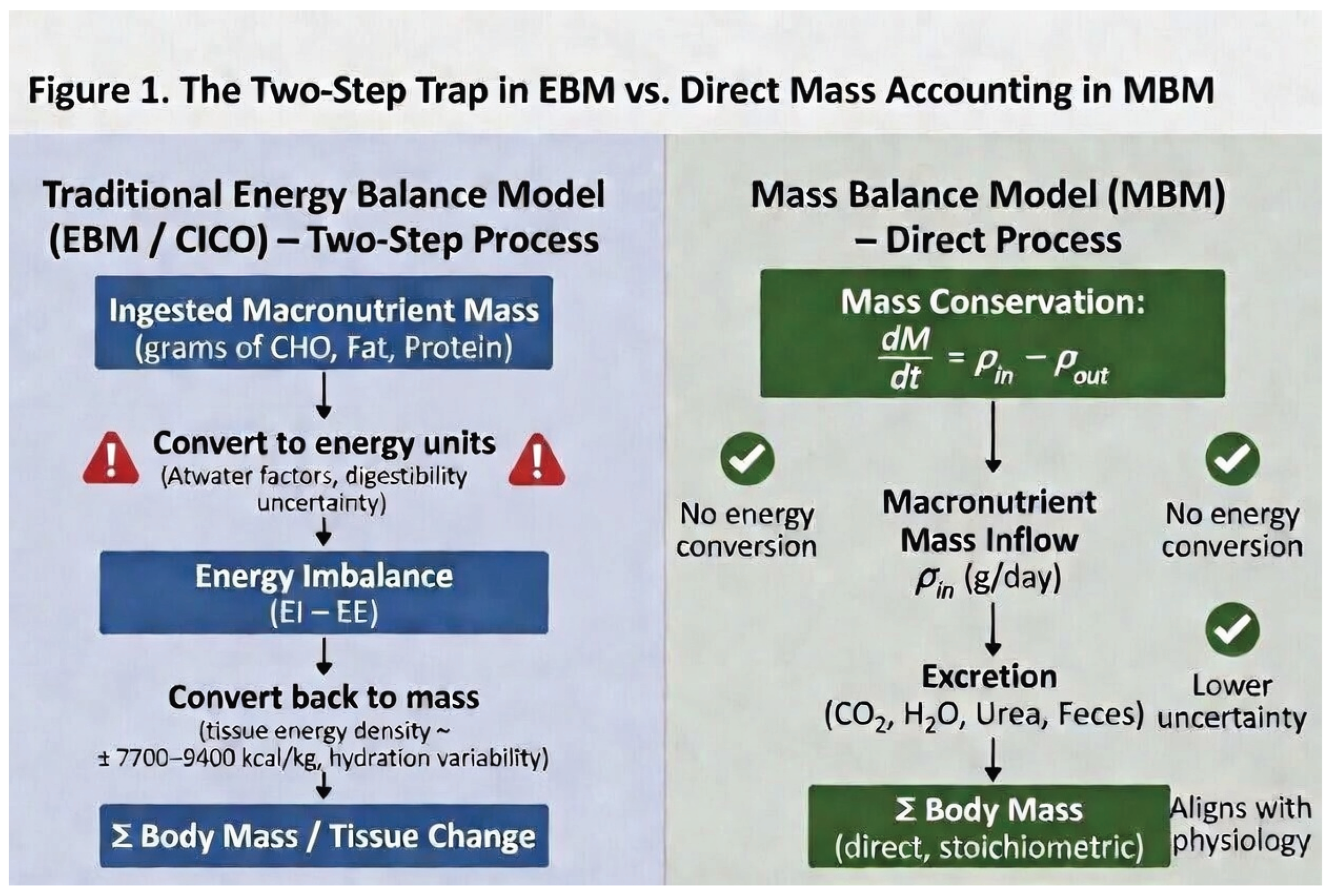
A particularly revealing limitation of the energy balance model becomes apparent when it is applied to the analysis of body composition. As Arencibia-Albite has clearly demonstrated [9,10], the traditional framework requires an inefficient two-step process: first, ingested macronutrient mass must be converted into energy units using various assumptions and coefficients; second, the resulting energy imbalance is then converted back into estimated changes in body mass or tissue. These repeated conversions add unnecessary complexity and propagate measurement uncertainty, while distancing the model from the actual physiological mechanisms at work.
In the conventional energy balance approach, changes in body mass are typically described by comparing energy intake with energy expenditure and then dividing the difference by an assumed energy density of the gained or lost tissue (often estimated between 7700 and 9400 kilocalories per kilogram for a mixture of fat and lean tissue). Energy intake itself is not measured directly but is instead calculated from the mass of food consumed using standard metabolizable energy values, such as the well-known Atwater factors.
By contrast, the mass balance model works directly with mass. It simply states that the rate of change in body mass equals the difference between the rate at which macronutrient mass enters the body and the rate at which mass leaves the body through respiration, urine, feces, and other pathways. All quantities are expressed in grams per day. This direct approach eliminates the need for intermediate energy conversions altogether. It aligns the mathematical description with the physical reality of atomic inflows and outflows, avoids physiologically questionable parameter adjustments, and substantially reduces the accumulation of measurement errors.
Recent empirical evaluations [9,10] show that the mass balance model can accurately reproduce long-term changes in body weight and body composition without requiring the kinds of adjustments frequently needed in traditional energy-balance calculations.
Figure 1.
The left panel illustrates the conventional EBM/CICO framework, which requires two indirect conversions: (1) ingested macronutrient mass is first converted into energy units using Atwater factors and digestibility assumptions (introducing uncertainty), and (2) the resulting energy imbalance (EI – EE) is then converted back into predicted body mass or tissue change using an assumed tissue energy density (typically 7700–9400 kcal/kg, further affected by hydration variability). The right panel shows the MBM, which tracks macronutrient mass directly from intake to excretion without intermediate energy conversions. All flows are expressed in grams per day, resulting in lower propagated uncertainty and better alignment with physiological stoichiometry. EBM = energy balance model; CICO = calories-in-calories-out; EI = energy intake; EE = energy expenditure; MBM = mass balance model; dM/dt = rate of change in body mass.
Figure 1.
The left panel illustrates the conventional EBM/CICO framework, which requires two indirect conversions: (1) ingested macronutrient mass is first converted into energy units using Atwater factors and digestibility assumptions (introducing uncertainty), and (2) the resulting energy imbalance (EI – EE) is then converted back into predicted body mass or tissue change using an assumed tissue energy density (typically 7700–9400 kcal/kg, further affected by hydration variability). The right panel shows the MBM, which tracks macronutrient mass directly from intake to excretion without intermediate energy conversions. All flows are expressed in grams per day, resulting in lower propagated uncertainty and better alignment with physiological stoichiometry. EBM = energy balance model; CICO = calories-in-calories-out; EI = energy intake; EE = energy expenditure; MBM = mass balance model; dM/dt = rate of change in body mass.
4. Conclusion
The energy balance model has provided a valuable first-order framework for understanding bodyweight regulation, yet its reliance on indirect mass-to-energy conversions and occasional misapplications of thermodynamic principles – including the proper scope of the first law of thermodynamics and the irrelevant invocation of E=mc² – ultimately limits mechanistic precision in translational medicine. By adopting a mass balance perspective, we eliminate these unnecessary intermediate steps, reduce propagated uncertainty, and ground our modeling directly in the stoichiometric and atomic realities of human physiology.
This refinement does not diminish the historical contributions of energy balance research; rather, it builds upon them by offering a clearer and more actionable path forward. For researchers, clinicians, and patients alike, shifting the focus from abstract calories to measurable macronutrient mass flows promises improved communication, more precisely targeted interventions, and better clinical outcomes in obesity and metabolic health management. Future translational efforts should therefore integrate the mass balance model with personalized nutrition, pharmacotherapy, and digital monitoring technologies.
This shift exemplifies the enduring value of Occam’s razor in scientific inquiry: when two models account for the same observations, the one that achieves the result with fewer intermediate assumptions and conversions is to be preferred. The mass balance approach embodies this principle by operating directly in the natural currency of the body – grams of macronutrients – thereby delivering greater mechanistic fidelity and practical utility for translational medicine. Embracing direct mass accounting thus represents not only a timely refinement but also a return to scientific parsimony in the study of human metabolism.
Author Contributions
This is a single-authored paper.
Funding
This research did not receive any specific grant from funding agencies in the public, commercial, or not-for-profit sectors.
Ethics approval and consent to participate
Not applicable.
Consent for publication
Not applicable.
Availability of data
All data generated or analyzed during this study can be found in the sources cited in this article.
Acknowledgments
I would like to thank my family for their support and care as well as my colleagues for stimulating discussions.
Conflicts of Interest
The author declares no conflict of interest.
References
- Hall KD, Farooqi IS, Friedman JM, Klein S, Loos RJF, Mangelsdorf DJ, O’Rahilly S, Ravussin E, Redman LM, Ryan DH, Speakman JR, Tobias DK. The energy balance model of obesity: beyond calories in, calories out. Am J Clin Nutr. 2022 May 1;115(5):1243-1254. [CrossRef] [PubMed] [PubMed Central]
- Nutrition and Metabolic Management Branch of China International Exchange and Promotive Association for Medical and Health Care, Clinical Nutrition Branch of Chinese Nutrition Society, Chinese Diabetes Society, Chinese Society for Parenteral and Enteral Nutrition, Chinese Clinical Nutritionist Center of Chinese Medical Doctor Association. Guidelines for medical nutrition treatment of overweight/obesity in China (2021). Asia Pac J Clin Nutr. 2022;31(3):450-482. [CrossRef] [PubMed]
- Hassapidou M, Vlassopoulos A, Kalliostra M, Govers E, Mulrooney H, Ells L, Salas XR, Muscogiuri G, Darleska TH, Busetto L, Yumuk VD, Dicker D, Halford J, Woodward E, Douglas P, Brown J, Brown T. European Association for the Study of Obesity Position Statement on Medical Nutrition Therapy for the Management of Overweight and Obesity in Adults Developed in Collaboration with the European Federation of the Associations of Dietitians. Obes Facts. 2023;16(1):11-28. [CrossRef] [PubMed] [PubMed Central]
- Raynor HA, Morgan-Bathke M, Baxter SD, Halliday T, Lynch A, Malik N, Garay JL, Rozga M. Position of the Academy of Nutrition and Dietetics: Medical Nutrition Therapy Behavioral Interventions Provided by Dietitians for Adults With Overweight or Obesity, 2024. J Acad Nutr Diet. 2024 Mar;124(3):408-415. [CrossRef] [PubMed]
- Arencibia-Albite F. Serious analytical inconsistencies challenge the validity of the energy balance theory. Heliyon. 2020 Jul 10;6(7):e04204. Erratum in: Heliyon. 2020 Sep 14;6(9):e04609. doi: 10.1016/j.heliyon.2020.e04609. [CrossRef] [PubMed]
- Arencibia-Albite F. The energy balance theory is an inconsistent paradigm. J Theor Biol. 2022 Oct 7;550:111240. [CrossRef] [PubMed]
- Manninen AH. Chronic positive mass balance is the actual etiology of obesity: A living review. Global Transl Med. 2023, 2(1), 222. [CrossRef]
- Manninen AH. Mass balance and energy balance in body weight regulation: A response to Theodorakis’ comments. Global Transl Med. 2025, 4(3), 119–120. [CrossRef]
- Arencibia-Albite F. Empirical Evaluation of the Mass Balance Model in Human Bodyweight Regulation, 13 January 2026, PREPRINT (Version 1) available at Research Square. [CrossRef]
- Arencibia-Albite F. Quantitative Foundations of Energy Balance Are Not Empirically Reliable Under Ideal Conditions, 16 January 2026, PREPRINT (Version 1) available at Research Square. [CrossRef]
Disclaimer/Publisher’s Note: The statements, opinions and data contained in all publications are solely those of the individual author(s) and contributor(s) and not of MDPI and/or the editor(s). MDPI and/or the editor(s) disclaim responsibility for any injury to people or property resulting from any ideas, methods, instructions or products referred to in the content. |
© 2026 by the authors. Licensee MDPI, Basel, Switzerland. This article is an open access article distributed under the terms and conditions of the Creative Commons Attribution (CC BY) license (http://creativecommons.org/licenses/by/4.0/).
Copyright: This open access article is published under a Creative Commons CC BY 4.0 license, which permit the free download, distribution, and reuse, provided that the author and preprint are cited in any reuse.


