

Submitted:
09 April 2026
Posted:
09 April 2026
You are already at the latest version
Abstract
The current article explores how people in contemporary America understand George Washington’s national authority through their daily cultural activities. It examines how individuals understand national symbol through ethical beliefs. Using thirty-three semi-structured online interviews and qualitative narrative analysis, the findings reveal that participants see Washington as a national symbol through personal understanding, emotional ties and their judgment of his moral character. Washington serves as a national figure whom people learn about in schools and see in popular culture yet his historical connection to slavery creates discomfort and mixed feelings for many individuals. Participants resolve this conflict through selective reverence, distancing, qualification, and informal critique. These practices illustrate a process of symbolic governance in which national authority persists because individuals continuously negotiate their understanding of national symbols through emotional and moral evaluation. Consequently, Washington is revealed as a figure whose authority is culturally constructed, maintained through varied cultural readings of his persona. This research shows how national symbols persist in modern culture, a process shaped by the continuous interplay between individual interpretation and historical awareness.
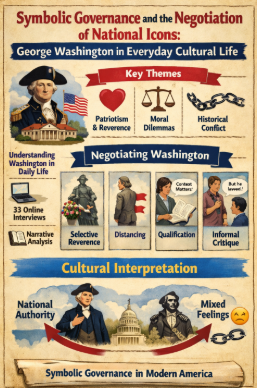
Keywords:
symbolic governance
; national memory
; everyday life
; cultural authority
; negotiated heritage
; national identity
Introduction
Culture is not a stable storage of shared meanings, as Cultural Studies suggest; it is the active site of struggle, negotiations, and power. These national icons, in this sense, do not merely reflect history; they contribute to its cultural production in the present. Individuals such as George Washington are still circulated in daily life—through education, media, political discourse, and popular discussion— where they acquire affective force and ideological significance. Such an understanding is in agreement with the Cultural Studies commitment to conjunctural analysis in which one examines how power, meaning, and affect are articulated within particular historical and cultural formations rather than treated as fixed or consensual (Grossberg, 2019). Icons such as these do not symbolize an established national consensus; rather, they are cultural formations that are worked and reworked in relation to questions of authority, belonging, exclusion, and historical memory (see Figure 1).
This article explores the contemporary cultural life of George Washington as a mediated national icon, focusing on how his symbolic authority is interpreted, negotiated, and sometimes contested in everyday meaning-making. Building on the central commitments of Cultural Studies, the study treats “culture” as dynamic and relational, shaped by power, affect, history, and material conditions. Washington’s image is approached not as a fixed historical reference, but as a site where ideology, memory, and cultural politics intersect in lived experience.
More recent works in Cultural Studies and cultural sociology have insisted on the contested nature of national symbols over the potentiality of their permanence through mediation and circulation (Couldry & Hepp, 2017; McGuigan, 2019). The environments are now digitally saturated; every iconic figure is through a variety of registers ranging from the educational narrative through popular discourse to visual culture and everyday chatter, each loaded with affective and ideological weights of its own. In other words, the meetings constitute what memory scholars call mediated memory: the past being constantly revised through present cultural practices instead of being simply preserved (Hoskins, 2018).
So, this study proposes exploring symbolic governance—in particular, the power plays expressed within culturally resonant images and narratives that naturalize authority without coercion. Recent research in Cultural Studies demonstrates how, in mediated religious contexts, popular cultural forms, or even algorithmic and affective regimes of everyday life, authority and governance enact themselves through everyday cultural practices rather than centralized institutional structures (Echchaibi, 2011; Hoover & Echchaibi, 2014; Striphas, 2003, 2015). Similar lives have also been found in other cultural domains: for instance, in digital activism, where governance and political authority arise more from informal daily practices than from formal institutions (Bennett & Segerberg, 2012). Nation founders are perhaps the most potent nodes of symbolic governance: they crystallize moral imaginaries of leadership, virtue, and national origin. These imaginaries are far from neutral; they always thread through longer histories of colonialism, racial hierarchy, and exclusion, and are constantly opened to critique and reinterpretation (Bhambra, 2021; Hall, 1997).
But the discussion of this article does not engage with institutional or official reflections of George Washington: it rather doesn’t analyze media-texts directly. Instead, it’s about how symbolic governance works through everyday interpretation, based on in-depth online interviews of twenty respondents. The respondents were invited to talk about their encounters with Washington, whether in education, popular culture, or public discourse-and articulate their emotional responses, moral tensions, and interpretational negotiations with the figure of Washington. This approach resonates with the Cultural Studies commitment to taking lived experience and cultural practice as seriously as sites of power-memory-authority reinscription and contestation (Radway, 1988).
Since almost all research published after 1970 have many references to Washington, this study assumes that Washington resonates within the everyday articulations of his statehood. As such, I construct narratives that locate participants’ own accounts of cultural memory around Washington, making it center-stage. Washington’s presence is made visible through those memories, and so are public memories: they have a constructive effect on how lived experiences about national icons might be understood in terms of attachment, ambivalence, irony, and critique-especially concerning narratives around slavery exclusion and inequality. Most findings will resonate with research on race, postcolonial, and memory studies, which unsettles what has been historically dominant not only through formal political action, but also through everyday commentary and sense-making (Trouillot, 1995; Stoler, 2023).
This paper then brings together three strands of Cultural Studies scholarship: (1) theories of symbolic power and governance; (2) approaches to media and mediation emphasizing circulation, affect, and everyday sense-making; (3) critical discourse on heritage and memory, the processes of which involving the culture in contention rather than consensual inheritance. The study illustrates how George Washington serves as a transactional cultural symbol across which authority, sustained through repetition and affective attachment, remains unstable and subject to renegotiation. Giving priority to lived interpretation, this article contributes to Cultural Studies’ long-standing project of understanding how culture functions at the intersection of history, power, and everyday life. What one thus shows is how national icons do not endure so much as fixed truths, but rather as cultural means through which one negotiates contemporary questions bearing upon belonging, morality, and historic accountability. Such icons operate in a way in which historical narrative, social values, and personal interpretation come together to allow an audience to engage or perhaps reinterpret passed meanings. Considering the question of power about mediated meanings that audiences live through, this paper thus adopt two research questions:
RQ1: How do people interpret, negotiate, and emotionally engage with George Washington as a national cultural symbol in everyday life?
RQ2: How do people articulate tensions between reverence, critique, and historical accountability—particularly in relation to power, exclusion, and slavery—when reflecting on Washington’s symbolic authority?
This article is subdivided into three interrelated sections outlining how George Washington’s symbolic authority is produced, maintained, and negotiated within everyday cultural life. The first section outlines the theoretical framework within Cultural Studies of how symbolic governance is structured. Washington is presented as a mediated national icon whose authority travels not merely through the institutional consensus circuits but also through education, popular culture, and everyday discourse. This section also clarify how mediation, affect, and inheritance shape the conditions under which national icons remain intelligible.
The second part of the article draws on thirty-three online interviews and forms the empirical core of the study. Here, participants talk about how they first encountered George Washington, what those early impressions meant to them emotionally, and how later learning—especially about slavery and exclusion—created tensions in those memories. Participants described some practices for coping with the tensions in everyday understandings: selective reverence, distancing, qualification, and informal critique. Thus, his symbolic authority is neither settled nor resolved, but is always worked out in ordinary processes of meaning-making.
Then the concluding chapter contextualized the findings within greater debates of Cultural Studies, memory studies, and heritage scholarship. The effect of considering national memory neither as a fixed institutional narrative nor a restricted one but rather as a dynamic, affective, and contested process replenished through everyday cultural practices is discussed here. Qualitative interviews and lived sense-making inform this Cultural Studies trajectory in national memory by showing national icons as persisting through a process of iterative debate, ambivalence, and reinterpretation, as opposed to being determined through consensus.
Literature Review and Theoretical Framing
Culture, Power, and the Production of Meaning
Cultural Studies have seen historically culture as a place where conflict is waged over the production and circulation of meanings, not merely a place to consume it. Culture is now viewed very much inextricably connected with power relations, ideology, and political economy, since those would be laid down by the foundational work of Williams (1977) and Hall (1997). Everyday practice means not only that these seem incidental, but are actually constitutive of how changeless imaginations get constructed in history over time and so become distinguished from one another by forming normalising social hierarchies. As Hall (1993) argues, nation is then best understood as a cultural narrative, continually reconstructed by symbols, stories, and shared imaginaries securing belonging and authority, rather than fixed political entity. For example, such national characters and icons hence occupy a very important part within this cultural field-that shorthand national identity, moral order, and legitimacy to rule.
Cultural Studies scholarship has demonstrated that such figures seldom work as stable or consensus-producing symbols. Perera’s (1996) work on Truganini is a case in point, showing how a national figure becomes a site or contestation, in which the unacknowledged or unforgotten histories of colonial violence are mediated by particular narrative framings and through particular kinds of memory. While a personification rather than resolution of historical contradiction, national icons often function as capacitors through which moral tensions are displaced, deferred, or contained symbolically. This thus illuminates how founding figures come to symbolize both national belonging as well as historical unease.
Meaning is never fixed or consensual in Cultural Studies. Within cultural studies meanings can be interpreted, contested, or resisted in any number of ways. People’s interpretation of cultural images, symbols, and narratives changes constantly. “Cultural Study,” in Hall’s encoding/decoding model, assumes that cultural texts are structured about dominant meanings; however, it never ensures that these meanings will be read uniformly. This remains very much central in thinking about national icons, whose authority rests not only on institutional repetition, but, and more importantly, on everyday interpretive practices by which audiences accept, qualify, or contest official national narratives. According to McGuigan (2019), modern cultural power works through affective attachments and symbolic resonance rather than straightforward coercion, making interpretation an important political struggle arena. Foundational audience-centered studies have long shown ordinary people negotiating ideology and authority through everyday meaning-making rather than passively entertaining dominant meanings.
Symbolic Governance and National Authority
Symbolic governance is a useful conceptual tool for analyzing power exercised and sustained through cultural representations, images, narratives, and figures rather than through the formal authority of the law only. As Alexander (2011) states, symbolic governance functions through the creation of emotionally powerful representations that project a sense of being natural, timeless, and self-evident, thereby gaining moral authority covertly without feeling the need for any physical coercion. These representations work affectively to shape how members of a public feel about institutions, histories, and identities and to foster attachment that will legitimize that power. Founding figures of nations are particularly adept at this, because they very nicely lend themselves to being seen as incarnations of collective virtue, sacrifice, and origin. Through a constant repetition in education, in commemoration, and in popular culture, they become synonymous with the nation itself, offering us simple stories through which complex histories can be made intelligible and governable. In a sense, mediated nationalism and commercial nationalism reinforce this by arguing that national authority is not merely inherited from the past, but actively produced through symbolic circulation across media, rituals, and everyday cultural forms (Billig,1995). In this sense, national legitimacy is less an effect of a shared historical consensus than an ongoing cultural work that keeps its symbolic figures recognisable, resonant, and emotionally persuasive.
At the same time, Cultural Studies scholarship robustly asserts that symbolic authority is always insecure and highly contested. In his study of museums, monuments, and heritage institutions, Bennett (1995) shows how these sites pedagogically work by trying to guide publics toward certain ways of viewing the nation while stabilizing preferred meanings. Yet stabilization is never more than contingent. Cultural meanings being historically situated and socially produced means they are always available for contestation, re-interpretation, and critique, especially as the political sensibilities and social values themselves shift. Thus, symbolic governance is in need of continuous upkeep. According to Shore and Wright (2011), governance by culture is always a process that needs to be defended, renewed, and at times redefined when coincidences between national ideals and historical realities become hard to ignore. In this regard, George Washington being framed as a symbol of governance thus brings into focus the cultural mechanisms whereby contrary to the morality attached to the idea, some form of authority continues to be sustained. His legitimacy is less dependent on its adjudication of contestation and far more on its everyday narratives, affects, and interpretive practices to assimilate tension and stay alive as a meaningful symbol. Such interpretations catalogue its authority not in sundry historical stances but in continuing cultural reproduction carefully grafted on lived experiences of a national narrative.
This study extends the discourses in revealing how symbolic governance is enacted through a process of institutional mediation as well as ordinary interpretive argue by the cultural subjects themselves. Interview participants, for example, did not merely echo the hegemonic narratives of Washington’s authority, but rather engaged actively in managing its contradictions. Reverential selectivity, emotional distance, moral qualification and informal critique were some of the practices that these people employed to keep symbolic authority intact. In re-situating the authority, they allowed the legitimacy to linger in spite of the realities of historical violence and exclusion. Accordingly, symbolic governance functions much less as a closure of ideology than as a flexible cultural process through which tension may be absorbed and authority sustained with the aid of affective negotiation. Because consensus is not attained, but rather contradiction is made livable within everyday cultural consciousness, this distinction is germane to claims made by Cultural Studies regarding how power is reproduced through both accommodation and ambivalence, as well as through beliefs or compliance.
Mediation, Media, and Cultural Circulation
Simply put, mediation has been a central theme to the working field of cultural studies since a long time. In the earlier work by Hall (1981), such concerns were directed toward the structuring of visibility and significance by media institutions. On the contrary, the later scholarship on mediation has expanded to include even wider cultural processes. In this sense, Couldry and Hepp (2017) have defined mediation as the very condition of contemporary social life in the sense of ordering how reality itself is organized through circulatory logics and interpretive practices. Memory scholars would agree that memory is not a structural form of an archive; it is continually reconstructed through mediated encounters. Hoskins (2018) presents contemporary memory as one that is fragmented, networked, and dynamically reinterpreted over time.
To be sure, if research subjects never interact formally with media platforms, their sense of history is shaped by long-term exposure to mediated narratives through schooling, through the popular culture experienced by peers, and through conversational exchanges that occur nearly every day. So the orientating viewpoint here is one to draw analytical attention away from the representation and toward lived experience-from expressionless artifacts bluntly characterizing life to the understanding of lived experience that emphasizes feeling, negotiating, and inhabiting historical meaning as a process of social practice rather than mere consumption. Plus, these are various mediated memory practices that exist in different social spaces to at least partially shape collective and individual understandings of history. Thus, they have come to highlight memory as a social process whereby historical accounts are actively constructed in the course of interaction with cultural texts and social networks, as opposed to simply being accepted passively. Thus, studies of mediation must account for this multiplicity of interactions between media formats, users, and negotiation over the nature of historical consciousness.
Mediation in this study, critically, is much more than a technologically bounded entity; it is an everyday cultural condition through which symbolic authority is apprehended, felt and worked through. Participants’ narratives suggest that Washington is more an effect of indirect engagements with historical media texts than the product of direct experiences with them, since most of the mediated impressions concerning him are acquired through education and popular conversations and are also elaborately diffusing through informal discussion. These bodily states seem to act much upon the effect or on the intellectual level, putting marks of attachment, unease, and ethical deliberation even when there is no act of conscious historical research. In that sense, mediation comes to be the channel through which symbolic governance comes to be practiced: authority is normalized not merely through institutional inculcation but also through that of experience, routinized exposure, and familiarity with which national figures become morally charged and supple to reinterpretation arrayed in the everyday life of the people. It further enhances Cultural Studies’ arguments; mediation turns into a lived, negotiated process through which power and memory are continually reproduced and contested through ordinary cultural practice, rather than fixed representations.
Race, Slavery, and the Politics of National Memory
Critical race theory, postcolonial studies, and Black Studies have shown that national narratives rely on selective memory and structured forgetting. These two, Gilroy (2004) and Bhambra (2021), argue that current national identities retain histories of slavery, empire, and racial exclusion in a broader cultural narrative of progress and unity through silence or exclusion. The typically founding national icons work as moral ballast holding the national identity in place yet obscured from view structural violence. More recent historical scholarship has sought to confront this structured erasure actively in what Catherine Hall describes as a project of reparative history that works to recover slavery and racial capitalism as core, rather than peripheral, to national formation (Hall, 2025). By reframing archives of slave-ownership and showing how imperial violence impacted national institutions and identities, such work makes it clear just how much national memory rests upon practices of historical omission and belated recognition.
Tuchman argues in Giroux (2019) that the political culture assumptions about history may not be relegated to yesteryears, but continue to exist well entrenched in the present through affective normalization and symbolic management. It is in this domain that the political culture submits historical violence into narratives that render it livable and extend authority into moral collapse. This perspective makes much sense in understanding how national icons remain greater than human culture despite historical legacies that disillusion or cause an ethical headache. Moreover, recent scholarship shows that not least these symbolic tensions would be challenged through cultural critique rather than formal political processes. Reviews of recent culture-war discourse show how strifes over historical symbols are often refashioned into moralized antagonisms that flatten political complexity and respond in a more polarized manner to the past (Phelan, 2024).
Debate over monument removals and public symbolism in post-Ferguson America shows that symbolization may contest authority without requiring consideration for the upholdment thereof. National symbols are often said to draw their power from contestation, criticism, and reinterpretation; it is within this liminality that the questions of racial justice, historical accountability, and civic belonging are re-negotiated rather than resolved (Meeks, 2025). Cultural Studies thus frames the symbolic struggle not as the demise of national meaning but rather as the key mechanism through which national identity is continuously remade. How ironic, uneasy, or engaged in stories or moral questions these acts cast into oblivion memory regimes-not replaced but destabilized-constitutes (Trouillot, 1995; Stoler, 2023). By placing participant-generated meaning at the foreground, this study opens an analytic space to examine how race and slavery become part of cultural consciousness with great unevenness: sometimes explicitly but most often through ambivalence and affective tensions.
Cultural Authority, Everyday Interpretation, and Transactional Meaning
This is cultural authority in Cultural Studies, increasingly acknowledged as emergent—negotiated rather than a fixed form of domination secured through consensus or institutional decree. Content analysis research refers to the theorization of everyday practice by De Certeau (1984) by emphasizing how individuals maneuver within dynamics of dominant cultural structures while simultaneously reworking such structures through interpretation, appropriation, and tactical use. Authority thus is never imposed simply from above; authority is continuously produced through the inhabiting and subtle transformation of dominant narratives in public through everyday lives. The illustration was complemented by an account of symbolic power by Couldry (2012) in which authority is understood not only as coercion but includes dimensions of recognition, participation, and shared meaning.
Within this framework, one can see national icons as transactional cultural symbols for which authority rests on the rerun exchanges of meanings rather than a consensus of fixed ideological commitments. These transactions are regarded neither formal nor contractual but as symbolic and affective-not unfolding over tired everyday encounters, stories, and inherited assumptions-how individuals invest in, withdraw from or qualify those meanings attached to figures of nations as they meet other information, moral challenge, or shifting social values. National icons would continue to be culturally potent, not because their meanings are stable, but because they are capable of contradiction within the meanings. They exist in circulation and retelling without requiring resolution, thus allowing for reverence and critique, mutually existing.
So, within this frame, George Washington appears neither as an uncontested symbol of national unity, nor a discredited historical legacy, but as a contested cultural space through which admiration, moral anxiety, and historical accountability interface. Acts of distance, qualification, and informal critique do not signify lessening of his symbolic authority; they show the everyday labor through which that authority is managed and recalibrated. Saying that it belongs to the Cultural Studies tradition that has continued to inquire into how power and memory are reproduced through ordinary cultural practices, this research foregrounds lived perception over institutional representation. It shows national identity is continuously brought into memorialization not through the forgetfulness of historical contradictions but by the everyday affective work of negotiating those contradictions. Arguably, this is the first model that emphasizes the importance of ordinary actors doing dramatized multiactive historical relations with heroes and historical public figures, indicative of the reflective but critical performative nature of the model , demonstrating the fluidity of memory and authority, both of which are constructed through the work of everyday life.
Methodology
Research Design and Epistemological Orientation
In this study, I adopt an interpretive qualitative methodology, drawing from Cultural Studies. Rather than generalizing empirical propositions, I emphasize interpretive depth, critical reflexivity, and theoretical engagement with issues of power, symbolism, mediation, and processes of everyday meaning-making (Hall, 1997; Grossberg, 2010). From this epistemological standpoint, one thus understands cultural meanings as social constructions emerging out of constant negotiations concerning ideology, affect, and symbolic authority.
Additionally, national icons such as George Washington do not exist as a fixed referent within this framework; rather, it is a culturally negotiated construction of meaning articulated through lived experience and narrative interpretation. Meaning-making is therefore understood to emerge through daily practices and encounters beyond institutional representations and through everyday cultural encounters, extending beyond official texts, or authoritative historical representations.
Participants and Sampling Strategy
Data were generated through in-depth online interviews with thirty-three adult participants. Purposive and snowball sampling strategies were employed to recruit individuals willing to provide accounts reflecting on national symbolism and historical memory. Recruitment was done through informal social and academic networks (e.g., professional contacts, social media, etc.).
Regarding the selection of participants, priority was given to their understanding of George Washington as a cultural symbol rather than demographic representativeness. Exclusions were made for the individuals whose professional lives were closely linked with heritage management, museums, or historical scholarship, in order to foreground everyday non-expert interpretations of national symbolism. The sampling strategy used focused more on theoretical relevance and interpretive capability than it is with representativeness, placing participants as interpretive agents, able to articulate emotion, ambivalence, and moral tension.
Data Collection
The research used semi-structured online interviews recorded through video and audio platforms to collect English-language data– from April to September 2025 in sessions lasting between thirty and sixty minutes. Online interviews were selected because they enhance accessibility, and contemporary digital environments provide spaces where people express national identity and national symbols. Four open-ended interview questions aligned with the study’s central theme were used to examine how participants understood George Washington’s public image, including. Q1. Can you describe your earliest memory of encountering George Washington, and what impression it created for you? Q2. How do you feel when you encounter representations of George Washington today (e.g., in education, media, monuments, or public culture)? Q3. In your view, what does George Washington represent in American society today? Q4. How do you understand the tension between respect for Washington as a national founder and critical discussions about issues such as power, exclusion, or slavery?
Participants were asked to narrate their first memory of Washington and their evolving emotional responses to education, media, and public cultural displays. These prompts encouraged critical, respectful, uncertain, or uncomfortable reflections. Before each interview, participants were informed about the study’s purpose, their voluntary participation, and right to withdraw, and verbal informed consent was obtained. Pseudonyms were used and all identifying information was removed from transcripts. A pilot study with four participants familiar with Washington’s role assessed the clarity and sequence of the questions, after which minor adjustments were made prior to the main data collection.
Data Analysis
The recorded interviews were created verbatim with participant permission, and analyzed through a reflexive thematic method that combines interpretive and critical research traditions from Cultural Studies (Hall, 1997; Braun & Clarke, 2019). Transcripts were read multiple times to become acquainted with participants’ stories while concentrating on understanding their emotional expressions, narrative patterns, and the points where they derived their personal understanding from their experience. ChatGPT was used solely for minor language editing.
The employed Quirkos software (vX.X) help in coding the transcript data. The initial coding process captured segments of meaning which included the following themes: authority, veneration, ambivalence, discomfort, slavery, moral judgment, and national identity. Quirkos enabled the grouping of related codes into categories while identifying pattern similarities throughout the data, which were reflexively interpreted. I then refined the developed categories into four main themes which emerged after data saturation (see Figure 2). This process created a clear pathway from the transcript excerpts which linked to the subsequent codes and categories and the development of themes, showing each participant’s excerpt, initial code, category, and theme (see Table 1), or Supplementary Table S2 (data). The study insvolved only adult participants discussing non-sensitive topics on public historical symbolism. It is a voluntary exercise, and all data were anonymized to protect their identities.
Reflexivity and Researcher Positioning
Reflexivity was built into the research design and analysis. From a Cultural Studies view, objectivist knowledge production is seen as impossible-researchers should thus account for the contributions of their disciplinary training, theoretical commitments, or cultural position. Instead of trying to eliminate them, I treated reflexivity as an analytic resource. Moreover, I employed reflexive memo-writing to document interpretive decisions from the research process, theoretical tensions involved, and underlying assumptions (Finlay, 2013). Participants’ accounts were seen as situated narratives articulated within broader cultural and historical discourses rather than treated as transparent representations of a singular reality. This interpretive stance enhanced analytical transparency and rigor, remaining consistent with research agendas regarding the conditions under which cultural knowledge is produced.
Findings
The research presents results from thirty-three semi-structured interviews which explored how interviewees perceive George Washington’s cultural significance in their daily lives. The analysis through Quirkos revealed existing patterns which demonstrated how people perceive and interpret Washington’s symbolic authority yet sometimes question its validity. The research produced four main themes which described Washington as an inherited national figure who most people accept without questioning. The initial two themes provide answers to Research Question 1 about how participants understand Washington as a national emblem while the subsequent themes explore Research Question 2 about how people change their understanding of his significance after acquiring historical knowledge and present-day ethical values (see Figure 2). The research findings show that people continuously change their understanding of Washington’s symbolic power through daily experiences and emotional responses and moral evaluations.
- Washington as an Inherited and Taken-for-Granted Figure
To this end, findings from 20 semi-structured interviews analyzing the cultural interpretation and lived mediation of George Washington were laid bare. The analysis followed the two research questions of the study and finds patterned ways in which Washington’s symbolic authority is met, interpreted, and negotiated through lived experience. One of the participants explained:
‘He wasn’t introduced as someone you think about. He was already part of what America was supposed to be.’
Washington, in most ordinary parlance, was represented symbolically as a leader, an embodiment of discipline and discipline national origin, rather than having any lasting connection with a specific historical incident. Participants noted that these qualities had been absorbed early on and remained largely unchallenged into adulthood.
- 2.
- Authority Without Intimacy
As far as the symbolic importance of Washington was concerned, participants did not speak of any emotional intimacy or connection with him. Rather, his authority was typically described as distanced and formal. A number of interviewees compared Washington with present-day personalities or family histories and said he felt more like a reference point than an amiable or relatable human being. One participant shared this observation:
‘You respect him because you’re supposed to, not because you actually know him.’
This also left Washington’s role to experience without awaiting any further emotional immersions; indeed some interviewees noted that distance facilitated the achievement of sanctity in the economy of limited opportunities for moral or personal questioning.
- 3.
- Discomfort and Historical Awareness
For most of the participants, there were occasions in which they would find themselves uneasy in considering Washington’s relationship to the institution of slavery. Such moments typically did not appear as revelations, but rather a realization evolving over time and challenging past notions. Participants remarked that understanding slavery complicates, but does not eliminate, Washington’s symbolic position. One participant remarked:
‘Once you really consider the slavery part, it changes how comfortably you see him. You can’t undo that knowledge.’
Often, such realizations produce more tensions than resolutions. Most of them had difficulty reconciling the figure of Washington—the founding father—with the contemporary standards of ethics, especially in matters of race and freedom see Figure 3.
- 4.
- Negotiating the Dilemma Through Distancing, Quantification, and Everyday Critique
All participants admitted that Washington was subject to just criticisms, but they described different ways of negotiating this unspoken dilemma in everyday life. Such tactics included mentally separating the historical significance of Washington from his moral failings, the qualification of praise with explicit disclaimers, framing him as “a product of his time,” and some informal or indirect critique through jokes, casual comments, or selected silence. All participants found such practices context-dependent and mostly limited to private or familiar settings, wherein critical comments felt acceptable to social conventions. As one interviewee explained:
‘I won’t celebrate him the way I used to, but I also don’t think you can just remove him.’
Another participant noted:
‘I might make a joke about the Founding Fathers when it comes up, but I wouldn’t bring it up in a serious setting.’
By combining distancing, qualification, and everyday commentary, participants were able to accommodate discomfort without directly challenging Washington’s symbolic authority in formal or public arenas. These negotiated practices allowed multiple, and at times conflicting, interpretations to coexist. Instead of producing a definitive redefinition of Washington’s meaning, such strategies functioned to stabilize his symbolic status under revised and conditional terms.
Discussion
The study analysed the interpretation and negotiation of George Washington’s symbolic authority within everyday cultural life. Based on the data obtained from interviews, Washington is shown to neither represent a secure national consensus nor a burden of historical discourse. Instead, Washington operates as a negotiated cultural symbol, whose symbolic strength gained through an early normalization has been shaken by the consciousness of history— and its management has been accomplished through quotidian interpretive practices. By foregrounding experienced meaning-making, this study points to Cultural Studies debates around the concepts of power, memory, and cultural afterlives of national icons—pointing to symbolic authority and the normalization of power.
To describe Washington as “always there” is to describe a system of symbolic governance whereby authority is reproduced through familiarity rather than force. This study finds that Washington’s status is a child’s internalization, sustained through repetitive cultural exposure, thus reiterating long-standing Cultural Studies arguments that power operates best when embedded in everyday practice (Hall, 1997; Bennett, 1995). Here affective normalization is at work: authority does not demand disbelief so much as acceptance; it works as background knowledge rather than as overt ideology. Reverence here implies distance and not intimacy. This very distance ensures the survival of the symbolic authority without an emotional deflection: national figures gain power largely because they are removed from personal experience. In other words, Washington acts dominantly, his legitimacy restored through daily recognition rather than ideological debate—introducing historical contradiction in daily life.
Thus, findings also show that knowing about slavery does not obliterate Washington’s symbolic authority; it generates ambivalence. Participants did not describe closure; rather, they voiced conflicts, tensions, discomfort, and moral dilemmas. This supports scholars who argue that national memory persists through this managed contradiction. Historical violence is acknowledged but hardly resolved entirely within the structure of the dominant narratives (Gilroy, 2004; Bhambra, 2021). Informed by Stanley Landgraf’s theory of social structure, some insights into these kinds of ambivalences would be illuminating. It shows how power flows, with, and against, the critique and deliberately staving off moral demand. The authority of Washington has not been maintained by denying history but by utilizing that critique in ways that preserve its symbolic base; it is, hence, showing how selective acknowledgment over ethical reckoning sustains national identity—pointing toward everyday negotiations and vernacular critique.
In their vernacular critique, participants made use of qualifying language, distancing language, and irony — adroitly employing other means of everyday cultural politics. Opposed in a direct way, they instead find a collective space of discomfort through underspecified reinterpretation; this accords with de Certeau’s explanations of everyday cultural resistance (1984). They stay but small pinpoint actions: actions that signal consciousness without bringing to bear confrontation or excoriate without provoking conflict.
That participants were unwilling to breach the informal context speaks even further as to the regulatory task assigned to symbolic authority. Arguments against Washington appear somewhat more viable in private conversations than within any institutional or public space, indicating that the national icons continue to set the parameters for acceptable speech. Within this realm of Cultural Studies, such negotiated microcontexts are covered in different studies to show how power survives not by means of outright silencing but through the manipulation of context and tone. It is within this terrain that mediated memory and cultural endurance become visible as key mechanisms through which Washington’s authority continues to circulate.
This study approaches interviews rather than media texts, yet the participants’ narratives highlight how mediated memory supports Washington’s symbolic power. Thus, knowledge about Washington was not archival but fragmented, cumulative, and experiential. Such interpretations resonate in theories of mediation emphasizing that one lives with and remembers historical meaning through repeated exposure and affective resonance rather than through formal instruction (Hoskins, 2018; Couldry & Hepp, 2017). With Washington, endurance relates not to mastering history but to sediments of shared and consensus-taken meanings. These interviews suggest that mediated memory constitutes not so much a storage of facts as a cultural space in which symbols still endure, even when the public morals in which they are embedded are questioned—pointing toward processes of transactional meaning and cultural flexibility
The results of this study can be understood as a kind of transactional meaning-making, in which symbolic authority is neither fully affirmed nor fully denied but under constant reinterpretation in everyday life. Participants do not arrive at definite pronouncements about Washington; they transact in a continuous process of recognition, discomfort, and adjustment. This gives national icons the capacity to remain culturally active even where critique exists against them. It changes the understanding for Cultural Studies from binary debates between preservation and removal. Instead, it highlights the cultural engagement through which such societies really live with their problematic histories. Washington’s life in symbols is a demonstration of how national memory can be maintained by negotiation instead of resolution undermining continuity while leaving consensus unnecessary.
The current study has contributed to cultural studies by first, placing interview-based interpretation at the center of Cultural Studies that promises empirical analysis of power and meaning in everyday life. Second, it shows how national symbols survive not through ideological faith but rather through affective familiarity, managed contradiction, and vernacular negotiation. Third, in so doing, it adds to the discussion and debate on memory, race, nationalism, and symbolic authority while illuminating how historical figures exercise a contemporary shaping influence on the cultural consciousness of today, even as their legacies remain disputed.
Limitation
This current study made no definitive or exhaustive claims about how George Washington is understood across diverse contexts. Based on in-depth interviews with thirty-three online participants, the findings rely on subjective and affective narratives and are therefore limited to self-reported accounts shaped by memory, language, and context. The research needs both interviews and institutional settings which include national symbol production and negotiation processes to understand how people change their interpretation of national symbols. The research needs to combine interviews with ethnographic methods and visual methods and textual methods to study how national symbols develop through their cultural life cycle. Nevertheless, by foregrounding everyday interpretive experiences, this study shows how national symbols endure through ongoing meaning-making in ordinary cultural life.
Conclusions
The symbolic power of Washington has been questioned, interpreted, and even supported in the daily cultural life of people rather than through the stories of institutions or the agreements of historians. Using data from in-depth interviews analysed, it shows that Washington cannot be seen just as a national icon in decline or a character whose existence has been cut off by critical historical knowledge. He still exists as a cultural symbol whose negotiations yield his authority through early normalization, affective attachment and the interpretative ability of every day meaning-making. The researcher also found that the subjects sometimes venerated and sometimes felt uneasy, especially when it came to slavery and discrimination in the past, which generated ambivalence instead of resolution. In this way, the study suggests that national icons are not supported by agreement or harmony, but rather, by the continual management of contradiction in people’s cultural practices.
The Highlighting of lived interpretation in the research, reveals how symbolic governance works through the regular practices of remembering, qualifying, distancing, and selective involvement, to mention the least. Power, in this light, is not exerted mainly through formal institutions or ideological teaching, but rather through the affective normalization and narrative negotiation that exist within the ordinary cultural life. National symbols still have power not because the historical violence is no more or has been forgotten, but because their meanings are constantly changing in a way that makes contradiction livable. This viewpoint strengthens the argument for Cultural Studies’ long-range dedication to the idea of culture being a battlefield where power is reproduced and contested through the practice of the daily life of the people rather than being imposed solely from above.
In conclusion, the research brings to Cultural Studies discussions concerning memory, heritage, and national identity the argument of how national memory is transmitted through cultural flexibility. The study reveals that instead of being a fixed endowment, heritage is an active and continuous process molded by interpretation, emotion, and moral reflection. The everyday interactions with national symbols thus reveal how communities cope with their difficult pasts in the present and how the power of history over the society is maintained, challenged, and redefined through the common activities in the cultural sphere.
Data Availability
Data are confidential; and all excerpts are anonymized (see Supplementary Table S2).
Ethical Considerations
Following institutional guidelines, formal ethical approval was not required for this study involving voluntary interviews with non-vulnerable adult participants. Additionally, i obtained verbal informed consent prior to interviews, and all responses were anonymized.
Supplementary Materials
The following supporting information can be downloaded at: Preprints.org.
Funding
No outside or external funding was received for this research.
Conflicts of Interest
The author declares no conflict of interest.
References
- Alexander, J. C. Performance and power; Cambridge; Polity Press, 2011. [Google Scholar]
- Bennett, T. The birth of the museum: History, theory, politics; London; Routledge, 1995. [Google Scholar]
- Bennett, W. L.; Segerberg, A. ‘The logic of connective action’. Information, Communication & Society 2012, 15(5), 739–768. [Google Scholar] [CrossRef]
- Bhambra, G. K. ‘Colonial global economy: Towards a theoretical reorientation of political economy’. Review of International Political Economy 2021, 28(2), 307–322. [Google Scholar] [CrossRef]
- Billig, M. Banal nationalism; London; Sage, 1995. [Google Scholar]
- Braun, V.; Clarke, V. ‘Reflecting on reflexive thematic analysis’. Qualitative Research in Sport, Exercise and Health 2019, 11(4), 589–597. [Google Scholar] [CrossRef]
- Couldry, N. Media, society, world: Social theory and digital media practice; Cambridge; Polity Press, 2012. [Google Scholar]
- Couldry, N.; Hepp, A. The mediated construction of reality; Cambridge; Polity Press, 2017. [Google Scholar]
- de Certeau, M. (1984) The practice of everyday life. Translated by S. Rendall. Berkeley: University of California Press. (Original work published 1980). Rendall, S., Translator.
- Echchaibi, N. ‘From audio tapes to video blogs: The delocalization of authority in Islam’. Nations and Nationalism 2011, 17(1), 25–44. [Google Scholar] [CrossRef]
- Finlay, L. ‘Unfolding the phenomenological research process’. Qualitative Research in Psychology 2013, 9(2), 172–193. [Google Scholar] [CrossRef]
- Gilroy, P. After empire: Melancholia or convivial culture? London; Routledge, 2004. [Google Scholar]
- Giroux, H.A. ‘Trump and the legacy of a menacing past’. Cultural Studies 2019, 33(4), 575–587. [Google Scholar] [CrossRef]
- Grossberg, L. Cultural studies in the future tense; Durham, NC; Duke University Press, 2010. [Google Scholar]
- Grossberg, L. Underneath the visible: Cultural studies and the politics of meaning; London; Routledge, 2019. [Google Scholar]
- Hall, C. Toward a reparative history: An interview with Catherine Hall’, Cultural Studies; Advance online publication, 2025. [Google Scholar]
- Hall, S. Cohen, S., Young, J., Eds.; ‘The determination of news photographs’. In The manufacture of news; London, Constable, 1981; pp. 226–243. [Google Scholar]
- Hall, S. ‘Culture, community, nation’. Cultural Studies 1993, 7(3), 349–363. [Google Scholar] [CrossRef]
- Hall, S. Representation: Cultural representations and signifying practices; London; Sage, 1997. [Google Scholar]
- Hoover, S.M.; Echchaibi, N. ‘Media theory and the “third spaces” of digital religion’. Journal of Communication 2014, 64(1), 1–18. [Google Scholar] [CrossRef]
- Hoskins, A. Digital memory studies: Media pasts in transition; London; Routledge, 2018. [Google Scholar]
- McGuigan, J. Neoliberal culture; London; Palgrave Macmillan, 2019. [Google Scholar]
- Meeks, S. (2025) ‘Black iconoclasm: Public symbols, racial progress, and post/Ferguson America’ (book review), Cultural Studies.
- Perera, S. ‘Claiming Truganini: Australian national narratives in the year of Indigenous peoples’. Cultural Studies 1996, 10(3), 395–420. [Google Scholar] [CrossRef]
- Phelan, S. ‘Seven theses about the so-called culture war(s)’. Cultural Studies 2024, 39(1), 1–18. [Google Scholar]
- Radway, J. ‘Reception study: Ethnography and the problems of dispersed audiences and nomadic subjects’. Cultural Studies 1988, 2(3), 359–376. [Google Scholar] [CrossRef]
- Shore, C.; Wright, S. ‘Conceptualising policy: Technologies of governance and the politics of visibility’. Critical Policy Studies 2011, 5(1), 1–25. [Google Scholar] [CrossRef]
- Stoler, A.L. Imperial debris: On ruins and ruination, Updated edn; Durham, NC; Duke University Press, 2023. [Google Scholar]
- Striphas, T. ‘Acknowledged goods: Cultural studies and the politics of academic publishing’. Cultural Studies 2003, 17(3–4), 393–412. [Google Scholar] [CrossRef]
- Striphas, T. ‘Algorithmic culture’. European Journal of Cultural Studies 2015, 18(4–5), 395–412. [Google Scholar] [CrossRef]
- Trouillot, M.-R. Silencing the past: Power and the production of history; Boston, MA; Beacon Press, 1995. [Google Scholar]
- Williams, R. Marxism and literature; Oxford; Oxford University Press, 1977. [Google Scholar]
Figure 1.
George Washington in everyday cultural circulation (Source: Canva).
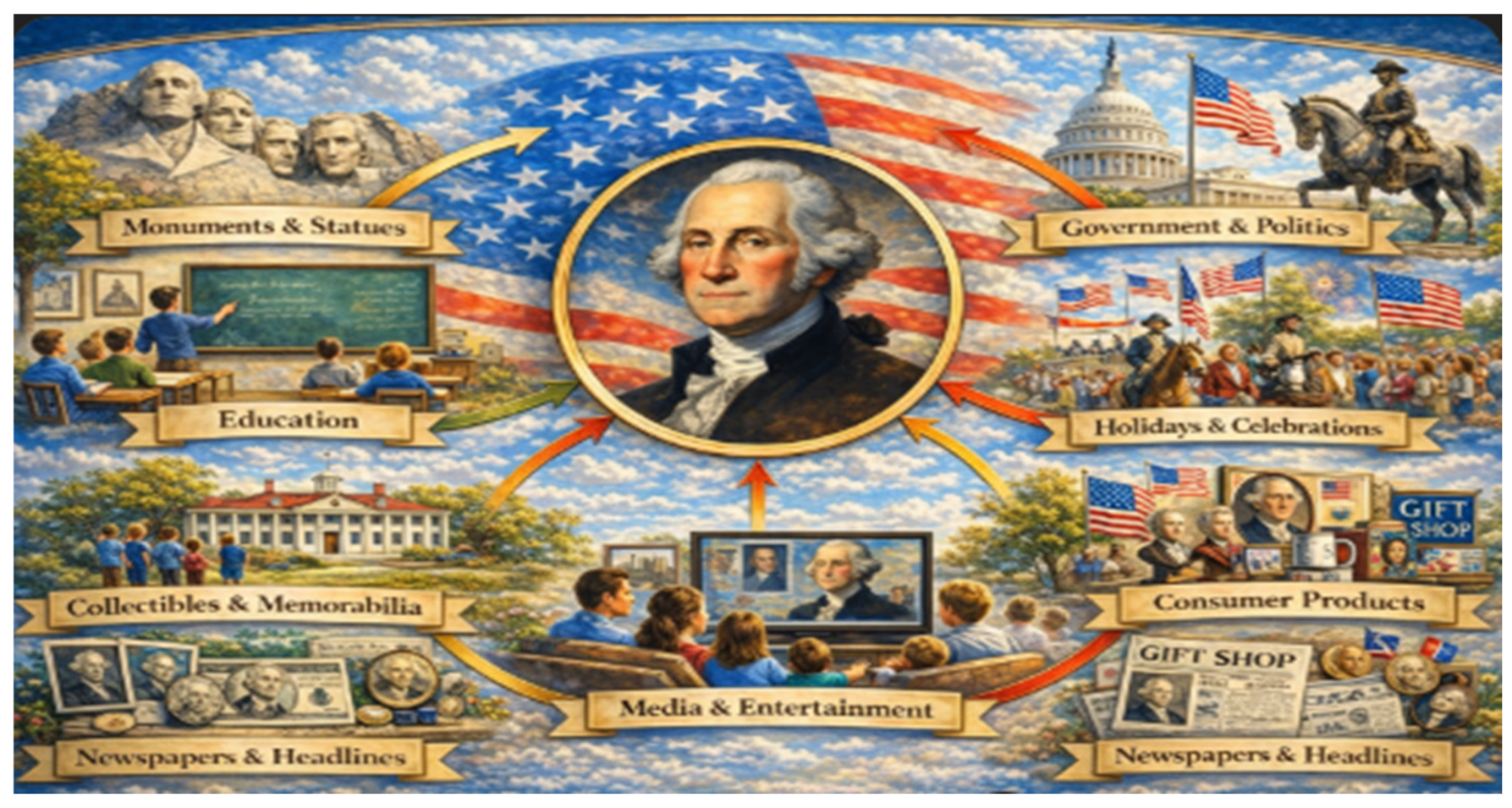
Figure 2.
Themes of negotiating George Washington in everyday cultural life (Source: Canva).
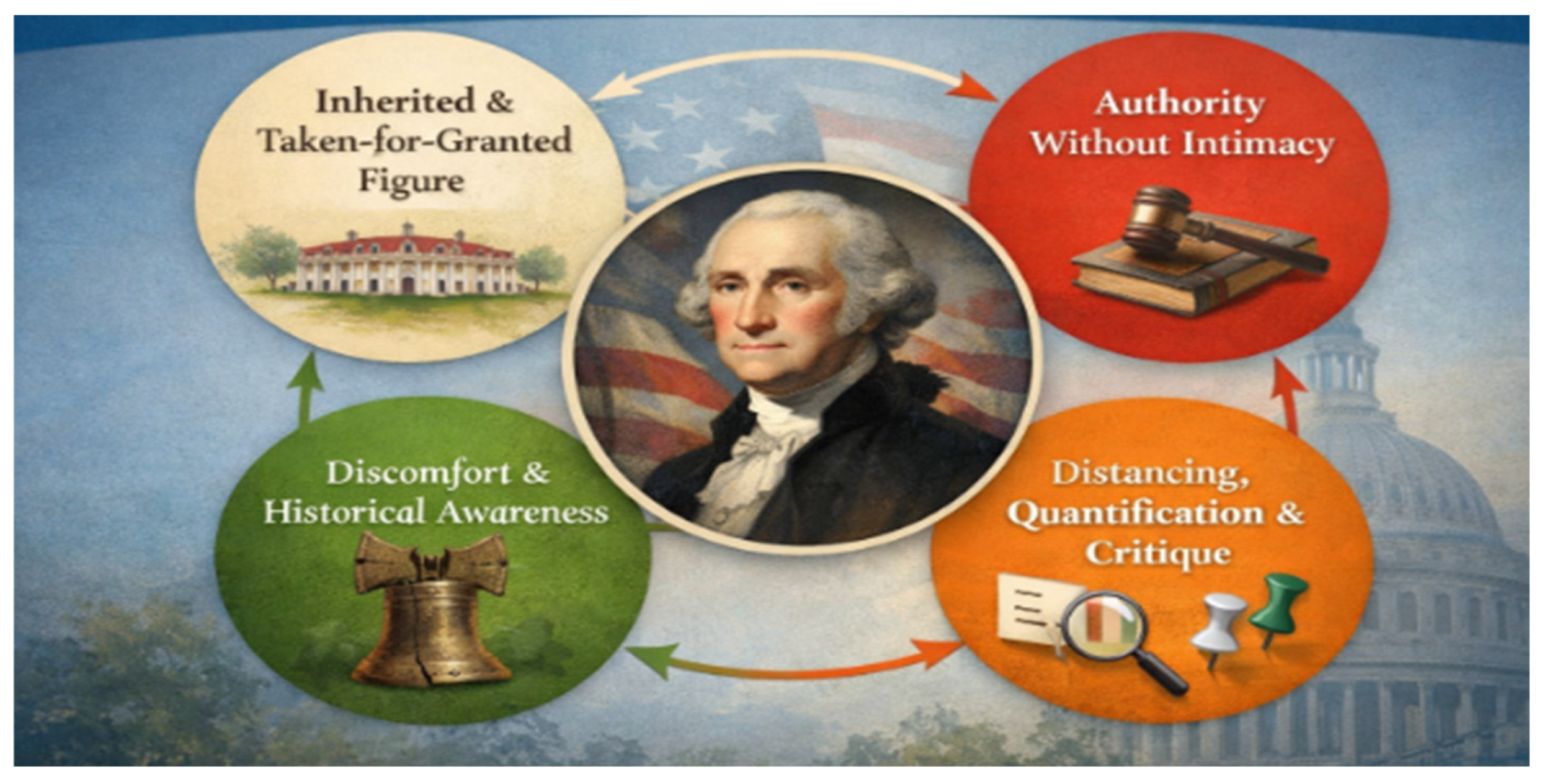
Figure 3.
Historical reassessment and moral tension (Source: Canva).
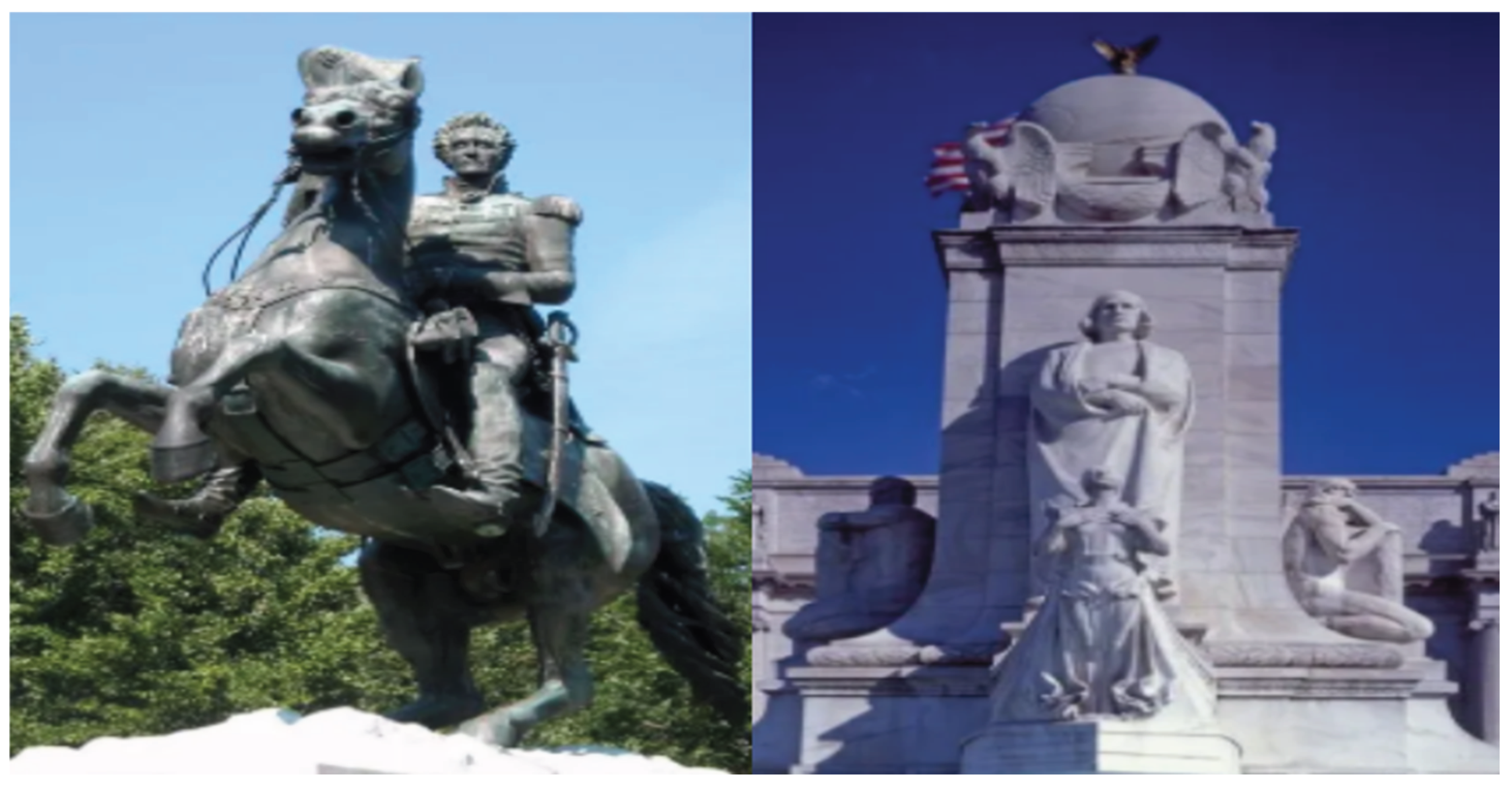

Table 1.
Sample transcript excerpts of semi-structured interviews with thirty three participants.
| Transcript Excerpts (Representative) | Initial Codes | Categories | Final Themes |
| “He wasn’t introduced as someone you think about. He was already part of what America was supposed to be.” | Inherited knowledge, taken-for-granted | Familiarity & automatic acceptance | Washington as an inherited and taken-for-granted figure |
| “You respect him because you’re supposed to, not because you actually know him.” | Distanced authority, lack of emotional connection | Authority without intimacy | Authority without intimacy |
| “Once you really consider the slavery part, it changes how comfortably you see him. You can’t undo that knowledge.” | Historical discomfort, moral tension | Awareness of historical wrongdoing | Discomfort and historical awareness |
| “I won’t celebrate him the way I used to, but I also don’t think you can just remove him.” | Distancing, qualification, everyday critique | Negotiation strategies, conditional reverence | Negotiating the dilemma through distancing, quantification, and everyday critique |
| “I might make a joke about the Founding Fathers when it comes up, but I wouldn’t bring it up in a serious setting.” | Informal critique, context-dependent criticism | Everyday negotiation, private critique | Negotiating the dilemma through distancing, quantification, and everyday critique |
Disclaimer/Publisher’s Note: The statements, opinions and data contained in all publications are solely those of the individual author(s) and contributor(s) and not of MDPI and/or the editor(s). MDPI and/or the editor(s) disclaim responsibility for any injury to people or property resulting from any ideas, methods, instructions or products referred to in the content. |
© 2026 by the authors. Licensee MDPI, Basel, Switzerland. This article is an open access article distributed under the terms and conditions of the Creative Commons Attribution (CC BY) license (http://creativecommons.org/licenses/by/4.0/).
Copyright: This open access article is published under a Creative Commons CC BY 4.0 license, which permit the free download, distribution, and reuse, provided that the author and preprint are cited in any reuse.