
Submitted:
08 April 2026
Posted:
09 April 2026
You are already at the latest version
Abstract
The Compiled Edition of the Yuan History Bibliography《元史藝文志輯本》, compiled by Luo Zhuyun 雒竹筠and Li Xinqian李新乾, represents the definitive modern reconstruction of the Yuan dynasty's scattered literary corpus, synthesizing and correcting earlier Qing supplements. Moving beyond a simple catalogue of errors, this study employs a critical historical epistemology to analyze the persistent inaccuracies within its Buddhist categories. It argues that these mistakes—including paleographic corruptions, misreadings of monastic institutions and anachronistic inclusions of Ming works—are not random oversights. Rather, they are systematic artifacts that reveal the inherent limitations of reconstructing a lost bibliographic tradition. These limitations manifest as a knowledge disjunction between later compilers and Yuan-specific socio-religious structures, and as temporal stratification, where later historical layers and scholarly contexts inadvertently permeate the reconstructed past. By examining these entries as a palimpsest—a composite text bearing traces of its own production—this paper demonstrates that the Compiled Edition is both an indispensable scholarly achievement and a historically mediated construct. The conclusion emphasizes the necessity of using this foundational reference work with source-critical awareness, understanding it as much for the insights it offers into Yuan textual history as for what it reveals about the perennial challenges of historical reconstruction itself.
Keywords:
compiled edition of the Yuan history bibliography
; Yuan dynasty bibliography
; Buddhist catalogues
; knowledge disjunction
; temporal stratification
; historical epistemology
1. Introduction
Due to the absence of a dedicated Bibliographic Treatise (yiwen zhi 藝文志) in the official dynastic history, the full scope of Yuan dynasty textual production long remained obscure. It was not until the Qing dynasty, with the flourishing of evidential scholarship (kaoju xue考據學), that the compilation of bibliographic records for predecessor dynasties became a concerted scholarly endeavor. Particularly significant efforts were made to reconstruct the literary corpus of the Yuan. Works such as Qian Daxin’s錢大昕 Bibliography of the Yuan History元史藝文志, Lu Wenchao’s 盧文弨Supplemented Bibliography of the Liao, Jin, and Yuan補遼金元藝文志, Ni Can倪燦 and Jin Menzhao’s 金門詔Supplemented Bibliography of the Three Histories補三史藝文志[1][i], and Wu Qian’s 吳騫Supplemented Bibliographic Records of Four Reigns 四朝經籍志補emerged successively. Through exhaustive compilation and reconstruction, they largely reconstituted the broad framework of Yuan dynasty writings. Among these, Qian’s bibliography was praised for its meticulous system and comprehensive scope, regarded as the standard model. Together with the works of Lu and Jin, it formed the collective designation of the "three complementary bibliographies of the Yuan History from the Qing dynasty" (hereinafter referred to as the "three complementary bibliographies"). However, these compilers, working centuries later, had no direct access to original Yuan works. Their records necessarily relied on filtered and transmitted information from various sources, making errors and omissions almost inevitable.
By the late 20th century, scholars Luo Zhuyun雒竹筠 and Li Xinqian 李新乾synthesized prior achievements into the Compiled Edition of the Yuan History Bibliography (hereinafter referred to as the Compiled Edition), representing a comprehensive integration of records on Yuan writings. It corrected numerous errors found in earlier works like Qian’s bibliography, such as mistaken monastic aliases and misattributed Buddhist texts, constituting a work of undeniable merit.
Yet, the advancement of scholarship relies not only on incremental improvement but also on maintaining a critical perspective toward existing achievements. Despite its refinements, the Compiled Edition itself—particularly in sections dealing with the complex institutional contexts and textual traditions of Buddhism and Daoism—still contains various inaccuracies. Previous research has often focused on case-by-case correction, textual source analysis, or classificatory critique of the "three complementary bibliographies," largely remaining within the internal discourse of bibliography studies. It has seldom situated the persistent, patterned misrecordings found even in this "more refined, later work" within the broader context of intellectual history and the processes of knowledge formation.
This study posits that the various errors in the Buddhist categories of the Compiled Edition—such as graphic and phonetic corruptions of personal and place names, misinterpretations of monastic titles and sectarian naming practices, and the mistaken inclusion of later works—are not merely incidental oversights. They are, in essence, microcosmic manifestations of the inherent dilemmas faced in the bibliographic reconstruction of a "textually fragmented era." These dilemmas manifest on at least three levels: First, the informational erosion and distortion inherent in textual transmission, which is particularly acute at the vulnerable endpoints of chains lacking authoritative editions. Second, a "knowledge disjunction" between later scholars and the specific institutions (e.g., the monastic official system) and religious social practices (e.g., White Lotus naming conventions) of the earlier period, leading to anachronistic misinterpretations. Third, the "temporal stratification" intrinsic to the work of supplementation itself, whereby compilers unconsciously project the literary landscape and intellectual boundaries of their own time onto the historical reconstruction.
Therefore, this paper aims to move beyond the technical level of simply "correcting" the Compiled Edition. Using its Buddhist entries as an analytical sample(Table 1), and through specific case studies of errors, it seeks to address a more fundamental question: What systematic limitations are encountered when scholars attempt to reconstruct the intellectual landscape of an era from which most original texts are lost, relying instead on fragments compiled by later generations? How do these limitations shape the historical understanding we ultimately obtain? Through a typological analysis of the Compiled Edition's errors, combined with a dual perspective from Yuan religious social history and post-Qing intellectual history, this paper argues that bibliographic works are not merely static lists of texts. Their very process of compilation constitutes a dynamic activity of "knowledge construction," constrained by historical conditions and intellectual frameworks. This research not only aims to provide concrete guidance for scholars to use the Compiled Edition and related bibliographies more cautiously but also hopes to offer a reflective case study from Yuan history for considering the methodology of "bibliographic supplementation" in classical philology, as well as for document-based research within the fields of book history and history of knowledge.
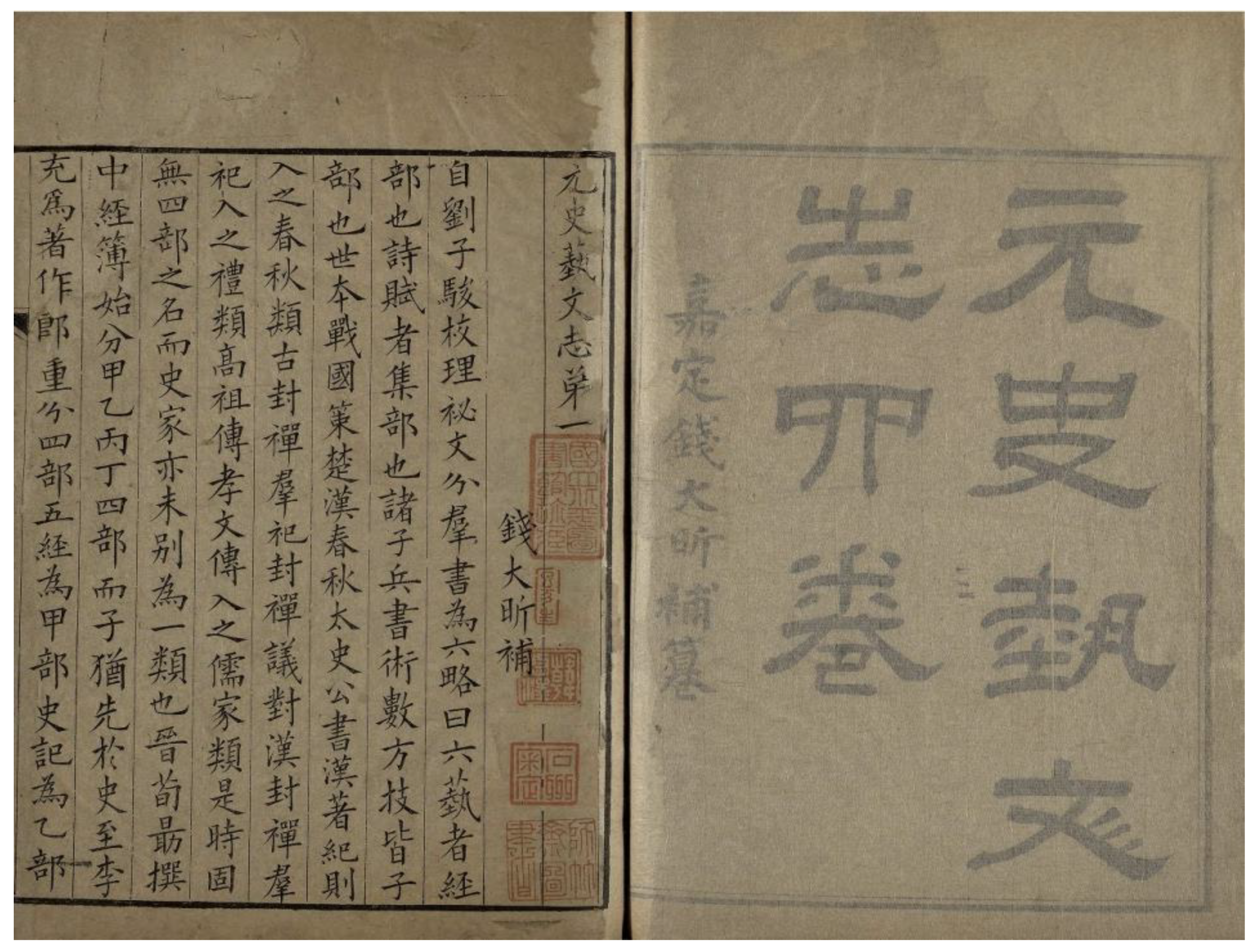
Figure 2.
The Bibliography of Chronicles of Yuan Dynasty in the National Library of China[ii].
2. Deconstructing Error: Knowledge Disjunction and Temporal Stratification in the Compiled Edition
The errors in the Compiled Edition are not random noise but systematic artifacts that reveal the conceptual and historical distances separating its compilers from their Yuan dynasty subject. These inaccuracies stem primarily from two interrelated phenomena: a disjunction of knowledge, where later scholars misapprehend the specific socio-religious institutions of the past, and temporal stratification, where the compiler’s own historical context inadvertently bleeds into the reconstruction. By analyzing key cases, we can trace how these forces operated to distort the bibliographic record.
2.1. Paleographic Corruption and the Limits of Textual Transmission
The most straightforward errors arise from the frailties of written transmission. The misrecording of Chen Danglin 陳黨琳 for Chen Juelin 陳覺琳 (dang 黨 for jue 覺) in the Pilu Canon entry is a classic graphic error.
For example, the Buddhist catalogue section in the Compiled Edition lists the Pilu Canon, compiled and edited by a certain Chen Danglin 陳黨琳 of the Wanshoutang at Houshan Bao'en 後山報恩萬壽堂in Jianyang during the second year of the Yanyou era. The name “Chen Danglin” recorded in the Luo's Edition is, in fact, an error for Chen Juelin 陳覺琳, likely resulting from the visual similarity between the Chinese characters dang 黨 and jue 覺.
This correction is supported by a colophon found at the beginning of a surviving volume of the Yuan Dynasty Pilu Canon, which reads:
Chen Juelin, the teaching successor of the Wanshou Hall at Houshan Bao'en in Jianyang County, Jianning Route, Fujian Circuit, reverently [undertakes this] to pray for the long life and peace of the reigning emperor and for the prosperity of all civil and military officials. He has gathered supporters to carve the printing blocks of the Pilu Great Canon to enable its circulation and recitation. Respectfully noted on a day in the second year of Yanyou (1315).
福建道建寧路建陽縣後山報恩萬壽堂嗣教陳覺琳,恭爲今上皇帝祝延聖壽萬安,文武官僚同資祿位,募眾雕刊毗盧大藏經板,流通讀誦者。
延祐二年(1315) 月 日謹題
Similarly, the Buddhist catalog entry for the work Four Ceremonies and Disciplines四教儀紀正 lists its author as Shi Chongji釋寵濟. However, a search through the historical Biographies of Eminent Monks yields no record of a monk by this name. This discrepancy is resolved by the Supplemented Continuation of Biographies of Eminent Monks 補續高僧傳. Its fourth volume contains a biography of Master Hongji弘濟, which credits him as the author of Four Ceremonies and Disciplines. Furthermore, the Luo's Edition catalog records a work titled Xiaozhi guan小止觀 (Small Treatise on Calming and Insight), noted as being translated into the Gaochang language, with Hongji named as its compiler. Corroborating this, the text Continuation of the Buddha's Patriarchal Record 續佛祖統紀, in its entry for "Master Hongji," states that he collaborated with the Gaochang’s General總統Prajna Shirikothe般若室利—who was proficient in Chinese and Sanskrit and well-versed in the scriptures—to translate Xiaozhi guan into his native language. It is thus evident that the "Hongji" recorded in the Compiled Edition as the translator of Xiaozhi guan and the "Master Hongji" mentioned in the Continuation of the Buddha's Patriarchal Record are the same person. The misattribution in the Compiled Edition , where the author of Four Ceremonies and Disciplines is mistakenly given as "Shi Chongji," likely stems from the graphical similarity between the Chinese characters for Hong (弘/宏) and Chong (寵).
These are not simply transcription errors, but rather evidence of a multi-generational process of textual transmission. By the Qing dynasty and in subsequent modern compilations, editors were often several removes from the primary Yuan-era sources—such as physical colophons and reliable contemporary biographies. Working instead with layers of intermediary texts, they inherited and inadvertently perpetuated these corruptions. Without direct access to authoritative originals for verification, such errors were easily introduced and became permanently entrenched in the scholarly record.
2.2. Conflated Geographies: The Stratification of Temporal Layers
The Buddhist catalog in the Compiled Edition employs a standard bibliographic format for Yuan dynasty scriptural groups: it first records the number of volumes, then the author—often including his monastic affiliation—and finally notes on the scripture’s existence. This section examines an error within these entries concerning the misidentification of a monastery name.
The entry for A General Record of the Buddha Through the Ages 佛祖歷代通載, a twenty-two-volume work, attributes its compilation to the monk Nianchang 念常(style name Meiwu梅屋), a native of Huating華亭. Crucially, it identifies him as a monk of Xiangfu Monastery 祥福寺 in Jiaxing. Nianchang, who traveled to the capital in the third year of the Zhizhi至治 era to compile scriptures and once served as a teacher to the emperor, is thus linked to this institution.
However, this attribution is incorrect. The primary source—the original Yuan edition of A General Record of the Buddha Through the Ages—clearly identifies the compiler in its title inscription as "Nianchang of Huating, Abbot of Dazhong Xiangfu Chan Monastery 大中祥符禪寺 on Jiaxing Road." Its preface likewise refers to him as the abbot of "Jiaxing Xiangfu Chan Monastery 祥符禪寺." Historical gazetteers confirm that during the Yuan dynasty, only Xiangfu Monastery 祥符寺, also known as Dazhong Xiangfu Monastery, existed in Jiaxing Road. A monastery named Xiangfu Monastery 祥福寺 was not established in the region until the Ming Hongwu period, located near Poyang Lake鄱阳湖—a geographically and temporally distinct site.
The error in the Compiled Edition thus stems from a dual dislocation: phonetic convergence and temporal conflation. The names "祥符 (Xiángfú)" and "祥福 (Xiángfú)" are homophonous. Later compilers, lacking direct access to Yuan-era geographical context and working with mediated texts, mistakenly equated the Yuan dynasty "Xiangfu Monastery" in Jiaxing with the phonetically identical but historically and geographically separate Ming-era "Xiangfu Monastery." This misidentification exemplifies how a loss of specific historical and topographical context during textual transmission can lead to the faulty anchoring of a figure to an incorrect institution.
2.3. The Sociological Misprision: Imposing Kinship on Religious Affiliation
The primary patronage for the carving of the Yuan dynasty Pilu Canon came from followers of the White Lotus tradition. Key organizers included Chen Juelin陳覺琳, who led fundraising efforts in Fujian, and Chen Jueyuan陳覺圓, who did the same in Henan. Based on the shared surname and the identical first character (Jue 覺) in their religious names, scholar He Mei has posited that the two were likely members of the same clan, a view also presented in her work co-authored with Li Fuhua, A Study of the Great Collection of Chinese Buddhist Sutras.
This interpretation, however, has been challenged. Barend ter Haar 田海offers a different analysis in his book White Lotus Religion in Chinese History. He argues that the naming practices among Yuan dynasty White Lotus adherents were highly conventional. Believers frequently adopted religious names containing a set of semantically resonant characters such as dao 道, zhi 智, yuan 圓, pu 普, miao 妙, and jue 覺. Statistical evidence from the Pilu Canon colophons supports this: over half of the 45 lay patrons recorded bore such patterned names, with 19 specifically using the character jue. This prevalence suggests that shared name characters primarily reflect common religious practice rather than familial kinship.Various sources further confirm that sharing a character in one's religious name does not necessarily indicate a blood relationship. Within religious communities, the generational character in a Dharma name signifies one's place in a spiritual lineage, which operates independently of secular familial hierarchies. A well-known illustration of this principle comes from the Ming novel Water Margin《水滸傳》. The character Lu Zhishen 魯智深 and his master, Elder Zhizhen 智真長老, share the character zhi 智 in their names despite their master-disciple relationship. This was possible due to Lu's elevated secular status as a former military officer and, crucially, his prestigious introduction to monastic life by the patron Zhao Yuanwai. Consequently, upon ordination, Lu was deemed worthy of receiving a Dharma name placing him in the same spiritual generation as his master. This demonstrates that within a religious framework, individuals of different ages or social standings may become peers based on the time and circumstances of their entry into the community. By this logic, the shared character jue in the names of Chen Juelin and Chen Jueyuan likely marks their belonging to the same religious generation within the White Lotus movement, not their position in a shared family tree.
Further evidence dismantling the presumed link between shared name characters and kinship comes from historical records concerning White Lotus adherents themselves. The Ming dynasty scholar Wei Su 危素 (courtesy name Taipu 太僕, 1303–1372, from Jinxi, Jiangxi), in his extant work Shuoxue Studio Draft《說學齋稿》 , documents White Lotus communities. In the second volume, an account concerning a White Lotus abbey mentions a certain Tu Wenzheng 屠文正, whose religious name was Jueyuan 覺緣, and whose son bore the religious name Juexing 覺興. This explicit case of a father and son sharing the generational character jue conclusively demonstrates that these naming patterns indicated religious affiliation and generation within the sect, which operated independently of, and could even supersede, secular familial seniority.
Furthermore, internal sectarian writings confirm that these specific name characters had evolved into potent and contentious symbols of group identity. The White Lotus patriarch Pudu 普度 (lay surname Jiang 蔣, from Danyang, Jiangsu), in his doctrinal work The Precious Mirror of the Lotus Sect 廬山蓮宗寶鑒, laments the proliferation of what he deemed heterodox interpretations:
As we are distant from the time of the sages, people often harbor mistaken understandings. Although aiming for the true path, they all fall into heretical schools. The ignorant, possessing mere consciousness, cause all manner of heresies and deceptions to flourish, various factions to blaze up simultaneously, disputes to swarm, and empty debates [on concepts like] ‘emptiness’ and ‘existence’ to arise, arbitrarily splitting the void and mutually destroying one another. ... There are those who cling to the characters pu 普 and jue 覺 for our school, and those who claim the characters miao 妙 and dao 道 for that school. These are all cases of privately stealing this mirror into that heretical domain, resulting in its being obscured by dust and grime, failing to comprehend the essence of the school. Although they obtain the name of this mirror, they cannot put it to use.
去聖時遙,人多謬解,雖期正道,悉陷邪宗,庸昏之徒,含識而已,致使群邪詭惑,諸黨並熾,是非蜂起,空有云云,夾截虛空,互相排毀。……有執我宗“普”字“覺”字者,有言彼宗“妙”字“道”字者,是皆私偷此鏡入彼邪域,致爲塵垢蔽蒙,不明宗體,雖得此鏡之名而不得其用也。
Pudu’s polemic explicitly identifies the characters pu, jue, miao, and dao as the defining labels claimed by different, mutually antagonistic groups within the broader White Lotus milieu. This indicates that by this period, such characters served primarily as symbols of sectarian distinction (tribal or factional identity), not as indicators of common kinship. Therefore, the shared jue in the names of Chen Juelin and Chen Jueyuan is far more likely to signify their membership in the same religious branch or generation than any familial relationship.
The intricate networks of jue-generation believers, bound by shared religious identity rather than kinship, are further illuminated in local records and literary sources. The Yuan poet Lu Qi 盧琦, in his poem Yuping Nanshanying an Shuhuai 《寓平南善應庵述懷》(Expressing My Feelings While Lodging at the Shan Ying Hermitage in Pingnan), documents the founding of the Shan Ying Hermitage 善应庵. According to the poem, the hermitage was established with the support of Chen Juejian 陳覺堅, a White Lotus adherent who donated his private residence. This Chen Juejian had previously founded the Anfu Hermitage 安福庵. His disciples, Chen Jueqing 陳覺慶 and Chen Juezheng 陳覺正from Houwan, are also recorded as daoshi (likely referring to lay religious practitioners). The network extends further: Chen Jueqing's disciple was Chen Juerong 陳覺榮, still a lay believer (upasaka), while Chen Juejian's grandson took the tonsure and the religious name Juezhen 覺真. This Chen-family cluster demonstrates that within a single surname, jue-generation individuals could be linked as master and disciple, as blood relatives (grandfather and grandson), or as fellow disciples, forming a complex web where religious affiliation and family ties intersect but are not equivalent.
Crucially, the jue-generation was not confined to a single surname. The Yuan scholar Du Ben 杜本 provides definitive evidence of this in his “Record of the Fuyi Hall in Jiangyuan” Jiangyuan Fuyi tang ji 《江源復一堂記》. The stele inscription details a leadership succession within a religious community:On the ninth day of the fifth month in the Yanyou Dingsi year [1317], Juejing assembled his disciples and passed on his teachings to his disciple Wang Juezhen [王覺真], before peacefully passing away. I happened to travel through the area, and Juezhen invited me in for a quiet seat. He spoke of the reasons for the community's rise and decline, wishing a record of its history be made for posterity, so that later generations would know its establishment was not easy. Gazing up at the lofty halls and looking down at the incense-filled vessels—where there is no worry of heat, cold, hunger, or thirst, but only the joy of purity and liberation—one sees this indeed has its origins. I was pleased with Juezhen's words, coming to know the foundation. Moreover, he was able to toil personally in practice, earnest and sincere. He contended with nothing, and through diligence and frugality accumulated resources to peacefully support his community. After Juezhen later passed away, Zheng Jueqiong [鄭覺瓊] succeeded him, being especially capable of upholding the precepts firmly and expanding the established regulations.
延祐丁巳(1317)五月九日,覺靜命集徒侶,付其法於弟子王覺真,蕭然逝化。予當道過其處,覺真延引清坐,且言興替之由,欲爲記其始末,以俟夫後來,使知成之不易。且仰觀夫高閎之宇,俯思夫香馥之盂,無寒暑饑渴之憂,有清淨解脫之樂者,其有由來也矣。予悅覺真之言,知所本始,且能劬躬踐行,謹願端愨。而於物無競,勤儉累積,以安養其眾。覺真既西逝,則爲今鄭覺瓊,尤能持戒堅確,增廣前規。而友蔣君汝晦居與相鄰,知之爲悉,乃錄其事如此,故得以次第記之。
This passage is pivotal. It confirms that the jue-generation included individuals with different surnames (Wang and Zheng), who were linked through master-disciple succession within a religious institution. Therefore, the cluster of Chen-surname jue believers, while significant, represents just one subset of a much broader, surname-transcending religious cohort.
Accordingly, the onomastic evidence demonstrates that jue-generation believers within the White Lotus movement were numerous and their relationships multifaceted—they could be linked by blood, by master-disciple ties, by marriage, or simply by shared sectarian affiliation within the same religious generation. The presence of other jue-generation believers with surnames like Wang and Zheng provides the final, crucial piece of evidence. It solidifies the argument that the shared character jue in the names of Chen Juelin and Chen Jueyuan primarily signifies their membership in a specific religious generation or branch of White Lotus teaching. While they shared a surname, the determining factor for their name similarity is far more likely their common religious identity than membership in the same kinship group. Their names, therefore, do not constitute reliable evidence for a clan relationship.2.4 Conclusion: Errors as Windows into Historical Rupture
The errors cataloged within the Compiled Edition of the Yuan History Bibliography are far more than simple oversights. They are, in essence, symptoms of historical rupture—tangible points where the conceptual world of the Qing and later compilers fractured against the institutional and social realities of the Yuan dynasty they sought to document. Through the systematic analysis of paleographic, geographical, and sociological misattributions, this chapter has demonstrated that these inaccuracies stem from a fundamental disjunction in contextual knowledge and the stratified nature of historical transmission. Collectively, they reveal the Compiled Edition not as a transparent window onto the Yuan, but as a palimpsest—a document in which the target era is viewed through the layered and often distorting lenses of subsequent periods. Each error type traces a distinct fault line in this disconnect: the textual, the spatio-temporal, and the socio-conceptual.
Therefore, the ultimate value of this bibliography for modern scholarship lies as much in rigorously correcting its specific errors as in thoughtfully analyzing their causes. It is through the critical examination of these “symptoms” that we can most clearly discern the shifting contours of historical knowledge itself, understanding not only the Yuan past but also the evolving perspectives of those who later attempted to capture it.
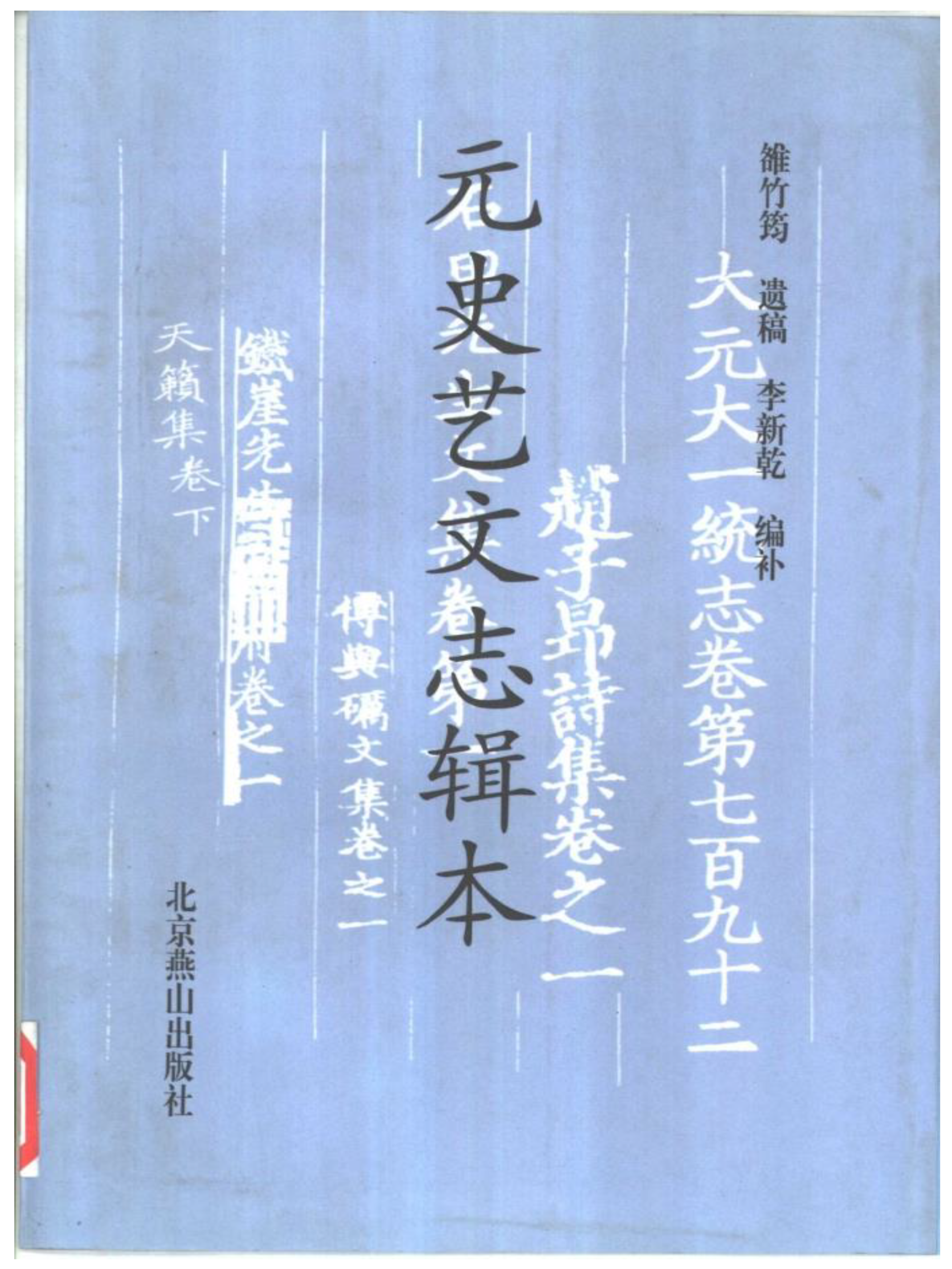
Figure 3.
Bibliography of Chronicles of Yuan Dynasty edition《元史藝文志輯本》, edited by Luo Zhuyun 雒竹筠and Li Xinqian李新乾[xlix].
Figure 3.
Bibliography of Chronicles of Yuan Dynasty edition《元史藝文志輯本》, edited by Luo Zhuyun 雒竹筠and Li Xinqian李新乾[xlix].
3. The Permeable Boundary: Misplaced Works and the Problem of Temporal Integrity
A critical challenge in reconstructing a lost bibliographic corpus lies in maintaining its temporal integrity—ensuring that the catalog accurately reflects the texts produced and circulating within its defined historical period. The Compiled Edition occasionally fails at this boundary, admitting works from later eras. These are not random inclusions but symptoms of a porous historiographical filter, influenced by textual ambiguity, evolving institutional memory, and the compilers’ own embeddedness within a later scholarly tradition.
3.1. Textual Ambiguity and the Erosion of Bibliographic Identity
The Compiled Edition, while serving as a valuable repository for works attributed to Yuan dynasty monks, contains bibliographic entries that demand critical scrutiny due to inconsistencies in recorded titles and editions. These discrepancies point not to minor variants but to probable errors in identification. For example, the catalogue lists a twenty-volume work as Chanlin leiyao (ju) 禪林類要(聚) (Classified Essentials [or Collection] of the Chan Forests). However, this specific title, leiyao, finds no support in major later supplements to Yuan dynasty bibliography. In contrast, authoritative sources like Qian Daxin's supplement, the Supplement to the Bibliographic Treatise of Yuan History, the Supplement to the Bibliographic Treatise of Liao, Jin and Yuan, and the Supplement to the Bibliographic Treatise of Four Dynastiesunanimously record the title as Chanlin leiju 禪林類聚 (Classified Collection of the Chan Forests). This stark contrast strongly suggests that the Compiled Edition contains a misidentified or erroneously transcribed title, with the correct characterju 聚 merely appended in parentheses as an apparent afterthought.
A similar issue of questionable specification arises with the entry for Wansong Older Commented on Tiantong Niangu Please Later Record 萬松老人評唱天童拈古請益後錄. The inclusion of the character "later" 後 is problematic, as the Ming dynasty catalogue “Chuan shi mu” 傳是目 records a work under the shorter title Wansong Older Commented on Tiantong Niangu Please Record (without "後"). This is corroborated by its listing in the Bibliography of Chinese Ancient Books, which describes a Ming Longqing period edition under the shorter title and attributes its compilation to Shiconglong 釋從隆. The discrepancy indicates that the Compiled Edition may either reference a distinct, otherwise unattested "later" volume or, more plausibly, has perpetuated an extraneous character introduced during textual transmission. These cases collectively highlight vulnerabilities in the Compiled Edition's foundational data, where titles appear to have been recorded without sufficient verification against a stable bibliographic tradition.
3.2. Anachronistic Attribution and the Sedimentation of Error
The Compiled Edition also contains significant inaccuracies in its records of monastic official titles, demonstrating how errors can become sedimented through textual transmission. A notable example is its entry for the Buddha Top White Umbrella Dharani Sutra 《佛頂大白傘蓋陀羅尼經》, which attributes the work to Sha Luoba 沙羅巴, a monk from the Western Regions and a śramaṇa of the Yandu Qingshou Temple who was granted the title "Great Wisdom" 大廣智. The entry further states that later, he was appointed as the general of the translation monasteries in Jiangsu and Zhejiang 江浙等處譯教總統, and the classics became popular.
The specific title "general of the translation monasteries" 譯教總統 recorded here is problematic. According to Yuan historical institutions, the monastic officials who oversaw Buddhist affairs were uniformly titled the "general of the Buddhist monasteries" 諸路釋教總統 or "chief general" 都總統. This administrative system was established in 1264 with the founding of the General Administration 總製院, later renamed the Commission for Buddhist and Tibetan Affairs 宣政院, which was placed under the overall responsibility of 'Phags-pa八思巴. As the Yuan dynasty consolidated control over former Southern Song territories, it established regional monastic officials such as the "supervisor" 總攝 and "general" 總統. For instance, in 1291, the Tibetan monk Nyan chen Shākya ba 輦真術納思 was appointed as the "chief general of the Buddhist monasteries of various routes" 諸路釋教都總統, a position subordinate to the central Commission.
The correct form of this title is corroborated by contemporaneous sources. Yang Lianzhenjia 楊璉真迦, the chief patron of the Puning Canon 普寧藏, was recorded as "Master Yongfu" 永福大師. TheYuanHistory: Annals of Shizu《元史·世祖本紀》 suggests Master Yongfu was likely from the Western Xia, an identification supported by a "tonsure-style" figure 髡髮狀 depicted next to his name and title in a Puning Canon frontispiece. The title inscribed alongside his portrait in both the Puning and Qisha Canons is unequivocally "Yang Lianzhenjia, Chief General of the Buddhist Monasteries of the Jianghuai Routes 江淮諸路釋教都總統, Merit Master Yongfu." Furthermore, in 1299, Emperor Chengzong sent the eminent monk Yishan Yining 一山一寧 of Mount Putuo to Japan, identifying him with the title "general of the Buddhist monasteries of Jiangsu and Zhejiang" 江浙等處釋教總統. An inscription from the end of a Puxian Xingyuan scroll in the Puning Canon ”臣”字函 also references this institution:
Furthermore, we received the guardianship of the Chief Superintendency of the Buddhist Monasteries of the Jianghuai Routes, which granted official permits and forwarded [our petition] to the Master under the Eaves ['Phags-pa] for an audience. The emperor subsequently issued a sacred decree to protect and uphold our school, enabling the completion of this virtuous undertaking.
又蒙江淮諸路釋教都總攝所護念,准給文憑,及轉呈簷八上師引覲。皇帝頒降聖旨,護持宗門,作成勝事。
Based on this convergence of official history and canonical colophons, it is evident that "general of the Buddhist monasteries" 釋教總統 was the standard designation for a high-ranking regional monastic administrator in the Yuan dynasty. Therefore, the title granted to Sha Luoba should have been the "general of the Buddhist monasteries of Jiangsu and Zhejiang and other areas" 江浙等處釋教總統, not "general of the translation monasteries" 譯教總統. The error in the Compiled Edition likely originated from the visual similarity between the Chinese characters for "Buddhism"釋and "translation" 譯, which led to the mis-transcription and subsequent perpetuation of an anachronistic and institutionally incorrect title
3.3. The Conflation of Historical Layers: Ming and Qing Works in a Yuan Catalog
While the Compiled Edition records numerous Buddhist texts from the Yuan dynasty, offering a valuable snapshot of scriptural circulation during that period, its catalog is not immune to significant chronological errors. The work occasionally includes later Ming and Qing titles, thereby conflating distinct historical layers within its bibliographic framework.
One clear case of anachronism is the entry for the Zangcheng Fashu藏乘法數(Numerical Categories of the Treasury Vehicle). The catalog describes it as a single-volume work, parenthetically noting its alternative title Jiaocheng Fashu教乘法數(Numerical Categories of the Teaching Vehicle). However, according to the Ming dynasty monk Zhixu’s guide Yuezang Zhijin《閱藏知津》(A Guide to Navigating the Buddhist Canon), the Jiaocheng Fashu is a forty-volume dictionary of Buddhist terminology compiled by the Ming monk Yuan Xuan—not a one-volume work by the Song monk Sui Ke as suggested in the Luo’s Edition. More decisively, the Jiaocheng Fashu was completed in 1431, during the Ming Xuande reign. It is therefore unequivocally a Ming dynasty production with no connection to the Yuan. The entry’s conflation of the two titles and its erroneous attribution represent a mistaken inclusion of a Ming work within a Yuan catalog, likely stemming from the compiler’s confusion between similarly named texts.
A parallel error, rooted in paleographic misreading, appears in the catalog’s appendix regarding a Qing dynasty publication.
It lists the Yuanshi Shizu Biao《元史氏族表》(Genealogical Tables of the Yuan History) as part of a series called the Qian Yanjiu Quanshu《潛研究全書》. This series name is unattested. The correct reference should be to Qian Daxin’s collected works, the Qianyantang Quanshu《潛研堂全書》, first published in 1840. The hall name “Qianyantang” was adopted by Qian Daxin after his retirement in 1767. The error in the Compiled Edition—substituting “Yanjiu” 研究 for “Yantang” 研堂—is a classic instance of graphic confusion, where the visually similar characters jiu 究 and tang堂were misread or miscopied.
It lists the Yuanshi Shizu Biao 《元史氏族表》(Genealogical Tables of the Yuan History) in three volumes, compiled by the Qing scholar Qian Daxin, and notes its publication as part of the Qianyanjiu quanshu《潛研究全書》 (The Complete Works of Profound Research), allegedly from the Guangxu光緒 reign period. However, no such series titled Qianyanjiu quansh is attested in extant bibliographic records. The authoritative Zhongguo congshu zonglu 《中國叢書綜錄》(Comprehensive Catalog of Chinese Collectanea) lists Qian Daxin's collected works under the correct title Qianyantang Quanshu《潛研堂全書》(The Complete Works of the Hall of Profound Research), which was first engraved in the 20th year of the Daoguang道光 reign (1840). Qian Daxin, renowned for his exceptional contributions to historical and phonological studies, produced a definitive corpus of scholarship within his lifetime. This corpus includes the fifty-volume Qianyantang Collection, which, together with works such as the Nian'er shi kaoyi《廿二史考異》(Textual Critiques of the Twenty-Two Histories) and the Shijia zhai yangxin lu《十駕齋養新錄》(New Records from the Ten Harness Studio), constitutes the crystallization of his lifelong academic endeavors. The name Qianyantang itself refers to the studio acquired by his family after Qian Daxin retired due to illness and returned to his hometown in Jiading in 1767, located near the Children's Bridge孩兒橋. The studio plaque was inscribed by Cao Xiuguang曹秀光. Given this context, it is evident that the title Qianyanjiu quanshu recorded in the Compiled Edition is an error for the correct Qianyantang quanshu. The mistake originated from the graphical similarity between the Chinese characters jiu (究, meaning "to investigate") and tang (堂, meaning "hall"), leading to the misreading and consequent
corruption of the book's title.
These examples demonstrate that errors in the Compiled Edition extend beyond the misrecording of contemporary Yuan details to include the faulty incorporation of materials from later periods. Such mistakes compromise the temporal integrity of the catalog, transforming it from a pure record of Yuan Buddhism into a composite text where historical boundaries have been blurred through scribal error and unverified attribution.
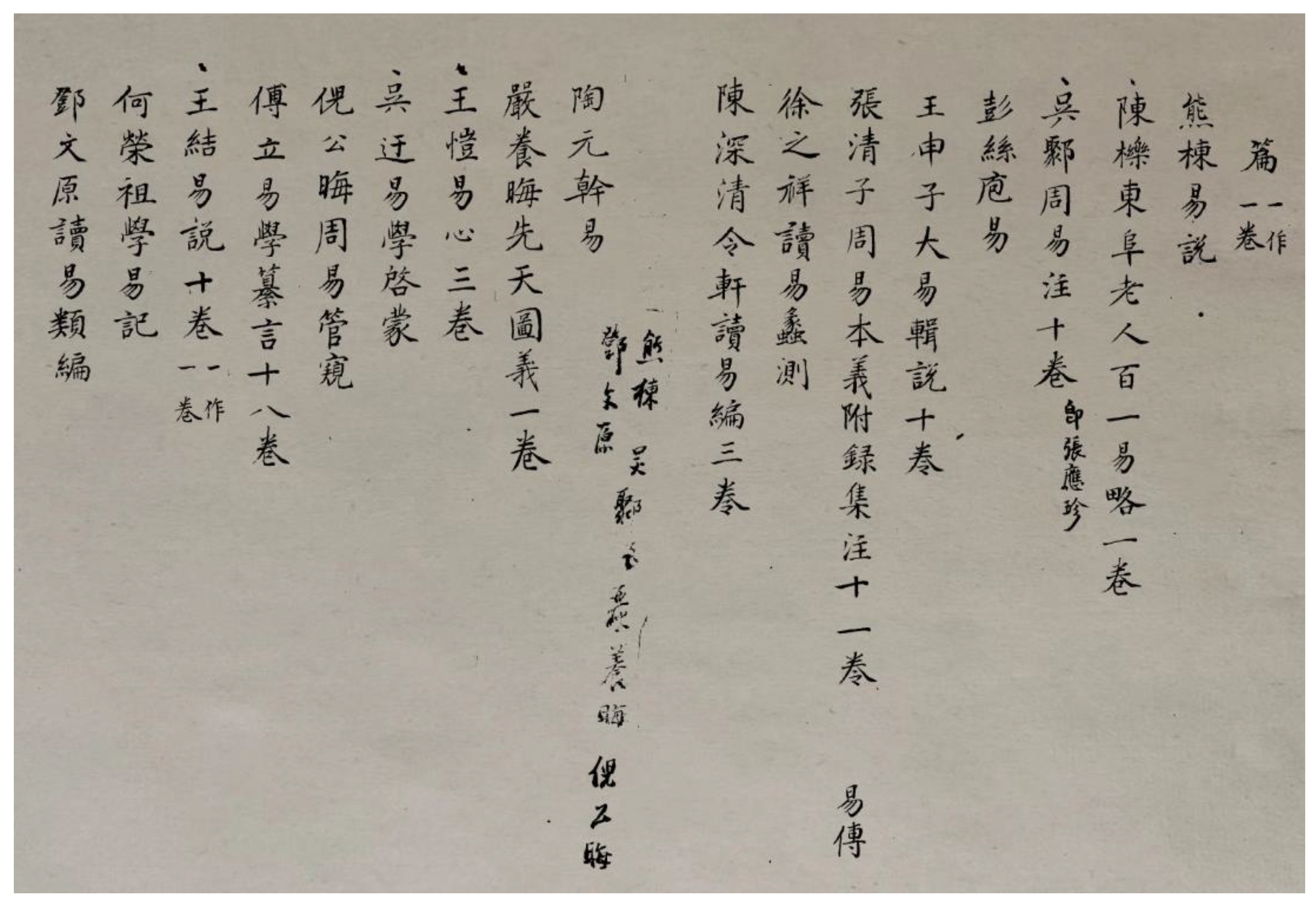
Figure 4.
The manuscript of Supplement to Bibliography of Chronicles of Yuan dynasties collected by the National Library of China[l].
Figure 4.
The manuscript of Supplement to Bibliography of Chronicles of Yuan dynasties collected by the National Library of China[l].
4. Conclusion: The Compiled Edition as a Palimpsest of Yuan Scholarship
While the Compiled Edition contains certain errors in its Buddhist entries, its scholarly value is equally demonstrated in its necessary corrections of omissions and inaccuracies found in earlier compilations such as the Qian’s Edition. For example, the Qian’s Edition lists the Shishi yulu 《石室語錄》(Stone Chamber Recorded Sayings) in one volume and Shishi heshang shanju shi《石室和尚山居詩》 (Poems on Mountain Dwelling by the Stone Chamber Monk) in two volumes. The Compiled Edition correctly identifies the monk in question as Qinggong清珙, whose sobriquet was Shiwu石屋 (Stone Hut), and cites as evidence the two-volume Shiwu Qinggong chanshi yulu 《石屋清珙禪師語錄》(Recorded Sayings of Chan Master Shiwu Qinggong) from a 1627 Ming blockprint edition, along with the one-volume Shiwu heshang zhu Jiaxing Danghu Fuyuan Chansi yulu 《石屋和尚住嘉興當湖福源禪寺語錄》(Recorded Sayings from Stone Hut Monk’s Residence at Jiaxing Danghu Fuyuan Chan Temple) and the one-volume Shiwu heshang jisong《石屋和尚偈頌》 (Verse and Hymns by Stone Hut Monk). This clearly shows that the “Stone Chamber” references in the Qian’s Edition are errors for “Stone Hut” (Shiwu), a misattribution rectified by the Compiled Edition. Another instance is the Qian’s Edition’s listing of the Zongmen tongyao xuji《宗門統要續集》 (Sequel to the Essential Compendium of the Chan School) as twelve volumes. The Compiled Edition, drawing on the earlier Zhizhai shulu jieti《直齋書錄解題》, specifies that the Zongmen tongyao ji《宗門統要集》 (Essential Compendium of the Chan School) in ten volumes was compiled by the Song monk Zongyong釋宗永, while its two-volume sequel was compiled by the monk Qingfa釋清筏. The Qian’s Edition’s failure to distinguish between the main text and its sequel, recording them simply as a twelve-volume sequel, is thus corrected.
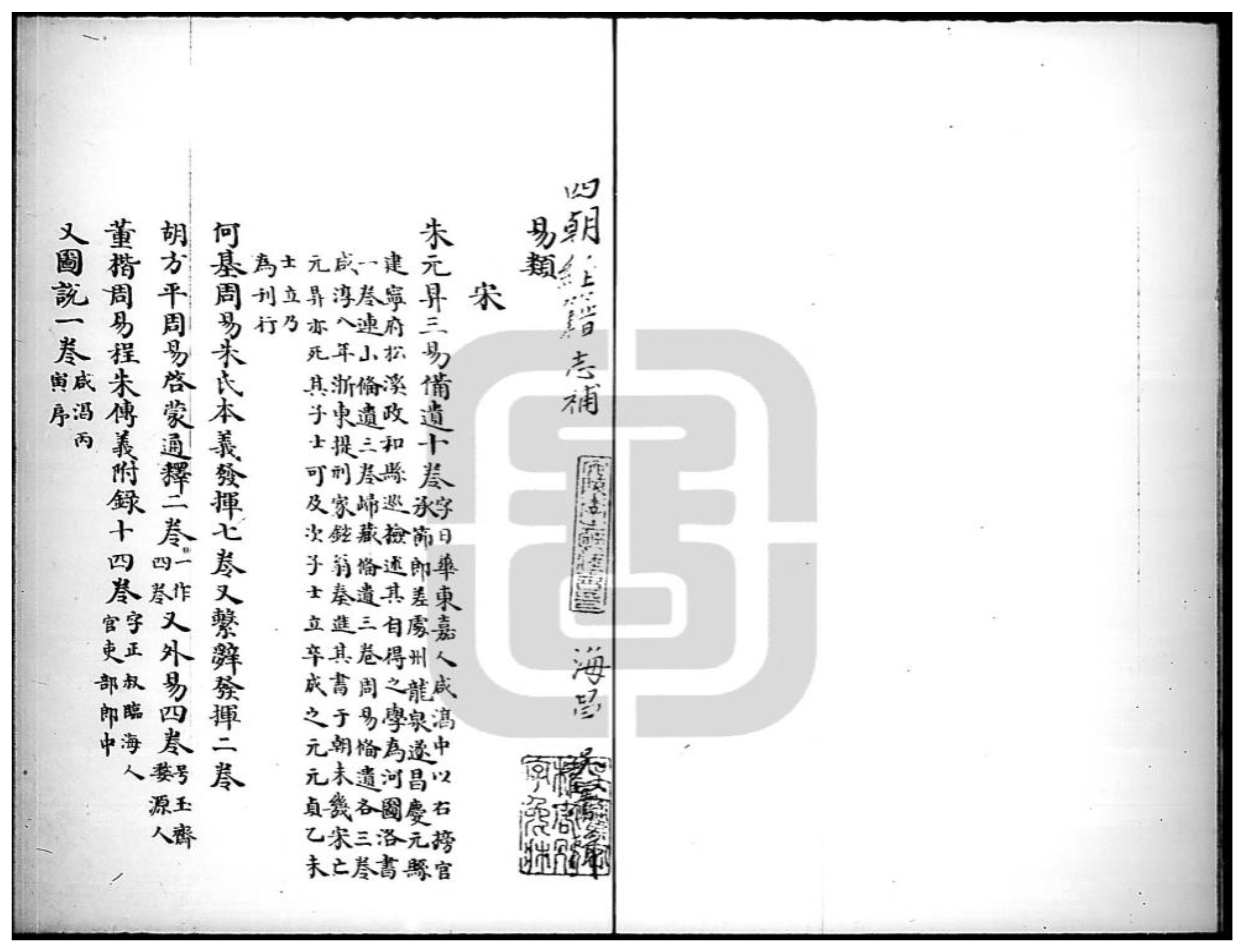
Figure 6.
The manuscript of Supplement to Bibliography of Chronicles of four dynasties[li].
In summary, the Compiled Edition revises and expands upon works like the Qian’s Edition, making significant contributions to the compilation of Yuan literary achievements. The vast body of writings by Yuan monks and literati, coupled with the absence of an official bibliographical record in the standard histories, has long made a comprehensive overview difficult to ascertain. The complexity of verifying key details such as personal names, place names, titles, and volume numbers has posed a major challenge for the compilation of official historical bibliographies.
Fortunately, the Compiled Edition broke free from the constraints of the standard history format, diligently gathering surviving Yuan works with the aim of preserving them without omission. Consequently, it became the refined successor to earlier Yuan bibliographies such as the Yuanshi yiwen zhi, the Bu Sanshi yiwen zhi, and the Bu Sichao jingji zhi. Despite containing certain errors and omissions, it remains an indispensable resource for the study of Yuan dynasty texts. The wealth of information and the numerous details awaiting further verification it contains provide a crucial foundation for later scholars to refine and build upon. As a palimpsest, the value of the Compiled Edition lies not only in the panorama of Yuan texts it seeks to reconstruct but also in the transparent way it reveals the complex texture of historical knowledge as it is accumulated and reconstituted. In using this landmark reference work, we must therefore rely on it to explore the scholarly world of the Yuan even as we look through its “errors” to examine the very frameworks of understanding that connect past and present—this constitutes the enduring tension and fascination of historiography itself.
References
- Wang. Wang, Zhongmin, Chinese Bibliography Series《中國善本書目》; Zhonghua Book Company: Beijing, 1984; p. 209. [Google Scholar]
- Wang; Yuan, Wang 王源. 2020, Wang2019)Wang Dan王丹, Five Complements of the Qing Dynasty Shangshu Category Description Errors, Yuan History and Ethnic and Borderland Research Collection 2020 No.2; Qian Daxin's Tenth Edition of Bibliographic Research; National Library Press: Beijing, 2019. [Google Scholar]
- Shao, Yongzhong 邵永忠. Analysis on the Achievements of Bibliography Complemented by Qing Ru . Library Journal 2003, No.10. [Google Scholar]
- Zhang; Fan; Zhang, Yanli 張豔麗; Fan, Hongxia 范紅霞. Analysis of the History, Art and Literature of the Three Scholars in the Qing Dynasty清三家補《元史藝文志》研究. Library Theory and Practice 1984, No.4. [Google Scholar]
- Luo; Li; Luo, Zhuyun 雒竹筠; Li, Xinqian 李新乾. Bibliography of Chronicles of Yuan Dynasty edition《元史藝文志輯本》; Beijing Yanshan Publishing House: Beijing, 1999; p. 278. [Google Scholar]
- CBETA 2024)Shi, Minghe 釋明河, Supplementary volume continuation of Eminent Monk Biography《補續高僧傳》. CBETA 2024.R3, X77, no. 1524, p.391c3 / / R134, p.91a9 / / Z 2B: 7, p.46a9 volume 4.
- CBETA 2024)Shi, Zhipan 釋志磐. Continuation of the Buddha 's reign《續佛祖統紀》 volume 1: CBETA 2024.R3 p.744b24-c1 / / R131, p.722a3-4 / / Z 2B: 4, pp.361c3-4. X75(no. 1515).
- Luo; Li. Luo Zhuyun 雒竹筠, Li Xinqian 李新乾Collection of Yuan History, Art and Literature《元史藝文志輯本》; 1999; p. 278. [Google Scholar]
- Ditto. p. 272.
- (He 1999)He Mei何梅. World Religion Studies《世界宗教研究》 1999, No.3.
- Haar, Barendter 田海; Ping, Liu 劉平; Rui, Wang 王蕊. White Lotus Religion in Chinese History; Commercial Press: Beijing, 2017; p. 40. [Google Scholar]
- Wei Su危素, Shuo Xue Zhai Draft Volume II, Ying Yin Wen Yuan Ge Si Ku Quan Shu《影印文淵閣四庫全書》; Taiwan Commercial Press: Taipei, 2008; Volume 1225, p. 7a.
- (Yang 1989)Yang Ne 楊訥Compilation of White Lotus Teaching Materials in Yuan Dynasty《元代白蓮教研究》, Beijing: Zhonghua Book Company, 1989, p.3. Pudu普度Lushan Lianzong Baojian, volume four chanting Buddha orthodoxy, Yang Ne 楊訥Compilation of White Lotus Religion Materials in Yuan Dynasty; 《元代白蓮教研究》, p.66.
- Lu Qi盧琦, Guifeng Collection, volume, contained in Ying Yin Wen Yuan Ge Si Ku Quan Shu《影印文淵閣四庫全書》; 2008; Volume 1246, p. p.51 b, p.52 a.
- Ji Yun紀昀, Compilation of the General Catalogue of the Complete Library of the Four Branches of Literature. In Collection 41; Hebei People 's Publishing House: Buddhism zhuang, 2000; Volume 188, p. 235.
- Luo; Li. Luo Zhuyun 雒竹筠, Li Xinqian 李新乾Collection of Yuan History, Art and Literature《元史藝文志輯本》; 1999; p. 267. [Google Scholar]
- Wang. Qian Daxin錢大昕, supplemented and Zhang Xufeng compiled Bibliography of Chronicles of Yuan Dynasty. Wang Chenglue王承略is the editor-in-chief of Wang Chenglue 's Supplement to the Examination of Twenty-Fifth History, Art and Literature; Tsinghua University Press: Beijing, 2014; Volume 22, p. 196. [Google Scholar]
- (CBETA 2024)Derived from Shi Nianchang釋念常The records concerning the buddha and. other founders of cults Volume 1: CBETA 2024.R3 T49(no.2036), pp.483b4-5、pp.477b1-4、pp.477c20-22.
- Luo; Li. Luo Zhuyun 雒竹筠, Li Xinqian 李新乾Collection of Yuan History, Art and Literature《元史藝文志輯本》; 1999; p. 271. [Google Scholar]
- Wang. Qian Daxin錢大昕, supplemented the compilation, and Zhang Xufeng張緒峰 compiled the Bibliography of Chronicles of Yuan Dynasty《元史藝文志》. Wang Chenglue王承略 editor-in-chief of Supplement to the Examination of Twenty-Fifth History, Art and Literature《二十五史藝文經籍志考補萃編》; 2014; twenty-second volume, p. 198. [Google Scholar]
- Wang. Zhang Jicai, Zhang Zuwei, Bu Bibliography of Chronicles of Yuan Dynasty. Supplement to the Examination of Twenty-Fifth History, Art and Literature; 《二十五史藝文經籍志考補萃編》, twenty-second volume, edited by Wang Chenglue王承略, 2014; p. 422. [Google Scholar]
- Wang; Yuji, Huang 黃虞稷; Can, Ni 倪璨; Wenchao, Lu 盧文弨; Jinchun, Chen 陳金春. sorted out Supplement Liao Jin Yuan Yi Wen Zhi《補遼金元藝文志》; 王承略is the editor-in-chief of the Supplement to the Examination of Twenty-Fifth History, Art and Literature; Chenglue, Wang, Ed.; 2014; twenty-second volume, p. 50. [Google Scholar]
- Wang; Qian, Wu 吳騫; Xufeng, Zhang 張緒峰. sorted out the Four Dynasties Classics Records Supplement. 《四朝經籍志補》Wang Chenglue王承略is the editor-in-chief of the twenty-second volume of the Supplement to the Examination of Twenty-Fifth History, Art and Literature《二十五史藝文經籍志考補萃編》. 2014, 315.
- Luo; Li. Luo Zhuyun 雒竹筠, Li Xinqian 李新乾Collection of Yuan History, Art and Literature《元史藝文志輯本》; 1999; p. 277. [Google Scholar]
- Zhang. Zhang Yun張雲, Research on the Local Administrative System of Tubo in Yuan Dynasty; Commercial Press: Beijing, 2017; p. 51. [Google Scholar]
- Zhang. Zhang Zhenglang張政烺, Dictionary of Ancient Chinese Officials,《中國古代職官大辭典》; Henan People 's Publishing House: Zhengzhou, 1990; p. 787. [Google Scholar]
- Spotted edition of the twenty-four history點校本“二十四史”. In Yuan History《元史》; Zhonghua Book Company: Beijing, 1976; Volume 13, p. 269.
- Fuhua, Li 李富華; Mei, He 何梅; (Li and He 2003)Originally published in Japan's Zengshang Temple Three Major Tibetan Catalogues Yuan block edition (Journal). A Study of the Great Chinese Buddhist Canon 《漢文佛教大藏經研究》; Religious and Cultural Publishing House: Beijing, 2003; Volume No.193, pp. 331–332 318. [Google Scholar]
- Fuhua, Li 李富華; Mei, He 何梅; (Li and He 2003)Originally published in Japan's Three Great Tibetan Sutra Catalogues of Yuan block edition ( Journal). A Study of the Great Chinese Buddhist Canon 《漢文佛教大藏經研究》; Religious and Cultural Publishing House: Beijing, 2003; Volume No.193, pp. 331–332 318. [Google Scholar]
- Luo; Li. Luo Zhuyun雒竹筠, posthumous manuscript, Li Xinqian李新乾 Compilation of Yuan History. Art and Literature《元史藝文志輯本》 1999, 274. [Google Scholar]
- Yang. Zhixu智旭, Yang Zhifeng楊之峰, Yuezang Zhijin《閱藏知津》; Zhonghua Book Company: Beijing, 2015; p. 860. [Google Scholar]
- Luo; Li. Luo Zhuyun 's posthumous manuscript, Li Xinqian edited and supplemented the Compilation of Yuan History, Art and Literature《元史藝文志輯本》; 1999; p. 541. [Google Scholar]
- Shanghai Library, Series of Chinese Books; Shanghai Ancient Books Publishing House: Shanghai, 1982; Volume 1, p. 506.
- Wang. Qian Daxin錢大昕, supplemented and Zhang Xufeng張緒峰 compiled Bibliography of Chronicles of Yuan Dynasty《元史藝文志》. Wang Chenglue 王承略is the editor-in-chief of the the twenty-second volume of the Supplement to the Examination of Twenty-Fifth History, Art and Literature《二十五史藝文經籍志考補萃編》; 2014; p. p.196. [Google Scholar]
- Posthumous manuscript of Luo Zhuyun雒竹筠, edited and supplemented by Li Xinqian李新乾, Compilation of Yuan History, Art and Literature《元史藝文志輯本》; p. 271.
- Wang. Qian Daxin錢大昕, supplemented and Zhang Xufeng張緒峰 compiled Bibliography of Chronicles of Yuan Dynasty《元史藝文志》. In Wang Chenglue 王承略editor-in-chief the twenty-second volume of the Supplement to the Examination of Twenty-Fifth History, Art and Literature; 2014; p. 198. [Google Scholar]
- Zhensun, Chen 陳振孫. Zhizhai Bibliography Problem Solving《直齋書錄解題》; Shanghai Ancient Books Publishing House: Shanghai, 1987; p. 356. [Google Scholar]
- Luo; Li. Luo Zhuyun 雒竹筠, Li Xinqian 李新乾Collection of Yuan History, Art and Literature《元史藝文志輯本》; 1999; p. 270. [Google Scholar]
[i] Wang Zhongmin 王重民has verified that the Supplement to the Bibliographies of Liao, Jin, and Yuan Histories was not compiled by Ni Can倪璨. Ni Can only wrote the preface to the Bibliography of the Ming History, not the bibliography itself. The earlier attribution to Ni Can was due to an error in Lu Wenbi’s records. In fact, this supplement was compiled by Zhao Jinmen. Its content differs from the findings of both Qian Daxin and Lu Wenbi and was intended to address omissions in Qian’s research. |
[ii] This version was published in the Shi Li ju士禮居of Huang Pi lie黃丕烈in Wu County吳縣 in the 5 th year of Jiaqing(1800)in the Qing Dynasty清嘉慶五年,which cited from the The official website of the National Library of China中國國家圖書館, |
Website:http://read.nlc.cn/OutOpenBook/OpenObjectBook?aid=892&bid=316960.0.(accessed on 8 May 2025) |
[iii] In addition to the directories listed in the following table , the following is a description of the Buddhist scriptures of the |
Yuan Dynasty in Bibliography of Chronicles of Yuan Dynasty《元史藝文志》(Qian's edition) ,Supplement to Bibliography of Chronicles of three dynasties《補三史藝文志》(Jin's edition) ,Four Dynasties Classics Records Supplement 《四朝經籍志補》(Wu's edition) ,Supplement to Bibliography of Chronicles of Liao, Jin and Yuan Dynasty《補遼金元藝文志》(Lu's edition) ,Supplement to Bibliography of Chronicles of Yuan dynasties《補元史藝文志》(Zhang 's edition).Concretely speaking , fifty-four volumes of Buddha 's reign《佛祖統紀》(Qian ,Jin ,Wu and Lu 's edition recorded), compiled by Zhipan释志磐 ; Yuan Zongji《源宗集》(Qian ,Lu and Zhang's edition recorded) , wrote by Shengqin釋盛勤; The Biography of Eminent Monks in Tang and Song Dynasties 《唐宋高僧傳》(Qian ,Wu ,Lu and Zhang recorded), written by Yuan Monk E'mengtang 噩夢堂; forty volumes of Zen Songgu Lianzhu Tongji《禪宗頌古連珠通集》(Qian ,Wu and Zhang 's edition recorded),wrote by Puhui釋普會.It needs to be pointed out here in particular ,the Buddhist scriptures listed above are all not recorded in Bibliography of Chronicles of Yuan Dynasty edition《元史藝文志辑本》 (Luo 's edition). |
[iv] Surangama Sutra《楞嚴經》, Yuan block edition , translated by Bilanna shili必蘭訥識理譯, recorded in Qian 's edition. |
[v] Five volumes of Identification record of ZhiYuan period《至元辨偽錄》, published in Yuan Dynasty, wrote by Xiangmai釋祥邁.Qian's edition recorded that Xiangmai is a monk at the Yunfeng Temple雲峰寺 of the Dadu Road大都. The title of the Yuan Dynasty edition of the National Library of China is Dayuan Identification record of ZhiYuan period 《大元至元辨偽錄》.This scripture is a printed copy of the Yuan Dynasty , folded binding經折裝. |
[vi] Jiugao Record 九皋錄was wrote by Miaosheng釋妙聲, published in Yuan Dynasty.Luo 's edition recorded that Miao Sheng named Jiugao, born in ZhejiangChangshu常熟, Wu County吳縣. |
[vii] The twenty-two volumes of Buddha s History,《佛祖歷代通載》are published in the Yuan Dynasty, wrote by Nianchang釋念常. Luo 's edition recorded that Nianchang born in Huating華亭, Jiangsu Province, was monk of Xiangfu Temple in Jiaxing嘉興祥福寺僧. In the third year of his reign , he often went to Beijing to write Buddhist scriptures. There is a block-printed book , fundraising donation engraved 募資捐刻in the seventh year (1347) of Yuan Zhizheng 's reign (1347) , collected in the National Library of China , whose book shadows are retained. In addition, the scriptures include the block-printed editions of Longqing 隆慶and Wanli 萬曆in the Ming Dynasty, the Temple of Great Maternal Grace 大慈恩寺edition of the 5th year of Xuande 宣德in the early Ming Dynasty and the block-printed edition of the Jinling sutra printing house金陵刻經處 in the Qing Dynasty.Xufang 徐坊has a movable type print 活字印本of the 17th year of Qing 'an 慶安in Japan. |
[viii] Xuecun ( Ju ) Quotation《雪村(聚)語錄》, Yuan block edition, wrote by Xuecun釋雪村.Qian 's edition recorded that Xuecun is born in Jintan金壇, Jiangsu Province, a monk in Zhenjiang鎮江, and lives in Chongming Temple in Jurong句容崇明寺. |
[ix] Four volumes of Buddhism Investigation of ancient events《釋氏稽古略》 wrote by Juean釋覺岸, published in Yuan Dynasty. Fu Zengxiang ’s Shuangjian Building 傅增湘雙鑒樓collected a Yuan block edition , Luo 's edition recorded its title Wu Cheng Kyung-ri solemn image BhikshuShi juean—baozhou editor烏程職里寶相比丘釋覺岸寶舟編輯再治. Fu also collected two volumes of the remnants of the Yuan publication, titled Baozhou寶舟as Baozhou寶洲 , and at the end of the volume, there are four lines of Liu Yong 's 劉庸poems. National Library to the Yuan Dynasty block-printed edition, Ming Jiajing 32 years Changfu 釋昌腹abdominal edition. In addition, there are brick-bridge 磚橋block-printed editions, Hangzhou editions, and Sequel Canon editions續藏. |
[x] Two volumes of Baizhang buddhist monastic rules《百丈清規》, compiled by Dehui 釋德輝and published in Yuan Dynasty. |
Qian 's edition recorded Baizhang buddhist monastic rules as eight volumes, which should be reference to other literature. Baizhang buddhist monastic rules are still many kinds of Yuan block editions. For example, Hanfen building涵芬樓 was published in the Yuan block edition of Baizhang buddhist monastic rules has Ouyang Xiu 's preface歐陽修序, Dehui 's preface in Zhiyuan later Wuyin 至元後戊寅after the Yuan Dynasty. Zhen qi record 《振綺錄》 published the Yuan block edition of Baizhang buddhist monastic rules. In addition , there are also Ming block-printed edition , Japanese Wen He 4 year日本文和四年(1355) block-printed edition. |
[xi] Ten volumes of Dayuan Zhiyuan Collation of Buddhist scriptures General Catalogue大元至元法寶勘同總錄, published in Yuan Dynasty, written by Qingjixiang釋慶吉祥.Qian 's edition recorded it as Zhiyuan Collation of Buddhist scriptures General Catalogue. Each book is the same, and there is no word " Da Yuan大元" The record of Dayuan Zhiyuan Collation of Buddhist scriptures General Catalogue 《大元至元法寶勘同總錄》recorded in Luo 's edition should be reference to other literature. In addition, Zhiyuan Collation of Buddhist scriptures General Catalogue has a copy edition of the Yao 's Shishi Mountain Room of Qing Dynasty清姚氏師石山房collected in the National Library. |
[xii] Wuchang Quotations《無長語錄》, Yuan block edition, Wrote by Shi Wuchang釋無長. Qian 's edition recorded that Wuchang named WuMing無明, qualificated Qian Yan千岩, king-given御賜" Buddha wisdom Yuanming cultivated enlightenment Boundless Puli Master " 佛慧圓明廣照無邊普利大禪師and " Wukou Fulong Mountain Shengshou Temple Monk. "烏口伏龍山聖壽寺僧. |
[xiii] New translation of Net Employment Barrier Support Confession《新譯淨除業障供養懺悔文》, Yuan block edition , translated by Shi Xianjue釋賢覺. The Chinese Ancient Rare Books Bibliography《中國古籍善本書目》Volume 20,57 on the description of the Yuan transcript New translation of net employment barrier support confession. |
[xiv] Heartlight Record《心燈錄》, Yuan block edition, wrote by Yun Gurui Zen Master雲壑瑞禪師. Qian 's edition spoke of Heartlight Record or Zhiyuan Heartlight Record 《至元心燈錄》, which was written by Master Yun Gurui雲古瑞禪師 in Zhi Yuan Dynasty. Wu's edition and Zhang 's edition are both Losing recorded its volumes. |
[xv] Three volumes of The Sound Record of the Valley《空谷傳聲錄》, Yuan block edition, recorded by Shi yicong釋義聰.There are three books of The Sound Record of the Valley recorded in Chuanshi Catalogue《傳世目》.Qian 's edition recorded the author was Older Lin Quan commented on singing《林泉老人評唱》 , Tou Ziqing monk Song Gu《投子青和尚頌古》, and Bhikshu participate in learning Yi Cong recorded. The Chinese Ancient Rare Books Bibliography volume 20, 40 under the description of several Ming engraved The Sound Record of the Valley.
|
[xvi] Three volumes of Xu Tang Listening Records《虛堂習聽錄》, Yuan block edition, compiled by Huiquan釋慧泉. Chuanshi Catalogue recorded Xu Tang Listening Records as three books. Qian 's edition recorded Xu Tang Listening Records 's author was Older Lin Quan commented on singing , Danxia Chun Zen master Song Gu《丹霞淳禅师頌古》, and Bhikshu participate in learning Huiquan recorded. The Shanghai Library contains the Ming edition of the book, which is entitled " Older Lin Quan Singing Danxia Chun Zen master Song Gu Xu Tang Listening Records " 林泉老人評唱丹霞淳禪師頌古虛堂聽習錄, the 20 and 41 volumes of Bibliography of Chinese Ancient Rare Books also record several block-printed editions. |
[xvii] The Yuan block edition of Ziyun Kaishizhuan《紫雲開士傳》, wrote by Dagui 釋大圭. Dagui wrote five volumes of his poems in Dream View sect《夢觀集》 , General Catalogue Summary of the Complete Library of the Four Branches of Literature 《四庫全書總目提要》recorded his five volumes of poems in Collections集部. |
[xviii] The three volumes of Older Wan Song singing Tiantong Jue monk Songgu from the Rong abbey record《萬松老人評唱天童覺和尚頌古從容庵錄》, Yuan block edition. Chuanshi Catalogue recorded it as three volumes and three books. There are three volumes of Mingsheng Taoist block-printed edition生生道人刻本collected in National Library of China. Volume 20 and 42 of the Bibliography of Rare Books of Ancient Chinese Books recorded there are several Ming block-printed editions of the book. |
[xix] The two volumes of Wan Song elder singing Tiantong Niangu please post-record《萬松老人評唱天童拈古請益後錄》, Yuan block edition, (Song) Shi Zhengjue Niangu釋正覺拈古, ( Yuan ) Shi Xingxiu commented on singing 釋行秀評唱.The book has a Ming edition, which recorded by Shi conglong釋從隆. Chuanshi Catalogue only mentioned Wan Song elder singing Tiantong Niangu please record《萬松老人評唱天童拈古請益錄》, there is no word “ post ”(後) in the title of the book. This book is also included in the 20 and 42 volumes of the Bibliography of Chinese Ancient Books , which is the Longqing block-printed edition of the Ming Dynasty明隆慶刻本, and there is also no word “ post ”(後) in the title of the book , the content that follows is “ Collected by Shi conglong ”. The Luo 's edition recorded in Wan Song elder singing Tiantong Niangu please later record should be reference to other literature. |
[xx] The ten volumes of Surangama Sutra Ensemble solution《楞嚴經會解》, Yuan block edition , wrote by Shi weize 釋惟則. The book has a Gusu Lion Forest block-printed edition in the second year of Zhizheng ( 1342 )至正二年姑蘇獅子林刻本, with a preface in the second year of Zhizheng ( 1342 ) Preface至正二年序. The existing Qing Dynasty Shunzhi Neifu edition清順治內府刻本. Volume 20 and 33 of the Bibliography of Chinese Ancient Books record several Ming block-printed editions of the book. |
[xxi] A volume of Surangama Sutra essence《楞嚴擲丸》, wrote by Shi weize. The book is recorded in Qian 's edition. |
[xxii] Ten volumes of Additional records of Lion Lin Tianru Monk's Quotation《獅子林天如和尚語錄別錄》and two volumes of Collection of Remaining Words《剩語集》are both published in Yuan Dynasty. Fu Zengxiang 's Zhizheng 8th year (1348) block-printed edition of Collection of Remaining Words are five volumes, followed by seven lines of postscripts:“ On the day of the first draft of the past, Qiantang sramana Fire Bodhisattva 錢塘沙門火菩薩saw it, take it away immediately , and Zhang Keming 張克明was rewritten. Fire Bodhisattva still published two volumes first with Comrade, so Wu county吳郡disciples... In the 8 years of Zhizheng, Shi shanyu respectfully record至正八年(1348)釋善遇謹識. And detailed engraved font : “ The font is Zhao Mengfu 's style, and the engraving process is very exquisite , (of chinese calligraphy) vigorous touches and fine strokes字撫松雪,雕工秀麗,鐵畫銀鉤 , which ranked the ” top horse ”上駟( top quality) of Yuan block-printed edition. ” There is a 9th year block-printed edition of Yuan Zhizheng元至正九年(1349) 刻本 , with half leaf eleven lines, twenty-one characters per line半葉十一行,行二十一字, in the collection of Tianyi Pavilion天一閣. Jiaye book photographs《嘉業書影》has the book' s photographs, which is wrote by Shi Tianru釋天如. The XunXi Record《薰習錄》recorded the five volumes of the Additional records of Lion Lin Tianru Monk's Quotation and the five volumes of the Collection of Remaining Words. |
[xxiii] A volume of Lion forest heaven as a monk pure land solution《獅子林天如和尚淨土或問》, Yuan block edition, wrote by Shi Shanyu釋善遇.The book also has a copy printed of Ming Dynasty Shi Hongci明釋洪慈摹刊本, and ten volumes of Ming engraved. The Adopted Catalogue of the Complete Library of the Four Branches of Literature 《四庫採進書目》recorded the Hongwu edition in the early Ming Dynasty明初洪武刊本. |
[xxiv] Zhang's edition recorded that four volume of The Zhongfeng vast wisdom Zen Master One Flower and Four Leaves Set《中峰廣慧禪師一花四葉集》. Qian's edition , Jin's edition and Lu's edition are all recorded One Flower and Five Leaves Set《一花五葉集》 , there are some omissions in the Zhang's edition , which should be reference to other literature. In addition , Qian's edition, Lu's edition , Zhang's edition and Wu's edition are all recorded that Shi mingben釋明本also wrote a volume of Buddhist Rites Instruction《庵事須知》. |
[xxv] A volume of Zhongfeng Zen Master's preach words, wrote by (Song) Shi Zongyong釋宗永 , two volumes of Sequel,worte by (Yuan) Shi Qingfa 釋清筏.Chen Zhensun 's 陳振孫Zhi Zhai Bibliography introduction《直齋書錄解題》recorded ten volumes of Zhongfeng Zen Master's preach words, which is wrote by Zongyong. The set正集and sequel 續集are not recorded separately in Qian 's edition , recorded together in 12 volumes , which is wrong. The book has a Yuan block-printed editions. |
[xxvi] The ten volumes of Lushan White Lotus Sect bible《廬山蓮宗寶鑒》, published in Yuan Dynasty, wrote by Pudu釋普度.Pudu named Youtan優曇, Lushan Donglin Temple廬山東林寺monk, recorded in Qian 's edition. Wenlutang Bookstore文祿堂書肆collected Goryeo ( 1311 ) block-printed edition高麗刻本 , which is currently collected in the National Library of China. |
[xxvii] The two volumes of Songxue bible《松雪普鑒》, Yuan block edition, wrote by Shi daxin釋大訢. Songxue bible is also named Jiefeng Quotation《傑峰語錄》, Jaifeng Pudu Dieting Ceremony《傑峰普度施食儀文》and so on , and the three above are the same book , but the names are different. Daxin once wrote a poem for Zhao Mengfu 's趙孟頫Songshi Sanskrit Monk landscape 《松石梵僧圖》, they had a very intimate relationship. Zhao Mengfu named Songxue Taoist松雪道人 , and Songxue bible was named after him.The Wu's edition and Zhang's edition are both recorded the book as Songyun bible《松雲普鑒》 , were wrong records due to similar glyphs. |
[xxviii] The book also has a Ming Wanli edition明萬曆刻本. |
[xxix] In addition to the Yuan block edition , the book also has the Ming Yongle Palace edition明永樂宮刊本 , the Qinfan秦藩本 edition , and the The Lost History《逸史》edition. |
[xxx] Regarding the title of this book , the above has been verified in detail , and it is no longer repeated here. At the end of the book , there are preface of eminent monk Miaotan 妙坦, Shanyi善儀. In addition, in the 2nd year of Qing 'an in Japan日本慶安二年( Qing Dynasty Shunzhi 6th year順治六年1649 ) , Takano Nakanodo 's 中野道伴block-printed edition , and the early Ming Dynasty block-printed edition in the National Library of China. |
[xxxi] There is another Ming edition with a reordering of Hongwu 's fifteen years at the end of the volume. In addition , the 7th year of the apocalypse is of " Shiwugong Zen Master 's Quotations "《石屋珙禪師語錄》, two volumes.There is also a copy of the Shiwu monk in Jiaxing Danghu Fuyuan Zen Temple Quotations《石屋和尚住嘉興當湖福源禪寺語錄》 , a volume Quotations , and the Shiwu monk hymns《石屋和尚偈頌》, a volume. Qian 's edition recorded a volume of Qinggong Shishi Quotations《清珙石室語錄》. The Qinggong named Shiwu石屋, and Qian 's mistake is Shishi石室. |
[xxxii] The Tonsure Instructions《淨發須知》has a Qing Dynasty pamphlet engraved edition, Xiangda 向達also collects this book and has an article published in the Briefing of ancient books collation《古籍整理簡報》. Volume 20 and 57 of the Bibliography of Ancient Chinese Books record the two volumes of the Qing Jingtang block-printed edition of Jianghu Expo massage cultivation Tonsure Instructions《江湖博覽按摩修養淨發須知》 , order mistake by □Wu Duo吳鐸 , a word is missing from the box of the original book, which is difficult to identify. |
[xxxiii] Analysis of Doubtful Discussion Notes 《析疑論述注》has been published by Ruzhan in the 40 th year of Wanli of Ming Dynasty明萬曆四十年(1586)釋如湛等刊本. |
[xxxiv] A volume of Han Wengong Biography Notes Pre-set 《韓文公別傳注前集》, a volume of Post-set《韓文公別傳注後集》 ,were both Yuan block edition, compilated by Shi Xiangmai's 釋祥邁, which has a Ming edition collected in the National Library. |
[xxxv] The Lushan recovery sect collected works《廬山復教集》has Goryeo block-printed editions 高麗刻本and photographic reprint edition影印本exist in the world. |
[xxxvi] In addition, there is Ming Dynasty manuscripts Luo Zhuyun handled雒竹筠經手明抄本. |
[xxxvii] The following eight kinds are included : a volume of Yanqing Zen Temple Quotations《延慶禪寺語錄》; a volume of Taizhou Lu Zishu Mountain Breadth Zen Temple Quotations《台州路紫籜山廣度禪寺語錄》collected by Shi Siqi , Shi Sijing 釋思齊、釋思敬; a volume of Qingyuan Road Tianning Zen Temple Quotations《慶元路天寧禪寺語錄》, collected by Shi Wenwei, Shi Yundan釋文暐、釋云澹; a volume of Tiantong Zen Temple Quotations《天童禪寺語錄》; a volume of Songgu《頌古》, collected by Shi Siqian, Shi Puzhuang釋思謙、釋普庄; Compliments 《讚語》, collectied by Shi Zongyuan, Shi Silian釋宗遠、釋思廉; a volume of Gatha《偈頌》, collected by Shi wendu , Shi wenlang釋文度、釋文朗; a volume of Post-record《後錄》. |
[xxxviii] At the beginning of the volume, there is the self-preface of bhikshu in the second year of Yuanzhen元貞二年(1296)比丘自序, the preface Dead shore old monk Kexiang in the fourth year of Zhiyuan至元二十四年(1287)絕岸老衲可湘序, and the selected preface of the home broken of the Xingcun retired scholar性存居士家亡選序. |
[xxxix] Regarding the title of this book , the above has been verified in detail , and it is no longer repeated here. |
[xl] The Diamond Sutra annotation 《金剛經注解》was wrote by WuWen Monk無聞和尚 , and there was a set of printed copies of Zifu Temple in Jiangling County, Hubei Province, Zhongxing Road in the 6th year of Later Zhiyuan後至元六年(1340)中興路湖北江陵縣資福寺刻套印本. |
[xli] The front of the book is the self-preface in the first year of Zhizheng至正元年(1341)自序 , and the back of the book is the postscript of sramana Zhengyin in the fourth year of Zhizheng至正四年(1344)沙門正印跋. |
[xlii] Sanan Yiluo沙南屹羅, also translated as Sanan Yiluo“莎南屹羅”. |
[xliii] Bahesiba拔合思巴, also translated as Pasiba“帕思拔” , Basiba“八思巴”. |
[xliv] The front of the book is the self-preface in the first year of Zhizheng, and the back of the book is the postscript of sramana |
Zhengyin in the fourth year of Zhizheng. See note 41 for details please. |
[xlv] Regarding the record error of Shi Chongji 's釋寵濟name, see the detailed discussion below, which will not be repeated here. |
[xlvi] The Iron piano copper sword building catalogue《鐵琴銅劍樓書目》is recorded in the Yuan Dynasty Edition. |
[xlvii] Fu Zengxiang collection Yuan edition , ten lines of twenty words, black mouth, left and right sides. Fu 's catalogue record the four words of Shiwu Quotation 《石屋語錄》, where above the type area版心, under the fishtail魚尾. The front of the book is the Samana Laiyuan《沙門來員序》 , and the back of the book is the Inscriptions on the tower wrote by Yuanxu元旭撰塔銘.The font is Zhao Mengfu 's style , and the engraving process is very exquisite. |
[xlviii] The Wu's edition and Zhang's edition are both recorded that Duan Zen Master’s Quotation《端禪師語錄》are six volume. |
[xlix] The materials used in this article are derived from this version. |
[l] This manuscript is Wu 's Scripture-Booking Building in Qing Dynasty清吳氏拜經樓鈔本 , which cited from the Confucius Old Book Network孔夫子舊書網.Website:https://book.kongfz.com/259643/6872717999(accessed on 15 May 2025) |
[li] This version was cited from the The official website of the National Library of China. Website:http://read.nlc.cn/OutOpenBook/OpenObjectBook?aid=892&bid=316420.0(accessed on 8 May 2025) |

Table 1.
The works of Buddhism categories in the Bibliography of Chronicles of Yuan Dynasty edition[iii].
Table 1.
The works of Buddhism categories in the Bibliography of Chronicles of Yuan Dynasty edition[iii].
| Title | Author | Version |
| Surangama Sutra《楞嚴經》[iv] | Translated by Bilanna shili 必蘭訥識理譯 |
Yuan block-printed edition |
| Identification Record of the Zhiyuan Period 《至元辨偽錄》五卷[v] |
Shi Xiangmai 釋祥邁 | Yuan block-printed edition of National Library Collection 國圖藏本 |
| Jiugao Record 《九皋錄》[vi] | Shi Miaosheng 釋妙聲 | Yuan block-printed edition |
| A Comprehensive Record of the Buddha and Patriarchs Through the Ages 《佛祖歷代通載》二十二卷[vii] | Shi Nianchang 釋念常 | Yuan block-printed edition |
| Xuecun ( Ju ) Quotations 《雪村(聚)語錄》[viii] | Shi Xuecun 釋雪村 | Yuan block-printed edition |
| Buddhism Investigation of Ancient Events《釋氏稽古略》四卷[ix] | Shi Juean 釋覺岸 | Yuan block-printed edition |
| Baizhang Buddhist Monastic Rules《百丈清規》二卷[x] | Compiled by Shi Dehui 釋德輝編 | Fu Zengxiang ’s Shuangjian Building Collection Yuan block-printed edition 傅增湘雙鑒樓藏元刊本 |
| General Catalogue of the Collated Buddhist Canon of the Zhiyuan Era, Great Yuan 《大元至元法寶勘同總錄》十卷[xi] | Shi Qingjixiang 釋慶吉祥 | Yuan block-printed edition |
| Essential Explanations of the Ten Approaches 《十門指要約說》三卷 Supplementary Discourses 《餘論》一卷 |
Shi Shanliang 釋善良 | Yuan block-printed edition |
| Summary of Doctrine and Contemplation 《教觀撮要》四卷 |
Shi Shanliang 釋善良 | Yuan block-printed edition |
| Quotations of Chan Master Benyan 《本岩禪師語錄》 | Yuan block-printed edition | |
| Wuchang Quotations 《無長語錄》[xii] | Shi Wuchang 釋無長 | Yuan block-printed edition |
| Buddhist Writings in Defense of the Teaching 《釋氏護教編》 |
Compiled by Shi Yiyuan 釋一元 | Yuan block-printed edition |
| Newly Translated Text for Purifying Karmic Obstacles, Making Offerings, and Repentance 《新譯淨除業障供養懺悔文》一卷[xiii] |
Translated by Shi Xianjue 釋賢覺譯 | Yuan block-printed edition |
| Record of the Mind’s Lamp 《心燈錄》[xiv] |
Yun Gurui Chan Master 雲壑瑞禪師 | Yuan block-printed edition |
| Record of Echoes in the Empty Valley 《空谷傳聲錄》三卷[xv] |
Recorded by Shi Yicong 釋義聰錄 | Yuan block-printed edition |
| Records of Listening from the Empty Hall 《虛堂習聽錄》三卷[xvi] |
Compiled by Shi Huiquan 釋慧泉編 | Yuan block-printed edition |
| Sihui Quotations《四會語錄》 | Shi Zuming 釋祖明 | Yuan block-printed edition |
| Biographies of the Purple Cloud Ascetics 《紫雲開士傳》[xvii] |
Shi Dagui 釋大圭 | Yuan block-printed edition |
| Continued Comprehensive Mirror of Buddhism 《續釋氏通鑒》十五卷 |
Compiled by Ze tang yi gong 則堂儀公修 |
Yuan block-printed edition |
| Treatise on Discerning Heterodoxy 《辨邪論》 |
Yelü Chucai 耶律楚材 |
Yuan block-printed edition |
| Wansong Elder’s Commentated Singing of Chan Master Tiantong Jue’s Odes on Ancient Cases from the Congrong Hermitage (3 vols.) 《萬松老人評唱天童覺和尚頌古從容庵錄》三卷[xviii] |
Commentated and sung by (Song) Shi Xingxiu , Glosses by Shi Lizhi (宋)釋行秀評唱,釋離知音義 | Yuan block-printed edition |
| Wansong Elder’s Commentated Singing of Tiantong’s Niangu, with Request for Elaboration: Later Record (2 vols.) 《萬松老人評唱天童拈古請益後錄》二卷[xix] |
(Song) Shi Zhengjue selected the ancient cases (Yuan) Shi Xingxiu commentated and sung (宋)釋正覺拈古、 (元)釋行秀評唱 |
Yuan block-printed edition |
| Buddhist News by Elder Wansong 《萬松老人釋氏新聞》 | Yuan block-printed edition | |
| Wanshou Quotations《萬壽語錄》一卷 | Yuan block-printed edition | |
| Quotations of Chan Master Miaoguo 《妙果禪師語錄》 | Shi Miaoguo 釋妙果 | Yuan block-printed edition |
| Commentary on the Zhao Lun 《肇論注》 | Shi Haiyin 釋海印 | Yuan block-printed edition |
| Collection of the Lamp of Wisdom 《慧燈集》 | Shi Zhenjue 釋真覺 | Yuan block-printed edition |
| Collected Explanations of the Surangama Sutra (10 vols.) 《楞嚴經會解》十卷[xx] |
Shi Weize 釋惟則 | The Gusu Lion Wood block-printed edition of the 2nd year (1342) of the reign of Zhizheng 元至正二年姑蘇獅子林刻本 |
| The Essence of the Surangama [Sutra] 《楞嚴擲丸》一卷[xxi] |
Shi Weize 釋惟則 | Yuan block-printed edition |
| Supplementary Records to the Quotations of Tianru, Monk of the Lion Grove (10 vols.) 《獅子林天如和尚語錄別錄》十卷[xxii]、 Collection of Remaining Words《剩語集》二卷 |
Compiled by Shi Weize and Shi Shanyu 釋惟則、釋善遇編 | Yuan block-printed edition |
| Pure Land Questions Answered by Tianru, Monk of the Lion Grove 《獅子林天如和尚淨土或問》一卷[xxiii] |
Shi Shanyu 釋善遇 | Yuan block-printed edition |
| One Flower and Five Leaves Collection 《一花五葉集》四卷[xxiv] |
Shi Mingben 釋明本 | Yuan block-printed edition |
| Dharma Words of Chan Master Zhongfeng 《中峰禪師法語》一卷、 Sequel 《續集》二卷[xxv] |
Dharma Words by (Song) Shi Zongyong, Sequel by (Yuan) Shi Qingfa《法語》(宋)釋宗永、 《續集》(元)釋清筏 |
Yuan block-printed edition |
| Precious Mirror of the Lotus Sect of Mount Lu 《廬山蓮宗寶鑒》十卷[xxvi] |
Shi Pudu 釋普渡 | Yuan block-printed edition |
| Golden Fortification of the Buddha-Dharma 《佛法金湯編》十卷 |
Shi Xintai 釋心泰 | Yuan block-printed edition |
| Universal Mirror of Pine Snow 《松雪普鑒》二卷[xxvii] |
Shi Daxin 釋大䜣 | Yuan to the official version of the reign of Emperor Yuyou Zhizheng 有元至正刊本 |
| Quotations of Chan Master Gumei 《古梅禪師語錄》二卷 |
Shi Haiwu 釋海弜 | Yuan block-printed edtion |
| Quotations of Monk Shuzhong 《恕中和尚語錄》六卷[xxviii] |
Shi Wuyun, compiled by Shi Zongfu 釋無慍、釋宗黻編 | Yuan block-printed edition |
| Quotations of Chan Master Duan 《端禪師語錄》八卷[xxix] |
Shi Rui Yuansou 釋行瑞元叟 |
Yuan block-printed edition |
| Classified Compendium of the Chan Grove 《禪林類聚》二十卷[xxx] |
Compiler unattributed; also attributed to Daotai and Zhijing 不題撰者,又著道泰、智境輯 |
Yuan block-printed edition from Book house of Japan 日本圖書寮藏元刊本 |
| Mountain Dwelling Poems of Monk Shiwu, with Danghu Quotations 《石屋和尚山居詩》並《當湖語錄》二卷、 Quotations 《語錄》一卷[xxxi] |
By Shi Qinggong, compiled by his disciple Zhirou 釋清珙、門人至柔編 |
The Nanjing Library has a collection of Yuan block-printed editions 南京圖書館藏有元刊本 |
| Essential Knowledge for Tonsure 《淨發須知》二卷[xxxii] | Compiler unattributed 不題撰者 |
Yuan block-printed edition |
| Pilu Canon《毗盧大藏經》 | Edited and published by Chen Juelin of the Houshan Bao’en Wanshoutang in Jianyang 建陽後山報恩萬壽堂陳覺林編校刊本 |
Yuan block-printed edition |
| Puning Canon《普寧大藏經》 | Printing blocks from the Puning Temple in Hangzhou 杭州普寧寺刊板 |
Yuan block-printed edition |
| Notes on the Analysis of Doubtful Points 《析疑論述注》一卷[xxxiii] Supplementary Odes for the Analysis of Doubtful Points 《續增析疑論頌詩》一卷 |
Shi Hongzhi 釋洪智 | The edition of Zhiyuan 至元刊本 |
| Annotation of the Separate Biography of Han Wengong: First Collection , 《韓文公別傳注前集》一卷 Later Collection《後集》一卷[xxxiv] |
Shi Xiangmai 釋祥邁 | Yuan block-printed edition |
| Collected Works on the Restoration of the Teaching at Mount Lu 《廬山復教集》二卷[xxxv] |
Shi Gaoman 釋杲滿 | Yuan block-printed edition |
| Explicit Commentary on the Continuation of the Ultimate Bliss Assembly of all Yoginis, the Mother Practice Unsurpassed within the Collection of Wheels of the Glorious Blood-Drinking King, Newly Translated 《新譯吉祥飲血王集輪無比修習母一切中 最勝上樂集本續顯釋記》□卷[xxxvi] |
Translator/Author unattributed | Yuan block-printed edition |
| Quotations of Monk Liaotang 《了堂和尚語錄》八卷[xxxvii] |
Author unattributed | Yuan block-printed edition |
| Quotations of Chan Master Shuangji of Huzhou 《湖州雙髻禪師語錄》一卷[xxxviii] |
By Shi Gaofeng, compiled by his disciples in training 釋高峰、參學門人編 | Published in the 2nd year of Yuanzhen ( 1296 ) 元貞二年刊本 |
| Quotations from the Lion Chan Temple on Mount Tianmu in Hangzhou 《杭州天目山獅子禪院語錄》一卷 |
By Shi Gaofeng, compiled by his disciples in training 釋高峰、參學門人編 |
Published in the 2nd year of Yuanzhen 元貞二年( 1296 ) 刊本 |
| Words Demonstrative to Chan Practitioners 《示禪人語》一卷 |
By Shi Gaofeng, compiled by his disciples in training 釋高峰、參學門人編 |
Published in the 2nd year of Yuanzhen 元貞二年 ( 1296 ) 刊本 |
| Hymns of the Chan Patriarchs 《禪宗諸祖歌頌》一卷 |
Compiler unattributed 不題撰者 |
Yuan block-printed edition |
| Proclaiming the Way by Monk Yuk-kwong 《迥光和尚唱道》一卷 |
Yuk-kwong Monk 迥光和尚 |
Yuan block-printed edition of National Library Collection 國圖藏元刊本 |
| Admonitions for the Black-robed 《緇門警訓》一卷、 Phonetic Notation 《直音》一卷 |
Compiler unattributed | Yuan block-printed edition |
| Primer for the Chan Garden 《禪苑蒙求》三卷 |
By (Jin) Shi Zhiming, annotated by (Yuan) Shi Wuzheng (金)釋志明、(元)釋無諍注 |
Yuan block-printed edition |
| On the Equanimity of the Three Teachings 《三教平心論》二卷 |
Liu Mi 劉謐 | Yuan block-printed edition |
| Record of Profound Points on the Pivotal Discussions of the Huayan [Sutra] 《華嚴懸談會玄記》四十卷 |
Shi Puri 釋普瑞 | Yuan block-printed edition |
| Sutra of the Great White Umbrella Canopy Dhāraṇī Spoken by the Buddha 《佛說大白傘蓋總持達喇呢經》一卷 |
Translated by Shi Zhenzhi, et al. 釋真智等譯 |
Yuan block-printed edition |
| Sutra of the Great White Umbrella Canopy Dhāraṇī Spoken by the Buddha 《佛說大白傘蓋總持陀羅尼經》一卷 |
Translated by Shi Zhenzhi, et al. 釋真智等譯 |
Yuan block-printed edition |
| Sutra of the Holy, Wonderful, and Auspicious True Names 《聖妙吉祥真實名經》一卷 |
Translated by Shi Zhihui 釋智慧譯 |
Yuan block-printed edition |
| Dharma-Numbers of the Tibetan Vehicle (Mahayana) 《藏乘法數》一卷[xxxix] Ode to the Mind by Chan Master Yongming Shou 《永明壽禪師心賦》一卷 |
Edited by Shi Kesui 釋可遂輯 | Yuan block-printed edition |
| Commentary on the Diamond Sutra 《金剛經注解》[xl] |
Monk WuWen 無聞和尚 |
Multi-color block-printed edition from the Zifu Temple in Jiangling County, Zhongxing Circuit, in the 6th year of the Zhiyuan era 至元六年中興路湖北江陵縣資福寺刻套印本 |
| Quotations of Chan Master (Da) Qiyun of Panshan 《盤山棲雲禪(大)師語錄》一卷 |
Shi Qiyun 釋棲雲 | Yuan block-printed edition of National Library Collection 國圖藏元刊本 |
| Quotations of Chan Master Gaofeng Yuanmiao 《高峰原妙禪師語錄》二卷 |
Shi Yuanmiao 釋原妙 | Yuan block-printed edition |
| Sutra of the Great Dhāraṇī of the Buddha’s Uṣṇīṣa Heart and Avalokiteśvara Bodhisattva 《佛頂心觀世音菩薩大陀羅尼經》三卷 |
Translator unattributed | Pocket-sized Yuan block-printed edition, formerly in the collection of Kuroda, Japan 日本黑田舊藏元刊袖珍本 |
| Quotations of Master Gaofeng 《高峰大師語錄》一卷 |
Shi Yuanmiao 釋原妙 | Yuan block-printed edition |
| Essential Chan Teachings of Monk Dufeng 《獨峰和尚禪要》一卷 |
Shi Fushan 釋福善 | Yuan block-printed edition |
| Essentials for Chan Meditation by Monk Gaofeng 《高峰和尚參禪節要》一卷 |
Compiled by Shi Chizheng釋持正輯 | Yuan block-printed edition |
| Quotations of Monk Huqiulong 《護球隆和尚語錄》一卷 | Compiled by Shi Sirui 釋嗣瑞輯 | Yuan block-printed edition |
| Quotations of Master Yin from the Longquan Monastery of Gaofeng 《高峰龍泉院因師集賢語錄》十五卷 |
Compiled by Shi Ruying 釋如瑛輯 | Yuan block-printed edition of National Library Collection 國圖藏元刊本 |
| General Discourse by Monk Mengshan 《蒙山和尚普說》一卷 |
Shi Zhine 釋知訥 | Yuan block-printed edition |
| Straightforward Explanation of the True Mind 《真心直說》一冊 |
Shi Zhine 釋知訥 | Yuan block-printed edition |
| Quotations of Master Bie’an, the Buddha-Sun of Perfect Illumination 《佛日圓明大師別岸和尚語錄》五卷、 Verses, Eulogies, and Postscripts 《偈頌贊跋》一卷[xli] |
Shi Ruozhou 釋若舟 | Yuan block-printed edition of National Library Collection 國圖藏元刊本 |
| The Path and Fruit by Master Mātṛceṭa (Maitrīpa) 《密哩乾巴上師道果》十卷、 Recitation of Mantras as Expounded by the Mahāyogin Name-Banner (fragment: vol. 10 only) 《大瑜伽士名稱幢師述持呪》殘存第十卷[xlii] |
Translated by Śramaṇa Sha Nan Yiluo 沙門沙南屹羅譯 |
Yuan block-printed edition |
| Essential Vajra Verses Spoken by Master Mātṛceṭa (Maitrīpa) 《密哩乾巴上師說金剛句要》一卷 Essential [Teachings] on Achieving Co-emergence by Dombi-pa 《端必瓦成就同生要》一卷 |
Translated by Śramaṇa Sha Nan Yiluo 沙門沙南屹羅譯 |
Yuan block-printed edition |
| Essence of the Non-Letter [Instruction] of Mahāmudrā 《大手印無字要》一卷 |
Translated by Śramaṇa Sha Nan Yiluo 沙門莎南屹羅譯 |
Yuan block-printed edition |
| Rite of Self-Initiation within the Maṇḍala of Hevajra 《喜金剛中圍內自受灌儀》一卷 |
Compiled by ‘Phags-pa , Translated by Śramaṇa Sha Nan Yiluo 八思巴集、莎南屹羅譯 |
Yuan block-printed edition |
| Vajra Verses on the Path and Fruit by Master Mātṛceṭa (Maitrīpa) 《密哩乾巴上師道果金剛句》 |
With a commentary by Shi Guangdao 釋廣道疏 |
Yuan block-printed edition |
| Treatise on Supporting the School and Manifesting the Orthodox 《扶宗顯正論》一卷 |
Published by Shi Shanqing and the Śramaṇa Yanlai 釋善慶、沙門嚴瀨刊 |
Yuan block-printed edition |
| Quotations of Monk Ran, the Weian of Songyin 《松隱唯庵然和尚語錄》三卷 |
Compiled by Shi Deran and the Bhikṣu Huisheng 釋得然、比丘慧省編 |
Yuan block-printed edition |
| Quotations of Monk Wujian of Tiantai 《天台無間(覩)和尚語錄》二卷 |
Compiled by Shi Xiandu, Shi Zhidu, et al. 釋先覩、釋智度等編 |
Yuan block-printed edition |
| Collection of Yuan Dynasty Buddhism 《元釋集》一卷 |
Shi Kexin 釋克新 | Yuan block-printed edition |
| Quotations of Chan Master Fanshi 《梵石禪師語錄》二十卷 |
Compiled by the junior disciple Shi Fanqi of Mingzhou, the Bhikṣu Zuguang, et al. 明州釋梵琦小師、比丘祖光等編 |
Yuan block-printed edition |
| New Commentary on the Zhao Lun 《肇論新疏》三卷 |
Shi Wencai 釋文才 | Yuan block-printed edition |
| Record of the Buddha-mind Seal Transmitted in Tiantai 《天台傳佛心印記》一卷 |
Shi Huaize 釋懷則 | Block-printed in the 3rd year of the Zhida era 至大三年刊本 |
| Essential Gate to the Visualization of the Pure Land 《淨土境觀要門》一卷 |
Shi Huaize 釋懷則 | Block-printed in the 3rd year of the Zhida era 至大三年刊本 |
| Chronological Biography of the State Preceptor of Perfect Illumination, Buddha-Light 《佛光圓滿常照國師年表》一卷 |
By Shi Zuguang, compiled by an anonymous Japanese editor 釋祖光撰,日本佚名編 |
Yuan block-printed edition |
| Ritual Manual for Conferring the Full Ordination (Upasampadā) in the Mūlasarvāstivāda Vinaya 《根本說一切有部出家授近圓羯磨儀規(範)》一卷[xliii] |
‘Phags-pa 拔合思巴 | Block-printed in the 7th year of the Zhiyuan era 至元七年刊本 |
| Treatise Revealing the Known《彰所知論》二卷 | ‘Phags-pa拔合思巴 | Yuan block-printed edition |
| Abbreviated Method for Study by Bhikṣus of the Mūlasarvāstivāda [School] 《根本說一切有部苾蒭習學略法》一卷 |
‘Phags-pa 拔合思巴 | Block-printed in the 7th year of the Zhiyuan era 至元七年刻本 |
| Verses in Praise of the Commentary on the Song of Enlightenment 《證道歌注頌》一卷 |
Shi Yongsheng 釋永盛 | Lithographic copy of a Yuan block-printed edition石印影元刊本 |
| Chan Master Foguo Yuanwu’s Critical Strokes 《佛果圜悟禪師擊節》二卷 Two Hundred Questions from Tongxuan of Qingzhou 《青州通玄二百問》二卷 |
Compiled by Shi Conglun, corrected by Shi Xingxiu 釋從倫編、釋行秀校正 |
Yuan block-printed edition |
| Record of the Patriarchs’ Lamp 《祖燈錄》六十二卷 |
Shi Xingxiu 釋行秀 | Yuan block-printed edition |
| Explanation of the Inquiry into the Origin of Humanity [in the Huayan Tradition] 《華嚴原人論解》三卷 |
Shi Yuanjue 釋圓覺 | Yuan block-printed edition |
| Sutra of the Great White Umbrella Canopy Dhāraṇī, Buddha’s Uṣṇīṣa 《佛頂大白傘蓋陀羅尼經》一卷 |
Shes-rab dpal 沙羅巴 | Yuan block-printed edition |
| Ritual Manual for Commemorative Recitation of the Original Vows of the Seven Buddhas, Master of Medicine Lapis Lazuli Light 《藥師琉璃光七佛本願功德經紀念誦儀規》二卷 |
Translated by Shes-rab dpal 沙羅巴譯 |
Yuan block-printed edition |
| Essence of the Wordless [Instruction on] Mahāmudrā 《大手印無字要》一卷 |
Translated by Shes-rab dpal 沙羅巴譯 |
Yuan block-printed edition |
| Sutra of the Most Excellent True Names of Mañjuśrī Bodhisattva 《文殊菩薩最勝真實名義經》一卷 |
Translated by Shes-rab dpal 沙羅巴譯 |
Yuan block-printed edition |
| Sutra of the Dhāraṇī of the King of Unwavering Brightness [and] Infinite Life 《無量壽決定光明王陀羅尼經》 |
Translated by Shes-rab dpal 沙羅巴譯 |
Yuan block-printed edition |
| Treatise Revealing the Known 《彰所知論》二卷 |
Translated by Shes-rab dpal 沙羅巴譯 |
Yuan block-printed edition |
| Sutra of the Vajra Dhāraṇī of the Destructive Aspect Spoken by the Buddha 《佛說壞相金剛陀羅尼經》一卷 |
Translated by Shes-rab dpal 沙羅巴譯 |
Yuan block-printed edition |
| Ocean of Miscellanea 《雜毒海》 | Shi Haiyun 釋海雲 | Yuan block-printed edition |
| General Discourse by Monk Mengshan 《蒙山和尚普說》 |
Compiled by Shi Zuli 釋祖立編 | Yuan block-printed edition |
| Quotations of Monk Bie’an 《別岸和尚語錄》[xliv] |
Shi Shanzhu 釋善住 | Yuan block-printed edition |
| Primer on Consciousness-Only 《唯識開蒙》三卷 |
Shi Miaogao 釋妙高 | Yuan block-printed edition |
| Questions and Answers on the Primer on Consciousness-Only 《唯識開蒙問答》二卷 |
Shi Miaogao 釋妙高 | Yuan block-printed edition |
| Correction of the Record of the Four Teachings 《四教儀紀正》 |
Shi Chongji 釋寵濟[xlv] | Yuan block-printed edition |
| Explanatory Record with Subcommentary on the Ritualized Classification of the Diamond Sutra 《銷釋金剛科儀錄說記》四卷 |
Translated by (Later Qin) Kumārajīva ; Expounded by (Song) Shi Yanshou ; Annotated by (Yuan) Shi Chenggui (姚秦)釋鳩摩羅什譯、 (宋)釋延壽述、(元)釋成桂注 |
Yuan block-printed edition |
| Smaller Treatise on Śamatha and Vipaśyanā 《小止觀》 |
Shi Hongji 釋宏濟 | Yuan block-printed edition |
| Expanded Texts on the Pure Land by Longshu 《龍舒增廣淨土文》二卷[xlvi] |
Wang Rixiu 王日休 | Yuan block-printed edition |
| Catalogue of the Yuan Dynasty Canon 《元藏經目》一本 |
Compiler unattributed | Yuan block-printed edition |
| The Four Teachings of Tiantai 《天台四教儀》一卷 |
Shi Diguan 釋諦觀 | Yuan block-printed edition |
| Supplemented Account of Mount Potalaka 《補陁洛迦山傳》一卷 |
Sheng Ximing 盛熙明 | Yuan block-printed edition |
| Quotations and Verses of Monk Shiwu while Abbot of the Fuyuan Chan Temple in Jiaxing 《石屋和尚住嘉興福源禪寺語錄偈頌》二卷[xlvii] |
Shi Qinggong 釋清珙 | Yuan block-printed edition from Fu Zengxiang’s Collection 傅增湘藏元刊本 |
| Platform Sutra of the Sixth Patriarch, Treasury of the Dharma 《六祖法寶壇經》十卷 | Compiled by Shi Zongbao 釋宗寶編 |
Block-printed in the 27th year of the Zhiyuan era 至元二十七年刊本 |
| Records of the Four [Masters under] Mazu 《馬祖四家錄》二卷 |
Recorded by Shi Lizhi 釋離知錄 | Yuan block-printed edition |
| Complete Collection of Quotations of the Ancient Plum Monk of Gaoyang Mountain 《高仰山古梅和尚語錄全集》一卷 Quotations of the Ancient Plum Monk who Reopened Longku Mountain 《龍窟重開山古梅和尚語錄》一卷 |
Compiler unattributed | Yuan block-printed edition |
| Quotations of Chan Master Duan 《端禪師語錄》八卷[xlviii] |
Shi Xing Rui Yuansou 釋行瑞元叟 |
Yuan block-printed edition |
| Collected Quotations of Chan Master Xuecun 《雪村聚語錄》 |
Compiled by Shi Xing Rui Yuansou 釋行瑞元叟輯 |
Yuan block-printed edition |
| Poems Longing for the Pure Land 《懷淨土詩》一卷 |
Shi Ming ben 釋明本 | Yuan block-printed edition |
| Comprehensive Collection of Linked Pearls of Chan Verses on Ancient [Cases] 《禪宗頌古聯珠通集》四十卷 |
Compiled by (Song) Shi Fa Ying, continued and compiled by (Yuan) Shi Puhui (宋)釋法應輯、(元)釋普惠續輯 |
Yuan block-printed edition |
Disclaimer/Publisher’s Note: The statements, opinions and data contained in all publications are solely those of the individual author(s) and contributor(s) and not of MDPI and/or the editor(s). MDPI and/or the editor(s) disclaim responsibility for any injury to people or property resulting from any ideas, methods, instructions or products referred to in the content. |
© 2026 by the author. Licensee MDPI, Basel, Switzerland. This article is an open access article distributed under the terms and conditions of the Creative Commons Attribution (CC BY) license.
Copyright: This open access article is published under a Creative Commons CC BY 4.0 license, which permit the free download, distribution, and reuse, provided that the author and preprint are cited in any reuse.