

Submitted:
08 April 2026
Posted:
09 April 2026
You are already at the latest version
Abstract
The recreational use of fentanyl (FT) combined with xylazine (XZ), known as “tranq-dope,” poses a growing public health threat due to its high toxicity and mortality. This study evaluated the effectiveness of naloxone (NX), its lipophilic prodrug NX90, and their combinations with the κ-agonist/µ-antagonist nalbuphine (NB) in reversing overdose and restoring respiratory function in a rat model. At the low FT dose (0.052 mg/kg), adding XZ (1 mg/kg) shortened time to overdose by ~2,600 seconds compared with FT alone, whereas onset times were similar at medium and high FT doses. Respiratory rate at overdose was also higher with XZ, showing a 2.2-fold increase at high FT doses. Most interventions did not significantly shorten time to reversal. Only NX+NB in females and NX90+NB in both sexes reduced reversal time compared with NX alone. However, respiratory rate at reversal was significantly improved with NX+NB, ½NX90+NB, and NX90+NB (90–92 breaths/min) compared with naloxone alone (80 ± 6 breaths/min). Interventions containing nalbuphine (κagonist/µantagonist) yielded higher RR and HR at reversal than NX alone, suggesting a contribution of κagonism to physiological recovery. In this FT+XZ dose range, coadministration of xylazine (1 mg/kg) was associated with higher respiratory rates at the time of overdose onset across ascending fentanyl doses, blunting the dosedependent RR decline observed with fentanyl alone at that specific endpoint. Comparable or improved reversal outcomes could be achieved using half-doses of NX or NX90 with NB—potentially reducing total dose of naloxone and mitigating the risk of precipitated withdrawal in individuals with opioid use disorder.
Keywords:
opioid use disorder
; fentanyl
; xylazine
; overdose
; polysubstance use
1. Introduction
The opioid epidemic is a major public health crisis that has been exacerbated by the recent widespread availability of fentanyl and the adulteration of illicit drugs with dangerous additives. In 2022 alone, approximately 68% of the 107,081 reported drug overdose deaths in the United States were attributed to synthetic opioids, with fentanyl being the primary contributor [1]. Fentanyl causes opioid-induced respiratory depression (OIRD), which, without prompt intervention, can lead to hypoxic brain injury, long-term disability [2,3] or even death. Since fentanyl became prevalent in the U.S. drug supply, there has also been a dramatic rise in non-fatal opioid-related overdose reaching 69.6 per 100,000 population in 2022.[1] Contributing to the severity of the crisis is the emergence of xylazine—an α2-adrenergic receptor agonist known to cause respiratory depression in humans [4,5]—as a frequent additive in the opioid supply. The rise in xylazine prevalence has coincided with a flattening of the non-fatal overdose curve and a sharp increase in fatal overdoses, suggesting that fentanyl-xylazine (FT-XZ) combinations may produce more lethal effects. One explanation is that characteristics of fentanyl OIRD in the presence of xylazine have changed and became deadlier. Indeed, when ingested by humans, xylazine alone induces respiratory depression of its own,[4,5] as well as dangerously low blood pressure, reduced heart rate (HR), and potentially death.[6] Furthermore, recent studies linked xylazine adulterated fentanyl to NX-resistant OIRD in humans.[7,8] Additionally, emergent animal data has confirmed the synergistic effects of fentanyl with high doses (3-32 mg/kg) of xylazine on overdose.[9]
On the other hand, pharmacological interactions of FT and XZ might be more nuanced depending on their doses and ratios. For example, Kiyatkin showed that while low dose of FT (0.02 mg/kg) dramatically reduces brain oxygenation by about 12-15 µM at the onset of overdose, the presence of XZ (1 mg/kg) seemed to blunt this effect to only about 7-9 µM reduction at the onset of overdose.[10] Others reported that xylazine reduces µ-agonistic effects of FT depending on the ratio of the two drugs.[11] Finally, recently reported k-agonism of xylazine[12] in view of its reported alleviation of µ-opioid respiratory depressant effects in rats[13,14] may also play a role in data heterogenicity.
As is quite often the case in polysubstance use, the interpretation of overdose data with FT and XZ should be based on their pharmacokinetic profiles that requires extensive modeling [15]. Therefore, besides FT and XZ doses and ratios, timing of overdose onset may become an important factor. One would expect that concentrations of each drug in the brain during an early-onset overdose to differ significantly from that in a delayed-onset scenario, potentially leading to distinct pharmacodynamic outcomes.
With respect to FT-XZ overdose reversal, the complicated pharmacology is likely playing a role in conflicting reports on efficacy of NX[7,8,16,17] or NX in combination with α2-adrenergic receptor antagonists. NX with atipamezole was effective in reversing FT-XZ overdose when a low fentanyl dose (0.02 mg/kg) was used in rats.[18] However, at a more typical fentanyl dose (0.1 mg/kg) another α2-adrenergic receptor antagonist yohimbine alone or in combination with naloxone failed to reverse fentanyl-xylazine respiratory depression.[16] If dose, ratio, and timing determine ‘tranq-dope’ outcomes, can any single regimen provide broadly effective reversal across clinically relevant scenarios?
First, it remains unclear whether any single agent, at any dose, can effectively reverse a polysubstance overdose that engages multiple pharmacological pathways. However, several promising agents are currently under development to address fentanyl overdose, which may serve as a starting point for a "one-catches-all" intervention approach. These include: a) mAb[19,20] and other fentanyl sequestrants[21], b) fentanyl based antagonists[22,23], c) improvements in existing µ-antagonists[24,25]), d) emerging class of various naloxone potentiators[26,27] and e) NX release formulations using nanoparticles[28] or triggered by hypoxia[29].
Second, prior findings demonstrated that a "one-catches-all" intervention may be feasible by stimulating respiratory function. Specifically, a selective antagonist of large-conductance calcium-activated potassium (BKCa) channels normalized blood gases at a low dose of FT (0.02 mg/kg) in the presence of XZ (3 mg/kg) in rats.[30] This approach is agnostic to the multiple pharmacological pathways causing respiratory depression and doesn’t rely on countering each driver of the respiratory depression separately.
Given that κ-opioid receptor agonists have also been shown to stimulate respiration, we explored a third approach – countering OIRD specifically while simultaneously stimulating respiratory function in the FT+XZ overdose model in rats. In this study, we report the respiratory rate (RR) and heart rate (HR) effects of low, medium, and high doses of fentanyl, with and without xylazine, as well as efficacy of NX, NX90 and their combinations with k-agonist/ µ-antagonist nalbuphine.
2. Results
The overall experimental timeline and monitored endpoints (RR, HR, reflexes) are summarized in Figure 1A.
2.1. Dose Selection
2.1.1. XZ Dose Selection:
We defined the onset of the overdose based on the following criteria: i) all 5 standard reflexes are completely inhibited, and ii) the rat no longer responds to any painful, tactile, or acoustic stimuli, and iii) there is at least 30% decrease in RR and HR, compared to the resting rates. To select the XZ dose, we tested 0.13, 0.39, 1, 3, and 5 mg/kg administered alone. At low doses (0.13 and 0.39 mg/kg) of XZ the most affected reflex was alertness, especially in females. At higher doses (1, 3 and 5 mg/kg) XZ produced a strong overdose with average onset times of 1500, 645 and 458 seconds respectively and with the full recovery taking more than 60 min. At the onset of overdose, RR was significantly depressed (59 ± 12, 66 ± 16 and 57 ± 8 breaths/min) as was HR (222 ± 42, 229 ± 16 and 241 ± 18 beats/min). Animals at 3 mg/kg and all animals at 5 mg/kg doses required administration of atipamezole to survive. The reported values reflect combined data (2 females + 2 males per group; total n=4). Considering the potentially synergistic effects of combining of XZ with FT, we decided that doses higher than 1 mg/kg could unjustifiably increase the risk of death for the animals. Therefore, we set the standard reference dose for XZ at 1 mg/kg, IM.
2.1.2. FT Dose Selection:
For this study we also evaluated low, medium and high FT doses at 0.05, 0.104 or 0.13 mg/kg, that correspond to 0.6-1.5 mg human dose - just under 2 mg lethal dose[32]- and likely to be more representative of the fentanyl contents in street opioids. With FT alone, overdose onset occurred at ~3,200 s (low), 360 s (medium), and 150 s (high), as shown on Figure 1.C. The reported values reflect combined data (2 females + 2 males per group; total n=4). The high FT dose also required intervention with NX90 at 0.26 mg/kg in most animals to prevent cardiopulmonary arrest. Therefore, we selected FT+XZ combination at 0.104 and 1 mg/kg respectively.
2.2. FT+XZ Overdose Onset:
With FT+XZ (1 mg/kg), overdose onset was ~630 s (low FT), 200 s (medium), and 230 s (high), indicating a flatter onset–dose relationship
2.3. RR and HR at Overdose Onset:
As shown in Figure 1B, RR and HR at the time of overdose onset decreased in a dose-dependent manner with fentanyl alone, falling to approximately 40–70 breaths/min and 200–260 beats/min across the low, medium, and high FT doses, whereas the addition of xylazine (1 mg/kg) attenuated the fentanyl-induced bradycardia and respiratory depression across all fentanyl doses, increasing RR by roughly 15–20 breaths/min and HR by 20–40 beats/min at each dose.
2.4. Overdose Reversal:
Overdose reversal was defined as full restoration of all five reflexes (100%) with corresponding improvement in RR and HR. We found that time to reversal without antidote was 543 ± 210 sec in males and 296 ± 65 sec in females. Time to reversal was generally not significantly decreased by interventions with the exceptions for NX+NB in females (113 ± 80 s) and NX90+NB in both sexes (198 ± 38 s in females; 228 ± 33 s in males) as shown on Figure 1.D.
RR and HR at overdose reversal: In males without antidote RR at reversal was 65 ± 8 breaths/min and HR was 227 ± 28 beats/min significantly lower than resting RR (97 ± 10 breaths/min) and resting HR (378 ± 31 beats/min). Similarly, for NX (0.20mg/kg) treated males we observed 80 ± 6 breaths/min and HR was 316 ± 34 beats/min; for NX90 (0.26mg/kg) - 80 ± 2 breaths/min and HR was 331 ± 27 beats/min; for ½NX (0.10mg/kg) + NB (0.10mg/kg) - 80 ± 7 breaths/min and HR was 321 ± 26 beats/min; for NX (0.20mg/kg) + NB (0.10mg/kg) - 90 ± 4 breaths/min and HR was 341 ± 8 beats/min; for ½NX90 + NB (0.13 + 0.10 mg/kg) - 84 ± 6 breaths/min and HR was 337 ± 19 beats/min; and for NX90 + NB (0.26 + 0.10 mg/kg) - 95 ± 5 breaths/min and HR was 364 ± 31 beats/min (Figure 2.A).
In females without antidote RR at reversal was 61 ± 7 breaths/min and HR was 210 ± 43 beats/min significantly lower than resting RR (100 ± 12 breaths/min) and resting HR (393 ± 31 beats/min). Similarly, for NX (0.20mg/kg) treated females we observed 79 ± 6 breaths/min and HR was 278 ± 9 beats/min; for NX90 (0.26mg/kg) - 89 ± 13 breaths/min and HR was 301 ± 18 beats/min; for NX (0.10mg/kg) + NB (0.10mg/kg) - 88 ± 13 breaths/min and HR was 364 ± 32 beats/min; for NX (0.20mg/kg) + NB (0.10mg/kg) - 89 ± 5 breaths/min and HR was 363 ± 30 beats/min; for NX90 + NB (0.13 + 0.10 mg/kg) - 88 ± 7 breaths/min and HR was 359 ± 42 beats/min; and for NX90 + NB (0.26 + 0.10 mg/kg) - 90 ± 4 breaths/min and HR was 370 ± 11 beats/min (Figure 2.B).
2.5. WCS-Like Phenotype:
In the presence of XZ, we observed a fentanyl-associated rigidity state—marked by chest and abdominal stiffening, limb extension or spasms, transient apnea, and SpO₂ decline—that we used as a behavioral and clinical proxy to model Wooden Chest Syndrome (WCS) in rats. At low FT doses, this WCS-like rigidity developed gradually (approximately 20 minutes post-administration) and could persist for up to 40 minutes, whereas at medium and high FT doses, onset was rapid (within about 2 minutes) but resolved more quickly, typically within 8–10 minutes.
3. Discussion
3.1. Idiosyncrasies of “Tranq-Dope” Overdose
3.1.1. Lack of Dose Response in Overdose Onset:
Unlike FT alone, the FT+XZ combination (“tranq-dope”) showed a plateauing dose-response curve with respect to overdose onset (Figure 1.C). Specifically, RR and HR at overdose onset were largely unaffected by further escalation of FT dose, whereas FT alone produced a clear dose-dependent suppression of RR (Figure 1.B). This aligns with previous findings showing no synergism between FT and XZ in brain oxygenation.[10] Consistent with prior work on brain oxygenation, we did not observe synergistic suppression of RR or HR when FT was combined with XZ at 1 mg/kg. While one study concluded that “the amplitude of brain oxygen decreases induced by fentanyl and xylazine was similar to that of fentanyl alone” [33], our data suggest that RR and HR during “tranq-dope” overdose (at selected doses) more closely resemble those observed in xylazine overdose alone. Notably, both studies used the same XZ dose (1 mg/kg), reinforcing the idea that outcomes in polysubstance overdose are strongly influenced by the specific dose and ratio of each drug involved.
3.1.2. Sex Specific BW Effect on Overdose Onset:
We also found a strong positive correlation between body weight and overdose onset in female rats (r > 0, R² = 0.729), indicating that heavier females tended to reach overdose more slowly. However, this correlation was not observed in males or in FT-only overdoses. This may indicate that, in some females, FT exposure at the time of overdose was relatively lower and XZ contributed more strongly, but we did not directly measure FT/XZ levels to confirm this. Additionally, previously published pharmacokinetic data on FT+XZ showed no difference in Tmax,[34] but curiously enough showed that both AUC∞ and Cmax for FT were lower in the presence of XZ, perhaps making a “tranq-dope” overdose with longer onset more “tranq” and less “dope” like. With the observed longer time to overdose onset in females, their overdose phenotype may reflect relatively reduced fentanyl exposure and a greater xylazine contribution, potentially making the opioid component more readily reversible. Consistent with this, females demonstrated shorter reversal times across all groups (Figure 1D) and generally improved RR and HR recovery profiles (Figure 2C). However, this does not imply that xylazine-dominant toxicity at higher doses (> 1mg/kg) is inherently less severe, as α2-mediated cardiovascular effects may independently influence the clinical course. Despite the observed inter-animal variability was larger than we have previously reported in FT overdose model,[31] the mean time of overdose reversal was lower for all interventions, reaching statistical significance in the NX+NB (females) and NX90+NB (both sexes) treated groups.
3.1.3. Wooden Chest Syndrome–Like Rigidity
In the presence of XZ, we observed a fentanyl-associated rigidity state that we used as a behavioral proxy for Wooden Chest Syndrome (WCS) in rats, characterized by chest and abdominal stiffening, limb extension or spasms, transient apnea, and SpO₂ decline. This WCS-like phenotype showed a clear dose-dependent temporal pattern: at low FT doses, rigidity developed gradually (≈20 minutes post-administration) and could persist for up to 40 minutes, whereas at medium and high FT doses, onset was rapid (within ≈2 minutes) but resolved more quickly, typically within 8–10 minutes. Given that xylazine is a potent α₂-adrenergic agonist, these rigidity patterns likely reflect dynamic shifts in α₂-adrenergic tone superimposed on µ-opioid receptor activation, which may help explain why “tranq-dope” overdose can present with prolonged chest stiffness at some dose combinations and shorter, more abrupt WCS-like episodes at others.
3.1.4. Respiratory Rate at the “Tranq-Dope” Overdose:
Most surprisingly, in the dose-selection study (n=4/dose), adding XZ (1 mg/kg) was associated with higher RR at overdose onset across ascending FT doses, blunting the dose-dependent RR decline observed with FT alone at this specific endpoint, with the largest relative increase at the high FT dose (2.2-fold, p=0.0066) as shown in Figure 1.B. This pattern is consistent with the plateauing dose-response pattern observed in the onset of “tranq-dope” overdose and parallels prior reports in which xylazine modified fentanyl-induced brain oxygenation changes at overdose onset[10]. While this is compatible with xylazine’s reported weak κ-opioid receptor agonist activity—which has been shown to counteract some μ-opioid respiratory depressant effects in rats[13,14]—we interpret it primarily as a modulation of the temporal profile of respiratory depression at the doses and endpoints studied here, rather than as evidence of a protective effect on overall respiratory or cardiovascular risk. It also could provide an explanation to why patients who were exposed to xylazine tolerated higher opioid doses prior to succumbing to death.[35] These findings contrast with previously reported synergistic respiratory depression of much higher xylazine doses (3–32 mg/kg) combined with fentanyl, reinforcing the conclusion that polysubstance overdose outcomes are highly dependent on the specific doses and ratios of the drugs involved. These seemingly paradoxical findings can be reconciled by recognizing that FT+XZ interactions are highly dependent on dose, ratio, route, and the respiratory endpoint chosen. More specifically, these findings suggest that the respiratory phenotype of “tranq-dope” overdose reflects a shift in the predominant pharmacologic influence, where reduced fentanyl exposure and increased α₂-adrenergic contribution from xylazine alter the pattern of respiratory depression without reducing overall toxicity, in parallel with the WCS-like rigidity patterns observed in our model, consistent with FT–XZ pharmacokinetic data and the dose- and sex-dependent idiosyncrasies of “tranq-dope” overdose outlined above.
3.2. Quality of the Reversal
While the time to overdose reversal was not significantly influenced by the type of reversal agent used, the quality of the reversal varied substantially (Figure 2.A and 2.B, Table 1).
NX (0.20 mg/kg) served as the positive control and clinical standard-of-care comparator, so improvements in RR and HR at reversal were interpreted relative to NX rather than solely against the no-antidote group. Thus, in the NX-treated males, at the time of reversal both RR and HR - the most critical physiological parameters – modestly recovered to 80 ± 6 breaths/min and 319 ± 40 beats/min, respectively. In contrast, NX+NB and NX90+NB treated males showed significant improvements in respiratory function over NX controls (Figure 2.A). Similarly, in the NX-treated females, at the time of reversal both RR and HR recovered to 79 ± 6 breaths/min and 278 ± 9 beats/min, respectively. In contrast, any addition of k-agonism significantly improved HR in all other interventions, while NX+NB and NX90+NB (including a combination with only half of NX90 dose) treated females showed significant improvements in respiratory function over NX controls, while any supplementation with κ-agonism seem to significantly improve HR (Figure 2.B). Overall, we found that RR in males and HR in females were more sensitive to the type of the reversal agent. This sex difference in pharmacodynamic outcomes perhaps could be explained by females having later onset of overdose that is consistent with a more “tranq”-like overdose.
Notably, the combination with the highest net k-agonism (NX90+NB) produced the most complete recovery of respiratory function in both sexes, coming closest to baseline levels. This suggests a more comprehensive physiological reversal of overdose compared to other treatment combinations. These findings support our hypothesis that effective reversal of "tranq-dope" overdose may require both μ-opioid receptor antagonism to counteract OIRD and k-agonism to stimulate respiratory function.
3.3. K-Agonism Effect on Respiratory Function and Heart Rate
To build on our observation that κ-active regimens improved “tranq-dope” reversal, we qualitatively ordered the treatments by expected μ-receptor antagonism and κ-opioid receptor agonism. For μ-antagonism, we anticipated the following hierarchy: NX+NX90 > NX > ½NX+NB > NX90+NB > ½NX90+NB > NX90, reflecting greater μ-block with full versus half doses of naloxone or NX90 and with the NX+NX90 combination. For κ-agonism, we expected NX90+NB > ½NX90+NB > ½NX+NB > NX+NB > NX90 > NX, consistent with nalbuphine providing the strongest κ-receptor activation in the panel, NX90 displaying weaker κ-agonism, and naloxone acting as κ-antagonist [37,39]. This dose-based ordering assumes that half-doses engage fewer receptors than full doses and is used only as a qualitative framework to interpret the RR and HR distributions in Figure 2, rather than as a quantitative measure of “net” μ- or κ-activity. In line with this qualitative ordering, Figure 2A–B shows that the regimens with greater expected κ-receptor contribution—particularly NX90+NB and ½NX90+NB—cluster closest to resting RR and HR at the time of overdose reversal in both males and females, whereas NX alone and NX90 alone remain further from baseline despite also achieving formal reversal. Consistent with this framework, NX+NB and NX90+NB produced the largest and most consistent improvements in RR and HR at reversal relative to NX alone, and several of these differences reached statistical significance (Figure 2C), supporting an association between higher net κ-agonism and better physiological quality of reversal.
This finding aligns with previous literature[14,15] and supports our hypothesis that supplementing μ-antagonism with κ-agonism may significantly improve respiratory function in “tranq-dope” overdose. Interestingly, our data suggest that the previously reported reversal of fentanyl-induced respiratory depression by nalbuphine [40] was likely more nuanced than previously thought and also could be attributed to its κ-agonist properties. The observed improvements in heart rate also align with prior studies documenting the cardioprotective effects of nalbuphine in fentanyl-anesthetized individuals.[41,42] Within this model, κ-agonist ranking was associated with greater physiological improvement, which we interpret as an association rather than confirmation of receptor-level causality.
4. Materials and Methods
4.1. Animals
A total of 146 Rattus norvegicus, Wistar breed, males and females (non-pregnant), aged 4-6 months and body weight 163 - 430 grams (average body weight: 278 g), were used. The test groups were homogeneous in terms of body weight and male to female ratio. The rats were purchased from the accredited Laboratory Animals Unit of the Experimental Medicine Center, University of Medicine and Pharmacy, Cluj-Napoca, Romania. Rats were housed in groups of 2 - 3 for one week in a climate-controlled facility (22°C with approximately 60% relative humidity), under a 12-hour light/dark cycle, with food and water available ad libitum.
All procedures in the study complied with the guidelines of Directive 63/2010 / EU and National Law 43/2014 on the protection of animals used for scientific purposes. The project was carried out with the approval of the Bioethics and Research Ethics Committee of the University of Agricultural Sciences and Veterinary Medicine Cluj Napoca (435/March13, 2024) and the project authorization issued by the National Sanitary Veterinary and Food Safety Authority (406/April 29,2024). The animals were accommodated and used for the experiments within the project in: Unit for Breeding and Use of Laboratory Animals of the University of Agricultural Sciences and Veterinary Medicine Cluj Napoca, which operates on the basis of the Veterinary authorization 926/June 6, 2021. ALURES code for the research is: NTS-RO-406074 v.1, 08-10-2025.
4.2. Chemicals, Experimental Groups and Protocol
4.2.1. Xylazine Overdose Model – Determination of Optimal Dose
To determine the optimal Xylazine dose for inducing overdose, a single ascending dose study was performed in 20 rats. Xylazine (Xilazin Bio 2%, 20 mg/mL, Bioveta a.s., Ivanovice na Hané, Czech Republic) was administered at five doses (0.13, 0.39, 1, 3, and 5 mg/kg) to separate groups (2 males and 2 females per dose).
4.2.2. Fentanyl and Xylazine Combination Overdose Model
This phase of the study aimed to establish the optimal Fentanyl dose to induce overdose when combined with Xylazine (1 mg/kg). Fentanyl (Fentanyl Kalceks, 500 µg/10 mL, Kalcex, Riga, Latvia) was administered at three doses (0.052, 0.104, and 0.130 mg/kg) to separate groups (2 males and 2 females per dose). For confirmatory purposes, additional rats were tested in groups where overdose was consistently observed: the 0.104 mg/kg group (dose selected for the main study) was expanded with 6 additional males and 6 females; the 0.130 mg/kg group received 1 additional male and 1 female.
4.2.3. Overdose Reversion Agents Used
Naloxone (Forvel, 0.4mg/ml, producer Medochemie, Limassol, Cyprus), Yohimbine (Millipore Sigma Aldrich, powder dissolved in sterile water for injections), Nalbuphine (Mallinckrodt) and NX90 (synthesized and characterized as previously described by Alfacheminvent LLC), powder dissolved in sterile saline solution 0.9%.
4.2.4. Main Study Protocol
The main study (Figure 1A) included six active treatment groups, each consisting of 5 males and 5 females, receiving NX (0.20 mg/kg), NX90 (0.26 mg/kg), ½NX+NB (0.10+0.10 mg/kg), NX+NB (0.20+0.10 mg/kg), ½NX90+NB (0.13+0.10 mg/kg), or NX90+NB (0.26+0.10 mg/kg). In addition, the positive control NX group and the negative control ‘No antidote’ group each consisted of 7 males and 7 females, providing larger reference cohorts for between-group comparisons. Each rat underwent individualized clinical monitoring for heart rate (HR), respiratory rate (RR), oxygen saturation (SpO₂), rectal temperature (RT), and blood pressure (BP), using validated equipment: HR and RR were measured with the IM8 VET System (Cardiacdirect, San Diego, USA), and SpO₂, RT, and BP with the M3T Vet Monitor (Tootoo Meditech Co., Ltd., Shenzhen, China).
Five standard reflexes were assessed: Alertness (AN): response to acoustic and brief painful stimuli (dorsal skin pinch); Astasia (AT): presence of locomotor imbalance or lack of movement despite stimulation; Corneal Reflex (CR): eyelid closure in response to corneal stimulation with a sterile cotton applicator; Righting Reflex (RRef): ability to right itself when placed in a supine position; Sternal Recumbency (SR): ability to rise from a sternal position when supported on all four limbs.
Additionally, clinical signs of Wooden Chest Syndrome (WCS) were monitored, including chest and abdominal stiffness, limb spasms, apnea, rigid limb extension, and SpO₂ decrease. A WCS-like episode was operationally defined as the presence of at least two of these signs occurring simultaneously and persisting for ≥10 seconds.
Measurements were taken following intramuscular administration (hind limb) of the Fentanyl (0.104 mg/kg) and Xylazine (1 mg/kg) combination as follows. Rats were monitored every 2 minutes during the first 10 minutes, and every 10 minutes thereafter, up to 60 minutes. Time to overdose and recovery were recorded at these intervals; if either occurred between checks, timing was assigned at the point of observation. Additionally, two more measurements were taken before treatment (ATp) 10 minutes prior to drug administration and post-treatment (PTp) 60 minutes after drug administration.
All animals were monitored simultaneously by two trained members of the research team, with results confirmed by a supervising investigator. Each reflex was tested three times at each time point. Reflex presence was scored as 100%; absence as 0%. The researchers responsible for reflex assessment and physiological monitoring were blinded to the treatment administered.
Upon confirming overdose (all 5 standard reflexes are completely inhibited; the rat no longer responds to painful, tactile, or acoustic stimuli; there is at least 33% decrease in respiratory rate (RR) and heart rate (HR), compared to ATp0), reversal agents were administered intranasally (IN) within 5–10 seconds, depending on group assignment, body weight, and antagonist concentration. Following our previous experience with fentanyl overdose reversal in rats we chose 0.2 mg/kg dose for NX and equimolar 0.26 mg/kg dose for NX90[31] as well as 0.10 mg/kg for NB[14]. The following overdose agents and their combinations were tested: 1. NX (0.20 mg/kg); 2. NX90 (0.26 mg/kg); 3. ½NX + NB (0.10 + 0.10 mg/kg); 4. NX + NB (0.20 + 0.10 mg/kg); 5. ½NX90 + NB (0.13 + 0.10 mg/kg); 6. NX90 + NB (0.26 + 0.10 mg/kg).
Recovery time was defined as the point at which all five reflexes had returned, the rats displayed normal mobility, responded to stimuli (painful, tactile, and acoustic), and RR and HR at that time point were recorded as indices of the physiological quality of reversal. Between-group differences in RR and HR at reversal were subsequently compared with the NX (0.20 mg/kg) group, with statistically significant deviations interpreted as improvements or impairments in cardiorespiratory recovery.
4.3. Statistical Analysis
Data were analyzed using repeated measures ANOVA (factors: time and treatment) in GraphPad InStat 3.10. Various statistical tests were used, with significance expressed via p-values. For sex-based comparisons, the unpaired t-test with Welch correction was applied. For multiple comparisons, the Bonferroni Multiple Comparisons Test – one-way ANOVA was used to assess differences by experimental time: within each group, across all groups, and across all groups, according to sex. Statistical significance was defined as p<0.05.
4.4. Study Limitations
While the best effort was made to keep all cohorts and sexes at the same age, the animals used in the initial dose selection were on average younger than animals used in the main study. With the observed protective body weight correlation in females this could inadvertently lead to a slightly different nature of the “tranq-dope” overdose at least in some animals. NB alone was not tested in this study since it did not have a significant improvement in RR and HR in fentanyl overdose.[14]
5. Conclusions
Our data suggest that “tranq-dope” overdose—at fentanyl doses representative of street levels—differs from fentanyl-only overdose in several key ways: i) Overdose onset time is not dose-dependent, ii) higher fentanyl doses result in faster resolution of WCS, ii) female subjects tended to show slower overdose onset, quicker reversal, and more favorable respiratory rate and heart rate outcomes than males.
This study provides further evidence that outcomes of polysubstance overdose depend on specific doses, drug ratios, and the speed of overdose onset and supports a model in which “tranq-dope” overdose reflects a dynamic shift in the balance between µ-opioid and α₂-adrenergic mechanisms, with xylazine contributing an increasingly prominent α₂-adrenergic component at certain dose and ratio combinations rather than a simple additive µ-opioid effect. We therefore interpret our data as consistent with a shift in the relative contributions of µ-opioid versus α₂-adrenergic mechanisms across the FT:XZ parameter space, with xylazine becoming more functionally dominant under some conditions without implying any intrinsic reduction in total drug burden.
Within this model, we demonstrate the feasibility of an approach that counters OIRD while simultaneously supporting respiratory function through regimens that combine µ-receptor antagonism with κ-agonist/µ-antagonist nalbuphine. While most tested interventions showed no significant difference in reversal time, the presence of a low dose of a k-agonist/µ-antagonist nalbuphine significantly improved RR and HR outcomes at the time of the reversal compared with naloxone alone.
These findings may have clinical relevance, as nalbuphine is commercially available and has a favorable safety profile. Unlike other k-agonists, it produces minimal euphoria, respiratory depression, or neuropsychiatric side effects such as dysphoria or hallucinations—though mild sedation, nausea, and dizziness may occur.[43,44]
Moreover, similar or better physiological recovery could be achieved using half-doses of naloxone or its lipophilic prodrug NX90 when combined with nalbuphine, suggesting a potential strategy to reduce total naloxone exposure and thereby mitigate the risk of precipitated withdrawal in individuals with opioid use disorder.
Author Contributions (CRediT Author Statement): Michael Voronkov: Conceptualization, Writing - Original Draft; Mihai Cernea: Methodology, Investigation, Project administration ; Cristina Stefanut: Methodology, Investigation, Data Curation; Georgiy Nikonov: Resources ; George Milevich: Writing - Review & Editing; John Abernethy: Writing - Conceptualization, Review & Editing All authors have read and agreed to the published version of the manuscript.
Funding
This research was funded by Serodopa Therapeutics.
Institutional Review Board Statement
The animal study protocol was approved by the Institutional Review Board of the University of Agricultural Sciences and Veterinary Medicine Cluj Napoca (435/March13, 2024) and the project authorization issued by the National Sanitary Veterinary and Food Safety Authority (406/April 29,2024). The animals were accommodated and used for the experiments within the project in: Unit for Breeding and Use of Laboratory Animals of the University of Agricultural Sciences and Veterinary Medicine Cluj Napoca, which operates on the basis of the Veterinary authorization 926/June 6, 2021. ALURES code for the research is: NTS-RO-406074 v.1, 08-10-2025.
Data Availability Statement
Additional data will be made available upon request.
Conflicts of Interest
The authors declare the following financial interests/personal relationships which may be considered as potential competing interests. Michael Voronkov reports administrative support and article publishing charges were provided by Serodopa Therapeutics, Inc. Mihai Cernea reports financial support and equipment, drugs, or supplies were provided by Serodopa Therapeutics, Inc. Cristina Stefanut reports financial support and equipment, drugs, or supplies were provided by Serodopa Therapeutics, Inc. Michael Voronkov reports a relationship with Serodopa Therapeutics, Inc that includes employment and equity or stocks. Georgiy Nikonov reports a relationship with Serodopa Therapeutics, Inc that includes consulting or advisory and equity or stocks. John Abernethy reports a relationship with Serodopa Therapeutics, Inc that includes board membership. Michael Voronkov has patent #WO2021029914A1 pending to Serodopa Therapeutics, Inc. Georgiy Nikonov has patent #WO2021029914A1 pending to Serodopa Therapeutics, Inc. George Milevich is an unpaid consultant at Serodopa Therapeutics, Inc.
Abbreviations
The following abbreviations are used in this manuscript:
| FT | Fentanyl |
| HR | Heart rate |
| NB | Nalbuphine |
| NX | Naloxone |
| OIRD | Opioid-induced respiratory depression |
| RR | Respiratory rate |
| XZ | Xylazine |
References
- Ahmad, FB; Cisewski, JA; Rossen, LM SP. Provisional drug overdose death counts. Atlanta, GA US Dep Heal Hum Serv CDC, Natl Cent Heal Stat Published online. 2023. [Google Scholar]
- Voronkov, M; Cocchiaro, B; Stock, JB. Does a hypoxic injury from a non-fatal overdose lead to Alzheimer Disease? Neurochem Int. 2021, 143, 104936. [Google Scholar] [CrossRef]
- Voronkov, M; Ataiants, J; Cocchiaro, B; Stock, JB; Lankenau, SE. A vicious cycle of neuropathological, cognitive and behavioural sequelae of repeated opioid overdose. Int J Drug Policy 2021, 97, 103362. [Google Scholar] [CrossRef]
- Malaca, S; Pesaresi, M; Kapoor, A; Berretta, P; Busardò, FP; Pirani, F. Pharmacology and toxicology of xylazine: quid novum? Eur Rev Med Pharmacol Sci. 2023, 27(15), 7337–7345. [Google Scholar] [CrossRef]
- Ruiz-Colón, K; Chavez-Arias, C; Díaz-Alcalá, JE; Martínez, MA. Xylazine intoxication in humans and its importance as an emerging adulterant in abused drugs: A comprehensive review of the literature. Forensic Sci Int. 2014, 240, 1–8. [Google Scholar] [CrossRef] [PubMed]
- What you should know about xylazine. 2023. Available online: https://www.cdc.gov/drugoverdose/deaths/other-drugs/xylazine/faq.html.
- Leconte, CE; Sethi, R. The Appearance of Xylazine in the United States as a Fentanyl Adulterant. Prim care companion CNS Disord. 2023, 25(6). [Google Scholar] [CrossRef]
- Friedman, J; Montero, F; Bourgois, P; et al. Xylazine spreads across the US: A growing component of the increasingly synthetic and polysubstance overdose crisis. Drug Alcohol Depend. 2022, 233, 109380. [Google Scholar] [CrossRef] [PubMed]
- Demery-Poulos, C; Moore, SC; Levitt, ES; Anand, JP; Traynor, JR. Xylazine Exacerbates Fentanyl-Induced Respiratory Depression and Bradycardia. bioRxiv Prepr Serv Biol. Published online. August 2024. [CrossRef]
- Kiyatkin, EA; Choi, S. Brain oxygen responses induced by opioids: focus on heroin, fentanyl, and their adulterants. Front psychiatry 2024, 15, 1354722. [Google Scholar] [CrossRef]
- Cakir, K; Etkins, J; Nguyen, ML; Gonzalez, K; Vivas Casanova, GE; Walker, EA. Antagonism of the antinociceptive effects of fentanyl and the veterinary anesthetic xylazine in mice. J Pharmacol Exp Ther. 2025, 392(4), 103397. [Google Scholar] [CrossRef] [PubMed]
- Bedard, ML; Huang, XP; Murray, JG; et al. Xylazine is an agonist at kappa opioid receptors and exhibits sex-specific responses to opioid antagonism. Addict Neurosci 2024, 11. [Google Scholar] [CrossRef]
- Dosaka-Akita, K; Tortella, FC; Holaday, JW; Long, JB. The kappa opioid agonist U-50,488H antagonizes respiratory effects of mu opioid receptor agonists in conscious rats. J Pharmacol Exp Ther. 1993, 264(2), 631–637. [Google Scholar] [CrossRef]
- Cernea, M; Nikonov, G; Ataiants, J; Ştefănuţ, C; Abernethy, J; Voronkov, M. Nalbuphine Potentiates Reversal of Fentanyl Overdose by Naloxone. Pharmaceuticals (Basel) 2024, 17(7). [Google Scholar] [CrossRef]
- Moss, RB; Pryor, MM; Baillie, R; et al. Higher naloxone dosing in a quantitative systems pharmacology model that predicts naloxone-fentanyl competition at the opioid mu receptor level. PLoS One 2020, 15(6), e0234683. [Google Scholar] [CrossRef] [PubMed]
- Acosta-Mares, P; Violante-Soria, V; Browne, TJ; Cruz, SL. Xylazine potentiates the lethal but not the rewarding effects of fentanyl in mice. Drug Alcohol Depend. 2023, 253, 110993. [Google Scholar] [CrossRef]
- Dahan, A; Franko, TS; Carroll, JW; et al. Fact vs. fiction: naloxone in the treatment of opioid-induced respiratory depression in the current era of synthetic opioids. Front public Heal. 2024, 12, 1346109. [Google Scholar] [CrossRef] [PubMed]
- Choi, S; Irwin, MR; Noya, MR; Shaham, Y; Kiyatkin, EA. Combined treatment with naloxone and the alpha2 adrenoceptor antagonist atipamezole reversed brain hypoxia induced by a fentanyl-xylazine mixture in a rat model. Neuropsychopharmacol Off Publ Am Coll Neuropsychopharmacol. 2024, 49(7), 1104–1112. [Google Scholar] [CrossRef]
- Bremer, PT; Burke, EL; Barrett, AC; Desai, RI. Investigation of monoclonal antibody CSX-1004 for fentanyl overdose. Nat Commun. 2023, 14(1), 7700. [Google Scholar] [CrossRef]
- Baehr, CA; Wu, MM; Pandit, SG; Arias-Umana, J; AuCoin, D; Pravetoni, M. Pharmacological Profiling of Antifentanyl Monoclonal Antibodies in Combination with Naloxone in Pre- and Postexposure Models of Fentanyl Toxicity. J Pharmacol Exp Ther. 2022, 381(2), 129–136. [Google Scholar] [CrossRef] [PubMed]
- XINHUA, LI; MITCHELL, Z; CHANDRASHEKAR, S; PIERCEN, O; DAN, W. Sequestration Compounds for Treatment of Substance Use Disorder and Uses Thereof. 2022. Available online: https://lens.org/039-781-970-247-873.
- ZHANG, Y. Development of Specific Mu Opioid Receptor Antagonists to Reverse the Acute and Chronic Toxicity of Fentanyls. Available online: https://reporter.nih.gov/search/iPdSvNjnnkKKCaKxu2iOWg/project-details/10476705.
- TRAYNOR, JR. Novel antagonists as fentanyl overdose rescue therapies. Available online: https://reporter.nih.gov/search/oS_EpK6EaEOUlTbKfaHT1w/project-details/10666669.
- PRISINZANO, TE. Development of Agents for Synthetic Opioid Overdose. Available online: https://reporter.nih.gov/search/N9T1iq31IUqxb42T-pO15Q/project-details/10672919.
- VORONKOV, M V. NX90: A Treatment for Overdose Caused by High Potency Opioids. Available online: https://reporter.nih.gov/search/JmPdXFUfA0qO_6kM57lA0g/project-details/11008545.
- Bosquez-Berger, T; Gudorf, JA; Kuntz, CP; et al. Structure-Activity Relationship Study of Cannabidiol-Based Analogs as Negative Allosteric Modulators of the μ-Opioid Receptor. J Med Chem. 2023, 66(14), 9466–9494. [Google Scholar] [CrossRef]
- O’Brien, ES; Rangari, VA; El Daibani, A; et al. A µ-opioid receptor modulator that works cooperatively with naloxone. Nature 2024, 631(8021), 686–693. [Google Scholar] [CrossRef]
- Kassick, AJ; Allen, HN; Yerneni, SS; et al. Covalent Poly(lactic acid) Nanoparticles for the Sustained Delivery of Naloxone. ACS Appl bio Mater. 2019, 2(8), 3418–3428. [Google Scholar] [CrossRef]
- Huang, B; Tang, S; Desai, A; et al. Human plasma-mediated hypoxic activation of indolequinone-based naloxone pro-drugs. Bioorg Med Chem Lett. 2009, 19(17), 5016–5020. [Google Scholar] [CrossRef]
- Miller, TL; Mathews, J; Dungan, GC; Pergolizzi, J V; Raffa, RB. ENA-001 Reverses Xylazine/Fentanyl Combination-Induced Respiratory Depression in Rats: A Qualitative Pilot Study. Cureus 2024, 16(11), e74826. [Google Scholar] [CrossRef]
- Voronkov, M; Nikonov, G; Ataiants, J; et al. Modifying naloxone to reverse fentanyl-induced overdose. Int J Pharm. 2022, 611, 121326. [Google Scholar] [CrossRef]
- United States Drug Enforcement Administration. Facts about Fentanyl. Available online: https://www.dea.gov/resources/facts-about-fentanyl.
- Kiyatkin, EA. Hypoxic effects of heroin and fentanyl and their basic physiological mechanisms. Am J Physiol Lung Cell Mol Physiol. 2024, 327(6), L930–L948. [Google Scholar] [CrossRef]
- St Onge, CM; Canfield, JR; Ortiz, A; Sprague, JE; Banks, ML. Xylazine does not enhance fentanyl reinforcement in rats: A behavioral economic analysis. Drug Alcohol Depend. 2024, 258, 111282. [Google Scholar] [CrossRef]
- Hays, HL; Spiller, HA; DeRienz, RT; et al. Evaluation of the relationship of xylazine and fentanyl blood concentrations among fentanyl-associated fatalities. Clin Toxicol (Phila) 2024, 62(1), 26–31. [Google Scholar] [CrossRef] [PubMed]
- Torralva, R; Eshleman, AJ; Swanson, TL; et al. Fentanyl but not Morphine Interacts with Nonopioid Recombinant Human Neurotransmitter Receptors and Transporters. J Pharmacol Exp Ther. 2020, 374(3), 376–391. [Google Scholar] [CrossRef] [PubMed]
- Peng, X; Knapp, BI; Bidlack, JM; Neumeyer, JL. Pharmacological properties of bivalent ligands containing butorphan linked to nalbuphine, naltrexone, and naloxone at mu, delta, and kappa opioid receptors. J Med Chem. 2007, 50(9), 2254–2258. [Google Scholar] [CrossRef]
- Toll, L; Berzetei-Gurske, IP; Polgar, WE; et al. Standard binding and functional assays related to medications development division testing for potential cocaine and opiate narcotic treatment medications. NIDA Res Monogr. 1998, 178, 440–466. [Google Scholar] [PubMed]
- Voronkov, M; Nikonov, G; Ataiants, J; et al. Modifying naloxone to reverse fentanyl-induced overdose. Int J Pharm 2021, 121326. [Google Scholar] [CrossRef]
- Latasch, L; Probst, S; Dudziak, R. Reversal by nalbuphine of respiratory depression caused by fentanyl. Anesth Analg. 1984, 63(9), 814–816. [Google Scholar] [CrossRef]
- Freye, E; Hartung, E; Segeth, M. Nalbuphine reverses fentanyl-related EEG-changes in man. Acta Anaesthesiol Belg. 1984, 35(1), 25–36. [Google Scholar]
- Liu, Y; Li, Y; Wu, C; Li, H. Effects of Nalbuphine Combined with Anterior Serratus Plane Block in Elderly Patients Undergoing Thoracoscopic Surgery. J Healthc Eng. 2022, 2022, 7408951. [Google Scholar] [CrossRef] [PubMed]
- Narver, HL. Nalbuphine, a non-controlled opioid analgesic, and its potential use in research mice. Lab Anim (NY) 2015, 44(3), 106–110. [Google Scholar] [CrossRef] [PubMed]
- Schmidt, WK; Tam, SW; Shotzberger, GS; Smith, DHJ; Clark, R; Vernier, VG. Nalbuphine. Drug Alcohol Depend. 1985, 14(3-4), 339–362. [Google Scholar] [CrossRef] [PubMed]
Figure 1.
Experimental design, dose-finding, and overdose characteristics in the fentanyl–xylazine model. A. Schematic of the experimental timeline and monitoring protocol for respiratory rate (RR), heart rate (HR), and five standard reflexes (alertness, astasia, corneal reflex, pinch reflex tail, pinch reflex toe, and sternal recumbency) used to define overdose onset and recovery. B. RR (breaths/min) and HR (beats/min) at the time of overdose for fentanyl (FT) alone versus FT combined with xylazine (XZ, 1 mg/kg) at low, medium, and high FT doses. Xylazine co-administration attenuated FT-induced bradycardia and respiratory depression, improving RR at overdose onset; (n=4). C. “Hockey stick” dose dependence of overdose onset in the presence of 1 mg/kg XZ (n=4). D. Time to recovery of all five reflexes (s) after overdose in rats treated with equimolar doses of NX or its lipophilic prodrug NX90, or their combinations with nalbuphine: ½NX+NB (0.10+0.10 mg/kg), NX+NB (0.20+0.10 mg/kg), ½NX90+NB (0.13+0.10 mg/kg), and NX90+NB (0.26+0.10 mg/kg). p<0.05, p<0.01, p<0.005 vs no-antidote control (n=5/sex, one-way ANOVA with post hoc multiple comparisons).Data are presented as mean ± SEM. For the dose-finding studies (panels B–C), n=4 rats per group (2 males, 2 females). For the main reversal study (panel D), n=5 males and 5 females per treatment group, as described in Materials and Methods.
Figure 1.
Experimental design, dose-finding, and overdose characteristics in the fentanyl–xylazine model. A. Schematic of the experimental timeline and monitoring protocol for respiratory rate (RR), heart rate (HR), and five standard reflexes (alertness, astasia, corneal reflex, pinch reflex tail, pinch reflex toe, and sternal recumbency) used to define overdose onset and recovery. B. RR (breaths/min) and HR (beats/min) at the time of overdose for fentanyl (FT) alone versus FT combined with xylazine (XZ, 1 mg/kg) at low, medium, and high FT doses. Xylazine co-administration attenuated FT-induced bradycardia and respiratory depression, improving RR at overdose onset; (n=4). C. “Hockey stick” dose dependence of overdose onset in the presence of 1 mg/kg XZ (n=4). D. Time to recovery of all five reflexes (s) after overdose in rats treated with equimolar doses of NX or its lipophilic prodrug NX90, or their combinations with nalbuphine: ½NX+NB (0.10+0.10 mg/kg), NX+NB (0.20+0.10 mg/kg), ½NX90+NB (0.13+0.10 mg/kg), and NX90+NB (0.26+0.10 mg/kg). p<0.05, p<0.01, p<0.005 vs no-antidote control (n=5/sex, one-way ANOVA with post hoc multiple comparisons).Data are presented as mean ± SEM. For the dose-finding studies (panels B–C), n=4 rats per group (2 males, 2 females). For the main reversal study (panel D), n=5 males and 5 females per treatment group, as described in Materials and Methods.
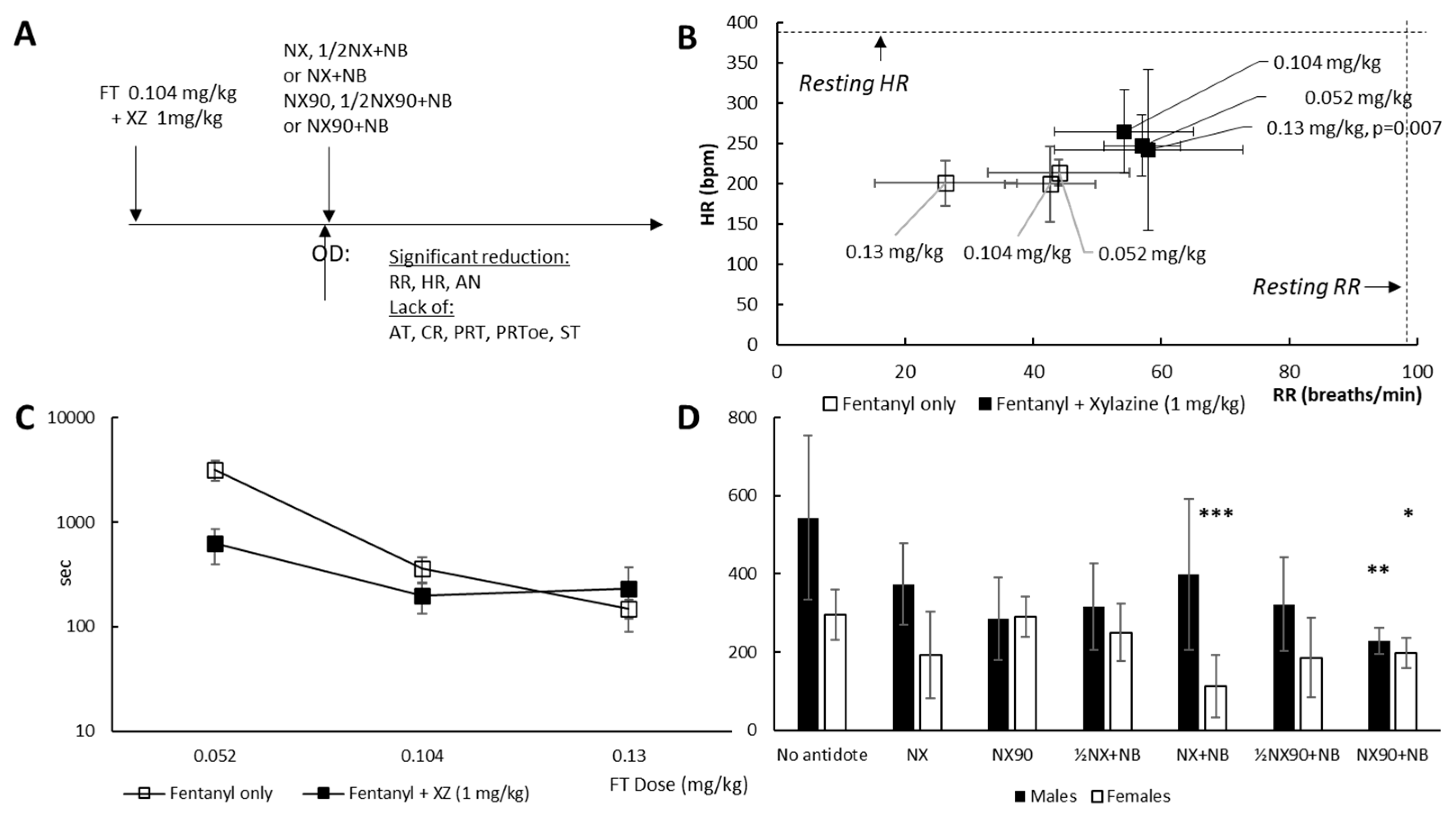
Figure 2.
Effects of naloxone, NX90, and nalbuphine combinations on respiratory and cardiovascular recovery after fentanyl–xylazine overdose. A. Respiratory rate (RR, breaths/min) and heart rate (HR, beats/min) at the time of overdose reversal in male rats treated with NX (0.20 mg/kg), NX90 (0.26 mg/kg), or their combinations with nalbuphine: ½NX+NB (0.10+0.10 mg/kg), NX+NB (0.20+0.10 mg/kg), ½NX90+NB (0.13+0.10 mg/kg), and NX90+NB (0.26+0.10 mg/kg). B. RR and HR at overdose reversal in female rats for the same treatment groups. C. Summary of statistical significance for the effects of each intervention on RR and HR at reversal relative to the NX-only group, indicating which combinations significantly improved respiratory and/or cardiovascular recovery compared with NX. Data are presented as mean ± SEM. For all treatment groups, n=5 males and 5 females as detailed in Materials and Methods. Statistical comparisons were performed using one-way ANOVA with appropriate post hoc multiple comparisons versus the NX-treated group; significance thresholds are indicated in the panel (e.g., p<0.05, p<0.01, p<0.005 vs NX).
Figure 2.
Effects of naloxone, NX90, and nalbuphine combinations on respiratory and cardiovascular recovery after fentanyl–xylazine overdose. A. Respiratory rate (RR, breaths/min) and heart rate (HR, beats/min) at the time of overdose reversal in male rats treated with NX (0.20 mg/kg), NX90 (0.26 mg/kg), or their combinations with nalbuphine: ½NX+NB (0.10+0.10 mg/kg), NX+NB (0.20+0.10 mg/kg), ½NX90+NB (0.13+0.10 mg/kg), and NX90+NB (0.26+0.10 mg/kg). B. RR and HR at overdose reversal in female rats for the same treatment groups. C. Summary of statistical significance for the effects of each intervention on RR and HR at reversal relative to the NX-only group, indicating which combinations significantly improved respiratory and/or cardiovascular recovery compared with NX. Data are presented as mean ± SEM. For all treatment groups, n=5 males and 5 females as detailed in Materials and Methods. Statistical comparisons were performed using one-way ANOVA with appropriate post hoc multiple comparisons versus the NX-treated group; significance thresholds are indicated in the panel (e.g., p<0.05, p<0.01, p<0.005 vs NX).
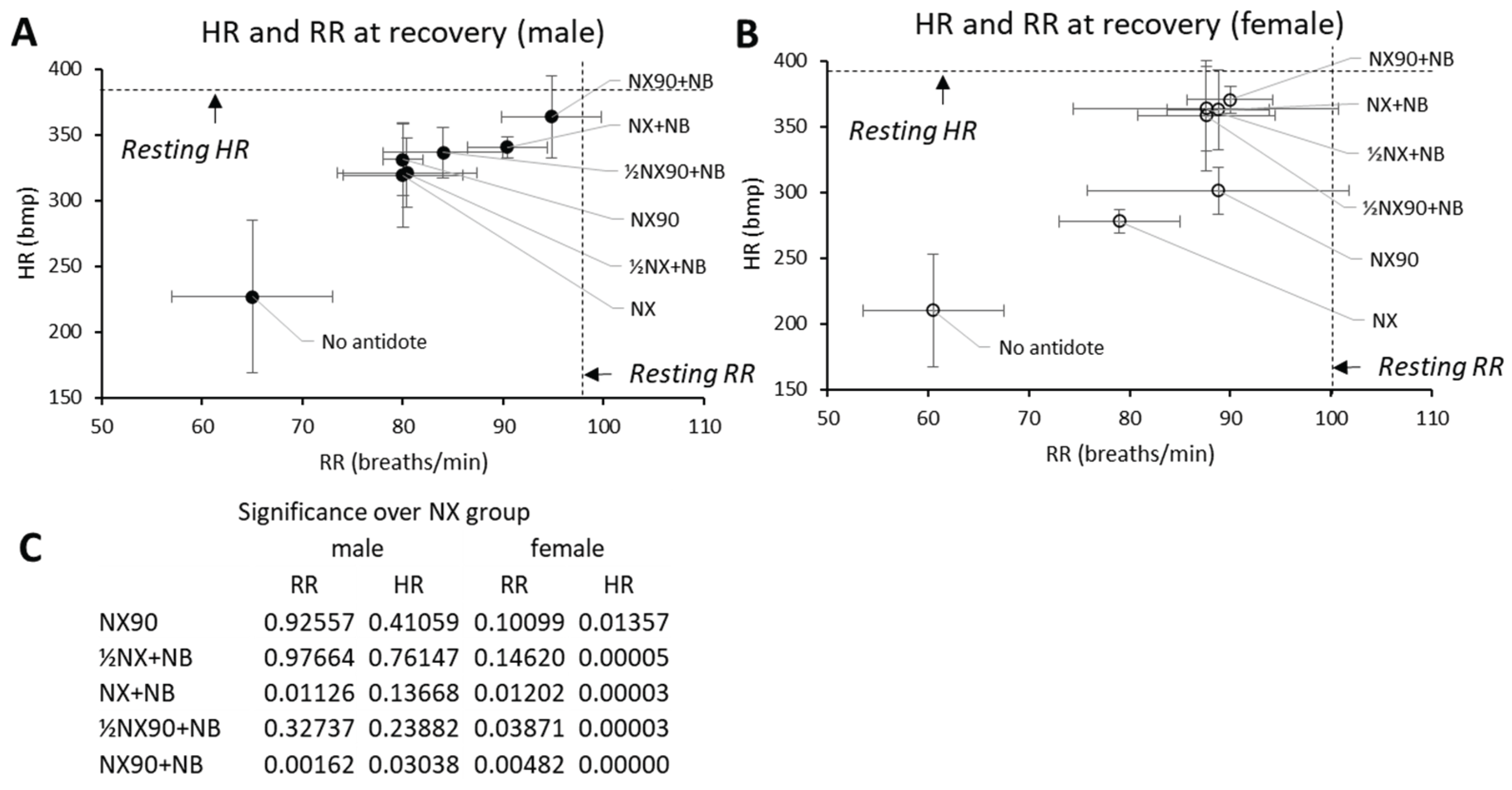

Table 1.
Average values in RR and HR at reversal.
| Antidote | Average improvement | |||||
|---|---|---|---|---|---|---|
| Group | Females | Males | ||||
| RR (breath/min) |
HR (beat/min) | RR (breath/min) | HR (beat/min) | RR (breath/min) | HR (beat/min) | |
| No antidote | 63 ± 8 | 218 ± 50 | 61 ± 7 | 210 ± 43 | 65 ± 8 | 227 ± 58 |
| NX | 80 ± 6 | 297 ± 32 | 79 ± 6 | 278 ± 9 | 80 ± 6 | 316 ± 34 |
| NX90 | 84 ± 10 | 316 ± 27 | 89 ± 13 | 301 ± 18 | 80 ± 2 | 331 ± 27 |
| NX+NB | 90 ± 6 | 352 ± 33 | 89 ± 13 | 363 ± 32 | 90 ± 7 | 341 ± 26 |
| ½NX+NB | 84 ± 6 | 343 ± 34 | 88 ± 5 | 364 ± 30 | 80 ± 4 | 321 ± 8 |
| ½NX90+NB | 86 ± 5 | 348 ± 24 | 88 ± 7 | 359 ± 42 | 84 ± 6 | 337 ± 19 |
| NX90+NB | 92 ± 5 | 367 ± 22 | 90 ± 4 | 370 ± 11 | 95 ± 5 | 364 ± 31 |
Disclaimer/Publisher’s Note: The statements, opinions and data contained in all publications are solely those of the individual author(s) and contributor(s) and not of MDPI and/or the editor(s). MDPI and/or the editor(s) disclaim responsibility for any injury to people or property resulting from any ideas, methods, instructions or products referred to in the content. |
© 2026 by the authors. Licensee MDPI, Basel, Switzerland. This article is an open access article distributed under the terms and conditions of the Creative Commons Attribution (CC BY) license (http://creativecommons.org/licenses/by/4.0/).
Copyright: This open access article is published under a Creative Commons CC BY 4.0 license, which permit the free download, distribution, and reuse, provided that the author and preprint are cited in any reuse.


