

Submitted:
08 April 2026
Posted:
09 April 2026
You are already at the latest version
Abstract
Employment recommendation systems are increasingly used to support graduate job matching. However, limited research has examined how graduating computer science students perceive and respond to a proposed employment recommendation approach that combines static information matching with dynamic interactive functions. Drawing on the Technology Acceptance Model (TAM) and Information System (IS) Success Model, this study conducted a questionnaire-based survey of 386 graduating students and included an exploratory assessment of the questionnaire’s internal consistency and construct structure. The findings show that only 38.3% of respondents reported willingness to use existing employment recommendation systems for job hunting, citing critical limitations including delayed matching to individual qualifications (71.0%), information lag (55.4%), and jobs not matching majors (54.1%). In contrast, respondents reported more favorable attitudes toward the proposed static-dynamic job recommendation approach: 67.6% expressed willingness to use it and 59.6% expressed willingness to recommend it to others. Subgroup analyses reveal that students from emerging computing fields (e.g., AI, Data Science) and those in active job-seeking status demonstrated significantly higher perceived usefulness (PU) and behavioral intention (BI) (p < 0.05). These results underscore a significant "trust gap" in current platforms and suggest that future systems must transition from passive matching to dynamic, user-centric engagement. This research provides a practical blueprint for developing more responsive digital career services that address the evolving complexities of the computer science labor market.
Keywords:
employment recommendation systems
; static-dynamic integration
; human-computer interaction
; survey research
; perceived usefulness
; user acceptance
1. Introduction
In recent years, the rapid expansion of higher education and the increasing complexity of labor markets have intensified competition in graduate employment worldwide [1,2]. Against this global backdrop, China provides a representative large-scale case, where higher education has rapidly transitioned from an elite system to mass and universal participation, resulting in a remarkable expansion in scale over the past two decades [3]. According to statistics released by the Ministry of Education, the total number of graduates from regular colleges and universities across the country has continued to climb from about 1 million at the beginning of this century [4] to nearly 12.22 million in 2025 [5], and is estimated to reach 12.70 million in 2026 [6]. This historic transformation has not only provided a large-scale supply of high-quality human resources for national development but has also put unprecedented supply pressure on the labor market [7]. In the context of the evolution of the global economic pattern, the upgrading of domestic industrial structure and the new technological revolution, the demand-side structure of the labor market is also undergoing profound and complex adjustments [8,9]. The transformation of traditional occupations and the emergence of new job profiles are occurring simultaneously, while labor market demand is becoming increasingly dynamic in terms of skill combinations, task complexity, and adaptability [10]. The continuous high level of supply and the rapid evolution of demand structure have jointly led to the prominence of structural contradictions in the employment market. The phenomena of "difficulty in finding employment" and "difficulty in recruiting" coexist, and the employment competition faced by graduates is becoming increasingly fierce and complex [11]. Against this macro background, how to break through the limitations of the traditional information matching model and achieve efficient, accurate and dynamic person-job fit with the help of technology, has become not only a technical optimization problem, but also a core issue concerning the career development path of millions of graduates, the efficiency of human resource allocation, and even the long-term stable development of the social economy [12,13].
To address this challenge, employment recommendation systems [14] based on big data and intelligent algorithms have emerged and are gradually becoming an important tool to assist students in job hunting [15]. These systems analyze students' professional background, skills, practical experience and behavioral preferences, while integrating corporate recruitment needs and job characteristics, to provide students with personalized job recommendations, thereby effectively broadening job search channels, reducing information search costs, and improving the targeting and success rate of job hunting [16]. Studies have shown that effective employment recommendation systems can not only optimize matching efficiency, but also alleviate the problem of information asymmetry in the job search process to a certain extent [17].
However, existing employment recommendation systems rely excessively on static historical data (such as resume keywords) for one-way matching in practical applications, lacking the ability to integrate and respond to dynamic real-time information [18]. This has led to many problems, such as "low accuracy in matching majors with positions", "delayed information updates" and "inability to adjust based on job seekers' real-time feedback" [19]. For fields such as computer science, where technology is developing rapidly and emphasizes practical operation and instant communication, the static characteristics of existing systems are difficult to meet graduates' needs for in-depth information, such as detailed technical stack requirements, team culture, and real-time Q&A. This may in turn lead to lower user trust and lower adoption [20].
A static-dynamic job recommendation approach where static profile-based matching is complemented by dynamic interaction (e.g., real-time communication and iterative feedback) has been increasingly discussed as a promising direction [21]. In this approach, a static matching module generates initial recommendations based on user profiles and job databases, while a dynamic interaction module (e.g., real-time chat, interview feedback, or skill-preference adjustment) supports bidirectional, real-time communication between job seekers and recruiters or the system during the job-search process [22]. Conceptually, this integration may enhance perceived control, transparency, and trust, and therefore has the potential to improve perceived usefulness and overall acceptance in employment recommendation services [23].
Although the concept of "static-dynamic fusion" has potential in the field of recommendation systems [24], there is currently no research on the acceptance of such systems by specific user groups, especially computer science students, because the technology in this field is updated rapidly and the demand for actual communication is strong, which better reflects the value of dynamic interactive systems [25]. Existing studies have mostly focused on algorithm optimization or macro-level performance evaluation [16], with limited attention to how specific user groups evaluate such systems in terms of perceived usefulness and behavioral intention [22]. Therefore, this study aims to investigate graduating computer science students’ awareness and stated willingness to use existing employment recommendation systems, and to examine their perceptions of and behavioral intentions toward a proposed static-dynamic job recommendation approach. Rather than evaluating an implemented system, this study focuses on how respondents assess the perceived usefulness and acceptance of this proposed design concept.
Accordingly, this study addresses the following research objectives:
RO1: To examine respondents’ perceived usefulness of a proposed employment recommendation approach that integrates static matching and dynamic interaction.
RO2: To examine respondents’ behavioral intentions toward a proposed employment recommendation approach that integrates static matching and dynamic interaction.
2. Materials and Methods
2.1. Ethical Considerations
Ethical approval was obtained from the Institutional Review Board of Yunnan College of Business Management, China (protocol code YCBM-2025-012; approval date: 22 November 2025). All participants provided written informed consent prior to participation and were informed that participation was voluntary and that they could withdraw at any time without penalty. Survey responses were anonymized and analyzed in deidentified form, and data were stored securely with access restricted to the research team.
2.2. Participants and Data Collection
In this study, “graduating computer science students” refers to final-year undergraduate students in computer science-related disciplines who are about to graduate. This study was conducted at two higher education institutions, surveying a total of 442 graduating students majoring in computer-related fields, of which 386 valid responses were retained after excluding questionnaires with missing responses or multiple selections in single-choice items, resulting in an effective response rate of 87.3%. Equation (1) shows that the target sample size was determined with reference to Cochran’s formula for large populations [26]. The formula was applied using a 95% confidence level (Z = 1.96), maximum variability (p = 0.5), and a 5% margin of error (e = 0.05). Under these assumptions, the recommended minimum sample size is approximately 384. Accordingly, the final sample of 386 valid responses satisfied the minimum sampling requirement for this study.
Participants were all graduating undergraduate students, with the following majors: Computer Science and Technology (165, 42.7%), Artificial Intelligence (78, 20.2%), Internet of Things Engineering (29, 7.5%), Software Engineering (23, 6.0%), Virtual Reality Technology (22, 5.7%), Network Engineering (21, 5.4%), Data Science (18, 4.7%), and other majors (30, 7.8%). Of all participants, 365 (94.6%) planned to enter the workforce directly after graduation, while 21 (5.4%) had no immediate plans for employment. All participants possessed basic skills in using digital tools and online platforms. In this study, sociodemographic characteristics (gender, major) and job-seeking status were treated as background or grouping variables; the main survey outcomes included participants’ awareness of employment recommendation systems, willingness to use them, functional evaluations, and stated acceptance of, and behavioral intentions toward, new recommendation systems integrating static matching and dynamic interaction.
2.3. Theoretical Framework
The theoretical framework of this study is primarily based on the Technology Acceptance Model (TAM) [27] and the Information System (IS) Success Model [28]. TAM provides a useful lens for understanding users’ acceptance of new technologies. In the present study, the empirical focus is placed on perceived usefulness (PU) and behavioral intention (BI), as these dimensions are more directly aligned with the questionnaire items and the exploratory factor structure obtained from the data. The Information Systems (IS) Success Model was used only as a supplementary interpretive lens when discussing respondents’ views on information quality, system responsiveness, service reliability, and related concerns such as trust and privacy. The present study does not test a full causal model; rather, these frameworks are used to support the descriptive and exploratory interpretation of the survey findings.
2.4. Questionnaire Design and Measurement
Questions related to perceived usefulness, such as "Do you think improving the accuracy of job matching in the employment recommendation system will help you find a suitable job? [29]" directly reflect students' perception of whether the function helps improve job search efficiency, which is a judgment of the system's "usefulness" [30]. Questions like "Do you think adding real-time chat interaction to the employment recommendation system will help you find a suitable job?" assess the perceived practicality of dynamic interactive functions in promoting information communication and improving matching effectiveness [31].
Behavioral intention was assessed using intention-oriented items such as “Would you use such an employment recommendation system?” and “Would you be willing to recommend such a system to your classmates or friends?”, which reflect adoption and recommendation intentions [32,33].
Questions related to system quality and information quality: For example, when investigating the limitations of existing systems [34], options such as "false information [35]," "information lag [36]," and "job mismatch with major [37]" directly point to students' evaluation of the quality (authenticity, timeliness, accuracy) of the information provided by the system [18,38]. "Unable to find a job in a timely manner based on one's qualifications" involves the perception of system quality (algorithm matching ability [39], responsiveness [40]).
Questions related to service quality and perceived risk: In the open comments, students commonly mentioned suggestions such as "strengthening corporate vetting" [41], "protecting personal privacy" [42], and "avoiding fake job postings" [43], reflecting their concerns about service quality (reliability and security) and also involving the impact of perceived risk (information risk and privacy risk) on their acceptance [44].
The question “Do you think this combination of static and dynamic employment recommendation systems can help you find a job?” was designed to capture respondents’ overall perceived usefulness of this proposed integrated approach [30], while also reflecting their general evaluation of its potential service value [45].
In addition to the structured items, the questionnaire also included a final open-ended question for supplementary comments and suggestions. Responses to the final open-ended question were screened to exclude non-substantive entries and then summarized using a descriptive thematic grouping approach.
2.5. Research Design and Data Analysis
This study employed a cross-sectional descriptive survey design to investigate respondents’ awareness of existing employment recommendation systems and their acceptance of a proposed static-dynamic job recommendation approach. Data were collected on-site using a structured questionnaire. The responses were used to descriptively examine perceived usefulness, behavioral intention, and selected user evaluations relevant to employment recommendation service design.
The questionnaire consisted of four parts: Part One covered respondents' socio-demographic characteristics and basic understanding of employment recommendation systems; Part Two investigated their user experience and functional evaluation of existing employment recommendation systems; Part Three explored the main limitations of existing systems; and Part Four focused on the acceptance, willingness to use, and recommendation intentions of the combined static and dynamic job recommendation system, along with related suggestions.
The questionnaire data were collected on-site through paper-based questionnaires, yielding a total of 386 valid responses. After being processed and coded, data were statistically analyzed using SPSS software [46]. In addition to descriptive statistics of demographic characteristics and basic cognition, the reliability and construct validity of the scales were systematically evaluated through reliability [47] and validity analyses [48].
The questionnaire explicitly examined their awareness, prior exposure, and evaluations of existing employment recommendation systems. However, with regard to the newly proposed static-dynamic recommendation approach, respondents did not interact with a working prototype. Their judgments of the proposed system were therefore formed on the basis of the functional descriptions provided in the questionnaire, together with their prior understanding and experience of existing job recommendation platforms.
2.6. Methodological Limitations
Despite yielding meaningful findings, this study has several limitations. First, the sample consisted entirely of computer science students at two higher education institutions located in the same geographical region, limiting its representativeness and geographical coverage. Accordingly, the findings should be interpreted with caution when generalized to broader student populations. Second, although the study participants were all computer science students, their understanding of the job market, job-seeking experience, and familiarity with recommender systems varied, which may have influenced their evaluation and acceptance of the system's functionality.
3. Results
3.1. Sociodemographic Characteristics
This study included 386 graduating computer science students as a valid sample, of whom 222 were male (57.5%) and 164 were female (42.5%). In terms of major distribution, Computer Science and Technology had the largest number of participants (165, 42.7%), followed by Artificial Intelligence with 78 participants (20.2%). Other majors included Internet of Things Engineering (29, 7.5%), Software Engineering (23, 6.0%), Virtual Reality Technology (22, 5.7%), Network Engineering (21, 5.4%), Data Science (18, 4.7%). An additional 30 participants (7.8%) were from other related majors. Regarding job-seeking intentions, the vast majority of participants (365, 94.6%) planned to work after graduation, with only 21 (5.4%) indicating no immediate plans for employment. In terms of specific job-seeking status, the largest proportion of those who are actively looking for work but have not yet received an interview opportunity (198 people, 51.3%), followed by those who are already in the internship stage (76 people, 19.7%), another 93 people (24.1%) are not looking for work for the time being, and 19 people (4.9%) have received an offer and signed a contract (Table 1).
3.2. Reliability and Validity Analysis
To examine the measurement quality of the survey instrument, internal consistency and sampling adequacy were assessed using SPSS. As shown in Table 2, the overall five-item scale yielded a Cronbach’s α of 0.818, indicating good internal consistency. Since the subsequent exploratory factor analysis suggested a two-factor structure, reliability was also examined separately for the two subdimensions. The perceived usefulness (PU) subscale showed excellent internal consistency (Cronbach’s α = 0.928), whereas the behavioral intention (BI) subscale showed acceptable internal consistency for exploratory research (Cronbach’s α = 0.630). Overall, these results provide preliminary support for the reliability of the instrument, although given the small number of items in the BI subscale, its internal consistency estimate is naturally more conservative [49,50].
Regarding the preliminary structural pattern of the questionnaire, the KMO value was 0.735 and Bartlett’s test of sphericity was significant (p < .001) (Table 3), indicating that the correlation matrix was suitable for principal component analysis.
Principal component analysis (PCA) with varimax rotation extracted two components with eigenvalues greater than 1, explaining 81.99% of the total variance [51]. The rotated component loadings shown in Table 4 indicated a clear two-component structure, with all loadings exceeding 0.50. Based on the loading pattern, Component 1 was interpreted as reflecting perceived usefulness (PU), whereas Component 2 was interpreted as behavioral intention (BI).
3.3. System Awareness and Willingness to Use
This study surveyed 386 graduating computer science students. Of these, 286 (74.1%) were aware of the job recommendation system, but only 148 (38.3%) were willing to use the existing system for job hunting. This significant gap indicates that awareness has not effectively translated into usage behavior, revealing obstacles to user acceptance of the current system.
3.4. Evaluation of the Existing Employment Recommendation System
Regarding the extent to which existing job recommendation system supports users in finding suitable jobs, the respondents' evaluations are distributed as follows: 37 people (9.6%) expressed "strongly agree," 56 people (14.5%) expressed "agree," 106 people (27.5%) expressed "neutral," 112 people (29.0%) expressed "disagree," and 75 people (19.4%) expressed "strongly disagree" (Table 5). The total percentage of respondents holding a positive attitude ("strongly agree" and "agree") was 24.1%, while the total percentage of respondents holding a negative attitude ("disagree" and "strongly disagree") was 48.4%. This distribution indicates that nearly half of the respondents express reservations about the current job recommendation system. This suggests limitations in meeting the job-seeking needs of graduating computer science students.
3.5. Limitations of Existing Employment Recommendation Systems
Table 6 summarizes responses to the multiple-choice question, "What limitations do you see in the current job recommendation system?" The results indicate that perceived problems cluster in the following areas.
3.5.1. Severe Deficiencies in Matching Functionality
A high percentage (71.0%) of respondents (274 people) felt the system "cannot match jobs promptly based on their qualifications." This directly reflects significant deficiencies in the current system's algorithmic personalization and real-time response, failing to meet users' core expectations for dynamic and accurate matching.
3.5.2. Multiple Challenges to Information Quality
Over half of the respondents pointed out problems with the system's information quality. Specifically, 55.4% (214 people) selected "information lag," highlighting insufficient timeliness. For graduating computer science students, information lag is not merely an inconvenience but a critical limitation. Due to the fast pace of technological change in the IT and AI sectors, employment information quickly loses relevance as emerging technologies alter required skills and job specifications [52].
3.5.3. Significant Mismatch in Professional Suitability
"Job not matching major" was specifically pointed out by 54.1% of respondents, further confirming the inherent limitations of general recommendation algorithms in understanding and matching majors such as computer science, which require specialized knowledge and skills.
3.5.4. Other Issues
A small number of respondents (2.1%) provided supplementary opinions in the "Other" option. However, most of the responses simply stated “none,” while a few respondents indicated that they were “not sure” or had never used the system. These responses did not reveal additional limitations beyond the categories already identified above.
3.6. Respondents’ Acceptance of the Proposed Static-Dynamic Job Recommendation Approach
To examine respondents’ attitudes toward a proposed employment recommendation approach that combines static profile matching with dynamic real-time interaction, this study assessed responses at two levels: perceived usefulness and behavioral intention. Overall, respondents reported generally favorable evaluations of this proposed design concept.
Figure 1 shows that regarding functional value recognition (perceived usefulness), respondents showed high levels of acceptance for both core functions, with particular emphasis on the dynamic interaction function. Specifically, regarding "improving job matching accuracy," a total of 59.6% of respondents (230 people) held a positive attitude (135 people "strongly agree," accounting for 35%; 95 people "agree," accounting for 24.6%), 18.4% (71 people) held a neutral attitude, while a total of 22% (85 people) held a negative attitude. The acceptance of the "real-time chat interaction" feature further increased, with a total of 65.3% of respondents (252 people) believing it would be helpful for job hunting (139 people "strongly agree," accounting for 36%; 113 people "agree," accounting for 29.3%). The proportions holding neutral and negative attitudes were 17.1% (66 people) and 17.6% (68 people), respectively. When asked whether the system as a whole would be helpful for job hunting, 63.2% of respondents (244 people) gave a positive evaluation (98 people "agree," accounting for 25.4%; 146 people "strongly agree," accounting for 37.8%), showing recognition of the overall value of this integrated model.
Figure 2 presents responses at the behavioral intention level, indicating that respondents showed a relatively strong willingness to use and recommend the proposed system. First, regarding personal usage intention, 67.6% of respondents (261 people) indicated a willingness to use such a system (84 people "agree," accounting for 21.8%; 177 people "strongly agree," accounting for 45.9%). Second, regarding the willingness to recommend to others, although the positive percentage was slightly lower, 59.6% of respondents (230 people) still expressed a willingness to recommend (106 people "agree," accounting for 27.5%; 124 people "strongly agree," accounting for 32.1%). At the same time, 21.3% of respondents (82 people) selected “disagree” or “strongly disagree,” suggesting that recommendation intention was somewhat lower than personal usage intention.
3.7. Qualitative Summary of Open-Ended Feedback and Design Suggestions
Open-ended responses to the question, “Please state your opinions and suggestions regarding the static and dynamic job recommendation system,” were reviewed qualitatively and grouped into recurring themes in order to provide supplementary context for the quantitative findings. Of the 386 responses received, 84 contained substantive comments after excluding brief non-informative entries such as “none,” “no comment,” or equivalent responses. These substantive comments were summarized using a descriptive thematic grouping approach rather than formal qualitative coding. Four recurring themes were identified: information governance and trust building, algorithm optimization and personalized services, privacy, security, and algorithm transparency, and functionality improvement and experience refinement.
3.7.1. Information Governance and Trust Building
This is a core pain point, with high-frequency keywords including "fake," "verification," and "authentic." Users strongly question the reliability of information on the current platform, citing concerns such as "most job search platforms are actually intermediary companies, falsely advertising recruitment information" and "too many fake jobs." They explicitly demand that the platform fulfill stricter verification responsibilities, "strengthening official verification and conducting background checks on companies," and establishing a corporate credit endorsement mechanism to "eliminate fake job postings" and "ensure the authenticity of recruiting companies." This reflects that information quality is not only a functional issue but also a fundamental problem affecting system credibility and user engagement.
3.7.2. Algorithm Optimization and Personalized Services
Users generally pointed out that the current recommended "jobs do not match their majors" (54.1% of the quantitative results echo this), hoping that the matching logic can go beyond keyword comparison and achieve a deeper understanding. Suggestions include "matching based on individual professional strengths" and "testing job matching. Recommending jobs based on work experience." A further demand is for the system to provide personalized diagnostics and development suggestions, such as "helping us match ourselves with job requirements and analyzing the reasons for any mismatches and gaps." This indicates that users expect the system to transform from a passive information filter into a proactive career development consultant.
3.7.3. Privacy, Security, and Algorithm Transparency
With increased awareness of data security, this topic was explicitly mentioned. Users are concerned about "the protection of personal information privacy" and suggested "viewing the platform's privacy policy." Simultaneously, they expressed unease about the "black box" algorithm, implicitly demanding the right to know about the recommendation logic, which is directly related to the suggestion to "improve privacy protection and algorithm transparency to enhance user trust." This shows that perceived risk (privacy risk and uncertainty risk) is a key obstacle affecting user adoption and trust.
3.7.4. Functionality Improvement and Experience Refinement
Users put forward many specific suggestions for functional enhancement, mainly including Enhancing information dimensions and interactivity: Suggestions include "adding multi-person public evaluations from companies" and building an integrated "online interview" process. Enhance tool functionality: Calls for the provision of "resume correction" or "intelligent optimization" services. Optimize interaction and filtering mechanisms: Demands simplification and fewer processes, addressing issues such as "duplicate recommendations" and the inability to "block uninteresting positions."
3.8. Exploratory Chi-Square Subgroup Analysis
For subgroup analysis, job search status was recoded into an active job-seeking group (actively searching or in an internship) and a less active job-seeking group (not actively looking or having received a signed offer). Professional orientation was recoded into Traditional Computing (Computer Science and Technology, Software Engineering, Network Engineering, and Internet of Things Engineering) and Emerging Computing Fields (Artificial Intelligence, Data Science, and Virtual Reality Technology), with respondents in Other excluded. The five user-acceptance items described in Section 3.6 were dichotomized into Positive and Non-positive for Pearson’s chi-square analysis [53]. Because this recoding reduces the ordinal information in the original Likert-scale responses, the subgroup results should be interpreted as exploratory.
As shown in Table 7, the active job-seeking group reported significantly higher positive response rates than the less active job-seeking group across all five evaluation items: improving job matching accuracy helps job search (63.5% vs. 50.0%, , ); real-time chat interaction helps job search (69.3% vs. 55.4%, , ); Combination of static and dynamic employment recommendation helps job search (66.8% vs. 54.5%, , ); intention to use the system (71.2% vs. 58.9%, , ); and intention to recommend the system (63.1% vs. 50.9%, , ).
As shown in Table 8, respondents in Emerging Computing Fields also reported significantly higher positive response rates than those in Traditional Computing for all five items: improving job matching accuracy helps job search (67.8% vs. 56.7%, , ); real-time chat interaction helps job search (73.7% vs. 61.8%, , ); Combination of static and dynamic employment recommendation helps job search (71.2% vs. 59.7%, , ); intention to use the system (77.1% vs. 63.4%, , ); and intention to recommend the system (70.3% vs. 54.6%, , ). Overall, positive evaluations of the proposed system were consistently higher among respondents with more active job-search engagement and among those from Emerging Computing Fields.
To preserve the ordinal information of the original Likert-scale responses, Mann-Whitney U tests were further conducted on the composite PU and BI scores [53]. As shown in Table 9, significant subgroup differences were observed for both professional orientation and job-seeking status. Respondents in Emerging Computing Fields showed significantly higher mean ranks than those in Traditional Computing on both PU (U = 12215.000, Z = -2.018, p = 0.044) and BI (U = 11631.500, Z = -2.674, p = 0.007). Similarly, the active job-seeking group showed significantly higher mean ranks than the less active group on both PU (U = 13170.500, Z = -2.206, p = 0.027) and BI (U = 12404.500, Z = -2.996, p = 0.003). These results further support the subgroup differences identified in the chi-square analysis.
4. Discussion
4.1. A Differential Analysis Based on Job-Seeking Status and Professional Orientation
To further explore the differences in acceptance of the proposed static-dynamic job recommendation approach among different groups, this study conducted a comparative analysis based on respondents' job-seeking status and professional orientation.
Regarding job-seeking status, the results suggest subgroup differences in the evaluation and acceptance of the proposed system functions between the two job-seeking groups. Specifically, respondents in the active job-seeking group (including those currently in internships or actively seeking employment) showed positive response rates that were generally about 12 to 14 percentage points higher across the five evaluation items than those in the less active job-seeking group. For example, regarding intention to recommend the system, the positive response rate in the active job-seeking group reached 63.1%, compared with 50.9% in the less active group. Similarly, for intention to use the system, the corresponding figures were 71.2% and 58.9%, respectively. These findings suggest that respondents with stronger immediate job-search involvement reported higher acceptance of the proposed system functions and more favorable overall evaluations of the proposed approach.
Regarding professional orientation, the observed differences were mainly reflected in the perceived value of specific functions and in overall behavioral acceptance. Based on the chi-square subgroup analysis, respondents in Emerging Computing Fields showed consistently higher positive response rates than those in Traditional Computing across all five evaluation items. In particular, students in Emerging Computing Fields reported higher positive evaluations for improving job matching accuracy (67.8% vs. 56.7%), and real-time chat interaction (73.7% vs. 61.8%) both with statistically significant subgroup differences (p<0.05). They also showed higher positive response rates for overall system helpfulness, intention to use, and intention to recommend. One possible explanation is that students in more rapidly evolving fields such as artificial intelligence, data science, and virtual reality may face faster knowledge updates and more specialized skill requirements, and may therefore place greater value on interactive communication and precise matching functions. By contrast, students in more traditional computing-related fields may perceive relatively less urgency for such dynamic support. However, as these subgroup analyses were exploratory, the findings should be interpreted with caution. These exploratory differences suggest that the functional design of job recommendation systems may need to consider the differentiated communication and matching needs of job seekers in different sub-fields.
4.2. Research Findings and Theoretical Alignment
This study examined how graduating computer science students viewed existing employment recommendation systems and how they responded to a proposed static-dynamic job recommendation approach. The results offer exploratory, survey-based evidence that respondents generally perceived the proposed approach as useful and reported relatively favorable behavioral intentions toward it. In this sense, the findings are broadly consistent with the Technology Acceptance Model (TAM) and can also be interpreted with reference to selected dimensions of the Information Systems (IS) Success Model, particularly perceived usefulness (PU), behavioral intention (BI), information quality, and service-related concerns.
On the one hand, the findings suggest relatively favorable perceived usefulness toward the proposed approach. Quantitative results show that only 24.1% of respondents believed existing systems helped them find suitable jobs, whereas 63.2% gave positive evaluations of the proposed static-dynamic job recommendation approach as a potentially helpful direction for job search support. This pattern is consistent with prior literature suggesting that interactive recommender features, such as user control and real-time feedback, may enhance the perceived relevance and personalization of recommendations [31,54]. The real-time chat function received particularly favorable ratings (65.3%), further indicating that direct communication is perceived as an important component in technically complex job-search contexts such as computer science, where users may need to clarify specific skill requirements and project backgrounds.
On the other hand, the findings indicate relatively favorable stated behavioral intentions toward the proposed approach. A substantial proportion of respondents reported willingness to use the system (67.6%) and willingness to recommend it to others (59.6%), suggesting a generally positive orientation toward possible adoption. The slightly lower recommendation intention may indicate that respondents were somewhat more cautious when considering whether to endorse such a system to peers, particularly with regard to credibility and practical readiness. Overall, this pattern offers a more nuanced understanding of how users may respond to proposed employment recommendation designs before actual system implementation.
4.3. Practical Implications for System Design
Respondents’ feedback suggests that information authenticity and trust building emerged as important design priorities in respondents’ feedback. The overwhelming user demand for information verification and rigorous corporate vetting (a core theme in the qualitative feedback) suggests that these aspects may deserve priority consideration in future service design. No amount of algorithmic complexity can compensate for a lack of trust in the underlying data. Future platforms may benefit from implementing and transparently communicating rigorous verification processes, perhaps integrating features such as company certifications, employee reviews, and detailed explanations of "matching reasons" to build credibility.
The favorable evaluation of real-time chat suggests that dynamic interaction may be a promising design component rather than merely an optional add-on. Strong positive feedback on live chat suggests that static job descriptions alone may be insufficient for technical positions. Future system design may benefit from more integrated communication tools, allowing for clarification of technology stacks, work culture, and project details. This aligns with the dynamics of job seeking research that emphasizes the importance of informative, multi-stage interaction in employment decisions.
Beyond Keyword Personalization: Criticism of "jobs not matching majors" (54.1%) calls for moving beyond simple keyword matching. For computer science positions, recommendation mechanisms may need to better account for skill equivalence, portfolios, and the rapidly evolving technological landscape [10,55]. Integrating user-suggested features, such as skills gap analysis and personalized skills enhancement suggestions, may expand the system’s role beyond simple job listing functions.
The subgroup findings also suggest that future system design may take into account differences across user groups. In particular, the results may help inform more tailored support for users at different stages of job seeking and from different professional orientations. For example, the system could provide a more guided “Beginner Mode” for users at an early stage of job exploration, while offering a more advanced mode for active job seekers, including deeper technical filtering and more direct recruiter interaction. In addition, the interface and matching logic may be adjusted to better reflect the communication and skill-assessment needs of different types of computing-related majors, including more traditional computer-related disciplines and emerging fields such as Artificial Intelligence and Data Science.
4.4. Limitations
While this study provides valuable empirical evidence for understanding the acceptance of a combined static and dynamic job recommendation system among graduating computer science students, several limitations exist that require careful consideration when interpreting and generalizing the findings.
First, the representativeness and breadth of the sample are limited. All participants in this study came from two higher education institutions in the same region. Although the sample size (N=386) is acceptable, their geographical location, institution type, and cultural background are relatively homogeneous. This limits the extrapolation validity of the findings to graduates from different regions and levels of institutions across the country (e.g., research universities, vocational colleges) and a wider range of academic disciplines. Future research needs to sample across a broader geographical and institutional scope to verify the generalizability of the study's conclusions.
Second, the findings are based primarily on self-reported perceptions rather than direct interaction with an implemented system. Although many respondents had prior awareness of, and in some cases experience with, existing employment recommendation systems, they did not directly interact with the newly proposed static-dynamic job recommendation approach in this study. Their evaluations were therefore formed on the basis of the functional descriptions presented in the questionnaire and their prior experience with related platforms. As a result, the present findings should be interpreted as survey-based evidence of perceived usefulness and stated behavioral intention toward a proposed design direction, rather than as evidence of actual usability, actual adoption behavior, or demonstrated system effectiveness. Future research should incorporate functional prototypes, usability testing, and objective behavioral data (e.g., system logs or task-based performance indicators) to strengthen the robustness of the conclusions.
In addition, the behavioral intention dimension was measured with only two items, and although its internal consistency was acceptable for exploratory research, this relatively brief measurement structure may limit the depth and stability of interpretation. Future studies should employ more comprehensive multi-item scales to strengthen construct measurement.
Finally, the study did not fully account for other potentially relevant background variables that may also be associated with user acceptance. Although the study analyzed differences in professional direction and job-seeking status, other factors that could potentially influence acceptance were not adequately included in the model, such as individual levels of technology anxiety, prior experience using similar tools, specific job-seeking strategies, and the overall state of the job market. These uncontrolled variables may have unknown confounding effects on the research results.
4.5. Future Directions
Based on the findings and limitations of this study, future research should go beyond evaluating proposed designs through questionnaires alone and begin to test them in more practical settings. This includes developing a functional prototype, carrying out usability testing, and examining actual user behavior through experimental or quasi-experimental studies. On this basis, future research can be further advanced in the following directions.
One important direction is to overcome the problems of high sample homogeneity and limited representativeness. Future research should systematically expand the sampling scope. Specifically, comparative studies can be conducted on graduates of computer science and related majors from various types of institutions, including research universities, applied undergraduate institutions, and vocational colleges, in different economic regions of eastern, central, and western China. Such research can not only test the robustness of the research conclusions under different educational backgrounds and cultural environments, but also explore how factors such as institution type and regional job market differences modulate users' functional needs and acceptance patterns of recommendation systems, thereby constructing a more universal and segmented theoretical framework and practical guide.
Another important direction is to compensate for the shortcomings of relying solely on self-reported data. Future research should adopt a mixed approach. While collecting subjective attitude data such as questionnaires and interviews, objective behavioral data should be actively integrated. For example, quasi-experimental studies can be conducted in cooperation with recruitment platforms to analyze users' real behavioral logs (such as click-through rate, chat interaction depth, resume modification frequency, and application conversion rate) when using prototypes with "static and dynamic" functions. By linking and cross-validating subjective "perceived usefulness" with objective "usage behavior" and "task completion effect," the validity and persuasiveness of research conclusions can be significantly improved, revealing more accurately the causal relationship between system design features and user experience.
At the same time, future research may also incorporate additional psychological, experiential, and situational variables to better explain the mechanisms underlying user acceptance. To gain a more comprehensive and in-depth understanding of the complex mechanisms influencing user acceptance, future research needs to construct and test a more integrated theoretical model. Based on existing variables, it is necessary to systematically incorporate and measure individual psychological factors (such as technology anxiety, privacy concerns, and algorithmic trust), prior experience factors (such as proficiency in using similar tools in the past), and dynamic situational factors (such as the intensity of specific job-seeking strategies and immediate perception of job market pressure). Using advanced statistical methods such as structural equation modeling, it is possible to analyze how these variables act as moderating or mediating variables influencing the "perception-intention-behavior" path, thereby revealing the underlying motivations and boundary conditions behind acceptance formation, and providing a precise theoretical basis for refined service design tailored to different user profiles.
5. Conclusions
This study systematically explored the acceptance of a job recommendation system integrating static matching and dynamic interaction functions among 386 computer science graduates through a questionnaire survey. The study found that although students rated existing systems relatively low, they showed high approval for the new "static-dynamic combination" model, particularly in relation to improved matching accuracy, real-time interaction, and overall helpfulness. The study further revealed that acceptance was significantly moderated by job-seeking status and major: students in the active job-seeking stage and those in emerging computing fields (e.g., AI, Data Science) showed stronger functional preferences. Theoretically, this study expanded the technology acceptance model, emphasizing the shaping role of context and domain characteristics on perceived usefulness; practically, it provides empirical evidence and design guidance for building a trustworthy, intelligent, and adaptive next-generation employment service platform. Despite limitations such as sample size, this study lays an important foundation for the optimization and development of intelligent employment services. Future optimization of employment recommendation systems should focus on information authenticity, matching accuracy, interactive functionality, and privacy protection to improve user experience and job search efficiency.
Author Contributions
Conceptualization, H.Q. and S.S.; methodology, H.Q. and S.S.; validation, H.Q. and S.S.; formal analysis, H.Q.; investigation, H.Q. and Y.Z.; data curation, H.Q.; writing-original draft preparation, H.Q.; writing-review and editing, S.S., F.F., X.S. and Y.Z.; visualization, H.Q.; supervision, S.S. and F.F.; project administration, H.Q.; funding acquisition, H.Q. All authors have read and agreed to the published version of the manuscript.
Funding
This research was funded by the Yunnan Provincial Department of Education Science Research Fund Project, grant number 2026J1468.
Acknowledgments
The authors would like to thank the participating students for their time and cooperation in completing the questionnaire survey.
Conflicts of Interest
The authors declare that the research was conducted in the absence of any commercial or financial relationships that could be construed as a potential conflict of interest.
References
- Portnoi, L.M.; Bagley, S.S.; Rust, V.D. Mapping the terrain: The global competition phenomenon in higher education. In Higher Education, Policy, and the Global Competition Phenomenon; Springer, 2010; pp. 1–13. [Google Scholar]
- Günay, A. Challenges for higher education graduates in the post-pandemic labor market. In International Perspectives and Strategies for Managing an Aging Workforce; IGI Global, 2022; pp. 144–159. [Google Scholar]
- Xiang, B.; Wang, H.; Wang, H. Is There a Surplus of College Graduates in China? Exploring Strategies for Sustainable Employment of College Graduates. Sustainability 2023, 15, 15540. [Google Scholar] [CrossRef]
- Ministry of Education of the People’s Republic of China. 2001 Statistical Communiqué on National Education Development. Available online: https://www.moe.gov.cn/jyb_sjzl/sjzl_fztjgb/tnull_844.html (accessed on 15 March 2026).
- Ministry of Education of the People’s Republic of China. 2025 college graduates expected to reach 12.22 million. Available online: https://www.moe.gov.cn/jyb_xwfb/s5147/202411/t20241115_1163118.html (accessed on 15 March 2026).
- Xinhua News Agency. The number of 2026 college graduates is expected to reach 12.70 million. Available online: https://www.news.cn/20251120/ead0f25dff2948dfa7f01fa78f207882/c.html (accessed on 15 March 2026).
- Hang, T.; Zhou, Y. Chinese University Major Decision and Its Effect on Wages: Modeling Interaction Between Major Specificity and Education-Job Relevancy Using Machine Learning Approaches. Journal of Chinese Political Science 2025, 30, 475–500. [Google Scholar] [CrossRef]
- Montobbio, F.; Staccioli, J.; Virgillito, M.E.; Vivarelli, M. The empirics of technology, employment and occupations: Lessons learned and challenges ahead. Journal of Economic Surveys 2024, 38, 1622–1655. [Google Scholar] [CrossRef]
- Pan, Y.; Gao, F.; Xing, Z. The impact of skill-biased technological change on urban-rural income inequality: Evidence from China. Applied Geography 2026, 187, 103891. [Google Scholar] [CrossRef]
- Bone, M.; González Ehlinger, E.; Stephany, F. Skills or degree? The rise of skill-based hiring for AI and green jobs. Technological Forecasting and Social Change 2025, 214, 124042. [Google Scholar] [CrossRef]
- Lynn, T.; Rosati, P.; Conway, E.; van der Werff, L. The future of work: Challenges and prospects for organisations, Jobs and Workers; 2023. [Google Scholar]
- Feng, J.; Yang, J.; Li, S.; Miao, Q.; Xi, Y.; Xia, Z. Enhancing person-job fit through multi-temporal career trajectory modeling. Expert Systems with Applications 2026, 300, 130413. [Google Scholar] [CrossRef]
- Xiong, Y.; Yu, J.; Wu, H. The relationship between psychological resilience and employability among higher vocational college students: The chain mediating effects of perceived social support and career decision-making self-efficacy. Frontiers in Psychology 2026, 16. [Google Scholar] [CrossRef] [PubMed]
- Zayed, Y.; Salman, Y.; Awad, M.; Hasasneh, A. Employment Recommendation System for Graduates Using Machine Learning. International Journal on Engineering Applications 2023, 11. [Google Scholar] [CrossRef]
- Shi, Q. The Employment Management for College Students Based on Deep Learning and Big Data. IEEE Access 2023, 11, 115627–115634. [Google Scholar] [CrossRef]
- Ricc, F.; Rokach, L.; Shapira, B. Recommender Systems Handbook; Springer: New York, 2011; pp. 1–35. [Google Scholar]
- Wang, Y. Design and Implementation of Student Job Matching System Based on Personalized Recommendation Algorithm. Systems and Soft Computing 2025, 200302. [Google Scholar] [CrossRef]
- Mashayekhi, Y.; Li, N.; Kang, B.; Lijffijt, J.; De Bie, T. A Challenge-based Survey of E-recruitment Recommendation Systems. Acm Computing Surveys 2024, 56. [Google Scholar] [CrossRef]
- Huang, X.; Lian, J.; Lei, Y.; Yao, J.; Lian, D.; Xie, X. Recommender ai agent: Integrating large language models for interactive recommendations. ACM Transactions on Information Systems 2025, 43, 1–33. [Google Scholar] [CrossRef]
- Konstan, J.; Terveen, L. Human-centered recommender systems: Origins, advances, challenges, and opportunities. AI Magazine 2021, 42, 31–42. [Google Scholar] [CrossRef]
- Tang, F.; Zhu, R.; Yao, F.; Wang, J.; Luo, L.; Li, B. Explainable person–job recommendations: Challenges, approaches, and comparative analysis. Frontiers in Artificial Intelligence 2025, 8. [Google Scholar] [CrossRef]
- Knijnenburg, B.P.; Bostandjiev, S.; O'Donovan, J.; Kobsa, A. Inspectability and control in social recommenders. In Proceedings of the Sixth ACM conference on Recommender Systems; 2012. [Google Scholar]
- He, X.; Liu, Q.; Jung, S. The impact of recommendation system on user satisfaction: A moderated mediation approach. Journal of Theoretical and Applied Electronic Commerce Research 2024, 19, 448–466. [Google Scholar] [CrossRef]
- He, C.; Parra, D.; Verbert, K. Interactive recommender systems: A survey of the state of the art and future research challenges and opportunities. Expert Systems with Applications 2016, 56, 9–27. [Google Scholar] [CrossRef]
- Roppelt, J.S.; Schuster, A.; Greimel, N.S.; Kanbach, D.K.; Sen, K. Towards effective adoption of artificial intelligence in talent acquisition: A mixed method study. International Journal of Information Management 2025, 82, 102870. [Google Scholar] [CrossRef]
- Cochran, W.G. Sampling Techniques; Johan Wiley & Sons Inc., 1977. [Google Scholar]
- Davis, F.D. Perceived Usefulness, Perceived Ease of Use, and User Acceptance of Information Technology. Management Information Systems Quarterly 1989, 13, 319–340. [Google Scholar] [CrossRef]
- DeLone, W.; McLean, E. Information Systems Success: The Quest for the Dependent Variable. Information Systems Research 1992, 3, 60–95. [Google Scholar] [CrossRef]
- Wang, Z.; Wei, W.; Xu, C.; Xu, J.; Mao, X. Person-job fit estimation from candidate profile and related recruitment history with co-attention neural networks. Neurocomputing 2022, 501, 14–24. [Google Scholar] [CrossRef]
- Akram, S.; Buono, P.; Lanzilotti, R. Recruitment chatbot acceptance in a company: A mixed method study on human-centered technology acceptance model. Personal and Ubiquitous Computing 2024, 28, 961–984. [Google Scholar] [CrossRef]
- Gao, C.; Lei, W.; He, X.; De Rijke, M.; Chua, T.-S. Advances and challenges in conversational recommender systems: A survey. AI Open 2021, 2, 100–126. [Google Scholar] [CrossRef]
- Mensah, I.K.; Zeng, G.; Luo, C. Determinants of social commerce purchase and recommendation intentions within the context of swift guanxi among Chinese college students. Sage Open 2023, 13, 21582440231175370. [Google Scholar] [CrossRef]
- Marikyan, D.; Papagiannidis, S.; Stewart, G. Technology acceptance research: Meta-analysis. Journal of Information Science 2023, 01655515231191177. [Google Scholar] [CrossRef]
- Al Naqbi, S.H. A mixed-method approach to post-implementation success of technology performance in UAE universities: Assessing DeLone and McLean IS success model. Sage Open 2024, 14, 21582440241240827. [Google Scholar] [CrossRef]
- Kingsley, S.; Silberman, M.S.; Wang, C.; Lambeth, R.; Zhi, J.; Eslami, M.; Li, B.; Bigham, J. ‘Your Duties Are To Sweep A Floor Remotely’: Low Information Quality in Job Advertisements is a Barrier to Low-Income Job-Seekers’ Successful Use of Digital Platforms. In Proceedings of the Proceedings of the 3rd Annual Meeting of the Symposium on Human-Computer Interaction for Work; 2024. [Google Scholar]
- Kissi, P.S. Job seekers satisfy or dissatisfy with the existing electronic recruitment: A theoretical and empirical investigation. Cogent Business & Management 2023, 10, 2278233. [Google Scholar] [CrossRef]
- Du, Y.; Liu, H.; Zhu, H.; Song, Y.; Zheng, Z.; Wu, Z. Quasi-Metric Learning for Bilateral Person-Job Fit. IEEE Transactions on Pattern Analysis and Machine Intelligence; 2025. [Google Scholar]
- Ertuğrul, D.Ç.; Bitirim, S. Job recommender systems: A systematic literature review, applications, open issues, and challenges. Journal of Big Data 2025, 12. [Google Scholar] [CrossRef]
- Gong, Z.; Song, Y.; Zhang, T.; Wen, J.-R.; Zhao, D.; Yan, R. Your Career Path Matters in Person-Job Fit. Proceedings of the AAAI Conference on Artificial Intelligence 2024, 38, 8427–8435. [Google Scholar] [CrossRef]
- Saito, Y.; Sugiyama, K. Multi-Behavior Job Recommendation with Dynamic Availability. In Proceedings of the Annual International ACM SIGIR Conference on Research and Development in Information Retrieval in the Asia Pacific Region; 2023. [Google Scholar]
- Ogunniye, G.; Legastelois, B.; Rovatsos, M.; Dowthwaite, L.; Portillo, V.; Vallejos, E.; Zhao, J.; Jirotka, M. Understanding User Perceptions of Trustworthiness in E-Recruitment Systems. Ieee Internet Computing 2021, 25, 23–32. [Google Scholar] [CrossRef]
- Boldi, A.; Silacci, A.; Rapp, A.; Caon, M. Designing for transparency: A web job board for e-recruitment to explore job seekers' privacy behaviours. Behaviour & Information Technology 2025, 44, 3038–3063. [Google Scholar] [CrossRef]
- Amaar, A.; Aljedaani, W.; Rustam, F.; Ullah, S.; Rupapara, V.; Ludi, S. Detection of Fake Job Postings by Utilizing Machine Learning and Natural Language Processing Approaches. Neural Processing Letters 2022, 54, 2219–2247. [Google Scholar] [CrossRef]
- Hosain, M.S.; Amin, M.B.; Debnath, G.C.; Rahaman, M.A. The use of Artificial Intelligence (AI) in the hiring process: Job applicants’ perceptions of procedural justice. Computers in Human Behavior Reports 2025, 19, 100713. [Google Scholar] [CrossRef]
- Siro, C.; Aliannejadi, M.; De Rijke, M. Understanding and Predicting User Satisfaction with Conversational Recommender Systems. ACM Transactions on Information Systems 2024, 42. [Google Scholar] [CrossRef]
- Verma, J.P. Data Analysis in Management with SPSS Software; Springer Science & Business Media, 2012. [Google Scholar]
- Rackwitz, R. Reliability analysis—A review and some perspectives. Structural Safety 2001, 23, 365–395. [Google Scholar] [CrossRef]
- McClure, L.A.; Boninger, M.L.; Ozawa, H.; Koontz, A. Reliability and validity analysis of the transfer assessment instrument. Archives of Physical Medicine and Rehabilitation 2011, 92, 499–508. [Google Scholar] [CrossRef]
- Nunnally, J.C. Psychometric Theory 3E; Tata McGraw-Hill Education, 1994. [Google Scholar]
- Cortina, J.M. What is coefficient alpha? An examination of theory and applications. Journal of Applied Psychology 1993, 78, 98. [Google Scholar] [CrossRef]
- Hair, J.F., Jr.; Black, W.C.; Babin, B.J.; Anderson, R.E. Multivariate data analysis. Multivariate Data Analysis 2010, 785. [Google Scholar]
- Nigar, M.; Juli, J.F.; Golder, U.; Alam, M.J.; Hossain, M.K. Artificial intelligence and technological unemployment: Understanding trends, technology's adverse roles, and current mitigation guidelines. Journal of Open Innovation: Technology, Market, and Complexity 2025, 100607. [Google Scholar] [CrossRef]
- Agresti, A. Categorical data analysis; John Wiley & Sons, 2013. [Google Scholar]
- Jannach, D.; Manzoor, A.; Cai, W.; Chen, L. A Survey on Conversational Recommender Systems. ACM Comput. Surv. 2021, 54, 105. [Google Scholar] [CrossRef]
- Smaldone, F.; Ippolito, A.; Lagger, J.; Pellicano, M. Employability skills: Profiling data scientists in the digital labour market. European Management Journal 2022, 40, 671–684. [Google Scholar] [CrossRef]
Figure 1.
Descriptive analysis of perceived usefulness (N = 386).
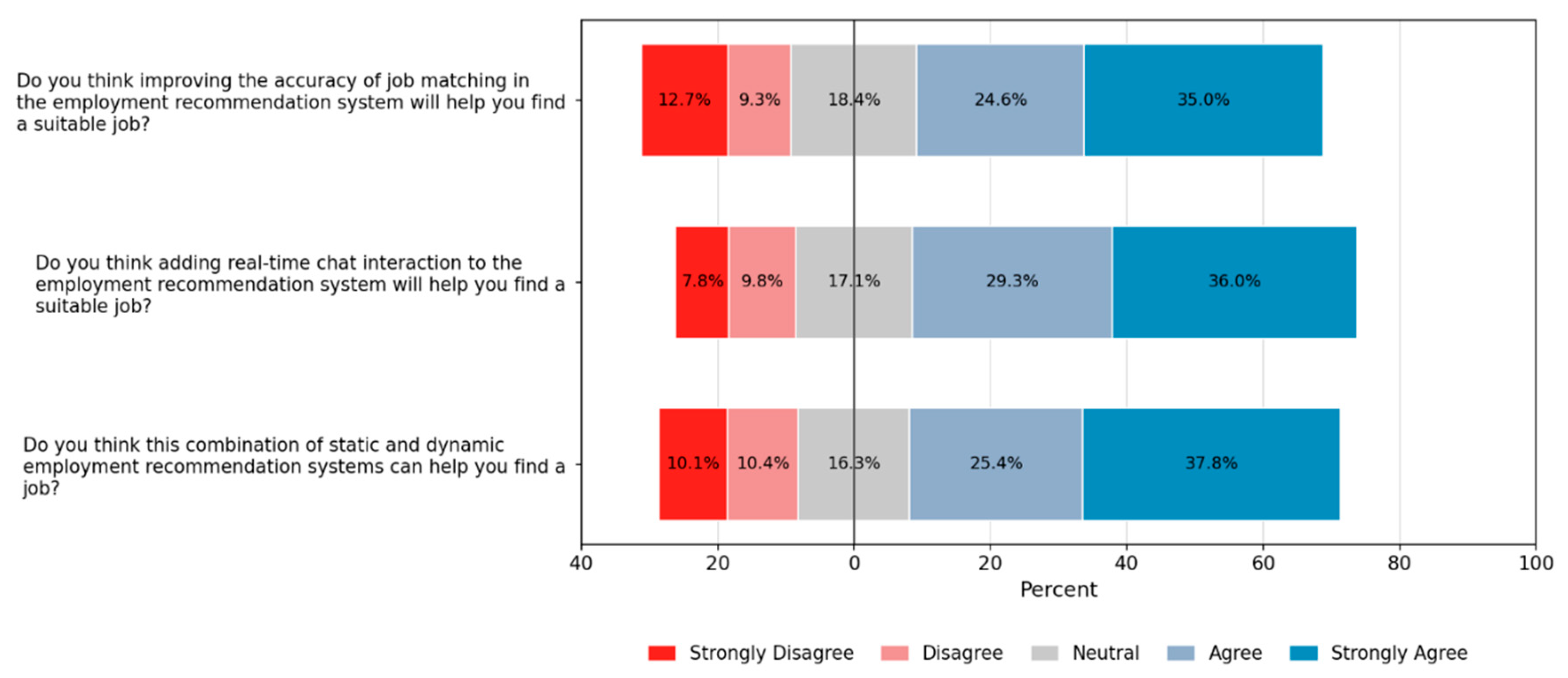
Figure 2.
Descriptive analysis of behavioral intention (N = 386).
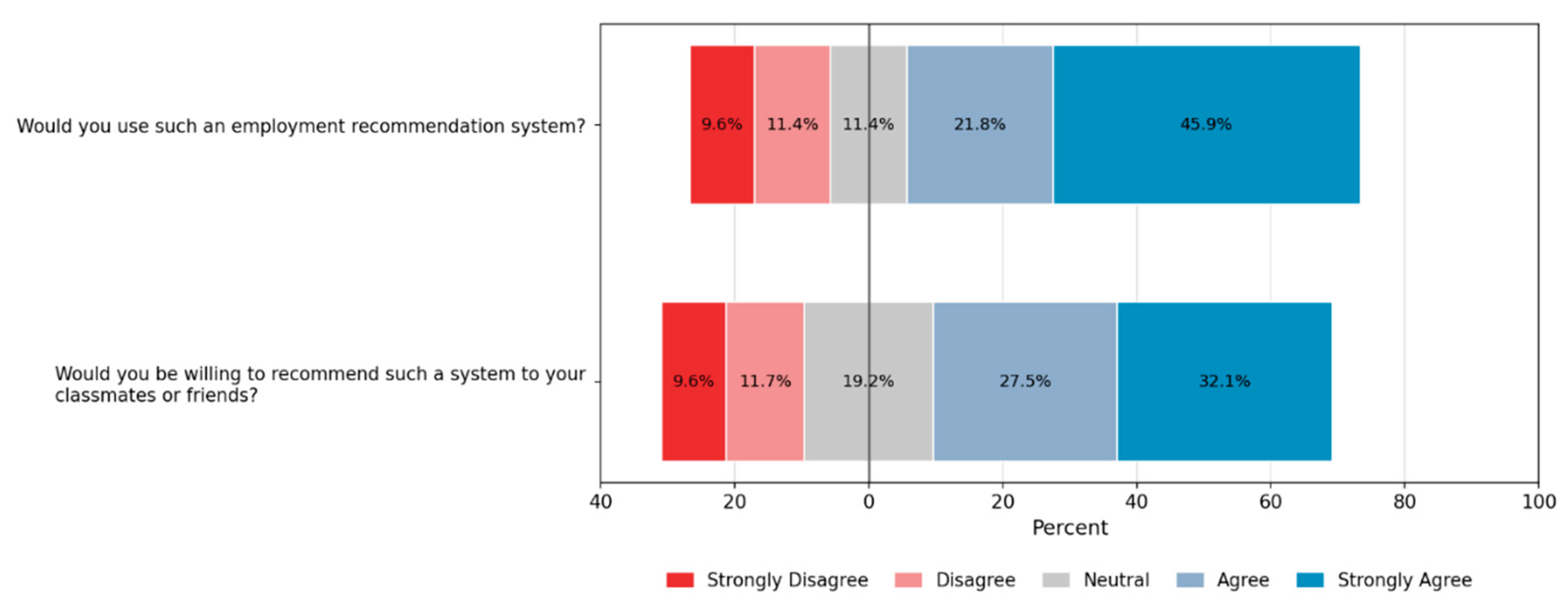

Table 1.
Sociodemographic characteristics and job-seeking status of the respondents (N = 386).
| Characteristic | Number (n) | Percentage (%) |
| Gender | ||
| Male | 222 | 57.5 |
| Female | 164 | 42.5 |
| Major/Specialization | ||
| Computer Science and Technology | 165 | 42.7 |
| Artificial Intelligence | 78 | 20.2 |
| Internet of Things Engineering | 29 | 7.5 |
| Software Engineering | 23 | 6.0 |
| Virtual Reality Technology | 22 | 5.7 |
| Network Engineering | 21 | 5.4 |
| Data Science | 18 | 4.7 |
| Other | 30 | 7.8 |
| Post-graduation Intention | ||
| Plan to seek employment | 365 | 94.6 |
| No immediate employment plans | 21 | 5.4 |
| Current Job Search Status | ||
| Actively searching, no interview yet | 198 | 51.3 |
| Currently in an internship | 76 | 19.7 |
| Not actively looking | 93 | 24.1 |
| Received job offer (signed contract) | 19 | 4.9 |
Table 2.
Internal consistency analysis of the questionnaire items.
| Item | Corrected total correlation | α Coefficient with item deleted | Cronbach Alpha |
| Overall scale | .818 | ||
| Do you think improving the accuracy of job matching in the employment recommendation system will help you find a suitable job? | .706 | .752 | |
| Do you think adding real-time chat interaction to the employment recommendation system will help you find a suitable job? | .764 | .738 | |
| Do you think this combination of static and dynamic employment recommendation systems can help you find a job? | .768 | .733 | |
| Would you use such an employment recommendation system? | .455 | .827 | |
| Would you be willing to recommend such an employment recommendation system to your classmates or friends? | .391 | .842 | |
| Perceived usefulness (PU) | .928 | ||
| Do you think improving the accuracy of job matching in the employment recommendation system will help you find a suitable job? | .773 | .961 | |
| Do you think adding real-time chat interaction to the employment recommendation system will help you find a suitable job? | .901 | .860 | |
| Do you think this combination of static and dynamic employment recommendation systems can help you find a job? | .892 | .864 | |
| Behavioral intention (BI) | .630 | ||
| Would you use such an employment recommendation system? | .460 | / | |
| Would you be willing to recommend such an employment recommendation system to your classmates or friends? | .460 | / |
Table 3.
KMO and Bartlett’s test results.
| Test | Value |
| KMO | .735 |
| Bartlett's Test of Sphericity | 1269.598 |
| df | 10 |
| Sig. | 0.000 |
Table 4.
Rotated component loadings and communalities.
| Item | Component 1 | Component 2 | Communality |
| Do you think improving the accuracy of job matching in the employment recommendation system will help you find a suitable job? | .867 | .209 | .796 |
| Do you think adding real-time chat interaction to the employment recommendation system will help you find a suitable job? | .947 | .158 | .923 |
| Do you think this combination of static and dynamic employment recommendation systems can help you find a job? | .940 | .180 | .916 |
| Would you use such an employment recommendation system? | .217 | .818 | .716 |
| Would you be willing to recommend such an employment recommendation system to your classmates or friends? | .120 | .857 | .749 |
Table 5.
User evaluation of the existing job recommendation system.
| Options | Number(n) | Percentage(%) |
| Strongly agree | 37 | 9.6 |
| Agree | 56 | 14.5 |
| Neutral | 106 | 27.5 |
| Disagree | 112 | 29.0 |
| Strongly disagree | 75 | 19.4 |
Table 6.
Reported limitations of existing employment recommendation systems.
| Limitations | Number (n) | Percentage (%) |
| 1.Severe deficiencies in matching functionality and responsiveness | 274 | 71 |
| 2. Multiple challenges to information quality | 214 | 55.4 |
| 3. Significant Mismatch in Professional Suitability | 209 | 54.1 |
| 4. Other Issues | 8 | 2.1 |
Table 7.
Positive response rates and chi-square test results by job-seeking status.
| Item | Active job-seeking (n, %) |
Less active job-seeking (n, %) |
χ² | p-value |
| Do you think improving the accuracy of job matching in the employment recommendation system will help you find a suitable job? | 174/274 (63.5%) | 56/112 (50.0%) | 6.020a | 0.014 |
| Do you think adding real-time chat interaction to the employment recommendation system will help you find a suitable job? | 190/274 (69.3%) | 62/112 (55.4%) | 6.862a | 0.009 |
| Do you think this combination of static and dynamic employment recommendation systems can help you find a job? | 183/274 (66.8%) | 61/112 (54.5%) | 5.193a | 0.023 |
| Would you use such an employment recommendation system? | 195/274 (71.2%) | 66/112 (58.9%) | 5.439a | 0.020 |
| Would you be willing to recommend such an employment recommendation system to your classmates or friends? | 173/274 (63.1%) | 57/112 (50.9%) | 4.951a | 0.026 |
Note: Positive responses include “agree” and “strongly agree.” The valid sample size for this comparison was N = 386.
Table 8.
Positive response rates and chi-square test results by professional orientation.
| Item | Emerging Fields (n, %) |
Traditional Computing (n, %) |
χ² | p-value |
| Do you think improving the accuracy of job matching in the employment recommendation system will help you find a suitable job? | 80/118 (67.8%) | 135/238 (56.7%) | 4.044a | 0.044 |
| Do you think adding real-time chat interaction to the employment recommendation system will help you find a suitable job? | 87/118 (73.7%) | 147/238 (61.8%) | 5.013a | 0.025 |
| Do you think this combination of static and dynamic employment recommendation systems can help you find a job? | 84/118 (71.2%) | 142/238 (59.7%) | 4.518a | 0.034 |
| Would you use such an employment recommendation system? | 91/118 (77.1%) | 151/238 (63.4%) | 6.775a | 0.009 |
| Would you be willing to recommend such an employment recommendation system to your classmates or friends? | 83/118 (70.3%) | 130/238 (54.6%) | 8.108a | 0.004 |
Note: Positive responses include “agree” and “strongly agree.” Valid N = 356; respondents in Other were excluded.
Table 9.
Mann-Whitney U test results by subgroup.
| Grouping variable | Comparison | Dimension | Group 1 Mean Rank | Group 2 Mean Rank | U | Z | p-value |
|---|---|---|---|---|---|---|---|
| Professional orientation | Emerging Fields (n = 118) vs. Traditional Computing (n = 238) | PU | 193.98 | 170.82 | 12215.000 | -2.018 | 0.044 |
| Emerging Fields (n = 118) vs. Traditional Computing (n = 238) | BI | 198.93 | 168.37 | 11631.500 | -2.674 | 0.007 | |
| Job-seeking status | Active job-seeking (n = 274) vs. Less active job-seeking (n = 112) | PU | 201.43 | 174.09 | 13170.500 | -2.206 | 0.027 |
| Active job-seeking (n = 274) vs. Less active job-seeking (n = 112) | BI | 204.23 | 167.25 | 12404.500 | -2.996 | 0.003 |
Note: PU and BI denote composite scores calculated from the original Likert-scale responses. For the professional-orientation comparison, respondents in the “Other” category were excluded; therefore, the valid sample size for that comparison was 356.
Disclaimer/Publisher’s Note: The statements, opinions and data contained in all publications are solely those of the individual author(s) and contributor(s) and not of MDPI and/or the editor(s). MDPI and/or the editor(s) disclaim responsibility for any injury to people or property resulting from any ideas, methods, instructions or products referred to in the content. |
© 2026 by the authors. Licensee MDPI, Basel, Switzerland. This article is an open access article distributed under the terms and conditions of the Creative Commons Attribution (CC BY) license.
Copyright: This open access article is published under a Creative Commons CC BY 4.0 license, which permit the free download, distribution, and reuse, provided that the author and preprint are cited in any reuse.


