

Submitted:
07 April 2026
Posted:
09 April 2026
You are already at the latest version
Abstract
Background: Excess dietary sodium intake is a major modifiable risk factor for hypertension and cardiovascular disease (CVD) globally. Potassium-Enriched Low-Sodium Salt Substitutes (LSSS), which partially replace sodium chloride with potassium chloride, are recommended as a population-level sodium-reduction strategy. However, sensory acceptability remains a key barrier to their adoption, particularly in India where discretionary salt use predominates. Objective: To assess whether potassium-enriched low-sodium salt substitutes (15% and 30% potassium chloride) differ from regular salt in perceived saltiness intensity when added to commonly consumed Indian food matrices. Methods: A controlled taste perception assessment was conducted using a screened analytical panel (N = 25) selected according to ISO 8586:2012 standards. Three salt formulations (100% NaCl, 85% NaCl & 15% KCl, and 70 % NaCl+30% KCl) were evaluated across three food matrices representing liquid (buttermilk), semi-solid (dal with roti), and surface-salted (French fries) foods. Saltiness intensity was rated on a five-point ordinal scale. Differences were analysed using Friedman’s test. Results: Across all three food matrices, no statistically significant differences in saltiness intensity were observed between regular salt and potassium-enriched formulations (p > 0.05). Although minor numerical variations in mean ratings and distribution patterns were noted, these differences were inconsistent and did not indicate systematic changes in perceived saltiness. Conclusions: Potassium-enriched LSSS containing up to 30% potassium chloride produced similar saltiness perception to regular salt across representative Indian food matrices when evaluated by trained assessors. These findings support the sensory feasibility of LSSS as a strategy for population-level sodium reduction in India.
Keywords:
low-sodium salt substitutes
; potassium chloride
; taste perception
; sensory evaluation
; sodium reduction
; hypertension prevention
; discretionary salt
; food matrix masking
; public health nutrition
1. Introduction
Hypertension is a leading modifiable risk factor for cardiovascular disease (CVD) globally and a major contributor to mortality [1,2]. In 2024, approximately 1.4 billion adults aged 30–79 years were living with hypertension worldwide, nearly doubling since 1990, with a disproportionate burden in low- and middle-income countries [2]. In India, non-communicable diseases (NCDs) account for approximately 63% of all deaths, with CVDs contributing nearly 27% [3,4]. Recent national evidence suggests that over one-fourth of Indian adults are hypertensive, reflecting a substantial and growing public health challenge [3]. Emerging evidence also indicates increasing prevalence of elevated blood pressure among children and adolescents, suggesting an early-life trajectory of hypertension [5,6,7].
Hypertension is a multifactorial condition influenced by genetic, behavioural, and dietary determinants. Among these, excess dietary sodium intake is a key modifiable driver. High sodium consumption is estimated to contribute to approximately 1.8 million deaths and 4% of global disability-adjusted life years (DALYs) [8,9]. Evidence from randomized controlled trials demonstrates a clear dose–response relationship between sodium reduction and blood pressure lowering, with each gram reduction in daily sodium intake associated with a decrease of ~2.4 mmHg in systolic and ~1.0 mmHg in diastolic blood pressure [10,11]. These effects are more pronounced among individuals with hypertension, older adults, and salt-sensitive populations [12,13]. Conversely, higher potassium intake lowers blood pressure through enhanced natriuresis and vasodilation [14,15]. Accordingly, sodium reduction remains a cornerstone of global CVD prevention strategies [2].
Dietary patterns in India present unique challenges for sodium reduction. The average Indian adult consumes approximately 3,200–4,400 mg of sodium per day (~8–11 g salt), nearly twice the WHO-recommended limit of <2,000 mg/day [16,17,18]. In contrast, potassium intake remains suboptimal at approximately 2.25 g/day, well below the recommended ≥3.5 g/day [17]. Unlike high-income countries where processed foods dominate sodium intake, nearly 70–80% of sodium consumption in India arises from discretionary sources such as cooking and table salt [2,16]. Although the contribution of processed and restaurant foods is increasing, home-prepared meals remain the primary source of sodium intake. This pattern suggests that household-level interventions, rather than food reformulation alone, are critical for population-level sodium reduction in India [16,18,19].
Low-sodium (potassium enriched) salt substitutes (LSSS), in which a portion of sodium chloride is replaced with potassium chloride, represent a promising and scalable intervention [11,20,21]. By simultaneously reducing sodium and increasing potassium intake, LSSS leverage complementary physiological mechanisms to lower blood pressure [14]. Large-scale trials have demonstrated their effectiveness: the Salt Substitute and Stroke Study (SSaSS) reported reductions in stroke (14%), major cardiovascular events (13%), and cardiovascular mortality (12%) without increased risk of serious hyperkalemia [22,23]. In India, the Salt Substitute in India Study (SSiIS) demonstrated significant reductions in systolic blood pressure among hypertensive individuals using reduced-sodium salt [24]. These findings have led to increasing global endorsement of LSSS as a cost-effective strategy for CVD prevention [2].
Despite this evidence base, sensory acceptability remains a barrier to widespread adoption of LSSS. Potassium chloride can impart bitter or metallic off-notes, particularly at higher substitution levels [25,26]. Sensory deviations can undermine sustained use, as consumers often reject foods perceived as organoleptically inferior despite known health benefits [27,28,29]. However, Indian diets are characterized by complex flavor profiles, including the use of spices, mixed textures, and high serving temperatures, which may mask subtle taste differences—a phenomenon described as matrix masking in sensory science [30,31]. Emerging evidence suggests that strong flavour matrices may reduce the detectability of salt modifications [32]. Nevertheless, empirical evidence on how potassium-enriched salt substitutes influence perceived saltiness intensity in common Indian foods remains limited.
To address this gap, we conducted a controlled taste perception study using a screened analytical panel (ISO 8586:2012) to evaluate two LSSS formulations (15% and 30% potassium chloride) across three representative food matrices—liquid (buttermilk), semi-solid (dal with roti), and surface-salted (French fries). The primary objective was to assess whether these reduced-sodium salts differ from regular salt in perceived saltiness intensity when incorporated into typical Indian preparations.
2. Materials and Methods
2.1. Study Design
A controlled analytical taste perception study was conducted to evaluate perceptual detectability of potassium-enriched Low-Sodium Salt Substitutes (LSSS) in commonly consumed Indian food matrices. The study employed a randomized complete block design, wherein each participant evaluated all test samples under standardized conditions and this was conducted in two sequential phases: a) Phase I- Screening and establishment of a screened analytical panel, b) Phase II-Evaluation of saltiness perception across selected food matrices
Phase I: Screening and establishment of a screened analytical panel
2.2. Panel Training and Orientation
Prior to data collection, panelists underwent a structured orientation session to familiarize them with the evaluation protocol, scale usage, and definition of saltiness intensity. Panelists were trained to focus specifically on saltiness intensity while minimizing the influence of other sensory attributes.
2.3. Panel Selection and Screening
Twenty-Six adult postgraduate nutrition students’ were recruited following ISO 8586:2012 criteria [33]. Participants were selected based on availability, willingness to participate, and absence of known taste impairments. Panel selection involved two stages of the screening process to ensure normal taste function and adequate discrimination ability.
2.3.1. Stage 1: Basic Taste Identification
Participants underwent suprathreshold aqueous solutions representing the four primary taste modalities: sweet taste was assessed using sucrose at a concentration of 20 g/L, sour taste using tartaric acid at 0.5 g/L, bitter taste was using caffeine at 1 g/L, and salty taste using sodium chloride at 2 g/L. Samples were presented in randomized order, and participants were asked to identify each taste. A minimum correct identification rate of 75% was required to proceed to the next stage [34].
2.3.2. Stage 2: Salt Intensity Discrimination (Ranking Test)
Salt intensity discrimination was assessed using a ranking based on gustatory Weber’s Law. Each candidate was presented with four sodium chloride solutions of increasing concentration of 0.1, 0.2, 0.5, and 1.0 g/100 mL, corresponding to least salty, slightly salty, moderately salty, and very salty intensities, respectively. Participants were instructed to rank the samples in ascending order of perceived saltiness. Participants were considered eligible if they correctly ranked the samples with no more than one adjacent transposition error
2.3.3. Final Panel Composition
These screening procedures ensured that only panelists demonstrating efficient gustatory acuity and discrimination ability were included in the screened panel. A total of 25 screened assessors (n=25) were selected to constitute the final analytical panel for the food matrix evaluation.
2.4. Test Environment and Conditions
These evaluations were conducted under controlled environmental conditions to minimize external bias. The testing area was maintained free from noise, odors, and visual distractions, with standardized lighting and ambient temperature [34]. Panelists were instructed to refrain from eating, drinking (except water), or using strongly flavored products at least 30 minutes prior to evaluation.
Phase II: Food Matrix Evaluation and Salt Intensity Assessment
2.5. Salt Formulations (Intervention Material)
Three salt formulations were evaluated in the study: (i) Salt 1 (0% KCl): 100% Sodium Chloride (NaCl), (ii) Salt 2 (15% KCl): 85% Sodium Chloride (NaCl) + 15% Potassium Chloride (KCl), and (iii) Salt 3 (30% KCl): 70% Sodium Chloride (NaCl) + 30% Potassium Chloride (KCl). The total weight of salt added to each recipe was held constant; only the mineral composition varied. All salt formulations were Iodized in accordance with FSSAI standards [35]. The 15% and 30% Potassium Chloride formulations were chosen based on WHO guideline suggestions and prior studies showing efficacy at these levels [2,22].
2.6. Sample Preparation and Standardization
2.6.1. Food Matrices
Three distinct food matrices were selected to represent different textures, temperatures, and salt-release dynamics common in Indian cuisine consistent with recommendations in sensory science literature [30,31].
- Buttermilk (Liquid Matrix): An acidic low-viscosity dairy beverage. This matrix tests salt perception in a solution where ions interact directly with taste receptors without mastication.
- Dal with Roti (DR) (Semi-solid): A viscous lentil stew served with Roti (un salted). This represents the staple carbohydrate-protein complex where “matrix masking” by spices is expected.
- French Fries (FF) (surface-salted snack /Lipid Matrix): Deep-fried potato strips with surface-applied salt. This tests the “salt burst” phenomenon and the interaction of salt crystals with a lipid coating.
2.6.2. Standardized Preparation:
All food items were prepared in bulk without salt in the institutional kitchen under standardized conditions. Each preparation was subsequently divided into three equal portions. Pre-weighed quantities of each salt formulation were added to the respective portions, mixed thoroughly for buttermilk and dal and applied uniformly for French fries immediately after frying. Care was taken to ensure homogeneity and consistency across samples in terms of temperature, texture, and portion size. Samples were prepared fresh and served at appropriate consumption temperatures. Uniform portion sizes and identical serving containers were used for all samples.
2.7. Blinding and Sample Presentation
2.7.1. Blinding and Coding
All samples were coded using randomly generated three-digit numbers to ensure blinding of participants to the salt formulation. A randomized block design was used to present the three salt variants within each food matrix to minimize order and carry-over effects.
2.7.2. Palate Cleansing
Between samples, participants followed a standardized palate cleansing protocol using potable water and unsalted puffed rice (murmura). A washout period of approximately 2 minutes was maintained between successive samplesto reduce carry-over effects.
2.8. Taste Perception Procedure
Saltiness intensity was assessed using a 5-point ordinal scale: 0 = Not salty, 1 = Slightly salty,2 = Moderately salty, 3 = Very salty, and 4 = Extremely salty. Panelists were instructed to evaluate each sample independently and record their perception of saltiness intensity.
2.9. Statistical Analysis
Given the ordinal nature of the data and repeated measures design, differences in saltiness ratings across salt formulations were analyzed using Friedman’s test. A significance level of p < 0.05 was considered statistically significant. Statistical analysis was performed using SPSS v22.0. Saltiness intensity ratings were treated as ordinal variables. For each food matrix, differences in perceived saltiness across the three salt formulations were assessed using the Friedman test, a non-parametric repeated-measures ANOVA. Descriptive statistics were presented as medians with interquartile ranges (IQR) and means and standard deviations (SD). Categorical variables are summarized using frequencies and percentages. Statistical significance was defined as a two-sided p-value <0. 05. This analysis focused primarily on identifying consistent perceptual differences between salt formulations rather than estimating clinical effect sizes.
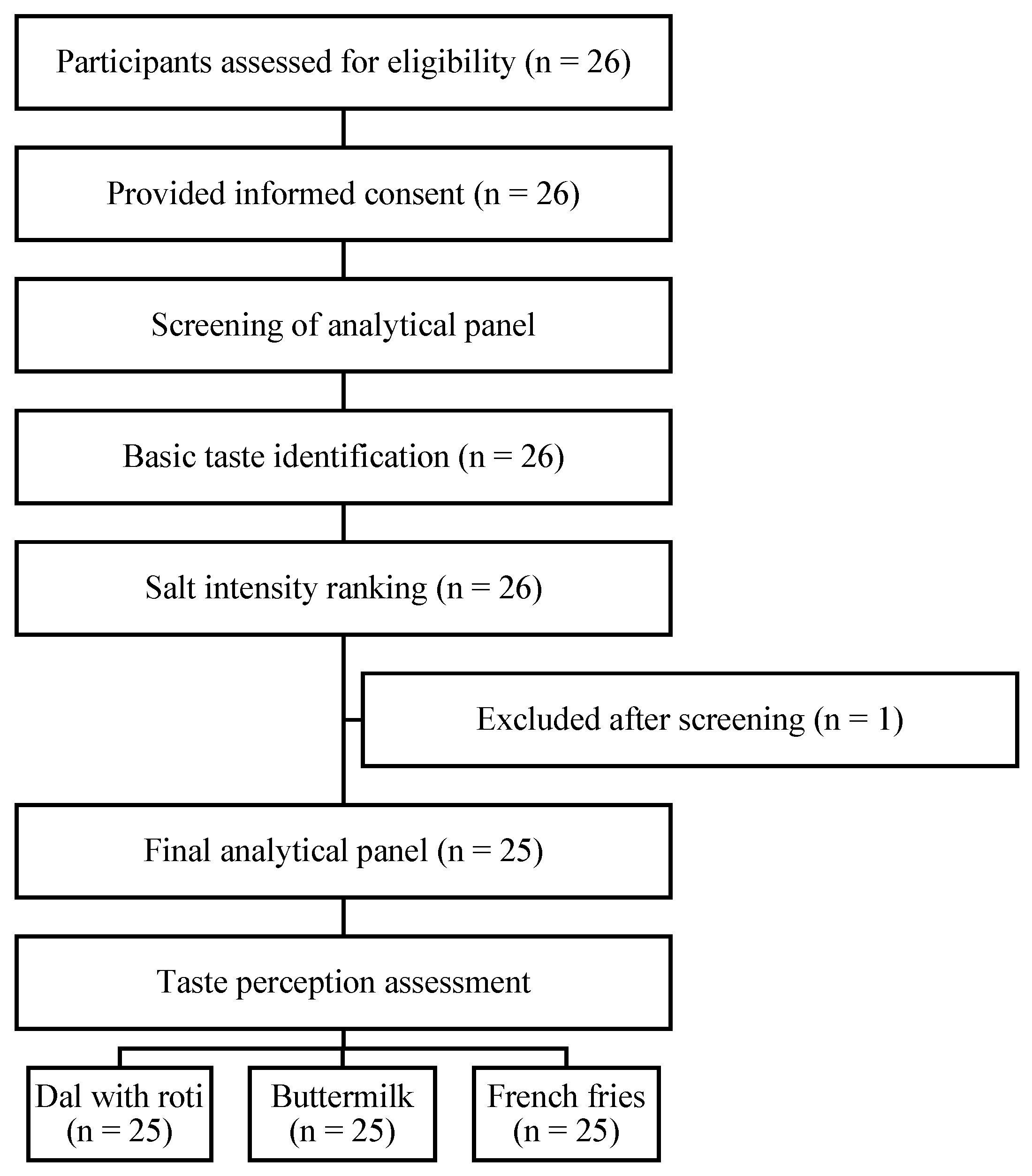
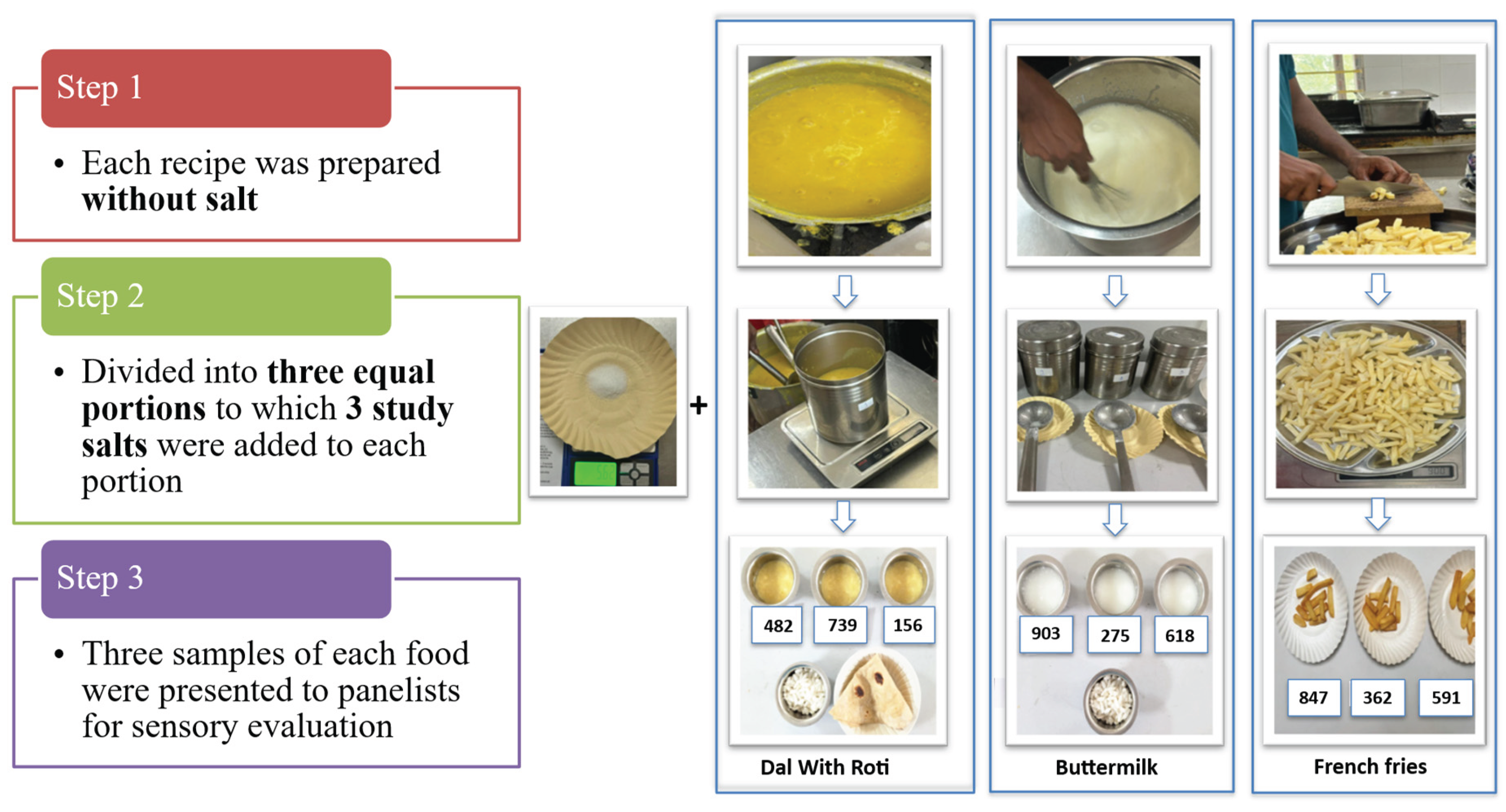
Figure A.
Flow Diagram of Panel Selection and Taste Perception Assessment Process.
Figure B.
Steps in Preparation of Study Foods.
3. Results
3.1. Saltiness Perception Across Salt Formulations
Table 1 presents the statistical comparison of saltiness intensity ratings across the three salt formulations within each recipe type. Across all food matrices, mean saltiness scores showed only minor variation between formulations. In buttermilk, mean saltiness increased modestly with higher sodium content (Salt-3: 1.40; Salt-1: 1.88). In dal with roti and French fries, variations were small and did not follow a consistent monotonic trend. Friedman test analysis demonstrated no statistically significant differences in saltiness perception across salt formulations for any food matrix (buttermilk: p = 0.119; dal with roti: p = 0.114; French fries: p = 0.105). These findings indicate that potassium substitution at both 15% and 30% levels did not result in measurable differences in perceived saltiness compared with regular salt.
3.2. Distribution of Salt Taste Intensity Ratings
The distribution of saltiness intensity ratings across food matrices and salt formulations is presented in Figure 1 and Supplementary Table 1. Across all matrices, responses were predominantly concentrated in the mid-range categories (“moderately salty” and “very salty”), with minimal representation at the extremes of the scale. This pattern was consistent across salt formulations, indicating substantial overlap in perceived saltiness. In buttermilk, a relatively higher proportion of “not salty” responses (24%) was observed for the 30% KCl formulation compared with other salts. However, this trend was not consistently observed in dal with roti or French fries, where distributions remained broadly comparable across formulations.
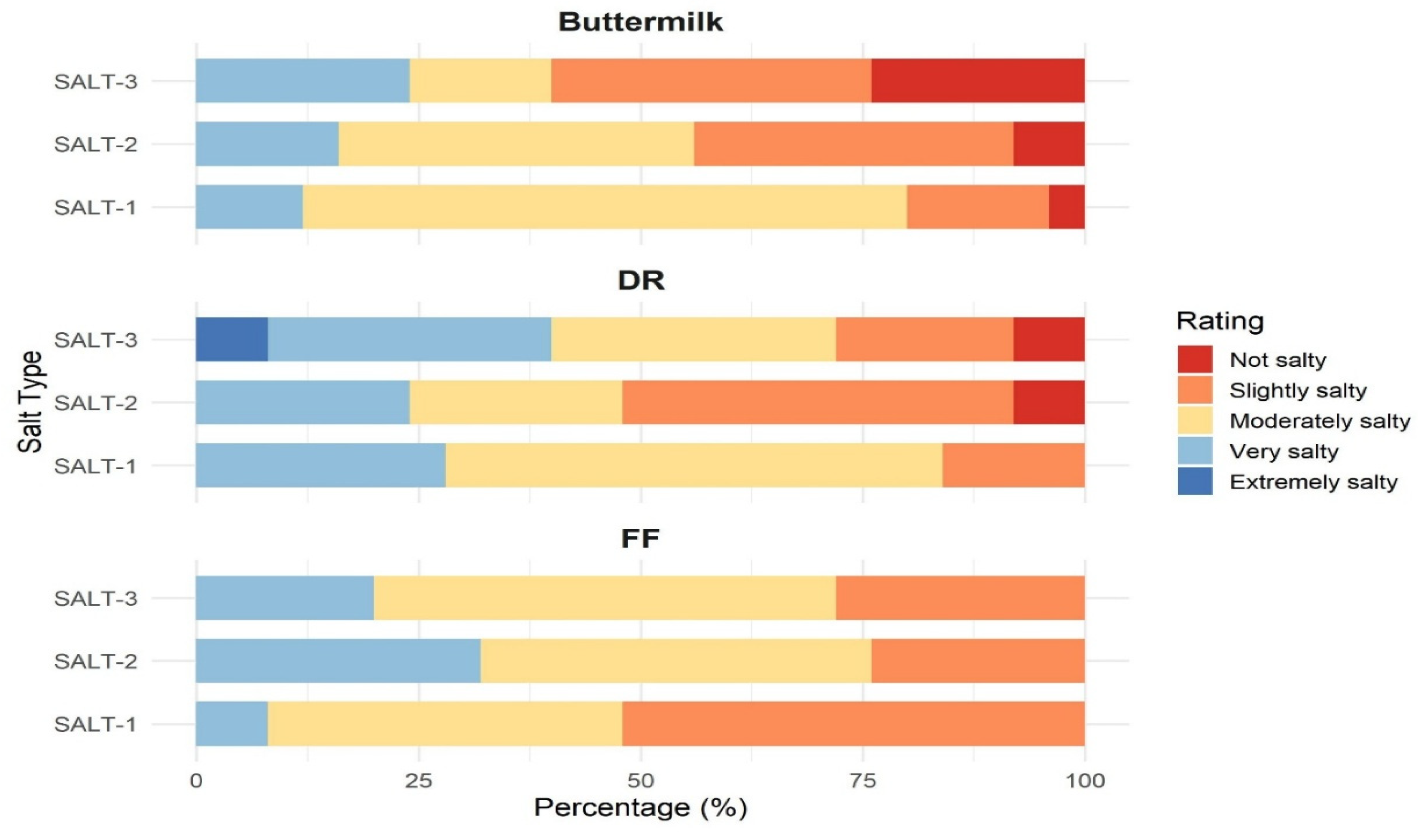
Figure 1.
Distribution of Salt Taste Intensity Ratings Across Recipes and Salt Levels. *Salt – 1: 100% NaCl; Salt-2: 15% KCl + 85% NaCl; Salt-3: 30% KCl + 70% NaCl.
Figure 1.
Distribution of Salt Taste Intensity Ratings Across Recipes and Salt Levels. *Salt – 1: 100% NaCl; Salt-2: 15% KCl + 85% NaCl; Salt-3: 30% KCl + 70% NaCl.
4. Discussion
4.1. Primary Findings
This analytical taste perception study found no statistically significant differences in saltiness intensity between regular salt and potassium-enriched formulations (15% and 30% KCl) when used in representative Indian food matrices. Across all tested foods, saltiness ratings showed substantial overlap between formulations, with no consistent directional trend observed with increasing sodium concentration. These findings indicate that partial substitution of sodium chloride with potassium chloride up to 30% does not result in systematic changes in perceived saltiness intensity under controlled conditions. This supports the sensory feasibility of such formulations for sodium reduction strategies without materially altering saltiness perception
4.2. Matrix-Dependent Masking Effects
The absence of consistent differences in saltiness perception across food matrices may be explained by matrix-dependent sensory interactions. In the dal with roti matrix, the combination of high viscosity, fat content, temperature, and complex spice profiles likely contributes to sensory masking, reducing the perceptual salience of subtle changes in salt composition [30,32,36]. In the case of French fries, lipid-mediated effects may have influenced salt perception. The presence of surface oil can delay salt dissolution and reduce the rate at which sodium ions reach taste receptors, thereby attenuating perceived intensity differences [31]. Consistent with this mechanism, only minor and non-significant variations in saltiness ratings were observed across formulations.
4.3. Acid-Salt Interaction in Liquids
In contrast, Buttermilk, an aqueous and acidic matrix, might be considered a worst-case scenario for salt detection: ions are fully dissolved and no solid texture to hide differences. We did see a slight downward trend in saltiness ratings for 30% KCl buttermilk (mean 1.40 vs. 1.88 for control), hinting at reduced sodium receptor stimulation. However, this drop was not statistically significant (p=0.119). One potential explanation is the interaction between sour and salty taste modalities. The acidic profile of buttermilk may suppress saltiness perception, as previously demonstrated [37], thereby attenuating the perceptual impact of reduced sodium content. These findings suggest that even in matrices with high ionic availability, perceptual differences may remain minimal under real-world conditions
4.4. Methodological Strengths and Limitations
This study has several strengths. The use of a screened analytical panel (ISO 8586:2012) ensured high taste acuity, enhancing sensitivity to detect subtle perceptual differences. The inclusion of multiple food matrices representing diverse physicochemical properties improves the ecological relevance of the findings. Additionally, standardized preparation, blinding, and randomized presentation minimized bias and strengthened internal validity.
However, certain limitations should be acknowledged. The use of a five-point ordinal scale, while appropriate for analytical evaluation, may limit sensitivity compared to continuous scales such as visual analogue scales [34]. The panel size (n = 25), although typical for such studies, may not detect very small differences. Furthermore, the study focused exclusively on saltiness intensity and did not formally assess other sensory attributes such as bitterness or metallic taste, which may influence overall acceptability.
4.5. Implications
These findings have important implications for sodium reduction strategies in India. The absence of systematic differences in saltiness perception suggests that potassium-enriched salt substitutes can be incorporated into commonly consumed foods without substantially altering perceived saltiness. Given that a large proportion of sodium intake in India originates from discretionary sources, such substitutions at the household level have the potential to meaningfully reduce population sodium intake. When considered alongside evidence demonstrating cardiovascular benefits of LSSS, the present findings support their feasibility as a scalable and acceptable intervention.
5. Conclusions
Potassium-enriched low-sodium salt substitutes containing up to 30% potassium chloride produced similar saltiness perception to regular salt across representative Indian food matrices when evaluated by trained assessors. This supports their continued evaluation and use as an effective, acceptable tool to combat India’s hypertension epidemic through dietary modification.
Supplementary Materials
The following supporting information can be downloaded at the website of this paper posted on Preprints.org
Author Contributions
Conceptualization, CSSG, PRG, C.M, and A.J.; Methodology, CSSG, PRG, N.G, M.S.V, M.A and R.R.S. ; formal analysis, A.J S.S.R. and K.R; investigation, PRG, C.M, K.R, N.G, M.S,V, M.A, and R.R.S.; data curation, N.G, M.S.V, M.A, and R.R.S.; writing—original draft preparation, CSSG ,PRG, C.M, and A.J.; writing—review and editing, N.A, G.M.S.R, I.I.M, M.S, S.S.R, M.M.K and RNP.; visualization, M.S, M.M.K, RNP and K.R; supervision, N.A, G.M.S.R, and I.I.M. All authors have read and agreed to the published version of the manuscript.:.
Funding
This project was supported by Resolve to Save Lives, which receives funding in part from Bloomberg Philanthropies.
Institutional Review Board Statement
The study was conducted in accordance with the Declaration of Helsinki, and approved by the Institutional Ethics Committee (IEC) of the ICMR – National Institute of Nutrition (Registration No: EC/NEW/INST/2024/TE/0513).
Informed Consent Statement
Informed consent was obtained from all subjects involved in the study.
Data Availability Statement
The data presented in this study are available on request from the corresponding author. The data are not publicly available due to privacy restrictions regarding the individual sensory panel responses.
Acknowledgments
.
Conflicts of Interest
The authors declare no conflicts of interest. The funding agency had no role in the design of the study; in the collection, analyses, or interpretation of data; in the writing of the manuscript; or in the decision to publish the results.”.
Abbreviations
The following abbreviations are used in this manuscript:
| CVD | cardiovascular disease |
| DALYs | Disability-Adjusted Life Years |
| KCl | Potassium Chloride |
| LSSS | Low-Sodium Salt Substitutes |
| NaCl | Sodium Chloride |
| NCDs | Non-Communicable Diseases |
References
- Lim, S.S., et al., A comparative risk assessment of burden of disease and injury attributable to 67 risk factors and risk factor clusters in 21 regions, 1990-2010: a systematic analysis for the Global Burden of Disease Study 2010. Lancet, 2012. 380(9859): p. 2224-60. [CrossRef]
- WHO, Global report on hypertension 2025: high stakes – turning evidence into action, in 2025, World Health Organization: Geneva.
- IIPS and ICF, National Family Health Survey -5. 2021, International Institute of Population Sciences: Mumbai.
- GoI, OPERATIONAL GUIDELINES: NATIONAL PROGRAMME FOR PREVENTION AND CONTROL OF NON-COMMUNICABLE DISEASES, M.o.H.F. Welfare, Editor. 2023, Ministry of Health & Family Welfare: New Delhi.
- Meena, J., et al., Prevalence of Hypertension among Children and Adolescents in India: A Systematic Review and Meta-Analysis. Indian J Pediatr, 2021. 88(11): p. 1107-1114. [CrossRef]
- Daniel, R.A., et al., Prevalence of hypertension among adolescents (10-19 years) in India: A systematic review and meta-analysis of cross-sectional studies. PLoS One, 2020. 15(10): p. e0239929. [CrossRef]
- Vasudevan, A., et al., Prevalence of and Factors Associated With High Blood Pressure Among Adolescents in India. JAMA Netw Open, 2022. 5(10): p. e2239282. [CrossRef]
- Nie, Y., et al., Global burden of disease from high-sodium diets, 1990-2021: analysis of GBD 2021 data. Front Nutr, 2025. 12: p. 1617644. [CrossRef]
- Global burden of 292 causes of death in 204 countries and territories and 660 subnational locations, 1990-2023: a systematic analysis for the Global Burden of Disease Study 2023. Lancet, 2025. 406(10513): p. 1811-1872.
- He, F.J., J. Li, and G.A. Macgregor, Effect of longer term modest salt reduction on blood pressure: Cochrane systematic review and meta-analysis of randomised trials. Bmj, 2013. 346: p. f1325. [CrossRef]
- He, F.J. and G.A. MacGregor, How far should salt intake be reduced? Hypertension, 2003. 42(6): p. 1093-9. [CrossRef]
- Strazzullo, P., et al., Salt intake, stroke, and cardiovascular disease: meta-analysis of prospective studies. Bmj, 2009. 339: p. b4567. [CrossRef]
- Whelton, P.K., et al., 2017 ACC/AHA/AAPA/ABC/ACPM/AGS/APhA/ASH/ASPC/NMA/PCNA Guideline for the Prevention, Detection, Evaluation, and Management of High Blood Pressure in Adults: Executive Summary: A Report of the American College of Cardiology/American Heart Association Task Force on Clinical Practice Guidelines. Hypertension, 2018. 71(6): p. 1269-1324. [CrossRef]
- Whelton, P.K., Sodium, blood pressure, and cardiovascular disease: a compelling scientific case for improving the health of the public. Circulation, 2014. 129(10): p. 1085-7.
- Roper, S.D., The taste of table salt. Pflugers Arch, 2015. 467(3): p. 457-63. [CrossRef]
- Johnson, C., et al., Mean population salt consumption in India: a systematic review. J Hypertens, 2017. 35(1): p. 3-9.
- Mathur, P., et al., Awareness, behavior, and determinants of dietary salt intake in adults: results from the National NCD Monitoring Survey, India. Scientific Reports, 2023. 13(1): p. 15890. [CrossRef]
- Shivashankar, R., et al., India’s tryst with salt: Dandi march to low sodium salts. Indian J Med Res, 2023. 158(3): p. 233-243. [CrossRef]
- Ghimire, K., et al., Salt intake and salt-reduction strategies in South Asia: From evidence to action. J Clin Hypertens (Greenwich), 2021. 23(10): p. 1815-1829. [CrossRef]
- Schorling, E., D. Niebuhr, and A. Kroke, Cost-effectiveness of salt reduction to prevent hypertension and CVD: a systematic review. Public Health Nutr, 2017. 20(11): p. 1993-2003. [CrossRef]
- Miranda, J.J., WHO’s Salt Substitution Guidelines for Population-Wide Impact: Act on Strong Evidence, Monitor for the Long Term. Glob Heart, 2025. 20(1): p. 32. [CrossRef]
- Neal, B., et al., Effect of Salt Substitution on Cardiovascular Events and Death. N Engl J Med, 2021. 385(12): p. 1067-1077. [CrossRef]
- Lim, G.B., Salt substitution reduces the rate of cardiovascular events and death. Nature Reviews Cardiology, 2021. 18(11): p. 738-739. [CrossRef]
- Yu, J., et al., Effects of a reduced-sodium added-potassium salt substitute on blood pressure in rural Indian hypertensive patients: a randomized, double-blind, controlled trial. The American Journal of Clinical Nutrition, 2021. 114(1): p. 185-193. [CrossRef]
- Kilcast, D. and C. den Ridder, 10 - Sensory issues in reducing salt in food products, in Reducing Salt in Foods, D. Kilcast and F. Angus, Editors. 2007, Woodhead Publishing. p. 201-220.
- Bolhuis, D.P., et al., Both longer oral sensory exposure to and higher intensity of saltiness decrease ad libitum food intake in healthy normal-weight men. J Nutr, 2011. 141(12): p. 2242-8. [CrossRef]
- Logue, A.W., The psychology of eating and drinking, 4th ed. The psychology of eating and drinking, 4th ed. 2015, New York, NY, US: Routledge/Taylor & Francis Group. xvii, 391-xvii, 391.
- Tuorila, H., et al., Food neophobia among the Finns and related responses to familiar and unfamiliar foods. Food Quality and Preference, 2001. 12(1): p. 29-37. [CrossRef]
- Steenkamp, J.-B.E.M. and H. Baumgartner, The Role of Optimum Stimulation Level in Exploratory Consumer Behavior. Journal of Consumer Research, 1992. 19(3): p. 434-448. [CrossRef]
- van Kleef, E., H.C.M. van Trijp, and P. Luning, Consumer research in the early stages of new product development: a critical review of methods and techniques. Food Quality and Preference, 2005. 16(3): p. 181-201.
- Fonseca-Bustos, V., et al., Effect of the Incorporation of Virgin Coconut Oil Byproduct in the Optimization Process of a Baked Snack. Journal of Food Processing and Preservation, 2023. 2023(1): p. 4851416. [CrossRef]
- Puri, S., et al., Sensory Trial of Quintuple Fortified Salt-Salt Fortified With Iodine, Iron, Folic Acid, Vitamin B(12), and Zinc-Among Consumers in New Delhi, India. Food Nutr Bull, 2022. 43(3): p. 340-350.
- ISO, ISO 8586:2012. Sensory analysis – General guidelines for the selection, training and monitoring of selected assessors and expert sensory assessors. 2012, International Organization for Standardization (ISO). : Geneva.
- Meilgaard, M.C., G. Civille, and B. Carr, Sensory Evaluation Techniques. Vol. Vol. II. 2016.
- FSSAI, Food Safety and Standards (Fortification of Foods) Regulations. 2018, FSSAI: New Delhi.
- Ma, Y., et al., Perceptual interactions among food odors: Major influences on odor intensity evidenced with a set of 222 binary mixtures of key odorants. Food Chemistry, 2021. 353: p. 129483. [CrossRef]
- Bartoshuk, L.M., V.B. Duffy, and I.J. Miller, PTC/PROP tasting: anatomy, psychophysics, and sex effects. Physiol Behav, 1994. 56(6): p. 1165-71. [CrossRef]

Table 1.
Comparison of Saltiness Intensity Ratings for Each Recipe and Salt Level.
| Recipe | Salt Level | N | Mean (SD) |
Friedman Chi-square value |
Friedman P-value |
| Buttermilk | Salt 1 | 25 | 1.88(0.66) | 4.25 | 0.119 |
| Salt 2 | 25 | 1.64 (0.86) | |||
| Salt 3 | 25 | 1.4 (1.12) | |||
| Dal Roti | Salt 1 | 25 | 2.12(0.66) | 4.03 | 0.114 |
| Salt 2 | 25 | 1.64(0.95) | |||
| Salt 3 | 25 | 2.12(1.09) | |||
| French Fries | Salt 1 | 25 | 1.56(0.65 | 4.50 | 0.105 |
| Salt 2 | 25 | 2.08(0.76) | |||
| Salt 3 | 25 | 1.92(0.70) |
*Salt – 1: 100% NaCl; Salt-2: 15% KCl + 85% NaCl; Salt-3: 30% KCl + 70% NaCl.
Disclaimer/Publisher’s Note: The statements, opinions and data contained in all publications are solely those of the individual author(s) and contributor(s) and not of MDPI and/or the editor(s). MDPI and/or the editor(s) disclaim responsibility for any injury to people or property resulting from any ideas, methods, instructions or products referred to in the content. |
© 2026 by the authors. Licensee MDPI, Basel, Switzerland. This article is an open access article distributed under the terms and conditions of the Creative Commons Attribution (CC BY) license (http://creativecommons.org/licenses/by/4.0/).
Copyright: This open access article is published under a Creative Commons CC BY 4.0 license, which permit the free download, distribution, and reuse, provided that the author and preprint are cited in any reuse.


