
Submitted:
04 April 2026
Posted:
08 April 2026
You are already at the latest version
Abstract
This paper studies a quantized implementation of a Gramian-based distributed observer for discrete-time systems observed by a network of sensor nodes. The starting point is a distributed observer based on local information matrices obtained from a distributed constructibility Gramian recursion. In order to account for limited communication, the information matrices and information vectors exchanged among neighboring nodes are quantized by means of a uniform quantizer with saturation. The resulting algorithm preserves the original distributed structure and requires only one communication round per sampling instant. A simple perturbation argument shows that the estimation error induced by quantization depends on the perturbation of the local information matrix and information vector, and therefore on the quantization resolution. Numerical results illustrate a sharp practical threshold on the number of communication bits: in the considered example the estimator remains stable for 25 bits, while 23 bits already lead to divergence.
Keywords:
distributed observers
; quantization
; sensor networks
; constructibility Gramian
; limited communication
1. Introduction
Distributed state estimation has been widely studied in the context of sensor networks, cooperative robotics, and cyber-physical systems; see, for example, the survey in [1] and the application-oriented discussions in [2,3]. Among the most common approaches are distributed Kalman filtering [4,5,6,7], diffusion-based estimation [8,9,10], covariance-intersection and consensus-based filtering [11,12], as well as observer-based distributed designs [13,14,15,16,17]. In many applications, however, communication bandwidth is limited and the exchange of full-precision matrices and vectors is unrealistic.
A Gramian-based distributed observer provides an attractive alternative to diffusion-based filtering because it gives a clear interpretation in terms of local information accumulation and because it allows the use of pre-computed distributed information structures. In the unquantized case, each node combines its local information contribution with information received from its neighbors and computes a local state estimate by solving a linear system involving a local information matrix. This viewpoint is closely related to the distributed constructibility-Gramian observer proposed in [17], and is also connected to earlier distributed observer constructions based on Luenberger-type designs [13,14,15]. In contrast with consensus-based filtering approaches such as [12], the Gramian-based formulation makes the role of the local information matrix explicit and is therefore particularly convenient for studying the impact of communication quantization.
The purpose of this paper is to introduce quantization in that Gramian-based distributed observer. More precisely, we consider a communication model where the information matrices and information vectors exchanged among agents are quantized by a uniform quantizer with saturation. This yields a simple algorithmic modification, but the numerical effect is nontrivial: quantization perturbs the information matrices directly, which may deteriorate conditioning and eventually compromise the matrix inversion step used to recover the state estimate. The present development is also conceptually related to quantized distributed estimation schemes such as the distributed quantized Luenberger filter of [18], although here the quantization acts on the Gramian-based information exchange rather than on a consensus recursion over local Luenberger updates.
The contribution of the paper is therefore twofold. First, we formulate a quantized version of the Gramian-based distributed observer that fits naturally within the original recursion of [17]. Second, we provide a simple perturbation analysis that explains the dependence of the estimation error on the quantization resolution and connects the observed performance loss with deterioration of the conditioning of the local information matrix. Numerical results show that, for the example considered, there is a sharp empirical transition between stable and unstable behavior.
1.1. Notation
Throughout the paper, ⊗ denotes the Kronecker product, the spectral radius, and the identity matrix. The notation stacks the matrices vertically, and denotes the block-diagonal matrix with diagonal blocks . When clear from the context, the superscript i refers to node .
2. Problem Formulation
Consider the discrete-time system
where is the system state, is the state transition matrix, and is process noise. Node measures
where , , and is measurement noise.
The communication graph is described by , where means that node i receives information from node j. Let be a stochastic primitive consensus matrix compatible with the graph.
Assumption 1
The matrix is invertible for all .
Assumption 2
The system is collectively observable through the sensor network over a finite information horizon.
The objective is to compute at each node a local estimate of the global state, using local measurements and one round of communication per sampling time, when inter-agent communication is quantized.
3. Unquantized Gramian-Based Distributed Observer
The starting point is the Gramian-based distributed observer. Let denote the local information matrix at node i, obtained from a distributed constructibility Gramian recursion. Given a local prediction at each node j, node i computes
and updates its estimate as
Here is a local weighting matrix. The matrix is obtained from the distributed Gramian recursion developed in the unquantized observer design [1] and is not repeated here in full. The only fact needed for the sequel is that each node can compute its own locally and then transmit it, together with the corresponding information vector contribution , to neighboring agents.
4. Uniform Quantization with Saturation
To account for communication constraints, we replace the transmission of and by quantized messages. We adopt a uniform quantizer with saturation.
For a scalar variable x, step size , and half-range , define
For vectors and matrices, the quantizer is applied elementwise. If bits are used, we set
In the simulations below, is chosen adaptively at each time instant according to the current magnitude of the information matrix and information vector, namely
where and is a small safeguard constant.
5. Quantized Gramian-Based Observer
With quantized communication, node i receives
and computes
The local estimate is then updated as
In practice, quantization may destroy the exact symmetry and positive definiteness of the information matrix. In the implementation used in the numerical section, after quantization we enforce symmetry by replacing with and, when needed, add a small diagonal regularization to guarantee invertibility.
The resulting distributed procedure is summarized below.
| Algorithm 1 Quantized Gramian-based observer at node i |
|
6. A Simple Perturbation Analysis
Define the quantization errors
Then the local information matrix and information vector used by node i can be written as
with
The following statement is immediate from standard perturbation arguments.
Proposition 1
Assume that is nonsingular and that is also nonsingular. Then
In particular, for sufficiently small perturbations the difference between quantized and unquantized estimates is of order .
Proposition 1 does not by itself guarantee stability of the quantized implementation. Its role is more modest: it shows that, as long as the quantized information matrix remains well conditioned, the effect of quantization scales with the perturbation of the transmitted information. Conversely, when quantization degrades conditioning too severely, the inversion step becomes numerically fragile and may lead to divergence.
7. Numerical Results
We now illustrate the behavior of the quantized observer through numerical simulations. In all cases, the plant and network configuration are the same: the network has 20 agents, the local state dimension is 2, and the communication graph is circular, with each node communicating with one neighbor on each side. The state-transition and measurement matrices are randomly perturbed over time. The observer design parameters are , , and the information horizon is
Three cases are considered. In Case 1, the Gramian-based distributed observer is used without quantization. In Case 2, the same observer is implemented with quantized communication and bits. In Case 3, the observer is again quantized, but with bits.
The main empirical observation is that the transition between stable and unstable behavior is sharp. For the considered problem, the quantized observer remained numerically stable for 25 bits, whereas 23 bits led to divergence. This indicates that the effect of quantization is not merely a gradual degradation in estimation quality. Instead, once the quantization-induced perturbation becomes sufficiently large, the conditioning of the local information matrix deteriorates to the point where the inversion step becomes numerically unreliable.
Figure 1 shows the reference behavior in the unquantized case, comparing the centralized observer, the distributed observer, and the Gramian-based distributed observer. Figure 2 shows the corresponding behavior for the quantized Gramian-based observer with 25 bits. To further illustrate the behavior of the adaptive quantizer, Figure 3, Figure 4, Figure 5 and Figure 6 report the evolution of the quantization step and adaptive range for the two quantized cases.
The numerical results support the perturbation-based interpretation of Section 6. In the stable regime, quantization acts as a bounded perturbation of the information recursion and the observer retains good performance. In the unstable regime, the dominant effect is the loss of conditioning of the local information matrix, which makes the inversion step increasingly sensitive and eventually leads to divergence.
8. Conclusions
This paper introduced a quantized version of a Gramian-based distributed observer for discrete-time systems. The proposed method preserves the original distributed recursion and uses a uniform quantizer with saturation for the information matrices and information vectors exchanged among neighboring agents. A simple perturbation argument shows that the effect of quantization is directly linked to the perturbation of the local information matrix and information vector. Numerical results reveal a sharp empirical threshold in the communication resolution: in the example considered, the quantized observer remained stable for 25 bits and diverged for 23 bits.
The results suggest two natural research directions. The first is the derivation of explicit sufficient conditions on the number of bits required to preserve conditioning of the information matrix. The second is the design of structure-preserving quantization schemes that better respect symmetry and positive definiteness of the transmitted information matrices.
Funding
This work was funded by national funds through FCT - Fundação para a Ciência e a Tecnologia, I.P., under projects/supports UID/6486/2025 (https://doi.org/10.54499/UID/06486/2025), UID/PRR/6486/2025 (https://doi.org/10.54499/UID/PRR/06486/2025) and UID/PRR2/06486/2025 (https://doi.org/10.54499/UID/PRR2/06486/2025), and by COFAC/ILIND/COPELABS through the Seed Funding Program (7th edition), project LoRaMAR (https://doi.org/10.62658/COFAC/ILIND/COPELABS/1/2025).
Conflicts of Interest
The author declares no conflict of interest.
Abbreviations
The following abbreviations are used in this manuscript:
| LTI | Linear time-invariant |
| LTV | Linear time-varying |
| PSD | Positive semidefinite |
References
- Rego, F.F.C.; Pascoal, A.M.; Aguiar, A.P.; Jones, C.N. Distributed state estimation for discrete-time linear time invariant systems: A survey. Annual Reviews in Control 2019, 48, 36–56. [Google Scholar] [CrossRef]
- Aberer, K.; Sathe, S.; Chakraborty, D.; Martinoli, A.; Barrenetxea, G.; Faltings, B.; Thiele, L. OpenSense: open community driven sensing of environment. In Proceedings of the Proceedings of the ACM SIGSPATIAL International Workshop on GeoStreaming - GIS ’10, San Jose, California, 2010; pp. 39–42. [Google Scholar] [CrossRef]
- Ghabcheloo, R.; Aguiar, A.P.; Pascoal, A.; Silvestre, C.; Kaminer, I.; Hespanha, J. Coordinated Path-Following in the Presence of Communication Losses and Time Delays. SIAM Journal on Control and Optimization 2009, 48, 234–265. [Google Scholar] [CrossRef]
- Khan, U.A.; Moura, J.M.F. Distributed Kalman Filters in Sensor Networks: Bipartite Fusion Graphs. In Proceedings of the 2007 IEEE/SP 14th Workshop on Statistical Signal Processing, Madison, WI, USA, 2007; pp. 700–704. [Google Scholar] [CrossRef]
- Khan, U.A.; Moura, J.M.F. Distributing the Kalman Filter for Large-Scale Systems. IEEE Transactions on Signal Processing 2008, 56, 4919–4935. [Google Scholar] [CrossRef]
- Olfati-Saber, R.; Jalalkamali, P. Coupled Distributed Estimation and Control for Mobile Sensor Networks. IEEE Transactions on Automatic Control 2012, 57, 2609–2614. [Google Scholar] [CrossRef]
- Sijs, J.; Bosch, P. Heterogeneous state estimation in dynamic networked systems. IET Control Theory & Applications 2015, 9, 2232–2241. [Google Scholar] [CrossRef]
- Cattivelli, F.S.; Sayed, A.H. Diffusion Strategies for Distributed Kalman Filtering and Smoothing. IEEE Transactions on Automatic Control 2010, 55, 2069–2084. [Google Scholar] [CrossRef]
- Zhang, Y.; Wang, C.; Li, N.; Chambers, J. Diffusion Kalman filter based on local estimate exchanges. In Proceedings of the 2015 IEEE International Conference on Digital Signal Processing (DSP), Singapore, Singapore, 2015; pp. 828–832. [Google Scholar] [CrossRef]
- Talebi, S.P.; Kanna, S.; Xia, Y.; Mandic, D.P. Cost-effective diffusion Kalman filtering with implicit measurement exchanges. In Proceedings of the 2017 IEEE International Conference on Acoustics, Speech and Signal Processing (ICASSP), New Orleans, LA, 2017; pp. 4411–4415. [Google Scholar] [CrossRef]
- Battistelli, G.; Chisci, L. Kullback-Leibler average, consensus on probability densities, and distributed state estimation with guaranteed stability. Automatica 2014, 50, 707–718. [Google Scholar] [CrossRef]
- Battistelli, G.; Chisci, L.; Mugnai, G.; Farina, A.; Graziano, A. Consensus-Based Linear and Nonlinear Filtering. IEEE Transactions on Automatic Control 2015, 60, 1410–1415. [Google Scholar] [CrossRef]
- Mitra, A.; Sundaram, S. An approach for distributed state estimation of LTI systems. In Proceedings of the 2016 54th Annual Allerton Conference on Communication, Control, and Computing (Allerton), Monticello, IL, USA, 2016; pp. 1088–1093. [Google Scholar] [CrossRef]
- Park, S.; Martins, N.C. Design of Distributed LTI Observers for State Omniscience. IEEE Transactions on Automatic Control 2017, 62, 561–576. [Google Scholar] [CrossRef]
- Rego, F.F.C.; Aguiar, A.P.; Pascoal, A.M.; Jones, C.N. A design method for distributed luenberger observers. In Proceedings of the 2017 IEEE 56th Annual Conference on Decision and Control (CDC), Melbourne, Australia, 2017; pp. 3374–3379. [Google Scholar] [CrossRef]
- del Nozal, A.R.; Millán, P.; Orihuela, L.; Seuret, A.; Zaccarian, L. Distributed estimation based on multi-hop subspace decomposition. Automatica 2019, 99, 213–220. [Google Scholar] [CrossRef]
- Rego, F.F. Distributed observers for LTV systems: A distributed constructibility gramian based approach. Automatica 2023, 155, 111117. [Google Scholar] [CrossRef]
- Rego, F.F.; Pu, Y.; Alessandretti, A.; Aguiar, A.P.; Pascoal, A.M.; Jones, C.N. Design of a distributed quantized luenberger filter for bounded noise. In Proceedings of the 2016 American Control Conference (ACC), Ieee, 2016; pp. 6393–6398. [Google Scholar]
Figure 1.
Average estimation error norm in the unquantized case.
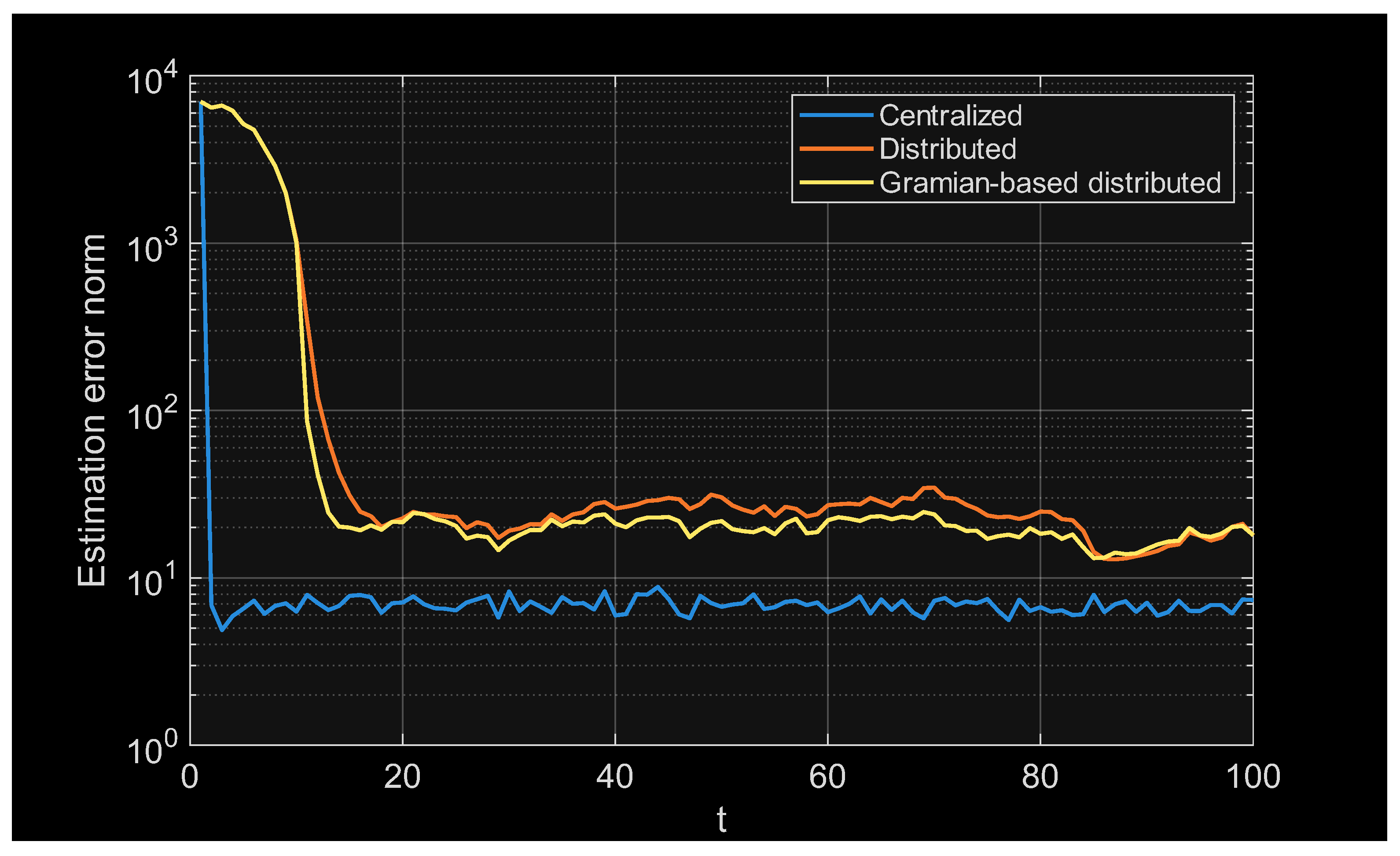
Figure 2.
Average estimation error norm in the quantized stable regime with 25 bits.
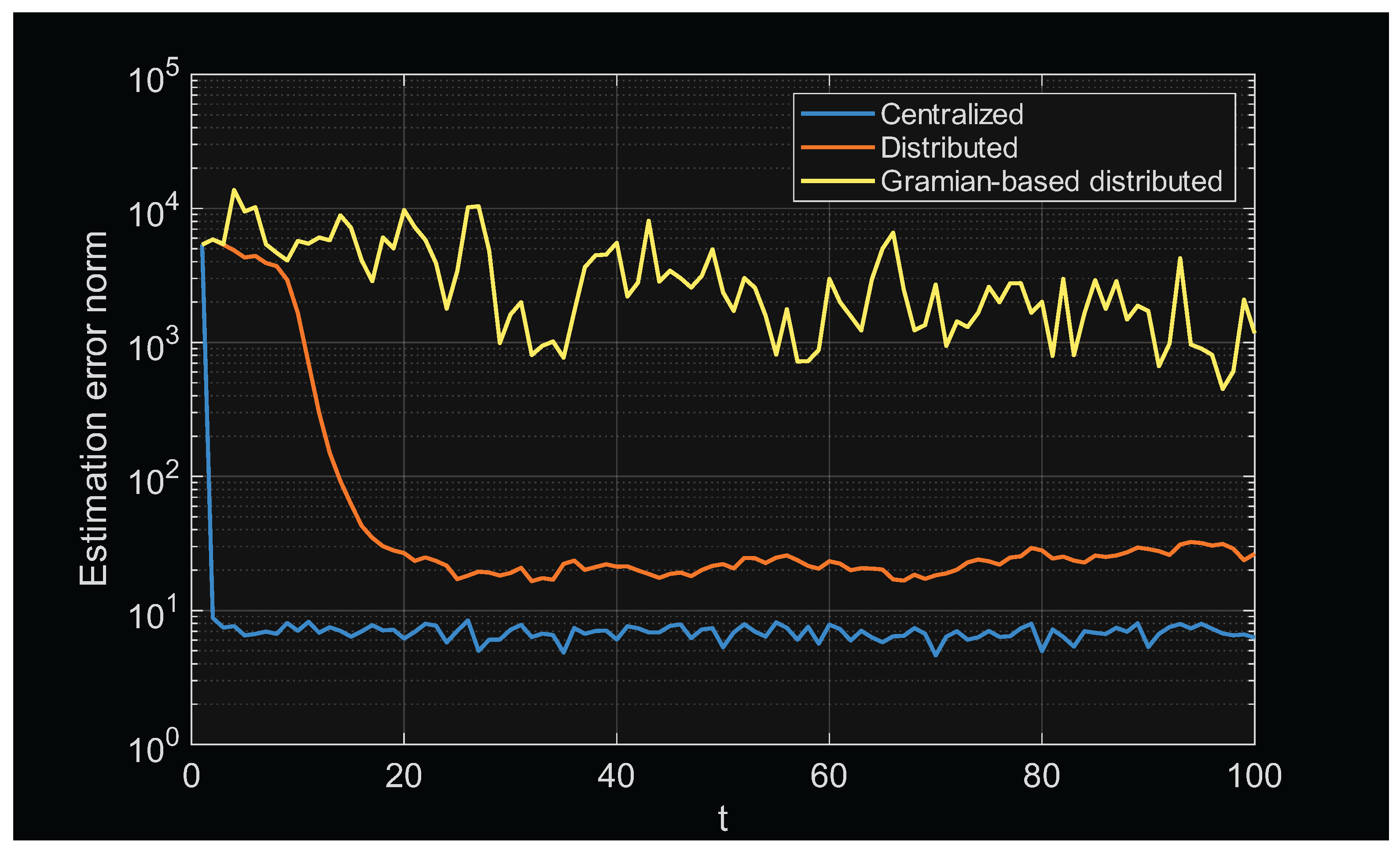
Figure 3.
Adaptive quantization steps and in the stable quantized regime with 25 bits.
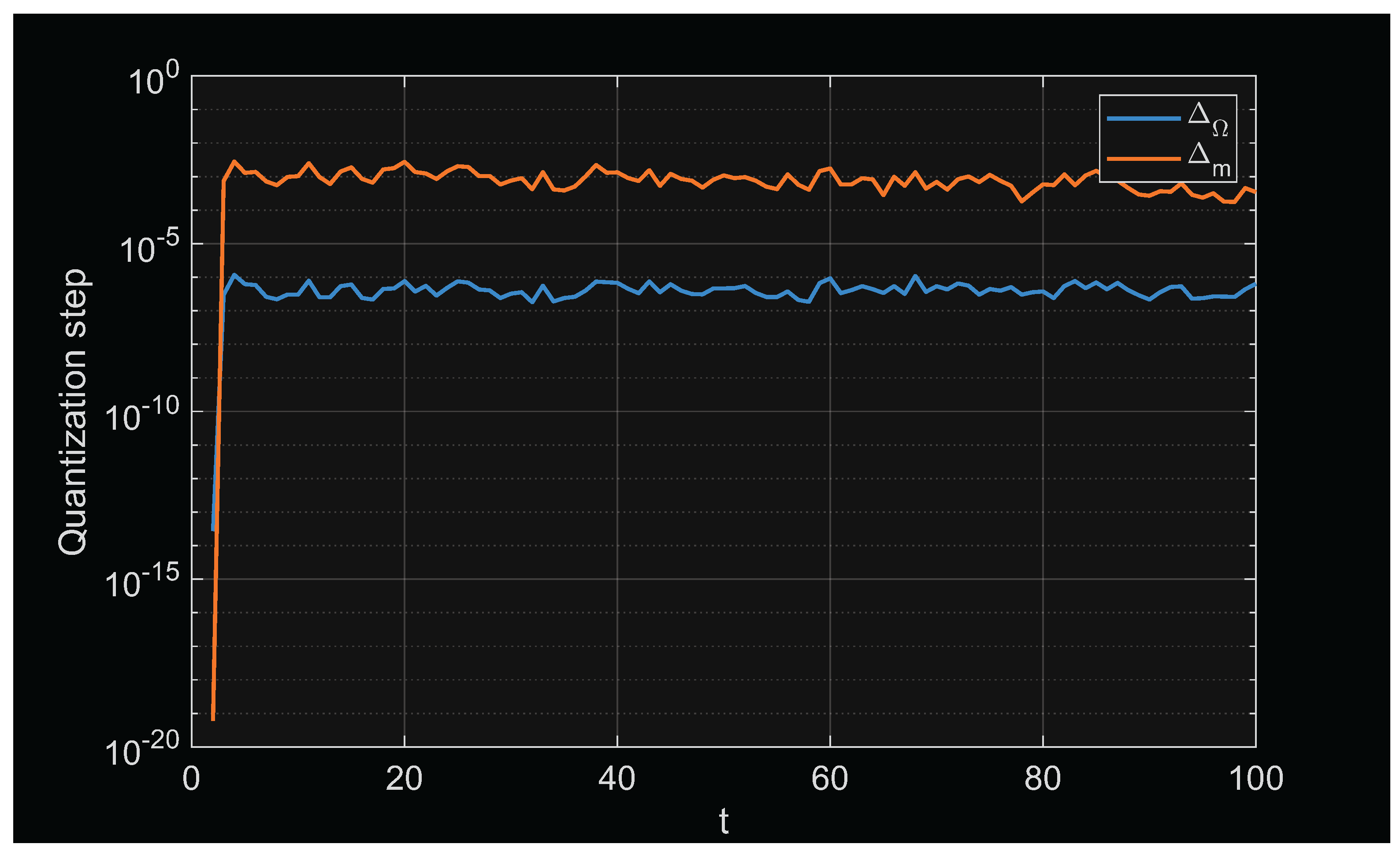
Figure 4.
Adaptive quantization ranges and in the stable quantized regime with 25 bits.
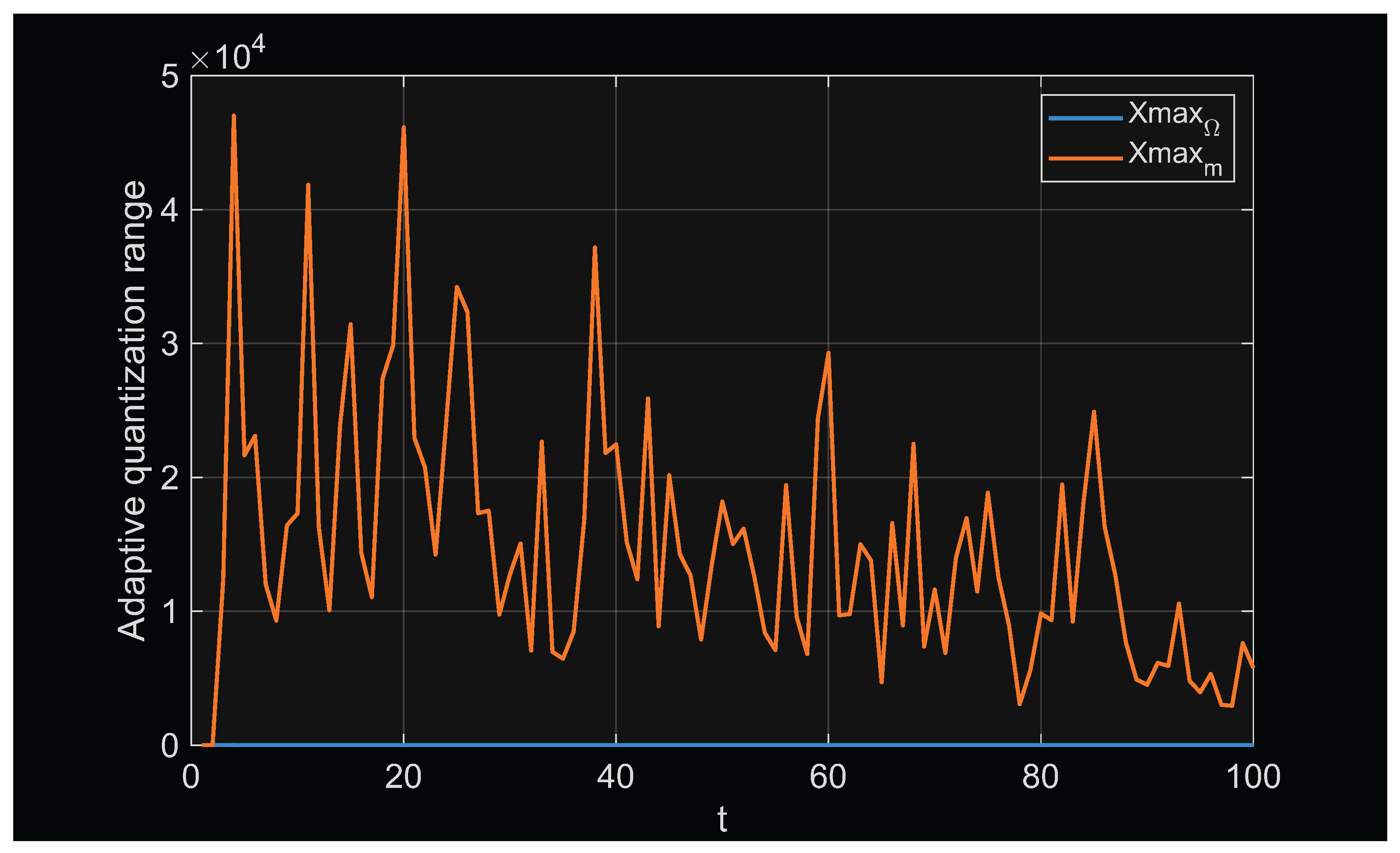
Figure 5.
Adaptive quantization steps and in the unstable quantized regime with 23 bits.
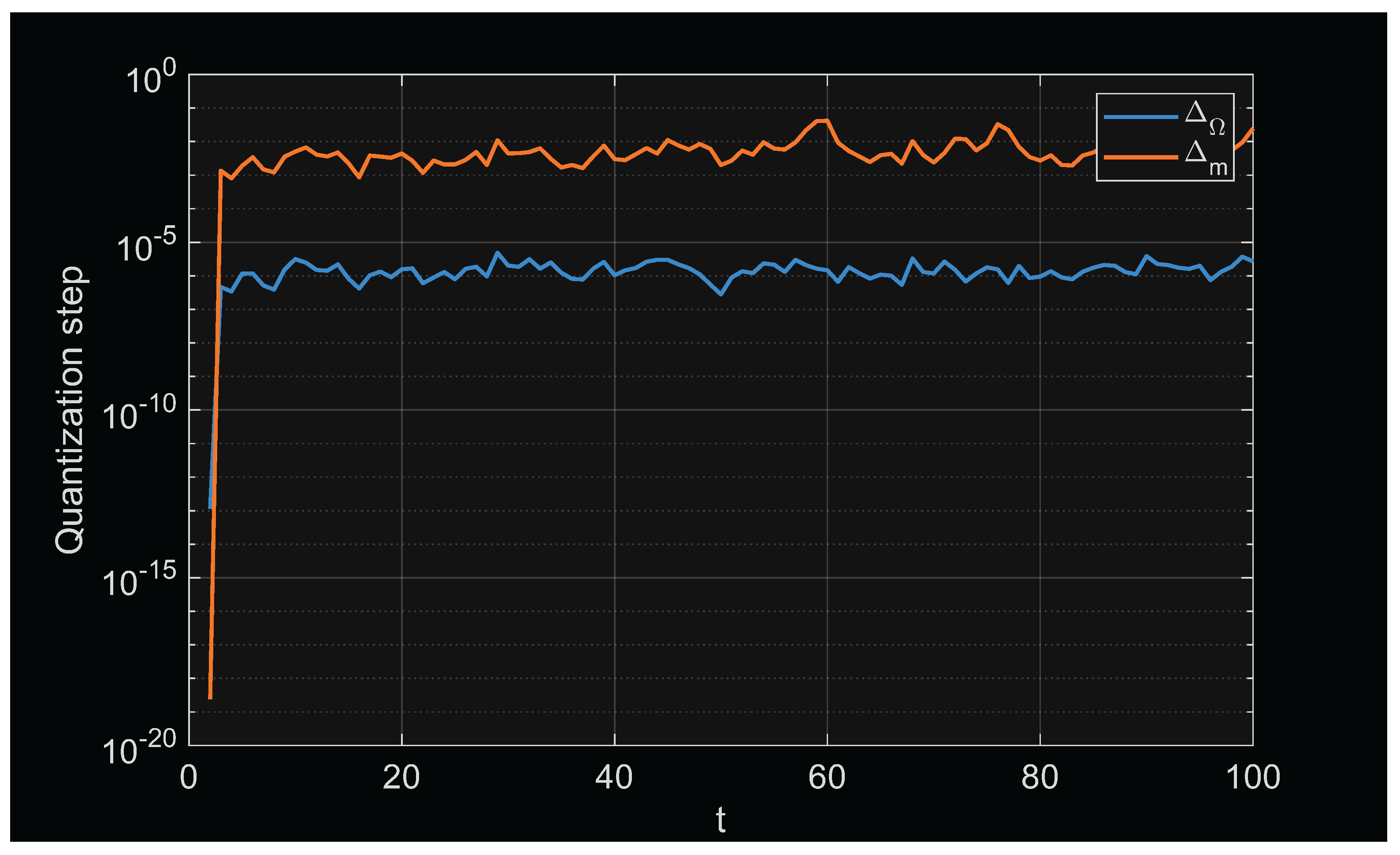
Figure 6.
Adaptive quantization ranges and in the unstable quantized regime with 23 bits.
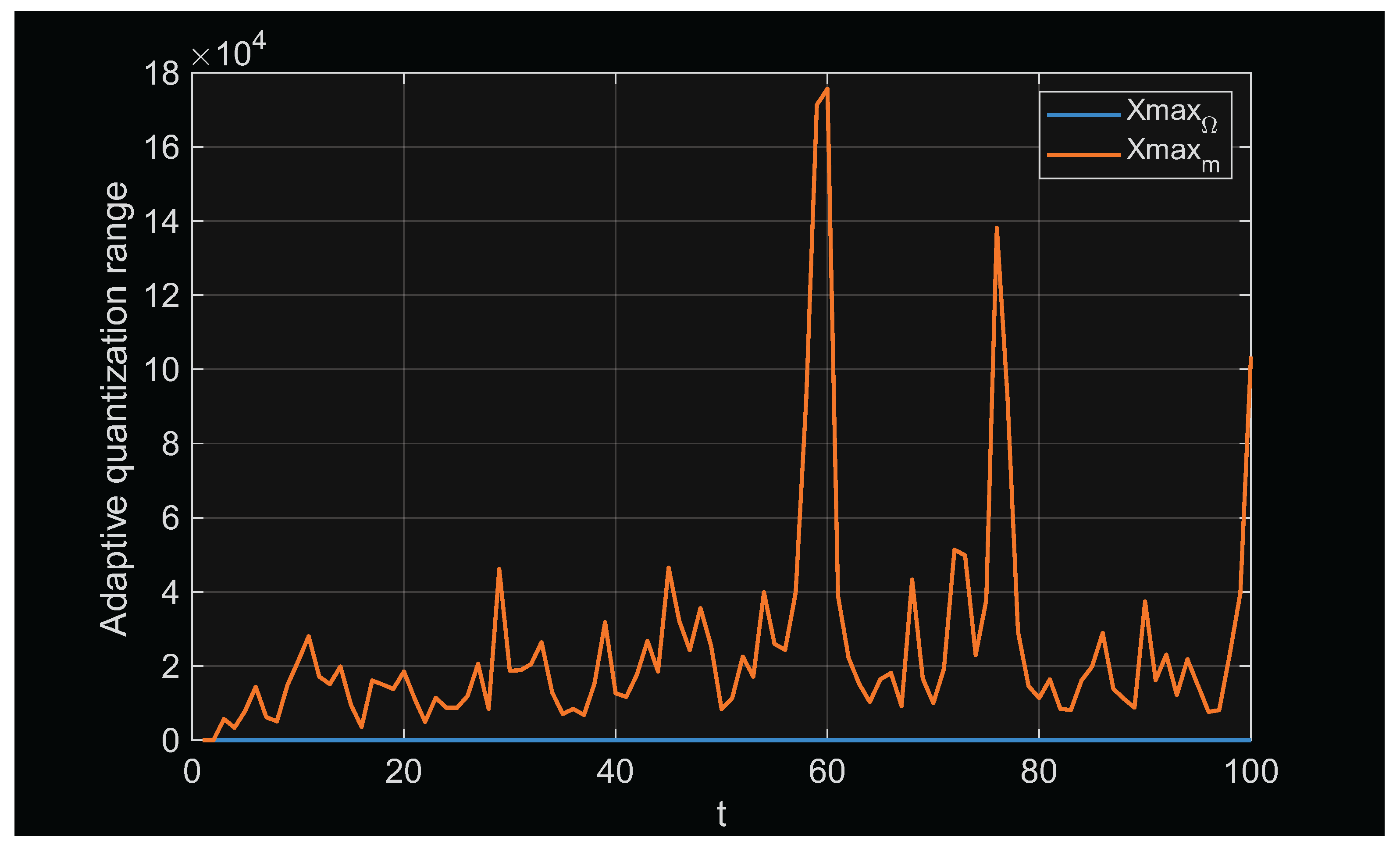
Disclaimer/Publisher’s Note: The statements, opinions and data contained in all publications are solely those of the individual author(s) and contributor(s) and not of MDPI and/or the editor(s). MDPI and/or the editor(s) disclaim responsibility for any injury to people or property resulting from any ideas, methods, instructions or products referred to in the content. |
© 2026 by the authors. Licensee MDPI, Basel, Switzerland. This article is an open access article distributed under the terms and conditions of the Creative Commons Attribution (CC BY) license (http://creativecommons.org/licenses/by/4.0/).
Copyright: This open access article is published under a Creative Commons CC BY 4.0 license, which permit the free download, distribution, and reuse, provided that the author and preprint are cited in any reuse.


