
Submitted:
07 April 2026
Posted:
08 April 2026
You are already at the latest version
Abstract
Cardiorenal syndrome type 1 (CRS-1) is defined as acute kidney injury (AKI) caused by acute decompensated heart failure (ADHF). Heart failure with preserved ejection fraction (HFpEF) is an increasingly prevalent subtype of heart failure. A significant number of patients with HFpEF during episodes of acute decompensation (ADHFpEF) develop CRS-1. The most important pathophysiological mechanisms leading to the development of CRS-1 in these patients are hemodynamic disturbances (elevated central venous pressure, elevated intra-abdominal pressure and pulmonary hypertension) and inflammation. Loop diuretics alone or in combination with thiazide diuretics and mineralocorticosteroid receptor antagonists are the mainstay therapeutic option for treating congestion in patients with ADHFpEF and CRS-1. Introducing SGLT-2 inhibitors as soon as clinically possible can further enhance diuresis and have a positive impact on reducing cardiorenal adverse events. Development of CRS-1 is a well known independent predictor of a worse outcome in patients with heart failure, although this impact appears to be less associated in patients with HFpEF, as compared to patients with HF with reduced EF. Further studies are needed to achieve a better understanding of pathophysiological mechanisms, and to introduce new treatment protocols, which would have a positive impact on cardiac and renal outcomes in these patients.
Keywords:
cardiorenal syndrome
; acute heart failure with preserved ejection fraction
; acute kidney injury
; therapy
; prognosis
Introduction
The kidneys and the heart are closely connected, and the dysfunction or failure of one organ leads to the dysfunction or failure of the other. A spectrum of disorders involving both the heart and kidneys, wherein acute or chronic dysfunction of one organ leads to acute or chronic dysfunction of the other organ, are encompassed by the term cardiorenal syndrome (CRS). There are five types of CRS categorized according to the primarily failing organ (the kidneys or the heart) and according to whether the failure is acute or chronic. CRS type 1 and type 3 are considered as acute, indicating that they are caused by acute deterioration of heart or kidney function, whereas CRS type 2 and type 4 are considered to be chronic conditions as they are caused by chronic heart or kidney failure. Finally, CRS type 5 integrates all cardiac and kidney involvement induced by systemic disease [1,2,3,4,5,6]. The five types of CRS are presented in Table 1.
CRS type 1 (CRS-1) is defined as acute kidney injury (AKI) caused by acute decompensated heart failure (ADHF). AKI is a common complication of ADHF and affects more than 50% of hospitalized patients [7,8,9,10]. The definition of AKI: a rise of 0,3-0,5mg/dl in serum creatinine with a decrease in glomerular filtration rate (GFR) of 9-15ml/min within 48 hours, or a rise of serum creatinine of ≥1.5 times within 7 days, as compared to the baseline value. The second parameter indicating the development of AKI is a decrease in urine output, and this parameter is used to determine the severity of AKI—oliguria to anuria indicates a severe degree of AKI [11,12,13,14,15,16]. There are four subtypes of CRS-1: 1) de novo ADHF leading to de novo AKI; 2) de novo ADHF leading to AKI in patients with already known chronic kidney disease (CKD); 3) ADHF in patients with previously known chronic heart failure (CHF) leading to de novo AKI; and 4) ADHF in patients with previously known CHF leading to AKI in patients with previously known CKD [15].
Heart failure with preserved ejection fraction (HFpEF) is an increasingly prevalent subtype of heart failure whose rate has risen in the past decade by 10%, relative to heart failure with reduced ejection fraction (HFrEF). This is caused primarily by the aging of the population and the increasing prevalence of comorbidities, which are also risk factors for HFpEF. HFpEF is associated with substantial morbidity, including a HF hospitalization rate of 35% and a 14% mortality rate during two-year follow-up. Compared with patients with HFrEF, patients with HFpEF are generally considered to have lower mortality. The large, MAGGIC meta-analysis has confirmed that the adjusted mortality for patients with HFpEF was considerably lower, as compared with patients with HFrEF, although in many observational studies this difference was negligible [17,18].
More than 50% of patients hospitalized for ADHF have a preserved ejection fraction [19]. According to data from the literature, CRS-1 development during episodes of ADHF seems to be more common in patients with HFpEF, as compared with patients with ADHF who have a reduced ejection fraction (ADHFrEF) [10,18]. CRS significantly complicates the course of in-hospital recovery and affects the prognosis of patients with ADHF. However, most data regarding CRS-1 development, progression, therapeutic options, and prognosis are related to patients with ADHFrEF. There are fewer data about CRS-1 in patients with ADHF and a preserved ejection fraction (ADHFpEF). In fact, most of the data are related to development and prognostic impact of CRS type 2 in these patients [9,20,21,22,23,24]. Since a significant number of patients with ADHF have a preserved EF and are at risk of or develop CRS-1 during hospitalization, it is of clinical importance to understand the mechanisms, the therapeutic approach, and prognostic impact of CRS-1 in patients with ADHFpEF.
In this narrative review, we will attempt to summarize the data about the epidemiology, specific pathophysiological mechanisms, therapeutic options, and prognostic impact of CRS-1 in patients with ADHFpEF.
Risk Factors for CRS-1 Development in Patients with ADHFpEF
Old age, hypertension (HTN), diabetes mellitus (DM), obesity, chronic kidney disease (CKD), and coronary microvascular dysfunction are the most commonly reported risk factors for HFpEF, but also for CRS-1 development in patients during acute decompensation [5,6,19,25,26,27].
Age is associated with increased arterial stiffness, myocardial stiffness, decreased diastolic relaxation, and HFpEF development. Also, with aging, kidney function declines, which is why older patients have lower GFR values which places them at higher risk of AKI [27]. Long-standing hypertension is one of the most common risk factors for HFpEF as it leads to cardiac remodeling, which causes left ventricular concentric hypertrophy and diastolic dysfunction [20]. Hypertension is also a risk factor for kidney dysfunction [28]. Furthermore, hypertension at a patient’s initial presentation as a part of ADHF has been associated with CRS-1 development during hospitalization, probably as a reflection of strong neurohumoral activation and sodium and water retention [9,29].
Diabetes mellitus (DM) is one of the most common causes of reduced kidney function and is also a risk factor for myocardial remodeling that leads to HFpEF. Obesity is also a risk factor for HFpEF, but its impact on CRS-1 development is complex and has not been confirmed in all studies. However, many studies have demonstrated that the increased number of adipocytes in obese patients secrete high levels of proinflammatory cytokines, which may, in turn, facilitate the development of AKI in patients with ADHF [5,16,29,30,31,32]. More than 60% of patients with CRS-1 have baseline CKD [2,10]. The explanation for the development of CRS-1 in patients with preserved baseline renal function could be that, during their lifetime, some individuals undergo repeated episodes of subclinical or clinically unrecognized episodes of AKI. These episodes occur with episodes of dehydration, nephrotoxic therapy for other diseases, etc. With every AKI episode there is injury to some nephron units. Kidneys have the ability to alter their blood flow and filtration and usually recover their function, but the number of remaining nephrons declines. This can be an explanation why some patients with normal renal function easily develop CRS-1 in the settings of ADHF [29]. Therapy for ADHF can also have an impact on CRS-1 development in hospitalized patients – high (loop) diuretic doses may be associated with CRS-1 development probably due to the activation of the renin-angiotensin-aldosterone system (RAAS) [16]. Other drugs, such as medication used for DM treatment (e.g., metformin), some antibiotics, or the administration of iodine contrast, may also affect the delicate balance between the heart and the kidneys during episodes of ADHF, and contribute to the occurrence of AKI [29].
Finally, coronary microvascular dysfunction has also been proposed as a novel mechanism for HFpEF and reduced renal function. In the PRevalence Of MIcrovascular DySfunction in Heart Failure with Preserved Ejection Fraction (PROMIS-HFpEF) trial, a worse coronary flow reserve (CFR) was associated with a higher urine albumin-to-creatinine ratio, which is an important diagnostic and prognostic marker in patients with CKD. This finding may indicate that patients with a worse CFR are at higher risk of AKI during an episode of ADHF, but the association of coronary microvascular dysfunction and CRS-1 development should be clarified in future studies [20].
Pathophysiology
The connections between the heart and the kidneys in patients with HFpEF are complex and not as yet completely understood [10,21,26]. The “vicious circle” between the heart and the kidneys that leads to the development and progression of CRS-1 also exists in patients with ADHFpEF, but with some differences, as compared with patients with ADHFrEF. The primary pathophysiological mechanisms leading to the development of AKI and CRS-1 in the context of ADHFpEF are hemodynamic mechanisms and include elevated central venous pressure (CVP), increased intra-abdominal pressure (IAP), and pulmonary hypertension [21,33].
The hallmark of ADHFpEF is the so-called backward heart failure, which causes increased CVP. In animal models, it has been demonstrated that an increase in CVP by 20 mmHg raises pressure in the renal veins, reduces urine flow by 30%, increases interstitial pressure in the kidneys, which leads to compression and increased pressure in the renal tubules and a decline in GFR, and, in the chronic course, also to the development of interstitial fibrosis [20,28,34]. The significance of elevated CVP in the development of CRS was also demonstrated in the clinical Evaluation Study of Congestive Heart Failure and Pulmonary Artery Catheterization Effectiveness (ESCAPE) trial [35]. Elevated IAP (≥8 mmHg) occurs as a consequence of increased CVP and is common in ADHFpEF. Elevated CVP causes a progressive shift of blood from effective circulatory volume to splanchnic capacitance veins. At some moment the IAP splanchnic veins capacitance function is overwhelmed, causing a significant rise in IAP (≥12mmHg). This, in turn, causes the renal venous pressure to rise, causing a drop in GFR and tubular dysfunction, as already mentioned above [20]. Pulmonary hypertension as a consequence of elevated left ventricular filling pressure leading to elevated right atrial pressure also contributes to CVP and the rise in IAP. As a consequence of AKI, neurohumoral activation occurs, leading to further pulmonary vascular remodeling, progression of pulmonary hypertension, and progression of kidney injury [20].
Chronotropic incompetence is the inability of the heart rate to increase appropriately with physical demand, which is common in patients with heart failure, especially in patients with HFpEF. It is related to autonomic dysfunction with decreased baroreflex sensitivity and increased sympathetic stimulation [20,27,34]. In patients with HFpEF, chronotropic incompetence reflects reduced beta-adrenergic responsiveness and seems to contribute to renal hypoperfusion, which can lead to AKI [20].
All previously mentioned hemodynamic mechanisms lead to the reduction of the gradient in the glomerular capillary network and to a decrease in GFR, which causes an increase in renin activity, an increase in aldosterone levels (generally, activation of the renin–angiotensin–aldosterone system – RAAS), and proteinuria [6,20,27].
RAAS activation is a well-known adaptive mechanism in patients with HFrEF (in whom reduced cardiac output is the first step towards and the main cause of reduced GFR), but it seems that RAAS activation is generally of lesser importance in patients with HFpEF than in patients with HFrEF.
Endothelial dysfunction and inflammation (through activation of proinflammatory cytokines, such as tumor necrosis factor alpha, interleukin-1, and interleukin-6) seem to be more important factors in CRS development in patients with ADHFpEF. Endothelial dysfunction with reduced nitric oxide (NO) bioavailability and signaling is identified as the primary pathophysiological abnormality in patients with HFpEF. Also, NO regulates renal hemodynamic and glomerular microcirculation and inhibits proximal tubular sodium reabsorption. Endothelial dysfunction and reduced NO production leads to disturbances in glomerular circulation and enhances tubular sodium reabsorption [20]. Inflammatory cytokines can induce AKI via activating death signaling receptors which cause tubular cell apoptosis [33]. Other nonhemodynamic factors responsible for the vicious circle between the heart and the kidneys are the reactive oxygen species (ROS). Reactive oxygen species lead to the oxidative injury of cardiomyocytes and renal tubular epithelial cells, thus worsening heart and kidney function [27]. Also, enhanced RAAS activation leads to ROS and stimulates proinflammatory cytokine production with renal consequences, as noted above [6,20,28].
The possible mechanisms that lead to CRS-1 development and progression in the setting of ADHFpEF are presented in Figure 1.
Diagnosis
In patients with acute HFpEF, the CRS-1 diagnosis is established based on the standard criteria for diagnosing ADHFpEF (with echocardiographic evidence of preserved EF ≥50% and diastolic dysfunction), together with the simultaneous presence of AKI [16,18]. However, diagnosing AKI in patients with ADHF can be complex as small fluctuations in the serum creatinine level (and urine output) are often observed in patients with ADHF. Diagnosis AKI rests on a combination of clinical assessment of congestion status, relevant hemodynamic parameters, the serum creatinine level, detection of markers of possible intrinsic kidney injury (such as urine microscopy), as well as through the investigation of alternative explanations for serum creatinine elevation [4,8,27].
Echocardiography is the most important method for diagnosing HFpEF. In addition to its use in detailed analysis of cardiac function, echocardiography can be applied to assess central venous pressure, systolic pulmonary artery pressure, and pulmonary capillary pressure. Pulmonary ultrasound is important for assessing pulmonary congestion and can potentially serve as a guidance tool for decongestion without triggering the worsening of renal function (WRF), by identifying a reduction in the number of pulmonary B lines [18]. Renal ultrasonography provides information about chronicity of renal disease including renal size, echogenicity, cortical thickness, and abnormal corticomedullary ratio, which is important in diagnosing AKI and demonstrating the presence of previous CKD. Additionally, renal ultrasonography of intrarenal venous flow patterns is an emerging tool in diagnosing renal venous congestion as a very important cause for CRS-1 development in patients with ADHFpEF [4,6].
B-type natriuretic peptide (BNP) and N-terminal-pro BNP (NTproBNP) are well known biomarkers for myocardial stretch, and are commonly used for diagnosing ADHF [6,18,20], but they are less sensitive for HFpEF [34]. Increased BNP levels during episodes of ADHF are linked to a higher risk of AKI. On the other hand, BNP levels are also significantly higher in patients with CRS-1, as compared with patients with AHF without renal impairment [27].
There are many proposed potential biomarkers for diagnosing AKI before a rise in serum creatinine occurs (such as kidney-injury molecules-KIM-a, neutrophil gelatinase-associated lipocalin (NGAL), etc). However, unfortunately, none of these markers seem reliable for early AKI diagnosis and the follow-up of kidney function, due to their dependence on volume status, renal inflammation, neurohumoral activation, etc. [4,21,36,37]. The most promising biomarker for early detection of AKI could be NGAL. NGAL (siderocalin) is a biomarker of tubular injury that can be detected in blood and urine in patients with AKI, 48-72 hours before the rise in the creatinine level [8,28,33,38]. This biomarker has been studied in CRS, and it seems that it may have some diagnostic and prognostic value in patients with AHF. There are data demonstrating that in hospitalized patients with ADHF an elevated plasma NGAL level at admission predicts AKI (although the studied patients were predominantly with ADHFrEF). On the other hand, the value of NGAL in ADHF was analyzed in the AKINESIS trial which found that plasma NGAL was not superior to creatinine for predicting WRF [6,33]. The urine NGAL level seems to be more sensitive in the early detection of AKI, as compared with the plasma level of NGAL [20].
Another novel biomarker is C-natriuretic peptide (CNP). CNP belongs to the family of natriuretic peptides but demonstrates predominantly antiproliferative and antifibrotic effects. The plasma level of CNP is normally low because CNP predominantly acts as a paracrine and autocrine factor. Urinary CNP is derived from local renal production, and it reflects renal structural integrity and function. Elevated urinary CNP levels have been detected in patients with ADHF, suggesting activation of renal natriuretic peptides in response to acute congestion, and may represent a marker of underlying AKI [6].
Despite all the presented data, currently, the role of novel renal biomarkers applicable for early diagnosis of AKI and CRS-1 needs further validation. In the meantime, serum creatinine-based definitions remain a strong tool in diagnosing AKI in everyday clinical practice [7].
Therapeutic Options
The most important therapeutic options in patients with ADHFpEF and CRS-1 are presented in Table 2
Loop diuretics are the mainstay therapeutic option for treating congestion in patients with ADHFpEF and CRS-1 [22,25]. In patients with ADHFpEF, diuretics are absolutely necessary for decongestion, but they must be applied with particular caution to avoid significant reduction in preload during their use, given that patients with HFpEF are preload-sensitive. Any decrease in preload in these patients leads to a reduction in cardiac output, which then further results in renal hypoperfusion and worsening of CRS-1 [20,27].
The fluid volume, fluid distribution, and diuretic response differ in patients with ADHFrEF and ADHFpEF [20]. There are data indicating that patients with ADHFpEF demonstrate an overall lesser intravascular volume expansion and a greater interstitial fluid expansion, as compared with patients with HFrEF. Diuretic therapy in patients with ADHFpEF leads to the loss of more total bodily fluid, as compared with patients with ADHFrEF [39]. In one study, which included patients with ADHF, it was found that the estimated plasma volume reduction with diuretics was associated with more frequent WRF in patients with ADHFpEF, but not in patients with ADHFrEF [20,40]. These findings indicate that patients with ADHFpEF are more susceptible to developing WRF or AKI with diuretic therapy than patients with ADHFrEF, due to the decrease in their preload [20,27].
However, despite these findings, principles of loop diuretics dosing and administration do not differ significantly between patients with ADHFpEF and patients with ADHFrEF. The dosing of diuretics should lead to decongestion, while preserving adequate renal perfusion. Doses of loop diuretics depend on whether patients were on daily oral diuretics before hospital admission or not [18,41,42,43]. Given that HFpEF is common in obese patients, dosing of diuretics in these patients requires higher doses than those that are usually recommended, and dosing according to body weight should also be considered [42].
Although intravenous loop diuretics can be administered as intravenous boluses or as continuous infusion, in the ROPA-DOP study it was found that in patients with ADHFpEF continuous intravenous loop diuretic therapy was associated with a higher rate of AKI, as compared with intermittent intravenous bolus dosing. The explanation for this finding may lay in the preload dependence and different fluid distribution in these patients (as mentioned previously). Continuous intravenous infusion of loop diuretics may not allow the adequate re-equilibration of intra- and extravascular volumes in the setting of acute decongestion, but when using intermittent intravenous boluses there is enough time between boluses for re-equilibration of intra- and extra-vascular volumes [20].
Accurate determination of volume status may be necessary in patients with ADHFpEF, and in patients who do not respond adequately on initial diuretic therapy, right heart catheterization and pulmonary artery catheter implantation should be considered, especially in those with WRF and without adequate diuresis [20]. Also, according to the results of the Pragmatic Urinary Sodium-based treatment algoritHm in Acute Heart Failure (PUSH-AHF) study, natriuresis-guided dosing of diuretic therapy in patients with ADHFpEF (which is based on the same principles as in patients with ADHFrEF) improved diuretic response and alleviated congestion [42,44,45,46,47]. These findings were confirmed in a meta-analysis and systematic review performed by Prata et al., which included three randomized controlled trials and two observational studies. Protocolized natriuresis-guided therapy was confirmed safe, reducing the risk of AKI [45]. Target diuresis after starting intravenous loop diuretic therapy in congested patients should be >100–150 ml/h and the spot urine sodium concentration should be >50–70 meq/L [46].
CRS is also defined as a state wherein effects of diuretic therapy are limited by the development of resistance to loop diuretics, which is considered as one of the hallmarks of CRS-1 [6,11,12,28,34,42]. The causes of diuretic resistance in patients with ADHFpEF include enhanced distal nephron sodium reabsorption and elevated CVP, which causes decreased renal perfusion and interstitial congestion that limits loop diuretic delivery to the proximal tubule [42,48]. The most important ways of resolving the problem of diuretic resistance in patients with HFpEF include combinations of diuretics (so-called sequential nephron blockade) and methods of renal replacement therapy (RRT).
The first step in resolving diuretic resistance is the combination of loop diuretics with thiazides and mineralocorticoid receptor antagonists (MRAs). However, it should be noted that studies analyzing the success of diuretic combinations in overcoming resistance have mostly included patients with ADHFrEF. In the Combination of Loop with Thiazide Diuretics in Patients with Decompensated Heart Failure (CLOROTIC) trial, treatment with thiazides in addition to loop diuretics showed greater weight loss in the group with combined therapy. However, in the thiazide group, a somewhat higher percentage of patients with registered WRF was recorded, compared with the group treated with loop diuretics alone [12]. MRAs (spironolactone, eplerenone and finerenone) are weak diuretics, but in combination with loop diuretics can prevent distal nephron sodium reabsorption, hypokalemia and in chronic settings can prevent myocardial fibrosis and remodeling [49]. Their long-term positive effect has been demonstrated in many previous studies in patients with HFrEF and in patients with heart failure with middle range ejection fraction. In meta-analysis by Zaheen et al. it was shown that in patients with HFpEF treatment with spironolactone and eplerenone improved echocardiographic parameters of diastolic dysfunction and blood pressure control, but had no influence on clinical outcomes [49]. Also, one preclinical study conducted on male hypertensive and diabetic rats with HFpEF revealed that finerenone treatment for 12 weeks resulted in reduced renal hypertrophy and cardiac fibrosis, and also improved cardiac diastolic function and perfusion [50]. MRAs are thought to have positive long-term effects on the kidneys because they are a very important part of neurohumoral blockade. However, in patients with CRS-1 careful titration of MRAs is necessary, with close monitoring of kidney function and electrolytes. There are data indicating that treatment with finerenone was less associated with rise in serum potassium level [51,52].
A combination of loop diuretics and acetazolamide was analyzed in the Acetazolamide in Decompensated Heart Failure with Volume Overload (ADVOR) trial. Treatment with acetazolamide also improved diuresis and decongestion, as compared to treatment with loop diuretics only, but with no difference in all-cause mortality and heart failure rehospitalization in the follow-up period [51].
The use of RRT is recommended if, despite all previous measures, there is no effective decongestion. Also, RRT is necessary in patients with CRS-1 and oliguria, electrolyte disbalance, acid-base disbalance, and/or signs of uremia (e.g., patients with AKI and customary nephrological criteria for starting RRT). RRT can result in many adverse events, including further WRF to the terminal stage [46,51]. Unless the patient has uremia, electrolyte disbalance, or metabolic acidosis, in which case starting RRT is necessary as soon as possible, in patients with ongoing congestion and diuretic resistance there is no clear evidence of the best timing for starting RRT [46]. Studies have not demonstrated the superiority of RRT over diuretic therapy, either in terms of decongestion or in terms of prognosis. In a large meta-analysis, early initiation of RRT did not influence 28-days all-cause mortality, as compared with delayed RRT in critically-ill patients with AKI. Furthermore, early initiation of RRT was associated with a higher hypotension rate and with RRT-associated infections [46].
The Diuretic Optimization Strategies Evaluation (DOSE) trial, the Ultrafiltration versus Intravenous Diuretics for Patients Hospitalized for Acute Decompensated Congestive Heart Failure (UNLOAD) trial, and the Cardiorenal Rescue Study in Acute Decompensated Heart Failure (CARRESS-HF) trial compared the different decongestion strategies in patients with volume overload, but without AKI [53,54]. WRF was reported more often in patients treated with high doses of loop diuretics than in patients treated with ultrafiltration (UF), in the DOSE trial, and more often in patients treated with UF than in patients treated with diuretic therapy, in the CARRESS-HF trial. Also, UF led to a greater increase in plasma-renin activity, as compared to stepwise pharmacological care [4]. On the other hand, there was no difference in the prevalence of WRF between treatment groups (diuretics vs. UF) in the UNLOAD trial. Although decongestion was better in patients treated with UF, there was no difference in prognosis between two analyzed groups [54]. However, results of the CARRESS-HF provided a strong argument against the use of UF as primary treatment in patients with ADHF [4]. It is very important to note that the above-mentioned trials and meta-analysis comparing UF and diuretic therapy in patients with ADHF did not mention the EF of the included patients (e.g., no differentiation between HFpEF and HFrEF was made) [20].
Other possible ways for overcoming diuretic resistance may include the following: vasodilator therapy, therapy with sodium glucose-2 transporter (SGLT-2) inhibitors, avoiding and correcting hypochloremia, and adding a vasopressin V2 receptor antagonist only in selected patients.
Vasodilation with direct vasodilators, such as nitrates in combination with hydralazine, can affect central hemodynamics and indirectly enhance diuresis. However, this therapy is reserved only for hypertensive and possibly normotensive patients, with blood pressure monitoring. Although patients with ADHFpEF often have elevated blood pressure, vasodilator therapy, especially venodilators, may cause prompt blood pressure decrease, which decreases pre-load and consequently cardiac output. This may contribute to a significant decrease in renal perfusion and aggravate AKI [53,54,55].
Milrinone acts as an inotropic agent, but with strong pulmonary and systemic vasodilation effects leading to greater reduction of filling pressures and is often preferred in patients who were previously treated with beta-blockers, as its mechanisms bypass adrenergic signaling [42]. Its effect on lowering filling pressure makes it adequate in certain patients with ADHFpEF. Nevertheless, milrinone should also be used cautiously due to the risk of systemic hypotension [8,42].
It has recently been suggested that the chloride anion is important for preserving serum osmolarity together with sodium. The chloride anion is also responsible for maintaining the fluid acid-base balance, wherein it “competes” with serum bicarbonate. Hypochloremia leads to changes in the distal nephrons, which, in turn, contribute to diuretic resistance and impaired decongestion. Findings from numerous studies have confirmed that there is an association between hypochloremia and poor decongestion [6,48]. However, at this moment, it is unclear whether chloride levels are only markers of severity and prognosis of CRS, or whether they can be a distinctive therapeutic target [6].
Tolvaptan, a direct vasopressin V2 receptor antagonist, has been associated with a greater degree of urine output and weight loss, when added to standard diuretic therapy, but without showing improvement in outcomes or rehospitalization [12]. Currently, tolvaptan is used for treating significant hypervolemia and euvolemic hyponatremia. Tolvaptan is not approved for ADHF treatment, even in patients with diuretic resistance, although it is reasonable to use it in patients with ADHF and hyponatremia resistant to ACEi treatment. There are no available data on tolvaptan efficacy in patients with ADHF in relation to the left ventricular ejection fraction value [25].
Currently, it appears that sequential nephron blockade is the most effective method for faster and more efficient decongestion, especially if, after the introduction of loop diuretics, adequate diuresis is not achieved. However, it should be emphasized that the therapeutic approach to the patient must be individualized.
Persistently elevated intraabdominal pressure after therapy has been associated with deterioration of renal function, regardless of central hemodynamic measures [56]. Reduction of intraabdominal pressure (IAP) following intensive medical therapy seems to be associated with improvement in renal function. Prompt reduction in IAP by paracentesis has been associated with improvement of renal function [57].
In patients with acute HFrEF, there is clear evidence that, even during an episode of acute decompensation, it is advisable to introduce therapy that has proven positive effects on prognosis, or not to discontinue such therapy, if possible. On the other hand, HFpEF is a clinical syndrome with limited therapeutic options [49].
In patients with HFpEF, SGLT-2 inhibitors are the only recommended therapy that has a positive effect on the prognosis and enhances the diuretic effect of loop diuretics in acutely decompensated patients [24,58]. This recommendation is based on the results of the Empagliflozin Outcome Trial in Patients with Chronic Heart Failure with Preserved Ejection Fraction – EMPEROR-Preserved trial, the Dapagliflozin Evaluation to Improve the Lives of Patients with Preserved Ejection Fraction Heart Failure – DELIVER trial, and the DAPA-HF trial. The results of the EMPEROR-Preserved trial have shown beneficial effects of empagliflozin, in terms of the reduction of the combined risk for cardiovascular death or hospitalization for heart failure, in patients with HFpEF, independently of diabetic status. Similar results have been found in the DAPA and DELIVER trials, wherein dapagliflozin was tested [21,34,59,60]. A meta analysis of EMPEROR and DELIVER trials confirmed a 20% reduction of composite end-point comprising cardiovascular deaths and first hospitalizations for ADHF. The beneficial effects were consistent across the EF range studied. Another meta-analysis, which included data from the DAPA-HF and DELIVER trials, confirmed that the positive effect of dapagliflozin did not differ in relation to EF [59]. SGLT2 inhibitors have positive neurohumoral effects; they also stimulate osmotic diuresis and natriuresis, decrease plasma volume, and lower blood pressure. These effects make them very useful in acute congestion and in patients with diuretic resistance [6,42,60]. When added to loop diuretics, SGLT2 inhibitors can help achieve and maintain euvolemia. Unlike conventional diuretics, SGLT-2 inhibitors preferentially remove interstitial fluid while preserving plasma volume, probably through enhanced lymphatic drainage and by maintaining capillary permeability [24]. In a randomized, blinded study, dapagliflozin initiated early in patients with ADHF improved the diuretic efficiency of loop diuretics [22]. The results of the randomized controlled Dapagliflozin in Acute Heart failure (DICTATE-AHF) trial showed that patients who received dapagliflozin 10mg were treated with a lower loop diuretic cumulative dose, as compared with patients on the placebo protocol (all patients received loop-diuretics with or without metolazone) [61,62]. SGLT-2 inhibitors lead to lower natriuresis compared with thiazide diuretics. One randomized trial has shown that dapagliflozin was not more effective at relieving congestion than metolazone, and patients receiving dapagliflozin received a larger cumulative dose of loop diuretics [46]. On the other hand, the EMPULSE study found that in hemodynamically stable patients with ADHF, introducing empagliflozin within the first three days of hospitalization was associated with clinical benefits defined as: reduced death, reduced number of future ADHF events, longer time to the first ADHF event, and improved symptoms at 90-day follow-up. The results in patients with ADHF were consistent regardless of the EF value [59]. The results of all the abovementioned trials have shown that SGLT-2 inhibitors have a diuretic effect and that they can be safely introduced in hemodynamically stable patients with ADHF [46]. Since SGLT-2 inhibitors also have proven positive effects on renal function, they seem to be a promising treatment in patients with CRS [59]. The initial WRF that may be registered after SGLT-2 introduction is transitory; it is followed by kidney function recovery and has no adverse prognostic impact. A meta-analysis by Neuen et al. has shown a significantly reduced risk of AKI, dialysis, transplantation, and death due to kidney disease in patients treated with SGLT-2 inhibitors vs. placebo [63]. Canagliflozin decreases levels of TNF-alpha, IL-6, matrix metalloproteinases–7, and fibronectin suggesting that this SGLT-2 inhibitor attenuates molecular pathways related to inflammation and fibrosis. These positive mechanisms are important in preventing CKD progression and chronic CRS development, but it remains unclear how much they can reduce CRS-1 development and improve recovery in patients with CRS-1 [6].
The positive effects of RAAS inhibitors and beta-blockers on the prognosis of patients with HFpEF have not been clearly demonstrated. Many patients with HFpEF are treated with RAAS inhibitors due to associated HTN or DM, for which the use of RAAS is indicated. In patients with ADHFpEF and any WRF, introducing or continuing RAAS inhibitors should be done with caution [18,27]. In a meta-analysis that included studies investigating the impact of RAAS inhibitors on WRF in patients with HFrEF and HFpEF (only two studies included patients with HFpEF), it was found that, in patients with HFpEF, RAAS inhibitors induced WRF and these patients had an increased mortality risk [27,64]. The most likely explanation for these findings is that patients with HFpEF are highly preload-dependent, and treatment with ACE inhibitors and sartans can cause vasodilation and hypotension leading to preload reduction. The consequence is a drop in stroke volume and a further decrease in renal blood flow and GFR [20,27,65]. In the PARAMOUNT trial, it was found that sacubitril-valsartan may attenuate the decrease in renal function in patients with HFpEF, as compared with valsartan, in the chronic setting but not in acute HFpEF [65].
Finally, clinicians should always search for precipitating conditions that can cause ADHF and affect renal function, e.g., sepsis, systemic inflammatory disorders, etc. [34]. All conditions that precipitate ADHF and can also aggravate renal function should be identified in a timely fashion and properly treated. At the same time, medications that can adversely influence renal function (such as non-steroid anti-inflammatory drugs) should be discontinued [28].
The Difference Between Transitory Worsening of Renal Function (WRF) and CRS-1, and Their Prognostic Impact
During the natural course of cardiac dysfunction, cardiorenal interaction is of critical importance as reduced renal function predicts cardiovascular mortality and other adverse events [10,23,28,33,66]. Both AKI and CKD are well known independent predictors of a worse outcome in patients with heart failure, although this negative impact appears to be less associated with patients with HFpEF, as compared to patients with HFrEF [18]. Exceptions to this rule are patients with ADHF and transitory WRF, but with signs of decongestion; data show that they do not have an increased mortality risk nor a higher risk of other adverse events [6,18,56,67,68,69,70,71]. This was also confirmed in a study by Sharma et al. where it was found that WRF in ADHFpEF with successful decongestion had no impact on one-year survival and hospital readmission [9]. Therefore, transitory WRF is not associated with poor prognosis in patients with ADHF, as long as decongestion is accomplished [70]. WRF, alongside clinical improvement and decongestion, is more frequently observed in patients with preserved renal function and should not be interpreted to favor one diuretic strategy over another [60], nor should it be considered as an early marker of CRS development. On the contrary, in patients with ongoing congestion, a rising creatinine level is considered as a marker of AKI/CRS-1 development, which is associated with a worse outcome, as compared with patients with ADHF without AKI [70]. The occurrence of CRS-1 is associated not only with adverse cardiovascular outcomes; affected patients are more likely to progress to end-stage kidney disease or experience further renal function deterioration [8].
As previously mentioned, the largest amount of data from the literature on the prognostic significance of AKI/CRS-1 relates to patients with HFrEF [27]. In a smaller number of studies that included patients with ADHFpEF, CRS-1 was associated with a more frequent need for hemodynamic support during hospitalization, longer in-hospital stay and higher in-hospital 30-day, 3-month, and 5-month mortality, as compared with ADHFpEF patients with stable kidney function [8,67,68]. The renal arterial resistive index (RI) is a Doppler index of renal blood flow. RI has recently been identified as a potential new marker of renal vascular and parenchymal abnormalities and an indicator of prognosis in patients with HFpEF. Increased RI is a marker of adverse prognosis in patients with HFpEF, even in those with normal GFR, and its prognostic value is additive to the prognostic value of lower eGFR [21].
Finally, patients who develop CRS-1 more often have higher creatinine levels at hospital discharge, as compared with patients who do not develop CRS-1. Also, most patients who develop CRS-1 do not achieve baseline creatinine levels, i.e., they develop some stage of CKD [10]. This was confirmed in a study which included patients with ADHFpEF. CRS-1 development was associated with an increased need for dialysis during hospitalization and lower rates of renal recovery by discharge. Nearly half of the analyzed patients with CRS-1 experienced deterioration in renal function during follow-up, along with a higher readmission rate for ADHF. Permanent impairment of renal function that may persist after AKI, places the patient at a high risk of cardiovascular and overall mortality in both short-term and long-term follow-up [8].
Future Directions
There are numerous studies investigating novel agents for treating HFpEF and improving renal function. Although, at this moment, none of the tested approaches have shown significant clinical benefit, it is important to mention the direction of further research. Some of the newly tested agents act through nitric oxide (NO) signaling and include serelaxin and inorganic nitrates. Serelaxin was the first agent to be tested. It is a recombinant human seralexin-2 hormone that promotes NO production through stimulation of widely distributed relaxin/insulin-like family peptide receptor 1 (RXFP1) and causes vasodilation. However, it increases renal blood flow and reduces pulmonary artery and wedge pressure. In the RELAX-AHF-2, there was no difference in cardiovascular death, worsening of heart failure, and renal failure at day 5, as compared to placebo, in patients hospitalized for AHF . However, in a biomarker substudy of RELAX-AHF2, serelaxin significantly reduced the worsening of ADHF through day 5 and decreased plasma concentrations of cardiac, renal and hepatic injury biomarkers. Most of these biomarkers return to the baseline value soon after intravenous serelaxin is discontinued. It has therefore been suggested that similar agents acting through NO pathways but with a longer half-life and administered for a longer period of time, might provide better clinical outcomes in patients with HFpEF [72,73]. Several long-acting agents are currently being developed [74]. Inorganic nitrates represent another group of agents acting through NO signaling. They restore NO cyclic guanosine monophosphate (cGMP) signaling and potentially attenuate diastolic dysfunction, pulmonary vascular disease, and endothelial dysfunction [20]. Preclinical studies have shown that geranylgeranylacetone (GGA) enhances NO activity, decreases myocardial stiffness, and promotes heat shock protein 1 and 5 (HSPB1 and HSPB5) expression. It also enhances endothelial NO activity through HSP90 expression in healthy humans. In acute and chronic models of kidney damage disease, GGA has been shown to induce renal HSP70, ameliorate tubular damage, and prevent WRF. However, results of the GLADIATOR-HFpEF double blind, randomized, placebo-controlled trial did not show beneficial effects on echocardiographic markers of diastolic and endothelial function, exercise capacity, or kidney function in patients with HFpEF [75].
Other agents showing promise are monoclonal antibodies that target inflammatory cytokines and the innate and humoral immune system to combat inflammation and improve endothelial function [5,12,76].
Finally, novel circulatory renal assist devices for the treatment of CRS-1 are being developed with the aim to improve renal arterial perfusion and reduce renal venous congestion [77].
Using implantable hemodynamic monitoring with a pressure sensor implanted in the pulmonary artery branch to monitor right-sided pressures was associated with reduction of cardiac decompensation and HF hospitalization [78]. Interatrial shunt devices are used for treatment of increased left atrial pressure in patients with HFpEF. These devices have potential roles in CRS if they can reduce the rate of HFpEF acute decompensation [79].
However, further studies are needed to determine the efficacy and long-term benefits of these novel devices and therapeutic procedures.
Conclusion
The number of patients with HFpEF is rising, and they are at risk of CRS development, especially during episodes of acute decompensation. Development of CRS-1 in patients with ADHFpEF complicates the treatment strategy and significantly affects short- and long-term outcomes in these patients. Knowledge and understanding of specific hemodynamic disturbances in patients with HFpEF that lead to renal dysfunction and the development of CRS-1 is necessary in order to adapt the therapeutic approach with the aim of achieving decongestion while preserving renal perfusion. Introducing SGLT-2 inhibitors as soon as clinically possible can have a positive impact on reducing cardiorenal adverse events. Nevertheless, further studies are needed to achieve a better understanding of pathophysiological mechanisms, to validate the use of new biomarkers for early diagnosis and prognosis, and to introduce new treatment protocols, which would have a positive impact not only on cardiac, but also on renal outcomes in these patients.
Author Contributions
Conceptualization, L.S. and D...; data curation L.S. and S.S.; writing—original draft preparation, L.S., R.L. and D.M.; writing—review and editing, M.A; visualization, L.S., L.Dj. and G.K. All authors have read and agreed to the published version of the manuscript.
Funding
This research received no external funding.
Institutional Review Board Statement
Not applicable.
Informed Consent Statement
Not applicable.
Data Availability Statement
No new data were created or analyzed in this study. Data sharing is not applicable to this article.
Conflicts of Interest
The authors report that there are no competing interests to declare.
References
- Bedo D, Beaudrey T, Florens N. Unraveling Chronic Cardiovascular and Kidney Disorder through the Butterfly Effect. Diagnostics (Basel). 2024 Feb 20;14(5):463. 2 iz med. istrživanja.
- Ronco C. The Cardiorenal Syndrome: Basis and Common Ground for a Multidisciplinary Patient-Oriented Therapy. Cardiorenal Med 2011;1(1):3-4.
- Ronco C, House AA, Haapio M. Cardiorenal syndrome: refining the definition of a complex symbiosis gone wrong. Intensive Care Med 2008;34(5):957-62.
- Rangaswami J, Bhalla V, Blair JEA, Chang TI, Costa S, Lentine KL, et al. Cardiorenal Syndrome: Classification, Pathophysiology, Diagnosis, and Treatment Strategies: A Scientific Statement From the American Heart Association. Circulation 2019;139(16):e840-e878.
- Zoccali C. A New Clinical Entity Bridging the Cardiovascular System and the Kidney: The Chronic Cardiovascular-Kidney Disorder. Cardiorenal Med 2025;15(1):21-8.
- Georgopoulou T, Petrakis I, Dermitzaki K, Pleros C, Drosataki E, Aletras G, et al. Cardiorenal Syndrome: Challenges in Everyday Clinical Practice and Key Points towards a Better Management. J Clin Med. 2023 Jun 18;12(12):4121.
- Buliga-Finis ON, Ouatu A, Badescu MC, Dima N, Tanase DM, Richter P, et al. Beyond the Cardiorenal Syndrome: Pathophysiological Approaches and Biomarkers for Renal and Cardiac Crosstalk. Diagnostics (Basel). 2022 Mar 22;12(4):773.
- Aletras G, Bachlitzanaki M, Stratinaki M, Lamprogiannakis E, Panagoutsos S, Kantartzi K, et la. Unraveling Acute Cardiorenal Syndrome: Predictors and Consequences in Acute Heart Failure. J Clin Med. 2025 Mar 26;14(7):2270.
- Sharma K, Hill T, Grams M, Daya NR, Hays AG, Fine D, et al. Outcomes and worsening renal function in patients hospitalized with heart failure with preserved ejection fraction. Am J Cardiol 2015;116(10):1534-40.
- Caetano F, Barra S, Faustino A, Botelho A, Mota P, Costa M, Leitão Marques A. Cardiorenal syndrome in acute heart failure: a vicious cycle? Rev Port Cardiol 2014;33(3):139-46.
- Nijst P, Mullens W. The acute cardiorenal syndrome: burden and mechanisms of disease. Curr Heart Fail Rep 2014;11(4):453-62.
- McCallum W, Sarnak MJ. Cardiorenal Syndrome in the Hospital. Clin J Am Soc Nephrol 2023;18(7):933-45.
- Ahmed A, Rich MW, Sanders PW, Perry GJ, Bakris GL, Zile MR, et al. Chronic kidney disease associated mortality in diastolic versus systolic heart failure: a propensity matched study. Am J Cardiol 2007;99(3):393-8.
- Gottlieb SS, Abraham W, Butler J, Forman DE, Loh E, Massie BM, et al. The prognostic importance of different definitions of worsening renal function in congestive heart failure. J Card Fail 2002;8(3):136-41.
- Newsome BB, Warnock DG, McClellan WM, Herzog CA, Kiefe CI, Eggers PW, et al. Long-term risk of mortality and end-stage renal disease among the elderly after small increases in serum creatinine level during hospitalization for acute myocardial infarction. Arch Intern Med 2008;168(6):609-16.
- Uduman J. Epidemiology of Cardiorenal Syndrome. Adv Chronic Kidney Dis 2018;25(5):391-399.
- Grilo RM, Falcão LM. Heart Failure With Preserved Ejection Fraction and Chronic Kidney Disease: From Pathophysiology to Treatment. Am J Cardiol 2026;258:287-301.
- McDonagh TA, Metra M, Adamo M, Gardner RS, Baumbach A, Böhm M, et al. 2021 ESC Guidelines for the diagnosis and treatment of acute and chronic heart failure: Developed by the Task Force for the diagnosis and treatment of acute and chronic heart failure of the European Society of Cardiology (ESC). With the special contribution of the Heart Failure Association (HFA) of the ESC. Eur J Heart Fail 2022;24(1):4-131.
- Roh J, Hill JA, Singh A, Valero-Muñoz M, Sam F. Heart Failure With Preserved Ejection Fraction: Heterogeneous Syndrome, Diverse Preclinical Models. Circ Res. 2022;130(12):1906-25.
- Agrawal A, Naranjo M, Kanjanahattakij N, Rangaswami J, Gupta S. Cardiorenal syndrome in heart failure with preserved ejection fraction-an under-recognized clinical entity. Heart Fail Rev 2019;24(4):421-37.
- Ananthram MG, Gottlieb SS. Renal Dysfunction and Heart Failure with Preserved Ejection Fraction. Heart Fail Clin 2021;17(3):357-67.
- Tuttle ML, Fang JC, Sarnak MJ, McCallum W. Epidemiology and Management of Patients With Kidney Disease and Heart Failure With Preserved Ejection Fraction. Semin Nephrol. 2024 Mar;44(2):151516.
- Kajimoto K, Sato N, Keida T, Sakata Y, Takano T; Acute Decompensated Heart Failure Syndromes (ATTEND) Investigators. Associations of anemia and renal dysfunction with outcomes among patients hospitalized for acute decompensated heart failure with preserved or reduced ejection fraction. Clin J Am Soc Nephrol 2014;9(11):1912-21.
- Masuda T, Kariro K, Morishita Y. Why are SGLT2 inhibitors effective in HFpEF? Implications for interstitial fluid retention and cardio-renal interaction. Hypertens Res. 2026 Jan 6. doi: 10.1038/s41440-025-02516-1. Epub ahead of print.
- Núñez-Marín G, Santas E. Cardiorenal Disease and Heart Failure with Preserved Ejection Fraction: Two Sides of the Same Coin. Cardiorenal Med 2025;15(1):108-21.
- Gori M, Senni M, Gupta DK, Charytan DM, Kraigher-Krainer E, Pieske B, et al. Association between renal function and cardiovascular structure and function in heart failure with preserved ejection fraction. Eur Heart J 2014;35(48):3442-51.
- Khandait H, Sodhi SS, Khandekar N, Bhattad VB. Cardiorenal Syndrome in Heart Failure with Preserved Ejection Fraction: Insights into Pathophysiology and Recent Advances. Cardiorenal Med 2025;15(1):41-60.
- Lazzeri C, Valente S, Tarquini R, Gensini GF. Cardiorenal syndrome caused by heart failure with preserved ejection fraction. Int J Nephrol. 2011 Feb 7;2011:634903.
- Ronco C, Cicoira M, McCullough PA. Cardiorenal syndrome type 1: pathophysiological crosstalk leading to combined heart and kidney dysfunction in the setting of acutely decompensated heart failure. J Am Coll Cardiol 2012;60(12):1031-42.
- Hunley TE, Ma LJ, Kon V. Scope and mechanisms of obesity-related renal disease. Curr Opin Nephrol Hypertens 2010;19(3):227-34.
- Ferris M, Hogan SL, Chin H, Shoham DA, Gipson DS, Gibson K, et al. Obesity, albuminuria, and urinalysis findings in US young adults from the Add Health Wave III study. Clin J Am Soc Nephrol 2007;2(6):1207-14.
- Aune D, Sen A, Norat T, Janszky I, Romundstad P, Tonstad S, et al. Body Mass Index, Abdominal Fatness, and Heart Failure Incidence and Mortality: A Systematic Review and Dose-Response Meta-Analysis of Prospective Studies. Circulation 2016;133(7):639-49.
- Fu K, Hu Y, Zhang H, Wang C, Lin Z, Lu H, et al. Insights of Worsening Renal Function in Type 1 Cardiorenal Syndrome: From the Pathogenesis, Biomarkers to Treatment. Front Cardiovasc Med. 2021 Dec 14;8:760152.
- Méndez AB, Azancot MA, Olivella A, Soler MJ. New aspects in cardiorenal syndrome and HFpEF. Clin Kidney J. 2022 May 6;15(10):1807-15.
- Binanay C, Califf RM, Hasselblad V, O’Connor CM, Shah MR, Sopko G, et al. Evaluation study of congestive heart failure and pulmonary artery catheterization effectiveness: the ESCAPE trial. JAMA 2005;294(13):1625-33.
- Damman K, Masson S, Hillege HL, Voors AA, van Veldhuisen DJ, Rossignol P, et al. Tubular damage and worsening renal function in chronic heart failure. JACC Heart Fail 2013;1(5):417-24.
- Sowers JR, Whaley-Connell A, Hayden MR. The Role of Overweight and Obesity in the Cardiorenal Syndrome. Cardiorenal Med 2011;1(1):5-12.
- Ahmad T, Jackson K, Rao VS, Tang WHW, Brisco-Bacik MA, Chen HH, et al. Worsening Renal Function in Patients With Acute Heart Failure Undergoing Aggressive Diuresis Is Not Associated With Tubular Injury. Circulation 2018;137(19):2016-28.
- Miller WL, Mullan BP. Volume Overload Profiles in Patients With Preserved and Reduced Ejection Fraction Chronic Heart Failure: Are There Differences? A Pilot Study. JACC Heart Fail 2016;4(6):453-9.
- Takei M, Kohsaka S, Shiraishi Y, Goda A, Izumi Y, Yagawa M, et al. Effect of estimated plasma volume reduction on renal function for acute heart failure differs between patients with preserved and reduced ejection fraction. Circ Heart Fail 2015;8(3):527-32.
- Mullens W, Damman K, Harjola VP, Mebazaa A, Brunner-La Rocca HP, Martens P, et al. The use of diuretics in heart failure with congestion - a position statement from the Heart Failure Association of the European Society of Cardiology. Eur J Heart Fail 2019;21(2):137-155.
- Aletras G, Bachlitzanaki M, Stratinaki M, Foukarakis E, Petrakis I, Pantazis Y, et al. Diuretic resistance in cardiorenal syndrome: mechanisms, monitoring and phenotype-tailored management. Front Cardiovasc Med. 2026 Jan 5;12:1731305.
- Felker GM, Ellison DH, Mullens W, Cox ZL, Testani JM. Diuretic Therapy for Patients With Heart Failure: JACC State-of-the-Art Review. J Am Coll Cardiol 2020;75(10):1178-95.
- Al-Shammari AS, Hamzah KA, Masanabadi M, Asif M, Budhiraja M, Shafi N, et al. Urinary Sodium-Guided Diuretic Therapy in Acute Decompensated Heart Failure: A Grade Assessed Systematic Review and Meta-Analysis with Trial Sequential Analysis. Curr Probl Cardiol. 2026 Jan 20:103272.
- Prata AA, Prata AA, Coan ACC, Scardini PG, Fernandes JM, Neto WF, et al. Protocolized natriuresis-guided diuretic therapy in acute heart failure: a systematic review and meta-analysis. Crit Care. 2025 Nov 5;29(1):474.
- Riccardi M, Pagnesi M, Lombardi CM, Metra M. Severe acute kidney injury in the intensive care unit: step-to-step management. Eur Heart J Acute Cardiovasc Care 2025;14(10):618-30.
- Ter Maaten JM, Beldhuis IE, van der Meer P, Krikken JA, Postmus D, Coster JE, et al. Natriuresis-guided diuretic therapy in acute heart failure: a pragmatic randomized trial. Nat Med 2023;29(10):2625-32.
- Georgopoulou T, Stratinaki M, Petrakis I, Aletras G, Foukarakis E, Marketou M, et al. Chloride dynamics in Heart Failure: The Clinical Implications of Serum Levels and the Emerging Significance of Urinary Chloride. Journal of CardioRenal Medicine. 2025; 1(1):6.
- Zaheen M, Ferdous F, Amarasekera AT, Petutschnigg J, Edelmann F, Tan TC. Mineralocorticoid Receptor Antagonists in Heart Failure with Preserved Ejection Fraction: A Systematic Review and Meta-Analysis. J Clin Med. 2025 May 21;14(10):3598. doi: 10.3390/jcm14103598.
- Sabina M, Trube J, Shah S, Lurie A, Grimm M, Bizanti A. Finerenone: A Third-Generation MRA and Its Impact on Cardiovascular Health-Insights from Randomized Controlled Trials. J Clin Med. 2024 Oct 25;13(21):6398. doi: 10.3390/jcm13216398.
- McCallum W, Testani JM. Updates in Cardiorenal Syndrome Med Clin North Am 2023;107(4):763-80.
- Hida Y, Imamura T, Kinugawa K. Impact of Finerenone in Patients with Heart Failure and Reduced/Mildly Reduced Ejection Fraction, Diabetes Mellitus, and Chronic Kidney Disease. J Clin Med. 2025 Nov 11;14(22):7997. doi: 10.3390/jcm14227997.
- Felker GM, Lee KL, Bull DA, Redfield MM, Stevenson LW, Goldsmith SR, et al. NHLBI Heart Failure Clinical Research Network. Diuretic strategies in patients with acute decompensated heart failure. N Engl J Med 2011;364(9):797-805.
- Costanzo MR, Guglin ME, Saltzberg MT, Jessup ML, Bart BA, Teerlink JR, et al. Ultrafiltration versus intravenous diuretics for patients hospitalized for acute decompensated heart failure. J Am Coll Cardiol 2007;49(6):675-83.
- Verbrugge FH, Grieten L, Mullens W. New insights into combinational drug therapy to manage congestion in heart failure. Curr Heart Fail Rep 2014;11(1):1-9.
- Mullens W, Abrahams Z, Skouri HN, Francis GS, Taylor DO, Starling RC, Paganini E, Tang WH. Elevated intra-abdominal pressure in acute decompensated heart failure: a potential contributor to worsening renal function? J Am Coll Cardiol 2008;51(3):300-6.
- Mullens W, Abrahams Z, Francis GS, Taylor DO, Starling RC, Tang WH. Prompt reduction in intra-abdominal pressure following large-volume mechanical fluid removal improves renal insufficiency in refractory decompensated heart failure. J Card Fail 2008;14(6):508-14.
- Tran P, Khweir L, Kuehl M, Joshi M, Appunu K, Ayub W, et al. A Pragmatic Approach to Acute Cardiorenal Syndrome: Diagnostic Strategies and Targeted Therapies to Overcome Diuretic Resistance. J Clin Med. 2025 Apr 26;14(9):2996. doi: 10.3390/jcm14092996.
- McDonagh TA, Metra M, Adamo M, Gardner RS, Baumbach A, Böhm M, et al. 2023 Focused Update of the 2021 ESC Guidelines for the diagnosis and treatment of acute and chronic heart failure: Developed by the task force for the diagnosis and treatment of acute and chronic heart failure of the European Society of Cardiology (ESC) With the special contribution of the Heart Failure Association (HFA) of the ESC. Eur J Heart Fail 2024 ;26(1):5-17.
- Cannatà A, Anastasia G, De Marzo V, Caspi O, Bromage D, Porto I, et al. Diuretic strategies in acute heart failure: a systematic review and network meta-analysis of randomized clinical trials. Eur Heart J Cardiovasc Pharmacother 2026;12(1):6-14.
- Kapelios CJ, Vazir A, Lund LH, Filippatos G, Fang JC. Pharmacological options to relieve congestion in acute heart failure. Heart Fail Rev 2025;30(6):1275-90.
- Cox ZL, Collins SP, Hernandez GA, McRae AT 3rd, Davidson BT, Adams K, et al. Efficacy and Safety of Dapagliflozin in Patients With Acute Heart Failure. J Am Coll Cardiol 2024;83(14):1295-306.
- Neuen BL, Young T, Heerspink HJL, Neal B, Perkovic V, Billot L, et al. SGLT2 inhibitors for the prevention of kidney failure in patients with type 2 diabetes: a systematic review and meta-analysis. Lancet Diabetes Endocrinol 2019;7(11):845-854.
- Beldhuis IE, Streng KW, Ter Maaten JM, Voors AA, van der Meer P, Rossignol P, et al. Renin-Angiotensin System Inhibition, Worsening Renal Function, and Outcome in Heart Failure Patients With Reduced and Preserved Ejection Fraction: A Meta-Analysis of Published Study Data. Circ Heart Fail. 2017 Feb;10(2):e003588.
- Solomon SD, Rizkala AR, Gong J, Wang W, Anand IS, Ge J, et al. Angiotensin Receptor Neprilysin Inhibition in Heart Failure With Preserved Ejection Fraction: Rationale and Design of the PARAGON-HF Trial. JACC Heart Fail. 2017 Jul;5(7):471-82.
- Al-Jarallah M, Rajan R, Al-Zakwani I, Dashti R, Bulbanat B, Sulaiman K, et al. Incidence and impact of cardiorenal anaemia syndrome on all-cause mortality in acute heart failure patients stratified by left ventricular ejection fraction in the Middle East. ESC Heart Fail 2019;6(1):103-10.
- Forman DE, Butler J, Wang Y, Abraham WT, O’Connor CM, Gottlieb SS, et al. Incidence, predictors at admission, and impact of worsening renal function among patients hospitalized with heart failure. J Am Coll Cardiol 2004;43(1):61-7.
- Owan TE, Hodge DO, Herges RM, Jacobsen SJ, Roger VL, Redfield MM. Secular trends in renal dysfunction and outcomes in hospitalized heart failure patients. J Card Fail 2006;12(4):257-62.
- Lala A, Coca S, Feinman J, Hamo CE, Fiuzat M, Abraham WT, et al. Standardized Definitions of Changes in Kidney Function in Trials of Heart Failure: JACC Expert Panel From the HF-ARC. J Am Coll Cardiol 2025;85(7):766-81.
- Kenneally LF, Lorenzo M, Romero-González G, Cobo M, Núñez G, Górriz JL, et al. Kidney function changes in acute heart failure: a practical approach to interpretation and management. Clin Kidney J 2023;16(10):1587-99.
- Mitsas AC, Elzawawi M, Mavrogeni S, Boekels M, Khan A, Eldawy M, et al. Heart Failure and Cardiorenal Syndrome: A Narrative Review on Pathophysiology, Diagnostic and Therapeutic Regimens-From a Cardiologist’s View. J Clin Med. 2022 Nov 28;11(23):7041. doi: 10.3390/jcm11237041.
- Filippatos G, Teerlink JR, Farmakis D, Cotter G, Davison BA, Felker GM, et al. Serelaxin in acute heart failure patients with preserved left ventricular ejection fraction: results from the RELAX-AHF trial. Eur Heart J 2014 ;35(16):1041-50.
- Metra M, Teerlink JR, Cotter G, Davison BA, Felker GM, Filippatos G, et al. Effects of Serelaxin in Patients with Acute Heart Failure. N Engl J Med 2019 22;381(8):716-26.
- Voors AA, Metra M, Postmus D, Greenberg BH, Cotter G, Davison BA, et al. End-organ protective effect of serelaxin in patients hospitalized for heart failure: Results of the biomarker substudy of Relaxin in Acute Heart Failure-2 (RELAX-AHF-2). Eur J Heart Fail 2025;27(7):1215-23.
- Nassiri S, Voordes GHD, van Heerebeek L, van Raalte DH, Verhaar MC, Touw DJ, et al. Effects of geranylgeranylacetone on diastolic and microvascular function in patients with heart failure with a preserved ejection fraction: A phase 2, randomized, placebo-controlled, crossover trial. Eur J Heart Fail 2025 ;27(12):3304-11.
- Chiuariu T, Șalaru D, Ureche C, Vasiliu L, Lupu A, Lupu VV, et al. Cardiac and Renal Fibrosis, the Silent Killer in the Cardiovascular Continuum: An Up-to-Date. J Cardiovasc Dev Dis. 2024 Feb 16;11(2):62. doi: 10.3390/jcdd11020062.
- Nathan S, Basir MB. Emerging Device Therapies for Cardiorenal Syndrome. J Soc Cardiovasc Angiogr Interv 2023 Dec 4;2(6Part B):101210.
- Adamson PB, Abraham WT, Aaron M, Aranda JM Jr, Bourge RC, Smith A, et al. CHAMPION trial rationale and design: the long-term safety and clinical efficacy of a wireless pulmonary artery pressure monitoring system. J Card Fail 2011;17(1):3-10.
- Shah SJ, Borlaug BA, Chung ES, Cutlip DE, Debonnaire P, Fail PS, et al. Atrial shunt device for heart failure with preserved and mildly reduced ejection fraction (REDUCE LAP-HF II): a randomised, multicentre, blinded, sham-controlled trial. Lancet. 2022 Mar 19;399(10330):1130-1140.
Figure 1.
Pathophysiological mechanisms leading to CRS-1 development. CRS-1= cardiorenal syndrome type 1;CVP=central venous pressure; IAP=intrabdominal pressure; NO=nitrit oxyde GFR=glomerular filtration rate; RAAS=renin-angiotensin-aldosteron system; SNS=sympathetic nervous system.
Figure 1.
Pathophysiological mechanisms leading to CRS-1 development. CRS-1= cardiorenal syndrome type 1;CVP=central venous pressure; IAP=intrabdominal pressure; NO=nitrit oxyde GFR=glomerular filtration rate; RAAS=renin-angiotensin-aldosteron system; SNS=sympathetic nervous system.
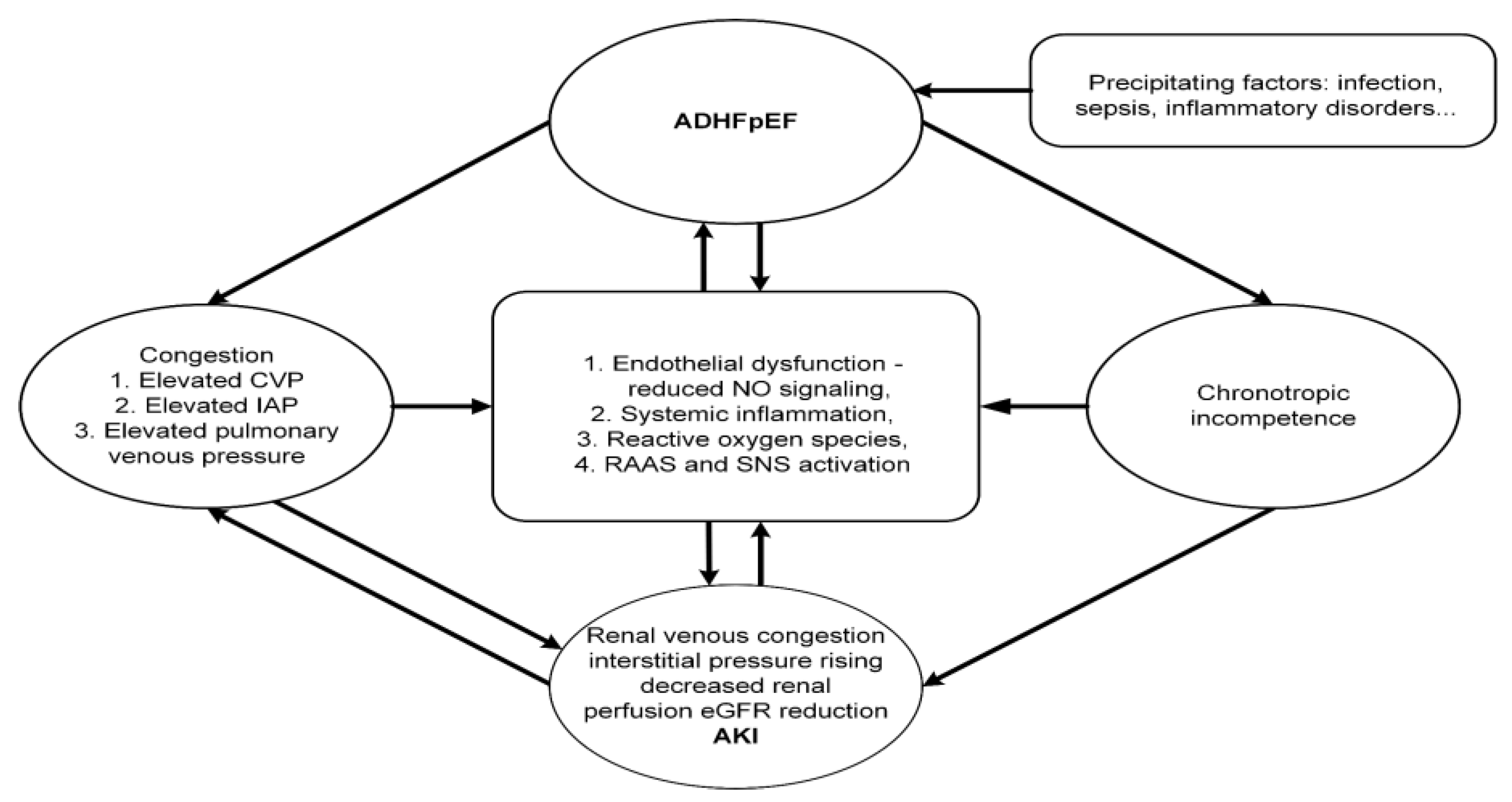

Table 1.
Classification of cardiorenal syndrome.
| CRS type | Name | Etiology/primarily failing organ |
|---|---|---|
| 1 | Acute cardiorenal syndrome | Acute decompensated heart failure (ADHF)/cardiogenic shock (different causes), including progression of heart failure; acute myocardial infarction (AMI); acute myocarditis, etc. |
| 2 | Chronic cardiorenal syndrome | Chronic heart failure (CHF) resulting in chronic kidney disease (CKD) |
| 3 | Acute renocardiac syndrome | Acute kidney injury (AKI) (different causes) resulting in HF |
| 4 | Chronic renocardiac syndrome | Chronic kidney disease (CKD) resulting in CKD-associated cardiomyopathy and HF |
| 5 | Secondary cardiorenal syndrome | Systemic condition/disease resulting in simultaneous kidney and heart dysfunction/failure (e.g., amyloidosis, sepsis, cirrhosis) |
Table 2.
The most important therapeutic options in patients with ADHFpEF and CRS-1.
| Therapy | Comments |
|---|---|
| Loop diuretics | - The mainstay of therapy for decongestion - Can be used alone or in combination with other diuretics as a part of sequential nephron blockade - Can cause enhanced RAAS activation and WRF/AKI |
| Mineralocorticosteroid receptor antagonists (MRAs) | - Successful in combination with loop diuretics, as a part of sequential nephron blockade - May have positive effects on the heart and kidneys in chronic settings - Caution: hyperkalemia |
| SGLT2 inhibitors | - In the acute setting: may enhance diuresis when combined with loop diuretics - In the chronic setting: disease-modifying agents that improve prognosis in patients with HFpEF - Initial WRF is transitory; it is followed by kidney function recovery and has no adverse prognostic impact. |
| ACEi inhibitors/ARB/ARNI | - No prognostic impact in patients with HFpEF - Used for treatment of concomitant conditions HTN, DM, etc. - Cautions: vasodilation and reduced preload may further cause a decline in kidney function. |
| Renal replacement therapy (RRT) | - If all previous measures do not lead to effective decongestion; mandatory in patients with volume overload, oliguria, electrolyte and/or metabolic acid-base disbalance |
HFpEF = heart failure with preserved ejection fraction; CRS-1 = cardiorenal syndrome type 1; SGLT-2 = sodium-glucose cotransporter; WRF = worsening of renal function; ACEi = angiotensin converting enzyme inhibitors; ARB = angiotensin receptor blocker; ARNI = angiotensin receptor blocker, neprilysin inhibitor.
Disclaimer/Publisher’s Note: The statements, opinions and data contained in all publications are solely those of the individual author(s) and contributor(s) and not of MDPI and/or the editor(s). MDPI and/or the editor(s) disclaim responsibility for any injury to people or property resulting from any ideas, methods, instructions or products referred to in the content. |
© 2026 by the authors. Licensee MDPI, Basel, Switzerland. This article is an open access article distributed under the terms and conditions of the Creative Commons Attribution (CC BY) license (http://creativecommons.org/licenses/by/4.0/).
Copyright: This open access article is published under a Creative Commons CC BY 4.0 license, which permit the free download, distribution, and reuse, provided that the author and preprint are cited in any reuse.


