

Submitted:
04 April 2026
Posted:
08 April 2026
You are already at the latest version
Abstract
Myocardial stiffness is a critical determinant of cardiac function and disease, influencing ventricular filling, contractility, mechanotransduction, and the progression of conditions such as hypertrophic cardiomyopathy, myocardial infarction, and heart failure with preserved ejection fraction. Over the past two decades, research in cardiac biomechanics has advanced from conventional ex vivo tissue characterization to multiscale experimental investigation, sophisticated constitutive modelling, and patient-specific computational inference based on imaging modalities such as magnetic resonance imaging and echocardiography.Despite these advances, the field remains fragmented across experimental biomechanics, computational modelling, and clinical imaging. Experimental studies commonly focus on isolated tissue characterization using biaxial testing, indentation, and rheological methods, whereas computational studies increasingly employ inverse finite element frameworks to estimate myocardial stiffness in vivo. At the same time, growing evidence indicates that myocardial viscoelasticity and other time-dependent mechanical behaviours play an important role in cardiac function, although these features are still insufficiently incorporated into many constitutive models.This review synthesises current knowledge on passive and viscoelastic myocardial stiffness across scales by integrating experimental methods, constitutive modelling strategies, and image-informed computational approaches. It examines the influence of myocardial microstructure, fibre architecture, extracellular matrix remodelling, and fibrosis on tissue stiffness, and reviews emerging techniques for non-invasive estimation of myocardial mechanical properties. The review also considers the potential of patient-specific cardiac digital twins for clinical decision support. Finally, it identifies key methodological challenges, unresolved questions, and future opportunities for advancing standardised mechanical characterisation and the clinical translation of cardiac biomechanics.
Keywords:
cardiac biomechanics
; myocardial stiffness
; viscoelasticity
; soft tissue mechanics
; computational cardiology
; finite element modelling
; cardiac digital twin
1. Introduction: Mechanical Stiffness as a Central Parameter in Cardiac Function
Mechanical stiffness of the myocardium is a fundamental determinant of cardiac performance and plays a central role in both physiological ventricular function and the development of cardiovascular disease. The heart functions as a dynamic biomechanical pump in which myocardial tissue undergoes cyclic deformation during each cardiac cycle. This deformation arises from the interaction between active contraction of cardiomyocytes and passive mechanical resistance generated by intracellular structures and the extracellular matrix. Passive myocardial stiffness therefore governs the mechanical relationship between ventricular pressure and volume during diastole and strongly influences the efficiency of cardiac filling and ejection. Consequently, myocardial mechanical properties have emerged as key determinants of cardiac health and disease progression.
In the healthy heart, passive stiffness contributes to ventricular compliance, allowing efficient diastolic filling while maintaining structural stability of the ventricular wall. This mechanical behaviour arises from the hierarchical structure of myocardial tissue, which consists of cardiomyocytes embedded in a collagen-rich extracellular matrix. At low levels of strain, myocardial tissue exhibits relatively low stiffness, enabling ventricular expansion during diastole. However, as strain increases, collagen fibers within the extracellular matrix progressively align and become mechanically engaged, resulting in nonlinear stiffening of the tissue [1,2,3]. This nonlinear mechanical response ensures that the ventricle can accommodate changes in preload while preventing excessive deformation that could compromise mechanical integrity.
At the cellular level, myocardial stiffness is strongly influenced by the giant sarcomeric protein titin, which acts as a molecular spring within cardiomyocytes. Titin generates passive tension during sarcomere stretch and plays a crucial role in regulating myocardial elasticity. Alterations in titin isoform expression, phosphorylation state, and molecular structure have been shown to significantly modify cardiomyocyte stiffness and contribute to cardiac dysfunction [4,5]. In addition to titin-based elasticity, the extracellular matrix contributes substantially to passive myocardial stiffness through networks of collagen fibers and associated structural proteins. Remodeling of this extracellular matrix is a hallmark of many cardiovascular diseases and is a major driver of pathological myocardial stiffening [6,7,8].
Mechanical stiffness also influences mechano-electrical feedback mechanisms within the heart. Mechanical deformation of myocardial tissue affects ion channel activity, intracellular calcium handling, and electrophysiological conduction pathways. This phenomenon, commonly referred to as mechanotransduction, enables the heart to adapt to changes in mechanical loading conditions but can also contribute to arrhythmogenesis under pathological circumstances [9,10]. Understanding how myocardial stiffness modulates these mechanobiological interactions is therefore essential for developing a comprehensive understanding of cardiac physiology.
One of the most clinically important contexts in which myocardial stiffness plays a central role is heart failure with preserved ejection fraction (HFpEF). HFpEF is characterized by impaired ventricular filling despite relatively normal systolic function. The underlying pathology involves increased passive myocardial stiffness, which reduces ventricular compliance and limits diastolic filling capacity. Elevated stiffness in HFpEF arises from both intracellular mechanisms, such as altered titin phosphorylation, and extracellular mechanisms including collagen deposition and fibrosis [11,12,13]. Increased myocardial stiffness in HFpEF has been strongly associated with diastolic dysfunction and reduced exercise tolerance, highlighting the importance of passive mechanics in the pathophysiology of this disease [13,14,15].
Myocardial stiffness is also critically involved in the structural remodeling that occurs following myocardial infarction. When cardiac tissue undergoes ischemic injury, necrotic myocardium is gradually replaced by fibrotic scar tissue. This scar region is significantly stiffer than surrounding healthy myocardium due to increased collagen deposition and loss of contractile cardiomyocytes. As a result, the mechanical heterogeneity of the ventricular wall increases, leading to altered stress distributions and progressive ventricular remodeling [5,16,17]. The mechanical properties of the infarct and border-zone regions strongly influence the progression of post-infarction remodeling and are therefore key targets for therapeutic interventions aimed at preventing heart failure.
Hypertrophic cardiomyopathy represents another condition in which myocardial stiffness plays a central role. This disease is characterized by abnormal thickening of the ventricular wall, often associated with genetic mutations affecting sarcomeric proteins. These mutations can alter the mechanical properties of cardiomyocytes and increase passive stiffness at the cellular level. In addition, hypertrophic cardiomyopathy is frequently accompanied by interstitial fibrosis, which further contributes to increased myocardial stiffness and impaired ventricular relaxation [10,18,19]. The combined effects of cellular and extracellular remodeling lead to diastolic dysfunction and increased susceptibility to arrhythmias.
Dilated cardiomyopathy provides a contrasting example in which ventricular stiffness may initially decrease due to structural weakening of the myocardium. In this condition, ventricular chambers become enlarged and contractile function is reduced. Over time, however, progressive remodeling of the extracellular matrix can lead to secondary increases in myocardial stiffness, further impairing ventricular mechanics and contributing to the progression of heart failure [20,21,22,23,24,25,26].
Given the central role of myocardial stiffness in cardiac function and disease, accurate quantification of myocardial mechanical properties has become an important objective in cardiovascular research. Traditional approaches to studying myocardial mechanics relied primarily on experimental measurements obtained from excised tissue samples using uniaxial or biaxial mechanical testing [27,28,29,30,31]. These experiments provided valuable insights into the nonlinear and anisotropic mechanical behaviour of myocardial tissue, but they were limited by the difficulty of replicating physiological loading conditions in isolated specimens [32,33,34].
Recent advances in imaging technologies and computational modeling have significantly expanded the ability to investigate myocardial mechanics in vivo. Techniques such as tagged magnetic resonance imaging, echocardiographic strain imaging, and magnetic resonance elastography allow measurement of myocardial deformation during the cardiac cycle. When combined with finite element models of the heart, these imaging-derived deformation fields can be used to estimate patient-specific myocardial stiffness through inverse modeling approaches [35,36,37]. Such methods have enabled the development of subject-specific computational models of cardiac mechanics, often referred to as cardiac digital twins.
Computational cardiac biomechanics has therefore emerged as a powerful framework for integrating structural, mechanical, and physiological information about the heart. Modern constitutive models of myocardial tissue incorporate anisotropic fiber architecture, nonlinear elasticity, and viscoelastic behavior to simulate ventricular mechanics under physiological loading conditions [20,38,39,40]. These models provide valuable insights into how structural changes at the cellular and tissue levels influence global cardiac function.
Despite these advances, significant challenges remain in the accurate quantification and interpretation of myocardial stiffness. Experimental measurements of myocardial mechanical properties often vary due to differences in specimen preparation, loading protocols, and strain measurement techniques. Furthermore, computational models used to infer myocardial stiffness from imaging data frequently involve complex inverse problems in which multiple parameter combinations may produce similar mechanical responses [28,41,42]. Addressing these challenges requires improved experimental standardization as well as the development of robust computational frameworks capable of integrating experimental and clinical data.
In this context, the integration of experimental biomechanics, advanced imaging techniques, and computational modeling offers a promising pathway toward a comprehensive understanding of myocardial mechanics. Such interdisciplinary approaches are essential for quantifying myocardial stiffness across multiple spatial scales, from molecular interactions within cardiomyocytes to organ-level ventricular function. Ultimately, the development of integrated experimental and computational frameworks will be critical for translating myocardial biomechanics into clinically useful diagnostic tools and therapeutic strategies.
2. Structural Basis of Myocardial Mechanical Behaviour
The mechanical behavior of myocardial tissue is fundamentally determined by its hierarchical structural organization. The ventricular myocardium is a complex composite material composed of cardiomyocytes, extracellular matrix proteins, vascular networks, and specialized connective tissue structures that together form a highly organized anisotropic mechanical system. This structural hierarchy spans multiple spatial scales, ranging from molecular interactions within sarcomeres to the macroscopic architecture of the ventricular wall. Understanding this multiscale organization is essential for explaining the nonlinear and anisotropic mechanical behavior observed in myocardial tissue.
2.1. Cardiomyocytes and Intracellular Mechanical Elements
At the cellular scale, cardiomyocytes represent the primary contractile elements of the heart. These elongated muscle cells are arranged in parallel bundles that follow the orientation of myocardial fibers. Cardiomyocytes contain sarcomeres, which are the fundamental contractile units responsible for active force generation. Sarcomeres consist of interdigitating actin and myosin filaments whose sliding motion produces active contraction during systole [43,44,45].
In addition to their active contractile role, cardiomyocytes contribute significantly to the passive mechanical properties of the myocardium. Passive elasticity at the cellular level is primarily governed by the giant cytoskeletal protein titin, which spans the sarcomere from the Z-disk to the M-line. Titin functions as a molecular spring that generates passive tension when cardiomyocytes are stretched during ventricular filling [46,47,48]. The stiffness of titin can vary depending on isoform expression and phosphorylation state, allowing cardiomyocytes to adjust their passive mechanical response under different physiological and pathological conditions.
Recent studies have demonstrated that alterations in titin stiffness contribute significantly to the mechanical abnormalities observed in several cardiac diseases. For example, reduced titin compliance has been linked to increased myocardial stiffness in heart failure with preserved ejection fraction, whereas alterations in titin isoform expression are associated with dilated cardiomyopathy [49,50,51]. These findings highlight the importance of intracellular mechanical elements in determining myocardial mechanical properties.
Cardiomyocytes are mechanically connected through specialized junctions known as intercalated discs. These structures contain desmosomes and adherens junctions that transmit mechanical forces between neighboring cells while maintaining electrical continuity. The integrity of these cell–cell junctions is essential for coordinated myocardial contraction and mechanical stability of the ventricular wall [52].
2.2. Collagen Fibers and the Extracellular Matrix
Surrounding the cardiomyocytes is a highly organized extracellular matrix (ECM) that plays a crucial role in determining the passive stiffness of myocardial tissue. The ECM consists primarily of collagen fibers, elastin, proteoglycans, and glycoproteins that together form a structural scaffold supporting the cellular components of the myocardium [53,54,55].
Collagen fibers are the dominant structural component of the ECM and are responsible for much of the passive stiffness of myocardial tissue. Two types of collagen, type I and type III, account for the majority of collagen content in the heart. These fibers form a complex network that surrounds individual cardiomyocytes and bundles of muscle fibers, providing mechanical reinforcement and facilitating force transmission throughout the myocardium [56].
At low levels of strain, collagen fibers within the ECM are relatively undulated and contribute minimally to tissue stiffness. As the tissue is stretched during ventricular filling, these fibers gradually straighten and align with the direction of loading. This progressive recruitment of collagen fibers produces the characteristic nonlinear stress–strain relationship observed in myocardial tissue, in which stiffness increases rapidly at higher strains [57,58,59,60,61].
The ECM also contributes to the viscoelastic behavior of myocardial tissue. Collagen fibers can slide relative to each other, and interstitial fluid within the ECM can redistribute during deformation. These mechanisms result in time-dependent mechanical phenomena such as stress relaxation and creep, which are commonly observed in myocardial mechanical experiments [39,61,62].
In pathological conditions, remodeling of the extracellular matrix can significantly alter myocardial stiffness. Increased collagen deposition, commonly referred to as fibrosis, is a hallmark of many cardiac diseases including myocardial infarction, hypertrophic cardiomyopathy, and heart failure. Fibrotic remodeling increases tissue stiffness and disrupts the normal mechanical behavior of the myocardium [63,64,65].
The myocardium exhibits a highly organized hierarchical structure that spans multiple spatial scales, ranging from molecular contractile elements to the geometry of the entire ventricle. At the smallest scale, sarcomeres within cardiomyocytes generate contractile forces through interactions between actin and myosin filaments, while titin contributes to passive elastic stiffness. These cardiomyocytes are arranged into aligned fiber bundles embedded within an extracellular matrix network composed primarily of collagen and elastin. At a larger structural level, cardiomyocytes form laminar sheet structures that can slide relative to each other during ventricular deformation. Finally, the ventricular wall exhibits a characteristic helical fiber architecture in which fiber orientation gradually rotates across the myocardial wall thickness. This hierarchical structural organization plays a central role in determining myocardial mechanical behavior and underlies the anisotropic stress–strain responses observed in experimental testing. The multiscale organization of myocardial tissue and its mechanical implications are illustrated schematically in Figure 1.
2.3. Myocardial Sheets and Laminar Structure
Beyond the cellular and extracellular matrix scales, the myocardium exhibits a laminar sheet architecture that plays an important role in ventricular mechanics. Cardiomyocytes are arranged into sheet-like layers, often referred to as myocardial sheets or laminae, which are separated by cleavage planes containing connective tissue and extracellular matrix components [66,67,68,69].
These laminar sheets allow groups of cardiomyocytes to move relative to each other during cardiac contraction and relaxation. Sliding between sheets contributes to ventricular wall thickening during systole and facilitates complex three-dimensional deformation of the ventricular wall. Experimental studies have shown that shear deformation between myocardial sheets is a major contributor to ventricular wall thickening during contraction [18,70,71].
The sheet structure of the myocardium also influences the mechanical anisotropy of cardiac tissue. Because the sheets are oriented along specific directions relative to myocardial fibers, the mechanical response of the myocardium depends not only on fiber orientation but also on the orientation of the sheet planes. This complex structural organization leads to orthotropic mechanical behavior in which material properties differ along multiple structural axes [72].
Understanding fiber–sheet mechanics is therefore essential for accurate modeling of ventricular deformation. Modern computational models of cardiac mechanics incorporate both fiber and sheet orientations in order to capture the anisotropic behavior of myocardial tissue [73].
2.4. Fiber Orientation Gradients Across the Ventricular Wall
One of the most distinctive features of myocardial architecture is the gradual rotation of fiber orientation across the ventricular wall. In the left ventricle, myocardial fibers are arranged in a helical pattern that rotates smoothly from the epicardium to the endocardium. Fiber orientation typically changes from approximately −60 degrees relative to the circumferential direction at the epicardium to approximately +60 degrees at the endocardium [74,75,76].
This transmural gradient in fiber orientation plays a crucial role in ventricular mechanics. The helical arrangement of myocardial fibers enables the heart to undergo torsional deformation during contraction. During systole, the apex and base of the heart rotate in opposite directions, producing a twisting motion that enhances the efficiency of ventricular ejection. During diastole, the release of this torsional deformation contributes to rapid ventricular relaxation and filling [77].
The transmural rotation of fiber orientation also contributes to mechanical heterogeneity across the ventricular wall. Because fibers at different depths within the myocardium are oriented in different directions, the local mechanical response of the tissue varies with depth. This structural heterogeneity influences stress distribution within the ventricular wall and plays an important role in determining overall cardiac mechanics [78,79].
Advances in imaging technologies have made it possible to study myocardial fiber architecture in unprecedented detail. Diffusion tensor magnetic resonance imaging (DT-MRI) allows three-dimensional mapping of myocardial fiber orientation and has revealed the complex structural organization of the ventricular myocardium [80,81,82]. These imaging data have been incorporated into computational models of cardiac mechanics to improve the accuracy of ventricular simulations.
2.5. Structural Anisotropy and Nonlinear Mechanical Behaviour
The hierarchical structure of the myocardium gives rise to strongly anisotropic mechanical behavior. Because cardiomyocytes and collagen fibers are preferentially aligned along specific directions, myocardial stiffness varies depending on the direction of applied loading. Experimental studies have consistently shown that myocardial tissue is significantly stiffer along the fiber direction than across fibers [83,84,85,86,87].
In addition to anisotropy, myocardial tissue exhibits pronounced nonlinear mechanical behavior. The nonlinear stress–strain relationship observed in myocardial tissue arises primarily from the progressive recruitment of collagen fibers in the extracellular matrix as the tissue is stretched. At low strains, the mechanical response is dominated by the relatively compliant intracellular structures of cardiomyocytes. As strain increases, collagen fibers become increasingly engaged and contribute more significantly to tissue stiffness [40,57,67,68,87,88].
This nonlinear mechanical behavior is essential for normal cardiac function. It allows the ventricle to accommodate changes in preload while maintaining structural stability under high pressures. However, pathological alterations in myocardial structure can disrupt this delicate mechanical balance, leading to impaired ventricular function.
Taken together, the multiscale structural organization of the myocardium, encompassing cardiomyocytes, extracellular matrix networks, laminar sheet structures, and transmural fiber orientation gradients, provides the structural foundation for the complex mechanical behavior of cardiac tissue. These structural features give rise to the nonlinear, anisotropic, and heterogeneous mechanical properties that characterize myocardial tissue and underpin the mechanical function of the heart.
3. Experimental Biomechanics of Cardiac Tissue
Experimental biomechanics provides the empirical foundation for understanding the mechanical behavior of myocardial tissue [16,89,90]. Because myocardial mechanical properties arise from complex interactions between cardiomyocytes, extracellular matrix networks, and ventricular geometry, experimental characterization is essential for quantifying the constitutive behavior of cardiac tissue [90]. Over the past several decades, numerous experimental techniques have been developed to measure myocardial mechanical properties under controlled conditions. These approaches range from classical tensile testing of excised myocardial specimens to advanced techniques capable of mapping spatial variations in tissue stiffness. Together, these methods provide critical insights into the nonlinear, anisotropic, and viscoelastic behavior of myocardial tissue.
A major objective of experimental cardiac biomechanics is to determine the stress–strain relationships governing myocardial deformation. These relationships are essential for developing constitutive models used in computational simulations of ventricular mechanics. Experimental measurements are therefore frequently combined with theoretical modeling frameworks to establish parameterized descriptions of myocardial material behavior.
3.1. Uniaxial Mechanical Testing
Uniaxial tensile testing represents one of the earliest experimental techniques used to characterize myocardial mechanical properties. In uniaxial tests, strips of myocardial tissue are subjected to tensile loading along a single direction while the resulting stress–strain response is recorded. Historically, this approach provided the first quantitative estimates of myocardial stiffness and revealed the highly nonlinear mechanical behavior of cardiac tissue [87,91,92,93,94,95].
Uniaxial testing has been particularly useful for studying directional mechanical properties of myocardial tissue. By aligning the specimen along the fiber direction or the cross-fiber direction, researchers can estimate stiffness along different structural axes of the myocardium. Early studies demonstrated that myocardial stiffness is significantly greater along the fiber direction than across fibers, reflecting the anisotropic organization of cardiomyocytes and collagen fibers within the ventricular wall [83,84,86,96,97,98].
Despite its historical importance, uniaxial testing has important limitations. Because myocardial tissue is a three-dimensional anisotropic material, deformation in one direction inevitably influences mechanical responses in other directions. Uniaxial tests constrain deformation in the transverse directions, thereby altering the natural deformation state of the tissue. As a result, uniaxial testing cannot fully capture the complex anisotropic mechanical behavior of myocardial tissue [72,99].
Nevertheless, uniaxial experiments remain valuable for investigating fundamental aspects of myocardial mechanics, particularly when combined with optical strain measurement techniques such as digital image correlation. These methods allow detailed analysis of strain distributions within myocardial specimens and improve the accuracy of mechanical property estimation [19].
3.2. Biaxial Mechanical Testing
To address the limitations of uniaxial experiments, biaxial mechanical testing has become widely recognized as the gold standard for characterizing anisotropic myocardial mechanics [30,100,101] and soft tissue in general [27,102,103,104,105]. In biaxial experiments, square or rectangular myocardial specimens are simultaneously stretched along two orthogonal directions while the resulting stresses and strains are measured. These directions typically correspond to the myocardial fiber direction and the cross-fiber direction [58,60,68,69].
Biaxial testing allows researchers to investigate the coupled mechanical behavior of myocardial tissue under physiologically relevant loading conditions [27,102,103]. Because myocardial deformation in vivo involves simultaneous stretching along multiple directions, biaxial testing more closely approximates the mechanical environment experienced by cardiac tissue within the ventricular wall.
Biaxial experiments have revealed several important features of myocardial mechanical behavior. First, myocardial tissue exhibits strong anisotropy, with significantly greater stiffness along the fiber direction than across fibers. Second, the stress–strain relationship of myocardial tissue is highly nonlinear, with stiffness increasing rapidly at larger strains due to collagen fiber recruitment [8,32,73,106,107,108,109,110].
In addition to characterizing anisotropy, biaxial testing provides the data necessary for calibrating constitutive models of myocardial tissue. Modern constitutive formulations, such as fiber-reinforced hyperelastic models, rely heavily on biaxial experimental data to determine material parameters [72,111,112].
Recent advances in biaxial testing techniques include the use of optical strain mapping systems that measure full-field deformation of myocardial specimens. These technologies enable precise quantification of local strain distributions and improve the reliability of mechanical property measurements.
Experimental characterisation of myocardial mechanical behaviour relies on a variety of mechanical testing techniques designed to quantify the anisotropic and nonlinear properties of cardiac tissue. Among these methods, biaxial mechanical testing has emerged as the gold standard for evaluating myocardial mechanics because it allows simultaneous loading along fiber and cross-fiber directions, thereby capturing the anisotropic stress–strain response associated with myocardial fiber architecture. Indentation and micro-indentation techniques provide complementary information by enabling localized measurements of tissue stiffness, which are particularly useful for mapping spatial heterogeneity in diseased myocardium such as infarct scars or fibrotic regions. Shear testing methods are also important for understanding myocardial sheet mechanics and the role of laminar structures in ventricular deformation. Representative experimental setups used to characterise myocardial mechanical properties are illustrated in Figure 2, highlighting how different testing modalities probe distinct aspects of myocardial mechanical behaviour.
3.3. Shear and Torsion Testing
Although tensile testing methods provide valuable information about myocardial stiffness, they do not fully capture the complex deformation modes experienced by myocardial tissue during the cardiac cycle. In particular, ventricular contraction involves significant shear deformation associated with the sliding of myocardial sheets and laminar structures.
Shear testing experiments are therefore used to investigate the mechanical behaviour of myocardial tissue under tangential loading conditions. In these experiments, tissue specimens are subjected to controlled shear deformation while the resulting shear stress response is measured. Shear testing provides insights into the mechanical interactions between myocardial fibres and sheet structures and helps characterise the orthotropic mechanical behaviour of cardiac tissue [18,70,113,114,115,116].
Torsion testing represents another experimental approach used to study myocardial mechanics. During torsion experiments, cylindrical or ring-shaped myocardial specimens are subjected to torsional deformation while torque and angular displacement are measured. These experiments are particularly useful for understanding the mechanical consequences of the helical fiber architecture of the ventricular wall [117,118].
Studies using torsional loading have demonstrated that myocardial tissue exhibits complex shear coupling effects due to the orientation of myocardial fibers and sheets. These effects play an important role in ventricular torsion during cardiac contraction and contribute to the mechanical efficiency of the heart [119,120,121].
A wide range of experimental techniques has been developed to characterize the mechanical behavior of myocardial tissue across multiple spatial scales. These methods differ in their loading configurations, measurable mechanical parameters, and ability to capture anisotropic or time-dependent behavior. Early investigations frequently relied on uniaxial tensile testing to estimate myocardial stiffness along specific anatomical directions, although this approach cannot fully capture the multidirectional coupling inherent in anisotropic cardiac tissue. Biaxial mechanical testing has subsequently become the preferred experimental approach for quantifying myocardial mechanics because it allows simultaneous loading along fiber and cross-fiber directions, thereby enabling accurate identification of constitutive model parameters. Additional methods such as shear testing, indentation-based approaches, and rheological measurements provide complementary insights into myocardial sheet mechanics, regional stiffness heterogeneity, and viscoelastic behavior. A summary of the most commonly used experimental techniques and their associated advantages and limitations is presented in Table 1.
3.4. Indentation and Micro-Indentation Techniques
Indentation methods have become increasingly important for measuring spatial variations in myocardial stiffness. In indentation experiments, a probe is pressed into the surface of the tissue while measuring the force required to produce a given displacement. The resulting force–displacement data can be used to estimate local mechanical properties of the tissue [122,123,124,125].
Micro-indentation techniques allow high-resolution mapping of myocardial stiffness across the ventricular wall. These methods are particularly useful for studying mechanical heterogeneity in diseased hearts. For example, indentation experiments have been widely used to measure stiffness gradients between infarcted scar tissue and surrounding healthy myocardium [5,17,36,126,127,128,129,130,131,132].
Following myocardial infarction, damaged myocardial tissue is replaced by fibrotic scar tissue composed primarily of collagen fibers. This scar region is typically significantly stiffer than adjacent healthy myocardium, leading to altered stress distributions within the ventricular wall. Indentation mapping allows researchers to quantify these stiffness gradients and investigate their role in ventricular remodeling [63,133,134,135,136,137,138].
3.5. Rheology and Viscoelastic Testing
In addition to elastic stiffness, myocardial tissue exhibits significant viscoelastic behavior. Viscoelasticity refers to the time-dependent mechanical response of materials subjected to deformation. In myocardial tissue, viscoelastic behavior arises from interactions between intracellular structures, extracellular matrix components, and interstitial fluid movement [62,141,142,143,144,145,146].
Rheological testing methods are commonly used to characterize viscoelastic behavior. In stress relaxation experiments, myocardial tissue is rapidly stretched to a specified strain and held at constant deformation while measuring the decay of stress over time. Conversely, creep experiments involve applying a constant load and measuring the resulting increase in strain over time.
These experiments reveal that myocardial tissue exhibits substantial stress relaxation and creep behavior, indicating that its mechanical properties are strongly time dependent. Cyclic loading experiments have also demonstrated hysteresis in the stress–strain response of myocardial tissue, reflecting energy dissipation during deformation [147,148,149,150,151,152].
Viscoelastic testing provides important information for developing constitutive models capable of describing the time-dependent mechanical behavior of cardiac tissue. Such models are essential for accurately simulating diastolic relaxation and ventricular filling in computational cardiac models [153,154,155,156,157].
3.6. Methodological Considerations in Myocardial Mechanical Testing
Although experimental methods provide valuable insights into myocardial mechanics, the measured mechanical properties of cardiac tissue can be strongly influenced by methodological factors. Several experimental variables must therefore be carefully controlled in order to obtain reliable measurements.
One critical factor is the orientation of the tissue specimen relative to myocardial fiber direction. Because myocardial tissue is strongly anisotropic, mechanical properties measured along different structural axes can differ significantly. Accurate characterization of myocardial mechanics therefore requires careful alignment of specimens with respect to fiber orientation [158,159,160,161].
Preconditioning protocols also play an important role in myocardial mechanical experiments. Soft biological tissues typically exhibit transient mechanical behavior during the first few loading cycles due to structural rearrangements within the tissue. Repeated loading cycles are therefore applied prior to measurement in order to achieve a stable mechanical response. This process, known as preconditioning, is essential for obtaining reproducible mechanical data [96,162,163,164].
Strain rate represents another important experimental variable. Myocardial tissue exhibits strain-rate-dependent mechanical behavior, meaning that measured stiffness may vary depending on the rate at which deformation is applied. Experimental protocols must therefore specify strain rate in order to ensure comparability between studies [165].
Finally, species differences can significantly influence measured myocardial mechanical properties. Many experimental studies use animal models such as rats, pigs, or sheep due to the limited availability of human myocardial tissue. However, differences in myocardial structure and composition between species can lead to variations in mechanical behavior. Care must therefore be taken when extrapolating results from animal experiments to human cardiac mechanics [166,167].
Taken together, experimental biomechanics provides essential insights into the mechanical behavior of myocardial tissue. Techniques such as biaxial testing, shear testing, indentation mapping, and viscoelastic experiments have revealed the complex anisotropic and nonlinear mechanical properties of cardiac tissue. These experimental measurements form the basis for constitutive models and computational simulations that aim to reproduce the mechanical behavior of the heart under physiological and pathological conditions.
Taken together, the experimental literature makes clear that no single testing modality can be regarded as a complete descriptor of myocardial mechanics. Uniaxial tests remain useful for directional screening and historical comparison, but they are intrinsically limited for parameter identification in a tissue whose response is multiaxial, anisotropic, and structurally coupled. Biaxial testing remains the most informative platform for calibrating passive constitutive laws because it captures fiber–cross-fiber coupling under controlled conditions, yet even biaxial data alone may underrepresent through-thickness heterogeneity, inter-sheet shear, and time-dependent dissipation. Indentation and AFM provide valuable access to regional and microscale stiffness gradients, especially in infarcted and fibrotic tissue, but their interpretation depends strongly on contact assumptions, local boundary effects, and sampling depth. Similarly, rheological and relaxation-based measurements are indispensable for demonstrating viscoelasticity, yet they are often acquired under simplified loading states that are difficult to map directly onto ventricular mechanics in vivo. The most important conclusion is therefore not that one method should replace the others, but that robust myocardial characterization increasingly requires multimodal mechanical datasets acquired with explicit control of specimen orientation, strain rate, preconditioning history, and species context. Without that experimental discipline, apparent differences in myocardial stiffness across studies may reflect protocol variability as much as genuine biology.
4. Viscoelastic and Constitutive Modelling of Passive Myocardial Mechanics
The passive myocardium is a nonlinear, anisotropic, nearly incompressible, and structurally heterogeneous material whose response depends not only on the magnitude and direction of deformation but also on loading history and timescale. Early constitutive descriptions of myocardial tissue relied primarily on hyperelastic formulations, which were highly effective for representing quasi-static pressure–volume behavior and experimentally measured stress–strain relations. These formulations established the importance of fiber architecture and anisotropy in passive stiffness and remain central to computational cardiac mechanics. However, experimental evidence accumulated over the last several decades has shown that the myocardium also exhibits marked time-dependent behaviour, including stress relaxation, hysteresis during cyclic loading, and strain-rate sensitivity. For this reason, a modern constitutive description of passive myocardium must integrate both elastic and viscoelastic features rather than treating them as separate modeling problems [40,84,88,93,157].
4.1. Experimental Basis for time-Dependent Myocardial Behaviour
Experimental studies in uniaxial loading, biaxial extension, and simple shear consistently demonstrate that passive myocardial tissue does not behave as a purely instantaneous elastic solid. Biaxial tests on ventricular myocardium showed strong anisotropy linked to preferred fiber direction, while shear experiments further demonstrated direction-dependent softening and clear viscoelastic effects. Human ventricular data have reinforced this picture by showing that passive myocardium exhibits nonlinear, orthotropic, history-dependent behavior under multiaxial loading, with measurable dependence on loading mode and structural orientation. These observations imply that constitutive laws based only on equilibrium elasticity capture only part of the passive response and may miss important features relevant to filling dynamics, regional deformation, and organ-level simulations [83,84,86,157,168].
4.2. Structural Origins of Passive Stiffness and Viscoelasticity
The time-dependent response of the myocardium arises from interacting mechanisms across multiple scales. At the intracellular scale, titin contributes substantially to passive tension and functions as a tunable molecular spring whose stiffness can be modified by isoform expression and phosphorylation state. At the extracellular scale, collagen architecture, recruitment, sliding, and cross-linking strongly influence nonlinear stiffening and mechanical dissipation. These matrix contributions are not passive background effects; rather, they interact with cardiomyocyte mechanics and tissue architecture to produce the observed anisotropic and rate-dependent behavior of the ventricular wall. Accordingly, myocardial viscoelasticity should not be attributed to a single mechanism, but to coupled contributions from titin, extracellular matrix remodeling, laminar architecture, and fluid-associated effects within the tissue microenvironment [58,169,170,171].
4.3. Hyperelastic Foundations and Structurally Based Constitutive Models
Despite the need to incorporate time dependence, hyperelastic constitutive laws remain the foundation of passive myocardial modeling. Phenomenological formulations derived from the soft-tissue biomechanics tradition, including Fung-type exponential laws, provided an early and mathematically efficient way to reproduce nonlinear stiffening. Later transversely isotropic and orthotropic formulations, including the Guccione model, enabled explicit representation of fiber-direction dependence and became important in finite-element simulations of the ventricle. Structurally based constitutive models, especially the Holzapfel–Ogden framework, advanced the field by linking material response more directly to myocardial microstructure through separate contributions of matrix, fibers, and sheet-related directions. These models are especially valuable because they preserve computational tractability while offering stronger physiological interpretability than purely phenomenological laws [40,84,88,93].
The central issue in myocardial constitutive modelling is no longer whether sufficiently sophisticated formulations exist, but whether the available data justify their complexity. Phenomenological hyperelastic models remain useful when the objective is efficient ventricular simulation or broad inverse fitting from limited data, but they often sacrifice mechanistic interpretability and can obscure which microstructural processes are actually driving stiffness changes. Structure-based models provide a more physiologically meaningful framework by linking stress response to fiber, sheet, and matrix architecture, and they are therefore preferable when the aim is to interpret anisotropy or regional remodeling in structural terms. However, their additional parameters increase the burden of parameter identification and make them vulnerable to non-uniqueness when experimental constraints are weak. Viscoelastic extensions become essential when relaxation, cyclic dissipation, or strain-rate effects are part of the scientific question, yet they should not be added automatically, because every extra viscous branch or fractional parameter introduces further identifiability demands. Multiscale formulations offer the strongest mechanistic explanatory power, especially for disease processes involving titin, fibrosis, and matrix remodeling, but they are presently most convincing when used to test hypotheses rather than to claim uniquely identifiable patient-specific parameters. In practice, the best constitutive model is therefore not the most elaborate one, but the simplest one that remains faithful to the loading mode, time scale, and biological mechanism under investigation.

Table 2.
Comparison of commonly used myocardial constitutive models. The table summarizes major constitutive modeling frameworks used to describe the passive mechanical behavior of myocardial tissue in computational cardiac biomechanics. These models range from phenomenological formulations that reproduce nonlinear stress–strain responses to structure-based and multiscale approaches that incorporate myocardial fiber architecture, extracellular matrix mechanics, and cellular processes. Each modeling framework differs in its complexity, physiological interpretability, and computational requirements. The choice of constitutive model depends on the objectives of the study, the availability of experimental data for parameter identification, and the level of structural detail required for accurate simulation of ventricular mechanics.
Table 2.
Comparison of commonly used myocardial constitutive models. The table summarizes major constitutive modeling frameworks used to describe the passive mechanical behavior of myocardial tissue in computational cardiac biomechanics. These models range from phenomenological formulations that reproduce nonlinear stress–strain responses to structure-based and multiscale approaches that incorporate myocardial fiber architecture, extracellular matrix mechanics, and cellular processes. Each modeling framework differs in its complexity, physiological interpretability, and computational requirements. The choice of constitutive model depends on the objectives of the study, the availability of experimental data for parameter identification, and the level of structural detail required for accurate simulation of ventricular mechanics.
| Constitutive Model | Model Type | Key Features | Advantages | Limitations | Typical Applications |
| Fung-type exponential model | Phenomenological hyperelastic model | Uses exponential strain-energy function to describe nonlinear stress–strain behavior of soft tissues | Simple formulation; widely used in early cardiac biomechanics studies; captures nonlinear stiffening | Limited physiological interpretation; does not explicitly represent myocardial microstructure | Early finite element simulations of ventricular mechanics; basic tissue characterization |
| Guccione transversely isotropic model | Phenomenological anisotropic model | Incorporates preferred fiber direction with transverse isotropy | Captures anisotropic mechanical behavior associated with myocardial fibers; relatively computationally efficient | Does not explicitly include sheet structure or collagen recruitment mechanisms | Ventricular finite element simulations and patient-specific cardiac modeling |
| Holzapfel–Ogden model | Structure-based anisotropic hyperelastic model | Represents myocardium as a fiber-reinforced composite with contributions from matrix, fibers, and sheet structure | Provides physiologically meaningful representation of myocardial architecture; widely used in modern cardiac mechanics models | Requires accurate information on fiber orientation; higher computational cost | Advanced ventricular mechanics simulations; constitutive parameter identification |
| Orthotropic myocardial models | Structure-based anisotropic models | Incorporate fiber, sheet, and sheet-normal directions | More realistic representation of myocardial mechanical anisotropy | Increased number of parameters; parameter identification may be difficult | High-fidelity cardiac finite element models |
| Viscoelastic myocardial models | Time-dependent constitutive models | Incorporate stress relaxation, creep, and strain-rate dependence | Capture experimentally observed viscoelastic behavior of myocardium | Additional parameters increase model complexity | Simulation of time-dependent cardiac tissue behavior |
| Multiscale myocardial models | Multiscale constitutive framework | Integrate cellular mechanics, sarcomere dynamics, and tissue-level deformation | Mechanistically grounded; connects cellular and organ-level mechanics | Computationally intensive; requires detailed parameter calibration | Cardiac digital twins; mechanistic modeling of cardiac disease |
4.4. Viscoelastic Extensions of Myocardial Constitutive Laws
The principal limitation of purely hyperelastic models is that they represent the stress response as instantaneous and path-independent once expressed through a strain-energy function. This is insufficient when the goal is to capture relaxation, cyclic dissipation, or loading-rate effects. One strategy has been to extend hyperelastic formulations using quasi-linear viscoelastic ideas long established in soft-tissue mechanics. Another has been to add generalized Maxwell-type overstress branches to anisotropic constitutive laws. Myocardium-specific implementations of these ideas now exist, including orthotropic viscoelastic formulations in which separate viscous mechanisms are associated with matrix, fiber, and sheet-related responses. More recently, fractional viscoelastic approaches have emerged as especially attractive because they can represent broad relaxation spectra and cyclic effects with fewer parameters than large discrete spring–dashpot networks. In human myocardium, such fractional anisotropic models have been shown to reproduce biaxial stretch, triaxial shear, and stress-relaxation data more accurately than hyperelastic counterparts alone [88,93,154,155,172,173,174].
Computational modeling of myocardial mechanics relies on constitutive formulations that describe the relationship between tissue deformation and mechanical stress. Early models of cardiac tissue were largely phenomenological and focused on reproducing the nonlinear stress–strain behavior observed in experimental testing. Among these, the Fung-type exponential formulation became widely adopted because it captures the characteristic stiffening response of soft biological tissues under increasing strain. More recent approaches incorporate structural information about myocardial architecture, particularly the orientation of collagen fibers and myocardial sheets, leading to structurally motivated constitutive models such as the Holzapfel–Ogden formulation. These models represent the myocardium as a fiber-reinforced composite in which mechanical stiffness arises from interactions between extracellular matrix components and aligned myocardial fibers. In parallel, multiscale modeling frameworks have been developed to bridge cellular and tissue scales by incorporating sarcomere mechanics and intracellular structural elements into tissue-level constitutive behavior. The conceptual differences between these constitutive modeling approaches are illustrated in Figure 3, highlighting how phenomenological, structure-based, and multiscale formulations capture different aspects of myocardial mechanical behavior.
4.5. Disease Remodeling and the Need for Region- and State-Dependent Constitutive Laws
A major reason to merge viscoelasticity with constitutive modeling is that disease changes both the magnitude and the mechanism of passive stiffness. In failing human myocardium, titin hypophosphorylation has been shown to increase cardiomyocyte resting tension, and experimental HFpEF studies indicate that altered titin properties can contribute substantially to elevated passive stiffness. After myocardial infarction, passive behavior becomes further complicated by scar formation, collagen reorganization, and time-dependent evolution of infarct mechanics. Scar tissue does not merely become “stiffer”; its anisotropy, collagen orientation, and maturation state affect deformation patterns and ventricular function. These findings support the use of constitutive models whose parameters vary by region, pathology, and time after injury rather than assuming a single homogeneous passive material law for the entire myocardium [58,128,169,170,171].
4.6. Implications for Computational Cardiac Mechanics
The choice of constitutive framework should be driven by the scientific or clinical question being asked. For quasi-static end-diastolic fitting or broad inverse parameter estimation, anisotropic hyperelastic models may remain adequate. For simulations concerned with filling dynamics, cyclic loading, relaxation, or time-resolved ventricular deformation, viscoelastic extensions become more appropriate. For mechanistic studies of disease, multiscale formulations that connect titin, extracellular matrix remodeling, tissue architecture, and organ-level mechanics may provide the greatest explanatory power, albeit at higher computational cost. In this sense, myocardial constitutive modeling is best viewed as a hierarchy: phenomenological hyperelastic laws for efficient baseline simulation, structurally based anisotropic laws for physiologically grounded tissue description, and viscoelastic or multiscale laws when rate dependence, disease remodeling, or digital-twin fidelity is central. This hierarchy is increasingly important in patient-specific modeling and broader computational cardiology, where constitutive choices directly influence predicted stress fields, filling behaviour, and translational usefulness [40,73,88,154,172].
A recurring weakness in the literature is the tendency to equate improved fit with improved understanding. In myocardial mechanics, a more flexible constitutive law can almost always reduce residual error, but that does not necessarily mean that the added parameters are biologically identifiable or clinically useful. For many applications, especially inverse estimation from sparse imaging data, the limiting factor is not constitutive richness but information content in the measurements. This suggests a practical hierarchy for the field: use anisotropic hyperelastic laws when the goal is stable baseline simulation, move to viscoelastic formulations when time dependence is experimentally demonstrated and functionally relevant, and reserve multiscale models for questions that explicitly concern mechanism across scales. The real challenge is therefore not simply developing more complex constitutive equations, but matching model structure to data quality, validation strategy, and intended use. That principle is likely to determine whether cardiac biomechanics advances as a predictive science rather than an exercise in increasingly elaborate curve fitting.
5. Image-Based and Patient-Specific Estimation of Myocardial Stiffness
Quantifying myocardial stiffness in vivo represents one of the most important challenges in modern cardiac biomechanics. While classical mechanical experiments provide detailed information about myocardial mechanical behaviour, they rely on excised tissue samples and therefore cannot capture patient-specific mechanical properties under physiological conditions. Over the past two decades, advances in cardiac imaging and computational modeling have enabled the estimation of myocardial stiffness directly from clinical data. These methods combine imaging-derived measurements of cardiac geometry and deformation with computational models of ventricular mechanics, thereby enabling non-invasive estimation of myocardial material parameters.
Image-based approaches have become increasingly important in cardiovascular research because they allow the integration of anatomical, mechanical, and functional information into personalized computational models of the heart. These models can simulate ventricular deformation, estimate myocardial stress distributions, and evaluate mechanical alterations associated with cardiovascular disease. The ability to estimate myocardial stiffness non-invasively has therefore opened new opportunities for both research and clinical applications.
5.1. MRI-Based Finite Element Inversion
Magnetic resonance imaging (MRI) has become one of the most powerful tools for studying cardiac mechanics. MRI provides high-resolution images of ventricular geometry and enables measurement of myocardial deformation throughout the cardiac cycle using techniques such as tagged MRI, displacement encoding with stimulated echoes (DENSE), and feature-tracking methods. These imaging techniques produce spatially resolved strain fields that describe how myocardial tissue deforms during contraction and relaxation [175,176,177].
Finite element (FE) modeling frameworks can incorporate these strain measurements to estimate myocardial material parameters through inverse modeling techniques. In MRI-based FE inversion, a computational model of the ventricle is constructed from patient-specific anatomical data. The model includes realistic ventricular geometry, myocardial fiber orientation, and boundary conditions representing physiological loading. Constitutive parameters governing myocardial stiffness are then iteratively adjusted until simulated deformation patterns match those observed in imaging data [73,178,179].
This inverse modeling process allows estimation of patient-specific myocardial stiffness without direct mechanical testing. Because ventricular deformation patterns depend strongly on the underlying material properties of the myocardium, matching simulated and measured strains provides a powerful approach for identifying constitutive parameters.
MRI-based inversion methods have been widely applied in studies of heart failure, myocardial infarction, and cardiomyopathies. These studies have demonstrated that patient-specific myocardial stiffness can vary significantly between individuals and between different regions of the ventricular wall. For example, infarcted regions of the myocardium exhibit significantly higher stiffness than healthy myocardium due to fibrotic remodeling of the extracellular matrix [8,17,107,145,180].
Despite their potential, MRI-based inversion methods face several challenges. Parameter identifiability remains a major concern because multiple combinations of constitutive parameters may produce similar deformation patterns. In addition, uncertainties in boundary conditions and loading conditions can influence the accuracy of parameter estimation. Addressing these challenges requires advanced optimization techniques and uncertainty quantification frameworks [27,101,181].
5.2. Magnetic Resonance Elastography
Magnetic resonance elastography (MRE) provides a more direct approach for estimating tissue stiffness in vivo. MRE is an imaging technique that measures the propagation of mechanical shear waves through biological tissues. By analyzing the speed and attenuation of these waves, it is possible to estimate the mechanical stiffness of the tissue [182,183,184].
In cardiac MRE, mechanical vibrations are introduced into the chest wall, generating shear waves that propagate through the myocardium. MRI is then used to visualize the resulting wave motion and calculate tissue stiffness from wave propagation patterns. Because shear wave speed is directly related to tissue stiffness, MRE can provide quantitative maps of myocardial mechanical properties [185].
Cardiac MRE has been applied in both experimental and clinical studies to investigate myocardial stiffness in conditions such as myocardial infarction and heart failure. These studies have demonstrated that myocardial stiffness measured using MRE correlates with histological markers of fibrosis and extracellular matrix remodeling [186].
One advantage of MRE is that it provides spatial maps of myocardial stiffness across the ventricular wall. This capability allows detection of regional mechanical heterogeneity that may not be apparent using global measures of cardiac function. However, cardiac MRE remains technically challenging due to cardiac motion and the relatively small amplitude of shear waves within the myocardium. Ongoing developments in imaging sequences and signal processing techniques continue to improve the feasibility of cardiac MRE for clinical applications [187].
Recent advances in cardiac imaging and computational biomechanics have enabled the estimation of myocardial mechanical properties directly from patient-specific data. In many studies, ventricular geometry and myocardial deformation are first obtained from cardiac magnetic resonance imaging or echocardiographic strain measurements. These data are then incorporated into computational models of ventricular mechanics to infer myocardial material parameters through inverse finite element analysis. In this approach, constitutive model parameters governing myocardial stiffness are iteratively adjusted until simulated ventricular deformation matches experimentally measured strain fields. This image-based parameter estimation framework provides a powerful tool for investigating regional variations in myocardial stiffness and for constructing personalized computational models of cardiac function. The general workflow for patient-specific estimation of myocardial stiffness is illustrated in Figure 4, highlighting the integration of medical imaging, computational modeling, and optimization algorithms.
5.3. Echocardiography-Derived Strain Analysis
Echocardiography represents the most widely used imaging modality in clinical cardiology due to its accessibility, portability, and real-time imaging capabilities. While traditional echocardiographic measurements primarily assess ventricular dimensions and global function, modern speckle-tracking echocardiography allows detailed analysis of myocardial deformation.
Speckle-tracking methods track natural acoustic markers within ultrasound images to measure myocardial strain throughout the cardiac cycle. By quantifying deformation in longitudinal, circumferential, and radial directions, speckle-tracking echocardiography provides important insights into regional myocardial mechanics [120,188,189,190,191].
Although echocardiography does not measure stiffness directly, strain measurements obtained from speckle-tracking analysis can be combined with computational models to infer myocardial mechanical properties. For example, regional strain patterns can be used to identify areas of reduced contractility or increased stiffness associated with myocardial fibrosis or ischemia.
Speckle-tracking echocardiography has been widely applied in studies of cardiomyopathies and heart failure. Reduced myocardial strain often indicates increased myocardial stiffness or impaired contractility, making strain analysis a valuable diagnostic tool for early detection of cardiac dysfunction [192,193,194,195].
However, echocardiographic strain measurements may be influenced by image quality, acoustic window limitations, and operator variability. Despite these limitations, echocardiography remains an important tool for assessing myocardial mechanics in clinical practice.
5.4. Bayesian and Machine Learning Inference Methods
Recent advances in computational methods have introduced new approaches for estimating myocardial mechanical properties from imaging data. Bayesian inference frameworks provide a probabilistic approach for identifying constitutive parameters while accounting for uncertainties in measurements and model assumptions. In Bayesian parameter estimation, prior knowledge about material properties is combined with observed imaging data to produce posterior probability distributions of model parameters [196].
This probabilistic approach provides several advantages over deterministic parameter estimation methods. In particular, Bayesian frameworks allow quantification of uncertainty in estimated parameters and help address issues related to parameter identifiability. These methods have been successfully applied to inverse problems in cardiac biomechanics and have demonstrated improved robustness compared with traditional optimization techniques [197,198,199,200].
Machine learning methods have also emerged as powerful tools for parameter estimation in cardiac mechanics. Neural networks and other data-driven algorithms can learn complex relationships between imaging features and underlying mechanical properties. Once trained, these models can rapidly estimate myocardial stiffness from imaging data without requiring computationally expensive finite element simulations [201,202,203,204,205,206].
Machine learning approaches have been applied to several aspects of cardiac biomechanics, including ventricular segmentation, strain estimation, and constitutive parameter identification. Hybrid modeling frameworks that combine physics-based models with machine learning algorithms are currently being explored as a promising direction for improving patient-specific cardiac modelling [207].
5.5. Toward the Cardiac Digital Twin
The integration of imaging data, computational modeling, and advanced parameter estimation techniques has given rise to the concept of the cardiac digital twin. A cardiac digital twin is a personalized computational model of the heart that replicates the structural, mechanical, and functional characteristics of an individual patient. These models integrate anatomical information from medical imaging with physiological data and biomechanical simulations to reproduce patient-specific cardiac behaviour [62].
Digital twin frameworks aim to simulate cardiac function under both normal and pathological conditions. By incorporating patient-specific myocardial stiffness and other mechanical parameters, these models can predict how the heart will respond to disease progression or therapeutic interventions.
The potential applications of cardiac digital twins include personalized diagnosis, treatment planning, and prediction of surgical outcomes. For example, patient-specific models may help guide surgical interventions for congenital heart defects or optimize therapies for heart failure [141,208,209,210].
Although the development of fully functional cardiac digital twins remains an ongoing challenge, rapid advances in imaging technology, computational power, and machine learning methods are bringing this vision closer to reality. Accurate estimation of myocardial stiffness remains a key component of this effort, as mechanical properties strongly influence ventricular function and disease progression.
In summary, image-based estimation of myocardial stiffness represents a rapidly evolving area of cardiac biomechanics. Techniques such as MRI-based inverse modeling, magnetic resonance elastography, echocardiographic strain analysis, and machine learning inference methods are transforming the ability to characterize myocardial mechanical properties in vivo. These advances are enabling the development of patient-specific computational models that may ultimately support personalized cardiovascular medicine.
The major advance of image-based biomechanics is not that myocardial stiffness can now be measured directly in a clinical sense, but that it can be inferred within increasingly constrained physiological models. That distinction matters. MRI-based finite-element inversion remains the most mechanistically grounded approach because it links deformation data to constitutive structure and ventricular loading, but it is also the most exposed to non-uniqueness arising from uncertain boundary conditions, fiber architecture, and parameter coupling. MRE offers a more direct route to regional stiffness mapping and is therefore attractive for clinical translation, yet it interrogates wave-propagation behaviour rather than constitutive response in the full multiaxial sense, and its interpretation remains sensitive to motion, resolution, and inversion assumptions. Echocardiographic strain imaging is highly scalable and clinically accessible, but it provides the most indirect path to stiffness and must therefore be interpreted with caution when contractility, loading, and passive material behaviour are changing simultaneously. Bayesian frameworks are especially valuable because they make uncertainty explicit rather than hiding it behind a single best-fit estimate, whereas machine-learning methods are most convincing when used as accelerators or surrogate models within a physics-informed pipeline rather than as stand-alone replacements for biomechanical reasoning. The field should therefore resist overstating precision: the most credible future lies in hybrid frameworks that combine rich imaging, physics-based modelling, and explicit uncertainty quantification, with digital twins judged not by visual realism but by prospective predictive validity.
Recent advances in cardiac imaging have enabled non-invasive quantification of myocardial deformation and stiffness through a range of imaging modalities. These techniques differ in their measurement principles, spatial resolution, and clinical applicability. A summary of the most widely used imaging approaches for estimating myocardial mechanical properties is presented in Table 3.
6. Disease-Related Remodeling and Clinical Relevance of Myocardial Stiffness
Altered myocardial stiffness is a defining biomechanical feature of several forms of heart disease and provides an important link between microstructural remodeling and impaired ventricular performance. From a clinical perspective, the most relevant disease contexts are those in which passive stiffness changes regional load transfer, ventricular compliance, and diastolic mechanics. Rather than surveying all cardiac pathologies, this section focuses on three representative disease settings in which passive myocardial stiffness has particularly clear mechanistic and translational significance: post-myocardial infarction remodeling, diffuse fibrosis in heart failure with preserved ejection fraction (HFpEF), and hypertrophic cardiomyopathy. This narrower focus avoids repetition of general pathophysiology discussed earlier while preserving the main clinical implications of myocardial stiffening [5,47,58,128,170,171,211,212,213,214,215,216,217].
6.1. Post-Myocardial Infarction Remodelling
Myocardial infarction provides one of the clearest examples of mechanically heterogeneous remodeling in the heart. Following ischemic injury, necrotic myocardium is progressively replaced by collagen-rich scar tissue. During the early phase after infarction, degradation of extracellular matrix and loss of viable cardiomyocytes weaken the infarct region and increase local compliance. As healing progresses, fibroblast activation and collagen deposition transform the infarct into a fibrotic scar that is substantially stiffer than healthy myocardium. This transition from early mechanical weakening to late scar stiffening has major consequences for ventricular mechanics because it alters regional stress transfer, promotes border-zone loading abnormalities, and contributes to long-term ventricular remodeling. Experimental and modeling studies have shown that infarct mechanics are not merely local material properties, but determinants of global function that influence ventricular dilation, wall stress distribution, and diastolic filling [16,58,128,211].
Post-infarction remodelling is characterised by the replacement of damaged myocardium with fibrotic scar, leading to increased passive stiffness and heterogeneous ventricular mechanics. These structural and material changes alter regional stress transfer, impair deformation, and contribute to adverse remodeling. Figure 5 schematically summarises these biomechanical differences between healthy and post-infarction myocardium.
6.2. Fibrosis and HFpEF
Diffuse myocardial fibrosis is a major route to pathological stiffening, particularly in HFpEF. In contrast to replacement fibrosis after infarction, HFpEF is commonly associated with interstitial and perivascular collagen accumulation distributed throughout the ventricular wall. This extracellular matrix expansion increases passive resistance to deformation and reduces ventricular compliance. Importantly, HFpEF stiffness is not solely an extracellular matrix problem; it also reflects cardiomyocyte-level changes, especially altered titin phosphorylation and other intracellular determinants of passive tension. Clinical and experimental studies have shown that abnormal passive stiffness, impaired relaxation, and elevated diastolic pressures are central features of this syndrome. From a biomechanical standpoint, HFpEF is therefore one of the clearest examples of multiscale stiffening, in which cellular and extracellular remodeling converge to impair diastolic mechanics [170,171,212,214,215].
6.3. Hypertrophic Cardiomyopathy as a Representative Cardiomyopathy
Among cardiomyopathies, hypertrophic cardiomyopathy is a suitable representative example because it links sarcomeric abnormalities, fibrosis, and impaired ventricular relaxation within a single disease framework. Hypertrophic cardiomyopathy is characterized by abnormal ventricular wall thickening, often caused by mutations in sarcomeric proteins, together with variable degrees of interstitial fibrosis and disordered myocardial architecture. These changes increase passive stiffness at both the cellular and tissue scales and contribute to diastolic dysfunction, abnormal deformation patterns, and increased susceptibility to arrhythmias. In the context of this review, hypertrophic cardiomyopathy is particularly useful because it illustrates that elevated myocardial stiffness is not only a consequence of collagen deposition but may also arise from altered intrinsic cardiomyocyte mechanics and genetically mediated remodeling [216,217].
6.4. Translational Implication
Across these disease settings, the common biomechanical theme is that altered passive stiffness alters ventricular compliance, redistributes wall stress, and modifies deformation in clinically meaningful ways. Post-myocardial infarction remodeling highlights the importance of regional stiffness heterogeneity, HFpEF emphasizes diffuse multiscale stiffening and diastolic dysfunction, and hypertrophic cardiomyopathy demonstrates how cellular and extracellular changes interact in a genetically mediated disease. Together, these examples justify the growing interest in stiffness-informed imaging, constitutive modeling, and patient-specific computational inference as tools for disease characterization and therapeutic planning [5,47,58,128,170,171,211,212,213,214,215,216,217].
7. Toward Standardization in Cardiac Tissue Mechanics
The rapid expansion of research in cardiac biomechanics over the past three decades has produced an extensive body of experimental and computational studies investigating myocardial mechanical behavior. These studies have significantly advanced understanding of ventricular mechanics, myocardial remodeling, and disease-related alterations in tissue stiffness. However, despite these advances, the field continues to face challenges related to reproducibility and cross-study comparability. Differences in specimen preparation, anatomical definitions, mechanical testing protocols, and constitutive modeling approaches often make it difficult to directly compare results obtained across laboratories.
In many cases, experimental measurements of myocardial stiffness vary substantially between studies due to differences in testing methodologies or reporting practices. Similarly, computational models of myocardial mechanics often employ different parameterization strategies and assumptions, which complicates the interpretation of model predictions. As cardiac biomechanics increasingly informs clinical research and patient-specific computational modeling, the need for standardized experimental and reporting practices has become increasingly apparent.
Standardization in cardiac tissue mechanics would improve the reproducibility of experimental findings, enhance the reliability of computational models, and facilitate integration of data across studies. Establishing clear guidelines for specimen characterization, mechanical testing protocols, and parameter reporting would therefore represent an important step toward advancing the field.
7.1. Anatomical Definition of Myocardial Specimens
One of the most fundamental challenges in cardiac biomechanics research concerns the anatomical definition of myocardial specimens used in experimental studies. The myocardium exhibits substantial structural heterogeneity across the ventricular wall, including variations in fiber orientation, extracellular matrix composition, and cellular architecture. Mechanical properties therefore vary significantly between anatomical regions of the heart.
Experimental studies often describe specimens using general anatomical terms such as “left ventricular free wall” or “septal myocardium.” However, these descriptions may lack sufficient precision to ensure reproducibility across studies. Mechanical properties measured in one region of the ventricle may differ substantially from those measured in another region due to variations in fiber architecture and local loading conditions [87,88,218,219,220].
To improve comparability between studies, detailed reporting of specimen location is essential. Investigators should specify the anatomical region from which tissue samples are obtained, including ventricular wall location, transmural depth, and orientation relative to anatomical landmarks. Whenever possible, spatial coordinates or standardized anatomical maps should be used to document specimen origin.
Precise anatomical definition becomes particularly important when studying diseased myocardium. In conditions such as myocardial infarction or hypertrophic cardiomyopathy, mechanical properties may vary dramatically between infarct regions, border zones, and remote myocardium. Accurate reporting of specimen location is therefore critical for interpreting mechanical measurements in pathological tissues [17].
7.2. Reporting of Myocardial Fiber Orientation
Myocardial fiber orientation represents another critical factor influencing mechanical behavior of cardiac tissue. Cardiomyocytes are arranged in a highly organized helical pattern within the ventricular wall, with fiber orientation gradually rotating from epicardium to endocardium. This structural organization gives rise to pronounced anisotropy in myocardial mechanical properties [113,115,221,222].
Several experimental techniques are available for determining myocardial fiber orientation, including histological analysis, polarized light imaging, and diffusion tensor magnetic resonance imaging. These methods allow quantification of fiber orientation within myocardial specimens and can provide valuable structural context for mechanical measurements [80,223,224,225].
7.3. Standardization of Mechanical Testing Protocols
Variability in mechanical testing protocols represents another major source of inconsistency in cardiac biomechanics research. Mechanical properties of myocardial tissue are highly sensitive to experimental conditions such as strain rate, preconditioning procedures, temperature, and specimen hydration.
For example, myocardial stress–strain responses may differ significantly depending on whether tissue samples are tested under uniaxial, biaxial, or shear loading conditions. Even within the same testing modality, differences in strain rates or loading sequences can produce variations in measured stiffness values [226,227,228].
Preconditioning protocols also play a critical role in determining measured mechanical responses. Biological soft tissues often exhibit stress softening during initial loading cycles due to microstructural rearrangements within the extracellular matrix. Without appropriate preconditioning, mechanical measurements may reflect transient tissue behavior rather than steady-state mechanical properties [94,95].
To improve reproducibility, standardized mechanical testing protocols should specify key experimental parameters, including strain rates, loading modes, preconditioning cycles, and environmental conditions. Reporting these parameters in sufficient detail would allow other researchers to replicate experimental conditions and compare results more effectively.
In addition, standardized specimen preparation procedures should be established to minimize variability introduced during tissue harvesting and handling. Factors such as storage conditions, time elapsed between tissue extraction and testing, and sample geometry can all influence measured mechanical properties.
7.4. Parameter Identifiability in Constitutive Models
Standardisation challenges extend beyond experimental testing to the computational modelling of myocardial mechanics. Constitutive models used in cardiac biomechanics often contain numerous parameters representing material stiffness, anisotropy, and viscoelastic behavior. Estimating these parameters from experimental data can be challenging, particularly when multiple parameter combinations produce similar mechanical responses.
This problem, commonly referred to as parameter identifiability, arises when experimental data are insufficient to uniquely determine model parameters. In such cases, different parameter sets may fit the same experimental dataset equally well, leading to uncertainty in model predictions [181].
Parameter identifiability issues are particularly common in inverse modeling approaches used to estimate myocardial stiffness from imaging data. Addressing these challenges requires careful experimental design and rigorous statistical analysis. Techniques such as sensitivity analysis, Bayesian inference, and uncertainty quantification can help identify which parameters are reliably constrained by available data [196,229,230,231].
7.5. Toward Consensus Guidelines in Cardiac Biomechanics
Given the growing importance of cardiac biomechanics in both research and clinical applications, developing consensus guidelines for experimental and computational studies would provide significant benefits to the field. Similar standardization initiatives have been successfully implemented in other areas of biomedical research, including imaging protocols and molecular biology reporting standards.
Establishing standardised reporting frameworks for cardiac tissue mechanics could facilitate data sharing, improve reproducibility, and accelerate the development of patient-specific computational models. Such frameworks could define minimum reporting requirements for specimen characterisation, mechanical testing protocols, and constitutive model parameterisation.
Standardization would also support the development of shared databases containing experimentally measured myocardial mechanical properties. These databases could serve as valuable resources for validating computational models and for identifying patterns in myocardial mechanical behaviour across species and disease conditions.
Ultimately, improved standardisation in cardiac biomechanics research would strengthen the reliability of experimental findings and enhance the translational impact of computational modelling efforts. As the field moves toward personalized cardiac simulations and digital twin technologies, consistent reporting and reproducible experimental methodologies will become increasingly essential.
8. Future Directions and Translational Opportunities
The integration of experimental biomechanics, advanced imaging technologies, and computational modeling has transformed the study of cardiac mechanics over the past two decades. These developments have provided new insights into myocardial structure–function relationships and have significantly improved the ability to quantify mechanical properties of the heart under both physiological and pathological conditions. However, the translational impact of cardiac biomechanics research is only beginning to be realized. Emerging technologies and computational frameworks are opening new opportunities for translating biomechanical insights into clinical applications.
Recent advances in imaging, experimental biomechanics, and computational inference are accelerating the transition of cardiac biomechanics toward clinically relevant personalization. Techniques such as tagged MRI, DENSE, magnetic resonance elastography, and microscale indentation provide complementary measurements of myocardial deformation and stiffness across spatial scales, whereas inverse finite-element modelling, Bayesian inference, and machine-learning frameworks enable estimation of patient-specific material properties from these data. The convergence of these platforms is laying the foundation for cardiac digital twins capable of supporting diagnosis, prognosis, and therapy planning. Figure 6 provides an overview of this emerging translational pipeline.
Future directions in cardiac biomechanics are likely to focus on personalized computational modeling, non-invasive biomarkers of myocardial stiffness, biomechanical optimization of cardiac therapies, and stronger integration between biomechanics research and clinical cardiology. These developments will require interdisciplinary collaboration between engineers, clinicians, imaging scientists, and computational modelers. As computational power and data availability continue to expand, the integration of biomechanical modeling into clinical decision-making may become increasingly feasible.
8.1. Personalized Cardiac Digital Twins
One of the most promising developments in computational cardiology is the emergence of the cardiac digital twin. A cardiac digital twin is a personalized computational representation of an individual patient’s heart that integrates anatomical, mechanical, electrophysiological, and hemodynamic data into a unified modeling framework. These models aim to replicate patient-specific cardiac function and allow simulation of disease progression and therapeutic interventions.
Digital twin technology relies heavily on accurate constitutive models of myocardial mechanics and reliable estimation of patient-specific material parameters. Advances in medical imaging, including cardiac magnetic resonance imaging and echocardiography, now provide high-resolution information about ventricular geometry and myocardial deformation. These data can be incorporated into computational models to estimate myocardial stiffness and simulate ventricular mechanics under patient-specific conditions [208].
The potential clinical applications of cardiac digital twins are extensive. Patient-specific simulations could be used to predict how the heart will respond to surgical procedures, device implantation, or pharmacological therapies. For example, digital twin models may help optimize ventricular assist device settings or guide surgical planning for ventricular reconstruction following myocardial infarction [62,232,233].
In addition, digital twin frameworks may allow simulation of disease progression under different treatment strategies. Such predictive modeling could support personalized treatment decisions by evaluating the potential outcomes of alternative therapeutic interventions. Although significant technical challenges remain, the concept of cardiac digital twins represents a major step toward personalized computational cardiology.
8.2. Non-Invasive Biomarkers of Myocardial Stiffness
Another important translational opportunity in cardiac biomechanics involves the development of non-invasive biomarkers for assessing myocardial stiffness. Myocardial stiffness plays a critical role in many cardiovascular diseases, including heart failure with preserved ejection fraction, hypertrophic cardiomyopathy, and myocardial fibrosis. However, direct measurement of myocardial mechanical properties in vivo remains challenging.
Recent advances in cardiac imaging and computational modeling have created new opportunities for estimating myocardial stiffness non-invasively. Techniques such as magnetic resonance elastography, MRI-based inverse modeling, and echocardiographic strain analysis allow researchers to infer myocardial mechanical properties from imaging-derived deformation data [183,184,186,234,235,236,237].
These methods have the potential to provide clinically useful biomarkers of myocardial stiffness that could aid in early diagnosis and disease monitoring. For example, elevated myocardial stiffness may serve as an early indicator of fibrotic remodeling before significant changes in global cardiac function become apparent. Early detection of such mechanical changes could allow more timely intervention and improved clinical outcomes [238,239,240,241,242,243,244].
In addition, non-invasive stiffness biomarkers may provide valuable tools for evaluating the effectiveness of therapeutic interventions aimed at reducing myocardial fibrosis or improving ventricular compliance. Monitoring changes in myocardial stiffness over time could help clinicians assess treatment responses and adjust therapeutic strategies accordingly.
8.3. Computational Design of Cardiac Patches and Implants
Biomechanical modeling also has important applications in the design and optimization of cardiac therapies. In recent years, researchers have begun to use computational simulations to guide the development of cardiac patches, scaffolds, and implantable devices designed to repair damaged myocardium.
Cardiac patches are biomaterial constructs intended to restore mechanical integrity and support tissue regeneration following myocardial infarction. The mechanical properties of these patches must be carefully tuned to match those of the surrounding myocardium. If the patch is too stiff, it may restrict ventricular deformation and impair cardiac function. Conversely, if the patch is too compliant, it may fail to provide adequate structural support.
Computational biomechanics provides a powerful framework for optimizing the design of such devices. Finite element simulations can predict how different patch materials and geometries influence ventricular mechanics and stress distributions within the myocardial wall. These simulations allow researchers to identify designs that restore mechanical function while minimizing adverse mechanical effects [100,107,108,245,246,247].
Similar computational approaches are being applied to the design of injectable biomaterials and tissue-engineered scaffolds intended to treat heart failure. By integrating biomechanical modeling with tissue engineering strategies, it may be possible to develop therapies that restore both structural and functional properties of damaged myocardium.
8.4. Integration of Biomechanics with Clinical Cardiology
A major future challenge in cardiac biomechanics is the integration of biomechanical modeling into routine clinical practice. While computational models have become increasingly sophisticated, their clinical adoption has been limited by challenges related to data availability, computational cost, and model validation.
Recent developments in high-performance computing and machine learning are beginning to address these challenges. Machine learning algorithms can accelerate parameter estimation and enable rapid generation of patient-specific models from clinical imaging data. These advances may eventually allow biomechanical simulations to be performed within clinically relevant timeframes [201,202,207,248,249,250,251].
In addition, improved collaboration between engineers and clinicians will be essential for translating biomechanical research into clinical applications. Clinicians provide critical insights into disease mechanisms and clinical needs, while engineers contribute expertise in modeling, imaging analysis, and computational simulation.
The integration of biomechanics with clinical cardiology also has important implications for medical education and training. As computational modeling becomes more widely used in cardiology, clinicians may increasingly rely on biomechanical simulations to understand disease mechanisms and evaluate treatment strategies.
8.5. Toward Mechanically Informed Cardiovascular Medicine
The long-term vision for cardiac biomechanics is the development of mechanically informed cardiovascular medicine, in which quantitative analysis of myocardial mechanical properties plays a central role in diagnosis, treatment planning, and therapeutic development. In such a framework, biomechanical data derived from imaging and computational modeling would complement traditional clinical measurements such as ejection fraction and blood pressure.
Achieving this vision will require continued advances in experimental biomechanics, imaging technologies, and computational modeling. In particular, improved methods for estimating myocardial stiffness in vivo will be critical for integrating biomechanical information into clinical decision-making.
Ultimately, the convergence of experimental biomechanics, computational modeling, and clinical cardiology has the potential to transform the understanding and treatment of cardiovascular disease. By incorporating mechanical insights into cardiovascular medicine, researchers and clinicians may be able to develop more effective diagnostic tools, personalized therapies, and improved strategies for preventing and treating heart disease.
9. Conclusion
Passive and viscoelastic myocardial stiffness has emerged as a unifying biomechanical concept linking myocardial microstructure, tissue-level constitutive behaviour, ventricular deformation, and clinical disease. As this review has shown, meaningful interpretation of myocardial stiffness requires integration across scales, from titin and extracellular matrix remodeling to anisotropic tissue mechanics, image-based inference, and organ-level computational simulation. The field has advanced substantially through improved experimental methods, more physiologically grounded constitutive models, and growing capacity to estimate myocardial mechanical properties from non-invasive imaging data. At the same time, important challenges remain in experimental standardization, parameter identifiability, uncertainty quantification, and the translation of model-derived stiffness metrics into clinically actionable biomarkers.
Looking forward, the most important opportunity is not simply to generate more detailed models, but to develop validated multiscale frameworks that connect measurement, inference, and prediction in ways that are robust enough for clinical use. Progress in this area will depend on closer integration of biomechanics, imaging science, computational modelling, and cardiology, together with clearer reporting standards and stronger validation against physiological and clinical outcomes. If these challenges can be addressed, myocardial stiffness may become a clinically meaningful descriptor of cardiac function that complements conventional measures and supports earlier diagnosis, mechanistically informed therapy, and patient-specific cardiovascular medicine.
Ethical Approval
Not applicable.
Consent to Participate
Not applicable.
Consent to Publish
Not applicable.
Data Availability Statement
The data that support the findings of this study are available from the corresponding author upon reasonable request.
Author Contributions
The author contributed from planning to writing and reviewing the manuscript.
Funding
This research work has no funding.
Competing Interests
No competing conflict of interest.
References
- Stroik, D.; Gregorich, Z. R.; Raza, F.; Ge, Y.; Guo, W. Titin: roles in cardiac function and diseases. Frontiers in physiology 2024, vol. 15, 1385821. [Google Scholar] [CrossRef]
- Wagner, F. A. Direction-dependent contributions of cardiac myofilament networks to myocardial passive stiffness reveal a major disparity for titin. Basic Research in Cardiology 2025, vol. 120(no. 4), 761–777. [Google Scholar] [CrossRef]
- Granzier, H. L.; Labeit, S. Discovery of titin and its role in heart function and disease. Circulation Research 2025, vol. 136(no. 1), 135–157. [Google Scholar] [CrossRef]
- Janssens, J. V. The cardiomyocyte origins of diastolic dysfunction: Cellular components of myocardial stiffness. American Journal of Physiology-Heart and Circulatory Physiology 2024, vol. 326(no. 3), H584–H598. [Google Scholar] [CrossRef]
- Janssens, K.; Kraamer, M.; Barbarotta, L.; Bovendeerd, P. H. Post-infarct evolution of ventricular and myocardial function. Biomechanics and Modeling in Mechanobiology 2023, vol. 22(no. 6), 1815–1828. [Google Scholar] [CrossRef]
- Yan, D. The role of myocardial regeneration, cardiomyocyte apoptosis in acute myocardial infarction: A review of current research trends and challenges. Journal of Cardiology 2025, vol. 85(no. 4), 283–292. [Google Scholar] [CrossRef]
- Ebrahimighaei, R. Extracellular matrix stiffness controls cardiac fibroblast proliferation via the nuclear factor-Y (NF-Y) transcription factor. Biochimica et Biophysica Acta (BBA)-Molecular Cell Research 2024, vol. 1871(no. 2), 119640. [Google Scholar] [CrossRef] [PubMed]
- Kolawole, F. O. Characterizing variability in passive myocardial stiffness in healthy human left ventricles using personalized MRI and finite element modeling. Scientific Reports vol. 15(no. 1), 5556, 2025. [CrossRef] [PubMed]
- Yang, H.; Wang, H.; Wang, L.; Jiang, J. The Potential Connection Between Mechanical Stress and Heart Failure with Preserved Ejection Fraction: Mechanistic Insights and Therapeutic Potential. International Journal of Medical Sciences 2026, vol. 23(no. 2), 543. [Google Scholar] [CrossRef] [PubMed]
- Du, X.-J.; She, G.; Wu, W.; Deng, X.-L. Coupling of β-adrenergic and Hippo pathway signaling: Implications for heart failure pathophysiology and metabolic therapy. Mitochondrion 2024, vol. 78, 101941. [Google Scholar] [CrossRef] [PubMed]
- Valente, V.; Beer, B. N.; Savarese, G. Advances in the Pharmacological Treatment of Heart Failure With Preserved Ejection Fraction. International Journal of Heart Failure 2026, vol. 8(no. 1), 24–42. [Google Scholar] [CrossRef] [PubMed]
- Fayyaz, A. U. Pathophysiological insights into HFpEF from studies of human cardiac tissue. Nature Reviews Cardiology 2025, vol. 22(no. 2), 90–104. [Google Scholar] [CrossRef]
- Aradhyula, V. Novel insights into the pathobiology of pulmonary hypertension in heart failure with preserved ejection fraction. American Journal of Physiology-Heart and Circulatory Physiology 2024, vol. 326(no. 6), H1498–H1514. [Google Scholar] [CrossRef] [PubMed]
- Xu, X. Biological aging, left ventricular dysfunction and mortality in patients with heart failure with preserved ejection fraction. npj Aging 2025. [Google Scholar] [CrossRef]
- Zhou, S. The gut microbiota-inflammation-HFpEF axis: deciphering the role of gut microbiota dysregulation in the pathogenesis and management of HFpEF. Frontiers in Cellular and Infection Microbiology vol. 15, 1537576, 2025. [CrossRef]
- Pandelani, T.; Nemavhola, F. Post-MI Remodeling Mechanics: Microstructure-Informed Models, Identifiability, and Uncertainty for Patient-Specific Prediction; 2026. [Google Scholar]
- Holmes, J. W.; Borg, T. K.; Covell, J. W. Structure and mechanics of healing myocardial infarcts. Annu. Rev. Biomed. Eng. 2005, vol. 7(no. 1), 223–253. [Google Scholar] [CrossRef]
- Laita, N.; Martínez, M. Á.; Doblaré, M.; Peña, E. On the myocardium modeling under multimodal deformations: a comparison between costa’s, Holzapfel and Ogden’s formulations. Meccanica 2025, vol. 60(no. 8), 2291–2324. [Google Scholar] [CrossRef]
- Avril, S. Recent Advances in The Virtual Fields Method for Evaluating and Identifying Tissue Biomechanical Properties and Constitutive Parameters. Journal of Biomechanical Engineering 2026, pp. 1–15. [Google Scholar] [CrossRef]
- Masithulela, F. J. Computational biomechanics in the remodelling rat heart post myocardial infarction; 2016. [Google Scholar]
- Masithulela, F. Bi-ventricular finite element model of right ventricle overload in the healthy rat heart. Bio-medical materials and engineering 2016, vol. 27(no. 5), 507–525. [Google Scholar] [CrossRef]
- Masithulela, F. Analysis of passive filling with fibrotic myocardial infarction. In ASME international mechanical engineering congress and exposition; American Society of Mechanical Engineers, 2015; vol. 57380, p. V003T03A004. [Google Scholar]
- Masithulela, F. The effect of over-loaded right ventricle during passive filling in rat heart: A biventricular finite element model. ASME international mechanical engineering congress and exposition, 2015; American Society of Mechanical Engineers; vol. 57380, p. V003T03A005. [Google Scholar]
- Nemavhola, F. Detailed structural assessment of healthy interventricular septum in the presence of remodeling infarct in the free wall–A finite element model. Heliyon 2019, vol. 5(no. 6). [Google Scholar] [CrossRef] [PubMed]
- Celi, S. An image-based approach for the estimation of arterial local stiffness in vivo. Frontiers in Bioengineering and Biotechnology 2023, vol. 11, 1096196. [Google Scholar] [CrossRef] [PubMed]
- Shazly, T. Image-Based Estimation of Left Ventricular Myocardial Stiffness. Journal of Biomechanical Engineering 2025, vol. 147(no. 1), 014501. [Google Scholar] [CrossRef]
- Pandelani, T.; Semakane, L.; Msibi, M.; Kuchumov, A. G.; Nemavhola, F. Passive biaxial mechanical properties of sheep myocardium. Frontiers in Bioengineering and Biotechnology vol. 13, 1549829, 2025. [CrossRef] [PubMed]
- Ngwangwa, H. Determination of cross-directional and cross-wall variations of passive biaxial mechanical properties of rat myocardia. Processes 2022, vol. 10(no. 4), 629. [Google Scholar] [CrossRef]
- Nemavhola, F. Study of biaxial mechanical properties of the passive pig heart: material characterisation and categorisation of regional differences. International Journal of Mechanical and Materials Engineering 2021, vol. 16(no. 1), 6. [Google Scholar] [CrossRef]
- Nemavhola, F.; Ngwangwa, H.; Davies, N.; Franz, T. Passive biaxial tensile dataset of three main rat heart myocardia: left ventricle, mid-wall and right ventricle. 2021. [Google Scholar] [CrossRef]
- Nemavhola, F. Biaxial quantification of passive porcine myocardium elastic properties by region. In Engineering Solid Mechanics; 2017. [Google Scholar]
- Avazmohammadi, R.; Soares, J. S.; Li, D. S.; Raut, S. S.; Gorman, R. C.; Sacks, M. S. A contemporary look at biomechanical models of myocardium. Annual review of biomedical engineering 2019, vol. 21(no. 1), 417–442. [Google Scholar] [CrossRef]
- Ferrario, C.; Padilla, J. R.; Venet, M.; Villemain, O.; Sermesant, M. Myocardial Stiffness Quantification Using Ultrasound Shear Wave Elastography and Reduced Modeling for Subject-Specific Simulations. In in International Conference on Functional Imaging and Modeling of the Heart; Springer, 2025; pp. 41–54. [Google Scholar]
- Ge, Y.; Husmeier, D.; Rabbani, A.; Gao, H. Advanced statistical inference of myocardial stiffness: A time series Gaussian process approach of emulating cardiac mechanics for real-time clinical decision support. Computers in Biology and Medicine 2025, vol. 184, 109381. [Google Scholar] [CrossRef]
- Shi, Q.; Xu, M.; Zhu, C.; Shi, G. Feel the force: Biomechanical homeostasis of the cardiovascular system. Journal of Translational Internal Medicine 2026, vol. 14(no. 1), 6–9. [Google Scholar] [CrossRef]
- Mendiola, E. A.; Mehdi, R. R.; Shah, D. J.; Avazmohammadi, R. On in-silico estimation of left ventricular end-diastolic pressure from cardiac strains. 2024 46th Annual International Conference of the IEEE Engineering in Medicine and Biology Society (EMBC) 2024, 1–4. [Google Scholar]
- Mu, S.; Chan, W. X.; Yap, C. H. A Cycle-Consistent Graph Surrogate for Full-Cycle Left Ventricular Myocardial Biomechanics. arXiv 2026, arXiv:2602.06884. [Google Scholar]
- Nemavhola, F. Fibrotic infarction on the LV free wall may alter the mechanics of healthy septal wall during passive filling. Bio-medical materials and engineering 2017, vol. 28(no. 6), 579–599. [Google Scholar] [CrossRef]
- Nordsletten, D.; Niederer, S.; Nash, M.; Hunter, P.; Smith, N. Coupling multi-physics models to cardiac mechanics. Progress in biophysics and molecular biology 2011, vol. 104(no. 1-3), 77–88. [Google Scholar] [CrossRef]
- Holzapfel, G. A.; Ogden, R. W. Constitutive modelling of passive myocardium: a structurally based framework for material characterization. Philosophical Transactions of the Royal Society A: Mathematical, Physical and Engineering Sciences 2009, vol. 367(no. 1902), 3445–3475. [Google Scholar] [CrossRef]
- Bracamonte, J. H.; Saunders, S. K.; Wilson, J. S.; Truong, U. T.; Soares, J. S. Patient-specific inverse modeling of in vivo cardiovascular mechanics with medical image-derived kinematics as input data: concepts, methods, and applications. Applied Sciences 2022, vol. 12(no. 8), 3954. [Google Scholar] [CrossRef]
- Ramadan, A. Selecting sensitive parameter subsets in dynamical models with application to biomechanical system identification. Journal of biomechanical engineering 2018, vol. 140(no. 7), 074503. [Google Scholar] [CrossRef]
- Linke, W. A.; Krüger, M. The giant protein titin as an integrator of myocyte signaling pathways. Physiology 2010, vol. 25(no. 3), 186–198. [Google Scholar] [CrossRef]
- Crocini, C.; Gotthardt, M. Cardiac sarcomere mechanics in health and disease. Biophysical reviews 2021, vol. 13(no. 5), 637–652. [Google Scholar] [CrossRef] [PubMed]
- Campbell, K. S. Impact of myocyte strain on cardiac myofilament activation. Pflügers Archiv-European Journal of Physiology 2011, vol. 462(no. 1), 3–14. [Google Scholar] [CrossRef] [PubMed]
- Granzier, H. L.; Irving, T. C. Passive tension in cardiac muscle: contribution of collagen, titin, microtubules, and intermediate filaments. Biophysical journal 1995, vol. 68(no. 3), 1027–1044. [Google Scholar] [CrossRef] [PubMed]
- Nagueh, S. F. Altered titin expression, myocardial stiffness, and left ventricular function in patients with dilated cardiomyopathy. Circulation 2004, vol. 110(no. 2), 155–162. [Google Scholar] [CrossRef]
- LeWinter, M. M.; Granzier, H. L. Cardiac titin and heart disease. Journal of cardiovascular pharmacology 2014, vol. 63(no. 3), 207–212. [Google Scholar] [CrossRef]
- Vahle, B. MyoMed205 Counteracts Titin Hyperphosphorylation and the Expression of Contraction-Regulating Proteins in a Rat Model of HFpEF. Journal of Cachexia, Sarcopenia and Muscle vol. 16(no. 3), e13843, 2025. [CrossRef] [PubMed]
- Hamdani, N.; Herwig, M.; Linke, W. A. Tampering with springs: phosphorylation of titin affecting the mechanical function of cardiomyocytes. Biophysical reviews 2017, vol. 9(no. 3), 225–237. [Google Scholar] [CrossRef] [PubMed]
- LeWinter, M. M.; Wu, Y.; Labeit, S.; Granzier, H. Cardiac titin: structure, functions and role in disease. Clinica chimica acta 2007, vol. 375(no. 1-2), 1–9. [Google Scholar] [CrossRef]
- Kleber, A. G.; Saffitz, J. E. Role of the intercalated disc in cardiac propagation and arrhythmogenesis. Frontiers in physiology 2014, vol. 5, 404. [Google Scholar] [CrossRef] [PubMed]
- Lindsey, M. L.; Borg, T. K. Understanding the role of the extracellular matrix in cardiovascular development and disease: where do we go from here? Journal of molecular and cellular cardiology 2009, vol. 48(no. 3), 431. [Google Scholar] [CrossRef]
- Burlew, B. S.; Weber, K. T. Cardiac fibrosis as a cause of diastolic dysfunction. Herz 2002, vol. 27(no. 2), 92–98. [Google Scholar] [CrossRef]
- Fan, D.; Takawale, A.; Lee, J.; Kassiri, Z. Cardiac fibroblasts, fibrosis and extracellular matrix remodeling in heart disease. Fibrogenesis & tissue repair 2012, vol. 5(no. 1), 15. [Google Scholar]
- Robinson, T. F.; Cohen-Gould, L.; Factor, S. M.; Eghbali, M.; Blumenfeld, O. O. Structure and function of connective tissue in cardiac muscle: collagen types I and III in endomysial struts and pericellular fibers. Scanning Microscopy 1988, vol. 2(no. 2), 33. [Google Scholar]
- Holzapfel, G. A.; Gasser, T. C.; Ogden, R. W. A new constitutive framework for arterial wall mechanics and a comparative study of material models. Journal of elasticity and the physical science of solids 2000, vol. 61(no. 1), 1–48. [Google Scholar]
- Fomovsky, G. M.; Thomopoulos, S.; Holmes, J. W. Contribution of extracellular matrix to the mechanical properties of the heart. Journal of molecular and cellular cardiology 2010, vol. 48(no. 3), 490–496. [Google Scholar] [CrossRef]
- Fomovsky, G. M.; Rouillard, A. D.; Holmes, J. W. Regional mechanics determine collagen fiber structure in healing myocardial infarcts. Journal of molecular and cellular cardiology 2012, vol. 52(no. 5), 1083–1090. [Google Scholar] [CrossRef]
- Sommer, G.; Gasser, T. C.; Regitnig, P.; Auer, M.; Holzapfel, G. A. Dissection properties of the human aortic media: an experimental study. Journal of biomechanical engineering 2008, vol. 130(no. 2). [Google Scholar] [CrossRef]
- Gizzi, A.; Pandolfi, A. Visco-hyperelasticity of electro-active soft tissues. Procedia IUTAM 2015, vol. 12, 162–175. [Google Scholar] [CrossRef]
- Niederer, S. A.; Lumens, J.; Trayanova, N. A. Computational models in cardiology. Nature reviews cardiology 2019, vol. 16(no. 2), 100–111. [Google Scholar] [CrossRef] [PubMed]
- Frangogiannis, N. G. The inflammatory response in myocardial injury, repair, and remodelling. Nature Reviews Cardiology 2014, vol. 11(no. 5), 255–265. [Google Scholar] [CrossRef] [PubMed]
- Talman, V.; Ruskoaho, H. Cardiac fibrosis in myocardial infarction—from repair and remodeling to regeneration. Cell and tissue research 2016, vol. 365(no. 3), 563–581. [Google Scholar] [CrossRef]
- Kong, P.; Christia, P.; Frangogiannis, N. G. The pathogenesis of cardiac fibrosis. Cellular and molecular life sciences 2014, vol. 71(no. 4), 549–574. [Google Scholar] [CrossRef]
- LeGrice, J.; Hunter, P. J.; Smaill, B. Laminar structure of the heart: a mathematical model. American Journal of Physiology-Heart and Circulatory Physiology 1997, vol. 272(no. 5), H2466–H2476. [Google Scholar] [CrossRef]
- Costa, D.; Takayama, Y.; McCulloch, A. D.; Covell, J. W. Laminar fiber architecture and three-dimensional systolic mechanics in canine ventricular myocardium. American Journal of Physiology-Heart and Circulatory Physiology 1999, vol. 276(no. 2), H595–H607. [Google Scholar] [CrossRef] [PubMed]
- Costa, D.; Holmes, J. W.; McCulloch, A. D. Modelling cardiac mechanical properties in three dimensions. Philosophical transactions of the Royal Society of London. Series A: Mathematical, physical and engineering sciences 2001, vol. 359(no. 1783), 1233–1250. [Google Scholar] [CrossRef]
- Takayama, Y.; Costa, K. D.; Covell, J. W. Contribution of laminar myofiber architecture to load-dependent changes in mechanics of LV myocardium. American Journal of Physiology-Heart and Circulatory Physiology 2002, vol. 282(no. 4), H1510–H1520. [Google Scholar] [CrossRef]
- Laita, N. On modeling the in vivo ventricular passive mechanical behavior from in vitro experimental properties in porcine hearts. Computers & Structures vol. 292, 107241, 2024.
- Tous, C. Distinguishing shear and tensile myocardial wall stiffness using ex vivo anisotropic Magnetic Resonance Elastography. Acta biomaterialia 2025, vol. 202, 276–291. [Google Scholar] [CrossRef] [PubMed]
- Gültekin, O.; Dal, H. “Computational finite strain orthotropic viscoelasticity of human passive myocardium,” in Solid (Bio) mechanics: Challenges of the Next Decade: A Book Dedicated to Professor Gerhard A; Springer: Holzapfel, 2022; pp. 257–278. [Google Scholar]
- Nash, P.; Hunter, P. J. Computational mechanics of the heart. Journal of elasticity and the physical science of solids 2000, vol. 61(no. 1), 113–141. [Google Scholar]
- Nachlas, L. A multilayered valve leaflet promotes cell-laden collagen type I production and aortic valve hemodynamics. Biomaterials 2020, vol. 240, 119838. [Google Scholar] [CrossRef] [PubMed]
- Helm, P.; Beg, M. F.; Miller, M. I.; Winslow, R. L. Measuring and mapping cardiac fiber and laminar architecture using diffusion tensor MR imaging. Annals of the New York Academy of Sciences 2005, vol. 1047(no. 1), 296–307. [Google Scholar] [CrossRef]
- Gilbert, S. H.; Bernus, O.; Holden, A. V.; Benson, A. P. A quantitative comparison of the myocardial fibre orientation in the rabbit as determined by histology and by diffusion tensor-MRI. in International Conference on Functional Imaging and Modeling of the Heart, 2009; Springer; pp. 49–57. [Google Scholar]
- Buckberg, G.; Hoffman, J. I.; Nanda, N. C.; Coghlan, C.; Saleh, S.; Athanasuleas, C. Ventricular torsion and untwisting: further insights into mechanics and timing interdependence: a viewpoint. Echocardiography 2011, vol. 28(no. 7), 782–804. [Google Scholar] [CrossRef]
- Young, A. A.; Axel, L. Three-dimensional motion and deformation of the heart wall: estimation with spatial modulation of magnetization--a model-based approach. Radiology 1992, vol. 185(no. 1), 241–247. [Google Scholar] [CrossRef]
- Young, A.; Kramer, C. M.; Ferrari, V. A.; Axel, L.; Reichek, N. Three-dimensional left ventricular deformation in hypertrophic cardiomyopathy. Circulation 1994, vol. 90(no. 2), 854–867. [Google Scholar] [CrossRef]
- Scollan, D.; Holmes, A.; Zhang, J.; Winslow, R. Reconstruction of cardiac ventricular geometry and fiber orientation using magnetic resonance imaging. Annals of biomedical engineering 2000, vol. 28(no. 8), 934–944. [Google Scholar] [CrossRef]
- Toussaint; Stoeck, C. T.; Schaeffter, T.; Sermesant, M.; Kozerke, S. Cardiac Laminae Structure Dynamics from In-vivo Diffusion Tensor Imaging. in 21st Annual ISMRM Scientific Meeting and Exhibition 2013: Discovery, Innovation & Application–Advancing MR for Improved Health, Salt Lake City, Utah, USA, 20-26 April 2013, 2013; Curran; pp. 1169–1169. [Google Scholar]
- Mekkaoui. Fiber architecture in remodeled myocardium revealed with a quantitative diffusion CMR tractography framework and histological validation. Journal of Cardiovascular Magnetic Resonance 2012, vol. 14(no. 1), 71. [Google Scholar] [CrossRef]
- Dokos, S.; Smaill, B. H.; Young, A. A.; LeGrice, I. J. Shear properties of passive ventricular myocardium. American Journal of Physiology-Heart and Circulatory Physiology 2002, vol. 283(no. 6), H2650–H2659. [Google Scholar] [CrossRef] [PubMed]
- Guccione, J. M.; McCulloch, A. D.; Waldman, L. Passive material properties of intact ventricular myocardium determined from a cylindrical model; 1991. [Google Scholar]
- Guccione, J. M.; Costa, K. D.; McCulloch, A. D. Finite element stress analysis of left ventricular mechanics in the beating dog heart. Journal of biomechanics 1995, vol. 28(no. 10), 1167–1177. [Google Scholar] [CrossRef] [PubMed]
- Sacks, S.; Sun, W. Multiaxial mechanical behavior of biological materials. Annual review of biomedical engineering 2003, vol. 5(no. 1), 251–284. [Google Scholar] [CrossRef]
- Humphrey, J. D. Cardiovascular solid mechanics: cells, tissues, and organs; Springer Science & Business Media, 2013. [Google Scholar]
- Humphrey, J. D.; Rajagopal, K. A constrained mixture model for growth and remodeling of soft tissues. Mathematical models and methods in applied sciences 2002, vol. 12(no. 03), 407–430. [Google Scholar] [CrossRef]
- Nemavhola, F.; Pandelani, T. Right-Ventricular Remodeling Mechanics: From Fiber Architecture and Constitutive Modeling to Imaging Biomarkers and Clinical Endpoints; 2026. [Google Scholar]
- Nemavhola, F.; Pandelani, T. Infarct Border-Zone Biomechanics After Myocardial Infarction: Linking Mechanotransduction, Fibrosis, and Ventricular Dysfunction; 2026. [Google Scholar]
- Omens, J. H.; Fung, Y.-C. Residual strain in rat left ventricle. Circulation research 1990, vol. 66(no. 1), 37–45. [Google Scholar] [CrossRef]
- Fung, Y. C. What are the residual stresses doing in our blood vessels? Annals of biomedical engineering 1991, vol. 19(no. 3), 237–249. [Google Scholar] [CrossRef] [PubMed]
- Fung, Y.; Liu, S.; Zhou, J. Remodeling of the constitutive equation while a blood vessel remodels itself under stress. 1993. [Google Scholar] [CrossRef]
- Fung, Y.; Liu, S. Determination of the mechanical properties of the different layers of blood vessels in vivo. Proceedings of the National Academy of Sciences 1995, vol. 92(no. 6), 2169–2173. [Google Scholar] [CrossRef] [PubMed]
- Fung, Y.-c. Biomechanics: mechanical properties of living tissues; Springer Science & Business Media, 2013. [Google Scholar]
- Emig, R. Passive myocardial mechanical properties: meaning, measurement, models. Biophysical reviews 2021, vol. 13(no. 5), 587–610. [Google Scholar] [CrossRef] [PubMed]
- Bezy, S. Impact of loading and myocardial mechanical properties on natural shear waves: comparison to pressure-volume loops. Cardiovascular Imaging 2022, vol. 15(no. 12), 2023–2034. [Google Scholar]
- Stella, J. A.; D’Amore, A.; Wagner, W. R.; Sacks, M. S. On the biomechanical function of scaffolds for engineering load-bearing soft tissues. Acta biomaterialia 2010, vol. 6(no. 7), 2365–2381. [Google Scholar] [CrossRef]
- Holzapfel, G. A.; Ogden, R. W. Biomechanics of soft tissue in cardiovascular systems; Springer Science & Business Media, 2003. [Google Scholar]
- Famaey. Community challenge towards consensus on characterization of biological tissue: C4Bio’s first findings. Journal of Biomechanics 2025, 113021. [Google Scholar] [CrossRef]
- Nemavhola, F.; Ngwangwa, H.; Pandelani, T.; Davies, N.; Franz, T. Understanding regional mechanics of rat myocardia by fitting hyperelatsic models. 2021. [Google Scholar] [CrossRef]
- Ndlovu, Z.; Nemavhola, F.; Desai, D. Biaxial mechanical characterization and constitutive modelling of sheep sclera soft tissue. Russian Journal of Biomechanics/Rossijski Zurnal Biomehaniki 2020, vol. 24(no. 1), 84–96. [Google Scholar] [CrossRef]
- Ndlovu, Z.; Desai, D.; Nemavhola, F.; Ngwangwa, H. M. Sheep sclera soft tissue subjected to mechanical equi-biaxial testing. 2021. [Google Scholar] [CrossRef]
- Pandelani, T.; Ngwangwa, H.; Nemavhola, F. Experimental analysis and biaxial biomechanical behaviour of ex-vivo sheep trachea. Frontiers in Materials 2023, vol. 10, 1230789. [Google Scholar] [CrossRef]
- Semakane, L.; Mohan, T. P.; Ngwangwa, H.; Pandelani, T.; Nemavhola, F. Mechanical Behaviour of Breast Tissue: An In-Depth Systematic Review. 2024. [Google Scholar] [CrossRef]
- Avazmohammadi, R. An integrated inverse model-experimental approach to determine soft tissue three-dimensional constitutive parameters: application to post-infarcted myocardium. Biomechanics and modeling in mechanobiology 2018, vol. 17(no. 1), 31–53. [Google Scholar] [CrossRef]
- Hoang; Guccione, J. Finite Element Modeling in Left Ventricular Cardiac Biomechanics: From Computational Tool to Clinical Practice. Bioengineering vol. 12(no. 9), 913, 2025. [CrossRef]
- Mehri, M.; Wenk, J. F. A Unified Finite Element Framework for Cardiac Growth and Remodeling in Mitral Regurgitation Incorporating Fiber Reorientation and Baroreflex. Acta Biomaterialia 2025. [Google Scholar] [CrossRef]
- Mehri, M.; Campbell, K. S.; Lee, L. C.; Wenk, J. F. A multi-scale finite element method for investigating fiber remodeling in hypertrophic cardiomyopathy. Scientific Reports vol. 15(no. 1), 31961, 2025. [CrossRef]
- Salih, A.; Hamandi, F.; Goswami, T. Advancements in finite element modeling for cardiac device leads and 3D heart models. Bioengineering 2024, vol. 11(no. 6), 564. [Google Scholar] [CrossRef]
- Qiu; Weiss, D. Local mechanical characterization of cardiovascular tissues: methods, challenges, and pathways to clinical use. Frontiers in Mechanical Engineering vol. 11, 1703081, 2025. [CrossRef]
- Holzapfel, G. A.; Ogden, R. W. Constitutive Modeling of Soft Biological Tissues. In in Constitutive Modelling of Solid Continua; Springer, 2025; pp. 493–520. [Google Scholar]
- Wilson, A. J.; Sands, G. B.; LeGrice, I. J.; Young, A. A.; Ennis, D. B. Myocardial mesostructure and mesofunction. American Journal of Physiology-Heart and Circulatory Physiology 2022, vol. 323(no. 2), H257–H275. [Google Scholar] [CrossRef] [PubMed]
- Wang, Y.; Chatterjee, E.; Li, G.; Xu, J.; Xiao, J. Force-sensing protein expression in response to cardiovascular mechanotransduction. EBioMedicine 2024, vol. 110. [Google Scholar] [CrossRef]
- Osouli, K.; De Gaetano, F.; Costantino, M. L.; Peirlinck, M. Heart in a knot: unraveling the impact of the nested tori myofiber architecture on ventricular mechanics: K. Osouli et al. Biomechanics and Modeling in Mechanobiology 2025, vol. 24(no. 5), 1815–1835. [Google Scholar] [CrossRef] [PubMed]
- Trifunović-Zamaklar. The basic heart anatomy and physiology from the cardiologist’s perspective: Toward a better understanding of left ventricular mechanics, systolic, and diastolic function. Journal of Clinical Ultrasound 2022, vol. 50(no. 8), 1026–1040. [Google Scholar] [CrossRef]
- Mukherjee, T.; Mendiola, E. A.; Neelakantan, S.; Shah, D. J.; Avazmohammadi, R. Four-dimensional assessment of left ventricular torsion in mitral valve prolapse using CMR. in Medical Imaging 2024: Image Processing 2024, vol. 12926: SPIE, 108–115. [Google Scholar]
- Zhong, Y. Evaluation the relationship between myocardial fibrosis and left ventricular torsion measured by cardiac magnetic resonance feature-tracking in hypertrophic cardiomyopathy patients with preserved ejection fraction. The International Journal of Cardiovascular Imaging 2024, vol. 40(no. 4), 921–930. [Google Scholar] [CrossRef]
- Young, K.; Hooton, C.; Zimmerman, M. B.; Reinking, B.; Gupta, U. Fetal left and right ventricular strain parameters using speckle tracking in congenital heart diseases. The international journal of cardiovascular imaging 2024, vol. 40(no. 6), 1235–1243. [Google Scholar] [CrossRef]
- Muraru. Right ventricular longitudinal strain in the clinical routine: a state-of-the-art review. European Heart Journal-Cardiovascular Imaging 2022, vol. 23(no. 7), 898–912. [Google Scholar] [CrossRef]
- Salte, M. Deep learning for improved precision and reproducibility of left ventricular strain in echocardiography: a test-retest study. Journal of the American Society of Echocardiography 2023, vol. 36(no. 7), 788–799. [Google Scholar] [CrossRef] [PubMed]
- Benech, C.; Romanelli, G. Atomic force microscopy indentation for nanomechanical characterization of live pathological cardiovascular/heart tissue and cells. Micron 2022, vol. 158, 103287. [Google Scholar] [CrossRef]
- Cox, M. A.; Driessen, N. J.; Boerboom, R. A.; Bouten, C. V.; Baaijens, F. P. Mechanical characterization of anisotropic planar biological soft tissues using finite indentation: experimental feasibility. Journal of biomechanics 2008, vol. 41(no. 2), 422–429. [Google Scholar] [CrossRef]
- Codan; Del Favero, G.; Martinelli, V.; Long, C.; Mestroni, L.; Sbaizero, O. Exploring the elasticity and adhesion behavior of cardiac fibroblasts by atomic force microscopy indentation. Materials Science and Engineering: C 2014, vol. 40, 427–434. [Google Scholar] [CrossRef] [PubMed]
- Mathur, A. B.; Collinsworth, A. M.; Reichert, W. M.; Kraus, W. E.; Truskey, G. A. Endothelial, cardiac muscle and skeletal muscle exhibit different viscous and elastic properties as determined by atomic force microscopy. Journal of biomechanics 2001, vol. 34(no. 12), 1545–1553. [Google Scholar] [CrossRef] [PubMed]
- Hiesinger, W. Myocardial tissue elastic properties determined by atomic force microscopy after stromal cell–derived factor 1α angiogenic therapy for acute myocardial infarction in a murine model. The Journal of thoracic and cardiovascular surgery 2012, vol. 143(no. 4), 962–966. [Google Scholar] [CrossRef]
- Gupta, B.; Ratcliffe, M. B.; Fallert, M. A.; Edmunds, L. H., Jr.; Bogen, D. K. Changes in passive mechanical stiffness of myocardial tissue with aneurysm formation. Circulation 1994, vol. 89(no. 5), 2315–2326. [Google Scholar] [CrossRef]
- Holmes, J. W.; Nuñez, J. A.; Covell, J. W. Functional implications of myocardial scar structure. American Journal of Physiology-Heart and Circulatory Physiology 1997, vol. 272(no. 5), H2123–H2130. [Google Scholar] [CrossRef]
- Rausch, K. Growth and remodeling of atrioventricular heart valves: A potential target for pharmacological treatment? Current Opinion in Biomedical Engineering 2020, vol. 15, 10–15. [Google Scholar] [CrossRef]
- Rausch; Karniadakis, G.; Humphrey, J. Modeling soft tissue damage and failure using a combined particle/continuum approach. Biomechanics and modeling in mechanobiology 2017, vol. 16(no. 1), 249–261. [Google Scholar] [CrossRef]
- Mendiola, A. An image-driven micromechanical approach to characterize multiscale remodeling in infarcted myocardium. Acta biomaterialia 2024, vol. 173, 109–122. [Google Scholar] [CrossRef] [PubMed]
- Pitoulis, G. Remodelling of adult cardiac tissue subjected to physiological and pathological mechanical load in vitro. Cardiovascular Research 2022, vol. 118(no. 3), 814–827. [Google Scholar] [CrossRef] [PubMed]
- Frangogiannis, G. Pathophysiology of myocardial infarction. Comprehensive physiology 2015, vol. 5(no. 4), 1841–1875. [Google Scholar] [CrossRef]
- Frangogiannis, G. The mechanistic basis of infarct healing. Antioxidants & redox signaling 2006, vol. 8(no. 11-12), 1907–1939. [Google Scholar]
- Logeart. Patterns of left ventricular remodeling post-myocardial infarction, determinants, and outcome. Clinical Research in Cardiology 2024, vol. 113(no. 12), 1670–1681. [Google Scholar] [CrossRef]
- Gissler, M. C.; Antiochos, P.; Ge, Y.; Heydari, B.; Gräni, C.; Kwong, R. Y. Cardiac magnetic resonance evaluation of LV remodeling post-myocardial infarction: prognosis, monitoring and trial endpoints. Cardiovascular Imaging 2024, vol. 17(no. 11), 1366–1380. [Google Scholar]
- Yong, J.; Tao, J.; Wang, K.; Li, X.; Yang, Y. Post-myocardial infarction cardiac remodeling: multidimensional mechanisms and clinical prospects of stem cell therapy. Stem Cell Reviews and Reports 2025, vol. 21(no. 5), 1369–1427. [Google Scholar] [CrossRef] [PubMed]
- Frantz, S.; Hundertmark, M. J.; Schulz-Menger, J.; Bengel, F. M.; Bauersachs, J. Left ventricular remodelling post-myocardial infarction: pathophysiology, imaging, and novel therapies. European heart journal 2022, vol. 43(no. 27), 2549–2561. [Google Scholar] [CrossRef]
- Peña, B.; Adbel-Hafiz, M.; Cavasin, M.; Mestroni, L.; Sbaizero, O. Atomic force microscopy (AFM) applications in arrhythmogenic cardiomyopathy. International journal of molecular sciences 2022, vol. 23(no. 7), 3700. [Google Scholar] [CrossRef]
- Villarreal, L.; Fontes-Silva, M.; Mendaro, L.; Romanelli, G.; Benech, J. C. Mechanics and disease of heart cells/cardiomyocytes explored through atomic force microscopy: present and future. Biophysical Reviews 2025, vol. 17(no. 2), 347–358. [Google Scholar] [CrossRef]
- Loewe, A.; Hunter, P. J.; Kohl, P. Computational modelling of biological systems now and then: revisiting tools and visions from the beginning of the century. Philosophical Transactions A vol. 383(no. 2296), 20230384, 2025. [CrossRef]
- Lo, S. C. A multi-component, multi-physics computational model for solving coupled cardiac electromechanics and vascular haemodynamics. Computer Methods in Applied Mechanics and Engineering vol. 446, 118185, 2025. [CrossRef]
- Jones, E.; Oomen, P. J. Synergistic biophysics and machine learning modeling to rapidly predict cardiac growth probability. Computers in Biology and Medicine 2025, vol. 184, 109323. [Google Scholar] [CrossRef] [PubMed]
- van Osta, N.; van Loon, T.; Lumens, J. Individual hearts: computational models for improved management of cardiovascular disease. In Heart; 2025. [Google Scholar]
- Familusi, M. A. Computational modeling of the tissue mechanics in rheumatic heart disease patients. 2025. [Google Scholar]
- Faza, N. N.; Harb, S. C.; Wang, D. D.; van den Dorpel, M. M.; Van Mieghem, N.; Little, S. H. Physical and computational modeling for transcatheter structural heart interventions. Cardiovascular Imaging 2024, vol. 17(no. 4), 428–440. [Google Scholar] [CrossRef]
- Hinton, A., Jr. Mitochondrial structure and function in human heart failure. Circulation research 2024, vol. 135(no. 2), 372–396. [Google Scholar] [CrossRef]
- Jiao. Nanopatterned Cell Sheet Assembly of Biomimetic Cardiac Laminae for Modeling Structure–Function Relationships. Biomaterials Research 2026, vol. 30, 0339. [Google Scholar] [CrossRef]
- Rajagopal, V.; Arumugam, S.; Hunter, P. J.; Khadangi, A.; Chung, J.; Pan, M. The cell physiome: what do we need in a computational physiology framework for predicting single-cell biology? Annual Review of Biomedical Data Science 2022, vol. 5(no. 1), 341–366. [Google Scholar] [CrossRef]
- Min, J. Association of pericardial fat with cardiac structure, function, and mechanics: the multi-ethnic study of atherosclerosis. Journal of the American Society of Echocardiography 2022, vol. 35(no. 6), 579–587. e5. [Google Scholar] [CrossRef] [PubMed]
- Tan, S. Differential associations of A-/B-type natriuretic peptides with cardiac structure, function, and prognosis in heart failure. Heart Failure 2024, vol. 12(no. 3), 461–474. [Google Scholar] [CrossRef] [PubMed]
- Lupisella, J. Molecular mechanisms of desensitization underlying the differential effects of formyl peptide receptor 2 agonists on cardiac structure–function post myocardial infarction. ACS Pharmacology & Translational Science 2022, vol. 5(no. 10), 892–906. [Google Scholar] [CrossRef]
- Brown, A. L.; Liu, J.; Ennis, D. B.; Marsden, A. L. Cardiac mechanics modeling: recent developments and current challenges. ArXiv 2509.07971 v1. 2025. [Google Scholar]
- Nordsletten, D. A viscoelastic model for human myocardium. Acta Biomaterialia vol. 135, 441–457, 2021/11/01/ 2021. [CrossRef] [PubMed]
- Zhang, W.; Jadidi, M.; Razian, S. A.; Holzapfel, G. A.; Kamenskiy, A.; Nordsletten, D. A. “A viscoelastic constitutive framework for aging muscular and elastic arteries,” (in eng). Acta Biomater 2024, vol. 188, 223–241. [Google Scholar] [CrossRef]
- Gkouti; Czekanski, A.; AlAttar, A. Simulating and Predicting the Mechanical Behavior of Electrospun Scaffolds for Cardiac Patches Fabrication. Materials 2023, vol. 16(no. 22), 7095. Available online: https://www.mdpi.com/1996-1944/16/22/7095. [CrossRef]
- Sommer. Biomechanical properties and microstructure of human ventricular myocardium. Acta Biomaterialia vol. 24, 172–192, 2015/09/15/ 2015. [CrossRef]
- Richardson, W. J.; Clarke, S. A.; Quinn, T. A.; Holmes, J. W. Physiological implications of myocardial scar structure. Comprehensive Physiology 2015, vol. 5(no. 4), 1877–1909. [Google Scholar] [CrossRef]
- Schwan, J. Anisotropic engineered heart tissue made from laser-cut decellularized myocardium. Scientific Reports 2016/08/30 2016, vol. 6(no. 1), 32068. [Google Scholar] [CrossRef]
- Liang, Z. Structural mechanisms linking muscle fiber alignment to elastic modulus in skeletal muscle. Materials & Design vol. 263, 115528, 2026/03/01/ 2026. [CrossRef]
- Laita, N. A comprehensive experimental analysis of the local passive response across the healthy porcine left ventricle. Acta Biomaterialia vol. 187, 261–277, 2024/10/01/ 2024. [CrossRef] [PubMed]
- Bianco; Levy, A. M.; Grytz, R.; Fazio, M. A. “Effect of different preconditioning protocols on the viscoelastic inflation response of the posterior sclera,” (in eng). Acta Biomater 2021, vol. 128, 332–345. [Google Scholar] [CrossRef]
- Bolli. “Preconditioning: a paradigm shift in the biology of myocardial ischemia,” (in eng). Am J Physiol Heart Circ Physiol 2007, vol. 292(no. 1), H19–27. [Google Scholar] [CrossRef]
- A. C. Silva, C. Pereira, A. C. R. G. Fonseca, P. Pinto-do-Ó, and D. S. Nascimento, “Bearing My Heart: The Role of Extracellular Matrix on Cardiac Development, Homeostasis, and Injury Response,” (in English), Frontiers in Cell and Developmental Biology, Review vol. Volume 8—2020, 2021-January-12 2021. [CrossRef]
- Tran, D. T.; Tsai, L. “Effect of strain rates on the mechanical response of whole muscle bundle,” (in eng). J Biol Phys 2023, vol. 49(no. 2), 257–267. [Google Scholar] [CrossRef] [PubMed]
- Bahadormanesh, N.; Tomka, B.; Kadem, M.; Khodaei, S.; Keshavarz-Motamed, Z. An ultrasound-exclusive non-invasive computational diagnostic framework for personalized cardiology of aortic valve stenosis. Medical Image Analysis 2023, vol. 87, 102795. [Google Scholar] [CrossRef]
- Xia, L.; Zhang, H.; Zheng, D. Multi-Scale Computational Cardiology; Frontiers Media SA, 2022; vol. 13, p. 847118. [Google Scholar]
- Sacks, M.; Chuong, C. Biaxial mechanical properties of passive right ventricular free wall myocardium; 1993. [Google Scholar]
- Krüger, M.; Linke, W. A. Titin-based mechanical signalling in normal and failing myocardium. Journal of molecular and cellular cardiology 2009, vol. 46(no. 4), 490–498. [Google Scholar] [CrossRef] [PubMed]
- Borbély, A. Hypophosphorylation of the Stiff N2B titin isoform raises cardiomyocyte resting tension in failing human myocardium. Circulation research 2009, vol. 104(no. 6), 780–786. [Google Scholar] [CrossRef]
- Hamdani, N. Myocardial titin hypophosphorylation importantly contributes to heart failure with preserved ejection fraction in a rat metabolic risk model. Circulation: Heart Failure 2013, vol. 6(no. 6), 1239–1249. [Google Scholar] [CrossRef]
- Gültekin, O.; Sommer, G.; Holzapfel, G. A. An orthotropic viscoelastic model for the passive myocardium: continuum basis and numerical treatment. Computer methods in biomechanics and biomedical engineering 2016, vol. 19(no. 15), 1647–1664. [Google Scholar] [CrossRef]
- Hussein, T. M.; Criscione, J. C. A new strain energy function representing the passive behavior of the myocardium. Journal of Biomechanical Engineering 2023, vol. 145(no. 11), 111004. [Google Scholar] [CrossRef]
- Namashiri; Allahverdizadeh, A.; Dadashzadeh, B.; Dokos, S. Electromechanical modeling of the left ventricle: considering hyperelastic and viscoelastic properties. Journal of the Brazilian Society of Mechanical Sciences and Engineering 2024, vol. 46(no. 12), 704. [Google Scholar] [CrossRef]
- Pan; Ng, S. M.; Neubauer, S.; Rider, O. J. Phenotyping heart failure by cardiac magnetic resonance imaging of cardiac macro-and microscopic structure: state of the art review. European Heart Journal-Cardiovascular Imaging 2023, vol. 24(no. 10), 1302–1317. [Google Scholar] [CrossRef] [PubMed]
- Sillanmäki, H.-L.; Vainio; Ylä-Herttuala, E.; Husso, M.; Hedman, M. Measuring Cardiac Dyssynchrony with DENSE (Displacement Encoding with Stimulated Echoes)—A Systematic Review. Reviews in Cardiovascular Medicine 2023, vol. 24(no. 9), 261. [Google Scholar] [CrossRef] [PubMed]
- Osman, N. F.; Kerwin, W. S.; McVeigh, E. R.; Prince, J. L. Cardiac motion tracking using CINE harmonic phase (HARP) magnetic resonance imaging. Magnetic Resonance in Medicine: An Official Journal of the International Society for Magnetic Resonance in Medicine 1999, vol. 42(no. 6), 1048–1060. [Google Scholar] [CrossRef]
- Guccione, M.; Waldman, L.; McCulloch, A. D. Mechanics of active contraction in cardiac muscle: Part II—Cylindrical models of the systolic left ventricle; 1993. [Google Scholar]
- Guccione, M.; McCulloch, A. D. Mechanics of active contraction in cardiac muscle: part I—constitutive relations for fiber stress that describe deactivation; 1993. [Google Scholar]
- Wang, V.; Nielsen, P.; Nash, M. Image-based predictive modeling of heart mechanics. Annual review of biomedical engineering 2015, vol. 17(no. 1), 351–383. [Google Scholar] [CrossRef]
- Sacks, S.; Mirnajafi, A.; Sun, W.; Schmidt, P. Bioprosthetic heart valve heterograft biomaterials: structure, mechanical behavior and computational simulation. Expert review of medical devices 2006, vol. 3(no. 6), 817–834. [Google Scholar] [CrossRef]
- Muthupillai; Lomas, D. J.; Rossman, P. J.; Greenleaf, J. F.; Manduca, A.; Ehman, R. L. Magnetic resonance elastography by direct visualization of propagating acoustic strain waves. science 1995, vol. 269(no. 5232), 1854–1857. [Google Scholar] [CrossRef]
- Meyer, K. Free-Breathing, 3D Cardiac Magnetic Resonance Elastography for Myocardial Stiffness Mapping. Magnetic Resonance in Medicine 2026, vol. 95(no. 4), 2356–2369. [Google Scholar] [CrossRef]
- Meyer. Cardiac elastography with external vibration for quantification of diastolic myocardial stiffness. Journal of the American Society of Echocardiography 2025, vol. 38(no. 5), 431–442. [Google Scholar] [CrossRef]
- Sack; Rump, J.; Elgeti, T.; Samani, A.; Braun, J. MR elastography of the human heart: noninvasive assessment of myocardial elasticity changes by shear wave amplitude variations. Magnetic Resonance in Medicine: An Official Journal of the International Society for Magnetic Resonance in Medicine 2009, vol. 61(no. 3), 668–677. [Google Scholar] [CrossRef]
- Kolipaka, A. MR elastography as a method for the assessment of myocardial stiffness: comparison with an established pressure–volume model in a left ventricular model of the heart. Magnetic Resonance in Medicine: An Official Journal of the International Society for Magnetic Resonance in Medicine 2009, vol. 62(no. 1), 135–140. [Google Scholar] [CrossRef]
- Arani. Cardiac MR elastography for quantitative assessment of elevated myocardial stiffness in cardiac amyloidosis. Journal of Magnetic Resonance Imaging 2017, vol. 46(no. 5), 1361–1367. [Google Scholar] [CrossRef] [PubMed]
- Amundsen, H. Noninvasive myocardial strain measurement by speckle tracking echocardiography: validation against sonomicrometry and tagged magnetic resonance imaging. Journal of the American College of Cardiology 2006, vol. 47(no. 4), 789–793. [Google Scholar] [CrossRef] [PubMed]
- Mirea, O. Variability and reproducibility of segmental longitudinal strain measurement: a report from the EACVI-ASE strain standardization task force. JACC: Cardiovascular Imaging 2018, vol. 11(no. 1), 15–24. [Google Scholar]
- Blessberger; Binder, T. Two dimensional speckle tracking echocardiography: basic principles. Heart 2010, vol. 96(no. 9), 716–722. [Google Scholar] [CrossRef]
- Voigt, J.-U. Definitions for a common standard for 2D speckle tracking echocardiography: consensus document of the EACVI/ASE/Industry Task Force to standardize deformation imaging. European Heart Journal-Cardiovascular Imaging 2015, vol. 16(no. 1), 1–11. [Google Scholar] [CrossRef]
- Mor-Avi. Current and evolving echocardiographic techniques for the quantitative evaluation of cardiac mechanics: ASE/EAE consensus statement on methodology and indications endorsed by the Japanese Society of Echocardiography. European Journal of Echocardiography 2011, vol. 12(no. 3), 167–205. [Google Scholar] [CrossRef]
- Gillam, L. D.; Marcoff, L. Echocardiography: past, present, and future. Circulation: Cardiovascular Imaging 2024, vol. 17(no. 4), e016517. [Google Scholar] [CrossRef]
- Al-Assaf, A. M. A. M. An Overview for Echocardiography Techniques-An Updated Review for Modern and Advanced Techniques and Innovations. Journal of Medical and Life Science 2024, vol. 6(no. 4), 611–632. [Google Scholar] [CrossRef]
- Chakraborti, S. Jana; Dey, S. The advancement of echocardiography through evolutionary development. J. Community Health Management 2023, vol. 9(no. 4), 123–131. [Google Scholar]
- Kaipio, P.; Somersalo, E. Statistical and computational inverse problems; Springer, 2005. [Google Scholar]
- Borowska; Gao, H.; Lazarus, A.; Husmeier, D. Bayesian optimisation for efficient parameter inference in a cardiac mechanics model of the left ventricle. International Journal for Numerical Methods in Biomedical Engineering 2022, vol. 38(no. 5), e3593. [Google Scholar] [CrossRef] [PubMed]
- Sundnes; Rodríguez-Cantano, R. A Bayesian approach to parameter estimation in cardiac mechanics. In in Solid (Bio) mechanics: Challenges of the Next Decade: A Book Dedicated to Professor Gerhard A. Holzapfel; Springer, 2022; pp. 245–256. [Google Scholar]
- Doraiswamy, S.; Criscione, J. C.; Srinivasa, A. R. A technique for the classification of tissues by combining mechanics based models with Bayesian inference. International Journal of Engineering Science 2016, vol. 106, 95–109. [Google Scholar] [CrossRef]
- Wang, S. Bayesian inference-based estimation of normal aortic, aneurysmal and atherosclerotic tissue mechanical properties: From material testing, modeling and histology. IEEE Transactions on Biomedical Engineering 2019, vol. 66(no. 8), 2269–2278. [Google Scholar] [CrossRef] [PubMed]
- Ngwangwa, H.; Modungwa, D.; Pandelani, T.; Nemavhola, F. Estimation of the biaxial tensile behavior of ovine esophageal tissue using artificial neural networks. BioMedical Engineering OnLine 2024, vol. 23(no. 1), 1–44. [Google Scholar] [CrossRef]
- Ngwangwa, H. M.; Nemavhola, F. Evaluating computational performances of hyperelastic models on supraspinatus tendon uniaxial tensile test data. Journal of Computational Applied Mechanics 2021, vol. 52(no. 1), 27–43. [Google Scholar]
- Shrestha, S.; Sengupta, P. P. The mechanics of machine learning: from a concept to value. Journal of the American Society of Echocardiography 2018, vol. 31(no. 12), 1285–1287. [Google Scholar] [CrossRef]
- Arzani, A.; Wang, J.-X.; Sacks, M. S.; Shadden, S. C. Machine learning for cardiovascular biomechanics modeling: challenges and beyond. Annals of Biomedical Engineering 2022, vol. 50(no. 6), 615–627. [Google Scholar] [CrossRef] [PubMed]
- Dabiri, Y.; Van der Velden, A.; Sack, K. L.; Choy, J. S.; Kassab, G. S.; Guccione, J. M. Prediction of left ventricular mechanics using machine learning. Frontiers in physics 2019, vol. 7, 117. [Google Scholar] [CrossRef] [PubMed]
- Francesco. Mathematical modeling and Machine Learning for the numerical simulation of cardiac electromechanics; 2020. [Google Scholar]
- Karniadakis, G. E.; Kevrekidis, I. G.; Lu, L.; Perdikaris, P.; Wang, S.; Yang, L. Physics-informed machine learning. Nature Reviews Physics 2021, vol. 3(no. 6), 422–440. [Google Scholar] [CrossRef]
- Corral-Acero, J. The ‘Digital Twin’to enable the vision of precision cardiology. European heart journal 2020, vol. 41(no. 48), 4556–4564. [Google Scholar] [CrossRef]
- Morotti. Precision cardiac electrophysiology: Toward digital twins and beyond. The Journal of Precision Medicine: Health and Disease 2025, vol. 2. [Google Scholar] [CrossRef]
- Thangaraj, M.; Benson, S. H.; Oikonomou, E. K.; Asselbergs, F. W.; Khera, R. Cardiovascular care with digital twin technology in the era of generative artificial intelligence. European Heart Journal 2024, vol. 45(no. 45), 4808–4821. [Google Scholar] [CrossRef]
- Clarke, A.; Richardson, W. J.; Holmes, J. W. Modifying the mechanics of healing infarcts: Is better the enemy of good? Journal of molecular and cellular cardiology 2016, vol. 93, 115–124. [Google Scholar] [CrossRef]
- Zile, R.; Baicu, C. F.; Gaasch, W. H. Diastolic heart failure—abnormalities in active relaxation and passive stiffness of the left ventricle. New England Journal of Medicine 2004, vol. 350(no. 19), 1953–1959. [Google Scholar] [CrossRef]
- Chiorescu, R. M. Current insights and future directions in the treatment of heart failure with preserved ejection fraction. International Journal of Molecular Sciences 2023, vol. 25(no. 1), 440. [Google Scholar] [CrossRef]
- Paulus, J.; Tschöpe, C. A novel paradigm for heart failure with preserved ejection fraction: comorbidities drive myocardial dysfunction and remodeling through coronary microvascular endothelial inflammation. Journal of the American college of cardiology 2013, vol. 62(no. 4), 263–271. [Google Scholar] [CrossRef]
- Westermann. Role of left ventricular stiffness in heart failure with normal ejection fraction. Circulation 2008, vol. 117(no. 16), 2051–2060. [Google Scholar] [CrossRef]
- Ho, Y. Myocardial fibrosis as an early manifestation of hypertrophic cardiomyopathy. New England Journal of Medicine 2010, vol. 363(no. 6), 552–563. [Google Scholar] [CrossRef] [PubMed]
- Marian, A. J.; Braunwald, E. Hypertrophic cardiomyopathy: genetics, pathogenesis, clinical manifestations, diagnosis, and therapy. Circulation research 2017, vol. 121(no. 7), 749–770. [Google Scholar] [CrossRef]
- Humphrey, J. D.; Tellides, G. Central artery stiffness and thoracic aortopathy. American Journal of Physiology-Heart and Circulatory Physiology 2019, vol. 316(no. 1), H169–H182. [Google Scholar] [CrossRef]
- Humphrey, J. D.; Schwartz, M. A.; Tellides, G.; Milewicz, D. M. Role of mechanotransduction in vascular biology: focus on thoracic aortic aneurysms and dissections. Circulation research 2015, vol. 116(no. 8), 1448–1461. [Google Scholar] [CrossRef]
- Humphrey, J. D. Mechanisms of arterial remodeling in hypertension: coupled roles of wall shear and intramural stress. Hypertension 2008, vol. 52(no. 2), 195–200. [Google Scholar] [CrossRef]
- Dell’Italia, J.; Kane, M. S.; Zheng, J.; Huang, S. W.; Pat, B.; Denney, T. S. Persistent Shift in Principal Strain Angles and Postsurgical Decline in Left Ventricular Ejection Fraction in Patients With Primary Mitral Regurgitation. Journal of the American Heart Association 2025, vol. 14(no. 22), e043558. [Google Scholar] [CrossRef] [PubMed]
- Rodríguez-Padilla, J. Impact of intraventricular septal fiber orientation on cardiac electromechanical function. American Journal of Physiology-Heart and Circulatory Physiology 2022, vol. 322(no. 6), H936–H952. [Google Scholar] [CrossRef] [PubMed]
- Scollan, F.; Holmes, A.; Winslow, R.; Forder, J. Histological validation of myocardial microstructure obtained from diffusion tensor magnetic resonance imaging. American Journal of Physiology-Heart and Circulatory Physiology 1998, vol. 275(no. 6), H2308–H2318. [Google Scholar] [CrossRef]
- Cook, P.; Dhahri, W.; Laflamme, M. A.; Ghugre, N. R.; Wright, G. A. Using diffusion tensor imaging to depict myocardial changes after matured pluripotent stem cell-derived cardiomyocyte transplantation. Journal of Cardiovascular Magnetic Resonance 2024, vol. 26(no. 2), 101045. [Google Scholar] [CrossRef]
- Lohr, D. Assessment of myocardial microstructure in a murine model of obesity-related cardiac dysfunction by diffusion tensor magnetic resonance imaging at 7T. Frontiers in Cardiovascular Medicine 2022, vol. 9, 839714. [Google Scholar] [CrossRef]
- Ambiga, R.; Verma, S. Morphology, microstructure and biomechanical properties of tendinous cords of heart–a systematic review of cadaveric studies. Anatomy 2025, vol. 19(no. 1), 30–40. [Google Scholar] [CrossRef]
- Baghersad; Sathish Kumar, A.; Kipper, M. J.; Popat, K.; Wang, Z. Recent advances in tissue-engineered cardiac scaffolds—the progress and gap in mimicking native myocardium mechanical behaviors. Journal of Functional Biomaterials 2023, vol. 14(no. 5), 269. [Google Scholar] [CrossRef]
- Eastep, R. A Comparative Biomechanical Investigation of Porcine Neonatal and Adult Left Ventricular Tissues; The University of Texas at Arlington, 2023. [Google Scholar]
- Sultan, A. A. Image-Based Models for Left Heart Flow Morphodynamics in Hypertrophic Obstructive Cardiomyopathy; The American University in Cairo (Egypt), 2025. [Google Scholar]
- Kakaletsis, S. Histomechanical characterization and microstructure-based modeling of right ventricular myocardium. 2023. [Google Scholar]
- Ghafarinatanzi, M. Identification of Mechanical Properties for Patient-Specific Left Ventricle Models from CMR Using Virtual Fields Method; Ecole Polytechnique: Montreal (Canada), 2023. [Google Scholar]
- Bragard, J. R. Cardiac computational modelling. Revista Española de Cardiología (English Edition) 2021, vol. 74(no. 1), 65–71. [Google Scholar] [CrossRef]
- Trayanova, A. Computational cardiology: the heart of the matter. International Scholarly Research Notices 2012, vol. 2012(no. 1), 269680. [Google Scholar] [CrossRef]
- Petrescu, A. Ultrasound shear wave elastography for detection of myocardial fibrosis. European Heart Journal-Cardiovascular Imaging 2025, vol. 26(no. 9), 1537–1545. [Google Scholar] [CrossRef]
- Benz, D. C. Echocardiographic characterization of myocardial stiffness in healthy volunteers, cardiac amyloidosis, and hypertrophic cardiomyopathy: a case-control study using multimodality imaging. Circulation: Cardiovascular Imaging vol. 18(no. 3), e017475, 2025. [CrossRef]
- Anders, M. S. Time-resolved mapping of myocardial stiffness using 2D multifrequency spiral MR elastography with and without external vibration. Magnetic Resonance in Medicine vol. 94(no. 6), 2421–2434, 2025. [CrossRef]
- Castelein, J. Reproducibility of cardiac multifrequency MR elastography in assessing left ventricular stiffness and viscosity. Journal of Magnetic Resonance Imaging vol. 61(no. 5), 2146–2154, 2025. [CrossRef]
- González, A.; Schelbert, E. B.; Díez, J.; Butler, J. Myocardial interstitial fibrosis in heart failure: biological and translational perspectives. Journal of the American College of Cardiology 2018, vol. 71(no. 15), 1696–1706. [Google Scholar] [CrossRef]
- Schotten, A. Goette; Verheule, S. Translation of pathophysiological mechanisms of atrial fibrosis into new diagnostic and therapeutic approaches. Nature Reviews Cardiology 2025, vol. 22(no. 4), 225–240. [Google Scholar] [CrossRef] [PubMed]
- Ghazal, R.; Wang, M.; Liu, D.; Tschumperlin, D. J.; Pereira, N. L. Cardiac fibrosis in the multi-omics era: implications for heart failure. Circulation research 2025, vol. 136(no. 7), 773–802. [Google Scholar] [CrossRef]
- Tocchetti, G. How to facilitate seamless translation from basic concepts to new heart failure drugs. A scientific statement of the Heart Failure Association of the ESC. European journal of heart failure 2025, vol. 27(no. 8), 1379–1392. [Google Scholar] [CrossRef]
- Zivalj, L. M. S.; Schleicher; Krsek, A.; Diamee, H. J. F.; Raljevic, D.; Baticic, L. MicroRNAs in Heart Failure Pathogenesis and Progression: Mechanistic Control, Biomarker Potential, and Translational Perspectives. Life 2026, vol. 16(no. 3), 400. [Google Scholar] [CrossRef]
- Imran, T. F. Translating Mechanistic Insights Into Action and Revealing New Pathways: Machine Learning Approaches in Heart Failure With Preserved Ejection Fraction. Journal of the American Heart Association 2026, e043617. [Google Scholar] [CrossRef]
- Paillard, M. Mitochondrial targets in ischaemic heart disease and heart failure, and their potential for a more efficient clinical translation. A scientific statement of the ESC Working Group on Cellular Biology of the Heart and the ESC Working Group on Myocardial Function. European journal of heart failure 2025, vol. 27(no. 9), 1720–1736. [Google Scholar]
- Janssens, K. L.; Bovendeerd, P. H. The Role of Infarct Stiffness in Cardiac Patch Therapy: A Computational Study Using an Idealized Left Ventricular Geometry. Journal of biomechanical engineering 2025, vol. 147(no. 8), 081005. [Google Scholar] [CrossRef] [PubMed]
- Neelakantan, S.; Pinto, D.; Mehdi, R. R.; Peighambari, S. B.; Myers, K. J.; Avazmohammadi, R. Intracardiac Hemodynamics Alteration in Myocardial Infarction. In in International Conference on Functional Imaging and Modeling of the Heart; Springer, 2025; pp. 430–441. [Google Scholar]
- Awadi, R. An Improved Computational Model Based on Cardiac Imaging Data for the Quantitative and Qualitative Assessment of the Mechanical Properties of the Human Left Ventricle. Journal of Computational and Cognitive Engineering 2026, vol. 5(no. 1), 62–73. [Google Scholar] [CrossRef]
- Magaña; Pezzuto, S.; Costabal, F. Sahli. Ensemble learning of the atrial fibre orientation with physics-informed neural networks. The Journal of Physiology 2025. [Google Scholar] [CrossRef] [PubMed]
- Gültekin, O.; Moeineddin, A.; Cansız, B.; Sveric, K.; Linke, A.; Kaliske, M. A Physics-Informed Neural Network Model for the Anisotropic Hyperelasticity of the Human Passive Myocardium. International Journal for Numerical Methods in Engineering vol. 126(no. 14), e70067, 2025. [CrossRef]
- Yalcinkaya, M. Physics-informed deep learning model selection for robust segmentation of multi-center stress perfusion datasets: results from the SCMR registry. Journal of Cardiovascular Magnetic Resonance vol. 27, 2025. [CrossRef]
- Höfler, M. Physics-informed neural network estimation of active material properties in time-dependent cardiac biomechanical models. arXiv 2025, arXiv:2505.03382. [Google Scholar] [CrossRef]
Figure 1.
Multiscale architecture of myocardial tissue and its mechanical implications. The figure illustrates the hierarchical organization of myocardial tissue across multiple spatial scales, ranging from the molecular contractile apparatus to the whole ventricle. At the microscale, sarcomeres composed of actin, myosin, and titin form the fundamental contractile units of cardiomyocytes. At the cellular scale, cardiomyocytes organize into aligned myofiber bundles embedded within a collagen-rich extracellular matrix that contributes to passive mechanical stiffness. At the tissue scale, cardiomyocytes are arranged into laminar sheet structures that facilitate shear deformation and ventricular wall thickening during contraction. At the organ level, myocardial fibers follow a helical arrangement across the ventricular wall, transitioning from right-handed helices in the endocardium to circumferential orientation in the midwall and left-handed helices in the epicardium. This multiscale architecture underlies the nonlinear, anisotropic, and spatially heterogeneous mechanical behavior of the myocardium.
Figure 1.
Multiscale architecture of myocardial tissue and its mechanical implications. The figure illustrates the hierarchical organization of myocardial tissue across multiple spatial scales, ranging from the molecular contractile apparatus to the whole ventricle. At the microscale, sarcomeres composed of actin, myosin, and titin form the fundamental contractile units of cardiomyocytes. At the cellular scale, cardiomyocytes organize into aligned myofiber bundles embedded within a collagen-rich extracellular matrix that contributes to passive mechanical stiffness. At the tissue scale, cardiomyocytes are arranged into laminar sheet structures that facilitate shear deformation and ventricular wall thickening during contraction. At the organ level, myocardial fibers follow a helical arrangement across the ventricular wall, transitioning from right-handed helices in the endocardium to circumferential orientation in the midwall and left-handed helices in the epicardium. This multiscale architecture underlies the nonlinear, anisotropic, and spatially heterogeneous mechanical behavior of the myocardium.
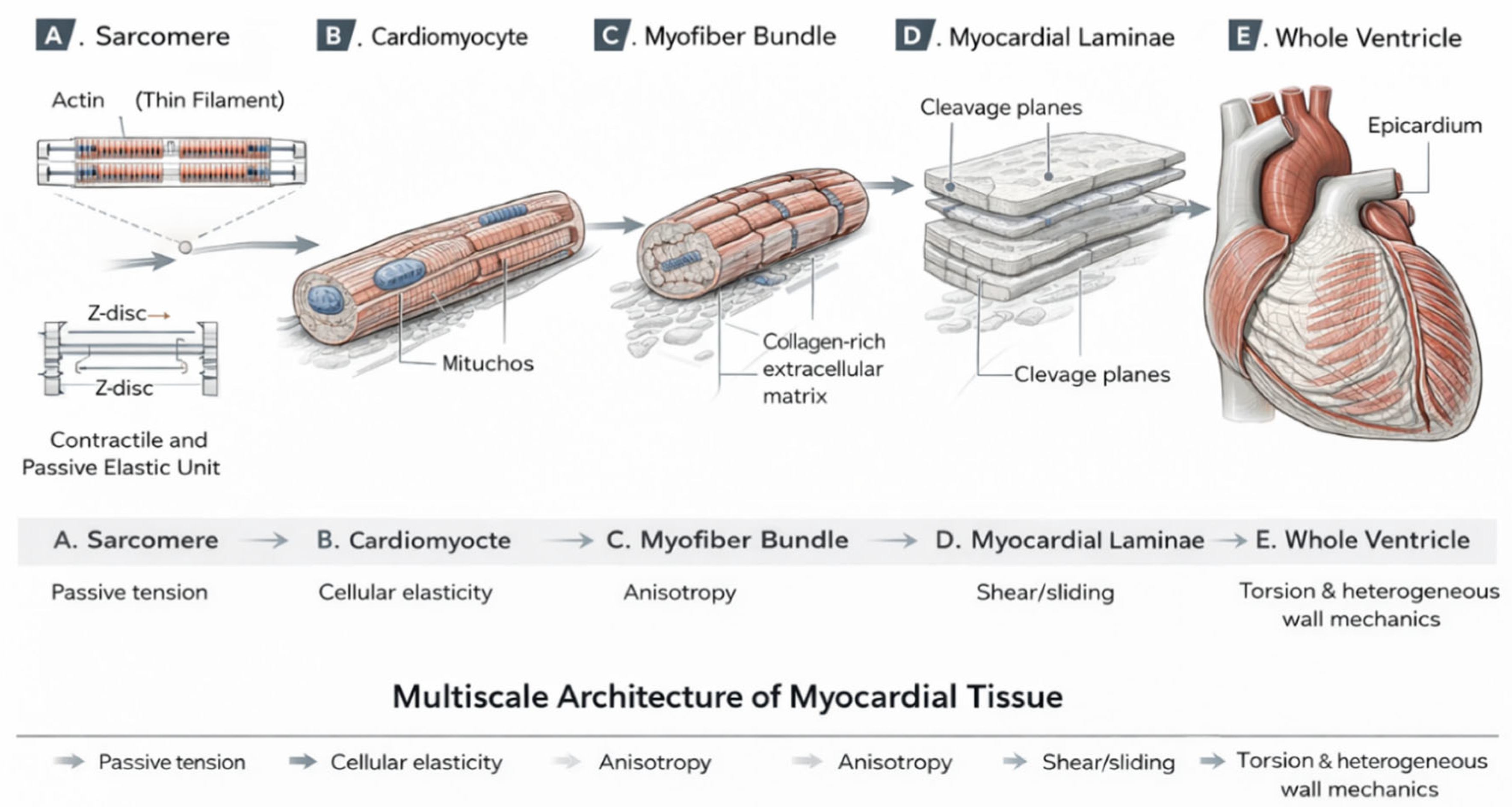
Figure 2.
Experimental methods for measuring myocardial mechanical properties. This figure illustrates commonly used experimental setups for characterizing the mechanical behavior of myocardial tissue. Panel A shows a biaxial mechanical testing system, in which myocardial specimens are mounted using sutures or hooks and stretched independently along two orthogonal directions to quantify anisotropic stress–strain behavior associated with myocardial fiber architecture. Panel B depicts indentation testing, where a rigid indenter applies controlled displacement to the tissue surface while a force transducer measures resistance, enabling estimation of local tissue stiffness and spatial heterogeneity. Panel C shows shear testing, in which controlled tangential displacement is applied to myocardial samples to characterize shear deformation associated with myocardial sheet mechanics. These experimental approaches provide complementary insights into the nonlinear, anisotropic, and spatially heterogeneous mechanical properties of cardiac tissue.
Figure 2.
Experimental methods for measuring myocardial mechanical properties. This figure illustrates commonly used experimental setups for characterizing the mechanical behavior of myocardial tissue. Panel A shows a biaxial mechanical testing system, in which myocardial specimens are mounted using sutures or hooks and stretched independently along two orthogonal directions to quantify anisotropic stress–strain behavior associated with myocardial fiber architecture. Panel B depicts indentation testing, where a rigid indenter applies controlled displacement to the tissue surface while a force transducer measures resistance, enabling estimation of local tissue stiffness and spatial heterogeneity. Panel C shows shear testing, in which controlled tangential displacement is applied to myocardial samples to characterize shear deformation associated with myocardial sheet mechanics. These experimental approaches provide complementary insights into the nonlinear, anisotropic, and spatially heterogeneous mechanical properties of cardiac tissue.
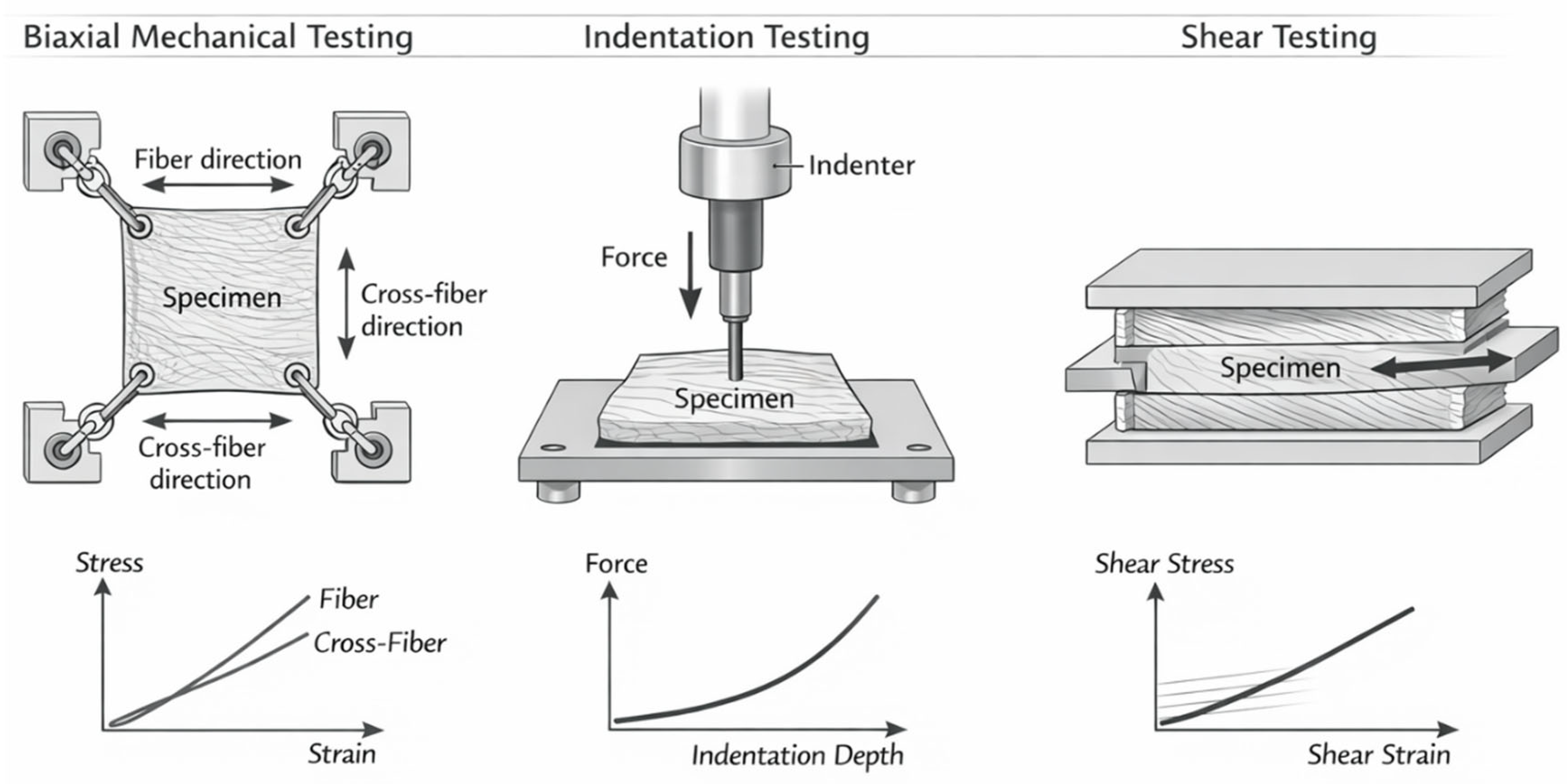
Figure 3.
Constitutive models of myocardial mechanics. The figure illustrates three major constitutive modeling approaches used to describe passive myocardial mechanical behavior. Panel A represents the Fung-type exponential model, a phenomenological formulation widely used to describe nonlinear stress–strain behavior of soft tissues. Panel B shows the Holzapfel–Ogden model, which incorporates myocardial fiber architecture by representing the tissue as a fiber-reinforced composite with distinct contributions from collagen fibers and extracellular matrix. Panel C illustrates multiscale constitutive frameworks that link cellular-level mechanics, such as sarcomere contraction and titin elasticity, to tissue-scale deformation via micro–macro coupling. The accompanying stress–strain curves demonstrate the nonlinear and anisotropic mechanical responses captured by these models. These constitutive formulations form the basis of many finite element simulations of ventricular mechanics.
Figure 3.
Constitutive models of myocardial mechanics. The figure illustrates three major constitutive modeling approaches used to describe passive myocardial mechanical behavior. Panel A represents the Fung-type exponential model, a phenomenological formulation widely used to describe nonlinear stress–strain behavior of soft tissues. Panel B shows the Holzapfel–Ogden model, which incorporates myocardial fiber architecture by representing the tissue as a fiber-reinforced composite with distinct contributions from collagen fibers and extracellular matrix. Panel C illustrates multiscale constitutive frameworks that link cellular-level mechanics, such as sarcomere contraction and titin elasticity, to tissue-scale deformation via micro–macro coupling. The accompanying stress–strain curves demonstrate the nonlinear and anisotropic mechanical responses captured by these models. These constitutive formulations form the basis of many finite element simulations of ventricular mechanics.
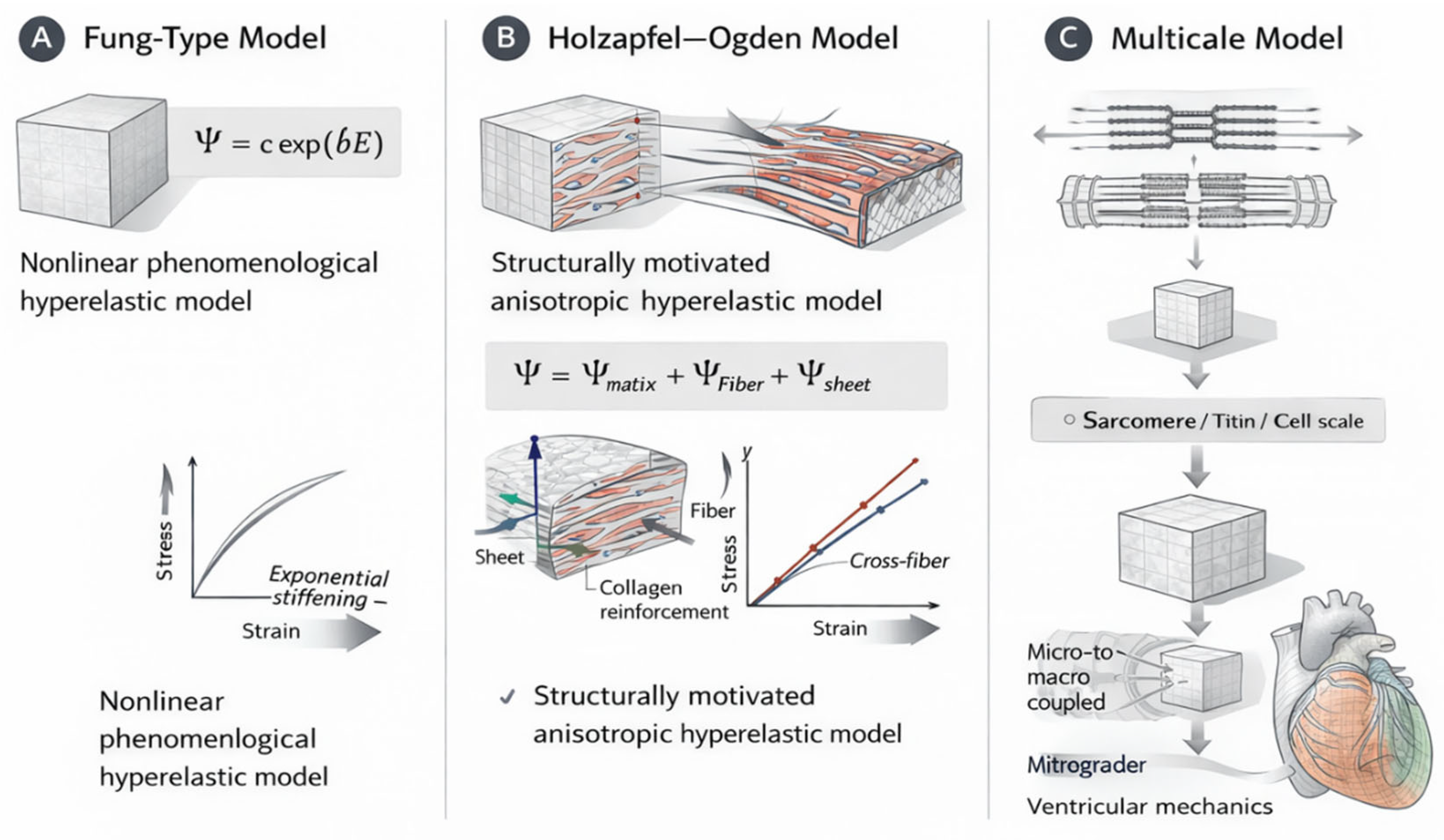
Figure 4.
Pipeline for patient-specific estimation of myocardial stiffness. The figure illustrates the computational workflow commonly used to estimate patient-specific myocardial mechanical properties from clinical imaging data. Cardiac magnetic resonance imaging (MRI) is first used to acquire high-resolution anatomical images of the ventricle. From these images, ventricular geometry and myocardial deformation fields are extracted using image segmentation and strain analysis techniques. The reconstructed geometry is then used to generate a finite element representation of the ventricular wall, incorporating myocardial fiber orientation and appropriate boundary conditions. Finally, inverse finite element methods or optimization algorithms are employed to identify constitutive model parameters that best reproduce the measured deformation patterns. This pipeline enables non-invasive estimation of myocardial stiffness and forms a key component of emerging patient-specific cardiac digital twin frameworks.
Figure 4.
Pipeline for patient-specific estimation of myocardial stiffness. The figure illustrates the computational workflow commonly used to estimate patient-specific myocardial mechanical properties from clinical imaging data. Cardiac magnetic resonance imaging (MRI) is first used to acquire high-resolution anatomical images of the ventricle. From these images, ventricular geometry and myocardial deformation fields are extracted using image segmentation and strain analysis techniques. The reconstructed geometry is then used to generate a finite element representation of the ventricular wall, incorporating myocardial fiber orientation and appropriate boundary conditions. Finally, inverse finite element methods or optimization algorithms are employed to identify constitutive model parameters that best reproduce the measured deformation patterns. This pipeline enables non-invasive estimation of myocardial stiffness and forms a key component of emerging patient-specific cardiac digital twin frameworks.
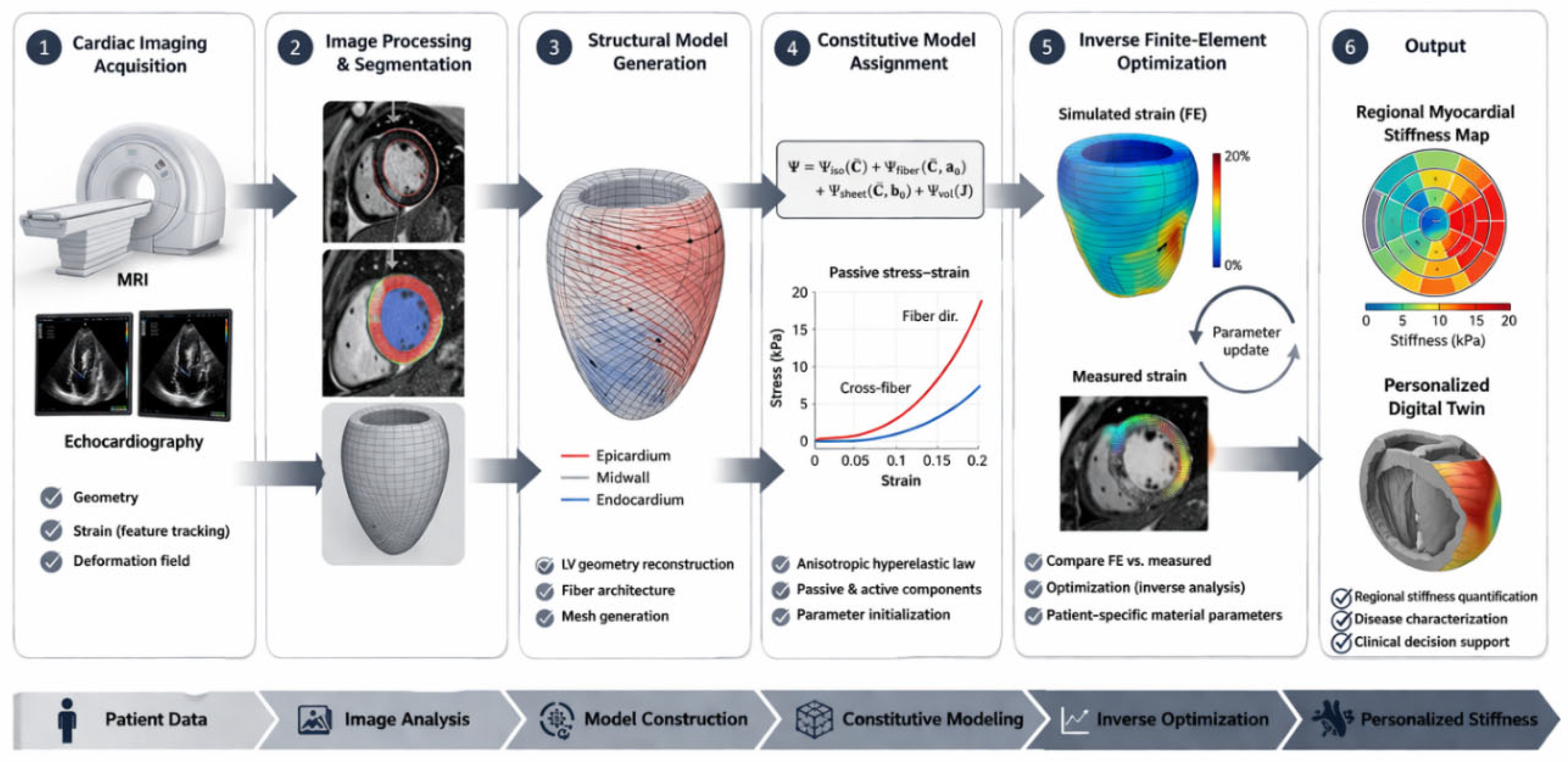
Figure 5.
Mechanical remodeling of myocardium after myocardial infarction. The figure illustrates the transition from healthy myocardium to post-infarction remodeled tissue. Healthy myocardium shows organized cardiomyocyte structure, a relatively uniform extracellular matrix, and compliant passive mechanics, whereas infarcted myocardium demonstrates fibrotic scar formation, increased collagen deposition, disrupted tissue architecture, border-zone heterogeneity, and increased passive stiffness. These regional structural changes alter stress transfer and deformation patterns within the ventricular wall, thereby contributing to adverse ventricular remodeling and impaired cardiac function.
Figure 5.
Mechanical remodeling of myocardium after myocardial infarction. The figure illustrates the transition from healthy myocardium to post-infarction remodeled tissue. Healthy myocardium shows organized cardiomyocyte structure, a relatively uniform extracellular matrix, and compliant passive mechanics, whereas infarcted myocardium demonstrates fibrotic scar formation, increased collagen deposition, disrupted tissue architecture, border-zone heterogeneity, and increased passive stiffness. These regional structural changes alter stress transfer and deformation patterns within the ventricular wall, thereby contributing to adverse ventricular remodeling and impaired cardiac function.
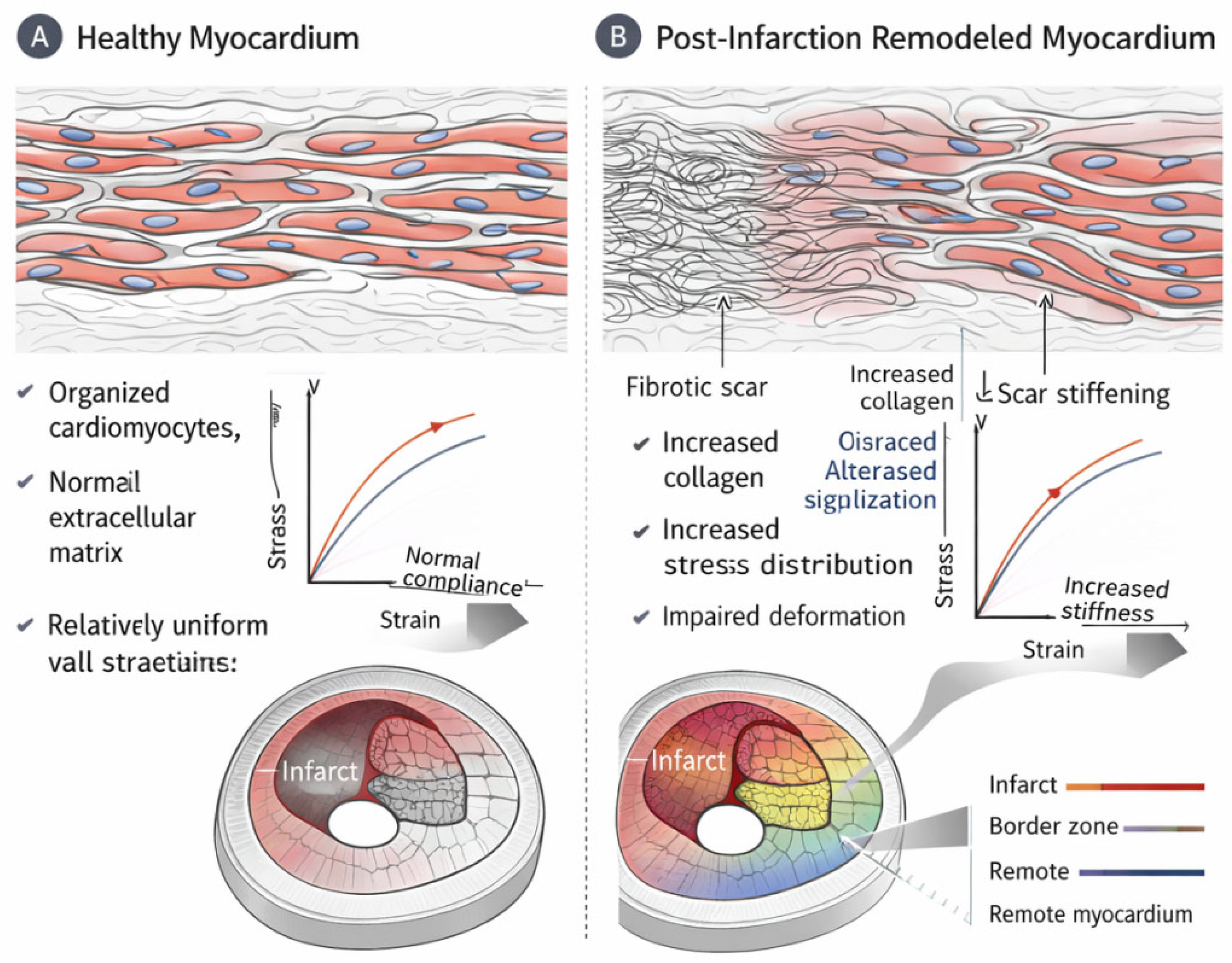
Figure 6.
Emerging experimental and computational platforms in cardiac biomechanics. This figure summarizes key platforms that are driving the translation of myocardial biomechanics from measurement to personalized clinical application. Panel A highlights tagged MRI, DENSE, and related strain-imaging approaches for quantifying myocardial deformation in vivo. Panel B illustrates magnetic resonance elastography, which estimates regional mechanical properties from propagating shear waves and reconstructed stiffness maps. Panel C shows high-resolution indentation and atomic force microscopy approaches for localized or microscale stiffness mapping. Panel D represents patient-specific inverse finite-element modelling, in which ventricular geometry and deformation data are integrated with constitutive formulations to estimate myocardial material parameters. Panel E depicts Bayesian and machine-learning inference frameworks that enable parameter estimation, uncertainty quantification, and accelerated model personalization. Panel F shows the cardiac digital twin as an integrative endpoint combining anatomy, mechanics, and predictive simulation for clinical decision support. Together, these platforms reflect the field’s transition from isolated mechanical characterization toward patient-specific computational cardiology and translational biomechanical medicine.
Figure 6.
Emerging experimental and computational platforms in cardiac biomechanics. This figure summarizes key platforms that are driving the translation of myocardial biomechanics from measurement to personalized clinical application. Panel A highlights tagged MRI, DENSE, and related strain-imaging approaches for quantifying myocardial deformation in vivo. Panel B illustrates magnetic resonance elastography, which estimates regional mechanical properties from propagating shear waves and reconstructed stiffness maps. Panel C shows high-resolution indentation and atomic force microscopy approaches for localized or microscale stiffness mapping. Panel D represents patient-specific inverse finite-element modelling, in which ventricular geometry and deformation data are integrated with constitutive formulations to estimate myocardial material parameters. Panel E depicts Bayesian and machine-learning inference frameworks that enable parameter estimation, uncertainty quantification, and accelerated model personalization. Panel F shows the cardiac digital twin as an integrative endpoint combining anatomy, mechanics, and predictive simulation for clinical decision support. Together, these platforms reflect the field’s transition from isolated mechanical characterization toward patient-specific computational cardiology and translational biomechanical medicine.
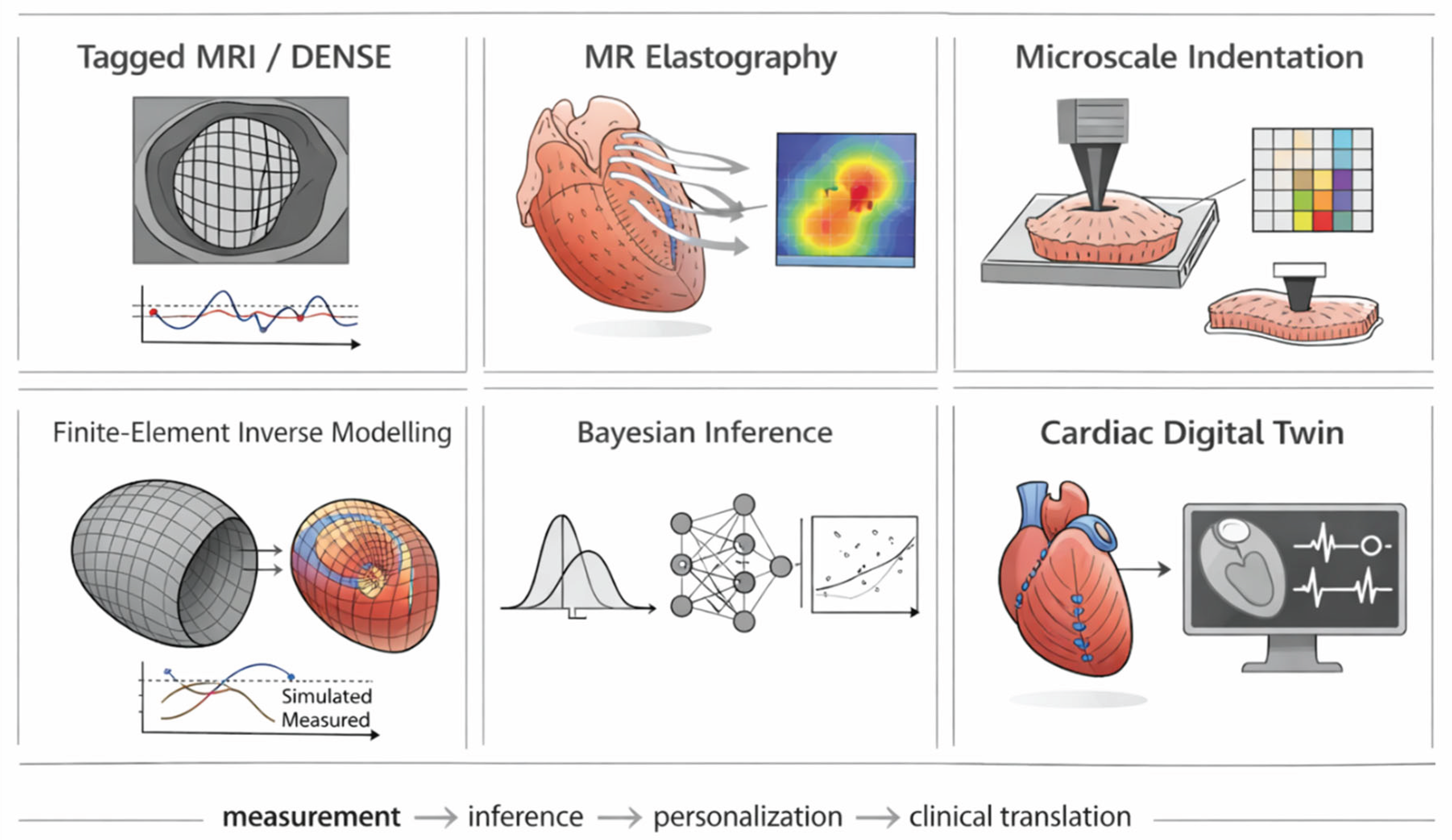
Table 1.
Summary of experimental methods used for myocardial mechanical characterization. The table summarizes the principal experimental techniques used to investigate the mechanical behavior of myocardial tissue. These methods differ in their loading configurations, measurable mechanical parameters, and their ability to capture the nonlinear, anisotropic, and viscoelastic properties of cardiac tissue. Classical approaches such as uniaxial and biaxial tensile testing are commonly used to quantify stress–strain relationships and identify constitutive model parameters, while complementary techniques including shear testing, indentation, and rheological measurements provide insights into laminar mechanics, spatial stiffness heterogeneity, and time-dependent viscoelastic responses. Each method offers distinct advantages and limitations, and together they provide a comprehensive experimental framework for understanding myocardial mechanical behavior across multiple spatial scales.
Table 1.
Summary of experimental methods used for myocardial mechanical characterization. The table summarizes the principal experimental techniques used to investigate the mechanical behavior of myocardial tissue. These methods differ in their loading configurations, measurable mechanical parameters, and their ability to capture the nonlinear, anisotropic, and viscoelastic properties of cardiac tissue. Classical approaches such as uniaxial and biaxial tensile testing are commonly used to quantify stress–strain relationships and identify constitutive model parameters, while complementary techniques including shear testing, indentation, and rheological measurements provide insights into laminar mechanics, spatial stiffness heterogeneity, and time-dependent viscoelastic responses. Each method offers distinct advantages and limitations, and together they provide a comprehensive experimental framework for understanding myocardial mechanical behavior across multiple spatial scales.
| Experimental Method | Loading Mode | Mechanical Properties Measured | Advantages | Limitations | Typical Applications |
| Uniaxial tensile testing | Tensile loading along a single direction (fiber or cross-fiber) | Stress–strain relationship, elastic modulus, nonlinear stiffness | Simple experimental setup; historically widely used; useful for directional stiffness estimation | Does not capture anisotropic coupling between directions; boundary effects can influence results | Early studies of myocardial stiffness; characterization of directional mechanics |
| Biaxial mechanical testing | Simultaneous loading along two orthogonal directions | Anisotropic stress–strain behavior; fiber vs cross-fiber stiffness; constitutive parameter identification | Considered the gold standard for soft tissue mechanics; captures anisotropic coupling | Requires complex specimen preparation; experimental setup more demanding | Parameter identification for constitutive models; finite element simulations of cardiac mechanics |
| Shear testing | Tangential deformation under controlled shear strain | Shear modulus; laminar sheet mechanics; inter-sheet sliding | Provides insight into sheet architecture and ventricular wall thickening mechanisms | Difficult specimen preparation; shear boundary conditions can be challenging | Investigation of myocardial sheet mechanics and laminar deformation |
| Torsion testing | Rotational deformation applied to tissue samples | Torsional stiffness; fiber–sheet coupling behavior | Mimics physiological torsional deformation of the ventricle | Experimental implementation is complex; rarely applied to small samples | Study of ventricular torsion and fiber orientation effects |
| Indentation / micro-indentation testing | Localized compressive loading using rigid indenter | Local tissue stiffness; spatial heterogeneity; regional mechanical properties | Enables mapping of stiffness across tissue surfaces; useful for infarct and scar regions | Interpretation requires contact mechanics models; sensitive to boundary effects | Characterization of infarct stiffness; mapping mechanical heterogeneity |
| Atomic force microscopy (AFM) | Nanoscale indentation using cantilever probe | Microscale elastic modulus; cellular and extracellular matrix stiffness | High spatial resolution; useful for cellular-scale mechanics | Limited penetration depth; sensitive to surface conditions | Measurement of stiffness in cardiomyocytes and extracellular matrix |
| Rheological testing | Oscillatory shear loading | Viscoelastic properties; storage and loss moduli; frequency-dependent stiffness | Quantifies time-dependent mechanical behavior | Often requires homogenized or modified samples | Study of myocardial viscoelasticity and damping behavior |
| Inflation testing (ventricular pressurization) | Pressure-driven deformation of intact ventricular wall | Global ventricular stiffness; pressure–volume relationships | Closely mimics physiological loading conditions | Requires intact specimens; difficult parameter identification | Whole-heart mechanical characterization and model validation |
Table 3.
Imaging modalities for non-invasive estimation of myocardial mechanical properties. The table summarizes commonly used imaging techniques that enable non-invasive characterization of myocardial mechanical behavior. These modalities provide measurements of myocardial deformation, strain, stiffness, or structural architecture that can be used to infer tissue mechanical properties. Techniques such as tagged MRI and DENSE MRI provide high-resolution measurements of myocardial strain, while magnetic resonance elastography and ultrasound elastography enable direct estimation of tissue stiffness. Echocardiographic speckle tracking offers a widely accessible clinical method for assessing myocardial deformation, whereas diffusion tensor MRI provides detailed information about myocardial fiber architecture for computational modeling. These imaging approaches form the foundation of modern patient-specific cardiac biomechanics and are increasingly integrated with computational models for estimation of myocardial material properties.
Table 3.
Imaging modalities for non-invasive estimation of myocardial mechanical properties. The table summarizes commonly used imaging techniques that enable non-invasive characterization of myocardial mechanical behavior. These modalities provide measurements of myocardial deformation, strain, stiffness, or structural architecture that can be used to infer tissue mechanical properties. Techniques such as tagged MRI and DENSE MRI provide high-resolution measurements of myocardial strain, while magnetic resonance elastography and ultrasound elastography enable direct estimation of tissue stiffness. Echocardiographic speckle tracking offers a widely accessible clinical method for assessing myocardial deformation, whereas diffusion tensor MRI provides detailed information about myocardial fiber architecture for computational modeling. These imaging approaches form the foundation of modern patient-specific cardiac biomechanics and are increasingly integrated with computational models for estimation of myocardial material properties.
| Imaging Modality | Measurement Principle | Mechanical Parameters Estimated | Advantages | Limitations | Typical Applications |
| Tagged Magnetic Resonance Imaging (Tagged MRI) | Spatial modulation of magnetization creates tag lines that deform with myocardial motion | Myocardial strain, regional deformation patterns | High spatial resolution; well-established technique for cardiac strain analysis | Requires specialized pulse sequences; time-consuming image processing | Quantification of ventricular deformation; validation of computational models |
| Displacement Encoding with Stimulated Echoes (DENSE MRI) | Direct encoding of tissue displacement within the MRI signal phase | Myocardial displacement fields; strain tensors | High accuracy in displacement measurements; suitable for detailed strain mapping | Technically complex acquisition; sensitive to motion artifacts | Quantitative assessment of myocardial mechanics and ventricular deformation |
| Feature Tracking MRI | Post-processing tracking of anatomical features across cine MRI frames | Global and regional myocardial strain | Does not require specialized imaging sequences; compatible with standard cine MRI | Lower spatial resolution compared with tagged MRI; dependent on image quality | Clinical assessment of ventricular mechanics |
| Magnetic Resonance Elastography (MRE) | Mechanical shear waves propagated through tissue and measured with MRI | Shear modulus; regional myocardial stiffness | Direct estimation of tissue stiffness; spatial mapping of mechanical properties | Technically challenging due to cardiac motion; limited clinical availability | Quantification of myocardial stiffness in fibrosis and heart failure |
| Speckle Tracking Echocardiography | Tracking of natural acoustic speckle patterns in ultrasound images | Longitudinal, circumferential, and radial strain | Widely available; non-invasive; real-time imaging | Dependent on image quality and acoustic window; lower spatial resolution | Clinical evaluation of myocardial function and early detection of dysfunction |
| Ultrasound Shear Wave Elastography | Ultrasound-generated shear waves used to estimate tissue elasticity | Shear modulus and stiffness distribution | Rapid acquisition; non-invasive stiffness estimation | Limited penetration depth; sensitive to motion artifacts | Experimental assessment of myocardial stiffness |
| Diffusion Tensor MRI (DT-MRI) | Measurement of water diffusion anisotropy within myocardial tissue | Fiber orientation and structural anisotropy | Provides detailed myocardial microstructure; useful for modeling fiber architecture | Requires long acquisition times; mainly used in research settings | Reconstruction of myocardial fiber architecture for computational models |
| Computed Tomography (CT)-based motion analysis | High-resolution imaging combined with motion tracking algorithms | Ventricular deformation and strain estimates | High spatial resolution; useful when MRI is contraindicated | Radiation exposure; limited soft tissue contrast | Structural and functional cardiac imaging |
Disclaimer/Publisher’s Note: The statements, opinions and data contained in all publications are solely those of the individual author(s) and contributor(s) and not of MDPI and/or the editor(s). MDPI and/or the editor(s) disclaim responsibility for any injury to people or property resulting from any ideas, methods, instructions or products referred to in the content. |
© 2026 by the authors. Licensee MDPI, Basel, Switzerland. This article is an open access article distributed under the terms and conditions of the Creative Commons Attribution (CC BY) license (http://creativecommons.org/licenses/by/4.0/).
Copyright: This open access article is published under a Creative Commons CC BY 4.0 license, which permit the free download, distribution, and reuse, provided that the author and preprint are cited in any reuse.


