
Submitted:
07 April 2026
Posted:
07 April 2026
You are already at the latest version
Abstract
Ultrafast physical random bit generators (PRBGs) are essential components for modern applications in secure communication, quantum cryptography, and artificial intelligence. While optical chaos-based PRBGs offer high-speed capabilities, conventional systems often rely on discrete components that suffer from system complexity and environmental instability. This paper proposes and experimentally demonstrates a robust, integrated solution using a two-section mutual injection DFB laser. The device was fabricated using the reconstruction equivalent chirp (REC) technique, which provides precise control over grating phase variation while utilizing low-cost, high-volume fabrication methods.The laser sections, each measuring 450 m in length, were designed with a free-running wavelength difference of 0.3 nm to ensure a flat optical spectrum and enhanced chaotic dynamics. By optimizing the bias currents, we achieved a chaos RF bandwidth of 20.1 GHz. Notably, the resulting chaotic signal lacks time-delayed signatures, which simplifies the randomness extraction process. To generate random bits, the chaotic waveform was sampled by an 8-bit analog-to-digital converter at 100 Gb/s. Following post-processing through delay-subtracting and the extraction of the four least significant bits (4-LSBs), we realized a total physical random bit rate of 400 Gb/s. The randomness of the generated sequence was successfully verified using the NIST SP 800-22 statistical test suite. This approach offers a compact, energy-efficient, and high-performance integrated chaotic source suitable for secure communication and high-performance computation.
Keywords:
mutual injection DFB laser
; random bit generators
; chaotic source
1. Introduction
Ultrafast physical random bit generators (PRBGs) are key components for the Monte Carlo method, making them suitable for applications in secure communication, quantum cryptography, encrypted optical fiber sensing, and artificial intelligence [1,2,3,4]. The PRBGs can be realized through two main mechanisms: thermal noise and optical chaos, which rely on the intricate dynamics of chaotic physical systems [5,6]. The latter has been studied for decades to overcome the limitations of electronic approaches, by utilizing the ultra-fast nature of optical processes. The chaotic lasers have attracted considerable attention for generating high-speed PRBGs owing to their large bandwidth and intensive randomness. In 2008, Uchida et al. first proposed the high-rate generation of random bit sequences of 1.7 Gb/s using two independent chaotic semiconductor lasers, which demonstrated the simplicity and high-speed capabilities inherent in PRBGs based on optical chaos [7]. Then, the total PRBG rate was pushed up to several hundreds of gigabits per second and even terabits per second by using chaotic lasers with various external perturbations, such as optical feedback, optical injection, and optoelectronic feedback [8,9,10,11,12]. However, in most above-mentioned situations, the discrete devices were used for PRBGs, which will cause a complex system and vulnerability to environmental influence. Recently, based on integrated chaotic lasers, such as microcomb [13], amplified spontaneous emission (ASE) [14], and microlaser [15,16], led to the realization of ultrafast PRBGs characterized by simplified systems and enhanced stability. Moreover, the integrated mutually coupled distributed feedback (DFB) laser was used in the chaos synchronization due to its ultra-short coupling delay, which shows the enormous potential for applying it to the ultrafast PRBGs [17].
In this paper, we propose and experimentally demonstrate a 400 Gb/s PRBG based on an integrated mutual injection DFB laser. The chaotic laser consists of the two-section mutual DFB laser with a free-running wavelength difference of 0.3 nm, which has a chaos radio-frequency (RF) bandwidth of 20.1 GHz. We successfully realize 400 Gbps random number sequences with verified randomness by adopting a multi-bit extraction method. The demonstrated performance suggests the proposed scheme is a strong candidate for integrated PRBGs.
2. Design and Fabrication
The reconstruction equivalent chirp (REC) technique has recently been introduced as a method to effectively achieve grating chirp and phase shifts, offering precise control over grating phase variation [18,19]. This approach utilizes low-cost, high-volume fabrication methods involving holographic exposure and micrometer-level contact exposure, steering clear of the more expensive and intricate electron beam lithography. It employs the high-order frequency response the sampling pattern generates on a homogeneous grating to achieve laser resonance. The index modulation change n(z) of the REC-based Bragg grating is given by [20]:

where Fm represents the mth order Fourier coefficient, Λ0 is the period of the seed grating, n0 is the index modulation of the seed grating, P and DP are the sampling period and the phase shift in the sampling structure, respectively. According to Equation (1), an equivalent phase shift m = 2πmDP/P can be generated in the mth order sub-grating with the variable length of the phase shift DP. The Bragg wavelength of +1st order is usually used and its order period can be expressed as,

where λ+1, n, Λ0, and P are the Bragg wavelength of +1st order sub-grating, the effective index, the period of the uniform seed grating, and the sampling period, respectively. When the period of a uniform grating is determined, the lasing wavelength is solely dependent on the sampling period, thus the grating fabrication tolerance is relaxed by the factor (P/Λ0+1)2, with the value of several hundred. In our device, the Bragg wavelength of the 0th order sub-grating is designed at 1635 nm and the center of the gain spectrum is at 1550 nm. Figure 1a shows the schematic of the proposed integrated two-section mutual injection DFB laser, which consists of the LD1 and LD2, respectively. The free-running wavelength difference of the LD1 and LD2 is set to 0.3 nm. The lengths of the LD1 and LD2 are both 450 μm. There is a 5-μm-long electrical isolation region between the two lasers. The anti-reflection films (AR/AR) are coated on both facets with their reflectivities of ~1% to avoid the influence of the random facet phase. Figure 1b depicts the microscope image of the fabricated two-section mutual injection DFB laser chip. The device was fabricated in the EPIHOUSE, a commercial InP foundry in China. Two-step metal-organic chemical vapor deposition (MOCVD) was employed to grow a standard 1.55 μm InGaAsP/InP laser on a 2-inch n-InP substrate. During the first epitaxy growth process, an n-InP buffer layer, an n-InAlGaAs lower optical confinement layer, a compressively InAlGaAs multiple-quantum-well active structure, a p-InGaAsP upper optical confinement layer, and a p-InGaAsP grating layer were successively grown. Subsequently, the pre-designed sampled grating was defined by the standard photolithography and inductive coupling plasma. A p-InP cladding layer, a p-InGaAsP transition layer, and a p-InGaAs contact layer were successively grown. The wafer was then further processed into the ridge waveguide lasers with a ridge width of 2 μm. After that, the Ti/Pt/Au electrodes were deposited through the standard photolithography and lift-off processes, in which the two adjacent electrodes were isolated by the electrical isolation layer. Finally, the lasers were obtained by wafer cleaving. The chaotic laser chip was further Butterfly packaged, which can protect the delicate chip from environmental factors and ensure stable operation.
3. Experiment Setup and Laser Test
The integrated two-section mutual injection DFB laser is tested under 25 °C controlled by the thermoelectric cooler using the experimental setup shown in Figure 2. DC bias is applied to both LD1 and LD2. Then, the optical signal is coupled into a tapered single-mode fiber, with the incorporation of an isolator to prevent optical feedback from other components within the system. The AQ6370 optical spectrum analyzer (OSA) records the laser output with a resolution of 0.02 nm. Finally, an electrical spectrum analyzer (ESA, Rohde & Schwarz) and an oscilloscope (OSC, Tektronix) are adopted to record the RF spectrum and the time series of the electrical signal from a high-speed photodetector (PD, Finisar). The free-running wavelengths of the LD1 and LD2 are tested.
As shown in Figure 3a, when the LD1 is biased at 49 mA and LD2 is biased at a small current (~16 mA) to compensate for the material absorption, the free-running wavelength of LD1 is 1539.85 nm. Under the same state, when the LD2 is biased at 46 mA and LD1 is biased at 16 mA, the free-running wavelength of LD2 is 1539.54 nm. When they are free running, the −20 dB linewidths of LD1 and LD2 are 0.078 nm and 0.074 nm, respectively. Under the biased currents of LD1 and LD2 at 49 mA and 46 mA, the spectrum of the two-section DFB laser at a chaotic state subjected to mutual injection is shown in Figure 3a by the black line. The −20 dB linewidth is 0.568 nm, which is widely broadened concerning that of free-running of LD1 and LD2. The corresponding RF spectrum of the chaotic laser is shown in Figure 3b. The broad peak on the spectrum at approximately 8.5 GHz is related to the relaxation oscillation frequency of the chaotic laser, which is larger than that of free-running lasers due to the optical injection. The calculation of the 80% bandwidth considers the span between zero and the frequency where 80% of the total energy, excluding the noise floor, is encompassed [21]. In the optical feedback chaos depicted in Figure 3b, the 80% bandwidth measures 20.1 GHz. The AC waveform of the chaotic laser system is illustrated in Figure 3c, demonstrating a random distribution of large values characteristic of a typical chaotic state. Meanwhile, an auto-correlation function (ACF) curve is depicted in Figure 3d. Without the need for a feedback loop to estimate a chaotic state as the chaotic laser, no time-delayed signature is observed in the ACF of the two-section mutual DFB laser [22]. The inset in Figure 3d represents the entire ACF curve for 500 ns.
We also investigate the influence of injection current on the behavior of the bandwidth of the chaotic laser. Here, the bias current of LD1 is fixed at 49 mA and the bias current of LD2 varies from 46 to 52 mA with the step of 2 mA. As shown in Figure 4a, the distinctly multi-modal peaks of the lasing spectra can be observed with the increase of bias current. The corresponding radio frequency (RF) spectra are depicted in Figure 4b. The calculated 80% bandwidths of the chaotic laser are 20.1, 19.38, 18.14, and 16.3 GHz at 46, 48, 50, and 52 mA respectively. Owing to the modal beating of the multi-modal peaks, it causes the reduction of the flatness of the spectrum and the bandwidth. In the case of the two-section mutual injection laser, if the wavelengths of LD1 and LD2 are too close, it will lead to intensified competition between the two wavelengths and generate multi-modal peaks. Thus, in our design, the free-running wavelength difference of the LD1 and LD2 is set to 0.3 nm, which can provide a flat optical spectrum and a large bandwidth in the chaotic state.
4. Random Bit Generation
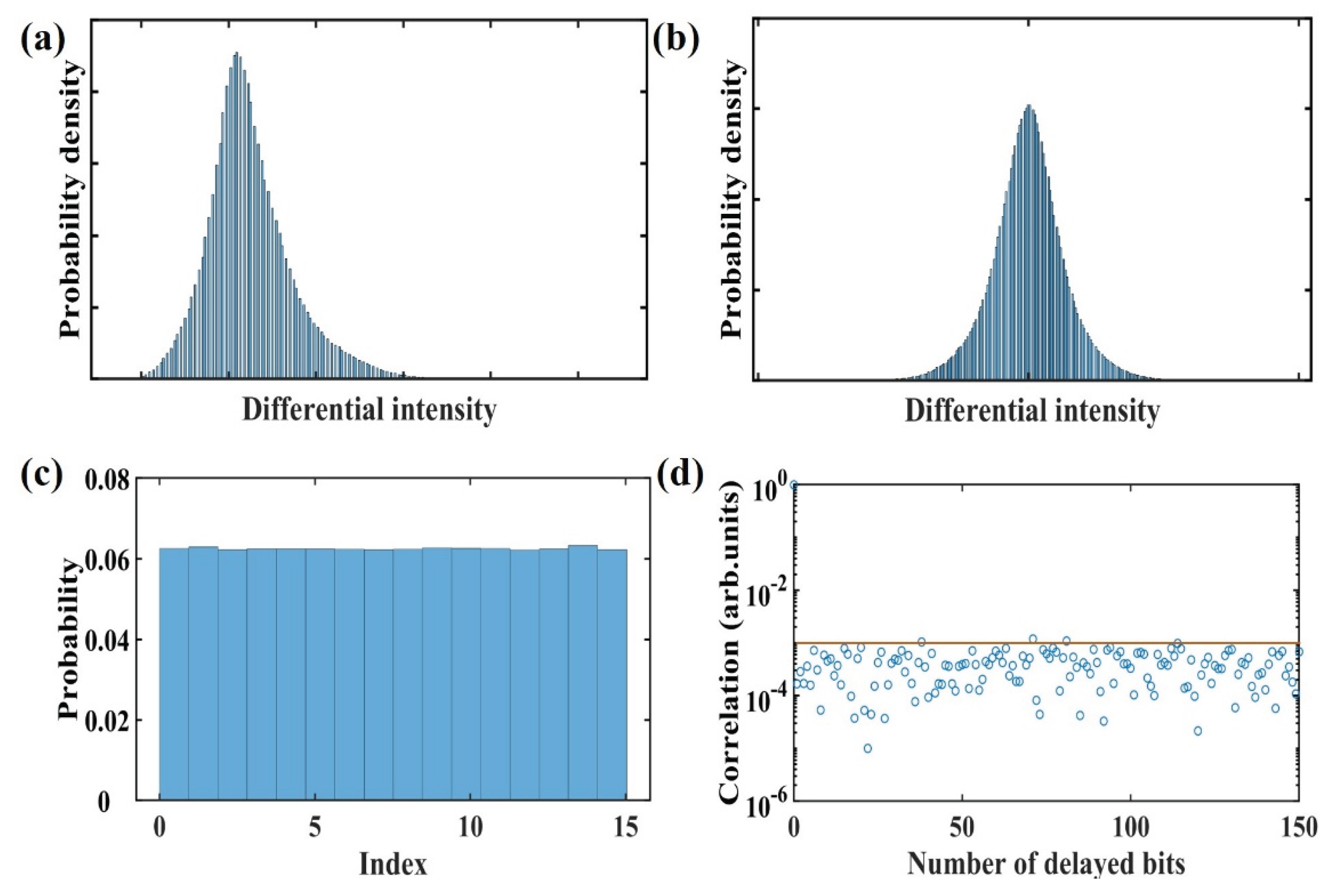
The two-section chaotic laser is utilized to generate physical random numbers. The bias currents of LD1 and LD2 are set to 49 mA and 46 mA, respectively. The chaotic laser waveform is converted into a binary stream through an 8-bit ADC operating at a sample rate of 100 Gb/s and the intensity histogram distribution of the 100 μs long raw data stream is illustrated in Figure 5a. The observed distribution displays asymmetry, a characteristic often associated with chaotic systems, particularly when subjected to a chaotic signal featuring random spikes. The inherent asymmetry in the distribution poses the risk of introducing bias into the generated random sequence. To mitigate this, additional post-processing techniques, including delay subtracting and extraction of the least significant bits (LSBs), were implemented for the PRBG [23]. To rectify the asymmetry and achieve a more balanced distribution, a delay difference is introduced to the raw data. It’s crucial to note that the selection of the delay time is pivotal in eliminating the periodicity of the original chaotic signals. Theoretically and experimentally demonstrated criteria for delay time selection suggest that weak periodicity can be eliminated if the cross-correlation coefficient between the chaotic signal and its delayed counterpart is less than 0.007 [24]. Considering the very low correlation coefficient at 1 ns in Figure 3d, we select a delay time of 1 ns and obtain a symmetric distribution as shown in Figure 5b. The symmetric distribution is favorable for unbiased bit extraction. By retaining four LSBs, we can obtain a nearly uniform probability distribution, as shown in Figure 5c. Figure 5d shows the ACF of the generated bit sequence and the correlation is around the lower limit 1/, where n = 106 is the length of the bit sequence.
The randomness of these generated random numbers is verified by the National Institute of Standards and Technology Special Publication (NIST SP) 800-22 statistical tests. To pass the tests, the composite P-value (the uniformity of P-values) should be larger than 0.0001 and the corresponding proportion should be limited to the range of 0.99±0.0094392 under the significance level α = 0.01 [25]. In this experiment, we use the 1000 sequences of 1-Mbit data to execute the standard statistical test suite with a significance level α = 0.01, and the results are shown in Figure 6. The P-values of the 15 NIST tests are larger than 0.0001. Meanwhile, the proportions of the tested random bits are within 0.99±0.0094392. These results indicate the true randomness of the proposed PRBG.
5. Conclusions
In summary, we propose and experimentally demonstrate an integrated two-section mutual injection DFB laser. The −20 dB linewidth of 0.568 nm and the 80% bandwidth of 20.1 GHz can be achieved under the chaotic state. By retaining 4-LSBs post-processing, we have realized a 400-Gb/s physical random bit sequence, which passed the NIST SP 800-22 statistical test of randomness. This work provides a compact and energy-efficient integrated chaotic source for ultrafast PRBGs.
Author Contributions
Jianyu Yu: Conceptualization, methodology, formal analysis, investigation, data analysis, and writing original draft preparation. Pai Peng: Investigation, methodology, and validation. Qi Zhou: Investigation and formal analysis of the NIST statistical tests. Pan Dai: Chip design based on the REC technique , and supervision of the fabrication process. Xiangfei Chen: Resources, supervision of the reconstruction equivalent chirp (REC) technical implementation, and funding acquisition. Yi Yang: Supervision, conceptualization, funding acquisition. All authors have read and agreed to the published version of the manuscript.
Funding
This work was supported by the Science and Technology Project Funding of State Grid Technology Co., Ltd. (J2025138).
Institutional Review Board Statement
Not applicable.
Informed Consent Statement
Not applicable.
Data Availability Statement
Data are contained within the article, as shown in the figures and associated descriptions.
Conflicts of Interest
The authors declare no conflicts of interest.
References
- Gisin, N.; Ribordy, G.; Tittel, W.; Zbinden, H. Quantum cryptography. Rev. Mod. Phys. 2002, 74, 145–195. [Google Scholar] [CrossRef]
- Asmussen, S.; Glynn, P.W. Stochastic Simulation: Algorithms and Analysis; Springer: New York, NY, USA, 2007. [Google Scholar]
- Shannon, C.E. Communication Theory of Secrecy Systems. Bell Syst. Tech. J. 1949, 28, 656–715. [Google Scholar] [CrossRef]
- Petrie, C.S.; Connelly, J.A. A noise-based IC random number generator for applications in cryptography. IEEE Trans. Circuits Syst. I Fundam. Theory Appl. 2000, 47, 615–621. [Google Scholar] [CrossRef]
- Oliver, N.; Soriano, M.C.; Sukow, D.W.; Fischer, I. Dynamics of a semiconductor laser with filtered optical feedback: From single-mode operation to chaos. IEEE J. Quantum Electron. 2013, 49, 910–918. [Google Scholar] [CrossRef]
- Xiang, S.; Wang, B.; Wang, Y.; Han, Y.; Wen, A.; Hao, Y. High-bit-rate physical random number generation based on an optical external-cavity semiconductor laser with symmetrical intensity distribution. J. Light. Technol. 2019, 37, 3987–3993. [Google Scholar] [CrossRef]
- Sciamanna, M.; Shore, K.A. Physics and applications of laser diode chaos. Nat. Photonics 2015, 9, 151–162. [Google Scholar] [CrossRef]
- Sakuraba, R.; Iwakawa, K.; Kanno, K.; Uchida, A. Tera-bit-per-second physical random number generation using dual-path optical feedback in semiconductor lasers. Opt. Express 2015, 23, 1470–1490. [Google Scholar] [CrossRef]
- Tseng, C.H.; Funabashi, R.; Kanno, K.; Uchida, A.; Wei, C.C.; Hwang, S.K. Physical random number generation using a semiconductor laser with phase-modulated optical feedback. Opt. Lett. 2021, 46, 3384–3387. [Google Scholar] [CrossRef]
- Xu, Y.; Lu, P.; Mihailov, S.; Bao, X. Physical random bit generation using an integrated chaotic semiconductor laser. Opt. Lett. 2017, 42, 4796–4799. [Google Scholar] [CrossRef]
- Cai, Q.; Li, P.; Shi, Y.; Jia, Z.; Ma, L.; Xu, B.; Chen, X.; Shore, K.; Wang, Y. Fast physical random number generation based on chaotic laser from an integrated mutual-injection semiconductor laser. Opt. Laser Technol. 2023, 162, 109273. [Google Scholar] [CrossRef]
- Ge, Z.; Xiao, Y.; Hao, T.; Li, W.; Li, M. 100-Gb/s physical random number generation based on a gain-switched laser diode with pulse-to-pulse jitter. IEEE Photonics Technol. Lett. 2021, 33, 1223–1226. [Google Scholar] [CrossRef]
- Shen, B.; et al. Massively parallel physical random number generation with a chaotic microcomb. Nat. Commun. 2023, 14, 4590. [Google Scholar] [CrossRef]
- Kyungduk, K.; Bittner, S.; Zeng, Y.; Guazzotti, S.; Hess, O.; Wang, Q.; Cao, H. Massively parallel ultrafast random bit generation with a chip-scale laser. Science 2021, 371, 948–952. [Google Scholar] [CrossRef]
- Li, J.; Li, Y.; Dong, Y.; Yang, Y.; Xiao, J.; Huang, Y. Ultrafast physical random number generation based on a high-bandwidth chaotic laser. Chin. Opt. Lett. 2023, 21, 061901. [Google Scholar] [CrossRef]
- Li, J.; Xiao, J.; Yang, Y.; Chen, Y.; Huang, Y. Parallel physical random bit generation based on a multi-mode chaotic laser. Nanophotonics 2023, 12, 4109–4118. [Google Scholar] [CrossRef] [PubMed]
- Liu, D.; Sun, C.; Xiong, B.; Luo, Y. High-speed and energy-efficient chaotic semiconductor laser for physical random bit generation. Opt. Express 2014, 22, 5614–5622. [Google Scholar] [CrossRef]
- Shi, Y.; Chen, X.; Zhou, Y.; Li, S.; Lu, L.; Liu, R.; Feng, Y. Experimental demonstration of a high-speed physical random bit generator based on a chaotic semiconductor laser. Opt. Lett. 2012, 37, 3315–3317. [Google Scholar] [CrossRef] [PubMed]
- Shi, Y.; Li, S.; Li, L.; Guo, R.; Zhang, T.; Rui, L.; Li, W.; Lu, L.; Song, T.; Zhou, Y.; et al. Sampling grating based DFB laser array for fast random number generation. J. Light. Technol. 2013, 31, 3243–3249. [Google Scholar] [CrossRef]
- Dai, Y.; Chen, X.; Xia, L.; Zhang, Y.; Xie, S. Sampled grating for reconstruction of optical grating equivalent chirp. Opt. Lett. 2004, 29, 1333–1335. [Google Scholar] [CrossRef]
- Lin, F.Y.; Liu, J.M. Chaotic lidar. Opt. Commun. 2003, 221, 173–180. [Google Scholar] [CrossRef]
- Li, Y.; Ma, C.; Xiao, J.; Wang, T.; Wu, J.; Yang, Y.; Huang, Y. High-speed physical random number generation based on a synchronized chaotic laser. Opt. Express 2022, 30, 2122–2132. [Google Scholar] [CrossRef] [PubMed]
- Reidler, I.; Aviad, Y.; Rosenbluh, M.; Kanter, I. Ultrahigh-speed random number generation based on a chaotic semiconductor laser. Phys. Rev. Lett. 2009, 103, 024102. [Google Scholar] [CrossRef] [PubMed]
- Zhang, J.; Wang, Y.; Xue, L.; Hou, J.; Zhang, B.; Wang, A.; Zhang, M. Robustness of physical random number generation based on a chaotic semiconductor laser. Appl. Opt. 2012, 51, 1709–1715. [Google Scholar] [CrossRef] [PubMed]
- Rukhin, A.; Soto, J.; Nechvatal, J.; Smid, M.; Barker, E. A Statistical Test Suite for Random and Pseudorandom Number Generators for Cryptographic Applications; NIST Special Publication 800-22 Revision 1a; National Institute of Standards and Technology: Gaithersburg, MD, USA, 2010. [Google Scholar]
Figure 1.
(a) Schematic of the proposed integrated two-section mutual injection DFB laser. (SCH-MQW: separate confinement hetero-structure-multi-quantum well; BG: Bragg grating). (b) microscopic images of fabricated chaotic laser chips.
Figure 1.
(a) Schematic of the proposed integrated two-section mutual injection DFB laser. (SCH-MQW: separate confinement hetero-structure-multi-quantum well; BG: Bragg grating). (b) microscopic images of fabricated chaotic laser chips.
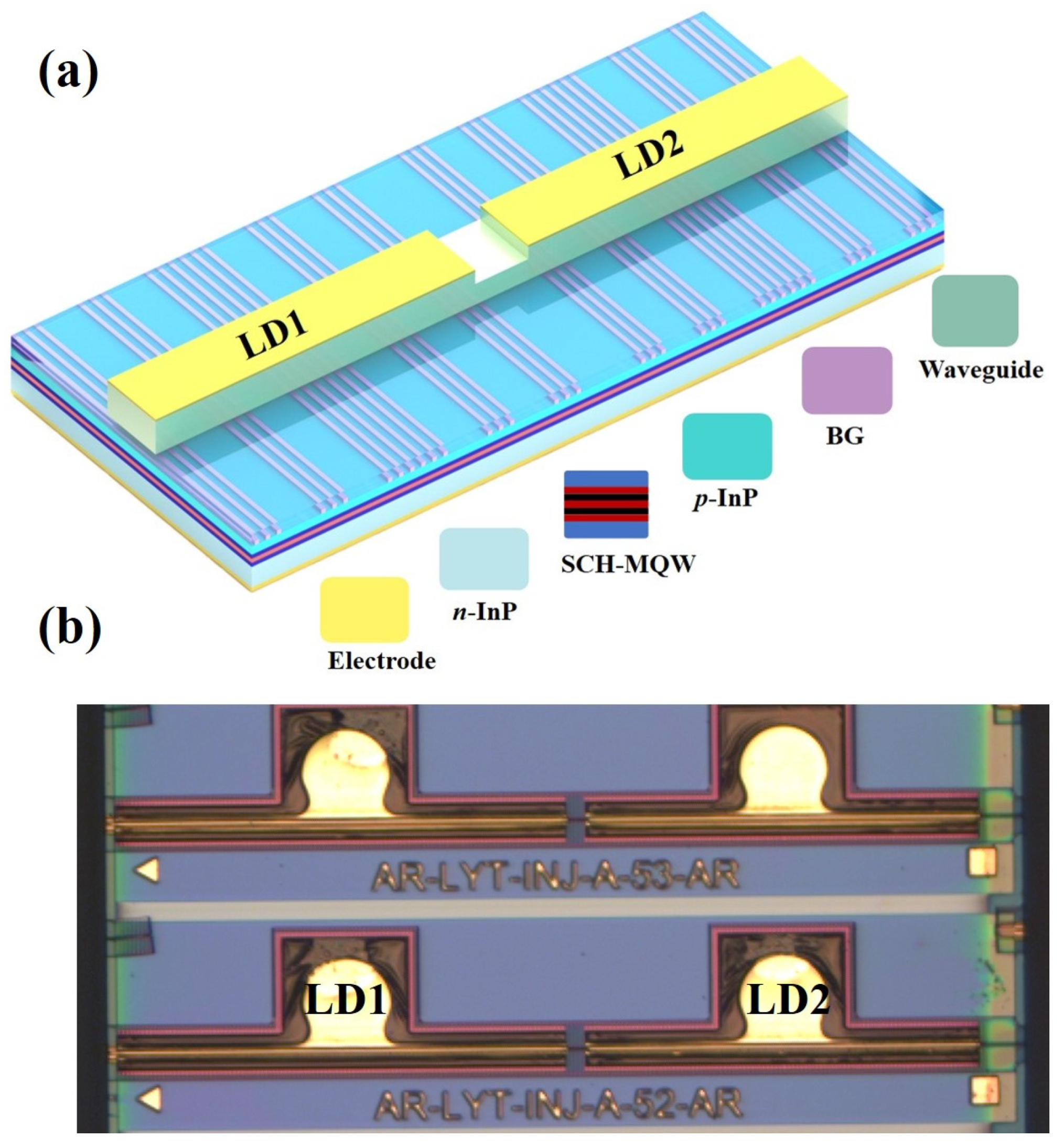
Figure 2.
Experimental setup. ISO: isolator, PD: photodetector; OSA: optical spectrum analyzer; ESA: electrical spectrum analyzer, OSC: oscilloscope.
Figure 2.
Experimental setup. ISO: isolator, PD: photodetector; OSA: optical spectrum analyzer; ESA: electrical spectrum analyzer, OSC: oscilloscope.
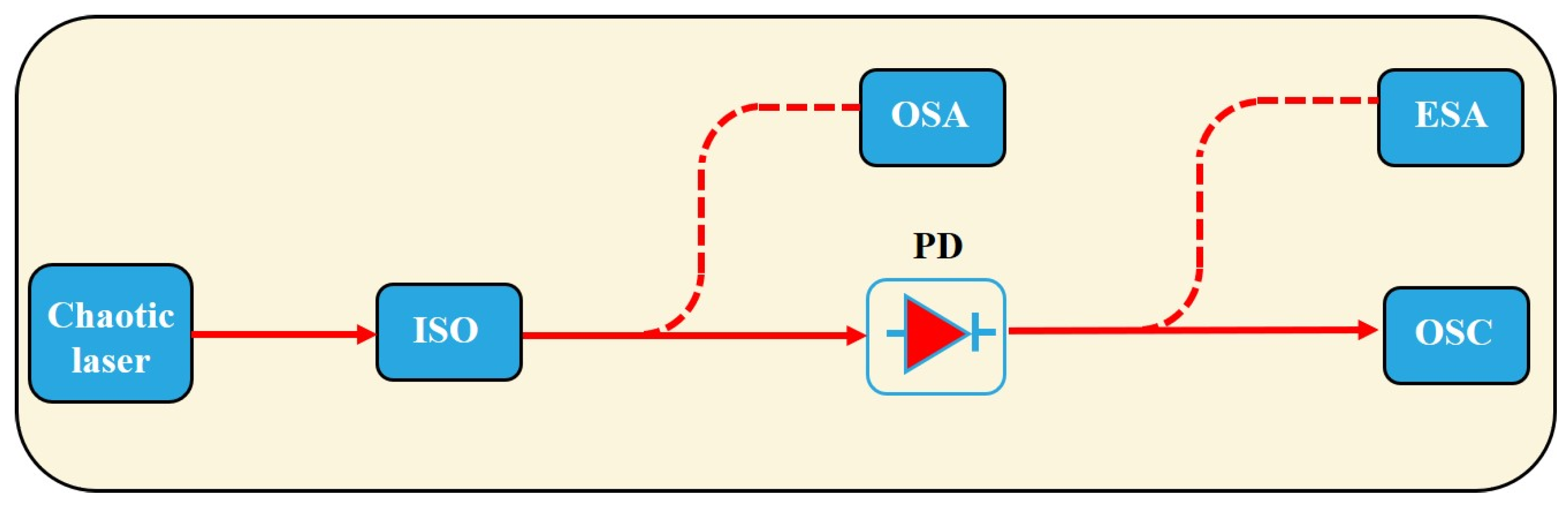
Figure 3.
(a) Optical spectra of free-running LD1, free-running LD2, and the chaotic state. (b) output spectra of the chaotic lasers. The black curve is the noise floor, and the red curve is the chaotic laser spectrum under the bias currents of LD1 and LD2 at 49 and 46 mA, respectively. (c) temporal waveform. (d) corresponding autocorrelation function for the chaotic output. The inset in (d) represents the entire ACF curve for 500 ns.
Figure 3.
(a) Optical spectra of free-running LD1, free-running LD2, and the chaotic state. (b) output spectra of the chaotic lasers. The black curve is the noise floor, and the red curve is the chaotic laser spectrum under the bias currents of LD1 and LD2 at 49 and 46 mA, respectively. (c) temporal waveform. (d) corresponding autocorrelation function for the chaotic output. The inset in (d) represents the entire ACF curve for 500 ns.
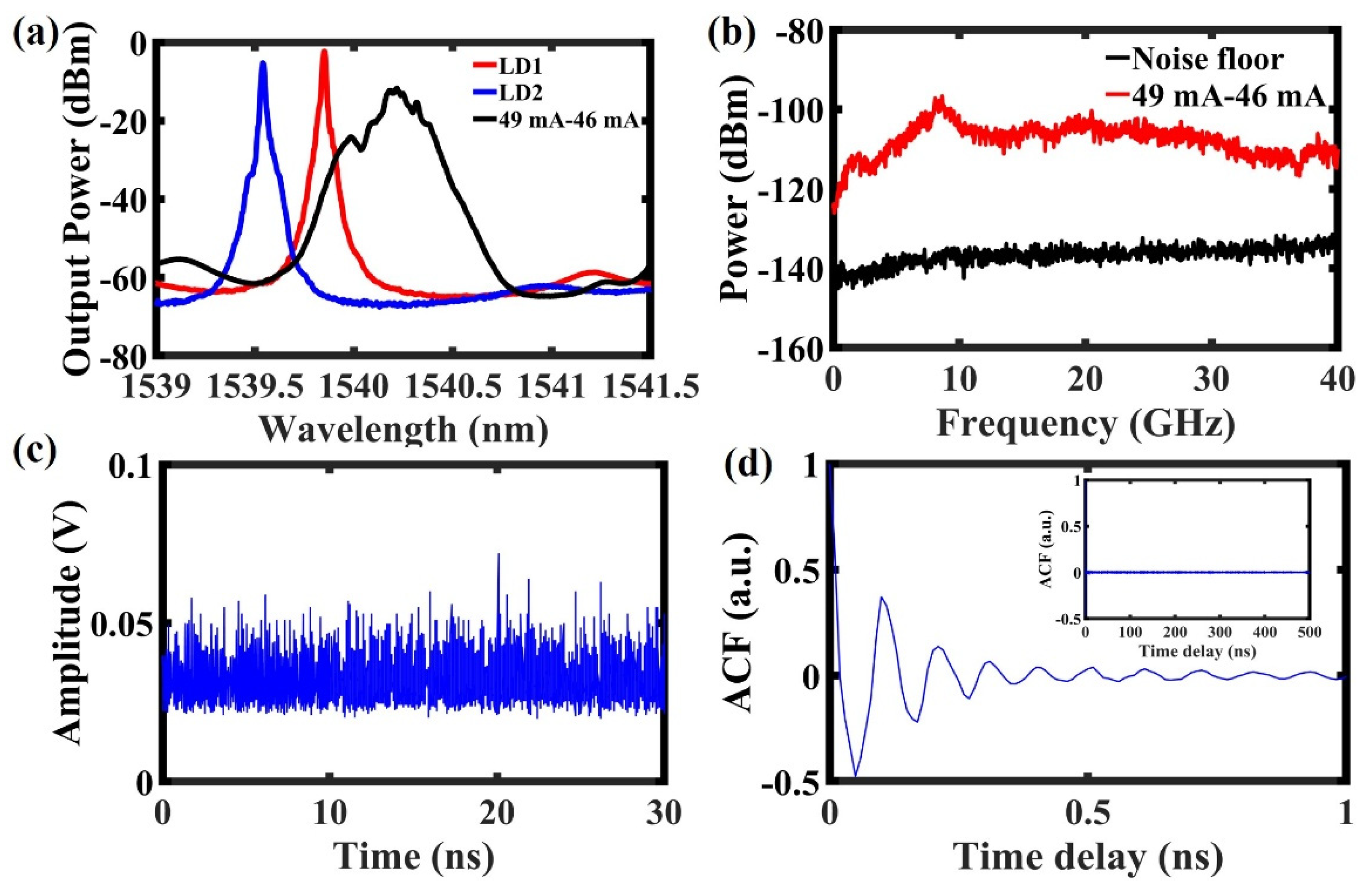
Figure 4.
(a) Lasing spectra and (b) corresponding RF spectra under the bias currents of LD2 at 46 mA, 48 mA, 50 mA, and 52 mA.
Figure 4.
(a) Lasing spectra and (b) corresponding RF spectra under the bias currents of LD2 at 46 mA, 48 mA, 50 mA, and 52 mA.
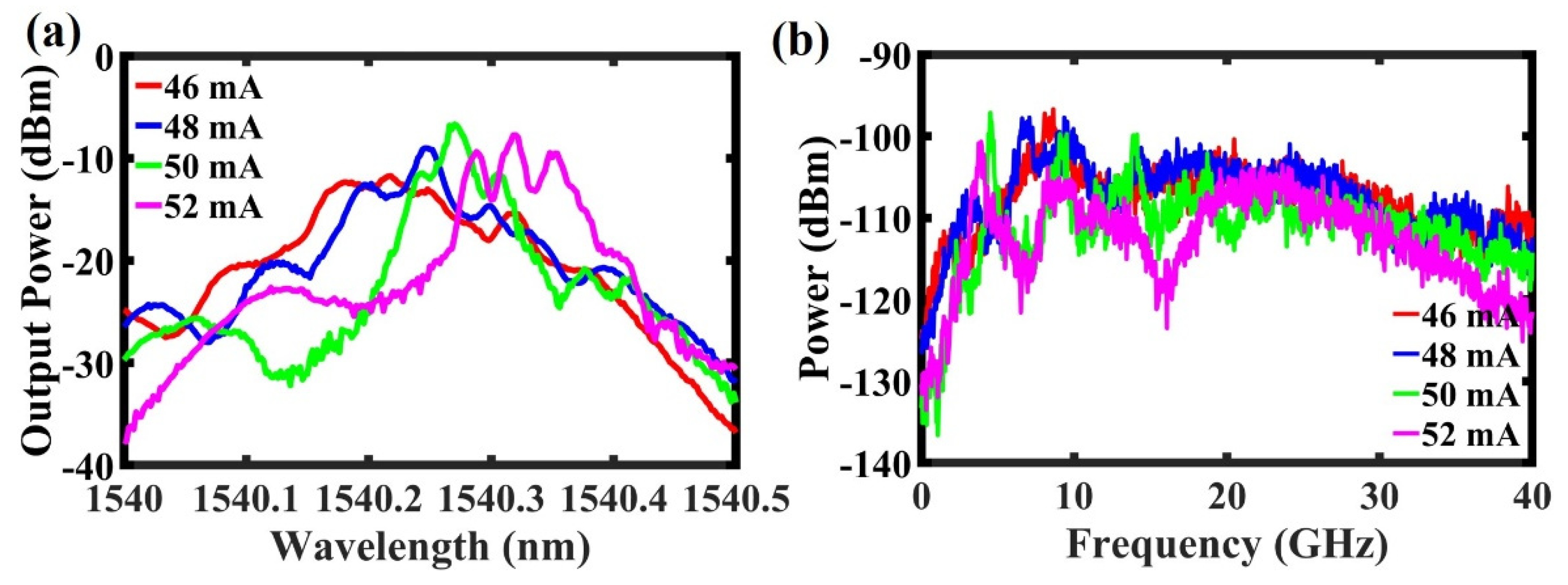
Figure 5.
(a) Raw signal intensity and (b) differential intensity after delay-subtracting post-processing. (c) probability distribution with 4-LSBs extraction, and (d) corresponding ACF curve of the bit stream.
Figure 5.
(a) Raw signal intensity and (b) differential intensity after delay-subtracting post-processing. (c) probability distribution with 4-LSBs extraction, and (d) corresponding ACF curve of the bit stream.
Disclaimer/Publisher’s Note: The statements, opinions and data contained in all publications are solely those of the individual author(s) and contributor(s) and not of MDPI and/or the editor(s). MDPI and/or the editor(s) disclaim responsibility for any injury to people or property resulting from any ideas, methods, instructions or products referred to in the content. |
© 2026 by the authors. Licensee MDPI, Basel, Switzerland. This article is an open access article distributed under the terms and conditions of the Creative Commons Attribution (CC BY) license (http://creativecommons.org/licenses/by/4.0/).
Copyright: This open access article is published under a Creative Commons CC BY 4.0 license, which permit the free download, distribution, and reuse, provided that the author and preprint are cited in any reuse.


