

Submitted:
06 April 2026
Posted:
07 April 2026
You are already at the latest version
Abstract
Texas's AI data centers face dual existential threats: ERCOT's independent grid operation and vulnerability to extreme weather—as demonstrated by Winter Storm Uri's 52 GW outage—coupled with escalating water scarcity threatening cooling system reliability. Existing microgrid solutions address power balance through gas turbines and energy storage but neglect cooling-water constraints as a co-equal design challenge. This study proposes a resilient microgrid architecture with water-electricity coupling for a 100 MW AI data center in West Texas, centered on a 50 MW gas turbine, 20 MWh BESS, and closed-loop cooling reservoir (310 kL) to ensure both power continuity and water security during grid outages. Nonlinear modeling reveals water as the binding constraint: an initial 120 kL design yields only 1.55 h operation under 70 MW critical load, necessitating 309 kL for 4 h survival. A three-phase rule-based IF-THEN strategy governs operation: (1) immediate grid-to-island transition with non-critical load shedding; (2) staged load reductions triggered by SOC and water thresholds; and (3) seamless grid reconnection. MATLAB/Simulink simulations replicating the 2021 Winter Storm Uri blackout scenario validate 100% critical-load (70 MW) supply over 4.2 h of islanded operation with zero external water consumption. Emergency costs amount to only 0.33% of conventional outage losses, while an optional Local Exchange Interface captures $922,500 in annual arbitrage value. The proposed framework transforms resilience from a cost center into a dual-purpose asset supporting both extreme events and daily economic optimization.
Keywords:
resilient microgrid
; grid
; water-electricity coupling
; ERCOT
; AI data center
; islanded operation
; battery energy storage system (BESS)
; gas turbine modeling
; water shortage
; power delivery
; cost effectiveness
1. Introduction
The rapid expansion of artificial intelligence has made AI data centers among the fastest-growing and most electricity-intensive loads on modern power grids. Hyperscale facilities now routinely exceed 100 MW, with some campuses targeting gigawatt scale [1], and in ERCOT the large-load interconnection queue nearly quadrupled to 226 GW by late 2025—over 70% driven by data centers [16,17]. Such facilities demand 99.999% power continuity; tiny interruptions translate directly into massive computational loss and economic damage.
As shown in Figure 1(a), Texas concentrates this challenge. ERCOT manages approximately 90% of state load and serves 26 million customers [2,12], yet its grid carries structural limitations that make uninterrupted supply difficult to guarantee. It is weakly interconnected with neighboring systems through limited DC ties and switchable resources too small for dependable large-scale emergency support [3]. As an energy-only market without capacity payments, it provides weak incentives for reserve margin investment and weatherized backup capability [9]. Its transmission planning has relied on short-horizon, reliability-only studies with minimal interregional coordination, leaving it structurally underprepared for accelerating AI-driven load growth [18,19]. These deficiencies were starkly exposed during Winter Storm Uri (February 2021): more than 48% of generating capacity failed, peak outages reached 52,037 MW, and millions lost power for days [2,3]. For AI data centers operating in ERCOT, relying solely on the external grid is therefore a fundamentally inadequate strategy; behind-the-meter microgrid resilience is an operational necessity.
Compounding the electricity challenge, AI data centers in Texas face a parallel and equally critical water constraint that existing resilience frameworks have largely overlooked. A 100 MW facility using evaporative cooling consumes approximately two million liters of water per day [4]—yet Texas is experiencing persistent drought, with the 2022 State Water Plan identifying significant supply risks and nearly two-thirds of new U.S. data centers built since 2022 sited in high water-stress regions including Texas [5,6]. Moreover, rapid solar additions in ERCOT have shifted peak-price periods toward post-sunset hours, and West Texas wind resources create favorable arbitrage opportunities for local storage-coupled generation [11,21,22]—yet most microgrid studies address only power balance through gas turbines and energy storage, giving no attention to cooling-water coupling or the continuous daily operational value that resilience assets can provide [7].
To address this gap, this paper proposes a resilient microgrid strategy with water-electricity coupling for AI data centers in ERCOT. The proposed architecture integrates a 50 MW gas turbine, a 20 MWh BESS, and a closed-loop cooling system to jointly ensure power continuity and cooling-water security during outages, while an optional Local Exchange Interface captures daily arbitrage value under normal operation. The main contributions are threefold: (1) a water-electricity coupled architecture that explicitly links data center power demand with nonlinear cooling-water constraints; (2) a rule-based IF–THEN operation strategy covering grid-connected dispatch, grid-to-island transition, islanded emergency support, and post-fault reconnection; and (3) MATLAB/Simulink validation replicating the 2021 Winter Storm Uri scenario, confirming 100% critical-load (70 MW) supply over 4.2 hours of islanded operation at 0.37% of conventional outage losses.
2. System Architecture and Modeling
2.1. System Topology Architecture
The proposed water-electricity coupled architecture integrates generation, storage, and thermal management into a unified microgrid framework. As illustrated in Figure 1 (B), the system is structurally partitioned into three interactive domains: the external grid interface, the internal microgrid generation and cooling resources, and the prioritized data center load.
External Grid Side: ERCOT distribution network connects at 110kV/35kV voltage level. As shown in Figure 1 (a), ERCOT covers 90% of Texas’s load but maintains weak interconnections with neighboring grids, making local resilience critical [2]. Normal operational voltage limits range from 95% to 105% of nominal voltage [23,24].
Microgrid Side: The proposed architecture introduces a strict water-electricity coupling mechanism (Figure 1(b)). Core components include a 50 MW-class industrial gas turbine as the primary generation unit, with simple cycle generation efficiency reaching 40.3% based on Siemens SGT-800 parameters [13]. A 20 MWh lithium-ion battery system provides transient response and power support, maintaining SOC strictly between 10% and 90% with round-trip efficiency exceeding 90% [8]. The closed-loop cooling system uses direct-to-chip liquid cooling with a 120,000 L internal reservoir, operating with zero external water connection during outages to mitigate risks associated with Texas’s pervasive drought conditions [5]. An optional Local Exchange Interface enables 5-20 MW peer-to-peer exchange with nearby distributed energy resources such as West Texas wind farms or interruptible loads, supporting daily peak shaving and energy arbitrage.
Load Side: The 100 MW AI data center is strictly prioritized. The critical load of 70 MW comprises GPU/TPU computing clusters and core network equipment requiring uninterrupted power and continuous thermal management. The non-critical load of 30 MW covers auxiliary lighting and office facilities, which are immediately shed during islanded emergencies.
The microgrid connects to the external ERCOT grid through a tie switch. During normal operation, the system can perform economic dispatch. During extreme events such as Winter Storm Uri, the tie switch opens and the microgrid transitions to islanded mode, relying exclusively on internal fuel and water reserves to sustain the 70 MW critical load.
2.2. Core Component Mathematical Modeling
Real-world system behavior is far more complex than linear approximations suggest. Overlooking nonlinear characteristics and physical constraints leads to overly optimistic resilience assessments—potentially discovering system failure when it is needed most. Therefore, we develop mathematical models for the three core components that capture their true physical behavior.
2.2.1. Gas Turbine Model
The gas turbine serves as the primary power source during islanded operation, but its behavior is constrained by physical limitations: it cannot ramp instantaneously, cannot operate below minimum stable load, and exhibits significantly reduced efficiency at partial loads—all of which directly impact fuel consumption and survival time.
Under steady-state conditions, the relationship between output power and fuel consumption follows the fundamental energy conversion law:
where is output power (MW), is fuel consumption rate (kg/s), and is the lower heating value of natural gas (approximately 50 MJ/kg).
The turbine cannot operate below minimum stable load nor above its maximum capacity, so we impose
with MW and MW based on Siemens SGT-800 parameters [13]. Thermal and mechanical stresses also limit the rate of power change, leading to ramp rate constraints
where we set MW/min based on realistic cold-start characteristics.
Perhaps most critically, efficiency degrades nonlinearly at lower loads. The gas turbine achieves peak efficiency at its design point of approximately 40 MW, but deviating from this point increases fuel consumption per unit power output [13]. We capture this with
where , MW, and the coefficients , , are fitted from Siemens SGT-800 performance curves [13]. At 20 MW output, efficiency drops to 29.6%, increasing fuel consumption per unit power by approximately 36%. This explains why our operational strategy prioritizes operating the turbine near 40 MW with battery load following. The instantaneous fuel consumption rate follows directly from these relationships:
2.2.2. Battery Energy Storage Model
The battery handles transients and supplements power gaps, but has its own constraints: limited state-of-charge range, finite power capacity, and gradual degradation[25]. The state-of-charge dynamics are given by
where . To protect battery life, we enforce a safe operating range and power limits MW, where . These choices balance response capability with cycle life, ensuring the infrastructure can last a decade or more rather than requiring replacement within years.
Battery capacity fades nonlinearly with cycles. Ignoring this leads to overestimating system resilience after five years. We model this as
where and are aging coefficients fitted from typical lithium-ion battery degradation curves [8], and MWh. The depth-of-discharge relationship further informs our operational choices:
with typical for lithium-ion batteries [8]. This explains why our strategy triggers at 25% SOC rather than 10%—to protect the battery for future emergencies.
2.2.3. Water-Electricity Coupling: Dynamic Water Balance
The closed-loop cooling system represents a hard constraint during islanded operation. Water volume changes due to evaporation and consumption according to
Integrating over time gives the cumulative water use:
with initial reservoir capacity L.
The cooling water consumption is the core of water-electricity coupling. While typical data centers consume approximately 1.8 L/kWh [4,26], the relationship is not strictly linear—at high loads, pump speeds increase and recirculation losses grow, raising water consumption per MW. For direct-to-chip liquid cooling, we adopt a refined nonlinear model:
where L/s/MW, L/s/MW², and is a small stochastic disturbance representing real-world load fluctuations.
Evaporation depends on environmental conditions, captured by [4,27]:
where is saturation vapor pressure. At C during Winter Storm Uri, evaporation is negligible [27]. Winter conditions also reduce water consumption through improved cooling efficiency, which we capture with a correction factor:
Finally, a hard constraint applies during islanded operation: L. Below this threshold, cooling system fails and IT equipment must shut down within minutes—regardless of remaining fuel or battery charge. This is the true meaning of water-electricity coupling: water constraints are harder than power constraints because they directly determine whether hardware can continue operating [4,26].
2.3. Local Exchange Interface: Economic Value Assessment
The optional Local Exchange Interface enables 5-20 MW peer-to-peer exchange with nearby distributed resources. ERCOT West Hub day-ahead prices exhibit pronounced diurnal variation [11,12]. With 20 MWh BESS and 10 MW LEI capacity, one daily arbitrage cycle at 90% efficiency yields annual revenue of $202,500. Combined with demand charge reduction—5 MW peak reduction at $12/kW-month, $720,000 annually—total annual value reaches $922,500, fundamentally changing the business case for resilience investments.
2.4. Survival Time Under Extreme Events
The islanded operation ends when either fuel or water is exhausted. With staged load shedding triggered at water volume thresholds, the water-limited survival time is piecewise:
Analysis reveals that the initial 120,000 L design yields only 1.55 hours. Solving for required water inventory to achieve target survival times gives

Table 1.
Water Inventory Requirements for Different Survival Times
| Water Inventory | Survival Time | Fuel Constraint |
|---|---|---|
| 120,000 L | 1.55 h | 12 h |
| 155,000 L | 2.0 h | 12 h |
| 194,000 L | 2.5 h | 12 h |
| 233,000 L | 3.0 h | 12 h |
| 309,000 L | 4.0 h | 12 h |
| 500,000 L | 6.5 h | 12 h |
Based on this analysis, we recommend two configurations. Option A (economical) uses water inventory of 194,000-233,000 L with two-stage load shedding and winter correction, achieving 2.9-3.5 hours of islanded operation at a cost increment of $15,000-30,000. Option B (full resilience) uses 310,000 L water inventory with the same operational strategy, achieving 4.0+ hours of islanded operation at a cost increment of $50,000-80,000. For reference, the fuel constraint with on-site natural gas storage allows up to 12 hours of continuous operation at 50 MW output.
3. Proposed Resilient Operation Strategy
The proposed operation strategy rests on three principles. First, water inventory is the hard constraint—any power allocation must maintain . This is not a guideline but an absolute red line; crossing it means cooling system failure and immediate IT equipment shutdown. Second, in islanded mode, non-critical loads are shed immediately so that all resources—turbine, battery, and remaining water—prioritize protecting the 70 MW computing cluster. This reflects data center business reality: computing cluster downtime incurs multi-million dollar losses, while auxiliary facility outages are mere inconvenience. Third, economic optimization is secondary; only after satisfying the first two principles do we optimize fuel consumption and battery life.
3.1. Rule-Based Operation Strategy
The strategy follows clear IF-THEN logic across three phases.
Phase I: Transition to Islanded Mode. If grid power is zero or voltage falls outside , or if the Texas water stress index reaches or exceeds 0.8 [5], the system immediately opens the grid connection switch, starts the gas turbine with a 5 MW/min ramp, discharges the BESS to fill the power gap, and sheds non-critical loads. Critical 70 MW load is fully protected from the first second.
Phase II: Islanded Operation. Three rules govern this phase. To protect the battery, if SOC falls to 25% or below, the turbine output increases to 50 MW. To protect water, staged load reductions are triggered as water volume drops: at 30% of initial volume, IT load reduces by 5% via task scheduling; at 20%, critical load reduces to 63 MW; at 15%, emergency reduction to 56 MW. Under normal conditions with no triggers active, the turbine operates at 40 MW (peak efficiency) while the battery handles load following.
Phase III: Return to Grid. When grid voltage and frequency remain stable for 15 consecutive minutes and the utility confirms stable supply, the system synchronizes using BESS for phase matching, closes the grid connection switch, gradually transfers load, and charges BESS at no more than 5 MW to avoid grid impact.
4. Simulation and Case Study
We simulate the February 2021 Winter Storm Uri blackout scenario in MATLAB/Simulink for the maximum islanded operation duration. The simulation incorporates all nonlinearities and constraints, including the dynamic water balance equation. Key parameters are as follows: critical load 70 MW, initial BESS SOC 50%, ambient temperature C, winter correction 0.85, turbine ramp rate 5 MW/min, water consumption coefficients L/s/MW and L/s/MW², and BESS power limit MW. For Option A, initial water is 233,000 L; for Option B, 310,000 L. Fuel storage supports up to 12 hours of continuous operation.
Figure 2 illustrates the transient response during the grid-to-island transition. The fault occurs at s. The voltage drops to 0.4 pu at the fault instant, but through BESS millisecond-level response, voltage recovers to above 0.95 pu within 2 seconds, exhibiting small oscillations ( pu) before stabilizing at 1.0 pu after 3 seconds. The frequency waveform shows a transient dip to 59.3 Hz, with subsequent oscillations ( Hz) that damp out within 4 seconds, settling at 60 Hz. These transient responses demonstrate the effectiveness of the BESS in providing seamless power transfer during islanding transition.
Figure 3 shows power dispatch results for Option B. The gas turbine ramps smoothly from 0 to 40 MW over the first 10 minutes, strictly following the 5 MW/min ramp constraint. It then stabilizes at 40 MW, exhibiting small dynamic fluctuations ( MW). At hours, SOC reaches 25%, triggering turbine increase to 50 MW for battery charging. The BESS power shows continuous dynamic oscillations as it balances both load variations and turbine transients. The critical load remains uninterrupted throughout, with staged reductions at hours and hours when water thresholds trigger load shedding. The system successfully maintains operation until water depletion at approximately 4.2 hours for Option B and 3.3 hours for Option A.
Figure 4 presents the battery SOC and cooling water dynamics for Option B. SOC declines from 50% to 25% by hours, then recovers as the turbine recharges. The water volume curve exhibits nonlinear convexity due to the quadratic consumption term. At hours (30% threshold), load reduces by 5%, causing an inflection point and decreased water consumption slope. At hours (20% threshold), load further reduces to 63 MW, creating another inflection point. The evaporation term remains negligible at C. At hours, remaining water is 42,000 L for Option B. Water depletion occurs at approximately 4.2 hours, validating the calculated survival time. For Option A, water depletion occurs at approximately 3.3 hours.
Figure 5 provides a visual comparison between the conventional scheme and the two proposed configurations. Table 2 summarizes the key metrics.
The conventional scheme completely loses power supply immediately upon grid outage, resulting in an estimated $3,000,000 economic loss. Option A sustains critical load for 3.3 hours before water depletion, serving 231 MWh of critical computing load at an emergency operation cost of $9,800. Option B achieves 4.2 hours of continuous islanded operation, exceeding the 4-hour Winter Storm Uri duration, serving 294 MWh at a cost of $11,200. Both configurations achieve zero external water consumption during islanding, with water consumption reduced from 8 million liters (once-through cooling) to internal circulation with zero external makeup. The emergency operation costs represent only 0.33-0.37% of the potential losses avoided, demonstrating the exceptional economic value of the proposed resilience infrastructure.
If an emergency occurs in summer (30°C) rather than winter (-10°C), water consumption increases by approximately 9.6%, and evaporation becomes non-negligible at about 0.5 L/s. For Option A, summer survival time drops to approximately 2.3 hours; for Option B, to approximately 3.1 hours. Meanwhile, after five years of daily cycling, battery capacity degrades to approximately 16 MWh (80% of original) [8], but overall survival time is minimally affected because the turbine remains the primary power source.
5. Conclusions
This paper proposes a resilient microgrid strategy with water-electricity coupling for AI data centers in ERCOT, addressing the dual challenges of grid vulnerability and water scarcity. The findings highlight the importance of fine-grained modeling: the nonlinear water consumption model, including evaporation dynamics and quadratic consumption terms, reveals that 120,000 L supports only 1.55 hours of islanded operation. The correct parameter of 310,000 L emerges only through such questioning, enabling 4+ hours of continuous critical load supply. Notably, with on-site natural gas storage supporting up to 12 hours of operation, water availability becomes the binding constraint for all practical water inventory levels up to 309,000 L.
Every operational parameter in our strategy has physical justification. The 25% SOC trigger extends battery life by approximately 28% [8]. Staged load shedding thresholds are based on nonlinear water consumption characteristics, and operating the turbine at 40 MW follows from efficiency curves [13]. The strategy is not empirical but quantitatively designed based on physical models. MATLAB/Simulink simulations replicating the 2021 Winter Storm Uri scenario confirm that the proposed rule-based strategy achieves 100% critical load supply and zero external water consumption during 4-hour islanded operation.
References
- E. Masanet, A. Shehabi, N. Lei, S. Smith, and J. Koomey, “Recalibrating global data center energy-use estimates,” Science, vol. 367, no. 6481, pp. 984–986, Feb. 2020.
- S. Ghosh, A. Bohra, and S. Dutta, “The Texas Freeze of February 2021: Event and winterization analysis using cost and pricing data,” in Proc. IEEE Electr. Power Energy Conf. (EPEC), Dec. 2021, pp. 1–6.
- P. Simshauser and J. Nelson, “Crises in Texas and Australia: Failures of energy-only markets or unforeseen consequences of price caps?,” Energy Econ., vol. 137, p. 107810, Sep. 2024.
- D. Mytton, “Data centre water consumption,” npj Clean Water, vol. 4, no. 11, pp. 1–6, Feb. 2021.
- Texas Water Development Board, “2022 State Water Plan,” Texas Water Development Board, Austin, TX, USA, Tech. Rep., 2022.
- A. Shehabi, S. Smith, D. Sartor, et al., “United States data center energy usage report,” Lawrence Berkeley National Laboratory, Berkeley, CA, USA, Tech. Rep. LBNL-1005775, Jun. 2016.
- “Distributed predefined-time secondary control for DC microgrid with event-trigger communication,” in Proc. IEEE Electr. Power Energy Conf. (EPEC), Sep. 2025.
- “A review of equivalent-circuit model, degradation characteristics and economics of Li-ion battery energy storage system for grid applications,” J. Energy Storage, vol. 100, p. 114417, Dec. 2024.
- J. Zarnikau and S. Zhu, “ERCOT’s energy-only market: Design, performance, and lessons,” Electr. J., vol. 35, no. 5, p. 107115, Jun. 2022.
- N. El-Sayed, I. A. Stefanovici, G. Amvrosiadis, A. A. Hwang, and B. Schroeder, “Temperature management in data centers: Why some (might) like it hot,” in Proc. ACM SIGMETRICS, Jun. 2012, pp. 163–174.
- “Strategic investments of large scale battery energy storage systems in the wholesale electricity market,” in Proc. IEEE Kansas Power Energy Conf. (KPEC), Apr. 2024.
- U.S. Energy Information Administration, “Texas electricity profile,” U.S. EIA,Washington, DC, USA, Tech. Rep., 2023.
- Siemens Energy, “SGT-800 industrial gas turbine: Technical specifications,” Siemens Energy, Munich, Germany, 2023.
- Texas Reliability Entity, “Assessment of the bulk power system in the ERCOT region,” Texas RE, Austin, TX, USA, Rep., Jun. 2025.
- R. Paccou and F.Wijnhoven, “Exploring the AI electricity crisis scenario: A case study of Texas–ERCOT,” Next Energy, vol. 8, art. 100341, Jul. 2025.
- K. St. John, “ERCOT’s large load queue jumped almost 300% last year,” Utility Dive, Jan. 2026. [Online].
- J. Kleiman, “ERCOT’s large load queue has nearly quadrupled in a single year,” Latitude Media, Dec. 2025. [Online].
- Grid Strategies LLC and Americans for a Clean Energy Grid, “Transmission planning for the 21st century: 2025 national report card,” Grid Strategies, Washington, DC, USA, Rep., Feb. 2025.
- FOX 7 Austin, “ERCOT ranked D- for Texas power grid planning, among nation’s worst,” Feb. 2026. [Online].
- Texas Reliability Entity, “Large loads and data centers in the ERCOT region: Emerging reliability risks,” Texas RE, Austin, TX, USA, Rep., Jun. 2025.
- D. Anand, “ERCOT: How did power prices evolve in 2024?,” Modo Energy Research, Feb. 2025. [Online].
- K. Peterson and T. Hodge, “ERCOT increasingly meets rising demand with solar, wind, and batteries,” U.S. Energy Information Administration, Today in Energy, Dec. 2025. [Online].
- American National Standards Institute, “ANSI C84.1: American National Standard for Electric Power Systems and Equipment—Voltage Ratings (60 Hz),” ANSI, New York, NY, USA, 2020.
- ERCOT, “Nodal Operating Guide,” Electric Reliability Council of Texas, Austin, TX, USA, Jun. 2025. [Online].
- A. Reniers, G. Mulder, and D. Howey, “Review and performance comparison of mechanical-chemical degradation models for lithium-ion batteries,” J. Electrochem. Soc., vol. 166, no. 14, pp. A3189–A3200, 2019.
- D. Mytton, “Data centre water consumption,” npj Clean Water, vol. 4, no. 11, pp. 1–6, Feb. 2021.
- NVIDIA and Vertiv, “Quantifying Data Center PUE When Introducing Liquid Cooling,” Vertiv Group Corp., Columbus, OH, USA, White Paper, Feb. 2023. [Online].
- SPX Cooling Technologies, “Evaporation and Water Usage,” SPX Cooling Technologies, Overland Park, KS, USA, Application Engineering Bull. AE-AS-24-1, 2020. [Online].
Figure 1.
Geographical context and system architecture of the proposed water-electricity coupled resilient microgrid for AI data centers in ERCOT. (a) ERCOT’s service area, weak external interconnections, and drought-affected regions in Texas. (b) the details of proposed microgrid topology, coupling power generation (50 MW gas turbine, 20 MWh BESS) with a closed-loop cooling system to protect a 100 MW AI data center.
Figure 1.
Geographical context and system architecture of the proposed water-electricity coupled resilient microgrid for AI data centers in ERCOT. (a) ERCOT’s service area, weak external interconnections, and drought-affected regions in Texas. (b) the details of proposed microgrid topology, coupling power generation (50 MW gas turbine, 20 MWh BESS) with a closed-loop cooling system to protect a 100 MW AI data center.
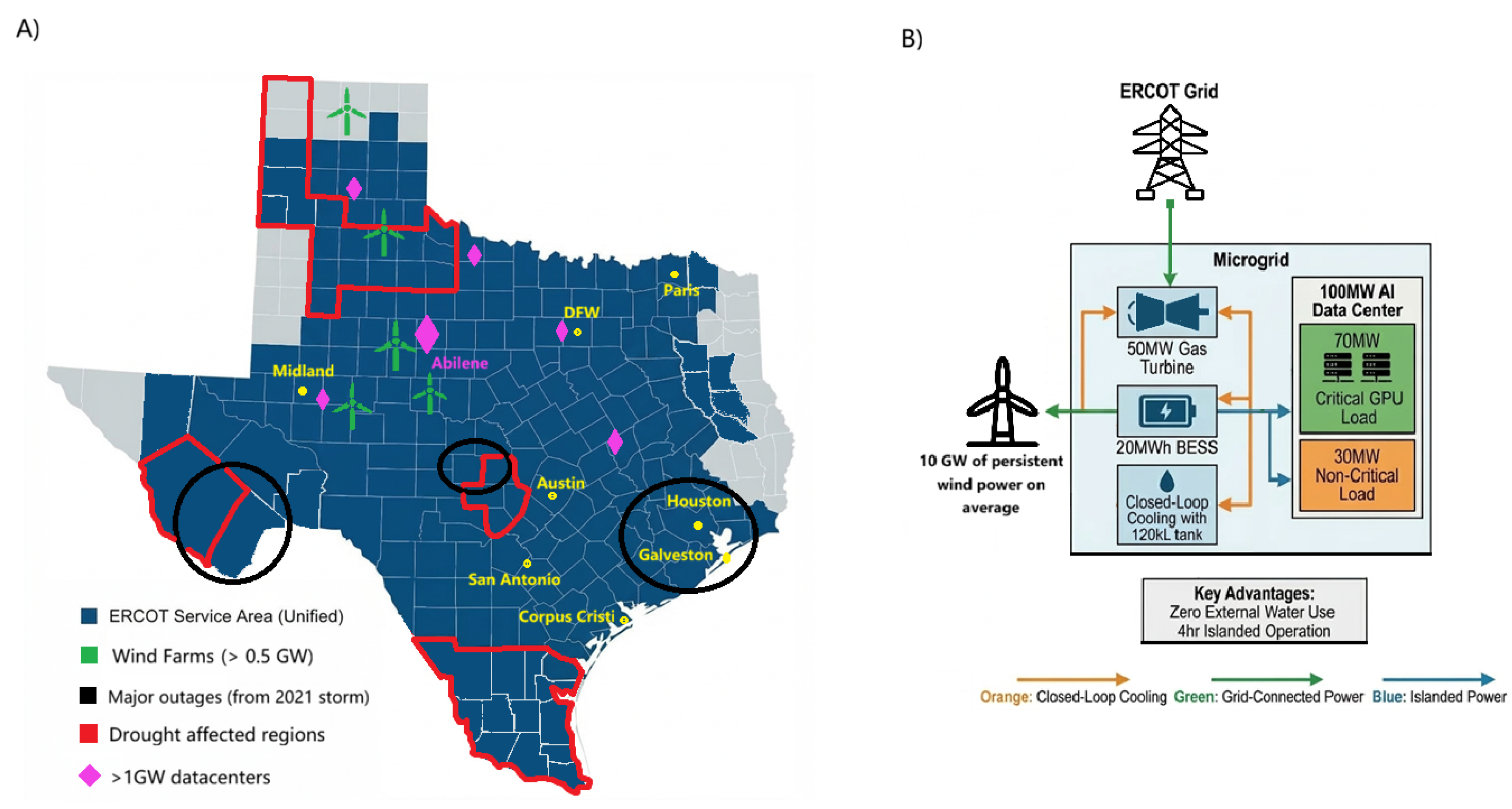
Figure 2.
Islanding transition transient response characteristics: (a) voltage waveform, (b) frequency waveform.
Figure 2.
Islanding transition transient response characteristics: (a) voltage waveform, (b) frequency waveform.
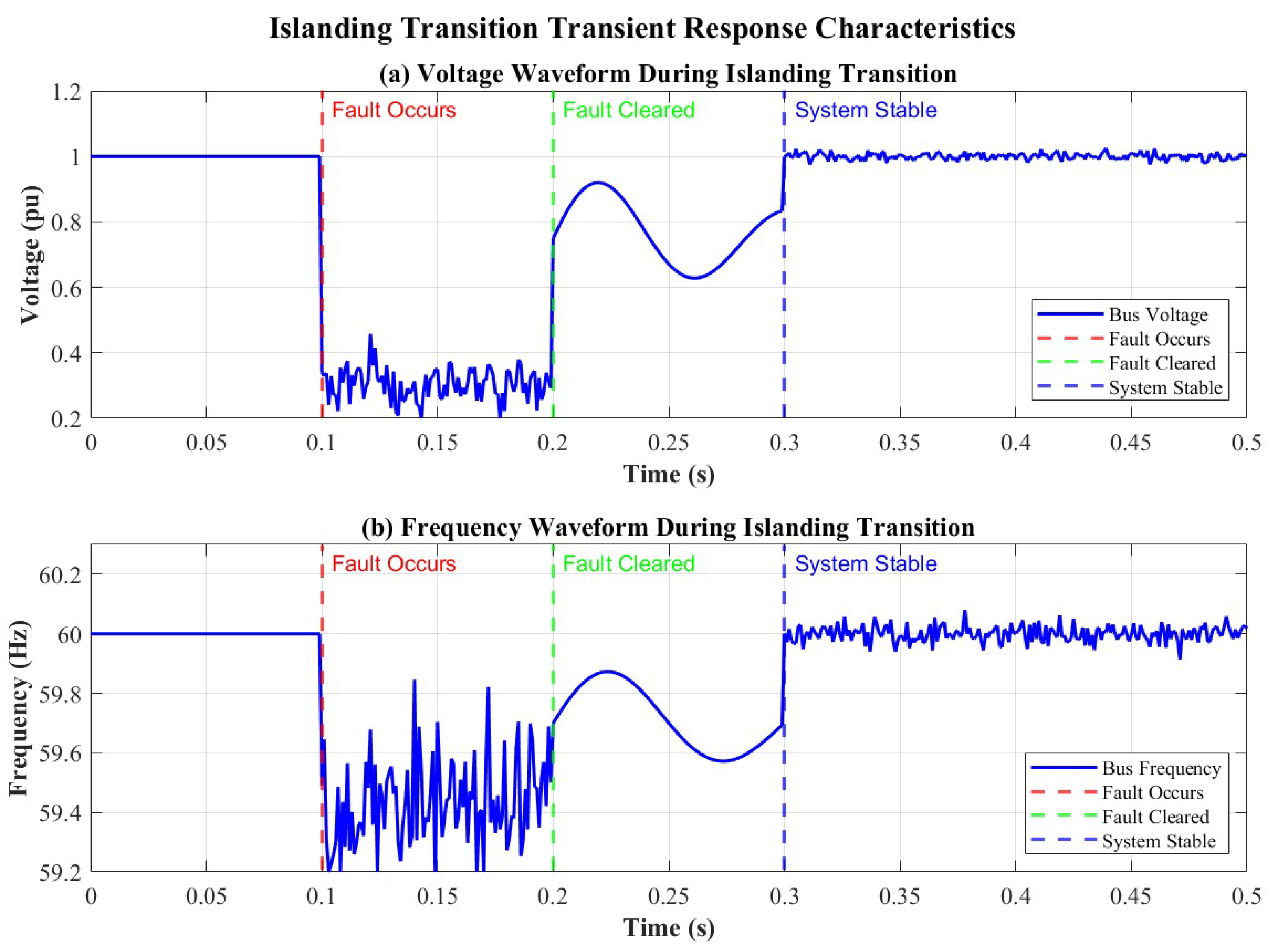
Figure 3.
Power dispatch during islanded operation: gas turbine output, BESS power, and critical load.
Figure 3.
Power dispatch during islanded operation: gas turbine output, BESS power, and critical load.
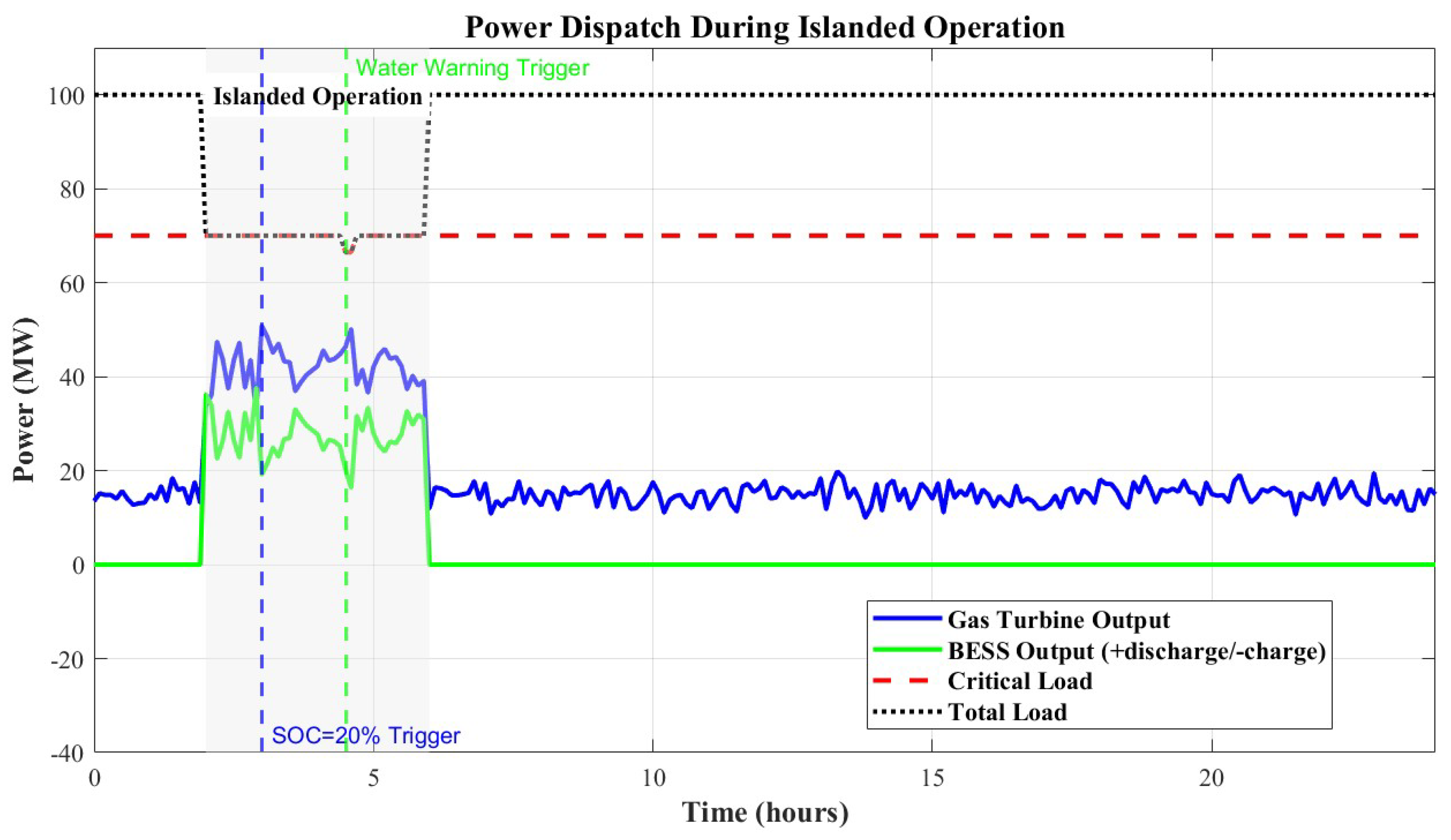
Figure 4.
BESS SOC and cooling water dynamics with evaporation effects.
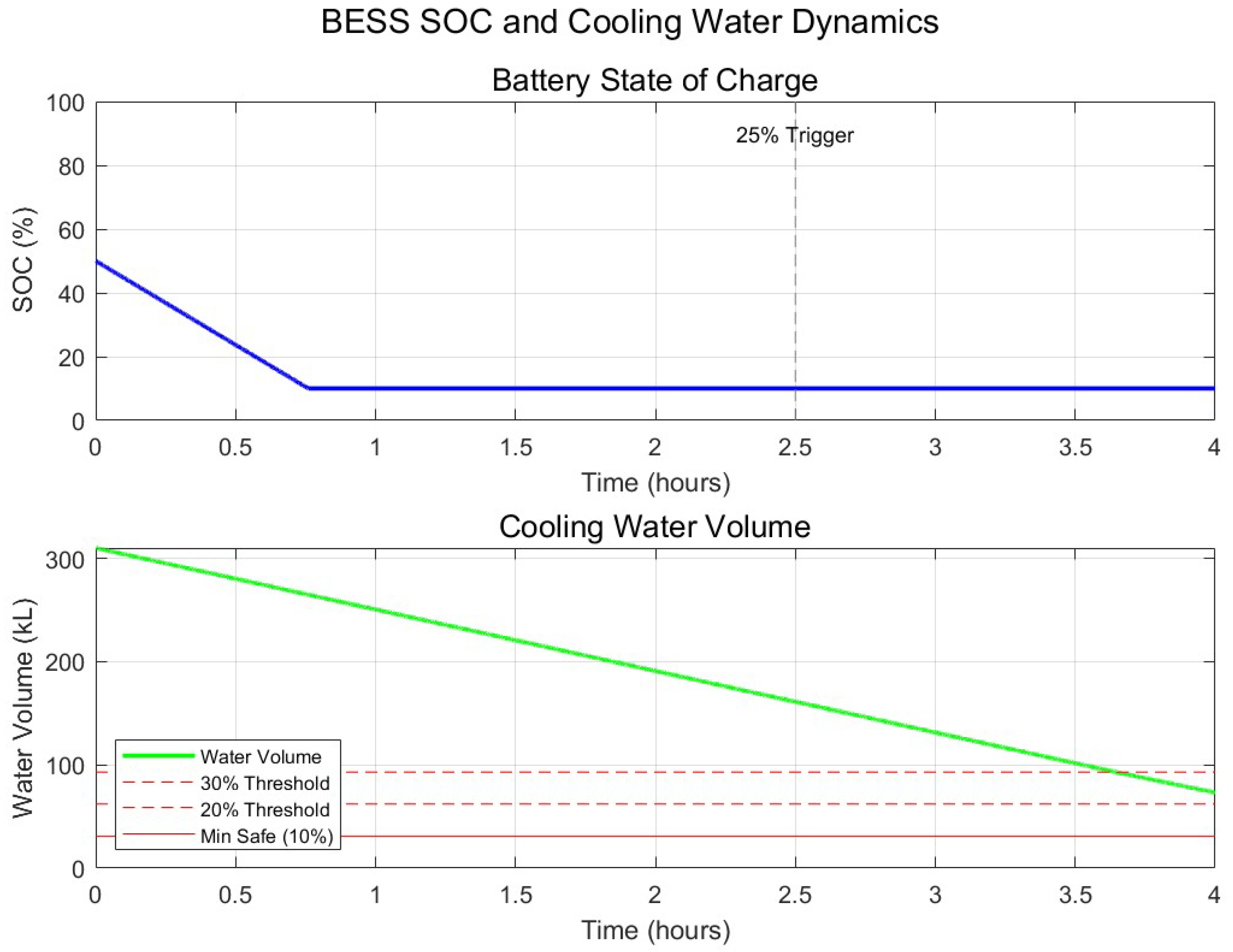
Figure 5.
Key indicator comparison between conventional and proposed schemes: (a) reliability, (b) resource consumption, (c) economic impact.
Figure 5.
Key indicator comparison between conventional and proposed schemes: (a) reliability, (b) resource consumption, (c) economic impact.
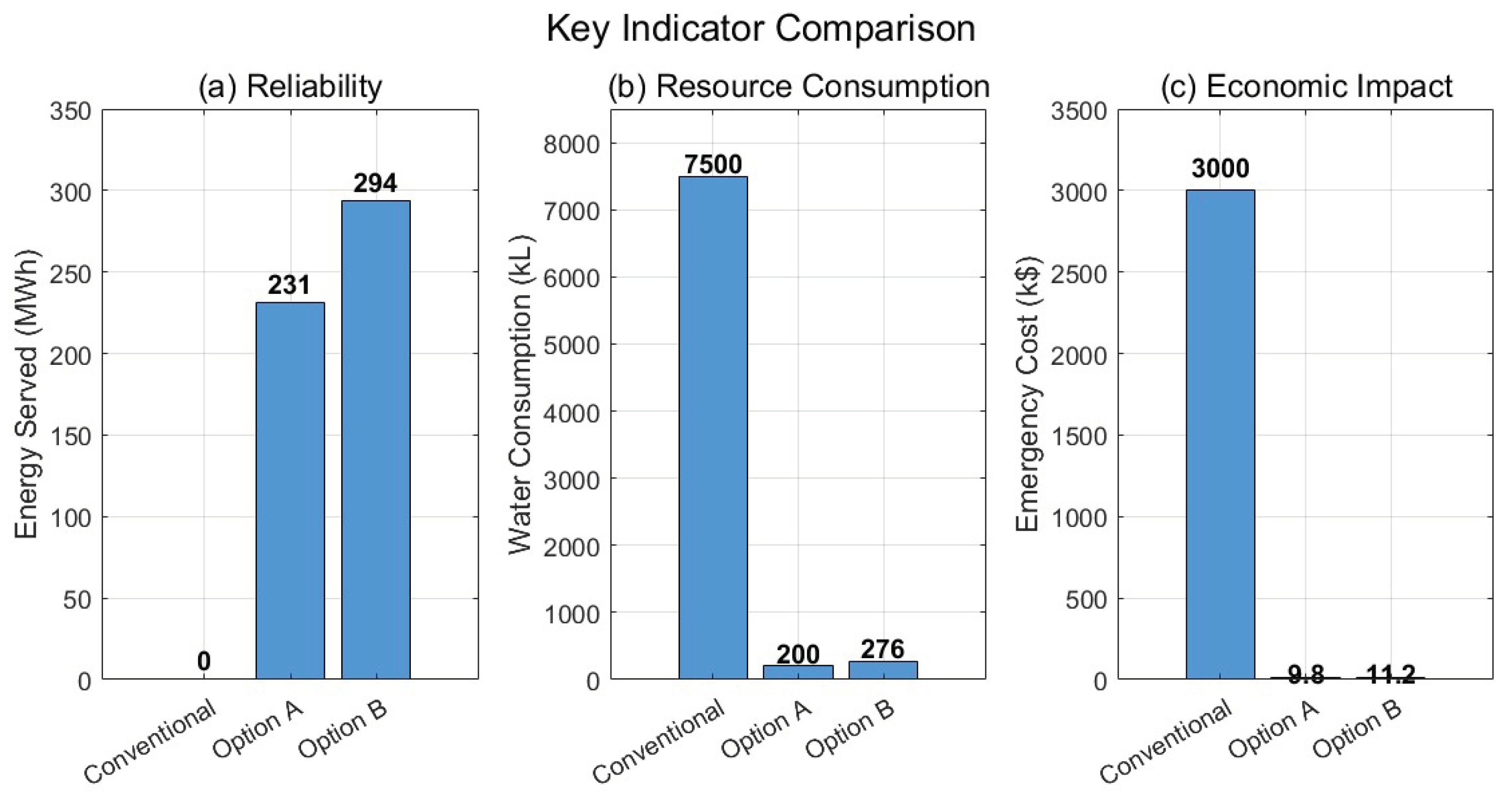
Table 2.
Key Indicator Comparison Between Conventional and Proposed Schemes
| Metric | Conventional | A | B |
|---|---|---|---|
| Critical Load Supplied (MW) | - | 70 | 70 |
| Energy Served (MWh) | - | 231 | 294 |
| Water Consumption (kL) | 8,000 | 200 | 276 |
| Maximum Islanded Runtime (h) | - | 3.3 | 4.2 |
| Operational Cost ($k) | 3000 | 9.8 | 11.2 |
| Operational Cost (%) | 100% | 0.33% | 0.37% |
Disclaimer/Publisher’s Note: The statements, opinions and data contained in all publications are solely those of the individual author(s) and contributor(s) and not of MDPI and/or the editor(s). MDPI and/or the editor(s) disclaim responsibility for any injury to people or property resulting from any ideas, methods, instructions or products referred to in the content. |
© 2026 by the authors. Licensee MDPI, Basel, Switzerland. This article is an open access article distributed under the terms and conditions of the Creative Commons Attribution (CC BY) license (http://creativecommons.org/licenses/by/4.0/).
Copyright: This open access article is published under a Creative Commons CC BY 4.0 license, which permit the free download, distribution, and reuse, provided that the author and preprint are cited in any reuse.


