
Submitted:
03 April 2026
Posted:
07 April 2026
You are already at the latest version
Abstract
Hydrogen production via catalytic steam reforming of hydrocarbons is a promising route for fuel cells and distributed energy systems. In this work, Ni–Cu/γ-Al₂O₃ catalysts were prepared and evaluated for iso-octane steam reforming. The effects of catalyst composition and reaction temperature on activity and hydrogen yield were systematically studied. Results show that Cu incorporation significantly enhances catalytic stability and reduces carbon deposition. At 550 °C and a steam-to-carbon ratio of 2, the Ni₀.₅Cu₀.₅/γ-Al₂O₃ catalyst achieved the highest hydrogen yield and conversion, outperforming monometallic Ni catalysts under identical conditions. This improvement is attributed to better metal dispersion and synergistic interactions between Ni and Cu. Compared with reported catalysts, the developed system exhibits competitive performance under moderate conditions, providing useful insights for designing efficient catalysts for hydrocarbon reforming.
Keywords:
hydrogen production
; steam reforming
; iso-octane
; Ni–Cu catalyst
; γ-Al2O3
1. Introduction
Hydrogen is widely recognized as a clean and sustainable energy carrier that can significantly contribute to the transition toward low-carbon energy systems [1,2]. With increasing global demand for clean energy technologies, hydrogen production has attracted extensive attention in both academic and industrial sectors. Among various hydrogen production methods, catalytic steam reforming of hydrocarbons remains one of the most mature and economically viable processes [2,4,5].
Iso-octane is frequently used as a model compound for gasoline reforming studies due to its chemical stability and representative hydrocarbon structure [6]. Steam reforming of iso-octane can generate significant quantities of hydrogen through catalytic reactions occurring at elevated temperatures [7]. However, several challenges remain in achieving high catalytic efficiency and long-term catalyst stability.
Nickel-based catalysts are widely employed in hydrocarbon reforming processes because of their high catalytic activity and relatively low cost compared with noble metal catalysts [8]. Nevertheless, conventional Ni catalysts often suffer from carbon deposition and metal sintering during operation, which can significantly reduce catalytic performance and lifetime [9,10].
To address these limitations, bimetallic catalyst systems have been extensively investigated [11]. Incorporating secondary metals such as Cu, Co, or Fe can improve catalyst stability, enhance metal dispersion, and reduce carbon formation [12,13]. In particular, Ni–Cu bimetallic catalysts have shown promising catalytic performance in hydrocarbon reforming reactions due to their favorable electronic and structural properties [14,15].
The addition of copper modifies the surface electronic structure of nickel, thereby reducing coke formation and improving catalyst durability [16]. Furthermore, the interaction between Ni and Cu can promote hydrogen production by enhancing the catalytic reforming pathway while suppressing undesired side reactions [17].
Another critical factor influencing catalyst performance is the choice of catalyst support. γ-Al2O3 is widely used as a support material due to its high surface area, good thermal stability, and strong metal–support interactions [18]. These properties make γ-Al2O3 particularly suitable for dispersing active metal species and improving catalytic activity.
Despite numerous studies on hydrocarbon reforming catalysts, further research is still needed to optimize catalyst composition and operating conditions for efficient hydrogen production. In particular, the catalytic behavior of Ni–Cu/γ-Al2O3 catalysts in iso-octane steam reforming has not been fully clarified.
Therefore, the objective of this study is to investigate the catalytic performance of Ni–Cu/γ-Al2O3 catalysts for hydrogen production via iso-octane steam reforming. The effects of catalyst composition and reaction temperature on hydrogen yield and catalytic activity were systematically evaluated. The findings provide valuable insights into the design of efficient catalysts for hydrogen production from hydrocarbon fuels.
2. Experimental
2.1. Catalyst Preparation
Ni–Cu catalysts supported on γ-Al2O3 were prepared using the wet impregnation method. Nickel nitrate and copper nitrate were used as precursor materials. The metal precursor solutions were mixed according to the desired Ni/Cu molar ratios and impregnated onto the γ-Al2O3 support.
After impregnation, the samples were dried at 110 °C for 12 h and subsequently calcined at 500 °C for 4 h to obtain the final catalyst materials.
2.2. Catalytic Reforming Experiments
Steam reforming experiments were carried out in a fixed-bed tubular reactor. The catalyst was placed in the reactor and heated to the desired reaction temperature under nitrogen flow.
The reactant mixture consisted of iso-octane and water vapor with a steam-to-carbon ratio of 2. The experimental setup used for the steam reforming reaction is illustrated in Figure 1.
The flow rate of nitrogen carrier gas was maintained at 15 mL.min−1, while the iso-octane feed rate was approximately 0.03 g.min−1.
Reaction temperatures were varied between 450 °C and 600 °C to evaluate catalytic performance.
2.3. Catalyst Characterization
The physicochemical properties of the prepared catalysts were characterized using several analytical techniques. The crystalline structure of the catalysts was analyzed by X-ray diffraction (XRD) using Cu Kα radiation. The diffraction patterns were recorded over a 2θ range of 10–80° to identify the crystalline phases present in the catalyst samples.
The surface morphology and dispersion of metal particles on the catalyst surface were examined using scanning electron microscopy (SEM). SEM images provide important information about the distribution of the active metal species on the γ-Al2O3 support.
In addition, the interaction between the active metal components and the support material was evaluated based on the structural characteristics observed from the XRD and SEM analyses.
3. Results and Discussion
In order to understand the catalytic performance of Ni–Cu/γ-Al2O3 catalysts, structural characterization and catalytic reforming experiments were conducted. XRD and SEM analyses were performed to evaluate the crystalline structure and morphology of the prepared catalysts. In addition, the influence of reaction temperature and catalyst composition on hydrogen production was systematically analyzed.
The crystalline structure of the prepared catalysts was characterized by X-ray diffraction (XRD) analysis, as shown in Figure 2.
The diffraction peaks observed at 2θ ≈ 37°, 45°, and 67° correspond to the characteristic peaks of the γ-Al2O3 support. These diffraction peaks are consistent with previously reported patterns of γ-Al2O3-supported nickel catalysts in hydrocarbon reforming reactions. In addition, distinct diffraction peaks corresponding to metallic Ni and Cu phases were also observed in the catalyst samples. The presence of these peaks confirms the successful incorporation of Ni and Cu species onto the γ-Al2O3 support.
Furthermore, the relatively broad diffraction peaks indicate that the metal particles are well dispersed on the catalyst surface. Good metal dispersion is beneficial for enhancing catalytic activity during hydrocarbon steam reforming reactions.
SEM analysis (Figure 3) reveals that the metal particles are well dispersed on the γ-Al2O3 support surface.
The SEM images show that the catalyst surface exhibits a relatively porous structure with uniformly distributed metal particles. The dispersion of Ni and Cu species on the γ-Al2O3 support is an important factor contributing to the improved catalytic performance.
Uniform distribution of the active metal sites facilitates effective interaction between the reactant molecules and the catalyst surface, thereby enhancing hydrogen production during the reforming process.
3.1. Effect of Temperature on Hydrogen Production
Reaction temperature plays a crucial role in hydrocarbon reforming reactions. As shown in Figure 4, hydrogen production increases significantly with increasing reaction temperature. Increasing temperature generally enhances hydrocarbon conversion and hydrogen production due to improved reaction kinetics.
At temperatures below 500 °C, the conversion of iso-octane was relatively limited, resulting in lower hydrogen yields. When the temperature increased to approximately 550 °C, a significant improvement in hydrogen production was observed. The hydrogen yield increased markedly compared with lower temperature conditions, indicating enhanced catalytic reforming activity at elevated temperatures.
This behavior is consistent with previous studies reporting that hydrocarbon steam reforming reactions require sufficiently high temperatures to overcome activation energy barriers [19,20].
The increase in hydrogen production at higher temperatures can be attributed to the endothermic nature of the steam reforming reaction. Higher reaction temperatures provide sufficient energy to promote the cleavage of C–C and C–H bonds in hydrocarbon molecules, thereby enhancing hydrogen generation.
However, excessively high temperatures may lead to catalyst sintering and potential deactivation. Therefore, an optimal reaction temperature is required to achieve high hydrogen yield while maintaining catalyst stability.
3.2. Influence of Ni–Cu Composition
The catalytic performance of catalysts with different Ni/Cu ratios is compared in Figure 5.
The catalytic activity strongly depends on the composition of the active metal phase [21]. Among the investigated catalysts, the Ni0.5Cu0.5/γ-Al2O3 catalyst exhibited the highest hydrogen yield.
The enhanced catalytic performance can be attributed to improved dispersion of active metal species, reduced carbon deposition, and synergistic electronic interactions between Ni and Cu.
The addition of Cu modifies the surface properties of Ni catalysts and inhibits excessive carbon formation during hydrocarbon reforming reactions [22].
The synergistic interaction between Ni and Cu modifies the electronic properties of the catalyst surface, which promotes reforming reactions while suppressing coke formation. Nickel provides active sites for hydrocarbon reforming reactions, while copper plays an important role in suppressing carbon deposition and improving catalyst stability.
The presence of Cu modifies the electronic properties of Ni and weakens the adsorption strength of carbonaceous intermediates on the catalyst surface. As a result, the formation of coke is reduced, leading to improved catalytic durability.
3.3. Catalyst Stability and Coke Suppression
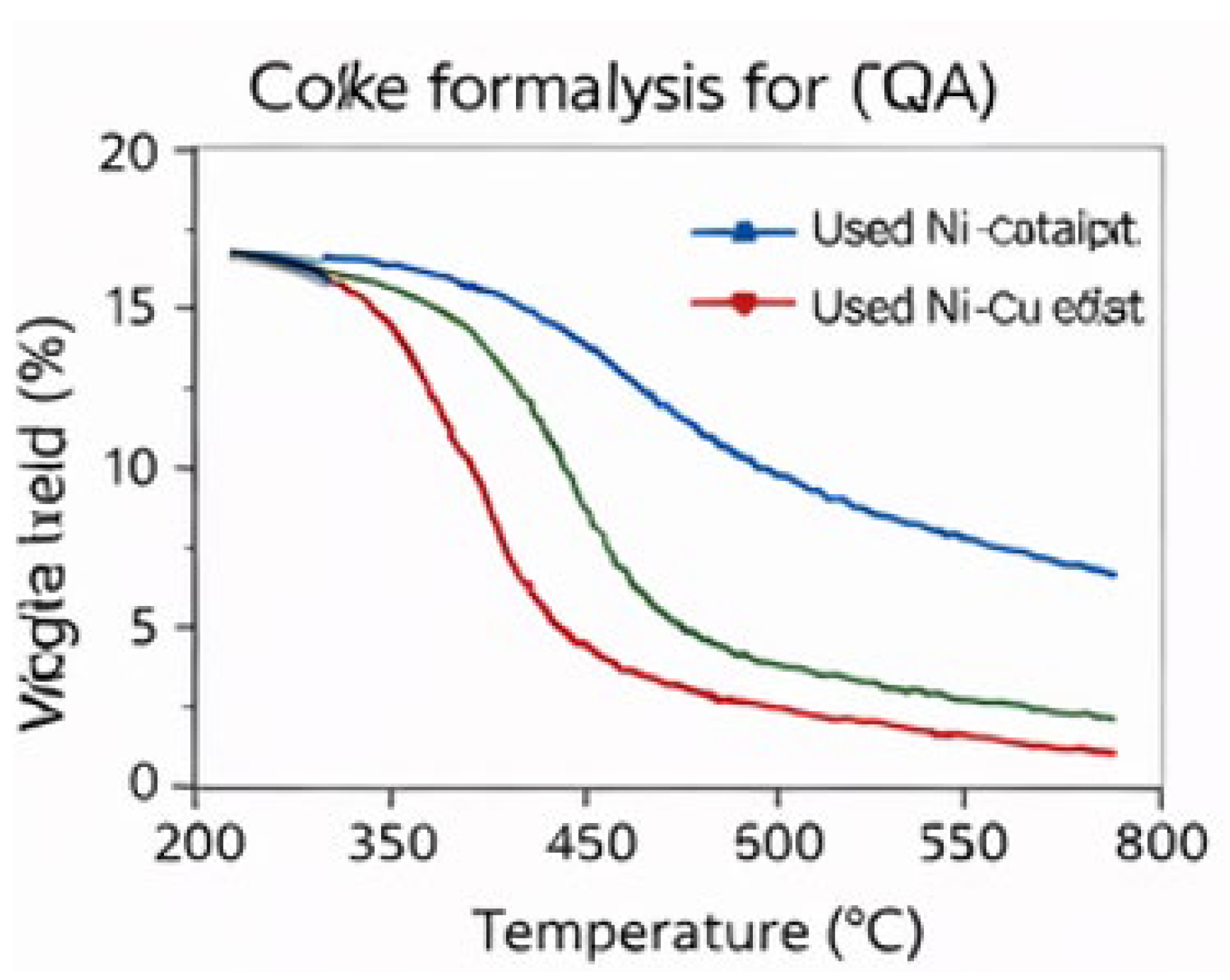
Carbon deposition is one of the major causes of catalyst deactivation in hydrocarbon reforming processes [23,24]. Experimental observations indicated that the incorporation of Cu significantly reduced coke formation compared with monometallic Ni catalysts.
This improvement can be explained by the ability of Cu to alter the adsorption properties of hydrocarbon intermediates on the catalyst surface [25].
The kinetic behavior of the reaction was further analyzed using the Arrhenius plot shown in Figure 6.
The Arrhenius plot exhibits an approximately linear relationship between the logarithm of the reaction rate and the reciprocal of temperature, indicating that the reforming reaction follows typical Arrhenius behavior. The slope of the fitted line can be used to estimate the apparent activation energy of the reaction. The relatively moderate activation energy suggests that the Ni–Cu bimetallic catalyst effectively facilitates hydrocarbon reforming and hydrogen generation.
Catalyst stability is a crucial factor in hydrocarbon reforming processes. The addition of Cu significantly improves the resistance of Ni-based catalysts to carbon deposition. This effect is mainly attributed to the modification of the surface electronic structure of Ni by Cu, which reduces the formation of carbon precursors.
As a result, the Ni–Cu bimetallic catalyst exhibits improved catalytic stability compared with conventional monometallic Ni catalysts.
4. Conclusions
This study investigated the catalytic performance of Ni–Cu/γ-Al2O3 catalysts for hydrogen production via iso-octane steam reforming. The structural characterization results confirmed that the active metal species were successfully dispersed on the γ-Al2O3 support, providing suitable active sites for the reforming reaction.
The experimental results indicated that reaction temperature has a significant influence on hydrogen production. Hydrogen yield increased with increasing temperature due to improved reaction kinetics and the endothermic nature of the reforming process. A notable improvement in hydrogen production was observed when the temperature increased to approximately 550 °C.
In addition, the catalytic performance was strongly affected by the Ni/Cu ratio. Among the investigated catalysts, the Ni0.5Cu0.5/γ-Al2O3 catalyst exhibited the most favorable performance, which can be attributed to the synergistic interaction between Ni and Cu species. Nickel provides active sites for hydrocarbon reforming, while copper helps suppress carbon deposition and enhances catalyst stability.
These findings demonstrate that Ni–Cu bimetallic catalysts supported on γ-Al2O3 are promising materials for hydrogen production from hydrocarbon fuels via steam reforming, particularly for on-site hydrogen generation in fuel cell applications.
References
- Zhang Y. et al. (2022). Hydrogen production via hydrocarbon steam reforming over bimetallic catalysts. International Journal of Hydrogen Energy, 47, 15678–15690.
- Song, C. Fuel processing for low-temperature and high-temperature fuel cells. Catalysis Today, 2002, 77, 17–49. [CrossRef]
- Armor J. N. (1999). The multiple roles for catalysis in the production of H2. Applied Catalysis A, 176, 159-176.
- Rostrup-Nielsen, J.R. Production of synthesis gas. Catalysis Today, 2000, 63, 159–164. [CrossRef]
- Rostrup-Nielsen, J.R.; Sehested, J.; Nørskov, J.K. Hydrogen and synthesis gas by steam- and CO2 reforming. Advances in Catalysis, 2002, 47, 65–139.
- Wang L. et al. (2021). Catalytic performance of Ni–Cu catalysts for hydrogen production from hydrocarbon reforming. Fuel, 292, 120309.
- Rostrup-Nielsen J. (2002). Catalytic steam reforming. Catalysis Today, 63, 159-164.
- Sehested J. (2006). Four challenges for nickel steam-reforming catalysts. Catalysis Today, 111, 103-110. [CrossRef]
- Bartholomew C. H. (2001). Mechanisms of catalyst deactivation. Applied Catalysis A, 212, 17-60.
- Sehested, J. Four challenges for nickel steam-reforming catalysts. Catalysis Today, 2006, 111, 103–110. [CrossRef]
- Li X. et al. (2023). Advances in nickel-based catalysts for hydrogen production. Applied Catalysis A: General, 651, 118896.
- Trimm D. L. (1999). Coke formation and minimisation during steam reforming reactions. Catalysis Today, 49, 3-10. [CrossRef]
- Trimm, D.L. Coke formation and minimisation during steam reforming reactions. Catalysis Today, 1997, 37, 233–238. [CrossRef]
- Ashok J. et al. (2015). Bimetallic Ni catalysts for reforming reactions. Fuel Processing Technology, 134, 341-350.
- Liu, D.; Quek, X.Y.; Cheo, W.N.E.; Lau, R.; Borgna, A.; Yang, Y. MCM-41 supported nickel catalysts for hydrogen production from steam reforming of hydrocarbons. Applied Catalysis B: Environmental, 2009, 92, 385–392.
- Song H., Ozkan U. (2010). Effects of Cu addition in Ni catalysts. Journal of Catalysis, 261, 66-74.
- Hou Z., Hughes R. (2001). Hydrogen production by methane reforming. International Journal of Hydrogen Energy, 26, 849-856.
- Busca G. (2014). Alumina-supported catalysts. Catalysis Today, 226, 2-13.
- Rostrup-Nielsen J. R. (2004). Hydrogen and synthesis gas. Catalysis Today, 106, 293-296.
- Xu, J.; Froment, G.F. Methane steam reforming, methanation and water–gas shift: I. Intrinsic kinetics. AIChE Journal, 1989, 35, 88–96.
- Chen Y. et al. (2022). Bimetallic catalysts for hydrocarbon reforming reactions. Catalysis Today, 389, 45–56.
- Chen D. et al. (2008). Carbon deposition in hydrocarbon reforming. Applied Catalysis A, 346, 1-8.
- Singh R. et al. (2021). Catalytic hydrogen production from hydrocarbon fuels. Renewable Energy, 178, 735–748.
- Ruckenstein, E.; Wang, H.Y. Carbon deposition and catalytic deactivation during CO2 reforming of methane over Ni catalysts. Applied Catalysis A: General, 2000, 204, 257–263.
- Bradford, M.C.J.; Vannice, M.A. CO2 reforming of CH4 over supported Ni catalysts. Catalysis Reviews, 1999, 41, 1–42.
Figure 1.
Schematic diagram of the experimental setup for iso-octane steam reforming.
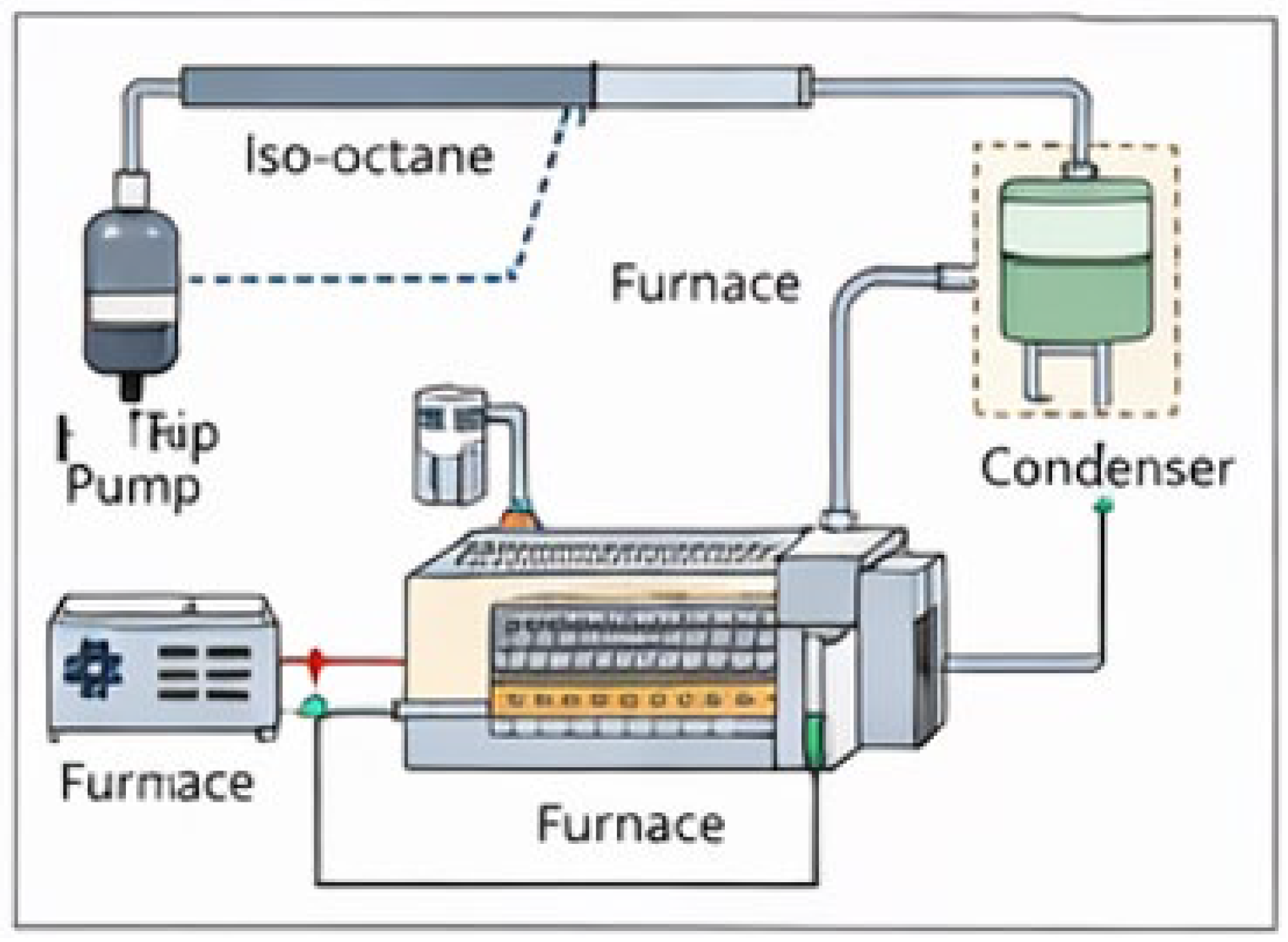
Figure 2.
XRD patterns of Ni–Cu/γ-Al2O3 catalysts with different Ni/Cu ratios.
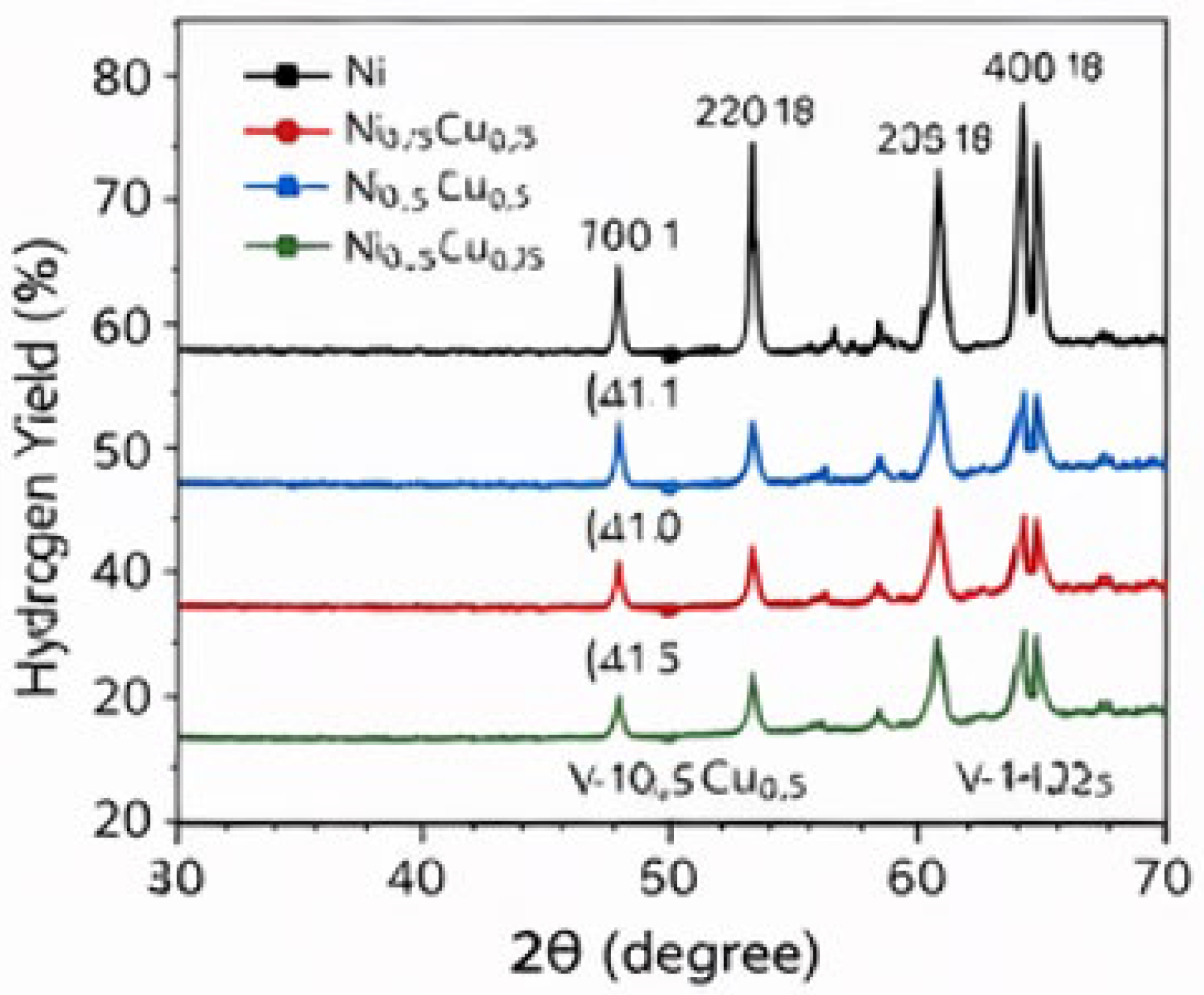
Figure 3.
SEM images of the Ni–Cu/γ-Al2O3 catalyst.
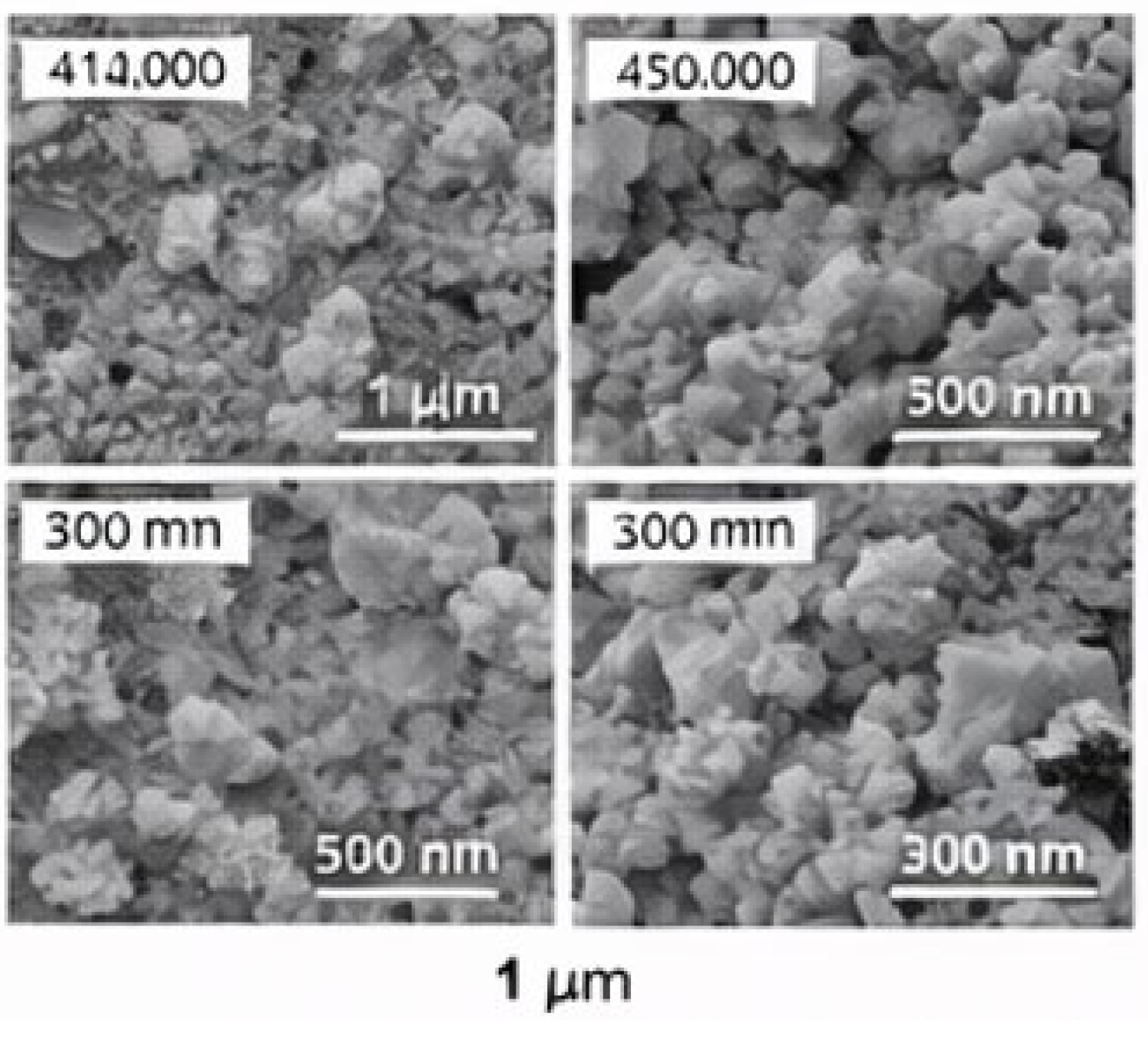
Figure 4.
Effect of reaction temperature on hydrogen yield during iso-octane steam reforming.
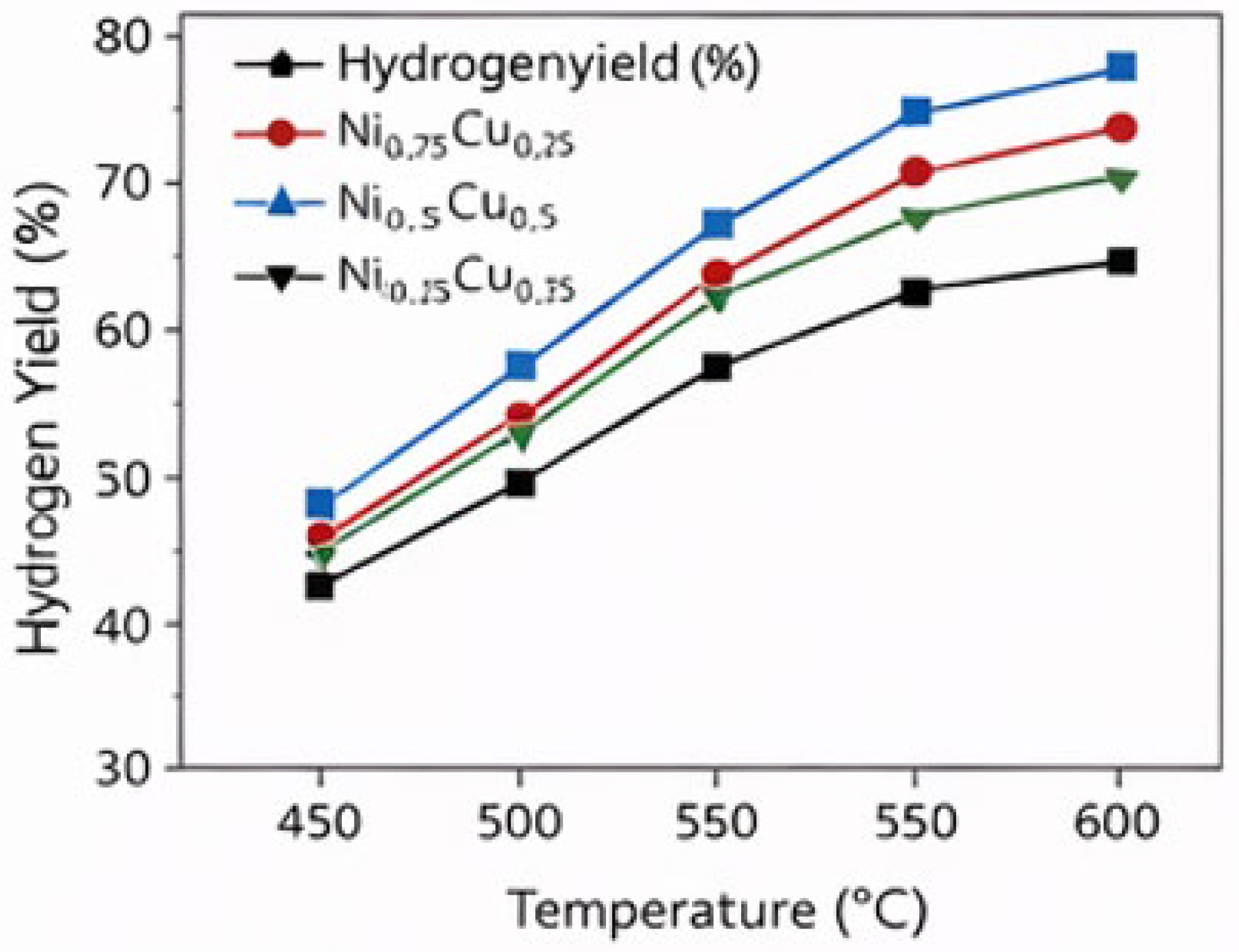
Figure 5.
Hydrogen yield over catalysts with different Ni/Cu ratios at 550 °C.
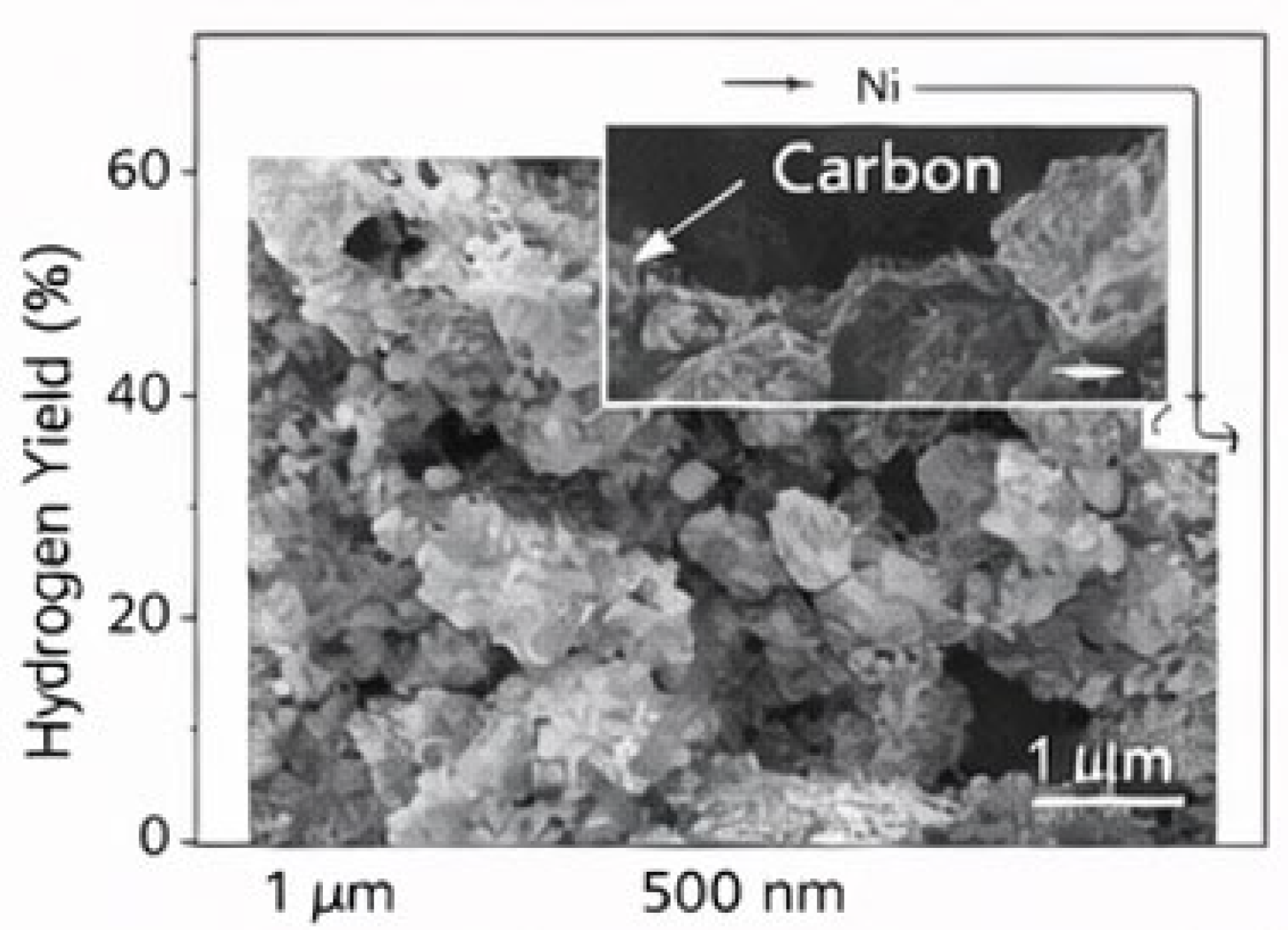
Figure 6.
Arrhenius plot for iso-octane steam reforming over Ni–Cu catalysts.
Disclaimer/Publisher’s Note: The statements, opinions and data contained in all publications are solely those of the individual author(s) and contributor(s) and not of MDPI and/or the editor(s). MDPI and/or the editor(s) disclaim responsibility for any injury to people or property resulting from any ideas, methods, instructions or products referred to in the content. |
© 2026 by the author. Licensee MDPI, Basel, Switzerland. This article is an open access article distributed under the terms and conditions of the Creative Commons Attribution (CC BY) license.
Copyright: This open access article is published under a Creative Commons CC BY 4.0 license, which permit the free download, distribution, and reuse, provided that the author and preprint are cited in any reuse.


