

Submitted:
04 April 2026
Posted:
07 April 2026
You are already at the latest version
Abstract
To maintain homeostatic conditions and optimal function during stressors, mitochondria initiate nuclear retrograde signaling. The mitochondrial Integrated Stress Response (ISR) and Unfolded Protein Response (UPRmt) are critical quality control mechanisms activated during instances of mitochondrial perturbations. Restoration of mitochondrial homeostasis is orchestrated by three transcription factors, ATF4, CHOP, and ATF5, which upregulate protective genes to counteract stress. As the health and function of skeletal muscle is heavily dependent on a highly adaptive mitochondrial network, defining how mitochondrial health is maintained across various conditions is essential. Although several studies demonstrate the importance of these responses following instances of stress, the signaling mechanisms required to initiate such pathways remain poorly characterized in skeletal muscle. This review examines how the mitochondrial ISR/UPRmt and related transcription factors respond to organellar stress by emphasizing the molecular events that occur during exercise, aging and muscle disuse. Through consolidating the literature, this work aims to highlight the current understanding of mitochondrial stress response signaling within skeletal muscle and thus emphasize areas for future research and potential therapeutic strategies during divergent metabolic conditions.
Keywords:
skeletal muscle
; aging
; muscle inactivity
; mitochondria
; stress response
; exercise
; ATF4
; ATF5
; CHOP
; Integrated Stress Response
; unfolded protein response
; adaptation
1. Introduction: Mitochondrial Function and Health
Mitochondria, colloquially termed the powerhouses of the cell, are responsible for producing the energetic molecule, adenosine triphosphate (ATP), from oxidative respiration (OXPHOS). A unique feature of these organelles, is that they possess their own double stranded DNA, termed mitochondrial DNA (mtDNA), as a product of evolutionary endosymbiosis with -proteobacteria [1]. Although the mitochondrial genome (mtDNA) only encodes 13 protein subunits of the mitochondrial electron transport chain (ETC), the remainder of mitochondrial proteins, ~1,200, are encoded by the nuclear genome [2]. Therefore, the overall synthesis, maintenance and structural capacity of mitochondrial function depends on the tightly coordinated regulation between both genomes [3,4].
While critical in cellular energy metabolism, mitochondria also play a pivotal role in regulating an array of biological functions, including calcium handling, redox homeostasis, programmed cell death (mitochondrially-mediated apoptosis) and the modulation of cellular inflammation [5]. Optimal health and function of these organelles is therefore required to sustain such diverse functions. In this instance, the quality of the mitochondrial network must be tightly regulated via communication between the mitochondria and nucleus [6]. Stressed states can initiate mito-nuclear communication, denoted as a stress response, to integrate changes in the transcriptome and proteome, ultimately enhancing mitochondrial fitness [6]. Failure to adapt to stressors is a common defect underlying the etiology of various diseases. In the current review, we will discuss a mitochondrial stress response pathway and its importance in maintaining mitochondrial health with a focus on skeletal muscle.
2. Skeletal Muscle and Mitochondrial Quality Control
Skeletal muscle is a central regulator of locomotion, whole-body energy expenditure, substrate utilization and thermogenesis [7]. In response to altered energetic demand or physiological stressors, such as exercise, skeletal muscle undergoes coordinated morphological, physiological and biochemical remodeling, reflecting its remarkable plasticity [8]. The adaptive capacity of skeletal muscle is thereby dependent on the highly efficient mitochondrial network, dictating the overall metabolic performance and health of skeletal muscle [5,9]. Given such, as alluded to previously, mitochondria must therefore preserve proteostatic, bioenergetic, and redox homeostasis through tightly regulated mitochondrial quality control (MQC) mechanisms [10]. These processes are identified as mitochondrial biogenesis, which drives the synthesis of new organelles; mitophagy, responsible for selectively removes dysfunctional mitochondria; and the transient activation of a mitochondrial stress response [11,12]. Collectively, such quality control mechanisms safeguard mitochondrial network integrity in order to meet and sustain the energetic demands of skeletal muscle [11,12].
Unlike biogenesis and mitophagy, the mitochondrial stress response dynamically senses perturbations in mitochondrial function to coordinate adaptive transcriptional programs to restore organellar integrity, positioning this regulatory process as a central mediator of mitochondrial network resilience and plasticity [6]. The mitochondrial stress response is a coordinated event that can be categorized into the initial general phase of detection, termed the Integrated Stress Response (ISR), which ultimately dictates the fine tuning of a more centralized stress program, the Mitochondrial Unfolded Protein Response (UPRmt) [6,13,14,15]. Multiple mitochondrial insults can trigger the activation of the ISR/UPRmt, triggering a transcriptional output response and translational reprogramming [6,13,14,15]. The overall nuclear response of the ISR/UPRmt is mediated by three critical transcription factors, ATF4, CHOP, and ATF5, which in concert upregulate the expression of protective genes to combat the associated mitochondrial stressor [16]. While evidence has suggested a newfound role for the stress response and associated regulators in maintaining mitochondrial health, less is known on how this restorative program operates in skeletal muscle during instances of physiological stress such as during exercise, aging and chronic muscle disuse.
It is well established that global MQC activation in skeletal muscle is context dependent, occurring in response to metabolically divergent stimuli, including exercise-induced metabolic stress and prolonged periods of muscle inactivity [17]. In the former, the stimulation of the MQC program with contractile activity promotes coordinated adaptation of mitochondrial and muscle phenotypes, however, with muscle inactivity, such processes are denoted as maladaptive and thus incapable of rescuing cellular homeostasis [10,18]. Although studies investigation MQC signaling in skeletal muscle during exercise training and muscle inactivity (including aging and muscle disuse) have largely focused on alterations in mitophagy and mitochondrial biogenesis, the overall contribution of mitochondrial stress-response signaling (ISR and UPRmt) and associated transcriptional regulators remains comparatively underexplored. Accordingly, this review synthesizes current evidence defining the cascades that govern mitochondrial-specific activation of the ISR and UPRmt, with an emphasis on skeletal muscle adaptations to exercise and maladaptation following muscle inactivity induced by aging or chronic disuse. By framing the mitochondrial stress response as a continuum rather than discrete pathways, we highlight their central role in skeletal muscle plasticity and health, identify critical gaps in the literature, and propose key areas for future investigation.
3. A Brief History of Mitochondrial Stress Response
The concept of a mitochondrial stress response was first established by pioneering work from Vandana Parikh and colleagues in 1987 [19], demonstrating that mitochondrial dysfunction, particularly mutations or depletion of mtDNA, alters nuclear gene expression in yeast. Following this work, subsequent studies revealed that mitochondria possess robust intermediary mechanisms to preserve cellular function and enhance their adaptative capability under various stressors [6]. In the face of acute organelle perturbations/stress, mitochondria can elicit a coordinated stress response through the generation of a “retrograde signal”, a form of communication with the nucleus, as mentioned previously, to initiate the enhancement of the expression of protective nuclear genes encoding mitochondrial proteins (NuGEMPs) [6,12,13]. This transcriptional reprogramming serves to resolve the original organellar perturbations and promote the improvement of mitochondrial function and adaptation [6,12,13,20]. Building on these initial findings, later investigations established the ISR/UPRmt in mammalian cells. In 1996, Martinus and colleagues showed that mtDNA loss (0) via Ethidium Bromide treatment in rat hepatoma cells (H4) led to increases in ISR/UPRmt downstream genes, mitochondrial chaperones, via elevations in their transcriptional activity [21]. This work was of the first to emphasize in mammalian cells that mitochondrial defects trigger a nuclear retrograde response, what is now classified as the ISR/UPRmt. One step forward, Zhao and colleagues in 2002 elucidated that CHOP, an ISR/UPRmt transcription factor, is required for the induction of mitochondrial stress-responsive proteins in COS-7 cells following mitochondrial protein toxicity [22]. Subsequently, further experimental analyses identified both ATF4 and CHOP, ISR/UPRmt transcription factors, as dual regulators of the nuclear retrograde signaling response in lymphocytes subjected to rotenone-induced inhibition of Complex I in the ETC [23]. Collectively, these studies defined a previously unrecognized, mitochondrial-specific stress response, largely orchestrated by ISR/UPRmt transcription factors. These advances catalyzed investigations into the role of this stress response program in preserving mitochondrial health across yeast, nematodes, mammalian cells and mouse models. Appreciating the physiological importance of the ISR/UPRmt therefore requires a precise mechanistic understanding of how this pathway is initiated, integrated, and ultimately resolved at the molecular level, a complexity that the subsequent sections of this review aims to address.
4. The Integrated Stress Response (ISR): A Conserved Cellular Sentinel
4.1. General Activation and Regulation of the ISR
The ISR is an evolutionally conserved adaptive program that is responsive to a variety of different global environmental and pathological stressors [14]. Such stressors include, protein homeostasis (proteostasis) defects, nutrient deprivation, viral infection, oxidative stress and most recently, mitochondrial dysfunction/perturbations [24]. The ISR ultimately serves to maintain cellular health and overcome stressors by reprogramming gene expression via the activation of specific transcription factors ATF4, CHOP and ATF5 [25]. In terms of overall activation, this program becomes responsive to distinct stress signals that are initially sensed and transmitted through the induction of four serine/threonine upstream kinases, protein kinase RNA-like endoplasmic reticulum kinase (PERK), general control nonderepressible 2 (GCN2), RNA-activated protein kinases (PKR), and heme-regulated inhibitor kinase (HRI) [26]. These four kinases share extensive homology in their catalytic domains but possess distinct regulatory domains, reflective of their unique response to stressors [26]. Upon sensing stress, the kinases will undergo full activation via autophosphorylation and homodimerization events, where they will then converge on a common target, the eukaryotic translation initiation factor eIF2, a heterotrimer consisting of an , , and subunit [27]. Specific to the ISR, the subunit is phosphorylated at Serine 51 by one or more of the four kinases, leading to reduced global translation as well as selective synthesis of important regulators of homeostatic control [28,29,30]. This distinct regulation ultimately alleviates the pressure of continued translation, which can be damaging to cellular constituents that are already facing stress, primarily focusing on restoring cellular homeostasis and thus overall survival.
The prominent feature of ISR signaling lies in the alterations of the ternary complex (TC) which is instrumental in initiating the translation of cap-dependant translation, commonly identified as AUG-initiated upstream open reading frames (uORFs) in the cell’s transcriptome [31]. The TC is composed of the heterotrimeric eukaryotic translation initiation factor eIF2 bound with guanosine 5′-triphosphate (GTP), and a charged methionyl-initiator tRNA (Met-tRNAi) [24]. Under basal conditions, the TC will dock onto the 40S ribosomal subunit, creating the 43S preinitiation complex (PIC) [32]. The recognition of the start codon AUG on mRNA triggers GTP hydrolysis of eIF2 and its release, followed by the recruitment and binding of the 60S ribosomal subunit, thus allowing the elongation phase of protein synthesis to commence [32]. The GDP bound to eIF2 is then exchanged for GTP, recycling eIF2 to its active state, allowing for another round of translation initiation [24]. This recycling is catalyzed by the interaction with the guanine exchange factor (GEF) protein, eIF2B [33]. Briefly, eIF2B is composed of two copies of five different subunits (α, β, δ, γ, and ε) that assemble into a large two-fold symmetric heterodecamer; however, eIF2B’s catalytic nucleotide exchange activity resides in eIF2Bε subunit [34]. In order to exchange GDP for GTP, eIF2B must form a complex with its substrate eIF2. However, phosphorylation of eIF2 induces a profound rearrangement in this subunits’ structure, which alters its binding site on eIF2B, thereby restricting the nucleotide-binding domain and preventing access to the catalytic GEF domain [33,34]. This inhibition subsequently blocks the eIF2B-mediated exchange of GDP for GTP and reduces the formation and availability of the 43S PIC, rendering the cell unable to re-initiate protein translation and thus attenuating global translation of 5’ cap-dependant mRNAs [32,33,34]. Simultaneously, the translation of mRNAs that contain short “inhibitory” upstream open reading frames (uORFs) in their 5’ untranslated region (5’UTR) are enhanced [35]. Under basal/normal conditions, these “inhibitory” uORFs prevent the translation of downstream coding DNA sequences (CDS) by causing the translation machinery to “skip” the start codon of the sequence, however, the reduced availability of the TC when eIF2 is phosphorylated allows for the inhibitory uORF to be skipped enabling the downstream coding sequence to be expressed [24]. As a result of this, the expression of selective transcripts which contain short “inhibitory” upstream open reading frames (uORFs) in their 5’untranslated will be elevated [24]. The most notable mRNAs translated constitute the ISR transcription factors, ATF4, CHOP, and ATF5, which in concert, mediate the nuclear expression of protective genes [36,37,38,39,40].
The ISR is terminated by the dephosphorylation of the central signaling molecule, eIF2. This event typically occurs when the initial stressor has been relieved, warranting normal protein synthesis and cell functioning to be resumed. The dephosphorylation of eIF2 is mediated by a protein phosphatase 1 (PP1) complex that recruits a catalytic subunit (PP1c) and a regulatory subunit [41]. In mammals, the most prevalent regulatory subunits of the phosphatase activity are GADD34, known as growth arrest and DNA damage-inducible protein, and CReP, the constitutive repressor of eIF2 phosphorylation [42,43]. In a complex with PP1c, CReP, in unstressed conditions, is ubiquitously responsible for monitoring the basal levels of eIF2 phosphorylation [43]. Conversely, GADD34, which is a downstream target of the ISR, specifically during the later stages of response activation, forms a complex with PP1c to significantly increase eIF2 dephosphorylation, acting as an important negative feedback loop to restore protein synthesis [42].
4.2. Mitochondrial Stress-Specific Activation of the ISR
The ISR has emerged as a fundamental adaptive pathway in which cells can sense and respond to mitochondrial dysfunction by coordinating a broad transcriptional program ultimately to preserve organellar homeostasis. A diverse array of mitochondrial insults, including pathological increases in ROS emission, defects in DNA replication/mtRNA processing, ETC blockage/inhibition, protein toxicity, and reductions in mitochondrial membrane potential can induce the ISR (Figure 1) [40,44,45,46,47,48]. The breadth of stimuli capable of engaging the ISR underscores its role as a central surveillance program and an indispensable guardian of mitochondrial integrity. Despite this growing appreciation, the molecular mechanisms by which mitochondrial stress signals are sense and transduced to ISR machinery remain poorly understood. Recent interest has converged on the upstream regulatory kinases, HRI, GCN2, and PKR, as critical mediators capable of detecting distinct forms of mitochondrial perturbations and initiating the ISR program. However, the specific conditions governing their selective activation, the degree to which they operate redundantly or cooperatively, and how their outputs are integrated at the level of shared downstream effectors remain active areas of investigation. This section solely examines the mechanisms by which each ISR kinase can become activated in response to mitochondrial stressors.
4.2.1. HRI and Mitochondrial Stress
The most prominent and well-explored kinase responsible for the initiation of the ISR following mitochondrial stress is HRI. Multiple lines of evidence have indeed demonstrated that the global activation of HRI during mitochondrial stressors can impart restoration of organellar function [46,49,50,51,52,53]. For example, under chemical stress or genetic conditions that induce mitochondrial perturbations, pharmacological activation of HRI can markedly restore mitochondrial function and morphology [49]. However, the signaling axis underlying HRI activation in response to mitochondrial stress was only recently uncovered by two independent research groups, revealing a pathway involving the mitochondrial stress-responsive metalloprotease OMA1 [54] and the mitochondrial protein DELE1 [55,56]. Guo and colleagues first identified that the presence of various mitochondrial stressors, such as oligomycin, antimycin A, rotenone, and CCCP, can trigger the ISR in various cell lines, including HEK293T, HeLa, iPSC cells [55]. Parallel to these findings, Fessler and colleagues further reinforced the OMA1-DELE1-HRI pathway by treating a multitude of cell lines, including HAP1 and SH-SH5Y cells, with mitochondrial inhibitors [56]. Consistently, both studies elucidated that OMA1, ordinarily dormant under physiological conditions, is rapidly activated upon mitochondrial stressors, such as ETC dysfunction and mitochondrial membrane depolarization [57,58] to engage with the imported longform DELE1 (L-DELE1) and proteolytically cleave it at the N-terminus into a shorter peptide fragment (S-DELE1) [59]. Some evidence also suggests that S-DELE1 will stall in the TOM complex triggering the release and ejection of the fragment into the cytosol to accumulate, leading to the interaction with HRI [55,56,60]. The N-terminal tetranucleotide repeats present in DELE1 facilitates protein-protein interactions, and in this case, is thus capable of binding to and influencing the autophosphorylation status of HRI [55]. In addition, more recent findings have also identified that in the face of mitochondrial import stress and iron deficiency, L-DELE1 can accumulate in the cytosol to initiate an OMA1-independant activation of HRI [61,62]. These pivotal studies highlight the foundational connection between mitochondrial stress and ISR activation via the OMA1-DELE1-HRI pathway.
4.2.2. GCN2 and Mitochondrial Stress
Mounting evidence has demonstrated that GCN2 is also required to maintain mitochondrial quality during stress, particularly in response to elevations in ROS, ETC dysfunction, and the imbalance of Kreb cycle derivatives and associated amino acids [63,64,65,66,67,68]. Although seemingly critical in the preservation of mitochondrial homeostasis, the mechanisms underlying GCN2 activation and thus context specificity is lacking within the literature. For example, two research groups consistently revealed that mitochondrial ROS increases the overall level of GCN2 phosphorylation [67,69]. However, the molecular underpinnings of this activation during elevations in ROS emission remains elusive. In a different context, evidence in C2C12 myoblasts and myotubes has established a potential signaling paradigm for GCN2 during mitochondrial stress, particularly during ETC dysfunction [25,40]. In the aforementioned study, Mick and colleagues, exemplified that Complex I and II inhibition led to a heightened ratio of NADH/NAD+, which restricts aspartate production through Krebs Cycle halting of Oxaloacetate (OAA) transamination, leading to the depletion of its derivative asparagine and thus amino acid deprivation [25,70,71,72]. This decline will activate GCN2 to then trigger the induction of the ISR, most likely driven by reductions in charged tRNA.
4.2.3. PKR and Mitochondrial Stress
Lastly, PKR has also been associated with responding to mitochondrial perturbations, such as unfolded proteins alongside cytosolic mtDNA thereby triggering the ISR [73]. PKR is classically known to recognize double stressed RNA (dsRNA) primarily through viral interactions, however, this kinase can also sense dsRNA molecules derived from mtRNA and thus mtDNA [73]. Since the mitochondrial genome is circular and double-stranded, bidirectional transcription from mitochondrial DNA’s light (L) and heavy (H) strands leads to the transcription of precursor complementary RNA molecules, which can hybridize to form mitochondrial dsRNA molecules [74,75,76,77]. mtRNA can be degraded by the degradosome complex, which consists of the mitochondrial helicase SUV3 and polynucleotide phosphorylase (PNPase) [74,75,76,77]. However, disruptions in mtRNA degradation processes, which typically occurs during mitochondrial stress and proteostasis failure, can lead to the accumulation of complementary RNA molecules, thereby increasing the likelihood of dsRNA formation [74,75,76,77]. The association between PKR and mtRNA was first eloquently elucidated in a study by Kim and colleagues in 2018 using formaldehyde-mediated crosslinking and immunoprecipitation sequencing (fCLIP-seq) in HeLa cells treated with the apoptotic inducer Staurosporine, which led to an increase in mtRNA production and thus mtRNA-PKR interaction [78]. Following these findings, the activation of PKR during various mitochondrial stressors was thoroughly examined in a multitude of cell lines [51,79,80,81,82]. For example, in a most recent study by Kusuma and colleagues, MEFs treated with a mitochondrial chaperone inhibitor, gamitrinib-triphenylphosphonium (GTPP), to impair mitochondrial protein handling (proteostasis), led to the formation mt-dsRNA, and their subsequent release into the cytosol, via the BAX/BAK channels, conferring cytosolic sensing and activation of PKR to initiate the ISR [79].
While the aforementioned studies have elucidated that the ISR kinases can respond to mitochondrial perturbations, the precise context of their activation, particularly within skeletal muscle, remains to be fully elucidated.
4.2.4. Kinase-Independent Activation of ISR
Beyond canonical ISR kinase signaling, mitochondrial stress can also initiate the ISR via mTORC1. In cultured MEFs, mTORC1 activation drives ATF4 accumulation and downstream gene expression even in cells harbouring a Serine51-Alanine knock-in mutation of eIF2α, in which eIF2α phosphorylation is abolished [83]. More recent evidence has further demonstrated that ATF4 is a target substrate of mTORC1 [84]. During Doxorubicin-induced mitochondrial stress, mTORC1 can phosphorylate ATF4 at two specific residues, Serine 166 and Threonine 173 [84]. These post-translational modifications, which occur independently of eIF2α activation, are sufficient to initiate an ATF4-dependent ISR program and thereby preserve mitochondrial homeostasis during organellar insults [84]. Consistent with these findings, mutation of these phosphorylation sites markedly attenuates ATF4-mediated ISR induction diminishing the expression of known gene targets, including Hspa9 and Asns [84]. Although this non-canonical pathway refines our understanding of ISR regulation, it remains unclear whether similar mTORC1-ATF4 signaling operates in skeletal muscle to support muscle integrity during mitochondrial stress.
4.3. Downstream Consequences of ISR Activation: Mitochondrial Stress Resolution
Following the activation of the ISR, translation is preferentially directed toward a subset of stress-responsive mRNAs, notably those encoding the ISR transcription factors ATF4, CHOP, and ATF5, as described above. Although all three factors contribute to the coordination of the ISR in mammalian cells, seminal work by Quirós and colleagues in 2017 first established ATF4 as the principal effector of this program, acting upstream of CHOP and ATF5 [85]. Using a comprehensive multi-omics approach, mitochondrial stress was induced via pharmacological inhibition of mitochondrial import, OXPHOS functioning, ribosomal translation, and membrane potential [85]. From this initial work, it was extensively revealed, alongside other various studies, that ATF4 drives a distinct transcriptional program that promotes expression of genes involved in metabolic reprogramming, (serine biosynthesis, one-carbon metabolism, amino acid synthesis and transport), protein quality control (chaperones and proteases), protection against oxidative damage (glutathione synthesis, cysteine availability, and NADH production), as well as autophagy/mitophagy enhancement to remove damaged organelles [46,86,87,88,89,90,91,92,93,94,95,96].
This diverse transcriptional control reflects the ability of ATF4 to dimerize with a wide variety of bZIP proteins (heterodimers), which includes three major subfamilies: cJun/cFos, ATF/CREB and CCAAT enhancer binding protein (C/EBP). In such heterodimers, ATF4 can bind to a multitude of promoter response elements (REs), including amino acid (AARE), C/EBP-ATF (CARE), cAMP (CRE), antioxidant (ARE), and mitochondrial (MURE) response elements via the flexible recognition of the DNA-motif, 5′-GTGACGT[AC][AG]-3′ [97,98,99]. These interactions have been extensively characterized across multiple cell types through chromatin immunoprecipitation and sequencing (ChIP-seq) [99]. An exhaustive catalog of more than 200 putative ATF4 downstream targets, along with the functional versatility conferred by its diverse heterodimerization with other transcription factors/partners (~40 binding partners), such as CHOP and ATF5, was recently compiled by Neill and Masson in 2023 thereby illustrating the complexity of ATF4 regulation [100].
Building on these foundational studies, more recent findings have delineated a temporal activation of the ISR within multiple tissue types, including skeletal muscle, which is characterized by discrete phases and transcriptional outcomes, summarized below [46]. Early phase activation of the ISR is marked by the preferential induction of stress-associated myokines, including FGF21 and GDF15, together with transcriptional regulators linked to metabolic rewiring such as CHOP and ATF5, with global translation simultaneously attenuated. This stage aims to conserve cellular energy while providing a temporary alleviation and preparation to resolve metabolic stress. The second phase encompasses the bulk of metabolic reprogramming, marked by coordinated upregulation of gene networks that drive de novo serine biosynthesis (Psat1, Psph, Phgdh), one-carbon metabolism (Mthfd2, Shmt2), glutathione production (Slc7a11, Slc3a2), and amino acid synthesis (Asns, Cth). This stage induces a metabolic shift to redirect carbon flux from glycolysis to support the aforementioned processes. The final phase transitions towards the activation of the mitochondrial unfolded protein response (UPRmt), culminating an increase in the expression of genes that support protein folding and handling (Hspa9, Hspd1, Hspe1) mitochondrial proteostasis (Lonp1), adaptive mitophagy/autophagy signaling (Lc3b, Atg7, Prkn) and antioxidant defense (Hmox1, Nfe2l2) [46].
Although the ISR is a homeostatic mechanism that promotes cellular adaptations through transient metabolic reprogramming and compensatory pathways, the precise transcriptional signature elicited by mitochondrial stress remains incompletely defined. In particular, it is unclear whether this conserved, phase-dependent ISR gene program is uniformly engaged in skeletal muscle during physiologically relevant mitochondrial stressors, such as exercise or throughout aging. Elucidating this facet in skeletal muscle would provide a better understanding on how the mitochondrial stress response operates and is functionally important in the maintenance of mitochondrial health.
4.4. Cell Guardian or Executioner? The ISR as a Double-Edge Sword
While the activation of the ISR is generally regarded as protective during moderate stress, under conditions when the stressor is severe, prolonged, or exceeds the capacity to restore homeostasis, the ISR can promote cell death via the regulation of various pro-apoptotic effectors [101]. This dual-phase switch is largely dependent on the duration, intensity, and context of the stressor, yet the precise molecular trigger that dictates such ISR outcome remains unknown. During prolonged stress, the main effector of the ISR, ATF4, upon hyper- or sustained-activation, can regulate a gene expression program that initiates cell death predominantly through CHOP activation [24,102,103]. With persistent elevation in stressed cells, CHOP can transform its role from a protective modulator to a driver of apoptosis by upregulating the expression of pro-apoptotic BH3-only proteins, BIM, PUMA, NOXA, BID, transmembrane death receptors, 4 (DR4) and 5 (DR5), while concurrently repressing anti-apoptotic Bcl-2 proteins like MCL1, BCL-XL, and BCL2 [50,103,104,105,106,107,108,109,110]. This CHOP-mediated cell-death program can trigger the intrinsic mitochondrial-mediated apoptotic pathway through the preferential binding of pro-apoptotic BH3-proteins to anti-apoptotic proteins at the BH3-binding grove consequently displacing the inhibitory binding on the pro-apoptotic effector, BAX, which enacts on BAK at the mitochondrial outer membrane (MOM) [111,112]. Since BAK is constitutively embedded into the MOM, BAX, upon activation and translocation from the cytosol, will oligomerize at the MOM to displace the inhibitory VDAC2 binding on BAK to thereby initiate BAK oligomerization [113]. These oligomerization events in turn facilitate mitochondrial outer membrane pore permeabilization (MOMP) permitting the induction of mitochondrial-mediated apoptotic signaling through the release of various pro-apoptotic factors, such as cytochrome c, apoptosis-inducing factor (AIF), and Endo G [114,115]. BAX and BAK can also be activated more directly, mediated by the cleavage of pro-apoptotic BH3-proteins, such as BID and BIM [116,117]. Indeed, multiple studies have confirmed this association of CHOP and apoptosis in various cellular stress conditions. For example, Puthalakath and colleagues observed an induction of CHOP and the expression of BIM in several cell types upon endoplasmic reticulum stress [118]. qPCR analysis confirmed that CHOP, when dimerized with C/EBPɑ, binds to a regulatory site on the BIM promoter, increasing its transcription during cellular stress and to promote apoptosis. In the same study, with tunicamycin treatment, an endoplasmic reticulum (ER) stress inducer, CHOP knockout thymocytes had a greater survival rate compared to WT thymocytes, supporting that this pathway is critical for stress-induced apoptosis. In cortical neuronal cells transfected with an siRNA directed against CHOP, PUMA mRNA was reduced after tunicamycin induction, leading to an attenuation in apoptosis [119]. This highlights the regulatory effects of CHOP on stress-induced apoptosis through the control of BH3-only proteins.
Although the ATF4-CHOP-BAX/BAK axis represents the canonical route by which ISR activation converges on an apoptotic commitment, it is now appreciated that the ISR can also drive programmed cell death through several mechanistically distinct pathways. One such pathway involves a non-canonical, cell-autonomous role of the CHOP target, the transmembrane death receptor 5 (DR5), which functions as a key mediator of ISR-induced apoptosis, independently of its classical activation by extracellular ligands (such as TNF-related apoptosis inducing ligand (TRAIL)) [120,121]. Persistent ISR signaling via the ATF4-CHOP axis directly upregulates DR5 expression, and upon surpassing a critical threshold, DR5 undergoes oligomerization and forms a death-inducing signaling complex (DISC), activating Caspase-8 and triggering mitochondrial apoptosis through BID cleavage, even in the absence of ligand engagement [122,123,124]. This ligand-independent DR5 activation has been supported by genetic and pharmacological studies, including the use of ISR inhibitor, such as ISRIB, which attenuates DR5 induction and cell death, confirming the centrality of the eIF2-ATF4-CHOP-DR5 axis in this apoptotic switch [120,125,126]. Notably, the functional significance of DR5 in ISR-mediated apoptosis is further underscored by evidence that genetic ablation of DR5 abrogates cell death in response to prolonged stress, positioning DR5 as a general kill switch for the terminal ISR [120]. Nevertheless, the precise molecular cues that govern DR5 oligomerization and activation in the absence of ligands, as well as the interplay between mitochondrial and death receptor pathways under diverse stress conditions, remain active areas of investigation. Collectively, these findings delineate a model in which the ISR, through the eIF2α-ATF4-CHOP axis, integrates stress signals to determine cell fate, with DR5 serving as a critical effector of apoptosis when adaptive capacity is exceeded.
4.5. The UPRᵐᵗ in Mammalian Cells
As previously discussed, activation of the ISR orchestrates a phase-specific initiation of the UPRmt within mammalian cells thereby serving as an essential precursor to UPRmt induction primarily through the upregulation of ATF4, CHOP and ATF5. Although these factors are critical for the UPRmt, their coordination in mitochondrial health has only recently been partially defined [46,92]. Moreover, while the UPRmt has been eloquently characterized in the model organism, C. elegans, [127,128], in mammalian cells, the precise signaling mechanisms governing this program still remains elusive. This section therefore highlights the canonical signaling mechanisms underlying the activation of the mammalian UPRmt, with a focus on the three aforementioned regulators, alongside alternative modes of non-canonical UPRmt activation (Figure 2).
The UPRmt, like the ISR, is an adaptive transcriptional program that preserves mitochondrial homeostasis during cellular stress [129]. This stress response program has evolved over time to maintain optimal mitochondrial functioning by regulating the folding and quality control of the mitochondrial proteome, especially since mitochondria greatly rely on the import of nuclear-derived mitochondrial proteins for the assembly of ETC complexes [130,131]. In mammalian cells, it was first demonstrated that the presence of unfolded/misfolded proteins and mtDNA depletion enhances the expression of the stress-responsive chaperones HSP60/10 and proteases ClpP, mtDnaJ, which are now recognized as markers of the UPRmt [21,22], a response thought to be solely mediated by CHOP [22,132]. During mitochondrial stress, CHOP induction depends on the activation of the kinase JNK2, which phosphorylates and activates the transcription factor c-Jun leading to the preferential elevation in CHOP expression [22,132]. Once induced, CHOP binds to specific promoter elements within UPRmt related-genes, to thereby upregulate their expression and initiate a restorative response [133]. However, later findings indicated the presence of additional conserved response elements within the promoter region of UPRmt targets, suggesting that CHOP alone is insufficient to fully elicit this response [133].
Subsequent work identified ATF5 as the second core factor of the UPRmt, and the mammalian homolog of ATFS-1, the central regulator of the UPRmt in C.elegans [134]. This functional conservation was supported by the restoration of mitochondrial function in ATFS-1-deficient C.elegans upon the exogenous expression of ATF5 [130,134]. It has since been acknowledged that ATF5, like ATFS-1, contains both a bZIP domain and a mitochondrial targeting sequence, allowing both its nuclear and mitochondrial localization, dictated by the presence of mitochondrial stress [130,134,135]. Under basal conditions, ATF5 will be imported into the mitochondria and subsequently degraded by resident proteases, however, upon mitochondrial stress, such as proteotoxicity and elevations in ROS, import capacity will be blunted, and ATF5 will instead localize to the nucleus to transcriptionally regulate stress responsive genes [136]. Beyond ATF5, UPRmt signaling is considerably divergent between C.elegans and mammalian cells, including the main transcriptional regulators and additional signaling mechanisms.
While CHOP and ATF5 were clearly elucidated as central factors in the canonical UPRmt signaling in earlier work, the contribution of ATF4 has only recently been defined. As discussed previously, work in 2017 was the first to elucidate the role of ATF4 in the UPRmt, as global transcriptomics revealed the presence of ATF4 binding elements in many of the promoters of stress responsive genes [85]. In addition, following various mitochondrial stressors, de novo motif analysis of common upregulated genes was conducted and revealed a similar binding element motif recognized by both ATF4 and CHOP [85]. However, ATF4 retained the highest statistical association with such binding element, positioning ATF4 as the central regulator of the mitochondrial stress response and thus the UPRmt. Moreover, in the same study, HeLa cells lacking a functional copy of ATF4 failed to upregulate several UPRmt related genes, whist exhibiting an inability to restore mitochondrial functioning [85]. This work was therefore of the first to connect ATF4 as an additional regulatory factor of the UPRmt, alongside CHOP and ATF5, with potentially a greater role of ATF4 than once hypothesized [85]. This association was further fortified in alveolar epithelial cells, implicating ATF4 as a critical rheostat in the UPRmt and positioning itself beyond CHOP and ATF5 [137]. During oligomycin induced mitochondrial stress, the absence of ATF4 but not ATF5 reduced the activation of the UPRmt, as evidenced by reductions in the expression of related genes, such as chaperones and proteases [137]. Collectively, these results suggest, that in conjunction with CHOP and ATF5, ATF4 is also a critical mediator of the UPRmt, and may even act as the primary regulator of this response.
In tandem with this canonical signaling axis involving CHOP, ATF5, and ATF4, several non-canonical axes of the UPRmt have also been described. The first axis, denoted as the antioxidant-UPRmt axis, involves the mitochondrial deacetylase Sirtuin 3 (Sirt3) and the transcription factor FOXO3A [138,139,140]. Upon sensing the accumulation of matrix misfolded proteins which subsequently leads to elevations in ROS production, Sirt3 becomes activated to deacetylate FOXO3A, triggering its nuclear localization and the upregulation of antioxidant enzymes, including superoxidase 2 (SOD2) and catalase [138,139,140]. As mitochondria contain different compartments, misfolded protein within the intermembrane space will trigger a compartmental specific axis, mediated by ER [141]. This axis is triggered by the accumulation of misfolded proteins in the mitochondrial intermembrane space (IMS), leading to ligand-independent activation of ER via phosphorylation at Serine 167 [141]. Activated ER localizes to the nucleus to induce the expression of IMS proteases, such as High temperature requirement A2 (HtrA2) [141]. An increase in ROS production within the IMS also triggers an ER specifc response through AKT signaling to enhance the expression of Nuclear Respiratory Factor 1 (NRF1) and related antioxidant proteins [141]. Collectively, these UPRmt pathways function in tandem to mitigate stress and preserve organellar integrity.
4.6. ISR and UPRmt Interconnection
Considerable evidence from mammalian cells underscores the central role of ISR in coordinating the UPRmt during mitochondrial stress during the phasic ISR program, as mentioned previously. This interconnection is largely mediated by the mitochondrial stress-induced phosphorylation of eIF2α which enables the preferential induction of master regulators CHOP, ATF5 and ATF4, coordinating a downstream UPRmt-specific response [135,142,143,144]. Collectively, these findings make it clear that the UPRmt in mammals relies on the ISR-dependant enhancement of the master regulators. Notably in C. elegans, ISR activation appears largely dispensable for UPRmt induction [145], as manipulation of the eIF2α kinases during various mitochondrial perturbations did not abolish the response, suggesting a species-specific divergence for ISR requirement [67].
Beyond this regulatory paradigm, evidence in several cell types during general stress suggests that the expression and activation of each transcription factor are not independent of each other, forming a complex regulatory network [135,146,147]. For example, ATF4 deficiency blunts the stress-responsive induction of ATF5 and CHOP [48,146,148], while ATF5 expression requires both ATF4 and CHOP [135,142,146,147]. Prolonged stress, however, can trigger a CHOP-mediated negative regulation of ATF4 via direct heterodimerization through their bZIP domains, forming a negative feedback loop. This interaction has been shown to attenuate ATF4-dependent activation of target genes involved in cellular homeostasis [135,149]. While this paradigm has been elucidated in the context of general cellular stress, during mitochondrial stress, however, this coordination is more divergent [92]. In the absence of ATF4, only the expression of ATF5 is blunted, with no effects on CHOP even during mitochondrial chaperone inhibition [92]. Similarly, this reduced expression of ATF5 is also observed in CHOP-deficit cells, thereby pointing to a coordinated regulation of ATF5 by ATF4 and CHOP [92]. Consistent with other cellular stressors, the absence of CHOP leads to elevations in the expression of only ATF4, confirming the role of CHOP as an ATF4 specific negative regulator [92]. Despite these insights, the precise coordination of such transcription factors under mitochondrial stress remains elusive. Resolving this interplay, alongside the specific contribution of each factor to the ISR/UPRmt signaling and mitochondrial health, particularly in the context of skeletal muscle is warranted.
5. The Mitochondrial Stress Response in Skeletal Muscle
Although the precise signaling pathways underpinning the ISR/UPRmt have largely been explored in many cell and tissue types, comparative evidence in skeletal muscle is underwhelming. As skeletal muscle is a highly metabolically active tissue, it is particularly susceptible to changes in mitochondrial functioning, thereby necessitating the stress response as an essential component required to maintain skeletal muscle health [150,151]. Over the course of several years, work from both our laboratory and others have attempted to uncover the importance of the mitochondrial stress response in skeletal muscle. For example, early evidence from our laboratory elucidated that the ISR/UPRmt in C2C12 myotubes can become activated in response to Tim23 gene manipulation, a protein responsible for coordinating protein import into mitochondria [152]. The elevation in ISR/UPRmt signaling during protein import stress, as evidenced in aberrations in CHOP, ClpP and Cpn10 protein expression, reflects the requirement for the stress response program to become activated during disrupted import and thus mitochondrial stress [152]. This reduction in import capacity ultimately leads to a form of genomic imbalance, termed mito-nuclear imbalance, hindering the amount of nuclear-derived mitochondrial proteins that can be incorporated into the mitochondrial thus impeding ETC supercomplex formation and functioning [153]. These findings were of the first to emphasize the importance of the stress response program in responding to defects in mitochondrial functioning particularly in skeletal muscle [152]. In a similar oversimplified context, during various instances of mitochondrial stress, either mediated through pharmacological or genetic manipulation, the activation of the ISR/UPRmt in skeletal muscle is necessary to mitigate detrimental effects to the mitochondrial reticulum, thereby preserving muscle health [154,155,156,157,158,159,160,161,162,163,164,165].
In the context of ISR/UPRmt regulators, previous literature from our laboratory also demonstrated a critical requirement for these factors to be present in skeletal muscle under basal, unstressed conditions, thereby solidifying their role as pertinent regulators of both mitochondrial and skeletal muscle heath. For example, in C2C12 myotubes, the absence of ATF4 led to severe reductions in mitochondrial respiration, elevations in ROS emission, as well as overall incapacity to initiate mitochondrial quality control regulation [166]. Similarly, rodent muscle devoid of ATF5 experienced reduced mitochondrial OXPHOS capacity, an inability to regulate to ROS production, and a suppression of antioxidant enzyme expression, alongside the blunted capacity to initiate and respond to common transient mitochondrial stressors (i.e contractile activity and acute muscle disuse) [167,168].
While the activation of the ISR/UPRmt in response to mitochondrial stress is seemingly critical in the maintenance of muscle health, it has been acknowledged within the literature that the sustained or prolonged activation of these stress responses can induce a detrimental cellular program, as previously mentioned, and promote the deleterious outcome of skeletal muscle atrophy. This consequence is largely dependent on the duration and nature of stimulus, most commonly observed during muscle disuse and throughout aging, discussed within the next section, consummating a catabolic environment for muscle. The shift in the cellular outcome is largely dependent on the ISR/UPRmt transcriptional regulators, ATF4, and CHOP, their activity, and related subsequent dimer partners, amongst a plethora of unknown components. While these parameters are certainly hypothesized to be the major regulators and determinants of the catabolic program in muscle, more evidence is required to solidify these postulations alongside identify the precise switch governing the shift in cellular outcome. Understanding the dichotomous nature of the ISR/UPRmt program is necessary in order to fully appreciate the importance of this stress response program in maintaining mitochondrial health during contractile activity, muscle disuse and aging. In the next sections of this review, we will highlight how the ISR/UPRmt program can become mechanistically activated during these challenged states and the outcome of the program in relation to muscle health.
5.1. Activation of the ISR/UPRmt During Acute Exercise
Acute bouts of exercise create a robust state of mitochondrial stress in skeletal muscle [169]. During this period, the energetic demand of contracting fibers transiently exceeds the capacity of the mitochondrial network, thereby engaging mitochondrial quality control pathways, including stress-responsive signaling mechanisms [170]. Indeed, evidence in skeletal muscle has exemplified that the ISR/UPRmt can become activated in response to acute exercise-induced stress. In C2C12 myotubes, a single bout of acute contractile activity led to the upstream initiation of the ISR/UPRmt, as evidence by the amplification of associated transcription factors [166]. In a rodent model, Slavin and colleagues [167] determined that in response to an acute exhaustive bout of treadmill exercise, the ISR/UPRmt was upregulated, primarily indicated by the nuclear localization of CHOP and ATF4. While the precise mechanisms governing activation of the ISR/UPRmt axis are often attributed to elevated reactive oxygen species (ROS) and increased protein misfolding/mitonuclear imbalance (proteotoxicity), however, direct experimental evidence for this later component remains limited [171,172].
To date, the only robust trigger of ISR/UPRmt activation in skeletal muscle during acute exercise is a transient, pronounced increase in mitochondrial ROS emission. Acute exercise is well recognized as a potent mitochondrial stressor, and elevations in mitochondrial ROS during these bouts can reliably activate the ISR/UPRmt pathway [173,174]. Mechanistically, the elevation in mitochondrial ROS during contractile activity can be sensed by JNK2, which imparts the phosphorylation and thus activation of c-Jun to facilitate the activation of CHOP, a signaling axis previously discussed [175]. In the context of acute exercise, it has indeed been observed that elevations in JNK2 and c-Jun phosphorylation/activation, alongside concurrent increases in the mRNA expression/protein levels of CHOP, occur in rodent skeletal muscle following acute exercise [167,176,177]. Abolishment of JNK2 activation via an MAPK inhibitor Sp600125 in rodent skeletal muscle reduces the overall responsiveness of the ISR/UPRmt, and related downstream targets following acute exercise, further fortifying this pathway involvement [178]. Concurrently, some evidence suggests that the ISR kinase, PKR, upon sensing mitochondrial stress, can also stimulate the activation of JNK2 and further propagate this coordination [179]. Cumulatively, although mechanistically not distinguished, these findings indicate that the transient activation in ROS during acute exercise can thereby, in proxy, stimulate mitochondrial stress response through JNK2 to therefore remediate mitochondrial homeostatic conditions.
In addition to direct kinase activation evident during exercise, recent evidence from our laboratory has indicated that acute exercise-induced mitochondrial stress can lead to the stabilization of ISR/UPRmt regulatory factors, such as ATF4, in an attempt to promote the overall induction of such program [177]. Following acute hindlimb stimulation in rodents, stark elevations and the stabilization of ATF4 mRNA as a result of enhanced RNA binding protein association with the stabilizing protein HuR, was observed. This regulatory process was of the first to demonstrate that acute contractile activity can not only elicit mitochondrial stress but promote the activation of the ISR via the stabilization of ATF4 to facilitate mitochondrial and skeletal muscle adaptations during exercise.
Despite these findings, the precise mechanisms and distinct signaling cascades that govern activation of the ISR/UPRmt following a single bout of contractile activity remains poorly defined. Nevertheless, the transient induction of these stress responses during acute exercise appears to restore mitochondrial homeostasis and prime the muscle for the beneficial adaptations that accrue with repeated/chronic exercise (i.e., training).
5.2. ISR/UPRmt Mediated Adaptations Following Chronic Exercise
It is well recognized that exercise training induces beneficial adaptations within the mitochondrial reticulum and phenotypic changes in skeletal muscle, a phenomenon first described by John Holloszy in 1967 [180]. To date, the underlying mechanisms driving these adaptations are thought to converge on the activation of mitochondrial quality control processes, including mitochondrial stress responses. Indeed, early work from our laboratory was of the first to show that chronically stimulated skeletal muscle possess greater expression of ISR/UPRmt downstream targets, mitochondrial chaperones, HSP60 and mtHSP70, indicating increases in mitochondrial folding capacity and thus response to changes in the protein folding environment [181]. Following these foundational findings, in C2C12 myotubes, four days of chronic contractile activity (CCA) elicited increases in the expression of ISR/UPRmt transcription factors CHOP and ATF4, alongside related downstream targets, mtHSP60, mtHSP70 and Cpn10 [182]. Likewise, in a rodent model of CCA, through time course evaluation, it was demonstrated that the expression of CHOP and ATF4 mRNA and protein levels were elevated between 1-7 days of the stimulus [176]. Interestingly, CHOP expression remained elevated throughout all 7 days, whereas ATF4 was reduced to control levels by day 5. Downstream targets, mtHSP70, Cpn10, HSP60, and ClpP, showed a consistent and sustained increase in mRNA levels throughout all 7 days of CCA [176]. These gradual shifts in ISR/UPRmt activity over time reflect an ongoing need for this stress-response program to drive mitochondrial adaptations and improve the muscle phenotype, in parallel with other quality control pathways such as biogenesis and mitophagy. Although the precise mechanisms by which ISR/UPRmt confer benefits in skeletal muscle remain to be fully defined, current findings underscore the need to further investigate this stress-response axis as a means to improve mitochondrial health and functional capacity during exercise.
6. The Intersection of Aging and the ISR/UPRmt
In contrast to the beneficial adaptations seen with exercise, the natural phenomenon of aging is often accompanied by the progressive reduction in both muscle mass and strength, termed sarcopenia [183]. Aging involves a gradual and cumulative decline in mitochondrial function marked by impairments in mitochondrial health, proteostatic machinery alongside the uncontrollable generation of ROS [184,185]. With this being said, mounting evidence has demonstrated an increased basal activation of the ISR/UPRmt pathway with age, which manifests as higher levels of phosphorylated eIF2α as well as the upregulation of downstream effectors such as ATF4, CHOP and downstream ISR targets [186,187,188,189,190,191]. For instance, in both aged rodents and humans, there is an elevation in the basal expression of ATF4, and such activation is linked to prolonged mitochondrial stress, commonly attributed to the aging phenotype [188,189,192,193,194]. Recent literature has also emphasized similar trends with CHOP activation, alongside associated reductions in skeletal muscle health during aging primarily in both the soleus and plantaris muscles of 18- and 24-month-old rodents [189,195]. This upregulation strongly correlated with reduced muscle mass, as evidenced by a negative correlation between CHOP expression and muscle weight. This highlights the link between chronically high levels of CHOP and muscle loss in aged tissue [189]. Interestingly, the UPRmt machinery, including chaperones (HSP60/mtHSP70) and proteases (LONP1/YME1L1/CLPP) shows complex regulation during aging. Many reports indicate a decline in expression of these protective proteins with age despite ongoing mitochondrial dysfunction [196]. However, some animal models display compensatory upregulation of UPRmt genes alongside improved oxidative phosphorylation gene expression, suggesting heterogeneity in adaptive capacity [185,190].
During aging, the chronic activation of the ISR/UPRmt, although theoretically should improve mitochondrial health, becomes immensely maladaptive, as previously alluded to, and thereby promotes a hypercatabolic state. This association was first established by seminal work from Adams’ group which highlighted that ATF4 can promote a pronounced skeletal muscle atrophy program and is the major ISR regulator capable of mediating muscle atrophy during aging [192,193,197,198]. While this relationship of ATF4 being a main driver of age-related muscle loss was recognized, the precise transcriptional dimer partner governing this program was not well defined until work by Ebert and colleagues [199], provided an eloquent framework to assess this paradigm. Through various methodologies, ATF4 was shown to dimerize with multiple factors in skeletal muscle, however, the most prominent and critical factor required to facilitate the muscle atrophy program was C/EBPβ [199]. This newfound ATF4-C/EBPβ dimer pair was demonstrated to bind to conserved ATF-C/EBP composite response elements within promoters of various atrogenes, including Gadd45 [199]. One of the most characterized axis downstream of ATF4 in skeletal muscle involves the transcriptional induction of Gadd45α (Growth Arrest and DNA Damage-inducible protein 45 alpha) [200,201,202]. The ATF4-C/EBPβ dimer is shown to directly bind to the proximal promoter of Gadd45α, driving robust increases in Gadd45α mRNA and protein in aged myofibers. Once upregulated, Gadd45 functions as a stress-sensing scaffold that activates the MAP kinase kinase MEKK4 (MAP3K4) [200,201]. In basal/young skeletal muscle, MEKK4 resides in an inactive conformation, but becomes activated upon Gadd45 binding during conditions of stress, such as during prolonged muscle inactivity or aging [200,201]. This protein-protein interaction generates a conformational change in MEKK4 which stimulates MEKK4 autophosphorylation at Threonine 1483, generating an active Gadd45a-MEKK4 kinase complex [200,201]. This activation ultimately leads to the sequential phosphorylation and activation of MKK3, MKK4, MKK6, and ultimately p38 MAPK, a potent catabolic signaling mediator in skeletal muscle [201,202,203,204]. While the upstream activation of this pathway is well characterized, the mechanism by which the downstream signaling cascade promotes muscle atrophy via biochemical mechanisms are not yet fully understood.
In addition to Gadd45, ATF4 has been elucidated to regulate the expression of p21 (Cdkn1a), a cyclin-dependent kinase inhibitor traditionally associated with cell cycle arrest [205]. Outside of its role in cell cycle regulation, in post-mitotic tissues, such as skeletal muscle, p21 expression is elevated particularly during instances of disuse and aging, and is purported to be a mediator of ATF4-driven related muscle atrophy [205,206]. This association was first elucidated by Ebert and colleagues where AAV6-mediated overexpression of p21 in the tibialis anterior (TA) of young adult mice (3-4 months of age) was sufficient to recapitulate key features of sarcopenic muscle [207]. The precise mechanism governing this p21 mediated induction of muscle atrophy is still largely unknown, however, evidence has suggested that p21 can repress the mRNA encoding spermine oxidase (Smox), which thereby reduces overall Smox protein levels [207,208,209]. Smox is a FAD-dependent oxidase enzymes required for regulating the conversion of polyamines and maintaining intracellular spermidine levels, a critical metabolite required for protein synthesis and cellular homeostasis [210,211,212] In young, healthy muscle, Smox expression is elevated and required to promote muscle growth by influencing gene expression in a positive manner [207]. However, reductions in the expression of this enzyme ultimately leads to muscle fiber atrophy potentially though the modulation of a pro-atrophy gene expression signature [207]. While the precise downstream signaling cascades governed this pathway are not yet elucidated, it is clear that ATF4 is critical in propagating p21-mediated muscle atrophy with age.
CHOP expression, as previously mentioned, is largely induced during aging as a product of prolonged mitochondrial dysfunction [189]. However, while CHOP is a canonical regulator of apoptosis in other tissue models/types, and although some downstream targets of CHOP are elevated during aging in muscle, such as BAX, whether this program also contributes to the age-related muscle atrophy program is not well characterized [189]. Understanding how these stress response factors become elevated in aged muscle, their role in mediating muscle atrophy and the precise signaling outcome remains a point to acknowledge and thus required to understand the nature of the ISR/UPRmt during conditions under prolonged activation.
7. The Activation of the ISR/UPRmt During Muscle Inactivity
Similar to aging, chronic muscle inactivity, brought on about by sedentarism, periods of immobilization, bed rest, or exposure to microgravity, promotes rapid muscle atrophy, alongside prominent declines in mitochondrial function and content [213]. The activation of the ISR/UPRmt is also hyperactivated in skeletal muscle during periods of muscle disuse and such regulation is demonstrated to further contribute to an atrophy program, findings emphasized in many studies [168,189,214,215,216,217,218]. For example, within the first 2-7 days of muscle disuse stimuli, such as hindlimb unloading or denervation, the activation of the ISR/UPRmt is rapidly elevated, denoted by early changes in ATF4, CHOP, and related downstream targets [215,219,220,221,222]. This early upregulation is hypothesized to potentially reflect an adaptive attempt to maintain mitochondrial quality during low energy demand states, a typical facet of sudden muscle disuse. Indeed, a recent study from our laboratory has emphasised the elevated expression of ISR/UPRmt related proteins following 7-days of denervation [168]. However, beyond this early stage, the prolonged and continual upregulation of these factors shifts this adaptive phenotype into a catabolic program. This speculation was confirmed upon transcription factor deletion in muscle, whereby the absence of regulators during disuse stimuli prevents related atrophy [168,215,219,220,223]. While the mechanisms governing the specific ISR/UPRmt induced atrophy program during disuse stimuli is still unknown, it is hypothesized that this program driven in part by ATF4, is dependent on p21 and Gadd45 mediated regulation [200,219,222,224]. With this in mind, the precise mechanisms underlying the phenotypic switch and downstream consequence of the ISR/UPRmt during disuse stimuli is still warranted (Figure 3). Future work should aim to discern this paradigm and focus on the signaling aspects governing such switch in skeletal muscle.
8. Modulation of the Mitochondrial Stress Responses to Improve Muscle Health
8.1. Direct Pharmacological Targeting of the ISR/UPRmt
Since the ISR/UPRmt can be beneficial in specific cellular contexts, it is not surprising that the transient pharmacological activation of the ISR/UPRmt improves mitochondrial stress resistance. Small-molecule activators of GCN2 or HRI (e.g., halofuginone, nucleoside mimetics 0357 and 3610) in patient fibroblasts with MFN2 mutations, augments ISR signaling to promote mitochondrial elongation and prevent pathological DRP1-mediated fragmentation, to ultimately restoring network morphology [49]. In cardiomyocytes, acute pharmacological activation of eIF2α via Salubrinal reduces mitochondrial complex-derived reactive oxygen species and confers robust protecting against ischemia/reperfusion injury [225]. Within a rodent model, a small molecule, RDR03027, was shown to induce ISR activation in skeletal muscle, demonstrated by an upregulation of genes involved in amino acid biosynthesis and glutathione synthesis, alongside the myokine, FGF21 [226]. These alterations led to enhanced energy consumption and prevented obesity and therefore improved skeletal muscle architype [226]. In contrast, with chronic stimuli, such as aging or prolonged muscle disuse, sustained ISR/UPRmt activation becomes maladaptive, contributing to weakness and atrophy, as previously emphasized. In these settings, agents that blunt ISR-ATF4 overactivation can preserve muscle health. For example, in multiple models of muscle atrophy (fasting-, disuse-, and are-related), the natural compounds Tomatidine and Ursolic acid function as small-molecule inhibitors of ATF4-dependant pathways, reducing atrophy gene expression and improve muscle mass and function. [192,227]. Although these strategies show strong efficacy in preclinical models, whether similar ISR-targeted or ATF4-modulating interventions will be safe and effective in humans remains an open question.
8.2. Exercise as Medicine
In addition to pharmacological interventions, exercise is denoted as a potent physiological ISR/UPRmt modulator, as previously mentioned, a facet that becomes increasingly important in instances where the ISR/UPRmt becomes dysregulated. In particular, with aging, aerobic and high-intensity training induce the ISR/UPRmt (elevating HSP60, LONP1, YME1L1), which corresponds to improvements in mitochondrial metabolism, oxidative capacity and the delay of sarcopenia-related muscle decrements [196,228]. These observations motivate the development of exercise mimetics (e.g., AMPK activators, mild mitochondrial stressors) that reproduce transient ISR/UPRmt activation to enhance mitochondrial quality control in individuals not capable of undergoing exercise regimes, such as in sedentary or frail individuals.
9. Conclusion and Future Perspectives
The ISR/UPRmt are central mitochondrial quality control pathways that regulate organellar health to preserve skeletal muscle function during physiological and pathological stress. Acute or moderate activation of these pathways, such as during exercise, enhances the capacity for mitochondrial adaptation, thereby supporting muscle performance. In contrast, chronic or excessive activation, as seen in aging muscle or during prolonged inactivity, can become maladaptive, driving atrophy, metabolic remodeling, and systemic disease progression (Figure 4). Although major advances have been made in understanding how the ISR/UPRmt are modulated in mammalian cells, their specific role, regulation and downstream targets within skeletal muscle remain incompletely defined. Given the importance of mitochondrial health for the maintenance of skeletal muscle mass and function, several facets warrant further investigation. Future work should delineate muscle-specific ISR/UPRmt signaling nodes, including how different eIF2α kinases and transcription factors are engaged by distinct contractile, or metabolic stressors. Translational studies should test whether fine-tuning ISR/UPRmt activity, either enhancing transient activation or dampening chronic hyperactivation, can be leveraged therapeutically to preserve muscle mass and mitochondrial function in aging, inactivity, and muscle-wasting diseases. Together, the evidence reviewed underscores the ISR/UPRmt as a central hub coordinating mitochondrial quality control and skeletal muscle adaptation across a spectrum of physiological and pathological conditions.
Author Contributions
Victoria C. Sanfrancesco: Writing – review & editing, Writing – original draft, Conceptualization, Investigation. Daniella Della Mea: Writing – original draft. David A. Hood: Supervision, Funding acquisition, Writing – review & editing.
Funding
This work was supported by funding from the Natural Sciences and Engineering Research Council (NSERC) of Canada (Grant No. 03623) to D.A. Hood. V. C. Sanfrancesco is a recipient of the Canada Graduate Scholarship-Doctoral (CGS-D) NSERC award.
Institutional Review Board Statement
Not applicable.
Informed Consent Statement
Not applicable.
Data Availability Statement
No new data were created or analyzed in this study.
Conflicts of Interest
No conflicts of interest, financial or otherwise, are declared by the authors.
References
- Martin, W.F.; Garg, S.; Zimorski, V. Endosymbiotic Theories for Eukaryote Origin. Philos. Trans. R. Soc. B Biol. Sci. 2015, 370, 20140330. [Google Scholar] [CrossRef]
- Roger, A.J.; Muñoz-Gómez, S.A.; Kamikawa, R. The Origin and Diversification of Mitochondria. Curr. Biol. 2017, 27, R1177–R1192. [Google Scholar] [CrossRef]
- Ernster, L.; Schatz, G. Mitochondria: A Historical Review. J. Cell Biol. 1981, 91, 227s–255s. [Google Scholar] [CrossRef]
- Greaves, L.C.; Reeve, A.K.; Taylor, R.W.; Turnbull, D.M. Mitochondrial DNA and Disease. J. Pathol. 2012, 226, 274–286. [Google Scholar] [CrossRef] [PubMed]
- Osellame, L.D.; Blacker, T.S.; Duchen, M.R. Cellular and Molecular Mechanisms of Mitochondrial Function. Best Pract. Res. Clin. Endocrinol. Metab. 2012, 26, 711–723. [Google Scholar] [CrossRef]
- Quirós, P.M.; Mottis, A.; Auwerx, J. Mitonuclear Communication in Homeostasis and Stress. Nat. Rev. Mol. Cell Biol. 2016, 17, 213–226. [Google Scholar] [CrossRef]
- Frontera, W.R.; Ochala, J. Skeletal Muscle: A Brief Review of Structure and Function. Calcif. Tissue Int. 2015, 96, 183–195. [Google Scholar] [CrossRef] [PubMed]
- Hood, D.A.; Irrcher, I.; Ljubicic, V.; Joseph, A.-M. Coordination of Metabolic Plasticity in Skeletal Muscle. J. Exp. Biol. 2006, 209, 2265–2275. [Google Scholar] [CrossRef] [PubMed]
- Bo, H.; Zhang, Y.; Ji, L.L. Redefining the Role of Mitochondria in Exercise: A Dynamic Remodeling. Ann. N. Y. Acad. Sci. 2010, 1201, 121–128. [Google Scholar] [CrossRef] [PubMed]
- Drake, J.C.; Wilson, R.J.; Yan, Z. Molecular Mechanisms for Mitochondrial Adaptation to Exercise Training in Skeletal Muscle. FASEB J. 2016, 30, 13–22. [Google Scholar] [CrossRef]
- Kotiadis, V.N.; Duchen, M.R.; Osellame, L.D. Mitochondrial Quality Control and Communications with the Nucleus Are Important in Maintaining Mitochondrial Function and Cell Health. Biochim. Biophys. Acta BBA - Gen. Subj. 2014, 1840, 1254–1265. [Google Scholar] [CrossRef]
- Roca-Portoles, A.; Tait, S.W.G. Mitochondrial Quality Control: From Molecule to Organelle. Cell. Mol. Life Sci. 2021, 78, 3853–3866. [Google Scholar] [CrossRef]
- Eckl, E.-M.; Ziegemann, O.; Krumwiede, L.; Fessler, E.; Jae, L.T. Sensing, Signaling and Surviving Mitochondrial Stress. Cell. Mol. Life Sci. 2021, 78, 5925–5951. [Google Scholar] [CrossRef] [PubMed]
- Pakos-Zebrucka, K.; Koryga, I.; Mnich, K.; Ljujic, M.; Samali, A.; Gorman, A.M. The Integrated Stress Response. EMBO Rep. 2016, 17, 1374–1395. [Google Scholar] [CrossRef]
- Anderson, N.S.; Haynes, C.M. Folding the Mitochondrial UPR into the Integrated Stress Response. Trends Cell Biol. 2020, 30, 428–439. [Google Scholar] [CrossRef]
- Anderson, N.S.; Haynes, C.M. Folding the Mitochondrial UPR into the Integrated Stress Response. Trends Cell Biol. 2020, 30, 428–439. [Google Scholar] [CrossRef]
- Hood, D.A.; Memme, J.M.; Oliveira, A.N.; Triolo, M. Maintenance of Skeletal Muscle Mitochondria in Health, Exercise, and Aging. Annu. Rev. Physiol. 2019, 81, 19–41. [Google Scholar] [CrossRef] [PubMed]
- Joseph, A.; Adhihetty, P.J.; Buford, T.W.; Wohlgemuth, S.E.; Lees, H.A.; Nguyen, L.M. -D.; Aranda, J.M.; Sandesara, B.D.; Pahor, M.; Manini, T.M.; et al. The Impact of Aging on Mitochondrial Function and Biogenesis Pathways in Skeletal Muscle of Sedentary High- and Low-functioning Elderly Individuals. Aging Cell 2012, 11, 801–809. [Google Scholar] [CrossRef] [PubMed]
- Parikh, V.S.; Morgan, M.M.; Scott, R.; Clements, L.S.; Butow, R.A. The Mitochondrial Genotype Can Influence Nuclear Gene Expression in Yeast. Science 1987, 235, 576–580. [Google Scholar] [CrossRef] [PubMed]
- Liu, Z.; Butow, R.A. Mitochondrial Retrograde Signaling. Annu. Rev. Genet. 2006, 40, 159–185. [Google Scholar] [CrossRef]
- Martinus, R.D.; Garth, G.P.; Webster, T.L.; Cartwright, P.; Naylor, D.J.; Høj, P.B.; Hoogenraad, N.J. Selective Induction of Mitochondrial Chaperones in Response to Loss of the Mitochondrial Genome. Eur. J. Biochem. 1996, 240, 98–103. [Google Scholar] [CrossRef]
- Zhao, Q. A Mitochondrial Specific Stress Response in Mammalian Cells. EMBO J. 2002, 21, 4411–4419. [Google Scholar] [CrossRef]
- Cortopassi, G.; Danielson, S.; Alemi, M.; Zhan, S.S.; Tong, W.; Carelli, V.; Martinuzzi, A.; Marzuki, S.; Majamaa, K.; Wong, A. Mitochondrial Disease Activates Transcripts of the Unfolded Protein Response and Cell Cycle and Inhibits Vesicular Secretion and Oligodendrocyte-Specific Transcripts. Mitochondrion 2006, 6, 161–175. [Google Scholar] [CrossRef]
- Costa-Mattioli, M.; Walter, P. The Integrated Stress Response: From Mechanism to Disease. Science 2020, 368, eaat5314. [Google Scholar] [CrossRef] [PubMed]
- Mick, E.; Titov, D.V.; Skinner, O.S.; Sharma, R.; Jourdain, A.A.; Mootha, V.K. Distinct Mitochondrial Defects Trigger the Integrated Stress Response Depending on the Metabolic State of the Cell. eLife 2020, 9, e49178. [Google Scholar] [CrossRef] [PubMed]
- Donnelly, N.; Gorman, A.M.; Gupta, S.; Samali, A. The eIF2α Kinases: Their Structures and Functions. Cell. Mol. Life Sci. 2013, 70, 3493–3511. [Google Scholar] [CrossRef]
- Kimball, S.R. Eukaryotic Initiation Factor eIF2. Int. J. Biochem. Cell Biol. 1999, 31, 25–29. [Google Scholar] [CrossRef]
- Dever, T.E. Gene-Specific Regulation by General Translation Factors. Cell 2002, 108, 545–556. [Google Scholar] [CrossRef] [PubMed]
- Wek, R.C. Role of eIF2α Kinases in Translational Control and Adaptation to Cellular Stress. Cold Spring Harb. Perspect. Biol. 2018, 10, a032870. [Google Scholar] [CrossRef] [PubMed]
- Harding, H.P.; Novoa, I.; Zhang, Y.; Zeng, H.; Wek, R.; Schapira, M.; Ron, D. Regulated Translation Initiation Controls Stress-Induced Gene Expression in Mammalian Cells. Mol. Cell 2000, 6, 1099–1108. [Google Scholar] [CrossRef]
- Algire, M.A.; Maag, D.; Lorsch, J.R. Pi Release from eIF2, Not GTP Hydrolysis, Is the Step Controlled by Start-Site Selection during Eukaryotic Translation Initiation. Mol. Cell 2005, 20, 251–262. [Google Scholar] [CrossRef] [PubMed]
- Jackson, R.J.; Hellen, C.U.T.; Pestova, T.V. The Mechanism of Eukaryotic Translation Initiation and Principles of Its Regulation. Nat. Rev. Mol. Cell Biol. 2010, 11, 113–127. [Google Scholar] [CrossRef]
- Sonenberg, N.; Hinnebusch, A.G. Regulation of Translation Initiation in Eukaryotes: Mechanisms and Biological Targets. Cell 2009, 136, 731–745. [Google Scholar] [CrossRef]
- Pavitt, G.D. Regulation of Translation Initiation Factor eIF2B at the Hub of the Integrated Stress Response. WIREs RNA 2018, 9, e1491. [Google Scholar] [CrossRef] [PubMed]
- Sidrauski, C.; Tsai, J.C.; Kampmann, M.; Hearn, B.R.; Vedantham, P.; Jaishankar, P.; Sokabe, M.; Mendez, A.S.; Newton, B.W.; Tang, E.L.; et al. Pharmacological Dimerization and Activation of the Exchange Factor eIF2B Antagonizes the Integrated Stress Response. eLife 2015, 4, e07314. [Google Scholar] [CrossRef]
- Vattem, K.M.; Wek, R.C. Reinitiation Involving Upstream ORFs Regulates ATF4 mRNA Translation in Mammalian Cells. Proc. Natl. Acad. Sci. 2004, 101, 11269–11274. [Google Scholar] [CrossRef]
- Jousse, C. Inhibition of CHOP Translation by a Peptide Encoded by an Open Reading Frame Localized in the Chop 5’UTR. Nucleic Acids Res. 2001, 29, 4341–4351. [Google Scholar] [CrossRef]
- Watatani, Y.; Ichikawa, K.; Nakanishi, N.; Fujimoto, M.; Takeda, H.; Kimura, N.; Hirose, H.; Takahashi, S.; Takahashi, Y. Stress-Induced Translation of ATF5 mRNA Is Regulated by the 5′-Untranslated Region. J. Biol. Chem. 2008, 283, 2543–2553. [Google Scholar] [CrossRef]
- Young, S.K.; Wek, R.C. Upstream Open Reading Frames Differentially Regulate Gene-Specific Translation in the Integrated Stress Response. J. Biol. Chem. 2016, 291, 16927–16935. [Google Scholar] [CrossRef] [PubMed]
- Koncha, R.R.; Ramachandran, G.; Sepuri, N.B.V.; Ramaiah, K.V.A. CCCP-induced Mitochondrial Dysfunction – Characterization and Analysis of Integrated Stress Response to Cellular Signaling and Homeostasis. FEBS J. 2021, 288, 5737–5754. [Google Scholar] [CrossRef]
- Cohen, P.T.W. Protein Phosphatase 1 – Targeted in Many Directions. J. Cell Sci. 2002, 115, 241–256. [Google Scholar] [CrossRef]
- Novoa, I.; Zeng, H.; Harding, H.P.; Ron, D. Feedback Inhibition of the Unfolded Protein Response by GADD34 -Mediated Dephosphorylation of eIF2α. J. Cell Biol. 2001, 153, 1011–1022. [Google Scholar] [CrossRef]
- Jousse, C.; Oyadomari, S.; Novoa, I.; Lu, P.; Zhang, Y.; Harding, H.P.; Ron, D. Inhibition of a Constitutive Translation Initiation Factor 2α Phosphatase, CReP, Promotes Survival of Stressed Cells. J. Cell Biol. 2003, 163, 767–775. [Google Scholar] [CrossRef] [PubMed]
- Chung, H.K.; Ryu, D.; Kim, K.S.; Chang, J.Y.; Kim, Y.K.; Yi, H.-S.; Kang, S.G.; Choi, M.J.; Lee, S.E.; Jung, S.-B.; et al. Growth Differentiation Factor 15 Is a Myomitokine Governing Systemic Energy Homeostasis. J. Cell Biol. 2017, 216, 149–165. [Google Scholar] [CrossRef]
- Durieux, J.; Wolff, S.; Dillin, A. The Cell-Non-Autonomous Nature of Electron Transport Chain-Mediated Longevity. Cell 2011, 144, 79–91. [Google Scholar] [CrossRef] [PubMed]
- Forsström, S.; Jackson, C.B.; Carroll, C.J.; Kuronen, M.; Pirinen, E.; Pradhan, S.; Marmyleva, A.; Auranen, M.; Kleine, I.-M.; Khan, N.A.; et al. Fibroblast Growth Factor 21 Drives Dynamics of Local and Systemic Stress Responses in Mitochondrial Myopathy with mtDNA Deletions. Cell Metab. 2019, 30, 1040–1054.e7. [Google Scholar] [CrossRef]
- Khan, N.A.; Nikkanen, J.; Yatsuga, S.; Jackson, C.; Wang, L.; Pradhan, S.; Kivelä, R.; Pessia, A.; Velagapudi, V.; Suomalainen, A. mTORC1 Regulates Mitochondrial Integrated Stress Response and Mitochondrial Myopathy Progression. Cell Metab. 2017, 26, 419–428.e5. [Google Scholar] [CrossRef] [PubMed]
- Quirós, P.M.; Prado, M.A.; Zamboni, N.; D’Amico, D.; Williams, R.W.; Finley, D.; Gygi, S.P.; Auwerx, J. Multi-Omics Analysis Identifies ATF4 as a Key Regulator of the Mitochondrial Stress Response in Mammals. J. Cell Biol. 2017, 216, 2027–2045. [Google Scholar] [CrossRef]
- Baron, K.R.; Oviedo, S.; Krasny, S.; Zaman, M.; Aldakhlallah, R.; Bora, P.; Mathur, P.; Pfeffer, G.; Bollong, M.J.; Shutt, T.E.; et al. Pharmacologic Activation of Integrated Stress Response Kinases Inhibits Pathologic Mitochondrial Fragmentation 2025.
- Sánchez-Vera, I.; Núñez-Vázquez, S.; Saura-Esteller, J.; Cosialls, A.M.; Heib, J.; Nadal Rodríguez, P.; Ghashghaei, O.; Lavilla, R.; Pons, G.; Gil, J.; et al. The Prohibitin-Binding Compound Fluorizoline Activates the Integrated Stress Response through the eIF2α Kinase HRI. Int. J. Mol. Sci. 2023, 24, 8064. [Google Scholar] [CrossRef]
- Zhu, S.; Nguyen, A.; Pang, J.; Zhao, J.; Chen, Z.; Liang, Z.; Gu, Y.; Huynh, H.; Bao, Y.; Lee, S.; et al. Mitochondrial Stress Induces an HRI-eIF2α Pathway Protective for Cardiomyopathy. Circulation 2022, 146, 1028–1031. [Google Scholar] [CrossRef]
- Bora, P.; Zaman, M.; Oviedo, S.; Kutseikin, S.; Madrazo, N.; Mathur, P.; Pannikkat, M.; Krasny, S.; Aldakhlallah, R.; Chu, A.; et al. Drug Repurposing Screen Identifies an HRI Activating Compound That Promotes Adaptive Mitochondrial Remodeling in MFN2-Deficient Cells. Proc. Natl. Acad. Sci. 2025, 122, e2517552122. [Google Scholar] [CrossRef]
- Sánchez-Vera, I.; Cosialls, A.M.; Maritorena-Hualde, N.; Schuler, M.-H.; Lavilla, R.; Pons, G.; Jae, L.T.; Iglesias-Serret, D.; Gil, J. Targeting Prohibitins Activates the ISR through DELE1-HRI by Impairing Protein Import into the Mitochondrial Matrix. Cell Death Differ. 2025. [Google Scholar] [CrossRef]
- Rivera-Mejías, P.; Narbona-Pérez, Á.J.; Hasberg, L.; Kroczek, L.; Bahat, A.; Lawo, S.; Folz-Donahue, K.; Schumacher, A.-L.; Ahola, S.; Mayer, F.C.; et al. The Mitochondrial Protease OMA1 Acts as a Metabolic Safeguard upon Nuclear DNA Damage. Cell Rep. 2023, 42, 112332. [Google Scholar] [CrossRef]
- Guo, X.; Aviles, G.; Liu, Y.; Tian, R.; Unger, B.A.; Lin, Y.-H.T.; Wiita, A.P.; Xu, K.; Correia, M.A.; Kampmann, M. Mitochondrial Stress Is Relayed to the Cytosol by an OMA1–DELE1–HRI Pathway. Nature 2020, 579, 427–432. [Google Scholar] [CrossRef] [PubMed]
- Fessler, E.; Eckl, E.-M.; Schmitt, S.; Mancilla, I.A.; Meyer-Bender, M.F.; Hanf, M.; Philippou-Massier, J.; Krebs, S.; Zischka, H.; Jae, L.T. A Pathway Coordinated by DELE1 Relays Mitochondrial Stress to the Cytosol. Nature 2020, 579, 433–437. [Google Scholar] [CrossRef] [PubMed]
- Alavi, M.V. OMA1—An Integral Membrane Protease? Biochim. Biophys. Acta BBA - Proteins Proteomics 2021, 1869, 140558. [Google Scholar] [CrossRef] [PubMed]
- Baker, M.J.; Lampe, P.A.; Stojanovski, D.; Korwitz, A.; Anand, R.; Tatsuta, T.; Langer, T. Stress-Induced OMA1 Activation and Autocatalytic Turnover Regulate OPA1-Dependent Mitochondrial Dynamics. EMBO J. 2014, 33, 578–593. [Google Scholar] [CrossRef]
- Fessler, E.; Krumwiede, L.; Jae, L.T. DELE1 Tracks Perturbed Protein Import and Processing in Human Mitochondria. Nat. Commun. 2022, 13, 1853. [Google Scholar] [CrossRef]
- Schmidt, O.; Pfanner, N.; Meisinger, C. Mitochondrial Protein Import: From Proteomics to Functional Mechanisms. Nat. Rev. Mol. Cell Biol. 2010, 11, 655–667. [Google Scholar] [CrossRef]
- Fessler, E.; Eckl, E.-M.; Schmitt, S.; Mancilla, I.A.; Meyer-Bender, M.F.; Hanf, M.; Philippou-Massier, J.; Krebs, S.; Zischka, H.; Jae, L.T. A Pathway Coordinated by DELE1 Relays Mitochondrial Stress to the Cytosol. Nature 2020, 579, 433–437. [Google Scholar] [CrossRef]
- Sekine, Y.; Houston, R.; Eckl, E.-M.; Fessler, E.; Narendra, D.P.; Jae, L.T.; Sekine, S. A Mitochondrial Iron-Responsive Pathway Regulated by DELE1. Mol. Cell 2023, 83, 2059–2076.e6. [Google Scholar] [CrossRef] [PubMed]
- Chaveroux, C.; Lambert-Langlais, S.; Parry, L.; Carraro, V.; Jousse, C.; Maurin, A.-C.; Bruhat, A.; Marceau, G.; Sapin, V.; Averous, J.; et al. Identification of GCN2 as New Redox Regulator for Oxidative Stress Prevention in Vivo. Biochem. Biophys. Res. Commun. 2011, 415, 120–124. [Google Scholar] [CrossRef] [PubMed]
- De Vito, A.; Lazzaro, M.; Palmisano, I.; Cittaro, D.; Riba, M.; Lazarevic, D.; Bannai, M.; Gabellini, D.; Schiaffino, M.V. Amino Acid Deprivation Triggers a Novel GCN2-Independent Response Leading to the Transcriptional Reactivation of Non-Native DNA Sequences. PLOS ONE 2018, 13, e0200783. [Google Scholar] [CrossRef] [PubMed]
- Darawshi, O.; Yassin, O.; Shmuel, M.; Wek, R.C.; Mahdizadeh, S.J.; Eriksson, L.A.; Hatzoglou, M.; Tirosh, B. Phosphorylation of GCN2 by mTOR Confers Adaptation to Conditions of Hyper-mTOR Activation under Stress. J. Biol. Chem. 2024, 300, 107575. [Google Scholar] [CrossRef] [PubMed]
- Li, J.; Gao, L.; Chen, J.; Zhang, W.-W.; Zhang, X.-Y.; Wang, B.; Zhang, C.; Wang, Y.; Huang, Y.-C.; Wang, H.; et al. Mitochondrial ROS-Mediated Ribosome Stalling and GCN2 Activation Are Partially Involved in 1-Nitropyrene-Induced Steroidogenic Inhibition in Testes. Environ. Int. 2022, 167, 107393. [Google Scholar] [CrossRef] [PubMed]
- Baker, B.M.; Nargund, A.M.; Sun, T.; Haynes, C.M. Protective Coupling of Mitochondrial Function and Protein Synthesis via the eIF2α Kinase GCN-2. PLoS Genet. 2012, 8, e1002760. [Google Scholar] [CrossRef] [PubMed]
- Falcón, P.; Escandón, M.; Brito, Á.; Matus, S. Nutrient Sensing and Redox Balance: GCN2 as a New Integrator in Aging. Oxid. Med. Cell. Longev. 2019, 2019, 1–9. [Google Scholar] [CrossRef]
- Li, J.; Gao, L.; Chen, J.; Zhang, W.-W.; Zhang, X.-Y.; Wang, B.; Zhang, C.; Wang, Y.; Huang, Y.-C.; Wang, H.; et al. Mitochondrial ROS-Mediated Ribosome Stalling and GCN2 Activation Are Partially Involved in 1-Nitropyrene-Induced Steroidogenic Inhibition in Testes. Environ. Int. 2022, 167, 107393. [Google Scholar] [CrossRef]
- Takase, S.; Kurokawa, R.; Kondoh, Y.; Honda, K.; Suzuki, T.; Kawahara, T.; Ikeda, H.; Dohmae, N.; Osada, H.; Shin-ya, K.; et al. Mechanism of Action of Prethioviridamide, an Anticancer Ribosomally Synthesized and Post-Translationally Modified Peptide with a Polythioamide Structure. ACS Chem. Biol. 2019, 14, 1819–1828. [Google Scholar] [CrossRef] [PubMed]
- Luengo, A.; Li, Z.; Gui, D.Y.; Sullivan, L.B.; Zagorulya, M.; Do, B.T.; Ferreira, R.; Naamati, A.; Ali, A.; Lewis, C.A.; et al. Increased Demand for NAD+ Relative to ATP Drives Aerobic Glycolysis. Mol. Cell 2021, 81, 691–707.e6. [Google Scholar] [CrossRef]
- Ye, J.; Palm, W.; Peng, M.; King, B.; Lindsten, T.; Li, M.O.; Koumenis, C.; Thompson, C.B. GCN2 Sustains mTORC1 Suppression upon Amino Acid Deprivation by Inducing Sestrin2. Genes Dev. 2015, 29, 2331–2336. [Google Scholar] [CrossRef]
- Rath, E.; Berger, E.; Messlik, A.; Nunes, T.; Liu, B.; Kim, S.C.; Hoogenraad, N.; Sans, M.; Sartor, R.B.; Haller, D. Induction of dsRNA-Activated Protein Kinase Links Mitochondrial Unfolded Protein Response to the Pathogenesis of Intestinal Inflammation. Gut 2012, 61, 1269–1278. [Google Scholar] [CrossRef] [PubMed]
- Borowski, L.S.; Dziembowski, A.; Hejnowicz, M.S.; Stepien, P.P.; Szczesny, R.J. Human Mitochondrial RNA Decay Mediated by PNPase–hSuv3 Complex Takes Place in Distinct Foci. Nucleic Acids Res. 2013, 41, 1223–1240. [Google Scholar] [CrossRef]
- Wang, D.D.-H.; Shu, Z.; Lieser, S.A.; Chen, P.-L.; Lee, W.-H. Human Mitochondrial SUV3 and Polynucleotide Phosphorylase Form a 330-kDa Heteropentamer to Cooperatively Degrade Double-Stranded RNA with a 3′-to-5′ Directionality. J. Biol. Chem. 2009, 284, 20812–20821. [Google Scholar] [CrossRef] [PubMed]
- Murphy, W.I.; Attardi, B.; Tu, C.; Attardi, G. Evidence for Complete Symmetrical Transcription in Vivo of Mitochondrial DNA in HeLa Cells. J. Mol. Biol. 1975, 99, 809–814. [Google Scholar] [CrossRef] [PubMed]
- Young, P.G.; Attardi, G. Characterization of Double-Stranded RNA from HeLa Cell Mitochondria. Biochem. Biophys. Res. Commun. 1975, 65, 1201–1207. [Google Scholar] [CrossRef]
- Kim, Y.; Park, J.; Kim, S.; Kim, M.; Kang, M.-G.; Kwak, C.; Kang, M.; Kim, B.; Rhee, H.-W.; Kim, V.N. PKR Senses Nuclear and Mitochondrial Signals by Interacting with Endogenous Double-Stranded RNAs. Mol. Cell 2018, 71, 1051–1063.e6. [Google Scholar] [CrossRef] [PubMed]
- Kusuma, F.; Park, S.; Nguyen, K.A.; Elvira, R.; Lee, D.; Han, J. PKR Mediates the Mitochondrial Unfolded Protein Response through Double-Stranded RNA Accumulation under Mitochondrial Stress. Int. J. Mol. Sci. 2024, 25, 7738. [Google Scholar] [CrossRef] [PubMed]
- Kim, S.; Lee, K.; Choi, Y.S.; Ku, J.; Kim, H.; Kharbash, R.; Yoon, J.; Lee, Y.S.; Kim, J.-H.; Lee, Y.J.; et al. Mitochondrial Double-Stranded RNAs Govern the Stress Response in Chondrocytes to Promote Osteoarthritis Development. Cell Rep. 2022, 40, 111178. [Google Scholar] [CrossRef]
- Yoon, J.; Lee, M.; Ali, A.A.; Oh, Y.R.; Choi, Y.S.; Kim, S.; Lee, N.; Jang, S.G.; Park, S.; Chung, J.-H.; et al. Mitochondrial Double-Stranded RNAs as a Pivotal Mediator in the Pathogenesis of Sjӧgren’s Syndrome. Mol. Ther. - Nucleic Acids 2022, 30, 257–269. [Google Scholar] [CrossRef]
- Fu, Y.; Sacco, O.; DeBitetto, E.; Kanshin, E.; Ueberheide, B.; Sfeir, A. Mitochondrial DNA Breaks Activate an Integrated Stress Response to Reestablish Homeostasis. Mol. Cell 2023, 83, 3740–3753.e9. [Google Scholar] [CrossRef]
- Ben-Sahra, I.; Hoxhaj, G.; Ricoult, S.J.H.; Asara, J.M.; Manning, B.D. mTORC1 Induces Purine Synthesis through Control of the Mitochondrial Tetrahydrofolate Cycle. Science 2016, 351, 728–733. [Google Scholar] [CrossRef] [PubMed]
- Li, T.Y.; Wang, Q.; Gao, A.W.; Li, X.; Sun, Y.; Mottis, A.; Shong, M.; Auwerx, J. Lysosomes Mediate the Mitochondrial UPR via mTORC1-Dependent ATF4 Phosphorylation. Cell Discov. 2023, 9, 92. [Google Scholar] [CrossRef]
- Quirós, P.M.; Prado, M.A.; Zamboni, N.; D’Amico, D.; Williams, R.W.; Finley, D.; Gygi, S.P.; Auwerx, J. Multi-Omics Analysis Identifies ATF4 as a Key Regulator of the Mitochondrial Stress Response in Mammals. J. Cell Biol. 2017, 216, 2027–2045. [Google Scholar] [CrossRef]
- Sasaki, K.; Uchiumi, T.; Toshima, T.; Yagi, M.; Do, Y.; Hirai, H.; Igami, K.; Gotoh, K.; Kang, D. Mitochondrial Translation Inhibition Triggers ATF4 Activation, Leading to Integrated Stress Response but Not to Mitochondrial Unfolded Protein Response. Biosci. Rep. 2020, 40, BSR20201289. [Google Scholar] [CrossRef]
- Mahor, D.; Pandey, R.; Bulusu, V. TCA Cycle off, ATF4 on for Metabolic Homeostasis. Trends Biochem. Sci. 2022, 47, 558–560. [Google Scholar] [CrossRef]
- Kasai, S.; Shimizu, S.; Tatara, Y.; Mimura, J.; Itoh, K. Regulation of Nrf2 by Mitochondrial Reactive Oxygen Species in Physiology and Pathology. Biomolecules 2020, 10, 320. [Google Scholar] [CrossRef]
- Harding, H.P.; Zhang, Y.; Zeng, H.; Novoa, I.; Lu, P.D.; Calfon, M.; Sadri, N.; Yun, C.; Popko, B.; Paules, R.; et al. An Integrated Stress Response Regulates Amino Acid Metabolism and Resistance to Oxidative Stress. Mol. Cell 2003, 11, 619–633. [Google Scholar] [CrossRef] [PubMed]
- Fusakio, M.E.; Willy, J.A.; Wang, Y.; Mirek, E.T.; Al Baghdadi, R.J.T.; Adams, C.M.; Anthony, T.G.; Wek, R.C. Transcription Factor ATF4 Directs Basal and Stress-Induced Gene Expression in the Unfolded Protein Response and Cholesterol Metabolism in the Liver. Mol. Biol. Cell 2016, 27, 1536–1551. [Google Scholar] [CrossRef] [PubMed]
- Madrazo, N.; Khattar, Z.; Powers, E.T.; Rosarda, J.D.; Wiseman, R.L. Mapping Stress-Responsive Signaling Pathways Induced by Mitochondrial Proteostasis Perturbations. Mol. Biol. Cell 2024, 35, ar74. [Google Scholar] [CrossRef]
- Uoselis, L.; Lindblom, R.; Lam, W.K.; Küng, C.J.; Skulsuppaisarn, M.; Khuu, G.; Nguyen, T.N.; Rudler, D.L.; Filipovska, A.; Schittenhelm, R.B.; et al. Temporal Landscape of Mitochondrial Proteostasis Governed by the UPRmt. Sci. Adv. 2023, 9, eadh8228. [Google Scholar] [CrossRef]
- Kühl, I.; Miranda, M.; Atanassov, I.; Kuznetsova, I.; Hinze, Y.; Mourier, A.; Filipovska, A.; Larsson, N.-G. Transcriptomic and Proteomic Landscape of Mitochondrial Dysfunction Reveals Secondary Coenzyme Q Deficiency in Mammals. eLife 2017, 6, e30952. [Google Scholar] [CrossRef]
- Bond, S.T.; King, E.J.; Walker, S.M.; Yang, C.; Liu, Y.; Liu, K.H.; Zhuang, A.; Jurrjens, A.W.; Fang, H.A.; Formosa, L.E.; et al. Mitochondrial Damage in Muscle Specific PolG Mutant Mice Activates the Integrated Stress Response and Disrupts the Mitochondrial Folate Cycle. Nat. Commun. 2025, 16, 2338. [Google Scholar] [CrossRef]
- Nikkanen, J.; Forsström, S.; Euro, L.; Paetau, I.; Kohnz, R.A.; Wang, L.; Chilov, D.; Viinamäki, J.; Roivainen, A.; Marjamäki, P.; et al. Mitochondrial DNA Replication Defects Disturb Cellular dNTP Pools and Remodel One-Carbon Metabolism. Cell Metab. 2016, 23, 635–648. [Google Scholar] [CrossRef] [PubMed]
- Rezaei Adariani, S.; Agne, D.; Koska, S.; Burhop, A.; Seitz, C.; Warmers, J.; Janning, P.; Metz, M.; Pahl, A.; Sievers, S.; et al. Detection of a Mitochondrial Fragmentation and Integrated Stress Response Using the Cell Painting Assay. J. Med. Chem. 2024, 67, 13252–13270. [Google Scholar] [CrossRef]
- Keerthiga, R.; Pei, D.-S.; Fu, A. Mitochondrial Dysfunction, UPRmt Signaling, and Targeted Therapy in Metastasis Tumor. Cell Biosci. 2021, 11, 186. [Google Scholar] [CrossRef] [PubMed]
- B’chir, W.; Maurin, A.-C.; Carraro, V.; Averous, J.; Jousse, C.; Muranishi, Y.; Parry, L.; Stepien, G.; Fafournoux, P.; Bruhat, A. The eIF2α/ATF4 Pathway Is Essential for Stress-Induced Autophagy Gene Expression. Nucleic Acids Res. 2013, 41, 7683–7699. [Google Scholar] [CrossRef] [PubMed]
- Örd, T.; Örd, D.; Adler, P.; Örd, T. Genome-Wide Census of ATF4 Binding Sites and Functional Profiling of Trait-Associated Genetic Variants Overlapping ATF4 Binding Motifs. PLoS Genet. 2023, 19, e1011014. [Google Scholar] [CrossRef] [PubMed]
- Neill, G.; Masson, G.R. A Stay of Execution: ATF4 Regulation and Potential Outcomes for the Integrated Stress Response. Front. Mol. Neurosci. 2023, 16, 1112253. [Google Scholar] [CrossRef]
- Clemens, M.J. Initiation Factor eIF2α Phosphorylation in Stress Responses and Apoptosis. In Signaling Pathways for Translation; Progress in Molecular and Subcellular Biology; Rhoads, R.E., Ed.; Springer Berlin Heidelberg: Berlin, Heidelberg, 2001; Vol. 27, pp. 57–89. ISBN 978-3-642-07505-6. [Google Scholar]
- Hu, H.; Tian, M.; Ding, C.; Yu, S. The C/EBP Homologous Protein (CHOP) Transcription Factor Functions in Endoplasmic Reticulum Stress-Induced Apoptosis and Microbial Infection. Front. Immunol. 2018, 9, 3083. [Google Scholar] [CrossRef] [PubMed]
- Tian, X.; El-Deiry, W.S. Integrated Stress Response (ISR) Activation and Apoptosis through HRI Kinase by PG3 and Other P53 Pathway-Restoring Cancer Therapeutics. Oncotarget 2024, 15, 614–633. [Google Scholar] [CrossRef]
- Fritsch, R.M.; Schneider, G.; Saur, D.; Scheibel, M.; Schmid, R.M. Translational Repression of MCL-1 Couples Stress-Induced eIF2α Phosphorylation to Mitochondrial Apoptosis Initiation. J. Biol. Chem. 2007, 282, 22551–22562. [Google Scholar] [CrossRef] [PubMed]
- Núñez-Vázquez, S.; Sánchez-Vera, I.; Saura-Esteller, J.; Cosialls, A.M.; Noisier, A.F.M.; Albericio, F.; Lavilla, R.; Pons, G.; Iglesias-Serret, D.; Gil, J. NOXA Upregulation by the Prohibitin-binding Compound Fluorizoline Is Transcriptionally Regulated by Integrated Stress Response-induced ATF3 and ATF4. FEBS J. 2021, 288, 1271–1285. [Google Scholar] [CrossRef]
- Kalkavan, H.; Chen, M.J.; Crawford, J.C.; Quarato, G.; Fitzgerald, P.; Tait, S.W.G.; Goding, C.R.; Green, D.R. Sublethal Cytochrome c Release Generates Drug-Tolerant Persister Cells. Cell 2022, 185, 3356–3374.e22. [Google Scholar] [CrossRef]
- Li, T.; Su, L.; Lei, Y.; Liu, X.; Zhang, Y.; Liu, X. DDIT3 and KAT2A Proteins Regulate TNFRSF10A and TNFRSF10B Expression in Endoplasmic Reticulum Stress-Mediated Apoptosis in Human Lung Cancer Cells. J. Biol. Chem. 2015, 290, 11108–11118. [Google Scholar] [CrossRef]
- Liu, K.; Shi, Y.; Guo, X.; Wang, S.; Ouyang, Y.; Hao, M.; Liu, D.; Qiao, L.; Li, N.; Zheng, J.; et al. CHOP Mediates ASPP2-Induced Autophagic Apoptosis in Hepatoma Cells by Releasing Beclin-1 from Bcl-2 and Inducing Nuclear Translocation of Bcl-2. Cell Death Dis. 2014, 5, e1323–e1323. [Google Scholar] [CrossRef]
- Ghosh, A.P.; Klocke, B.J.; Ballestas, M.E.; Roth, K.A. CHOP Potentially Co-Operates with FOXO3a in Neuronal Cells to Regulate PUMA and BIM Expression in Response to ER Stress. PLoS ONE 2012, 7, e39586. [Google Scholar] [CrossRef]
- Tsukano, H.; Gotoh, T.; Endo, M.; Miyata, K.; Tazume, H.; Kadomatsu, T.; Yano, M.; Iwawaki, T.; Kohno, K.; Araki, K.; et al. The Endoplasmic Reticulum Stress-C/EBP Homologous Protein Pathway-Mediated Apoptosis in Macrophages Contributes to the Instability of Atherosclerotic Plaques. Arterioscler. Thromb. Vasc. Biol. 2010, 30, 1925–1932. [Google Scholar] [CrossRef] [PubMed]
- Sora, V.; Papaleo, E. Structural Details of BH3 Motifs and BH3-Mediated Interactions: An Updated Perspective. Front. Mol. Biosci. 2022, 9, 864874. [Google Scholar] [CrossRef] [PubMed]
- Maillet, L.; Fétiveau, A.; Lalier, L.; Martin, N.; Barillé-Nion, S.; Guette, C.; Gautier, F.; Téletchéa, S.; Juin, P.P. Allosteric Regulation of BH3-in-Groove Interactions by Tail Anchors of BCL-xL Complexes Limits BH3 Mimetic Antagonism. Nat. Commun. 2025, 16, 10621. [Google Scholar] [CrossRef]
- Cheng, E.H.-Y.; Sheiko, T.V.; Fisher, J.K.; Craigen, W.J.; Korsmeyer, S.J. VDAC2 Inhibits BAK Activation and Mitochondrial Apoptosis. Science 2003, 301, 513–517. [Google Scholar] [CrossRef]
- Hohorst, L.; Ros, U.; Garcia-Saez, A.J. Mitochondrial Dynamics and Pore Formation in Regulated Cell Death Pathways. Trends Biochem. Sci. 2025, 50, 1001–1014. [Google Scholar] [CrossRef]
- Nguyen, T.T.; Wei, S.; Nguyen, T.H.; Jo, Y.; Zhang, Y.; Park, W.; Gariani, K.; Oh, C.-M.; Kim, H.H.; Ha, K.-T.; et al. Mitochondria-Associated Programmed Cell Death as a Therapeutic Target for Age-Related Disease. Exp. Mol. Med. 2023, 55, 1595–1619. [Google Scholar] [CrossRef] [PubMed]
- Kim, H.; Tu, H.-C.; Ren, D.; Takeuchi, O.; Jeffers, J.R.; Zambetti, G.P.; Hsieh, J.J.-D.; Cheng, E.H.-Y. Stepwise Activation of BAX and BAK by tBID, BIM, and PUMA Initiates Mitochondrial Apoptosis. Mol. Cell 2009, 36, 487–499. [Google Scholar] [CrossRef]
- Sarosiek, K.A.; Chi, X.; Bachman, J.A.; Sims, J.J.; Montero, J.; Patel, L.; Flanagan, A.; Andrews, D.W.; Sorger, P.; Letai, A. BID Preferentially Activates BAK While BIM Preferentially Activates BAX, Affecting Chemotherapy Response. Mol. Cell 2013, 51, 751–765. [Google Scholar] [CrossRef]
- Puthalakath, H.; O’Reilly, L.A.; Gunn, P.; Lee, L.; Kelly, P.N.; Huntington, N.D.; Hughes, P.D.; Michalak, E.M.; McKimm-Breschkin, J.; Motoyama, N.; et al. ER Stress Triggers Apoptosis by Activating BH3-Only Protein Bim. Cell 2007, 129, 1337–1349. [Google Scholar] [CrossRef]
- Galehdar, Z.; Swan, P.; Fuerth, B.; Callaghan, S.M.; Park, D.S.; Cregan, S.P. Neuronal Apoptosis Induced by Endoplasmic Reticulum Stress Is Regulated by ATF4–CHOP-Mediated Induction of the Bcl-2 Homology 3-Only Member PUMA. J. Neurosci. 2010, 30, 16938–16948. [Google Scholar] [CrossRef] [PubMed]
- Zappa, F.; Muniozguren, N.L.; Conrad, J.E.; Acosta-Alvear, D. The Integrated Stress Response Engages a Cell-Autonomous, Ligand-Independent, DR5-Driven Apoptosis Switch. Cell Death Dis. 2025, 16, 101. [Google Scholar] [CrossRef] [PubMed]
- Chan, Z.C.K.; Leong, K.H.; Kareem, H.S.; Norazit, A.; Noor, S.M.; Ariffin, A. Activation of Death Receptor, DR5 and Mitochondria-Mediated Apoptosis by a 3,4,5-Trimethoxybenzyloxy Derivative in Wild-Type and P53 Mutant Colorectal Cancer Cell Lines. Naunyn. Schmiedebergs Arch. Pharmacol. 2020, 393, 405–417. [Google Scholar] [CrossRef] [PubMed]
- Lu, M.; Lawrence, D.A.; Marsters, S.; Acosta-Alvear, D.; Kimmig, P.; Mendez, A.S.; Paton, A.W.; Paton, J.C.; Walter, P.; Ashkenazi, A. Opposing Unfolded-Protein-Response Signals Converge on Death Receptor 5 to Control Apoptosis. Science 2014, 345, 98–101. [Google Scholar] [CrossRef] [PubMed]
- Iurlaro, R.; Püschel, F.; León-Annicchiarico, C.L.; O’Connor, H.; Martin, S.J.; Palou-Gramón, D.; Lucendo, E.; Muñoz-Pinedo, C. Glucose Deprivation Induces ATF4-Mediated Apoptosis through TRAIL Death Receptors. Mol. Cell. Biol. 2017, 37, e00479-16. [Google Scholar] [CrossRef]
- Muniozguren, N.L.; Zappa, F.; Acosta-Alvear, D. The Integrated Stress Response Induces a Common Cell-Autonomous Death Receptor 5-Dependent Apoptosis Switch 2022.
- Kischkel, F.C.; Lawrence, D.A.; Chuntharapai, A.; Schow, P.; Kim, K.J.; Ashkenazi, A. Apo2L/TRAIL-Dependent Recruitment of Endogenous FADD and Caspase-8 to Death Receptors 4 and 5. Immunity 2000, 12, 611–620. [Google Scholar] [CrossRef] [PubMed]
- Taketani, K.; Kawauchi, J.; Tanaka-Okamoto, M.; Ishizaki, H.; Tanaka, Y.; Sakai, T.; Miyoshi, J.; Maehara, Y.; Kitajima, S. Key Role of ATF3 in P53-Dependent DR5 Induction upon DNA Damage of Human Colon Cancer Cells. Oncogene 2012, 31, 2210–2221. [Google Scholar] [CrossRef]
- Nargund, A.M.; Pellegrino, M.W.; Fiorese, C.J.; Baker, B.M.; Haynes, C.M. Mitochondrial Import Efficiency of ATFS-1 Regulates Mitochondrial UPR Activation. Science 2012, 337, 587–590. [Google Scholar] [CrossRef] [PubMed]
- Nargund, A.M.; Fiorese, C.J.; Pellegrino, M.W.; Deng, P.; Haynes, C.M. Mitochondrial and Nuclear Accumulation of the Transcription Factor ATFS-1 Promotes OXPHOS Recovery during the UPRmt. Mol. Cell 2015, 58, 123–133. [Google Scholar] [CrossRef]
- Naresh, N.U.; Haynes, C.M. Signaling and Regulation of the Mitochondrial Unfolded Protein Response. Cold Spring Harb. Perspect. Biol. 2019, 11, a033944. [Google Scholar] [CrossRef]
- Lu, H.; Wang, X.; Li, M.; Ji, D.; Liang, D.; Liang, C.; Liu, Y.; Zhang, Z.; Cao, Y.; Zou, W. Mitochondrial Unfolded Protein Response and Integrated Stress Response as Promising Therapeutic Targets for Mitochondrial Diseases. Cells 2022, 12, 20. [Google Scholar] [CrossRef]
- Shpilka, T.; Haynes, C.M. The Mitochondrial UPR: Mechanisms, Physiological Functions and Implications in Ageing. Nat. Rev. Mol. Cell Biol. 2018, 19, 109–120. [Google Scholar] [CrossRef]
- Horibe, T.; Hoogenraad, N.J. The Chop Gene Contains an Element for the Positive Regulation of the Mitochondrial Unfolded Protein Response. PLoS ONE 2007, 2, e835. [Google Scholar] [CrossRef]
- Aldridge, J.E.; Horibe, T.; Hoogenraad, N.J. Discovery of Genes Activated by the Mitochondrial Unfolded Protein Response (mtUPR) and Cognate Promoter Elements. PLoS ONE 2007, 2, e874. [Google Scholar] [CrossRef]
- Fiorese, C.J.; Schulz, A.M.; Lin, Y.-F.; Rosin, N.; Pellegrino, M.W.; Haynes, C.M. The Transcription Factor ATF5 Mediates a Mammalian Mitochondrial UPR. Curr. Biol. 2016, 26, 2037–2043. [Google Scholar] [CrossRef]
- Teske, B.F.; Fusakio, M.E.; Zhou, D.; Shan, J.; McClintick, J.N.; Kilberg, M.S.; Wek, R.C. CHOP Induces Activating Transcription Factor 5 (ATF5) to Trigger Apoptosis in Response to Perturbations in Protein Homeostasis. Mol. Biol. Cell 2013, 24, 2477–2490. [Google Scholar] [CrossRef]
- Fiorese, C.J.; Schulz, A.M.; Lin, Y.-F.; Rosin, N.; Pellegrino, M.W.; Haynes, C.M. The Transcription Factor ATF5 Mediates a Mammalian Mitochondrial UPR. Curr. Biol. 2016, 26, 2037–2043. [Google Scholar] [CrossRef] [PubMed]
- Jiang, D.; Cui, H.; Xie, N.; Banerjee, S.; Liu, R.-M.; Dai, H.; Thannickal, V.J.; Liu, G. ATF4 Mediates Mitochondrial Unfolded Protein Response in Alveolar Epithelial Cells. Am. J. Respir. Cell Mol. Biol. 2020, 63, 478–489. [Google Scholar] [CrossRef]
- Papa, L.; Germain, D. SirT3 Regulates the Mitochondrial Unfolded Protein Response. Mol. Cell. Biol. 2014, 34, 699–710. [Google Scholar] [CrossRef] [PubMed]
- Kenny, T.C.; Hart, P.; Ragazzi, M.; Sersinghe, M.; Chipuk, J.; Sagar, M.A.K.; Eliceiri, K.W.; LaFramboise, T.; Grandhi, S.; Santos, J.; et al. Selected Mitochondrial DNA Landscapes Activate the SIRT3 Axis of the UPRmt to Promote Metastasis. Oncogene 2017, 36, 4393–4404. [Google Scholar] [CrossRef]
- Kenny, T.C.; Germain, D. From Discovery of the CHOP Axis and Targeting ClpP to the Identification of Additional Axes of the UPRmt Driven by the Estrogen Receptor and SIRT3. J. Bioenerg. Biomembr. 2017, 49, 297–305. [Google Scholar] [CrossRef]
- Papa, L.; Germain, D. Estrogen Receptor Mediates a Distinct Mitochondrial Unfolded Protein Response. J. Cell Sci. 2011, 124, 1396–1402. [Google Scholar] [CrossRef] [PubMed]
- Zhou, D.; Palam, L.R.; Jiang, L.; Narasimhan, J.; Staschke, K.A.; Wek, R.C. Phosphorylation of eIF2 Directs ATF5 Translational Control in Response to Diverse Stress Conditions. J. Biol. Chem. 2008, 283, 7064–7073. [Google Scholar] [CrossRef]
- Hinnebusch, A.G.; Ivanov, I.P.; Sonenberg, N. Translational Control by 5′-Untranslated Regions of Eukaryotic mRNAs. Science 2016, 352, 1413–1416. [Google Scholar] [CrossRef] [PubMed]
- Watatani, Y.; Ichikawa, K.; Nakanishi, N.; Fujimoto, M.; Takeda, H.; Kimura, N.; Hirose, H.; Takahashi, S.; Takahashi, Y. Stress-Induced Translation of ATF5 mRNA Is Regulated by the 5′-Untranslated Region. J. Biol. Chem. 2008, 283, 2543–2553. [Google Scholar] [CrossRef] [PubMed]
- Ma, Z.; Horrocks, J.; Mir, D.A.; Cox, M.; Ruzga, M.; Rollins, J.; Rogers, A.N. The Integrated Stress Response Protects against ER Stress but Is Not Required for Altered Translation and Lifespan from Dietary Restriction in Caenorhabditis Elegans. Front. Cell Dev. Biol. 2023, 11, 1263344. [Google Scholar] [CrossRef]
- Fusakio, M.E.; Willy, J.A.; Wang, Y.; Mirek, E.T.; Al Baghdadi, R.J.T.; Adams, C.M.; Anthony, T.G.; Wek, R.C. Transcription Factor ATF4 Directs Basal and Stress-Induced Gene Expression in the Unfolded Protein Response and Cholesterol Metabolism in the Liver. Mol. Biol. Cell 2016, 27, 1536–1551. [Google Scholar] [CrossRef]
- Liu, K.; Zhao, C.; Adajar, R.C.; DeZwaan-McCabe, D.; Rutkowski, D.T. A Beneficial Adaptive Role for CHOP in Driving Cell Fate Selection during ER Stress 2023.
- Ma, Y.; Brewer, J.W.; Alan Diehl, J.; Hendershot, L.M. Two Distinct Stress Signaling Pathways Converge Upon the CHOP Promoter During the Mammalian Unfolded Protein Response. J. Mol. Biol. 2002, 318, 1351–1365. [Google Scholar] [CrossRef] [PubMed]
- Su, N.; Kilberg, M.S. C/EBP Homology Protein (CHOP) Interacts with Activating Transcription Factor 4 (ATF4) and Negatively Regulates the Stress-Dependent Induction of the Asparagine Synthetase Gene. J. Biol. Chem. 2008, 283, 35106–35117. [Google Scholar] [CrossRef] [PubMed]
- Vincent, A.E.; White, K.; Davey, T.; Philips, J.; Ogden, R.T.; Lawless, C.; Warren, C.; Hall, M.G.; Ng, Y.S.; Falkous, G.; et al. Quantitative 3D Mapping of the Human Skeletal Muscle Mitochondrial Network. Cell Rep. 2019, 26, 996–1009.e4. [Google Scholar] [CrossRef]
- Chen, C.C.W.; Erlich, A.T.; Crilly, M.J.; Hood, D.A. Parkin Is Required for Exercise-Induced Mitophagy in Muscle: Impact of Aging. Am. J. Physiol.-Endocrinol. Metab. 2018, 315, E404–E415. [Google Scholar] [CrossRef]
- Oliveira, A.N.; Hood, D.A. Effect of Tim23 Knockdown in Vivo on Mitochondrial Protein Import and Retrograde Signaling to the UPRmt in Muscle. Am. J. Physiol.-Cell Physiol. 2018, 315, C516–C526. [Google Scholar] [CrossRef] [PubMed]
- Pöverlein, M.C.; Jussupow, A.; Kim, H.; Kaila, V.R. Protein-Induced Membrane Strain Drives Supercomplex Formation 2025.
- Kayvanpour, E.; Wisdom, M.; Lackner, M.K.; Sedaghat-Hamedani, F.; Boeckel, J.-N.; Müller, M.; Eghbalian, R.; Dudek, J.; Doroudgar, S.; Maack, C.; et al. VARS2 Depletion Leads to Activation of the Integrated Stress Response and Disruptions in Mitochondrial Fatty Acid Oxidation. Int. J. Mol. Sci. 2022, 23, 7327. [Google Scholar] [CrossRef] [PubMed]
- Touvier, T.; De Palma, C.; Rigamonti, E.; Scagliola, A.; Incerti, E.; Mazelin, L.; Thomas, J.-L.; D’Antonio, M.; Politi, L.; Schaeffer, L.; et al. Muscle-Specific Drp1 Overexpression Impairs Skeletal Muscle Growth via Translational Attenuation. Cell Death Dis. 2015, 6, e1663–e1663. [Google Scholar] [CrossRef]
- Jackson, C.B.; Marmyleva, A.; Monteuuis, G.; Awadhpersad, R.; Mito, T.; Zamboni, N.; Tatsuta, T.; Vincent, A.E.; Wang, L.; Khan, N.A.; et al. De Novo Serine Biosynthesis Is Protective in Mitochondrial Disease. Cell Rep. 2025, 44, 115710. [Google Scholar] [CrossRef] [PubMed]
- Agnew, T.; Goldsworthy, M.; Aguilar, C.; Morgan, A.; Simon, M.; Hilton, H.; Esapa, C.; Wu, Y.; Cater, H.; Bentley, L.; et al. A Wars2 Mutant Mouse Model Displays OXPHOS Deficiencies and Activation of Tissue-Specific Stress Response Pathways. Cell Rep. 2018, 25, 3315–3328.e6. [Google Scholar] [CrossRef]
- Streeter, J.; Persaud, L.; Gao, J.; Manika, D.; Fairman, W.; García-Peña, L.M.; Marti, A.; Manika, C.; Gaddi, S.; Schickling, B.; et al. ATF4-Dependent and Independent Mitokine Secretion from OPA1 Deficient Skeletal Muscle in Mice Is Sexually Dimorphic. Front. Endocrinol. 2024, 15, 1325286. [Google Scholar] [CrossRef]
- Lin, S.; Wu, J.; Lian, G.; Wu, W.; Chen, W.; Chen, A.; Luo, L.; Xie, L. Protective Effects of Salubrinal against H2O2-Induced Muscle Wasting via eIF2α/ATF4 Signaling Pathway. Front. Pharmacol. 2025, 16, 1607606. [Google Scholar] [CrossRef]
- Guo, Q.; Xu, Z.; Zhou, D.; Fu, T.; Wang, W.; Sun, W.; Xiao, L.; Liu, L.; Ding, C.; Yin, Y.; et al. Mitochondrial Proteostasis Stress in Muscle Drives a Long-Range Protective Response to Alleviate Dietary Obesity Independently of ATF4. Sci. Adv. 2022, 8, eabo0340. [Google Scholar] [CrossRef] [PubMed]
- Keipert, S.; Ost, M.; Johann, K.; Imber, F.; Jastroch, M.; Van Schothorst, E.M.; Keijer, J.; Klaus, S. Skeletal Muscle Mitochondrial Uncoupling Drives Endocrine Cross-Talk through the Induction of FGF21 as a Myokine. Am. J. Physiol.-Endocrinol. Metab. 2014, 306, E469–E482. [Google Scholar] [CrossRef] [PubMed]
- Lin, H.-P.; Petersen, J.D.; Gilsrud, A.J.; Madruga, A.; D’Silva, T.M.; Huang, X.; Shammas, M.K.; Randolph, N.P.; Johnson, K.R.; Li, Y.; et al. DELE1 Maintains Muscle Proteostasis to Promote Growth and Survival in Mitochondrial Myopathy. EMBO J. 2024, 43, 5548–5585. [Google Scholar] [CrossRef] [PubMed]
- Igual Gil, C.; Löser, A.; Lossow, K.; Schwarz, M.; Weber, D.; Grune, T.; Kipp, A.P.; Klaus, S.; Ost, M. Temporal Dynamics of Muscle Mitochondrial Uncoupling-Induced Integrated Stress Response and Ferroptosis Defense. Front. Endocrinol. 2023, 14, 1277866. [Google Scholar] [CrossRef]
- Vásquez-Trincado, C.; Dunn, J.; Han, J.I.; Hymms, B.; Tamaroff, J.; Patel, M.; Nguyen, S.; Dedio, A.; Wade, K.; Enigwe, C.; et al. Frataxin Deficiency Lowers Lean Mass and Triggers the Integrated Stress Response in Skeletal Muscle. JCI Insight 2022, 7, e155201. [Google Scholar] [CrossRef]
- Mick, E.; Titov, D.V.; Skinner, O.S.; Sharma, R.; Jourdain, A.A.; Mootha, V.K. Distinct Mitochondrial Defects Trigger the Integrated Stress Response Depending on the Metabolic State of the Cell. eLife 2020, 9, e49178. [Google Scholar] [CrossRef]
- Memme, J.M.; Sanfrancesco, V.C.; Hood, D.A. Activating Transcription Factor 4 Regulates Mitochondrial Content, Morphology, and Function in Differentiating Skeletal Muscle Myotubes. Am. J. Physiol.-Cell Physiol. 2023, 325, C224–C242. [Google Scholar] [CrossRef] [PubMed]
- Slavin, M.B.; Kumari, R.; Hood, D.A. ATF5 Is a Regulator of Exercise-Induced Mitochondrial Quality Control in Skeletal Muscle. Mol. Metab. 2022, 66, 101623. [Google Scholar] [CrossRef] [PubMed]
- Kuthe, J.; Hood, D.A. ATF5 Is Required for the Normal Stress Response during Skeletal Muscle Denervation. Sports Med. Health Sci. 2026, S2666337626000132. [Google Scholar] [CrossRef]
- Layec, G.; Blain, G.M.; Rossman, M.J.; Park, S.Y.; Hart, C.R.; Trinity, J.D.; Gifford, J.R.; Sidhu, S.K.; Weavil, J.C.; Hureau, T.J.; et al. Acute High-Intensity Exercise Impairs Skeletal Muscle Respiratory Capacity. Med. Sci. Sports Exerc. 2018, 50, 2409–2417. [Google Scholar] [CrossRef] [PubMed]
- Yoo, S.-Z.; No, M.-H.; Heo, J.-W.; Park, D.-H.; Kang, J.-H.; Kim, J.-H.; Seo, D.-Y.; Han, J.; Jung, S.-J.; Kwak, H.-B. Effects of Acute Exercise on Mitochondrial Function, Dynamics, and Mitophagy in Rat Cardiac and Skeletal Muscles. Int. Neurourol. J. 2019, 23, S22–31. [Google Scholar] [CrossRef]
- Vargas-Mendoza, N.; Angeles-Valencia, M.; Morales-González, Á.; Madrigal-Santillán, E.O.; Morales-Martínez, M.; Madrigal-Bujaidar, E.; Álvarez-González, I.; Gutiérrez-Salinas, J.; Esquivel-Chirino, C.; Chamorro-Cevallos, G.; et al. Oxidative Stress, Mitochondrial Function and Adaptation to Exercise: New Perspectives in Nutrition. Life 2021, 11, 1269. [Google Scholar] [CrossRef] [PubMed]
- Musci, R.; Hamilton, K.; Linden, M. Exercise-Induced Mitohormesis for the Maintenance of Skeletal Muscle and Healthspan Extension. Sports 2019, 7, 170. [Google Scholar] [CrossRef] [PubMed]
- Wang, F.; Wang, X.; Liu, Y.; Zhang, Z. Effects of Exercise-Induced ROS on the Pathophysiological Functions of Skeletal Muscle. Oxid. Med. Cell. Longev. 2021, 2021, 3846122. [Google Scholar] [CrossRef] [PubMed]
- Bouviere, J.; Fortunato, R.S.; Dupuy, C.; Werneck-de-Castro, J.P.; Carvalho, D.P.; Louzada, R.A. Exercise-Stimulated ROS Sensitive Signaling Pathways in Skeletal Muscle. Antioxidants 2021, 10, 537. [Google Scholar] [CrossRef]
- Lessard, S.J.; MacDonald, T.L.; Pathak, P.; Han, M.S.; Coffey, V.G.; Edge, J.; Rivas, D.A.; Hirshman, M.F.; Davis, R.J.; Goodyear, L.J. JNK Regulates Muscle Remodeling via Myostatin/SMAD Inhibition. Nat. Commun. 2018, 9, 3030. [Google Scholar] [CrossRef] [PubMed]
- Memme, J.M.; Oliveira, A.N.; Hood, D.A. Chronology of UPR Activation in Skeletal Muscle Adaptations to Chronic Contractile Activity. Am. J. Physiol.-Cell Physiol. 2016, 310, C1024–C1036. [Google Scholar] [CrossRef]
- Sanfrancesco, V.C.; Hood, D.A. Acute Contractile Activity Induces the Activation of the Mitochondrial Integrated Stress Response and the Transcription Factor ATF4. J. Appl. Physiol. 2025, 138, 857–871. [Google Scholar] [CrossRef]
- Gaspar, R.S.; Katashima, C.K.; Crisol, B.M.; Carneiro, F.S.; Sampaio, I.; Silveira, L.D.R.; Silva, A.S.R.D.; Cintra, D.E.; Pauli, J.R.; Ropelle, E.R. Physical Exercise Elicits UPRmt in the Skeletal Muscle: The Role of c-Jun N-Terminal Kinase. Mol. Metab. 2023, 78, 101816. [Google Scholar] [CrossRef]
- Zhang, P.; Langland, J.O.; Jacobs, B.L.; Samuel, C.E. Protein Kinase PKR-Dependent Activation of Mitogen-Activated Protein Kinases Occurs through Mitochondrial Adapter IPS-1 and Is Antagonized by Vaccinia Virus E3L. J. Virol. 2009, 83, 5718–5725. [Google Scholar] [CrossRef]
- Holloszy, J.O. Biochemical Adaptations in Muscle. J. Biol. Chem. 1967, 242, 2278–2282. [Google Scholar] [CrossRef] [PubMed]
- Ornatsky, O.I.; Connor, M.K.; Hood, D.A. Expression of Stress Proteins and Mitochondrial Chaperonins in Chronically Stimulated Skeletal Muscle. Biochem. J. 1995, 311, 119–123. [Google Scholar] [CrossRef]
- Mesbah Moosavi, Z.S.; Hood, D.A. The Unfolded Protein Response in Relation to Mitochondrial Biogenesis in Skeletal Muscle Cells. Am. J. Physiol.-Cell Physiol. 2017, 312, C583–C594. [Google Scholar] [CrossRef]
- Janssen, I.; Heymsfield, S.B.; Wang, Z.; Ross, R. Skeletal Muscle Mass and Distribution in 468 Men and Women Aged 18–88 Yr. J. Appl. Physiol. 2000, 89, 81–88. [Google Scholar] [CrossRef]
- Koltai, E.; Hart, N.; Taylor, A.W.; Goto, S.; Ngo, J.K.; Davies, K.J.A.; Radak, Z. Age-Associated Declines in Mitochondrial Biogenesis and Protein Quality Control Factors Are Minimized by Exercise Training. Am. J. Physiol.-Regul. Integr. Comp. Physiol. 2012, 303, R127–R134. [Google Scholar] [CrossRef]
- Marzetti, E.; Calvani, R.; Coelho-Júnior, H.J.; Landi, F.; Picca, A. Mitochondrial Quantity and Quality in Age-Related Sarcopenia. Int. J. Mol. Sci. 2024, 25, 2052. [Google Scholar] [CrossRef]
- Ladiges, W.; Morton, J.; Blakely, C.; Gale, M. Tissue Specific Expression of PKR Protein Kinase in Aging B6D2F1 Mice. Mech. Ageing Dev. 2000, 114, 123–132. [Google Scholar] [CrossRef]
- Ubaida-Mohien, C.; Lyashkov, A.; Gonzalez-Freire, M.; Tharakan, R.; Shardell, M.; Moaddel, R.; Semba, R.D.; Chia, C.W.; Gorospe, M.; Sen, R.; et al. Discovery Proteomics in Aging Human Skeletal Muscle Finds Change in Spliceosome, Immunity, Proteostasis and Mitochondria. eLife 2019, 8, e49874. [Google Scholar] [CrossRef]
- Michie, K.L.; Kunz, H.E.; Dasari, S.; Lanza, I.R. The Influence of Aging on the Unfolded Protein Response in Human Skeletal Muscle at Rest and after Acute Exercise. Med. Sci. Sports Exerc. 2024, 56, 2135–2145. [Google Scholar] [CrossRef] [PubMed]
- Michel, J.M.; Godwin, J.S.; Kerr, N.R.; Childs, T.E.; Booth, F.W.; Mobley, C.B.; Hughes, D.C.; Roberts, M.D. Skeletal Muscle Atrophy Induced by Aging and Disuse Atrophy Are Strongly Associated with the Upregulation of the Endoplasmic Stress Protein CHOP in Rats. Mol. Biol. Rep. 2025, 52, 322. [Google Scholar] [CrossRef] [PubMed]
- Urbina-Varela, R.; Castillo, N.; Videla, L.A.; Del Campo, A. Impact of Mitophagy and Mitochondrial Unfolded Protein Response as New Adaptive Mechanisms Underlying Old Pathologies: Sarcopenia and Non-Alcoholic Fatty Liver Disease. Int. J. Mol. Sci. 2020, 21, 7704. [Google Scholar] [CrossRef]
- Chen, J.; Kastroll, J.; Bello, F.M.; Pangburn, M.M.; Murali, A.; Smith, P.M.; Rychcik, K.; Loughridge, K.E.; Vandevender, A.M.; Dedousis, N.; et al. Skeletal Muscle Mitochondrial Dysfunction Is Associated with Increased Gdf15 Expression and Circulating GDF15 Levels in Aged Mice. Sci. Rep. 2025, 15, 8101. [Google Scholar] [CrossRef] [PubMed]
- Ebert, S.M.; Dyle, M.C.; Bullard, S.A.; Dierdorff, J.M.; Murry, D.J.; Fox, D.K.; Bongers, K.S.; Lira, V.A.; Meyerholz, D.K.; Talley, J.J.; et al. Identification and Small Molecule Inhibition of an Activating Transcription Factor 4 (ATF4)-Dependent Pathway to Age-Related Skeletal Muscle Weakness and Atrophy. J. Biol. Chem. 2015, 290, 25497–25511. [Google Scholar] [CrossRef] [PubMed]
- Miller, M.J.; Marcotte, G.R.; Basisty, N.; Wehrfritz, C.; Ryan, Z.C.; Strub, M.D.; McKeen, A.T.; Stern, J.I.; Nath, K.A.; Rasmussen, B.B.; et al. The Transcription Regulator ATF4 Is a Mediator of Skeletal Muscle Aging. GeroScience 2023, 45, 2525–2543. [Google Scholar] [CrossRef]
- Von Ruff, Z.D.; Miller, M.J.; Moro, T.; Reidy, P.T.; Ebert, S.M.; Volpi, E.; Adams, C.M.; Rasmussen, B.B. Resistance Exercise Training in Older Men Reduces ATF4-Activated and Senescence-Associated mRNAs in Skeletal Muscle. GeroScience 2025, 47, 4601–4622. [Google Scholar] [CrossRef]
- Hwee, D.T.; Baehr, L.M.; Philp, A.; Baar, K.; Bodine, S.C. Maintenance of Muscle Mass and Load-induced Growth in Muscle RING Finger 1 Null Mice with Age. Aging Cell 2014, 13, 92–101. [Google Scholar] [CrossRef]
- Cordeiro, A.V.; Peruca, G.F.; Braga, R.R.; Brícola, R.S.; Lenhare, L.; Silva, V.R.R.; Anaruma, C.P.; Katashima, C.K.; Crisol, B.M.; Barbosa, L.T.; et al. High-Intensity Exercise Training Induces Mitonuclear Imbalance and Activates the Mitochondrial Unfolded Protein Response in the Skeletal Muscle of Aged Mice. GeroScience 2021, 43, 1513–1518. [Google Scholar] [CrossRef]
- Adams, C.M.; Ebert, S.M.; Dyle, M.C. Role of ATF4 in Skeletal Muscle Atrophy. Curr. Opin. Clin. Nutr. Metab. Care 2017, 20, 164–168. [Google Scholar] [CrossRef]
- Ebert, S.M.; Rasmussen, B.B.; Judge, A.R.; Judge, S.M.; Larsson, L.; Wek, R.C.; Anthony, T.G.; Marcotte, G.R.; Miller, M.J.; Yorek, M.A.; et al. Biology of Activating Transcription Factor 4 (ATF4) and Its Role in Skeletal Muscle Atrophy. J. Nutr. 2022, 152, 926–938. [Google Scholar] [CrossRef]
- Ebert, S.M.; Bullard, S.A.; Basisty, N.; Marcotte, G.R.; Skopec, Z.P.; Dierdorff, J.M.; Al-Zougbi, A.; Tomcheck, K.C.; DeLau, A.D.; Rathmacher, J.A.; et al. Activating Transcription Factor 4 (ATF4) Promotes Skeletal Muscle Atrophy by Forming a Heterodimer with the Transcriptional Regulator C/EBPβ. J. Biol. Chem. 2020, 295, 2787–2803. [Google Scholar] [CrossRef] [PubMed]
- Ebert, S.M.; Dyle, M.C.; Kunkel, S.D.; Bullard, S.A.; Bongers, K.S.; Fox, D.K.; Dierdorff, J.M.; Foster, E.D.; Adams, C.M. Stress-Induced Skeletal Muscle Gadd45a Expression Reprograms Myonuclei and Causes Muscle Atrophy. J. Biol. Chem. 2012, 287, 27290–27301. [Google Scholar] [CrossRef] [PubMed]
- Bullard, S.A.; Seo, S.; Schilling, B.; Dyle, M.C.; Dierdorff, J.M.; Ebert, S.M.; DeLau, A.D.; Gibson, B.W.; Adams, C.M. Gadd45a Protein Promotes Skeletal Muscle Atrophy by Forming a Complex with the Protein Kinase MEKK4. J. Biol. Chem. 2016, 291, 17496–17509. [Google Scholar] [CrossRef]
- Marcotte, G.R.; Miller, M.J.; Kunz, H.E.; Ryan, Z.C.; Strub, M.D.; Vanderboom, P.M.; Heppelmann, C.J.; Chau, S.; Von Ruff, Z.D.; Kilroe, S.P.; et al. GADD45A Is a Mediator of Mitochondrial Loss, Atrophy, and Weakness in Skeletal Muscle. JCI Insight 2023, 8, e171772. [Google Scholar] [CrossRef]
- Glass, D.J. Skeletal Muscle Hypertrophy and Atrophy Signaling Pathways. Int. J. Biochem. Cell Biol. 2005, 37, 1974–1984. [Google Scholar] [CrossRef]
- Miyake, Z.; Takekawa, M.; Ge, Q.; Saito, H. Activation of MTK1/MEKK4 by GADD45 through Induced N-C Dissociation and Dimerization-Mediated Trans Autophosphorylation of the MTK1 Kinase Domain. Mol. Cell. Biol. 2007, 27, 2765–2776. [Google Scholar] [CrossRef]
- Inoue, Y.; Kawachi, S.; Ohkubo, T.; Nagasaka, M.; Ito, S.; Fukuura, K.; Itoh, Y.; Ohoka, N.; Morishita, D.; Hayashi, H. The CDK Inhibitor P21 Is a Novel Target Gene of ATF 4 and Contributes to Cell Survival under ER Stress. FEBS Lett. 2017, 591, 3682–3691. [Google Scholar] [CrossRef] [PubMed]
- Fox, D.K.; Ebert, S.M.; Bongers, K.S.; Dyle, M.C.; Bullard, S.A.; Dierdorff, J.M.; Kunkel, S.D.; Adams, C.M. P53 and ATF4 Mediate Distinct and Additive Pathways to Skeletal Muscle Atrophy during Limb Immobilization. Am. J. Physiol.-Endocrinol. Metab. 2014, 307, E245–E261. [Google Scholar] [CrossRef] [PubMed]
- Bongers, K.S.; Fox, D.K.; Kunkel, S.D.; Stebounova, L.V.; Murry, D.J.; Pufall, M.A.; Ebert, S.M.; Dyle, M.C.; Bullard, S.A.; Dierdorff, J.M.; et al. Spermine Oxidase Maintains Basal Skeletal Muscle Gene Expression and Fiber Size and Is Strongly Repressed by Conditions That Cause Skeletal Muscle Atrophy. Am. J. Physiol.-Endocrinol. Metab. 2015, 308, E144–E158. [Google Scholar] [CrossRef] [PubMed]
- Abbas, T.; Dutta, A. P21 in Cancer: Intricate Networks and Multiple Activities. Nat. Rev. Cancer 2009, 9, 400–414. [Google Scholar] [CrossRef] [PubMed]
- Besson, A.; Dowdy, S.F.; Roberts, J.M. CDK Inhibitors: Cell Cycle Regulators and Beyond. Dev. Cell 2008, 14, 159–169. [Google Scholar] [CrossRef]
- Casero, R.A.; Pegg, A.E. Polyamine Catabolism and Disease. Biochem. J. 2009, 421, 323–338. [Google Scholar] [CrossRef] [PubMed]
- Cervelli, M.; Bellini, A.; Bianchi, M.; Marcocci, L.; Nocera, S.; Polticelli, F.; Federico, R.; Amendola, R.; Mariottini, P. Mouse Spermine Oxidase Gene Splice Variants: Nuclear Subcellular Localization of a Novel Active Isoform. Eur. J. Biochem. 2004, 271, 760–770. [Google Scholar] [CrossRef]
- Fan, J.; Yang, X.; Li, J.; Shu, Z.; Dai, J.; Liu, X.; Li, B.; Jia, S.; Kou, X.; Yang, Y.; et al. Spermidine Coupled with Exercise Rescues Skeletal Muscle Atrophy from D-Gal-Induced Aging Rats through Enhanced Autophagy and Reduced Apoptosis via AMPK-FOXO3a Signal Pathway. Oncotarget 2017, 8, 17475–17490. [Google Scholar] [CrossRef]
- Edgerton, V.R.; Roy, R.R.; Allen, D.L.; Monti, R.J. Adaptations in Skeletal Muscle Disuse or Decreased-Use Atrophy. Am. J. Phys. Med. Rehabil. 2002, 81, S127–S147. [Google Scholar] [CrossRef]
- Nunes, E.A.; Stokes, T.; McKendry, J.; Currier, B.S.; Phillips, S.M. Disuse-Induced Skeletal Muscle Atrophy in Disease and Nondisease States in Humans: Mechanisms, Prevention, and Recovery Strategies. Am. J. Physiol.-Cell Physiol. 2022, 322, C1068–C1084. [Google Scholar] [CrossRef]
- Memme, J.M.; Oliveira, A.N.; Hood, D.A. P53 Regulates Skeletal Muscle Mitophagy and Mitochondrial Quality Control Following Denervation-Induced Muscle Disuse. J. Biol. Chem. 2022, 298, 101540. [Google Scholar] [CrossRef] [PubMed]
- Wang, L.; Pang, X.; Li, S.; Li, W.; Chen, X.; Zhang, P. ER Stress Is Activated and Involved in Disuse-Induced Muscle Atrophy. Front. Biosci.-Landmark 2023, 28, 136. [Google Scholar] [CrossRef] [PubMed]
- Gallot, Y.S.; Bohnert, K.R. Confounding Roles of ER Stress and the Unfolded Protein Response in Skeletal Muscle Atrophy. Int. J. Mol. Sci. 2021, 22, 2567. [Google Scholar] [CrossRef]
- Ibrahim, Z.; Ramachandran, G.; El-Huneidi, W.; Elmoselhi, A.; Qaisar, R. Suppression of Endoplasmic Reticulum Stress Prevents Disuse Muscle Atrophy in a Mouse Model of Microgravity. Life Sci. Space Res. 2022, 34, 45–52. [Google Scholar] [CrossRef] [PubMed]
- Fox, D.K.; Ebert, S.M.; Bongers, K.S.; Dyle, M.C.; Bullard, S.A.; Dierdorff, J.M.; Kunkel, S.D.; Adams, C.M. P53 and ATF4 Mediate Distinct and Additive Pathways to Skeletal Muscle Atrophy during Limb Immobilization. Am. J. Physiol.-Endocrinol. Metab. 2014, 307, E245–E261. [Google Scholar] [CrossRef]
- Wang, L.; Pang, X.; Li, S.; Li, W.; Chen, X.; Zhang, P. ER Stress Is Activated and Involved in Disuse-Induced Muscle Atrophy. Front. Biosci.-Landmark 2023, 28, 136. [Google Scholar] [CrossRef]
- Mcglory, C.; Gorissen, S.H.M.; Kamal, M.; Bahniwal, R.; Hector, A.J.; Baker, S.K.; Chabowski, A.; Phillips, S.M. Omega-3 Fatty Acid Supplementation Attenuates Skeletal Muscle Disuse Atrophy during Two Weeks of Unilateral Leg Immobilization in Healthy Young Women. FASEB J. 2019, 33, 4586–4597. [Google Scholar] [CrossRef]
- Stevenson, E.J.; Giresi, P.G.; Koncarevic, A.; Kandarian, S.C. Global Analysis of Gene Expression Patterns during Disuse Atrophy in Rat Skeletal Muscle. J. Physiol. 2003, 551, 33–48. [Google Scholar] [CrossRef]
- Cussonneau, L.; Coudy-Gandilhon, C.; Deval, C.; Chaouki, G.; Djelloul-Mazouz, M.; Delorme, Y.; Hermet, J.; Gauquelin-Koch, G.; Polge, C.; Taillandier, D.; et al. Induction of ATF4-Regulated Atrogenes Is Uncoupled from Muscle Atrophy during Disuse in Halofuginone-Treated Mice and in Hibernating Brown Bears. Int. J. Mol. Sci. 2022, 24, 621. [Google Scholar] [CrossRef] [PubMed]
- Bongers, K.S.; Fox, D.K.; Ebert, S.M.; Kunkel, S.D.; Dyle, M.C.; Bullard, S.A.; Dierdorff, J.M.; Adams, C.M. Skeletal Muscle Denervation Causes Skeletal Muscle Atrophy through a Pathway That Involves Both Gadd45a and HDAC4. Am. J. Physiol.-Endocrinol. Metab. 2013, 305, E907–E915. [Google Scholar] [CrossRef]
- Zhang, G.; Wang, X.; Li, C.; Li, Q.; An, Y.A.; Luo, X.; Deng, Y.; Gillette, T.G.; Scherer, P.E.; Wang, Z.V. Integrated Stress Response Couples Mitochondrial Protein Translation With Oxidative Stress Control. Circulation 2021, 144, 1500–1515. [Google Scholar] [CrossRef] [PubMed]
- Miyake, M.; Nomura, A.; Ogura, A.; Takehana, K.; Kitahara, Y.; Takahara, K.; Tsugawa, K.; Miyamoto, C.; Miura, N.; Sato, R.; et al. Skeletal Muscle-specific Eukaryotic Translation Initiation Factor 2α Phosphorylation Controls Amino Acid Metabolism and Fibroblast Growth Factor 21-mediated Non-cell-autonomous Energy Metabolism. FASEB J. 2016, 30, 798–812. [Google Scholar] [CrossRef]
- Kunkel, S.D.; Suneja, M.; Ebert, S.M.; Bongers, K.S.; Fox, D.K.; Malmberg, S.E.; Alipour, F.; Shields, R.K.; Adams, C.M. mRNA Expression Signatures of Human Skeletal Muscle Atrophy Identify a Natural Compound That Increases Muscle Mass. Cell Metab. 2011, 13, 627–638. [Google Scholar] [CrossRef]
- Cordeiro, A.V.; Brícola, R.S.; Braga, R.R.; Lenhare, L.; Silva, V.R.R.; Anaruma, C.P.; Katashima, C.K.; Crisol, B.M.; Simabuco, F.M.; Silva, A.S.R.; et al. Aerobic Exercise Training Induces the Mitonuclear Imbalance and UPRmt in the Skeletal Muscle of Aged Mice. J. Gerontol. Ser. A 2020, 75, 2258–2261. [Google Scholar] [CrossRef] [PubMed]
Figure 1.
The activation of the ISR during mitochondrial stress. Various mitochondrial stressors, such as unfolded protein accumulation, ETC inhibition, membrane depolarization and ROS emission can initiate the ISR. Such stressors can trigger elicit various physiological changes, ranging from metabolic alterations, and the accumulation of DELE1 and mt-dsRNA within the cytosol, activating the ISR kinases GCN2, HRI, and PKR. Once activated, the ISR kinases will converge on the -subunit of the eIF2 complex and induce its phosphorylation, initiating the selective translation of mRNA containing an inhibitory upstream open reading frames (uORFs), such as ATF4. Once ATF4 is translated, it will translocate to the nucleus where it can form heterodimers to induce the expression of CHOP, ATF5 and ISR adaptive genes to combat the initial mitochondrial stressor and restore mitochondrial function/homeostasis. In concert, ATF4, CHOP and ATF5 can further propagate the adaptive response of the ISR.
Figure 1.
The activation of the ISR during mitochondrial stress. Various mitochondrial stressors, such as unfolded protein accumulation, ETC inhibition, membrane depolarization and ROS emission can initiate the ISR. Such stressors can trigger elicit various physiological changes, ranging from metabolic alterations, and the accumulation of DELE1 and mt-dsRNA within the cytosol, activating the ISR kinases GCN2, HRI, and PKR. Once activated, the ISR kinases will converge on the -subunit of the eIF2 complex and induce its phosphorylation, initiating the selective translation of mRNA containing an inhibitory upstream open reading frames (uORFs), such as ATF4. Once ATF4 is translated, it will translocate to the nucleus where it can form heterodimers to induce the expression of CHOP, ATF5 and ISR adaptive genes to combat the initial mitochondrial stressor and restore mitochondrial function/homeostasis. In concert, ATF4, CHOP and ATF5 can further propagate the adaptive response of the ISR.
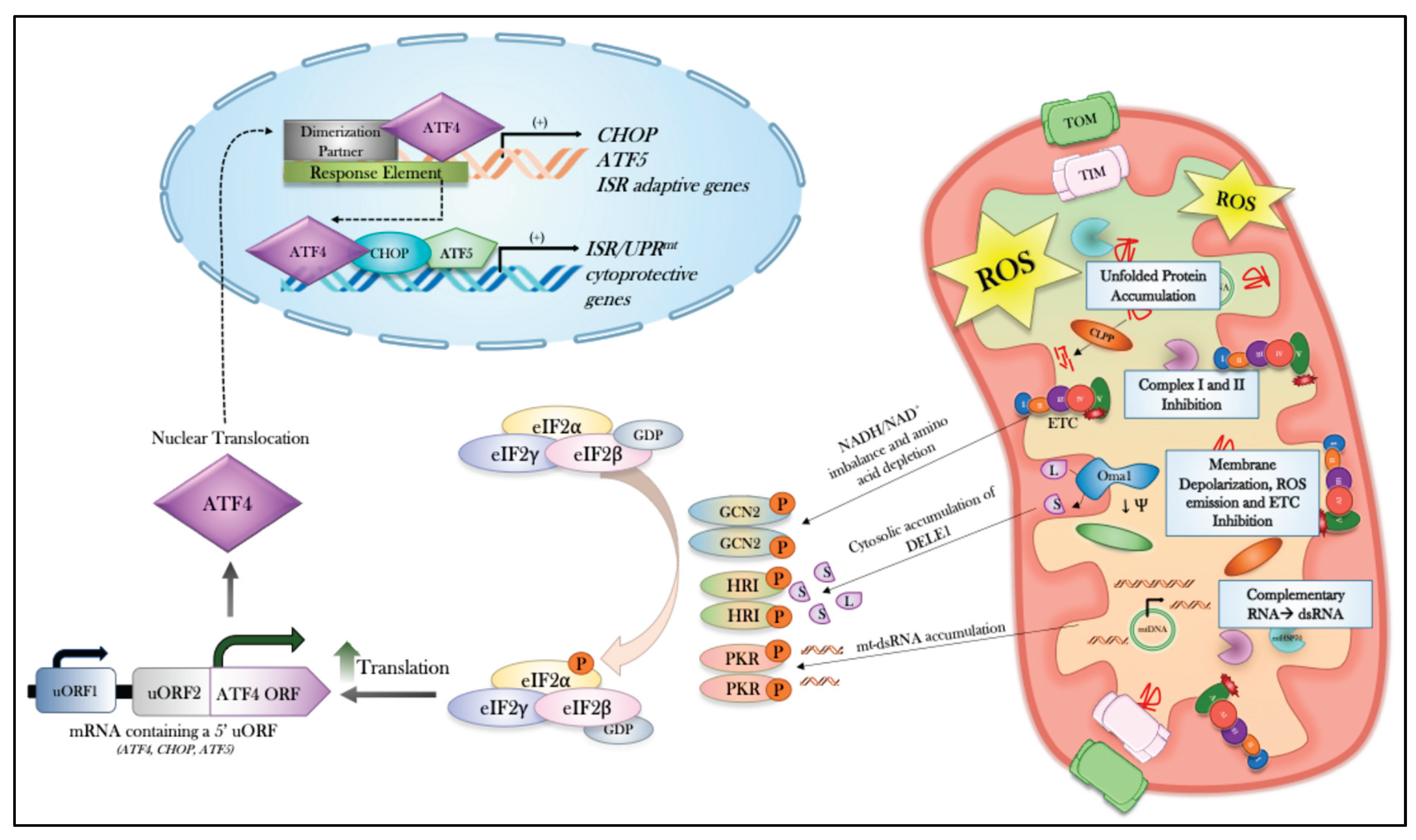
Figure 2.
The induction of the Mitochondrial Unfolded Protein Response (UPRmt). The canonical UPRmt axis, involving ATF4, CHOP and ATF5, is activated following global mitochondrial stress, such as misfolded/unfolded protein accumulation, elevations in ROS emission and imbalanced protein status, to induce the expression of related protective genes, such as chaperones and proteases. Other non-canonical pathways of the UPRmt can be initiated during instances of specific compartmental stressors. In the intermembrane space (IMS), ROS can trigger the activation of the kinase, AKT, to then phosphorylate ER where it will localize to the nucleus to upregulate the expression of NRF1. Similarly, misfolded/unfolded protein aggregates within the IMS can also directly prompt the activation of ER to stimulate the expression of HtrA2. In the matrix, elevations in both ROS and misfolded protein aggregates can elicit Sirt3 deacetylase activity, which will then deacylate FOXO3A, initiating its nuclear activation and regulation of mnSOD2 and catalase. These signaling axis all contribute to the remediation of mitochondrial function during various perturbations.
Figure 2.
The induction of the Mitochondrial Unfolded Protein Response (UPRmt). The canonical UPRmt axis, involving ATF4, CHOP and ATF5, is activated following global mitochondrial stress, such as misfolded/unfolded protein accumulation, elevations in ROS emission and imbalanced protein status, to induce the expression of related protective genes, such as chaperones and proteases. Other non-canonical pathways of the UPRmt can be initiated during instances of specific compartmental stressors. In the intermembrane space (IMS), ROS can trigger the activation of the kinase, AKT, to then phosphorylate ER where it will localize to the nucleus to upregulate the expression of NRF1. Similarly, misfolded/unfolded protein aggregates within the IMS can also directly prompt the activation of ER to stimulate the expression of HtrA2. In the matrix, elevations in both ROS and misfolded protein aggregates can elicit Sirt3 deacetylase activity, which will then deacylate FOXO3A, initiating its nuclear activation and regulation of mnSOD2 and catalase. These signaling axis all contribute to the remediation of mitochondrial function during various perturbations.
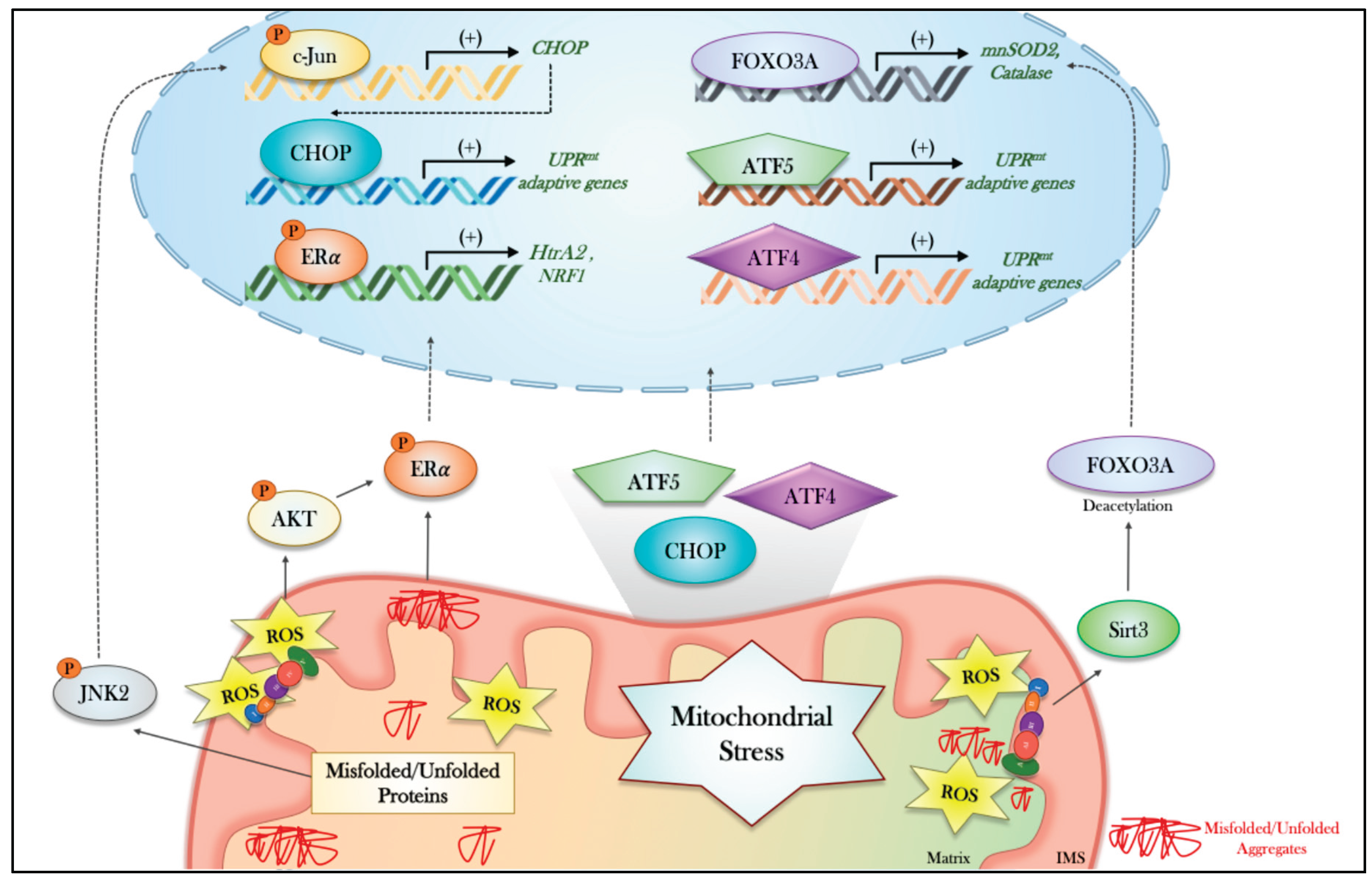
Figure 3.
ATF4-mediated downstream mechanisms of skeletal muscle atrophy during aging and muscle disuse. Upon prolonged muscle disuse and aging, ATF4 mediates a transcriptional program to promote the expression of pro-atrophy genes, Gadd45 and p21. Gadd45, when upregulated, leads to the activation of MEKK4 to form an active kinase complex, which is responsible for phosphorylating various MKK proteins (MKK3, MKK4 and MKK6) in skeletal muscle. Upon activation, these kinases will then subsequently activate p38MAPK to induce skeletal muscle atrophy. Similarly, when p21 is upregulated, it can lead to the modulation of unidentified targets, which represses the expression of the Smox enzyme, in an unknown manner, reducing metabolites required for protein synthesis and anabolism, consequently promoting skeletal muscle atrophy.
Figure 3.
ATF4-mediated downstream mechanisms of skeletal muscle atrophy during aging and muscle disuse. Upon prolonged muscle disuse and aging, ATF4 mediates a transcriptional program to promote the expression of pro-atrophy genes, Gadd45 and p21. Gadd45, when upregulated, leads to the activation of MEKK4 to form an active kinase complex, which is responsible for phosphorylating various MKK proteins (MKK3, MKK4 and MKK6) in skeletal muscle. Upon activation, these kinases will then subsequently activate p38MAPK to induce skeletal muscle atrophy. Similarly, when p21 is upregulated, it can lead to the modulation of unidentified targets, which represses the expression of the Smox enzyme, in an unknown manner, reducing metabolites required for protein synthesis and anabolism, consequently promoting skeletal muscle atrophy.
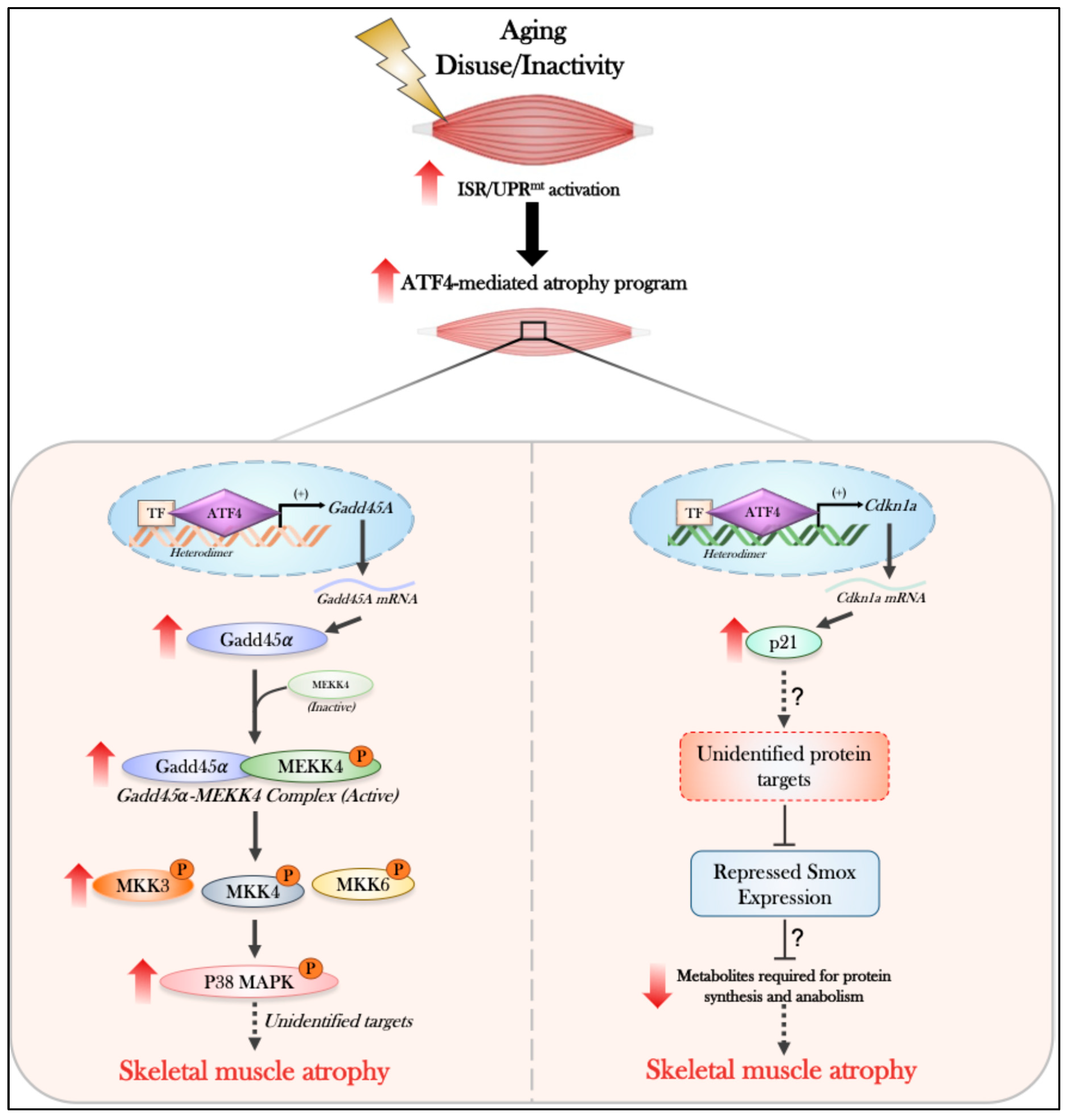
Figure 4.
A summary of the metabolic events and physiological outcomes that occur with exercise, aging and disuse, with respect to ISR/UPRmt activation. During exercise (acute and chronic), the ISR/UPRmt is transiently activated which propagates an adaptive gene program to promote enhancements in mitochondrial quality, adaptive capacity and this muscle health. Conversely, with aging and muscle disuse, chronic and prolonged activation of the ISR/UPRmt is observed consummating a maladaptive seen program which does not support mitochondrial quality control and instead promotes the induction of muscle atrophy and weakness.
Figure 4.
A summary of the metabolic events and physiological outcomes that occur with exercise, aging and disuse, with respect to ISR/UPRmt activation. During exercise (acute and chronic), the ISR/UPRmt is transiently activated which propagates an adaptive gene program to promote enhancements in mitochondrial quality, adaptive capacity and this muscle health. Conversely, with aging and muscle disuse, chronic and prolonged activation of the ISR/UPRmt is observed consummating a maladaptive seen program which does not support mitochondrial quality control and instead promotes the induction of muscle atrophy and weakness.
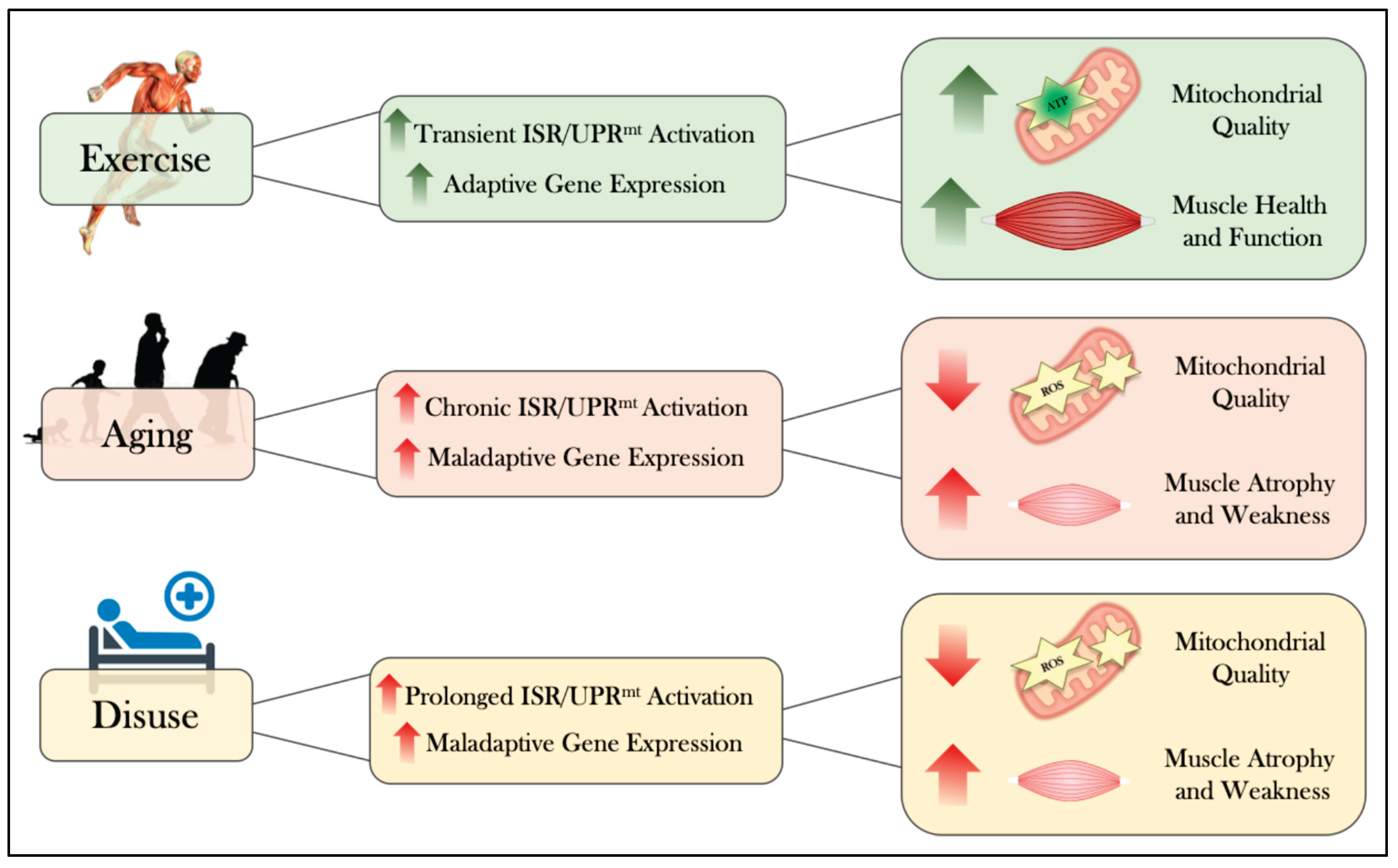
Disclaimer/Publisher’s Note: The statements, opinions and data contained in all publications are solely those of the individual author(s) and contributor(s) and not of MDPI and/or the editor(s). MDPI and/or the editor(s) disclaim responsibility for any injury to people or property resulting from any ideas, methods, instructions or products referred to in the content. |
© 2026 by the authors. Licensee MDPI, Basel, Switzerland. This article is an open access article distributed under the terms and conditions of the Creative Commons Attribution (CC BY) license (http://creativecommons.org/licenses/by/4.0/).
Copyright: This open access article is published under a Creative Commons CC BY 4.0 license, which permit the free download, distribution, and reuse, provided that the author and preprint are cited in any reuse.


