

Submitted:
06 April 2026
Posted:
07 April 2026
You are already at the latest version
Abstract
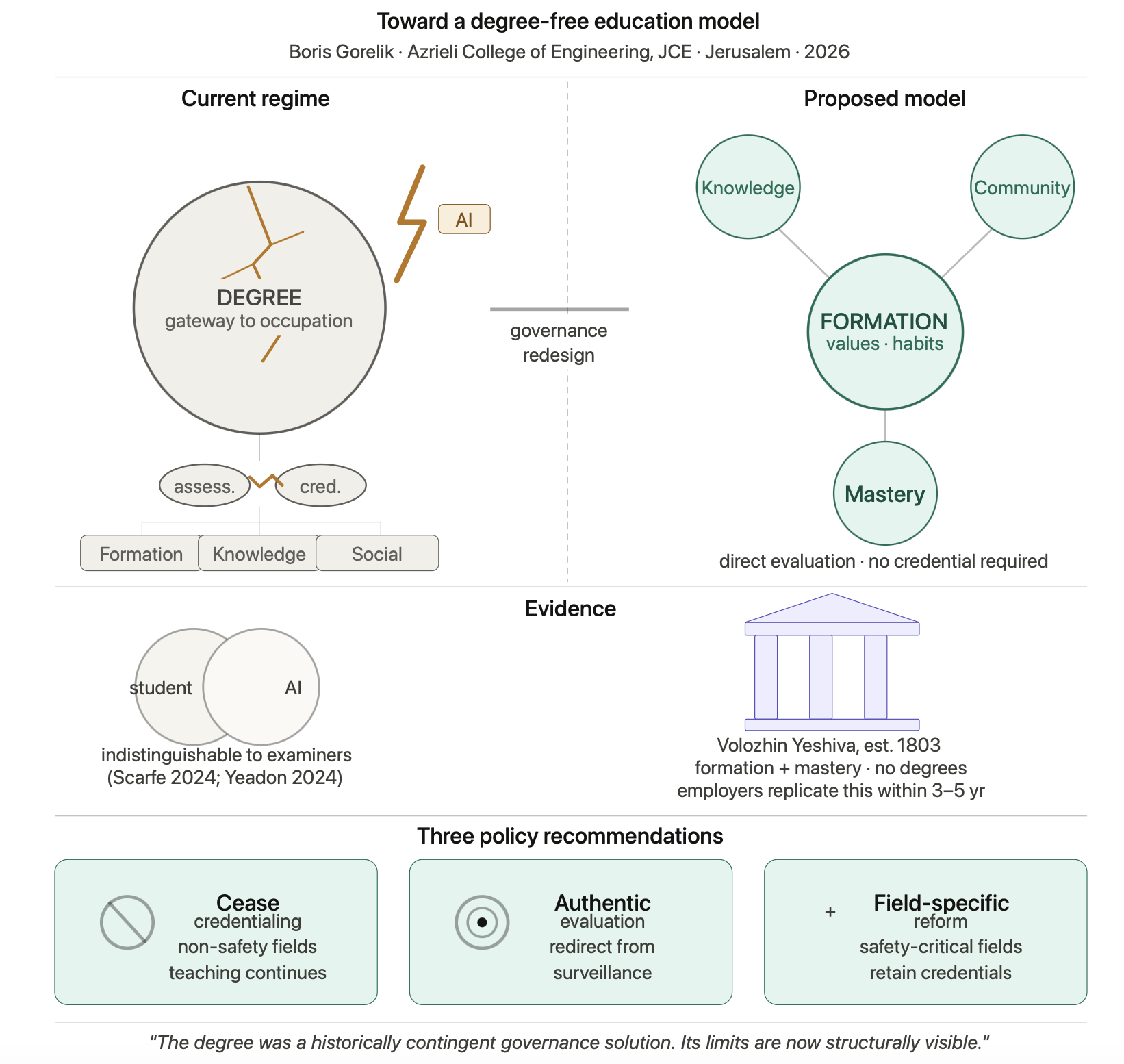
Generative AI has not created the governance crisis in higher education credentialing. It has forced it into view. The academic degree is the principal instrument through which higher education systems govern access to occupations and distribute social recognition. In many fields, it can no longer perform that function reliably. When AI-generated work consistently receives first-class grades and detection tools remain unreliable, the inference from submitted artifact to certified competence collapses. Strengthening surveillance restores procedural control at the cost of assessment validity. This paper proposes a degree-free model as a governance intervention. Collins (1979) and Dore (1976) established credentialism as an administrative proxy for competence that serves institutional convenience more than it measures capability. Spence’s (1973) signaling framework specifies the conditions under which credentials function as information devices. Generative AI systematically violates those conditions. The governance implication is institutional redesign, not pedagogical adjustment. The proposal draws on the yeshiva as a historical existence proof: a non-credentialing institution organized around formation, community, and recognized mastery. It is supported by two well-evidenced findings. AI has substantially weakened the validity of conventional assessment formats. Employers already discount the degree, substituting direct performance evaluation within three to five years of hire. The degree-free model formalizes what labor markets have already enacted. Three policy recommendations follow. In non-safety-critical fields, institutions should cease issuing degrees; teaching and formation continue. Public investment in surveillance-based assessment should be redirected toward authentic evaluation. Reform must be field-differentiated: mandatory credentialing remains justified in licensed and safety-critical professions. The degree was a historically contingent governance solution. Its limits are now structurally visible.
Keywords:
higher education
; AI in education
; credentialism
; degree-free model
; educational governance
; assessment validity
; labor market signaling
; institutional redesign
Copyright: This open access article is published under a Creative Commons CC BY 4.0 license, which permit the free download, distribution, and reuse, provided that the author and preprint are cited in any reuse.


