

Submitted:
04 April 2026
Posted:
06 April 2026
You are already at the latest version
Abstract
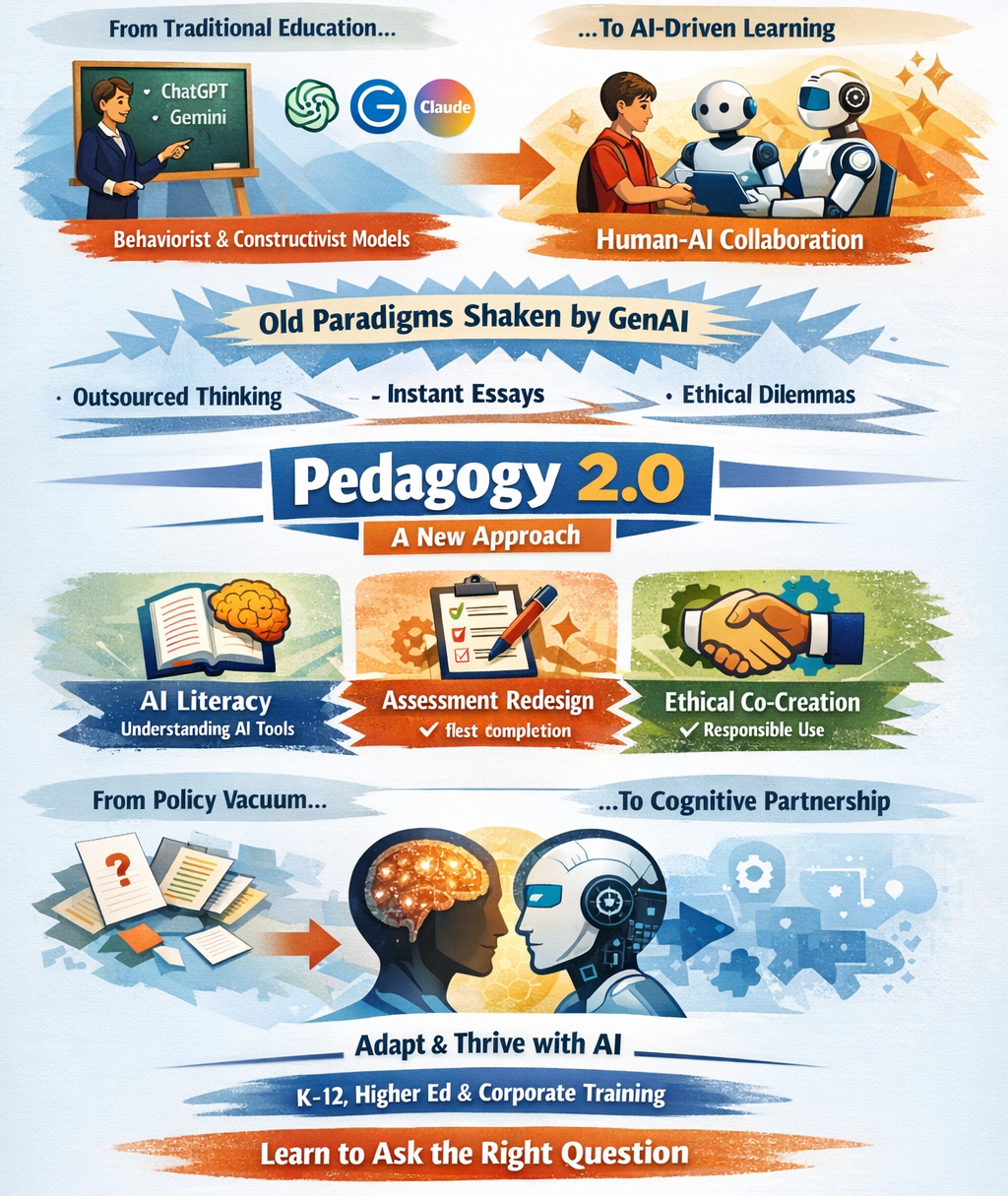
The traditional educational paradigms have been shaken overnight by generative AI-based tools like ChatGPT, Gemini, or Claude. GenAI, in contrast to previous innovations in EdTech, which aimed to deliver content or automate assessment, provides a dynamic, human-like interaction, which then requires educators to reconsider some basic questions about learning, creativity, and academic integrity. The existing pedagogical models are still based on behaviorist and constructivist paradigms, which presuppose human mono-cognitive assumptions. Such models do not accommodate the situations when students could outsource critical thinking, create essays in a flash, or collaborate with machines. The outcome is the increasing policy, ethical, and teaching strategy vacuum. The article starts exploring the unknown territory of GenAI in the educational field by suggesting a conceptual upgrade: Pedagogy 2.0. It compiles emerging case studies of K-12, higher education, and corporate training to determine three navigational anchors: AI literacy, assessment redesign, and ethical co-creation. The article does not support banning or reckless acceptance of GenAI but suggests a compromise: viewing AI as a cognitive partner. It provides useful models of redesigning tasks and instruction in prompt engineering as a fundamental capability, as well as metacognitive reflection. Pedagogy 2.0 does not eliminate traditional teaching but supplements it. Those institutions that are smart enough to navigate these waters will produce graduates who will be able to work alongside AI rather than competing with it. Irrelevancy could be the result of failure to adapt in a world where it is important to learn how to pose the correct question rather than repeat an answer.
Keywords:
generative AI
; pedagogy 2.0
; AI literacy
; assessment redesign
; cognitive partnership
Copyright: This open access article is published under a Creative Commons CC BY 4.0 license, which permit the free download, distribution, and reuse, provided that the author and preprint are cited in any reuse.


