

Submitted:
02 April 2026
Posted:
06 April 2026
You are already at the latest version
Abstract
Journalism plays a structurally indispensable yet under-theorized role in democratic governance. This article situates journalism within a recalibrated constitutional architecture in which the Quarta Politica—conceptualized as an Ombudsman Council—constitutes a fourth power alongside the legislative, executive, and judicial branches, endowed with distinct coercive authority oriented toward systemic correction and participatory accountability. Within this framework, journalism is not a separate power but a constitutionally protected function that secures the informational conditions upon which all four powers depend. By producing, verifying, and disseminating public information, journalism sustains accountability, enables informed participation, and facilitates collective judgment. The article reconceptualizes democracy as dependent on three interrelated dimensions: the distribution of coercive authority, the institutionalization of participatory oversight, and the integrity of the informational environment. It demonstrates that journalism performs a non-substitutable role as an early-warning and accountability-generating mechanism. Under conditions of digital transformation, platform dominance, and media fragility, these informational foundations are increasingly at risk. The article therefore advances a calibrated framework for the constitutional protection of journalism—grounded in independence, sustainability, and accountability—embedded within the Quarta Politica. A comparative perspective, including Global South contexts, underscores the generalizability of this approach across diverse democratic settings.
Keywords:
Quarta Politica
; fourth power
; journalism
; constitutional function
; informational democracy
; digital constitutionalism
; media independence
; democratic resilience
; ombudsman institutions
; comparative constitutionalism
1. Introduction
“If I had to choose between a government without newspapers or newspapers without a government, I would not hesitate to prefer the latter.” Thomas Jefferson’s oft-cited dictum has long functioned as rhetorical homage to the press. Today, however, it reads less as an Enlightenment flourish than as an empirical warning. A growing body of comparative research demonstrates that the quality of journalism and the quality of democracy rise and fall together. Where press freedom deteriorates, democratic standards erode; where independent journalism thrives, accountability, institutional integrity, and public trust tend to follow.
Recent cross-national evidence confirms this relationship. Countries ranking highly in democratic governance—particularly the Nordic states—consistently occupy leading positions in global press freedom indices (Reporters Without Borders 2024). Conversely, states undergoing democratic backsliding exhibit parallel declines in media freedom. The V-Dem Democracy Report 2024 identifies restrictions on media freedom as one of the earliest and most recurrent indicators of autocratization (V-Dem Institute 2024). The relationship is therefore structural rather than incidental: when journalism weakens, the entire architecture of democratic accountability becomes more vulnerable.
This relationship is not merely correlational but constitutive. Empirical studies show that higher levels of press freedom are systematically associated with lower levels of corruption (Brunetti and Weder 2003). By exposing abuses of power, uncovering conflicts of interest, and enabling informed public deliberation, journalism performs a function that is internal to democratic governance itself. Without credible and independently produced information regarding the exercise of public authority, the mechanisms of accountability central to democracy cannot operate effectively.
Yet journalism today operates under intensifying and convergent pressures. Traditional threats—censorship, intimidation, and violence—are now compounded by structural transformations in the information environment. Digital disinformation, algorithmic amplification of polarizing content, the economic fragility of news organizations, and the disruptive effects of artificial intelligence have fundamentally reshaped the conditions under which journalism is produced and consumed. Since the mid-2010s, the rise of populist movements has further intensified these pressures, often through deliberate strategies aimed at discrediting professional media as part of broader efforts to undermine independent institutions (Norris and Inglehart 2019). Simultaneously, the migration of advertising revenue to global digital platforms has eroded the economic foundations that historically sustained investigative reporting (Pickard 2020). Journalism thus remains widely recognized as a cornerstone of democratic life while confronting unprecedented structural strain.
These developments call not for rhetorical reaffirmation but for institutional recalibration. Modern democracies face a deeper constitutional paradox: while legislative, executive, and judicial institutions are designed to exercise and constrain coercive authority, the effective functioning of these powers increasingly depends on the integrity of the informational environment within which they operate. Classical separation-of-powers theory—Trias Politica—was designed to distribute coercive power among three branches in order to prevent domination (Montesquieu 1748/1989). Contemporary constitutional thought has extended this framework through the recognition of oversight institutions—often conceptualized as the Quarta Politica—tasked with monitoring, reviewing, and constraining administrative conduct (Walker 2002), (Celeste 2019), (Galiñanes and Klinkers 2025).
However, prevailing interpretations of the Quarta Politica remain conceptually incomplete when they are reduced to supervisory or advisory functions. A significant step toward overcoming this limitation has been made by Manuel Galiñanes and Leo Klinkers, who explicitly propose the institutionalization of an Ombudsman Council as a distinct fourth power within democratic governance (Galiñanes and Klinkers 2025). Their contribution marks an important shift from viewing oversight bodies as peripheral mechanisms toward recognizing them as a structurally necessary component of the constitutional order.
Building on this foundation, the present article advances the argument in a critical respect. While Galiñanes and Klinkers establish the Quarta Politica as a fourth branch tasked with safeguarding democratic integrity, the full constitutional implications of such a status require further clarification. If the Quarta Politica is to be understood as a “power” in the strict constitutional sense—standing alongside the legislative, executive, and judicial branches—it cannot remain limited to monitoring, advisory, or recommendatory functions. A body that lacks the capacity to produce binding effects does not exercise power, but influence.
Accordingly, this article develops and extends their framework by articulating the necessity of coercive authority as a defining attribute of the Quarta Politica. The argument is straightforward but consequential: parity within the separation of powers entails not only functional distinctiveness but also institutional effectiveness. Just as the legislative, executive, and judicial branches possess coercive means to enact, implement, and enforce decisions, the Quarta Politica must be equipped with constitutionally grounded powers capable of compelling rectification when systemic failures occur.
This extension does not depart from the logic of Galiñanes and Klinkers; rather, it renders that logic fully operational under contemporary conditions of democratic stress. In contexts characterized by polarization, institutional erosion, and the strategic manipulation of information, purely advisory oversight proves insufficient. The Quarta Politica must therefore be conceived as a corrective power: an authority capable not only of identifying democratic deficits but of enforcing remedies across the institutional and societal domains in which those deficits arise.
Within this reconceptualized framework, journalism must be understood not merely as a social practice or market activity, but as a constitutionally relevant function embedded within the architecture of democratic power. As an organized, professional, and independent mechanism for producing, verifying, and circulating information, journalism constitutes a knowledge-based infrastructure essential to the operation of all other powers. It does not itself exercise coercion; rather, it generates the informational preconditions that enable coercive authority to be exercised legitimately, lawfully, and accountably.
Accordingly, this article situates journalism within the institutional domain of the Quarta Politica, while maintaining its structural independence from the state. This positioning reflects a critical distinction: journalism is not incorporated into the apparatus of coercion, but it is recognized as a function whose protection may require coercive guarantees. The Quarta Politica, endowed with binding authority, becomes the constitutional locus through which such guarantees can be articulated and enforced.
This reconceptualization departs from the traditional notion of the “Fourth Estate.” While that concept captures the intuition that the press operates as a counterweight to political authority, it remains metaphorical and institutionally indeterminate. It acknowledges importance without specifying constitutional status, normative function, or enforcement mechanisms. Journalism instead occupies a hybrid position—organizationally private yet normatively public, economically market-based yet oriented toward collective goods, decentralized in structure yet systemically influential. Under contemporary conditions, this hybrid role acquires constitutional significance.
The argument developed here is therefore twofold. First, journalism performs an indispensable function within democratic governance that cannot be replicated by existing institutions. Second, this function warrants explicit constitutional protection within a Quarta Politica endowed with coercive authority. Such protection does not entail the incorporation of journalism into the state; on the contrary, it requires safeguarding the conditions under which journalism can operate independently and effectively.
The normative basis for this claim rests on three interrelated arguments. First, journalism performs a distinctive accountability function. Courts adjudicate legality, legislatures establish norms, and executives implement policy. Yet in many cases investigative reporting initiates the very processes that activate these mechanisms. Without journalistic scrutiny, formal institutions frequently lack the information necessary to act.
Second, journalism sustains the informational infrastructure upon which democratic decision-making depends. Democratic governance presupposes access to reliable information and a sufficiently shared factual basis to enable citizens to evaluate competing claims (Habermas 1996), (Estlund 2008). In fragmented information environments characterized by misinformation and strategic manipulation, professional journalism remains one of the few institutionalized practices committed to verification, evidentiary standards, and editorial accountability.
Third, journalism contributes to democratic pluralism in ways that extend beyond formal institutional design. Its decentralized and adaptive structure enables the amplification of marginalized voices, the investigation of transnational actors, and the articulation of local grievances within broader public debates. This flexibility allows journalism to respond to evolving political and technological conditions while maintaining its capacity to scrutinize power.
Recognizing journalism as a function requiring enhanced protection entails corresponding institutional implications. The objective is not to constitutionalize media organizations as state actors, but to secure the enabling conditions under which journalism can operate: editorial independence, pluralistic ownership structures, and economic sustainability. Within a Quarta Politica endowed with coercive authority, these conditions can be protected not merely normatively, but through enforceable guarantees.
At the same time, such recognition entails reciprocal responsibilities within the profession itself. Public trust cannot be presumed; it must be continuously earned and maintained. Transparent correction mechanisms, clear editorial standards, and meaningful engagement with diverse audiences are essential components of institutional credibility. As recent research indicates, declining trust in media institutions reflects not only external pressures but also internal perceptions of opacity, elitism, or partisan alignment (Newman et al. 2024). Strengthened protection must therefore be accompanied by strengthened professional accountability.
The stakes are considerable. Longitudinal data show that governments undergoing autocratization frequently begin by constraining media freedoms before weakening electoral competition or judicial independence (V-Dem Institute 2024). When the informational watchdog is compromised, the broader system of checks and balances becomes structurally fragile. Conversely, reinforcing the institutional conditions of journalism may serve as an early and effective safeguard against democratic decline.
This article proceeds from the premise that contemporary democracies require a recalibrated architecture of powers. The Quarta Politica, conceived as a fourth branch endowed with coercive authority, strengthens systemic accountability within the constitutional order. The protection of journalism within this framework strengthens the informational conditions upon which that order depends. Together, they form a mutually reinforcing structure: one secures the capacity of democratic systems to correct themselves; the other secures their capacity to know when correction is necessary. In combination, they aim to ensure that democratic governance remains transparent, accountable, and resilient under the conditions of the twenty-first century.
2. From Trias Politica to Quarta Politica
The preceding section identified a structural tension in contemporary democratic governance: while constitutional systems are designed to distribute and constrain coercive authority, their effective functioning increasingly depends on the integrity of the informational environment within which both citizens and institutions operate. The introduction of the Quarta Politica responds to deficits in participatory oversight. Yet this development raises a further and more fundamental question: how are the informational conditions that render such oversight meaningful to be secured?
Classical constitutional theory did not confront this question directly. The doctrine of the separation of powers emerged in response to the dangers of concentrated authority, not to the risks of informational distortion. It therefore presupposed—rather than institutionalized—the communicative conditions necessary for accountability. Contemporary democracies, by contrast, operate within environments in which information is actively produced, mediated, and strategically shaped under conditions of economic concentration, political contestation, and technological transformation (Habermas 1996), (Zuboff 2019).
This section develops the argument in four steps. It first revisits the classical architecture of coercive authority and its structural limits. It then examines the emergence of the Quarta Politica as a fourth power, building on the proposal advanced by Galiñanes and Klinkers (2025) while clarifying its constitutional implications. Third, it analyzes the historical and functional role of journalism as an informal but indispensable component of democratic accountability. Finally, it integrates these strands by arguing for the constitutional protection of journalism within the institutional framework of the Quarta Politica.
2.1. Classical Separation of Powers: The Architecture and Limits of Coercive Authority
Modern constitutionalism rests on the premise that liberty depends on the division of coercive power. The classical doctrine of the separation of powers distributes legislative, executive, and judicial authority across distinct institutions in order to prevent their concentration. Each branch operates within a defined sphere while constraining the others through reciprocal mechanisms of control (Montesquieu [1748] 1989).
This arrangement establishes a dynamic equilibrium in which no single institution can monopolize authority. Its normative force lies not in assumptions about the virtue of officeholders, but in the structuring of incentives: power is constrained because it is counterposed. As articulated in Federalist No. 51, constitutional stability derives from the principle that “ambition must be made to counteract ambition” (Hamilton, Madison, and Jay [1788] 2003).
Yet this framework reflects the historical conditions under which it was formulated. It presumes relatively bounded state functions and a public sphere in which information circulates without systematic distortion. These assumptions no longer hold. Contemporary governance is characterized by expanded administrative systems, technocratic decision-making, and the diffusion of authority across transnational and hybrid institutional arrangements (Koppell 2010).
Under such conditions, the exercise of power extends beyond formal acts of legislation, execution, or adjudication. It is embedded in regulatory practices, bureaucratic discretion, and increasingly in the control, management, and strategic deployment of information. The separation of powers remains necessary, but it is no longer sufficient. While it constrains coercive authority, it does not ensure that such authority is publicly intelligible, contestable, or subject to continuous scrutiny.
The constitutional problem thus extends beyond the division of power to include the conditions under which power becomes visible, knowable, and accountable.
2.2. The Quarta Politica: From Oversight Function to Coercive Corrective Power
The evolution of constitutional systems reflects a growing recognition of these limitations. The proliferation of oversight institutions—ombudsman bodies, independent authorities, and specialized review mechanisms—signals an attempt to address forms of administrative complexity that escape traditional checks and balances.
A decisive step in this direction is provided by Galiñanes and Klinkers (2025), who propose the institutionalization of an Ombudsman Council as a distinct Quarta Politica within democratic governance. Their contribution marks a conceptual shift from viewing oversight as a peripheral or auxiliary function toward recognizing it as a structurally necessary component of the constitutional order.
However, the full implications of this proposal require further clarification. If the Quarta Politica is to be understood as a fourth power—standing alongside the legislative, executive, and judicial branches—it must possess the defining characteristic of constitutional power: the capacity to produce binding effects. A body limited to monitoring, recommendation, or advisory functions may influence outcomes, but it does not exercise power in the strict sense.
Accordingly, the Quarta Politica must be conceived as a coercive corrective power. Its role is not merely to observe or evaluate, but to intervene where systemic failures of accountability occur. This includes failures originating within the traditional branches of government as well as those emerging within the broader societal and informational environment.
This conceptualization extends—rather than departs from—the framework proposed by Galiñanes and Klinkers. It renders their model fully operational under contemporary conditions characterized by democratic backsliding, institutional erosion, and strategic manipulation of information. In such contexts, purely advisory oversight is structurally insufficient. The capacity to compel rectification becomes essential.
The Quarta Politica thus occupies a distinct position within the constitutional architecture. It does not duplicate the functions of the legislative, executive, or judicial branches; rather, it operates across them, ensuring that their exercise of power remains consistent with the principles of democratic accountability. Its authority is corrective rather than generative, but no less coercive in its effects.
At the same time, this expanded role introduces a critical dependency: effective correction presupposes access to reliable information. Without such information, neither citizens nor institutions—including the Quarta Politica itself—can identify, evaluate, or address failures of governance.
2.3. Journalism and the “Fourth Estate”: Informational Power Without Constitutional Form
The political significance of journalism predates its formal recognition within constitutional theory. Historically conceptualized as the “Fourth Estate,” the press has long functioned as a central mechanism through which information about power is produced, verified, and disseminated. By exposing wrongdoing, structuring public debate, and connecting dispersed actors, journalism has played a decisive role in the practical operation of democratic accountability (Tocqueville [1835] 2000).
Yet this role developed outside the formal architecture of governance. Journalism derives its authority from professional norms, social legitimacy, and organizational practices rather than from constitutional status (Schudson 2001). Its influence is therefore indirect: it triggers responses within formal institutions without itself constituting one.
Despite this institutional indeterminacy, its impact has been substantial. Investigative reporting has repeatedly initiated processes of accountability subsequently taken up by courts, legislatures, and regulatory bodies. Empirical research confirms that media freedom is associated with lower levels of corruption and higher levels of governmental transparency (Brunetti and Weder 2003).
However, the conditions sustaining this function have become increasingly unstable. Economic pressures, ownership concentration, and the transformation of media markets have weakened the material foundations of journalism. At the same time, the fragmentation of the public sphere, the rise of disinformation, and the algorithmic amplification of polarizing content have eroded shared informational baselines (Habermas 1996), (Norris and Inglehart 2019).
These developments do not diminish the importance of journalism; they clarify its structural role. Journalism provides the informational infrastructure upon which both coercive constraints and corrective oversight depend. Its function is not reducible to expression or opinion, but consists in the systematic production of publicly relevant knowledge.
The constitutional implication is direct: a function so central to democratic accountability cannot remain entirely external to institutional design.
2.4. Constitutionalizing Informational Accountability within the Quarta Politica
The preceding analysis reveals a structurally interdependent architecture of democratic governance. The Trias Politica organizes coercive authority across three branches. The Quarta Politica, as a fourth power, ensures that this authority remains subject to continuous correction. Yet both depend on a prior condition: the availability of reliable information regarding how power is exercised.
Addressing this dependency requires conceptual precision. The objective is not to transform journalism into a branch of government. Such incorporation would undermine its independence by subjecting it to the very structures it must scrutinize. The appropriate response is instead functional and constitutional: to embed the protection of journalism within the institutional framework of the Quarta Politica, while preserving its organizational autonomy.
Within a Quarta Politica endowed with coercive authority, this protection can be operationalized through institutional mechanisms capable of producing binding effects. A Chamber for the Protection of Journalism constitutes one such mechanism. Its mandate would include safeguarding press freedom, protecting editorial independence, ensuring pluralistic media structures, and addressing systemic threats arising from both state and non-state actors (Baker 2006), (Curran and Seaton 2018).
Importantly, this institutional design can be extended. The informational and developmental conditions of democratic governance are not limited to journalism alone. Parallel structural vulnerabilities arise in other domains essential to democratic reproduction. Two additional chambers warrant conceptual recognition and further development in subsequent work:
- a Chamber for the Protection of Children, addressing the structural asymmetries and long-term vulnerabilities affecting minors within political, digital, and socio-economic systems;
- a Chamber for the Protection of Education and Science, safeguarding the epistemic foundations of democratic societies against politicization, erosion of academic freedom, and disinformation.
These chambers share a common rationale: each protects a domain in which long-term democratic capacity is formed but insufficiently secured by existing institutional arrangements. Their inclusion within the Quarta Politica reflects a broader constitutional evolution from the regulation of power to the protection of the conditions that make democratic self-government posible.
From a theoretical perspective, this shift marks a transition from a purely institutional separation of powers toward a more comprehensive differentiation of democratic functions. Classical constitutionalism sought to prevent domination through the division of authority. Contemporary constitutionalism must additionally secure the conditions under which democratic legitimacy is continuously produced—conditions that are participatory, informational, and epistemic in nature (Habermas 1996).
Within this framework, the protection of journalism emerges as a structural requirement. It ensures that the processes through which power is scrutinized, contested, and corrected remain viable. Where such conditions deteriorate, oversight loses effectiveness and coercive power becomes less accountable. Where they are sustained, democratic systems exhibit greater resilience, adaptability, and capacity for self-correction.
The sections that follow build on this foundation by examining the normative justification, institutional design, and practical implications of securing journalism as a constitutionally protected function within a coercively empowered Quarta Politica.
3. Journalism as Structural Accountability: A Normative Defense
If journalism is to be recognized as a function warranting constitutional protection within the Quarta Politica, the argument must address a series of well-founded objections. Critics point to media capture by political or economic elites, ideological polarization, ownership concentration, and the distorting effects of algorithmic amplification. These concerns are empirically grounded and normatively significant. Yet rather than undermining the case for protecting journalism, they clarify the conditions under which its democratic role becomes both indispensable and structurally vulnerable.
The central question is therefore not whether journalism is imperfect, but whether democratic governance can dispense with the function it performs. The argument developed here proceeds from the opposite premise: precisely because journalism is susceptible to distortion, its enabling conditions must be institutionally secured within a constitutional framework capable of enforcing such protection. Within the architecture advanced in this article, that framework is provided by the Quarta Politica as a coercive corrective power.
3.1. The Anti-Corruption Function and the Problem of Capture
The most persistent concern is media capture. If journalism can be co-opted by governments, oligarchic interests, or partisan actors, how can it function as an independent check on power? The force of this objection lies in its implicit recognition of journalism’s structural importance: capture matters only because journalism plays a decisive role in shaping accountability.
Empirical research provides a consistent baseline. Where media remain independent, corruption declines. Brunetti and Weder (2003) demonstrate a robust negative correlation between press freedom and bureaucratic corruption across political systems. Investigative reporting increases the likelihood that misconduct will be exposed, thereby raising both reputational and legal costs for public officials. In many instances, journalistic inquiry precedes and activates formal accountability mechanisms within courts, legislatures, and oversight institutions.
Capture disrupts this sequence. Political interference, selective allocation of state advertising, and concentrated ownership aligned with governing interests can compromise editorial independence. The appropriate response, however, is not to diminish journalism’s constitutional relevance, but to clarify and enforce the institutional conditions under which it can perform its function. As with judicial independence, the objective is not the elimination of risk but the construction of robust safeguards.
Comparative research reinforces this conclusion. Hallin and Mancini (2004) demonstrate that media systems vary systematically according to ownership structures, regulatory frameworks, and professional norms. Where pluralism and autonomy are institutionally embedded, journalism is more capable of fulfilling its watchdog role. The implication is constitutional: vulnerability to capture strengthens the case for embedding the protection of journalism within a coercively empowered Quarta Politica.
The analogy with the Trias Politica remains instructive. The possibility of collusion among branches does not invalidate the separation of powers; it justifies reinforcing it. Likewise, the risk of media capture supports the institutionalization—not the abandonment—of enforceable safeguards for journalistic Independence.
3.2. Polarization and the Charge of Partisanship
A second objection concerns polarization. In many contemporary democracies, media environments appear increasingly fragmented along ideological lines, with outlets reinforcing partisan identities and contributing to informational segmentation. Critics argue that journalism, rather than stabilizing democratic life, may intensify división.
This diagnosis is partially supported by empirical developments, particularly in digital communication environments that facilitate selective exposure and confirmation bias. Norris and Inglehart (2019) show how populist actors exploit media fragmentation to undermine trust in independent institutions. However, the conclusion that journalism thereby loses its democratic function does not follow.
First, polarization tends to intensify where professional journalism weakens rather than where it remains robust. Bennett and Livingston (2018) argue that the erosion of editorial gatekeeping allows unverified and strategically manipulated content to circulate more freely, thereby exacerbating fragmentation. In this sense, the weakening of journalism is not merely a consequence of polarization—it is also one of its drivers.
Second, pluralism itself is a core democratic value. A diverse media landscape may reflect ideological differences without abandoning standards of verification and accountability. The relevant distinction is not between political orientations, but between communicative practices grounded in professional norms and those driven solely by mobilization, propaganda, or disinformation.
Embedding the protection of journalism within the Quarta Politica therefore does not aim to eliminate disagreement, but to ensure that disagreement unfolds within a framework of factual accountability. The objective is not consensus, but the preservation of a shared informational basis within which contestation remains meaningful. This requires not only normative recognition, but institutional guarantees capable of counteracting systemic distortions.
3.3. Ownership Concentration and Democratic Pluralism
A related challenge concerns the concentration of media ownership. When a limited number of actors control major outlets, diversity of perspectives may be constrained and editorial independence compromised. This reflects a structural tension: journalism operates within market systems while simultaneously performing a public function.
As Pickard (2020) demonstrates, the economic foundations of journalism have been significantly destabilized by the rise of digital platforms, reducing newsroom capacity and weakening investigative reporting. At the same time, concentrated ownership structures may generate dependencies that shape editorial priorities.
Recognizing journalism as a constitutionally protected function reframes this issue as a matter of democratic governance rather than purely market organization. Liberal constitutional orders have long acknowledged that markets require safeguards against monopolistic concentration in order to function effectively. The same principle applies with particular force to the media sector, where diversity of ownership and access to distribution channels are directly linked to the quality of democratic deliberation.
Importantly, the existence of concentration does not negate journalism’s structural necessity. Other democratic institutions operate under analogous imperfections: legislatures may be dominated by majorities, and courts may face political pressures. The appropriate response is institutional reinforcement. Within the Quarta Politica, coercive mechanisms can be designed to prevent excessive concentration, promote pluralism, and protect the structural conditions under which journalism can fulfil its role.
3.4. Algorithmic Amplification and the Transformation of the Public Sphere
A more recent objection concerns the transformation of the public sphere through digital platforms and algorithmic systems. Social media infrastructures prioritize engagement, often amplifying sensationalist or misleading content, while advances in artificial intelligence blur the boundary between verified reporting and fabrication. In such an environment, journalism may appear to lose its privileged role.
This transformation is undeniable. Bennett and Livingston (2018) describe a shift from institutional gatekeeping to networked disinformation, in which political actors bypass traditional media filters. Yet this shift does not render journalism obsolete; it heightens its structural and constitutional significance.
When visibility is governed by algorithmic incentives rather than evidentiary standards, professional journalism remains one of the few organized practices committed to verification, source transparency, and editorial accountability. Its function becomes not merely informative but corrective—counteracting distortions introduced by digitally mediated communication.
From a constitutional perspective, digital platforms represent a novel concentration of power not anticipated by classical theories. Private actors can shape public discourse at a scale comparable to, or exceeding, that of state institutions. Within this environment, journalism performs a critical countervailing function: investigating platform governance, exposing coordinated disinformation, and contextualizing rapidly circulating narratives.
Embedding the protection of journalism within the Quarta Politica therefore acquires an additional dimension. It enables the deployment of coercive safeguards to protect journalism’s capacity to scrutinize emerging forms of power that operate beyond traditional institutional categories, thereby extending democratic accountability into the digital domain.
3.5. Early-Warning Function and Democratic Resilience
Beyond responding to objections, the normative case rests on positive evidence of journalism’s structural role within democratic systems. Longitudinal analyses by the V-Dem Institute (2024) demonstrate that restrictions on media freedom frequently precede broader processes of democratic decline. Governments seeking to consolidate authority often begin by constraining journalists, controlling narratives, or delegitimizing independent reporting.
This recurring pattern suggests that journalism functions as an early-warning mechanism within democratic systems. It does not merely report on institutional deterioration; it frequently signals its onset. By uncovering irregularities, documenting abuses, and rendering latent problems visible, journalism initiates processes of scrutiny that may subsequently be taken up by courts, legislatures, or the Quarta Politica.
Historical experience reinforces this dynamic. Investigative reporting has repeatedly triggered formal accountability responses, from corruption inquiries to legislative reform. The sequence is consistent: exposure precedes institutional reaction. Without the initial act of disclosure, formal mechanisms often remain dormant.
Within the broader constitutional architecture, journalism thus operates as a decentralized and anticipatory form of oversight. It does not itself exercise coercive authority, but it enables the effective exercise of such authority by other institutions. In doing so, it contributes directly to the resilience and adaptive capacity of democratic systems.
3.6. Imperfection and Institutional Necessity
No democratic institution is immune to distortion. Legislatures may become partisan, executives may overreach, and courts may face politicization. Journalism is subject to analogous vulnerabilities. The relevant question, however, is not whether journalism is flawless, but whether its function is dispensable.
The cumulative evidence suggests it is not. Where independent journalism weakens, corruption tends to increase; where media freedom declines, democratic backsliding accelerates; and where investigative reporting persists, accountability mechanisms function more effectively.
The objections of capture, polarization, concentration, and algorithmic distortion therefore do not undermine the case for protecting journalism within the Quarta Politica. On the contrary, they define the institutional safeguards required to ensure that journalism can perform its role under contemporary conditions.
Within the recalibrated constitutional framework developed in this article, journalism occupies a distinct structural position. It is neither incorporated into the state nor reducible to a purely private activity. It is an independent, publicly oriented function whose protection is necessary to sustain the informational conditions under which democratic accountability becomes posible.
Embedding the protection of journalism within the Quarta Politica is therefore not an act of institutional expansion, but of constitutional clarification. It recognizes that democratic governance depends not only on the distribution of coercive power and the safeguarding of participatory oversight, but also on the integrity of the informational environment through which power is rendered visible, contestable, and corrigible.
4. Civic Agency and Citizen Journalism: Participation within the Quarta Politica
A potential misunderstanding of the proposed framework is that strengthening the constitutional protection of journalism risks elevating professional media into a privileged and insulated domain, detached from the citizenry in whose name democratic accountability is exercised. If journalism is afforded enhanced protection within the Quarta Politica, does this imply a technocratic narrowing of public discourse? Or can such protection accommodate participatory and citizen-driven forms of communication without diluting the standards upon which public trust depends?
Addressing this concern requires a clear analytical distinction between function and institutional form. The protection afforded to journalism within the Quarta Politica does not attach to a specific professional class, organizational structure, or market actor. It is directed instead at a constitutional function: the independent production, verification, and public dissemination of information necessary for democratic accountability. This function may be carried out by professional news organizations, investigative consortia, public broadcasters, and—under identifiable conditions—collaborative networks that incorporate citizen participation. What is normatively decisive is not professional status as such, but adherence to practices that ensure reliability, transparency, and corrigibility.
This functional approach situates journalism within a broader democratic ecology of communication. Democratic theory has long emphasized that public communication is inseparable from civic agency. For Dewey (1927), democracy is not merely a system of institutions but a mode of associated life sustained through communication. Public problems become political only when they are articulated, shared, and recognized as matters of common concern. Journalism, in this sense, does not replace civic agency; it structures the communicative environment within which citizens can recognize themselves as a public capable of collective judgment.
The transformation of the media environment over the past two decades has significantly expanded the scope of such participation. Citizen journalism, whistleblowing platforms, community-based reporting, and real-time digital documentation have disrupted the informational concentration historically associated with large media organizations. As Benkler (2006) argues, the emergence of a networked public sphere enables decentralized actors to contribute directly to agenda-setting and information flows. Similarly, Shirky (2008) highlights how digital communication facilitates new forms of collective action and distributed knowledge production that operate beyond traditional institutional boundaries.
This shift has been further conceptualized as “produsage” (Bruns 2008), in which the distinction between producers and consumers of information becomes increasingly blurred. Individuals do not merely receive information; they generate, interpret, and circulate it, contributing to dynamic and collaborative communicative environments. These developments do not displace professional journalism; rather, they expand the range of inputs upon which it can draw and the publics with which it interacts.
From the perspective of the Quarta Politica, these transformations should be understood not as a challenge to journalistic authority, but as an expansion of democratic oversight capacity. Citizen contributions can reveal local realities overlooked by national media, provide immediate documentation of unfolding events, and generate leads for further investigation. The informational environment thus becomes more distributed and, potentially, more responsive to public concerns.
At the same time, participatory communication introduces significant risks. Decentralized information flows, in the absence of verification and accountability, can facilitate the spread of misinformation, coordinated manipulation, or targeted harassment. The distinctive contribution of journalism lies not in exclusivity, but in method: practices such as source verification, evidentiary assessment, editorial review, and the institutionalization of correction. The protection of journalism within the Quarta Politica therefore does not privilege professional actors as such; it safeguards these epistemic standards as constitutive elements of democratic accountability.
In practice, the relationship between civic participation and professional journalism is increasingly collaborative. Investigative projects frequently rely on citizen-submitted data that journalists verify and contextualize. Local reporting initiatives fill gaps left by the economic contraction of commercial media. Digital platforms enable individuals to document abuses that journalists subsequently investigate and amplify. Through these interactions, civic agency and journalistic practice become mutually reinforcing rather than oppositional.
This relationship can be further clarified through the lens of deliberative democracy. As Habermas (1989) argues, legitimate public discourse requires both inclusivity and the critical testing of claims. Citizen participation broadens the range of perspectives represented in public debate. Journalistic practices, in turn, provide the procedures through which claims are assessed, compared, and, where necessary, corrected. The protection of journalism within the Quarta Politica thus mediates between openness and reliability—ensuring that expanded participation does not come at the cost of diminished accountability.
Importantly, constitutional protection of journalism does not delegitimize other communicative actors. Bloggers, activists, whistleblowers, and community reporters play essential roles in pluralism and agenda formation. However, when journalism performs its specific function—exposing corruption, scrutinizing power, or correcting falsehoods—it does so under identifiable standards that justify public confidence. The distinction is therefore functional rather than hierarchical.
This distinction has institutional implications. Within a Quarta Politica endowed with coercive authority, the protection of journalism must extend to all actors who demonstrably perform this function under conditions consistent with its defining standards. This includes safeguarding whistleblowers, protecting sources, and ensuring that citizen-generated information—when subjected to processes of verification and public accountability—can contribute effectively to democratic oversight. The role of the Quarta Politica is thus not to define who counts as a journalist in formal or professional terms, but to protect the integrity of the function wherever it is credibly exercised.
In contexts where professional media infrastructures are weak or constrained, citizen-driven forms of reporting may play an even more prominent role. Grassroots documentation and transnational networks have often brought attention to abuses that would otherwise remain hidden. These cases demonstrate that the function protected within the Quarta Politica is not confined to established institutions, but can be activated by civic initiative. Yet without mechanisms for verification, legal protection, and amplification, such contributions remain fragile. Institutional safeguards are therefore necessary to ensure that these inputs can effectively contribute to public accountability.
Clarifying this relationship dispels the charge of elitism. The protection of journalism within the Quarta Politica does not create a closed estate; it establishes a constitutional ecology in which different actors contribute to a shared function. Professional journalism provides continuity, investigative capacity, and methodological discipline; civic participation contributes immediacy, diversity, and democratic vitality. Together, they sustain the informational flows upon which democratic governance depends.
At the same time, this expanded communicative landscape reveals a deeper structural issue. The democratic value of participation ultimately depends on the quality of the informational environment within which citizens form judgments. Participation without reliable information risks becoming manipulable; information without participation risks becoming inert. Preserving the balance between these dimensions—ensuring that the public sphere remains open, reliable, and resistant to distortion—requires not only civic engagement but also enforceable institutional safeguards.
Within the constitutional framework developed in this article, it is precisely this task that falls to the Quarta Politica. By protecting the conditions under which journalism—broadly understood as a function—can operate with integrity, it ensures that expanded participation strengthens rather than destabilizes democratic accountability. It is to the specification of these safeguards and their institutional design that the analysis now turns.
5. Knowledge Foundations of Democracy
The preceding sections have established that journalism performs a constitutionally relevant function within a Quarta Politica endowed with coercive authority, and that this function operates within an increasingly participatory communicative environment. This claim rests on a deeper and more fundamental premise: democracy is not merely a system of institutions, but a form of governance that depends on the availability, reliability, and public accessibility of knowledge.
Democratic legitimacy therefore derives not only from procedures such as voting and representation, but from the conditions under which citizens are able to form, revise, and justify political judgments. As Estlund (2008) argues, the authority of democratic decisions is linked to their connection with processes of public reasoning. Where such processes are systematically distorted, democratic procedures risk remaining formally valid while becoming substantively hollow.
From this perspective, the protection of journalism within the Quarta Politica is not simply a matter of institutional design, but a response to a constitutive requirement of democratic governance: the need for a shared and sufficiently reliable epistemic environment within which public judgment can take place.
5.1. The Public Sphere and Communicative Legitimacy
The knowledge-dependent character of democracy finds its most systematic articulation in the work of Habermas. In The Structural Transformation of the Public Sphere (1989), he describes the emergence of a communicative space in which citizens deliberate on matters of common concern, distinct from both state authority and market exchange. In Between Facts and Norms (1996), this insight develops into a theory of legitimacy: law is justified when it can be traced to processes of public reasoning that satisfy conditions of inclusion, reciprocity, and reason-giving.
Within this framework, journalism performs a constitutive role. It structures the circulation of information, translates complex institutional processes into publicly accessible forms, and frames the issues through which public debate unfolds. Without reliable mediation, communicative processes cannot generate the informed public judgment upon which democratic legitimacy depends.
This perspective clarifies the constitutional significance of journalism. If the Quarta Politica, as developed by Galiñanes and Klinkers (2025) and extended in this article, serves as a coercive corrective power addressing failures of accountability and participation, then the protection of journalism addresses a prior and enabling condition: the integrity of the communicative processes through which such failures are identified and contested.
The Chamber for the Protection of Journalism thus operates at the level of communicative legitimacy. Its function is not to shape outcomes of public debate, but to safeguard the conditions under which such debate can occur in a manner consistent with democratic principles.
5.2. Disinformation and Algorithmic Structuring of the Public Sphere
The urgency of this function becomes evident in the contemporary digital environment. The public sphere has undergone a profound transformation under the influence of platform-based communication systems. Algorithmic curation—optimized for engagement rather than reliability—reshapes information flows in ways that amplify polarization, misinformation, and affective reaction.
Empirical research documents the scale and systemic character of these dynamics. Networked misinformation ecosystems distort public understanding of political events (Benkler, Faris and Roberts 2018), while digital architectures facilitate the formation of echo chambers and the fragmentation of shared knowledge (Sunstein 2001; 2017). At the same time, the economic logic of data-driven platforms, as analyzed by Zuboff (2019), incentivizes attention-maximizing content rather than truth-oriented communication. As Gillespie (2018) demonstrates, platform governance involves continuous decisions about visibility that effectively structure the boundaries of public discourse.
Under such conditions, the informational environment is no longer a neutral arena in which competing claims are evaluated on equal terms. It is a dynamically structured system in which visibility, amplification, and credibility are shaped by algorithmic and commercial priorities. The resulting asymmetries undermine the epistemic conditions required for democratic accountability.
Within this transformed landscape, journalism assumes an enhanced structural role. It provides a countervailing practice grounded in verification, evidentiary standards, and editorial accountability. The constitutional protection of journalism within the Quarta Politica is therefore not directed at regulating opinion or limiting expression, but at ensuring that reliable information can be produced, circulated, and publicly evaluated under conditions compatible with democratic governance.
5.3. Verification Norms as Democratic Infrastructure
The practices associated with journalism did not emerge arbitrarily; they developed historically as institutional responses to recurring crises of credibility. The establishment of fact-checking, source verification, editorial independence, and transparency norms represents the gradual consolidation of standards designed to sustain public trust (Schudson 2001).
These practices can be understood as a form of democratic infrastructure. By requiring corroboration, distinguishing between reporting and opinion, correcting errors, and disclosing conflicts of interest, they reduce informational asymmetries and constrain the arbitrary exercise of power. They also provide shared reference points that enable citizens to evaluate political claims within a common framework of understanding.
When journalism exposes corruption or policy failure, it activates accountability mechanisms across the constitutional system. When it systematically scrutinizes the claims of public officials, it preserves the integrity of political contestation. In this sense, journalistic practices perform a function analogous to other institutional safeguards: they sustain the conditions under which democratic processes remain meaningful.
Recognizing journalism as a function protected within the Quarta Politica is therefore to acknowledge that these practices serve a public function extending beyond individual organizations. Just as judicial independence protects the integrity of adjudication and the Quarta Politica safeguards participatory fairness through coercive corrective authority, the protection of journalism safeguards the reliability of the informational environment upon which both depend.
Crucially, this recognition does not entail incorporation into the state. Independence remains the condition of the function. The role of the Quarta Politica is to secure the enabling conditions—legal, institutional, and economic—under which such practices can be sustained and enforced against systemic threats.
5.4. Democratic Resilience and Informational Integrity
The argument leads to a broader constitutional conclusion. Democratic resilience depends not only on the distribution of coercive power and the safeguarding of participatory oversight, but also on the integrity of the informational environment within which public judgment is formed.
The Trias Politica constrains coercive authority across the legislative, executive, and judicial branches. The Quarta Politica, as a fourth power, ensures that this authority remains subject to continuous correction. Yet both depend on reliable information in order to function effectively. Without it, oversight mechanisms may remain inactive, public scrutiny may be misdirected, and legitimacy may erode even where formal institutional structures persist.
The protection of journalism within the Quarta Politica is therefore part of a broader constitutional effort to secure the knowledge foundations of democratic governance. It ensures that the processes through which citizens interpret, evaluate, and contest political authority remain anchored in practices of verification, transparency, and accountability.
As digital infrastructures continue to reshape the conditions of communication, this task becomes increasingly urgent. The challenge is not to restore an earlier model of the public sphere, but to preserve its core democratic functions—openness, reliability, and accountability—under transformed technological and institutional conditions.
In this sense, the Quarta Politica does not merely extend the architecture of checks and balances; it completes it. By combining coercive corrective authority with the protection of the informational conditions of accountability, it enables democratic systems to remain both self-reflective and self-correcting in an environment of increasing complexity.
6. Digital Constitutionalism and the Protection of Journalism within the Quarta Politica
In contemporary democracies, the conditions under which public opinion is formed are no longer shaped primarily by state institutions or traditional media. They are increasingly structured by privately governed digital infrastructures whose algorithmic architectures determine the circulation, visibility, and relative prominence of information. This transformation reconfigures the environment in which democratic accountability operates, introducing new concentrations of power that lie beyond the scope of classical constitutional frameworks.
Public communication now unfolds within systems that are transnational in reach, privately regulated in operation, and only partially subject to democratic control. The informational environment upon which democratic legitimacy depends is thus embedded in a hybrid governance order combining public law, private rule-making, and technological design. Constitutional theory can no longer treat this environment as external to governance; it must recognize it as a central domain of power requiring institutional articulation.
These developments have given rise to the emerging field of digital constitutionalism, which seeks to extend principles such as transparency, accountability, due process, and fundamental rights into the governance of digital intermediaries (Celeste 2019), (De Gregorio 2022), (Suzor 2018). Within the framework developed in this article, this debate intersects directly with the role of journalism as a constitutionally protected function within the Quarta Politica. If democratic governance depends on the availability of reliable information, then the infrastructures that structure information flows must themselves become objects of scrutiny and, where necessary, subjects of enforceable constitutional constraints.
Within the classical Trias Politica, constitutional limitations were directed at state actors exercising coercive authority. The Quarta Politica extends these constraints by addressing failures of accountability across institutional and societal domains. The rise of digital platforms introduces a further layer: private actors capable of shaping public discourse at systemic scale without exercising formal governmental power. This form of influence is neither reducible to coercion nor adequately addressed by existing constitutional mechanisms, yet its effects on democratic life are profound.
In this context, the protection of journalism acquires renewed structural significance. Journalism no longer functions solely as a watchdog over public institutions; it increasingly scrutinizes the governance practices of digital platforms that shape the conditions of public communication. Investigative reporting on algorithmic systems, data governance, and content moderation extends democratic scrutiny into domains that remain largely opaque to citizens. When journalists expose systemic biases, conflicts of interest, or coordinated disinformation campaigns, they perform a function analogous to classical oversight—directed, however, at non-state forms of power.
Digital infrastructures have simultaneously transformed the structure of the public sphere. Rather than organizing shared arenas of debate through editorial mediation, platforms fragment communication into personalized informational environments governed by algorithmic curation. Empirical research demonstrates that such dynamics facilitate disinformation, intensify polarization, and erode shared reference points for public deliberation (Benkler, Faris and Roberts 2018), (Tucker et al. 2018). These tendencies are reinforced by economic models based on data extraction and behavioral prediction, in which attention becomes the primary resource (Zuboff 2019).
The constitutional implication is not that platforms should be assimilated to state actors, but that their systemic impact requires constitutionally grounded oversight capable of addressing their effects. Within this recalibrated framework, journalism performs an indispensable investigative function. However, exposure alone is insufficient. The capacity to reveal systemic distortions does not entail the capacity to correct them.
6.1. Journalism and Platform Accountability
Within digitally mediated communication systems, journalism functions as a critical interface between citizens and complex technological infrastructures. The opacity of algorithmic systems—often described as “black boxes” (Pasquale 2015)—limits the capacity of individuals to understand how information is prioritized, filtered, or suppressed. This asymmetry creates a structural deficit in democratic accountability.
Investigative journalism helps bridge this gap by rendering visible forms of power that would otherwise remain inaccessible. Through analysis of platform practices, disclosure of internal processes, and documentation of societal effects, journalism extends democratic scrutiny beyond the boundaries of formal state authority.
At the same time, journalism operates within the infrastructures it scrutinizes. Digital platforms have become primary channels for the distribution of news, creating structural dependencies that affect visibility, revenue, and audience reach. This dual position—simultaneously dependent and critical—introduces new vulnerabilities. Algorithmic prioritization may disadvantage verified reporting relative to engagement-driven content, while economic pressures may weaken investigative capacity.
These conditions reinforce a fundamental asymmetry: journalism can expose systemic problems but cannot compel their resolution. Platform governance, by contrast, can shape informational environments without being subject to equivalent mechanisms of accountability. This imbalance reveals a structural gap in contemporary constitutional orders.
Protecting journalism within the Quarta Politica must therefore extend beyond traditional guarantees of press freedom. It requires the capacity to address platform-induced dependencies and distortions through enforceable mechanisms—ensuring fair conditions of access, transparency in content ranking and moderation, and safeguards against discriminatory amplification or suppression.
6.2. The Corrective Role of the Quarta Politica in the Digital Domain
If journalism provides visibility, the Quarta Politica must provide corrective capacity. Within the digital environment, this entails extending its coercive authority to domains where systemic informational distortions arise but remain insufficiently regulated by existing institutions.
The role of the Quarta Politica is not to replace legislatures, regulators, or courts, but to act where systemic failures persist across or between them. In the context of digital platform governance, this includes the capacity to:
- investigate structural patterns of algorithmic bias and informational asymmetry;
- require transparency in platform decision-making processes;
- compel corrective measures where systemic risks to democratic accountability are identified;
- provide accessible mechanisms through which individuals and collectives can challenge distortions affecting public communication.
Such functions reflect the defining characteristic of the Quarta Politica as a coercive corrective power. Its authority lies not in generating policy or adjudicating individual disputes in the conventional sense, but in ensuring that the conditions under which democratic processes unfold remain consistent with constitutional principles.
The relationship between journalism and the Quarta Politica is therefore structurally complementary but asymmetrical. Journalism identifies and publicizes systemic problems; the Quarta Politica possesses the authority to require their examination and, where necessary, their correction. Without journalism, institutional intervention lacks informational grounding; without the Quarta Politica, exposure lacks enforceable consequence.
6.3. Global Dimensions and the Limits of National Constitutionalism
Digital platforms operate across jurisdictions, while constitutional frameworks remain predominantly national. This mismatch complicates accountability in systems that shape public discourse at a global scale.
Platform governance increasingly resembles transnational rule-making, applying internal standards across diverse legal contexts and creating de facto regimes of communication governance. As Walker (2002) observes, such developments reflect a broader condition of constitutional pluralism, in which authority is dispersed across overlapping legal and institutional orders.
Digital constitutionalism can be understood as an effort to extend constitutional principles into this fragmented landscape. Yet the global scope of digital infrastructures exposes the limits of purely national responses. Effective oversight increasingly requires coordination across jurisdictions in areas such as transparency, competition, and data governance.
For the argument developed here, the implication is clear: journalism’s constitutional function cannot rely solely on professional norms or market dynamics in a globally mediated environment. It requires institutional conditions that enable independent reporting to operate across borders and to scrutinize transnational concentrations of power.
Within this evolving landscape, the Quarta Politica provides a conceptual and institutional anchor. By embedding the protection of journalism within a coercively empowered framework, it links decentralized informational practices with structured mechanisms of accountability capable of operating across complex governance environments.
6.4. From Exposure to Enforceability
The analysis above reveals a fundamental structural asymmetry. Journalism can expose distortions in digital communication systems, but it lacks the authority to compel their correction. Existing constitutional frameworks, designed to constrain state power, remain insufficiently equipped to address emerging concentrations of private, transnational influence over the informational environment.
If the integrity of democratic communication is to be preserved, exposure must be complemented by enforceable institutional responses. This requires moving beyond normative recognition toward the specification of concrete powers, competences, and procedures capable of addressing systemic informational risks.
Within the framework developed in this article, this task falls to the Quarta Politica. As a coercive corrective power, it provides the institutional means through which the informational conditions of democratic governance can be actively safeguarded.
The following section therefore turns to the institutionalization of this function. It specifies how the protection of journalism can be operationalized within the Quarta Politica through concrete legal, economic, and organizational mechanisms, and how these mechanisms can be designed to preserve independence while ensuring effectiveness.
7. Institutionalizing the Protection of Journalism within the Quarta Politica
If journalism is to be understood as a constitutional function within the Quarta Politica, its protection cannot depend on normative recognition or professional ethics alone. As constitutional theory consistently demonstrates, essential functions of democratic governance must be secured through institutional design endowed with effective authority. The separation of powers did not rely on civic virtue, but on structured constraints backed by coercive capacity. The same principle applies to the informational foundations of democracy, particularly in light of the structural role of the public sphere in legitimizing law and democratic will-formation (Habermas 1996).
The argument developed in this article establishes that democratic accountability depends on three interdependent dimensions: the distribution of coercive authority, the safeguarding of participatory processes, and the integrity of the informational environment within which public judgment is formed. These dimensions are not hierarchical but structurally co-equal. The Quarta Politica, as a fourth power, operates alongside the legislative, executive, and judicial branches, and—crucially—must possess coercive authority commensurate with its constitutional function: the correction of systemic failures affecting participation, accountability, and informational integrity.
Institutionalizing the protection of journalism within this framework therefore requires more than reaffirming press freedom. It entails constructing a coercively empowered institutional architecture capable of safeguarding the conditions under which journalism—and the broader informational environment—can function effectively under contemporary pressures, including structural transformations in media systems and their political-economic organization (Hallin and Mancini 2004).
7.1. The Ombudsman Council as a Coercive Fourth Power
The Quarta Politica is embodied in the Ombudsman Council, conceived not as an advisory or purely supervisory body, but as a constitutional organ endowed with corrective authority. Its defining function is to identify, investigate, and remedy systemic distortions that undermine democratic participation and accountability across both public and private domains.
Unlike the legislative branch, it does not create general norms; unlike the executive, it does not implement policy; unlike the judiciary, it does not primarily adjudicate disputes between parties. Its distinctive role lies in systemic intervention: addressing patterns of dysfunction that escape or exceed the scope of existing institutional mechanisms.
To fulfil this role, the Ombudsman Council must be vested with powers that include:
- the authority to initiate investigations ex officio into systemic risks affecting democratic processes;
- the capacity to compel disclosure of information from public institutions and, where constitutionally justified, private actors exercising significant influence over the public sphere;
- the power to issue binding corrective orders addressing identified distortions;
- the ability to impose proportionate sanctions or remedial measures in cases of persistent non-compliance;
- the competence to refer matters to legislative or judicial bodies where structural reform or adjudication is required.
These powers are not punitive in a conventional sense. They are corrective and systemic, aimed at restoring the conditions under which democratic governance can function effectively. Their legitimacy derives from the recognition that certain forms of power—particularly those affecting participation and information—require dedicated mechanisms of constraint.
7.2. The Chamber for the Protection of Journalism
Within this institutional framework, a Chamber for the Protection of Journalism constitutes a specialized organ responsible for safeguarding the informational conditions of democratic accountability.
Its mandate is functional rather than corporatist. It does not represent media organizations, nor does it regulate content. Its role is to ensure that the conditions necessary for independent, pluralistic, and reliable journalism are maintained—conditions increasingly threatened by economic and structural pressures on the news industry (Pickard 2020).
7.2.1. Core Competences
The Chamber should be empowered to:
- investigate threats to editorial independence, including political interference, economic coercion, and undue concentration of ownership;
- require transparency regarding relationships between media actors, state authorities, and dominant economic interests;
- address structural dependencies between journalism and digital platforms, including discriminatory amplification, suppression, or revenue asymmetries;
- monitor and act upon systemic risks affecting pluralism and diversity within the media ecosystem;
- protect journalists against harassment, intimidation, or strategic litigation that undermines their capacity to perform their function, in line with established protections under international human rights law (European Court of Human Rights, Goodwin v. United Kingdom, 1996), (United Nations Educational, Scientific and Cultural Organization 2012).
7.2.2. Coercive Instrument
To ensure effectiveness, these competences must be supported by enforceable powers, including:
- binding orders requiring cessation of practices that undermine journalistic independence;
- mandatory transparency obligations imposed on relevant actors;
- corrective measures addressing structural distortions (e.g., access conditions, visibility practices, or unfair economic dependencies);
- sanctions proportionate to systemic impact in cases of persistent violation.
7.2.3. Safeguarding Independence
A central constitutional constraint must be maintained: the Chamber shall not exercise editorial control. Its jurisdiction concerns conditions, not content. This distinction is essential to preserving the independence that constitutes the very object of protection, consistent with the principle that freedom of expression protects even information that may “offend, shock or disturb” (European Court of Human Rights, Handyside v. United Kingdom, 1976).
7.3. Composition and Appointment of the Chamber for the Protection of Journalism
If the Chamber is to exercise coercive authority while preserving independence, its composition must be designed with particular care. The central challenge is to ensure that the body possesses expertise, pluralism, and democratic legitimacy, while avoiding both political capture and corporatist closure.
The Chamber should therefore be constituted through a multi-source appointment model, combining professional competence with institutional independence.
7.3.1. Plural Composition
Membership should reflect the functional diversity of the informational ecosystem, including:
- experienced journalists with demonstrated commitment to editorial independence;
- representatives of independent media regulatory or self-regulatory bodies;
- experts in media law, constitutional law, and digital platform governance;
- representatives of civil society organizations working on freedom of expression, transparency, and democratic accountability;
- where appropriate, individuals with expertise in data systems, algorithms, and information integrity.
This plural composition reflects the recognition that the informational environment is not shaped by a single profession, but by interacting institutional and technological forces (Pickard 2020).
7.3.2. Appointment Mechanism
To prevent concentration of influence, appointments should be distributed across multiple constitutional actors, for example:
- nomination by independent professional bodies (e.g., journalist associations, press councils);
- selection or confirmation by the Ombudsman Council through transparent procedures;
- limited participation of legislative bodies, subject to supermajority requirements to prevent partisan capture;
- exclusion of direct appointment by the executive branch.
Terms should be fixed, staggered, and non-renewable, ensuring both continuity and Independence.
7.3.3. Eligibility and Incompatibilities
Members must meet strict criteria:
- demonstrated professional integrity and independence;
- absence of active political office or executive governmental roles;
- disclosure of financial and institutional affiliations;
- incompatibility with positions that create conflicts of interest, particularly within dominant media or platform corporations.
7.3.4. Safeguards Against Capture
Institutional design must anticipate risks of both political and economic capture. Safeguards should include:
- transparent appointment procedures;
- public hearings for nominees;
- clear rules on recusal and conflicts of interest;
- judicial review of appointment irregularities.
These mechanisms reflect broader insights from regulatory theory concerning the vulnerability of oversight bodies to capture and the need for structural countermeasures (Carpenter and Moss 2014).
7.3.5. Democratic Legitimacy
While the Chamber is not a representative body in the electoral sense, its legitimacy derives from:
- its plural composition;
- the transparency of its procedures;
- its accountability to constitutional norms and judicial oversight.
In this sense, it exemplifies a form of functionally grounded legitimacy, analogous to that of independent central banks or constitutional courts, but oriented toward the protection of the informational conditions of democracy.
The institutional design outlined above can be further specified through concrete constitutional provisions and comparative institutional analogues. While the present section develops the normative and structural principles governing the composition and functioning of the Chamber, its full operationalization requires a more detailed articulation of legal form and institutional feasibility. For this purpose, Appendix A provides a model constitutional provision establishing the Chamber for the Protection of Journalism, and Appendix B situates the proposed body within a comparative framework of independent oversight institutions. These appendices draw on established scholarship on non-majoritarian institutions and regulatory design, which highlights both the necessity and the challenges of delegating coercive authority to bodies insulated from direct political control (Majone 1996), (Thatcher and Stone Sweet 2002), (Carpenter and Moss 2014), (European Union 2016).
7.4. Additional Chambers: Extending the Logic of Structural Protection
The logic underpinning the Chamber for the Protection of Journalism—namely, that certain domains are so fundamental to democratic life that their integrity requires dedicated institutional protection—extends beyond the informational sphere. Two additional chambers should therefore be envisaged as part of the evolving architecture of the Quarta Politica.
7.4.1. Chamber for the Protection of Children
Children constitute a structurally vulnerable group whose capacity to participate meaningfully in democratic life depends on conditions they cannot secure themselves. Contemporary risks—including digital exploitation, exposure to harmful content, and systemic neglect—operate across institutional boundaries and are often inadequately addressed by existing frameworks.
A Chamber for the Protection of Children would be tasked with:
- identifying systemic failures affecting the rights, development, and well-being of minors;
- intervening where institutional fragmentation produces gaps in protection;
- ensuring that public and private actors comply with standards safeguarding children’s interests across domains, including digital environments.
7.4.2. Chamber for the Protection of Education and Science
Democratic governance presupposes not only access to information, but the existence of reliable systems for knowledge production and transmission. Education and science therefore constitute foundational infrastructures of democracy.
Yet both domains face increasing pressures, including politicization, disinformation, and erosion of institutional autonomy. A Chamber for the Protection of Education and Science would address:
- threats to academic freedom and institutional independence;
- systemic distortions in the production and dissemination of knowledge;
- the integrity of educational systems as conditions for informed citizenship.
7.4.3. Programmatic Development
These additional chambers are proposed as part of a programmatic extension of the Quarta Politica. Their full institutional articulation warrants dedicated analysis and will be developed in subsequent work. Their inclusion here serves to clarify that the protection of journalism is not an isolated innovation, but part of a broader constitutional logic: the identification and safeguarding of structural conditions upon which democratic life depends.
7.5. Economic Foundations and Structural Sustainability
Institutional protection without material viability is insufficient. The capacity of journalism to perform its function depends on sustainable economic conditions that are increasingly undermined by structural transformations in the media ecosystem.
The Quarta Politica must therefore address not only direct interference, but also systemic economic vulnerabilities. This includes:
- monitoring the impact of platform dominance on revenue distribution and newsroom viability;
- supporting frameworks for public interest media funding administered at arm’s length from political control;
- encouraging pluralistic ownership structures and preventing excessive concentration;
- identifying and correcting structural imbalances that compromise investigative capacity.
These measures do not substitute market dynamics but correct their failures where they undermine democratic functions. Economic sustainability thus becomes a constitutional concern insofar as it conditions the viability of journalism as democratic infrastructure.
7.6. Accountability, Standards, and Reciprocal Responsibility
While the Quarta Politica provides protection, journalism itself remains subject to standards that sustain its legitimacy. Constitutional recognition does not imply immunity from scrutiny; it reinforces the importance of professional accountability.
The Chamber for the Protection of Journalism should therefore:
- promote transparency in editorial practices and correction mechanisms;
- support independent self-regulatory bodies and press councils;
- encourage adherence to standards of verification, evidence, and public accountability.
This dimension is not coercive in the same sense as structural safeguards. It operates through normative reinforcement and institutional facilitation, ensuring that protection is matched by responsibility, as further elaborated in the institutional and comparative specifications provided in Appendix A and Appendix B.
7.7. Constitutional Synthesis: From Visibility to Enforceability
The constitutional architecture developed in this section can be schematically represented (Diagram 1) to clarify the relationship between the classical branches of government and the Quarta Politica, as well as the internal structure through which the latter exercises its corrective function.
Diagram 1.
The Quarta Politica within the Constitutional Architecture of Democratic Governance. The diagram illustrates the integration of the Trias Politica (legislative, executive, and judicial powers) with the Quarta Politica as a distinct, co-equal constitutional branch. While the classical branches exercise coercive authority over law and policy, the Quarta Politica—through the Ombudsman Council and its specialized chambers—exercises corrective authority over systemic distortions affecting participation, accountability, and the informational environment.
Diagram 1.
The Quarta Politica within the Constitutional Architecture of Democratic Governance. The diagram illustrates the integration of the Trias Politica (legislative, executive, and judicial powers) with the Quarta Politica as a distinct, co-equal constitutional branch. While the classical branches exercise coercive authority over law and policy, the Quarta Politica—through the Ombudsman Council and its specialized chambers—exercises corrective authority over systemic distortions affecting participation, accountability, and the informational environment.
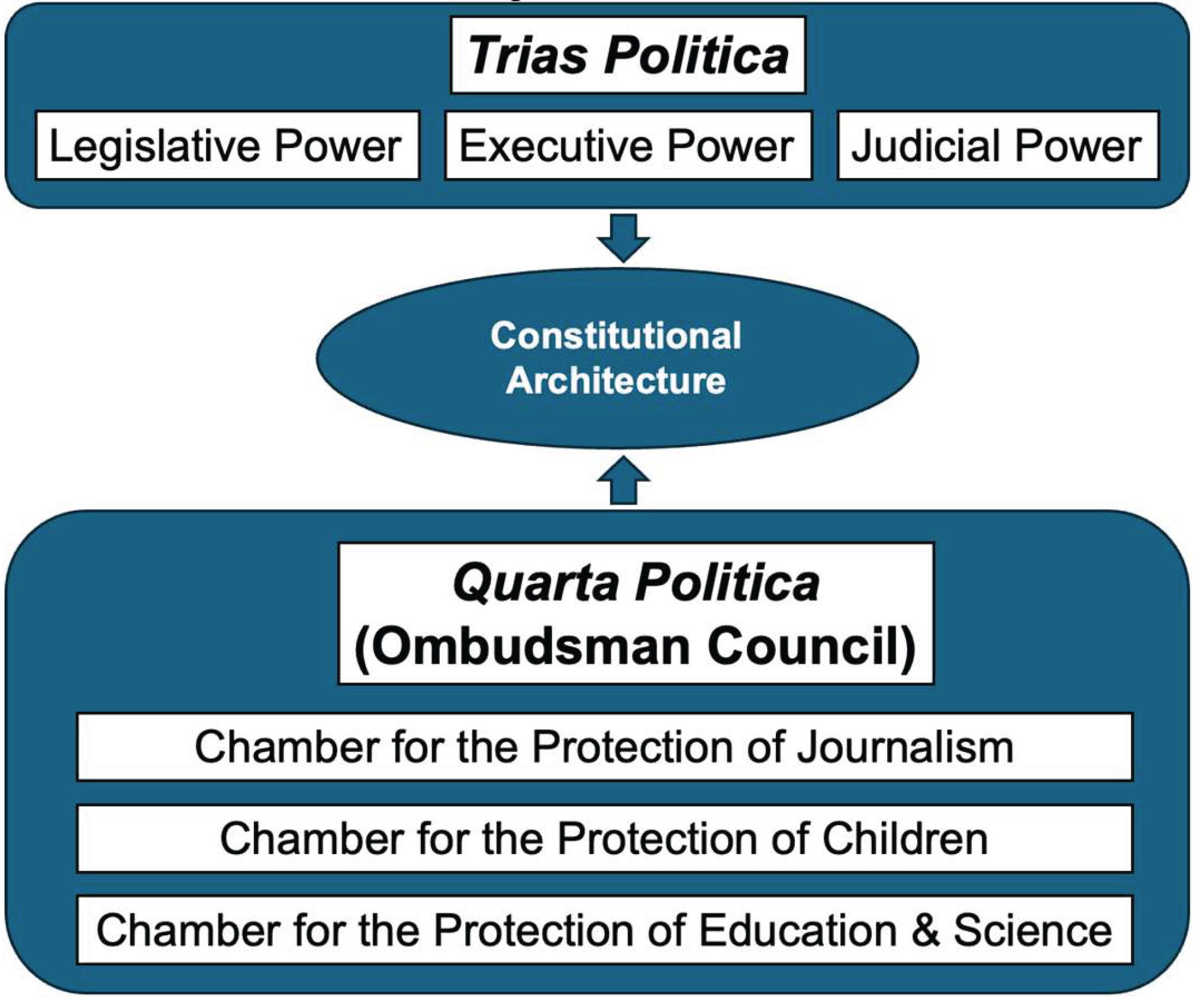
As the diagram indicates, the Quarta Politica does not displace the classical separation of powers but complements it by addressing domains of democratic vulnerability that remain structurally under-protected within the traditional constitutional framework.
Within this integrated constitutional architecture:
- the classical branches exercise coercive authority over law and policy;
- the Quarta Politica exercises coercive corrective authority over systemic distortions affecting democratic functioning;
- within it, the protection of journalism ensures that the informational environment remains visible, contestable, and reliable.
These conditions are not merely normative aspirations or expansion of power, but a rebalancing of constitutional capacity in response to evolving forms of influence, grounded in binding international legal frameworks protecting freedom of expression and access to information, including Article 19 of the United Nations’s Universal Declaration of Human Rights (1948) and the International Covenant on Civil and Political Rights (1966). Where earlier constitutionalism sought to prevent domination through institutional division, contemporary constitutionalism must also prevent informational and participatory degradation through structured intervention.
By embedding the protection of journalism within a coercively empowered Quarta Politica, constitutional design addresses a critical vulnerability of modern democracies: the gap between the exposure of systemic problems and their effective correction. It transforms visibility into enforceability, thereby strengthening the capacity of democratic systems to monitor, adapt, and sustain themselves under conditions of increasing complexity.
8. Risks and Counterarguments: Calibrating the Constitutional Protection of Journalism
To embed the protection of journalism within the Quarta Politica is to advance a demanding but carefully delimited claim: that democratic governance depends not only on the distribution of authority and the safeguarding of participation, but also on the integrity of the informational environment through which public judgment is formed. This claim extends classical constitutional reasoning beyond the control of coercive power toward the institutional conditions under which accountability becomes effective.
Such an extension inevitably invites concern. Critics warn that formal recognition may foster corporatism, entrench media elites, justify intrusive regulation, or fail to address persistent problems such as concentration, bias, and polarization. These objections are not peripheral; they identify genuine risks that must be confronted if the proposed framework is to remain normatively credible and institutionally viable. The question is therefore not whether such risks exist, but whether they can be addressed through constitutional design.
8.1. Function, Not Guild: Avoiding Corporatism and State Capture
A first concern is that constitutional recognition may privilege journalism as a professional class, insulating it from scrutiny or enabling corporatist arrangements that entrench incumbents. Historical experience with professional bodies demonstrates that institutional recognition can, under certain conditions, drift toward self-protection rather than public service (Schudson 2001).
The framework advanced here avoids this outcome by grounding protection in function rather than status. The object of constitutional concern is not a closed occupational group, but a public function: the structured production, verification, and dissemination of information necessary for democratic accountability. This distinction is decisive. Just as judicial authority is exercised by judges but constrained by procedural norms and review, the protection of journalism must be tied to adherence to publicly justifiable standards rather than professional identity alone.
If corporatism is a risk, state capture remains the more pervasive danger. Contemporary patterns of democratic erosion often proceed not through overt repression, but through the gradual co-optation of independent institutions (Levitsky and Way 2010). Media organizations—dependent on licenses, access, or economic conditions shaped by public policy—are particularly vulnerable to such pressures. Selective allocation of state advertising, regulatory harassment, or indirect political influence over ownership structures can undermine independence while maintaining formal legality (Hallin and Mancini 2004).
The constitutional response is therefore not to refrain from institutionalization, but to design it with precision. Within the Quarta Politica, a Chamber for the Protection of Journalism should be insulated from executive control through pluralistic composition, transparent appointment procedures, and clearly delimited competences. Its role is not to regulate content or confer professional privileges, but to monitor threats to independence, investigate systemic pressures, and uphold the conditions under which journalism can function.
8.2. Concentration, Bias, and Structural Distortions
A second set of objections concerns structural distortions within media systems themselves. Concentrated ownership, economic dependencies, and editorial bias may limit diversity of viewpoints and align communicative power with dominant interests. These concerns are longstanding and well documented (Curran and Seaton 2018), (Pickard 2020).
These critiques do not undermine the case for constitutional protection; rather, they underscore its necessity. If journalism performs a public function, then distortions affecting its operation become matters of constitutional concern. The appropriate response is therefore institutional, not dismissive.
Tools for addressing concentration and structural bias are already embedded within democratic practice: competition law, ownership transparency, cross-media limits, and public-interest obligations. Within the framework proposed here, these instruments acquire a clearer constitutional rationale. Safeguarding pluralism in the communicative sphere becomes analogous to safeguarding competition in economic markets or fairness in electoral systems (Baker 2006).
Bias presents a more complex challenge. Complete neutrality is neither attainable nor necessarily desirable in a pluralistic society. What distinguishes journalism is not the absence of perspective, but the presence of procedural safeguards: verification, source corroboration, editorial accountability, and correction mechanisms (Schudson 2001). These practices do not eliminate disagreement; they structure it within a framework of evidentiary discipline.
In the digital environment, these challenges are intensified by algorithmic amplification. Platform ranking systems may privilege emotionally engaging or polarizing content, thereby reshaping the visibility of information (Gillespie 2018). Journalism must operate within this environment, but its methodological commitments provide a counterweight to such distortions. At the same time, broader regulatory frameworks—particularly regarding transparency and accountability in platform governance—remain necessary to ensure that the distribution of information does not systematically disadvantage verified reporting (Zuboff 2019).
8.3. Pluralism and the Risk of Privileging Voices
A further concern is that constitutional protection may inadvertently privilege certain voices or institutional forms, thereby constraining the diversity essential to democratic life. If journalism is singled out for protection, does this risk marginalizing alternative forms of expression or reinforcing existing hierarchies within the public sphere?
This objection highlights a crucial point: democratic legitimacy depends on pluralism, not uniformity. The framework developed here does not seek to monopolize public discourse, but to safeguard the conditions under which diverse voices can engage meaningfully. Protection of journalism is justified not because it is exclusive, but because it provides structured processes—investigation, verification, and public disclosure—that enable claims to be contested on shared grounds (Habermas 1996).
The protection of journalism within the Quarta Politica therefore operates at the intersection of openness and reliability: it does not restrict participation, but reinforces the conditions under which participation can be informed and accountable.
Pluralism also requires active support. Market dynamics alone may not sustain local journalism, minority-language media, or investigative reporting in less profitable contexts. Public-interest funding mechanisms, community media initiatives, and transnational collaborations can broaden participation and counter structural imbalances (Pickard 2020). Within the Quarta Politica, the Chamber for the Protection of Journalism could play a role in identifying systemic gaps and recommending measures to enhance diversity and inclusión.
8.4. Measured Constitutional Claim
The proposal advanced in this article is intentionally bounded. It does not elevate journalism into a separate branch of government, nor does it insulate it from criticism or competition. It clarifies that democratic governance depends on institutional conditions that enable reliable information about public affairs to be produced, verified, and made accessible.
The risks identified—corporatism, capture, concentration, bias—are real. Yet they are not unique to journalism; they affect all democratic institutions. The history of constitutional development suggests that such risks are best addressed through structured safeguards rather than institutional neglect (Rosanvallon 2008).
Embedding the protection of journalism within the Quarta Politica does not eliminate communicative inequalities; it provides a framework within which they can be contested and mitigated. Empirical evidence reinforces this prudential logic: restrictions on media freedom frequently precede broader patterns of democratic decline, while independent journalism is consistently associated with greater transparency and lower levels of corruption (Brunetti and Weder 2003), (V-Dem Institute 2024).
The claim advanced here is therefore neither maximalist nor symbolic. It is a calibrated response to a structural vulnerability in contemporary democracies: the erosion of the informational conditions upon which accountability depends.
9. The Quarta Politica Beyond the West: A Comparative and Global South Perspective
The constitutional theory of the Quarta Politica must extend beyond consolidated Western democracies to avoid reproducing the asymmetries it seeks to address. Institutional stability, legal protections, and economic infrastructures characteristic of North Atlantic contexts cannot be assumed. In hybrid regimes, transitional democracies, and post-colonial states, journalism often operates under conditions that test the limits of its constitutional function.
A comparative perspective sharpens rather than dilutes the argument. The central question is not whether the Quarta Politica exists outside the West, but how its distinct components—including the protection of journalism—manifest under different political, institutional, and economic conditions.
9.1. Hybrid Regimes and the Fragility of Informational Accountability
Competitive authoritarian regimes, as described by Levitsky and Way (2010), illustrate how formal democratic institutions coexist with systematic constraints on media independence. Regulatory harassment, selective advertising allocation, ownership manipulation, and intimidation restrict journalistic autonomy while preserving the appearance of legality.
In such contexts, the constitutional function of journalism becomes especially visible in its fragility. The erosion of media freedom often precedes or accompanies the weakening of other accountability mechanisms. This pattern reinforces the central claim of this article: the informational dimension of accountability is not secondary, but foundational (V-Dem Institute 2024).
9.2. Media Systems, Post-Colonial Contexts, and Structural Asymmetries
Media-system typologies highlight variation in media–state relations, yet Global South scholarship emphasizes that historical trajectories shaped by decolonization, economic dependency, and nation-building produce distinct institutional configurations (Hallin and Mancini 2004), (Chakravartty and Roy 2013).
In many post-colonial states, journalism has served both as a vehicle of political mobilization and as a fragile mechanism of oversight. Its constitutional function must therefore be understood within broader structural asymmetries, including limited resources, political pressures, and uneven legal protections.
Global information hierarchies further complicate this picture. International news flows remain concentrated in a small number of dominant actors, while domestic investigative journalism in many regions operates under severe constraints (Thussu 2006). These asymmetries affect whose voices are heard, whose narratives circulate, and whose accountability claims gain visibility.
9.3. Digital Infrastructures and Global Inequalities
Digital platforms intensify these inequalities. Platform governance, largely designed by corporations headquartered in a small number of jurisdictions, applies standardized rules across diverse political and cultural contexts. This often results in uneven enforcement, linguistic blind spots, and insufficient responsiveness to locally specific forms of disinformation or political manipulation (Gillespie 2018).
From the perspective of the Quarta Politica, this reveals a critical tension: the informational environment is increasingly global, while institutional protections remain largely national. The protection of journalism as a constitutional function must therefore operate across, and not only within, jurisdictions.
Digital constitutionalism provides partial responses by articulating general principles—transparency, accountability, due process—but their implementation remains uneven (Celeste 2019), (De Gregorio 2022). Journalism plays a crucial role in exposing these gaps, investigating platform practices, and bringing transnational dynamics into public scrutiny.
9.4. Adaptive Function and Institutional Substitution
Comparative experience also demonstrates journalism’s resilience. Emerging forms of collaborative and transnational investigative journalism—particularly those organized through global networks—illustrate how the function can persist and adapt under adverse conditions (Graves and Konieczna 2015) (Sambrook 2018).
In contexts where formal oversight institutions are weak or compromised, journalism may partially compensate by exposing abuses and mobilizing public or international attention. This does not transform journalism into a substitute for the Quarta Politica; rather, it highlights the adaptability of its function within incomplete or uneven constitutional architectures.
Where ombudsmanic structures are underdeveloped, the informational dimension of accountability may temporarily rely more heavily on journalistic practices. This reinforces, rather than weakens, the argument for institutionalizing their protection within a more fully developed Quarta Politica framework.
9.5. Toward a Plural and Global Constitutional Perspective
A comparative lens ultimately strengthens the argument of this article. The constitutional function of journalism is not culturally specific nor dependent on any single institutional model. Wherever citizens seek to hold power accountable, the production and circulation of verified information becomes indispensable.
What varies are the conditions under which this function can be exercised: legal protections, economic resources, institutional supports, and exposure to risk. Recognizing these variations is essential to avoiding parochialism and to designing frameworks that are adaptable to different contexts.
Embedding the protection of journalism within the Quarta Politica provides a flexible but principled approach. It does not impose a uniform institutional model, but articulates a constitutional requirement: that democratic governance must secure the informational conditions under which accountability can be exercised.
In a globalized and unequal communicative environment, this requirement acquires both national and transnational dimensions. Safeguarding journalism is not only a domestic constitutional task, but part of a broader effort to sustain democratic accountability across interconnected systems of power.
10. Conclusion: Journalism, Coercive Authority, and the Informational Foundations of Democratic Governance
This article has advanced a central claim: journalism, understood as a constitutionally protected function within the Quarta Politica, constitutes a structural condition of democratic governance. Its role lies in the organized production, verification, and public dissemination of information necessary for accountability, participation, and collective judgment. In contemporary democracies, the effectiveness of political institutions depends not only on legal rules and procedural safeguards, but also on the integrity of the informational environment in which those institutions operate.
Revisiting the architecture of constitutionalism clarifies the significance of this claim. The classical doctrine of the separation of powers distributes coercive authority among legislative, executive, and judicial institutions in order to prevent domination and arbitrariness. This article has argued that such an arrangement, while necessary, is no longer sufficient. The introduction of the Quarta Politica—conceptualized as an Ombudsman Council—responds to structural deficiencies in contemporary democracies by institutionalizing participatory oversight and safeguarding the relationship between citizens and the exercise of power (Galiñanes and Klinkers 2025).
However, this reconceptualization entails a crucial implication that must be made explicit. If the Quarta Politica is to stand on the same constitutional plane as the classical branches, it cannot be reduced to a merely advisory or supervisory body. A power that lacks the capacity to act cannot meaningfully counterbalance those that possess coercive authority. Accordingly, the Quarta Politica must itself be endowed with constitutionally defined coercive powers—carefully delimited, procedurally constrained, and normatively oriented toward correction rather than domination. Its authority lies in its capacity to rectify systemic failures, enforce accountability, and ensure that democratic participation is not only formally guaranteed but substantively effective.
Within this fourfold constitutional architecture, journalism occupies a distinct yet indispensable position. It is not itself a coercive power, nor should it become one. Its constitutional relevance lies in a different dimension: it provides the informational conditions that enable all four powers to function effectively. Without reliable knowledge about the exercise of authority, coercive mechanisms cannot be properly directed, participatory oversight cannot be meaningfully exercised, and democratic legitimacy cannot be sustained.
The argument has demonstrated that journalism performs a non-substitutable function within democratic systems. It operates as an early-warning mechanism, frequently initiating processes of accountability later taken up by legislatures, courts, or the Quarta Politica itself. It sustains the epistemic infrastructure necessary for public deliberation, enabling citizens to evaluate competing claims and hold power to account. And it contributes to pluralism by ensuring that diverse perspectives can enter public debate under conditions structured by verification and evidentiary discipline.
At the same time, journalism operates under conditions of heightened structural vulnerability. Economic pressures, ownership concentration, political interference, and the transformation of the public sphere through digital platforms have weakened many of the institutional foundations that historically sustained it. These developments do not diminish journalism’s importance; they intensify the need to secure the conditions under which it can perform its function. Constitutional protection, in this sense, is not symbolic but adaptive: it reflects the evolving structure of democratic risk.
The analysis has further clarified that such protection must be carefully calibrated. It does not entail elevating journalism into a separate branch of government, nor does it justify privileging a professional class. The object of protection is a function, not a guild. Institutional design must therefore avoid corporatism, prevent state capture, and preserve pluralism while ensuring independence, sustainability, and accountability. Embedding the protection of journalism within the Quarta Politica—through a dedicated Chamber for the Protection of Journalism—provides a framework capable of reconciling these requirements while preserving editorial autonomy.
The digital transformation of the public sphere reinforces this conclusion. Public discourse is increasingly mediated by privately governed platforms whose algorithmic systems shape visibility, attention, and the circulation of information. In this environment, journalism assumes an expanded role: not only scrutinizing public authority, but also investigating the infrastructures through which communication itself is organized. The protection of journalism thus extends democratic oversight into domains that lie beyond the reach of traditional constitutional mechanisms, while the Quarta Politica provides institutional pathways through which such scrutiny can translate into corrective action.
A comparative perspective confirms the broader applicability of this framework. Across diverse political contexts—including hybrid regimes, transitional democracies, and post-colonial states—the informational dimension of accountability remains indispensable, even where institutional supports are fragile or uneven. The capacity to produce and circulate verified information persists as a necessary condition for holding power to account. Embedding its protection within the Quarta Politica offers a principled yet adaptable approach capable of accommodating variation while maintaining a clear constitutional standard.
The theoretical synthesis that emerges is therefore both structural and normative. Democratic governance depends on three interdependent dimensions: the distribution of coercive authority, the institutionalization of participatory oversight through a fourth power endowed with corrective capacity, and the integrity of the informational environment. These dimensions are distinct but mutually reinforcing. The Trias Politica constrains power; the Quarta Politica corrects and rebalances it; journalism enables both by rendering power visible, intelligible, and contestable.
The protection of journalism within the Quarta Politica addresses a fundamental vulnerability in contemporary democracies: the erosion of the conditions under which citizens can know, evaluate, and challenge the exercise of power. It does not guarantee truth, nor does it eliminate bias or manipulation. What it secures are the institutional conditions under which claims can be tested, errors corrected, and accountability activated.
Democracy ultimately depends not only on who governs or how decisions are made, but on whether the exercise of power remains subject to informed scrutiny and effective correction. A constitutional order that recognizes four powers—legislative, executive, judicial, and the Quarta Politica endowed with coercive authority—while simultaneously safeguarding the informational infrastructure that enables them to function, is better equipped to meet the challenges of contemporary governance. Securing these informational foundations is therefore not ancillary to constitutional design; it is integral to the preservation and renewal of democracy itself.
In the exercise of its functions, the Chamber shall uphold:
- freedom of expression;
- independence of journalism;
- pluralism and diversity;
- proportionality;
- protection against abuse of power.
Funding
This research received no external funding.
Conflicts of Interest
The authors declare no conflicts of interest.
Appendix A. Constitutional Design of the Chamber for the Protection of Journalism
This Appendix sets out a model constitutional provision for the establishment and functioning of the Chamber for the Protection of Journalism. It operationalizes the principles developed in Section 7 by specifying mandate, powers, composition, and safeguards, drawing on established practices in the design of independent oversight institutions.
Draft Constitutional Article: Chamber for the Protection of Journalism
1. Establishment
- A Chamber for the Protection of Journalism (hereinafter “the Chamber”) is hereby established as an organ of the Ombudsman Council within the Quarta Politica.
- The Chamber shall exercise its functions independently and in accordance with the Constitution.
2. Mandate
- 1.
- The Chamber shall safeguard the structural conditions necessary for the existence of independent, pluralistic, and reliable journalism.
- 2.
- In particular, it shall address systemic risks affecting:
- ○
- editorial independence;
- ○
- media pluralism and diversity;
- ○
- the economic sustainability of journalism;
- ○
- the integrity of the informational environment.
- 3.
- The Chamber shall not exercise any control over editorial content or interfere in the substance of journalistic expression.
3. Powers
- 1.
- For the fulfilment of its mandate, the Chamber shall have the power to:
- ○
- initiate investigations on its own motion or upon complaint;
- ○
- require the production of information from public authorities and, where necessary, private entities exercising significant influence over the public sphere;
- ○
- adopt binding decisions and corrective measures addressing systemic distortions;
- ○
- impose proportionate sanctions in cases of non-compliance;
- ○
- refer matters to competent legislative or judicial authorities.
- 2.
- All measures adopted by the Chamber shall comply with the principles of legality, necessity, and proportionality.
4. Composition
- The Chamber shall be composed of members of high competence, integrity, and independence.
- Its composition shall ensure plural representation of relevant expertise, including journalism, law, media governance, and civil society.
- Members shall act in their personal capacity and shall neither seek nor accept instructions from any authority or interest.
5. Appointment and Tenure
- 1.
- Members shall be appointed through a procedure ensuring pluralism and institutional balance, including:
- ○
- nomination by independent professional and civil society bodies;
- ○
- selection by the Ombudsman Council through transparent procedures;
- ○
- confirmation by a qualified majority of the legislature, where constitutionally required.
- 2.
- Members shall serve for a single, non-renewable term of fixed duration.
- 3.
- Terms shall be staggered to ensure continuity.
6. Independence and Incompatibilities
- 1.
- Members shall be independent of the legislative, executive, and judicial branches.
- 2.
- Membership shall be incompatible with:
- ○
- elected political office;
- ○
- executive governmental functions;
- ○
- positions creating conflicts of interest within media or platform enterprises.
- ○
- Members shall disclose all relevant financial and institutional interests.
7. Accountability and Review
- The Chamber shall adopt reasoned decisions, which shall be made public.
- Its acts shall be subject to judicial review.
- The Chamber shall submit periodic public reports on its activities.
8. Transparency and Participation
- The Chamber shall ensure transparency in its procedures.
- It shall establish mechanisms for the submission of complaints and participation by affected parties.
9. Guiding Principles
Appendix B. Comparative Institutional Models and Feasibility Framework
This Appendix situates the Chamber within the broader family of independent oversight institutions (see Table below) that exercise public authority outside direct majoritarian control. Such institutions have become central to modern governance, particularly in domains requiring technical expertise, long-term stability, and insulation from political pressure (Carpenter and Moss 2014).
| Institution Type |
Core Function |
Degree of Independence |
Coercive Powers |
Comment |
| Central Banks | Monetary stability, inflation control | Very high (often constitutionally protected) | Interest rate setting, regulatory authority | Legitimacy of non-majoritarian expert bodies with strong powers |
| Data Protection Authorities (DPAs) |
Protection of personal data and privacy rights | High (EU GDPR model especially) | Fines, binding decisions, investigations | Protect systemic conditions (data/privacy) |
| Competition Authorities |
Prevent monopolies, ensure market fairness | High | Sanctions, structural remedies, market interventions | Concentration and platform dominance regulation |
| Media Regulators (e.g., audiovisual authorities) |
Licensing, broadcasting standards | Medium to high (varies by country) | Licensing decisions, sanctions | Often content-oriented |
| Anti-Corruption Agencies | Investigate and prevent corruption | Variable (often politically contested) | Investigations, referrals, sanctions | Risks of capture without strong safeguards |
| Classical Ombudsman Institutions |
Address maladministration, protect rights | High but typically non-coercive | Recommendations (usually non-binding) | It laks coercive authority |
| Quarta Politica | Protect informational conditions of democracy | High (constitutionally embedded, multi-source legitimacy) | Binding corrective powers, systemic intervention | Systemic democratic infrastructure protection |
References
- Baker, C. Edwin. 2006. Media Concentration and Democracy: Why Ownership Matters. Cambridge: Cambridge University Press. [CrossRef]
- Benkler, Yochai. 2006. The Wealth of Networks: How Social Production Transforms Markets and Freedom. New Haven: Yale University Press.
- Benkler, Yochai, Robert Faris, and Hal Roberts. 2018. Network Propaganda: Manipulation, Disinformation, and Radicalization in American Politics. Oxford: Oxford University Press.
- Bennett, W. Lance, and Steven Livingston. 2018. The Disinformation Order: Disruptive Communication and the Decline of Democratic Institutions. European Journal of Communication 33: 122–139. [CrossRef]
- Brunetti, Aymo, and Beatrice Weder. 2003. A Free Press Is Bad News for Corruption. Journal of Public Economics 87(7–8): 1801–1824. [CrossRef]
- Bruns, Axel. 2008. Blogs, Wikipedia, Second Life, and Beyond: From Production to Produsage. New York: Peter Lang.
- Celeste, Edoardo. 2019. Digital Constitutionalism: A New Systematic Theorisation. International Review of Law, Computers & Technology 33: 76–99. [CrossRef]
- Chakravartty, Paula, and Srirupa Roy. 2013. Media Pluralism Redux. Oxford: Oxford University Press.
- Curran, James, and Jean Seaton. 2018. Power Without Responsibility: Press, Broadcasting and the Internet in Britain. 8th ed. London: Routledge. [CrossRef]
- De Gregorio, Giovanni. 2022. Digital Constitutionalism in Europe: Reframing Rights and Powers in the Algorithmic Society. Cambridge: Cambridge University Press.
- Dewey, John. 1927. The Public and Its Problems. New York: Henry Holt.
- Estlund, David. 2008. Democratic Authority: A Philosophical Framework. Princeton: Princeton University Press. [CrossRef]
- European Court of Human Rights. 1976. Handyside v. United Kingdom, Judgment of 7 December 1976. Strasbourg.
- European Court of Human Rights. 1996. Goodwin v. United Kingdom.
- European Union. 2016. General Data Protection Regulation (GDPR), Regulation (EU) 2016/679.
- Galiñanes, Manuel, and Leo Klinkers. 2025. Reimagining Checks and Balances: Establishing the Ombudsman Council as Quarta Politica in Democratic Governance. London Journal of Research in Humanities & Social Science 25: 43-51. https://journalspress.com/LJRHSS_Volume25/Reimagining-Checks-and-Balances-Establishing-the-Ombudmus-Council-as-Quarta-Politica-in-Democratic-Governance.pdf.
- Gillespie, Tarleton. 2018. Custodians of the Internet: Platforms, Content Moderation, and the Hidden Decisions That Shape Social Media. New Haven: Yale University Press.
- Graves, Lucas, and Magda Konieczna. 2015. Sharing the News: Journalistic Collaboration as Field Repair. International Journal of Communication 9: 1966–1984.
- Habermas, Jürgen. 1989. The Structural Transformation of the Public Sphere: An Inquiry into a Category of Bourgeois Society. Translated by Thomas Burger. Cambridge, MA: MIT Press. (Original work published 1962).
- Habermas, Jürgen. 1996. Between Facts and Norms: Contributions to a Discourse Theory of Law and Democracy. Translated by William Rehg. Cambridge, MA: MIT Press. (Original work published 1992).
- Hallin, Daniel C., and Paolo Mancini. 2004. Comparing Media Systems: Three Models of Media and Politics. Cambridge: Cambridge University Press. [CrossRef]
- Hamilton, Alexander, James Madison, and John Jay. [1788] 2003. The Federalist Papers. New York: Signet Classics.
- International Covenant on Civil and Political Rights (ICCPR). 1966. United Nations Treaty Series.
- Koppell, Jonathan G.S. 2010. World Rule: Accountability, Legitimacy, and the Design of Global Governance. Chicago: University of Chicago Press.
- Levitsky, Steven, and Lucan A. Way. 2010. Competitive Authoritarianism: Hybrid Regimes after the Cold War. Cambridge: Cambridge University Press. [CrossRef]
- Majone, Giandomenico. 1996. Regulating Europe. London: Routledge.
- Montesquieu, Charles de Secondat. [1748] 1989. The Spirit of the Laws. Edited by Anne M. Cohler, Basia C. Miller, and Harold S. Stone. Cambridge: Cambridge University Press.
- Newman, Nic, et al. 2024. Digital News Report 2024. Oxford: Reuters Institute for the Study of Journalism.
- Norris, Pippa, and Ronald Inglehart. 2019. Cultural Backlash: Trump, Brexit, and Authoritarian Populism. Cambridge: Cambridge University Press.
- Pasquale, Frank. 2015. The Black Box Society: The Secret Algorithms That Control Money and Information. Cambridge, MA: Harvard University Press.
- Pickard, Victor. 2020. Democracy without Journalism? Confronting the Misinformation Society. Oxford: Oxford University Press.
- Reporters Without Borders (RSF). 2024. World Press Freedom Index 2024. Paris: RSF.
- Rosanvallon, Pierre. 2008. Counter-Democracy: Politics in an Age of Distrust. Cambridge: Cambridge University Press.
- Schudson, Michael. 2001. The Objectivity Norm in American Journalism. Journalism 2: 149–170. https://doi.org/10.1177/146488490100200201.
- Sambrook, Richard. 2018. Global Teamwork: The Rise of Collaboration in Investigative Journalism. Reuters Institute for the Study of Journalism. University of Oxford, Great Britain.
- Shirky, Clay. 2008. Here Comes Everybody: The Power of Organizing Without Organizations. New York: Penguin Press.
- Sunstein, Cass R. 2001. Republic.com. Princeton: Princeton University Press.
- Sunstein, Cass R. 2017. #Republic: Divided Democracy in the Age of Social Media. Princeton: Princeton University Press.
- Suzor, Nicolas P. 2018. “Digital Constitutionalism: Using the Rule of Law to Evaluate the Legitimacy of Governance by Platforms.” Social Media + Society 4 (3). [CrossRef]
- Thatcher, Mark, and Alec Stone Sweet. 2002. Theory and Practice of Delegation to Non-Majoritarian Institutions. West European Politics 25: 1–22. [CrossRef]
- Tocqueville, Alexis de. [1835] 2000. Democracy in America. Chicago: University of Chicago Press.
- Tucker, Joshua A., et al. 2018. Social Media, Political Polarization, and Political Disinformation: A Review of the Scientific Literature. Hewlett Foundation Report.
- Thussu, Daya Kishan. 2006. International Communication: Continuity and Change. London: Arnold.
- Universal Declaration of Human Rights (UDHR). 1948. United Nations General Assembly Resolution 217 A (III).
- United Nations. 1966. International Covenant on Civil and Political Rights.
- United Nations Educational, Scientific and Cultural Organization (UNESCO). 2012. Plan of Action on the Safety of Journalists and the Issue of Impunity. Paris: UNESCO. https://www.unesco.org/en/safety-journalists/un-plan-action.
- V-Dem Institute. 2024. Democracy Report 2024: Democracy Winning and Losing at the Ballot. Gothenburg: University of Gothenburg.
- Walker, Neil. 2002. The Idea of Constitutional Pluralism. Modern Law Review 65: 317–359.
- Zuboff, Shoshana. 2019. The Age of Surveillance Capitalism: The Fight for a Human Future at the New Frontier of Power. New York: PublicAffairs.
Disclaimer/Publisher’s Note: The statements, opinions and data contained in all publications are solely those of the individual author(s) and contributor(s) and not of MDPI and/or the editor(s). MDPI and/or the editor(s) disclaim responsibility for any injury to people or property resulting from any ideas, methods, instructions or products referred to in the content. |
© 2026 by the authors. Licensee MDPI, Basel, Switzerland. This article is an open access article distributed under the terms and conditions of the Creative Commons Attribution (CC BY) license (http://creativecommons.org/licenses/by/4.0/).
Copyright: This open access article is published under a Creative Commons CC BY 4.0 license, which permit the free download, distribution, and reuse, provided that the author and preprint are cited in any reuse.


