

Submitted:
30 July 2026
Posted:
30 July 2026
You are already at the latest version
Abstract
This study presents a comprehensive first-principles investigation of the optoelectronic and thermoelectric properties of AlSb in its cubic and hexagonal phases. Structural optimization was performed using the SCAN meta-GGA functional, while the electronic and optical properties were evaluated within the modified Becke-Johnson potential combined with the Hubbard correction (mBJ+U) framework, which provides an improved description of the electronic structure and band-gap values in closer agreement with available experimental data than conventional GGA and SCAN approaches. Both AlSb phases are found to be quasi-direct band-gap semiconductors, with calculated band gaps of 1.71 eV for the cubic phase and 1.50 eV for the hexagonal phase. Additional mBJ+SOC calculations reveal a noticeable reduction of the band gap due to relativistic effects associated with Sb atoms, while preserving the overall electronic-band topology. The optical response reveals strong absorption in the visible and ultraviolet spectral regions, moderate reflectivity, and high refractive indices, indicating pronounced light-matter interaction characteristic of III-V semiconductors. Owing to its reduced symmetry and narrower band gap, the hexagonal phase exhibits enhanced absorption at lower photon energies and a red-shifted optical response compared with the cubic polymorph. Thermoelectric transport calculations demonstrate large negative Seebeck coefficients, thermally activated carrier generation, and a systematic increase in the power factor with carrier concentration for both phases. The cubic phase exhibits higher power-factor values owing to its more dispersive electronic bands and enhanced electrical transport coefficients, whereas the hexagonal phase benefits from lower thermal conductivity, which is advantageous for thermoelectric applications at elevated temperatures. These results establish AlSb as a multifunctional semiconductor with tunable optoelectronic and thermoelectric properties and provide valuable insight into the relationship between crystal structure, electronic structure, and functional performance in III-V semiconductors.
Keywords:
aluminum antimonide (AlSb)
; III-V semiconductors
; mBJ+U approximation
; quasi-direct band-gap
; optoelectronic properties
; thermoelectric performance
; thermal conductivity
; energy conversion materials
1. INTRODUCTION
The development of modern optoelectronic and thermoelectric devices depends on materials that can simultaneously maintain stable electrical transport, withstand thermal loads, and interact efficiently with light. Traditional semiconductors such as Si, GaAs, CdTe and halide perovskites have held a leading position in photovoltaic and infrared technologies for many years [1,2,3,4]. At the same time, their performance is often limited by temperature-induced degradation, chemical instability, or other practical issues that restrict their use in more demanding conditions [5,6,7,8,9,10,11,12,13,14]. These limitations have encouraged the search for compounds whose properties can be tuned more flexibly and which offer greater structural and thermal robustness. Another trend that has become increasingly important is the use of multifunctional materials that combine optical absorption, charge transport, and thermoelectric conversion within a single system. Such an approach is attractive because it reduces the number of layers in a device and simplifies fabrication while maintaining high efficiency [15,16,17]. Achieving this balance, however, requires a semiconductor with suitable band-edge dispersion, strong bonding stability and predictable phonon behaviour .
Aluminum antimonide (AlSb), a III-V compound with a moderate quasi-direct band-gap of about 1.6 eV, has drawn renewed attention for these reasons. It exhibits relatively high carrier mobility and is compatible with established epitaxial growth techniques [8,9,10], which makes it attractive for infrared optoelectronics, photovoltaic cells, radiation detection, and thermoelectric applications. Although the cubic zinc-blende phase (F-43m) is the stable form at ambient pressure, a hexagonal modification can be stabilized under epitaxial strain or in nanostructured forms [11,12,13]. Because the symmetry and bonding patterns differ in the two structures, their optical absorption, band gaps, and transport properties also differ, creating opportunities for targeted property tuning.
Previous studies have shown that the thermoelectric performance of bulk AlSb has been limited by relatively high lattice thermal conductivity and modest Seebeck coefficients [14]. Nonetheless, recent theoretical and experimental works suggest that phonon engineering, nanostructuring, and alloying can substantially enhance the thermoelectric figure of merit [15,16,17,18,19]. Furthermore, the development of first-principles methods, such as the modified Becke-Johnson (mBJ) potential and hybrid HSE06 functional, allows accurate prediction of optical transitions, carrier transport, and phonon-limited heat conduction, making it possible to reassess the intrinsic optoelectronic potential of AlSb. In compounds containing heavy p-block elements such as Sb, relativistic effects associated with spin-orbit coupling may also influence the band-edge electronic structure and optical transitions, making their assessment important for reliable prediction of optoelectronic properties.
Recent investigations of low-dimensional and pressure-modified AlSb systems have revealed a quasi-direct band gap in the range of 1.5-1.7 eV, high absorption coefficients, and strong polarizability comparable to those of other III-V semiconductors such as GaSb and InSb [23,24,25,26,27]. However, comprehensive comparative studies of the cubic and hexagonal phases, particularly addressing their optoelectronic and thermoelectric behaviour, remain limited. Understanding how crystal symmetry and electronic configuration influence photon absorption, carrier mobility, and thermal transport is essential for the rational design of AlSb-based energy-conversion materials [28,29,30]. Owing to its moderate band gap, strong light-matter interaction, and promising transport characteristics, AlSb represents an attractive candidate for multifunctional energy-related applications.
Previous first-principles studies on AlSb have mainly focused either on the electronic and optical properties of the cubic phase or on pressure-induced transitions to dense B1 (rock-salt, NaCl-type) and B2 (CsCl-type) structures, typically considering a limited subset of physical properties and a single crystal structure [1,2,13,21,24,27,29]. In addition, most thermoelectric reports treat bulk AlSb within simplified transport models or without explicitly addressing the role of phonon stability, elastic anisotropy, carrier effective masses, spin–orbit coupling effects, and phase competition between the cubic and hexagonal polymorphs. As a result, there is still no unified picture that consistently links structural, vibrational, electronic, optical and thermoelectric behaviour of AlSb in both phases.
In this work, we fill this gap by performing a comprehensive first-principles investigation of AlSb in its cubic and hexagonal phases. SCAN-relaxed geometries are combined with mBJ, mBJ+SOC, and mBJ+U electronic-structure calculations and Boltzmann transport modelling to obtain a consistent description of phase stability, electronic structure, optoelectronic behaviour, and thermoelectric performance in both polymorphs. This combined approach allows us to clarify how crystal symmetry and bonding anisotropy control the band gap, optical absorption, lattice stiffness, thermal transport, and Seebeck response under ambient condition. Compared with earlier investigations of AlSb, the present work places particular emphasis on a detailed analysis of the electronic structure, spin-orbit coupling effects, orbital-resolved density of states, optical response, carrier effective masses, and carrier-concentration-dependent thermoelectric transport properties. Special attention is given to the comparative assessment of mBJ, mBJ+SOC, and mBJ+U electronic structures and their influence on the optoelectronic characteristics of cubic and hexagonal AlSb polymorphs.
2. COMPUTATIONAL DETAILS
The optoelectronic and thermoelectric properties of cubic (F-43m) and hexagonal (P63mc) aluminum antimonide (AlSb) were investigated using density functional theory as implemented in the Vienna ab initio simulation package (VASP) [31]. The interaction between electrons and ions was described using the projector augmented-wave (PAW) method, with valence electron configurations Al: 3s23p1 and Sb: 4d105s25p3. Structural optimization of both phases was performed using the SCAN meta-GGA exchange-correlation functional [32]. Convergence tests were carried out to ensure numerical accuracy, resulting in a plane-wave cutoff energy of 700 eV and Γ-centered k-point meshes of 7×7×7 for the cubic phase and 12×12×5 for the hexagonal phase. Following full structural optimization, all optoelectronic properties were calculated using the modified Becke-Johnson potential combined with a Hubbard correction (mBJ+U) [33,34]. This approach was chosen to overcome the well-known band gap underestimation of local and semi-local functionals (LDA, GGA, SCAN). The Hubbard correction was applied to the Sb d states using U = 4 eV, following previous studies on antimony-containing semiconductors and compounds where semicore d states were shown to influence the overall electronic structure and band-gap description. The selected U value was adopted from the literature and additionally verified through comparative band-gap calculations. The inclusion of U slightly improves the agreement between the calculated and experimental band-gap values while preserving the overall electronic-band topology. Spin-orbit coupling effects were also evaluated because of the relatively large atomic number of Sb. To assess the influence of relativistic and correlation effects on the electronic structure of AlSb, additional mBJ+SOC calculations were performed and systematically compared with the mBJ and mBJ+U results. Electronic band structures, total and partial densities of states (DOS and PDOS), and optical properties, including the complex dielectric function, absorption coefficient, refractive index, reflectivity, and energy-loss function, were calculated within the linear response formalism based on the mBJ+U electronic structure. Thermoelectric transport coefficients were evaluated using the BoltzTraP2 code interfaced with Quantum ESPRESSO 7.4.1 [35]. Calculations were performed within the constant relaxation time approximation, employing a dense k-point mesh (35×35×35) to ensure convergence of transport integrals.
3. RESULTS AND DISCUSSION
Aluminum antimonide crystallizes in two structural forms: a cubic lattice (space group F-43m) and a hexagonal lattice (space group P63mc). Before analyzing its properties, convergence tests were performed to determine optimal parameters for stable energy minimization. The effects of plane-wave cutoff energy and k-point mesh density on total energy convergence were examined using Γ-centered and Monkhorst-Pack schemes. As shown in Figure S1, the total energy stabilized at about 700 eV, and further increases produced negligible changes while raising computational cost. Both sampling methods demonstrated consistent convergence, confirming the accuracy of the chosen Brillouin zone discretization and the reliability of the calculations.
For both AlSb phases, k-point optimization was carried out at ENCUT = 700 eV. The optimal meshes were 7×7×7 (Γ-centered) for the cubic and 12×12×5 for the hexagonal structure (Figure S2). These parameters were used in all electronic-structure and optical-property calculations. The Monkhorst-Pack grid provided uniform sampling for highly symmetric systems, whereas the Γ-centered mesh ensured accurate representation of states near the Γ point, which is important for lower-symmetry crystals. The difference in total energy between the two schemes was below 1 meV per atom, confirming sufficient numerical precision.
Following convergence validation, full structural optimization was performed for both phases. Equilibrium lattice constants, cell volumes, and interaxial angles were evaluated using several exchange-correlation functionals and compared with experimental data (Table S1). The PBE functional, part of the generalized gradient approximation (GGA) family, predicts the largest lattice constants, while LDA yields the smallest. PBEsol and SCAN values lie between these limits and closely match experimental results [37,38]. For example, for the cubic phase, lattice constants are a = 6.233 Å (PBE), 6.169 Å (PBEsol), 6.121 Å (LDA), and 6.172 Å (SCAN). The trend arises from intrinsic differences in the treatment of electron correlation: PBE tends to overestimate volumes, LDA underestimates them, while SCAN provides reliable predictions for both structural and energetic parameters.
To assess the relative thermodynamic stability of the cubic (F-43m) and hexagonal (P63mc) phases of AlSb, the difference in free energy (ΔF) was evaluated as a function of temperature, as shown in Figure 1. At low temperatures, the calculated free-energy difference is negative, indicating that the cubic phase is thermodynamically more stable than the hexagonal phase. This result is consistent with experimental observations, where AlSb predominantly crystallizes in the zinc-blende structure under ambient conditions. The negative value of ΔF reflects the lower total energy of the cubic phase, arising from its higher symmetry and more favorable bonding configuration. With increasing temperature, ΔF increases monotonically and approaches zero, reflecting a gradual reduction of the free-energy difference between the two phases. This behaviour originates from entropic contributions to the free energy, particularly vibrational entropy, which is enhanced in the lower-symmetry hexagonal structure. However, the free-energy curves do not intersect, and no temperature-induced thermodynamic phase transition is predicted within the investigated temperature range. At elevated temperatures, the reduced magnitude of ΔF indicates that the hexagonal phase becomes progressively more competitive in terms of thermodynamic stability, although the cubic phase remains energetically favored. This trend suggests that while the cubic structure represents the equilibrium ground state, the hexagonal phase should be regarded as a metastable modification that may be stabilized under non-equilibrium synthesis conditions, such as thin-film growth, strain engineering, or high-temperature processing.
Although the differences between the two AlSb phases are minor, they become more evident at higher temperatures, revealing distinct levels of thermodynamic stability. The calculated formation energies, -1.316 eV for the cubic and -1.258 eV for the hexagonal phase, confirm the superior thermodynamic stability of the cubic form. These findings are consistent with the thermodynamic results and provide a sound basis for further modeling, including phase diagram development and evaluation of stability in solid-state systems and heterostructures. The dynamical stability of both polymorphs was additionally confirmed by phonon-dispersion calculations (Figure S3), which show the absence of imaginary phonon modes throughout the Brillouin zone.
Beyond dynamical stability, the directional mechanical response of a crystal can provide insight into its mechanical response under external loading, particularly under external strain and anisotropic loading conditions. Therefore, the elastic anisotropy of both AlSb polymorphs was analysed based on the calculated elastic stiffness tensors (Table 1).
The elastic anisotropy of both AlSb polymorphs was further evaluated using the ELATE package based on the calculated elastic tensors. The corresponding anisotropy parameters are summarized in Table 1, while the three-dimensional directional dependence of Young’s modulus is shown in Figure 2. Both phases exhibit moderate elastic anisotropy, with Emax/Emin ratios ranging from 1.53 to 1.62 and Gmax/Gmin ratios below 1.8. The cubic phase shows slightly larger anisotropy indicators, including higher Gmax/Gmin and AU values, suggesting a stronger directional dependence of its elastic response. In contrast, the hexagonal phase exhibits a more uniform distribution of elastic stiffness, as reflected by its lower universal anisotropy index (AU = 0.22). The wider variation of Poisson’s ratio in the cubic phase (νmin = 0.04, νmax = 0.45) further confirms its stronger directional dependence of elastic deformation compared with the hexagonal polymorph.
The observed anisotropy originates from differences in crystal symmetry and bonding topology between the two polymorphs. In the cubic phase, elastic deformation is influenced by the anisotropic distribution of bond stiffness along different crystallographic directions, leading to a larger variation of Young’s and shear moduli. The hexagonal structure, despite its lower symmetry, exhibits a more balanced directional elastic response due to the more uniform distribution of elastic stiffness within the crystal framework. The relatively small AU values obtained for both structures indicate that AlSb remains mechanically close to isotropic behaviour, which is beneficial for structural reliability and resistance to mechanical failure under multidirectional loading conditions.
Additional insight into the directional elastic response is provided by the two-dimensional projections of Young’s modulus, linear compressibility, shear modulus, and Poisson’s ratio presented in Figures S4-S7 of the Supplementary Information. The nearly symmetric distributions observed for the linear compressibility confirm that both AlSb polymorphs exhibit only weak directional dependence of volumetric deformation under hydrostatic loading. In contrast, the directional Young’s and shear moduli display moderate anisotropy, particularly in the XZ and YZ planes, reflecting variations in bond stiffness associated with crystal symmetry. The Poisson’s-ratio distributions further indicate that transverse deformation remains positive in all crystallographic directions, confirming the absence of anomalous auxetic behaviour. These results support the conclusion that both AlSb polymorphs combine mechanical stability with relatively isotropic elastic behaviour, which is advantageous for device reliability under complex thermo-mechanical operating conditions.
Figure 2 provides a visual representation of the directional dependence of Young’s modulus for both AlSb polymorphs. Deviations of the elastic surfaces from an ideal spherical shape reflect the presence of elastic anisotropy. Consistent with the anisotropy parameters summarized in Table 1, both phases exhibit only moderate directional variations of the elastic response. The cubic F-43m phase displays a relatively smooth anisotropic distribution of Young’s modulus, whereas the hexagonal P63mc phase shows a more direction-dependent surface shape associated with its lower crystal symmetry. Nevertheless, the low values of the universal anisotropy index (0.41 for F-43m and 0.22 for P63mc) indicate that both polymorphs remain mechanically close to isotropic behaviour. The moderate elastic anisotropy and positive elastic moduli further support the mechanical robustness of both AlSb phases for potential optoelectronic and thermoelectric applications. The detailed two-dimensional directional projections shown in Figures S4-S7 further confirm that the observed anisotropy remains moderate and does not compromise the overall mechanical robustness of either AlSb polymorph.
Following full structural optimization, the electronic band gaps of cubic and hexagonal AlSb were calculated using the mBJ+U approach. Conventional LDA, GGA, and SCAN functionals systematically underestimate the band gap due to self-interaction errors and the incomplete treatment of exchange effects. The mBJ potential generally provides more accurate band-gap values than conventional semi-local functionals. The mBJ-based electronic structure provides an improved description of the band-edge states and yields band-gap values that are consistent with available experimental data. The band gap values were determined from the electronic band structures as the energy difference between the conduction band minimum and the valence band maximum. The total density of states (DOS) confirms the obtained gaps by exhibiting a clear energy region with zero DOS around the Fermi level. For the cubic phase, the band gap is about 1.7 eV, while for the hexagonal phase it decreases to approximately 1.5 eV. The resulting band gap values are summarized in Table 2 and compared with available experimental data.
The calculated band-gap values obtained using the mBJ, mBJ+SOC, and mBJ+U approaches are summarized in Table 2. The mBJ+U band gaps differ from the corresponding mBJ values by only 0.02-0.03 eV, indicating that the Hubbard correction mainly affects the description of localized semicore Sb states while preserving the overall electronic-band topology. The inclusion of spin-orbit coupling reduces the band gap from 1.68 to 1.56 eV for the cubic phase and from 1.48 to 1.34 eV for the hexagonal phase, indicating a noticeable contribution of relativistic effects associated with Sb atoms. The observed SOC-induced band-gap reduction is expected for Sb-containing compounds because of the relatively strong relativistic effects associated with antimony atoms. Although SOC noticeably modifies the magnitude of the band gap, the overall electronic-band topology remains essentially unchanged, indicating that the fundamental optical-transition pathways are preserved. Among the considered approaches, the mBJ+U method yields a band gap of 1.71 eV for cubic AlSb, which is in excellent agreement with the available experimental values of 1.63-1.81 eV [39,40,41]. Therefore, the mBJ+U electronic structure was adopted for the subsequent analysis of the electronic, optical, and transport properties [42,43,44,45,46,47,48,49,50,51,52,53]. The hexagonal phase exhibits a slightly narrower band gap (1.50 eV) than the cubic phase (1.71 eV). This reduction originates from the lower crystal symmetry and modified local coordination environment in the hexagonal structure. The different stacking sequence and non-equivalent atomic positions introduce small variations in Al-Sb bond lengths and bond angles, which alter the orbital hybridization and electronic-state distribution near the band edges. As a result, the conduction-band minimum shifts toward lower energies, leading to a narrower band gap compared with the cubic polymorph. A comparison of the total density of states obtained using the mBJ, mBJ+SOC, and mBJ+U approaches is presented in Figure S8. The overall DOS profiles and band-edge characteristics remain very similar for all three approaches, indicating that the fundamental electronic structure of AlSb is largely preserved. The Hubbard correction produces only minor modifications of the electronic-state distribution while slightly improving the agreement between the calculated and experimental band-gap values. Consequently, the mBJ+U results were adopted for the subsequent analysis because they provide the closest agreement with the available experimental data.
In addition to the band-gap values, the carrier effective masses provide important information about charge-transport behaviour and thermoelectric performance. Since the effective mass is directly related to the curvature of the electronic bands near the band extrema, it can be used to evaluate carrier mobility and transport efficiency. Lower effective masses generally indicate more dispersive electronic bands and higher carrier mobility, whereas larger effective masses are associated with flatter bands and enhanced density of states near the band edges. The estimated electron and hole effective masses for both AlSb polymorphs are summarized in Table 3.
As shown in Table 3, the cubic phase exhibits substantially lower electron and hole effective masses than the hexagonal phase. These results are consistent with the overall band dispersion observed near the band edges and indicate more efficient carrier transport in the cubic polymorph. The larger effective masses obtained for the hexagonal phase suggest a stronger localization of charge carriers and a higher density of electronic states near the band edges, in agreement with the DOS and PDOS analysis. The reduced electron effective mass of the cubic phase is expected to favor carrier mobility and electrical conductivity, which may contribute to the enhanced carrier-transport characteristics of the cubic phase. The effective-mass analysis provides additional support for the transport behaviour discussed in the thermoelectric section and helps explain the differences in electrical conductivity and power factor between the two AlSb polymorphs.
Next, using carefully relaxed structures obtained with the SCAN functional, we investigated the electronic properties of AlSb. The band gap widths were refined using the mBJ+U approach, while the electronic structure was analysed in detail through the calculated band structures and total density of states (Figure 3 and Figure 4), as well as the partial density of states (Figure 5). The electronic band structure and total DOS of cubic AlSb (F-43m) calculated using the mBJ+U approach are shown in Figure 3. The cubic phase exhibits a quasi-direct band-gap with well-defined band edges, consistent with the value reported in Table 2. The pronounced dispersion near the conduction-band minimum is reflected in the low electron effective mass of 0.14 m0, confirming the highly dispersive nature of the conduction-band states.
The electronic band structure and DOS of hexagonal AlSb (P63mc) are presented in Figure 4. Similar to the cubic phase, the hexagonal structure exhibits a quasi-direct band-gap; however, the gap is reduced, in agreement with Table 2. The band dispersion near the valence-band region differs from that of the cubic phase, leading to a modified distribution of electronic states close to the band edges.
Compared with the cubic phase, the hexagonal structure exhibits a modified band dispersion near the valence- and conduction-band edges, leading to a different distribution of electronic states close to the band gap. This behaviour is associated with the lower crystal symmetry and altered local coordination environment of the P63mc structure. The different stacking sequence and the presence of non-equivalent Wyckoff positions for Al and Sb atoms introduce small variations in Al-Sb bond lengths and bond angles, which modify the orbital hybridization and electronic-state distribution near the band edges. As a result, the conduction-band minimum shifts toward lower energies, leading to the observed reduction of the band gap in comparison with the cubic polymorph. This trend is also consistent with the calculated carrier effective masses (Table 3), where the hexagonal phase exhibits larger electron and hole effective masses than the cubic phase, indicating less efficient carrier transport. The inclusion of spin-orbit coupling (SOC) reduces the calculated band gap in both polymorphs, from 1.68 to 1.56 eV for the cubic phase and from 1.48 to 1.34 eV for the hexagonal phase.
Additional insight is provided by the partial density of states shown in Figure 5a. The valence band is dominated by Sb p states with a smaller contribution from Al p orbitals, while the conduction band is primarily composed of Al s states with minor Sb s character. This confirms strong s-p hybridization at the band edges, typical for III-V semiconductors. The mBJ+U approach was adopted because it provides band-gap values in closer agreement with available experimental measurements than conventional GGA and SCAN functionals, while maintaining a computational cost significantly lower than that of hybrid functionals. In addition, the U correction improves the description of localized semicore states without altering the fundamental orbital character of the band edges. The corresponding PDOS shown in Figure 5b reveals that the valence band remains dominated by Sb p states, while the conduction band is mainly formed by Al s states. Compared to the cubic phase, the hexagonal structure exhibits a higher PDOS near both the valence- and conduction-band edges. This enhancement originates from the reduced crystal symmetry and altered local coordination of Al and Sb atoms, which lead to distortions in Al-Sb bond lengths and bond angles. These distortions weaken the ideal sp3 hybridization observed in the cubic phase and result in a denser distribution of electronic states near the band edges, thereby contributing to the observed band-gap narrowing. The Sb d states are located several electronvolts below the valence-band maximum and therefore do not contribute directly to the formation of the band edges. The valence- and conduction-band extrema are primarily governed by Sb p and Al s states, respectively. To further clarify the orbital origin of the electronic states forming the valence- and conduction-band edges, the partial density of states was analyzed for both AlSb polymorphs (Figure 5).
The band-edge electronic structure is primarily governed by Sb p and Al s states. Therefore, the role of the U correction is mainly associated with improving the description of localized semicore states rather than modifying the fundamental orbital composition of the band gap. The cubic phase shows a wider band gap and lower PDOS near the band edges, consistent with its higher symmetry and stronger sp3 hybridization. In contrast, the hexagonal P6₃mc phase exhibits enhanced PDOS near the band edges and a reduced band gap, which may favor optical transitions and charge-carrier activity in lower-gap optoelectronic applications. The PDOS results are in excellent agreement with the calculated band structures shown in Figure 3 and Figure 4, confirming consistent electronic trends across both phases. The PDOS analysis indicates that the Sb semicore d states are located well below the valence-band maximum and do not directly participate in the formation of the band edges. Their influence on the electronic structure is therefore indirect and mainly associated with modifications of the effective electronic potential. This observation is consistent with the relatively small difference between the mBJ and mBJ+U band-gap values and suggests that the Hubbard correction primarily improves the description of localized semicore states while preserving the overall electronic-band structure.
To further investigate the optical response of AlSb, the frequency-dependent complex dielectric functions was calculated for the F-43m and P63mc phases using the mBJ+U electronic structure. Based on the dielectric function, key optical parameters including the absorption coefficient (α), extinction coefficient (k), energy-loss function (L), refractive index (n), and reflectivity (R) were derived. Figure 6a,b shows the real ε1(ω) and imaginary ε2(ω) parts of the dielectric function for both AlSb phases. The onset of ε2(ω) occurs at photon energies consistent with the calculated band gaps, confirming that the optical absorption is governed by direct interband transitions. The cubic phase exhibits a slightly higher peak intensity in ε2(ω), reflecting stronger optical transition probabilities associated with its higher symmetry and more delocalized electronic states. The real part ε1(ω) displays normal dispersive behaviour, with positive values at low energies and sign reversal at higher photon energies, indicating plasma resonance effects.
The dielectric spectra of both phases exhibit several pronounced maxima associated with interband transitions. Differences in peak position and intensity reflect the changes in electronic-state distribution induced by the distinct crystal symmetries and bonding environments of the two polymorphs. The extinction coefficient (Figure 7) follows the same general pattern as the absorption spectrum, reaching its maximum between 4 and 6 eV and gradually decreasing at higher photon energies, reflecting the dispersive nature of the optical response.
The absorption coefficients of both phases reach values on the order of 104 cm-1, typical of efficient light-harvesting semiconductors, confirming the potential of AlSb for thin-film photovoltaic applications (Figure 8). In the 2-12 eV range, multiple resonance peaks associated with interband transitions are evident. The energy loss function (Figure 9) displays a dominant plasmon resonance around 13 eV for both structures, corresponding to collective oscillations of conduction electrons and indicating similar plasma frequencies. Both AlSb phases demonstrate strong ultraviolet absorption and high transparency in the visible spectrum, confirming their suitability for optoelectronic and photonic devices such as photodetectors, light-emitting diodes, and solar absorbers.
Multiple peaks in the 3-7 eV range originate from interband transitions between Sb p states in the valence band and Al s/p states in the conduction band, in agreement with the PDOS analysis. The hexagonal phase shows a slightly red-shifted absorption onset and enhanced absorption in the vicinity of the absorption edge, reflecting its narrower band gap and facilitating optical transitions at lower photon energies. The extinction coefficient follows a similar trend, with pronounced maxima in the same energy range, confirming the strong dispersive optical response of both structures.
The calculated energy-loss function, shown in Figure 9, exhibits a pronounced plasmon resonance at high photon energies for both phases. This peak corresponds to collective oscillations of valence electrons and indicates similar plasma frequencies for cubic and hexagonal AlSb. The comparable plasmon energies suggest that the overall free-electron density and screening behaviour are not strongly affected by the structural phase transition. These values are comparable to those reported for other III-V semiconductors such as InSb and GaSb, reflecting the high polarizability and strong covalent bonding characteristic of the Al-Sb system. The large refractive index indicates strong light-matter interaction, which enhances optical confinement in nanoscale devices. The reflectivity spectra show moderate values of up to 60%, suggesting efficient coupling of incident light into the material without excessive surface reflection. This property is advantageous for photovoltaic and optoelectronic devices where both absorption and internal photon management are critical.
The combination of a high refractive index and strong reflectivity confirms its suitability for integration into photonic and energy-conversion systems where precise control of light propagation and reflection is essential. Furthermore, the slightly narrower band gap of the P63mc phase enhances absorption in the near-infrared spectral region, broadening its applicability for IR photodetectors, long-wavelength optoelectronic devices, and integrated photonic components. This contrast between the two phases highlights the potential of AlSb as a dual-range material capable of operating across both the visible and IR regimes.
The static optical constants summarized in Table 4 further clarify the phase-dependent optical response of AlSb. The cubic phase exhibits larger values of the real part of the dielectric constant ε1(0) = 12.21, refractive index n(0) = 3.49, and reflectivity R(0) = 0.31 compared to the hexagonal P63mc phase, which shows ε1(0) = 9.30, n(0) = 3.05, and R(0) = 0.26. These differences reflect the stronger electronic polarizability of the cubic phase, consistent with its higher crystal symmetry and more effective sp³ hybridization.
The static optical parameters summarized in Table 4 further support the phase-dependent optical behaviour of AlSb. The larger values of ε1(0), n(0), and R(0) obtained for the cubic F-43m phase indicate stronger electronic polarizability and a greater ability to confine electromagnetic radiation within the material. These characteristics are consistent with the higher symmetry of the cubic structure and its more dispersive electronic bands. In contrast, the slightly lower optical constants of the hexagonal P63mc phase are accompanied by a reduced band gap and a red-shifted absorption edge, which facilitate optical transitions at lower photon energies. The combined optical results therefore suggest that the cubic phase may be more suitable for applications requiring strong optical confinement and efficient carrier transport, whereas the hexagonal phase appears advantageous for extended spectral absorption and infrared optoelectronic applications.
The thermoelectric properties of AlSb were analyzed to determine how crystal structure and temperature affect the Seebeck coefficient, electrical conductivity, and power factor. The Seebeck coefficient, which quantifies the voltage generated by a temperature gradient, is highly sensitive to the electronic states near the Fermi level [54,55,56,57,58,59,60]. The analysis was performed using temperature- and carrier-concentration-dependent transport coefficients, allowing a direct assessment of thermopower generation, heat transport, and power conversion efficiency. The next section explores how these effects are reflected in the macroscopic thermoelectric performance of AlSb. Within the BoltzTraP2 formalism, the carrier concentration is determined from the calculated electronic structure and corresponding chemical potential, allowing direct evaluation of transport coefficients as functions of both temperature and carrier density.
Figure 10 presents the temperature dependence of the Seebeck coefficient for both AlSb phases. In the entire investigated temperature range (300-1000 K), both structures exhibit large negative Seebeck coefficients, indicating dominant n-type transport. The magnitude of the Seebeck coefficient decreases monotonically with increasing temperature, reflecting the progressive thermal activation of charge carriers and the reduction of energy-dependent asymmetry in the transport distribution function. At low temperatures, both phases show very large absolute Seebeck values (exceeding 700-800 μV/K), characteristic of intrinsic or weakly doped semiconductors. As temperature increases, the cubic phase maintains a systematically higher Seebeck coefficient compared to the hexagonal phase, which can be attributed to its wider band gap and more symmetric band-edge dispersion, resulting in a stronger energy filtering effect for charge carriers.
The temperature dependence of the carrier concentration is shown in Figure 11. In both phases, the carrier density increases rapidly with temperature, following the expected thermally activated behaviour of narrow-gap semiconductors. The cubic phase exhibits a more rapid increase in carrier concentration with temperature, which is consistent with the differences in the calculated electronic structure and density of states near the band edges. In contrast, the hexagonal phase exhibits a weaker temperature dependence of carrier concentration, consistent with its modified band-edge electronic structure.
To further clarify the intrinsic transport behaviour, the Seebeck coefficient was analyzed as a function of carrier concentration (Figure 12). In both phases, the magnitude of the Seebeck coefficient decreases with increasing carrier concentration, reflecting the transition from a low-density, energy-selective transport regime to a more metallic-like response. For a given carrier concentration, the cubic phase consistently exhibits a lower absolute Seebeck coefficient than the hexagonal phase, indicating a more delocalized electronic structure and reduced band-edge asymmetry.
The electronic thermal conductivity as a function of carrier concentration is shown in Figure 13. In both structures, thermal conductivity increases monotonically with carrier concentration, as enhanced carrier populations facilitate heat transport. However, the hexagonal phase displays systematically lower thermal conductivity across the entire concentration range. This reduction is consistent with the modified electronic structure and reduced carrier transport efficiency of the hexagonal phase.
The combined effect of Seebeck coefficient and electrical transport is reflected in the power factor, shown in Figure 14. Both AlSb phases exhibit a monotonic increase in the power factor with carrier concentration, indicating improved thermoelectric properties under moderate to high doping conditions. The cubic phase reaches substantially higher power factor values, driven by its higher carrier concentration and stronger electrical conductivity. In contrast, the hexagonal phase shows a more gradual increase, limited by reduced carrier mobility but partially compensated by its lower thermal conductivity. The observed power-factor trends are also consistent with the calculated carrier effective masses, where the lower electron effective mass of the cubic phase favors higher carrier mobility and electrical transport.
Tthe results demonstrate that the cubic phase is more favorable for applications requiring high power output and efficient charge transport, while the hexagonal phase offers advantages in regimes where reduced thermal conductivity and enhanced thermopower are critical. This complementary behaviour highlights the potential of AlSb as a phase-tunable thermoelectric material, where structural modification provides a pathway to optimize performance across different operating conditions. Notably, the observed differences in thermoelectric response between the cubic and hexagonal phases are consistent with their temperature-dependent free-energy landscape, where the gradual stabilization of the P63mc phase at elevated temperatures, as indicated by ΔF(T), correlates with its reduced thermal conductivity and enhanced thermopower-driven transport behaviour . The findings suggest that targeted structural tuning and phonon engineering in AlSb-based compounds can further optimize their high-temperature thermoelectric properties and expand their applicability in next-generation energy conversion and waste-heat recovery technologies [59,60,61,62].
CONCLUSION
A comprehensive first-principles investigation of cubic and hexagonal AlSb polymorphs was performed using SCAN structural optimization combined with mBJ+U electronic-structure calculations. Both phases were found to be direct-gap semiconductors with band gaps of 1.71 eV and 1.50 eV, respectively, in good agreement with available experimental data. The inclusion of spin-orbit coupling reduces the band gap in both phases, confirming the importance of relativistic effects associated with Sb atoms. Effective-mass analysis revealed lower electron and hole effective masses in the cubic phase, indicating more efficient carrier transport. Elastic-anisotropy calculations further showed that both polymorphs remain mechanically close to isotropic behaviour, although the cubic phase exhibits a slightly stronger directional dependence of the elastic response.
The calculated optical properties demonstrate strong absorption in the visible and ultraviolet regions, moderate reflectivity, and relatively large refractive indices, confirming the suitability of AlSb for optoelectronic applications. Owing to its reduced symmetry and narrower band gap, the hexagonal phase exhibits enhanced low-energy optical absorption and a red-shifted optical response. Thermoelectric calculations predict large negative Seebeck coefficients and favourable transport characteristics for both polymorphs, with the cubic phase exhibiting superior electrical transport properties and the hexagonal phase benefiting from lower thermal conductivity. The inclusion of spin-orbit coupling analysis, carrier effective masses, elastic anisotropy, and phonon-stability verification provides a more comprehensive understanding of AlSb polymorphs and highlights the potential of crystal-phase engineering for tailoring their optoelectronic and transport descriptors.
Supplementary Materials
The following supporting information can be downloaded at the website of this paper posted on Preprints.org.
Author Contributions
DN and AB: Investigation, Methodology, Supervision, Writing—original draft, Writing—review & editing; ShM and IR: Investigation, Conceptualization, Data curation, Visualization; Funding acquisition; SM: Formal analysis, Validation; SS: Resources, Data curation; AA and SM: Visualization, Editing assistance; MBI and KK: Methodology, Writing—review & editing. All authors have read and agreed to the published version of the manuscript.
Funding
This work was supported by the Interstate Fund for Humanitarian Cooperation of the CIS Member States through the scientific project funded by the International Nanotechnology Innovation Center of the CIS (grant no. 26-111), and by the International Science and Technology Center (grant no. TJ-0040).
Use of Artificial Intelligence
Artificial intelligence tools were used solely for language polishing, grammatical correction, and minor editorial assistance. All scientific content, data analysis, and interpretation of the results were performed exclusively by the authors. The authors carefully reviewed and verified all AI-assisted text to ensure accuracy, originality, and compliance with ethical publishing standards, including the COPE guidelines.
Conflicts of Interest
The authors declare no conflicts of interest.
References
- Mohebpour, M. A., & Tagani, M. B. (2023). First-principles study on the electronic and optical properties of AlSb monolayer. Scientific Reports, 13, 9925. [CrossRef]
- Gouasmia, W., Boudjaadar, D., Oumelaz, F., Nemiri, O., Khenata, R., Sahnoun, M., Boudali, A., Rahmouni, F., Benhouria, A., & Benhouria, M. (2025). First-principles assessment of the structural, phase transition, electronic, elastic and thermal properties of the semiconductor alloys AlSb1-xBix (x = 0, 0.25, 0.5, 0.75, 1). The European Physical Journal B, 98(10), 85. [CrossRef]
- Wei, B., Zhang, X., Li, W., Li, J., Li, Y., Gao, Q., Hong, J., Nan, C. W., & Lin, Y. H. (2025). Optical phonons on thermal conduction in advanced materials. Applied Physics Reviews, 12(1). [CrossRef]
- Yang, X., Luo, T., & Ruan, X. (2019). Stronger role of four-phonon scattering than three-phonon scattering in thermal conductivity of III-V semiconductors. Physical Review B, 100(24), 245203. [CrossRef]
- Guo, Z., Han, Z., Feng, D., Lin, G., & Ruan, X. (2024). Sampling-accelerated prediction of phonon scattering rates for converged thermal conductivity and radiative properties. npj Computational Materials, 10(1), 31. [CrossRef]
- Guo, Z., Roy Chowdhury, P., Han, Z., Sun, Y., Feng, D., Lin, G., & Ruan, X. (2023). Fast and accurate machine-learning prediction of phonon scattering rates and lattice thermal conductivity. npj Computational Materials, 9(1), 95. [CrossRef]
- Huang, Z., Wu, L., He, J., Li, W., Zhang, J., & Cai, Y. (2010). The electrical, optical properties of AlSb polycrystalline thin films deposited by magnetron co-sputtering without annealing. Chinese Physics B, 19(12), 127204. [CrossRef]
- Baumann, S., Eperon, G. E., Virtuani, A., Jeangros, Q., Kern, D. B., Barrit, D., Schall, J., Nie, W., Oreski, G., Khenkin, M., Ulbrich, C., Peibst, R., Stein, J. S., & Köntges, M. (2024). Stability and reliability of perovskite-containing solar cells and modules: Degradation mechanisms and mitigation strategies. Energy & Environmental Science, 17(20), 7566-7601. [CrossRef]
- Zhang, D., Liu, F., Yang, S., Li, H., & Wang, Y. (2022). Degradation pathways in perovskite solar cells and how to meet international standards. Communications Materials, 3(1), 58. [CrossRef]
- Shawon, A. K. M. A., Ur, S., & Kim, I.-H. (2019). Synthesis and Thermoelectric Property Elucidation of Mechanically Alloyed and Vacuum Hot Pressed Single-Phase AlSb. Journal of Electronic Materials, 48(11), 7261-7270. [CrossRef]
- Green, M. A., Dunlop, E. D., Yoshita, M., Kopidakis, N., Bothe, K., Siefer, G., Hinken, D., Rauer, M., Hohl-Ebinger, J., & Hao, X. (2024). Solar cell efficiency tables (Version 64). Progress in Photovoltaics: Research and Applications, 32(5), 425-441. [CrossRef]
- Zahn, D., Grin, Y., & Ruban, A. V. (2004). Nucleation and Growth in Pressure-Induced Phase Transitions from Molecular Dynamics Simulations: Mechanism of the Reconstructive Transformation of NaCl to the CsCl-Type Structure. Physical Review Letters, 92(25), 250201. [CrossRef]
- Bhambhani, P., Munjal, N., Sharma, G., Vyas, V. V., & Sharma, B. K. (2012, July). First-principles study of B1 to B2 phase transition in PbS. In Journal of Physics: Conference Series (Vol. 377, No. 1, p. 012068). IOP Publishing. [CrossRef]
- Sun, G., Wang, J., He, J., Zhang, Y., & Li, Z. (2023). Four-phonon and normal scattering in 2D hexagonal crystals. International Journal of Heat and Mass Transfer, 212, 124475. [CrossRef]
- Staudinger, P., Caroff, P., Dick, K. A., Persson, A. R., Lehmann, S., & Borg, B. M. (2019). Exploring the size limitations of wurtzite III-V film growth. Nano Letters, 19(12), 9151-9157. [CrossRef]
- Hjort, M., Lehmann, S., Knutsson, J., Jacobsson, D., Dick, K. A., & Thelander, C. (2014). Electronic and structural differences between wurtzite and zinc blende InAs nanowire surfaces: Experiment and Theory. ACS Nano, 8(12), 12346-12355. [CrossRef]
- Mahmud, S., Ali, M. A., Hossain, M. M., & Uddin, M. M. (2024). DFT aided prediction of phase stability, optoelectronic and thermoelectric properties of A2AuScX6 (A= Cs, Rb; X= Cl, Br, I) double perovskites for energy harvesting technology. Vacuum, 221, 112926. [CrossRef]
- Dahri, S., Jabar, A., Bahmad, L., Drissi, L. B., & Laamara, R. A. (2024). The electronic, thermodynamic, thermoelectric and optical properties of Ca(InP)2 compound: DFT study. Journal of the Korean Ceramic Society, 61(6), 1187-1197. 10.1007/s43207-024-00435-4.
- Bafekry, A., Faraji, M., Fadlallah, M. M., Jappor, H. R., Karbasizadeh, S., Ghergherehchi, M., Abdolhosseini Sarsari, I., & Abdolahzadeh Ziabari, A. (2021). Novel two-dimensional AlSb and InSb monolayers with a double-layer honeycomb structure: A first-principles study. Physical Chemistry Chemical Physics, 23(42), 18752-18759. [CrossRef]
- Zhang, H., Lu, Z., Tang, C., Ma, J., & Zhang, C. (2024). Calculation of tunable optical and electronic properties of AlSb/BAs heterostructure. Materials Science in Semiconductor Processing, 170, 107222. 10.1016/j.mssp.2024.108163.
- Patel, H. S., Dabhi, V. A., & Vora, A. M. (2025). Advanced study of the electronic and thermoelectric properties of AEMSe compounds under compression and tensile strain. Materials Advances, 6(16), 5777-5791. [CrossRef]
- Ai, P., Zhou, W., Chen, Q., Wang, Y., Liu, S., & Li, X. (2024). Low lattice thermal conductivity induced by rattling-like vibration in Zintl phase Na2CaCdSb2 compound with high ZT from two-channel model. Chemical Engineering Journal, 499, 156458. 10.1016/j.cej.2024.156458.
- Ur, S., Shawon, A. K. M. A., & Kim, I.-H. (2020). Improvement of thermoelectric properties of AlSb by incorporation of Mg as p-type dopant. Electronic Materials Letters, 16(6), 540-548. [CrossRef]
- Singh, R. K., & Singh, S. (1989). Structural phase transition and high-pressure elastic behaviour of III-V semiconductors. Physical Review B, 39(1), 671-674. [CrossRef]
- Mujica, A., & Needs, R. J. (1997). Theoretical study of the high-pressure phase stability of GaP, InP, and InAs. Physical Review B, 55(15), 9659-9672. [CrossRef]
- Moin, M., Anwar, A. W., Ahmad, M. A., Yaseen, M., Ilays, U., Nabi, S., Alhazmi, S. E., Al-Muhimeed, T. I., AlObaid, A. A., & Hassan, J. (2023). First-principle calculations to investigate structural, electronic, mechanical, optical, and thermodynamic features of promising (La, In)-doped AlSb for optoelectronic applications. Journal of Molecular Modeling, 29(7), 219. [CrossRef]
- Fang, D., & Wang, D. (2025). Electric-Field-Modulated Topological Phase Transition in AlSb/InSe Heterobilayers. physica status solidi (RRL)—Rapid Research Letters, 19(1), 2400219. [CrossRef]
- Bhogi, A., Srinivas, B., Papolu, P., Konakanchi, R., Prakash, K. J., Shareefuddin, M., & Kistaiah, P. (2024). Theoretical investigation on electronic, optical and phonon properties of compound semiconductors suitable for photovoltaic device applications. Journal of the Indian Chemical Society, 101(10), 101285. [CrossRef]
- Raufov, I., Ashurov, A., Sattorzoda, S., Najmiddinov, T., Nazriddinzoda, S., Yusupova, K., & Murodov, D. (2025). The Promise of Lead-Free Perovskites: Can they Replace Toxic Alternatives in Solar Cells and Lead the Future?. International Journal of Research and Innovation in Applied Science, 10(1), 353-377. [CrossRef]
- Okbi, F., Moussa, R., Bouzgarrou, S., Faid, F., Lakel, S. (2025). Effect of Pressure on the Structural, Electronic, and Elastic Properties of Indium-Doped AlSb Compounds. Semiconductors, 59(10), 1085-1097.
- Kresse, G., & Furthmüller, J. (1996). Efficient iterative schemes for ab initio total-energy calculations using a plane-wave basis set. Physical Review B, 54(16), 11169-11186. [CrossRef]
- Sun, J., Ruzsinszky, A., Perdew, J. P. (2015). Strongly constrained and appropriately normed semilocal density functional. Physical review letters, 115(3), 036402. [CrossRef]
- Tran, F., Blaha, P. (2009). Accurate band gaps of semiconductors and insulators with a semilocal exchange-correlation potential. Physical review letters, 102(22), 226401. [CrossRef]
- Dudarev, S. L., Botton, G. A., Savrasov, S. Y., Humphreys, C. J., & Sutton, A. P. (1998). Electron-energy-loss spectra and the structural stability of nickel oxide: An LSDA+U study. Physical Review B, 57(3), 1505-1509. [CrossRef]
- Giannozzi, P., Andreussi, O., Brumme, T., Bunau, O., Buongiorno Nardelli, M., Calandra, M., et al. (2017). Advanced capabilities for materials modelling with Quantum ESPRESSO. Journal of Physics: Condensed Matter, 29(46), 465901. [CrossRef]
- Nilsen, T. A., Patra, S. K., Breivik, M., & Fimland, B. O. (2011). Thermal dependence of the lattice constant and the Poisson ratio of AlSb above room temperature. Journal of crystal growth, 336(1), 29-31. [CrossRef]
- Nakano, K., Sakai, T. (2018). Assessing the performance of the Tran-Blaha modified Becke-Johnson exchange potential for optical constants of semiconductors in the ultraviolet-visible light region. Journal of Applied Physics, 123(1), 015104. [CrossRef]
- Tang, P., Li, B., Feng, L., Wu, L., Zhang, J., Li, W., Zeng, G., Wang, W., & Liu, C. (2017). Structural, electrical and optical properties of AlSb thin films deposited by pulsed laser deposition. Journal of Alloys and Compounds, 692, 22-25. [CrossRef]
- Becla, P., & Witt, A. F. (1995). AlSb photonic detectors for gamma-ray spectroscopy. Progress report, October 1994-August 1995. Massachusetts Institute of Technology.
- Tang, P., Li, B., Feng, L., Wu, L., Zhang, J., Li, W., Zeng, G., Wang, W., & Liu, C. (2017). Structural, electrical and optical properties of AlSb thin films deposited by pulsed laser deposition. Journal of Alloys and Compounds, 692, 22-25. [CrossRef]
- Doroshkevich, A. S., Nabiev, A. A., Pawlukojć, A., Doroshkevich, N. V., Rahmonov, K. R., Khamzin, E. K., ... & Ibrahim, M. A. (2019). Frequency modulation of the Raman spectrum at the interface DNA-ZrO 2 nanoparticles. Egyptian Journal of Chemistry, 62(2), 13-20.
- Khan, N. U., Ullah, K., Iqbal, J., Ullah, H., & Rehman, A. (2025). DFT-based study of Na2AgAlX6 (X= Cl, Br) halide double perovskites: insights from PBEsol, TB-mBJ, and HSE06 calculations for photovoltaic and photocatalytic applications. Physica Scripta, 100(5), 055946. 10.1088/1402-4896/adc846.
- Bouferrache, K., Habila, M. A., Ghebouli, M. A., Alomairy, S., Alanazi, F. K., Fatmi, M., & Ghebouli, B. (2025). Ferromagnetic and half metallic properties of BaFeO3 and CaFeO3 for spintronic applications. Scientific Reports, 15(1), 37093. [CrossRef]
- Mishra, K. K., Shukla, S., & Sharma, R. (2025). Unveiling structural, mechanical, electronic, and optical properties of Ba3AsCl3 perovskite: a novel multi-functional DFT study. Physica Scripta, 100(8), 085921. 10.1088/1402-4896/adee54.
- Pela, R. R., Hsiao, C. L., Hultman, L., Birch, J., & Gueorguiev, G. K. (2024). Electronic and optical properties of core-shell InAlN nanorods: a comparative study via LDA, LDA-1/2, mBJ, HSE06, G0W0 and BSE methods. Physical Chemistry Chemical Physics, 26(9), 7504-7514. [CrossRef]
- Mahmood, Q. (2025). Study of Influence of Electron Spin on Half Metallic Ferromagnetism and Thermoelectric Behaviour of X2TiMoO6 (X= Mg, Ca, Sr, Ba) for Spintronic Applications. Journal of Inorganic and Organometallic Polymers and Materials. Advance online publication. 10.1007/s10904-025-03996-x.
- Huang, J., & Kang, J. (2024). Cation disorder in MgSnN2 and its effects on the electronic properties. Physical Review Materials, 8(7), 074604. [CrossRef]
- Patel, H. S., Dabhi, V. A., & Vora, A. M. (2024). Advancing thermoelectric potential: strontium telluride under compression strain analyzed with HSE hybrid functional and Wannier interpolation. Scientific Reports, 14(1), 20700. [CrossRef]
- Sharov, V., Pavlov, A., Eliseyev, I., Moskalev, M., Komarov, S., Novikova, K., & Mukhin, I. (2025). Nanoscale Welding and Strain-Engineered Photoluminescence of GaN Nanowires. Advanced Optical Materials, e01821. [CrossRef]
- Nematov, D. (2023). Molecular and dissociative adsorption of H2O on ZrO2/YSZ surfaces. International Journal of Innovative Science and Modern Engineering, 11(10), 1-7. [CrossRef]
- Dilshod, N. ., Kholmirzo, K. ., Aliona, S. ., Kahramon, F. ., Viktoriya, G. ., & Tamerlan, K. . (2022). On the Optical Properties of the Cu2ZnSn[S1−xSex]4 System in the IR Range. Trends in Sciences, 20(2), 4058. [CrossRef]
- Nematov, D. D., Burkhonzoda, A. S., Kurboniyon, M. S., Zafari, U., Kholmurodov, K. T., Brik, M. G., Yamamoto, T., Shokir, F. (2025). The Effect of Phase Changes on Optoelectronic Properties of Lead-Free CsSnI3 Perovskites. Journal of Electronic Materials, 54(3), 1634-1644. [CrossRef]
- Gouveia, J. D., Galvão, T. L., Iben Nassar, K., & Gomes, J. R. (2025). First-principles and machine-learning approaches for interpreting and predicting the properties of MXenes. npj 2D Materials and Applications, 9(1), 8. 10.1038/s41699-025-00529-5.
- Saeed, M., Khan, R., Abualnaja, K. M., Ali, A. M., Batool, K., & Murtaza, G. (2025). Electronic Profiles, Optical Absorption, and High Thermoelectric Performance of XCu3GeSe4 (X= K, Rb, Cs): A Computational Approach. International Journal of Energy Research, 2025(1), 2992478. [CrossRef]
- Nizomov, Z., Sodatdinov, S., Saidzoda, R. K., (2024). Influence of the Height Value of Cylindrical Specimens of Copper Grade M3 on the Kinetics of Their Cooling and Heat Transfer Processes. Engineering Science & Technology, 316-325. [CrossRef]
- Nizomov, Z., Sodatdinov, S., Saidzoda, R., (2024). Analysis of Thermal Isotropy of Parallelepiped Shape of Bronze Samples for Mechanical Engineering Applications. J Mod Ind Manuf, 3(9). 10.53964/jmim.2024009.
- Dilshod, N. (2022). DFT calculations of the main optical constants of the Cu2ZnSnSexS4-x system as high-efficiency potential candidates for solar cells. International Journal of Applied, 11(4), 287-293.
- Makhsudov, B., & Yarov, M. (2024). Combined X-ray Diffraction Analysis and Quantum Chemical Interpretation of the Effect of Thermal Neutrons on the Geometry and Electronic Properties of CdTe. J Mod Nanotechnol, 4(4), 2.
- Yuan, T., Liu, G., & Zhang, G. (2025). First-principles study on the influence of tensile deformation on the optoelectronic properties of the F-HfSe2 system. Journal of Molecular Modeling, 31(10), 319. 10.1007/s00894-025-06504-7.
- Marzegalli, A., Montalenti, F., & Scalise, E. (2024). Polytypic quantum wells in Si and Ge: impact of 2D hexagonal inclusions on electronic band structure. Nanoscale Horizons, 9(12), 2320-2325. [CrossRef]
- Nematov, D. D., Kholmurodov, K. T., Stanchik, A. V., Fayzullaev, K., Gnatovskaya, V., & Kudzoev, T. (2023). A DFT study of structure, electronic and optical properties of Se-doped kesterite Cu2ZnSnS4 (CZTSSe). Letters in Applied NanoBioScience, 12(3), 67. [CrossRef]
- Uglah, A. M., Saleem, K. B., Sultan, H. S., Maatki, C., Almeshaal, M. A., Selimefendigil, F., & Kolsi, L. (2025). Numerical Investigation on Optimizing the Couple Geometry of a Thermoelectric Generator Under Various Thermal Conditions. Case Studies in Thermal Engineering, 107191. [CrossRef]
Figure 1.
Temperature dependence of the free-energy difference between cubic and hexagonal phases of AlSb.
Figure 1.
Temperature dependence of the free-energy difference between cubic and hexagonal phases of AlSb.
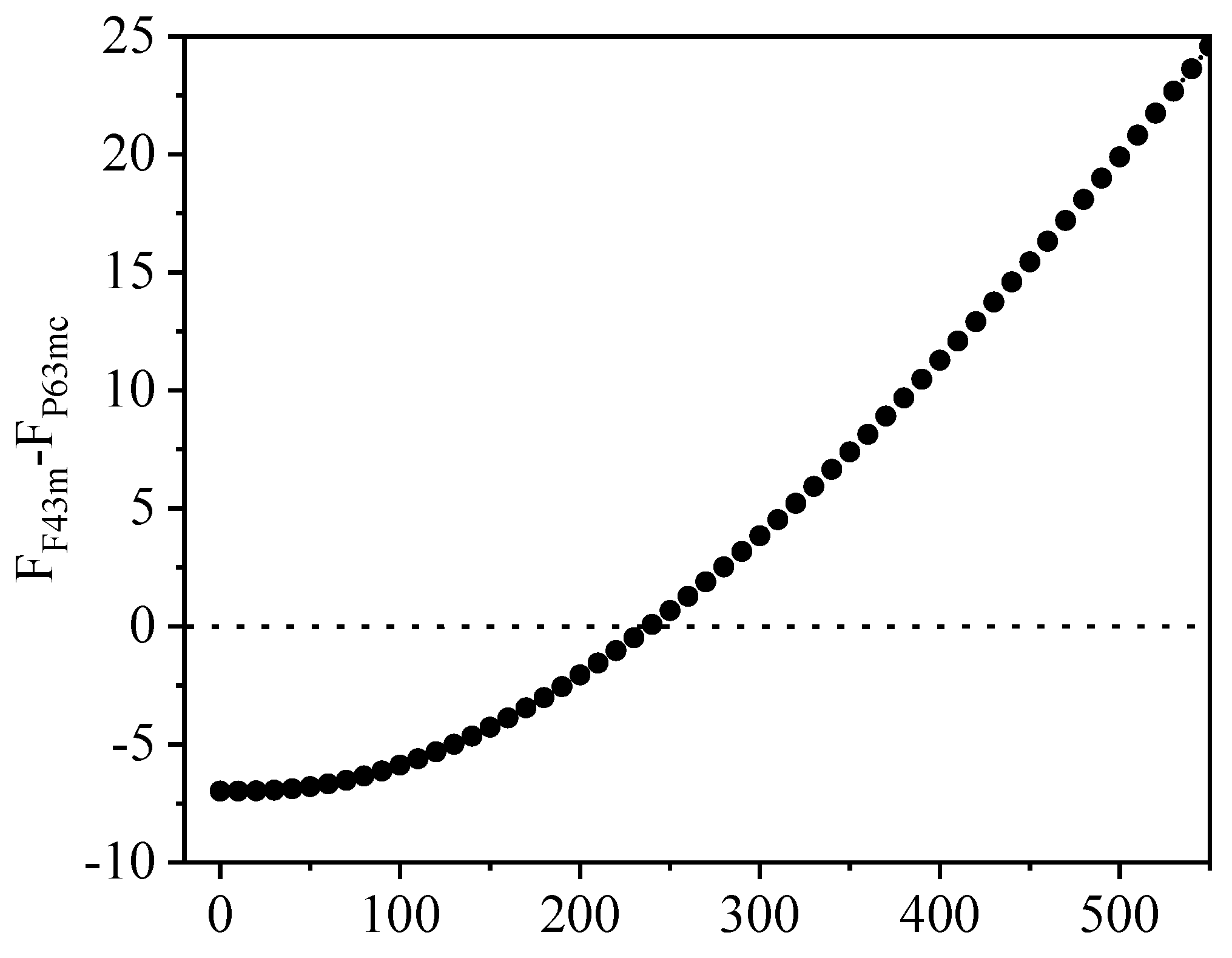
Figure 2.
Three-dimensional directional dependence of Young’s modulus for (a) cubic F-43m and (b) hexagonal P63mc AlSb, illustrating the elastic anisotropy associated with different crystal symmetries.
Figure 2.
Three-dimensional directional dependence of Young’s modulus for (a) cubic F-43m and (b) hexagonal P63mc AlSb, illustrating the elastic anisotropy associated with different crystal symmetries.
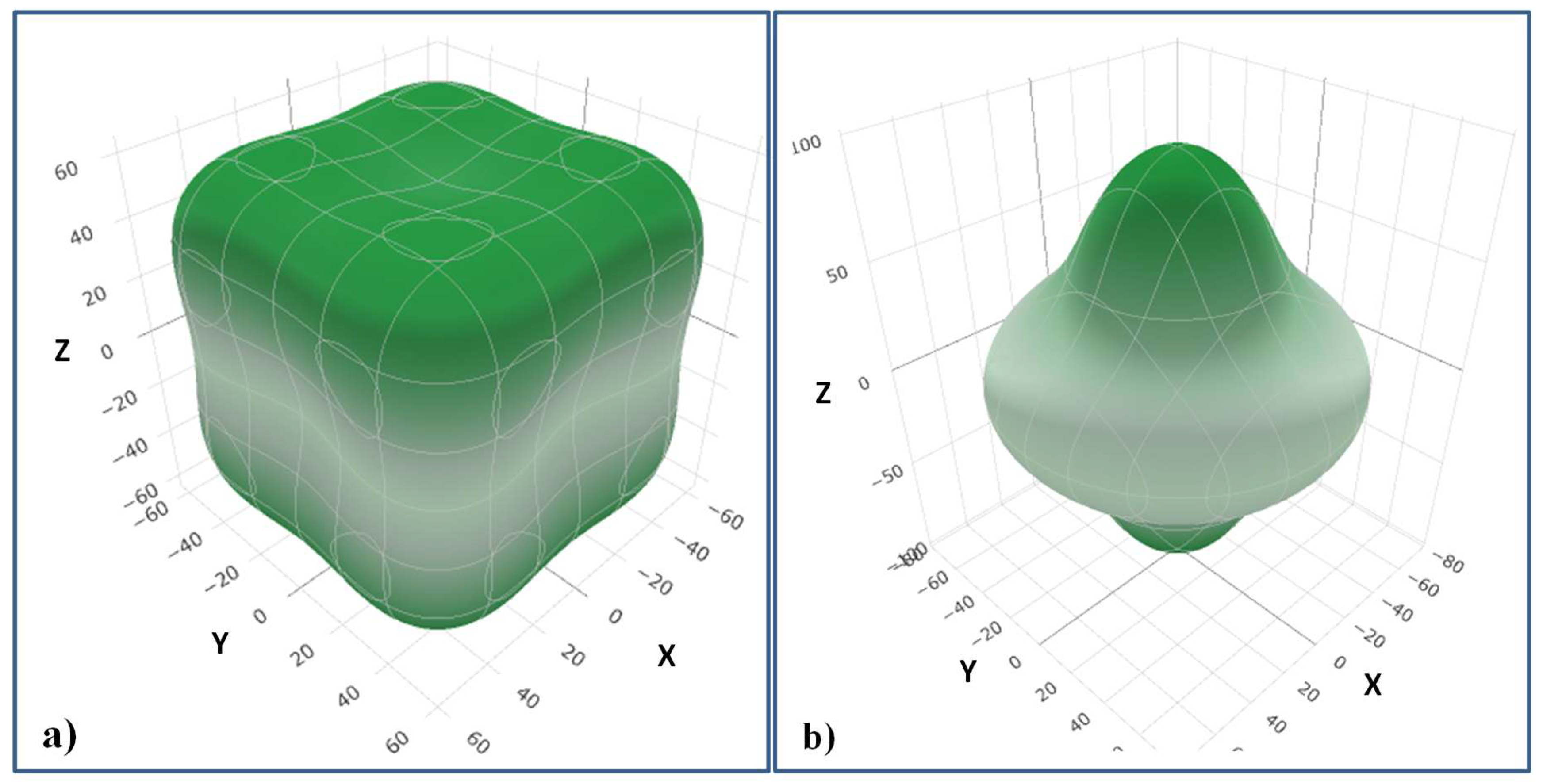
Figure 3.
Electronic band structure and total density of states (DOS) of cubic AlSb (F-43m) calculated using the mBJ+U method.
Figure 3.
Electronic band structure and total density of states (DOS) of cubic AlSb (F-43m) calculated using the mBJ+U method.
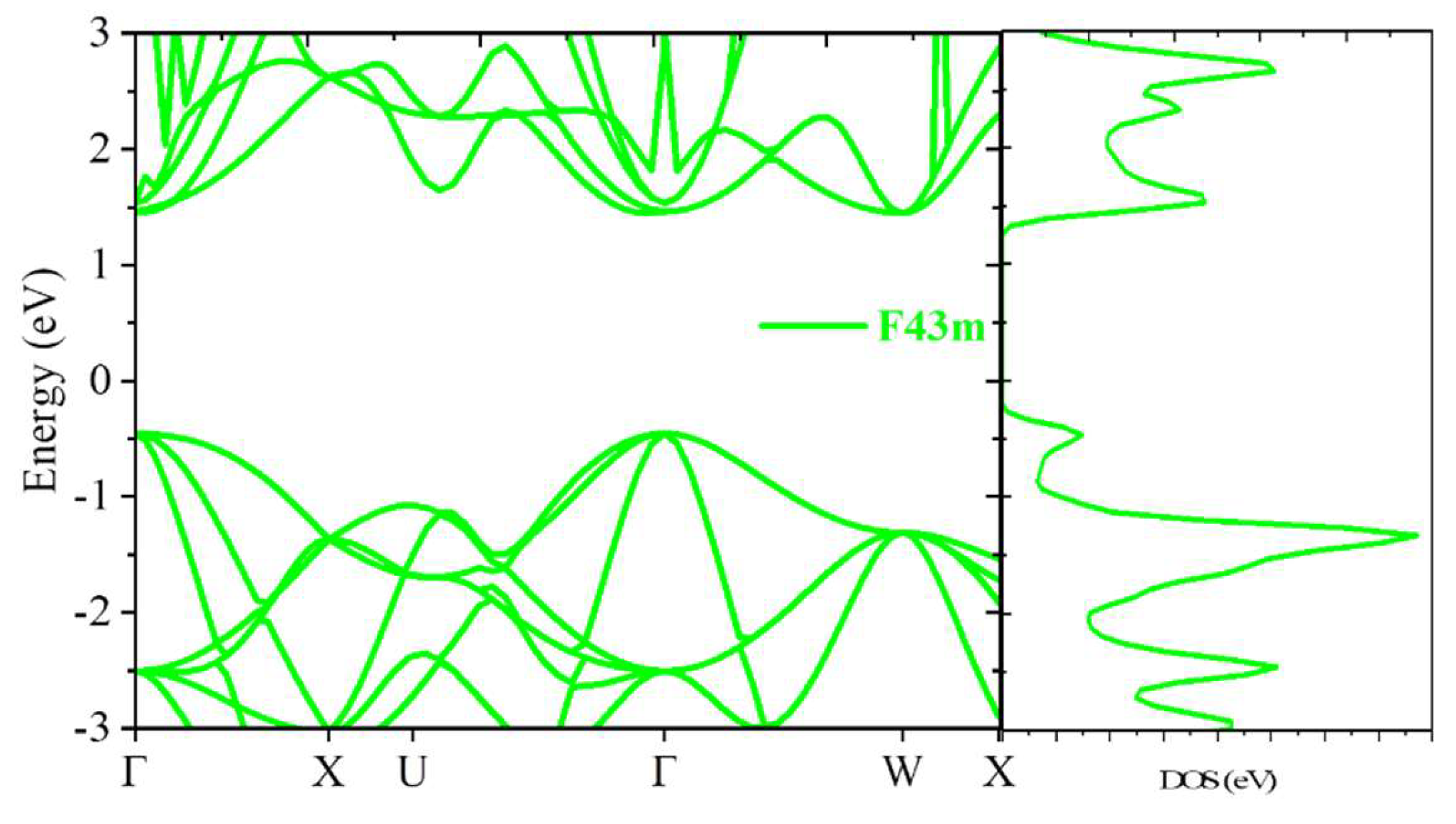
Figure 4.
Electronic band structure and total density of states (DOS) of hexagonal AlSb (P63mc) calculated using the mBJ+U method.
Figure 4.
Electronic band structure and total density of states (DOS) of hexagonal AlSb (P63mc) calculated using the mBJ+U method.
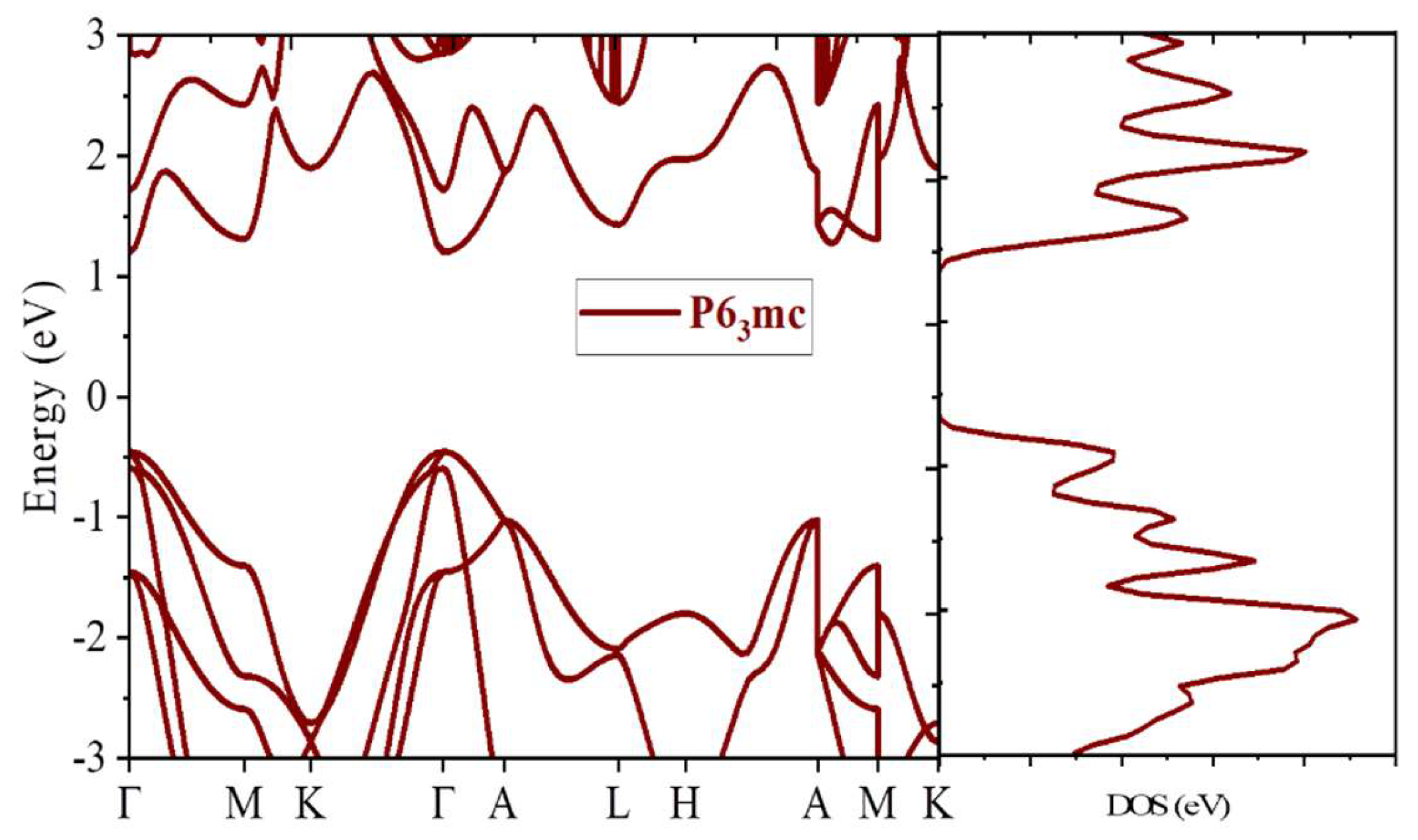
Figure 5.
Partial density of states (PDOS) of AlSb calculated using the mBJ+U method: (a) cubic phase and (b) hexagonal phase, showing the orbital contributions of Al (s, p) and Sb (s, p, d) states.
Figure 5.
Partial density of states (PDOS) of AlSb calculated using the mBJ+U method: (a) cubic phase and (b) hexagonal phase, showing the orbital contributions of Al (s, p) and Sb (s, p, d) states.
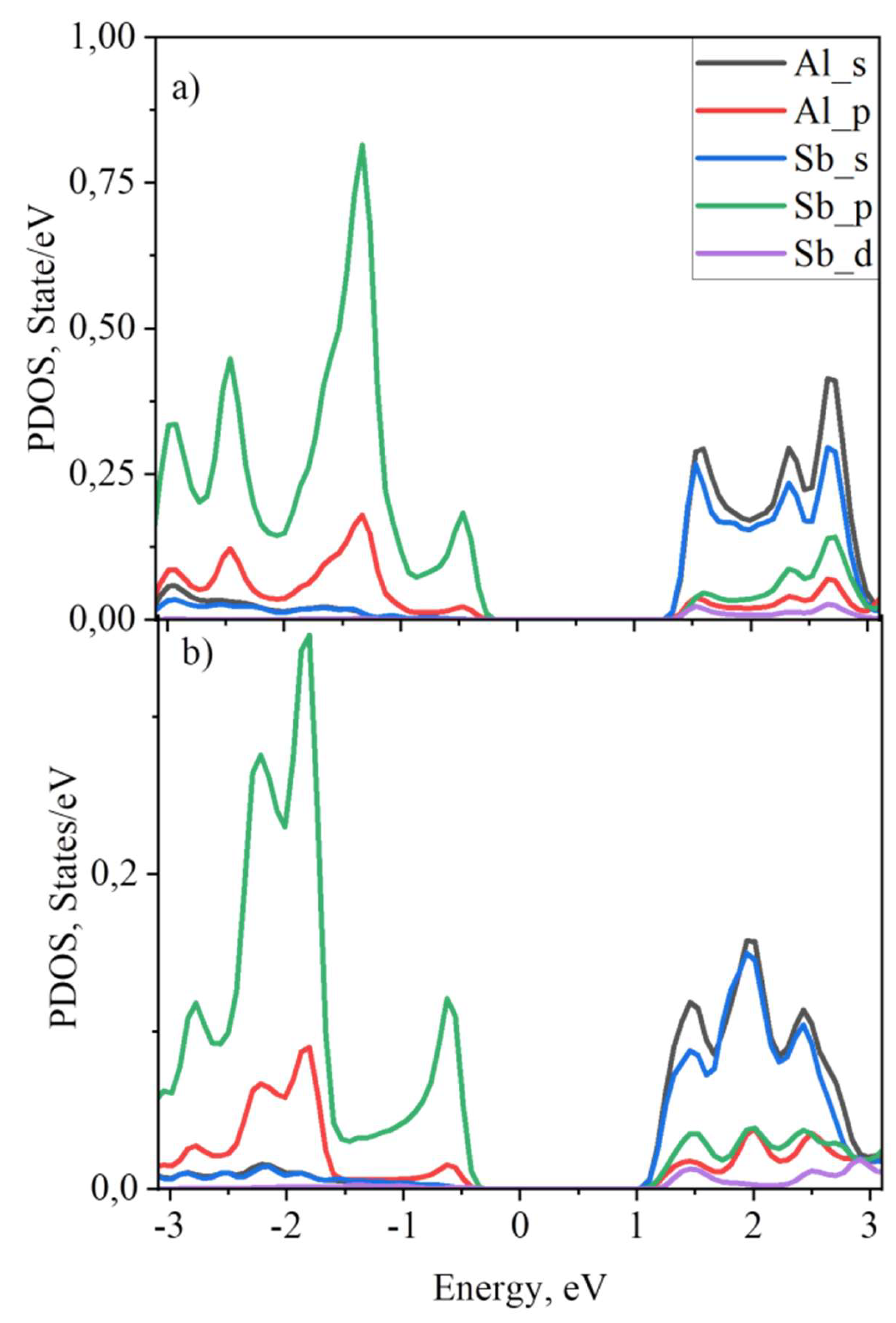
Figure 6.
Real (a) and imaginary (b) parts of the dielectric function of F-43m and P63mc phases AlSb calculated using the mBJ+U method.
Figure 6.
Real (a) and imaginary (b) parts of the dielectric function of F-43m and P63mc phases AlSb calculated using the mBJ+U method.
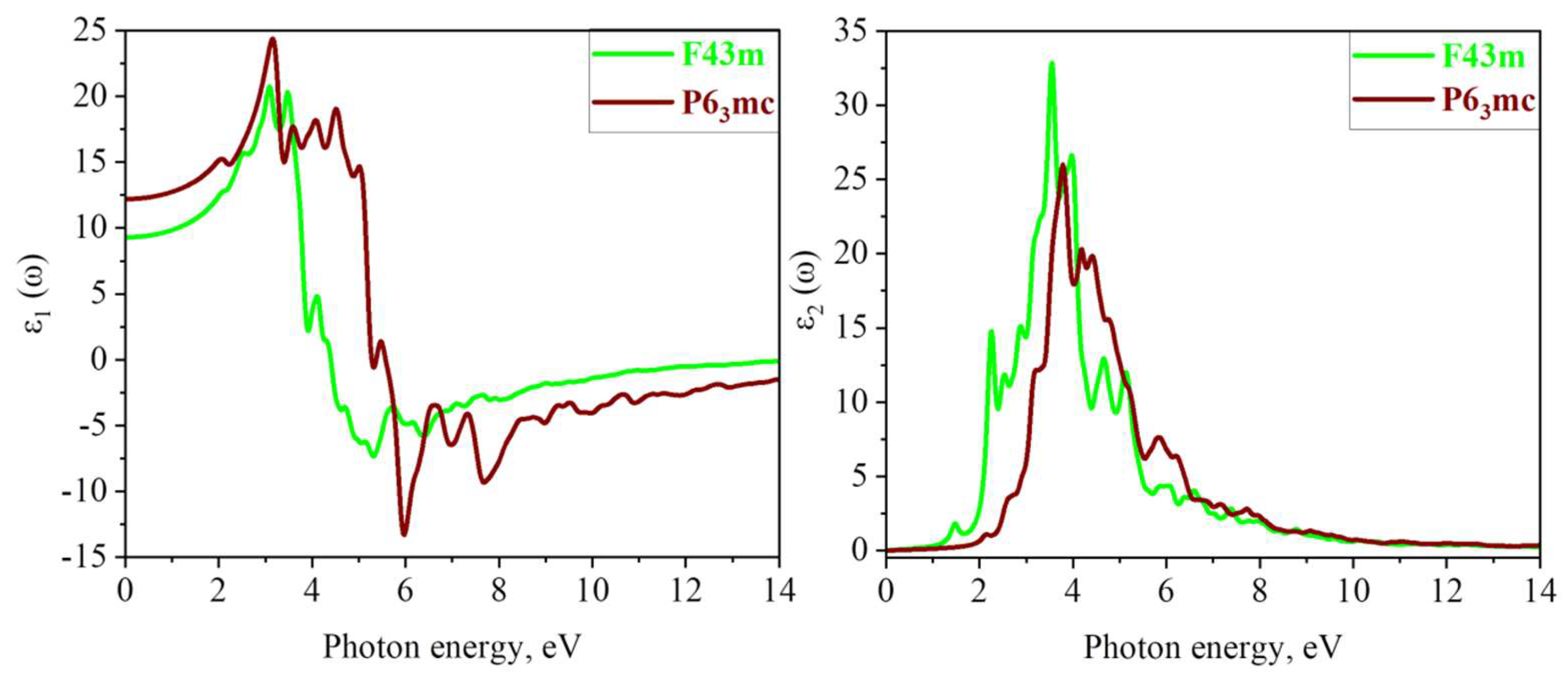
Figure 7.
Energy-dependent extinction coefficient of cubic and hexagonal AlSb calculated using the mBJ+U method.
Figure 7.
Energy-dependent extinction coefficient of cubic and hexagonal AlSb calculated using the mBJ+U method.
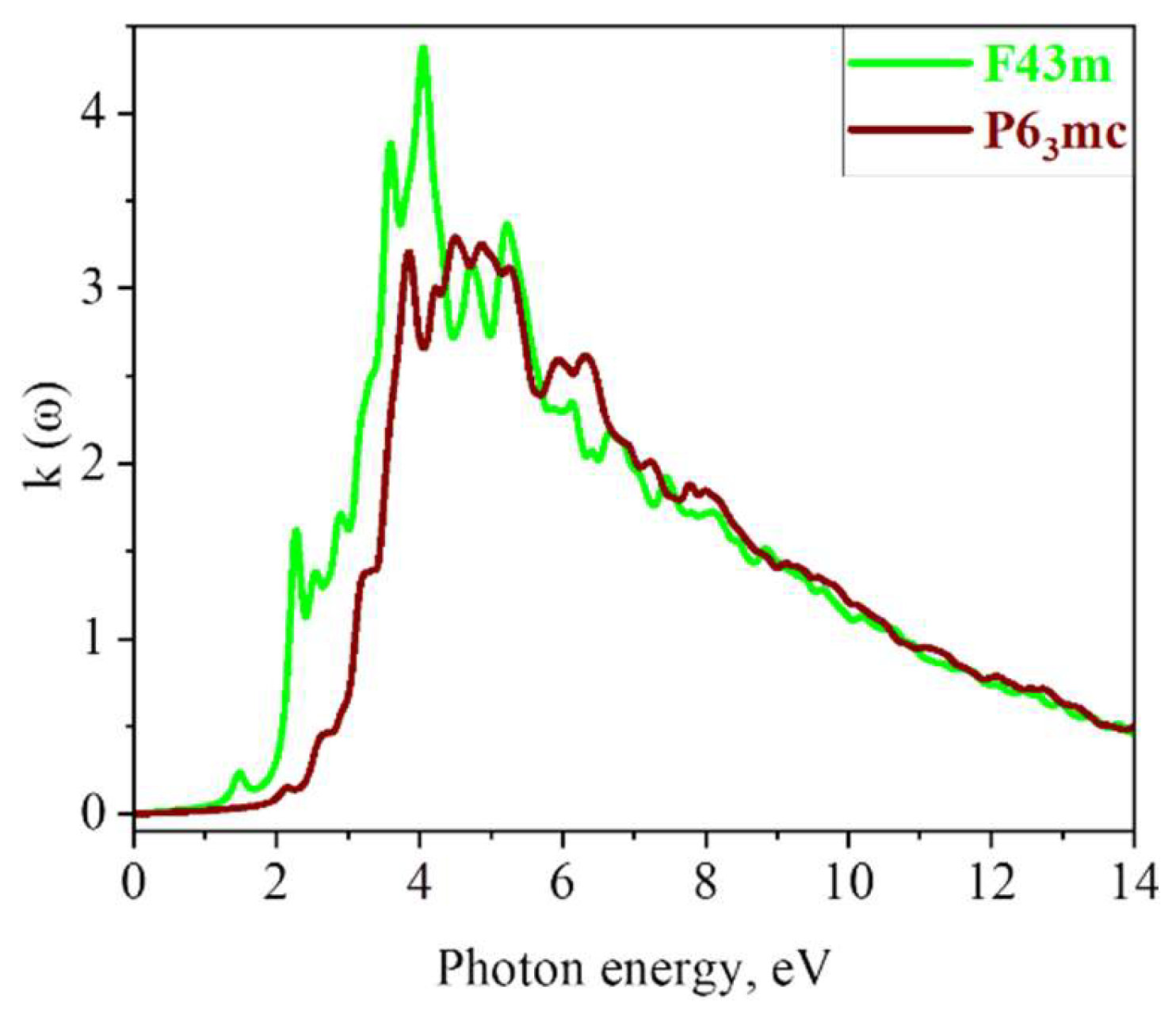
Figure 8.
Energy-dependent absorption coefficient of cubic and hexagonal AlSb calculated using the mBJ+U method.
Figure 8.
Energy-dependent absorption coefficient of cubic and hexagonal AlSb calculated using the mBJ+U method.
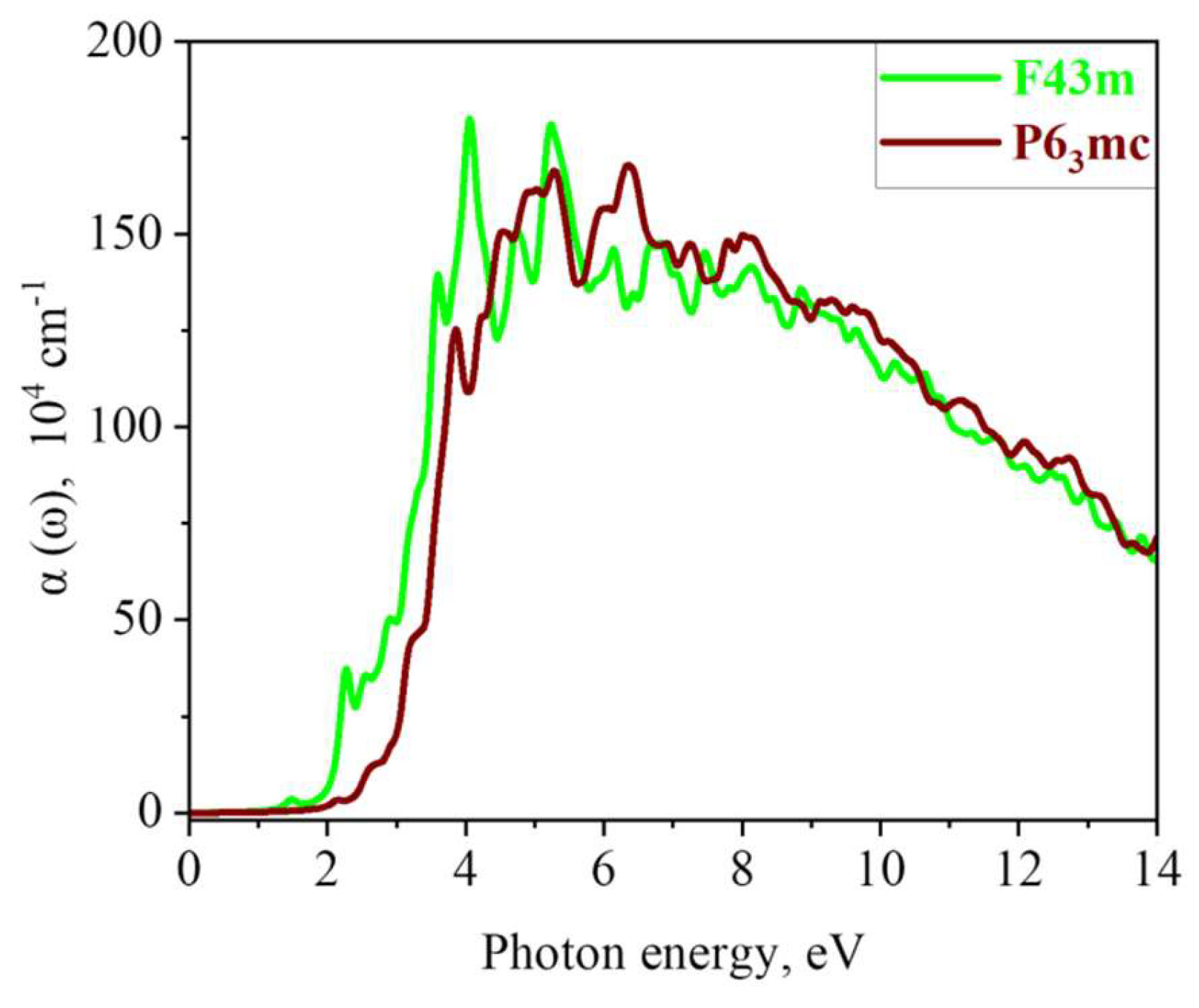
Figure 9.
Energy-loss function of cubic and hexagonal AlSb, illustrating plasmon resonance behaviour .
Figure 9.
Energy-loss function of cubic and hexagonal AlSb, illustrating plasmon resonance behaviour .
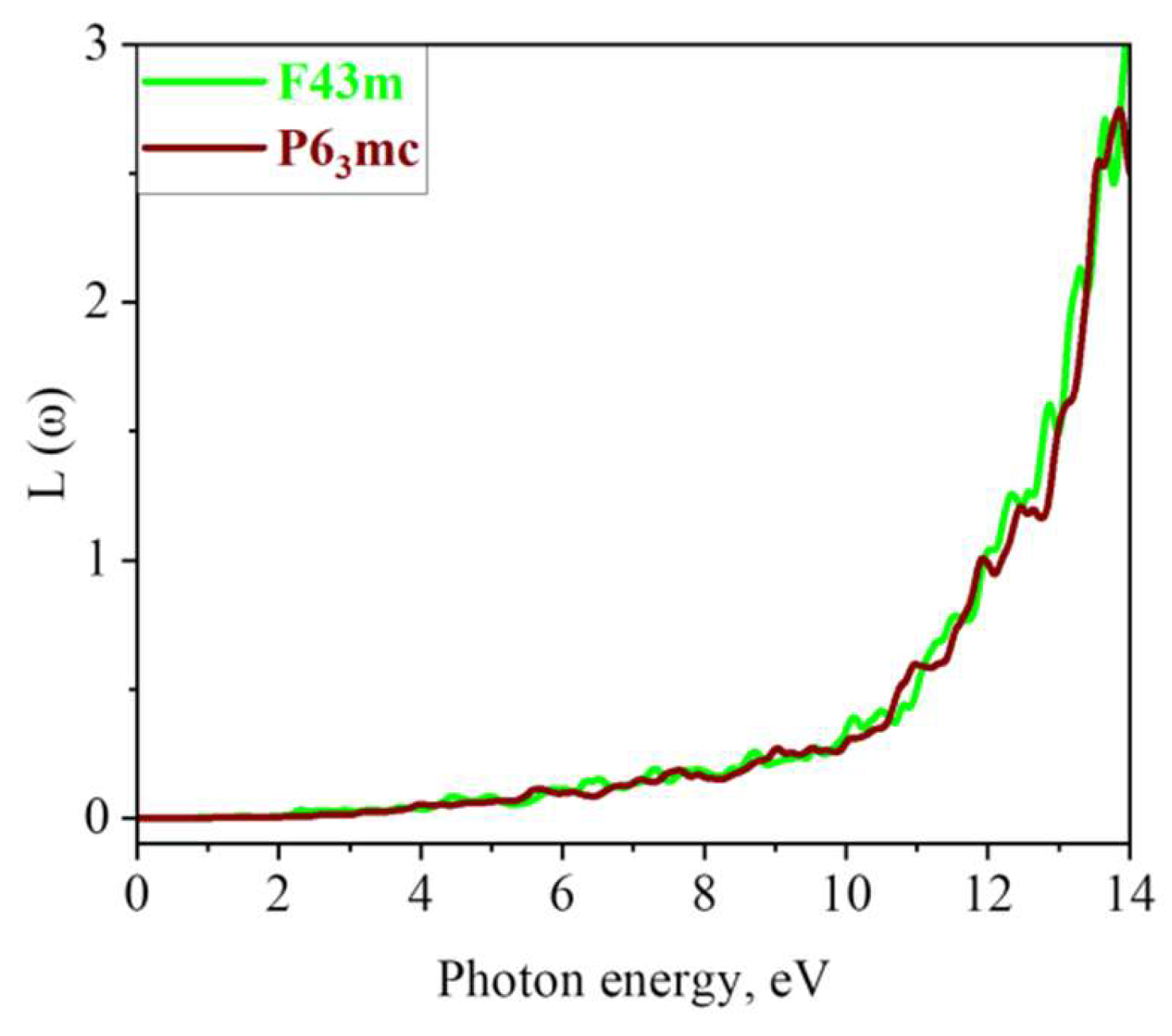
Figure 10.
Temperature dependence of the Seebeck coefficient for cubic and hexagonal AlSb.
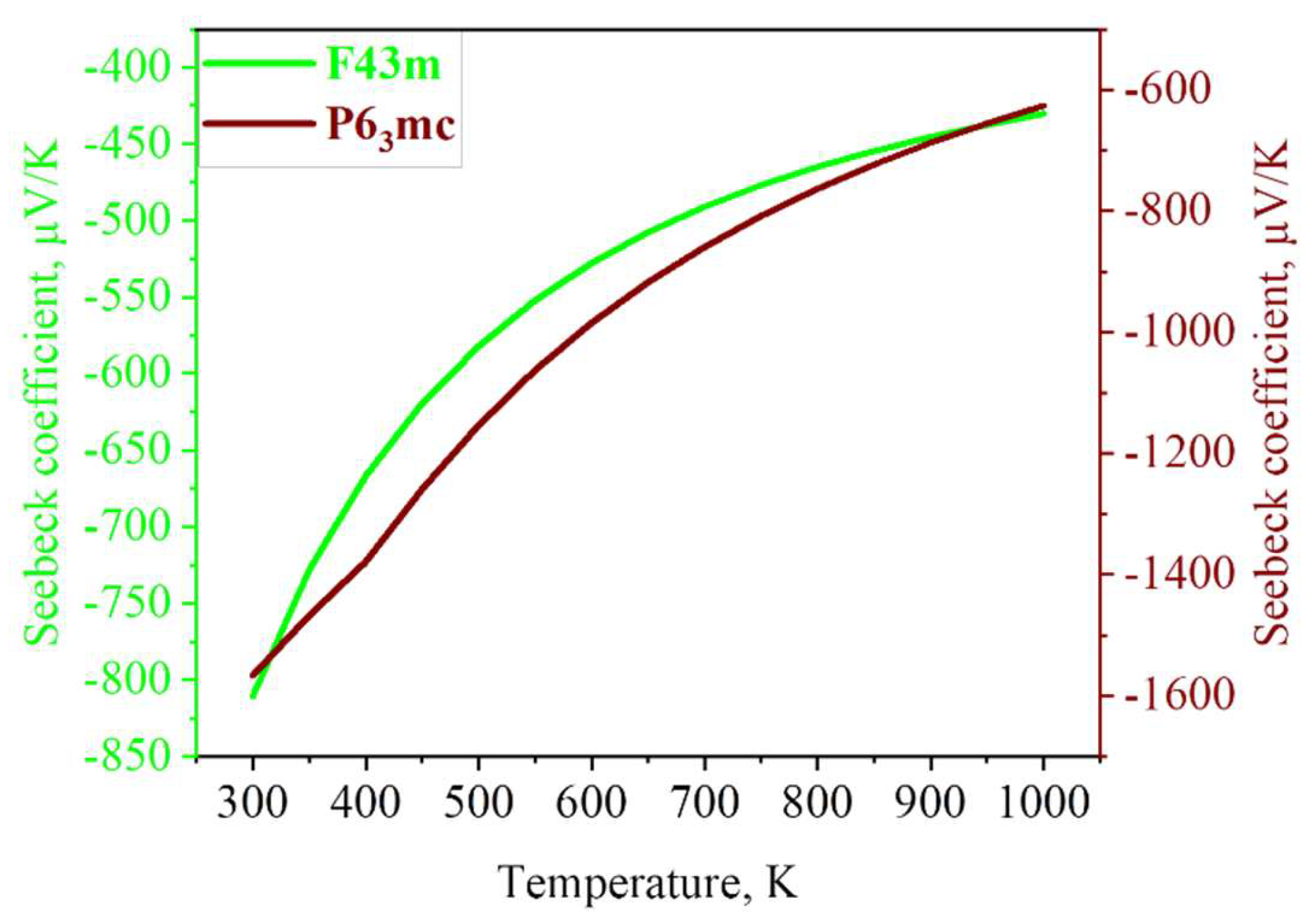
Figure 11.
Temperature dependence of the carrier concentration for cubic and hexagonal AlSb.
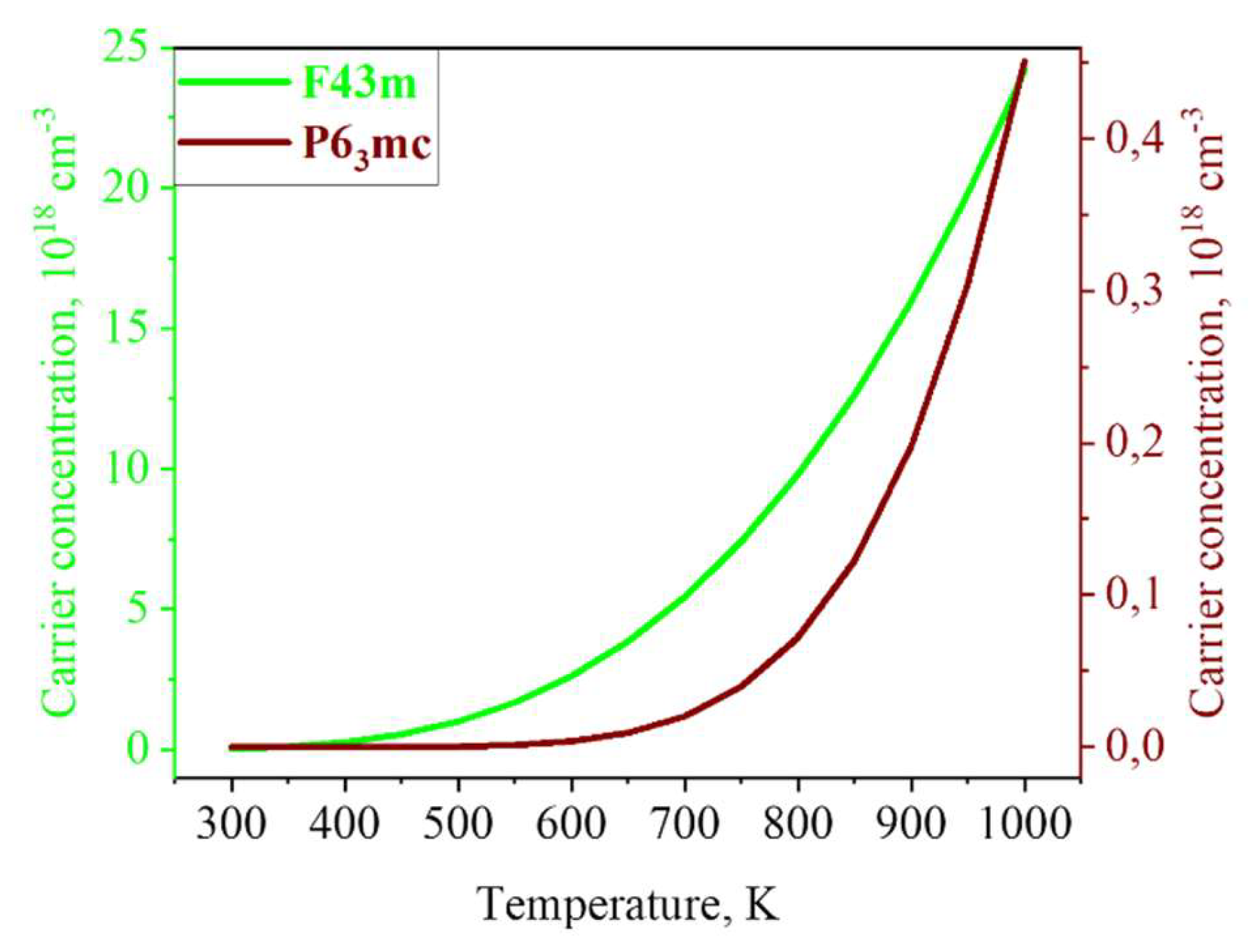
Figure 12.
Seebeck coefficient as a function of carrier concentration for cubic and hexagonal AlSb.
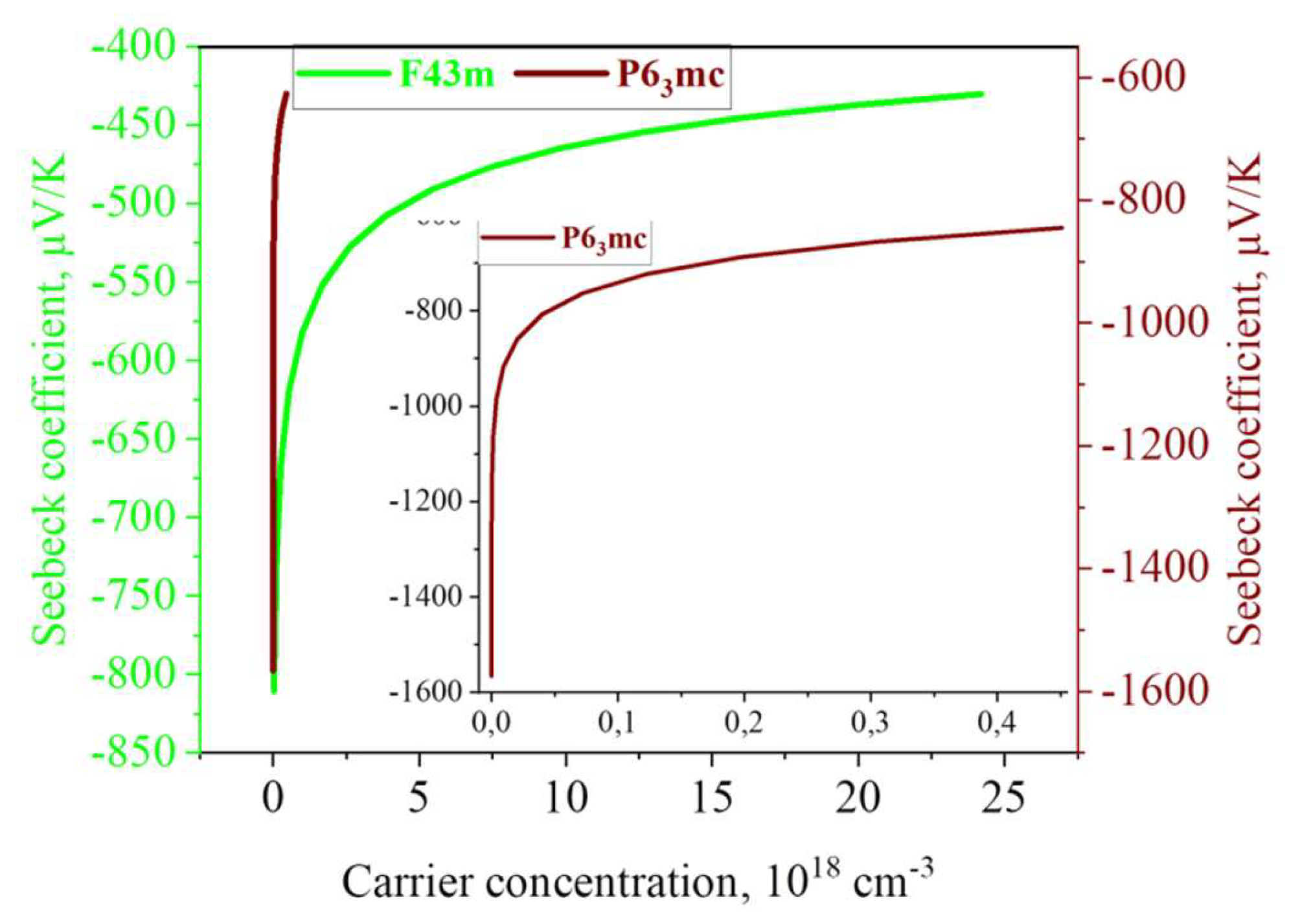
Figure 13.
Thermal conductivity as a function of carrier concentration for cubic and hexagonal AlSb.
Figure 13.
Thermal conductivity as a function of carrier concentration for cubic and hexagonal AlSb.
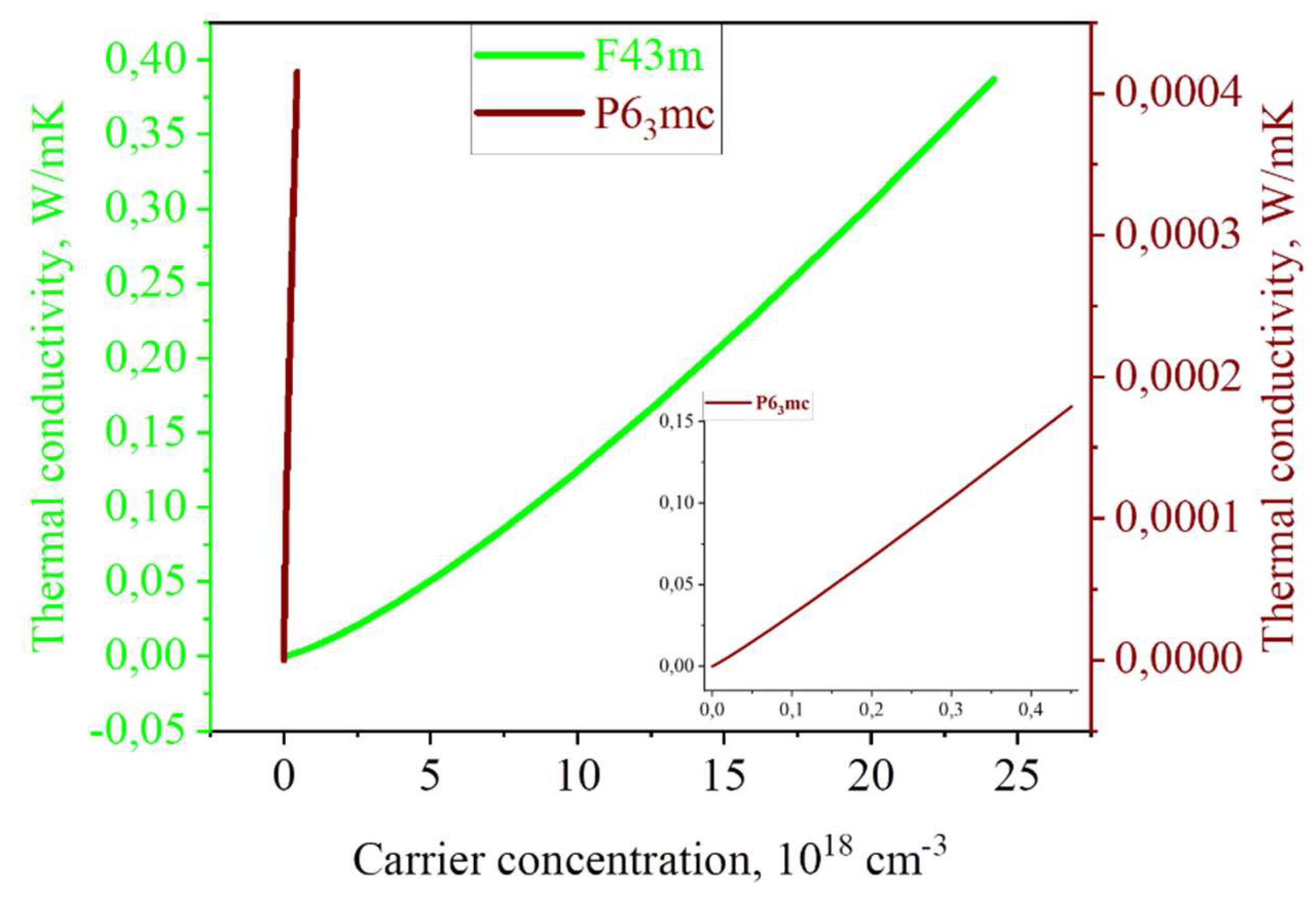
Figure 14.
Power factor as a function of carrier concentration for cubic and hexagonal AlSb.
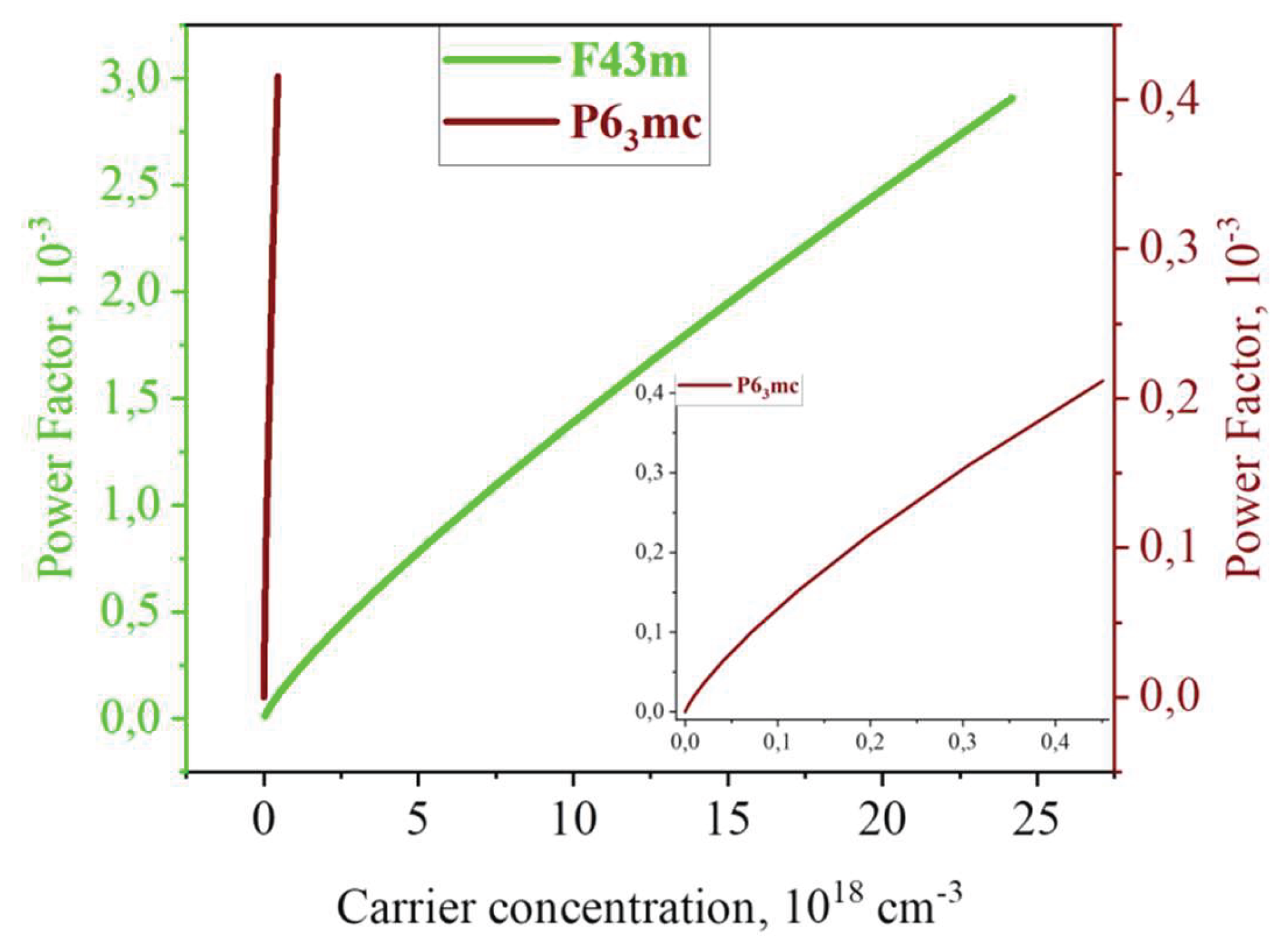

Table 1.
Elastic anisotropy parameters of the F-43m and P63mc phases of AlSb.
| Phase | Emax (GPa) | Emin (GPa) | Emax/ Emin |
Gmax (GPa) | Gmin (GPa) | Gmax/ Gmin |
νmax | νmin | AU |
|---|---|---|---|---|---|---|---|---|---|
| F-43m | 86.42 | 53.17 | 1.62 | 35.76 | 20.13 | 1.77 | 0.45 | 0.04 | 0.41 |
| P63mc | 95.78 | 62.24 | 1.53 | 36.34 | 22.73 | 1.59 | 0.38 | 0.14 | 0.22 |
Table 2.
Calculated band gap energies (in eV) of cubic and hexagonal AlSb, compared with available experimental data.
Table 2.
Calculated band gap energies (in eV) of cubic and hexagonal AlSb, compared with available experimental data.
| AlSb | Calculation |
Experimental |
||
|---|---|---|---|---|
| mBJ | mBJ+SOC | mBJ+U | ||
| F43m | 1.68 | 1.56 | 1.71 | 1.63[39], 1.75[40] |
| P63mc | 1.48 | 1.34 | 1.50 | - |
Table 3.
Estimated carrier effective masses of cubic and hexagonal AlSb.
| Phase | / | / |
|---|---|---|
| F43m | 0.14 | 0.62 |
| P63mc | 0.26 | 0.91 |
Table 4.
Static optical parameters of cubic and hexagonal phases of AlSb, including the refractive index n(0), real part of the dielectric constant ε1(0), and reflectivity R(0).
Table 4.
Static optical parameters of cubic and hexagonal phases of AlSb, including the refractive index n(0), real part of the dielectric constant ε1(0), and reflectivity R(0).
| AlSb | ε1(0) | n(0) | R(0) |
|---|---|---|---|
| F43m | 12.208 | 3.49 | 0.308 |
| P63mc | 9.927 | 3.04 | 0.256 |
Disclaimer/Publisher’s Note: The statements, opinions and data contained in all publications are solely those of the individual author(s) and contributor(s) and not of MDPI and/or the editor(s). MDPI and/or the editor(s) disclaim responsibility for any injury to people or property resulting from any ideas, methods, instructions or products referred to in the content. |
© 2026 by the authors. Licensee MDPI, Basel, Switzerland. This article is an open access article distributed under the terms and conditions of the Creative Commons Attribution (CC BY) license.
Copyright: This open access article is published under a Creative Commons CC BY 4.0 license, which permit the free download, distribution, and reuse, provided that the author and preprint are cited in any reuse.