
Submitted:
04 April 2026
Posted:
07 April 2026
You are already at the latest version
Abstract
Background/Objectives: Longer lifetime exposure to endogenous estradiol (LEE2) has been associated with lower risk of age-related cognitive decline and dementia. Complementary to cognitive decline, behavioural and functional decline are also predictive of dementia risk; however, the association between LEE2 and these domains is underexplored. We investigated whether LEE2 is linked to later-life changes in behaviour and function. Methods: Baseline data from 1166 females enrolled in the CAN-PROTECT study were analyzed. LEE2 was estimated based on length of the reproductive period (menopause age - menarche age) plus years pregnant and scaled in 5-year increments. Objective cognition was measured using the CAN-PROTECT neuropsychological battery, while subjective cognition, behaviour, and function were measured using the Revised Everyday Cognition (ECog-II) scale, Mild Behavioral Impairment Checklist (MBI-C), and Standard Assessment of Global Everyday Activities (SAGEA) scale, respectively. Linear regressions modeled the association between LEE2 and neuropsychological performance. Three separate negative binomial regression models examined the association between LEE2 and ECog-II, MBI-C, and SAGEA total scores. All models adjusted for menopause hormone therapy ever use, menopause type, age, education, and ethnocultural background. Results: Each five-year increase in LEE2 was associated with lower MBI-C score (count ratio [CR]= 0.91, 95% CI [0.84, 0.98]) and lower SAGEA score (CR=0.91, 95% CI [0.86, 0.98]). LEE2 was not significantly associated with any objective or subjective cognitive measures. Conclusions: Longer LEE2 may confer protection against later-life behavioural and functional changes in older women.
Keywords:
estradiol
; cognition
; behaviour
; function
; dementia risk
1. Introduction
Alzheimer disease (AD) is the most common cause of dementia, accounting for approximately 60-70% of all cases worldwide [1]. An estimated 55 million people currently live with dementia, a number projected to nearly triple by 2050 as populations age [2]. Notably, females represent nearly two-thirds of individuals with AD3, which cannot be fully explained by greater longevity alone [4]. This sex disparity underscores the importance of understanding biological and life course factors that may confer susceptibility or resilience to AD in females.
Although recent advances in disease-modifying therapies have shown promise for some patients, their impact on clinical outcomes remains modest [5,6]. This has increased the importance of identifying early risk markers and modifiable factors that precede the onset of AD. One such avenue involves understanding how hormonal exposures across the female lifespan correlate with later-life brain health. From menarche (first menstruation) through the reproductive years (including pregnancy) to menopause (permanent cessation of menses), females experience dynamic fluctuations in reproductive hormones, particularly estradiol (E2), the most abundant and potent form of circulating estrogen. E2 exerts widespread neuroprotective effects [7] including supporting vascular integrity [8]; promoting synaptic plasticity [9]; modulating neurotransmitter [10] and inflammatory systems [11]; and facilitating the clearance of amyloid-beta and phosphorylated tau [7], hallmark proteinopathies of AD. Consequently, variations in E2 exposure have been proposed as one mechanism linking female reproductive aging to later-life brain health and AD risk.
Beyond post-menopausal decline in E2, lifetime exposure to endogenous estradiol (LEE2) may also play a role in shaping brain aging trajectories. LEE2 duration can be approximated by the interval of time between menarche and menopause [12], with additional years of pregnancy contributing to exposure given the markedly elevated E2 levels during gestation [13,14,15]. Shorter LEE2 has been associated with poorer performance on cognitive tasks (including poorer delayed memory recall [12] and global cognition [15]), and greater risk of white matter hyperintensity burden [8,14] and dementia16 in later life. Conversely, longer LEE2 may confer neuroprotective benefits through prolonged exposure to the supportive effects of E2 on neural [15], vascular [14], and inflammatory [17] processes.
While emerging evidence links LEE2 to cognitive outcomes, few studies have examined the association of LEE2 with other early markers of neurodegenerative disease, such as neuropsychiatric symptoms (NPS) and functional decline. Both NPS and functional decline are predictive of dementia risk and progression and may precede overt cognitive impairment [18]. When NPS are later-life emergent and persistent, they are classified as mild behavioural impairment (MBI) [19], which has been associated with neurodegeneration [20] and AD cerebrospinal21 and plasma [22,23] fluid biomarkers, even after accounting for cognitive status. Similarly, subtle functional difficulties (e.g., managing medications, preparing meals, travelling, and managing finances) may also signal early-stage neurodegenerative changes [24,25]; recent work has linked mild functional impairment in cognitively unimpaired older adults to both incident dementia and AD biomarkers [26,27]. Although no studies to date have directly examined LEE2 in relation to MBI or functional decline, premature menopause has been linked to greater depressive symptoms [28] and poorer physical function [29] in later life, suggesting that duration of E2 exposure may influence behavioural and functional outcomes. Thus, extending investigations of LEE2 beyond cognition may strengthen early identification of females at elevated risk of neurodegeneration.
In addition to endogenous E2 exposure, menopause hormone therapy (MHT) may also influence brain aging and dementia risk, though findings remain inconsistent [30]. Variability in MHT timing of initiation, duration of use, and formulation of E2, as well as individual health characteristics may contribute to these inconsistencies [31]. These findings underscore the need to account for MHT use in LEE2 models when evaluating their effects on brain aging.
The present study examined the associations between LEE2, cognition, behaviour, and function in a sample of postmenopausal females. We hypothesized that longer LEE2 would associate with lower severity of cognitive, behavioural, and functional symptoms in later life, reflecting a potential protective effect of prolonged E2 exposure on the aging female brain.
2. Materials and Methods
2.1. Study Design
Data were drawn from the Canadian Platform for Research Online to Investigate Health, Quality of Life, Cognition, Behaviour, Function, and Caregiving in Aging (CAN-PROTECT) [32], a digital epidemiology platform longitudinally investigating risk and resilience in brain aging [33,34,35]. To be eligible for CAN-PROTECT, participants must be aged 18 years or older, reside in Canada, be dementia-free at enrollment, and have access to an internet-connected computer or tablet. Participants complete annual mandatory neuropsychological assessments and demographic questions, as well as optional assessments of cognition, behaviour, function, quality of life, medical and psychiatric history, and lifestyle. Participants who reported female sex at birth were also invited to complete a fertility and menopause questionnaire. All participants provide informed consent electronically at registration. The CAN-PROTECT study was approved by the Conjoint Health Research Ethics Board at the University of Calgary, with recruitment ongoing since March 8, 2023.
2.2. Participants
Baseline demographic, cognitive, behavioural, functional, and reproductive health data were available for 1999 participants. Inclusion in the analysis required complete data on neuropsychological battery tests, subjective cognitive, behavioural, and functional measures, reported female sex at birth, self-reported post-menopausal status, and age at menarche and menopause. Of these, 1168 met inclusion criteria; however, two participants were excluded due to biologically implausible values for age at menarche (i.e., menarche after 40 years of age). The final analytic sample comprised 1166 participants (Figure 1).
2.3. Measures
2.3.1. Lifetime Exposure to Endogenous E2
Lifetime exposure to endogenous E2 (LEE2) was estimated by using self-reported reproductive history from the fertility and menopause questionnaire. Specifically, reproductive span was calculated as the difference between reported age at menopause and age at menarche [12]. To account for elevated E2 during pregnancy [13], an additional 0.75 years (equivalent to nine months) was added for each reported biological child, an approach previously used to examine LEE2 and white matter hyperintensities [14]. For regression analyses, LEE2 was scaled in five-year increments to improve interpretability of effect estimates. Data on miscarriages and preterm births are not collected in CAN-PROTECT and therefore were not included in LEE2 estimates.
2.3.2. MHT Use
Ever use of MHT was self-reported and included unopposed estrogen (e.g., E2, conjugated estrogens) and opposed estrogen (e.g., combination estrogen and progestin) forms. Data on MHT use indicated for reasons other than menopause symptom treatment are not collected in CAN-PROTECT and thus, were not identified as MHT users. MHT use was categorized as either never or ever use.
2.3.3. E2-Related Reproductive Variables
Menopause type was categorized as spontaneous, surgical, or due to other reasons. CAN-PROTECT captures menopause resulting from oophorectomy or hysterectomy as a single category, precluding distinction between these two surgical procedures.
2.3.4. Objective Cognition
Objective measures of cognition were assessed using the validated CAN-PROTECT neuropsychological battery [36], which is comprised of six assessments including: Trail Making B, Switching Stroop, Self-Ordered Search, Paired Associate Learning, Verbal Reasoning, and Digit Span.
Raw test scores were extracted across the six domains and winsorized at the first and 99th percentiles to minimize outlier effects. Each task was then standardized into a z-score based on the sample distribution, with time-based measures reverse-coded so that higher z-scores consistently reflected better performance. Domain composite scores were calculated as the mean of all non-missing standardized task scores within each domain, and a global composite neuropsychological score was derived as the mean of all available task z-scores per participant.
2.3.5. Subjective Cognition
Subjective cognition was assessed using the Revised Everyday Cognition (ECog-II) scale [37], a 41-item measure developed to detect subtle cognitive impairment in populations at risk for dementia. Items cover memory, language, visual-spatial and perceptual, planning, organizational, and executive function, with participants rating perceived change over the past ten years on a scale from 0-3 (0=no change, 1=occasionally worse, 2=consistently a little worse, 3=much worse). Total ECog-II scores were calculated by summing all item severity scores, with higher scores indicating greater perceived impairment.
2.3.6. Subjective Behaviour
Subjective behavioural symptoms were assessed using the Mild Behavioral Impairment Checklist (MBI-C) [38], a 34-item measure design to capture late-life onset, persistent (≥6 months), and impactful behavioural changes not explained by established psychiatric conditions or other diagnoses. The MBI-C covers five domains: decreased motivation, affective dysregulation, impulse dyscontrol, social inappropriateness, and abnormal perception and thought content. Items are rated from 0-3 (0=no symptom, 1=mild symptom, 2=moderate symptom, 3=severe symptom). Total MBI-C scores were calculated by summing all item severity scores, with higher total scores indicating greater behavioural disturbance.
2.3.7. Subjective Function
Subjective functional ability was measured using the Standard Assessment of Global Everyday Activities (SAGEA) scale [39], a 15-item, multidomain measure of functional capacity over the past month. The SAGEA assesses instrumental activities of daily living, basic activities of daily living, cognition, social participation, and mobility. Items are rated on a 0-3 scale (0=no impairment, 1=mild impairment, 2=moderation impairment, 3=severe impairment), with higher scores indicating greater functional impairment. For four activities, participants are additionally asked whether they require assistance from another person; endorsement of assistance contributes additional points, up to a maximum of 3 points per item. Total SAGEA scores were calculated as the sum of all domain scores.
2.4. Statistical Analysis
Participant demographics and outcome variables were summarized using descriptive statistics (count, percentages, mean, and standard deviations). Distributions of outcome variables were visually inspected using histograms and Q-Q plots and further assessed for skewness, kurtosis, and dispersion to guide model selection. LEE2 was modeled as a continuous exposure variable, scaled in five-year increments to enhance interpretability of effect estimates.
The relationship between LEE2 (exposure) and neuropsychological performance (global and domain) was modeled using linear regressions. Comparatively, the associations of LEE2 (exposure) and the outcome variables, ECog-II, MBI-C, and SAGEA total scores, were modeled as overdispersed count outcomes using separate negative binomial regressions. Exponentiated coefficients from these models (using a log link) are presented as count ratios (CRs), representing the proportional change in the expected count of the outcome per one-unit increase in the predictor. This terminology was used instead of incidence rate ratios because no offset term –used to account for differing exposure times or observation periods– was included; thus, the models estimated counts rather than rates.
All models were adjusted for MHT use (never versus ever), menopause type (spontaneous, surgical, or other), age, years of education, and ethnocultural (European versus no European) background.
3. Results
A total of 1166 females were included in the analyses. Participants had a mean age of 64.0±7.4 years and reported a mean number of 15.8±4.5 years of education. Most participants (85.2%) reported at least some European ethnocultural background (Table 1).
The mean age at menarche was 12.7±1.5 years, while menopause onset occurred at a mean age of 49.6±5.8 years. Most participants experienced spontaneous menopause (76.1%). While 23.2% of the sample reported having no biological children, the majority reported at least one, with an average of 1.3±0.9 years pregnant. Combining reproductive period with years pregnant, the mean years of LEE2 was 38.2±5.9. Approximately 35.2% reported MHT use at some point.
On average, participants reported a global neuropsychological performance z-score of 0.0±0.5, ECog-II severity score of 12.5±11.7, MBI-C severity score of 5.9±7.7, and SAGEA severity score of 2.8±3.5.
3.1. LEE2 and Cognition
3.2. LEE2 and Behaviour
LEE2 was associated with severity of MBI symptoms (Figure 2). Each additional five years of LEE2 corresponded to an estimated 9.0% lower expected MBI-C total score (CR= 0.91, 95% CI [0.84 0.98], p=0.009).
3.4. LEE2 and Function
LEE2 was associated with severity of subjective functional impairment (Figure 2). Each additional five years of LEE2 corresponded to an estimated 9.0% lower SAGEA total score (CR=0.91, 95% CI [0.86, 0.98], p=0.009).
3.5. MHT Use
MHT ever use was not associated with subjective cognitive, behavioural, or functional outcomes (Table 3). Similarly, no associations were observed between MHT use and most neuropsychological measures, though MHT use was associated with better verbal reasoning performance (b=0.127, 95% CI [0.02, 0.23], p=0.016).
4. Discussion
Among 1166 postmenopausal females without a diagnosis of dementia, longer LEE2 was associated with lower severity of behavioural and functional symptoms. No statistically significant associations were observed between LEE2 and objective or subjective cognitive outcomes.
In the present study, LEE2 associations with all measures of cognition were not statistically significant. Although longer LEE2 has been proposed to confer neuroprotective effects on cognition, findings across studies remain mixed [40,41] and are further compounded by limited investigation. Some studies report that among cognitively unimpaired females, longer reproductive spans are associated with reduced subjective cognitive complaints [15,42], lower white matter hyperintensity burden [14], and better memory [12] and verbal fluency [43]. Differences between our findings and prior work may reflect variation in how LEE2 is operationalized. In this study, LEE2 was defined as reproductive span and adjusted for parity, whereas other studies additionally adjusted for breastfeeding [15,42], a factor not captured in CAN-PROTECT. Notably, studies incorporating breastfeeding [15,42] into LEE2 calculations have reported positive associations with cognition, while studies limited to reproductive span alone have not consistently observed such relationships [40]. These findings suggest that LEE2 characterization may influence observed relationships. Additionally, our participants were highly educated (mean of 15.8 years of schooling), and greater years of education are associated with higher cognitive reserve [44,45], an established resilience factor against cognitive decline and dementia. Higher educational attainment may contribute to attenuating detectable associations between LEE2 and cognitive performance.
Extending beyond cognition, the present findings link longer LEE2 to lower severity of subjective behavioural and functional complaints, markers that have been largely overlooked in understanding dementia risk early in the disease course. Although limited, preliminary work has shown that earlier menopause [28] and shorter LEE2 [46,47] is associated with more depressive symptoms in later life. In parallel, another study found that among postmenopausal females, spontaneous premature menopause was associated with later-life physical functional decline [29], including lower gait speed and grip strength, when adjusted for age and study site. However, the association between premature menopause and grip strength was attenuated when adjusted for education, body-mass index, MHT use, and history of smoking. Our findings further align with prior work showing that greater menopause symptom burden [48], which may reflect the intensity of hormonal fluctuations during the menopause transition [49], is associated with more severe MBI symptoms. These results collectively suggest that both the timing and duration of estrogenic exposure may shape later-life brain health. Although functional symptoms were not examined in the prior work, evidence links menopause to greater functional difficulties in later life [50,51], potentially due to long-term impact of E2 loss on neural [52], vascular [53], and skeletal [54,55] systems, independent of age. Thus, lower E2 exposure -whether from earlier menopause or shorter LEE2- may contribute to greater behavioural and functional complaints. In comparison, prolonged exposure may preserve brain integrity through its effects on vascular health [8], synaptic plasticity [9], neurotransmitter regulation [10], inflammation [11], and the clearance of AD pathological proteins [7,52]. These mechanisms may underpin behavioural and functional resilience, analogous to the protective effects of greater years of education or factors that promote higher cognitive reserve [44,45]. Collectively, these findings expand current evidence by emphasizing that associations between LEE2 and AD risk may manifest not only through cognitive pathways, but also through behavioural and functional changes that are equally relevant to dementia risk in females.
In contrast to our LEE2 findings, MHT use was neither associated with most objective and subjective cognitive measures, nor with subjective behavioural or functional outcomes. However, MHT use was associated with better verbal reasoning performance. Some prior studies have similarly reported improved processing speed among MHT users compared to non-users [56,57], although findings remain inconsistent. Variability across studies may reflect differences in MHT duration and formulation, as well as the timing of MHT initiation, which was not directly examined in the present study. Moreover, these results align with broader literature demonstrating inconsistent associations between MHT use and later-life brain outcomes [30,44,58]. For example, while longer LEE2 has been linked to lower white matter hyperintensity burden, no comparable association was observed for exogenous E2 use [14], which comprised of both MHT and hormonal contraceptives used in earlier life. Conversely, another study [59] found that birth control pill and MHT use following premature oophorectomy associated with better episodic memory and visuospatial processing in later life. Similar findings have been noted among females who experienced spontaneous menopause at older ages 60 but these studies only explored age at menopause and not LEE2 duration, which may influence outcomes. Importantly, our primary analyses classified MHT use as never versus ever use, an approach that may obscure potential differences based on recency of use. To explore whether associations differed according to MHT status (never, past, or current use), we conducted post-hoc sensitivity analyses. Although MHT status was not directly assessed in CAN-PROTECT, we derived status using reported age at initiation and duration of use to estimate the end age relative to participants’ current age. In these exploratory models, current MHT use was independently associated with better global neuropsychological performance (p=0.015) and verbal reasoning (p<0.001) compared to non-users, whereas past use was not associated with cognitive performance. No associations were observed between MHT status and behavioural and functional outcomes. These findings raise the possibility that associations between MHT and cognition may depend on recency of exposure rather than lifetime history of use alone.
Nevertheless, given the cross-sectional design and post-hoc nature of these analyses, these results should be interpreted cautiously. Furthermore, longitudinal investigations incorporating detailed characterization of MHT duration, formulation, and timing of initiation, in addition to MHT status, should be conducted to clarify relationships.
Several limitations to the current study warrant consideration. First, the cross-sectional design precludes inference about temporal relationships between LEE2 and later-life dementia risk markers. Longitudinal data are needed to clarify whether the modest effects observed predict future decline, as even small differences may be meaningful in a largely unimpaired sample. Second, our LEE2 measure represents a crude proxy of cumulative endogenous E2 exposure and does not capture other medical, lifestyle, and reproductive factors that may influence hormonal variability. Third, MHT use was categorical and lacked critical details about timing of initiation, duration, dosage, or formulation -factors that may modify the study outcomes [30,61]. Relatedly, information on hormonal contraceptive use (i.e., birth control pills) during reproductive years was unavailable, despite widespread use62 of estrogen-containing birth control pills that may alter LEE2. Finally, recall bias in self-reported reproductive history (i.e., age at menarche and menopause) may affect LEE2 accuracy. This limitation extends to much of the CAN-PROTECT dataset, which relies on retrospective self-reporting. Future longitudinal studies should aim to replicate these findings using biomarker and hormonal data.
Despite these limitations, the study offers several notable strengths. Leveraging a large, well-characterized, population-based Canadian cohort enhances the generalizability of findings. Our operationalization of LEE2 includes both reproductive duration and pregnancies, providing a more comprehensive estimate of cumulative endogenous E2 exposure. Prior studies often consider only reproductive duration, overlooking pregnancies, an experience that can substantially increase E2 levels [13], and may independently influence dementia risk [63,64] and resilience [65]. Finally, by simultaneously examining cognition, behaviour, and function, this study expands the scope of female brain aging research and supports a multidimensional approach to identifying early indicators of dementia risk.
5. Conclusions
We provide evidence from a cross-sectional study of dementia-free postmenopausal females that longer LEE2 may associate with lower severity of subjective behavioural and functional complaints. These results underscore the potential role of LEE2 in supporting later-life brain health. Furthermore, these findings highlight the importance of expanding female dementia risk identification beyond cognition to include behavioural and functional changes.
Author Contributions
Conceptualization, J.F.E.C. and Z.I.; methodology, J.F.E.C., D.X.G., M.G., and Z.I.; formal analysis, J.F.E.C. and Z.I.; software, D.X.G., C.B., B.C., A.C., E.P., and A.B.; investigation, J.F.E.C., D.X.G., M.G., and Z.I.; resources, C.B., B.C., A.C., E.P., A.B., and Z.I; data curation, D.X.G., A.B., and Z.I.; writing—original draft preparation, J.F.E.C. and Z.I; writing—review and editing, J.F.E.C., D.X.G., M.G., C.B., B.C., A.C., P.R., C.K.B., E.E.S. and Z.I.; visualization, J.F.E.C.; supervision, Z.I.; project administration, Z.I.; funding acquisition, Z.I. All authors have read and agreed to the published version of the manuscript.
Funding
CAN-PROTECT was supported by Gordie Howe CARES and the Evans Family fund via the Hotchkiss Brain Institute. The funders did not influence study design, collection, analysis, interpretation, writing, or decision to submit for publication.
Institutional Review Board Statement
The study was conducted in accordance with the Declaration of Helsinki, and approved by the Institutional Review Board (or Ethics Committee) of University of Calgary (REB21-1065 and renewed November 14, 2025).
Informed Consent Statement
Informed consent was obtained from all participants involved in the study.
Data Availability Statement
At this time, the authors do not have ethical or legal permission to share the study data, including de-identified data. The study is still in its early stages, and a data access committee has not yet been established, nor has a data sharing policy been finalized. Upon study completion, the authors will seek legal review and submit an amendment to the ethics board. Addressing data sharing is a priority, contingent on obtaining stable funding for all study activities. While the authors are unable to publicly post the data at this time, they are open to sharing data with qualified investigators for validation purposes. Interested researchers may contact ismailz@ucalgary.ca to request access to the data.
Acknowledgments
For the purpose of open access, the author has applied a Creative Commons Attribution (CC BY) licence to any Author Accepted Manuscript version arising from this submission.
Conflicts of Interest
The authors declare no conflicts of interest.
Abbreviations
The following abbreviations are used in this manuscript:
| MDPI | Multidisciplinary Digital Publishing Institute |
| DOAJ | Directory of open access journals |
| AD | Alzheimer disease |
| E2 | Estradiol |
| LEE2 | Lifetime exposure to endogenous estradiol |
| NPS | Neuropsychiatric symptoms |
| MBI | Mild behavioral impairment |
| MHT | Menopause hormone therapy |
| CAN-PROTECT | Canadian Platform for Research Online to Investigate Health, Quality of Life, Cognition, Behaviour, Function, and Caregiving in Aging |
| ECog-II | Revised Everyday Cognition scale |
| MBI-C | Mild Behavioral Impairment Checklist |
| SAGEA | Standard Assessment of Global Everyday Activities |
| CR | Count ratio |
References
- Frisoni, GB; Hansson, O; Nichols, E; et al. New landscape of the diagnosis of Alzheimer’s disease. The Lancet 2025. [Google Scholar] [CrossRef] [PubMed]
- Nichols, E; Steinmetz, JD; Vollset, SE; et al. Estimation of the global prevalence of dementia in 2019 and forecasted prevalence in 2050: An analysis for the Global Burden of Disease Study 2019. The Lancet Public Health 2022, 7(2), e105–e125. [Google Scholar] [CrossRef] [PubMed]
- O’Neal, MA. Women and the risk of Alzheimer’s disease. Frontiers in Global Women’s Health 2024, 4, 1324522. [Google Scholar] [CrossRef] [PubMed]
- Castro-Aldrete, L; Einsiedler, M; Novakova Martinkova, J; et al. Alzheimer disease seen through the lens of sex and gender. Nature Reviews Neurology 2025, 1–15. [Google Scholar] [CrossRef]
- Zhang, Y; Chen, J; Li, Y; Jiao, B; Luo, S. Disease-modifying therapies for Alzheimer’s disease: Clinical trial progress and opportunity. Ageing research reviews 2025, 103, 102595. [Google Scholar] [CrossRef]
- Smith, EE; Phillips, NA; Feldman, HH; et al. Use of lecanemab and donanemab in the Canadian healthcare system: Evidence, challenges, and areas for future research. The journal of prevention of Alzheimer’s disease 2025, 12(3), 100068. [Google Scholar] [CrossRef]
- Wang, X; Feng, S; Deng, Q; Wu, C; Duan, R; Yang, L. The role of estrogen in Alzheimer’s disease pathogenesis and therapeutic potential in women. Molecular and Cellular Biochemistry 2024, 1–16. [Google Scholar] [CrossRef]
- Thurston, RC; Chang, Y; Wu, M; et al. Reproductive hormones in relation to white matter hyperintensity volumes among midlife women. Alzheimer’s & Dementia 2024, 20(9), 6161–6169. [Google Scholar] [CrossRef]
- Smejkalova, T; Woolley, CS. Estradiol acutely potentiates hippocampal excitatory synaptic transmission through a presynaptic mechanism. Journal of Neuroscience 2010, 30(48), 16137–16148. [Google Scholar] [CrossRef]
- Bendis, PC; Zimmerman, S; Onisiforou, A; Zanos, P; Georgiou, P. The impact of estradiol on serotonin, glutamate, and dopamine systems. Frontiers in neuroscience 2024, 18, 1348551. [Google Scholar] [CrossRef]
- Au, A; Feher, A; McPhee, L; Jessa, A; Oh, S; Einstein, G. Estrogens, inflammation and cognition. Frontiers in neuroendocrinology 2016, 40, 87–100. [Google Scholar] [CrossRef]
- Oughli, HA; Nguyen, SA; Siddarth, P; et al. The effect of cumulative lifetime estrogen exposure on cognition in depressed versus non-depressed older women. Journal of geriatric psychiatry and neurology 2022, 35(6), 832–839. [Google Scholar] [CrossRef] [PubMed]
- Dukic, J; Johann, A; Henninger, M; Ehlert, U. Estradiol and progesterone from pregnancy to postpartum: A longitudinal latent class analysis. Frontiers in Global Women’s Health 2024, 5, 1428494. [Google Scholar] [CrossRef] [PubMed]
- Cote, S; Perron, T-L; Baillargeon, J-P; Bocti, C; Lepage, J-F; Whittingstall, K. Association of cumulative lifetime exposure to female hormones with cerebral small vessel disease in postmenopausal women in the UK biobank. Neurology 2023, 101(20), e1970–e1978. [Google Scholar] [CrossRef] [PubMed]
- Matyi, JM; Rattinger, GB; Schwartz, S; Buhusi, M; Tschanz, JT. Lifetime estrogen exposure and cognition in late life: The Cache County Study. Menopause 2019, 26(12), 1366–1374. [Google Scholar] [CrossRef]
- Park, HK; Marston, L; Mukadam, N. The effects of estrogen on the risk of developing dementia: A cohort study using the UK biobank data. The American Journal of Geriatric Psychiatry 2024, 32(7), 792–805. [Google Scholar] [CrossRef]
- Huang, T; Shafrir, AL; Eliassen, AH; Rexrode, KM; Tworoger, SS. Estimated Number of Lifetime Ovulatory Years and Its Determinants in Relation to Levels of Circulating Inflammatory Biomarkers. American Journal of Epidemiology 2019, 189(7), 660–670. [Google Scholar] [CrossRef]
- Borda, MG; Aarsland, D; Tovar-Rios, DA; et al. Neuropsychiatric symptoms and functional decline in Alzheimerʼs disease and Lewy body dementia. Journal of the American Geriatrics Society 2020, 68(10), 2257–2263. [Google Scholar] [CrossRef]
- Ismail, Z; Smith, EE; Geda, Y; et al. Neuropsychiatric symptoms as early manifestations of emergent dementia: Provisional diagnostic criteria for mild behavioral impairment. Alzheimer’s & Dementia 2016, 12(2), 195–202. [Google Scholar]
- Guan, DX; Rehman, T; Nathan, S; et al. Neuropsychiatric symptoms: Risk factor or disease marker? A study of structural imaging biomarkers of Alzheimer’s disease and incident cognitive decline. Human Brain Mapping 2024, 45(13), e70016. [Google Scholar] [CrossRef]
- Ismail, Z; Leon, R; Creese, B; Ballard, C; Robert, P; Smith, EE. Optimizing detection of Alzheimer’s disease in mild cognitive impairment: A 4-year biomarker study of mild behavioral impairment in ADNI and MEMENTO. Molecular Neurodegeneration 2023, 18(1), 50. [Google Scholar] [CrossRef] [PubMed]
- Leon, R; Ghahremani, M; Guan, DX; Smith, EE; Zetterberg, H; Ismail, Z. Enhancing Alzheimer Disease Detection Using Neuropsychiatric Symptoms: The Role of Mild Behavioural Impairment in the Revised NIA-AA Research Framework. Journal of Geriatric Psychiatry and Neurology 2025, 08919887251366634. [Google Scholar] [CrossRef] [PubMed]
- Ghahremani, M; Leon, R; Smith, EE; Ismail, Z. Exploring the association between mild behavioral impairment and plasma p-tau217: Implications for early detection of Alzheimer’s disease. Alzheimer’s & Dementia: Diagnosis, Assessment & Disease Monitoring 2025, 17(2), e70119. [Google Scholar]
- Ghahremani, M; Smith, EE; Ismail, Z. Persistent functional impairment as an early indicator of cognitive decline and dementia in cognitively normal older adults. J Alzheimers Dis 2025, 13872877251406661. [Google Scholar] [CrossRef]
- Ghahremani, M; Smith, EE; Ismail, Z. Persistent Functional Impairment as an Early Indicator of Alzheimer Disease Pathology and Progression. Journal of the American Geriatrics Society 2025. [Google Scholar] [CrossRef]
- Vassilaki, M; Aakre, JA; Kremers, WK; et al. Association between functional performance and Alzheimer’s disease biomarkers in individuals without dementia. Journal of the American Geriatrics Society 2018, 66(12), 2274–2281. [Google Scholar] [CrossRef]
- Arruda, F; Rosselli, M; Greig, MT; et al. The association between functional assessment and structural brain biomarkers in an ethnically diverse sample with normal cognition, mild cognitive impairment, or dementia. Archives of Clinical Neuropsychology 2021, 36(1), 51–61. [Google Scholar] [CrossRef]
- van Zwol-Janssens, C; Louwers, YV; Laven, JS; Schipper, J; Jiskoot, G. Depressive symptoms in women with premature ovarian insufficiency (POI): A cross-sectional observational study. Menopause 2024, 10.1097. [Google Scholar] [CrossRef]
- Velez, MP; Alvarado, BE; Rosendaal, N; et al. Age at natural menopause and physical functioning in postmenopausal women: The Canadian Longitudinal Study on Aging. Menopause 2019, 26(9), 958–965. [Google Scholar] [CrossRef]
- Nerattini, M; Jett, S; Andy, C; et al. Systematic review and meta-analysis of the effects of menopause hormone therapy on risk of Alzheimer’s disease and dementia. Frontiers in aging neuroscience 2023, 15, 1260427. [Google Scholar] [CrossRef]
- Rocca, WA; Kantarci, K; Faubion, SS. Risks and benefits of hormone therapy after menopause for cognitive decline and dementia: A conceptual review. Maturitas 2024, 108003. [Google Scholar] [CrossRef]
- Ismail, Z; Guan, DX; Vellone, D; et al. The Canadian platform for research online to investigate health, quality of life, cognition, behaviour, function, and caregiving in aging (CAN-PROTECT): Study protocol, platform description, and preliminary analyses. Aging and Health Research 2024, 4(4), 100207. [Google Scholar] [CrossRef]
- Guan, DX; Aundhakar, A; Tomaszewski Farias, S; et al. Vascular risk factor associations with subjective cognitive decline and mild behavioural impairment. Brain Communications 2025, 7(3), fcaf163. [Google Scholar] [CrossRef] [PubMed]
- Guan, DX; Peters, ME; Pike, GB; et al. Cognitive, behavioral, and functional outcomes of suspected mild traumatic brain injury in community-dwelling older persons without mild cognitive impairment or dementia. Journal of the Academy of Consultation-Liaison Psychiatry 2025, 66(2), 118–129. [Google Scholar] [CrossRef] [PubMed]
- Mudalige, D; Guan, DX; Ballard, C; et al. The mind and motion: Exploring the interplay between physical activity and Mild Behavioral Impairment in dementia-free older adults. International Review of Psychiatry 2024, 36(3), 196–207. [Google Scholar] [CrossRef]
- Brooker, H; Williams, G; Hampshire, A; et al. FLAME: A computerized neuropsychological composite for trials in early dementia. Alzheimer’s & Dementia: Diagnosis, Assessment & Disease Monitoring 2020, 12(1), e12098. [Google Scholar] [CrossRef]
- Farias, ST; Weakley, A; Harvey, D; Chandler, J; Huss, O; Mungas, D. The measurement of Everyday Cognition (ECog): Revisions and updates. Alzheimer Disease & Associated Disorders 2021, 35(3), 258–264. [Google Scholar]
- Ismail, Z; Agüera-Ortiz, L; Brodaty, H; et al. The Mild Behavioral Impairment Checklist (MBI-C): A rating scale for neuropsychiatric symptoms in pre-dementia populations. Journal of Alzheimer’s disease 2017, 56(3), 929–938. [Google Scholar] [CrossRef]
- Marzona, I. The Standard Assessment of Global Activities in the Elderly (SAGE) Scale: Validation process of a new tool for the assessment of disability in older adults; 2011. [Google Scholar]
- Low, L-F; Anstey, K; Jorm, A; Rodgers, B; Christensen, H. Reproductive period and cognitive function in a representative sample of naturally postmenopausal women aged 60–64 years. Climacteric 2005, 8(4), 380–389. [Google Scholar] [CrossRef]
- Georgakis, MK; Kalogirou, EI; Diamantaras, A-A; et al. Age at menopause and duration of reproductive period in association with dementia and cognitive function: A systematic review and meta-analysis. Psychoneuroendocrinology 2016, 73, 224–243. [Google Scholar] [CrossRef]
- Fox, M; Berzuini, C; Knapp, LA. Cumulative estrogen exposure, number of menstrual cycles, and Alzheimer’s risk in a cohort of British women. Psychoneuroendocrinology 2013, 38(12), 2973–2982. [Google Scholar] [CrossRef]
- Ryan, J; Carrière, I; Scali, J; Ritchie, K; Ancelin, M-L. Life-time estrogen exposure and cognitive functioning in later life. Psychoneuroendocrinology 2009, 34(2), 287–298. [Google Scholar] [CrossRef] [PubMed]
- Jett, S; Malviya, N; Schelbaum, E; et al. Endogenous and exogenous estrogen exposures: How women’s reproductive health can drive brain aging and inform Alzheimer’s prevention. Frontiers in Aging Neuroscience 2022, 14, 831807. [Google Scholar] [CrossRef] [PubMed]
- Guan, DX; Mortby, ME; Pike, GB; et al. Linking cognitive and behavioral reserve: Evidence from the CAN-PROTECT study. Alzheimers Dement (N Y) 2024, 10(4), e12497. [Google Scholar] [CrossRef] [PubMed]
- Wu, Q; Yan, Y; La, R; et al. Association of reproductive lifespan and age at menopause with depression: Data from NHANES 2005–2018. Journal of Affective Disorders 2024, 356, 519–527. [Google Scholar] [CrossRef]
- Georgakis, MK; Thomopoulos, TP; Diamantaras, A-A; et al. Association of age at menopause and duration of reproductive period with depression after menopause: A systematic review and meta-analysis. JAMA psychiatry 2016, 73(2), 139–149. [Google Scholar] [CrossRef]
- Crockford, JF; Guan, DX; Einstein, G; et al. Menopausal symptom burden as a predictor of mid-to late-life cognitive function and mild behavioral impairment symptoms: A CAN-PROTECT study. PLoS ONE 2025, 20(3), e0301165. [Google Scholar] [CrossRef]
- Al-Azzawi, F; Palacios, S. Hormonal changes during menopause. Maturitas 2009, 63(2), 135–137. [Google Scholar] [CrossRef]
- Tseng, LA; El Khoudary, SR; Young, EA; et al. The association of menopause status with physical function: The Study of Women’s Health Across the Nation. Menopause 2012, 19(11), 1186–1192. [Google Scholar] [CrossRef]
- Sowers, M; Tomey, K; Jannausch, M; Eyvazzadeh, A; Nan, B; Randolph, J., Jr. Physical functioning and menopause states. Obstetrics & Gynecology 2007, 110(6), 1290–1296. [Google Scholar] [CrossRef]
- Mosconi, L; Berti, V; Dyke, J; et al. Menopause impacts human brain structure, connectivity, energy metabolism, and amyloid-beta deposition. Scientific reports 2021, 11(1), 10867. [Google Scholar] [CrossRef]
- Aittokallio, J; Saaresranta, T; Riskumäki, M; et al. Effect of menopause and age on vascular impairment. Maturitas 2023, 169, 46–52. [Google Scholar] [CrossRef] [PubMed]
- Karlamangla, AS; Burnett-Bowie, S-AM; Crandall, CJ. Bone health during the menopause transition and beyond. Obstetrics and gynecology clinics of North America 2018, 45(4), 695. [Google Scholar] [CrossRef] [PubMed]
- Wright, VJ; Schwartzman, JD; Itinoche, R; Wittstein, J. The musculoskeletal syndrome of menopause. Climacteric 2024, 27(5), 466–472. [Google Scholar] [CrossRef] [PubMed]
- Greendale, GA; Huang, MH; Wight, RG; et al. Effects of the menopause transition and hormone use on cognitive performance in midlife women. Neurology 2009, 72(21), 1850–1857. [Google Scholar] [CrossRef]
- Calvo, N; Einstein, G. Steroid hormones: Risk and resilience in women’s Alzheimer disease. Frontiers in Aging Neuroscience 2023, 15, 1159435. [Google Scholar] [CrossRef]
- Lee, JK; Frank, RD; Christenson, LR; Fields, JA; Rocca, WA; Mielke, MM. Associations of reproductive factors and exogenous estrogens with global and domain-specific cognition in later life. Alzheimer’s & Dementia 2024, 20(1), 63–73. [Google Scholar]
- Watts, A; Donofry, S; Ripperger, H; et al. Lifetime estrogen exposure and domain-specific cognitive performance: Results from the IGNITE study. Frontiers in Aging Neuroscience 2025, 17, 1524474. [Google Scholar] [CrossRef]
- Puri, TA; Gravelsins, LL; Alexander, MW; et al. Association between menopause age and estradiol-based hormone therapy with cognitive performance in cognitively normal women in the CLSA. Neurology 2025, 105(6), e213995. [Google Scholar] [CrossRef]
- Mosconi, L; Andy, C; Nerattini, M; et al. Systematic Review and Meta-analysis of Menopause Hormone Therapy (MHT) and the Risk of Alzheimer’s Disease and All-cause Dementia: Effects of MHT Characteristics, Location, and APOE-4 Status. Current Obstetrics and Gynecology Reports 2025, 14(1), 6. [Google Scholar] [CrossRef]
- Campbell, AJ; Claydon, VE; Liva, S; Cote, AT. Changes in Canadian contraceptive choices: Results of a national survey on hormonal contraceptive use. BMC Women’s Health 2025, 25(1), 147. [Google Scholar] [CrossRef]
- Bae, J; Lipnicki, D; Han, J; et al. Parity and the risk of incident dementia: A COSMIC study. Epidemiology and psychiatric sciences 2020, 29, e176. [Google Scholar] [CrossRef]
- Bae, JB; Lipnicki, DM; Han, JW; et al. Does parity matter in women’s risk of dementia? A COSMIC collaboration cohort study. BMC medicine 2020, 18(1), 210. [Google Scholar] [CrossRef]
- Fu, C; Hao, W; Ma, Y; et al. Number of live births, age at the time of having a child, span of births and risk of dementia: A population-based cohort study of 253,611 UK women. Journal of women’s health 2023, 32(6), 680–692. [Google Scholar] [CrossRef]
Figure 1.
PRISMA flowchart of analyzed CAN-PROTECT participants. Abbreviations: ECog-II, Revised Everyday Cognition scale; MBI-C, Mild Behavioral Impairment Checklist; SAGEA, Standard Assessment of Global Everyday Activities scale.
Figure 1.
PRISMA flowchart of analyzed CAN-PROTECT participants. Abbreviations: ECog-II, Revised Everyday Cognition scale; MBI-C, Mild Behavioral Impairment Checklist; SAGEA, Standard Assessment of Global Everyday Activities scale.
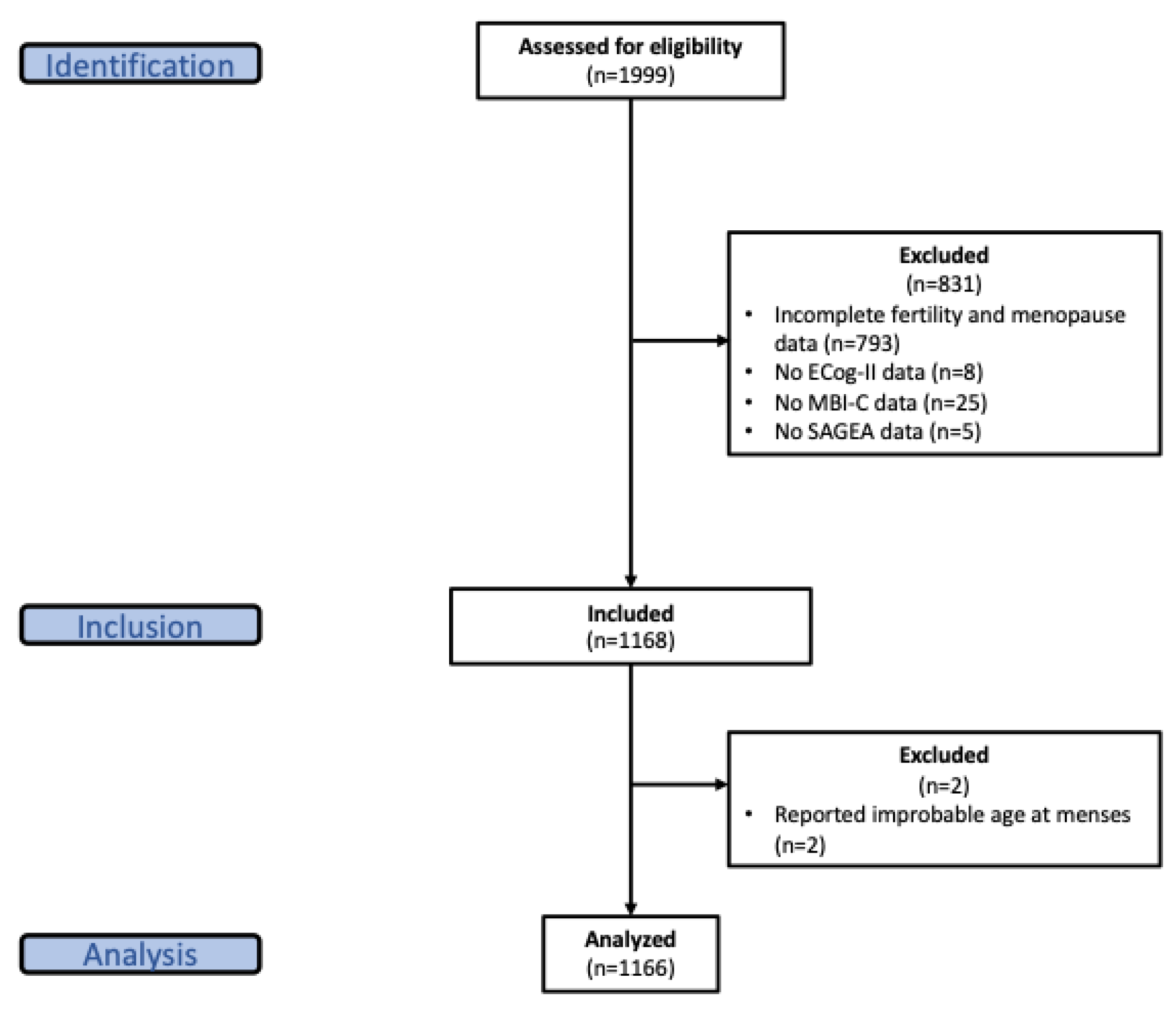
Figure 2.
LEE2 associations with cognition, behaviour, and function. Negative binomial regression models used to assess associations of LEE2 (scaled in 5-year increments) with (A) ECog-II, (B) MBI-C, and (C) SAGEA scores. Shaded regions represent 95% confidence intervals. Count ratios (CR), 95% confidence intervals and p-values for each model are displayed beneath the corresponding panel. Abbreviations: ECog-II, Revised Everyday Cognition scale; MBI-C, Mild Behavioral Impairment Checklist; SAGEA, Standard Assessment of Global Everyday Activities scale.
Figure 2.
LEE2 associations with cognition, behaviour, and function. Negative binomial regression models used to assess associations of LEE2 (scaled in 5-year increments) with (A) ECog-II, (B) MBI-C, and (C) SAGEA scores. Shaded regions represent 95% confidence intervals. Count ratios (CR), 95% confidence intervals and p-values for each model are displayed beneath the corresponding panel. Abbreviations: ECog-II, Revised Everyday Cognition scale; MBI-C, Mild Behavioral Impairment Checklist; SAGEA, Standard Assessment of Global Everyday Activities scale.
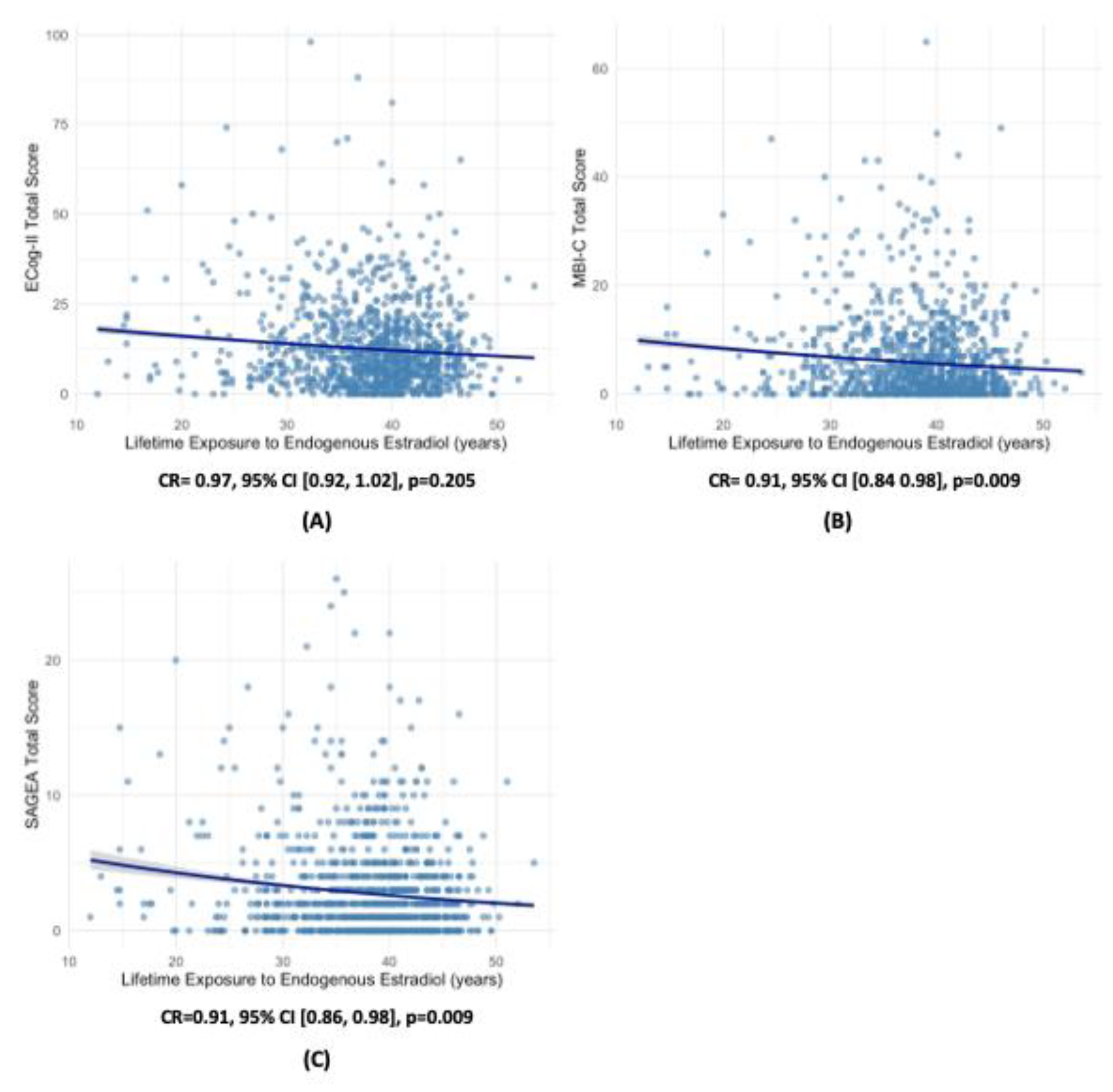

Table 1.
Participant demographics.
| Variable | M(SD), Range | N(%) |
|---|---|---|
| Age (years) | 64.0(7.4), 43.0-88.0 | --- |
| Education (years) | 15.8(4.5), 1.0-30.0 | --- |
| Ethnocultural background | ||
| European origins | --- | 993(85.2) |
| Non-European origins | --- | 173(14.8) |
| Menarche age (years) | 12.7(1.5), 8.0-23.0 | --- |
| Menopause age (years) | 49.6(5.8), 21.0-65.0 | --- |
| Menopause type | ||
| Spontaneous | --- | 887(76.1) |
| Surgical | --- | 187(16.0) |
| Other reasons | --- | 92(7.9) |
| Biological children (number) | ||
| 0 children | --- | 270(23.2) |
| 1 child | --- | 162(13.9) |
| 2 children | --- | 475(40.7) |
| 3 children | --- | 207(17.8) |
| 4 children | --- | 44(3.8) |
| 5 children | --- | 5(0.4) |
| 6+ children | --- | 3(0.3) |
| Time pregnant (years) | 1.3(0.9), 0-4.5 | --- |
| LEE2 (years) | 38.2(5.9), 12.0-53.5 | |
| MHT ever use | --- | 410(35.2) |
| ECog-II score | 12.5(11.7), 0.0-98.0 | --- |
| MBI-C score | 5.9(7.7), 0.0-65.0 | --- |
| SAGE score | 2.8(3.5), 0.0-26.0 | --- |
Participant demographics. Mean (M), standard deviation (SD), and ranges were calculated for continuous variables. Total number (N) and percentage (%) were calculated for categorical variables. Abbreviations: LEE2, lifetime endogenous estradiol exposure; MHT, menopause hormone therapy; ECog-II, Revised Everyday Cognition scale; MBI-C, Mild Behavioral Impairment Checklist; SAGEA, Standard Assessment of Global Everyday Activities scale.
Table 2.
Neuropsychological performance.
| Variable | b Coefficient | 95% CI [2.5, 97.5] | p Value |
|---|---|---|---|
| Global score | 0.00 | [-0.03, 0.02] | 0.895 |
| Trail Making B | 0.01 | [-0.02, 0.04] | 0.546 |
| Switching Stroop | 0.02 | [-0.02, 0.07] | 0.349 |
| Self-Ordered Search | 0.00 | [-0.04, 0.05] | 0.915 |
| Paired Associate Learning | -0.03 | [-0.07, 0.01] | 0.111 |
| Verbal Reasoning | -0.01 | [-0.06, 0.04] | 0.643 |
| Digit Span | 0.00 | [-0.04, 0.04] | 0.986 |
Association of LEE2 (scaled in 5-year increments) with neuropsychological performance. Coefficient estimates are presented as standardized unit differences for neuropsychological domain performances. Estimates are adjusted for MHT ever use, menopause type (spontaneous, surgical, other), age, years of education, and ethnocultural (European vs no European) background.
Table 3.
MHT use.
| Variable | CR | b | 95% CI [2.5, 97.5] | p-Value |
|---|---|---|---|---|
| Global neuropsychological score | --- | 0.04 | [-0.02, 0.09] | 0.161 |
| Trail Making B | --- | -0.01 | [-0.07, 0.05] | 0.780 |
| Switching Stroop | --- | 0.04 | [-0.05, 0.14] | 0.376 |
| Self-Ordered Search | --- | 0.01 | [-0.10, 0.11] | 0.918 |
| Paired Associate Learning | --- | 0.04 | [-0.05, 0.13] | 0.411 |
| Verbal Reasoning | --- | 0.13 | [0.02, 0.23] | 0.016 |
| Digit Span | --- | 0.03 | [-0.04, 0.11] | 0.407 |
| ECog-II total score | 1.00 | --- | [0.89, 1.12] | 0.969 |
| MBI-C total score | 0.88 | --- | [0.75, 1.03] | 0.104 |
| SAGEA total score | 1.02 | --- | [0.88, 1.18] | 0.782 |
Exploratory associations of MHT ever use with neuropsychological performance, ECog-II, MBI-C and SAGEA scores. Coefficient estimates are presented as standardized unit differences for neuropsychological domain performances and count ratios for ECog-II, MBI-C, and SAGEA scores. Estimates are adjusted for LEE2, menopause type (spontaneous, surgical, other), age, years of education, and ethnocultural (European vs no European) background. Abbreviations: MHT, menopause hormone therapy; ECog-II, Revised Everyday Cognition scale; MBI-C, Mild Behavioral Impairment Checklist; SAGEA, Standard Assessment of Global Everyday Activities scale.
Disclaimer/Publisher’s Note: The statements, opinions and data contained in all publications are solely those of the individual author(s) and contributor(s) and not of MDPI and/or the editor(s). MDPI and/or the editor(s) disclaim responsibility for any injury to people or property resulting from any ideas, methods, instructions or products referred to in the content. |
© 2026 by the authors. Licensee MDPI, Basel, Switzerland. This article is an open access article distributed under the terms and conditions of the Creative Commons Attribution (CC BY) license.
Copyright: This open access article is published under a Creative Commons CC BY 4.0 license, which permit the free download, distribution, and reuse, provided that the author and preprint are cited in any reuse.


