

Submitted:
04 April 2026
Posted:
06 April 2026
You are already at the latest version
Abstract
Geriatric pharmacotherapy is usually challenged by physiological senescence. For instance, progressive declines in organ function and alterations in body composition can complicate drug disposition. However, conventional pharmacometrics models commonly have limited capacity to map these high-dimensional, non-linear relationships. In this review, we are examining the recent shift toward integrating Machine Learning (ML) with mechanistic Pharmacokinetic (PK)/Pharmacodynamic (PD) models to improve the accuracy and precision of dosing. Machine learning approaches like Random Forest and XGBoost consistently provided more accurate exposure predictions and significantly more efficient computational workflows than conventional methods. Nevertheless, concerns such as "black box" transparency and the potential of algorithmic bias toward specific patient demographics are challenging. It is important to incorporate explainability tools like SHAP, and adopting FAIR data principles is crucial for achieving professional trust and ensuring site-specific generalizability.
Keywords:
machine learning
; pharmacokinetics
; pharmacodynamics
; (PK/PD)
; geriatric population
; precision dosing
; artificial intelligence
; population pharmacokinetics (PopPK)
; physiological senescence
; clinical decision support systems
1. Introduction
1.1. Limitations of Conventional Modeling in Heterogeneous Populations
One of the largest inconveniences we face while modeling a PK/PD profile is the specific stratification in some individuals [1]. This problem becomes even more prevalent in geriatric populations where physiological properties of the body systems deviates from the normal population [2]. Using the emerging hybrid modelling which combines mechanistic PK/PD equations with Artificial Intelligence (AI) prediction models can produce more refined results than the usual approach [1,3].
1.2. Physiological Senescence and Pharmacokinetic Deviations
The biological complexity of the aging process is characterized by a progressive accumulation of molecular and cellular changes that lead to a time-dependent loss of functional units, such as nephrons and neurons [4]. Such anatomical changes lead to failure in maintaining homeostasis under physiological stress, resulting in a notable loss of functional reserve. In the geriatric population, these changes result in reduced renal and hepatic clearance and an increased volume of distribution (Vd) for lipid-soluble drugs due to increased relative body fat percentage [5]. As an example, polar drugs like digoxin and gentamicin tend to have smaller volumes of distribution in the elderly, which, in turn, will require significantly reduced loading doses to avoid higher serum concentrations and avoid the subsequent toxicity. Another factor is that the age-related decline in Glomerular Filtration Rate (GFR) is not always accompanied by an increase in plasma creatinine due to loss of muscle mass, which renders creatinine an unreliable standalone indicator of renal function in the geriatric population [2].
1.3. AI Role in Improving Precision Therapy
The goal of integrating AI with PK/PD is to provide dynamic, predictive frameworks usable at the point of care [1]. Using advanced computational approaches could facilitate quantification of uncertainty and simulation of alternative dosing scenarios, thereby supporting the progression toward precision therapy and ensuring that medication regimens are safe, effective, and tailored to the unique physiological landscape of the aging patient [1].
AI further extends the concept of precision therapy by developing patient-specific digital twins that simulate individualized PK and PD responses across varying dosing scenarios [6]. Before implementing various therapeutic approaches, these systems allow clinicians to assess them prospectively. Furthermore, clinicians can assess the confidence in each dosage recommendation through the probabilistic predictions and uncertainty quantification providedd by contemporary ML frameworks [7,8]. Given the high physiological variability and limited therapeutic windows in geriatric populations, this is especially crucial [9]. By continuously updating predictions as new clinical data (such as laboratory values or therapeutic drug monitoring results) become available, these models enable real-time adaptive dosing when integrated into Clinical Decision Support Systems (CDSS), turning dosing from a static process into a dynamic, data-driven clinical workflow [10,11].
1.4. The Machine Learning Paradigm Shift
The rapid growth of ML (Figure 1), now recognized as a subset of AI applications, represents an important development in PK modelling, as data-driven methodologies can now overcome traditional PK/PD model structural limitations [12]. ML algorithms such as random forests, XGBoost, and artificial neural networks (ANNs) can be effectively employed to statistically identify complex patterns and trends in a dataset, which cannot be efficiently detected using traditional analysis techniques [12,13]. In contrast to conventional compartment modeling, ML models are inherently data-driven and focused on accurate performance, allowing the modeling of complex nonlinear associations without requiring strict mechanistic modeling [12,14]. Recent studies show that incorporating individual PK parameter estimates derived from population pharmacokinetic (PopPK) models as features in ML algorithms can considerably improve predictive performance, delivering enhanced real-time dosing accuracy and efficiency beyond what either approach could achieve in isolation [15,16,17].
This flowchart provides an overview of the primary categories of ML, including supervised, unsupervised, semi-supervised, and reinforcement learning. Each category is further subdivided by the presence of labelled or unlabelled data and the type of output variable, illustrating the algorithms employed in each scenario. This framework serves as a reference for understanding various ML methodologies and their applications [18]. Created using Biorender with publication licence.
1.5. Aims of the Review
This review critiques the intersection of machine learning and geriatric populations. The scope of this review is to integrate clinical pharmacy and data analysis with the current use of ML models to optimize PK/PD models in geriatric populations. This review is structured as follows to ensure clarity and coherence: The physiological and pharmacological challengess specific to elderly individuals are described in Section 2. The principles and limitations of conventional PK/PD modeling techniques are covered in Section 3; Machine learning techniques and their incorporation into pharmacometric frameworks are presented in Section 4; data requirements, feature engineering, and model performance are critically assessed in Section 5 and Section 6; The impact of these models on drug regimen design is the subject of Section 7; clinical implementation and decision-support integration are covered in Section 8; current limitations, including ethical and regulatory issues, are reviewed in Section 9; and future directions for research and clinical translation are highlighted in Section 10.
This review proposes a structured translational framework that integrates ML with PK/PD, specifically tailored to geriatric pharmacotherapy, emphasizing clinical implementation, data constraints, and decision-support integration.
1.6. Methods
The search for original articles was conducted on PubMed, Google Scholar, and Scopus on the 9th of November 2025. After many attempts in searching the literature, the final search query that we felt most satisfied with using was:“((Machine Learning OR Artificial Intelligence OR Deep Learning OR Reinforcement Learning OR AI) AND (Pharmacokinetics OR Pharmacodynamics OR PK/PD OR Pharmacometrics OR Population Pharmacokinetics OR PopPK OR Precision Dosing OR Dose Optimization) AND (Geriatric OR Elderly OR Older Adults OR Aging OR Frailty)) NOT (Review)”. The results were then narrowed down to articles published in the last 10 years, as shown in the query we provided, we excluded reviews by excluding the word “Review”, the articles were then selected based on their relevance to our aims.
The study selection process followed a structured approach to enhance transparency and reproducibility. After removal of duplicates, titles and abstracts were screened for relevance to the integration of ML with PK/PD modelling in geriatric or aging populations. Full-text articles were subsequently assessed based on predefined inclusion criteria, including: (i) original research articles, (ii) studies involving ML applications in PK, PD, or precision dosing, and (iii) relevance to clinical or translational pharmacology. Studies were excluded if they were non-English, conference abstracts without full data, or not directly related to dosing optimization. Although a formal PRISMA diagram was not included, the selection process yielded a focused body of literature representing recent advancements in ML-enhanced pharmacometrics [19].
2. Age-Related PK/PD Challenges in Elderly Patients
2.1. Physiological Senescence and Organ Functional Decline
Advanced age is characterized by a set of anatomical, physiological, and biochemical changes that profoundly influence drug disposition [20]. The primary factor among these alterations is the functional decline of the kidneys and liver [21,22], the critical organs for drug clearance and drug metabolism which pose a key challenge in designing safe and effective medication regimens [22]. Renal aging is characterized by reductions in renal blood flow, progressive deterioration of the GFR, and impaired tubular secretion [20]. which collectively promote the accumulation of predominantly renally eliminated drugs such as vancomycin and digoxin [20,22]. Hepatic senescence, although less predictable in its progression, is associated with reductions in liver volume (approximately 20–40%) and hepatic blood flow, accompanied by diminished Cytochrome P450 (CYP450) enzyme activity, particularly affecting Phase I metabolism reactions [20,22]. Collectively, these alterations prolong the elimination half-life of lipophilic drugs, thereby increasing the risk of systemic accumulation and subsequent toxicity [22]. Table 1 summarizes reasons for Increased Vulnerability to Medications in Frail Older Adults.
2.2. Pharmacokinetic Variability in Geriatric Populations
The PK profile of older adults differs substantially from that of younger populations because of age-related changes in body composition. Increases in the fat-to-lean mass ratio and reductions in total body water markedly influence the Vd [22]. For hydrophilic medications such as vancomycin, reductions in total body water can result in elevated plasma levels [17], whereas hydrophobic medications often exhibit increased and prolonged elimination half-lives [15,22].
Clinical investigations involving risperidone demonstrate that, although CYP2D6 enzymatic activity does not appear to decline intrinsically with age, age-associated physiological reductions lead to markedly increased plasma levels of the active moiety in elderly patients compared to younger adults [20]
Voriconazole biotransformation exhibits substantial interindividual variability in elderly patients, in whom age-related hepatic impairment combined with saturable pharmacokinetics necessitates careful, individualized dosing to prevent supratherapeutic concentrations that are connected to neurotoxicity and hepatotoxicity [15].
2.3. Pharmacodynamic Sensitivity and Immuno-Senescence
In addition to PK alterations, the geriatric population frequently demonstrates age-related alterations in PD responses, frequently characterized by an increased sensitivity to CNS medications, including opioids and benzodiazepines [22]. This increased sensitivity is frequently driven by age-related neuronal alterations, including reductions in dopaminergic and cholinergic receptor availability, thereby increasing the risk of drug-induced delirium and falls. [20]. Moreover, immune-senescence is described as the progressive reduction of immune system function and "inflammaging." characterized by chronic low-grade inflammation, compromising the ability to respond effectively to infectious diseases and vaccinations, thus further narrowing the therapeutic index for respiratory and antimicrobial agents [22]. Table 2 illustrates the impact of PD factors on elderly patients.
2.4. The Burden of Multimorbidity and Polypharmacy
Geriatric care is complicated by multimorbidity, defined as the presence of two or more chronic conditions, which frequently necessitates the use of polypharmacy [24]. Morbidity affects an estimated 65% to 98% of individuals aged 65 and older in high-income countries [24]. This creates a high-risk clinical environment for Drug-Drug Interactions (DDIs) and Adverse Drug Reactions (ADRs). For instance, the cardiometabolic disease cluster encompasses hypertension, diabetes, and dyslipidemia often necessitates overlapping pharmacotherapies that can increase the risk of Pharmacodynamic potentiation or clinically significant electrolyte disturbances [23].
Fragmented care and uncoordinated prescribing frequently give rise to prescribing cascades wherein additional medications are initiated to manage adverse drug reactions of existing therapies, further increasing the risk of falls, cognitive decline, and avoidable hospitalizations [25].
2.5. Geriatric-Specific Determinants
Frailty is a critical yet often undercharacterized determinant of pharmacokinetic variability in geriatric populations. Unlike chronological age alone, frailty reflects a multidimensional decline in physiological reserve, encompassing sarcopenia, reduced organ perfusion, and altered protein binding capacity [26,27]. These changes can significantly influence drug distribution and clearance, particularly for highly protein-bound or hydrophilic medications. For instance, reduced albumin levels in frail individuals may increase the free fraction of drugs, thereby enhancing pharmacological effects and toxicity risk. Furthermore, frailty has been associated with impaired renal autoregulation and reduced hepatic metabolic capacity, leading to greater inter-individual variability that goes beyond what is captured by conventional covariates such as age or creatinine clearance [27]. Consequently, incorporation of frailty indices into PK/PD modeling frameworks is increasingly recognized as essential for accurate dose individualization in older adults.
In addition to PK alterations, elderly individuals frequently exhibit PD hypersensitivity, whereby drug effects are amplified despite similar or even lower plasma concentrations [28,29]. This phenomenon is particularly evident in central nervous system agents, such as benzodiazepines, opioids, and antipsychotics, where age-related changes in receptor density, signal transduction pathways, and blood–brain barrier permeability enhance drug responsiveness [29]. For example, increased sensitivity to γ-aminobutyric acid (GABA)-mediated effects contributes to heightened sedation and fall risk in older adults receiving benzodiazepines [9]. Similarly, altered dopaminergic and cholinergic signaling may predispose elderly patients to delirium and extrapyramidal symptoms when exposed to antipsychotics [30]. These PD shifts significantly narrow the therapeutic window and highlight the need for models that integrate both PK and PD variability rather than relying solely on concentration-based dosing strategies.
Age-related changes in drug-metabolizing enzymes and transporters further complicate pharmacotherapy in geriatric populations. While hepatic cytochrome P450 (CYP450) activity may not decline uniformly with age, evidence suggests substantial inter-individual variability influenced by comorbidities, inflammation, and polypharmacy [31]. Phase I metabolic pathways, particularly those mediated by CYP3A4 and CYP2D6, may exhibit reduced functional capacity in frail or diseased elderly patients, leading to prolonged drug half-life and accumulation [31]. In parallel, alterations in drug transporters, such as P-glycoprotein (P-gp) and organic anion transporting polypeptides (OATPs), can modify drug absorption and tissue distribution, including penetration into the central nervous system [32]. These transporter-mediated effects are especially relevant for drugs with narrow therapeutic indices, where even modest changes in transporter activity may result in clinically significant toxicity or therapeutic failure. Incorporating variability in enzymes and transporters into predictive models is therefore critical for improving dosing precision in this population.
3. Traditional PK/PD Modelling Approaches and Limitations
Traditional approaches to PK/PD modeling, commonly grouped under pharmacometrics, form the quantitative foundation for drug development and clinical dose optimization [16]. These approaches are designed to characterize how drug dosage relates to plasma concentrations and resulting clinical outcomes using a systematic, mechanism-based framework [33]. Although these approaches have long been regarded as the regulatory “gold standard”, their dependence on manual, sequential workflows and simplified representations of biology poses substantial challenges in the context of high-dimensional clinical data [16,34].
3.1. Mechanistic Basis and Compartmental Modeling
Traditional pharmacometrics is essentially depend on mechanistic or semi-mechanistic models that base on well-established principles of biology, physiology, and pharmacology [34]. An essential aspect of this approach is the application of compartmental models, which simplify the human body into a network of interconnected compartments [33]. For example, one- or two-compartment model may consist of central compartment representing to the vascular system, whereas peripheral compartments represent drug movement into various tissue compartments [16].
These models are commonly expressed as Ordinary Differential Equations (ODEs) or as closed-form solutions to describe the dynamics of drug Absorption, Distribution, Metabolism, and Elimination (ADME) [16]. Unlike fully data-driven methods, the parameters derived from such models (including Clearance (Cl), Vd, and maximum drug effect (E-max)) possess explicit biological significance. This inherent interpretability allows clinicians to connect model predictions to physiological mechanisms, thereby improving insight into the factors that drive an individual patient’s response [16].
3.2. Nonlinear Mixed-Effects (NLME)
The standard statistical basis of traditional pharmacometric analysis is NLME modeling, which describes the time-concentration profiles at the population level while explicitly accounting for multiple sources of variability [16,33]. Within this framework, model parameters are typically divided into:
- Fixed effects
Representing the typical or average parameter values across the population.
- 2.
- Random effects
Which represent population heterogeneity and include Inter-Individual Variability (IIV), Inter-Occasion Variability (IOV), and Residual Unexplained Variability (RUV) [16].
NLME modeling is particularly valued for its ability to accommodate sparse or unbalanced datasets, which are frequently encountered in clinical research where intensive blood sampling may be ethically inappropriate or operationally impractical [16,35]. By analyzing data across the full study population, this approach facilitates the identification of covariates, such as age, body weight, and renal function, that explain the observed variability [16,33].
3.3. Bayesian Forecasting and a Priori Dose Optimization
Conventional modeling approaches accelerate Model-Informed Precision Dosing (MIPD) via two corresponding strategies a priori and a posteriori implementation [35]. In the priori setting, dosing is selected based solely on patient-specific covariates; however, this strategy is often limited by substantial inter-individual variability (IIV). In contrast, posteriori Bayesian prediction incorporates early Therapeutic Drug Monitoring (TDM) measurements to refine individual parameter estimates. While Bayesian updating generally improves predictive performance, it can be affected by parameter shrinkage, whereby individual estimates are pulled toward the population mean when patient-level information is limited, leading to masking of true patient deviations [33,35].
3.4. Limitations and Challenges of Traditional PK/PD Modelling
Although their strong mechanistic application and traditional modeling approaches are subject to several practical limitations:
- Time and labor demands: Developing population PK models involves a progressive, fundamentally manual process that requires technical expertise. Evaluating different structural models and examining covariate effects is time-consuming, and the overall process of model development and validation can take weeks to months [16,34].
- Physiological oversimplification: To maintain computational tractability, conventional models often rely on one- or two-compartment structures. Despite their practicality, such formulations may induce model misspecification. when representing complex pharmacokinetic behavior, particularly for drugs exhibiting nonlinear clearance or heterogeneous tissue distribution [33].
- Limitations in covariate selection: Covariate selection procedures become inefficient because They are poorly suited to high-dimensional datasets, as a result, they tend to perform poorly when there is strong collinearity among predictors [33].
- Limited generalizability and risk of bias: Models developed and evaluated in highly selected populations exhibit limited generalizability to other clinical groups. For example, several meropenem population models have shown limited predictive accuracy in patients undergoing continuous renal replacement therapy (CRRT) due to the absence of covariates that effectively reflect physiological alteration. Although mechanistic statements provide a useful structural framework, they can lead to systematic bias if the biological mechanisms are inaccurate, incomplete, or not applicable to the target population [16,35].
4. Machine Learning Methods Applied to PK/PD Modelling
The growing interest in ML algorithms (Figure 2) stems from the inherent limitations of traditional pharmacometrics, which often rely on linear regression models that may fail to capture complex, nonlinear relationships in patient data [36,37].
Several ML methods were tested in the PK/PD field, yielding mixed results. For example, [37] concluded that the “Random Forest (RF)” algorithm demonstrated a good prediction capability for continuous outputs with an ideal prediction percentage of 59.0%, whereas another algorithm called “General discriminant analysis (GDA)” demonstrated a total True Positive Rate (TPR) of 95.4% and 95.6% for training and validation sets, respectively for categorical outputs.
In clinical practice, where weight-based heparin dosing nomograms are used in the treatment of thrombosis, [38] tried using multiple ML models to test their predictive capability based on activated partial thromboplastin time across 3 ranges: subtherapeutic, normal therapeutic, and supratherapeutic. The results were that the shallow neural network performed the best (F1 scores of 87.26%, 85.98%, and 87.55% for data sets 1, 2, and 3, respectively) [38].
Using ML algorithms in a hybrid manner was also researched [36]. Adam and L-BFGS algorithms for predicting PK parameters via the inverse approach; the results confirmed that using both algorithms concurrently was ideal for solving inverse problems and superior to using either algorithm alone. Table 3 provides comprehensive information on the ML algorithms used.
This figure outlines prevalent ML algorithms, systematically categorized into regression, classification, and clustering. Each methodology is depicted with an icon and accompanied by a succinct description of its function. The algorithms presented includes Linear Regression, Decision Tree, Random Forest, K-nearest Neighbors, Support Vector Machine, Neural Networks, Naive Bayes, Logistic Regression, K-Means Clustering, and Hierarchical Clustering. Such information is vital for understanding fundamental concepts within data science and ML. Created using Biorender with publication licence.
Beyond standalone applications, there is growing focus on hybrid strategies that merge mechanistic pharmacometric models with ML techniques. ML algorithms can be used for automated covariate selection, highlighting nonlinear relationships that traditional stepwise methods might miss [19]. New frameworks like neural ordinary differential equations (neural ODEs) allow pharmacokinetic principles to be incorporated directly into deep learning models, enabling continuous-time modeling of drug kinetics [7]. Machine learning also helps create surrogate models for physiologically based pharmacokinetic (PBPK) simulations, reducing computational load while preserving accuracy [7]. Additionally, ML-based parameter estimation offers an alternative to classical optimization, especially for high-dimensional or sparse datasets [19]. These combined approaches are crucial for integrating data-driven and mechanistic modeling paradigms [19].
5. Data Requirements and Feature Engineering in Geriatric Populations
Effective implementation of ML in PK/PD modeling is fundamentally dependent on the availability of high-quality, diverse, and longitudinal datasets [39]. Key data requirements include comprehensive patient-level information, including demographics, laboratory values, comorbidities, medication history, and therapeutic drug monitoring measurements [40]. Importantly, temporal consistency and accurate timestamping are essential for capturing drug exposure–response relationships [40]. In geriatric populations, additional variables such as frailty indices, functional status, and polypharmacy profiles further enhance model relevance [41]. Without adequately structured and representative datasets, even the most sophisticated algorithms may fail to generate clinically meaningful predictions [42]. Figure 3 shows the common ML pipeline.
The figure illustrates a structured ML pipeline including four main stages: Data Preparation, Model Building, Deployment, and Monitoring. It details the processes of data collection, preprocessing, model training, tuning, validation, deployment, and ongoing performance monitoring. This pipeline serves as a framework for systematic development and integration of ML models into applications. Created using Biorender with publication licence.
ML approaches are increasingly being applied to personalized medication regimen design, raising important questions regarding data quality and representation when used in PK/PD modeling for clinical decision-making [43,44]. In practice, data used for these purposes are rarely collected with machine learning applications as the primary objective and instead originate from clinical care, observational studies, or pharmacometrics analyses, which often results in heterogeneous, longitudinal, and incomplete datasets [45]. Consequently, feature engineering extends beyond simple variable construction and becomes a necessary step to ensure that model inputs remain clinically interpretable and statistically plausible [43].
Clinical studies that feed into machine learning models for pharmacokinetics and pharmacodynamics often involve datasets with many variables, mix different types of data, and often lack information on key patient characteristics. Some characteristics can substantially complicate accurate parameter estimation and affect the model's ability to make reliable predictions, particularly in population pharmacometrics [43].
Incomplete covariate information in such analyses typically reduces statistical power and could introduce systematic bias into the resulting inferences before any model is developed. ML–based imputation methods, such as random forests or neural networks, have shown they can match or outperform traditional statistical techniques, especially when the relationships between variables are nonlinear and complex. This evidence indicates that imputations should be assessed as a core element of feature engineering rather than just a routine, or mechanical preprocessing step [43].
It has been shown that electronic health records (EHRs) outperform patient-related PK/PD factors when large amounts of data are collected during routine care, as they provide valuable long-term insights for determining individual patient dosages. These records include diagnostic codes, practical test results, previous medical appointments, and clinical observations collected over previous years [45].
Nevertheless, many traditional predictive modeling workflows depend on the manual curation and structuring of selected variables from preprocessed EHR datasets, an often time-intensive process that can exclude substantial amounts of potentially informative data. This limitation becomes especially challenging when designing personalized treatment, because clinically relevant signals that rely on an individual’s likely response are spread across numerous longitudinal entries rather than narrowed to a small set of pre-specified features [45].
Deep learning approaches that work directly with raw electronic health record (EHR) data, whether it’s structured information like lab values and diagnoses or unstructured notes written by clinicians, offer a powerful and promising alternative.
These approaches can enable models to automatically detect patient-related factors and their interactions without the need to define requirements and characteristics in advance [45].
When coupled with sequence-based architectures and explicit temporal information, these methods can better represent the longitudinal evolution of a patient’s clinical history. Although this approach reduces the need for intensive manual feature organization, it increases the model's sensitivity to massive data volumes, the uniformity of temporal recording, and variations in how clinicians document information across different healthcare settings [45].
As a result, representation learning can simplify some aspects of feature engineering while introducing additional data requirements that must be considered during model development [45].
The importance of representation learning is especially evident in multimodal settings where PK/PD-relevant cohorts are small. In many precision medicine applications, rich PK/PD measurements or biological assay data are available only for limited patient subsets. Transfer learning setups can overcome this limitation by first training models on large-scale real-world electronic health record collections, and then fine-tuning them for smaller, more complex datasets. By reusing pretrained weights and a smart combination of early- and late-fusion techniques, these methods will improve overall prediction accuracy and help prevent overfitting. However, their effectiveness remains strongly dependent on the degree of association between the data distributions and the clinical patterns present in the new target data set [46].
Unstructured clinical text provides an additional source of specific patient information, and it remains relevant to therapeutic decision-making. Clinical notes contain reports of symptoms, adverse events, and functional status that impact drug response and tolerability. When applied to clinical documentation, natural language processing (NLP) has demonstrated robust performance across a range of methods, including simple rule-based systems, traditional machine learning approaches, and more advanced deep learning architectures [47].
Feature engineering in this context focuses on extracting key clinical concepts, classifying whole documents, and using pre-trained language models, which together facilitate the extraction of nuanced clinical information that could influence pharmacokinetic and pharmacodynamic patterns or treatment efficacy in an individual patient [47].
Emerging data sources, such as wearable biosensors, will expand the range of potential features available for personalized medication strategies by enabling continuous, real-time physiological and biochemical measurements. These data streams are affected by low signal-to-noise ratios, sensor drift, and inter-individual variability.
As a result, careful calibration and transformation into statistically meaningful features are required before such information can be reliably integrated with PK/PD models or clinical decision-making systems [48].
Overall, the reviewed studies indicate that successful ML–based personalized medication regimen design is strongly influenced by data requirements and feature engineering choices rather than model complexity alone. Constructing feature representations that appropriately reflect the structure, limitations, and multimodal nature of clinical and pharmacometrics data remains a central challenge for integrating PK/PD modeling into clinical decision-making [43,45,47,48].
Even with these improvements, there are still some major problems that need to be solved. Clinical datasets often lack or contain incomplete covariate information, potentially leading to bias and diminished model reliability [49,50,51,52]. The differences between electronic health record systems make it even harder to harmonize data, which makes it harder for models to work at different institutions [53]. PK datasets are often limited in size, increasing the risk of overfitting, especially when employing complexe ML architectures [54,55]. To address these constraints, strategies including robust imputation techniques, standardized data frameworks, and transfer learning methodologies have been suggested [53,56,57,58,59]. To ensure that ML models have both internal validity and external generalizability, these problems must be addressed.
6. Performance of ML-Enhanced PK/PD Models
The integration of machine learning into PK/PD modeling caused a significant shift from traditional parametric approaches toward data-driven precision dosing. As discussed earlier, ML algorithms, such as RF, XGBoost, Decision Tree (DT) analysis, GDA, and L-BFGS, showed a strong ability to provide semi-accurate predictions regardless of the complexity of patient physiology and the non-linear nature of drug disposition [60,61,62]. The mentioned models (and many others) could enhance decision-making, as they demonstrated significant predictive accuracy, identified novel risk factors, and optimized the selection of Population PK (PopPK) models in real-world settings [61,62,63].
6.1. Superiority in Predictive Accuracy and Bias Reduction
Results from multiple clinical studies showed that ML-based models consistently outperform conventional Bayesian PopPK frameworks in predicting drug exposure [61,63]. In a retrospective study of vancomycin dosing, a Random Forest model achieved an overall predictive accuracy of 83%, surpassing the 57% accuracy of a traditional Bayesian PopPK model [61]. In another study with sepsis patients, a hybrid PopPK-ML model reduced the Mean Absolute Percentage Error (MAPE) by 58% compared to PopPK models alone when concentration data were unavailable [63].
The performance of these models is assessed using metrics such as Root Mean Squared Error (RMSE) and the percentage of predictions within ±30% (F30)[62,63]. For example, DT analysis used to predict digoxin toxicity (plasma levels ≥0.9 ng/mL) yielded an accuracy of 88.2%, offering a straightforward flowchart that medical staff can use to mitigate adverse drug reactions [60]. By leveraging ensemble learning and bootstrapping, ML models such as RF reduce the risk of overfitting and enhance robustness across diverse patient cohorts [61].
6.2. Uncovering Non-Linear Covariate Interactions
Machine learning enhanced models offer a distinct advantage over the conventional models, in their ability to capture complex, non-linear relationships among covariates that might be overlooked by traditional linear regression approaches [61,62]. In digoxin therapy, although creatinine Clearance (CrCl) remains the most determinant factor for dose adjustment, decision tree analysis demonstrated that the risk of toxicity is significantly increased when a low CrCl (<32 mL/min) is combined with a higher daily dosing (≥1.6 µg/kg) and a preserved left ventricular ejection fraction (LVEF ≥50%) [60].
ML models have demonstrated the ability to effectively incorporate a broader spectrum of clinical variables beyond conventional demographics. In studies evaluating vancomycin trough concentrations, B-type Natriuretic Peptide (BNP), C-reactive protein (CRP), and lipid profiles (HDL-C and LDL-C) were identified as significant predictors of drug exposure [61,62]. Elevated levels of BNP, a biomarker of cardiac dysfunction, were a positive risk factor for exceeding target vancomycin concentrations, most likely due to impaired organ perfusion, which reduced drug clearance [61]. Which shows the potential of ML to transform personalized medicine by considering the nuances of a patient's pathophysiological state [61,62].
6.3. ML-Guided Model Selection and Ensembling
Practitioners often find themselves in a “stuck between a rock and a hard place” situation when selecting the appropriate PK model from multiple options, especially for underrepresented populations [62]. ML tasks framed as “multi-label” classification could guide individualized model selection by ranking existing models based on the predicted probability that they will yield an accurate prediction, as discussed earlier. In a study involving over 340,000 vancomycin records, ML-based model selection and averaging outperformed all single PK models and naïve averaging strategies [62].
ML algorithms could also function as a safety mechanism to avoid inappropriate models. Selecting the lowest-ranked PK model for a patient has been shown to perform worse than the worst single model at the population level. Highlighting which models are likely to produce suboptimal exposure, ML would reduce the risk of treatment failure or toxicity before any plasma concentrations are even measured [62].
6.4. Performance Variability Across Clinical Data Availability
The relative performance of ML-enhanced models is highly dependent on the availability of TDM data[62,63]. In priori scenarios (where no concentration data are available) hybrid ML-PopPK models are the most effective, because they combine the mathematical framework of PK principles with the predictive power of ML to account for inter-individual variability. However, once TDM concentrations are obtained, Bayesian-Maximum a posteriori (MAP) estimation remains the "gold standard" for posteriori precision dosing, as it directly integrates the patient's observed drug levels to refine the prediction [63].
The ML-predicted probabilities of a model's accuracy also serve as a clinical signal. For example, low predicted probabilities across all available models may notify the clinician to collect TDM samples earlier or reduce reliance on Bayesian priors for a highly complex patient [62].
While ML models demonstrate strong predictive performance, their superiority over traditional pharmacometric approaches is highly context dependent. ML models tend to outperform conventional methods in large, high-dimensional datasets with complex nonlinear relationships, particularly in priori prediction scenarios [64]. However, in settings with limited sample sizes or limited availability of therapeutic drug monitoring data, traditional Bayesian approaches may remain more robust and clinically interpretable [7]. Furthermore, the flexibility of ML models increases susceptibility to overfitting, especially when training data are not sufficiently representative [19]. Therefore, the optimal modelling strategy should be selected based on data availability, clinical context, and the trade-off between interpretability and predictive performance [7,19].
7. Impact of ML on the Accuracy of Medication Regimen Design
7.1. Superiority of Nonlinear ML Models over Traditional Methods
Integrating ML into the field of pharmacy has led to a paradigm shift in predictive performance. [15] Although traditional models of PopPK are grounded in robust mechanistic principles, they rely on predefined fixed compartmental assumptions [12]. They may hinder their ability to capture the complex, high-dimensional interaction characteristics of real-world geriatric datasets [65].
Comparative studies indicate that nonlinear ML algorithms, including Artificial Neural Networks (ANN), RF, and XGBoost [14], consistently perform better than linear regression techniques and conventional PopPK models in predicting drug concentrations (Table 4) [65]. When cyclosporine was studied, an ANN model substantially achieved a higher coefficient of determination (R² = 0.75) and lower lower median absolute prediction error relative to conventional PopPK approaches, with particularly marked improvements observed in patients with unstable clinical conditions [14].
7.2. Enhancing Accuracy Through ML-PopPK Hybridization
One major evolution in dosing regimen design involves incorporating individual PK parameters, such as clearance estimates derived from PopPK modelling, as input characteristics into ML algorithms [15]. This hybrid framework enhances the strength of PopPK by combining it with the pattern-recognition capacity of ML approaches [17].
In one study that tested voriconazole in geriatric patients, the incorporation of apparent clearance (CL/F) as an input feature markedly enhanced model performing, with a collaborative approach which combines (XGBoost, RF, and CatBoost) achieving an R² of 0.828 [15]. Similarly, when studying treatment with vancomycin, machine learning models that included individual Pharmacokinetic parameter estimations exhibited better predictive performance than models based only on clinical features, resulting in more accurate target trough levels [17].
7.3. Feature Importance and Clinical Interpretability
The "black box" impression of complex machine learning models is being processed through the application of explainable tools such as SHapley Additive exPlanations (SHAP) [15]. SHAP values enable clinicians to determine the relative contribution of features, such as body weight, daily dose, and inflammatory biomarkers, including procalcitonin, to predicted drug concentrations [15]. For example, when predicting vancomycin levels, an analysis using a tool such as SHAP identified CL as the major determinant of model accuracy, followed by daily dosing and serum creatinine levels [17]. Such transparency is critical for clinical adoption, as it ensures model predictions are interpretable with established pharmacological principles [12,66].
7.4. Efficiency in Computational Workflows and Run-Times
ML algorithms offer substantial advantages in time and labour efficiency. Traditional PopPK model development is a manual, iterative process that can take weeks. However, ML models with embedded feature selection can be trained and optimized in seconds or minutes [15,16]. In a comparative evaluation using rifampicin, Machine Learning models achieved run-times at least 22-fold faster than those for parameter estimation using NLME modelling. This computational pace enables real-time clinical decision support by allowing prompt dose adjustments in acute geriatric settings, where reliance on conventional therapeutic drug monitoring results or manual pharmacokinetic model fitting could compromise timely care [15,16].
8. Clinical Implications for Personalized Dosing in the Elderly
8.1. Transitioning to Individual-Level Therapeutic Targets
Implementing individualized dosing in the elderly clinically demands a deviation from the "one-size-fits-all" principle. Therapeutic windows at the population level often fail to capture the marked variability among older adults, in which a standard dose may result in adverse effects in one patient and subtherapeutic levels in another. Precision dosing aims to define individualized therapeutic targets that integrate multiple biomarkers such as PK, PD, and disease-specific factors to optimize the benefit-risk profile [16]. For drugs with a narrow therapeutic index, for instance, tacrolimus or lamotrigine [65,67], machine learning-based tools adjust inter-individual maintenance doses to achieve predefined target drug concentrations by accounting for a patient’s specific physiological and genetic characteristics [67].
8.2. Adaptive Dosing via Reinforcement Learning (RL)
This approach provides a robust framework for adaptive dosing, mirroring the sequential decision-making process in which clinicians adjust doses in response to evolving patient data. Integrated RL-PK/PD models, often referred to as Model-Informed RL (MIRL), enable the dynamic learning of optimal dosing policies through trial-and-error processes conducted within a simulated environment [67]. Case studies in propofol anesthesia and oncology, demonstrated in Table 5, such as erdafitinib have shown that Reinforcement Learning Based Agents can outperform standard clinical dosing protocols by maintaining key biomarkers within target ranges for longer durations while substantially reducing the incidence of severe toxicity [68].
8.3. Decision Support Tools and Point-of-Care Integration
The ultimate clinical objective is to integrate predictive modeling approaches into a user-friendly Clinical Decision Support System (CDSS) are embedded within EHRs [22,65]. Web-based applications now exist that allow prescribers to input patient characteristics (such as age, weight, and co-medications) to receive real-time, personalized dosing recommendations [65]. Clinical Decision Support systems can integrate adaptive Bayesian modelling to continuously update a patient's "digital twin" as new TDM data becomes available, resulting in a refined dose throughout the course of therapy [69].
Integration of ML–enhanced PK/PD models into clinical workflows requires seamless incorporation into hospital information systems and prescribing platforms [71,72]. Modern Clinical Decision Support Systems (CDSS) embedded within EHRs can enable automated data extraction, real-time model execution, and direct presentation of dosing recommendations at the point of care [71]. Such systems can function in a clinician-in-the-loop framework, where algorithmic outputs support, rather than replace, clinical judgment [72] . Importantly, interoperability standards such as FHIR facilitate communication between predictive models and hospital systems, ensuring scalability across healthcare settings. These advancements are critical for translating computational models from research environments into routine clinical practice [71].
8.4. Reducing Adverse Drug Reactions and Enhancing Safety
Personalized dosing strategies have profound potential to reduce the global burden of adverse drug reactions which account for approximately 12% of hospitalizations in the elderly population [73]. When using a ML-based risk stratification approach to identify individuals at high risk, clinicians can deprescribe inappropriate medications and switch to safer therapeutic alternatives [74]. Furthermore, PK/PD-informed dosing strategies in geriatric oncology have been demonstrated to reduce toxicities such as hematologic while preserving the therapeutic effects of chemotherapy [70]. As these technologies continue to grow, they are poised to redefine the role of the clinical pharmacist from an observer to an active architect of personalized, safer therapeutic regimens [75,76].
8.5. Geriatric-Specific Implementation Challenges: Limitations of Clinical Trials in the Elderly
The systematic underrepresentation of elderly and frail people in clinical trials is a significant obstacle to optimizing pharmacotherapy in geriatric populations [77,78,79,80]. Patients with multimorbidity, cognitive impairment, or polypharmacy are frequently excluded from randomized controlled trials, leading to study populations that do not accurately represent clinical complexity in the real world [78,81,82,83]. As a result, when applied to older adults, dosage recommendations derived from such trials might not have external validity. This restriction is especially troublesome for medications with high inter-individual variability or narrow therapeutic indices, as standard dosing schedules may yield suboptimal results. Furthermore, longitudinal changes in physiological status, such as progressive frailty or acute illness, which have a major impact on drug response, are frequently missed by traditional trial designs[77,78]. PK/PD models enhanced by ML present a potential
9. Current Limitations and Ethical Considerations
Recent attempts to integrate machine learning and PK/PD modeling into clinical decision-making show significant potential to advance personalized medicine. However, [84,85] discuss critical limitations regarding model generalizability, algorithmic bias, and the transparency of deep learning systems. If these systems are deployed without rigorous assessment of their performance in diverse, real-world clinical settings, healthcare professionals may erroneously believe them to be an accurate source of information, even though they are far from correct, which could potentially do more harm than good to patients [85].
9.1. Challenges in Generalizability and Site-Specific Biases
An important limitation of high-performing ML models is the discrepancy between internal and external performance. The aforementioned models often achieve high accuracy on "internal" test data (unseen data from the same hospital system used for training) but fail to generalize to "external" data from different institutions. This decline in performance often stems from “short-cut learning”, where the model misuse confounding information obtained from a specific site’s distribution rather than learning the underlying biological or clinical markers [85].
In real-world clinical data, ML models have demonstrated an impeccable ability to identify the hospital system or department of acquisition with nearly 100% accuracy using subtle image features or administrative metadata. For example, those models may rely on site-specific acquisition protocols, scanner manufacturers (e.g., Konica Minolta vs. Fujifilm), or pixel-color schemes in a Picture Archiving and Communication System (PACS) to calibrate predictions. If these site-specific features are correlated with different baseline disease prevalence (such as different scanners being used in an Intensive Care Unit (ICU) versus an outpatient clinic) the model may use these variables as a proxy for disease risk, leading to inaccurate results that would fail as an input in new environments[85].
9.2. Algorithmic Bias and Demographic Disparities
There is now a growing concern that ML algorithms may produce or even amplify structural inequalities related to race, gender, and socioeconomic status [84,86,87]. Both [87,88] claimed that both traditional clinical equations and modern ML models can both show significant bias against under-served populations.
3 different forms of bias were encountered while applying the said ML models into clinical application:
- Gender and race bias: [88] found that both standard clinical tools (like Pooled Cohort Risk Equations) and ML models were biased against women, resulting in lower true positive rates and lower positive prediction rates compared to men.
- Underdiagnosis bias: In radiological deep learning models, under-served patient populations (including female, Black, Hispanic, and lower socioeconomic status patients (proxied by Medicaid insurance)) are consistently and selectively underdiagnosed. Which, in turn, is particularly harmful because underdiagnosis falsely labels a sick individual as healthy, potentially delaying or denying access to critical life-saving medication adjustments or triage priority [87].
- Intersectional vulnerabilities: These biases are often found in intersectional subgroups. For example, Hispanic female patients may face higher rates of algorithmic underdiagnosis bias than white female patients, which would in turn conclude that simple demographic checks are insufficient to capture the depth of algorithmic unfairness [87].
9.3. Label Selection and Proxy Bias
The choice of the "label" or "ground truth" used to train an algorithm is perhaps the most critical determinant of its ethical profile. A common source of bias is the use of convenient proxies for health needs, such as health care costs [86].
[86] demonstrates that widely used commercial algorithms predict health care costs rather than actual illness. Since unequal access to care is a true phenomenon, health systems historically spend less money on Black patients than on White patients with the same clinical needs. And since that is the case, an algorithm to be trained to predict cost will falsely conclude that Black patients are "healthier" than White patients who have the same level of physiological illness. This basically means that even if we trained an ML-algorithm while blinding the race/ethnicity data for it, it will remain sicker-biased because it reflects the structural inequalities embedded in the training data.
9.4. Explainability and Clinician Trust
For ML-enhanced PK/PD modeling to be fully adopted, clinicians must be able to trust and rationalize the model's predictions and assess and validate them [89]. Many deep learning algorithms, such as DenseNet-121, take and use millions of parameters, making it fundamentally difficult to identify the variables responsible for a specific prediction [85,89].
Clinicians have expressed that "black box" numbers are insufficient, because they require feature importance (knowing which patient variables drove the decision) and uncertainty quantification to calibrate and ensure their own trust. Without providing these needs, an “alarm fatigue” would set in, where clinicians ignore model outputs due to the lack of actionable context or perceived misalignment with evidence-based medical practice. Also, the temporal nature of PK/PD modeling requires explanations that account for patient trajectories, an area that has not been explored sufficiently as of yet [89].
9.5. Data Requirements and Lack of Standardized Guidelines
A significant barrier to developing fair models is the lack of high-quality, standardized data and formal guidelines to prevent the many types and forms of bias [84]. A survey of AI specialists in healthcare revealed that:
- 68% of developers claimed that a lack of fair data as a primary reason for algorithmic bias.
- 49% referred to a lack of guidelines or recommendations for technically implementing fairness in clinical applications
- 50% of projects rely on data from only one center, limiting the model's exposure to diverse patient populations and acquisition protocols, which would in return contribute to the site-specific bias mentioned before.
The integration of the FAIR data principles (Findable, Accessible, Interoperable, and Reusable) and the use of international semantic standards (like HL7’s Fast Healthcare Interoperability Resources (FHIR) or Systematized Nomenclature of Medicine Clinical Terms (SNOMED CT)) are absolutely essential to reduce and limit bias, yet only a small fraction of developers currently feel these tools are utilized effectively to ensure algorithmic fairness [84].
While limitations might be significant, they are not unbeatable. [88] suggests that the many bias mitigation methods available, such as resampling data by case proportion, can reduce gender-based disparities in prediction performance. [86] also claims that retraining the ML algorithms to predict biological health markers rather than cost-based proxies can reduce racial bias by up to 84%. In the future, the clinical pharmacy community must prioritize fully external testing and the inclusion of diverse stakeholders in the model development and training process to ensure that personalized dosing regimens do not escalate systemic health inequities [84,85,87].
From a regulatory and clinical implementation perspective, external validation remains a critical requirement for the adoption of ML–based dosing tools [90]. Models developed using single-centre datasets often demonstrate reduced performance when applied to external populations due to differences in patient demographics, clinical practices, and data collection protocols [91]. Regulatory agencies increasingly emphasize the need for transparent, reproducible, and generalizable models, particularly in high-risk applications such as medication dosing [90]. Prospective validation studies and multicenter collaborations are therefore essential to establish clinical credibility [92]. In parallel, ensuring algorithmic fairness and minimizing bias across demographic groups must be prioritized to prevent exacerbation of existing healthcare disparities [92]
10. Future Directions
The application of ML, and specifically RL, to personalized medication regimen design is currently in its infancy. However, integrating these computational frameworks into clinical pharmacy, particularly for the geriatric population, where PK/PD variability is high, signals a paradigm shift toward a "learning health care system" [93].
10.1. Incorporating Multi-Modal and High-Resolution Data Sources
Most existing models depend primarily on laboratory results, physiological indicators, and basic demographic information [93,94]. However, accurately characterizing the health status of older adults, particularly those with multiple coexisting conditions, requires a more comprehensive approach. Future systems should therefore integrate diverse, high-resolution data modalities, such as genomic, proteomic, and metabolomic data, to improve the fidelity of patient-state assessment [94].
Integrating these “-omic” approaches enables a better characterization of an individual’s physiological condition and allows analytical models to more effectively differentiate normal aging processes from sudden or disease-related alterations [94].
10.2. Real-Time Dynamic Decision Support and Bedside Integration
While retrospective analyses have demonstrated that ML policies can outperform standard clinical guidelines, for instance, in the dosing of unfractionated heparin and the management of sepsis, the next frontier is real-time clinical integration [93,94].
Future systems should be embedded directly within EHR software, serving as a clinician-in-the-loop decision-support tool [92,93]. These tools should not dictate definitions of therapeutic states but rather minimize the number of treatment iterations required to achieve a therapeutic window defined by the caretaker.To be effective, these systems must be engineered to continuously accommodate evolving clinical phenotypes, producing patient-specific dosing policies that reflect the immediate and ongoing utility of each action. One of the primary challenges in advancing machine learning applications in geriatrics is the limited availability of extensive, high-quality longitudinal datasets [93].
Future research is likely to place greater emphasis on Federated Transfer Learning (FTL), a framework that enables decentralized model training through multiple institutions without need to share sensitive raw data. By design, this strategy aligns with data protection frameworks such as the General Data Protection Regulation (GDPR), while still allowing models to benefit from the heterogeneity existing across patient populations exposed to differing environmental and related factors. FTL is especially well-suited for domain adaptation situations, in which models initially trained on well-curated, standardized datasets can be progressively refined using diverse real-world clinical data. This approach reduces the impact of dataset biases and improves model strength, as well as cross-institutional generalizability [95].
10.3. Methodological Advancements in Algorithmic Robustness
Future research should encourage the use of multitask learning strategies that simultaneously infer event-time dynamics and relative risk rankings within partial likelihood and optimization frameworks. Such joint optimization strategies have demonstrated measurable gains in discriminative performance, particularly improvements in concordance indices, when compared to conventional Cox proportional hazards models, highlighting their potential for more robust survival inference under complex clinical conditions [96].
10.4. Transition to Prospective Clinical Validation
Rigorous prospective validation is essential for the broad clinical integration of machine learning–enhanced PK/PD models. Although retrospective analyses of large-scale datasets offer scalability and efficiency, they are limited by latent treatment decision processes and systematically missing data that cannot be fully accounted for. Accordingly, future research must develop toward controlled clinical trial settings to demonstrate that these computational approaches can deliver measurable, real-time reductions in mortality and adverse outcomes. Creating robust, evidence-based estimates of patient risk reduction will be essential for interpreting these models into routine clinical decision-making [93,94].
11. Conclusions
The integration of ML into PK/PD modeling represents a paradigm shift toward a true "learning health care system" (Figure 4). Traditional modelling frameworks often encounter limitations with the high-dimensional complexity and non-linear interactions that characterize the geriatric population, where physiological senescence impairs drug disposition and clearance. As previously discussed, ML algorithms (such as RF and SNNs) demonstrated superior predictive performance and computational efficiency, reaching training speeds (up to 22-fold) faster than conventional methods. However, clinical implementation remains hindered by concerns regarding algorithmic bias, site-specific generalizability, and "black box" transparency. Addressing these challenges by applying explainability tools like SHAP and adhering to standardized FAIR data principles is critical to building clinician trust and preventing "alarm fatigue" from setting in.
Future directions should emphasize the integration of multi-modal datasets, including genomics and proteomics, with Reinforcement Learning agents that adapt to evolving clinical phenotypes. By advancing toward prospective clinical validation and seamless integration into Decision Support Systems, these technologies will empower pharmacists and healthcare clinicians to become active architects of safe, individualized therapeutic regimens.
From a translational perspective, the incorporation of ML into PK/PD modeling should not be regarded as a substitute for conventional pharmacometric methodologies, but rather as a supplementary enhancement within a cohesive precision-dosing framework. ML models offer distinct advantages for capturing nonlinear, high-dimensional relationships and enabling real-time predictive analytics, especially in complex clinical settings such as geriatric care. But because they are hard to understand, prone to overfitting, and require large datasets, they need to be carefully implemented and tested. Conversely, PopPK models persist in offering a mechanistically sound and clinically interpretable framework, especially when augmented by therapeutic drug monitoring and Bayesian prediction. The most promising path forward is through hybrid modeling strategies, where ML improves prediction accuracy and covariate identification, and pharmacometric models ensure that the findings are physiologically plausible and clinically trustworthy. In the end, successful clinical adoption will depend on ensuring that model selection fits specific use cases, integrating these tools into decision support systems, and conducting thorough external validation to support safe and effective individualized therapy for elderly individuals.
Abbreviations
The following abbreviations are used in this manuscript:
| PK | Pharmacokinetic |
| PD | Pharmacodynamic |
| AI | Artificial Intelligence |
| Vd | Volume of Distribution |
| GFR | Glomerular Filtration Rate |
| CYP450 | Cytochrome P450 |
| CNS | Central Nervous System |
| SSRI | Selective Serotonin Reuptake Inhibitors |
| GI | Gastro-Intestinal |
| ADEs | Adverse Drug Events |
| DDIs | Drug-Drug Interactions |
| ADRs | Adverse Drug Reactions |
| ODEs | Ordinary differential equations |
| ADME | Absorption, distribution, metabolism, and elimination |
| CL | Clearance |
| E-max | maximum drug effect |
| NLME | Nonlinear Mixed-Effects |
| PopPK | Population PK |
| IIV | Inter-individual variability |
| IOV | Inter-occasion variability |
| RUV | Residual unexplained variability |
| MIPD | Model-Informed Precision Dosing |
| TDM | Therapeutic drug monitoring |
| CRRT | Continuous renal replacement therapy |
| ML | machine learning |
| RF | Random Forest |
| GDA | General discriminant analysis |
| TPR | true positive rate |
| INR | International Normalized Ratio |
| aPTT | activated partial thromboplastin time |
| SNN | Shallow Neural Network |
| XGBoost | Extreme Gradient Boosting |
| SVM | Support Vector Machine |
| AdaBoost | Adaptive Boosting |
| MLP | Multilayer Perceptron |
| EHR | Electronic health records |
| DT | Decision Tree |
| MAPE | Mean absolute percentage error |
| RMSE | Root Mean Squared Error |
| CrCl | Creatinine Clearance |
| BNP | B-type Natriuretic Peptide |
| CRP | C-reactive protein |
| MAP | Maximum a posteriori |
| ANN | Artificial Neural Networks |
| SHAP | Shapley Additive exPlanations |
| RL | Reinforcement Learning |
| MIRL | Model-Informed RL |
| FGFR | Fibroblast Growth Factor Receptor |
| CHR | Complete Hematologic Response |
| DOACs | Direct Oral Anti-Coagulants |
| CDSS | Clinical Decision Support System |
| PACS | Picture Archiving and Communication System |
| ICU | Intensive Care Unit |
| FHIR | Fast Healthcare Interoperability Resources |
| SNOMED CT | Systematized Nomenclature of Medicine Clinical Terms |
| FTL | Federated Transfer Learning |
| GDPR | General Data Protection Regulation |
References
- Gettman, D. Integrating Pharmacokinetics/Pharmacodynamics (PK/PD) with Artificial Intelligence to Advance Predictive Modeling of Therapeutic Windows. 2023. [Google Scholar]
- Mangoni, A.A.; Jackson, S.H.D. Age-Related Changes in Pharmacokinetics and Pharmacodynamics: Basic Principles and Practical Applications. Br. J. Clin. Pharmacol. 2004, 57, 6–14. [Google Scholar] [CrossRef]
- Yang, K.; Gonzalez, D.; Woodhead, J.L.; Bhargava, P.; Ramanathan, M. Leveraging In Silico and Artificial Intelligence Models to Advance Drug Disposition and Response Predictions Across the Lifespan. Clin. Transl. Sci. 2025, 18, e70272. [Google Scholar] [CrossRef]
- Papadopoulos, D.; Magliozzi, R.; Mitsikostas, D.D.; Gorgoulis, V.G.; Nicholas, R.S. Aging, Cellular Senescence, and Progressive Multiple Sclerosis. Front. Cell. Neurosci. 2020, 14, 178. [Google Scholar] [CrossRef] [PubMed]
- Klotz, U. Pharmacokinetics and Drug Metabolism in the Elderly. Drug Metab. Rev. 2009, 41, 67–76. [Google Scholar] [CrossRef] [PubMed]
- Yang, K.; Gonzalez, D.; Woodhead, J.L.; Bhargava, P.; Ramanathan, M. Leveraging in Silico and Artificial Intelligence Models to Advance Drug Disposition and Response Predictions across the Lifespan. Clin. Transl. Sci. 2025, 18, e70272. [Google Scholar] [CrossRef] [PubMed]
- Keutzer, L.; You, H.; Farnoud, A.; Nyberg, J.; Wicha, S.G.; Maher-Edwards, G.; Vlasakakis, G.; Moghaddam, G.K.; Svensson, E.M.; Menden, M.P. Machine Learning and Pharmacometrics for Prediction of Pharmacokinetic Data: Differences, Similarities and Challenges Illustrated with Rifampicin. Pharmaceutics 2022, 14, 1530. [Google Scholar] [CrossRef] [PubMed]
- Stankevičiūtė, K.; Woillard, J.-B.; Peck, R.W.; Marquet, P.; van der Schaar, M. Bridging the Worlds of Pharmacometrics and Machine Learning. Clin. Pharmacokinet. 2023, 62, 1551–1565. [Google Scholar] [CrossRef]
- Mangoni, A.A.; Jackson, S.H. Age-related Changes in Pharmacokinetics and Pharmacodynamics: Basic Principles and Practical Applications. Br. J. Clin. Pharmacol. 2004, 57, 6–14. [Google Scholar] [CrossRef]
- Zhu, X.; Huang, W.; Lu, H.; Wang, Z.; Ni, X.; Hu, J.; Deng, S.; Tan, Y.; Li, L.; Zhang, M. A Machine Learning Approach to Personalized Dose Adjustment of Lamotrigine Using Noninvasive Clinical Parameters. Sci. Rep. 2021, 11, 5568. [Google Scholar] [CrossRef]
- Wicha, S.G.; Märtson, A.; Nielsen, E.I.; Koch, B.C.; Friberg, L.E.; Alffenaar, J.; Minichmayr, I.K. International Society of Anti-Infective Pharmacology (ISAP), the P. study group of the E.S. of C.M., Infectious Diseases (EPASG) From Therapeutic Drug Monitoring to Model-informed Precision Dosing for Antibiotics. Clin. Pharmacol. Ther. 2021, 109, 928–941. [Google Scholar] [CrossRef]
- Dudarski, L. Harnessing Machine Learning for Predictive Pharmacokinetics:Revolutionizing Drug Development and Personalized Medicine. Curr. Issues Pharm. Med. Sci. 2025, 38, 125–131. [Google Scholar] [CrossRef]
- Parvathaneni, M.; Awol, A.K.; Kumari, M.; Lan, K.; Lingam, M. Application of Artificial Intelligence and Machine Learning in Drug Discovery and Development. J. Drug Deliv. Ther. 2023, 13, 151–158. [Google Scholar] [CrossRef]
- Mao, J.; Chen, Y.; Xu, L.; Chen, W.; Chen, B.; Fang, Z.; Qin, W.; Zhong, M. Applying Machine Learning to the Pharmacokinetic Modeling of Cyclosporine in Adult Renal Transplant Recipients: A Multi-Method Comparison. Front. Pharmacol. 2022, 13, 1016399. [Google Scholar] [CrossRef] [PubMed]
- Chen, Y.; Liu, R.; Ma, P.; Shang, S.; Yu, M.; Xie, L.; Zhao, L.; Huang, Y. A Real-Time Plasma Concentration Prediction Model for Voriconazole in Elderly Patients via Machine Learning Combined with Population Pharmacokinetics 2024.
- Keutzer, L.; You, H.; Farnoud, A.; Nyberg, J.; Wicha, S.G.; Maher-Edwards, G.; Vlasakakis, G.; Moghaddam, G.K.; Svensson, E.M.; Menden, M.P.; et al. Machine Learning and Pharmacometrics for Prediction of Pharmacokinetic Data: Differences, Similarities and Challenges Illustrated with Rifampicin. Pharmaceutics 2022, 14, 1530. [Google Scholar] [CrossRef]
- Ma, P.; Ma, H.; Liu, R.; Wen, H.; Li, H.; Huang, Y.; Li, Y.; Xiong, L.; Xie, L.; Wang, Q. Prediction of Vancomycin Plasma Concentration in Elderly Patients Based on Multi-Algorithm Mining Combined with Population Pharmacokinetics. Sci. Rep. 2024, 14, 27165. [Google Scholar] [CrossRef]
- Sarker, I.H. Machine Learning: Algorithms, Real-World Applications and Research Directions. SN Comput. Sci. 2021, 2, 1–21. [Google Scholar] [CrossRef] [PubMed]
- Stankevičiūtė, K.; Woillard, J.-B.; Peck, R.W.; Marquet, P.; van der Schaar, M. Bridging the Worlds of Pharmacometrics and Machine Learning. Clin. Pharmacokinet. 2023, 62, 1551–1565. [Google Scholar] [CrossRef] [PubMed]
- Kneller, L.A.; Hempel, G. Modelling Age-Related Changes in the Pharmacokinetics of Risperidone and 9-Hydroxyrisperidone in Different CYP2D6 Phenotypes Using a Physiologically Based Pharmacokinetic Approach. Pharm. Res. 2020, 37, 110. [Google Scholar] [CrossRef]
- Błeszyńska, E.; Wierucki, Ł.; Zdrojewski, T.; Renke, M.; Błeszyńska, E.; Wierucki, Ł.; Zdrojewski, T.; Renke, M. Pharmacological Interactions in the Elderly. Medicina (Mex.) 2020, 56. [Google Scholar] [CrossRef]
- Zubair, H. Personalized Medicine in Aging: Strategies and Specific Needs of Older Adults. 2025, 7. [Google Scholar]
- Woodford, H.J. Polypharmacy in Older Patients. Br. J. Hosp. Med. 2024, 85, 1–12. [Google Scholar] [CrossRef]
- Calderón-Larrañaga, A.; Vetrano, D.L.; Onder, G.; Gimeno-Feliu, L.A.; Coscollar-Santaliestra, C.; Carfí, A.; Pisciotta, M.S.; Angleman, S.; Melis, R.J.F.; Santoni, G.; et al. Assessing and Measuring Chronic Multimorbidity in the Older Population: A Proposal for Its Operationalization. J. Gerontol. Ser. A 2017, 72, 1417–1423. [Google Scholar] [CrossRef] [PubMed]
- Michael, A.E.; Michael, N.; Erfurth, A.; Kujovic, M. Clozapine for the Treatment of Aggressiveness and Agitation in Advanced Dementia. Psychogeriatrics 2023, 23, 963–972. [Google Scholar] [CrossRef]
- Clegg, A.; Young, J.; Iliffe, S.; Rikkert, M.O.; Rockwood, K. Frailty in Elderly People. The lancet 2013, 381, 752–762. [Google Scholar] [CrossRef] [PubMed]
- Fried, L.P.; Tangen, C.M.; Walston, J.; Newman, A.B.; Hirsch, C.; Gottdiener, J.; Seeman, T.; Tracy, R.; Kop, W.J.; Burke, G. Frailty in Older Adults: Evidence for a Phenotype. J. Gerontol. A. Biol. Sci. Med. Sci. 2001, 56, M146–M157. [Google Scholar] [CrossRef]
- Hilmer, S.N.; McLachlan, A.J.; Le Couteur, D.G. Clinical Pharmacology in the Geriatric Patient. Fundam. Clin. Pharmacol. 2007, 21, 217–230. [Google Scholar] [CrossRef]
- Turnheim, K. When Drug Therapy Gets Old: Pharmacokinetics and Pharmacodynamics in the Elderly. Exp. Gerontol. 2003, 38, 843–853. [Google Scholar] [CrossRef]
- Hilmer, S.N.; McLachlan, A.J.; Le Couteur, D.G. Clinical Pharmacology in the Geriatric Patient. Fundam. Clin. Pharmacol. 2007, 21, 217–230. [Google Scholar] [CrossRef] [PubMed]
- Kneller, L.A.; Hempel, G. Modelling Age-Related Changes in the Pharmacokinetics of Risperidone and 9-Hydroxyrisperidone in Different CYP2D6 Phenotypes Using a Physiologically Based Pharmacokinetic Approach: Kneller and Hempel. Pharm. Res. 2020, 37, 110. [Google Scholar] [CrossRef]
- Ho, R.H.; Kim, R.B. Transporters and Drug Therapy: Implications for Drug Disposition and Disease. Clin. Pharmacol. Ther. 2005, 78, 260–277. [Google Scholar] [CrossRef]
- Stankevičiūtė, K.; Woillard, J.-B.; Peck, R.W.; Marquet, P.; van der Schaar, M. Bridging the Worlds of Pharmacometrics and Machine Learning. Clin. Pharmacokinet. 2023, 62, 1551–1565. [Google Scholar] [CrossRef] [PubMed]
- Huang, Z.; Denti, P.; Mistry, H.; Kloprogge, F. Machine Learning and Artificial Intelligence in PK-PD Modeling: Fad, Friend, or Foe? Clin. Pharmacol. Ther. 2024, 115, 652–654. [Google Scholar] [CrossRef]
- Yang, N.; Wang, J.; Xie, Y.; Ding, J.; Wu, C.; Liu, J.; Pei, Q. External Evaluation of Population Pharmacokinetic Models to Inform Precision Dosing of Meropenem in Critically Ill Patients. Front. Pharmacol. 2022, 13. [Google Scholar] [CrossRef]
- Mtshali, S.; Jacobs, B. Machine Learning-Based Prediction of Pharmacokinetic Parameters for Individualized Drug Dosage Optimization. Int. J. Inf. Technol. 2024, 17. [Google Scholar] [CrossRef]
- Xue, L.; He, S.; Singla, R.K.; Qin, Q.; Ding, Y.; Liu, L.; Ding, X.; Bediaga-Bañeres, H.; Arrasate, S.; Durado-Sanchez, A.; et al. Machine Learning Guided Prediction of Warfarin Blood Levels for Personalized Medicine Based on Clinical Longitudinal Data from Cardiac Surgery Patients: A Prospective Observational Study. Int. J. Surg. Lond. Engl. 2024, 110, 6528–6540. [Google Scholar] [CrossRef]
- Su, L.; Liu, C.; Li, D.; He, J.; Zheng, F.; Jiang, H.; Wang, H.; Gong, M.; Hong, N.; Zhu, W.; et al. Toward Optimal Heparin Dosing by Comparing Multiple Machine Learning Methods: Retrospective Study. JMIR Med. Inform. 2020, 8, e17648. [Google Scholar] [CrossRef] [PubMed]
- Hernández-Mustieles, M.A.; Lima-Carmona, Y.E.; Pacheco-Ramírez, M.A.; Mendoza-Armenta, A.A.; Romero-Gómez, J.E.; Cruz-Gómez, C.F.; Rodríguez-Alvarado, D.C.; Arceo, A.; Cruz-Garza, J.G.; Ramírez-Moreno, M.A. Wearable Biosensor Technology in Education: A Systematic Review. Sensors 2024, 24, 2437. [Google Scholar] [CrossRef] [PubMed]
- Landi, I.; Glicksberg, B.S.; Lee, H.-C.; Cherng, S.; Landi, G.; Danieletto, M.; Dudley, J.T.; Furlanello, C.; Miotto, R. Deep Representation Learning of Electronic Health Records to Unlock Patient Stratification at Scale. NPJ Digit. Med. 2020, 3, 96. [Google Scholar] [CrossRef]
- Wimmer, B.C.; Dent, E.; Visvanathan, R.; Wiese, M.D.; Johnell, K.; Chapman, I.; Bell, J.S. Polypharmacy and Medication Regimen Complexity as Factors Associated with Hospital Discharge Destination among Older People: A Prospective Cohort Study. Drugs Aging 2014, 31, 623–630. [Google Scholar] [CrossRef]
- Syed, M.; Syed, S.; Sexton, K.; Syeda, H.B.; Garza, M.; Zozus, M.; Syed, F.; Begum, S.; Syed, A.U.; Sanford, J. Application of Machine Learning in Intensive Care Unit (ICU) Settings Using MIMIC Dataset: Systematic Review; MDPI, 2021; Vol. 8, p. 16. [Google Scholar] [CrossRef]
- Rind, S.; Zhang, N.; Khan, W.U.; Zhang, Q. Sweat-Based Wearable Biosensors: A New Era of Continuous, Noninvasive Health Monitoring and Diagnostics. Wearable Electron. 2025, 2, 323–343. [Google Scholar] [CrossRef]
- Zolnoori, M.; Barrón, Y.; Song, J.; Noble, J.; Burgdorf, J.; Ryvicker, M.; Topaz, M. HomeADScreen: Developing Alzheimer’s Disease and Related Dementia Risk Identification Model in Home Healthcare. Int. J. Med. Inf. 2023, 177, 105146. [Google Scholar] [CrossRef] [PubMed]
- Rajkomar, A.; Oren, E.; Chen, K.; Dai, A.M.; Hajaj, N.; Hardt, M.; Liu, P.J.; Liu, X.; Marcus, J.; Sun, M.; et al. Scalable and Accurate Deep Learning with Electronic Health Records. NPJ Digit. Med. 2018, 1, 18. [Google Scholar] [CrossRef]
- Gibson, L.L.; Mueller, C.; Stewart, R.; Aarsland, D. Characteristics Associated with Progression to Probable Dementia with Lewy Bodies in a Cohort with Very Late-Onset Psychosis. Psychol. Med. 2024, 54, 3479–3488. [Google Scholar] [CrossRef]
- Mataraso, S.J.; Espinosa, C.A.; Seong, D.; Reincke, S.M.; Berson, E.; Reiss, J.D.; Kim, Y.; Ghanem, M.; Shu, C.-H.; James, T.; et al. A Machine Learning Approach to Leveraging Electronic Health Records for Enhanced Omics Analysis. Nat. Mach. Intell. 2025, 7, 293–306. [Google Scholar] [CrossRef]
- Bräm, D.S.; Nahum, U.; Atkinson, A.; Koch, G.; Pfister, M. Evaluation of Machine Learning Methods for Covariate Data Imputation in Pharmacometrics. CPT Pharmacomet. Syst. Pharmacol. 2022, 11, 1638–1648. [Google Scholar] [CrossRef]
- Bräm, D.S.; Nahum, U.; Atkinson, A.; Koch, G.; Pfister, M. Evaluation of Machine Learning Methods for Covariate Data Imputation in Pharmacometrics. CPT Pharmacomet. Syst. Pharmacol. 2022, 11, 1638–1648. [Google Scholar] [CrossRef]
- Ali, A.; Alsayed, A.R.; Seder, N.; Jarrar, Y.; Altabanjeh, R.H.; Zihlif, M.; Ata, O.A.; Samara, A.; Zihlif, M. Unveiling Etiology and Mortality Risks in Community-Acquired Pneumonia: A Machine Learning Approach. Biomol. Biomed. 2025, 26, 333. [Google Scholar] [CrossRef] [PubMed]
- Al-Shajlawi, M.; Alsayed, A.R.; Abazid, H.; Awajan, D.; Al-Imam, A.; Basheti, I. Using Laboratory Parameters as Predictors for the Severity and Mortality of COVID-19 in Hospitalized Patients. Pharm. Pract. 2022, 20, 2721. [Google Scholar] [CrossRef]
- Alsayed, A.R.; Alsayed, Y. Integrating Telemonitoring in COPD Exacerbations Care: A Multinational Study Using the Alsayed System for Applied Medical-Care Improvement (ASAMI) Database. OBM Transplant. 2025, 9, 1–20. [Google Scholar] [CrossRef]
- Rajkomar, A.; Oren, E.; Chen, K.; Dai, A.M.; Hajaj, N.; Hardt, M.; Liu, P.J.; Liu, X.; Marcus, J.; Sun, M.; et al. Scalable and Accurate Deep Learning With Electronic Health Records. NPJ Digit. Med. 2018, 1. [Google Scholar] [CrossRef] [PubMed]
- Stankevičiūtė, K.; Woillard, J.-B.; Peck, R.W.; Marquet, P.; van der Schaar, M. Bridging the Worlds of Pharmacometrics and Machine Learning. Clin. Pharmacokinet. 2023, 62, 1551–1565. [Google Scholar] [CrossRef]
- Keutzer, L.; You, H.; Farnoud, A.; Nyberg, J.; Wicha, S.G.; Maher-Edwards, G.; Vlasakakis, G.; Moghaddam, G.K.; Svensson, E.M.; Menden, M.P. Machine Learning and Pharmacometrics for Prediction of Pharmacokinetic Data: Differences, Similarities and Challenges Illustrated with Rifampicin. Pharmaceutics 2022, 14, 1530. [Google Scholar] [CrossRef] [PubMed]
- Alsayed, A.R. Illustrating How to Use the Validated Alsayed_v1 Tools to Improve Medical Care: A Particular Reference to the Global Initiative for Asthma 2022 Recommendations. Patient Prefer. Adherence 2023, 1161–1179. [Google Scholar] [CrossRef]
- Bräm, D.S.; Nahum, U.; Atkinson, A.; Koch, G.; Pfister, M. Evaluation of Machine Learning Methods for Covariate Data Imputation in Pharmacometrics. CPT Pharmacomet. Syst. Pharmacol. 2022, 11, 1638–1648. [Google Scholar] [CrossRef] [PubMed]
- Mansoor, A.R.; Abed, A.; Alqudah, A.; Alsayed, A.R. Assessment of Medical Care Strategies for Primary Hypertension in Iraqi Adults: A Hospital-Based Problem-Oriented Plan. Patient Prefer. Adherence 2025, 1317–1335. [Google Scholar] [CrossRef]
- Alsayed, A.R.; Ahmed, S.I.; Shweiki, A.O.A.; Al-Shajlawi, M.; Hakooz, N. The Laboratory Parameters in Predicting the Severity and Death of COVID-19 Patients: Future Pandemic Readiness Strategies. Biomol. Biomed. 2024, 24, 238. [Google Scholar] [CrossRef]
- Asai, Y.; Tashiro, T.; Kondo, Y.; Hayashi, M.; Arihara, H.; Omote, S.; Tanio, E.; Yamashita, S.; Higuchi, T.; Hashimoto, E.; et al. Machine Learning-Based Prediction of Digoxin Toxicity in Heart Failure: A Multicenter Retrospective Study. Biol. Pharm. Bull. 2023, 46, 614–620. [Google Scholar] [CrossRef]
- Hu, T.; Ding, X.; Han, F.; An, Z. Machine Learning Approach for Personalized Vancomycin Steady-State Trough Concentration Prediction: A Superior Approach over Bayesian Population Pharmacokinetic Model. Front. Pharmacol. 2025, 16, 1549500. [Google Scholar] [CrossRef]
- van Os, W.; O’Jeanson, A.; Troisi, C.; Liu, C.; Brooks, J.T.; Hughes, J.H.; Tong, D.M.H.; Keizer, R.J. Machine Learning-Based Model Selection and Averaging Outperform Single-Model Approaches for a Priori Vancomycin Precision Dosing. CPT Pharmacomet. Syst. Pharmacol. 2025, 14, 1650–1660. [Google Scholar] [CrossRef]
- Chen, K.; Wang, C.; Wei, Y.; Ma, S.; Huang, W.; Dong, Y.; Wang, Y. Machine Learning and Population Pharmacokinetics: A Hybrid Approach for Optimizing Vancomycin Therapy in Sepsis Patients. Microbiol. Spectr. 2025, 13, e00499-25. [Google Scholar] [CrossRef]
- Hu, T.; Ding, X.; Han, F.; An, Z. Machine Learning Approach for Personalized Vancomycin Steady-State Trough Concentration Prediction: A Superior Approach over Bayesian Population Pharmacokinetic Model. Front. Pharmacol. 2025, 16, 1549500. [Google Scholar] [CrossRef]
- Zhu, X.; Huang, W.; Lu, H.; Wang, Z.; Ni, X.; Hu, J.; Deng, S.; Tan, Y.; Li, L.; Zhang, M.; et al. A Machine Learning Approach to Personalized Dose Adjustment of Lamotrigine Using Noninvasive Clinical Parameters. Sci. Rep. 2021, 11, 5568. [Google Scholar] [CrossRef] [PubMed]
- Kamiya, Y.; Handa, K.; Miura, T.; Ohori, J.; Kato, A.; Shimizu, M.; Kitajima, M.; Yamazaki, H. Simplified Physiologically Based Pharmacokinetic Model Subsequently. Biol Pharm Bull.
- Tang, J.; Liu, R.; Zhang, Y.-L.; Liu, M.-Z.; Hu, Y.-F.; Shao, M.-J.; Zhu, L.-J.; Xin, H.-W.; Feng, G.-W.; Shang, W.-J.; et al. Application of Machine-Learning Models to Predict Tacrolimus Stable Dose in Renal Transplant Recipients. Sci. Rep. 2017, 7, 42192. [Google Scholar] [CrossRef]
- Tosca, E.M.; De Carlo, A.; Ronchi, D.; Magni, P. Model-Informed Reinforcement Learning for Enabling Precision Dosing Via Adaptive Dosing. Clin. Pharmacol. Ther. 2024, 116, 619–636. [Google Scholar] [CrossRef]
- Kaul, R.; Ossai, C.; Forkan, A.R.M.; Jayaraman, P.P.; Zelcer, J.; Vaughan, S.; Wickramasinghe, N. The Role of AI for Developing Digital Twins in Healthcare: The Case of Cancer Care. WIREs Data Min. Knowl. Discov. 2023, 13, e1480. [Google Scholar] [CrossRef]
- Srivastava, D.S. Pharmacokinetic–Pharmacodynamic (PK–PD) Modeling in Personalized Medicine: Optimizing Dosage for High-Risk Patient Populations. Int. J. 2025, 01. [Google Scholar] [CrossRef]
- Zhu, X.; Huang, W.; Lu, H.; Wang, Z.; Ni, X.; Hu, J.; Deng, S.; Tan, Y.; Li, L.; Zhang, M. A Machine Learning Approach to Personalized Dose Adjustment of Lamotrigine Using Noninvasive Clinical Parameters. Sci. Rep. 2021, 11, 5568. [Google Scholar] [CrossRef] [PubMed]
- Wicha, S.G.; Märtson, A.; Nielsen, E.I.; Koch, B.C.; Friberg, L.E.; Alffenaar, J.; Minichmayr, I.K. International Society of Anti-Infective Pharmacology (ISAP), the P. study group of the E.S. of C.M., Infectious Diseases (EPASG) From Therapeutic Drug Monitoring to Model-informed Precision Dosing for Antibiotics. Clin. Pharmacol. Ther. 2021, 109, 928–941. [Google Scholar] [CrossRef] [PubMed]
- Spanakis, M.; Ioannou, P.; Tzalis, S.; Chouzouri, F.; Patelarou, E.; Kofteridis, D.P.; Antoniou, K.M.; Schiza, S.E.; Patelarou, A.; Tzanakis, N. Evaluation of Drug Interactions in Hospitalized Patients with Respiratory Disorders in Greece. Adv. Respir. Med. 2023, 91, 74–92. [Google Scholar] [CrossRef]
- Peruzzi, E.; Roncato, R.; De Mattia, E.; Bignucolo, A.; Swen, J.J.; Guchelaar, H.; Toffoli, G.; Cecchin, E. Implementation of Pre-emptive Testing of a Pharmacogenomic Panel in Clinical Practice: Where Do We Stand? Br. J. Clin. Pharmacol. 2025, 91, 270–282. [Google Scholar] [CrossRef]
- Dr. P. Devi Guna Sireesha; Shaik Ayesha Sidhikha; Tokala Divya; Inapanurthy kavya; Gorlollapalli Thanveer Apsha AI PERSONALIZED DRUG DOSING FOR RESPIRATORY MEDICATIONS. 2025. [CrossRef]
- Van Dijkman, S.C.; Wicha, S.G.; Danhof, M.; Della Pasqua, O.E. Individualized Dosing Algorithms and Therapeutic Monitoring for Antiepileptic Drugs. Clin. Pharmacol. Ther. 2018, 103, 663–673. [Google Scholar] [CrossRef]
- Uhlig, K.; Leff, B.; Kent, D.; Dy, S.; Brunnhuber, K.; Burgers, J.S.; Greenfield, S.; Guyatt, G.; High, K.; Leipzig, R. A Framework for Crafting Clinical Practice Guidelines That Are Relevant to the Care and Management of People with Multimorbidity. J. Gen. Intern. Med. 2014, 29, 670–679. [Google Scholar] [CrossRef]
- Cherubini, A.; Oristrell, J.; Pla, X.; Ruggiero, C.; Ferretti, R.; Diestre, G.; Clarfield, A.M.; Crome, P.; Hertogh, C.; Lesauskaite, V. The Persistent Exclusion of Older Patients from Ongoing Clinical Trials Regarding Heart Failure. Arch. Intern. Med. 2011, 171, 550–556. [Google Scholar] [CrossRef] [PubMed]
- Al Maqbali, M.; Alsayed, A.; Bashayreh, I. Quality of Life and Psychological Impact among Chronic Disease Patients during the COVID-19 Pandemic. J. Integr. Nurs. 2022, 4, 217–223. [Google Scholar] [CrossRef]
- Khader, H.; Hasoun, L.Z.; Alsayed, A.; Abu-Samak, M. Potentially Inappropriate Medications Use and Its Associated Factors among Geriatric Patients: A Cross-Sectional Study Based on 2019 Beers Criteria. Pharmacia 2021, 68, 789–795. [Google Scholar] [CrossRef]
- Alimam, S.M.; Alhmoud, J.F.; Khader, H.A.; Alsayed, A.R.; Abusamak, M.; Mohammad, B.A.; Mosleh, I.; Khadra, K.A.; Aljaberi, A.; Habash, M. Effect of Weekly High-Dose Vitamin D3 Supplementation on the Association between Circulatory FGF-23 and A1c Levels in People with Vitamin D Deficiency: A Randomized Controlled 10-Week Follow-up Trial. Pharm. Pract. 2024, 22, 1–8. [Google Scholar] [CrossRef]
- Khaled, R.A.; Alhmoud, J.F.; Issa, R.; Khader, H.A.; Mohammad, B.A.; Alsayed, A.R.; Khadra, K.A.; Habash, M.; Aljaberi, A.; Hasoun, L. The Variations of Selected Serum Cytokines Involved in Cytokine Storm after Omega-3 Daily Supplements: A Randomized Clinical Trial in Jordanians with Vitamin D Deficiency. Pharm. Pract. 2024, 22, 1–10. [Google Scholar] [CrossRef]
- Daboul, S.M.; Abusamak, M.; Mohammad, B.A.; Alsayed, A.R.; Habash, M.; Mosleh, I.; Al-Shakhshir, S.; Issa, R.; Abu-Samak, M. The Effect of Omega-3 Supplements on the Serum Levels of ACE/ACE2 Ratio as a Potential Key in Cardiovascular Disease: A Randomized Clinical Trial in Participants with Vitamin D Deficiency. Pharm. Pract. 2022, 21, 2761. [Google Scholar] [CrossRef]
- Vorisek, C.N.; Stellmach, C.; Mayer, P.J.; Klopfenstein, S.A.I.; Bures, D.M.; Diehl, A.; Henningsen, M.; Ritter, K.; Thun, S. Artificial Intelligence Bias in Health Care: Web-Based Survey. J. Med. Internet Res. 2023, 25, e41089. [Google Scholar] [CrossRef] [PubMed]
- Zech, J.R.; Badgeley, M.A.; Liu, M.; Costa, A.B.; Titano, J.J.; Oermann, E.K. Variable Generalization Performance of a Deep Learning Model to Detect Pneumonia in Chest Radiographs: A Cross-Sectional Study. PLOS Med. 2018, 15, e1002683. [Google Scholar] [CrossRef]
- Obermeyer, Z.; Powers, B.; Vogeli, C.; Mullainathan, S. Dissecting Racial Bias in an Algorithm Used to Manage the Health of Populations. Science 2019, 366, 447–453. [Google Scholar] [CrossRef]
- Seyyed-Kalantari, L.; Zhang, H.; McDermott, M.B.A.; Chen, I.Y.; Ghassemi, M. Underdiagnosis Bias of Artificial Intelligence Algorithms Applied to Chest Radiographs in Under-Served Patient Populations. Nat. Med. 2021, 27, 2176–2182. [Google Scholar] [CrossRef]
- Li, F.; Wu, P.; Ong, H.H.; Peterson, J.F.; Wei, W.-Q.; Zhao, J. Evaluating and Mitigating Bias in Machine Learning Models for Cardiovascular Disease Prediction. J. Biomed. Inform. 2023, 138, 104294. [Google Scholar] [CrossRef]
- Tonekaboni, S.; Joshi, S.; McCradden, M.D.; Goldenberg, A. What Clinicians Want: Contextualizing Explainable Machine Learning for Clinical End Use.
- Reich, C.; Meder, B. The Heart and Artificial Intelligence—How Can We Improve Medicine Without Causing Harm. Curr. Heart Fail. Rep. 2023, 20, 271–279. [Google Scholar] [CrossRef]
- Norori, N.; Hu, Q.; Aellen, F.M.; Faraci, F.D.; Tzovara, A. Addressing Bias in Big Data and AI for Health Care: A Call for Open Science. Patterns 2021, 2. [Google Scholar] [CrossRef]
- Topol, E.J. Bias in Healthcare Algorithms. Nat. Med. 2019, 25, 44–56. [Google Scholar] [CrossRef] [PubMed]
- Nemati, S.; Ghassemi, M.M.; Clifford, G.D. Optimal Medication Dosing from Suboptimal Clinical Examples: A Deep Reinforcement Learning Approach. Annu. Int. Conf. IEEE Eng. Med. Biol. Soc. IEEE Eng. Med. Biol. Soc. Annu. Int. Conf. 2016, 2016, 2978–2981. [Google Scholar] [CrossRef]
- Komorowski, M.; Celi, L.A.; Badawi, O.; Gordon, A.C.; Faisal, A.A. The Artificial Intelligence Clinician Learns Optimal Treatment Strategies for Sepsis in Intensive Care. Nat. Med. 2018, 24, 1716–1720. [Google Scholar] [CrossRef] [PubMed]
- Cristea, A.-M.; Dobre, C.; Cristea, A.-M.; Dobre, C. Federated Transfer Learning for Tomato Leaf Disease Detection Using Neuro-Graph Hybrid Model. AgriEngineering 2025, 7. [Google Scholar] [CrossRef]
- Luck, M.; Sylvain, T.; Cardinal, H.; Lodi, A.; Bengio, Y. Deep Learning for Patient-Specific Kidney Graft Survival Analysis 2017.
Figure 1.
Types of Machine Learning (ML).
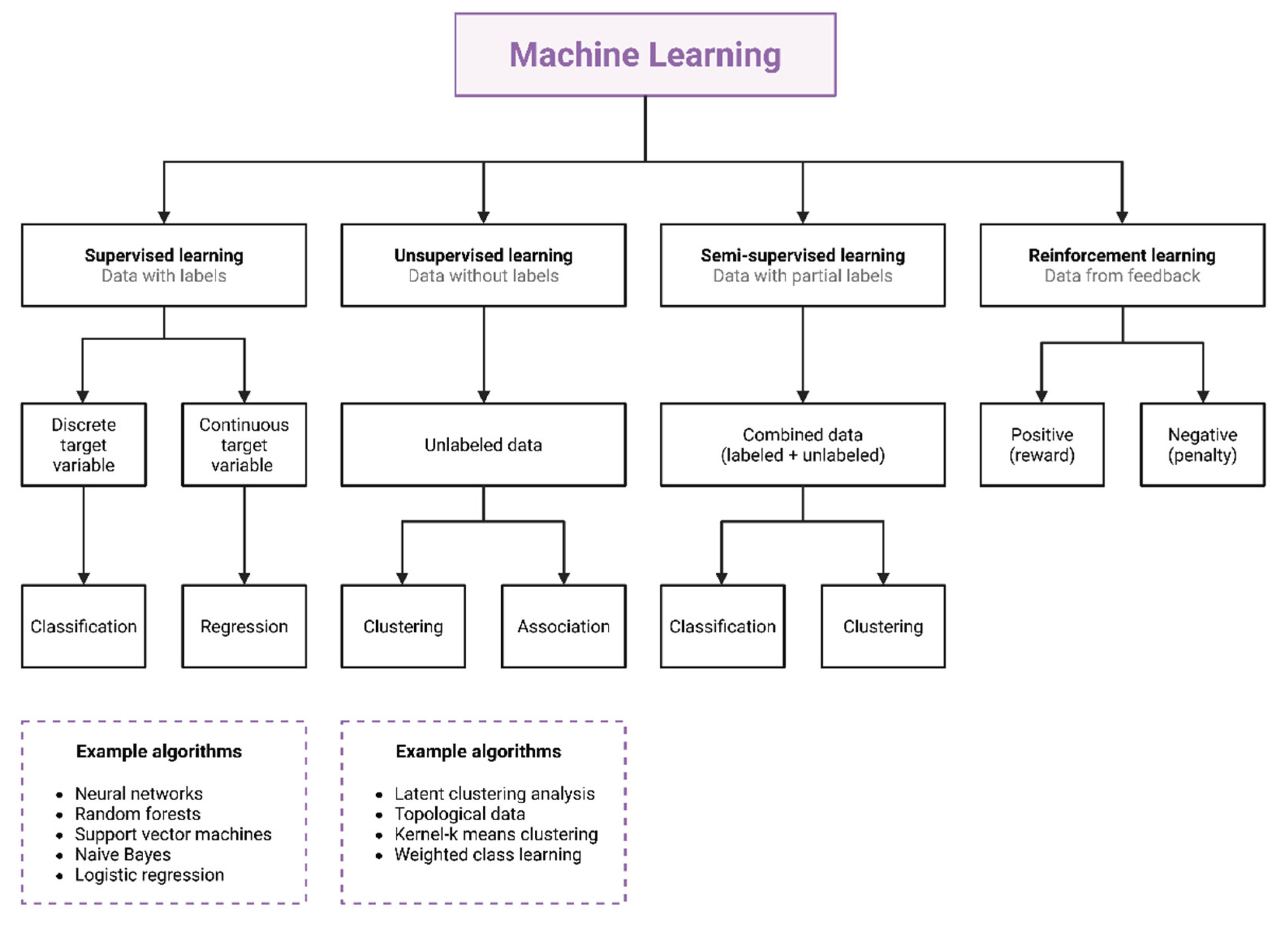
Figure 2.
Common Machine Learning (ML) Algorithms.
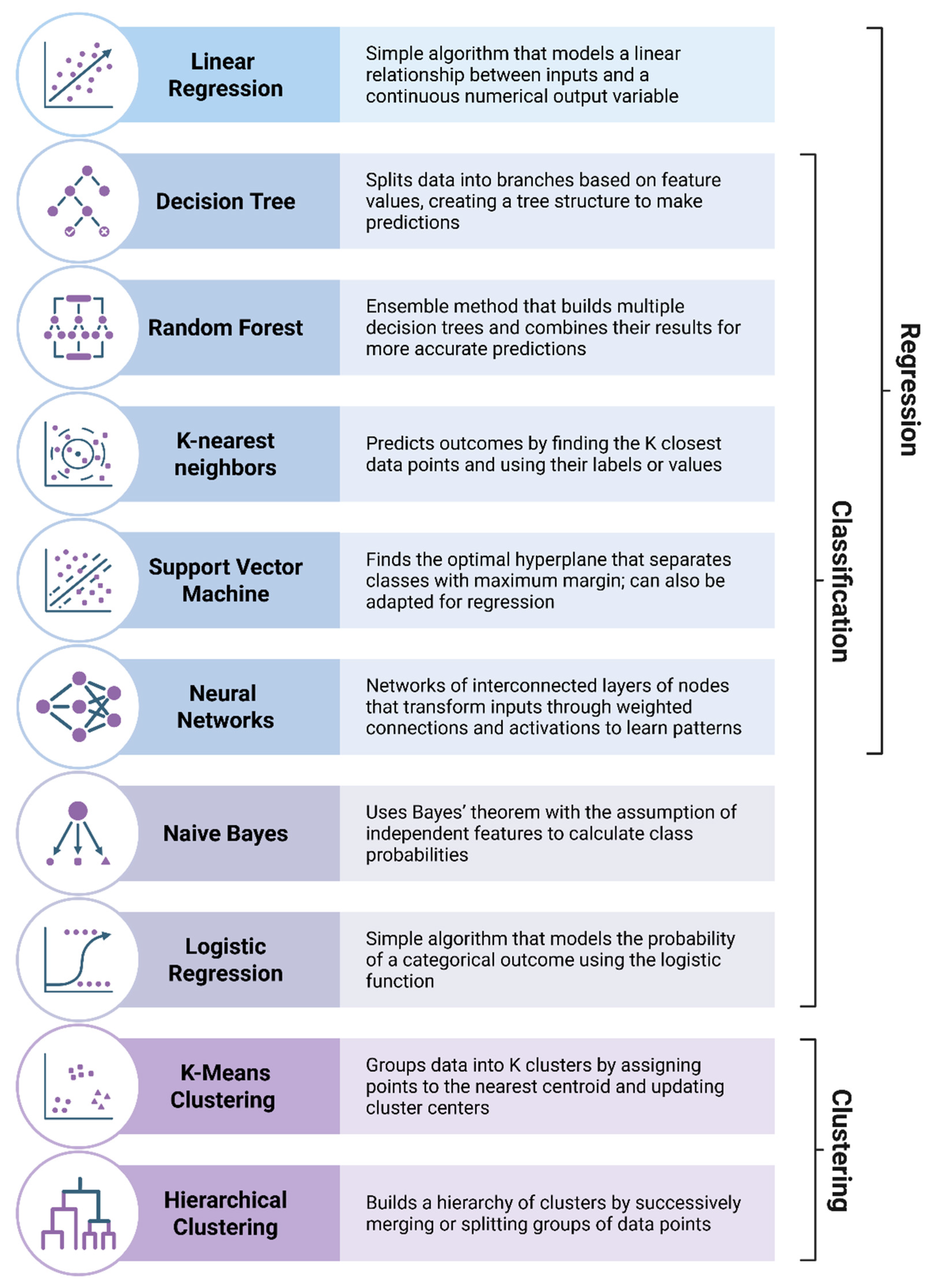
Figure 1.
Machine Learning (ML) Pipeline.
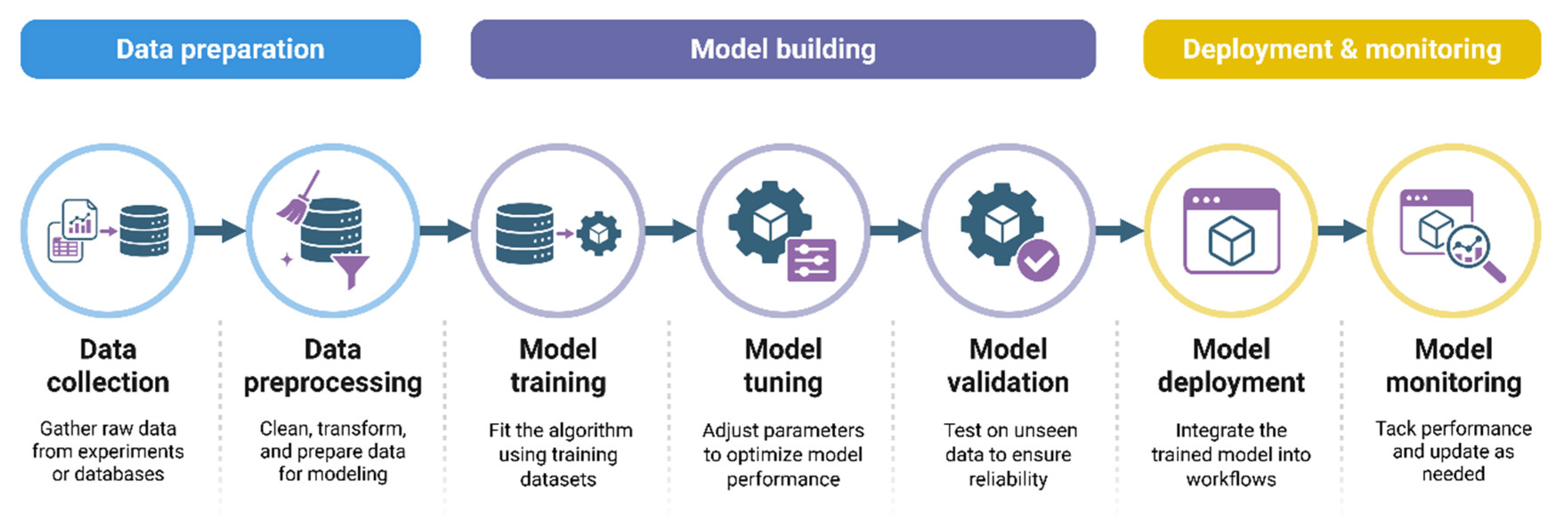
Figure 4.
Integration of Machine Learning with Pharmacokinetic/Pharmacodynamic Modeling in Geriatric Precision Medicine.
Figure 4.
Integration of Machine Learning with Pharmacokinetic/Pharmacodynamic Modeling in Geriatric Precision Medicine.
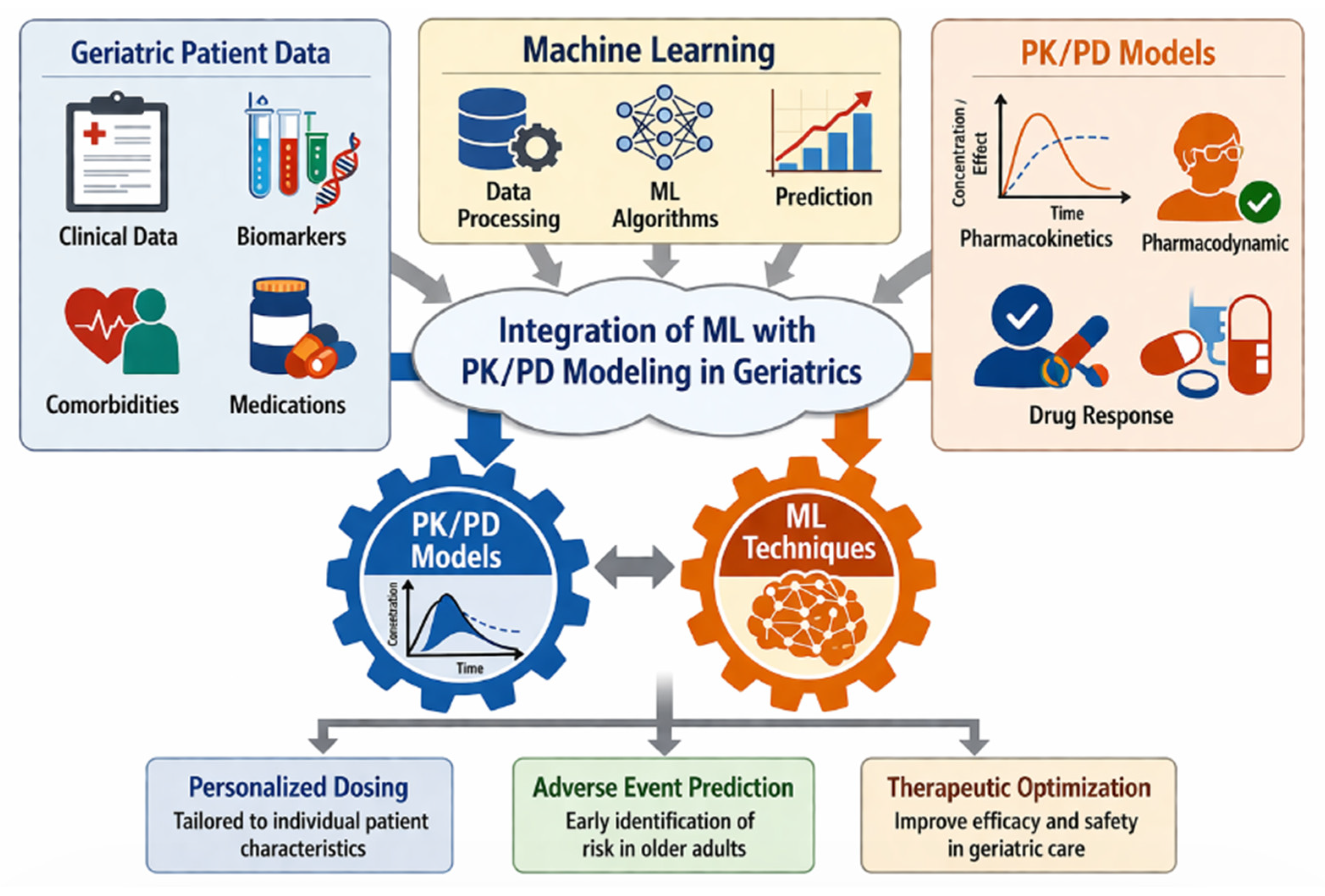

Table 1.
Reasons for Increased Vulnerability to Medications in Frail Older Adults.
| Reason | Underlying Change | Clinical Comment/Impact |
|---|---|---|
| Changes in body composition | ↑ Proportion of body fat | Lipophilic drugs (e.g., benzodiazepines) have ↑ volume of distribution → prolonged half-life and accumulation |
| ↓ Proportion of total body water | Hydrophilic drugs (e.g., digoxin, lithium) reach higher plasma concentrations | |
| ↓ Muscle mass | Reduced creatinine production → renal function may be overestimated | |
| Altered drug clearance | ↓ Hepatic metabolism | Reduced phase I metabolism → ↑ bioavailability and toxicity of many drugs |
| ↓ Renal elimination | Accumulation of renally cleared drugs → ↑ risk of adverse drug reactions | |
| Increased vulnerability to toxicity | ↑ Blood–brain barrier permeability | Greater Central Nervous System (CNS) effects (confusion, sedation, delirium) |
| Atypical presentation of adverse effects | Non-specific symptoms | Falls or delirium may not be immediately recognized as medication-related |
| Polypharmacy | Multiple concurrent medications | ↑ Risk of drug–drug interactions (e.g., aspirin + Selective Serotonin Reuptake Inhibitors (SSRI) → ↑ Gastro-Intestinal (GI) bleeding risk) |
| Multimorbidity | Multiple coexisting diseases | ↑ Risk of drug–disease interactions (e.g., opioids worsening constipation) |
Adapted from [23].
Table 2.
Pharmacodynamic factors and their impact on geriatric patients.
| Pharmacodynamic Factor | Impact in Geriatrics |
|---|---|
| Altered receptor sensitivity | Changes in receptor number or responsiveness may reduce or enhance drug effects, sometimes necessitating dose adjustments |
| Drug metabolism (PD-related response) | Slower metabolic processes can prolong drug action and increase the risk of accumulation and adverse effects |
| Physiological changes | Age-related alterations in organ function influence drug distribution, elimination, and tissue responsiveness |
| Increased susceptibility to Adverse Drug Events (ADEs) | Older adults have greater vulnerability to ADEs, requiring cautious dosing and close monitoring |
| Pharmacodynamic interactions | Coexisting diseases and polypharmacy increase the likelihood of clinically significant drug–drug and drug–disease interactions |
Adapted from [21].
Table 3.
ML algorithms and their usage in the clinical setting.
| Algorithm | Clinical Application | Output Type | Performance & Key Findings | Source |
|---|---|---|---|---|
| RF | Warfarin blood levels (International Normalized Ratio (INR)) | Continuous | Optimal for raw data/59.0% ideal prediction percentage and 0.595 correlation in validation. | [37] |
| GDA | Warfarin blood levels (INR) | Categorical | Best for categorical output/total True Positive Rate (TPR) of 95.6%. Provides an explicit equation. | [37] |
| Shallow Neural Network (SNN) | Heparin dosing (activated partial thromboplastin time (aPTT)) | Categorical | Performed best across 3 datasets (F1 scores: 85.98%–87.55%). Outperformed ensemble models. | [38] |
| L-BFGS (Optimizer) | 2-Compartment PK parameters | Continuous | Significantly faster training (~3.4s) compared to Adam (>2400s) for small-scale datasets. | [36] |
| Adam (Optimizer) | 2-Compartment PK parameters | Continuous | Used in a hybrid approach; effective for solving inverse problems but slower in small datasets. | [36] |
| Extreme Gradient Boosting (XGBoost) | Heparin dosing (aPTT) | Categorical | Achieved second-best F1 scores (73.94%–78.85%). More robust than traditional RF for heparin data. | [38] |
| Support Vector Machine (SVM) | Heparin dosing (aPTT) | Categorical | Achieved 100% precision for normal and supratherapeutic classes but had lower recall than SNN. | [38] |
| Adaptive Boosting (AdaBoost) | Heparin dosing (aPTT) | Categorical | Performance was competitive with XGBoost, reaching up to 81.67% F1 score in specific datasets. | [38] |
| Multilayer Perceptron (MLP) | Warfarin blood levels (INR) | Continuous/Categorical | Demonstrated lower correlation (0.475) and higher error rates compared to RF or GDA. | [37] |
Table 4.
Comparative predictive performance: ML algorithms vs. traditional PopPK models.
| Drug | ML Model | ML Performance (R²) | Population PK Performance (R²) | Accuracy Improvement (F30%) | Comments |
|---|---|---|---|---|---|
| Cyclosporine | ANN | 0.75 | 0.68 | 56.46% (ML) vs 51.22% (PopPK) | ML showed modest but clinically relevant improvement over PopPK |
| Vancomycin | ML Ensemble (SVR, LightGBM, CatBoost) | 0.656 | 0.218 | 76.62% (ML) vs 53.75% (PopPK) | Marked superiority of ML in exposure prediction |
| Voriconazole | ML Ensemble | 0.828 | Not specified | Minimal MAPE achieved (0.772) | High predictive accuracy despite lack of PopPK comparator |
| Tacrolimus | Regression Tree | 0.73 | 0.71 (Multiple Linear Regression) | 56.1% ideal rate | ML marginally outperformed traditional regression |
Adapted from [13].
Table 5.
Multi-objective precision dosing targets for elderly populations.
| Clinical Condition | Primary Biomarker(s) | Individual-Level Target | Clinical Goal | Clinical Rationale | Source |
|---|---|---|---|---|---|
| Metastatic Cancer (Erdafitinib) | Serum phosphate ([PO₄³⁻]) | 5.5–7.0 mg/dL | Balance antitumor efficacy while limiting hyperphosphatemia | Serum phosphate serves as a pharmacodynamic biomarker reflecting Fibroblast Growth Factor Receptor (FGFR) inhibition intensity | [68,69] |
| Polycythemia Vera (Givinostat) | Platelets, WBC, Hematocrit | Complete Hematologic Response (CHR) | Simultaneous normalization of all three blood cell lines | Multi-parameter control is required to reduce thrombotic risk and disease progression | [68,69] |
| Renal Impairment (Direct Oral Anti-Coagulants (DOACs)) | Plasma drug concentration / renal function | 25–30% dose reduction | Maintain therapeutic anticoagulation while minimizing bleeding risk | Age-related renal decline significantly increases DOAC exposure | [70] |
| Critical Care (Vancomycin) | Serum concentration (or AUC-guided exposure) | 15–25 mg/L (or AUC/MIC 400–600) | Achieve stable exposure while preventing nephrotoxicity | Narrow therapeutic index; elderly patients are highly susceptible to Acute Kidney Injury (AKI) | [69] |
Disclaimer/Publisher’s Note: The statements, opinions and data contained in all publications are solely those of the individual author(s) and contributor(s) and not of MDPI and/or the editor(s). MDPI and/or the editor(s) disclaim responsibility for any injury to people or property resulting from any ideas, methods, instructions or products referred to in the content. |
© 2026 by the authors. Licensee MDPI, Basel, Switzerland. This article is an open access article distributed under the terms and conditions of the Creative Commons Attribution (CC BY) license (http://creativecommons.org/licenses/by/4.0/).
Copyright: This open access article is published under a Creative Commons CC BY 4.0 license, which permit the free download, distribution, and reuse, provided that the author and preprint are cited in any reuse.


