

Submitted:
19 November 2026
Posted:
20 November 2026
You are already at the latest version
Abstract
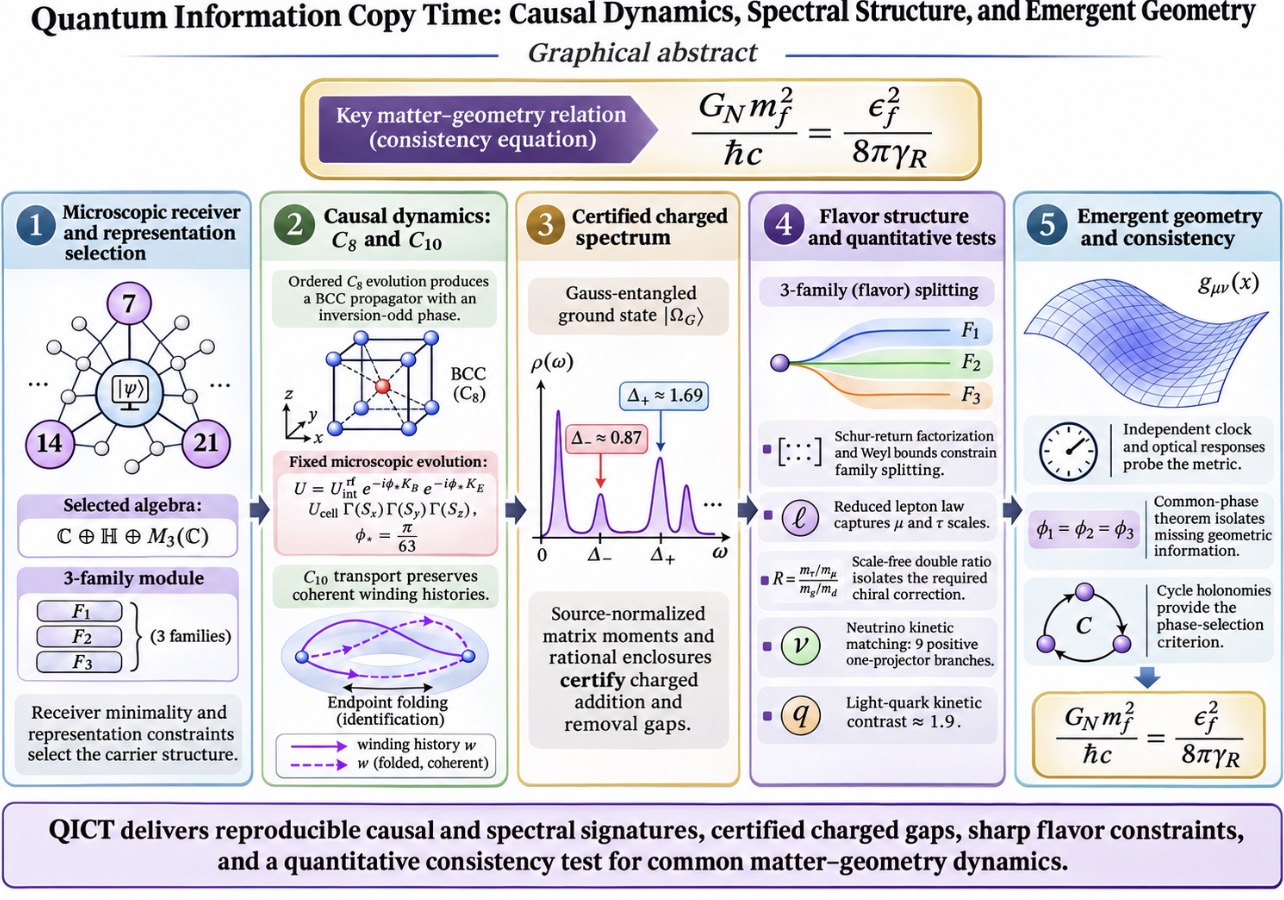
AbstractQuantum Information Copy Time (QICT) develops a microscopic account of how a finite receiver resolves gauge-covariant transport, charged excitations and geometric response. Receiver minimality and representation constraints select carriers of ranks 7, 14 and 21, the algebra C ⊕ H ⊕ M₃(C) and a three-family module.Ordering the C8 evolution produces a body-centered-cubic propagator with an inversion-odd phase; coherent C10 transport preserves exterior winding histories that endpoint folding cannot distinguish. Source-normalized matrix moments yield positive spectral measures and controlled threshold estimators. In an interacting four-link fermion–gauge model, a Gauss-entangled ground state supports charged addition and removal gaps Δ₊ ≃ 1.69 and Δ₋ ≃ 0.87, certified by rational enclosures.Schur-return factorization, central-channel rank bounds and a sharp Weyl inequality constrain the origin of three-family mass splitting. An electron-calibrated reduced law captures the muon and tau mass scales, while its scale-free double ratio resolves the small chiral correction required for agreement with precision data. Neutrino kinetic matching gives nine positive one-projector branches; the light-quark mass ratio fixes a relative kinetic contrast near 1.9. These calibrated comparisons specify quantitative tests of the interacting kernel.Independent clock and optical responses probe the metric, and a common-phase theorem isolates the geometric information absent from normalized matter propagation. Cycle holonomies furnish a precise criterion for selecting the missing transition phases.Together, the results establish reproducible causal and spectral signatures and a concrete test of common matter–geometry dynamics.
Keywords:
lattice gauge dynamics
; chiral propagators
; spectral invariants
; coherent transport
; charged spectra
; clock holonomies
; emergent geometry
Copyright: This open access article is published under a Creative Commons CC BY 4.0 license, which permit the free download, distribution, and reuse, provided that the author and preprint are cited in any reuse.