
Submitted:
02 April 2026
Posted:
07 April 2026
You are already at the latest version
Abstract
Path planning is critical for multi-robot systems (MRS), directly affecting task efficiency, execution time and operational cost. Despite extensive research and the successful application of numerous algorithms, achieving globally optimal solutions in cluttered or dynamic environments remains a significant challenge. Issues such as scalability with in-creasing numbers of robots, computational efficiency, system robustness, and coordination complexity continue to drive the development of more reliable approaches. This study reviews modelling approaches, optimisation criteria, and solution algorithms based on roadmap planning methods that are widely used for multi-robot path planning (MRPP). It focuses on three graph-based algorithms: Multi-Robot Path Planning algorithm, Central Algorithm (CA), and the Optimisation Central Algorithm (OCA). These algorithms utilise visibility graphs (VG) for environment representation and the Dijkstra’s algorithm for shortest-path computation, while incorporating algebraic connectivity to improve coordination, safety and scalability. In addition, the technological context and implementation platforms, including simulation environments, cloud robotics, and AI-based frameworks, are conceptually examined. The potential applications of these methods in assistive robotics are highlighted, particularly in supporting safe and reliable navigation in healthcare and human-centered environments. The paper synthesises theoretical and practical insights, identifies current limitations and challenges, and outlines future re-search directions for efficient, scalable and robust MRPP.
Keywords:
multi‐robot systems
; multi‐robot path planning
; graph‐based planning
; algebraic connectivity
; collision avoidance
; optimised paths
; connectivity preservation
1. Introduction
The growing reliance on autonomous robotic systems across various domains, including industrial, medical, military, and environmental applications, has intensified the need for effective multi-robot coordination strategies [1,2,3]. Multi-Robot Systems (MRS) offer significant advantages over single-robot frameworks, notably in terms of task efficiency, operational robustness, and system scalability [1,4,5]. These capabilities are particularly valuable in complex, hazardous, or dynamically changing environments [6,7,8]. Despite these advantages, the fundamental challenge of multi-robot motion planning persists [2,9,10], where the task requires devising collision-free, computationally efficient, and synchronised paths to ensure seamless coordination for robots operating within shared environments [1,11,12,13]. Effective path planning in MRS not only reduces task execution time but also minimises energy consumption, mechanical wear, and overall operational effort. However, guaranteeing globally optimal and computationally efficient solutions, particularly in environments with dense obstacles or complex interaction constraints, remains a significant challenge despite decades of research and development [6,14,15,16]. As the number of robots increases, issues such as scalability, coordination complexity, communication maintenance, robustness, and fault tolerance become further challenging. A wide variety of path planning approaches have been proposed, including grid-based, sampling-based, and roadmap-based methods. Among these, roadmap-based motion planning techniques have been widely adopted for multi-robot systems due to their ability to transform continuous planning problems into discrete graph search problems with provable optimality guarantees [17,18,19,20,21,22,23,24,25].
Graph-based methods offer a structured approach to modelling these environments and interactions, facilitating the design of algorithms that leverage recent advancements [17,18,19,20,26,27,28,29]. These include visibility graphs providing an effective representation for navigating static polygonal environments while supporting optimal path computation through classical shortest-path algorithms [21,22,30,31,32,33,34,35]. The contribution of this paper is to provide a comprehensive review of graph-based roadmap planning methods for multi-robot path planning, with a specific focus on three representative algorithms: the Multi-Robot Path Planning (MRPP) algorithm, the Central Algorithm (CA), and the Optimisation Central Algorithm (OCA). These algorithms share a common foundation in visibility graph construction and the Dijkstra’s algorithm for optimal path search, while differing in their planning architectures, optimisation criteria, and safety mechanisms [1,23,24,25,26,27,28,29]. Notably, metrics derived from algebraic graph properties, e.g., algebraic connectivity (λ₂) and eigenvalue-based techniques to enhance coordination, connectivity preservation, and collision avoidance [9,36,37,38,39,40]. These enable robots to navigate obstacle-rich environments efficiently [1,7,41,42,43,44,45,46,47,48,49]. Graph-based methods offer not only a mathematically rigorous foundation but also the flexibility to incorporate coordination and optimisation in modern MRS applications [24,25,26,27,50,51,52,53,54,55,56,57,58,59,60]. Furthermore, the potential implementation of these algorithms is discussed through enabling technologies such as simulation platforms, cloud robotics, and AI-based frameworks to assess their applicability in real-world scenarios [61,62,63,64,65,66,67,68,69,70]. In addition, the relevance of these approaches to emerging application domains, such as assistive robotics, is considered, where safe, reliable, and human-aware navigation is essential [71,72,73,74,75,76,77,78,79,80,81,82,83,84,85,86,87,88,89,90,91,92,93]. This study makes several important contributions to the field of MRPP.
- It provides a clear, structured review of various graph-theoretic motion planning strategies, highlighting their foundational principles and applicability in diverse robotic environments.
- It introduces novel hybrid approaches that blend classical roadmap techniques with algebraic graph theory.
- It evaluates both well-established methods and the newly proposed algorithms in terms of computational efficiency, robustness, path optimality, and adaptability in density environments.
The objective of this review was to analyse the modelling approaches, optimisation criteria, and solution strategies employed by these algorithms, highlighting their theoretical contributions and practical performance trade-offs. Each algorithm has been designed to address different levels of environmental complexity and operational demands in multi-robot systems. In addition, persistent challenges in MRPP are discussed, and potential future research directions are identified to support the development of more scalable, safe, and efficient multi-robot systems.
The remainder of this paper is organised as follows. Section 2 provides an overview of multi-robot systems (MRS), their classifications based on the scope of this review, and highlights the relevance of graph-theoretic foundations in MRS research. Section 3 describes the methodology adopted for conducting this review and introduces the main algorithms considered for multi-robot path planning. Section 4 presents a comprehensive taxonomy of multi-robot path planning methods. Section 5 reviews and analyses the three graph-based planning algorithms investigated in this study, namely MRPP, CA, and OCA, and discusses the key challenges associated with multi-robot path planning. Finally, Section 6 concludes the paper and summarises the future research in this field.
2. Materials and Methods
The review adopts a structured methodology to identify, select, and analyze relevant literature on graph-based multi-robot path planning. The objective was to ensure a comprehensive evaluation of existing approaches, with a particular focus on MRPP, Centralized Approaches (CA), and Optimization-based Centralized Coordination Approaches (OCA) [2,9,31]. The review was conducted following the PRISMA 2020 (Preferred Reporting Items for Systematic Reviews and Meta-Analyses) framework to ensure transparency and reproducibility in the study selection process.
2.1. Literature Search Strategy
A comprehensive literature search was undertaken across multiple academic databases, including IEEE Xplore, ScienceDirect, SpringerLink and Google Scholar. The search covered publications from 2012 to 2026 to capture the most recent advancements in decentralized coordination [6,15], communication-efficient task allocation [7], and adaptive formation tracking [8].
Search keywords included combinations of the following terms:
- Multi-robot path planning (MRPP)
- Collision avoidance (CA) and obstacle-aware collision avoidance (OCA)
2.2. Study Selection and Eligibility Criteria
The selection process, illustrated in the PRISMA flow diagram (Figure 1), followed predefined inclusion and exclusion criteria to ensure the technical relevance and quality of the reviewed literature. The diagram also distinguishes between core reviewed studies and supporting references used for theoretical and technological context. The selections are further outlined in Table 1.
Studies were included if they met the following benchmarks:
- i.
- ii.
- iii.
- iv.
Studies were excluded if they:
2.3. Data Extraction and Synthesis
The initial search yielded 220 papers. After removing 40 duplicates, 180 records were retained for screening. The articles’ titles and abstracts were reviewed, resulting in 95 studies selected for full-text assessment. Following full-text evaluation, a final library of 93 references met the required criteria. This includes 40 primary research articles identified through rigorous eligibility mapping and 53 references were included to support theoretical foundations (e.g., Fiedler's algebraic connectivity [19]), background concepts, and enabling implementation platforms such as robot operating system (ROS), Gazebo, and Webots used to provide comprehensive technological context for MRPP, CA, and OCA frameworks [75,76,77].
3. Multi-Robot Systems
Multi-Robot Systems (MRS) consist of multiple robots working collaboratively within a shared environment to perform tasks that may be too complex, large-scale, or hazardous for single-robot systems [30,31,32,33,34,35]. The main reason for the growing interest in this system, is their ability to withstand system failures by creating redundant processes and expanding responsibilities (if one of the robots fails, the others step in). Thus, the system provides a decreased failure rate [31,32,33,34,35,36]. Even in the event of individual robot failure, remaining robots can seamlessly continue the task, thereby increasing the overall resilience and robustness of the system [3,4,34].
Despite, their many advantages, MRS face certain limitations and disadvantages that must be carefully considered. Coordination complexity remains a major challenge, particularly in dynamic and uncertain environments where communication and collaboration algorithms must operate reliably under changing conditions [1,2,33,37,38,39]. Communication constraints can further degrade system performance, especially in obstacle-rich or interference-prone settings, thereby necessitating robust mechanisms for dependable information exchange. Ensuring system robustness and fault tolerance is critical, as the failure of individual robots may adversely affect overall system performance [1,2,35,36,40]. This underscores the importance of continued research in this dynamic field to tackle emerging challenges such as coordination, path planning problems, communication, and autonomy under real-world constraints [1,6,10,41,42,43]. Figure 2 illustrates an example of a MRS consisting of 5 robots ( represented as undirected graph.
3.1. Classification of Multi-Robot Systems
MRS can take many forms, varying by their configurations, missions, and operational domains. To contextualise this variety, it is essential to understand the various aspects that affect the development of these systems. The taxonomy proposed in this study focuses on three critical dimensions: composition, coordination, and communication [1,5,6].
3.1.1. Composition (Homogeneous vs Heterogeneous)
Composition refers to the physical and functional makeup of a robot team, particularly the distinction between homogeneous and heterogeneous multi-robot systems. This distinction is defined by the capabilities and functionalities of the robots comprising the system [1,2,4,5]. Homogeneous systems consist of identical robots equipped to perform the same tasks and are commonly employed in applications requiring the parallel execution of simple operations, such as search and rescue, surveillance, and mapping. These systems are generally easier to design, deploy, and control, and are often more cost-effective due to their uniform hardware and simplified coordination requirements. In contrast, heterogeneous systems comprise robots with diverse capabilities, such as combinations of aerial and ground vehicles, enabling them to address more complex tasks including construction, exploration, and transportation [32,43]. By leveraging complementary strengths, heterogeneous teams offer greater flexibility and adaptability and can mitigate limitations of homogeneous systems, particularly in dynamic or uncertain environments. However, this increased capability comes at the cost of higher system complexity in terms of coordination, communication, and control [1,2,4,5,32].
3.1.2. Composition : Homogeneous Versus Heterogeneous
Coordination concerns how tasks are distributed and synchronised across a robot team. Effective coordination is essential for achieving collective objectives, minimising conflicts, and ensuring temporal consistency in collaborative tasks [1,6,7,10,33,34]. Coordination strategies are commonly categorised by their decision-making structure. In centralised coordination, a leader maintains global knowledge of the environment and robot states, enabling efficient global planning and simplified control. It is possible to allow more than one member to acquire the role of a leader during the mission, this offers strong performance guarantees and simplifies coordination. This approach offers strong performance guarantees but is sensitive to communication failures and is best suited to small teams operating in static, known environments [1,2,33,34]. In contrast, decentralised coordination relies on autonomous decision-making by individual robots, improving scalability and robustness to failures and environmental changes. However, decentralised methods often produce sub-optimal solutions and require sophisticated communication mechanisms to ensure collision avoidance and task completion [1,7,10,33,34].
3.1.3. Communication : Explicit, Implicit and Networked
Communication is the foundational backbone enabling coordinated action, information sharing, and collision avoidance in multi-robot systems. The choice of communication technology directly affects system scalability, robustness, efficiency, and overall performance. Robots must frequently exchange information to synchronise tasks, particularly in dynamic or unknown environments [1,2,6,7,12,36]. Recent studies emphasise communication-aware planning, where robots adapt their trajectories not only to avoid obstacles but also to maintain communication quality, as poor network reliability can significantly degrade team performance [6,12,15,20,27,35]. Addressing these challenges requires the co-design of communication protocols and control strategies, with current research focusing on scalable frameworks capable of supporting large robot teams and complex operations [6,7,8,10,24]. Communication modalities define how information is exchanged among robots. Communication can be explicit, such as wireless communication via Wi-Fi, or implicit, where robots infer information through sensing or interaction with the environment, which itself may act as a communication medium [1,7,8]. Accordingly, inter-agent interaction can occur through sensing, direct communication, or environmental cues [1,6]. The simplest form, sometimes referred to as cooperation without communication, relies solely on environmental interaction [1,35,36]. More recently, dynamic network models have been adopted to represent varying communication and sensing relationships among mobile robots, offering a flexible and effective framework for coordinating multi-robot operations [7,8,10,43]. These categories are illustrated in Figure 3, which provides a structured framework for analysing different MRS architectures.
3.2. Motivation and Challenges in Multi-Robot Path Planning
Path planning is a fundamental problem in robotics as it directly governs a robot’s ability to navigate safely and efficiently in complex environments. The motivation for developing advanced path planning algorithms arises from the need to generate collision-free, optimal, and computationally efficient trajectories that can be reliably executed in real-world applications [1,25,40,41]. In MRS, this motivation becomes more pronounced due to the requirement for coordination among multiple robots operating within a shared workspace. Robots must not only avoid static obstacles but also prevent inter-robot collisions while accomplishing collective tasks [1,25,44]. These requirements introduce significant challenges, including scalability with respect to the number of robots, communication constraints for maintaining coordination, and robustness against individual robot failures. Addressing these challenges necessitates the development of planning algorithms capable of producing near-optimal solutions with low computational overhead, thereby bridging the gap between theoretical optimality and practical applicability [42,43].
3.3. Graph-Theoretic Foundations for Multi-Robot Planning
Graph theory, a branch of discrete mathematics, has become a foundational tool in robotic motion planning, particularly within multi-robot systems [1,2,20,42]. Originating from Euler’s solution to the Königsberg bridge problem in 1736 [1,19], graph theory has evolved into a powerful mathematical framework for modelling networks, connectivity, and pathfinding. In the context of multi-robot navigation, it provides an abstract yet structured representation of the workspace, enabling efficient modelling of spatial configurations, obstacles, communication links, and inter-robot interactions [25,26,42]. This abstraction is especially valuable for addressing key challenges in path optimisation, coordinated control, and connectivity preservation in complex environments [15,20,24]. A graph consists of a set of vertices and edges . In robotic motion planning, vertices may correspond to the robot positions, waypoints, or obstacle vertices, while the edges represent feasible paths, visibility relations, or communication links between entities [1,21,26,44]. Graphs can be directed or undirected and may be weighted or unweighted. Weighted graphs are particularly important in robotics, as edge weights can encode distance, energy consumption, traversal cost, or collision risk, enabling more precise optimisation and decision-making in complex environments [2,6,15,25,40].
3.3.1. Algebraic Graph Theory: Connectivity and Robustness
Algebraic graph theory extends classical graph concepts by analysing the spectral properties of matrices associated with graphs, most notably the adjacency and Laplacian matrices. In recent years, these tools have gained significant attention in multi-robot systems due to their ability to quantify and preserve communication connectivity and coordination robustness [15,18,19,24,45]. Connectivity-preserving control strategies based on Laplacian eigenvalues have been widely adopted to ensure reliable cooperation, even in partially connected or dynamically changing environments [15,24]. These methods not only enhance robustness but also support the scalability of multi-robot systems in real-time applications [7,8,46,47].
For a weighted graph, the adjacency matrix is defined as where represents the weight of the edge between nodes and , and otherwise. The diagonal matrix (D) has entries corresponding to the sum of the weights of edges incident on each node [15,18,45]. The weighted Laplacian matrix is then defined as: , where A is the adjacency matrix. The eigenvalues of the Laplacian matrix (provide critical insight into network structure. For an undirected graph, the smallest eigenvalue = 0 always exists and corresponds to a constant eigenvector. The multiplicity of these zero eigenvalues equals the number of connected components in the graph. The second smallest eigenvalue, known as the algebraic connectivity or Fiedler value quantifies the robustness of the connected the graph. A larger indicates stronger connectivity, greater robustness to link failures, and improved resilience of communication networks [1,3,10,26,27,28,29,47].
In multi-robot networks, for a connected communication graph , the zero eigenvalue naturally arises from the Laplacian’s structure and represents the baseline connectivity of the graph. The value of λ₂ ranges between 0 and the number of vertices (N), and the connectivity refers to the number of vertices in the graph, if the graph is completely connected. Thus, the maximum value of =N and it is obtained when the entries of the adjacent matrix (A) are all equal to 1, this means all possible edges are present in it [10,28,29,47]. Figure 4 illustrates examples of robot interaction graphs with varying levels of algebraic connectivity, demonstrating how higher values of λ₂ correspond to stronger and more robust communication topologies [1,15,18,19,24].
3.3.2. Graph-Based Motion Planning Techniques
Graph-theoretic models form the backbone of many classical and modern motion planning techniques. Among the most prominent are Cell Decomposition (CD), Roadmap Methods (RM), including Visibility Graphs (VG), and Voronoi Diagrams (VD) and Potential Fields (PF). Each technique offers distinct advantages, trade-offs, and suitable application contexts [9,11,13,14,21,26,48,49]. Our review focuses on the roadmap-based techniques. Figure 5 illustrates path planning method techniques.
3.3.2.1. Roadmap Methods
Roadmap (RM) methods offer a balanced and scalable framework for multi-robot motion planning by representing the free configuration space as a graph, where the vertices correspond to valid configurations and the edges denote feasible transitions [21,25,26,49]. This abstraction enables efficient path computation using classical graph search algorithms [21,23,25]. Roadmap methods are scalable and well suited to environments with sparse, known obstacles and support efficient replanning in semi-dynamic settings without requiring complete reconstruction of the graph [2,6,25,48,49,50]. Key roadmap-based methods include:
- Visibility graph (VG): This is a subclass of roadmap methods that connects all pairs of mutually visible vertices (e.g., obstacle corners and robot or goal positions) with straight lines. It produces the shortest possible paths in a polygonal environment [1,21,25,50,51]. However, VG has notable drawbacks: it often generates paths that pass too close to the obstacles. This can be unsafe in practical applications, and it scales poorly as the number of obstacles increases. VG is most effective when path optimality is crucial, and the environment is static and fully understood [1,22,51].
- Voronoi Diagram (VD): It represents another roadmap technique that generates paths equidistant from the closest obstacles. This approach emphasises safety by maximising obstacle clearance, making it ideal in situations where collision risk must be minimised (e.g., high-speed navigation or uncertain sensing) [1,14]. Though VD paths may not be the shortest, the diagram is more scalable than VG and moderately complex to implement. Like VG, VD is not well-suited for rapidly changing environments that require pre-computation adjustments [14,27,50]. The operations of VG and VD are illustrated in Figure 6.
VG and VD have long been foundational techniques in robot path planning for static, well-structured environments [22,26,49,50]. However, they often exhibit limitations when dealing with dynamic obstacles or complex, high-dimensional spaces due to their pre-computational nature and scalability constraints [14,22,26]. VG provides optimal, shortest paths but often compromises safety by routing paths too close to obstacles that is suboptimal for practical applications where robustness is critical [14,26]. In contrast, VD prioritises safe navigation by maximising obstacle clearance, making it more suitable for high-speed or uncertain environments, though at the cost of path optimality [14,22,50]. These techniques methods are fundamentally supported by graph-theoretic models, which facilitate planning through: graph search algorithms (e.g., the Dijkstra’s, A*, D*) [10,15,24,54,55,56,57,58,59,60].
3.3.2.2. Graph Search Algorithms
Graph search algorithms play a central role in robot path planning, particularly within roadmap-based and grid-based representations of the static environment. Among the most used methods are the Dijkstra’s and A* algorithms, both of which compute shortest paths on weighted graphs but differ in efficiency and heuristic guidance.
The Dijkstra’s algorithm guarantees optimal solutions in graphs with non-negative edge weights and is deterministic, making it well suited to offline planning in fully known environments [1,21,25,57,58,59]. In contrast, A* improves computational efficiency through heuristic guidance but requires admissible and consistent heuristics that can be difficult to define in complex polygonal environments. Incremental methods such as D* are designed for dynamic or partially known environments by updating paths as conditions change, but they introduce additional computational overhead [1,10,15,16,24,41].
In multi-robot systems, the Dijkstra’s algorithm is therefore commonly preferred during offline planning stages due to its robustness, simplicity, and guaranteed optimality, whereas A* and D* are more suitable for real-time replanning in dynamic settings [1,2,4,12,25]. Since this review focuses on offline planning in static, fully known environments and employs VG representations, the Dijkstra’s algorithm is adopted to ensure deterministic behaviour and globally optimal path solutions, while heuristic-based and incremental methods are not considered [1,2,15,21,25,56].
3.4. Role of Graph Theory in Multi-Robot Planning Architectures
Graph theory graph-theoretic planning offers a structured and effective framework for modelling, analysing, and solving coordination and navigation problems in multi-robot systems (MRS). By abstracting robots, environments, and their interactions as vertices and edges, graph-based representations enable systematic analysis of connectivity, collision avoidance, and path optimality [1,43,52,53,54]. This abstraction is particularly effective for multi-robot path planning in structured and static environments. A key advantage of graph-theoretic planning lies in its modularity. The environment is represented as a roadmap graph, while robot states and interactions are incorporated as adaptable components, allowing obstacle geometry, start and goal positions, and inter-robot relationships to be modified independently [49,57]. This modular structure supports scalable and reusable planning architectures [1,2,5,53]. In addition, classical graph search algorithms most notably the Dijkstra’s algorithm guarantee optimal solutions in graphs with non-negative edge weights. In roadmap-based planners such as MRPP, CA, and OCA, this reduces continuous motion planning to a discrete shortest-path problem, ensuring optimal trajectories with respect to the underlying graph [1,2,3,25].
Graph-theoretic frameworks also facilitate coordination and collision avoidance by encoding obstacle constraints and inter-robot distances within graph structures and edge weights [52,53]. When integrated with visibility graph representations and Laplacian-based connectivity analysis, these methods provide a mathematically grounded and computationally efficient basis for coordinated navigation [3,4,7,8,10,12,18]. Scalability and robustness are further enhanced through spectral graph theory, where λ₂, quantify network cohesion and support connectivity-preserving planning strategies [52,53,54]. In multi-robot planning, λ₂ is used to preserve communication connectivity and guide robot prioritisation, a capability that is central to the MRPP framework [6,15,19,24]. Collectively, these properties establish graph theory as a central foundation for multi-robot path planning. The reviewed MRPP, CA, and OCA algorithms exploit visibility graph representations and spectral graph properties to enhance coordination, efficiency, and safety in structured and static environments.
4. Visibility Graph–Based Planning and Algebraic Connectivity
VG based planning provides a principled and mathematically rigorous framework for multi-robot path planning in static and structured environments. In a VG representation, the vertices correspond to obstacle vertices as well as the robots’ start and goal positions. The edges represent direct line-of-sight connections that do not intersect any obstacles [1,51]. Each edge is typically weighted by its Euclidean length, transforming the continuous motion planning problem into a discrete shortest-path search on an undirected weighted graph. When combined with exact graph search algorithms, this representation guarantees shortest-path optimality with respect to the constructed roadmap [50,51,52].
In multi-robot path planning, the VG-based roadmaps are particularly effective in sequential planning architectures, where paths generated for earlier robots influence the planning space of subsequent robots [1,52]. In this context, VG offers deterministic behaviour and predictable performance that are essential for analysing coordination strategies and optimisation criteria. The MRPP, CA, and OCA algorithms all adopt VG-based representations as their foundational roadmaps. By integrating VG geometry with connectivity-aware coordination mechanisms, these algorithms achieve efficient, collision-free, and coordinated motion planning across multi-robot teams.
4.1. Visibility Graph Construction and Graph-Based Representation
VG is constructed from an undirected weighted graph , where the vertex set consists of the obstacle corners together with the robot start and goal positions, and the edge set represents the feasible straight-line connections between mutually visible vertices. An edge exists, if and only if, the line segment connecting and does not intersect any obstacle boundary. The complete edge set can be expressed as E = where denotes visibility edges and represents the obstacle boundary edges [1,25,52]. The weighted is the Euclidean distance associated with each edge, enabling shortest path calculations using the Dijkstra’s algorithm. This formulation reduces motion planning to a graph optimisation problem while preserving geometric optimality in polygonal environments [60,61,62,63,64]. In multi-robot scenarios, robots operate within a shared two-dimensional workspace and are subject to communication constraints. The robot team can be modelled as an undirected weighted interaction graph, where each robot position represents a node and the edges indicate communication or sensing relationships within a limited range. Neighbourhood relationships are defined based on inter-robot distance, ensuring that robots can exchange information with nearby teammates. This graph-based representation provides a unified framework for integrating motion planning, communication awareness, and coordination constraints [1,25,52]. By combining VG roadmaps with inter-robot interaction graphs, planning algorithms can account for both environmental geometry and robot-to-robot relationships. This abstraction forms the basis for coordinated path planning with inter-robot awareness, enabling scalable and structured multi-robot navigation [65,66,67].
4.2. Algebraic Connectivity and Collision Avoidance
Algebraic connectivity provides a critical measure for coordinating multiple robots by quantifying the robustness of communication links within a robot network. In multi-robot path planning, λ₂ is particularly valuable for guiding coordination and prioritisation strategies and for supporting reliable information exchange among the robots [15,19,24]. Collision avoidance in practical multi-robot planning can be addressed through several complementary mechanisms. First, the planning problem can be formulated in a higher-dimensional configuration space, where each dimension represents the state of an individual robot and the collisions correspond to forbidden regions [1,19,66,67,68,69,70]. The Dijkstra’s algorithm can then be employed to compute collision-free paths within this space. Second, prioritised planning is commonly adopted, in which robots plan sequentially and paths generated for higher-priority robots are treated as dynamic obstacles for lower-priority robots thereby reducing inter-robot conflicts [26,68,70] Third, algebraic connectivity supports coordination and collision avoidance by guiding planning order and helping to prevent simultaneous conflicts in shared regions [3,14,15,19,24].
Among the reviewed algorithms, MRPP explicitly integrates algebraic connectivity into the planning process to sequence robots and preserve network cohesion during path generation. Although CA and OCA do not directly optimise λ₂, their reduced VG structures indirectly influence connectivity by simplifying interaction regions and improving safety margins. The combined use of VG and λ₂ therefore provides both geometric optimality and coordinated robustness, forming a strong foundation for scalable and reliable multi-robot path planning [14,25,64,65].
4.3. Multi-Robot Path Planning Algorithm
MRPP is a graph-based framework designed to address the coordination and navigation challenges in multi-robot systems operating within shared environments. The primary objective of MRPP is to generate collision-free and near-optimal paths for multiple robots while preserving robust inter-robot connectivity. MRPP integrates three fundamental components:
- (i)
- VG for modelling the environment and capturing shortest line-of-sight connections between vertices.
- (ii)
- The Dijkstra’s algorithm for computing optimal paths.
- (iii)
- Algebraic connectivity (λ₂) to assess and preserve communication robustness among robots.
A distinguishing feature of MRPP is its sequential planning strategy where the robots’ paths are generated individually rather than simultaneously. The planning order is determined using λ₂ such that robots whose trajectories are more critical to maintaining overall system connectivity are prioritised. This connectivity-aware sequencing reduces potential conflicts and enhances coordination robustness. Once a robot’s path is computed, it is treated as a dynamic obstacle for subsequent robots, ensuring inter-robot collision avoidance without requiring full replanning.
To further minimise conflicts, edge weights within the graph are dynamically adjusted based on previously planned paths, discouraging excessive overlap and promoting spatial separation among robot trajectories. By applying the Dijkstra’s algorithm on a well-constructed VG with modified weights, MRPP guarantees the shortest feasible paths under the given constraints while maintaining safety. This combination enables effective coordination, collision avoidance, and path optimality, making MRPP a suitable framework for multi-robot navigation in complex yet structured environments.
Despite its strengths, MRPP certain limitations, e.g., paths may pass close to obstacle boundaries thus potentially reducing safety margins in cluttered environments. The computational cost increases with environmental complexity and the number of robots that may limit scalability in highly cluttered or large-scale workspaces. In addition, as MRPP primarily relies on offline planning, its performance may degrade in highly dynamic environments that require frequent replanning. These limitations motivate the development of reduced-graph approaches such as CA and OCA that aim to retain the strengths of MRPP while improving efficiency and safety [1,25,26].
4.4. Central Algorithm (CA)
The CA is a roadmap-based path planning approach proposed to mitigate the high computational complexity associated with traditional VG methods while preserving near-optimal path quality. Although VG-based planning guarantees shortest paths in static environments, its computational cost grows rapidly with the number of obstacle vertices, making it less efficient in densely cluttered workspaces. CA mitigates this issue by introducing a structured reduction of the VG through the concept of a Central Baseline (CB).
CB is constructed between the start and goal positions of each robot. Only obstacles that intersect to this baseline are considered during roadmap construction. For each relevant obstacle, a limited set of waypoints (W) is generated in the free configuration space surrounding the obstacle, typically four waypoints per obstacle at strategic locations that enable safe detours. This selective process results in a reduced visibility graph, significantly decreasing the number of vertices and edges compared to a full VG. The Dijkstra’s algorithm is applied to compute the shortest path. By operating on a streamlined graph, CA achieves substantial improvements in computational efficiency while maintaining path lengths comparable to those produced by full VG-based planning. This makes CA particularly suitable for dense environments but spatially distributed obstacles where full VG construction is prohibitive.
Overall, CA provides an effective trade-off between optimality and efficiency. Its structured roadmap reduction makes it well suited for rapid offline planning in static environments where computational efficiency is critical. However, because CA prioritises efficiency, the resulting paths may pass closer to obstacle boundaries, leading to reduced safety margins in highly cluttered environments. This limitation motivates the Optimisation Central Algorithm (OCA) that extends CA by explicitly incorporating safety distance constraints while retaining its computational advantages [1,25,26].
4.5. Optimisation Central Algorithm (OCA)
The OCA is an extension of the CA that explicitly incorporates safety considerations into the roadmap construction and path planning process. While CA primarily focuses on reducing visibility graph complexity to improve computational efficiency, OCA enhances this framework by introducing a safety distance Ds to ensure robust and collision-free navigation in practical environments (Ds is defined as the average minimum allowable distance between the robot and surrounding obstacles). OCA applies an obstacle expansion strategy by a predefined safety margin δ. The expanded obstacles effectively shrink the free configuration space, ensuring that any planned path maintains sufficient clearance from real obstacles. Waypoints are then generated around the boundaries of these expanded obstacles in the configuration space, allowing the planner to produce general and feasible solutions across different map layouts. This contributes to smoother and more executable trajectories while preserving safety. The Dijkstra’s algorithm is employed to compute the shortest feasible path between the start and goal positions. Despite the introduction of expanded obstacles and additional constraints, OCA retains the computational advantages of CA by considering only obstacles intersecting the central baseline, thereby maintaining tractability.
Overall, OCA achieves a balanced trade-off between safety, optimality, and efficiency. By integrating safety distance constraints, obstacle expansion, and provides a robust and practical solution for multi-robot path planning in static, fully known environments where reliable clearance and execution robustness are paramount [1,25,26].
5. Taxonomy of Multi-Robot Path Planning Methods
Multi-robot path planning methods can be systematically classified according to their environmental knowledge, planning architecture, environment representation, and optimisation criteria [1,66]. Such a taxonomy provides a structured understanding of the design choices underlying different algorithms and clarifies their respective strengths, limitations, and application domains. Figure 7 presents the taxonomy adopted in this review, positioning the MRPP, CA, and OCA algorithms within a unified conceptual framework. It clarifies the relationships and design choices underlying graph-based multi-robot path planning approaches and highlights their complementary strengths.
5.1. Optimisation Central Algorithm (OCA)
Environmental knowledge refers to the extent and availability of information about the workspace during the planning process. In MRPP, this knowledge can range from fully known static environments to partially known or dynamically changing settings. In practice, many multi-robot systems adopt hybrid approaches, where an offline global plan is generated using roadmap-based techniques such as VG, MRPP CA, or OCA, and then refined online to accommodate dynamic obstacles or inter-robot interactions. This combination exploits the optimality and efficiency of offline graph search while retaining the flexibility of online replanning. Consequently, integrating offline graph construction with online adaptive control remains a promising direction for scalable and robust multi-robot path planning.
5.1.1. Offline and Online Planning
Path planning approaches can be broadly divided into offline (global) and online (local) methods, depending on whether the environment is fully known a priori or evolves during execution [2,38]. This distinction is particularly relevant for graph-based and roadmap-based planning frameworks. Offline path planning assumes full knowledge of the workspace, including obstacle geometry and robot start and goal configurations [37]. Under these conditions, a global roadmap can be constructed and robot paths computed prior to execution. Such approaches are well suited to static environments and allow the use of exact graph-based algorithms, such as Dijkstra’s algorithm, to compute shortest paths with guaranteed optimality [38]. Roadmap-based methods, particularly VG, are therefore widely adopted for offline planning in polygonal environments [1,51,67].
In contrast, online planning addresses partially known or dynamic environments where robots must update their paths during execution in response to environmental changes [1,15,70,73]. Common approaches include D*, potential field methods, and learning-based planners. Although these methods enhance adaptability and real-time responsiveness, they typically forgo global optimality [27,43,59,65]. In graph-based frameworks, online planning is often realised through incremental roadmap updates or local replanning on a precomputed graph when new obstacles are detected [1,53,73].
The MRPP, CA, and OCA algorithms operate within an offline planning framework assuming complete and accurate prior knowledge of the environment. This allows detailed VG construction and the computation of globally optimal paths before execution. In multi-robot settings, offline planning also enables the use of λ₂ to sequence robots and reduce conflicts, as employed in MRPP. While offline methods provide high-quality solutions in static environments, they are limited in their ability to cope with unforeseen changes. The reliance on offline planning reflects a deliberate design choice that prioritises optimality and coordination over responsiveness to dynamic environments [1,25].
5.1.2. Roadmap Construction
Roadmap construction is a fundamental stage in graph-based path planning where the continuous workspace is abstracted into a discrete graph that captures feasible robot motions. In MRS operating in static environments, an effective roadmap must balance geometric accuracy with computational efficiency [1,30,31,32,33,34,35,36,37,38,39,40,41,42,43]. The algorithms reviewed in this study, i.e., MRPP, CA, and OCA, utilise VG-based roadmaps to discretise the workspace [1,25,26]. These algorithms establish an undirected weighted graph as the search space, by connect mutually visible vertices of polygonal obstacles, along with robot start and goal positions [1,25,26]. However, the algorithms differ substantially in their implementation of roadmap reduction techniques and the specific criteria used to refine the resulting search space for multi-robot coordination [1,25,43]. MRPP utilises a full visibility graph, ensuring global optimality but at higher computational cost in complex environments. CA reduces roadmap complexity by considering only obstacles intersecting a central baseline between start and goal regions, producing a reduced visibility graph that preserves path quality while improving efficiency. OCA further modifies the roadmap by expanding obstacles in configuration space, enforcing safety distances and generating safer trajectories. These progressive refinements, demonstrate how roadmap construction directly influences efficiency, safety, and scalability in multi-robot path planning [1,25,26].
5.1.3. Dijkstra’s Algorithm: Path Search and Optimality
The MRPP, CA, and OCA algorithms utilise the Dijkstra’s algorithm as their primary pathfinding mechanism due to its deterministic behaviour and guaranteed optimality. Once the workspace is modelled as a graph-based roadmap, the motion planning problem is transformed into a shortest-path search problem over the constructed graph. This choice ensures that the resulting paths are mathematically optimal with respect to the underlying graph construction and the specific design of each algorithm [1,36,60,61,62,63,64,65,66,67,68].
The Dijkstra’s algorithm is selected for several key reasons. First, it guarantees global optimality in VG-based roadmaps [74]. Second, it provides a deterministic and heuristic-free baseline, which is essential for fair evaluation of the graph construction and reduction strategies employed by CA and OCA [1,54]. Third, it enables a clear separation between optimal path computation and higher-level coordination mechanisms [18,25]. For example, λ₂-based sequencing in MRPP where the emphasis is placed on inter-robot coordination rather than heuristic guidance of the search process, and preservation of network connectivity throughout the planning process [1,25,40].
Although the Dijkstra’s algorithm is computationally demanding for large graphs, in the context of offline planning, its cost is effectively mitigated using reduced graph representations in CA and OCA. As a result, efficient computation is achieved while preserving the optimality guarantees of the underlying path planning process.
5.2. Environment Representation
Environment representation plays a critical role in determining the efficiency and optimality of robot path planning. One of the common representations is VG-based roadmap method [1,25]. It is particularly effective, provides an exact geometric representation of free space in static polygonal environments by connecting mutually visible obstacle vertices, start points and goal locations to form a weighted graph [21,51]. This representation enables the computation of globally shortest paths using graph search algorithms such as the Dijkstra’s algorithm [1,21,25,40,49,57].
MRPP, CA, and OCA all rely exclusively on VG representation. Although the algorithms differ in how the VG is constructed or reduced, they all maintain VG as the foundational representation, ensuring consistency in path optimality while allowing algorithm-specific optimisations [1,25,26,50,51,52,53,54].This shared foundation enables fair comparison between the algorithms as differences in performance arise from roadmap refinement, coordination strategy, and optimisation objectives rather than from fundamentally different environment models [1,25].
5.3. Planning Architecture
Planning architecture defines how coordination and decision-making are structured and executed within a multi-robot system. Broadly, planning strategies can be categorised as centralised or distributed, and further distinguished by simultaneous or sequential planning mechanisms [68,72]. In this review, all considered algorithms adopt a centralised planning framework, where global knowledge of the environment and robot states is available during the planning stage. Such architectures are particularly suitable for offline planning in static environments, as they enable the construction of complete roadmap representations and ensure globally consistent solutions [44,57]. Centralised planning also facilitates coordination among robots, reducing the likelihood of conflicts during execution [1,33,66]. Within this framework, the algorithms differ in their architectural strategies. The MRPP algorithm follows a sequential planning strategy in which robots are prioritised based on their influence on system connectivity.to reduce inter-robot conflicts [1,25]. In contrast, CA introduces a reduced VG to limit the search space and improve computational efficiency while the OCA extends CA by incorporating a safety margin to enhance collision avoidance and robustness. These distinctions highlight how architectural choices directly influence efficiency, safety, and scalability while retaining centralised coordination [1,26].
5.4. Optimisation Criteria
Plan Optimisation criteria define the objectives guiding the path planning process and distinguish the functional priorities of different algorithms [65]. The most common criterion is path length minimisation, which is pursued by all three algorithms reviewed. Beyond geometric optimality, additional criteria are incorporated to address coordination and safety requirements in multi-robot systems [1,25,65,70,73]. Path length minimisation is a common objective shared by MRPP, CA, and OCA achieved through shortest-path search on visibility graph [1,25,26]. This ensures that all algorithms generate efficient paths with respect to Euclidean distance. Beyond path length, each algorithm incorporates a distinct optimisation criterion aligned with its design goals [40,57,74]. To ensure a consistent and objective evaluation, the following performance metrics were employed to evaluate each algorithm.
- Path Length: Total Euclidean distance from start position to goal position per robot, which defined as:where is the total distance of the path sum of all edge weights along is the weight of moving from vertices , is the Euclidean distance between vertices and (in meters).
- Arrival Time: Time to reach the goal, assuming constant robot speed (S) = 1 unit/second (can be changed if needed), the arrival time for robot i is calculated as:
- Connectivity (λ₂): Algebraic connectivity value posts each planning step (for MRPP).
- Central Baseline (CB): Reduced obstacles and generate waypoints (for CA). The efficiency of the CA is evaluated by measuring the reduction in obstacles and vertices considered during planning. This reduction is expressed as Central Baseline Reduction (): Where is the number of obstacles intersecting the CB and is the total number of obstacles in the full VG. Lower values of indicate greater computational savings.
- Safety Distance: This is the minimum average clearance from obstacles (for OCA): This is defined aswhere are the values of the x- coordinate axis and y-coordinate axis of the vertices j, respectively.
- Computation Time: This is the time required to compute the complete set of paths.
MRPP uniquely optimises λ₂ to preserve communication links and coordination among robots during sequential planning [1,7,25]. Concurrently, it utilises VG to generate optimal paths. CA and OCA algorithms represent advancements that build upon the strengths of the VG method while effectively addressing its inherent limitations, particularly concerning obstacle proximity and safety [1,3,26]. CA introduces the CB as an optimisation mechanism to reduce graph complexity and computation time. OCA prioritises a fixed safety distance (e.g., 0.3 m), explicitly enforcing clearance from obstacles through obstacle expansion in configuration space 2. In essence, while CA guarantees a path that does not intersect an obstacle, OCA further ensures that the robot maintains a specified clearance from obstacles. This makes OCA particularly well-suited for real-world applications where factors such as environmental uncertainty, and the need for robust safety margins are critical considerations. These criteria clearly differentiate the algorithms while maintaining a unified optimisation framework [1,25,26].
6. Review and Analysis of Graph-Based Multi-Robot Path Planning Algorithms: MRPP, CA, and OCA
The MRPP, CA, and OCA algorithms represent three closely related yet progressively refined approaches to graph-based multi-robot path planning. While all three algorithms are built upon VG representations and employ the Dijkstra’s algorithm for shortest-path computation, they differ substantially in planning architecture, optimisation objectives, computational efficiency, and safety performance [1,5,25,26].
From a planning architecture perspective, MRPP adopts a centralised sequential strategy in which robots are prioritised and plans paths sequentially, one robot at a time, utilising λ₂ as a constraint to preserve communication links and coordination among robots [1,7,25]. This makes MRPP particularly effective in scenarios where maintaining network connectivity is critical. However, the reliance on full VG increases computational cost, especially in environments with dense obstacles or large robot teams. In contrast, CA focuses on computational efficiency by introducing a reduced visibility graph based on a central baseline [1,26]. This reduction leads to faster computation while producing path lengths comparable to those of full VG-based methods [1,25]. The trade-off is a reduced safety margin, as paths may pass closer to obstacle boundaries. OCA further refines CA by explicitly incorporating safety distance criterion through obstacle expansion in configuration space. OCA generates safer paths compared to CA and offers superior robustness and suitability for real-world deployments [1,26].
The comparative review of these algorithms highlights the trade-offs between optimality, computational cost, connectivity, and collision avoidance in multi-robot path planning. Understanding their trade-offs allows practitioners to select the most appropriate method based on application needs. For instance, effective coordination requires more than individual optimal paths. It requires strategies to manage robots’ interactions [2,9,11,40]. The incorporation of algebraic connectivity (λ₂) within the MRPP framework is motivated by the need to quantify and exploit graph connectivity for sequencing and coordination, thereby reducing conflicts and improving performance [13,24]. By leveraging roadmap representations and spectral graph properties, these methods address the growing demands for scalable and robust navigation [2,6,7,9,11,13,24,25]. Specifically:
- CA and OCA: Enhance centralised and semi-centralised coordination while preserving inter-robot communication.
- MRPP: Offers a scalable framework that ensures connectivity maintenance and efficient task allocation under static and partially dynamic constraints [1,6,12,15]. Together, these methods represent significant advancement over traditional roadmap strategies by enabling robust, coordinated, and safe multi-robot navigation across diverse operational environments [5,10,20,27].
While the above analysis focuses on algorithmic design and performance, it is equally important to understand how these methods can be supported by modern technological frameworks and implemented in practical systems.
6.1. Technological Context and Implementation Considerations
In addition to algorithmic analysis, understanding the technological context and implementation platforms is essential for evaluating the practical applicability of multi-robot path planning methods. It should be noted that this section provides a conceptual discussion of implementation considerations, rather than reporting real-world experimental deployment [75,76,77]. MRPP is typically associated with simulation platforms such as ROS, Gazebo, and Webots that enable controlled testing and validation prior to potential real-world deployment. CA is conceptually linked to cloud robotics or digital twin platforms that can support applications such as smart factories, logistics systems and coordinated warehouse operations [78,79,80]. OCA is considered suitable for large-scale autonomous fleets operating in dynamic or cluttered environments, where enhanced robustness, safety, and operational efficiency are required [81,82,83].
Figure 8 provides a structured visualisation of the technological context and implementation considerations for these algorithms across multiple layers, including algorithms, key technologies and methods, implementation platforms, and applications.
Figure 8 highlights the interaction between the algorithm’s design, enabling technologies, and deployment environments, including emerging applications such as assistive robotics. As illustrated, MRPP, CA, and OCA are connected to core technologies such as visibility graphs, the Dijkstra’s algorithm, algebraic connectivity (λ₂), and optimisation and artificial intelligence (AI) techniques that form the foundation for path computation. These methods are conceptually mapped to implementation platforms, including simulation environments, cloud robotics and digital twin systems, and AI-based frameworks [75,78,81]. In this context, MRPP emphasizes connectivity maintenance within simulation-based environments, CA balances computational efficiency with centralised coordination via cloud or digital twin platforms, and OCA leverages AI and optimisation frameworks to support scalable and robust deployment [75,78,81,82]. This structured representation underscores the importance of aligning algorithm selection with application requirements, operational constraints, and deployment scenarios in multi-robot path planning. By situating MRPP, CA, and OCA within their technological and implementation contexts, researchers and practitioners can more effectively evaluate deployment strategies, identify computational bottlenecks, and guide future developments toward practical applications [81,82,83].
These considerations highlight the importance of selecting appropriate technological frameworks to ensure that path planning algorithms can effectively meet real-world requirements in terms of scalability, safety, and coordination. Furthermore, Table 2 summarizes the key characteristics of MRPP, CA, and OCA, including their core technologies, implementation platforms, and primary advantages in multi-robot path planning.
In summary, the applicability of MRPP, CA, and OCA is closely associated with the availability of appropriate technological frameworks, including simulation environments, cloud robotics, digital twin systems, and AI-based platforms. These technologies play a critical role in enabling the transition from theoretical models to practical deployment. Future research should therefore focus not only on algorithmic improvements but also on the integration of these methods within suitable implementation infrastructures to enhance real-time performance, scalability, and system reliability [10,16,18,40,85].
6.2. Robotics and Assistive Technology Applications
Building upon the technological context discussed in Section 6.1, these implementation frameworks enable the deployment of multi-robot systems in various real-world domains. An important and emerging application area is assistive robotics, where safe and reliable navigation is critical. In addition to industrial and logistics domains, multi-robot path planning plays an increasingly important role in assistive technology domains. Assistive robotics focus on developing systems that support individuals with disabilities, elderly users, or patients in healthcare environments, improving independence and quality of life. Mobile assistive robots are widely used for tasks such as navigation assistance, object delivery, and daily activity support within indoor environments. For example, service robots and intelligent wheelchairs rely on autonomous navigation and obstacle avoidance to safely interact with users and operate in human-centred spaces. These systems require robust path planning to ensure safety, reliability, and efficiency in dynamic and uncertain environments.
Assistive robots can operate in healthcare and domestic settings to perform tasks such as medication delivery, patient monitoring, and mobility assistance. In such applications, path planning algorithms must account for human presence, unpredictable obstacles, and strict safety constraints. Techniques based on graph representations and shortest-path computation provide structured and interpretable solutions, making them suitable for safety-critical environments. Although most current assistive systems rely on single-robot architectures, the integration of multi-robot systems presents promising opportunities. Examples include coordinated robotic assistants in hospitals, distributed service robots in smart homes, and collaborative rehabilitation systems. In this context, the algorithms reviewed in this paper MRPP, CA, and OCA can be conceptually extended to support coordinated navigation, task allocation, and collision avoidance among multiple assistive agents.
Overall, the applications of multi-robot path planning in assistive technologies highlights the importance of safety, adaptability, and human-aware navigation, reinforcing the need for scalable and robust planning strategies in real-world environments.
7. Conclusions and Future Research Directions
This review presented a structured analysis of graph-based multi-robot path planning methods, with a focus on MRPP, CA, and OCA. By examining their planning architectures, optimisation criteria, and performance trade-offs, the article highlighted how visibility graph representations combined with classical graph search and connectivity measures enable effective coordination, efficiency, and collision avoidance in structured environments. While MRPP prioritises connectivity preservation, CA and OCA progressively enhance computational efficiency and safety, reflecting an evolution toward more scalable and robust coordination strategies.
Despite visibility graphs providing a strong foundation for global path planning, their practical effectiveness depends on specific optimisation objectives and system constraints. Challenges remain in terms of scalability and adaptability to dynamic and uncertain environments. Addressing these limitations requires the development of planning approaches capable of generating near-optimal solutions with reduced computational overhead. Such advancements are essential for bridging the gap between theoretical optimality and real-world operational requirements. Recent research trends indicate a shift toward hybrid navigation frameworks that integrate global planning with local reactive behaviours to better handle dynamic obstacles and environmental uncertainty.
Overall, achieving reliable and scalable multi-robot path planning in real-world applications requires not only accurate modelling of environmental and robot dynamics but also the alignment of algorithmic design, enabling technologies, and application-specific requirements. This integrated perspective is essential for advancing the deployment of multi-robot systems across diverse and complex operational domains.
Author Contributions
Conceptualization, F.A.S.A. and R.S.; methodology, F.A.S.A. and R.S.; investigation, F.A.S.A. and R.S.; resources, F.A.S.A. and R.S.; writing—original draft preparation, F.A.S.A. and R.S.; writing—review and editing, F.A.S.A. and R.S.; visualisation, F.A.S.A. and R.S.; supervision, R.S. The authors have read and agreed to the published version of the manuscript.
Funding
This research received no external funding.
Institutional Review Board Statement
Not applicable.
Informed Consent Statement
Not applicable.
Data Availability Statement
No new data were created.
Conflicts of Interest
The authors declare no conflicts of interest.
Abbreviations
The following abbreviations are used in this manuscript:
| CA | Central algorithm |
| CB | Central baseline |
| MRPP | Multi-robot path planning algorithm |
| MRS | Multi-robotic systems |
| MRS | Multi-robotic systems |
| OCA | Optimisation central algorithm |
| PL | Path length |
| PRM | Probabilistic road map |
| RM | Roadmap |
| RRT | Rapidly exploring random tree |
| UGI | User graphic interface |
| VD | Voronoi diagram |
| VG | Visibility graph |
References
- Alwafi, F.A.S. Social Graphs and Their Applications to Robotics. Ph.D. Thesis, Sheffield Hallam University, Sheffield, UK, 2022. Available online: https://shura.shu.ac.uk/31906/ (accessed on 30 March 2026).
- AbuJabal, N.; Rabie, T.; Baziyad, M.; Kamel, I.; Almazrouei, K. Path Planning Techniques for Real-Time Multi-Robot Systems: A Systematic Review. Electronics 2024, 13(12), 2239. Available online: https://www.mdpi.com/2079-9292/13/12/2239. [CrossRef]
- Zhao, L.; Chen, B.; Hu, F. Research on Swarm Control Based on Complementary Collaboration of Unmanned Aerial Vehicle Swarms Under Complex Conditions. Drones 2025, 9(2), 119. Available online: https://www.mdpi.com/2504-446X/9/2/119. [CrossRef]
- Suresh, A.; Laux, M.; Brinkmann, W.; Danter, L.C.; Kirchner, F. Enhancing Heterogeneous Multi-Robot Teaming for Planetary Exploration. Engineering Proceedings 2025, 90, 112. Available online: https://www.mdpi.com/2673-4591/90/1/112.
- Li, W.; Wang, Z.; Mai, R.; Ren, P.; Zhang, Q.; Zhou, Y.; Xu, N.; Zhuang, J.; Xin, B.; Gao, L.; Hao, Z.; Fan, Z. Modular Design Automation of the Morphologies, Controllers, and Vision Systems for Intelligent Robots: A Survey. Visual Intelligence 2023, 1(2), 1–23. Available online: https://link.springer.com/content/pdf/10.1007/s44267-023-00006-x.pdf. [CrossRef]
- Tang, W.; Li, C.; Wu, J.; Zhu, Q. Decentralized Communication-Maintained Coordination for Multi-Robot Exploration: Achieving Connectivity and Adaptability. In 2024 IEEE/RSJ International Conference on Intelligent Robots and Systems (IROS) 25 2024, Abu Dhabi, United Arab Emirates, 14-18 October 2024 (pp. 3417-3424). Available online: https://ieeexplore.ieee.org/abstract/document/10802832.
- Wang, S.; Li, S.; Huangfu, Y.; Qiu, Y.; Liu, Y. Communication-Efficient Decentralized Task Allocation for Large-Scale Multi-Agent Systems. IEEE Robotics and Automation Letters 2025, 10(10), 10074–10081. [Google Scholar] [CrossRef]
- Zhu, L.; Huang, Y.; Li, Y.; Cai, H.; Zhao, W.; Liu, X.; Guo, Y. Lipschitz-Nonlinear Heterogeneous Multi-Agent Adaptive Distributed Time-Varying Formation-Tracking Control with Jointly Connected Topology. Entropy 2025, 27(6), 648. Available online: https://www.mdpi.com/1099-4300/27/6/648. [CrossRef] [PubMed]
- Banik, S.; Banik, S.C.; Mahmud, S.S. Path Planning Approaches in Multi-Robot System: A Review. Engineering Reports 2025, 7, e13035. Available online: https://onlinelibrary.wiley.com/doi/pdf/10.1002/eng2.13035. [CrossRef]
- Peng, S. Multi-robot path planning combining heuristics and multi-agent reinforcement learning. arXiv 2025. Available online: https://arxiv.org/pdf/2306.01270.
- Tafrishi, S. A.; Svinin, M.; Tahara, K. A Survey on Path Planning Problem of Rolling Contacts: Approaches, Applications and Future Challenges. arXiv 2025, arXiv:2501.04442. Available online: https://arxiv.org/abs/2501.04442. [CrossRef]
- Wen, G.; Duan, Z.; Yu, W.; Chen, G. Consensus in Multi-Agent Systems With Communication Constraints. International Journal of Robust and Nonlinear Control 2012, 22(2), 170–182. Available online: https://www.academia.edu/download/45150275/Consensus_in_multiagent_systems_with_com20160427-360-metxht.pdf. [CrossRef]
- Jathunga, T.; Rajapaksha, S. Improved Path Planning for Multi-Robot Systems Using a Hybrid Probabilistic Roadmap and Genetic Algorithm Approach. Journal of Robotics and Control 2025, 6(2), 715–733. [Google Scholar] [CrossRef]
- Zhou, M.; Li, J.; Wang, C.; Wang, J.; Wang, L. Applications of Voronoi Diagrams in Multi-Robot Coverage: A review. Journal of Marine Science and Engineering 2024, 12(6), 1022. Available online: https://www.mdpi.com/2077-1312/12/6/1022. [CrossRef]
- Chaabi, H. Distributed Multi-Robot Exploration with Connectivity Maintenance Under QoS Constraints. Doctoral dissertation, Université de Lille, 2025. Available online: https://hal.science/tel-05379346/document.
- Shaoul, Y.; Mishani, I.; Vats, S.; Li, J.; Likhachev, M. Multi-Robot Motion Planning with Diffusion Models. arXiv. Available online: https://arxiv.org/pdf/2410.03072.
- Lee, S. H.; Jo, W.; Robert, L.P., Jr.; Tilbury, D.M. Local Minima Prediction using Dynamic Bayesian Filtering for UGV Navigation in Unstructured Environments. arXiv. Available online: https://arxiv.org/pdf/2505.14337.
- Shorinwa, O.; Halsted, T.; Yu, J.; Schwager, M. Distributed Optimization Methods for Multi-Robot Systems: Part i—A Tutorial. arXiv. Available online: https://arxiv.org/pdf/2301.11313.
- Fiedler, M. Algebraic Connectivity of Graphs. Czechoslovak Mathematical Journal 1973 23(2), 298–305. Available online: https://eudml.org/doc/12723. [CrossRef]
- Pasham, S. D. Using Graph Theory to Improve Communication Protocols in AI-Powered IoT Networks. The Metascience (An International Multidisciplinary Research Journal) 2024, 2(2), 17–48. Available online: http://yuktabpublisher.com/index.php/TMS/article/download/129/117. [CrossRef]
- Lozano-Pérez, T.; Wesley, M.A. An Algorithm for Planning Collision-Free Paths Among Polyhedral Obstacles. Communications of the ACM 1979, 22(10), 560–570. Available online: https://dl.acm.org/doi/10.1145/359156.359164. [CrossRef]
- Takeno, J. Visibility graphs – Knowledge and References, Taylor & Francis Group an Informa Business. 2022. https://taylorandfrancis.com/knowledge/Engineering_and_technology/Systems_%26_control_engineering/Visibility_graphs/ (accessed on 21 March 2026).
- Jensen, J. H.; Sørensen, K.P.B.; le Fevre Sejersen, J.; Sarabakha, A. Multi-Agent Path Planning in Complex Environments using Gaussian Belief Propagation with Global Path Finding. arXiv. Available online: https://arxiv.org/pdf/2502.20369.
- Li, J.; Wang, C.; Li, B.; Wei, Q.; Song, L.; Huang, D. Maintaining Connectivity in Coverage Control: A Distributed Algebraic Connectivity Estimation Approach Using Control Barrier Functions. Aerospace Systems 2025, 1–11. Available online: https://link.springer.com/article/10.1007/s42401-025-00424-3. [CrossRef]
- Alwafi, F.A.S.; Xu, X.; Saatchi, R.; Alboul, L. Development and Evaluation of a Multi-Robot Path Planning Graph Algorithm. Information 2025, 16, 431. Available online: https://www.mdpi.com/2078-2489/16/6/431. [CrossRef]
- Alwafi, F.; Xu, X.; Alboul, L.; Penders, J. Visibility Graph (VG)-Based Path Planning Method for Multi-Robot Systems. UKRAS22 Conference Robotics for Unconstrained Environment, 11 November 2022 Proceedings; pp. 60–61. Available online: https://api.semanticscholar.org/CorpusID:253560451.
- Bai, R.; Yuan, S.; Li, K.; Guo, H.; Yau, W.Y.; Xie, L. Realm: Real-Time Line-Of-Sight Maintenance in Multi-Robot Navigation with Unknown Obstacles. ArXiv. 2025. Available online: https://arxiv.org/abs/2502.15162.
- Griparić, K. Algebraic Connectivity Control in Distributed Networks Using Multiple Communication Channels. Sensors 2021, 21, 5014. [Google Scholar] [CrossRef]
- Sharon, G.; Stern, R.; Felner, A.; Sturtevant, N.R. Conflict-Based Search for Optimal Multi-Agent Path Finding. Artificial Intelligence 2015, 219, 40–66. [Google Scholar] [CrossRef]
- Chitikena, H.; Sanfilippo, F.; Ma, S. Robotics in Search and Rescue (SAR). Applied. Sciences 2023, 13, 1800. [Google Scholar] [CrossRef]
- Bui, H.D. A Survey of Multi-Robot Motion Planning. arXiv. 2023. Available online: https://arxiv.org/abs/2310.08599.
- Barth, A.; Ma, O. Cooperative Behavior of a Heterogeneous Robot Team for Planetary Exploration Using Deep Reinforcement Learning. Acta Astronautica 2024, 214, 689–700. [Google Scholar] [CrossRef]
- Matos, D.M.; Costa, P.; Sobreira, H.; Valente, A.; Lima, J. Efficient Multi-Robot Path Planning in Real Environments: A Centralized Coordination System. International Journal of Intelligent Robotics and Applications 2025, 9, 217–244. [Google Scholar] [CrossRef]
- Capelli, B.; Fouad, H.; Beltrame, G.; Sabattini, L. Decentralised Connectivity Maintenance with Time Delays Using Control Barrier Functions. 2021 IEEE International Conference on Robotics and Automation (ICRA), Conference Location, Xi'an, China, 30 May 2021 - 05 June 2021; Available online: https://ieeexplore.ieee.org/abstract/document/9561066.
- Woosley, B.; Dasgupta, P.; Rogers, J.G.; Twigg, J. Multi-Robot Information Driven Path Planning Under Communication Constraints. Autonomous Robots 2019, 44, 721–737. [Google Scholar] [CrossRef]
- Zhou, C.; Li, J.; Shi, M.; Wu, T. Multi-Robot Path Planning Algorithm for Collaborative Mapping Under Communication Constraints. Drones 2024, 8(9), 493. [Google Scholar] [CrossRef]
- Ma, H. Graph-Based Multi-Robot Path Finding and Planning. Spring Nature Current Robotic Reports 2022, 3, 77–84. [Google Scholar] [CrossRef]
- Al-Kamil, S.J.; Szabolcsi, R. Optimizing Path Planning in Mobile Robot Systems Using Motion Capture Technology. Results in Engineering. 2024, 22(102043), pp.1–9. [Google Scholar] [CrossRef]
- Hvězda, J. Comparison of Path Planning Methods for a Multi-Robot Team. Engineering Computer Science. 2017; Corpus ID: 235682174; Available online: https://www.semanticscholar.org/paper/Comparison-of-path-planning-methods-for-a-team-Hv%C4%9Bzda/38fba26a68e234c40df6f9148abb9c1e450195b1.
- Zhang, H.Y.; Lin, W.M.; Chen, A.X. Path Planning for the Mobile Robot: A Review. Symmetry 2018, 10, 450. [Google Scholar] [CrossRef]
- Yu, J.; LaValle, S.M. Optimal Multi-Robot Path Planning on Graphs: Complete Algorithms and Effective Heuristics. IEEE Transactions on Robotics 2016, 32(5), 1163–1177. [Google Scholar] [CrossRef]
- Yu, J. Intractability of Optimal Multi-Robot Path Planning on Planar Graphs. IEEE Robotics and Automation Letters 2015, 1(1), 33–40. Available online: https://ieeexplore.ieee.org/abstract/document/7342901. [CrossRef]
- Tafrishi, S.A.; Svinin, M.; Tahara, K. A Survey on Path Planning Problem of Rolling Contacts: Approaches, Applications and Future Challenges. arXiv 2025, arXiv:2501.04442, 1–38. Available online: https://arxiv.org/abs/2501.04442. [CrossRef]
- Campbell, S.; O’Mahony, N.; Carvalho, A.; Krpalkova, L.; Riordan, D.; Walsh, J. Path Planning Techniques for Mobile Robots A Review. 2020 6th International Conference on Mechatronics and Robotics Engineering (ICMRE), Barcelona, Spain, 12-15 February 2020; Available online: https://ieeexplore.ieee.org/abstract/document/9065187.
- Malli, I.; Bechlioulis, C.P.; Kyriakopoulos, K.J. Robust Distributed Estimation of the Algebraic Connectivity for Networked Multi-Robot Systems. 2021 IEEE International Conference on Robotics and Automation (ICRA), Xi'an, China, 30 May 2021 - 05 June 2021; Available online: https://ieeexplore.ieee.org/document/9561201.
- Murayama, T. Dynamical Improvement of Network Connectivity for Multi-Robot Robustness Using Perturbed Algebraic Connectivity. 2021 IEEE/SICE International Symposium on System Integration (SII) Conference Location, Iwaki, Fukushima, Japan, 11-14 January 2021; Available online: https://ieeexplore.ieee.org/document/9382705.
- Murayama, T. Distributed Control for Bi-Connectivity of Multi-Robot Network. SICE Journal of Control, Measurement, and System Integration 2023, 16, PP. 1–10. Available online: https://www.tandfonline.com/doi/full/10.1080/18824889.2022.2157194. [CrossRef]
- Defoort, M.; Veluvolu, K.C. A Motion Planning Framework with Connectivity Management for Multiple Cooperative Robots. Journal of Intelligent & Robotic Systems 2013, 75, 343–357. [Google Scholar] [CrossRef]
- Ichter, B.; Schmerling, E.; Lee, T.W.E.; Faust. A Learned Critical Probabilistic Roadmaps for Robotic Motion Planning. 2020 IEEE International Conference on Robotics and Automation (ICRA), Paris, France, 31 May 2020 - 31 August 2020; Available online: https://ieeexplore.ieee.org/abstract/document/9197106.
- Niu, H.; Savvaris, A.; Tsourdos, A.; Ji, Z. Voronoi-Visibility Roadmap-Based Path Planning Algorithm for Unmanned Surface Vehicles. Journal of Navigation 2019, 72, 850–874. [Google Scholar] [CrossRef]
- Lee, W.; Choi, G.H.; Kim, T.W. Visibility Graph-Based Path-Planning Algorithm with Quadtree Representation. Applied Ocean Research 2021, 117, 102887. Available online: https://www.sciencedirect.com/science/article/pii/S0141118721003588?via%3Dihub. [CrossRef]
- Ma, Y.; Mao, Z.; Wang, T.; Qin, J.; Ding, W.; Meng, X. Obstacle Avoidance Path Planning of Unmanned Submarine Vehicle Using Improved Firework–Ant Colony Algorithm. Computers & Electrical. Engineering 2020, 87, 106773. [Google Scholar] [CrossRef]
- Xu, K.; Xing, J.; Sun, W.; Xu, P.; Yang, R. Multi-Robot Collision Avoidance Method in Sweet Potato Fields. Front. Plant Sci. 2024, 15, 1393541. [Google Scholar] [CrossRef]
- Solis, I.; Motes, J.; Sandström, R.; Amato, N.M. Representation-Optimal Multi-Robot Motion Planning Using Conflict-Based Search. IEEE Robotics and Automation Letters 2021, 6(3), 4608–4615. Available online: https://ieeexplore.ieee.org/document/9387143. [CrossRef]
- Luo, W; Chakraborty, N; Sycara, K. Minimally disruptive connectivity enhancement for resilient multi-robot teams. In2020 IEEE/RSJ International Conference on Intelligent Robots and Systems (IROS), 2020 Oct 24; IEEE; pp. 11809–11816. Available online: https://www.cs.uic.edu/~wenhao/publications/IROS19_k_connectivity.pdf.
- Liang, D.; Liu, Z.; Bhamra, R. Collaborative Multi-Robot Formation Control and Global Path Optimization. Applied Sciences 2022, 12, 7046. [Google Scholar] [CrossRef]
- Taghavifar, H.; Rakheja, S.; Reina, G. A Novel Optimal Path-Planning and Following Algorithm for Wheeled Robots on Deformable Terrains. Journal of Terramechanics 2020, 96, 147–157. [Google Scholar] [CrossRef]
- Adzhar, N.; Yusof, Y.; Ahmad, M.A. A Review on Autonomous Mobile Robot Path Planning Algorithms. Adv. Sci. Technol. Eng. Syst. J. 2020, 5, 236–240. [Google Scholar] [CrossRef]
- Patle, B.K.; Pandey, A.; Parhi, D.R.K.; Jagadeesh, A.J.D.T. A Review: On Path Planning Strategies for Navigation of Mobile Robot. Defence Technology 2019, 15, 582–606. [Google Scholar] [CrossRef]
- Khaksar, W.; Vivekananthen, S.; Saharia, K.S.M.; Yousefi, M.; Ismail, F.B. A Review on Mobile Robots Motion Path Planning in Unknown Environments. In Proceedings of the 2015 IEEE International Symposium on Robotics and Intelligent Sensors (IRIS), Langkawi, Malaysia, 18-20 October 2015; 2015. Available online: https://ieeexplore.ieee.org/document/7451628.
- Sharma, A.; Shoval, S.; Sharma, A.; Pandey, J.K. Path Planning for Multiple Targets Interception by the Swarm of UAVs based on Swarm Intelligence Algorithms: A Review. IETE Technical Review 2022, 39, 675–697. [Google Scholar] [CrossRef]
- Aggarwal, S.; Kumar, N. Path planning techniques for unmanned aerial vehicles: A review, solutions, and challenges. Computer Communications 2020, 149, 270–299. [Google Scholar] [CrossRef]
- Liu, Z.; Zhang, Y.; Yu, X.; Yuan, C. Unmanned Surface Vehicles: An Overview of Developments and Challenges. Annual Reviews in Control 2016, 41, 71–93. [Google Scholar] [CrossRef]
- Hadi, B.; Khosravi, A.; Sarhadi, P. A Review of the Path planning and Formation Control for Multiple Autonomous Underwater Vehicles. Journal of Intelligent & Robotic Systems 2021, 101(67), 1–26. [Google Scholar] [CrossRef]
- Zafar, M.N.; Mohanta, J. Methodology for path planning and optimization of mobile robots: A review. Procedia Computer Science 2018, 133, 141–152. [Google Scholar] [CrossRef]
- Verma, J.K.; Ranga, V. Multi-Robot Coordination Analysis, Taxonomy, Challenges and Future Scope. Journal of Intelligent & Robotic Systems 2021, 102(10), 1–36. Available online: https://pmc.ncbi.nlm.nih.gov/articles/PMC8051283/. [CrossRef] [PubMed]
- Dutta, A.; Bhattacharya, A.; Kreidl, O.P.; Ghosh, A.; Dasgupta, P. Multi-Robot Informative Path Planning in Unknown Environments Through Continuous Region Partitioning. International Journal of Advanced Robotic Systems 2020, 17(6). Available online: https://link.springer.com/article/10.1007/s10846-021-01378-2. [CrossRef]
- Huang, S.K.; Wang, W.J.; Sun, C.H. A Path Planning Strategy for Multi-Robot Moving with Path-Priority order Based on a Generalized Voronoi Diagram. Applied Sciences 2021, 11, 9650. [Google Scholar] [CrossRef]
- Govindaraju, M.; Fontanelli, D.; Kumar, S.S.; Pillai, A.S. Optimized Offline-Coverage Path Planning Algorithm for Multi-Robot for Weeding in Paddy Fields. IEEE Access 2023, 11, 1–17. [Google Scholar] [CrossRef]
- Nayak, S.; Paton, M.; Otte, M.W. A Heuristic-Guided Dynamical Multi-Rover Motion Planning Framework for Planetary Surface Missions. IEEE Robotics and Automation Letters 2023, 8, 2542–2549. [Google Scholar] [CrossRef]
- Dewangan, R.K.; Shukla, A.; Godfrey, W.W. A Solution for Priority-Based Multi-Robot Path Planning Problem with Obstacles using Ant Lion Optimization. Modern Physics Letters B 2020, 34, 2050137. [Google Scholar] [CrossRef]
- Yang, L.; Fu, L.; Li, P.; Mao, J.; Guo, N.; Du, L. LF-ACO: An Effective Formation Path Planning for Multi-Mobile Robot. Mathematical Biosciences and Engineering 2022, 19(1), 225–252. [Google Scholar] [CrossRef] [PubMed]
- Elmi, Z.; Efe, M.Ö. Online Path Planning of Mobile Robot Using Grasshopper Algorithm in a Dynamic and Unknown Environment. Journal of Experimental & Theoretical Artificial Intelligence. 2021, 33(3), 467–485. [Google Scholar] [CrossRef]
- Dijkstra, E.W. A Note on Two Problems in Connexion with Graphs. Numerische Mathematik. 1959, 1, 269–271. [Google Scholar] [CrossRef]
- Quigley, M.; Gerkey, B.; Conley, K.; Faust, J.; Foote, T.; Leibs, J.; Berger, E.; Wheeler, R.; Ng, A. ROS: An Open-Source Robot Operating System. 2009. Available online: https://ai.stanford.edu/~mquigley/papers/icra2009-ros.pdf?utm_source=chatgpt.com.
- Koenig, N.; Howard, A. Design and Use Paradigms for Gazebo, an Open-Source Multi-Robot Simulator. Published in: 2004 IEEE/RSJ International Conference on Intelligent Robots and Systems (IROS) (IEEE Cat. No.04CH37566), Sendai, Japan, 28 September 2004 - 02 October 2004; Available online: https://ieeexplore.ieee.org/document/1389727.
- Michel; Webots, O. Professional Mobile Robot Simulation. International Journal of Advanced Robotic Systems 2004, 1(1), pp. 39–42. Available online: https://www.researchgate.net/publication/221702459_WebotsTM_Professional_Mobile_Robot_Simulation. [CrossRef]
- Kehoe, B.; Patil, S.; Abbeel, P.; Goldberg, K. A Survey of Research on Cloud Robotics and Automation. Published in: 2014 International Conference on Audio, Language and Image Processing, Conference Location: Shanghai, China, 07-09 July 2014; Available online: https://ieeexplore.ieee.org/document/7009926.
- Hoebert, T.; Lepuschitz, W.; List, E.; Merdan, M. Cloud-based Digital Twin for Industrial Robotics. In International Conference on Industrial Applications of Holonic and Multi-Agent Systems, Industrial Applications of Holonic and Multi-Agent Systems; 2019; pp. 105–116. Available online: https://link.springer.com/chapter/10.1007/978-3-030-27878-6_9https://www.researchgate.net/publication/335233874_Cloud-Based_Digital_Twin_for_Industrial_Robotics.
- Kaur, H.; Bhatia, M. Scientometric Analysis of Digital Twin in Industry 4.0. IEEE Internet of Things Journal. 2024, 12(2), 1200–1221. Available online: https://ieeexplore.ieee.org/abstract/document/10680079/. [CrossRef]
- Kober, J.; Bagnell, J.A.; Peters, J. Reinforcement Learning in Robotics: A Survey. International Journal of Robotics Research 32(11). 2013. Available online: https://journals.sagepub.com/doi/10.1177/0278364913495721.
- Zhou, J.; Cui, G.; Zhang, Z.; Yang, C.; Liu, Z.; Wang, L.; Li, C.; Sun, M. Graph Neural Networks: A Review of Methods and Applications. AI Open 2020, 1, 57–81. Available online: https://www.sciencedirect.com/science/article/pii/S2666651021000012. [CrossRef]
- Nguyen, N. D.; Nguyen, T.T.; Nguyen, H.; Creighton, D.; Nahavandi, S. Review, Analysis and Design of a Comprehensive Deep Reinforcement Learning Framework. arXiv. 2021. Available online: https://arxiv.org/pdf/2002.11883.
- Zhao, K.; Ning, L. Hybrid Navigation Method for Multiple Robots Facing Dynamic Obstacles. Tsinghua Science and Technology 2022, 27(6), 894–901. [Google Scholar] [CrossRef]
- Vikas; Parhi, D.R. Multi-Robot Path Planning using a Hybrid Dynamic Window Approach and Modified Chaotic Neural Oscillator Based Hyperbolic Gravitational Search Algorithm in a Complex Terrain. Intelligent Service Robotics 2023, 16, 213–230. Available online: https://link.springer.com/article/10.1007/s11370-023-00460-y. [CrossRef]
- Eirale, A.; Martini, M.; Tagliavini, L.; Gandini, D.; Chiaberge, M.; Quaglia, G. Marvin: Marvin: An Innovative Omni-Directional Robotic Assistant for Domestic Environments. Sensors 2022, 22(14), 5261. Available online: https://www.mdpi.com/1424-8220/22/14/5261. [CrossRef]
- Holland, J.; Kingston, L.; McCarthy, C.; Armstrong, E.; O’dwyer, P.; Merz, F.; McConnell, M. Service Robots in the Healthcare Sector. Robotics 2021, 10(1), 47. Available online: https://www.mdpi.com/2218-6581/10/1/47. [CrossRef]
- Zhang, Z.; Xu, P.; Wu, C.; Yu, H. Smart Nursing Wheelchairs: A New Trend in Assisted Care and the Future of Multifunctional Integration. Biomimetics 2024, 9(8), 492. Available online: https://www.mdpi.com/2313-7673/9/8/492. [CrossRef]
- Levine, S.; Finn, C.; Darrell, T.; Abbeel, P. End-to-End Training of Deep Visuomotor Policies. Journal of Machine Learning Research 2016, 17, 1–40. Available online: https://www.jmlr.org/papers/volume17/15-522/15-522.pdf.
- Townsend, D; MajidiRad, A. Trust in Human-Robot Interaction Within Healthcare Services: A Review Study. International Design Engineering Technical Conferences and Computers and Information in Engineering Conference 2022 Aug 14 (Vol. 86281, p. V007T07A030). American Society of Mechanical Engineers. Available online: https://digitalcommons.odu.edu/cgi/viewcontent.cgi?article=1125&context=mae_fac_pubs.
- Sodhi, G.K.; Kaur, S.; Gaba, G.S.; Kansal, L.; Sharma, A.; Dhiman, G. COVID-COVID-19: Role of Robotics, Artificial Intelligence and Machine Learning During the Pandemic. 2022, 18(2), 124–34. [Google Scholar] [CrossRef] [PubMed]
- Das, G.P.; McGinnity, T.M.; Coleman, S.A.; Behera, L. A Distributed Task Allocation Algorithm for a Multi-Robot System in Healthcare Facilities. Journal of Intelligent & Robotic Systems 2015, 80(1), :33–58. Available online: http://www.gauthampdas.com/wp-content/uploads/downloads/2015/01/2014_Springer_JIRS_Das_et_al.pdf.
- Zhang, T.; Zhao, D.; Yang, J; Wang, S.; Liu, H. A Smart Home Based on Multi-heterogeneous Robots and Sensor Networks for Elderly Care. International Conference on Intelligent Robotics and Applications, 15th International Conference, ICIRA 2022, Harbin, China, August 1–3 2022; Proceedings, Part I. Available online: https://link.springer.com/chapter/10.1007/978-3-031-13844-7_10.
Figure 1.
PRISMA 2020 flow diagram illustrating the systematic literature search, screening, eligibility assessment, and inclusion process.
Figure 1.
PRISMA 2020 flow diagram illustrating the systematic literature search, screening, eligibility assessment, and inclusion process.
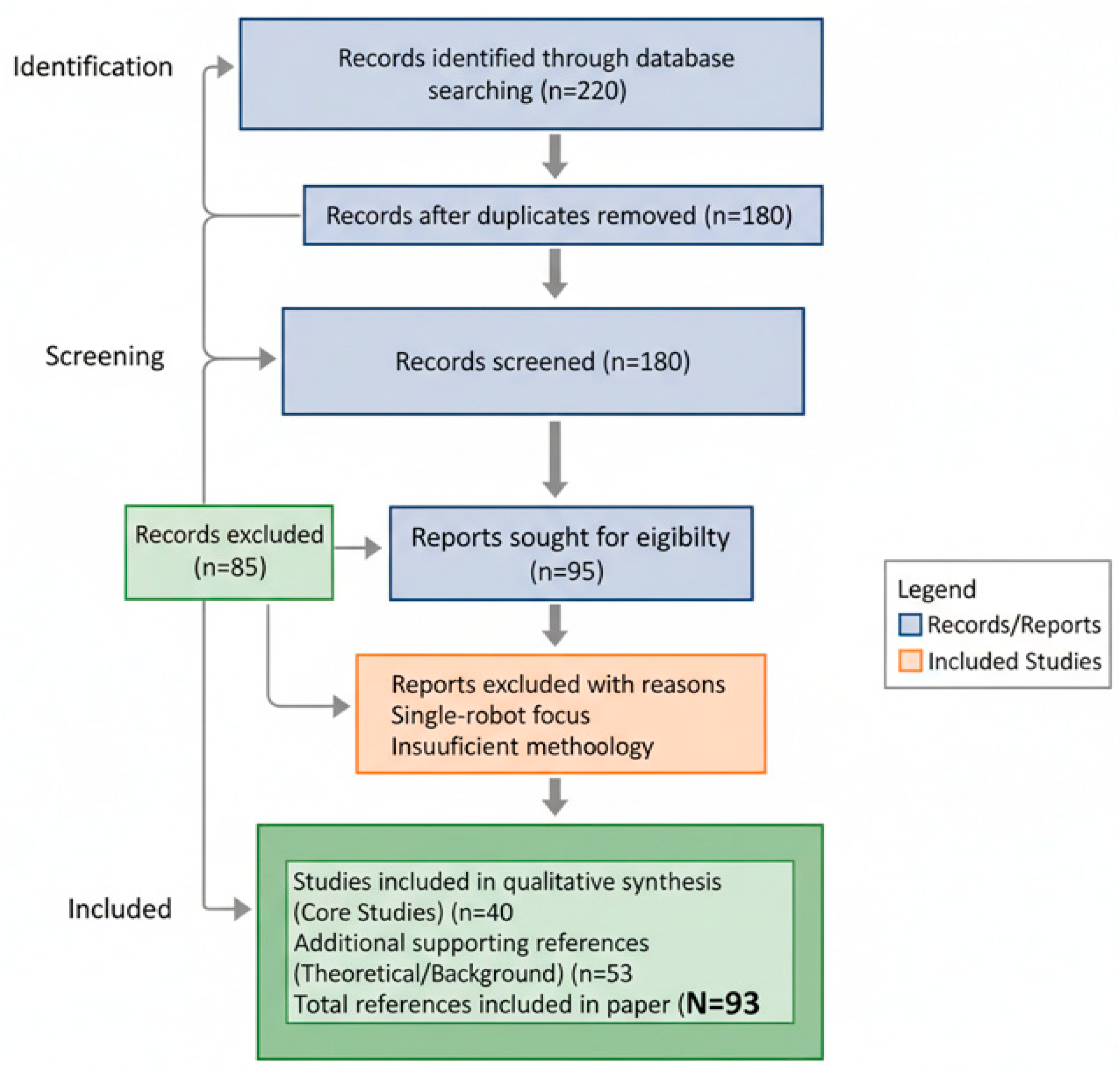
Figure 2.
An example of a Multi Robot System consisting of robots R1-R5.
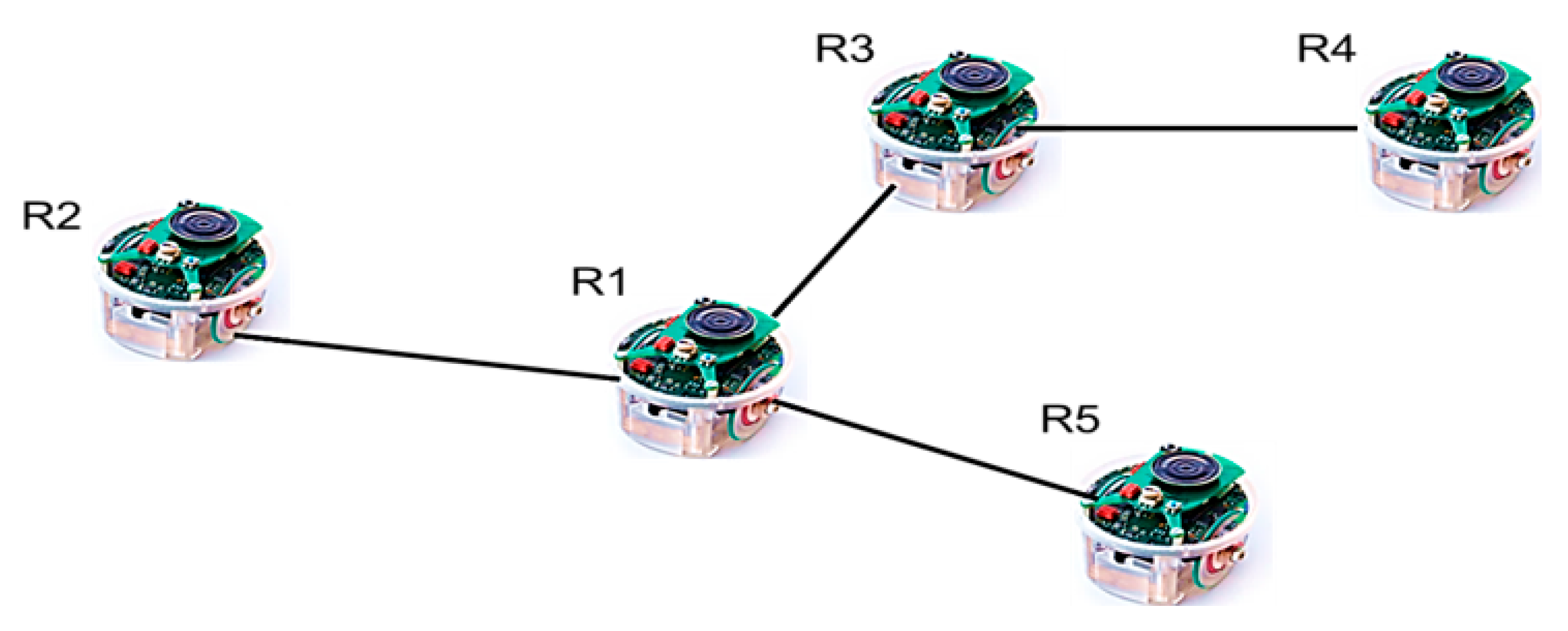
Figure 3.
Classification of multi-robot systems.
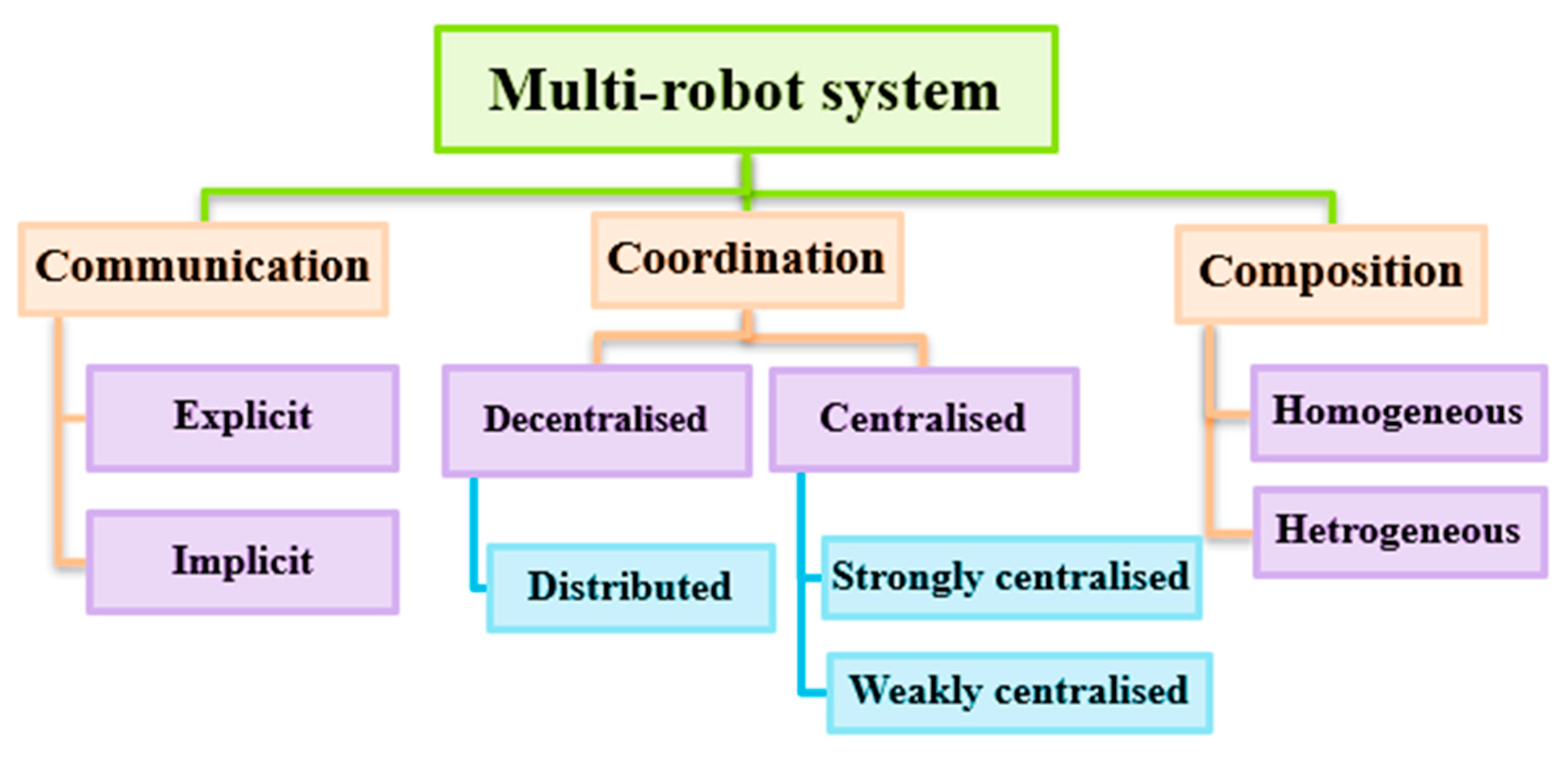
Figure 4.
Examples of connected graph and with varying levels of algebraic connectivity.
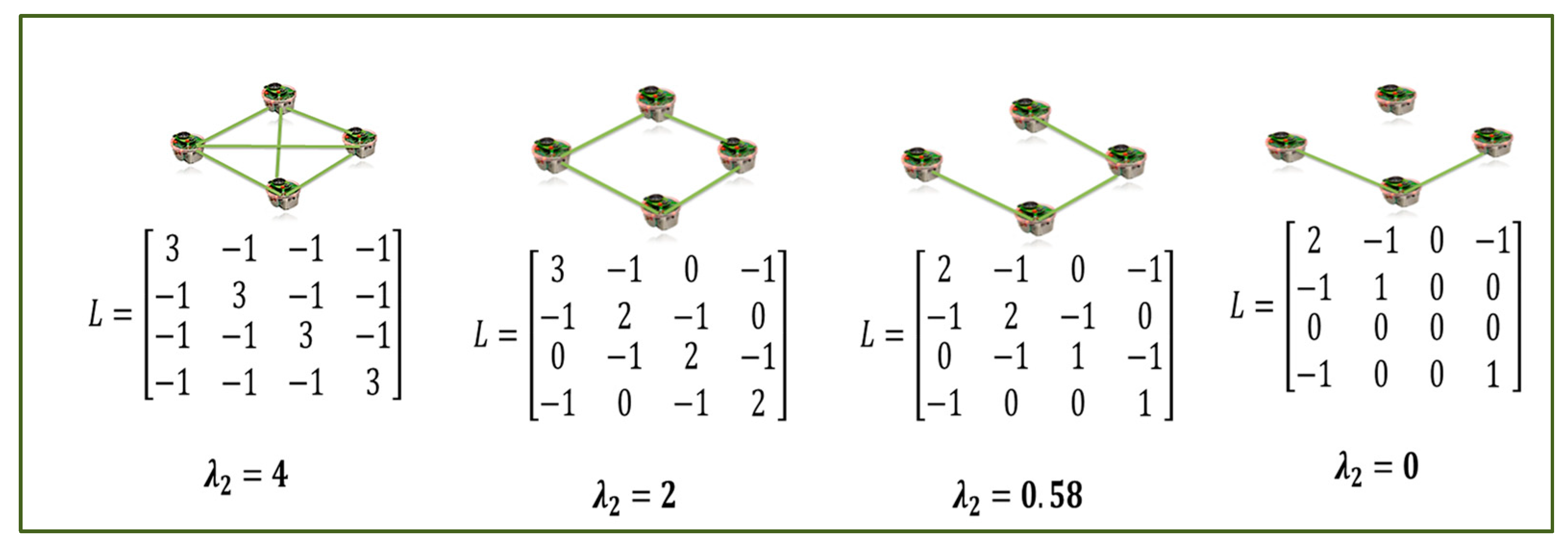
Figure 5.
Structure of path planning techniques.
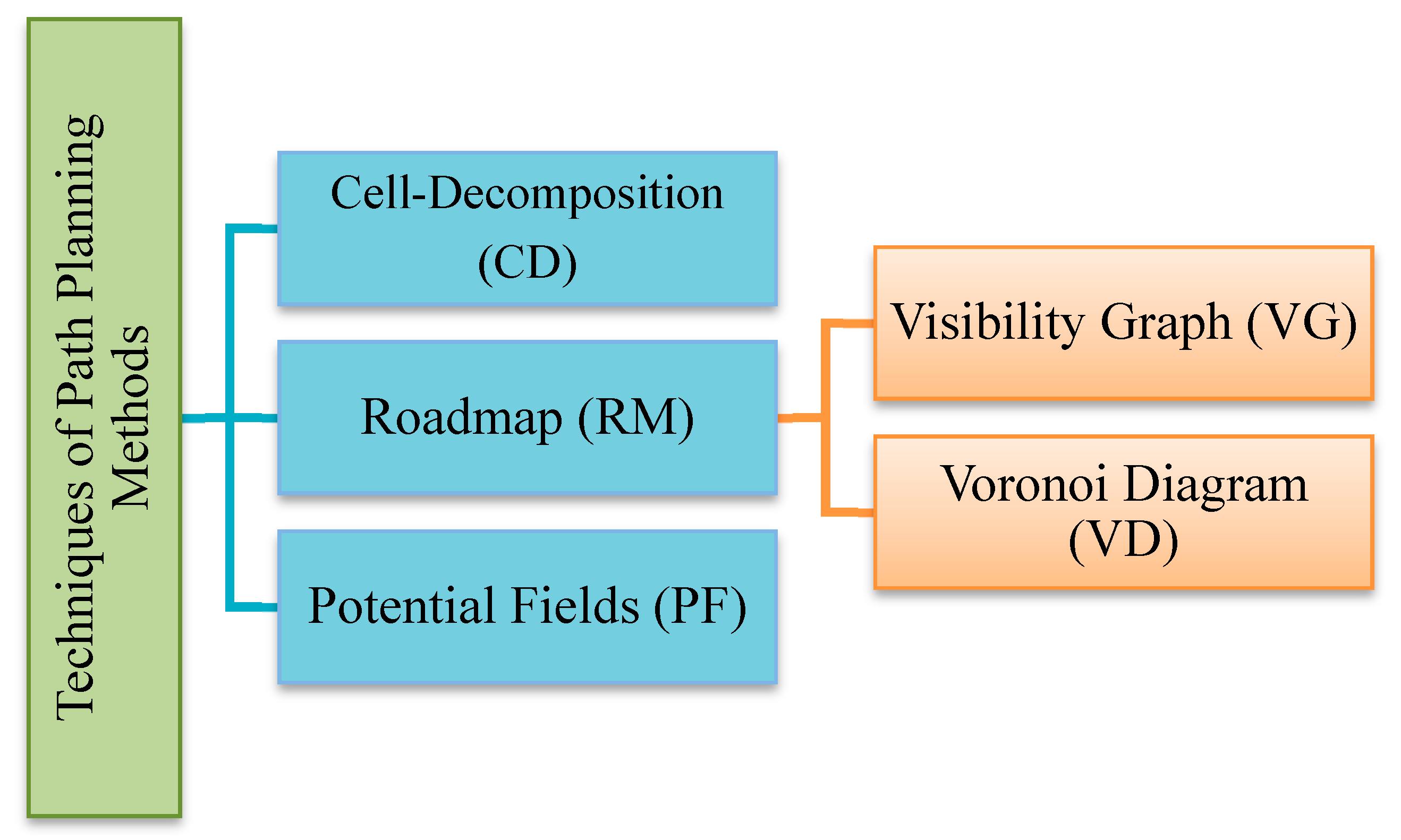
Figure 6.
Operations of visibility graph versus Voronoi diagram.
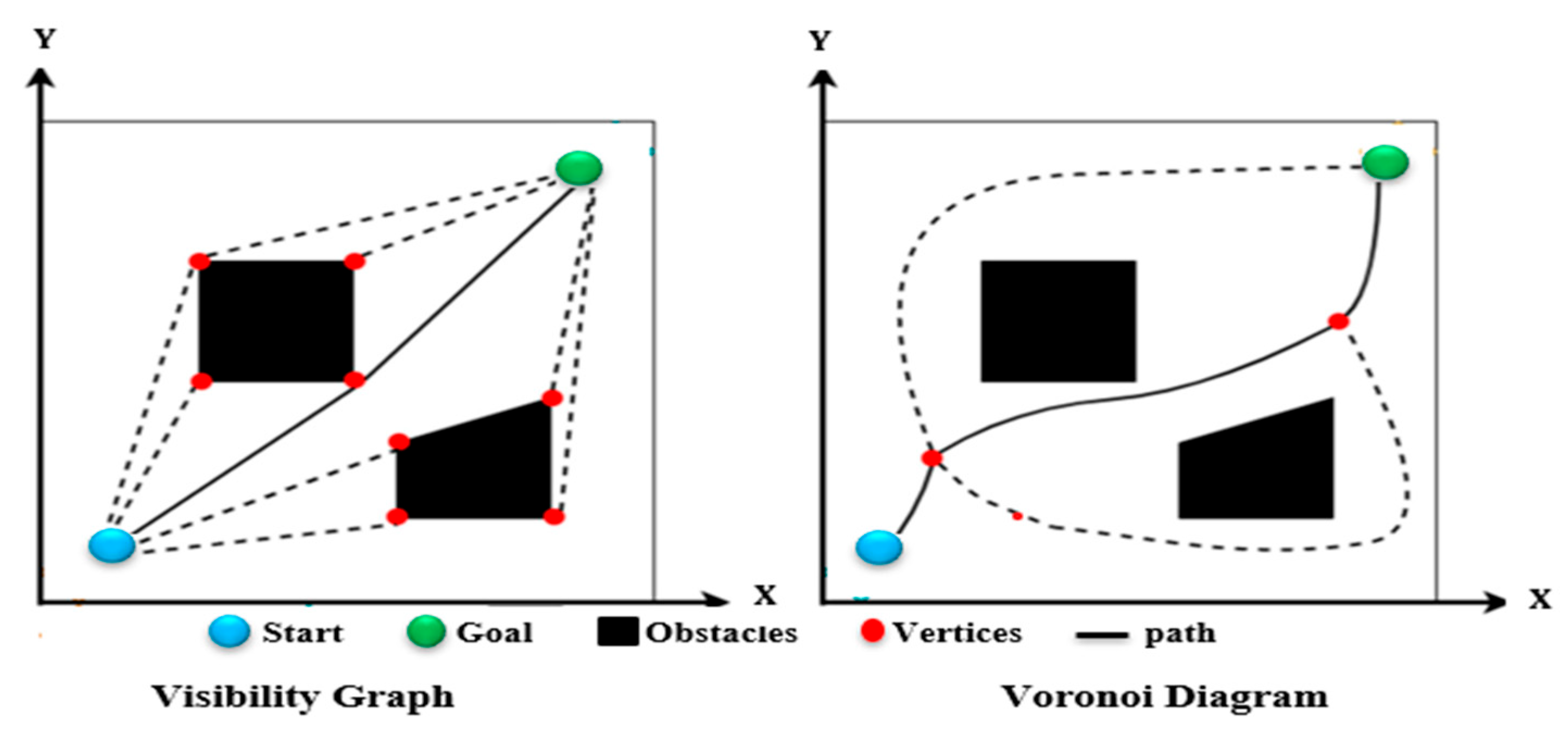
Figure 7.
Taxonomy of multi-robot path planning methods illustrating the classification of MRPP, CA, and OCA according to planning architecture, environment representation, and optimisation criteria.
Figure 7.
Taxonomy of multi-robot path planning methods illustrating the classification of MRPP, CA, and OCA according to planning architecture, environment representation, and optimisation criteria.
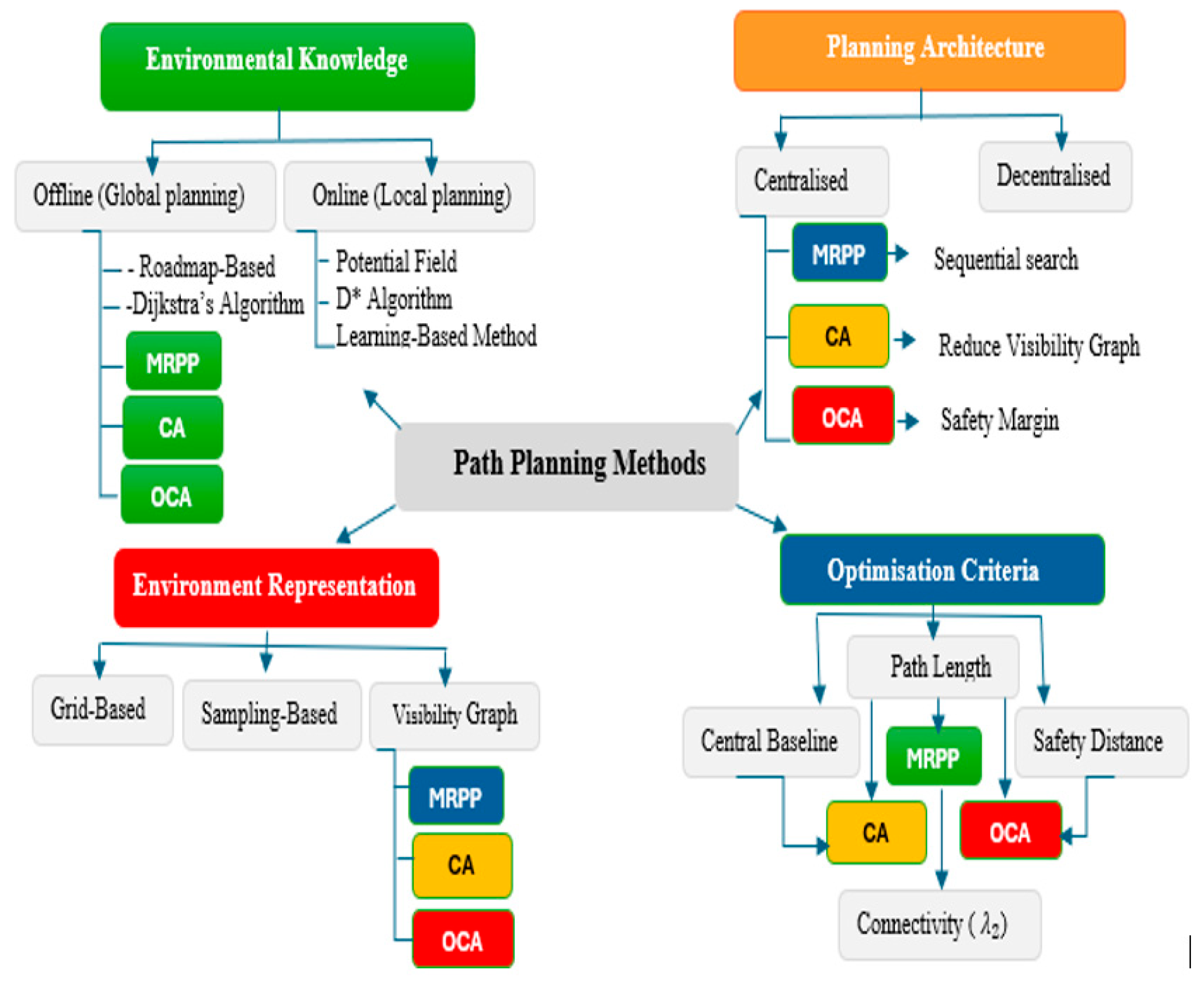
Figure 8.
Structured framework illustrating the relationship between MRPP, CA, and OCA algorithms, their underlying graph-based methods, implementation platforms, and application domains.
Figure 8.
Structured framework illustrating the relationship between MRPP, CA, and OCA algorithms, their underlying graph-based methods, implementation platforms, and application domains.
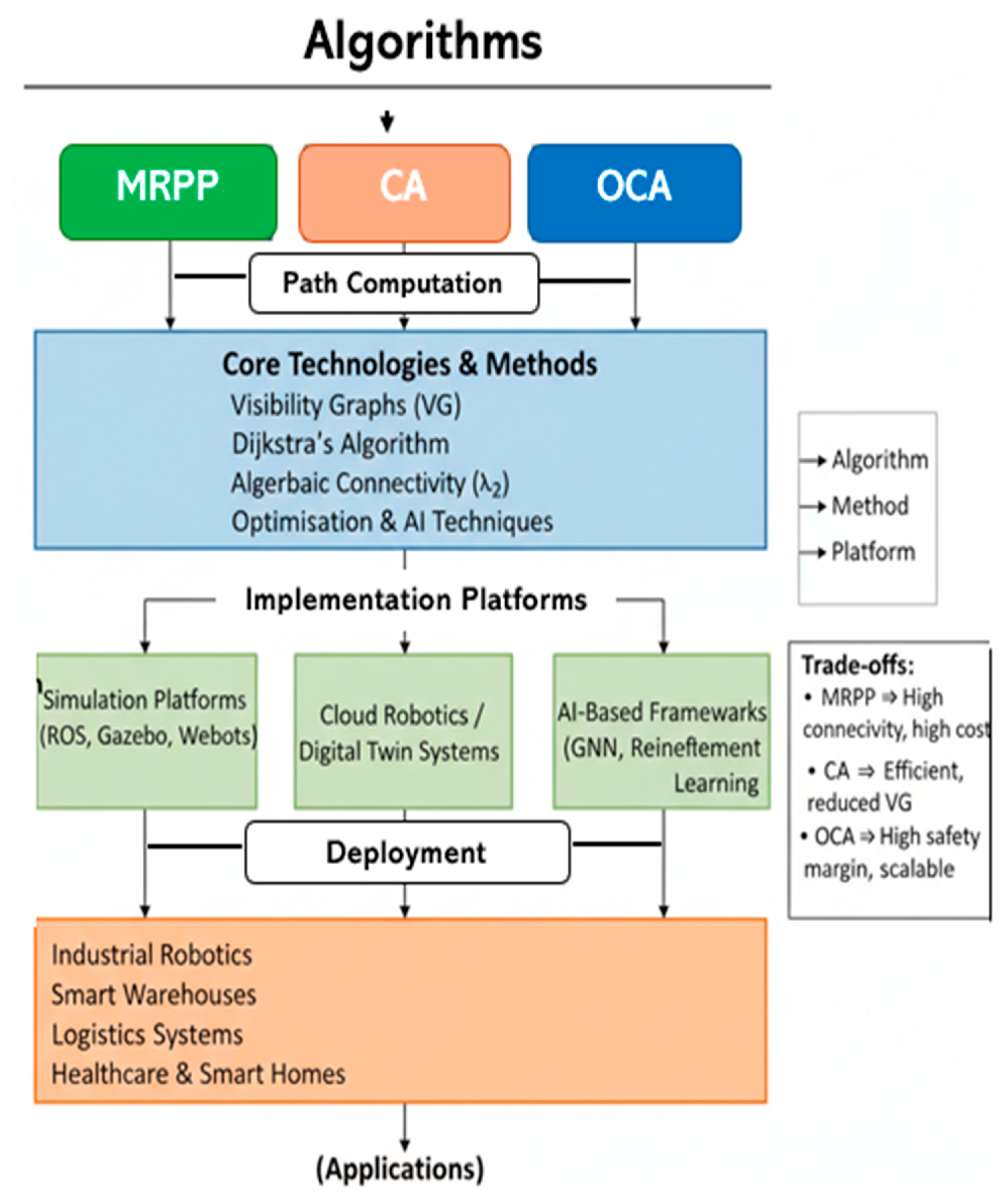

Table 1.
Summary of literature search and selection process.
| Phase | Action | Articles |
|---|---|---|
| Identification | Initial database search (2012–2026) | 220 |
| Deduplication | Removal of duplicate records | 180 |
| Screening | Title and abstract review (Exclusion of irrelevant studies) | 95 |
| Eligibility | Full-text evaluation against Inclusion/Exclusion criteria | 40 |
| Final Inclusion | Key studies + supporting foundational/theoretical articles | 93 |
Table 2.
Comparisons of MRPP, CA, and OCA in terms of core technologies, implementation platforms, and key advantages.
Table 2.
Comparisons of MRPP, CA, and OCA in terms of core technologies, implementation platforms, and key advantages.
| Algorithm | Core Technology / Method | Implementation Platform (Conceptual) | Key Role / Advantage |
|---|---|---|---|
| MRPP | Visibility Graphs (VG); Dijkstra’s algorithm; graph-based path planning | ROS (Robot Operating System); Gazebo and Webots simulation platforms; industrial autonomous mobile robot environments | Computes optimal paths for multiple robots; enables basic coordination in structured environments; supports collision avoidance through path reservation |
| CA | Centralised coordination; shortest path algorithms (Dijkstra); algebraic connectivity (λ₂) for sequencing and ordering | Cloud robotics frameworks; digital twin platforms; warehouse robot fleet management systems | Ensures global coordination; improves system-wide efficiency; suitable for moderate-scale robot teams with centralized control |
| OCA | Centralised optimisation; multi-objective optimisation (e.g., task efficiency and safety); λ₂-based eigenvalue sequencing; integration with AI/heuristics | ROS integrated with cloud/offboard computation; graph neural network (GNN) or reinforcement learning (RL)-based simulation; smart factory and logistics platforms | Enhances scalability and safety compared to CA; reduces collisions and congestion; optimises performance metrics such as time, energy, and task completion |
Disclaimer/Publisher’s Note: The statements, opinions and data contained in all publications are solely those of the individual author(s) and contributor(s) and not of MDPI and/or the editor(s). MDPI and/or the editor(s) disclaim responsibility for any injury to people or property resulting from any ideas, methods, instructions or products referred to in the content. |
© 2026 by the authors. Licensee MDPI, Basel, Switzerland. This article is an open access article distributed under the terms and conditions of the Creative Commons Attribution (CC BY) license (http://creativecommons.org/licenses/by/4.0/).
Copyright: This open access article is published under a Creative Commons CC BY 4.0 license, which permit the free download, distribution, and reuse, provided that the author and preprint are cited in any reuse.


