
Submitted:
02 April 2026
Posted:
07 April 2026
You are already at the latest version
Abstract
Background: Higher education institutions are expanding online delivery and integrating generative artificial intelligence (GenAI), yet faculty readiness remains uneven, raising concerns about assessment validity, academic integrity, institutional legitimacy, and the quality of scalable online provision. Objective: This study develops the EPIQ-AI Readiness Framework to explain how institutions can align faculty capacity, governance, and quality assurance for AI-supported teaching and online program delivery. Methods: Using an integrative secondary evidence synthesis, the study triangulates recent official statistics, large-scale faculty and institutional surveys, peer-reviewed studies, and policy frameworks published between 2020 and 2025. The analysis is organized across four readiness domains: epistemic, pedagogical, institutional, and quality-and-compliance readiness. Results: The evidence converges on four main findings. First, faculty adoption of AI is increasingly widespread, but confidence, pedagogical clarity, and depth of use remain limited. Second, institutional ambitions for online scale and AI integration are advancing faster than policy maturity, professional development, and support capacity. Third, assessment has become the central pressure point, with growing evidence that detection-centered academic integrity regimes are unreliable, potentially biased, and insufficient for high-stakes decisions. Fourth, faculty readiness is best understood not as an individual skills deficit but as a sociotechnical alignment problem shaped by governance, incentives, workload, literacy, course design support, and equity-sensitive implementation. Conclusions: The EPIQ-AI framework reframes readiness as a multidimensional condition for credible AI-enabled and online higher education. It offers a theoretically grounded and operationally actionable model for institutions seeking to strengthen AI literacy, redesign assessment, improve governance, and sustain epistemic integrity while advancing scalable, policy-compliant online delivery.
Keywords:
generative artificial intelligence
; faculty readiness
; AI-supported teaching
; online program delivery
; higher education
; assessment redesign
; academic integrity
1. Introduction
1.1. Background Context
Distance education has shifted from peripheral provision to a mainstream modality, with U.S. national enrollment data indicating that 54.2% of students at degree-granting postsecondary institutions took at least one distance education course in fall 2023 and 26.1% were enrolled exclusively in distance education (National Center for Education Statistics, 2025). In parallel, online learning leaders report institutional prioritization of online versions of on-campus courses (69%) and degrees (65%), indicating that online expansion is not merely a pandemic residue but an ongoing strategic orientation (Simunich et al., 2024). This broader reorientation is consistent with post-COVID analyses of higher education digital transformation that continue to foreground adoption, quality assurance, and governance challenges rather than mere technological substitution (Sangwa, Butera, & Mutabazi, 2025). Meanwhile, GenAI has moved from novelty to infrastructural presence in educational work, prompting policy bodies to emphasize governance, risk management, and educator capacity development rather than ad hoc reactions (U.S. Department of Education, Office of Educational Technology, 2023; UNESCO, 2023).
1.2. Problem Statement
Higher education is expanding online delivery and experimenting with AI, but the evidentiary landscape reveals a mismatch between strategic ambition and faculty readiness. Global faculty survey evidence indicates that a majority of faculty have used AI in teaching (61%), yet barriers center on time/resource scarcity (40%) and uncertainty about how to use AI pedagogically (38%) (Digital Education Council, 2025). In U.S. national instructor evidence, large majorities have experimented with GenAI (72%), while only small minorities report confidence in using it instructionally (14%) or understanding teaching applications (18%) (Ruediger et al., 2024). Simultaneously, institutions report uneven policy maturity for student AI use (only 35% with institution-wide policies; 40% still discussing) and persistent cultural and operational barriers, with faculty autonomy identified as a primary constraint on online initiatives (Simunich et al., 2024). The core problem is therefore not whether AI and online delivery will expand, but whether expansion can occur without degrading epistemic standards, assessment validity, and institutional legitimacy.
1.3. Research Objective
The overarching objective is to develop a theoretically grounded and operationally actionable framework for faculty readiness in AI-supported teaching and online program delivery. Specific objectives are to (a) synthesize the best available multi-source evidence on readiness distributions and determinants; (b) identify capacity-building priorities with immediate operational value; (c) derive propositions linking institutional supports to faculty adoption and assessment integrity; and (d) propose an impact assessment framework to guide staged implementation.
1.4. Research Questions
RQ1: What does recent robust secondary evidence indicate about the distribution of faculty readiness for AI-supported teaching and online program delivery (confidence, competence, and adoption depth)? RQ2: Which institutional supports (policy clarity, training, tools, infrastructure, incentives) most consistently align with readiness gaps and adoption barriers? RQ3: How is GenAI reshaping assessment and academic integrity risks, and which governance responses are supported by converging evidence?
1.5. Significance and Contribution of the Study
The principal contribution is the EPIQ-AI Readiness Framework, which reframes readiness as a sociotechnical and epistemic condition required for credible online scale and AI-enabled pedagogy, integrating technology adoption theory, teacher knowledge theory, and organizational readiness for change (Davis, 1989; Mishra & Koehler, 2006; Venkatesh et al., 2003; Weiner, 2009). Operationally, the framework specifies measurable readiness domains and capacity-building priorities that institutional leadership can implement prior to large-scale rollout, directly addressing policy and practice gaps identified in the latest sector evidence (Digital Education Council, 2025; Robert & McCormack, 2024; Simunich et al., 2024).
2. Literature Review and Analytical Framework
2.1. Conceptual Clarification and Scope of the Field
“Online program delivery” is not merely a technological format but a regulated educational condition. Under U.S. federal regulation, distance education must support “regular and substantive interaction” between students and instructors, distinguishing it from correspondence education (eCFR, n.d.; U.S. Department of Education, 2020). “AI-supported teaching” is treated here as the use of AI systems (including GenAI and related analytics) to design learning activities, generate or critique content, provide feedback, or support instructional decisions. A policy-relevant definition frames AI as automation based on associations that shifts edtech from content access toward pattern detection and automation of decisions, thereby amplifying risks of bias and unfairness and necessitating governance (U.S. Department of Education, Office of Educational Technology, 2023). “Faculty readiness” is conceptualized as a multidimensional construct spanning epistemic understanding, pedagogical competence, motivational orientation, and perceived and actual institutional support—consistent with empirical work showing that readiness for online teaching is multifaceted and heterogeneous rather than uniform across faculty populations (Scherer et al., 2021).
2.2. State of Scholarship and Major Empirical Debates
Two debates dominate the recent scholarship (Scherer et al., 2021; Xia et al., 2024). The first concerns whether readiness is primarily an individual attribute (skills, confidence) or an emergent organizational condition (support, culture, governance). Online teaching readiness research shows distinct teacher readiness profiles (high, low, and inconsistent readiness) and identifies institutional preparation and contextual factors as significant determinants, undermining “one-size-fits-all” training assumptions (Scherer et al., 2021). The second debate concerns whether GenAI’s primary challenge is detectability (policing student work) or assessability (redesigning tasks to preserve validity). Recent evidence increasingly favors the assessment-redesign view: a scoping review of GenAI and higher education assessment (969 records screened; 32 empirical studies included) argues for transforming assessment toward self-regulated learning and integrity, supported by teacher professional development and institutional policy rethinking (Xia et al., 2024). This aligns with global faculty perceptions that current evaluation methods require significant change, including calls for urgent revamps (Digital Education Council, 2025).
2.3. Comparative Review of the Most Relevant Theoretical Traditions:
2.3.1. Technology Acceptance Traditions (TAM/UTAUT)
Technology acceptance models emphasize perceived usefulness and ease of use (TAM) and extend toward social influence and facilitating conditions (UTAUT) (Davis, 1989; Venkatesh et al., 2003). These theories explain why “tool exposure” does not automatically translate into adoption. Yet, for AI-supported teaching, acceptance models are incomplete: they do not adequately theorize epistemic stakes (truth, justification, authorship) or assessment legitimacy, which are central to higher education’s social function.
2.3.2. Teacher Knowledge Traditions (TPACK)
TPACK conceptualizes the situated integration of technological, pedagogical, and content knowledge (Mishra & Koehler, 2006). Online teaching readiness research operationalizes readiness partly through TPACK self-efficacy and shows that readiness comprises instructional presence, institutional support perceptions, and TPACK-related competence (Scherer et al., 2023). However, GenAI introduces qualitatively new issues (e.g., synthetic text that is plausible but potentially untrue), pushing beyond “technology integration” toward epistemic governance.
2.3.3. Organizational Readiness for Change
Organizational readiness for change frames readiness as a collective state shaped by change commitment and change efficacy, predicting implementation quality and sustainability (Weiner, 2009). This tradition better fits AI and online scale because readiness depends on governance, resources, workflow redesign, and shared norms. Yet, it still requires an education-specific articulation of readiness that includes assessment validity and epistemic integrity as core institutional goods.
2.4. Synthesis of the Literature and Derivation of the Analytical Framework
The evidence suggests that AI-supported teaching readiness cannot be fully explained by acceptance (motivation) or knowledge (competence) alone, nor by organizational capacity in abstraction from epistemic and assessment stakes. UNESCO’s global guidance explicitly frames GenAI as raising profound implications for how knowledge is understood and how learning is assessed and validated, grounding governance in human agency, inclusion, and accountability (UNESCO, 2023). In parallel, sector-level risk governance norms (e.g., NIST AI RMF) emphasize practical risk management for AI deployment and the need to benefit from AI while protecting against harms (National Institute of Standards and Technology, 2023). These converging strands motivate an integrated framework: readiness must be treated as EPIQ—Epistemic, Pedagogical, Institutional, and Quality-and-compliance alignment.
2.5. Conceptual Model and Propositions
The EPIQ-AI Readiness Framework posits that credible AI-supported teaching and scalable online delivery require alignment across micro-level faculty capacities and macro-level institutional systems, mediated by pedagogical and assessment design capacity. Figure 1 presents the conceptual architecture of the EPIQ-AI readiness framework.
3. Methodology
3.1. Research Design
The study uses an integrative secondary evidence synthesis design, appropriate for policy-relevant questions spanning heterogeneous evidence types (official statistics, sector surveys, peer-reviewed empirical studies, and governance frameworks). This design is appropriate for questions that require the integration of heterogeneous empirical, policy, and conceptual materials in order to produce an analytically coherent synthesis and a new conceptual framework rather than a pooled statistical estimate (Torraco, 2005; Whittemore & Knafl, 2005).
3.2. Study Scope and Review Boundaries
The thematic scope covers (a) faculty readiness for online teaching and online program delivery, (b) faculty readiness for GenAI-supported teaching, and (c) assessment and academic integrity in AI-impacted higher education. The temporal focus prioritizes 2020–2025 evidence for modality expansion and GenAI, while incorporating seminal theoretical works where necessary for framework construction.
3.3. Data Sources: Evidence Draws from Four Source Classes
(1) official datasets and definitions (NCES IPEDS distance education participation; U.S. federal definitions for distance education and RSI); (2) multi-institutional sector surveys (Digital Education Council global faculty survey; Ithaka S+R U.S. instructor survey analysis; CHLOE chief online learning officer survey); (3) peer-reviewed studies and reviews (online teaching readiness profiling; GenAI assessment scoping review; AI integrity systematic review; AI detection evaluations and bias studies); and (4) authoritative policy frameworks such as UNESCO guidance; NIST AI RMF; U.S. Department of Education OET guidance; EU-level regulatory summaries via European Commission and Council press releases (National Center for Education Statistics, 2025; Ruediger et al., 2024; Simunich et al., 2024; Balalle & Pannilage, 2025; Elkhatat et al., 2023; Liang et al., 2023; UNESCO, 2023; U.S. Department of Education, 2020; U.S. Department of Education, Office of Educational Technology, 2023).
3.4. Search Strategy and Source Identification
Source identification combined targeted retrieval of (a) latest sector surveys with explicit sample descriptions, (b) open-access peer-reviewed articles in established publishers (Elsevier, Springer Nature), and (c) official government or intergovernmental publications and regulations. Search terms centered on “faculty readiness,” “online teaching readiness,” “generative AI teaching,” “assessment redesign,” “academic integrity,” “regular and substantive interaction,” and “AI detection bias.”
3.5. Eligibility, Quality Appraisal, and Evidence Selection
Inclusion prioritized (a) transparent methodology and sampling, (b) direct relevance to higher education, and (c) authoritative provenance (government statistics, intergovernmental guidance, or peer-reviewed outlets). AI detection evidence was included only where limitations and bias were documented by primary or peer-reviewed sources, given the high-stakes nature of academic misconduct adjudication (Elkhatat et al., 2023; Liang et al., 2023; OpenAI, 2023).
3.6. Data Extraction and Organization
Extracted elements included sample frames, adoption prevalence, readiness indicators (confidence, clarity, training adequacy), institutional strategy signals (online priorities, barriers, budgets), and assessment/integrity concerns. These elements were organized using the EPIQ domains (Epistemic, Pedagogical, Institutional, Quality-and-compliance).
3.7. Analytical Techniques
Analysis proceeded through cross-source triangulation and theory-driven thematic synthesis, mapping convergent findings into the EPIQ domains and using propositions to link determinants and outcomes. The approach is also tested for cross-source consistency (e.g., whether policy immaturity appears simultaneously in faculty perceptions and institutional leader reports) (Digital Education Council, 2025; Simunich et al., 2024).
3.8. Validity, Reliability, and Reproducibility
Validity was strengthened through convergence requirements: principal claims were supported by at least two independent evidence classes (e.g., faculty surveys plus institutional leader surveys; peer-reviewed studies plus policy frameworks) (Robert & McCormack, 2025). This logic is consistent with triangulation approaches that treat convergence across independent data sources as a means of strengthening interpretive validity and reducing overreliance on any single evidence stream (Carter et al., 2014). Reliability was addressed by privileged sources with explicit samples and stable reporting (official statistics, peer-reviewed designs, or formal sector surveys).
3.9. Ethical Considerations
As secondary research, the study emphasizes responsible interpretation, avoidance of performative techno-optimism, and attention to equity risks (e.g., potential harms of unreliable AI detection for multilingual writers) (Liang et al., 2023).
3.10. Methodological Limitations and Mitigation
Sector surveys are not uniformly comparable across countries and roles (faculty vs. chief online officers vs. IT leaders), and some high-quality proprietary reports (e.g., member-only publications) limit extractable detail. Mitigation relied on triangulating multiple open and authoritative sources and focusing on robust directional patterns rather than overfitting fine-grained cross-survey comparisons (Digital Education Council, 2025; Robert, 2024; Ruediger et al., 2024; Simunich et al., 2024). Table 1 maps the principal evidence sources onto the four EPIQ-AI readiness domains and clarifies how each source informs the analytical framework used in the synthesis.
4. Findings and Discussion
Table 2 consolidates the highest-salience readiness signals drawn from the major secondary sources reviewed in this study and provides the empirical bridge into the research-question-driven findings that follow.
Evidence converges on a central pattern: readiness is uneven and adoption is not synonymous with preparedness. Globally, a majority of faculty report AI use in teaching (61%), but the distribution of use intensity is cautious, and non-users cite time/resource scarcity and uncertainty about instructional application as dominant barriers (Digital Education Council, 2025). In the United States, instructors report substantial experimentation (72%), yet confidence is strikingly low (14% confident), implying that “trial” often occurs without stable pedagogical integration (Ruediger et al., 2024). This pattern is consistent with broader online teaching readiness research: faculty are not homogeneous in readiness, and readiness profiles are shaped by prior experience and preparation rather than position alone (Scherer et al., 2021).
A further implication is that experience does not linearly accumulate into readiness. Evidence indicates a curvilinear relationship between online teaching experience and readiness (especially TPACK self-efficacy), suggesting that both novice and experienced faculty may require different kinds of support (Scherer et al., 2023). This challenges a common institutional assumption: that readiness gaps can be closed primarily by “more time using the tools,” rather than by targeted professional development and structural support.
The EPIQ model clarifies why readiness appears uneven. Technology acceptance logics predict that adoption depends on perceptions of value and ease, but the survey evidence shows that faculty are often not stalled by ideological hostility; rather, they report an absence of time, resources, and pedagogically meaningful guidance (Digital Education Council, 2025). In TPACK terms, exposure to tools does not equal the situated knowledge needed to integrate them into disciplinary teaching with valid assessment (Mishra & Koehler, 2006; Scherer et al., 2023). Organizational readiness theory further implies that unevenness is expected when institutions vary in change commitment and change efficacy as expressed in training capacity, policy clarity, and governance arrangements (Weiner, 2009).
4.3. Institutional Supports and Readiness Gaps
Across evidence sources, five institutional supports repeatedly emerge as readiness enablers: (1) access to appropriate AI tools and resources; (2) AI literacy and skills training; (3) curated best practices and use cases; (4) clear guidelines for AI in teaching; and (5) an environment that encourages innovation and tolerates failure (Digital Education Council, 2025; Robert & McCormack, 2024). The salience of guidelines is reinforced by the inverse: 80% of faculty do not find institutional AI guidelines comprehensive, suggesting that policy ambiguity functions as a readiness inhibitor (Digital Education Council, 2025).
Institutional leader evidence further demonstrates that governance maturity is still developing. CHLOE reports that 35% of institutions have institution-wide AI policies, while 40% are still discussing but have not published policies, implying that many faculty are operating in policy vacuums or fragmented departmental regimes (Simunich et al., 2024). Complementarily, EDUCAUSE frames AI policy development as a multi-domain institutional project spanning governance, operations (including professional development and infrastructure), and pedagogy (including integrity and assessment) (Robert & McCormack, 2024).
Online expansion also increases the support burden: chief online officers report widespread strategic prioritization of online course and degree conversions (Simunich et al., 2024). Yet they identify faculty autonomy and buy-in as persistent barriers and tensions, meaning that even robust technical infrastructure will not yield scalable online quality if faculty agency is not institutionally respected and operationally supported (Simunich et al., 2024).
The evidence indicates that readiness is structurally constrained by the institution’s support ecology. If policy clarity and training are missing, faculty may rationally restrict student AI use (as reflected by high prohibition rates) to preserve assessment credibility (Robert & McCormack, 2024; Ruediger et al., 2024). From an organizational readiness lens, policy immaturity and insufficient resources reduce collective change efficacy, lowering implementation quality even where change commitment exists among some faculty (Weiner, 2009). Importantly, CHLOE’s reporting that resource sufficiency varies and that sizeable shares disagree that resources are adequate underscores that “online scale” often advances faster than capacity-building for teaching and course design support roles (e.g., instructional design and learning support staffing) (Simunich et al., 2024).
4.4. Assessment, Integrity, and Governance Responses
Assessment and academic integrity are the decisive readiness frontier (Digital Education Council, 2025; Xia et al., 2024). Global faculty evidence shows that 54% believe student evaluation methods require either significant changes soon (41%) or an urgent complete revamp (13%), indicating that marginal policy tweaks are unlikely to suffice (Digital Education Council, 2025). Preferences also tilt toward structured permission regimes: faculty most often prefer AI-permitted-with-disclosure-and-instructor-instructions approaches, rather than blanket bans or mandatory AI use (Digital Education Council, 2025). In the U.S. instructor survey evidence, 42% completely prohibit student GenAI use, and majorities remain uncertain about net benefits, reflecting epistemic and evaluative insecurity rather than settled consensus (Ruediger et al., 2024).
Peer-reviewed synthesis strengthens these survey signals. A scoping review of GenAI and assessment (32 empirical studies) argues that higher education assessment should shift toward self-regulated learning, responsibility, and integrity, recommending professional development in assessment, AI, and digital literacy, alongside institutional policy review and interdisciplinary approaches (Xia et al., 2024). A systematic review on AI and academic integrity similarly emphasizes a balanced approach that leverages AI benefits while sustaining ethical standards and integrity culture (Balalle & Pannilage, 2025).
Crucially, detection-centric integrity strategies face empirical and ethical constraints. OpenAI’s own classifier documentation reported meaningful false positives (9% on its challenge set) and noted that the tool was discontinued due to low accuracy, undermining any presumption that detection can serve as a primary integrity adjudication mechanism (OpenAI, 2023). Peer-reviewed research evaluating AI content detection tools documents inconsistent performance and false positives on human-written controls, warning against sole reliance in high-stakes contexts (Elkhatat et al., 2023). Further, an open-access analysis argues that GPT detectors can be biased against non-native English writers, raising equity and due-process concerns for multilingual and international students (Liang et al., 2023).
4.5. Integrative Cross-Disciplinary Discussion
From a learning sciences perspective, GenAI collapses a long-standing assessment assumption: that presented fluency plausibly indicates individual mastery (Xia et al., 2024). GenAI can produce plausible text at scale, meaning assessment validity must increasingly depend on task design, process evidence, and demonstration of judgment, rather than product-only evaluation (Xia et al., 2024). From organizational studies, the evidence indicates that readiness is a distributed institutional capacity: online scale and AI integration require coordinated governance, resourcing, and cultural alignment, as shown by the persistence of faculty autonomy and buy-in as major barriers to online initiatives (Simunich et al., 2024). From ethics and policy, UNESCO’s framing of GenAI as implicating human agency and the meaning of knowledge, coupled with risk-governance frameworks emphasizing trustworthy AI, implies that readiness must include the capacity to deliberate about what should not be automated in pedagogy and evaluation (National Institute of Standards and Technology, 2023; UNESCO, 2023).
The EPIQ framework thus interprets “readiness unevenness” as a predictable consequence of misalignment: faculty willingness to experiment coexists with institutional underinvestment in guidelines, training, and assessment redesign capacity, producing uncertainty and prohibition as rational defensive responses (Digital Education Council, 2025; Ruediger et al., 2024; Simunich et al., 2024). Figure 2 visualizes this synthesized misalignment pathway.
4.6. Theoretical, Ethical, and Policy Implications
Theoretically, EPIQ-AI extends TAM/UTAUT by positing that perceived usefulness is insufficient in higher education unless coupled with epistemic justification capacity (the ability to evaluate AI outputs, manage hallucination risk, and design tasks that assess reasoned understanding) (Davis, 1989; Venkatesh et al., 2003). It extends TPACK by treating GenAI not only as a teaching tool but as a knowledge-production technology that alters the epistemic environment of assessment and scholarly writing (Mishra & Koehler, 2006). It also reframes organizational readiness for change by specifying that “change efficacy” in higher education includes assessment legitimacy and integrity protection mechanisms as core outputs (Weiner, 2009).
Ethically, the evidence supports shifting away from punitive, detection-first regimes toward transparent policy, student AI literacy, and assessment redesign, partly because detection tools can be unreliable and discriminatory in effect, particularly for multilingual writers (Elkhatat et al., 2023; Liang et al., 2023; OpenAI, 2023). Policy-wise, external governance regimes increasingly encode risk-based approaches to AI oversight. The EU AI Act establishes a risk-based framework, specific transparency obligations for systems such as chatbots, and stricter requirements for high-risk systems, underscoring that higher education institutions must treat AI governance as a compliance-relevant domain rather than as a mere teaching tip sheet (European Commission, 2024; European Parliament & Council on the European Union, 2024).
5. Conclusion and Recommendations
5.1. Conclusion
Converging evidence indicates that faculty readiness for AI-supported teaching and scalable online program delivery is uneven, characterized by widespread experimentation but limited confidence, significant policy ambiguity, and acute pressure on assessment and integrity regimes (Digital Education Council, 2025; Ruediger et al., 2024; Simunich et al., 2024; Xia et al., 2024). The EPIQ-AI framework explains this pattern by treating readiness as an alignment problem across epistemic literacy, pedagogical competence, institutional governance and resourcing, and quality-and-compliance obligations.
5.2. Theoretical and Scholarly Contribution
The EPIQ-AI framework advances scholarship by integrating three classical traditions (technology acceptance, TPACK, and organizational readiness) into a distinctly higher-education-specific readiness theory centered on epistemic integrity and assessment legitimacy—dimensions increasingly foregrounded by global policy guidance on GenAI (Davis, 1989; Mishra & Koehler, 2006; UNESCO, 2023; Venkatesh et al., 2003; Weiner, 2009).
5.3. Recommendations
For academic institutions and governance bodies, the evidence supports a staged readiness strategy that begins with policy clarity and faculty capacity-building before ambitious AI-enabled or online scale-up. Institutional leaders should establish institution-wide AI policies that explicitly address permitted uses, disclosure norms, assessment design principles, data privacy, intellectual property, accessibility, and due process in misconduct allegations, because both faculty and chief online officers report that policy formation is incomplete and uneven (Robert & McCormack, 2024; Simunich et al., 2024; UNESCO, 2023; U.S. Department of Education, Office of Educational Technology, 2023). For faculty development and teaching and learning centers, professional learning should be redesigned around assessment transformation and epistemic evaluation (how to assess reasoning and process in an AI-saturated environment), consistent with evidence that many instructors lack confidence and that the research literature calls for professional development in assessment, AI, and digital literacy (Ruediger et al., 2024; Xia et al., 2024). For private-sector partners and edtech providers, procurement and integration should be conditioned on transparent model limitations, bias risk documentation, and secure workflows, aligning institutional practice with risk management norms that emphasize trustworthy AI and harm mitigation (National Institute of Standards and Technology, 2023). For philanthropic and civil society organizations, support should prioritize open educational resources for AI literacy and assessment redesign rather than surveillance tooling, given documented limitations of AI detection and bias risk (Elkhatat et al., 2023; Liang et al., 2023; OpenAI, 2023).
5.4. Impact Assessment Framework
The EPIQ-AI model implies that institutions can operationalize readiness through a dashboard of threshold indicators. This operationalization logic is also consistent with EDUCAUSE’s Higher Education Generative AI Readiness Assessment, which frames AI preparedness as an institution-wide, cross-functional evaluative process (EDUCAUSE, 2025). Table 3 translates the framework into an operational dashboard linking each readiness domain to illustrative indicators and corresponding institutional action priorities.
As shown in Table 3, epistemic readiness can be tracked via the proportion of faculty completing AI literacy modules covering limitations, bias, and responsible use, paired with measured confidence shifts (not merely attendance) (Ruediger et al., 2024; UNESCO, 2023; U.S. Department of Education, Office of Educational Technology, 2023). Pedagogical readiness can be tracked through adoption of AI-aware assessment patterns (e.g., authentic tasks, process artifacts, oral defenses, iterative drafts) aligned with scoping-review recommendations and faculty calls for assessment transformation (Xia et al., 2024). Institutional readiness can be assessed through policy maturity (published institution-wide guidance), support capacity (instructional design staffing and training availability), and faculty workload recognition, consistent with reported barriers and resource sufficiency variance (Digital Education Council, 2025; Robert & McCormack, 2024; Simunich et al., 2024). Quality-and-compliance readiness should be assessed through demonstrated alignment with distance education requirements for regular and substantive interaction in online courses (eCFR, n.d.; U.S. Department of Education, 2020) and the presence of documented integrity due-process workflows that do not rely on detection as a sole determinant (Elkhatat et al., 2023; Liang et al., 2023; OpenAI, 2023).
5.5. Study Limitations
The synthesis relies on secondary sources with different populations and instruments (global faculty, U.S. instructors, U.S. chief online officers), limiting direct statistical comparability across estimates, and it privileges open and authoritative sources rather than paywalled sector reports. These constraints were mitigated through cross-source convergence checks and by focusing on robust directional findings that recur across independent evidence classes (Digital Education Council, 2025; Robert, 2024; Ruediger et al., 2024; Simunich et al., 2024).
Funding
This research received no external funding. The study was completed through the authors’ own scholarly work, with only routine institutional support from their affiliated institution(s).
Ethical approval
This study is based exclusively on secondary sources, including peer-reviewed literature, official datasets, institutional frameworks, and public policy and regulatory documents. It did not involve human participants, interviews, surveys conducted by the authors, experiments, or access to identifiable personal data. Formal ethical approval and informed consent were therefore not required.
Data availability
No original dataset was generated for this study. The materials supporting the analysis consist of publicly accessible sources cited throughout the manuscript, including peer-reviewed publications, official datasets, institutional reports, and policy or regulatory documents. All evidence used in the study can be traced through the methodology section and the reference list.
Conflicts of Interest
The authors declare that there are no financial, institutional, professional, or personal relationships that could reasonably be perceived as having influenced the conception, evidence selection, synthesis, interpretation, or writing of this manuscript.
Use of AI tools
During manuscript preparation, the author(s) used OpenAI’s GPT-5.4 Thinking model in a limited support role for editorial and research-assistance tasks, including language refinement, structural organization, and phrasing improvement. All substantive decisions concerning argument development, source selection, verification, interpretation, and final revision were made by the author(s), who bear full responsibility for the content of the manuscript.
References
- Balalle, H.; Pannilage, S. Reassessing academic integrity in the age of AI: A systematic literature review on AI and academic integrity. Social Sciences & Humanities Open 2025, 11, 101299. [Google Scholar] [CrossRef]
- Carter, N.; Bryant-Lukosius, D.; DiCenso, A.; Blythe, J.; Neville, A. J. The use of triangulation in qualitative research. Oncology Nursing Forum 2014, 41(5), 545–547. [Google Scholar] [CrossRef] [PubMed]
- Council of the European Union. Artificial intelligence (AI) act: Council gives final green light to the first worldwide rules on AI (Press release 409/24). 21 May 2024. https://www.consilium.europa.eu/en/press/press-releases/2024/05/21/artificial-intelligence-ai-act-council-gives-final-green-light-to-the-first-worldwide-rules-on-ai/pdf/.
- Davis, F. D. Perceived usefulness, perceived ease of use, and user acceptance of information technology. MIS Quarterly 1989, 13(3), 319–340. [Google Scholar] [CrossRef]
- Digital Education Council. AI meets academia: What faculty think: Global AI Faculty Survey 2025. 2025. https://www.digitaleducationcouncil.com/post/digital-education-council-global-ai-faculty-survey.
- eCFR. (n.d.). 34 CFR § 600.2—Definitions. https://www.ecfr.gov/current/title-34/subtitle-B/chapter-VI/part-600/subpart-A/section-600.2.
- EDUCAUSE. (2025, March 10). Higher education generative AI readiness assessment. https://library.educause.edu/resources/2024/4/higher-education-generative-ai-readiness-assessment.
- Elkhatat, A. M.; Elsaid, K.; Almeer, S. Evaluating the efficacy of AI content detection tools in differentiating between human and AI-generated text. International Journal for Educational Integrity 2023, 19, Article 17. [Google Scholar] [CrossRef]
- European Commission. European Artificial Intelligence Act comes into force (Press release IP/24/4123). 1 August 2024. https://ec.europa.eu/commission/presscorner/api/files/document/print/ov/ip_24_4123/IP_24_4123_EN.pdf.
- European Commission. AI Act enters into force. 1 August 2024. https://commission.europa.eu/news-and-media/news/ai-act-enters-force-2024-08-01_en.
- European Parliament; Council of the European Union. (2024). Regulation (EU) 2024/1689 of the European Parliament and of the Council of 13 June 2024 laying down harmonised rules on artificial intelligence (Artificial Intelligence Act). Official Journal of the European Union, L 2024/1689. http://data.europa.eu/eli/reg/2024/1689/oj.
- Liang, W.; Yuksekgonul, M.; Mao, Y.; Wu, E.; Zou, J. GPT detectors are biased against non-native English writers. Patterns 2023, 4(7), 100779. [Google Scholar] [CrossRef] [PubMed]
- Mishra, P.; Koehler, M. J. Technological pedagogical content knowledge: A framework for teacher knowledge. Teachers College Record 2006, 108(6), 1017–1054. [Google Scholar] [CrossRef]
- National Center for Education Statistics. (2025). Digest of education statistics, Table 311.15: Number and percentage of students enrolled in degree-granting postsecondary institutions, by distance education participation, location of student, level of enrollment, and control and level of institution: Fall 2022 and fall 2023. https://nces.ed.gov/programs/digest/d25/tables/dt25_311.15.asp.
- National Institute of Standards and Technology. (2023). Artificial Intelligence Risk Management Framework (AI RMF 1.0) (NIST AI 100-1). [CrossRef]
- OpenAI. New AI classifier for indicating AI-written text. 20 July 2023. https://openai.com/index/new-ai-classifier-for-indicating-ai-written-text/.
- Robert, J. 2024 EDUCAUSE AI Landscape Study. EDUCAUSE. 2024. https://library.educause.edu/resources/2024/2/2024-educause-ai-landscape-study.
- Robert, J.; McCormack, M. (2025, February 17). 2025 EDUCAUSE AI landscape study: Into the digital AI divide. EDUCAUSE. https://library.educause.edu/resources/2025/2/2025-educause-ai-landscape-study.
- Robert, J.; McCormack, M. 2024 EDUCAUSE Action Plan: AI Policies and Guidelines. EDUCAUSE. 2024. https://library.educause.edu/resources/2024/5/2024-educause-action-plan-ai-policies-and-guidelines.
- Ruediger, D.; Blankstein, M.; Love, S. Generative AI and postsecondary instructional practices: Findings from a national survey of instructors. Ithaka S+R. 2024. https://sr.ithaka.org/publications/generative-ai-and-postsecondary-instructional-practices.
- Sangwa, D.; Butera, A.; Mutabazi, P. Digital Transformation of Higher Education: A Post-COVID Review of Adoption, Quality Assurance, and Governance Challenges. Current Research Bulletin 2025. [Google Scholar] [CrossRef]
- Scherer, R.; Howard, S. K.; Tondeur, J.; Siddiq, F. Profiling teachers’ readiness for online teaching and learning in higher education: Who’s ready? Computers in Human Behavior 2021, 118, 106675. [Google Scholar] [CrossRef]
- Scherer, R.; Siddiq, F.; Howard, S. K.; Tondeur, J. The more experienced, the better prepared? New evidence on the relation between teachers’ experience and their readiness for online teaching and learning. Computers in Human Behavior 2023, 139, 107530. [Google Scholar] [CrossRef]
- Simunich, B.; Garrett, R.; Fredericksen, E. E.; McCormack, M.; Robert, J.; Ubell, R. (2024). CHLOE 9: Strategy shift: Institutions respond to sustained online demand (The Changing Landscape of Online Education, 2024). Quality Matters, Eduventures Research, & EDUCAUSE. https://www.qualitymatters.org/sites/default/files/research-docs-pdfs/QM-Eduventures-EDUCAUSE-CHLOE%209-Report-2024.pdf.
- Torraco, R. J. Writing integrative literature reviews: Guidelines and examples. Human Resource Development Review 2005, 4(3), 356–367. [Google Scholar] [CrossRef]
- UNESCO. Guidance for generative AI in education and research. 2023. https://www.unesco.org/en/articles/guidance-generative-ai-education-and-research.
- U.S. Department of Education; Office of Educational Technology. Artificial intelligence and the future of teaching and learning: Insights and recommendations. 2023. https://www.ed.gov/sites/ed/files/documents/ai-report/ai-report.pdf.
- U.S. Department of Education. Distance education and innovation. Federal Register 2020, 85(171), 54742–54818. https://fsapartners.ed.gov/sites/default/files/attachments/2020-09/FR090220_0.pdf.
- Venkatesh, V.; Morris, M. G.; Davis, G. B.; Davis, F. D. User acceptance of information technology: Toward a unified view. MIS Quarterly 2003, 27(3), 425–478. [Google Scholar] [CrossRef]
- Weiner, B. J. A theory of organizational readiness for change. Implementation Science 2009, 4, 67. [Google Scholar] [CrossRef] [PubMed]
- Whittemore, R.; Knafl, K. The integrative review: Updated methodology. Journal of Advanced Nursing 2005, 52(5), 546–553. [Google Scholar] [CrossRef] [PubMed]
- Xia, Q.; Weng, X.; Ouyang, F.; Lin, T. J.; Chiu, T. K. F. A scoping review on how generative artificial intelligence transforms assessment in higher education. International Journal of Educational Technology in Higher Education 2024, 21, Article 40. [Google Scholar] [CrossRef]
Figure 1.
EPIQ-AI Readiness Framework for AI-Supported Teaching and Scalable Online Program Delivery. A conceptual framework integrating technology acceptance, teacher knowledge, and organizational readiness traditions into four aligned readiness domains: epistemic, pedagogical, institutional, and quality-and-compliance readiness.
Figure 1.
EPIQ-AI Readiness Framework for AI-Supported Teaching and Scalable Online Program Delivery. A conceptual framework integrating technology acceptance, teacher knowledge, and organizational readiness traditions into four aligned readiness domains: epistemic, pedagogical, institutional, and quality-and-compliance readiness.
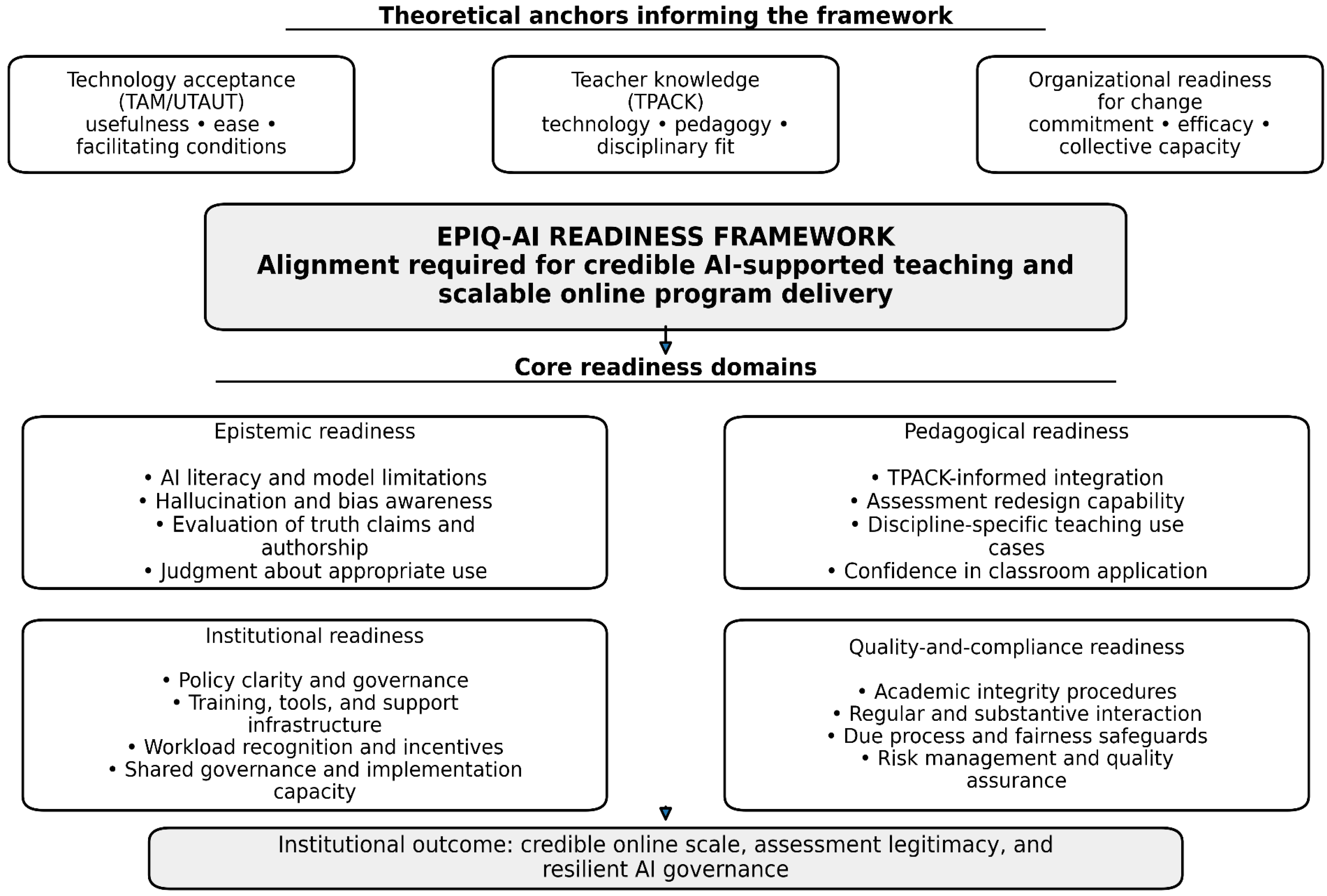
Figure 2.
Readiness Misalignment Pathway in AI-Supported Teaching and Online Program Delivery. An analytical pathway showing how institutional expansion pressures, support deficits, uneven faculty response, and assessment stress combine to create pressure for governance redesign. Arrows indicate escalating pressure and interaction across stages, not deterministic causation.
Figure 2.
Readiness Misalignment Pathway in AI-Supported Teaching and Online Program Delivery. An analytical pathway showing how institutional expansion pressures, support deficits, uneven faculty response, and assessment stress combine to create pressure for governance redesign. Arrows indicate escalating pressure and interaction across stages, not deterministic causation.
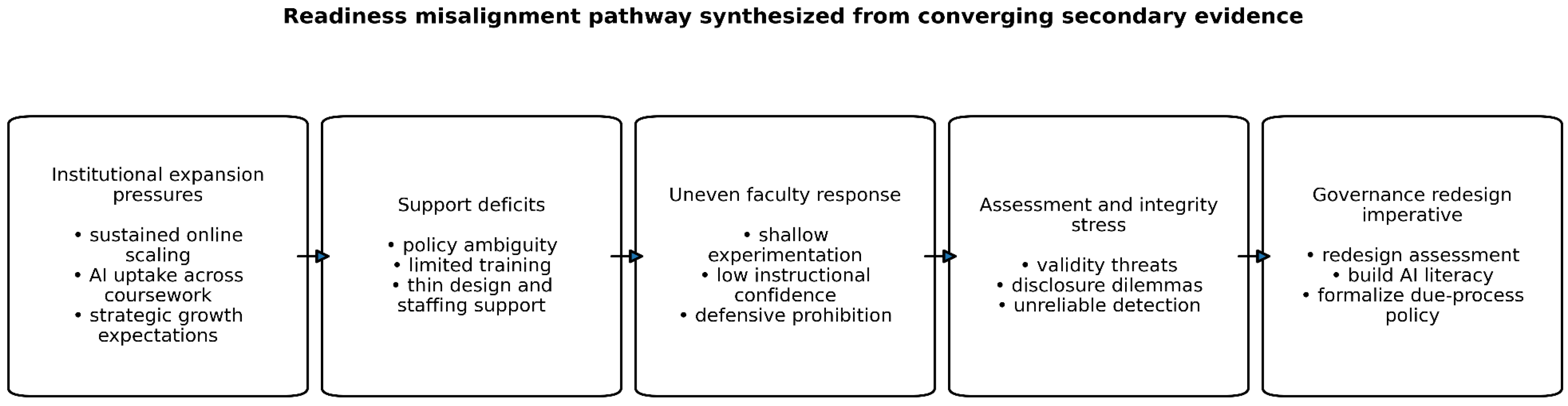

Table 1.
Mapping Major Evidence Sources onto the EPIQ-AI Readiness Domains.
| Evidence source | Epistemic readiness | Pedagogical readiness | Institutional readiness | Quality-and-compliance readiness |
|---|---|---|---|---|
| Digital Education Council (2025) | Uncertainty about meaningful AI use and the implications for student evaluation. | Use is widespread but cautious; adoption depth remains uneven. | Major gaps are reported in guidelines, training, best-practice examples, and enabling conditions. | Disclosure-based permission regimes are preferred over blanket mandates or simple bans. |
| Ruediger et al. (2024). | Experimentation exceeds confidence, indicating unresolved judgment about value and fit. | Defensive restrictions reflect weak confidence in valid course-level integration. | Training and policy clarity are indirectly implicated by faculty uncertainty and prohibition. | High prohibition rates signal unresolved integrity and assessment concerns. |
| Scherer et al. (2021; 2023). | Readiness varies by prior experience, preparation, and self-efficacy rather than role alone. | TPACK-related readiness is heterogeneous, with different support needs across faculty profiles. | Institutions cannot assume readiness will accumulate automatically with time or seniority. | Not a primary focus of these studies. |
| Robert and McCormack (2024) | Responsible institutional AI use requires critical literacy rather than simple tool access. | Best practices and curated use cases are core enablers of adoption. | Governance, operations, infrastructure, and pedagogy must be aligned in policy development. | Assessment and integrity considerations should be built into institutional guidance. |
| Simunich et al. (2024). | Strategic online expansion increases the need for sound faculty judgment under changing conditions. | Scalable online quality depends on faculty buy-in and continuing design support. | Institution-wide policy maturity remains uneven, and reported resource sufficiency varies. | Weak support capacity creates downstream risk for online quality assurance. |
| Xia et al. (2024). | Integrity and responsibility should be cultivated through redesigned assessment practice. | Assessment should shift toward authentic, process-rich, and self-regulated learning tasks. | Professional development and policy review are necessary for sustainable implementation. | Assessment reform is central to durable academic integrity protection. |
| OpenAI (2023); Elkhatat et al. (2023).; Liang et al. (2023). | Judgment about authorship and originality cannot be outsourced to unreliable detectors. | Course design should reduce dependence on product-only evaluation and detector-based control. | Institutions need due-process safeguards before acting on detector outputs. | False positives and bias make sole reliance on detection unsuitable in high-stakes settings. |
Note. Cells summarize the principal contribution of each source to the four EPIQ-AI readiness domains. “Not a primary focus” indicates that the source was not used in this study as a main basis for claims in that domain.
Table 2.
High-Salience Readiness Signals from Major Secondary Sources.
| Evidence source | Sample and scope | Core readiness signal | Operational implication |
|---|---|---|---|
| Digital Education Council Global AI Faculty Survey (2025) | 1,681 faculty; 52 institutions; 28 countries | 61% report having used AI in teaching; among non-users, top barriers include lack of time/resources (40%) and uncertainty about how to use AI in teaching (38%) (Digital Education Council, 2025). | Readiness barriers are primarily capacity and pedagogical translation, not mere access. |
| Digital Education Council Global AI Faculty Survey (2025) | Same as above | 80% do not find institutional AI guidelines comprehensive; only 6% are fully satisfied with institutional AI literacy resources; top enablers emphasize access to tools (65%), AI literacy training (64%), best-practice collections (60%), and clear guidelines (50%) (Digital Education Council, 2025). | Governance and faculty development are viewed as prerequisites for scaled AI integration. |
| Ithaka S+R national instructor survey analysis (2024) | U.S. instructors; 2,654 in GenAI module | 72% experimented with GenAI as an instructional tool, yet only 14% report confidence using it instructionally; 38% report little/no confidence (Ruediger et al., 2024). | Adoption prevalence should not be misread as instructional readiness. |
| Ithaka S+R national instructor survey analysis (2024) | Same | 42% completely prohibit student GenAI use; only 19% agree GenAI benefits teaching in their field; 56% remain uncertain (Ruediger et al., 2024). | Policies and support must address uncertainty and disciplinary divergence. |
| CHLOE 9 (2024) chief online learning officer survey | 324 institutional responses from U.S. chief online learning officers and equivalents, including usable partial responses; item-level n varies. | Online priorities: 69% prioritize online versions of on-campus courses, 65% online versions of on-campus degrees (Simunich et al., 2024). | Online scale is an institutional strategy, increasing the stakes of faculty readiness. |
| CHLOE 9 (2024) | Same | Faculty autonomy is the most frequently cited primary barrier to online initiatives; lack of buy-in and support staffing remain prominent barriers (Simunich et al., 2024). | Rollout must be negotiated as shared governance, not imposed as an IT project. |
| CHLOE 9 (2024) | Same | AI policy maturity: 35% report institution-wide AI policies/guidelines for student use; 40% are discussing policies but none published (Simunich et al., 2024). | Institutional policy formation lags behind practical AI presence in coursework. |
| NCES IPEDS (fall 2022) | U.S. degree-granting institutions | 54.2% of students took at least one distance education course (National Center for Education Statistics, 2025). | Policy-compliant, high-quality online teaching is a mass-scale requirement, not niche expertise. |
Note. Percentages are reproduced from the cited sources; samples and question wording vary by study.4.2. Faculty Readiness, Confidence, and Adoption Depth.
Table 3.
Operational EPIQ-AI Readiness Dashboard.
| Domain | Illustrative indicators | Institutional action priority |
|---|---|---|
| Epistemic readiness | Faculty completion of AI literacy modules on limitations, bias, hallucination risk, and responsible use; measured confidence shifts; evidence of judgment about acceptable and unacceptable AI-supported work. | Establish structured literacy pathways, applied workshops, and discipline-sensitive guidance on evaluation of AI outputs. |
| Pedagogical readiness | Adoption of AI-aware assessment patterns such as authentic tasks, process artifacts, oral defenses, iterative drafts, and reflective disclosure; evidence of alignment between tool use and learning outcomes. | Support assessment redesign, model valid disciplinary use cases, and strengthen instructional-design partnership for course revision. |
| Institutional readiness | Published institution-wide guidance; availability of training and consultation; instructional-design and learning-support capacity; faculty workload recognition; evidence of coherent governance across units. | Strengthen policy maturity, resource support roles adequately, and align incentives, governance, and faculty autonomy in implementation. |
| Quality-and-compliance readiness | Demonstrated alignment with distance-education expectations for regular and substantive interaction; documented integrity due-process workflows; reduced reliance on detector-only decision making. | Embed compliance review, due-process safeguards, and integrity procedures that privilege evidence-rich adjudication over detection alone. |
Note. Indicators are illustrative operational measures implied by the EPIQ-AI model. Institutions should adapt thresholds, evidence sources, and review cycles to local context, modality mix, and governance structure.
Disclaimer/Publisher’s Note: The statements, opinions and data contained in all publications are solely those of the individual author(s) and contributor(s) and not of MDPI and/or the editor(s). MDPI and/or the editor(s) disclaim responsibility for any injury to people or property resulting from any ideas, methods, instructions or products referred to in the content. |
© 2026 by the authors. Licensee MDPI, Basel, Switzerland. This article is an open access article distributed under the terms and conditions of the Creative Commons Attribution (CC BY) license (http://creativecommons.org/licenses/by/4.0/).
Copyright: This open access article is published under a Creative Commons CC BY 4.0 license, which permit the free download, distribution, and reuse, provided that the author and preprint are cited in any reuse.


