

Submitted:
03 April 2026
Posted:
03 April 2026
You are already at the latest version
Abstract
The challenge of context-free validity arises from the common belief that rigorous methodology ensures research credibility in various contexts, despite variations in epistemic foundations, institutional capacity, cultural norms, and operational conditions. This assumption is clear in Global South contexts, where research tools and evaluation frameworks from other regions are applied without proper adaptation, highlighting the limitations of claims to universal validity. The challenge is especially evident in socioeconomic research, where tools and frameworks are often applied across contexts without accounting for institutional capacity, cultural norms, or resource limitations. This paper presents the Contextual Research Validity Index (CRVI), a framework for evaluating how well a research design fits the epistemic, institutional, cultural, and operational aspects of its intended context. The CRVI views contextual validity as a form of legitimacy, emphasising that a method’s credibility relies not only on technical precision but also on how well its assumptions align with the realities of the environment. The framework includes four dimensions—epistemic alignment, institutional fit, cultural resonance, and operational feasibility—combined into a composite index for systematic assessment. By focusing on contextual alignment, the CRVI addresses shortcomings in existing validity frameworks and provides researchers, evaluators, and practitioners with a tool to anticipate misfits, adapt designs, and enhance interpretive robustness. By redefining validity as a relational outcome and treating contextual coherence as a quantifiable aspect of rigour, the CRVI provides a systematic framework for assessing the legitimacy of research across diverse contexts.
Keywords:
contextual validity
; research legitimacy
; methodological rigour
; situated research
; socioeconomic challenges
; evaluation frameworks
; context-sensitive methods
Introduction
For decades, research traditions have operated under the assumption that once a method meets established validity criteria—internal, external, construct, and ecological validity—it can be universally applied. This assumption reflects a positivist belief in context-independent truth, suggesting that methodological rigour ensures interpretive legitimacy regardless of the study's location. However, practical experience indicates that research instruments validated within a specific epistemic, institutional, or cultural environment may lose their relevance or effectiveness when transferred to different environments (Qolamani, 2023; Colak et al., 2024). What is considered methodologically sound in one context may become conceptually fragile or socially incoherent in another.
O’Brien et al. (2024) emphasise the importance of engaging with various contexts to ensure the legitimacy of findings in educational research, where external applicability can vary. Çolak and Yılmaz (2024) highlight that cultural and social factors significantly affect health-related decisions, indicating that methods may not transfer directly between contexts. Qolamani (2023) advocates for adapting research methods to the complexity of diverse social situations and stresses the necessity for researchers to be aware of their positionality and broader socio-cultural influences. These limitations are clear in socioeconomic challenges, where methods suited for high-resource settings are often misapplied to regions with weak institutions, diverse cultures, and varied development paths.
Despite widespread acknowledgement that context is significant, approaches to contextualising validity tend to be descriptive rather than evaluative. Constructs such as ecological validity (Bronfenbrenner, 1977), situated rigour (Tracy, 2010), and realist evaluation (Pawson & Tilley, 1997) emphasise the importance of setting, yet none offer a systematic method for measuring contextual fit. Scholars like Chilisa (2020) and Mignolo (2011) further illustrate that epistemologies developed within particular cultural and institutional environments are frequently regarded as universal standards, enabling methodological authority to migrate unidirectionally—from North to South—without regard for whether local conditions can support or interpret imported frameworks. This results in a deficiency in contextual validity: research that satisfies technical standards but diminishes interpretive power when removed from its original environment.
This issue is especially evident across numerous contexts and geographic areas, where research instruments and evaluation frameworks developed in other regions are often utilised without adequate modification to fit local institutional capabilities, cultural practices, or resource availability. Nevertheless, the fundamental issue is not exclusive to any particular region. Assumptions of validity that disregard context also influence policy transfer, organisational practices, and technology implementation in developed economies, underscoring the need for a comprehensive framework to evaluate contextual legitimacy across different environments (Chilisa, 2020; Pawson & Tilley, 1997).
The Contextual Research Validity Index (CRVI) is introduced to assess how well a research method, policy model, or technological system suits its specific context. Instead of asking “Is this method valid?”, the CRVI asks “Is this method valid here?”. Frimpong & Mamuti (2026) first raised this challenge in relation to Africa’s digital asymmetries, advocating for a measurable tool to determine when methodological reliability does not equate to contextual legitimacy. The CRVI offers a structured index for evaluating contextual alignment across disciplines.
This shift is critical in today's global research landscape, where evaluation tools created in Northern contexts are often used in Africa, Asia, and Latin America with little adaptation (Johnston et al., 2025). These practices wrongly assume that universal standards ensure relevance across different regions. Many tools may be technically sound but fail because they do not consider local institutional capacities, cultural norms, and resource conditions that influence research implementation. For instance, leadership scales validated in the U.S. may be statistically reliable but lack meaning in countries like Ghana or Kenya, where cultural expectations differ significantly.
This highlights a key issue: rigour without context can be counterproductive. When research frameworks do not align with local realities, they can reinforce biases while appearing objective. This is particularly problematic in regions with governance, knowledge traditions, and resource conditions that differ from those assumed by mainstream methodologies. Consequently, widely accepted "best practices" can lead to misinterpretations, policy fatigue, or unintended outcomes, despite appearing methodologically sound.
Critiques of universality have gained attention, especially in epistemic decolonisation (Chilisa, 2020; Ndlovu-Gatsheni, 2019) and feminist epistemologies (Haraway, 1988). However, the methodological response is lacking. Existing frameworks explain the importance of context but do not provide a systematic, comparable, and actionable way to evaluate contextual alignment. As a result, researchers and policymakers lack tools to determine if a design is contextually coherent, partially aligned, or fundamentally incompatible with local conditions.
The CRVI addresses this by viewing validity as a relational property dependent on the interaction between a framework’s assumptions and its operating environment. A method is contextually valid if it is epistemically meaningful, institutionally feasible, culturally resonant, and operationally sustainable in its specific setting. The CRVI translates this view into a measurable index, providing both a conceptual framework and a practical tool for assessing contextual fit.
The paper is organised as follows: it begins with a review of the theoretical foundations of validity, highlighting the limitations of current methodologies. It then introduces the Conceptual Framework for Research Validity Improvement (CRVI) and explores its four dimensions. Following this, the logic underpinning the framework is explained. The application of the framework in various contexts—including research, leadership, artificial intelligence governance, and policy—is demonstrated. The paper also discusses the theoretical contributions of the CRVI, outlines its implications for global research governance, and addresses its limitations and potential directions for future research.
Literature Review
The Fragmented History of Validity
In the social sciences, validity has traditionally been defined by criteria that ensure a research design's accuracy, generalizability, and coherence (Leung, 2015; Bhattacherjee, 2012). Foundational work by Campbell and Stanley (1963) and Cook and Campbell (1979) established internal, external, and construct validity as key indicators of rigour. Later, Bronfenbrenner (1977) emphasised ecological validity, advocating for study designs that reflect real-world conditions. While these frameworks recognise the influence of context on meaning, they primarily focus on methodological correctness rather than on whether a method's assumptions hold up across different environments.
As research has become global, this issue is increasingly apparent. Tools validated in stable, high-resource contexts are often used in diverse settings with distinct epistemic traditions and cultural practices. However, validity theory has not kept pace with these changes, providing little guidance on whether the original assumptions of a method still hold when applied elsewhere. Consequently, there is an increasing disconnect between methodological rigour and contextual relevance.
Situated Knowledge and Contextual Rigour
Situated knowledge challenges universal claims to validity by emphasising that all knowledge is shaped by specific perspectives (Haraway, 1988). Tracy (2010) introduces the idea of “situated rigour,” which shows that research quality is tied to its relational and cultural context. This perspective questions the notion of context-neutral validity.
However, while this scholarship critiques universality, it lacks a formal way to evaluate research methods against local contexts. Current discussions focus on interpretive responsibility and reflexivity, but do not provide structured tools to assess how well a design's assumptions align with local circumstances. As a result, understanding the influence of context remains largely theoretical.
This gap is especially concerning in cross-context or multi-country research, where differences in epistemic norms, institutional structures, or cultural expectations can impact methodological effectiveness. Although the literature emphasises the need for sensitivity to these factors, it fails to outline practical evaluations for contextual compatibility.
Realism, Decolonisation, and the Global South Epistemic Turn
Realist evaluation (Pawson & Tilley, 1997) holds that interventions vary across contexts, particularly across institutional and social settings. However, it does not provide a structured method to assess this contextual fit. Scholars from the Global South, including Ndlovu-Gatsheni (2020), Mignolo (2011), and Chilisa (2020), argue that Northern methodological templates often ignore local knowledge and can reinforce existing power dynamics. Southern theory (Connell, 2007) highlights that global knowledge tends to favour Northern perspectives, leading to a lack of recognition for contextual differences.
These critiques indicate that understanding contextual legitimacy is both technical and political. Despite calls for methodological decolonisation, a systematic tool for assessing contextual fit is still lacking.
From Fragmented Ideas to a Coherent Framework
Various literatures—classical validity, situated knowledge, realist evaluation, and decolonial critique—share a common theme: context influences the meaning, authority, and practical relevance of research design. Each tradition highlights an important aspect, but none fully integrates them into a cohesive evaluative framework.
From classical validity, we learn the importance of systematic criteria. Situated knowledge teaches us that all research is context-dependent. Realist evaluation shows that mechanisms operate differently across contexts. Decolonial scholarship emphasises the need for epistemic diversity and methodological humility.
These perspectives lay the groundwork for understanding contextual validity, but they lack a cohesive, index-based method for measuring contextual coherence. Consequently, context is often merely "considered" rather than effectively measured.
Framing the Gap and Purpose
Context is essential in research, yet no unified tool exists to assess how well a method fits its environment. Current frameworks explain the importance of context but lack a precise way to measure contextual validity in research designs.
There is no metric to evaluate the severity of contextual misalignment—whether it is minor, requires adaptation, or is so severe as to invalidate the design. As a result, researchers face two unsatisfactory options: using external standards that may not suit local conditions or making subjective judgments about contextual relevance.
The Contextual Research Validity Index (CRVI) fills this gap. It converts contextual awareness into a structured evaluation framework based on four dimensions—epistemic, institutional, cultural, and operational. Each dimension contributes to a comprehensive measure of contextual legitimacy, allowing researchers to assess what current scholarship can only discuss conceptually.
The Contextual Research Validity Index (CRVI)
Purpose and Orientation of the CRVI
The Contextual Research Validity Index (CRVI) assesses how well a research design, program model, or analytical framework holds up in its specific operational environment. Traditional validity frameworks often focus on internal coherence and methodology but neglect to evaluate whether the underlying assumptions remain relevant in different contexts, such as epistemic, institutional, cultural, or operational settings.
The CRVI takes a systematic approach to address this by validating methods within a specific socio-institutional and cultural context rather than in an abstract sense. It formalises the idea of contextual fit as an essential aspect of academic rigour, building on previous calls for context-sensitive evaluation (Pawson & Tilley, 1997; Tracy, 2010; Chilisa, 2020).
The Four Dimensions of the CRVI
The CRVI includes four interrelated dimensions that each evaluate a specific aspect of contextual coherence.
Epistemic Alignment (E)
Epistemic alignment assesses whether a method's conceptual foundations match the knowledge traditions and practices of the local context. A method is considered misaligned when it relies on cognitive, behavioural, or ontological assumptions that do not fit the local environment. For instance, leadership models based on individual self-actualisation, which work in North American contexts, may fail in African settings where leadership is tied to relational obligations and collective well-being (Chilisa, 2020). Even if these tools are statistically valid, their differing assumptions can lead to misleading interpretations in the local context.
Institutional Fit (I)
Institutional fit assesses whether a method aligns with existing governance, organisational structures, regulatory systems, and incentives. Even a sound framework can be unworkable if the institutions are not equipped to support its implementation. For example, evaluation models that depend on stable monitoring systems are impractical in contexts with fragmented institutional capacity or where informal governance prevails. A research design lacks institutional fit when it relies on assumptions of stability, bureaucratic capacity, or regulatory oversight that are absent in the context (Pawson & Tilley, 1997; Ndlovu-Gatsheni, 2020).
Cultural Resonance (C)
Cultural resonance refers to how well a method aligns with the norms, values, and social meanings that influence the interpretation of research or interventions. Even well-designed studies can encounter resistance or misunderstanding if they contradict local cultural assumptions. For instance, mental health assessments validated in Western contexts often assume open disclosure, which can conflict with the emotional privacy norms in some Asian and African communities. These tools struggle with cultural resonance, not due to a lack of scientific validity, but because they overlook the impact of local norms on participation and interpretation.
Operational Feasibility (O)
Operational feasibility assesses if a method can be effectively implemented with the available resources, including materials, technology, and logistics. Even methods with strong support and alignment may fail if they rely on resources that exceed local capacity. For example, digital surveys might work well in theory but can be unreliable in rural areas with poor connectivity or low digital literacy. It is essential to consider practical implementation challenges alongside meaning and legitimacy.
Composite Index Structure
The CRVI assigns a score of 1-5 to each dimension, with 1 indicating very low fit and 5 indicating very high fit. Expert reviewers, researchers, or local stakeholders can rate each dimension using a 5-point Likert scale (1 = Very Low, 5 = Very High).
These scores are subsequently integrated into a simple composite index:
Where:
E = Epistemic Alignment
I = Institutional Fit
C = Cultural Resonance
O = Operational Feasibility
The CRVI uses a simple arithmetic mean because all four dimensions are equally important for maintaining contextual coherence. Each dimension is essential, and none can fully replace another. By treating them equally, the paper avoids introducing an unsupported hierarchy. The linear aggregation structure yields precise, interpretable results across diverse research settings. More complex methods, such as weighted or multiplicative indices, could suggest a prioritisation not supported by current theory. Thus, the arithmetic mean is a practical starting point for measuring contextual validity, with the possibility of exploring context-specific weighting or different aggregation methods in future research.
A CRVI score close to 5 shows strong contextual coherence, scores between 3 and 4 indicate partial alignment that needs adjustment, and scores below 3 reveal substantial misfit. In critical areas such as health interventions or AI applications, scores below 3 should generally prompt redesign before implementation.
Figure 1 illustrates the CRVI structure.
Figure 1: CRVI highlights four dimensions of contextual validity: epistemic alignment (E), institutional fit (I), cultural resonance (C), and operational feasibility (O). Together, these dimensions contribute to contextual coherence. The framework views contextual validity as an integrated system rather than a checklist, stressing the relational and dynamic aspects of research legitimacy in specific contexts.
Integrative Logic and Relationships Across Dimensions
The four dimensions interact in complex ways. Epistemic alignment influences cultural resonance, as beliefs about agency, emotion, and rationality shape how tools are interpreted. Institutional fit can enhance or hinder this alignment; a theoretically sound model may fail if institutions lack the necessary incentives. Cultural resonance often affects institutional adoption—communities may reject well-designed interventions if they see them as externally imposed (Mignolo, 2011). Operational feasibility impacts the other dimensions, determining if epistemic and cultural coherence can be effectively achieved.
The CRVI’s logic shows this interdependence. High contextual validity relies on consistency across all four dimensions; weaknesses in one area can weaken the others. The index highlights system-wide alignment between method and context, indicating where adjustments are needed.
Contextual Reflexivity and Adaptive Coherence
The CRVI emphasises that contextual validity is dynamic. As conditions change—such as institutional reforms, cultural shifts, or resource availability—the relevance of a method can fluctuate. It encourages researchers to regularly evaluate contextual validity throughout the project rather than treating it as a one-time assessment. This approach reflects a growing perspective that rigour is an adaptable process rather than a fixed requirement (Frimpong & Mamuti, 2026; Chilisa, 2020). Ongoing reflection helps ensure that designs stay aligned with their operational environments.
Positioning the CRVI Within Broader Methodological Thought
The CRVI builds on existing methods that recognise context but lack a formal evaluation system. While ecological validity focuses on realism, it does not assess how well it aligns with epistemic or institutional standards (Bronfenbrenner, 1977). Realist evaluation highlights contextual variations but lacks a scoring mechanism for comparing cases (Pawson & Tilley, 1997). Situated knowledge emphasises positionality but fails to convert reflexivity into measurable criteria (Haraway, 1988; Tracy, 2010). Decolonial scholarship critiques universalism but lacks an index-based solution (Chilisa, 2020; Ndlovu-Gatsheni, 2020; Mignolo, 2011).
The CRVI addresses these gaps by integrating these concepts into a comprehensive evaluative framework. This framework assesses contextual legitimacy across various research domains, geographic areas, and knowledge traditions, providing a structured approach to understand how context influences the meaning, feasibility, and authority of research designs.
Integrative Logic of the CRVI Framework
Overview
The Contextual Research Validity Index (CRVI) consists of four interconnected dimensions: epistemic alignment, institutional fit, cultural resonance, and operational feasibility. These dimensions work together to ensure that a research design remains relevant within its environment. This section highlights how contextual validity arises from the combined consistency of these elements rather than from any single dimension.
Relational Interdependence Among Dimensions
Contextual validity functions as an interconnected system. Weakness in one area can weaken the others, while strength in one can enhance overall coherence. The four components should not be viewed as separate checkboxes; instead, they interact in ways that can reinforce or undermine each other.
Epistemic–Institutional Alignment
A method can be epistemically sound, rooted in solid theories, yet still fail if the necessary institutional support is lacking. For example, participatory decision-making relies on norms of transparency and accountability that may not be present in some settings (Pawson & Tilley, 1997). On the other hand, robust institutional systems can offset minor epistemic mismatches by offering interpretive support.
Epistemic–Cultural Resonance
Cultural meaning-making significantly influences epistemic alignment. Concepts that seem universal can take on different interpretations in different contexts. For example, leadership styles focused on autonomy or self-expression may clash with cultures that prioritise hierarchy or community obligations (Chilisa, 2020). Without cultural relevance, epistemic alignment is insufficient.
Institutional Fit–Operational Feasibility
Institutional structures can either support or limit operational capacity. Research designs that rely on digital systems, constant monitoring, or technical infrastructure may look good on paper but can be impractical in resource-limited settings. Therefore, operational feasibility serves as a reality check for what institutions aspire to achieve.
Cultural Resonance–Operational Feasibility
Cultural expectations influence participation, consent, and engagement. Simple designs can fail if they clash with social norms. Designs that resonate well with a culture make implementation easier, while those that do not can complicate even straightforward tasks.
Systemic Logic of Contextual Coherence
Contextual validity occurs when assumptions, institutions, cultural expectations, and material capabilities align to create a coherent interpretation and practice. The CRVI views context as an active force that influences research rather than just a backdrop. As these forces work together systemically, contextual validity is a characteristic of the entire system, not just the individual components.
Feedback Loops and Contextual Dynamics
Contextual validity is dynamic. As contexts change—due to institutional reforms, technological advancements, and shifts in cultural norms—the fit between research methods and their environments also evolves. The CRVI enables ongoing assessments, viewing contextual validity as an iterative process rather than a fixed one. This reflexive approach ensures that research designs stay relevant amid changing conditions, drawing on situated knowledge (Haraway, 1988) and adaptive methodologies (Frimpong & Mamuti, 2026). This flexibility sets the CRVI apart from traditional validity criteria, which assume that a validated method remains stable over time.
Thresholds of Coherence
CRVI scores can be interpreted based on three thresholds:
- High coherence (CRVI ≥ 4.0): Strong alignment; design is contextually robust.
- Moderate coherence (CRVI 3.0–3.9): Partial alignment; design is viable but needs some adaptation.
- Low coherence (CRVI < 3.0): Significant misalignment; design risks providing misleading findings.
These thresholds help determine when recalibration or redesign is needed.
Distinction from Adjacent Methodological Traditions
The CRVI incorporates concepts from ecological validity (Bronfenbrenner, 1977), realist evaluation (Pawson & Tilley, 1997), situated knowledge (Haraway, 1988; Tracy, 2010), and decolonial thought (Chilisa, 2020; Ndlovu-Gatsheni, 2019; Mignolo, 2011), but it stands out by systematically measuring contextual fit through an evaluative index. While existing frameworks recognise the importance of context, they lack a structured method for determining when contextual alignment is achieved, weakened, or lost. The CRVI acts as a bridge, turning conceptual critique into practical assessment.
Summary
The integrative logic of the CRVI is based on three principles:
- 1
- Contextual validity results from the alignment of epistemic, institutional, cultural, and operational aspects.
- 2
- These dimensions interact dynamically, creating a system of reinforcing or undermining relationships.
- 3
- Contextual coherence should be reviewed regularly as it changes with evolving circumstances.
This offers a basis for applying the CRVI in empirical, policy, technological, and cross-cultural research contexts.
Applications of the CRVI
Research Design and Evaluation
The CRVI offers a framework for diagnosing why research designs often fail across contexts, given varying epistemic and institutional conditions. Many studies that meet standard validity criteria face resistance or produce unclear interpretations because their assumptions clash with local values and institutional realities. By assessing epistemic, institutional, cultural, and operational compatibility, the CRVI helps researchers determine necessary adaptations before data collection starts. This is particularly useful in comparative and cross-country research, where standardised tools may not yield consistent results. The CRVI enables researchers to foresee potential translation issues with methods, allowing for necessary adjustments rather than discarding the approach. It also serves as a monitoring tool for contextual changes over time, which is crucial in dynamic environments. Ultimately, the CRVI enhances methodological rigour with contextual relevance, ensuring research produces meaningful and credible interpretations in its specific setting.
Leadership and Organisational Practice
Leadership theories and measurement tools often assume that validated constructs in one environment are applicable in others. However, leadership is influenced by cultural expectations, historical contexts, and institutional structures. The CRVI highlights that models based on individual agency may not work well in environments where authority is more relational or communal. By assessing cultural and epistemic alignment, the CRVI helps determine when leadership concepts align with local views on influence and legitimacy. It also examines whether organisational structures can support the expected behaviours of a leadership framework and whether interventions can be realistically implemented given resource limitations. Overall, the CRVI advocates adapting leadership models to local contexts rather than simply importing them, enabling more effective and sustainable leadership development.
Artificial Intelligence and Technological Systems
New technologies that perform well in one setting may not perform well in others. The CRVI assesses whether the assumptions built into an algorithm align with local realities.
Key factors include:
- Institutional Fit: Determines if regulatory and organisational capacities can support ethical AI use.
- Cultural Resonance: Ensures users understand and trust the system's decisions, vital for adoption.
- Operational Feasibility: Checks if resources and infrastructure can support the technology reliably.
By incorporating these elements, the CRVI acts as a contextual ethics audit, enabling designers and regulators to identify misalignments before deployment. This approach makes AI governance more practical and socially relevant.
Public Policy and Development Practice
Public policies often fail when they are designed without considering the actual conditions of implementation. The CRVI highlights why strong interventions may struggle: misaligned assumptions about local behaviours, insufficient institutional capacity, unexpected cultural influences, and operational challenges. It serves as a diagnostic tool for policymakers to identify these misalignments early in the design process. By assessing each dimension, practitioners can adjust interventions, seek additional support, or entirely reconfigure imported models. This promotes a shift from “best practice” to contextually appropriate “best fit” strategies, enhancing the legitimacy and effectiveness of policies to better serve communities.
Illustrative Mini-Cases
Illustrative cases are essential in conceptual and methodological papers because they connect theory with practical application, demonstrating how a proposed framework works in real-world settings. In developing methodologies, abstract concepts can seem distant from the realities of actual research settings. Mini-cases provide needed examples to demonstrate operational logic, interpretive steps, and decision-making processes (Yin, 2018). Short, fictional or representative cases can help readers understand the relevance of a framework across contexts and clarify complex concepts (Stake, 1995).
This manuscript introduces the CRVI framework. By including mini-cases, we enhance its usability, interpretability, and adaptability, thereby improving clarity and demonstrating the framework's practical value.
Indonesia—Leadership & Muslim Work Culture
A technology firm in Jakarta has introduced a Western-style leadership assessment focused on assertive communication, quick decision-making, and individual performance. A CRVI assessment shows moderate relevance (3/5): some leadership competencies fit, but the model's emphasis on direct confrontation and self-promotion clashes with Indonesian norms that value harmony, respect for seniority, and non-confrontational dialogue. Cultural alignment is low (2/5) because it fails to incorporate Islamic principles such as humility, collective responsibility, and consensus-building. Institutional fit is moderate (3/5), as HR can administer the tool, but lacks ways to adapt feedback to local cultural norms. Operational feasibility is high (4/5) due to good digital infrastructure and staff capability.
The CRVI score (3.0) indicates a need for adaptation in the assessment, particularly by integrating culturally relevant leadership behaviours and aligning the evaluation language with Islamic values. See Table 1.
Ghana—Public Education Reform
Ghana's Ministry of Education tests an imported student-engagement assessment, initially validated in Canada. Prior to national deployment, a CRVI assessment is carried out. The epistemic alignment score is low (2/5) because the tool assumes individualistic classroom participation, which contrasts with Ghanaian schools' reliance on collective responses and teacher-led recitations. Institutional fit is moderate (3/5): district education offices can support monitoring efforts, but inconsistent supervisory capacity hampers full implementation. Cultural resonance ranges from low to moderate (2.5/5), as many questions—especially those on autonomy and self-directed learning—do not match typical classroom norms or parental expectations. Operational feasibility is relatively high (4/5): teachers can implement the tool with minimal resources.
The overall CRVI score of 2.88 indicates partial alignment with the local context and highlights the need to further align it with Ghanaian pedagogical practices prior to nationwide implementation. See Table 2.
The CRVI assessment of the Ghanaian case highlights a key point: high operational feasibility does not guarantee the effectiveness of a research instrument if there is misalignment in epistemic and cultural aspects. The low scores in these areas suggest that the instrument's assumptions about classroom participation and learner autonomy do not align with the realities of Ghanaian basic education.
The case shows that contextual validity is influenced by the interaction of all four components, not just one. Even with strong institutional support and feasibility, the overall CRVI score falls short of the level needed for reliable contextual coherence. This underscores the need for thorough pre-implementation diagnostics and warns against the risks of transferring methodologies without proper adaptation. The CRVI serves not only as an evaluative tool but also as a means to identify potential misalignments before large-scale implementation. This shift from illustrative examples to theoretical analysis informs the broader discussion that follows.
Theoretical Contributions
This paper presents three key contributions to research validity, methodology, and knowledge legitimacy, emphasising the importance of contextual validity in methodological rigour.
First, it redefines validity as relational rather than universal. Traditional frameworks assume that once research meets certain criteria, its credibility is maintained across different settings. The Contextual Relational Validity Index (CRVI) challenges this by highlighting that validity depends on how well a method aligns with the specific cultural, institutional, and operational conditions of its context. This approach shifts the focus from merely internal methodological consistency to the importance of contextual coherence.
Second, the paper introduces a method for measuring contextual validity using an index-based approach. While previous literature acknowledges the importance of context, it lacks an evaluative mechanism. The CRVI fills this gap by operationalising contextual alignment through four interdependent dimensions, creating a composite index. This innovation allows researchers to systematically evaluate contextual fit, compare designs, and identify areas that need adaptation, moving beyond qualitative judgments.
Third, it reinterprets research legitimacy. By treating contextual validity as a measurable standard, the CRVI questions the prevailing hierarchy that prioritises methods from specific institutions or epistemic backgrounds. It illustrates that methodological authority comes not just from technical complexity but also from the fit with the context of knowledge application. This contributes to discussions on epistemic justice by providing a clear tool for assessing validity and legitimacy across different contexts.
On the whole, these contributions position the CRVI as a valuable framework that connects methodological rigour, contextual awareness, and epistemic responsibility.
Implications
The CRVI has important implications for research, organisational decision-making, technology governance, and global knowledge production.
For researchers, the CRVI emphasises that methodological rigour must align with contextual relevance. It helps identify when a technically sound design may lead to misleading interpretations due to misalignment with the realities of its research site. This encourages a shift towards more adaptable and context-sensitive research practices.
In organisational leadership, the CRVI enhances decision-making by clarifying why specific managerial models fail. Leadership concepts that work in one context may not fit another due to differing expectations of authority and relationships. Evaluating contextual alignment enables organisations to adapt leadership models rather than assuming they can be universally applied.
In the governance of AI and emerging technologies, the CRVI notes that frameworks that focus solely on technical accuracy can overlook important contextual factors such as institutional capacity and cultural trust. Systems might excel in controlled settings but lack legitimacy in different regulatory or social contexts. Thus, responsible AI deployment must consider contextual legitimacy, not just performance.
Lastly, the CRVI addresses epistemic inequality in global research by providing a method to assess contextual fit. This enables scholars from different geographic and socioeconomic backgrounds to critically evaluate and adapt imported methodologies, promoting more equitable and contextually grounded knowledge production.
Limitations and Future Research
The CRVI provides a clear method for evaluating contextual alignment, but it has limitations that present opportunities for improvement.
First, the four dimensions—epistemic, institutional, cultural, and operational fit—capture essential aspects of contextual coherence. However, context is complex and may involve additional factors, such as political economy or environmental conditions. While the CRVI is intentionally concise, future research could explore the need for domain-specific adaptations or weighting.
Second, scoring the CRVI relies on interpretation, which is influenced by assessors' biases and expertise. This subjectivity is not inherently problematic, as contextual legitimacy is relational, but it raises concerns about consistency and comparability between studies. Clearer guidelines, calibration exercises, or multi-stakeholder scoring could enhance reliability without making the tool overly mechanical.
Third, the CRVI aims to bridge disciplines while focusing on the local context. This creates a tension; the framework cannot be fully universal without losing its contextual sensitivity. Future research should strive to balance general structure with local adaptability, possibly through modular extensions or flexible indicators.
Lastly, more empirical research is needed to link CRVI scores with research outcomes. Studies comparing cases and using longitudinal or mixed-methods designs could determine whether higher contextual validity leads to better results. This would strengthen the index and contribute to a broader understanding of contextual legitimacy.
In summary, the CRVI should be regarded as a dynamic framework that needs ongoing refinement to reflect the adaptive reflexivity it advocates.
Conclusion
The CRVI Index posits that the credibility of research is inextricably linked to the contexts in which knowledge is formulated, understood, and utilised. By redefining validity as a relational outcome rather than a universal characteristic, the CRVI challenges the notion that research methods can be applied effectively across diverse environments without adaptation. It integrates concepts from ecological validity, realist evaluation, situated knowledge, and decolonial scholarship into a systematic index for evaluating contextual coherence.
The CRVI highlights the importance of considering local conditions in areas facing socioeconomic challenges. Often, research designs and policy tools are applied without accounting for local institutional capacities, cultural norms, or resource limitations. This context-free approach can lead to misunderstandings, failed implementations, and negative social outcomes. By making contextual validity a measurable aspect, the CRVI helps scholars, policymakers, and practitioners evaluate whether methods and interventions are not just technically effective but also feasible and appropriate in complex socioeconomic environments.
The CRVI's impact goes beyond offering a tool for evaluation. It transforms the perception of methodological rigour by promoting context from a peripheral factor to an assessable aspect of validity. This framework clarifies why technically sound methodologies might struggle when their foundational assumptions do not align with the settings in which they are used, thus fostering more informed, reflective, and equitable approaches to knowledge creation.
The CRVI should be seen as an evolving framework. Its four dimensions provide a strong foundation, but further empirical validation, adjustments, and specific applications are needed to enhance its accuracy and relevance. As future research applies the index in various contexts, the CRVI can evolve into a more thorough theory of contextual legitimacy. This perspective recognises context as not just a limitation but as a vital component of credible and ethical research. Researchers can use the CRVI to assess contextual validity in epistemic, institutional, cultural, and operational areas.
Conflicts of Interest
Authors declare no conflict of interest.
Data Availability Statement
Not applicable.
Informed Consent Statement
Not applicable.
Disclosure of Delegation to Generative AI
The authors declare the use of generative AI in the research and writing process. According to Suchikova et al. (2025), the following tasks were delegated to GAI tools under full human supervision: - Summarizing text. The GAI tool used was: ChatGTP-5.2. Responsibility for the final manuscript lies entirely with the authors. GAI tools are not listed as authors and do not bear responsibility for the final outcomes.
References
- Bhattacherjee, A. (2012). Social Science Research: Principles, Methods, and Practice. Textbooks. Collection. 3. University of South Florida Scholar Commons.
- Bronfenbrenner, U. (1977). Toward an experimental ecology of human development. American Psychologist, 32(7), 513–531. [CrossRef]
- Campbell, D. T., & Stanley, J. C. (1963). Experimental and quasi-experimental designs for research. Houghton Mifflin.
- Chilisa, B. (2020). Indigenous research methodologies (2nd ed.). SAGE Publications.
- Connell, R. (2007). Southern theory: The global dynamics of knowledge in social science. Polity Press.
- Colak, M. S., Deniz, M. B., Korkmaz, S., & Yilmaz, M. H. (2024). A Panorama of Liquidity Creation in Turkish Banking Industry: Highlights, Determinants and Consequences. SSRN Electronic Journal. [CrossRef]
- Cook, T. & Campbell, D.T. (1979). Quasi-Experimentation: Design & Analysis Issues for Field Setting. Rand Mc-Nally College Publishing Company, Chicago.
- Frimpong, V., & Mamuti, A. (2026). Adaptive Methodologies and Bricolage Research Design in Africa’s Digital Asymmetry. International Journal of Applied Research in Business and Management, 7(1). [CrossRef]
- Haraway, D. (1988). Situated knowledges: The science question in feminism and the privilege of partial perspective. Feminist Studies, 14(3), 575–599. [CrossRef]
- Johnston, J., Skinner, N. A., Tokar, A., Arabi, E., Ndiaye, N., Strehlow, M., … & Utunen, H. (2025). Global use, adaptation, and sharing of massive open online courses for emergency health on the openwho platform: survey study. Journal of Medical Internet Research, 27, e52591. [CrossRef]
- Leung L. (2015). Validity, reliability, and generalizability in qualitative research. Journal of family medicine and primary care, 4(3), 324–327. [CrossRef]
- Mignolo, W. D. (2011). The darker side of Western modernity: Global futures, decolonial options. Duke University Press.
- Ndlovu-Gatsheni, S. J. (2019). Epistemic freedom in Africa: Deprovincialization and decolonisation. Routledge.
- Ndlovu-Gatsheni, S.J. (2020). Decolonisation, Development and Knowledge in Africa: Turning Over a New Leaf (1st ed.). Routledge. [CrossRef]
- O’Brien, B. C., Stalmeijer, R. E., Hoffman, M., Thammasitboon, S., Balmer, D. F., & Brown, M. E. L. (2024). The transferability triad: Exploring possibilities for applicability, resonance and theoretical engagement in health professions education scholarship. The Clinical Teacher. [CrossRef]
- Pawson, R., & Tilley, N. (1997). Realistic evaluation. SAGE Publications.
- Qolamani, K. I. B. (2023). Mastering advanced qualitative research methods in social studies. Al-Adabiya: Jurnal Kebudayaan Dan Keagamaan, 18(2), 105-124. [CrossRef]
- Stake, R. E. (1995). The art of case study research. Sage Publications, Inc.
- Suchikova, Y., Tsybuliak, N., Teixeira da Silva, J. A., & Nazarovets, S. (2025). GAIDeT (Generative AI Delegation Taxonomy): A taxonomy for humans to delegate tasks to generative artificial intelligence in scientific research and publishing. Accountability in Research, 1–27. [CrossRef]
- Tracy, S. J. (2010). Qualitative Quality: Eight “Big-Tent” Criteria for Excellent Qualitative Research. Qualitative Inquiry, 16(10), 837–851. [CrossRef]
- Yin, R. K. (2018). Case Study Research and Applications: Design and Methods (6th ed.). Thousand Oaks, CA: Sage.
Figure 1.
The Contextual Research Validity Index (CRVI) Framework. Source: Developed by the Authors (2026).
Figure 1.
The Contextual Research Validity Index (CRVI) Framework. Source: Developed by the Authors (2026).
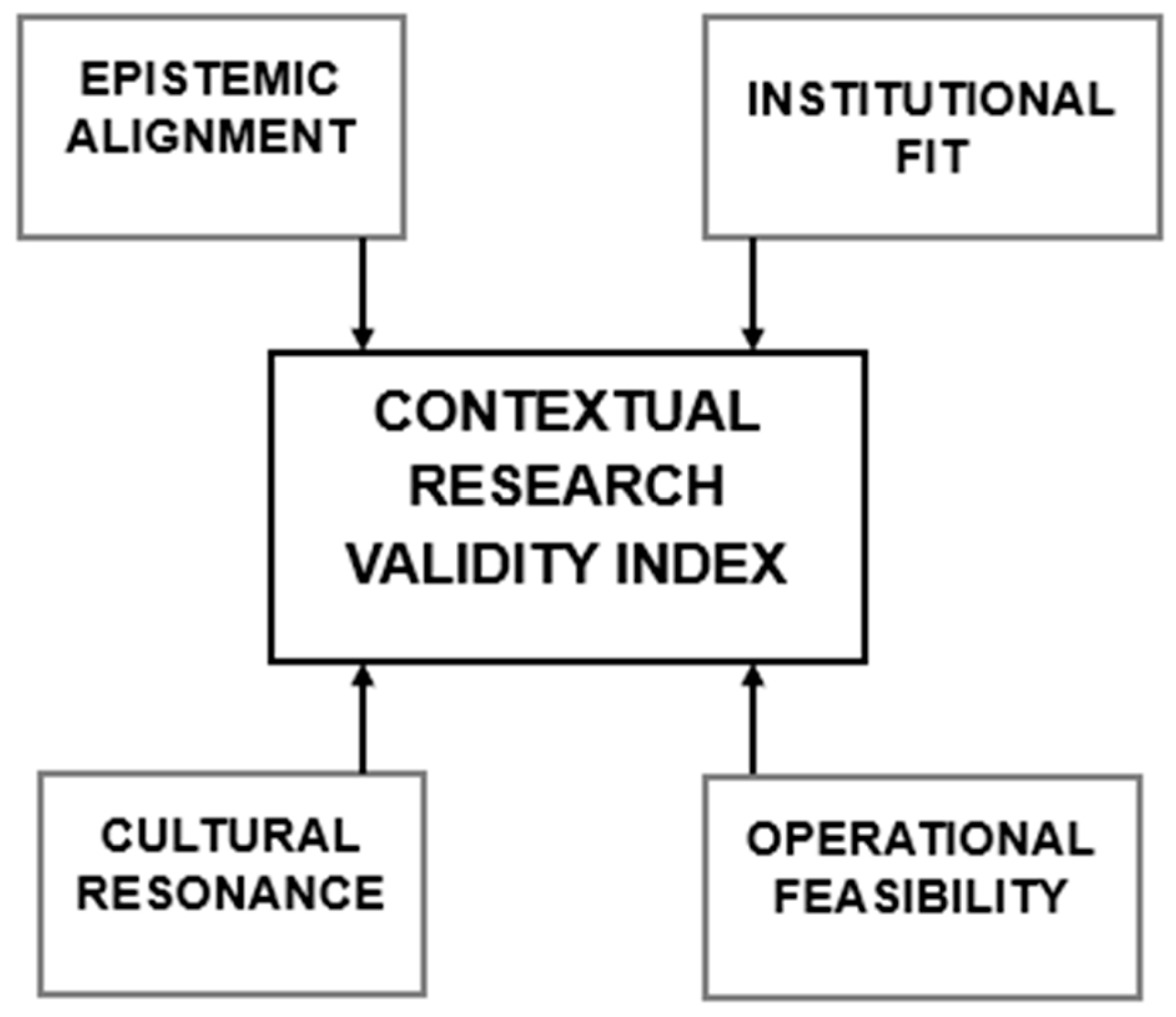

Table 1.
CRVI Assessment for a Leadership Framework in an Indonesian Private-Sector Firm.
| CRVI Dimension | Score (1–5) | Justification |
| Epistemic Alignment (E) | 3 | The leadership model promotes assertive communication and autonomy, but these conflict with Indonesian values of harmony and respect for seniority. |
| Institutional Fit (I) | 3 | HR systems can handle assessments, but they lack the ability to frame feedback in line with local cultural or religious expectations. |
| Cultural Resonance (C) | 2 | Behavioural indicators ignore values shaped by Islamic principles, such as humility, collective responsibility, and consensus-building. Staff find many aspects to be culturally misaligned. |
| Operational Feasibility (O) | 4 | The digital infrastructure, training capacity, and administrative processes are robust, enabling effective use of the tool. |
| Composite CRVI Score | 3.0 | The assessment requires adaptation by incorporating Islamic-informed leadership behaviours and aligning evaluation language with local organisational norms. |
Source: Developed by the Authors (2026).
Table 2.
CRVI Assessment for an Imported Student-Engagement Instrument in Ghanaian Basic Schools.
| CRVI Dimension | Score (1–5) | Justification |
| Epistemic Alignment (E) | 2 | The instrument assumes individual participation and self-directed learning, whereas Ghanaian basic schools typically emphasise collective responses, teacher-led recitation, and structured authority. |
| Institutional Fit (I) | 3 | District education offices can aid in monitoring and training, but lack the supervisory capacity to integrate the new assessment system fully. |
| Cultural Resonance (C) | 2.5 | Some survey items clash with local norms about teacher-student relationships and parent expectations for discipline, autonomy, and classroom behaviour. |
| Operational Feasibility (O) | 4 | Teachers can easily use the tool with minimal resources. It is feasible to deliver it in a paper format, and logistical issues are not a significant concern. |
| Composite CRVI Score | 2.88 | The tool has some contextual alignment but needs to be adapted to Ghanaian teaching methods and cultural norms before it can be used nationwide. |
Source: Developed by the Authors (2026).
Disclaimer/Publisher’s Note: The statements, opinions and data contained in all publications are solely those of the individual author(s) and contributor(s) and not of MDPI and/or the editor(s). MDPI and/or the editor(s) disclaim responsibility for any injury to people or property resulting from any ideas, methods, instructions or products referred to in the content. |
© 2026 by the authors. Licensee MDPI, Basel, Switzerland. This article is an open access article distributed under the terms and conditions of the Creative Commons Attribution (CC BY) license (http://creativecommons.org/licenses/by/4.0/).
Copyright: This open access article is published under a Creative Commons CC BY 4.0 license, which permit the free download, distribution, and reuse, provided that the author and preprint are cited in any reuse.


