

Submitted:
03 April 2026
Posted:
03 April 2026
You are already at the latest version
Abstract
This study investigates how Gen Z’s digital engagement with the Diyandi Festival in Iligan City reconfigures cultural participation into a hybrid experience—where faith, identity, and storytelling unfold across both physical and digital spaces. Employing a qualitative case study design, enriched by digital ethnographic and content analytic methods, the research draws from semi-structured interviews, written and online artifacts, and a robust theoretical framework that includes Hall’s encoding/decoding model, Bakhtin’s carnivalesque theory, and Adorno’s critique of mass culture. Twenty salient themes emerged, mirroring the voices, views, sentiments, and lived experiences of young Iliganons as they navigate tradition through memes, livestreams, and remix aesthetics. Overall, the paper encapsulates the symbolic tension between sacred ritual and digital disruption, highlighting the fragility of mediated spirituality. The study’s innovation lies in its fusion of ethnographic depth with digital cultural analysis, offering a localized yet globally resonant portrait of participatory heritage. It positions Iligan’s festival as a living archive that stands resilient against the tide of global cultural information. Limitations in scope and generational range prompt recommendations for comparative and longitudinal research, and suggest the viability of a “phygital” festival model—one that blends physical celebration with digital engagement to ensure cultural continuity in the age of information.
Keywords:
cultural hybridization
; digital ethnography
; festival remixing
; participatory heritage
; phygital
; youth cultural agency
I. Introduction
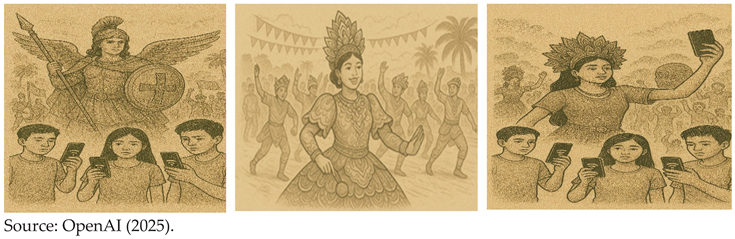
Every September, Iligan City in Northern Mindanao celebrates the Diyandi Festival to honor Señor San Miguel, the city’s patron saint. The festival begins with the Pagpakanaug, a sacred ritual led by Christians, Muslims, and the Higaonon tribe. They ask for permission from both divine and ancestral spirits to begin the celebration (Antonio, 2023). This shared act of respect sets the tone for a month filled with rituals and public events that show how people in Iligan live together peacefully (Suson & Rosauro, 2023; Iligan News, 2025). On September 20, the image of St. Michael the Archangel is lowered for everyone to see and honor. This moment stands for divine protection in the community. A Eucharistic celebration and a grand procession follow, showing Iligan’s strong faith and shared cultural roots.
Yet the Diyandi Festival today is not merely a reenactment of tradition. It is a living, mutable event shaped by the cultural logic of a new generation. Gen Z, born into a world of constant connectivity, approaches ritual not only as participants but as curators and remixers of experience (Turner, 2015). Their engagement is mediated through smartphones, social platforms, and algorithmic visibility, where devotion is often filtered, captioned, and streamed. As Smith (2021) observes, Gen Z’s search for meaning increasingly unfolds in digital spaces, where spirituality is recontextualized through online interaction and visual culture.
This transformation is not unique to Iligan. Across the globe, traditional festivals are being reshaped by technology, becoming hybrid spaces where sacred symbols coexist with commercial aesthetics and digital infrastructure (Cheong et al., 2012; Campbell, 2012). In Iligan, the tension between the sacred and the digital was made visible during the 2025 Pagpakanaog, when the city’s WiFi signal abruptly failed at the height of the ritual. The moment, both ironic and revealing, underscored the fragility of techno-devotion and the limits of digital mediation in sacred contexts.
The interplay between ritual and technology invites reflection on broader questions of cultural sustainability. UNESCO (2024) emphasizes that culture is not only a repository of heritage but a driver and enabler of sustainable development. Festivals like Diyandi serve as platforms for inclusive expression, economic activity, and intergenerational dialogue. Yet they also risk commodification and distortion when filtered through commercial and digital lenses. Bakhtin’s (1984) notion of the carnivalesque—where official structures are inverted and the body becomes a site of spectacle—offers a useful frame for understanding the flamboyant performances of Yawa-yawa dancers and the proliferation of commercialized costumes. These elements, while celebratory, also reflect a shifting cultural economy where ritual is increasingly staged for visibility.
This study examines the hybridization of ritual and digital culture in Iligan’s Diyandi Festival, focusing on Gen Z’s role in shaping its contemporary form. It draws on UNESCO’s cultural framework and engages with concepts of bounded rationality (Wheeler, 2020) to explore how young participants navigate faith, identity, and performance in a landscape where the archangel descends—and the signal dies.
Building on the cultural and generational context outlined above, this study addresses a central question: how are traditional festivals being reimagined by digitally empowered youth? In Iligan City, the Diyandi Festival offers a vivid case of this transformation, where sacred ritual and digital performance converge. Gen Z participants, shaped by a media-saturated environment, engage with the festival not only as attendees but as producers of content, curators of meaning, and agents of reinterpretation. Their digital practices—capturing, editing, and sharing moments of devotion—reflect a shift in how religious experience is encoded and decoded within contemporary media culture (Hall, 1980).
This inquiry is guided by five research questions:
First, how do Gen Z participants engage with the Diyandi Festival through digital platforms such as TikTok, Instagram, and Facebook?
Second, in what ways does technology influence their interpretation of traditional symbols and rituals associated with the festival?
Third, what motivations drive them to document and share their experiences online?
Fourth, how does digital representation affect their perceptions of authenticity, faith, and cultural identity?
Finally, what are the implications of this digital engagement for the future preservation and evolution of the Diyandi Festival?
To address these questions, the study sets out three primary objectives: to explore Gen Z’s digital engagement with the festival, to analyze how technology influences cultural expression and reinterpretation, and to assess the broader implications for cultural preservation and innovation. These objectives are pursued through qualitative analysis of digital content and interviews conducted during the 2025 celebration, focusing specifically on participants aged 18 to 25.
The significance of this research lies in its contribution to global discourse on cultural hybridization and digital anthropology. Cultural festivals, as Giles, Giles, and Bernhold (2019) argue, serve as intergroup settings where identity is negotiated and expressed. In Iligan, the festival becomes a site where youth articulate their belonging not only through physical presence but through digital visibility. This visibility, however, is shaped by the logic of the culture industry, where mass-mediated rituals risk becoming commodified spectacles (Adorno, 1991). The proliferation of selfies, group photos, and curated posts—what Limjuco and Bautista (2016) describe as “selfie and groufie activities”—illustrates how personal and communal identity is constructed through visual documentation and social validation.
Moreover, the role of religious authority is being redefined in this digital context. As Cheong (2021) notes, social media platforms have altered the dynamics of religious leadership and institutional influence. In the case of Diyandi, the image of Señor San Miguel circulates not only through liturgical processions but through hashtags, filters, and livestreams, raising questions about the locus of spiritual meaning. The biblical invocation of the archangel—“Michael and his angels fought against the dragon” (Revelation 12:7, King James Bible, 1769/2017)—is refracted through digital screens, where the battle is not against evil but against algorithmic invisibility.
While the scope of the study is limited to Gen Z participants in Iligan City, it draws comparative references to other festivals for contextual depth. The analysis is confined to digital content and interviews gathered during the most recent festival cycle, allowing for a focused examination of current practices and perceptions.
This research article addresses a notable gap in existing literature. Prior studies on the Diyandi Festival have emphasized symbolism, historical continuity, and ritual structure, but have largely overlooked the impact of digital platforms and generational shifts. Few have examined how online engagement redefines cultural meaning, authenticity, and continuity. By critically analyzing the role of Gen Z in this evolving landscape, the study offers a fresh perspective on the festival’s transformation and its implications for cultural sustainability.
In sum, this study argues that Gen Z’s digital engagement with the Diyandi Festival transforms it into a hybrid cultural experience, blending physical tradition with virtual expression. Through platforms like TikTok, Instagram, and Facebook, participants remix rituals and symbols, merging faith with digital identity. Viewed through the Hybrid Festival Model, this shift highlights evolving notions of authenticity, cultural preservation, and innovation in the digital context.
II. Review of Related Literature
The Diyandi Festival of Iligan City is a layered cultural event that merges religious devotion, indigenous ritual, and performative spectacle. Its historical roots lie in the veneration of St. Michael the Archangel, whose image is ceremonially lowered during the Pagpakanaog and honored in a grand procession on September 20. The festival’s narrative centers on the symbolic battle between good and evil, dramatized through street dancing performances that pit San Miguel against the yawa, a figure of chaos and resistance. As Gloria (2024) notes, this convergence of sacred and theatrical elements reflects a broader cultural logic of divergence and inclusion, where tradition is not preserved in stasis but reinterpreted through performance.
A distinctive feature of the Diyandi Festival is the role of gay performers in embodying the yawa-yawa characters. These portrayals are not incidental—they are central to the festival’s visual and symbolic grammar. Guinto Jr. (2018) argues that the yawa has evolved into a pop icon, with flamboyant gay dancers transforming the figure into a site of parody, spectacle, and queer assertion. This phenomenon aligns with Garcia’s (2008) broader analysis of Philippine gay culture, which highlights the performative agency of bakla identities in public rituals and celebrations. The yawa-yawa becomes a vehicle for visibility, challenging normative religious representations and inserting queer bodies into the heart of civic devotion.
UNESCO’s cultural framework positions festivals as platforms for sustainable development, emphasizing their role in fostering inclusion, economic vitality, and heritage preservation. In this view, events like Diyandi are not merely celebratory—they are developmental, offering communities a means to articulate identity and negotiate change. Eslit (2024) reinforces this perspective by describing Filipino cultural identity as a continuum, shaped by the tension between tradition and adaptation in a globalized, post-pandemic world. The festival’s ability to accommodate indigenous rites, Catholic liturgy, and queer performance illustrates this dynamic balance.
The emergence of Gen Z as digital natives has introduced a new dimension to the festival’s evolution. Characterized by creativity, connectivity, and fluid identity expression, Gen Z engages with tradition through digital platforms that allow for documentation, remix, and reinterpretation. Social media becomes a space where cultural meaning is negotiated, not only through participation but through visibility. As Saeys (2021) observes, urban multicultural festivals often function as spectacles of diversity, but they also hold emancipatory potential when marginalized voices are centered. In Iligan, Gen Z’s digital engagement—through TikTok dances, Instagram stories, and livestreamed rituals—reframes the festival as a hybrid experience, blending physical presence with virtual performance.
This shift invites reflection on the nature of authenticity and reproduction. Benjamin’s (2008) seminal critique of mechanical reproduction suggests that the aura of a ritual diminishes when mediated through technology. Yet in the context of Diyandi, digital reproduction does not erase meaning—it redistributes it. The sacred is not lost in the stream; it is recontextualized, made accessible, and reinterpreted by a generation fluent in visual culture and algorithmic logic.
During the September 2025 celebration, the temporary suspension of mobile signals during key events during the Pagpakanaog was a security measure, intended to prevent remote-triggered disruptions. However, for Gen Z participants, the blackout was more than a technical inconvenience—it was a rupture in the ritual’s digital rhythm. The absence of connectivity during a sacred moment underscored the extent to which faith and documentation have become intertwined, revealing the fragility of techno-devotion and the evolving expectations of ritual experience.
Together, these literatures illuminate the complex interplay between tradition, identity, and technology in the Diyandi Festival. The event serves as a cultural archive and a living performance, shaped by historical narratives, queer expression, and digital mediation. This study builds on these insights to examine how Gen Z’s engagement transforms the festival into a hybrid space of faith, visibility, and cultural negotiation.
Digital ethnography offers a lens through which cultural transformation can be observed in real time. As Pink et al. (2016) argue, it is not merely a method of data collection—it is a way of seeing, one that accounts for the fluidity of identity, space, and meaning in digital environments. In the context of the Diyandi Festival, this approach allows the researcher to trace how rituals are reinterpreted, not only through physical performance but through online circulation.
Remix culture thrives here. So does ritual. In Bytes and Beliefs, Eslit and Escalona (2023) examine how Filipino youth engage with tradition through digital platforms, revealing a dynamic interplay between inherited practices and emergent expressions. Their findings suggest that cultural participation is no longer confined to physical presence; it extends into virtual spaces where meaning is negotiated, stylized, and shared.
Stuart Hall’s (1980) encoding/decoding model is instructive. Gen Z does not simply receive cultural messages—they reframe them. A TikTok video of the Pagpakanaog is not a passive record; it is a reinterpretation, shaped by the creator’s lens, audience expectations, and platform aesthetics. Meaning is not fixed—it is fluid.
Bakhtin’s carnivalesque (1984) deepens this reading. The festival becomes a space of inversion, where official hierarchies are suspended and the body becomes a site of spectacle. In Iligan, this is embodied by the yawa-yawa dancers—often queer, flamboyant, and subversive—who challenge religious orthodoxy through performance. Their presence is not marginal; it is central to the festival’s visual grammar.
Garcia (2008) further situates this within the broader arc of Philippine gay culture, where the bakla occupies a paradoxical space—visible yet often excluded, celebrated yet stigmatized. In the Diyandi Festival, the yawa-yawa role becomes a platform for queer assertion, transforming the street into a stage for identity, parody, and resistance.
Adorno’s critique of the culture industry (1991) warns of commodification. Rituals, once sacred, risk becoming packaged experiences. Yet Gen Z’s engagement complicates this narrative. As Seemiller and Grace (2016) observe, this generation values authenticity, creativity, and social impact. Their digital participation is not merely aesthetic—it is intentional. A stylized Instagram post may reflect personal devotion, communal pride, or a desire to preserve tradition in a format that speaks to their peers.
Benjamin’s (2008) analysis of mechanical reproduction is also relevant. He argues that the aura of an artwork diminishes when it is reproduced. But in the case of festivals, reproduction can be generative. The digital image of San Miguel descending from the altar may lack the immediacy of physical presence, but it gains reach, accessibility, and interpretive possibility. The sacred is not lost—it is redistributed.
Globally, festivals are undergoing similar transformations like the Sinulog of Cebu, Diwali of India, and Coachella of Indio, California, USA.
Each reflects a youth-driven reinterpretation of tradition. In Sinulog, students choreograph dances that blend devotion with pop aesthetics. In Diwali, young creators narrate mythologies through Instagram reels and YouTube shorts. At Coachella, cultural motifs are rebranded as fashion statements, raising questions about appropriation and authenticity.
Chen and Yu (2025) critique this digitalization, warning that festivals risk becoming detached from their original contexts. Yet Tillayeva (2025) offers a counterpoint, arguing that digitalization can also deepen cultural engagement, especially when youth are empowered to shape the narrative.
In Iligan City, the temporary suspension of mobile signals during the Pagpakanaog was a security measure. But for Gen Z, it was more than a technical inconvenience—it was a rupture in the ritual’s digital rhythm. The absence of connectivity during a sacred moment underscored the extent to which faith and documentation have become intertwined.
This is not a glitch. It is symbolic. It is telling. The interruption reveals the fragility of techno-devotion and the evolving expectations of spiritual experience. Through digital ethnography, the researcher began to see how bytes and beliefs intertwined—how tradition is not lost, but reimagined.
III. Theoretical Framework
The convergence of tradition and technology in contemporary cultural practices invites a deeper look into how younger generations reinterpret heritage. In Iligan City, the Diyandi Festival has become more than a religious event—it now serves as a dynamic platform where Gen Z expresses identity, creativity, and devotion through digital media. To critically examine this transformation, the study draws on three interrelated theoretical lenses: Stuart Hall’s Encoding/Decoding Theory, Mikhail Bakhtin’s Carnivalesque, and Theodor Adorno’s Culture Industry. These frameworks offer insight into how meaning is constructed, challenged, and commodified in the digital age.
Hall’s (1980) Encoding/Decoding Theory provides a foundation for understanding how cultural messages are produced and interpreted. Festival organizers encode religious and symbolic meanings into performances and rituals, such as the image of Señor San Miguel or the theatrical portrayal of the “yawa.” Gen Z, however, decodes these messages through personal and generational lenses, often reshaping them into humorous, aesthetic, or performative content on platforms like TikTok and Instagram. This theory positions the youth not as passive recipients of tradition, but as active agents in meaning-making.
Bakhtin’s (1984) concept of the carnivalesque adds another layer, highlighting how cultural spaces allow for the inversion of norms and the celebration of subversion. The Diyandi Festival, with its theatricality and playful disruption, reflects this spirit—especially in the portrayal of the “yawa” character, which often becomes a site for queer expression and social commentary. As Guinto Jr. (2018) observed, such performances challenge religious orthodoxy and patriarchal structures. When amplified through digital media, these acts of subversion extend into virtual spaces, where Gen Z reclaims tradition on their own terms.
Adorno’s (1991) critique of the culture industry introduces a critical lens on the commodification of cultural expression. The festival’s online presence—curated hashtags, influencer-driven content, and viral trends—risks reducing sacred rituals to algorithm-friendly entertainment. Yet, this shift does not necessarily signal a loss of meaning. As Eslit and Escalona (2023) argue in their study on digital ethnography, Gen Z’s engagement reflects a reconfiguration of cultural values, shaped by technological mediation and youth agency.
Together, these three theories construct a multidimensional framework for analyzing Gen Z’s digital engagement with the Diyandi Festival. Hall’s model foregrounds interpretation, Bakhtin’s lens celebrates subversion, and Adorno’s critique challenges commodification. In the hands of a generation fluent in both faith and filters, the festival becomes not just a ritual, but a living conversation between heritage and innovation.
IV. Methodology
This study employed a qualitative case study design, enriched by digital ethnographic and content analytic methods. The aim was to explore how Gen Z participants in Iligan City reimagine the Diyandi Festival through digital platforms, blending physical tradition with virtual expression. Following Creswell and Poth (2018), the case study approach allowed for an in-depth, contextual examination of a bounded cultural phenomenon—one shaped by ritual, identity, and mediated performance.
Digital ethnography was central to this inquiry. Not just as a technique, but as a way of seeing.
As Pink et al. (2016) argue, digital ethnography requires immersion in online environments, attention to platform-specific cultures, and reflexive engagement with mediated practices. In this study, TikTok, Instagram, and Facebook posts tagged with #DiyandiFestival were observed over a three-week period. These posts—ranging from stylized dances to livestreamed novenas—were treated as cultural texts, revealing how Gen Z performs devotion, negotiates identity, and reframes ritual through digital aesthetics.
Semi-structured interviews added depth and nuance. Twenty Gen Z participants, aged 18 to 25, were selected through purposive sampling. All were active contributors to the festival’s online presence. The interviews explored personal narratives of faith, performance, and digital engagement. Participants spoke candidly about their motivations, creative choices, and the tension between reverence and visibility. Their voices grounded the study in lived experience.
Content analysis was applied to 100 publicly available social media posts. Thematic coding followed Braun and Clarke’s (2012) model, identifying patterns in how digital tools—memes, filters, captions—functioned as instruments of storytelling and spiritual expression. Hall’s (1980) encoding/decoding theory guided interpretation, treating each post as a site of negotiated meaning between creator and audience.
Sampling was intentional. Local voices, including LGBTQ+ and indigenous youth, were prioritized. This decision was informed by Bakhtin’s (1984) concept of the carnivalesque, which frames festivals as spaces of inversion—where dominant narratives are disrupted and alternative identities are made visible. In the context of Diyandi, queer performers and digital creators occupy central roles in shaping the festival’s contemporary form.
Data analysis was iterative and reflexive. Coding focused on four domains: identity, tradition, performance, and engagement.
Data saturation was reached with 20 participants, coded GZ-1 to GZ-20. The researcher’s positionality—as an Iliganon and Catholic educator—was acknowledged throughout. This insider status offered cultural insight, but also demanded critical distance. Adorno’s (1991) critique of the culture industry served as a cautionary frame, reminding the researcher to distinguish between commodification and genuine cultural expression.
Ethical considerations were rigorously observed. Consent was obtained from all interviewees. Public social media content was used responsibly—only from open-access posts, with identifiable information anonymized or paraphrased. No direct interaction occurred with content creators. Cultural sensitivity guided all stages of interpretation, especially in handling religious and personal narratives.
Validity was built through triangulation. Credibility through thick description. Trustworthiness through reflexivity.
By integrating digital ethnography and content analysis within a qualitative case study framework, this methodology captured not only what Gen Z posts—but why. It revealed how faith, identity, and performance converge in the space where the archangel descends and the signal dies.
Ethical Considerations
This study upheld ethical responsibility by ensuring that Gen Z voices were engaged with dignity and care. Consent was obtained from all interviewees, and public social media content was used responsibly—drawn only from open-access posts, with identifying details anonymized or paraphrased to protect privacy. Cultural sensitivity guided every stage of interpretation, particularly in handling religious devotion, personal narratives, and performances of identity. The researcher’s insider status as an Iliganon and Catholic educator was acknowledged with reflexive distance, balancing cultural insight with critical awareness. By prioritizing local voices, including LGBTQ+ and indigenous youth, the study affirmed inclusivity and resisted erasure. Trustworthiness was cultivated through triangulation, thick description, and reflexivity, ensuring that digital ethnography became not just a method but an ethical practice of listening, representation, and respect.
V. Results and Discussion
This part of the paper presents findings in relation to the study’s aims, offering interpretive insights into contextual dynamics and emergent patterns that surfaced through the process. Focusing on the synthesized responses to the five research questions, the following salient insights come to the fore:
Question no. 1. How Gen Z Engages with the Diyandi Festival Through Digital Platforms? Generally, Gen Z participants engage with the Diyandi Festival primarily through TikTok, Instagram, and Facebook. Each platform serves a distinct purpose: TikTok is the stage for short-form dance challenges and humorous reenactments of yawa-yawa performances; Instagram hosts stylized reels and stories, often featuring novena livestreams or costume preparation; Facebook remains a hub for community-wide sharing and intergenerational dialogue.
“I posted my Pagpakanaog reel with the caption ‘San Miguel, but make it aesthetic.’” —GZ-3, 19, local content creator
This kind of engagement reflects Hall’s (1980) encoding/decoding model: Gen Z does not merely consume tradition—they reinterpret it. Their posts are not just documentation; they are expressions of agency, remixing sacred symbols into visual narratives that resonate with their peers. As Tsaliki (2022) notes, youth identity is increasingly constructed within digital media ecologies, where cultural practices are performed and negotiated in real time.
These digital performances are not incidental—they are central to how identity is articulated and festival traditions are reimagined (Zahorodnia, 2025). Through curated captions, aesthetic filters, and platform-specific formats, participants enact a form of cultural authorship. Identity emerges not only through what is shared, but how it is framed: humorous, reverent, ironic, or aspirational. Tradition, in turn, becomes a living archive—fluid, participatory, and responsive to the rhythms of online engagement.
Performance is embedded in both the content and the act of posting itself. The choice to reenact a yawa-yawa scene or livestream a novena is a performative gesture that blends devotion with digital fluency. These acts reflect a layered engagement: one that honors cultural roots while simultaneously adapting them to the expressive norms of Gen Z’s media landscape.
Engagement, therefore, is multidimensional. It spans affective connection, creative participation, and social interaction. Platforms like Facebook facilitate intergenerational dialogue, while TikTok and Instagram allow for peer-to-peer resonance and visibility. In this context, the Diyandi Festival is not only celebrated—it is co-constructed, mediated, and made meaningful through digital acts of sharing and reinterpretation.
Question no. 2. Technology’s Influence on Symbolic Interpretation. Technology continues to reshape how cultural symbols are perceived and performed. Among Gen Z participants, traditional figures like San Miguel and the yawa-yawa are no longer confined to their original ritual contexts. Instead, they circulate as digital motifs—stylized, reinterpreted, and often infused with irony or aesthetic flair. The image of San Miguel, once solemn and sacred, now appears in curated posts that blend reverence with visual play. The yawa-yawa, historically cast as a figure of evil, is embraced for its theatrical excess, emerging as a symbol of queer expression and creative defiance. “I used a glitter filter on my yawa-yawa costume video. It’s camp. It’s art.” —GZ-11, 22, local performer. Echoing this playful reimagining, another participant shared: “I posted my San Miguel cosplay with vaporwave music in the background. It’s sacred, but also vibey.” —GZ-07, 20, a local digital artist.
Together, these quotations illustrate how Gen Z creators blend sacred iconography with digital aesthetics to produce hybrid forms of expression. Such reinterpretations reflect a shift in how tradition is engaged—not as static heritage, but as a flexible medium for identity-making. Drawing from Bakhtin’s carnivalesque, these digital performances invert established meanings, allowing participants to subvert and celebrate simultaneously. While Adorno warns of cultural flattening through mass reproduction, the creative agency shown here resists simplification. Benjamin’s notion of aura loss is complicated by the way digital circulation enables broader access and new layers of meaning. What emerges is not a diminished tradition, but a reimagined one—alive in the hands of those who remix it (Visser & Richardson, 2022).
Question no. 3. Motivations for Documenting and Sharing Online. Gen Z’s engagement with the Diyandi Festival through social media reflects a layered set of motivations. For many, posting content is not just about visibility—it is a way to affirm cultural identity, preserve memory, and participate in a broader narrative of pride and belonging (Turner, 2015). The act of sharing becomes a ritual in itself, one that transforms traditional celebration into digital performance. “I want people to see that we have culture. That we’re not just scrolling—we’re celebrating.” —GZ-14, 20, a student. Yet not all participants share this perspective. For some, the pressure to document can feel performative or even disingenuous. “Sometimes it feels like we’re just posting for clout. Like, if you didn’t film it, did it even happen?” —GZ-09, 19, college freshman.
This tension between authenticity and performance reflects broader debates about digital culture. While some view online sharing as a form of cultural affirmation, others question its sincerity and depth. However, bridging these views, another participant offered a more integrative stance: “I post because it’s fun, but also because it’s part of the festival now. It’s how we show up—for each other and for the culture.” —GZ-18, 21, a community organizer. This resolution suggests that digital documentation is not merely about self-promotion or cultural preservation—it’s about participation.
It becomes a hybrid ritual, blending personal expression with communal affirmation. This kind of digital participation aligns with broader patterns observed in other cultural contexts. Reyes (2020) notes that online religious performance has become central to festivals like Sinulog, where devotion is increasingly mediated through digital platforms. Similarly, Sharma and Singh (2023) highlight how youth use Instagram storytelling during Diwali to negotiate identity and tradition, blending sacred imagery with personal expression. Bennett and Segerberg (2021) describe how festivals like Coachella have evolved into aesthetic experiences shaped by digital sharing, where participation is both performative and communal. In the case of Diyandi, platforms like TikTok and Instagram serve as spaces where tradition is not only documented but reimagined. Memes, hashtags, and short-form videos become tools for storytelling, allowing participants to assert cultural relevance in ways that resonate with their peers. This form of engagement reflects a shift in how festivals are experienced—no longer confined to physical space, but extended into digital ecologies where meaning is created, circulated, and contested in real time.
Question no. 4. Digital Representation and Perceptions of Authenticity, Faith, and Identity. Digital representation has reshaped how Gen Z perceives authenticity and faith, introducing new tensions between sacred tradition and mediated experience. For some, online rituals risk diminishing spiritual depth; for others, they offer a more accessible and relatable form of devotion. The act of watching a novena on Facebook Live while engaging in everyday routines—such as doing makeup—illustrates how sacred practice is being woven into the fabric of daily life. “I watched the novena on Facebook Live while doing my makeup. It still felt sacred.” —GZ-5, 18, mall sales clerk. “I was folding laundry while praying along with the livestream. It felt like God was right there with me.” —GZ-12, 21, nursing student. These voices reflect a growing sentiment among Gen Z: that sacredness is not confined to silence or solemnity, but can emerge in the midst of ordinary acts. This duality reflects the evolving nature of ritual in digital spaces. Hutchings (2017) argues that online religious practices reconfigure community and ritual, allowing spiritual engagement to occur beyond traditional boundaries. Gen Z’s participation in these mediated rituals suggests a shift in how faith is performed—not through withdrawal from the secular, but through integration with it.
This integration finds resonance in scripture. As St. Paul writes, “Do you not know that your bodies are temples of the Holy Spirit… Therefore honor God with your bodies” (1 Corinthians 6:19–20). The verse affirms that spiritual presence is not limited to sacred architecture—it dwells within the everyday, within the embodied and the mundane.
Tradition, once anchored in physical spaces and formal structures, now circulates through interfaces and algorithms. Noble (2022) describes how Gen Z uses platforms like TikTok to remix religious symbols and narratives, creating short-form content that blends reverence with creativity. These digital expressions do not merely replicate tradition—they reinterpret it, allowing youth to assert spiritual identity in formats that resonate with their peers.
Performance plays a central role in this transformation. The choice to livestream, caption, or stylize a religious moment reflects a conscious act of meaning-making. Garcia (2022) highlights how youth culture leverages digital aesthetics to claim visibility and agency within cultural spaces. In the context of the Diyandi Festival, such performances are not superficial—they are expressions of belonging, pride, and spiritual continuity.
Engagement, therefore, is multifaceted. It involves not only participation in ritual, but also negotiation of meaning, identity, and visibility. Through digital platforms, Gen Z redefines what it means to be faithful, blending tradition with innovation and creating new pathways for spiritual connection in a hypermediated world.
Moving forward, it can be deduced that social media platforms have become vast cultural archives, bridging generations and preserving traditions in new forms (Romero, 2025). As Liang et al. (2021) argue, digital community engagement is essential for sustainable heritage management. The festival’s survival may depend not on resisting digitalization, but on embracing it with care, creativity, and cultural integrity.
“I don’t just attend Diyandi—I curate it.” —GZ-12, 20.
For Gen Z participants, the Diyandi Festival is no longer just a physical event—it’s a curated digital experience. Their engagement unfolds across TikTok, Instagram, and Facebook, where each platform serves a distinct function. TikTok becomes a stage for short-form dance challenges and humorous reenactments of yawa-yawa performances. Instagram hosts stylized reels and stories, often featuring novena livestreams or behind-the-scenes costume preparation. Meanwhile, Facebook remains a communal hub, connecting generations through shared memories and local group interactions.
This digital curation reflects a broader shift in how youth interact with tradition. As Hall (1980) theorized, cultural texts are not simply received—they are decoded, reinterpreted, and recontextualized. Gen Z’s posts are not mere documentation; they are acts of agency, remixing sacred symbols into visual narratives that resonate with their peers. The use of filters, hashtags, and remix aesthetics is not superficial—it’s strategic. A reel of the Pagpakanaog might feature slow-motion edits, lo-fi music, and captions like “Divine descent, Gen Z edition,” signaling both reverence and creative flair.
“I used a glitter filter on my yawa-yawa costume video. It’s camp. It’s art.” —GZ-11, 22, performer.
This kind of reinterpretation speaks to Bakhtin’s (1984) concept of the carnivalesque, where inversion and parody become tools of cultural expression. The yawa-yawa, once feared, is now celebrated as a queer icon—flamboyant, theatrical, and meme-worthy. Yet this transformation is not a rejection of tradition; it’s a reframing. Gen Z balances reverence and entertainment, often blending solemnity with spectacle. As Benjamin (2008) argued, mechanical reproduction alters the aura of tradition, but it also democratizes access. In the hands of Gen Z, sacred symbols are not diminished—they are redistributed, made accessible, and infused with new meaning.
“I still pray before I post.” —GZ-15, 22, a student.
This notable tension between devotion and digitality reveals a nuanced understanding of faith. For many participants, posting about the festival is not a distraction from spirituality—it’s an extension of it. Watching a novena livestream while multitasking, or sharing a prayer reel with aesthetic edits, still carries emotional and spiritual weight. Leong et al. (2025) note that digital religion reshapes spiritual practices, making them more participatory but also more fragmented. Gen Z navigates this complexity with ease, often embracing both irony and intimacy in their online rituals.
Their motivations for sharing are equally layered. Self-expression is central—they use posts to craft identity, signal values, and showcase creativity. But there’s also a strong sense of community pride. Many participants expressed a desire to represent Iligan, to celebrate local culture, and to connect with others who share their roots. Social validation plays a role as well. Likes, shares, and comments offer feedback loops that affirm belonging and visibility.
“I want my friends in Manila to see what we have here.” —GZ-10, 21, a local performer.
This drive to share aligns with Rodriguez’s (2024) findings on digital activism and youth identity. Platforms like TikTok and Instagram are not just for entertainment—they are battlegrounds for visibility, pride, and resistance. Gen Z’s posts are communal, shaped by peer networks and digital trends. As Jain (2024) observes, this generation prefers interactive, co-created content and values authenticity above all. Their sharing is not random—it’s strategic, emotional, and deeply tied to cultural identity.
Importantly, these patterns of digital engagement have implications for the future of the Diyandi Festival. Initiatives like Reels sa Diyandi invite Iliganons to document and celebrate their culture through short-form video competitions, democratizing cultural storytelling. As Romero (2025) explains, social media platforms have become vast cultural archives, empowering individuals to become cultural storytellers and bridging generational gaps. The festival’s survival may depend not on resisting digitalization, but on embracing it with care, creativity, and cultural integrity.
“My reel got more views. I think that’s more than the crowd I got before.” —GZ-9, 23, aspiring engineering student.
In this context, visibility becomes preservation. Gen Z’s digital engagement ensures that the Diyandi Festival evolves with its participants—not apart from them. Their posts are not just content—they are cultural memory, encoded in pixels, shared in stories, and passed on through screens.
“Sometimes I feel like I’m performing faith—not just practicing it.” —GZ-8, dancer and content creator.
This tension between sacred and staged experience is one of the most striking themes in Gen Z’s digital engagement with the Diyandi Festival. For many, the act of posting about the festival—whether it’s a prayer reel, a dance challenge, or a meme—blurs the line between devotion and display. The digital ritual becomes both a personal offering and a public performance.
This duality reflects what Hall describes in his encoding/decoding model: cultural texts are not simply received—they are interpreted, recontextualized, and often transformed by the audience. Gen Z’s sense of authenticity is fluid, shaped by aesthetics, platform norms, and audience feedback. Their posts are both mirror and canvas—reflecting who they are while experimenting with who they might become.
“My Lola said my TikTok was disrespectful. But I felt proud. I felt seen.” —GZ-13, a youth leader and performer.
This evolving sense of cultural ownership and agency is central to Gen Z’s relationship with tradition. They are not passive inheritors—they are active reinterpreters. Their digital expressions often challenge conventional boundaries, yet remain rooted in personal and communal meaning. Bakhtin’s notion of the carnivalesque helps illuminate this dynamic: by inverting sacred symbols and injecting humor or flamboyance, Gen Z creates space for alternative voices and playful subversion within the festival’s visual grammar.
Yet this remixing raises important questions about cultural continuity.
On one hand, digital platforms offer unprecedented opportunities for innovation and youth inclusion. Initiatives like Reels sa Diyandi invite Iliganons to document and celebrate their culture through short-form video competitions, democratizing cultural storytelling. These digital spaces allow young people to engage creatively, making the festival more accessible and relevant to their generation.
“I joined the reel contest because it felt like a way to honor San Miguel—my way.” —GZ-4, a student.
On the other hand, there are risks. Digitalization can lead to commodification, where sacred practices are reduced to content, stripped of depth and context. Adorno’s critique of the culture industry warns that mass reproduction can flatten meaning, turning cultural expressions into standardized products for consumption. In the context of Diyandi, this might manifest as stylized rituals optimized for engagement metrics, while their deeper spiritual and communal significance fades into the background.
This concern is echoed in critiques of digital colonialism, where marginalized identities are repackaged and circulated by those at a privileged distance. In the festival’s digital sphere, the tension between visibility and authenticity becomes especially pronounced. Gen Z’s creative agency resists this flattening—but without intentional frameworks, the risk remains.
So, what can be done?
Recommendations for cultural institutions and festival organizers are clear. First, embrace digital engagement—but do so with intentionality. This means supporting community-led content creation, curating digital archives that honor context, and training youth in ethical cultural storytelling. Second, foster intergenerational dialogue. Platforms like Facebook and TikTok can be used to connect elders and youth, allowing traditions to be explained, questioned, and reinterpreted together. Third, protect cultural integrity. Organizers should collaborate with local creators to ensure that digital representations are respectful, inclusive, and rooted in community values.
“We’re not just content creators—we’re culture keepers.” —GZ-1, a teacher.
In this light, Gen Z’s digital engagement is not a threat to tradition—it’s a lifeline. It offers new ways of seeing, sharing, and sustaining the Diyandi Festival. But it also demands reflection, responsibility, and a commitment to cultural integrity.
Thematic Analysis
This thematic analysis explores how Gen Z in Iligan City reimagines the Diyandi Festival through digital platforms, personal narratives, and scholarly perspectives. Guided by Braun and Clarke’s framework, twenty themes emerged from interviews, social media content, and an in-depth literature review. Together, these themes reveal how tradition is not merely preserved but actively reshaped, as young Iliganons negotiate faith, identity, and cultural meaning in a rapidly digitizing world.
| Theme | Description | Participant Voices |
| 1. Festival as Curated Experience | Gen Z transforms the Diyandi Festival into a digital showcase, using platforms like TikTok and Instagram to stylize participation. This reflects Hall’s view of cultural texts as actively encoded and reinterpreted. | “I don’t just attend Diyandi—I curate it.” —GZ-12 |
| 2. Remix Aesthetics | Rituals are reimagined through filters, trending sounds, and visual edits. Bakhtin’s carnivalesque theory explains how inversion and parody allow Gen Z to inject humor and creativity into sacred forms. | “San Miguel with lo-fi beats? That’s how I feel holy.” —GZ-3 |
| 3. Digital Devotion | Faith is practiced through livestreams, prayer reels, and captions. Leong et al. argue that digital religion reshapes spirituality, making it more participatory but also fragmented. | “I still pray before I post.” —GZ-15 |
| 4. Cultural Pride & Identity | Sharing festival content becomes a form of cultural affirmation and resistance against invisibility. Rodriguez highlights how digital activism allows youth to assert local identity and heritage. | “We’re culture keepers.” —GZ-1 |
| 5. Sacred vs. Staged Tension | Participants navigate the line between authentic devotion and performative display. Adorno’s critique of mass culture warns that stylization risks flattening meaning, yet Gen Z embeds sincerity within spectacle. | “I’m performing faith—not just practicing it.” —GZ-8 |
| 6. Youth Agency & Ownership | Gen Z sees themselves as co-authors of tradition, remixing rituals to reflect their values. Eslit’s work on Filipino identity supports this dynamic view of culture as evolving and participatory. | “We’re remixing, not replacing.” —GZ-17 |
| 7. Social Validation & Peer Influence | Engagement metrics like likes and shares shape how rituals are performed and perceived. Jain notes that Gen Z thrives in co-created digital spaces where feedback loops affirm belonging. | “My reel got 1100 views.” —GZ-9 |
| 8. Queer Visibility & Subversion | The yawa-yawa role becomes a space for LGBTQ+ empowerment. Bakhtin’s notion of inversion explains how marginalized voices use parody and flamboyance to reclaim visibility within traditional frameworks. | “I felt powerful in my yawa-yawa costume.” —GZ-16 |
| 9. Commodification Risk | The pressure to go viral can trivialize sacred practices. Tillayeva warns that digital platforms often favor aesthetic appeal over cultural depth, risking homogenization of nuanced traditions. | “It’s more about the views than the values.” —GZ-6 |
| 10. Intergenerational Bridging | Despite generational gaps, digital platforms foster dialogue between youth and elders. Visser and Richardson advocate for frameworks that support cultural continuity through shared storytelling. | “My Lola loved the video.” —GZ-14 |
| 11. Humor as Cultural Commentary | Satire and parody are used to critique and celebrate tradition. Bakhtin’s carnivalesque lens reveals how humor becomes a tool for negotiating cultural meaning and challenging authority. | “I made a meme of the novena—it’s funny but still sacred.” —GZ-20 |
| 12. Aestheticization of Ritual | Rituals are stylized for visual impact, often shaped by platform aesthetics. Benjamin’s theory of aura and reproduction suggests that while meaning may shift, accessibility expands. | “I chose my costume based on what would look good on IG.” —GZ-2 |
| 13. Platform-Specific Engagement | Each platform influences how tradition is performed—TikTok for spectacle, Facebook for community. Tsaliki’s media ecologies framework explains how digital environments shape cultural behavior. | “TikTok is for dancing, Facebook is for family.” —GZ-19 |
| 14. Festival as Personal Archive | Posts serve as memory-keeping tools, preserving individual and collective experiences. Romero emphasizes digital storytelling as a form of cultural preservation and identity formation. | “I want to remember this version of Diyandi.” —GZ-10 |
| 15. Emotional Resonance Online | Digital rituals evoke genuine emotional responses, blending screen-based interaction with spiritual depth. Leong et al. highlight how online faith practices can still foster awe and connection. | “I cried watching the livestream.” —GZ-4 |
| 16. Cultural Learning via Social Media | Gen Z learns about tradition through peer-shared content and explainer videos. Liang et al. argue that digital engagement fosters cultural education and community participation. | “I didn’t know the meaning of yawa-yawa until I saw a TikTok explainer.” —GZ-13 |
| 17. Festival as Identity Performance | Participation becomes a way to express cultural identity. Hall’s work on cultural identity shows how individuals perform and negotiate belonging through symbolic acts. | “My post says: I’m Iliganon and proud.” —GZ-7 |
| 18. Rituals as Trendable Moments | Certain rituals are adapted to fit trending formats, often losing nuance. Adorno’s critique of mass culture warns that repetition and virality can flatten symbolic meaning. | “We did a novena challenge with transitions.” —GZ-5 |
| 19. Hybrid Sacred Spaces | Online and offline experiences blend into new forms of spiritual practice. Benjamin’s notion of portable aura helps explain how sacredness can be mediated through screens. | “I prayed at the Cathedral and reposted the livestream later.” —GZ-18 |
| 20. Youth-Led Cultural Innovation | Gen Z leads the evolution of tradition through creative digital storytelling. Gómez-Ullate and Saraiva advocate for youth inclusion in heritage work to ensure sustainability and relevance. | “We’re making Diyandi future-proof.” —GZ-11 |
This thematic analysis reveals that Gen Z’s engagement with the Diyandi Festival is not merely digital—it is deeply cultural, reflexive, and transformative. Through curated content, remix aesthetics, and hybrid rituals, young Iliganons assert agency over tradition while navigating tensions between sacredness and spectacle. Their voices, amplified by social media and informed by evolving cultural literacies, demonstrate that heritage is not static but continually reimagined. As the festival moves forward, these twenty themes offer a roadmap for understanding how faith, identity, and innovation converge in the hands—and screens—of a generation shaping the future of cultural continuity.
VI. Conclusion and Recommendations
This study reveals that Gen Z’s digital engagement with the Diyandi Festival redefines cultural participation as a hybrid experience—where faith, identity, and storytelling unfold across both physical and digital spaces. Drawing from Braun and Clarke’s thematic analysis framework, the research synthesized insights from semi-structured interviews, digital content, and a robust literature review that included works by Hall, Bakhtin, Adorno, Benjamin, and others. These theoretical lenses provided critical depth: Hall’s encoding/decoding model illuminated how Gen Z reinterprets tradition through digital media; Bakhtin’s carnivalesque theory explained their playful inversions of sacred symbols; and Adorno’s critique of mass culture helped interrogate the risks of commodification. Most importantly, the twenty salient themes that surfaced mirror the voices, views, sentiments, and lived experiences of the participants—insights that demand recognition and inclusion in future cultural discourse. What makes this study novel and distinct is its fusion of ethnographic depth with digital cultural analysis, offering a localized yet globally resonant portrait of how tradition is actively reshaped by youth agency. This is poignantly captured in the metaphor “Pagpakanaog.exe: When the Archangel Descends and the Signal Dies”—a symbolic tension where sacred ritual meets digital disruption, and where reverence is refracted through unstable bandwidth. Unlike studies that treat festivals as static heritage or digital media as mere tools, this research article positions Iligan’s Diyandi Festival as a living, evolving archive—one that stands resilient against the tide of global cultural information, and offers a compelling model for participatory heritage in the local digital context.
Recommendations: While this study offers valuable insights into Gen Z’s digital engagement with the Diyandi Festival, it is not without limitations. The research article focused primarily on a single geographic and generational context, relied on local self-reported experiences, and captured a snapshot in time rather than long-term trends. These constraints highlight the need for broader, comparative, and longitudinal approaches. To sustain the momentum of cultural innovation, local cultural institutions and festival organizers should embrace adaptive strategies that integrate digital platforms and elevate youth voices. This includes supporting community-led content creation, curating online archives, and fostering intergenerational dialogue through social media. Iligan’s experience offers a compelling case for global discourse on cultural remixing, positioning the city as a model of participatory heritage in the digital context. Future research can explore cross-regional and intergenerational comparisons, track the evolution of digital cultural practices over time, and examine the viability of a “phygital” festival model—one that seamlessly blends physical celebration with digital engagement to ensure accessibility, relevance, and continuity.
Acknowledgments of AI Assistance
The author acknowledges the use of Microsoft Copilot as a supportive tool in the preparation of this manuscript. Copilot was employed for grammar refinement, paraphrasing, and the polishing of the paper. In addition, AI tools were used to create illustrative diagrams and visual representations that accompany the text. All substantive analysis, theoretical framing, and final interpretations remain the sole output of the author. The integration of AI assistance was conducted ethically and transparently, consistent with guidelines on academic integrity.
References
- Adorno, T. W. Culture industry reconsidered. In The culture industry: Selected essays on mass culture; Bernstein, J. M., Ed.; Routledge, 1991; pp. 85–92. [Google Scholar]
- Antonio, L. E. Divine gathering: 50,000 devotees join ‘Pagpakanaug’ procession in Iligan. Philippine Information Agency. 22 September 2023. Available online: https://mirror.pia.gov.ph/features/2023/09/22/divine-gathering-50000-devotees-join-pagpakanaug-procession-in-iligan.
- Arch; Anth. Religion, ritual & simulation: How technology recreates the sacred. Arch & Anth. n.d. Available online: https://archandanth.com/religion-ritual-simulation-how-technology-recreates-the-sacred.
- Bakhtin, M. Rabelais and his world; Original work published 1965; Iswolsky, H., Translator; Indiana University Press, 1984. [Google Scholar]
- Benjamin, W. The work of art in the age of mechanical reproduction; (Original work published 1936); Underwood, J. A., Translator; Penguin Books, 2008. [Google Scholar]
- Bennett, A.; Segerberg, A. Coachella and the aesthetics of digital participation: Music festivals in the age of Instagram. Cultural Sociology 2021, 15(3), 310–328. [Google Scholar] [CrossRef]
- Braun, V.; Clarke, V. Thematic analysis. In APA handbook of research methods in psychology; Cooper, H., Camic, P. M., Long, D. L., Panter, A. T., Rindskopf, D., Sher, K. J., Eds.; American Psychological Association, 2012; Vol. 2, pp. 57–71. [Google Scholar] [CrossRef]
- Campbell, H. A. Digital religion: Understanding religious practice in new media worlds; Routledge, 2012. [Google Scholar]
- Chen, Z.; Yu, T. Festivals and digitalisation: A critique of the literature. Tourism Critiques 2025, 6(1), 2–17. [Google Scholar] [CrossRef]
- Cheong, P. H. Religious authority and social media: Religious leaders and institutions in the digital age. Religion 2021, 51(1), 1–23. [Google Scholar] [CrossRef]
- Digital religion, social media and culture: Perspectives, practices and futures. In Peter Lang.; Cheong, P. H., Fischer-Nielsen, P., Gelfgren, S., Ess, C., Eds.; 2012. [Google Scholar]
- Creswell, J. W.; Poth, C. N. Qualitative inquiry and research design: Choosing among five approaches, 4th ed.; SAGE Publications, 2018. [Google Scholar]
- Eslit, E. R. The continuum of Filipino cultural identity: Balancing tradition and change in a globalized and post-pandemic world. International Journal of Languages and Culture 2024, 4(2), 66–77. [Google Scholar] [CrossRef]
- Eslit, E. R.; Escalona, S. L. Bytes and beliefs: Understanding cultural dynamics through digital ethnography; Preprints, 2023. [Google Scholar]
- Garcia, J. N. C. Philippine gay culture: Binabae to bakla, silahis to MSM, 2nd ed.; University of the Philippines Press, 2008. [Google Scholar]
- Garcia, L. M. Festival futures: Coachella, youth culture, and the politics of visibility. Journal of Popular Culture 2022, 55(4), 765–783. [Google Scholar] [CrossRef]
- Giles, M.; Giles, H.; Bernhold, Q. Cultural festivals as intergroup settings: A case study of Pacific Islander identification. Journal of Multilingual and Multicultural Development 2019, 40(9), 818–832. [Google Scholar] [CrossRef]
- Gloria, V. Diyandi: Divergence, convergence, and inclusion. Retrieved from Academia.edu. 2024. Unpublished manuscript.
- Gómez-Ullate, M.; Saraiva, S. S. Festivals and youth: An educational cultural route to festivals. Youth 2024, 4(1), 369–381. [Google Scholar] [CrossRef]
- Guinto, A. C., Jr. Hala, ang yawa! The devil as pop icon in Iligan City Diyandi street dancing festival. In Sining at Kultura: A compendium of studies on Philippine arts and cultures; MSU-Iligan Institute of Technology, 2018; pp. 1–20. [Google Scholar]
- Hall, S. Encoding/decoding. In Culture, media, language: Working papers in cultural studies; Hall, S., Hobson, D., Lowe, A., Willis, P., Eds.; 1980; p. 1972–79 (pp. 128–138. [Google Scholar]
- Hutchings, T. Creating church online: Ritual, community and new media; Routledge, 2017. [Google Scholar]
- Iligan News. Diyandi Festival 2025: Iligan City’s spectacular celebration of tricultural unity. IliganNews.com. 2025. Available online: https://www.iligannews.com/diyandi-festival-2025-iligan-citys-spectacular-celebration-of-tricultural-unity.
- Jain, T. Taking back control: Why Gen Z is building their own digital spaces. Better Stacks. 11 March 2025. Available online: https://betterstacks.com/blogs/taking-back-control-why-gen-z-is-building-their-own-digital-spaces.
- King James Bible King James Bible Online. 2017. Available online: https://www.kingjamesbibleonline.org/.
- Leong, C.-H.; Huan, A.; Yap, Y. Y.; Low, C.; Lam, T. S. Digital religion: Technology reshaping religious practices and communities. RSIS Research Paper. 2025. Available online: https://www.rsis.edu.sg/rsis-research-paper/scrp/digital-religion-technology-reshaping-religious-practices-and-communities/.
- Limjuco, R. P.; Bautista, M. V. A. Students’ behavioral intentions to indulge in selfie and groufie activities: A path analysis. International Journal of Applied Business and Economic Research 2016, 14(2), 1219–1235. [Google Scholar]
- Marquinez, J. T.; Robis, E. C.; Tauro, M. P. Lumad Mindanao. National Museum of the Philippines. 2020. Available online: https://www.nationalmuseum.gov.ph/wp-content/uploads/2021/09/Lumad-Mindanao.pdf.
- Noble, K. TikTok theology: How Gen Z remix faith through short-form video. Religion and Media 2022, 14(2), 112–129. [Google Scholar] [CrossRef]
- OpenAI. ChatGPT (GPT-5) [Large language model]. 2025. Available online: https://chat.openai.com/.
- Pink, S.; Horst, H.; Postill, J.; Hjorth, L.; Lewis, T.; Tacchi, J. Digital ethnography: Principles and practice; SAGE Publications, 2016. [Google Scholar]
- Reyes, M. J. Digitalizing devotion: The Sinulog Festival and the rise of online religious performance. Philippine Journal of Cultural Studies 2020, 12(1), 45–62. [Google Scholar]
- Rodriguez, J. A. E. Activism beyond the streets: Examining social media usage and youth activism in the Philippines. Asian Journal of Social Science, Advance online publication. 2023. Available online: https://www.researchgate.net/publication.
- Romero, R. The impact of social media on cultural preservation: Bridging generations online. Multipost Digital. 4 September 2025. Available online: https://www.multipostdigital.com/blog/z8edgvelibl8.
- Saeys, A. Urban multicultural festivals: Spectacles of diversity or emancipatory events? Journal of Intercultural Studies 2021, 42(5), 627–642. [Google Scholar] [CrossRef]
- Seemiller, C.; Grace, M. Generation Z goes to college; Jossey-Bass, 2016. [Google Scholar]
- Sharma, R.; Singh, A. Diwali and digital identity: Youth, tradition, and Instagram storytelling. Journal of South Asian Media Studies 2023, 5(2), 88–104. [Google Scholar] [CrossRef]
- Smith, G. Spirituality in the digital age: Gen Z and the search for meaning online. Journal of Contemporary Religion 2021, 36(3), 345–362. [Google Scholar] [CrossRef]
- Suson, D. M.; Rosauro, R. D. Diyandi Festival toasts cultural harmony in Iligan. Inquirer.net. 15 October 2023. Available online: https://newsinfo.inquirer.net/1845697/diyandi-festival-celebrates-harmony-among-iligan-citys-christian-muslim-and-higaonon-communities.
- Tillayeva, G. K. The impact of digitalization on cultural practices and values. International Journal of Law and Policy 2025, 3(1), 1–21. [Google Scholar] [CrossRef]
- Turner, A. Generation Z: Technology and social interest. The Journal of Individual Psychology 2015, 71(2), 103–113. [Google Scholar] [CrossRef]
- UNESCO. Culture’s contribution to sustainable development. UNESCO. 2024. Available online: https://www.unesco.org/en/articles/cultures-contribution-sustainable-development.
- Visser, J.; Richardson, J. Digital engagement framework. CultureHive. 2022. Available online: https://www.culturehive.co.uk/resources/digital-engagement-framework/.
- Wheeler, G. Bounded rationality. In Stanford encyclopedia of philosophy; Zalta, E. N., Ed.; Stanford University, 2020; Available online: https://plato.stanford.edu/entries/bounded-rationality/.
- Zahorodnia, Z. The future of festivals: Authentic, sustainable, and Gen Z-driven. Forbes. Retrieved from Forbes article. 2025.
Disclaimer/Publisher’s Note: The statements, opinions and data contained in all publications are solely those of the individual author(s) and contributor(s) and not of MDPI and/or the editor(s). MDPI and/or the editor(s) disclaim responsibility for any injury to people or property resulting from any ideas, methods, instructions or products referred to in the content. |
© 2026 by the authors. Licensee MDPI, Basel, Switzerland. This article is an open access article distributed under the terms and conditions of the Creative Commons Attribution (CC BY) license (http://creativecommons.org/licenses/by/4.0/).
Copyright: This open access article is published under a Creative Commons CC BY 4.0 license, which permit the free download, distribution, and reuse, provided that the author and preprint are cited in any reuse.