
Submitted:
02 April 2026
Posted:
03 April 2026
You are already at the latest version
Abstract
Background: The expansion of online and hybrid graduate education has shifted the central quality question from delivery feasibility to whether institutions can credibly demonstrate advanced, assessable graduate capability in digitally mediated environments. Competency-based education offers a promising framework for this challenge, but its conceptual foundations and implementation logics remain uneven across higher education. Objective: This scoping review maps how competency-based curriculum design is conceptualised and operationalised in online graduate education and derives context-sensitive implications for emerging African universities. Methods: Guided by Joanna Briggs Institute scoping review methodology and a Population-Concept-Context framework, the review synthesised peer-reviewed studies alongside selected policy and quality assurance documents relevant to online graduate education, competency-based design, and digital higher education governance. The analysis was interpreted through Constructive Alignment, Community of Inquiry, and TPACK. Results: The evidence converged around six interdependent domains: competency specification, curriculum architecture, assessment evidence chains, online interaction design, learning management system configuration, and faculty and governance capability. The review found that the central problem is not merely definitional ambiguity, but the failure to sustain alignment from competency statements to valid assessment, platform workflows, and institutional quality assurance. It also found that much of the available evidence comes from higher-capacity systems and professionally regulated disciplines, limiting direct transferability to emerging African universities. Conclusion: Competency-based online graduate curricula are most defensible when treated as institution-wide design architectures rather than course-level innovations. For emerging African universities, credible implementation depends on coherent alignment among curriculum, pedagogy, assessment, platform design, faculty development, and quality management. The review therefore argues for selective translation rather than uncritical borrowing of dominant models.
Keywords:
competency-based education
; online graduate education
; curriculum design
; assessment design
; quality assurance
; faculty development
; African higher education
1. Introduction
1.1. Background
Digital higher education has shifted from peripheral innovation to mainstream provision. In OECD contexts, fully online and hybrid programmes have grown quickly, while quality assurance authorities have increasingly focused on how to embed quality standards for digital provision within existing higher education quality assurance systems (Staring et al., 2022). The conceptual stakes rise in graduate education, which must protect advanced disciplinary knowledge and research-oriented formation while responding to adult learners' needs for flexibility and sustained institutional support. Research on graduate online education and advising shows that online graduate learners' satisfaction, engagement, and persistence are closely linked to programme design and institutional support structures that extend beyond course delivery alone (Martin, Morse, & Kumar, 2022; Meyer et al., 2022).
For emerging African universities, the policy and development context is distinctive. Sub-Saharan Africa’s tertiary participation remains low relative to global levels, even as continental policy frameworks press institutions to expand digital provision across teaching, research, assessment, and administration. The African Union’s Digital Education Strategy for 2023–2028 explicitly treats digital education as a system-wide agenda and places infrastructure, digital capability, and curriculum-aligned platforms at the centre of implementation (AU, 2022). The implication is that online graduate education in African contexts cannot be analysed as a mere delivery-mode question. It must be analysed as an institutional-capacity question in which curriculum coherence, assessment credibility, platform design, and quality management are materially interdependent.
In this review, competency-based education refers to programme designs that make explicit and assessable claims about what graduates should be able to know, do, and justify. The review uses competence to denote the integrated capability itself and competency to denote its curricular specification, while recognising that the literature frequently blurs the two. That slippage is not treated here as terminological trivia. It matters because definitional ambiguity migrates downstream into curriculum mapping, assessment criteria, platform configuration, and quality assurance judgments. When key terms remain unstable, coherence problems are not merely semantic; they become structural problems of design and evidence.
1.2. Problem and Gap
CBE promises to shift programme logic from time and content coverage toward demonstrable capability, but the competence discourse remains conceptually unstable within higher education. A systematic literature review focused on competence-oriented higher education reports that ambiguous terminology and inconsistent language remain persistent challenges, accompanied by a clear need for teacher in-service training to enact competence-oriented reforms (Brauer, 2021). In online environments, these conceptual tensions intersect with the realities of platform-mediated pedagogy and assessment. Evidence from a synthesis of graduate online education indicates that research has grown substantially, but is geographically concentrated and thematically skewed, with relatively limited attention to organizational-level conditions that shape programme sustainability and quality (Martin, Morse, & Kumar, 2022). Parallel scholarship on digital higher education quality assurance emphasizes that effective quality assurance for digital programmes requires institution-level quality management and governance supports rather than reliance on course-level design alone (Staring et al., 2022).
The resulting gap is not simply a lack of studies. It is an integrative deficit: the literature often treats competency framing, curriculum architecture, assessment practices, LMS workflows, faculty development, and institutional governance as separable domains. Yet online competency-based graduate programmes live or fail at the intersections, where misalignment can become structurally embedded in platform workflows, assessment evidence chains, and staffing models (Hadullo, 2021; Schmid et al., 2024; Staring et al., 2022; van Dorresteijn et al., 2025).
1.3. Aim and Objectives
The aim of this scoping review is to map and synthesize research and authoritative guidance on competency-based curriculum design in online graduate education, and to derive carefully bounded curriculum, policy, LMS, and faculty development implications relevant to emerging African universities.
1.4. Research Questions
RQ1: How is competency-based curriculum design conceptualized and operationalized in literature pertinent to online graduate education? RQ2: What curriculum architecture, assessment, LMS, faculty capability, and governance factors enable or constrain competency-based online graduate programme implementation? RQ3: What evidence-supported implications can be drawn for emerging African universities developing online graduate programmes under contemporary digital transformation pressures?
1.5. Scholarly Contribution
The contribution of this review is analytic rather than advocative. First, it clarifies how definitional choices around competence and competency shape not only curriculum language but also assessment validity, digital workflow design, and quality assurance judgment (Brauer, 2021). Second, it treats online graduate education as a programme-level rather than course-level phenomenon, bringing together curriculum architecture, interaction design, platform affordances, faculty capability, and governance within one interpretive frame (Martin, Morse, & Kumar, 2022). Third, it offers a bounded transfer argument for emerging African universities: not a simple importation of models developed in higher-capacity systems, but a selective translation of design principles under conditions of uneven infrastructure, expanding participation pressures, and continental digital transformation agendas (Schmid et al., 2024; Staring et al., 2022; van Dorresteijn et al., 2025).
2. Theoretical and Conceptual Framework
This review uses three frameworks analytically, not as decorative descriptions, to illuminate design tensions across micro-level pedagogy and macro-level institutional architecture.
2.1. Constructive Alignment as a Coherence test for Competency Architectures
Constructive Alignment theorizes curriculum quality as the deliberate alignment of intended learning outcomes, teaching and learning activities, and assessment tasks (Biggs, 1996). Under CBE, intended outcomes are rewritten as programme competencies. The framework therefore enables a disciplined diagnostic question: whether competency statements function as assessable claims that structurally constrain curriculum sequencing and assessment evidence, or whether they dissolve into aspirational rhetoric that cannot be validly assessed (Biggs, 1996; Johnstone & Soares, 2014). Constructive Alignment also exposes a common implementation failure mode reported across competency-based reforms: assessment practices that remain implicitly content-based or time-based after competencies have been formally adopted, producing a governance fiction of outcomes compliance without an evidential chain of mastery (Biggs, 1996; Vargas et al., 2025).
2.2. Community of Inquiry as an Interactional Account of Online Graduate Learning
The Community of Inquiry framework conceptualizes online learning quality as the interaction of teaching presence, social presence, and cognitive presence (Garrison et al., 2000). For graduate education, Community of Inquiry is analytically valuable because it shifts attention away from delivery mode and toward the conditions of higher-order engagement and meaning-making in professional and research-oriented learning. Two recent syntheses demonstrate this empirical relevance. A meta-analysis reports positive correlations between the presences and learning outcomes, including a moderate correlation between teaching presence and actual learning and a strong correlation between cognitive presence and perceived learning (Martin, Wu, Wan, & Xie, 2022). A systematic review focused on cognitive presence in online courses further emphasizes that instructional activities and design choices shape movement through cognitive presence phases, from triggering events to resolution, which are directly relevant to graduate-level inquiry and applied problem solving (Moore & Miller, 2022).
2.3. TPACK as a Capability Logic for Faculty Enactment and Institutional Scalability
TPACK frames effective technology integration as situated professional knowledge formed through the interaction of content knowledge, pedagogical knowledge, and technological knowledge (Mishra & Koehler, 2006). In competency-based online graduate programmes, TPACK functions as a capability constraint: the most elegant competency map collapses if faculty cannot design digitally mediated learning tasks and assessments that validly elicit competency evidence. A second-order review of TPACK reviews argues that persistent conceptual and methodological issues remain unresolved and that TPACK research must account for its complex, situated, and dynamic nature (Schmid et al., 2024). This supports an institutional interpretation: faculty development cannot be reduced to platform training; it must develop situated design judgment for alignment, interaction, and assessment in digital contexts.
2.4. Integrated Analytical Model
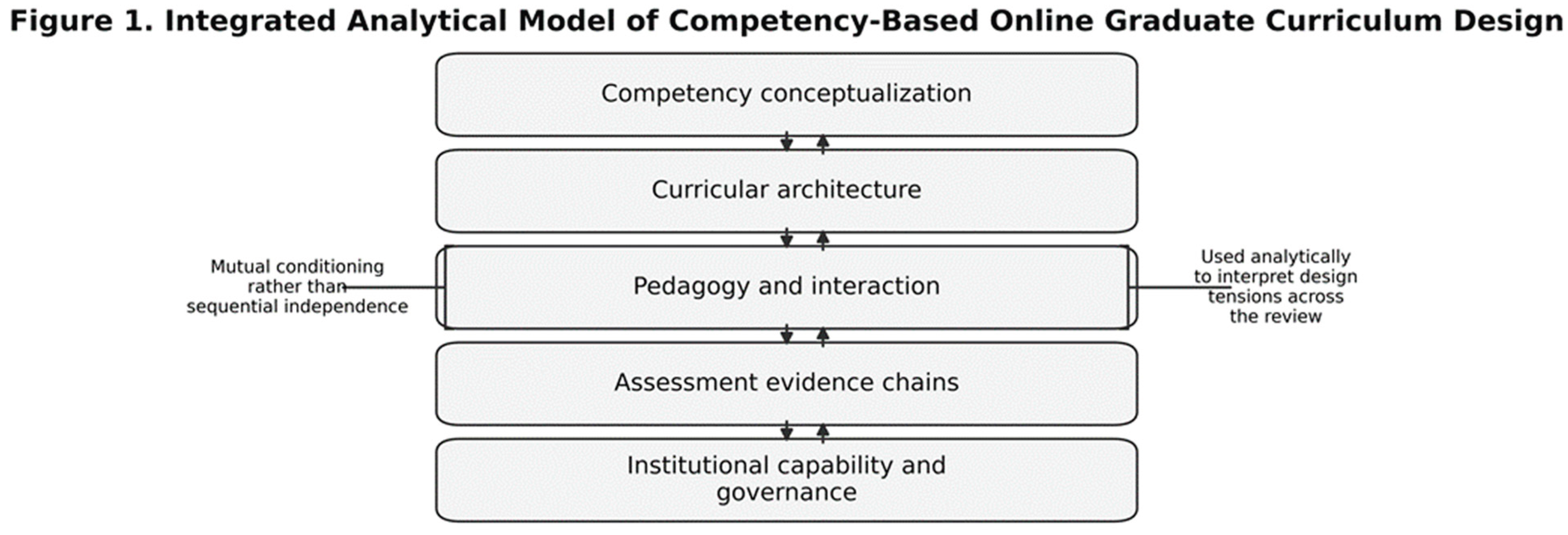
Synthesizing these frameworks yields an integrated model with five interdependent design layers: competency conceptualization, curricular architecture, pedagogy and interaction, assessment evidence chains, and institutional capability and governance. In this model, curriculum, platform, pedagogy, and quality assurance are treated as mutually conditioning rather than sequentially independent domains.
Figure 1.
Integrated analytical model derived from the manuscript's theoretical framework. The figure visualises the five interdependent design layers identified in Section 2.4 and clarifies the paper's core claim that competency conceptualisation, curricular architecture, pedagogy and interaction, assessment evidence chains, and institutional capability and governance are mutually conditioning rather than sequentially independent domains.
Figure 1.
Integrated analytical model derived from the manuscript's theoretical framework. The figure visualises the five interdependent design layers identified in Section 2.4 and clarifies the paper's core claim that competency conceptualisation, curricular architecture, pedagogy and interaction, assessment evidence chains, and institutional capability and governance are mutually conditioning rather than sequentially independent domains.
3. Methodology
3.1. Design Justification and Methodological Orientation
A scoping review design was selected because the field is conceptually heterogeneous, spans empirical studies, evidence syntheses, policy texts, and implementation reports, and requires mapping rather than effect-size aggregation. The review followed current JBI guidance for scoping reviews. Methodologically, it pursued breadth with discipline by using explicit PCC-based eligibility criteria, staged source selection, structured data charting, and a clear distinction between descriptive mapping and interpretive inference (Aromataris et al., 2024; Peters et al., 2021).
3.2. PCC Framework
Population: graduate learners, faculty, instructional designers, supervisors or advisors, and programme leaders engaged in online graduate education, including organizational actors responsible for governance and quality assurance. Concept: competency-based curriculum design, including competency definition, curriculum architecture, assessment design, evidence capture, feedback, and programme-level improvement logic. Context: online, blended, hybrid, and digitally mediated graduate education in higher education, with interpretive attention to emerging African universities operating under digital transformation agendas.
3.3. Eligibility Criteria
Eligible evidence includes peer-reviewed empirical studies and evidence syntheses that address competency-based curriculum design in online higher education with explicit relevance to graduate education, as well as authoritative policy and quality assurance documents directly relevant to digital higher education governance (Peters et al., 2021; Staring et al., 2022). Because graduate-specific evidence is uneven, studies in broader higher education contexts are considered when they provide transferable programme-level insights for graduate design, for example in relation to alignment frameworks, LMS evidence workflows, or faculty capability models. Purely emergency remote teaching studies without durable design implications are treated as out of scope, consistent with the aim of mapping sustainable programme design rather than crisis improvisation (van Dorresteijn et al., 2025).
3.4. Information Sources and Search Strategy
The search strategy follows JBI expectations of transparent and reproducible searching, combining database searching with targeted retrieval of authoritative institutional and intergovernmental documents relevant to digital higher education quality assurance and African digital education strategy (Peters et al., 2021). Searches are structured around competency language, curriculum and assessment terms, online learning terms, and graduate education terms. The full database-specific search strings are reproduced in Appendix A, and the data-charting template is provided in Appendix B (both available in the manuscript supplementary materials uploaded to the manuscript’s OSF project, see link in the data availability statement).
3.5. Screening Process and Data Charting
Screening proceeded in staged fashion, from title and abstract review to full-text assessment, against PCC-aligned eligibility criteria, with documented inclusion logic and exclusion decisions where these were necessary for analytic clarity (Peters et al., 2021). Data charting used a structured form capturing bibliographic metadata, region, educational level, delivery mode, competency conceptualization, curriculum architecture features, assessment models, LMS and digital infrastructure implications, faculty development components, governance and quality assurance dimensions, reported tensions or contradictions, and stated or inferable relevance to emerging African universities.
3.6. Quality Appraisal Approach
Consistent with JBI guidance, methodological appraisal was used to calibrate interpretive confidence rather than to impose a rigid exclusion rule (Peters et al., 2021). Empirical studies were therefore read not as equivalent units of evidence but as differently weighted contributions to the synthesis, with greater interpretive caution applied where research design, sampling, or analytic transparency were weak. In this review, appraisal supported judgment about the strength of inferences, especially where curriculum, policy, and governance implications were derived from uneven evidence.
3.7. Synthesis Strategy and Trustworthiness
Synthesis is conducted as a thematic mapping aligned to the review's analytic frame: competency conceptualization, curriculum architecture, assessment models, online pedagogical structures, LMS and learning analytics affordances, faculty development models, and quality assurance and governance patterns. Trustworthiness was strengthened through explicit eligibility criteria, structured data charting, source triangulation across empirical and policy materials, and disciplined separation of evidence from inference (Aromataris et al., 2024; Peters et al., 2021).
4. Results
4.1. Conceptualizations of Competency
Across the mapped literature, competency is repeatedly treated as a high-stakes but conceptually unstable construct in higher education. In competence-oriented higher education synthesis, ambiguous terminology and inconsistent language are explicitly reported as persistent problems, not minor semantic issues (Brauer, 2021). The implications for online graduate education are structural: when competency definitions remain underspecified, programme designers struggle to decide whether competencies should be framed as broad graduate capacities, such as research judgment and ethical reasoning, or as atomized, observable performance indicators (Brauer, 2021; Johnstone & Soares, 2014).
In applied online CBE design work, competency is often defined pragmatically as demonstrable knowledge and skills expected to be shown as learners progress, emphasizing evidence of mastery rather than time spent in courses (Hadullo, 2021; Johnstone & Soares, 2014). This pragmatic framing supports implementation but can also conceal a deeper contradiction: graduate education's epistemic aims cannot be reduced to checklists without risking curricular fragmentation and assessment trivialization, especially in research-oriented degrees (Brauer, 2021).
4.2. Curriculum Architecture Patterns
A recurring architecture pattern in CBE literature is the move from course-by-course content accumulation toward programme-level competency frameworks that constrain sequencing, learning activities, and assessment evidence. In the Kenyan Moodle-based online CBE framework study, implementation is explicitly organized as a staged architecture: planning, design, implementation, improvement, and achieving (Hadullo, 2021). This staged model is analytically significant because it refuses to treat curriculum design as a one-time specification; it embeds curriculum within organizational readiness, platform configuration, and continuous improvement loops.
Evidence from graduate online education synthesis provides a cautionary boundary: organizational-level themes are comparatively underrepresented in the broader graduate online education literature, implying that many programmes may be designed or studied primarily at the course level while programme architecture and institutional conditions remain weakly theorized (Martin, Morse, & Kumar, 2022).
4.3. Assessment Models and Evidence Chains
Assessment emerges as the decisive hinge between competency rhetoric and defensible competence claims. Constructive Alignment predicts that if assessment tasks do not validly elicit the performances implied by intended outcomes, then curricula become incoherent regardless of how well outcomes are written (Biggs, 1996). Empirical competency-based higher education work continues to report misalignment as a persistent weakness. Experience-report evidence on standardizing assessment in competency-based higher education emphasizes that implementation quality pivots on the coherence of assessment systems relative to competency structures (Vargas et al., 2025).
Graduate education adds a further constraint: valid evidence of graduate competence often requires complex, open-ended performance assessment, including research proposals, portfolios, analytic writing, and authentic projects. In online environments, these assessments must be designed not only for validity but also for credible workflow feasibility, documentation, and feedback cycles, all of which are institutionally and technically mediated (Biggs, 1996; Staring et al., 2022).
4.4. Online Pedagogical Structures in Graduate Contexts
The evidence base on online learning consistently demonstrates that interactional design is not optional for deep learning. The Community of Inquiry meta-analysis reports that teaching, cognitive, and social presences are positively related to learning outcomes and satisfaction in online and blended settings (Martin, Wu, Wan, & Xie, 2022). A systematic review focused on fostering cognitive presence sharpens this point by showing that cognitive presence is enacted through specific instructional activities that support inquiry phases rather than through content delivery alone (Moore & Miller, 2022).
This creates a tension for competency-based online graduate designs that emphasize self-pacing and mastery progression. Self-paced structures may increase flexibility, but they can also undermine cohort-based community, sustained discourse, and feedback-rich learning cycles unless programme architecture deliberately compensates through structured interaction designs and advising or supervision systems (Martin, Wu, Wan, & Xie, 2022; Meyer et al., 2022; Moore & Miller, 2022).
4.5. LMS and Digital Infrastructure Implications
The LMS is not a neutral container in competency-based online graduate education; it is part of the curriculum's epistemic and evidential architecture. Moodle documentation explicitly frames competencies as proficiency descriptors and notes that the platform can support competency frameworks and evaluation against competencies (Moodle, n.d.). In the Kenyan online CBE framework study, Moodle configuration is treated as integral to CBE implementation, with explicit linkage between competency frameworks, learning activities, assessments, discussion forums, and analytics for improvement (Hadullo, 2021).
The platform layer also links to institutional research capacity through learning analytics and quality assurance. In digitally mediated programmes, LMS configuration choices shape what kinds of programme-level evidence can be generated for quality assurance, accreditation, and continuous improvement, not merely what content can be delivered (Hadullo, 2021; Staring et al., 2022).
The African Union digital strategy further reinforces that infrastructure is a foundational enabling condition for digital education, explicitly naming higher education teaching, research, assessment, and administration as sites of digital technology appropriation and defining infrastructure development as the primary strategic objective (African Union Commission, 2022). This positions LMS and network infrastructure not as peripheral information technology issues but as curricular preconditions for competency evidence integrity.
4.6. Faculty Development Models and Capability Constraints
Faculty development is repeatedly framed in the literature as necessary but often insufficiently conceptualized at the organizational level. A systematic review of faculty development programmes in the health professions concludes that organizational impact remains underexplored and recommends broadening faculty development using a competency-based framework (Kohan et al., 2023). Online teacher professional development synthesis likewise reports predominantly positive effects on teachers' competencies and teaching practice, while also implying variability in outcomes and the need to attend to design and evaluation quality (Amemasor et al., 2025).
TPACK research synthesis further problematizes simplistic tool training, arguing that TPACK must be understood as complex, situated, and dynamic, with unresolved conceptual issues that affect measurement and professional learning design (Schmid et al., 2024). For online competency-based graduate programmes, this supports an institutional inference bounded by evidence: faculty development must be tied to programme-level alignment and assessment design, not merely to platform operation (Kohan et al., 2023; Schmid et al., 2024).
4.7. Policy, Quality Assurance, and Governance Patterns
Two governance signals recur in high-authority sources. First, UNESCO's Global Convention defines quality assurance as an ongoing process by which the quality of a higher-education system, institution, or programme is assessed by the competent authority or authorities to assure stakeholders that acceptable educational standards are continuously being maintained and enhanced (UNESCO, 2019). Second, the OECD working paper on digital higher education explicitly aims to assist policy makers in adapting quality assurance systems to digital higher education by reviewing standards, indicators, and institutional quality management practices for digital programmes (Staring et al., 2022).
For emerging African universities operating under continental digital transformation agendas, the African Union strategy's emphasis on coordination capacity, knowledge mapping, and system-level infrastructure provides a governance frame that aligns with the OECD and UNESCO emphasis on continuous quality management rather than one-time programme launch decisions (African Union Commission, 2022; Staring et al., 2022; UNESCO, 2019).
4.7. Evidence Gaps and Regional Imbalances
The mapped synthesis highlights persistent regional and thematic imbalances. Graduate online education research synthesis reports that a majority of studies originate in the United States and that organizational-level issues are among the least studied themes (Martin, Morse, & Kumar, 2022). Competence-oriented higher education synthesis also signals conceptual ambiguity and the need for teacher training, but the evidence does not yet converge on stable, cross-context definitions that can straightforwardly translate into consistent graduate programme architectures (Brauer, 2021). In African policy documents, the urgency of infrastructure, access expansion, and relevance is prominent, but policy aspiration does not directly substitute for empirical evidence on effective institutional design patterns for competency-based online graduate programmes in African universities (African Union Commission, 2022; UNESCO, 2024).
Across these themes, the literature presents competency-based online graduate education not as a single pedagogical model but as a recurring alignment problem. Studies differ in discipline, delivery mode, and regulatory context, yet the same fault-lines recur: ambiguous competency language, weak translation into assessment, underdeveloped faculty capability, and insufficient institutional support. That convergence justifies moving the discussion away from isolated design features and toward the question of how digitally mediated graduate competence is institutionally produced, evidenced, and governed.
5. Discussion
5.1. Theoretical Interpretation Through Constructive Alignment, Community of Inquiry, and TPACK
Constructive Alignment identifies where competency discourse becomes educationally consequential. The literature repeatedly suggests that CBE succeeds or fails on whether competencies operate as assessable claims that structure curriculum and assessment, rather than functioning as aspirational labels (Biggs, 1996; Johnstone & Soares, 2014; Vargas et al., 2025). In online graduate education, alignment is further complicated by digital mediation: assessment evidence and feedback cycles must pass through platform workflows, making misalignment not only a pedagogical issue but also an infrastructural and governance issue (Hadullo, 2021; Staring et al., 2022).
Figure 2.
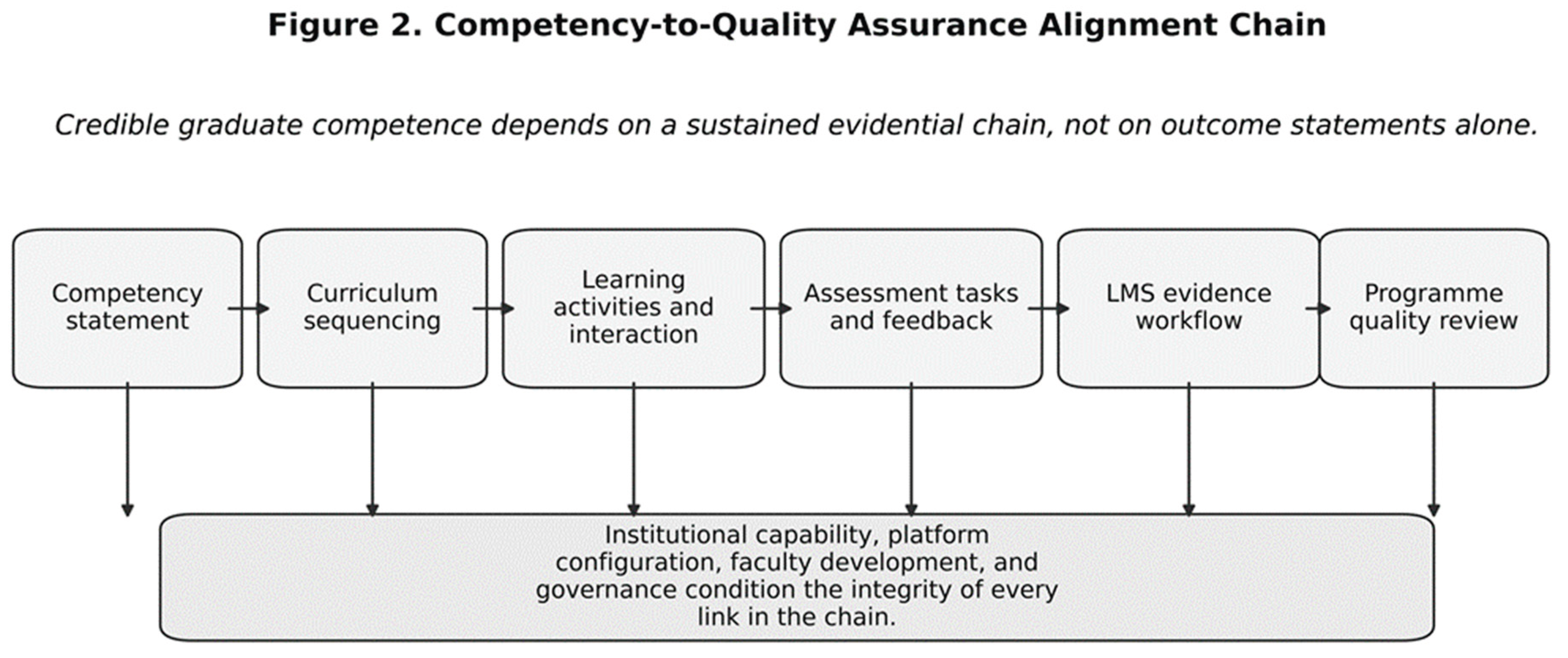
Alignment chain showing how competency statements must travel through curriculum sequencing, learning activity design, assessment tasks, feedback processes, LMS evidence workflows, and programme-level quality review if institutions are to make credible claims about graduate competence in digitally mediated environments.
Figure 2.
Alignment chain showing how competency statements must travel through curriculum sequencing, learning activity design, assessment tasks, feedback processes, LMS evidence workflows, and programme-level quality review if institutions are to make credible claims about graduate competence in digitally mediated environments.
Community of Inquiry clarifies what quality means in online graduate education beyond platform access. The empirical synthesis indicates that the presences are meaningfully related to learning outcomes and satisfaction in online and blended settings (Martin, Wu, Wan, & Xie, 2022). For graduate education, this implies that competency development cannot be treated as a private accumulation of micro-skills. It often requires discourse, supervised inquiry, and structured interaction that supports cognitive presence (Garrison et al., 2000; Moore & Miller, 2022). Consequently, the common CBE design move toward maximum self-pacing introduces a design contradiction: flexibility can undermine community unless programmes deliberately engineer interactional structures and advising or supervision supports appropriate to graduate study (Martin, Wu, Wan, & Xie, 2022; Meyer et al., 2022).
TPACK exposes the hidden capability boundary between curriculum plans and enacted curriculum. CBE in online graduate education is enacted by faculty who must integrate technology, pedagogy, and disciplinary knowledge into assessment and learning designs that produce valid evidence of competence (Mishra & Koehler, 2006). Faculty development evidence repeatedly shows positive effects but points to underexplored organizational impact and the need for sustained, context-specific support rather than short workshops (Amemasor et al., 2025; Kohan et al., 2023). TPACK therefore supports a disciplined institutional inference: without capability-building tied to programme architecture and assessment logic, institutions risk competency frameworks on paper with weak enacted validity (Schmid et al., 2024).
5.2. Convergences, Contradictions, and Conceptual Ambiguities
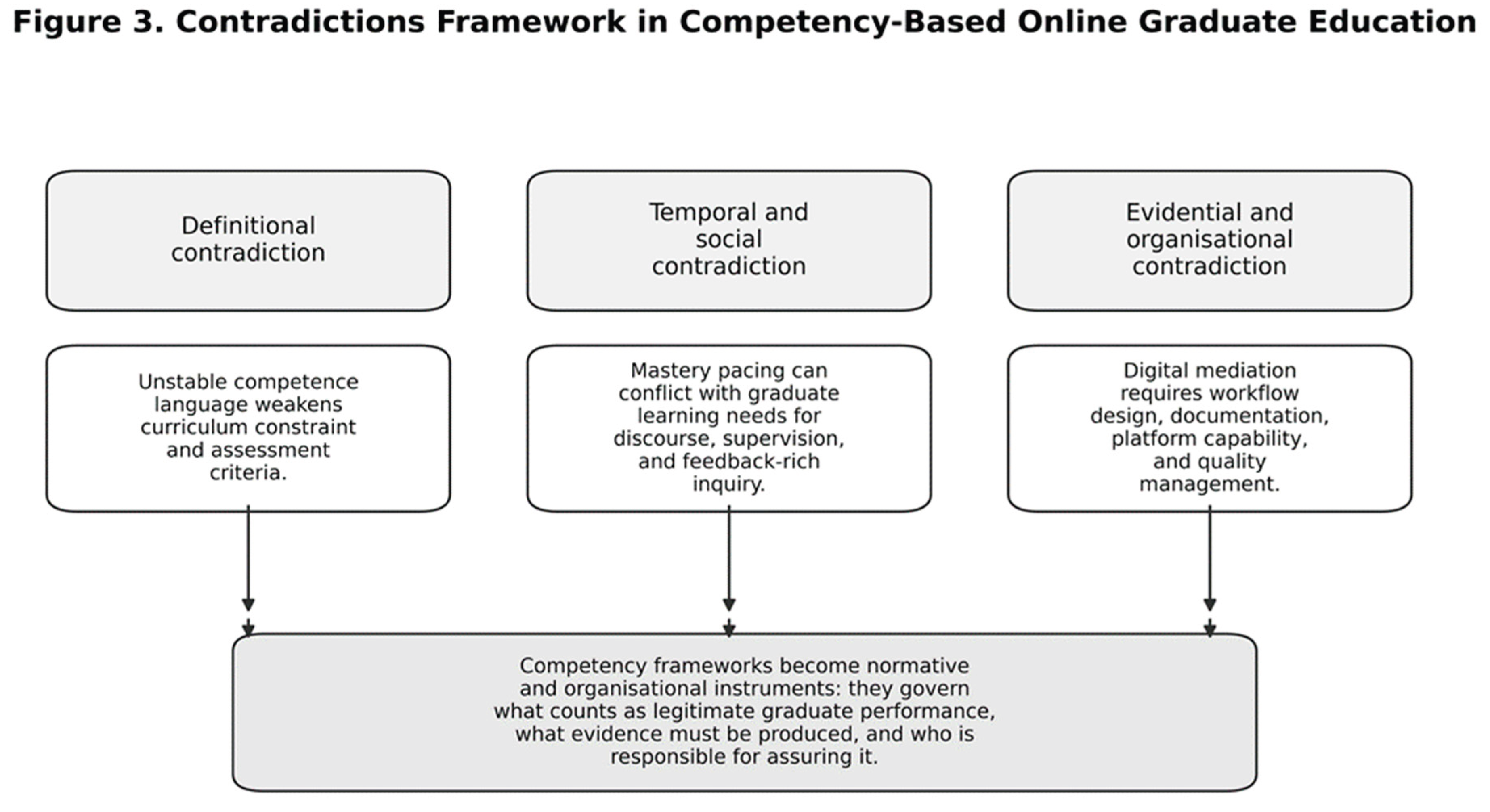
Three contradictions emerge as analytically central. The first is definitional. Competence discourse remains unstable across higher education, and that instability is not merely lexical (Brauer, 2021). When competencies are underspecified, curriculum architecture loses constraint, assessment criteria weaken, and institutions struggle to justify claims of graduate mastery. The second is temporal and social. Competency-based models frequently privilege mastery progression and variable pacing, while the strongest online learning evidence continues to emphasise structured interaction, teaching presence, cognitive presence, and feedback-rich learning processes (Martin et al., 2022; Moore & Miller, 2022). For graduate education, this tension is especially acute because advanced competence often depends on supervised inquiry, discourse, and judgment, not only on the accumulation of discrete performances. The third is evidential and organisational. Competency-based education requires credible evidence chains, yet digital mediation introduces new pressures around workflow design, documentation, platform capability, and institutional quality management (Staring et al., 2022; UNESCO, 2019; Vargas et al., 2025). The deeper implication is that competency frameworks in digitally mediated graduate education are normative and organisational instruments, not merely descriptive statements of outcomes. They determine what counts as legitimate graduate performance, what evidence must be produced to justify that judgment, and which institutional actors become responsible for generating, interpreting, and assuring that evidence. This is why conceptual ambiguity becomes institutionally consequential rather than merely terminological.
Figure 3.
Framework summarising the manuscript's three analytically central contradictions: definitional instability, the tension between mastery pacing and interaction-rich graduate learning, and the evidential-organisational pressures introduced by digital mediation. The figure also shows the manuscript's interpretive conclusion that competency frameworks function as normative and organisational instruments rather than as neutral lists of outcomes.
Figure 3.
Framework summarising the manuscript's three analytically central contradictions: definitional instability, the tension between mastery pacing and interaction-rich graduate learning, and the evidential-organisational pressures introduced by digital mediation. The figure also shows the manuscript's interpretive conclusion that competency frameworks function as normative and organisational instruments rather than as neutral lists of outcomes.
5.3. Transferability to Emerging African Universities
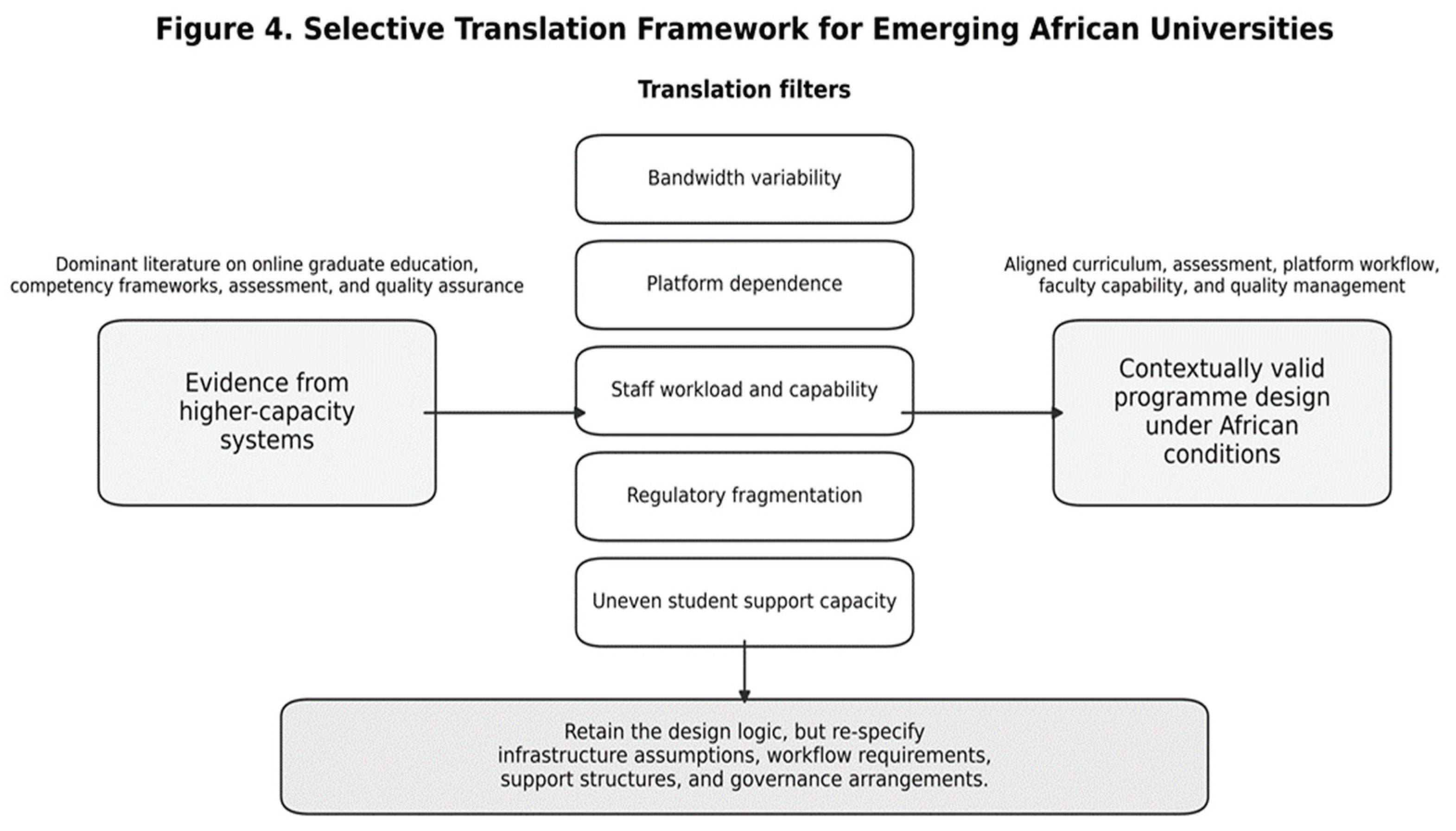
The African transfer question should be framed neither as simple adoption nor as exceptionalist refusal. Most included studies come from better-resourced systems, so direct transplantation would be methodologically careless (UNESCO, 2024). At the same time, the policy problem facing emerging African universities is real and immediate: participation pressures remain high, infrastructure is uneven, and continental digitalisation agendas are accelerating institutional decision-making (AU, 2022; Staring et al., 2022; UNESCO, 2019). The defensible move, therefore, is selective translation. Evidence from dominant research contexts can inform design principles, but those principles must be re-specified under African conditions of bandwidth variability, platform dependence, staff workload, regulatory fragmentation, and uneven student support capacity. In this sense, the issue is not whether African universities should imitate established models, but under what material, regulatory, and pedagogical conditions those models remain valid after translation.
Figure 4.
Selective translation framework showing how findings derived mainly from higher-capacity systems should be filtered through African conditions of bandwidth variability, platform dependence, staff workload and capability, regulatory fragmentation, and uneven student support capacity before being translated into contextually valid programme design.
Figure 4.
Selective translation framework showing how findings derived mainly from higher-capacity systems should be filtered through African conditions of bandwidth variability, platform dependence, staff workload and capability, regulatory fragmentation, and uneven student support capacity before being translated into contextually valid programme design.
5.4. Curriculum, Policy, LMS, and Faculty Development Implications
Implications should be framed as design logics rather than prescriptions. First, institutions should treat competency definition as a formal curriculum-governance act. Competencies need to be few enough to be assessable, rich enough to capture graduate-level judgment, and specific enough to structure sequencing, learning activity design, and assessment criteria. Definitional work is therefore not a preliminary drafting exercise (Brauer, 2021); it is part of institutional quality architecture.
Second, online graduate pedagogy should be designed around inquiry-rich interaction rather than around content release alone. Where programmes rely on self-paced mastery models, they should deliberately engineer compensating structures, such as cohort seminars, supervisory touchpoints, formative feedback cycles, and peer discourse, so that flexibility does not erode cognitive presence, professional dialogue, or research formation (Martin et al., 2022; Meyer et al., 2022; Moore & Miller, 2022).
Third, LMS decisions should be treated as curriculum-infrastructure decisions. Platform configuration should support competency mapping, rubric-based assessment, feedback documentation, and programme-level quality monitoring. When platforms cannot sustain those functions, institutions struggle to evidence graduate competence in a way that is credible to internal quality units, accreditors, or external stakeholders (Hadullo, 2021; Moodle, n.d.; Staring et al., 2022).
Fourth, faculty development should be aligned to programme architecture rather than restricted to generic platform training. The relevant capability is not merely digital operation but the situated capacity to design valid tasks, judge complex performance, facilitate advanced inquiry, and use digital systems in ways that preserve academic standards (Amemasor et al., 2025; Kohan et al., 2023; Schmid et al., 2024). At policy and governance level, this implies that internal quality assurance should be repositioned from end-stage compliance to continuous design review, in which curriculum, pedagogy, platform configuration, and faculty capability are evaluated as interdependent dimensions of programme quality (Staring et al., 2022; UNESCO, 2019).
5. Conclusion
This review shows that the decisive question in competency-based online graduate education is not whether competencies can be written, but whether institutions can sustain a credible chain from competency statement to learning activity, assessment judgment, platform record, and quality assurance review. Where that chain is weak, competency language becomes symbolic. Where it is strong, digitally mediated graduate programmes can make more defensible claims about advanced capability, professional judgment, and research formation.
For emerging African universities, the central implication is therefore institutional rather than merely pedagogical. Online competency-based graduate provision should be designed as an integrated architecture in which curriculum governance, interaction design, digital infrastructure, faculty capability, and quality management are intentionally aligned. Because the evidence base remains geographically uneven, the appropriate stance is disciplined translation rather than uncritical borrowing. Future research should therefore prioritise African empirical studies of programme-level design, assessment validity, staff capability, and governance arrangements in digitally mediated graduate education.
Funding
This research was not supported by any external grant or sponsor. The study was completed through the authors’ own scholarly effort, with routine non-financial institutional support associated with their academic affiliations.
Data Availability Statement
The materials analysed in this review were obtained from publicly accessible sources cited in the manuscript. The search materials, extraction framework, and archived supporting files associated with the review are available through the Open Science Framework at: https://doi.org/10.17605/OSF.IO/2FS3Z (Sangwa et al., 2026). Additional source documents remain accessible through the original repositories and institutional websites listed in the references. Unless otherwise indicated by the original source, archived files are shared under a Creative Commons Attribution 4.0 licence.
Conflicts of Interest
The authors report no competing interests. They have no financial, institutional, professional, or personal affiliations that could reasonably be understood to have influenced the conception of the review, the selection or interpretation of evidence, or the writing of the manuscript.
Ethical approval
Ethics approval was not required for this study because it was a scoping review based entirely on secondary materials. The review drew on published literature and publicly accessible documentary sources, including policy texts, institutional reports, and official databases. No human participants were recruited, and no personal or identifiable data were collected or analysed.
Use of AI tools
During manuscript preparation, the authors used OpenAI’s GPT-5.4 Thinking model in a limited support role. Its use was confined to assistance with literature search support, structural organisation, language refinement, and editorial polishing. All substantive scholarly decisions, including source selection, verification, interpretation, argument development, and final revision, were undertaken by the authors, who bear full responsibility for the content of the manuscript.
References
- African Union Commission. Digital education strategy and implementation plan 2023-2028. 2022. Available online: https://static.au.int/pt/node/42414.
- Amemasor, S. K.; Oppong, S. O.; Ghansah, B.; Benuwa, B.-B.; Essel, D. D. A systematic review on the impact of teacher professional development on digital instructional integration and teaching practices. Frontiers in Education 2025, 10, 1541031. [Google Scholar] [CrossRef]
- JBI manual for evidence synthesis; Aromataris, E., Lockwood, C., Porritt, K., Pilla, B., Jordan, Z., Eds.; JBI, 2024; Available online: https://synthesismanual.jbi.global.
- Biggs, J. Enhancing teaching through constructive alignment. Higher Education 1996, 32(3), 347–364. [Google Scholar] [CrossRef]
- Brauer, S. Towards competence-oriented higher education: A systematic literature review of the different perspectives on successful exit profiles. Education + Training 2021, 63(9), 1376–1390. [Google Scholar] [CrossRef]
- Garrison, D. R.; Anderson, T.; Archer, W. Critical inquiry in a text-based environment: Computer conferencing in higher education. The Internet and Higher Education 2000, 2(2-3), 87–105. [Google Scholar] [CrossRef]
- Hadullo, K. Online competency based education framework using Moodle LMS: A case of HEIs in Kenya. International Journal of Education and Development using Information and Communication Technology 2021, 17(1), 193–206. Available online: https://ijedict.dec.uwi.edu/viewarticle.php?id=2866.
- Johnstone, S. M.; Soares, L. Principles for developing competency-based education programs. Change: The Magazine of Higher Learning 2014, 46(2), 12–19. [Google Scholar] [CrossRef]
- Kohan, M.; Changiz, T.; Yamani, N. A systematic review of faculty development programs based on the Harden teacher's role framework model. BMC Medical Education 2023, 23, 910. [Google Scholar] [CrossRef] [PubMed]
- Martin, F.; Morse, J.; Kumar, S. Systematic review of research on graduate online education from 2000 to 2020. Quarterly Review of Distance Education 2022, 23(1), 41–60. Available online: https://eric.ed.gov/?id=EJ1362965. [CrossRef]
- Martin, F.; Wu, T.; Wan, L.; Xie, K. A meta-analysis on the Community of Inquiry presences and learning outcomes in online and blended learning environments. Online Learning 2022, 26(1), 325–359. [Google Scholar] [CrossRef]
- Meyer, H. S.; Preisman, K. A.; Samuel, A. Get connected: A scoping review of advising online graduate students. Online Learning 2022, 26(3), 274–292. [Google Scholar] [CrossRef]
- Mishra, P.; Koehler, M. J. Technological pedagogical content knowledge: A framework for teacher knowledge. Teachers College Record 2006, 108(6), 1017–1054. [Google Scholar] [CrossRef]
- Moodle. Competencies. MoodleDocs. n.d. Available online: https://docs.moodle.org/405/en/Competencies.
- Moore, R. L.; Miller, C. N. Fostering cognitive presence in online courses: A systematic review (2008-2020). Online Learning 2022, 26(1), 130–149. [Google Scholar] [CrossRef]
- Peters, M. D. J.; Marnie, C.; Tricco, A. C.; Pollock, D.; Munn, Z.; Alexander, L.; McInerney, P.; Godfrey, C. M.; Khalil, H. Updated methodological guidance for the conduct of scoping reviews. JBI Evidence Implementation 2021, 19(1), 3–10. [Google Scholar] [CrossRef] [PubMed]
- Sangwa, S.; Ndahayo, C.; Dusengumuremyi, F. Competency-Based Curriculum Design in Online Graduate Education: A Scoping Review with Curriculum, Policy, and Faculty Development Implications for Emerging African Universities. 2026. [Google Scholar] [CrossRef]
- Schmid, M.; Brianza, E.; Mok, S. Y.; Petko, D. Running in circles: A systematic review of reviews on technological pedagogical content knowledge (TPACK). Computers & Education 2024, 214, 105024. [Google Scholar] [CrossRef]
- Staring, F.; Brown, M.; Bacsich, P.; Ifenthaler, D. Digital higher education: Emerging quality standards, practices and supports. In OECD Education Working Papers No. 281; OECD Publishing, 2022. [Google Scholar] [CrossRef]
- UNESCO. Global Convention on the Recognition of Qualifications concerning Higher Education. 2019. Available online: https://www.unesco.org/en/legal-affairs/global-convention-recognition-qualifications-concerning-higher-education?hub=686.
- UNESCO. UNESCO Forum on Higher Education in Africa: Background document. 2024. Available online: https://indico.un.org/event/1014732/attachments/20010/57231/Background%2520document-Africa-HE%2520Forum%2520FINAL.pdf.
- Vargas, H.; Arredondo, E.; Heradio, R.; de la Torre, L. Standardizing course assessment in competency-based higher education: An experience report. Frontiers in Education 2025, 10, Article 1579124. [Google Scholar] [CrossRef]
- van Dorresteijn, C.; Fajardo-Tovar, D.; Pareja Roblin, N.; Cornelissen, F.; Meij, M.; Voogt, J.; Volman, M. What factors contribute to effective online higher education? A meta-review. Technology, Knowledge and Learning 2025, 30(1), 171–202. [Google Scholar] [CrossRef]
Disclaimer/Publisher’s Note: The statements, opinions and data contained in all publications are solely those of the individual author(s) and contributor(s) and not of MDPI and/or the editor(s). MDPI and/or the editor(s) disclaim responsibility for any injury to people or property resulting from any ideas, methods, instructions or products referred to in the content. |
© 2026 by the authors. Licensee MDPI, Basel, Switzerland. This article is an open access article distributed under the terms and conditions of the Creative Commons Attribution (CC BY) license (http://creativecommons.org/licenses/by/4.0/).
Copyright: This open access article is published under a Creative Commons CC BY 4.0 license, which permit the free download, distribution, and reuse, provided that the author and preprint are cited in any reuse.


