

Submitted:
02 April 2026
Posted:
03 April 2026
You are already at the latest version
Abstract
Background: Lung transplantation (LTx) remains the final therapeutic option for patients with end-stage and irreversible respiratory failure. The most common complication after LTx is chronic lung allograft dysfunction (CLAD), which affects long-term outcomes. However, CLAD may be partially reversible, especially after early detection of the cause. For this reason, systematic monitoring of transplanted lung function, including spirom-etry values, is so important. In these cases, the usage of modern technologies and tele-medicine can be extremely useful and allow for early response to possible decreases of spirometry values.
Objective: The aim of our study is to evaluate the feasibility and clinical usefulness of spirometry telemonitoring in lung transplant patients.
Methods: This retrospective study compared lung transplant recipients, where the first group of patients was subjected to spirometry telemonitoring (N=21), the second group was monitored with standard home spirometry (N=23), and the control group underwent routine follow-ups only in the transplant center (N=32).
Results: The mean number of emergency visits was found to be lower in the telemoni-toring vs routine care group (1.24 vs 2.34, P=.05). Additionally, the mean duration of all visits was higher in the routine care group (10.0 days) in comparison to the telemonitoring group (5.8 days, P< .001) and to the standard home spirometry group (8.7 days, P=0.03).
Conclusions: Spirometry telemonitoring using digital devices is not only feasible in lung transplant recipients, but it may provide substantial clinical benefits in this group of patients. It makes it possible to react faster in the event of abnormalities, which results in a reduction in the number of emergency visits and their duration.
Keywords:
lung transplantation
; spirometry
; telemedicine
1. Introduction
Lung transplantation (LTx) has emerged as the only recognized and definitive treatment option for patients suffering from end-stage and irreversible lung failure. This complex medical procedure is life-saving but involves significant challenges and considerations, both medical and ethical. Globally, the number of lung transplantations performed annually continues to increase. According to the International Society for Heart and Lung Transplantation (ISHLT), approximately 4,500 lung transplants are conducted each year worldwide [1], highlighting the growing recognition of LTx as a viable solution for terminal lung conditions. However, the procedure is costly, with total expenses often ranging from several hundred thousand to over a million dollars [2].
Primary candidates for lung transplantation are individuals affected by severe pulmonary diseases, including chronic obstructive pulmonary disease (COPD), interstitial lung diseases, cystic fibrosis, and idiopathic pulmonary arterial hypertension [3,4,5,6,7,8,9]. These patients usually experience substantial impairment in quality of life and have no remaining effective therapeutic alternatives. Given the global shortage of donor lungs, organ allocation is subject to strict medical and ethical criteria [4]. The concept of utility is frequently applied to maximize the survival benefit on both individual and population levels.
Despite its benefits, lung transplantation carries a high risk of complications. Post-operative issues include infections related to aggressive immunosuppression, acute and chronic graft rejection, airway remodeling, neoplastic changes, and increased risk of gastroesophageal reflux [3]. One of the most critical long-term complications is chronic lung allograft dysfunction (CLAD), which affects more than half of recipients within five years [10]. CLAD is the leading cause of graft failure and long-term mortality after LTx. It is characterized by a persistent decline in forced expiratory volume in 1 s (FEV1), detected through spirometry. CLAD manifests in various phenotypes: obstructive, restrictive, or mixed, and is multifactorial in origin.
Chronic rejection occurs in up to 70% of patients within a decade after transplantation and can appear as early as three months post-surgery [11]. In the early post-transplant period (first 30 days), the leading causes of death are graft failure and infections. In contrast, long-term mortality is predominantly driven by chronic rejection, most commonly in the form of bronchiolitis obliterans syndrome (BOS) [12,13]. BOS is a progressive obstructive condition, clinically defined by irreversible FEV1 decline due to bronchiolar fibrosis and obliteration, which ultimately leads to respiratory failure [12].
Early detection and intervention in rejection-related processes are essential to prevent irreversible graft injury. Regular monitoring of pulmonary function is vital, and spirometry—particularly FEV1—is the most commonly used tool for detecting BOS [14,15,16,17,18,19,20,21,22,23,24]. Home spirometry enables early identification of lung function deterioration before clinical symptoms develop, but adherence remains a significant barrier. Poor health status, lack of motivation, time constraints, and limited internet access contribute to low adherence rates [25,26,27]. Studies show that compliance is highest during the first year post-transplant and among older patients and those diagnosed with BOS [15]. Conversely, younger recipients, particularly those with cystic fibrosis, are less likely to consistently perform home spirometry [15].
Evidence suggests that patients are more likely to adhere to home monitoring protocols if they are aware their physicians can access their results in real time [25]. Furthermore, targeted patient education about spirometry use has been shown to improve adherence [26]. According to ISHLT guidelines, a drop of 10% or more in FEV1 compared to baseline in home spirometry should prompt diagnostic workup and clinical evaluation [28]. This approach supports timely therapeutic decisions before the development of irreversible CLAD.
Although home spirometry is a valuable tool, its proper use requires technical competence and active patient engagement. The test can be challenging to perform correctly, and the accuracy of patient-reported data can vary. Nonetheless, the benefits of early detection through home spirometry are both clinical and economic. The cost of managing early-stage CLAD is significantly lower than that of treating advanced disease [17]. Thus, telemonitoring strategies may reduce healthcare expenditures and improve outcomes.
Notably, FEV1 monitoring in single-lung transplant recipients may be less reliable due to the presence of a native lung, which can mask early changes in allograft function. This has led to interest in alternative or complementary methods for surveillance. In response to these limitations, recent studies have investigated the potential of computer-based monitoring systems. These digital tools may provide accurate, real-time analysis of lung function and patient-reported data, helping to mitigate adherence issues and support more efficient care delivery [21,23]. Such systems could also reduce the need for expanding clinical teams as transplant volumes grow.
In this study, we evaluated the feasibility and clinical utility of spirometry telemonitoring in lung transplant patients discharged from the Silesian Center for Heart Diseases in Zabrze between December 2021 and July 2022. Our findings aim to inform practical considerations for implementing remote spirometry monitoring in routine clinical follow-up after lung transplantation.
2. Materials and Methods
Study Design
This was an investigator-initiated, observational, retrospective, non-interventional, non-randomized study. The study conforms to the ethical guidelines of the 1975 Declaration of Helsinki and was acknowledged by the Institutional Board Review Committee on Human Research of Medical University of Silesia in Katowice (registration number: BNW/NWN/0052/KB/47/24). The patients who underwent LTx in Silesian Center for Heart Diseases (Zabrze, Poland) between December 2021 and July 2022 were equipped with the portable spirometer (AioCare, HealthUp). They were trained on how to perform spirometry examinations at home, in line with American Thoracic Society/European Respiratory Society (ATS/ERS) guidelines [25], by an experienced operator on discharge from the hospital. They were asked to perform daily spirometry tests and report respiratory symptoms using the mobile app (AioCare Patient, HealthUp). All examinations were transmitted in real-time to the patient’s profile in the telemedical web platform (AioCare Doctor, HealthUp) to be assessed by the attending physician. In case of significant spirometry parameters drop, patients were invited for teleconsultation or urgent visits at the transplant center. The number of examinations, technical correctness, adherence to the protocol, and spirometry results were evaluated. Additionally, the number and length of emergency and elective visits were compared between the telemonitoring spirometry group and the comparison groups described below.
Equipment and Usage
Spirometry tests were conducted using the portable spirometer (AioCare®, HealthUp, Poland). This device, classified as a class IIa hospital-grade equipment, adheres to the ATS/ERS 2019 Quality Standards and the European Union’s General Data Protection Regulations [4]. It pairs with a patient’s smartphone (iOS/Android) through Bluetooth® and is managed by the AioCare Patient mobile app. Patients were required to register an account and input their biometric (such as age, birth sex, ethnicity, weight, and height) and fundamental medical information. The app instantly assessed the technical quality of the spirometry tests based on the ATS/ERS 2019 Standards [29]. All the collected data were automatically uploaded to a secure health cloud platform (AioCare Doctor), enabling doctors to assess the examinations and trends in time.
Comparison Groups
Telemonitoring spirometry programme results were retrospectively compared to two other groups of lung transplant patients hospitalized between 2017-2022 in the Silesian Center for Heart Disease in Zabrze. The home spirometry group (called later: routine care + home spirometry) consisted of patients who were equipped with a portable spirometer (MIR, Italy) at discharge. Patients in this group were educated on how to perform spirometry at home, instructed to keep a daily spirometry results diary and to contact an attending physician in case of a significant drop in spirometry parameters. The second comparison group (called later: routine care) was digital monitoring naive. In terms of patient management, all groups were under routine care, following ISHLT recommendations [4,10,11]. The participants selected for this study were matched to the study group based on diagnosis/cause of transplantation, sex, and age.
Analysis
The averaged results depicting demographic and spirometry data were presented as the mean value and 95% confidence intervals or minimum and maximum values. The mean values of continuous variables were compared between groups using the ANOVA or Kruskal-Wallis method (if the assumptions for the former are not met). The comparison for categorical variables was conducted using the chi-square test (with Yates correction if the value of the categorical variable in at least one group is less than 5). The significance level of the tests was set at 0.05.
The levels of adherence, the correctness of spirometry examinations (score A or B according to ATS/ERS 2019) and average values of the percentage of predicted values of spirometry parameters (%predFEV1, %predFVC, %predFEV1/FVC) were presented in bar plots for each month of monitoring. We fitted trend lines to the results of spirometry parameters and calculated the Pearson correlation coefficient to determine the significance of their changes in time.
The comparison of the number of visits (all, only routine, and only emergency visits), as well as their mean and maximum duration between study groups, were calculated using linear mixed models. The p-values for analyzed parameters were adjusted with fixed effects: age, sex, and random effects (random intercept): duration of monitoring in years (span between the first and the last visit), and the year of transplantation. The results were calculated using MATLAB2022b software.
3. Results
Twenty-one patients after lung transplantation (9 females and 12 males) were recruited to the study, with a mean age of 53.0 (95%CI: 47.3-58.6) years and mean body mass index (BMI) of 21.4 (95%CI: 19.5-23.2) kg/m^2. The summary of the demographic data is shown in Table 1.
The average time of monitoring of each patient was 252.2 (min: 53, max: 445) days with a mean adherence level (following the rule: 1 spirometry per day) equalled 62.7% (min: 15.1%, max: 97.4%). The average value of spirometry examinations was 225 (min: 9, max: 806) per patient; among these, the mean percentages of measuring acceptable FEV1 and forced vital capacity (FVC) were 59.7% (95%CI: 44.7–74.6%) and 58.9% (44.2–73.6%), respectively. The total number of examinations performed by all patients was 4,957 (15,875 single maneuvers). The summary of the performance parameters for each participant is presented in Table 2.
The percentage adherence, correctness level, and spirometry results within each month of monitoring were presented in Figure 1.
We observed a relatively constant adherence level during the first 6 months (between 63–70%; see Figure 1A); the adherence decreased (below the average value) in the next 3 months (53–62%). The average level of correctness of the spirometry examinations was relatively lower in the 1st month of monitoring (56%) and increased in the next months up to 69% in the 3rd and 4th months; from the 5th month, it was close to the average value (61–65%) for overall months (63%; see Figure 1B). Figure 1C presents the mean parentages of predictive values (%Predicted) of FEV1, FVC and FEV1/FVC parameters in each month. We observed a significant increase in the mean %Predicted FVC and a significant decrease of %Predicted FEV1/FVC values with the number of monitoring months; the Pearson coefficients for these parameters were r = 0.94 (P<.001) for FVC and -0.90 (P<.001) for FEV1/FVC. We also observed a decrease of %Pred FEV1, but it was insignificant (r=-0.50, P=.17). The comparison of the number of visits, their mean and maximum duration between study groups is shown in Figure 2.
The mean number of emergency visits was found to be lower in the telemonitoring vs routine care group (1.24 (0.65–1.83) vs 2.34 (1.3–3.39), P=.049). Additionally, the mean duration of all visits was higher in the routine care group (10.0 (6.6–13.5) days) in comparison to the telemonitoring group (5.8 (4.2–7.5) days, P=.003) and to home monitoring + routine care group (8.7 (5.3–12.1), P=0.03). Moreover, in study group, we do not observe significant correlations between the percentage adherence and clinical parameters related to post-lung transplantation complications, such as number of urgent visits (r=0.23) and their mean and maximum duration (-0.049 and 0.274, respectively).
4. Discussion
Regarding the rapid development of telemedicine and digital devices, we evaluated their role and usefulness in implementing a spirometry telemonitoring programme in lung transplant patients at the Silesian Center for Heart Diseases in Zabrze. We evaluated technical and clinical indicators of spirometry telemonitoring and highlighted the usefulness and clinical advantages of telemedicine and new digital tools in lung transplant patients’ care. The concept of home spirometry in lung transplantation, especially for early detection of BOS, has been explored with various approaches to home spirometry results in terms of transmission and different levels of patient and physician engagement [14,15,16,17,18,19,20,21,22,23,24]. Nevertheless, poor adherence remains one of the major challenges for successful implementation of spirometry telemonitoring programmes worldwide. One study examined lung transplant patient adherence to home spirometry during the first six months after hospital discharge. They observed a high 80% adherence rate in one patient, while another showed a still respectable 61% adherence despite some punctuality issues likely due to internet connectivity problems [24]. This aligns with earlier research findings. For instance, Morlion and colleagues in Belgium reported adherence rates of 55% for bi-daily measurements and 84% for daily measurements [22], while Finkelstein SM and team recorded an 82% adherence for weekly spirometry submissions [21]. A study by Kugler et al., involving 287 lung transplant patients over an average of 54 +/- 45 months post-transplant, revealed that 43% did not adhere to the prescribed home spirometry monitoring [15]. Our research achieved an adherence rate to the spirometry examination protocol roughly parallel to these studies (average 63.4%, across a nine-month period), with a slight decline over time. Additionally, our study noted a high level of technical accuracy in spirometry tests conducted at home by patients (average 63%), which remained consistent throughout the nine-month tracking period. Only a few studies, similarly to our approach, examined the clinical implications of spirometry telemonitoring combining telemedical and digital tools in this group of patients [19,23]. Odishyo [23] showed that using the proposed, chat-based spirometry alerting system, they detected 15 cases of CLAD and 7 cases of CLAD progression through home spirometry alerting. Patient cost-saving analysis counted as the number of visits reduced in 2-year follow-up and transportation costs for the 155 patients transplanted since the beginning of the program; this amounts to a total of $ 179,899.20. The authors did not present a detailed analysis of the reduced number of visits or a cost-effectiveness analysis for healthcare providers. Therefore, direct comparison was impossible. Our study found a significantly lower mean duration of all visits in the spirometry telemonitoring group compared to other groups and a significantly lower number of emergency visits compared to the digital monitoring naive group. It is worth noticing that in the Odishyo study, inclusion criteria were different and the median time since transplant was 5.3 and 1.9 years, respectively, for engaged defined as >=1 submitted FEV1 through chat and non-engaged groups. Patients in our study were recruited on hospital discharge and monitored in the first nine months after the transplant. Our findings align with Odishyo that the engagement of patients, therefore adherence and technical correctness, may be higher in the first years after the lung transplant. Additionally, our results suggest that the effect of telemedical and digital tools may be more substantial in the first years, when the risk of complications, including CLAD, is the highest. Similar to our findings, no significant differences in the number of emergency and routine visits were observed by Sengpiel, who compared home monitoring to spirometry telemonitoring in a Randomized Controlled Trial. Nevertheless, a trend toward shorter intervals between symptom onset and time to consultation was present. Although our study showed only a significant difference in the mean duration of all visits between those two approaches, further randomized controlled trials should carefully investigate the impact of telehealth intervention in this population of patients, with a focus on the standardization of telemonitoring and digital intervention protocol.
Limitations
This study has several limitations. First of all, it is a retrospective analysis of data collected during telemonitoring spirometry programmes, launched as a response to restricted access to spirometry labs during the COVID-19 pandemic. The number of patients enrolled in these programmes was limited by the number of procedures performed, and the number of 21 patients was about 1/3 of the patients who underwent lung transplant procedures in the Silesian Center for Heart Diseases in Zabrze at that time. The rest of the patients were instructed to buy personal spirometers without a teletransmission function, and digital spirometry data was not collected for those patients. Therefore, comparison adherence and technical correctness to control groups undergoing standard care simultaneously was not possible. Last, considering the study’s retrospective nature, small groups and, despite no significant differences between groups, results could be influenced by heterogeneous indications of lung transplant and the patient’s general condition.
5. Conclusions
Our findings showed that spirometry telemonitoring using digital devices is not only feasible in lung transplant patients, but it may provide substantial clinical benefits in this group of patients. Recruited participants achieved high technical correctness of spirometry examinations and presented high adherence to the protocol. Moreover, the telemonitoring group, in comparison to groups with home self-monitoring or routine follow-ups, had a significantly lower mean duration of all visits at the hospital and a lower number of urgent visits.
Author Contributions
MB, WB, LK, MO led the project administration, resources and conceptualization; MB, WB, DG, FZ and MO collected data; software management including analysis, interpretation and visualization of data was done by MS; MB, WB, DG, WK and MS were responsible for data curation and interpretation, as well as writing the original draft; LK, MO supervised, reviewed and edited the project. All authors had full access to all the data in the study and had final responsibility for the decision to submit for publication.
Funding
HealthUp, provided devices and a patient monitoring system.
Institutional Review Board Statement
The study was conducted in accordance with the Declaration of Helsinki, and approved by the Institutional Board Review Committee on Human Research of Medical University of Silesia in Katowice (registration number: BNW/NWN/0052/KB/47/24).
Informed Consent Statement
Informed consent was obtained from all subjects involved in the study.
Data Availability Statement
The data presented in this study are available on request from the corresponding author due to privacy restrictions.
Conflicts of Interest
MB and WB were advisors of Healthup company (producer of the AioCare System used in the study). MS is a contractual employee of Healthup company, and LK owns the Healthup company. MS was funded by the COSMOS and HEART.FM projects, which have received funding from the European Research Council under the European Union’s Horizon 2020 research and innovation programme (Grant agreement Nos. 788960 and 957532).
Abbreviations
The following abbreviations are used in this manuscript:
ATS—American Thoracic Society
BMI—Body Mass Index
BOS—Bronchiolitis Obliterans Syndrome
CLAD—Chronic Lung Allograft Dysfunction
COPD—Chronic Obstructive Pulmonary Disease
ERS—European Respiratory Society
FEV1—Forced Expiratory Volume in 1 s
FVC—Forced Vital Capacity
ISHLT—International Society for Heart and Lung Transplantation
LTx—Lung Transplantation
References
- The International Society for Heart and Lung Transplantation. The International Thoracic Organ Transplant (TTX) Registry of the International Society for Heart and Lung Transplantation: Thirty-Sixth Annual Report. J Heart Lung Transplant 2019, 38, 1015–66. [Google Scholar]
- State of lung transplant 2020, transplants.org.
- Cierpka, L.; Durlik, M. Transplantologia kliniczna. Przeszczepy narządowe, 1st ed.; Termedia Wydawnictwa Medyczne: Poznań, 2015. [Google Scholar]
- Leard, LE; Holm, AM; Valapour, M; et al. Consensus document for the selection of lung transplant candidates: An update from the International Society for Heart and Lung Transplantation. J Heart Lung Transplant. 2021, 40(11), 1349–1379. [Google Scholar] [CrossRef]
- Raport Przewlekła Obturacyjna Choroba Płuc POChP, 2018, Central and Eastern European Society of Technology Assessment in Health Care (CEESTAHC).
- World Health Organization. (2022, May 19). “Chronic obstructive pulmonary disease (COPD)”. 19 May 2022.
- Opieka nad chorymi na mukowiscydozę w Polsce, Stan obecny i rekomendacje poprawy, Raport Warszawa–Kraków 2019 Polskiego Towarzystwa Mukowiscydozy.
- Benden, C; Schwarz, C. CFTR Modulator Therapy and Its Impact on Lung Transplantation in Cystic Fibrosis. Pulm Ther. 2021, 7(2), 377–393. [Google Scholar] [CrossRef] [PubMed]
- Wiatr, E.; Rowińska-Zakrzewska, E.; Pirożyński, M. Choroby śródmiąższowe płuc, 2nd ed.; Alfa Medica Press: Bielsko Biała, 2012. [Google Scholar]
- Glanville, AR; Verleden, GM; Todd, JL; et al. Chronic lung allograft dysfunction: Definition and update of restrictive allograft syndrome-A consensus report from the Pulmonary Council of the ISHLT. J Heart Lung Transplant. 2019, 38(5), 483–492. [Google Scholar] [CrossRef] [PubMed]
- Verleden, SE; Vos, R; Vanaudenaerde, BM; Verleden, GM. Chronic lung allograft dysfunction phenotypes and treatment. J Thorac Dis. 2017, 9(8), 2650–2659. [Google Scholar] [CrossRef] [PubMed]
- Whitson, BA; D’Cunha, J. Diagnosis and management of bronchiolitis obliterans syndrome in lung transplant recipients. Minerva Pneumol. 2008, 47, 93–107. [Google Scholar]
- Sheshadri, A; Healey, B; Sacks, N; Wu, E; Cyr, P; Boerner, G; Huang, H. Bronchiolitis Obliterans Syndrome Following Lung Transplantation: Economic Burden by Chronic Lung Allograft Dysfunction (CLAD) Stage. The Journal of Heart and Lung Transplantation 2021, 40.4, S70. [Google Scholar] [CrossRef]
- Wijbenga, N; Hoek, RAS; Mathot, BJ; Seghers, L; van Weezel, JJ; den Ouden, J; Wijsenbeek, MS; Aerts, JGJV; Hellemons, ME; Moor, CC. Evaluation of a Home Monitoring Application for Follow Up after Lung Transplantation-A Pilot Study. J Pers Med. 2020, 10(4), 240. [Google Scholar] [CrossRef] [PubMed] [PubMed Central]
- Kugler, C; Fischer, S; Gottlieb, J; Gohrbandt, B; Welte, T; et al. Daily routine patient-controlled lung function testing using electronic spirometry is essential for long-term outcome following lung transplantation. The Journal of Heart and Lung Transplantation. [CrossRef]
- Robson, KS; West, AJ. Improving survival outcomes in lung transplant recipients through early detection of bronchiolitis obliterans: Daily home spirometry versus standard pulmonary function testing. Can J Respir Ther 2014, 50(1), 17–22. [Google Scholar] [PubMed] [PubMed Central]
- Bhatia, P. Can bronchiolitis obliterans in lung transplant recipients be diagnosed earlier by home spirometry? CME Respir Med 2000, 2, 42. [Google Scholar]
- Levine, SM. Can bronchiolitis obliterans syndrome be diagnosed by phone from the comfort of home? Chest 1999, 116, 120–6. [Google Scholar] [CrossRef] [PubMed]
- Sengpiel, J; Fuehner, T; Kugler, C; et al. Use of telehealth technology for home spirometry after lung transplantation: A randomized controlled trial. Prog Transplant. 2010, 20, 310–7. [Google Scholar] [CrossRef] [PubMed]
- de Wall, C; Sabine, D; Gregor, W; Mark, G; Axel, H; Thomas, F; Tobias, W; Jens, G. Home spirometry as early detector of azithromycin refractory bronchiolitis obliterans syndrome in lung transplant recipients. Respir Med. 2014, 108(2), 405–12. [Google Scholar] [CrossRef] [PubMed]
- Finkelstein, SM; Lindgren, BR; Robiner, W; Lindquist, R; Hertz, M; Carlin, BP; VanWormer, A. A randomized controlled trial comparing health and quality of life of lung transplant recipients following nurse and computer-based triage utilizing home spirometry monitoring. Telemed J E Health 2013, 19(12), 897–903. [Google Scholar] [CrossRef] [PubMed] [PubMed Central]
- Morlion, B; Knoop, C; Paiva, M; Estenne, M. Internet-based home monitoring of pulmonary function after lung transplantation. Am J Respir Crit Care Med 2002, 165(5), 694–7. [Google Scholar] [CrossRef] [PubMed]
- Odisho, AY; Liu, AW; Maiorano, AR; Bigazzi, MOA; Medina, E; Leard, LE; Shah, R; Venado, A; Perez, A; Golden, J; Kleinhenz, ME; Kolaitis, NA; Maheshwari, J; Trinh, BN; Kukreja, J; Greenland, J; Calabrese, D; Neinstein, AB; Singer, JP; Hays, SR. Design and implementation of a digital health home spirometry intervention for remote monitoring of lung transplant function. J Heart Lung Transplant. 2023, 42(6), 828–837. [Google Scholar] [CrossRef] [PubMed]
- Fadaizadeh, L; Najafizadeh, K; Shafaghi, S; Hosseini, MS; Ghoroghi, A. Using Home Spirometry for Follow up of Lung Transplant Recipients: “A Pilot Study”. Tanaffos 2013, 12(1), 64–9. [Google Scholar] [PubMed] [PubMed Central]
- Dabbs; Devito, AJ; et al. Trajectory Analysis of Self-Reported Adherence to Home Spirometry After Lung Transplantation. The Journal of Heart and Lung Transplantation 2018, 37.4, S301–S302. [Google Scholar] [CrossRef]
- Gries, CJ; Dew, MA; DeVito Dabbs, AJ; Pilewski, JM; Patterson, SJ; White, DB. Preliminary Results: Both High and Low Literacy Lung Transplant Patients Have Difficulty Adhering to and Interpreting Home Spirometry. The Journal of Heart and Lung Transplantation 2013, 32.4, S124. [Google Scholar] [CrossRef]
- Becker, FS; Martinez, FJ; Brunsting, LA; Deeb, GM; Flint, A; Lynch, JP. Limitations of spirometry in detecting rejection after single-lung transplantation. Am J Respir Crit Care Med1501994159166. [CrossRef]
- Glanville, AR; Verleden, GM; Todd, JL; Benden, C; Calabrese, F; Gottlieb, J; Hachem, RR; Levine, D; Meloni, F; Palmer, SM; Roman, A; Sato, M; Singer, LG; Tokman, S; Verleden, SE; von der Thüsen, J; Vos, R; Snell, G. Chronic lung allograft dysfunction: Definition and update of restrictive allograft syndrome-A consensus report from the Pulmonary Council of the ISHLT. J Heart Lung Transplant. 2019, 38(5), 483–492. [Google Scholar] [CrossRef]
- Graham, BL; Steenbruggen, I; Miller, MR; et al. Standardization of Spirometry 2019 Update. An Official American Thoracic Society and European Respiratory Society Technical Statement. Am J Respir Crit Care Med. 2019, 200(8), e70–e88. [Google Scholar] [CrossRef]
Figure 1.
A) The percentage of adherence, B) The percentage of correct spirometry examination (with acceptable FEV1 and FVC parameters), C) The percentage of predicted values (%Predicted) of FEV1, FVC and FEV1/FVC in each month of monitoring (from month 1 to 9). The percentage values and the number of participants monitored at a given month were displayed above the bars.
Figure 1.
A) The percentage of adherence, B) The percentage of correct spirometry examination (with acceptable FEV1 and FVC parameters), C) The percentage of predicted values (%Predicted) of FEV1, FVC and FEV1/FVC in each month of monitoring (from month 1 to 9). The percentage values and the number of participants monitored at a given month were displayed above the bars.
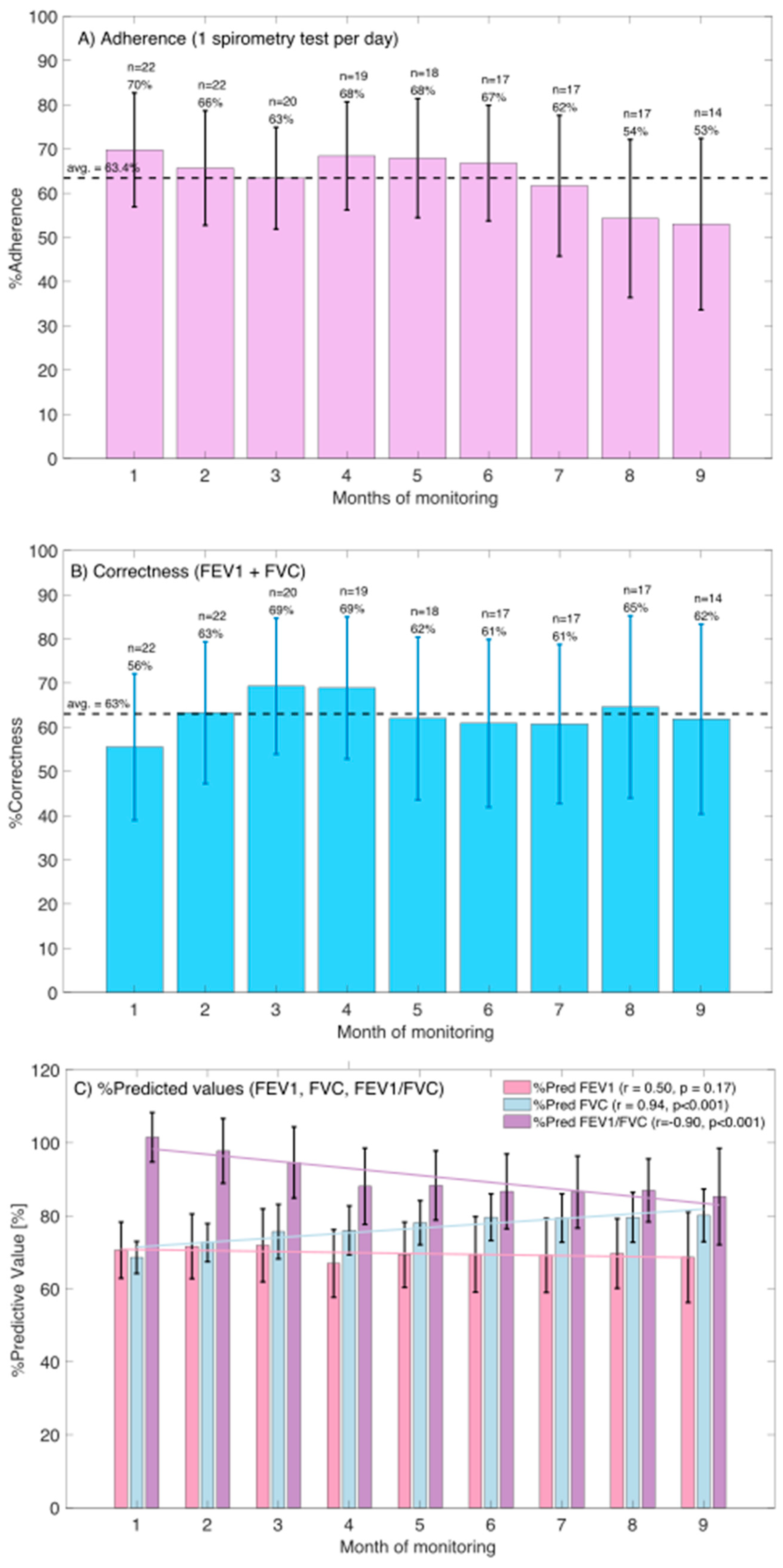
Figure 2.
Comparison results of A) the number of visits, B) mean duration of visits, and C) maximum duration of visits between three groups: routine care + spirometry telemonitoring, routine care + home spirometry, and routine care. The comparisons were calculated for all, only routine and only emergency visits.
Figure 2.
Comparison results of A) the number of visits, B) mean duration of visits, and C) maximum duration of visits between three groups: routine care + spirometry telemonitoring, routine care + home spirometry, and routine care. The comparisons were calculated for all, only routine and only emergency visits.
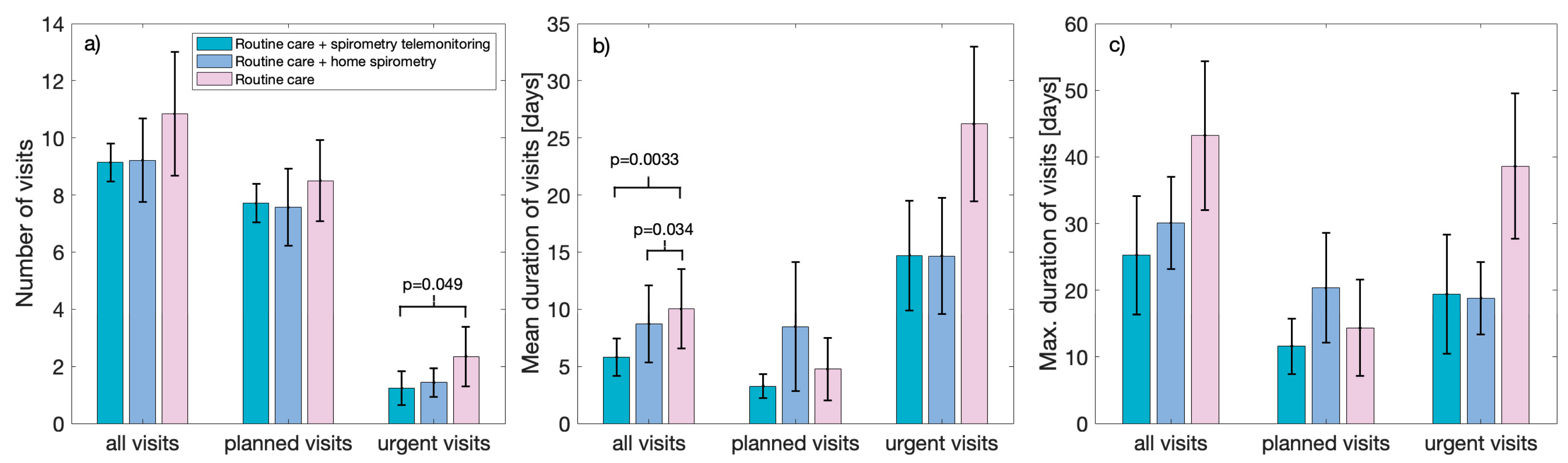

Table 1.
Groups characteristics.
| Parameter | Routine care + telespirometry monitoring | Routine care + home monitoring | Routine care | p-value |
| N | 21 | 23 | 32 | - |
| Age [y] | 53.0 (47.3–58.6) | 54.2 (49.0–59.3) | 53.7 (49.3–58.1) | .96 |
| Sex | F: 9, M: 12 | F: 9, M: 14 | F: 14, M: 18 | .94 |
| Time of monitoring (per person) [y] | 1.02 (0.94–1.11) | 1.15 (0.84–1.47) | 1.46 (1.17–1.74) | .09 |
| COPD | 10 (47.6%) | 11 (47.8%) | 13 (40.6%) | .82 |
| Pulmonary fibrosis | 7 (33.3%) | 9 (39.1%) | 9 (28.1%) | .68 |
| Pulmonary hypertension | 1 (4.8%) | 2 (8.7%) | 6 (18.7%) | .26 |
| Others | 3 (14.3) | 1 (4.4%) | 4 (12.5%) | .51 |
Table 2.
Summary of the performance of each patient for the telespirometry monitoring group.
| ID | Age [y] |
Sex [F–female, M–male] |
BMI [kg/m^2] |
Days of monitoring [days] | Number of examinations | Adherence [%] | Correctness level [%] | Percent of obstruction [%] |
| 1 | 56 | M | 27.0 | 445 | 322 | 63.1 | 13.4 | 53.5 |
| 2 | 49 | F | 16.8 | 409 | 686 | 83.1 | 57.9 | 26.7 |
| 3 | 58 | F | 19.8 | 156 | 48 | 29.5 | 4.2 | 0.0 |
| 4 | 20 | F | 16.2 | 216 | 174 | 69.0 | 83.3 | 41.4 |
| 5 | 44 | F | 17.9 | 371 | 359 | 72.5 | 68.5 | 51.2 |
| 6 | 40 | M | 22.7 | 287 | 147 | 51.2 | 95.9 | 1.4 |
| 7 | 32 | M | 17.9 | 343 | 806 | 97.4 | 27.0 | 62.8 |
| 8 | 39 | M | 25.7 | 244 | 140 | 48.0 | 49.3 | 24.6 |
| 9 | 54 | M | 22.0 | 305 | 179 | 56.4 | 93.9 | 41.1 |
| 10 | 60 | F | 26.0 | 318 | 315 | 91.2 | 69.8 | 0.0 |
| 11 | 61 | M | 24.4 | 98 | 47 | 38.8 | 14.9 | 28.6 |
| 12 | 64 | M | 20.1 | 298 | 252 | 72.5 | 74.2 | 10.7 |
| 13 | 65 | M | 27.0 | 270 | 187 | 59.6 | 37.4 | 0.0 |
| 14 | 59 | F | 30.1 | 291 | 266 | 78.0 | 79.3 | 49.8 |
| 15 | 68 | M | 23.9 | 288 | 126 | 40.3 | 60.3 | 0.0 |
| 16 | 44 | M | 15.4 | 53 | 9 | 15.1 | 11.1 | 0.0 |
| 17 | 65 | M | 19.8 | 56 | 35 | 55.4 | 2.9 | 0.0 |
| 18 | 66 | F | 20.3 | 78 | 68 | 78.2 | 73.5 | 0.0 |
| 19 | 53 | F | 14.0 | 260 | 166 | 59.2 | 94.6 | 1.3 |
| 20 | 66 | M | 23.7 | 263 | 251 | 93.9 | 94.8 | 5.0 |
| 21 | 53 | F | 17.2 | 214 | 128 | 54.7 | 93.8 | 35.0 |
Disclaimer/Publisher’s Note: The statements, opinions and data contained in all publications are solely those of the individual author(s) and contributor(s) and not of MDPI and/or the editor(s). MDPI and/or the editor(s) disclaim responsibility for any injury to people or property resulting from any ideas, methods, instructions or products referred to in the content. |
© 2026 by the authors. Licensee MDPI, Basel, Switzerland. This article is an open access article distributed under the terms and conditions of the Creative Commons Attribution (CC BY) license (http://creativecommons.org/licenses/by/4.0/).
Copyright: This open access article is published under a Creative Commons CC BY 4.0 license, which permit the free download, distribution, and reuse, provided that the author and preprint are cited in any reuse.