
Submitted:
02 April 2026
Posted:
03 April 2026
You are already at the latest version
Abstract
Climate change poses significant challenges to the operation and safety of dam and reservoir (D&R) systems, particularly in regions characterized by water scarcity and high climate variability. This study presents a structured methodology for climate risk assessment that integrates regional climate projections, system-specific thresholds, and a semi-quantitative risk matrix approach. A key innovation is the explicit linkage between climate indicators and system performance through physically based thresholds, combined with empirically derived exceedance probabilities from high-resolution climate projections. The methodology is applied to the Almopeos D&R system in Northern Greece using an ensemble of statistically downscaled CMIP6 simulations under two emission scenarios (SSP2-4.5 and SSP5-8.5) and two future periods (2041–2060 and 2081–2100). Three climate indicators are analyzed: TX35 (temperature extremes), CDD (consecutive dry days), and Rx1day (extreme precipitation). Results indicate that temperature increase is the dominant climate risk hazard, leading to increased irrigation demand and reduced system reliability, with risks classified as high to very high. Drought conditions represent a secondary but important risk, becoming critical during prolonged dry periods affecting reservoir storage, while extreme precipitation events exhibit low likelihood but potentially high consequences for dam safety. Adaptation measures are prioritized using a qualitative multi-criteria approach, highlighting the effectiveness of operational measures, while structural and monitoring interventions remain essential for ensuring system safety. The proposed methodology provides a transparent and transferable framework for climate-resilient planning of water infrastructure systems.
Keywords:
climate change adaptation
; dams and reservoirs
; climate proofing
; climate risk assessment
; Mediterranean region
1. Introduction
Dam and reservoir (D&R) systems play a critical role in water resources management by supporting hydropower production, irrigation, flood control, water supply, and ecosystem regulation. Despite their importance, numerous dam failures have occurred worldwide, sometimes resulting in severe human, environmental, and economic losses [1,2]. Regardless of the underlying causes of failure, such as structural, hydrological, geotechnical, or operational factors, the consequences are often catastrophic, including loss of life, environmental degradation, and major economic damage [3,4]. Therefore, effective risk management and analysis methodologies are essential for ensuring dam safety and supporting informed decision-making throughout the life cycle of D&R systems [5,6].
Risk assessment approaches applied to D&R systems are generally classified into qualitative, semi-quantitative, and quantitative methods according to their level of complexity and data requirements [7]. Among these, semi-quantitative approaches are widely used in engineering practice, because they provide a balance between methodological rigor and practical applicability when detailed probabilistic data are unavailable.
One of the most commonly applied tools in semi-quantitative risk analysis is the risk matrix approach. Risk matrices are widely used in dam safety assessments, particularly for preliminary or screening-level analyses, due to their transparency, simplicity, and ability to incorporate expert judgement. They are included in several dam safety guidelines and national risk management frameworks [8,9,10] and support decision-making processes by helping to prioritize further investigations and mitigation measures. Applications of risk matrices in dam safety analysis are reported in studies such as Sohler et al. [11] and Xie et al. [12], while similar approaches have been applied to other water infrastructure systems, including water distribution networks [13]. Lane and Hrudey [14] provide a detailed guide for the development and application of risk matrices in water infrastructure management.
Several additional methodologies have been applied to dam safety and infrastructure risk analysis. Failure Mode and Effects Analysis (FMEA) and its extensions, such as PFMA and FMECA, are widely used for the systematic identification and evaluation of failure mechanisms [15,16,17]. Event Tree Analysis (ETA) has been applied to assess the progression of failure scenarios and their consequences [18,19,20]. Fault Tree Analysis (FTA) is commonly used to analyse the logical relationships between system failures and their causes [21,22,23]. Probabilistic approaches, such as Monte Carlo simulation, have been used to quantify uncertainties in dam performance and failure processes [24,25]. Bayesian networks provide a flexible framework for modelling dependencies and updating risk estimates under uncertainty [26,27,28]. In addition, multi-criteria decision analysis methods, including the Analytic Hierarchy Process (AHP), have been applied to support decision-making and prioritization of risk mitigation measures [29,30,31,32]. These approaches provide more detailed probabilistic or system-based analyses but often require extensive data and computational effort.
Climate change introduces additional challenges for the design, operation, and safety of D&R systems, as it affects temperature, precipitation patterns, and the frequency and magnitude of extreme hydrological events. The Mediterranean region is widely recognized as one of the most vulnerable areas to climate change, often referred to as a climate change hotspot, where temperature increases exceed the global average and are accompanied by a reduction in precipitation and an increase in the frequency and intensity of extreme events [33,34]. These changes are expected to affect significantly hydrological regimes, leading to increased water scarcity, prolonged drought periods, and higher variability in water availability.
In this context, D&R systems play a critical role in ensuring water security, particularly for irrigation, which represents the dominant water use in many Mediterranean regions. However, the performance and safety of these systems are increasingly challenged by climate-driven pressures, including increased evaporation losses, higher water demand, reduced inflows, and the potential for extreme hydrological events. These characteristics make Mediterranean D&R systems particularly vulnerable to climate change and highlight the need for integrated risk assessment and adaptation planning approaches tailored to regional conditions. Therefore, case studies from Mediterranean environments provide valuable insights into the development of transferable methodologies for climate-resilient water infrastructure.
In response to these challenges, Stamou et al. [35] developed a Climate Risk and Vulnerability Assessment (CRVA) methodology within the CLIMPACT research project, based on an extensive literature review and the technical guidance of the European Commission for climate proofing of infrastructure [36]. The methodology consists of five steps implemented in two phases: a screening phase, including system description (step 1), climate change assessment (step 2), and vulnerability assessment (step 3), and a detailed analysis phase, including risk assessment (step 4) and the identification, appraisal, and prioritization of adaptation measures (step 5). The preferred measures should then be integrated into the project design and/or its operation to improve climate resilience [37]. Stamou et al. [38] applied the first three steps of this methodology to the Almopeos D&R system in Northern Greece and identified three main groups of climate hazards affecting the system: (i) increasing temperatures and extreme heat, (ii) decreasing precipitation and drought conditions, and (iii) extreme precipitation and flooding events.
Building on previous work on CRVA for D&R systems [35,38], the present study advances the methodology by explicitly linking climate indicators to system performance using system-specific thresholds. In particular, thresholds are derived based on irrigation demand, reservoir storage characteristics, and hydrological response, allowing a more physically meaningful interpretation of climate change impacts. Furthermore, the study introduces the use of empirically derived exceedance probabilities from high-resolution climate projections for the estimation of hazard likelihood. This approach enables a transparent and data-driven representation of climate uncertainty without relying on assumed statistical distributions. The proposed framework is applied to the Almopeos D&R system in Northern Greece, with the objective of demonstrating how climate-informed risk assessment, combined with system-based thresholds and a semi-quantitative risk matrix, can support practical decision-making and climate-proofing of D&R systems in the Mediterranean region.
2. Materials and Methods
2.1. Methodology
The methodology adopted in this study follows the CRVA framework developed by Stamou et al. [35] within the CLIMPACT project and is consistent with the European Commission guidance on climate proofing of infrastructure [36]. The framework shown in Figure 1 comprises five steps implemented in two phases: (i) a screening phase, including system description, climate change assessment, and vulnerability assessment, and (ii) a detailed analysis phase, including risk assessment and identification of adaptation measures.
This work focuses on the detailed analysis (phase 2), which follows the screening phase (phase 1), in which the following groups of climate hazards were identified as potentially significant: (i) increasing temperatures and extreme heat, (ii) decreasing precipitation and drought conditions, and (iii) extreme precipitation and flooding events [38]. In the present detailed analysis, the impacts of these hazards are classified according to the dominant climate driver using the typologization of Stamou et al. [39] as (i) temperature-related impacts (TIM), (ii) drought-related impacts (DIM), and (iii) flood-related impacts (FIM). These impacts are then analysed using an impact chain approach, which represents the causal sequence linking climate hazards to physical processes and their consequences on the performance of the D&R system.
Each impact chain therefore represents a structured pathway from climate forcing to infrastructure response and operational consequences. For each impact chain, consequences are evaluated across a set of risk areas relevant to D&R systems, whose identification is based on engineering judgement, available literature, and operational knowledge [5,8,9,36]. In this study, the following five risk areas are considered, that are consistent with EC [36]: asset damage (CA), safety and health (CH), environmental impacts (CE), service disruption and social impacts (CS), and financial and reputational impacts (CF & CR). These risk areas and indicative consequences are shown in Table 1.
In Table 2 and Table 3 and 4, twenty representative climate–impact chains are presented using the typology of impacts defined in Stamou et al. [38]. These chains describe the main mechanisms through which (i) temperature-related impacts (TIM1–TIM6), (ii) drought-related impacts (DIM1–DIM6), and (iii) flood-related impacts (FIM1–FIM8) may affect the five risk areas of D&R systems, along with the relevant climate indicators used in the risk assessment. These indicators include maximum temperature (TXm in °C), hot days (HD; annual count of days with daily maximum temperature > 30 °C), tropical nights (TR; annual count of days with daily minimum temperature > 20 °C), annual count of days with daily maximum temperature > 35 °C (TX35), annual total precipitation on wet days (PRCPTOT in mm), consecutive dry days (CDD; maximum number of consecutive days with daily precipitation less than 1 mm in a year), annual count of days when precipitation is ≥ 20 mm (R20mm), and annual maximum one-day precipitation (Rx1day in mm) [38]. The information in Table 2 and Table 3 and 4 provides the basis for the subsequent climate risk assessment, in which the likelihood of hazards and the magnitude of their consequences are evaluated using a semi-quantitative risk matrix approach.
2.2. Consequences Analysis
The assessment of climate risks for D&R systems requires a multi-dimensional evaluation of potential consequences, reflecting the wide range of impacts associated with infrastructure malfunction or failure. As shown in Table 1, Table 2, Table 3 and Table 4, these impacts extend beyond structural damage to include effects on human safety, the environment, service provision, and economic performance, in line with established dam safety frameworks [6,8,9] and the climate-proofing guidance of the European Commission [36].
In this study, consequences are assessed using the five-level scale of the climate-proofing framework of the EC [36], ranging from insignificant (score = 1) to catastrophic (score = 5), which is extended to include representative quantitative indicators for each risk area, for which thresholds are defined to enhance transparency and applicability to the Almopeos D&R system. These indicators include repair costs relative to asset value (CA), population at risk (CH), spatial extent and recovery time of environmental impacts (CE), irrigation deficit (CS), and economic losses (CF & CR). The resulting classification framework is presented in Table 5, where qualitative levels are directly linked to quantitative thresholds.
This combined approach ensures consistency with EC [36] while enabling a more explicit and reproducible assessment based on system-specific characteristics. Moreover, while EC [36] expresses financial impacts in terms of turnover of the infrastructure operator, the present study adopts an alternative approach based on agricultural production losses. This adaptation reflects the primary function of the Almopeos D&R system, which is irrigation water supply, and its role in supporting regional economic activity, and therefore provides a more appropriate measure of financial impact.
2.3. Likelihood Analysis
The likelihood analysis evaluates the probability of occurrence of the climate hazards considered in the assessment of D&R systems within the selected planning horizon. The classification presented in Table 6 is based on the five-level qualitative scale proposed by the EC [36], to which scores ranging from 1 (rare) to 5 (almost certain) are assigned. The assessment is based on the distributions of key climate indicators, which are derived from available climate information, including historical data, climate projections, and expert judgement, and expresses the degree of confidence that a given hazard may occur.
Likelihood is evaluated for the main groups of hazards identified in the vulnerability analysis: temperature increase and heat waves, decreased precipitation and drought conditions, and extreme precipitation and flood events [38].
2.4. Risk Analysis
The overall climate risk for each impact chain is determined by combining the magnitude of consequences and the likelihood of occurrence using a semi-quantitative risk matrix approach. This approach provides a transparent and practical framework for comparing risks across different hazard categories and types of consequences. The risk score (R) is calculated as:
where C is the consequence score and L is the likelihood score, both ranging from 1 to 5. The resulting risk scores range from 1 to 25.
Risk scores are classified into four qualitative levels: Low, Moderate, High, and Very High that correspond to risk scores 1-4, 5-9, 10-15 and 16-25, respectively, as shown in Table 7. This classification supports the prioritization of climate risks and the identification of impact chains requiring further analysis or mitigation.
2.5. Assessment of Adaptation Measures
Following the risk assessment, adaptation measures are identified and classified to reduce the most significant risks and enhance the climate resilience of a D&R system. The identified measures are then assessed and prioritized, and the preferred measures are integrated into the D&R design and/or operation to improve climate resilience [37].
The identification and classification of measures are guided by the Key Type Measures (KTMs) framework of the European Climate Adaptation Platform (Climate-ADAPT) [34]. The KTM framework groups adaptation options into categories including: (i) grey infrastructure measures, such as structural upgrades of hydraulic components; (ii) nature-based solutions (NbS), including catchment restoration and erosion control; (iii) management and operational measures, such as improved reservoir operation, monitoring, and maintenance; (iv) policy and institutional measures, including regulatory and planning instruments; and (v) information and capacity-building measures, such as data collection, training, and stakeholder engagement.
In D&R systems, these measures aim to reduce either the likelihood or the consequences of climate-related risks, while enhancing the adaptive capacity of the system. Their application to the Almopeos D&R system is presented in Section 3.
3. Application of the Methodology
3.1. The Case Study of Almopeos D&R System
The study area is located along the Almopeos River in Northern Greece, where the river flows through a narrow valley before entering the Giannitsa plain. The planned dam is situated approximately 4 km north of the settlement of Kali, at the outlet of the gorge. The reservoir collects runoff from the upstream Almopia basin, which includes both mountainous and lowland areas. A plan view of the system is shown in Figure 2.
The Almopeos reservoir has a total storage capacity of approximately 35.5 Mm3. The dam is an earthfill embankment structure with a height of about 61.0 m and a crest length of 245.0 m. The embankment consists of an impervious clayey silt core surrounded by coarse-grained shells derived from nearby borrow areas, while the upstream face is protected by a rockfill layer against wave action and water level fluctuations. The foundation consists of alluvial deposits treated by grouting to reduce seepage.
The primary function of the reservoir is irrigation water supply for the surrounding agricultural areas. Inflow is provided by the Almopeos River, whose ecological status upstream is classified as good, although its chemical status is considered less than good according to the River Basin Management Plan of Western Macedonia.
The spillway system comprises an inflow channel, a spillway equipped with fusegates, a collector channel, a drop channel, a stilling basin, and an escape channel returning flow to the downstream river. Most structures are constructed of reinforced concrete, while the escape channel is partly excavated in natural soil and protected with stone lining. The fusegates increase the effective discharge capacity during extreme flood events. Additional hydraulic structures include a vertical concrete well for water abstraction, pipelines for irrigation release, environmental flow, and sediment flushing, as well as a Howell–Bunger valve for flow regulation. Sediment flushing is performed periodically during early winter rainfall events. The system also includes an administration building with automation and control systems, as well as monitoring equipment such as piezometers, extensometers, inclinometers, and accelerometers. Access is provided by two rural roads on both sides of the river. Although no permanent staff is present on site, regular inspection and maintenance visits are planned. Environmental flow released downstream ranges between 0.04 and 1.1 m3/s, depending on hydrological conditions.
Based on these characteristics, the methodology described in Section 2 is applied in the following subsections.
3.2. Selection of Relevant Impact Chains for the Almopeos D&R System
Table 2, Table 3 and Table 4 present representative climate–impact chains describing the main mechanisms through which temperature increase, drought conditions, and extreme precipitation events may affect D&R systems. However, their relevance depends on the characteristics and operation of the specific system considered. Therefore, prior to the risk assessment, the impact chains were screened for their applicability to the Almopeos D&R system. This selection was based on the main characteristics of the project described in Section 3.1 and the following criteria:
- coverage of the main components of D&R systems, including inputs, functions, assets, outflows, and supporting infrastructure, following the system typologization of Stamou et al. [39], and
- representation of impacts across the five risk areas considered in the assessment.
Based on these criteria, eleven impact chains were identified as the most relevant for the Almopeos system, including three temperature-related chains (TIM1–TIM3), three drought-related chains (DIM1, DIM2, and DIM4), and five chains associated with extreme precipitation and floods (FIM1–FIM5), which are summarized in Table 8.
These selected chains represent the dominant climate–impact mechanisms affecting water availability, water quality and dam safety, including embankment desiccation, seepage risk, overtopping, piping and sediment transport. They form the basis for the subsequent consequence and risk assessment.
3.3. Consequence Analysis of Almopeos D&R System
The magnitude of consequences for the selected eleven impact chains (Table 2, Table 3 and Table 4 and 8) was evaluated using the five-level scale defined in Table 5 for the five risk areas introduced in Section 2.1 and the corresponding system-specific indicators, namely repair costs relative to asset value (CA), population at risk (CH), spatial extent and recovery time of environmental impacts (CE), irrigation deficit (CS), and economic losses (CF & CR).
3.3.1. Asset Damage (CA)
For temperature-related impact chains (Table 2), increased water temperature (TIM1) leads to algal growth and obstruction of infrastructure components, resulting in minor maintenance costs (1–5% of asset value, CA = 2), while TIM2 and TIM3 do not directly affect structural integrity. For drought-related chains (Table 3), reduced reservoir levels (DIM1 and DIM2) expose structural elements, leading to minor deterioration (CA = 2). In contrast, prolonged drought (DIM4) may cause desiccation and cracking of the clay core, requiring major repair works (15–40%, CA = 4). For extreme precipitation chains (Table 4), flooding and hydraulic loading (FIM1 and FIM4) result in significant structural stress (CA = 4), while internal erosion (FIM3) produces similar damage levels. Overtopping (FIM2) may lead to structural failure (CA = 5), whereas sediment transport (FIM5) results in minor damage (CA = 2).
3.3.2. Safety and Health (CH)
Temperature-related (TIM1–TIM3) and most drought-related chains (DIM1 and DIM2) do not pose direct safety risks (CH = 1), while DIM4 presents low risk (CH = 2). For extreme precipitation chains (Table 4), flooding (FIM1) is expected to have limited direct impact on human safety and is therefore classified as moderate (CH = 3). For dam failure scenarios, overtopping (FIM2) and piping/internal erosion (FIM3), the assessment is based on dam-break analysis results provided in the design studies of the project, which include both one-dimensional and two-dimensional hydraulic modelling of flood wave propagation downstream of the dam. These analyses indicate rapid flood wave propagation, high flood depths (up to approximately 20–28 m near the dam), and significant inundation extent, affecting settlements and agricultural areas downstream. Based on these results, the affected population is estimated to range between approximately 150 and 800 people, considering the spatial distribution of settlements within the inundation area and typical rural population densities. The risk to human safety is further increased due to the short arrival times of the flood wave, estimated at approximately 1–5 minutes near the dam and less than two hours in downstream areas. Consequently, both overtopping (FIM2) and piping (FIM3) are classified as high to very high risk (CH = 4–5), while spillway malfunction (FIM4) is considered moderate (CH = 3).
3.3.3. Environmental Impacts (CE)
Temperature-related chains (Table 2) affect water quality over distances of approximately 1–5 km (TIM1, CE = 3), while TIM2 and TIM3 result in more localized impacts (CE = 2). Drought-related chains (Table 3) affect river reaches of 1–5 km (DIM1–DIM2, CE = 2–3), while DIM4 has no direct environmental impact (CE = 1). Extreme precipitation chains (Table 4) produce the most significant environmental impacts. Flooding (FIM1) is expected to affect river reaches of 5–20 km (CE = 4), while dam failure scenarios, including overtopping (FIM2) and internal erosion (FIM3), are associated with high-magnitude impacts along several kilometers downstream, as indicated by dam-break analysis and flood propagation modelling from the project design studies. These impacts include rapid changes in flow regime, erosion and sediment transport, and disturbance of aquatic habitats. Sediment transport (FIM5) is classified as moderate (CE = 3), reflecting increased turbidity and geomorphological changes within the affected river corridor. Overall, the environmental consequences are classified as moderate to high, depending on the impact chain and spatial extent.
3.3.4. Service Disruption (CS)
Service disruption was assessed based on irrigation deficit, considering the relationship between water demand and reservoir storage capacity. For an annual irrigation demand of approximately 60–70 Mm3 and a storage capacity of 35.5 Mm3, as defined in the project design studies, the system is highly sensitive to changes in inflow and demand. Temperature-related chains (Table 2) increase irrigation demand (TIM3), resulting in deficits of 30–40% (CS = 4), while increased evaporation losses (TIM2) lead to deficits of 10–20% (CS = 3). Drought-related chains (Table 3) have the strongest effect: reduced inflows (DIM1) result in deficits of 35–50% (CS = 4), while DIM2 and DIM4 have limited impact (CS = 2). Extreme precipitation chains (Table 4) may cause temporary or permanent disruption of the system. Flooding (FIM1) leads to deficits of 20–40% (CS = 4), mainly due to temporary operational disruption and infrastructure damage. In contrast, dam failure scenarios, including piping/internal erosion (FIM3) and overtopping (FIM2), as analyzed in the dam-break modelling studies, result in partial or complete system failure. Piping (FIM3) is associated with severe disruption (CS = 4), while overtopping (FIM2) leads to complete loss of system functionality and irrigation supply (>60%, CS = 5).
3.3.5. Financial and Reputational Impacts (CF & CR)
Financial impacts were evaluated based on agricultural production losses associated with irrigation deficits. According to the agricultural study of the project, the irrigated area is dominated by high-value crops, particularly tree crops (58.1%) and vegetables (10.8%), while maize and other crops account for smaller shares. Based on this crop distribution and typical production values, the total annual agricultural production is estimated to range between approximately 20 and 35 million Euros. Accordingly, irrigation deficits result in proportional economic losses depending on their severity and duration. Temperature and drought-related chains (Table 2 and Table 3) lead to minor to major losses (CF = 2–4), consistent with the deficit ranges identified in Section 3.3.4. In contrast, extreme precipitation chains (Table 4) produce the highest financial impacts. Flooding (FIM1) leads to moderate losses (CF = 3), while piping/internal erosion (FIM3) results in major losses (CF = 4). Overtopping (FIM2), associated with complete system failure and loss of irrigation supply, leads to very high financial impacts (CF = 5).
Reputational impacts (CR) are considered moderate to high, particularly in failure scenarios, due to potential effects on public trust, institutional credibility, and stakeholder confidence.
The resulting consequence scores for all impact chains are summarized in Table 9, where the maximum value across the five risk areas defines the overall consequence score.
3.4. Likelihood Analysis of Almopeos D&R System
The likelihood analysis is based on the distributions of representative key indicators that correspond to the main hazards groups identified in the vulnerability analysis. The following indicators were selected in the present analysis:
- TX35 (temperature increase and heat waves): number of days per year with maximum temperature exceeding 35 °C,
- CDD (drought conditions): maximum number of consecutive dry days per year, and
- Rx1day (extreme precipitation): maximum daily precipitation per year.
3.4.1. Climate Change Scenarios
Two greenhouse gas emission scenarios were considered: SSP2-4.5 and SSP5-8.5, representing intermediate and high-emission pathways, respectively. For each scenario, two future periods were analyzed (2041–2060 and 2081–2100), resulting in four scenario–period combinations. The analysis was based on daily high-resolution (1 km × 1 km) statistically downscaled climate projections from four CMIP6 global climate models (GCMs): UKESM1-0-LL (r1i1p1f2), developed by the Met Office Hadley Centre (MOHC); MIROC-ES2L (r1i1p1f2), developed by the Centre for Climate System Research (University of Tokyo), JAMSTEC, and NIES; CanESM5 (r1i1p1f1), developed by the Canadian Centre for Climate Modelling and Analysis; and INM-CM4-8 (r1i1p1f1), developed by the Russian Academy of Sciences. These simulations were statistically downscaled within the framework of the CLIMADAT-hub project, following the methodology described in Varotsos et al. [42], using the CLIMADAT-GRid high-resolution (1 km × 1 km) gridded observational dataset for Greece as the reference dataset [43].
3.4.2. Empirical Distributions of Climate Indicators
For each climate indicator, annual values from all climate models and simulation years within each scenario–period combination were combined into a single ensemble dataset representing the range of possible future conditions. This dataset captures both interannual variability and inter-model differences. The variability of each indicator was quantified using empirical exceedance probability functions, defined as:
where N(X>x) is the number of years in which the indicator exceeds the threshold x, and Ntot is the total number of years in the sample.
This empirical approach avoids assumptions regarding theoretical probability distributions and enables a direct, data-driven estimation of likelihood based on the frequency of occurrence of the selected climate indicators in the ensemble of model simulations. The resulting exceedance probability distributions for all indicators and scenario–period combinations are presented in Table 10.
3.4.3. Definition of System-Based Thresholds for Climate Indicators
Critical thresholds were defined to link climate indicators with system performance based on physical system characteristics, irrigation demand, and hydrological response.
For temperature-related hazards, the threshold for TX35 was derived from irrigation demand analysis using project data. Average daily demand during typical summer conditions (June and August) is approximately 0.33–0.37 Mm3/day, corresponding to a representative value of about 0.35 Mm3/day, while peak demand during July reaches approximately 0.43 Mm3/day. This increase of about 20–25% is consistent with enhanced evapotranspiration under high-temperature conditions [44]. Considering the concentration of irrigation demand within the May–September period, the limited inflows during summer, and the cumulative effect of high-temperature days, a threshold of 20 days per year is adopted. This value represents sustained periods of elevated demand leading to system stress and is consistent with observed durations of heatwaves in Mediterranean regions [33,45,46].
For drought-related impacts, the threshold for CDD was derived from a simplified reservoir water balance using project data. The peak irrigation demand is approximately 0.43 Mm3/day, while the total reservoir storage is approximately 35.5 Mm3, resulting in a theoretical supply duration of about 70–80 days under zero inflow conditions. Accounting for environmental flow requirements (0.04–1.1 m3/s), operational constraints and residual inflows, this duration reduces to approximately 60–70 days. Since shorter dry periods (20–30 days) are common in Mediterranean climates and do not represent critical conditions, a threshold of 60 consecutive dry days is adopted, corresponding to the onset of significant system stress. This is consistent with drought classifications reported in the literature [33,47,48].
For flood-related hazards, the threshold of Rx1day was defined based on simplified rainfall–runoff relationships and empirical evidence on rainfall extremes. Daily rainfall that exceeds approximately 50 mm/day is generally associated with significant runoff generation in Mediterranean catchments and represents the onset of conditions requiring operational attention. However, it should be acknowledged that, although statistical downscaling improves the spatial detail of the projections and makes them more suitable for local-scale applications, short-duration precipitation extremes may still be underestimated because the driving GCMs remain limited by coarse native resolution and by their imperfect representation of convective processes. Consequently, the selected threshold should be interpreted as an operational indicator of hydrological response rather than a strict design-level criterion, and the derived exceedance probabilities should be interpreted with caution.
3.4.4. Likelihood Probability and Scores of Hazards
The likelihood of occurrence of the main climate hazards was evaluated based on the exceedance probabilities of the selected climate indicators and their corresponding system-based thresholds. The resulting likelihood scores for the selected impact chains are summarized in Table 11.
Temperature-related hazards (TX35) exhibit consistently high exceedance probabilities across all scenarios and future periods. For the selected threshold of 20 days per year, probabilities range from approximately 72.5% to 100% (Table 10), corresponding to likelihood levels 4 to 5 (Table 11). This indicates that high-temperature conditions leading to increased irrigation demand are expected to become a persistent feature of the system. These findings are consistent with projections of more frequent and prolonged heatwaves in the Mediterranean region [33,45,46] confirming that temperature increase represents the dominant climate driver affecting system performance.
Drought-related hazards, evaluated using a threshold of 60 consecutive dry days (CDD), show relatively low exceedance probabilities, generally ranging between approximately 6% and 18% (Table 10), corresponding to likelihood level 2 (Table 11). This suggests that while moderate dry periods are common in Mediterranean climates, prolonged drought conditions leading to critical system stress occur less frequently. These findings are consistent with projections of increasing drought variability and persistence in Southern Europe [33,47], while highlighting the importance of distinguishing between frequent dry spells and severe drought events.
In contrast, extreme precipitation events (Rx1day) exhibit low exceedance probabilities for thresholds relevant to system operation, generally below 5% (Table 10), corresponding to likelihood level 1 (Table 11). However, these results should be interpreted with caution. Climate models are known to have limitations in representing short-duration precipitation extremes, which are often associated with convective processes and may be underestimated [49,50]. In addition, flood generation depends on multiple factors, including antecedent soil moisture, rainfall duration and spatial variability, which are not fully captured by single-day precipitation indicators. Consequently, although extreme precipitation is classified as a low-likelihood hazard based on the selected indicator, its potential contribution to dam safety risk remains important due to the high consequences associated with failure scenarios. This highlights the need for a precautionary interpretation of flood-related risks in dam safety assessments.
Overall, the likelihood analysis indicates that the climate hazard regime of the Almopeos D&R system is dominated by temperature increase and, to a lesser extent, drought conditions, while extreme precipitation represents a lower-probability but potentially high-impact hazard.
3.5. Risk Assessment of Almopeos D&R System
The overall risk associated with the groups of climate hazards and impact chains affecting the Almopeos D&R system was evaluated by multiplying the consequences scores (Table 9) with the corresponding likelihood scores (Table 11). The resulting risk scores and levels for each impact chain are presented in Table 12.
Temperature-related hazards (TX35), which exhibit very high likelihood levels (level 5; Table 11), result in high to very high risk across all associated impact chains (TIM1–TIM3). In particular, increased irrigation demand (TIM3) reaches the highest risk level (Very High), reflecting both the high probability of occurrence and the significant impact on system operation. Water quality degradation (TIM1) and evaporation losses (TIM2) are also classified as high risk. These results confirm that temperature increase constitutes the dominant risk driver for the system.
Drought conditions, which were evaluated using a threshold for CDD of 60 consecutive dry days, are associated with lower likelihood levels (score=2; Table 11), but relatively high consequences. As a result, drought-related impact chains (DIM1, DIM2, DIM4) are classified as moderate risk (Table 12). This indicates that although severe drought events are less frequent, their impacts on reservoir storage, water quality, and structural behavior can be significant when they occur. The results highlight the importance of considering both likelihood and consequence in risk evaluation, particularly for water resource systems sensitive to prolonged dry conditions.
Extreme precipitation events (Rx1day) exhibit low likelihood levels score=1; Table 11), resulting in low to moderate risk levels across the corresponding impact chains (FIM1–FIM5). Most flood-related risks are classified as low, except for overtopping (FIM2), which reaches a moderate risk level due to its high consequence despite the low probability of occurrence. These results should be interpreted with caution, as climate models are known to underestimate short-duration precipitation extremes, and flood-generating processes depend on additional factors such as antecedent conditions, rainfall duration, and catchment response [49,50].
Overall, the risk assessment indicates that the Almopeos D&R system is primarily exposed to temperature-driven increases in irrigation demand, with drought conditions representing a secondary but important risk factor. Extreme precipitation events, although associated with potentially severe consequences, remain low-probability hazards under the considered scenarios. These findings provide a basis for prioritizing adaptation and risk management measures, with emphasis on demand management, system flexibility, and resilience to prolonged dry conditions.
3.6. Assessment of Adaptation Measures for Almopeos D&R System
Based on the climate risk assessment presented in Section 3.5, a set of adaptation measures was identified to reduce the most significant climate risks affecting the Almopeos D&R system.
3.6.1. Identification of Adaptation Measures
The identification of these measures follows the KTMs framework of Climate-ADAPT [34], as introduced in Section 2.5.
The dominant risks are primarily associated with increased irrigation demand and evaporation losses under high-temperature conditions (TIM2 and TIM3), as well as reduced water availability during prolonged dry periods (DIM1). Secondary risks include dam safety under drought conditions (DIM4) and low-probability but high-consequence flood events (FIM1–FIM5).
The identified adaptation measures are grouped according to the KTM categories as follows:
- Management and operational measures (KTM-M), which include adaptive reservoir operation rules, improved irrigation scheduling, and measures to increase irrigation efficiency in the command area.
- Grey infrastructure measures (KTM-G), which entail the maintenance and upgrading of spillway components (including fusegates), and reinforcement of drainage and seepage control systems.
- Information and capacity-building measures (KTM-I) that deal with the enhanced monitoring of seepage, pore water pressures, and water quality, as well as with the development of flood forecasting and early warning systems.
- Nature-based solutions (KTM-N), such as catchment management interventions aimed at reducing erosion and sediment inflow into the reservoir.
- Policy and institutional measures (KTM-P). These measures, although not explicitly developed in this study, include regulatory and planning measures that support efficient water use and risk-informed dam operation and are implicitly relevant.
This classification ensures consistency with the Climate-ADAPT framework while linking adaptation options to the dominant risk drivers identified in the system.
3.6.2. Appraisal of Adaptation Measures
The identified measures were analyzed in terms of their role in reducing either the likelihood or the consequences of the main climate-related risks.
Reservoir operation and irrigation management (KTM-M). Given that the reservoir supplies irrigation water to approximately 12,000 ha of agricultural land, priority is given to measures that improve water management efficiency under increased demand and reduced inflows. Adaptive reservoir operation rules and improved irrigation scheduling directly reduce the consequences of increased irrigation demand and evaporation losses (TIM2 and TIM3), which represent the highest risk levels identified in Table 12. Such approaches are widely recognized as effective strategies for climate adaptation in water resources systems [34,41].
Dam safety under drought conditions (KTM-G and KTM-I). Prolonged dry periods may lead to desiccation and cracking of the clay core, increasing seepage and piping risk (DIM4). Adaptation measures include enhanced monitoring of seepage and pore water pressures (KTM-I), systematic inspection of the embankment, and maintenance of drainage systems (KTM-G). These measures reduce the likelihood of structural degradation and are consistent with established dam safety practices [6,41].
Dam safety under extreme precipitation events (KTM-G and KTM-I). Although extreme precipitation events exhibit low likelihood (Table 11), they may lead to severe consequences, particularly overtopping (FIM2). Measures include inspection and maintenance of spillway components (KTM-G), verification of discharge capacity under future conditions, and the development of early warning systems and emergency action plans (KTM-I). These measures reduce consequences and improve preparedness [5,9].
Sediment and water quality management (KTM-N and KTM-I). Impacts related to water quality degradation and sediment transport (TIM1, DIM2 and FIM5) are addressed through enhanced monitoring (KTM-I), optimization of sediment management practices, and catchment-scale interventions (KTM-N). These measures support long-term system functionality and environmental performance [41].
Overall, the measures represent a combination of operational, structural, monitoring and catchment-based interventions targeting both dominant and secondary risks.
3.6.3. Prioritization of Adaptation Measures
Following the appraisal stage, the identified measures were evaluated and prioritized using a qualitative multi-criteria approach that considers their effectiveness in reducing climate risks, technical feasibility, and implementation cost. Such approaches are widely applied in climate adaptation planning for water infrastructure systems, as they support decision-making under uncertainty and limited data availability [14,34]. The results of this evaluation are summarized in Table 13.
Effectiveness refers to the ability of each measure to reduce the likelihood or the magnitude of the identified climate risks, particularly those associated with increased irrigation demand and evaporation losses under high-temperature conditions (TIM2 and TIM3), reduced reservoir storage (DIM1), and dam safety under prolonged drought conditions (DIM4) and extreme events (FIM1–FIM3). Technical feasibility reflects the degree to which each measure can be implemented within the existing design, operational practices and institutional framework of the Almopeos D&R system. Cost represents the approximate level of financial resources required for implementation and is expressed qualitatively as low, moderate or high.
As shown in Table 13, the prioritization indicates that operational and monitoring interventions, corresponding mainly to the management and operational (KTM-M) and information and capacity-building (KTM-I) categories, represent the most effective and feasible options for addressing the dominant climate risks. In particular, adaptive reservoir operation rules and improvements in irrigation efficiency are identified as high-priority measures, as they directly address the highest-risk impact chains related to increased water demand and evaporation losses (TIM2 and TIM3), as well as reduced water availability (DIM1). Similarly, enhanced monitoring of seepage and embankment conditions and systematic inspection practices are considered essential for managing structural risks associated with prolonged drought conditions (DIM4), offering high effectiveness at relatively low implementation cost.
Measures related to structural safety, such as maintenance and inspection of spillway components, including fusegates, also rank among the high-priority options (Table 13). Although these measures primarily address flood-related hazards with low likelihood, they are critical for reducing the consequences of extreme events, particularly overtopping and piping (FIM1, FIM2 and FIM3), and are therefore necessary within a precautionary dam safety framework [5,9].
In contrast, measures such as flood forecasting and early warning systems, sediment management, and water quality monitoring are assigned medium priority (Table 13). These measures contribute to enhancing system resilience and operational performance but are primarily associated with impact chains characterized by moderate or lower risk levels. In particular, nature-based solutions (KTM-N), such as catchment management interventions to reduce sediment inflow, play a supportive role in improving long-term system sustainability, while information-based measures (KTM-I) related to water quality monitoring contribute to maintaining environmental performance.
Overall, the prioritization highlights that adaptation planning for the Almopeos D&R system should focus primarily on measures that improve water management efficiency and system flexibility under increasing temperature and demand pressures, while also ensuring adequate monitoring and structural preparedness for less frequent but potentially high-consequence events. This combination of measures reflects a balanced adaptation strategy consistent with current best practices in climate risk management for water infrastructure systems.
4. Discussion
The climate risk assessment performed for the Almopeos D&R system highlights the importance of considering both operational and structural impacts of climate change on D&R systems. The results indicate that the dominant risks are associated primarily with increased irrigation demand and evaporation losses under high-temperature conditions, as well as reduced water availability during prolonged dry periods, while extreme precipitation events represent low-probability but high-consequence hazards.
In the case of the Almopeos D&R system, the highest risk levels are associated with increased irrigation demand (TIM3), reduced reservoir storage (DIM1) and potential desiccation of the clay core during prolonged drought periods (DIM4). These results reflect the strong dependence of the system on water availability and are consistent with projections for Mediterranean regions, where increasing temperatures and hydrological variability are expected to intensify water scarcity and affect reservoir operation [33,34]. Under such conditions, the balance between water supply and demand becomes the critical factor controlling system performance.
At the same time, extreme precipitation events remain a key concern for dam safety. Although their likelihood is low according to the climate projections used in this work, their potential consequences are severe, particularly in the case of overtopping and piping. This finding is consistent with previous studies identifying overtopping as one of the leading causes of dam failures worldwide [1,41]. It also highlights the need to account for low-probability, high-consequence events in dam safety assessments, even when their contribution to overall risk is limited.
The results underline the importance of combining structural and non-structural adaptation measures. Operational measures, such as adaptive reservoir management and improved irrigation efficiency, are particularly effective in addressing the dominant risks related to increased demand and water scarcity. At the same time, structural and monitoring measures, including spillway maintenance, seepage monitoring and enhanced inspection procedures, are essential for managing safety risks associated with extreme hydrological conditions. This combination of measures reflects current best practice in climate adaptation for water infrastructure systems [6,41].
From a methodological perspective, the semi-quantitative risk matrix approach proved to be a practical tool for integrating climate projections, infrastructure characteristics and expert judgement within a consistent assessment framework. The use of climate indicators and empirically derived exceedance probabilities allowed a transparent estimation of likelihood levels without requiring full probabilistic modelling. This approach is particularly suitable for screening-level or intermediate assessments where data availability is limited.
Nevertheless, several limitations should be acknowledged. First, the likelihood assessment is based on statistically downscaled CMIP6 climate projections and is therefore subject to uncertainties associated with the driving climate models, emission scenarios, and the downscaling and bias-correction procedures. Although the statistical downscaling increases the spatial resolution of the projections, the underlying climate model data may still underestimate short-duration precipitation extremes because such events are strongly influenced by processes that are not always well represented in coarse-resolution global climate models. This limitation is directly relevant to the low exceedance probabilities obtained for the Rx1day indicator and implies that flood-related risks may be underestimated. Second, the consequence evaluation relies partly on engineering judgement, particularly in the definition of thresholds and impact severity. Third, the analysis focuses on a representative subset of impact chains rather than an exhaustive set of all possible failure mechanisms. While this approach ensures practical applicability, it may omit less probable or indirect pathways.
Despite these limitations, the methodology provides a structured and transparent framework for climate risk assessment of D&R systems. Its application to the Almopeos case demonstrates how climate change considerations can be systematically incorporated into dam safety and water resources management. The approach is transferable to other systems, particularly in Mediterranean regions, where increasing temperatures, drought conditions and hydrological variability are expected to significantly affect water infrastructure performance.
5. Conclusions
This study developed and applied a structured framework for assessing climate-related risks in D&R systems, integrating climate projections, system-based thresholds and a semi-quantitative risk matrix approach.
The application to the Almopeos D&R system demonstrates that temperature-driven increases in irrigation demand constitute the dominant climate risk, leading to high to very high impacts on system operation. Drought conditions represent a secondary risk, becoming critical under prolonged dry periods that affect reservoir storage. In contrast, extreme precipitation events are characterized by low likelihood, although their potential consequences remain important for dam safety.
The results indicate that adaptation strategies should prioritize operational measures that improve water use efficiency and system flexibility, supported by monitoring and structural interventions to ensure safety under both drought and extreme conditions.
Methodologically, the study highlights the value of combining empirical climate information with system-specific thresholds to support transparent and practical risk assessments under uncertainty. The proposed approach is transferable to other water infrastructure systems, particularly in regions exposed to increasing temperature and hydrological variability.
Overall, the findings support the integration of climate risk considerations into dam operation and safety planning, with emphasis on managing demand-driven stresses while maintaining preparedness for low-probability, high-consequence events.
Author Contributions
Conceptualization A.I.S. and G.M.; methodology A.I.S. and G.M.; formal analysis A.I.S., G.M., A.T.S. and A.B.; investigation A.I.S., G.M., A.S., A.T.S., A.B., K.V.V., C.G. and A.K.; data curation A.I.S., G.M., A.S., A.T.S., A.B., K.V.V., C.G. and A.K.; writing—original draft preparation A.I.S., G.M., A.S., A.T.S., A.B., K.V.V., C.G. and A.K.; writing—review and editing A.I.S., G.M., A.S., A.T.S., A.B., K.V.V., C.G. and A.K.; supervision A.I.S.; project administration A.I.S., funding acquisition A.I.S. All authors have read and agreed to the published version of the manuscript.
Funding
The present work was performed within the project “Support the upgrading of the operation of the National Network on Climate Change (Climpact)” of the General Secretariat of Research and Innovation under Grant “2023NA11900001”.
Data Availability Statement
The data and materials of the current work are available from the corresponding author upon reasonable request.
Acknowledgments
The authors would also like to thank the company HYDRODOMIKI CONSULTING ENGINEERS Ltd that performed the design of the Almopeos Dam and Reservoir system for providing the required data.
Conflicts of Interest
The authors declare no conflicts of interest.
References
- Rico, M.; Benito, G.; Salgueiro, A.R.; Díez-Herrero, A.; Pereira, H.G. Reported Tailings Dam Failures. Journal of Hazardous Materials 2008, 152, 846–852. [Google Scholar] [CrossRef] [PubMed]
- Gee, N.; Baker, M.; Mauney, L.; Hotchkiss, R.H. Analysis of Dam Failure and Incident Investigations in the United States from 1960 through 2022: Framework for Improving Future Investigations. J. Water Resour. Plann. Manage. 2024, 150, 04023081. [Google Scholar] [CrossRef]
- Ellingwood, B.; Corotis, R.B.; Boland, J.; Jones, N.P. Assessing Cost of Dam Failure. J. Water Resour. Plann. Manage. 1993, 119, 64–82. [Google Scholar] [CrossRef]
- DeNeale, S.T.; Baecher, G.B.; Stewart, K.M.; Smith, E.D.; Watson, D.B. Current State-of-Practice in Dam Safety Risk Assessment; Oak Ridge National Laboratory: Oak Ridge, TN, 2019. [Google Scholar]
- Federal Emergency Management Agency Federal Guidelines for Dam Safety Risk Management; FEMA: Washington, DC, 2015.
- U.S. Bureau of Reclamation; U.S. Army Corps of Engineers. Best Practices in Dam and Levee Safety Risk Analysis; USBR and USACE: Denver, CO and Washington, DC, 2019. [Google Scholar]
- Environment Agency Guide to Risk Assessment for Reservoir Safety Management; Environment Agency: United Kingdom, 2013.
- International Commission on Large Dams Risk Assessment in Dam Safety Management: A Reconnaissance of Benefits, Methods and Current Applications; Bulletin: Paris, 2005; Vol. 130.
- U.S. Bureau of Reclamation Public Protection Guidelines: A Risk Framework to Support Dam Safety Decision-Making; U.S. Bureau of Reclamation: Denver, CO, 2011.
- Central Water Commission Guidelines for Assessing and Managing Risks Associated with Dams; Dam Rehabilitation and Improvement Project (DRIP): India, 2019.
- Sohler, F.A.S.; Caldeira, L.M.M.S. Safety of Dams: A Pathological Approach of Qualitative and Quantitative Risks. Journal of Civil Engineering and Architecture 2016, 10, 1032–1051. [Google Scholar] [CrossRef]
- Xie, Y.; Pubucireng; Wan, Y.; Peng, X.; Jing, P. Study on Risk Assessment Method of Cascade Reservoirs Based on Hidden Danger Investigation. In Hydraulic Structure and Hydrodynamics; Wang, W., Wang, C., Lu, Y., Eds.; Lecture Notes in Civil Engineering; Springer Nature Singapore: Singapore, 2025; Vol. 608, pp. 13–21. ISBN 978-981-97-7250-6. [Google Scholar]
- Nunes, R.; Arraut, E.; Pimentel, M. Risk Assessment Model for the Renewal of Water Distribution Networks: A Practical Approach. Water 2023, 15, 1509. [Google Scholar] [CrossRef]
- Lane, K.; Hrudey, S.E. A Critical Review of Risk Matrices Used in Water Safety Planning: Improving Risk Matrix Construction. Journal of Water and Health 2023, 21, 1795–1811. [Google Scholar] [CrossRef]
- Liu, H.-C.; Liu, L.; Liu, N. Risk Evaluation Approaches in Failure Mode and Effects Analysis: A Literature Review. Expert Systems with Applications 2013, 40, 828–838. [Google Scholar] [CrossRef]
- Santos, R.N.C.D.; Caldeira, L.M.M.S.; Serra, J.P.B. FMEA of a Tailings Dam. Georisk: Assessment and Management of Risk for Engineered Systems and Geohazards 2012, 6, 89–104. [Google Scholar] [CrossRef]
- Hartford, D.N.D.; Baecher, G.B. Risk and Uncertainty in Dam Safety; Thomas Telford Publishing: London, 2004; ISBN 0 7277 3270 6. [Google Scholar]
- Briseno-Ramiro, R.A.; Alcocer-Yamanaka, V.H.; Pedrozo-Acuña, A.; Brena-Naranjo, J.A.; Dominguez-Mora, R. Dam Risk Assessment Using Event Tree Analysis and Bayesian Networks. In Proceedings of the Proceedings of the IAHR World Congress, 2019. [Google Scholar]
- Juliastuti; Thoyibahri, B.; Cahyono, C.; Setyandito, O. Qualitative Assessment of Deterioration Embankment Dam Using Index Condition and Annual Probability of Failure (APF) Using Event Tree Method. IOP Conf. Ser.: Earth Environ. Sci. 2021, 794, 012060. [Google Scholar] [CrossRef]
- Zielinski, P.A. Event Trees in the Assessment of Dam Safety Risks.
- Pérez, A.I.N.; Ugarelli, R. Fault Tree Analysis for Infrastructure Asset Management. VANN 2014, 49, 492–499. [Google Scholar]
- Patev, R.C.; Putcha, C.S. Development of Fault Trees for Risk Assessment of Dam Gates and Associated Operating Equipment. International Journal of Modelling and Simulation 2005, 25, 190–201. [Google Scholar] [CrossRef]
- Gachlou, M.; Roozbahani, A.; Banihabib, M.E. Comprehensive Risk Assessment of River Basins Using Fault Tree Analysis. Journal of Hydrology 2019, 577, 123974. [Google Scholar] [CrossRef]
- Goodarzi, E.; Mirzaei, M.; Ziaei, M. Evaluation of Dam Overtopping Risk Based on Univariate and Bivariate Flood Frequency Analyses. Can. J. Civ. Eng. 2012, 39, 374–387. [Google Scholar] [CrossRef]
- Goodarzi, E.; Shui, L.T.; Ziaei, M. Risk and Uncertainty Analysis for Dam Overtopping – Case Study: The Doroudzan Dam, Iran. Journal of Hydro-environment Research 2014, 8, 50–61. [Google Scholar] [CrossRef]
- Morales-Nápoles, O.; Delgado-Hernández, D.J.; De-León-Escobedo, D.; Arteaga-Arcos, J.C. A Continuous Bayesian Network for Earth Dams’ Risk Assessment: Methodology and Quantification. Structure and Infrastructure Engineering 2014, 10, 589–603. [Google Scholar] [CrossRef]
- Li, Z.; Wang, T.; Ge, W.; Wei, D.; Li, H. Risk Analysis of Earth-Rock Dam Breach Based on Dynamic Bayesian Network. Water 2019, 11, 2305. [Google Scholar] [CrossRef]
- He, L.; Wang, S.; Gu, Y.; Pang, Q.; Wu, Y.; Ding, J.; Yan, J. Seepage Behavior Assessment of Earth-Rock Dams Based on Bayesian Network. International Journal of Distributed Sensor Networks 2021, 17, 155014772110586. [Google Scholar] [CrossRef]
- Zamarrón-Mieza, I.; Yepes, V.; Moreno-Jiménez, J.M. A Systematic Review of Application of Multi-Criteria Decision Analysis for Aging-Dam Management. Journal of Cleaner Production 2017, 147, 217–230. [Google Scholar] [CrossRef]
- Samaras, G.D.; Gkanas, N.I.; Vitsa, K.C. Assessing Risk in Dam Projects Using AHP and ELECTRE I. International Journal of Construction Management 2014, 14, 255–266. [Google Scholar] [CrossRef]
- Wu, J.; Chen, X.; Lu, J. Assessment of Long and Short-Term Flood Risk Using the Multi-Criteria Analysis Model with the AHP-Entropy Method in Poyang Lake Basin. International Journal of Disaster Risk Reduction 2022, 75, 102968. [Google Scholar] [CrossRef]
- Yang, Y.; Ren, Q.; Tian, Y.; Xiong, Y. Risk Analysis for a Cascade Reservoir System Using the Brittle Risk Entropy Method. Sci. China Technol. Sci. 2016, 59, 882–887. [Google Scholar] [CrossRef]
- IPCC Climate Change 2021: The Physical Science Basis; Cambridge University Press: Cambridge, 2021.
- European Environment Agency Climate Risk Assessment and Adaptation in Europe; EEA: Copenhagen, 2023.
- Stamou, A.I.; Mitsopoulos, G.; Koutroulis, A. Proposed Methodology for Climate Change Adaptation of Water Infrastructures in the Mediterranean Region. Environ. Process. 2024, 11, 12. [Google Scholar] [CrossRef]
- European Commission Technical Guidance on the Climate Proofing of Infrastructure in the Period 2021–2027; European Commission: Brussels, 2021.
- European Commission Guidelines for Project Managers: Making Vulnerable Investments Climate Resilient; European Commission, Directorate-General for Climate Action: Brussels, 2013.
- Stamou, A.I.; Mitsopoulos, G.; Sfetsos, A.; Stamou, A.T.; Sideris, S.; Varotsos, K.V.; Giannakopoulos, C.; Koutroulis, A. Vulnerability Assessment of Dams and Reservoirs to Climate Change in the Mediterranean Region: The Case of the Almopeos Dam in Northern Greece. Water 2025, 17, 1289. [Google Scholar] [CrossRef]
- Stamou, A.I.; Mitsopoulos, G.; Sfetsos, A.; Stamou, A.T.; Varotsos, K.V.; Giannakopoulos, C.; Koutroulis, A. Typologizing the Hydro-Environmental Research on Climate Change Adaptation of Water Infrastructure in the Mediterranean Region. Atmosphere 2024, 15, 1526. [Google Scholar] [CrossRef]
- Zhang, S.; Hou, W.; Yin, J.; Lin, Z. A Review of Research and Practice on the Theory and Technology of Reservoir Dam Risk Assessment. Sustainability 2022, 14, 14984. [Google Scholar] [CrossRef]
- International Commission on Large Dams Dam Safety Management: Operational Phase of the Dam Life Cycle; Bulletin: Paris, 2017; Vol. 154.
- Varotsos, K.V.; Dandou, A.; Papangelis, G.; Roukounakis, N.; Kitsara, G.; Tombrou, M.; Giannakopoulos, C. Using a New Local High Resolution Daily Gridded Dataset for Attica to Statistically Downscale Climate Projections. Clim Dyn 2023, 60, 2931–2956. [Google Scholar] [CrossRef]
- Varotsos, K.V.; Katavoutas, G.; Kitsara, G.; Karali, A.; Lemesios, I.; Patlakas, P.; Hatzaki, M.; Tenentes, V.; Sarantopoulos, A.; Psiloglou, B.; et al. CLIMADAT-GRid: A High-Resolution Daily Gridded Precipitation and Temperature Dataset for Greece. Earth Syst. Sci. Data 2025, 17, 4455–4477. [Google Scholar] [CrossRef]
- Allen, R.G.; Pereira, L.S.; Raes, D.; Smith, M. Crop Evapotranspiration: Guidelines for Computing Crop Water Requirements; FAO Irrigation and Drainage Paper; Food and Agriculture Organization: Rome, 1998; Vol. 56. [Google Scholar]
- Perkins, S.E.; Alexander, L.V. On the Measurement of Heat Waves. Journal of Climate 2013, 26, 4500–4517. [Google Scholar] [CrossRef]
- Russo, S.; Sillmann, J.; Fischer, E.M. Top Ten European Heatwaves since 1950 and Their Occurrence in the Coming Decades. Environ. Res. Lett. 2015, 10, 124003. [Google Scholar] [CrossRef]
- Spinoni, J.; Vogt, J.V.; Naumann, G.; Barbosa, P.; Dosio, A. Will Drought Events Become More Frequent and Severe in Europe? Intl Journal of Climatology 2018, 38, 1718–1736. [Google Scholar] [CrossRef]
- World Meteorological Organization Manual on Drought Indices and Indicators; WMO: Geneva, 2009.
- Kendon, E.J.; Roberts, N.M.; Fowler, H.J.; Roberts, M.J.; Chan, S.C.; Senior, C.A. Heavier Summer Downpours with Climate Change Revealed by Weather Forecast Resolution Model. Nature Clim Change 2014, 4, 570–576. [Google Scholar] [CrossRef]
- Fowler, H.J.; Lenderink, G.; Prein, A.F.; Westra, S.; Allan, R.P.; Ban, N.; Barbero, R.; Berg, P.; Blenkinsop, S.; Do, H.X.; et al. Anthropogenic Intensification of Short-Duration Rainfall Extremes. Nat Rev Earth Environ 2021, 2, 107–122. [Google Scholar] [CrossRef]
Figure 1.
Climate risk and vulnerability assessment (CRVA) for D&R systems based on Stamou et al. [38].
Figure 1.
Climate risk and vulnerability assessment (CRVA) for D&R systems based on Stamou et al. [38].
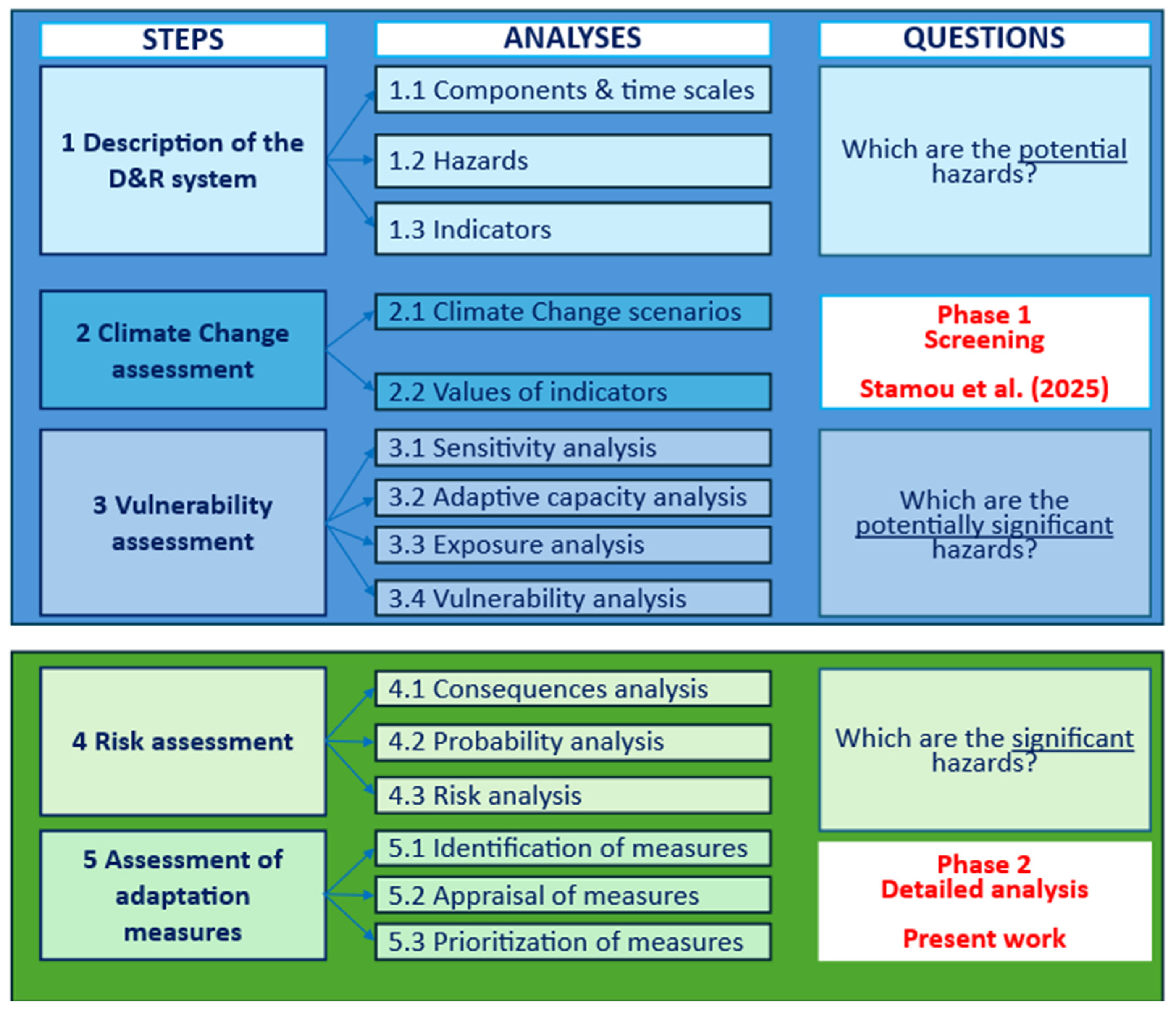
Figure 2.
Plan view of the Almopeos D&R system: (1) Dam, (2) spillway, (3) collector channel, (4) fall channel, (5) stilling basin, (6) escape channel, (7) water abstraction well, (8) outlet water channel, (9) flushing pipe, (10) flushing sluice gate, (11) administration building, (12) irrigation pipe, (13) access road to administration building, (14) access road to spillway, and (15) Almopeos River axis.
Figure 2.
Plan view of the Almopeos D&R system: (1) Dam, (2) spillway, (3) collector channel, (4) fall channel, (5) stilling basin, (6) escape channel, (7) water abstraction well, (8) outlet water channel, (9) flushing pipe, (10) flushing sluice gate, (11) administration building, (12) irrigation pipe, (13) access road to administration building, (14) access road to spillway, and (15) Almopeos River axis.
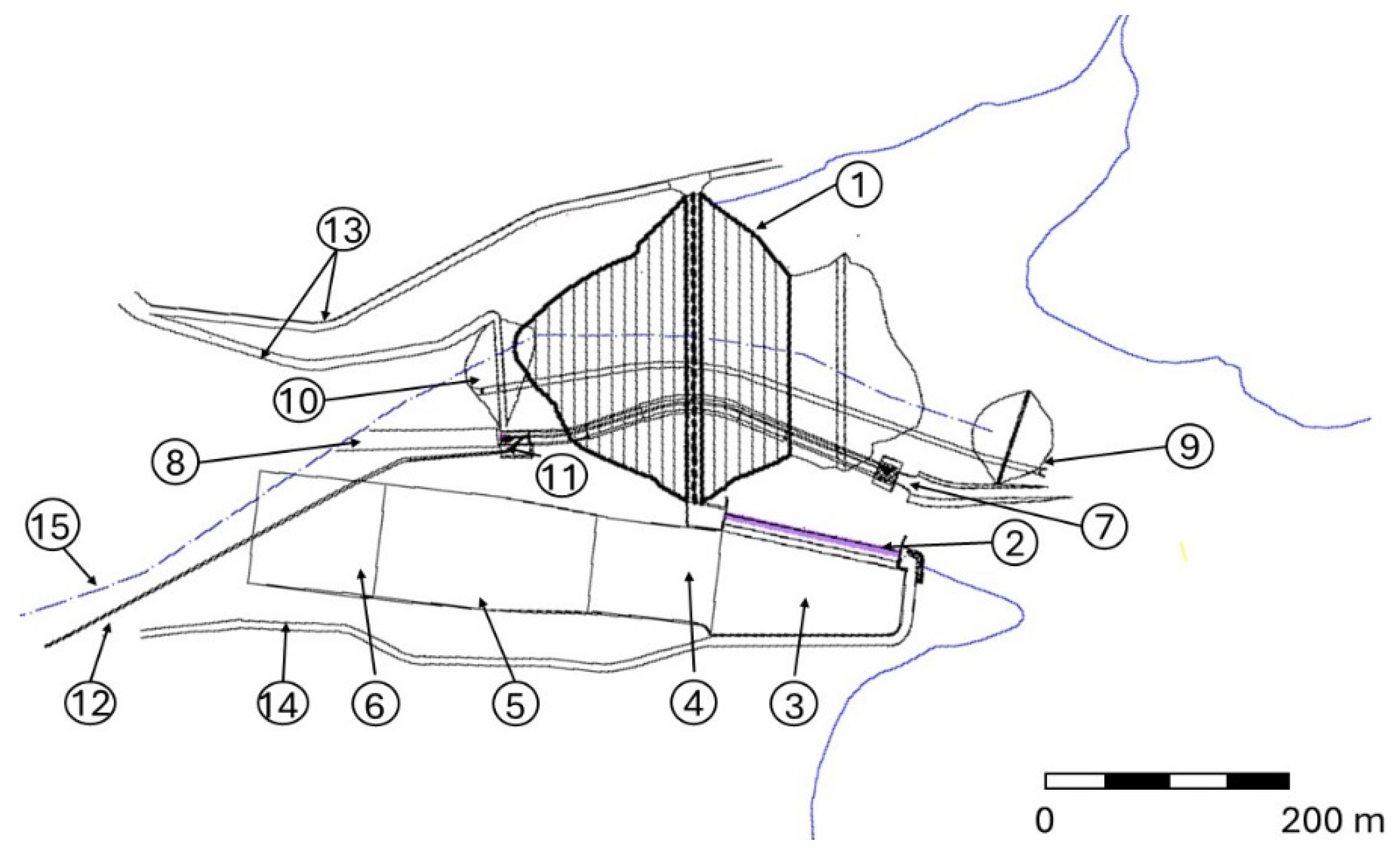

Table 1.
Risk areas considered in the climate risk assessment of D&R systems.
| Risk Area | Description | Indicative consequences |
|---|---|---|
| Asset Damage (CA) | Damage to physical components of the dam and associated infrastructure. | Spillway overtopping, erosion of embankments, malfunction of outlet works. |
| Safety and Health (CH) | Impacts on human life and public safety caused by dam malfunction or failure. | Downstream flooding, emergency evacuations, injuries or fatalities. |
| Environmental Impacts (CE) | Adverse effects on aquatic and terrestrial ecosystems. | Habitat degradation, sediment transport changes, water quality deterioration. |
| Service Disruption & Social Impacts (CS) | Interruption of water services affecting communities or users. | Irrigation supply interruption, restrictions on water use. |
| Financial and reputational impacts (CF & CR). | Economic consequences related to infrastructure damage or service disruption. | Repair costs, loss of hydropower production, irrigation supply interruption. |
Table 2.
Impacts of mean air temperature increase and extreme heat, relevant impacts chains and affected risk areas.
Table 2.
Impacts of mean air temperature increase and extreme heat, relevant impacts chains and affected risk areas.
| Symbol | Climate indicator | Impact | Impact chain (simplified) | CA | CH | CE | CS | CF&CR |
|---|---|---|---|---|---|---|---|---|
| TIM1 | TXm, HD | Obscuring of monitoring sites due to algae growth | Increased water temperature → T-P1 increased algae growth → obstruction of monitoring sites → increased maintenance | X | X | |||
| TIM1 | TXm, TR | Degradation of water quality due to increased water temperature | Increase in air temperature → T-I increase in river and reservoir water temperature → T-P1 increased biological activity and degraded water quality → reduced suitability of water for irrigation (T-O1) → environmental impacts (CE) and increased monitoring or treatment costs (CA, CF & CR) | X | X | X | ||
| TIM2 | TXm, HD | Reduction of reservoir storage due to increased evaporation | Higher temperature and heat waves → T-P2 increased evaporation from the reservoir surface → reduction of effective reservoir storage → reduced water availability for irrigation (T-O1) → service disruption (CS) and economic losses (CF & CR) | X | X | X | ||
| TIM3 | TXm, TX35 | Increased irrigation water demand during heat waves | Increased temperature and evapotranspiration → T-O1 increased irrigation water demand → higher withdrawals from the reservoir → reduced reliability of irrigation supply (CS) → financial losses in agriculture (CF & CR) | X | X | |||
| TIM4 | TXm, TX35, TR | Desiccation and cracking of embankment materials | Prolonged heat and drought conditions → T-A1 desiccation and shrinkage of clayey materials in the embankment → formation of cracks and increased seepage susceptibility → increased inspection and maintenance requirements (CA) and higher repair costs (CF & CR) | X | X | |||
| TIM5 | TXm, HD | Thermal deterioration of spillway and auxiliary structures | High temperature and solar radiation → T-A2 thermal expansion and cracking of spillway concrete structures and T-A3 deformation of metallic auxiliary components → reduced structural reliability → increased maintenance and repair needs (CA, CF & CR) | X | X | |||
| TIM6 | HD, TX35, TR | More difficult working conditions for personnel | Heat waves and tropical nights → T-S4 increased thermal stress for personnel → difficult outdoor working conditions and reduced operational efficiency → occupational health risks (CH) and operational disruptions (CS) | X | X | X |
Table 3.
Impacts of decreased mean precipitation, aridity and droughts, relevant impacts chains and affected risk areas.
Table 3.
Impacts of decreased mean precipitation, aridity and droughts, relevant impacts chains and affected risk areas.
| Symbol | Climate indicator | Impact | Impact chain | CA | CH | CE | CS | CF&CR |
|---|---|---|---|---|---|---|---|---|
| DIM1 | PRCPTOT | Reduced reservoir storage due to reduced inflows | Reduced precipitation → D-I reduced inflows to the reservoir → D-P1 reduced reservoir volumes and water levels → reduced water supply potential for irrigation (D-O1) → service disruption (CS) and economic losses (CF & CR) | X | X | X | ||
| DIM2 | PRCPTOT, CDD | Degradation of water quality due to low reservoir levels | Reduced inflows and prolonged dry periods → D-P1 reduced reservoir volumes → increased concentration of pollutants and degraded water quality → additional monitoring or treatment required (D-O1) → environmental impacts (CE) and increased operational costs (CA, CF & CR) | X | X | X | ||
| DIM3 | PRCPTOT | Damage to exposed parts of the dam due to low water levels | Prolonged low reservoir levels → D-P1 exposure of upstream dam surfaces → D-A1 erosion or deterioration of exposed materials due to waves, temperature and UV radiation → increased inspection and maintenance requirements (CA) and higher repair costs (CF & CR) | X | X | |||
| DIM4 | CDD | Desiccation and shrinkage of clay core causing seepage and piping | Prolonged drought conditions → D-A1 desiccation and shrinkage of clay core and embankment materials → cracking and increased seepage paths → risk of piping and internal erosion → potential structural instability (CA) and downstream impacts (CH, CE, CS, CF & CR) | X | X | X | X | X |
| DIM5 | PRCPTOT, CDD | Instability or slumping of the upstream dam face | Repeated wetting and drying cycles associated with reservoir level fluctuations → D-A1 instability or slumping of upstream dam face → reduced structural reliability → increased maintenance and repair needs (CA) and higher operational costs (CF & CR) | X | X | |||
| DIM6 | CDD | Increased irrigation demand during drought conditions | Drought and prolonged dry periods → D-O1 increased irrigation water demand → increased withdrawals and reduced reliability of water supply (CS) → economic losses in agriculture (CF & CR) | X | X |
Table 4.
Impacts of extreme precipitation and floods, relevant impacts chains and affected risk areas.
Table 4.
Impacts of extreme precipitation and floods, relevant impacts chains and affected risk areas.
| Symbol | Climate indicator | Impact | Impact chain | CA | CH | CE | CS | CF&CR |
|---|---|---|---|---|---|---|---|---|
| FIM1 | Rx1day | Overflow and flooding risk | Extreme precipitation events → F-I increased inflows to the reservoir → F-P1 rapid increase of reservoir water levels → F-P2 overflow and increased flooding risk → downstream impacts on population and environment (CH, CE, CS) and economic losses (CF & CR) | X | X | X | X | X |
| FIM2 | Rx1day | Overtopping of the dam | Extreme inflow and rapid reservoir filling → F-P1 rapid rise in reservoir water level → F-A1 overtopping of the embankment dam → erosion and possible dam breach → severe downstream impacts (CH, CE, CS, CF & CR) | X | X | X | X | X |
| FIM3 | Rx1day | Seepage and piping due to rapid water level rise | Rapid reservoir level rise during floods → F-P1 rapid water level fluctuations → F-A1 increased pore pressure and seepage within embankment → piping and internal erosion risk → potential dam failure (CA) with downstream impacts (CH, CE, CS, CF & CR) | X | X | X | X | X |
| FIM4 | R20mm, Rx1day | Damage or malfunction of spillway structures | High inflow and discharge velocities → F-P1 increased flow through spillway system → F-A2 structural stress or deterioration of spillway components → reduced discharge capacity → increased maintenance needs (CA, CF & CR) | X | X | |||
| FIM5 | R20mm, Rx1day | Sediment and debris transport | Heavy rainfall and runoff → F-I increased sediment loads and debris transport → F-P1 sediment accumulation and obstruction of hydraulic structures → damage or malfunction of components (CA) and environmental impacts (CE) | X | X | X | ||
| FIM6 | R20mm | Degraded water quality due to sediments and turbidity | Intense rainfall and runoff → F-I increased turbidity and sediment inflow → F-P1 deterioration of water quality → need for additional monitoring or treatment (F-O1) → environmental impacts (CE) and operational costs (CF & CR) | X | X | |||
| FIM7 | R20mm, Rx1day | Damage to auxiliary structures and equipment | Flood flows and debris → F-A3 damage to pipelines, valves, intake structures or monitoring equipment → reduced operational reliability (CA) → repair and maintenance costs (CF & CR) | X | X | |||
| FIM8 | R20mm | Damage to access roads and site accessibility | Heavy rainfall and local flooding → F-S3 erosion or damage to access roads → reduced accessibility for inspection and maintenance (CS) → increased restoration costs (CF & CR) | X | X |
Table 5.
Magnitude of consequence across the five risk areas (based on EC [36]).
Table 5.
Magnitude of consequence across the five risk areas (based on EC [36]).
| Score | Magnitude | Asset damage (CA) | Safety and health (CH) | Environmental impacts (CE) | Service disruption (CS) | Financial impacts (CF & CR) |
|---|---|---|---|---|---|---|
| 1 | Insignificant | <1% damage (negligible) | No population at risk | Negligible impact, localized, immediate recovery |
<5% irrigation deficit (no impact) |
<2% economic loss |
| 2 | Minor | 1–5% damage (minor repair) | <10 people, minor injuries | <1 km affected, recovery <1 month |
5–15% deficit (minor restrictions) |
2–10% economic loss |
| 3 | Moderate | 5–15% damage (moderate repair) |
10–100 people at risk, serious injuries possible | 1–5 km affected, recovery <1 year | 15–30% deficit (moderate impact) | 10–25% economic loss |
| 4 | Major | 15–40% damage (major repair) |
100–1000 people at risk (high risk) | 5–20 km affected, recovery >1 year | 30–60% deficit (severe shortage) | 25–50% economic loss |
| 5 | Catastrophic | >40% damage or structural failure | >1000 people at risk or fatalities | >20 km affected, long-term or irreversible impact | >60% deficit (system failure) | >50% economic loss |
Table 6.
Scale of the likelihood analysis for the climate hazards (based on EC [36]).
Table 6.
Scale of the likelihood analysis for the climate hazards (based on EC [36]).
| Score | Term | Qualitative estimation | Quantitative estimation |
|---|---|---|---|
| 1 | Rare | Hazard is highly unlikely to occur | 5% |
| 2 | Unlikely | Hazard is unlikely to occur | 20% |
| 3 | Moderate | Hazard is as likely to occur as not | 50% |
| 4 | Likely | Hazard is likely to occur | 80% |
| 5 | Almost certain | Hazard is very likely to occur | 95% |
Table 7.
Classification of risk scores.
| Risk score | Risk level |
|---|---|
| 1–4 | Low |
| 5–9 | Moderate |
| 10–15 | High |
| 16–25 | Very High |
Table 8.
Selected impact chains and justification.
| Group of hazards | Selected impact chains | Main justification |
|---|---|---|
| Temperature increase and heat waves | TIM1, TIM2 & TIM3 | Irrigation use, water quality sensitivity, evaporation losses, increased demand |
| Decreased precipitation and drought | DIM1, DIM2 & DIM4 | Reduced inflows, water quality deterioration at low levels, clay-core desiccation |
| Extreme precipitation and floods | FIM1, FIM2, FIM3, FIM4 & FIM5 | Earthfill dam safety, spillway performance, sediment/debris transport, flood loading |
Table 9.
Consequences scores for the selected impact chains and risk areas.
| Group of hazards | Impact chains | CA | CH | CE | CS | CF&CR | Overall |
|---|---|---|---|---|---|---|---|
| Temperature increase and heat waves | TIM1 – Water quality degradation | 2 | 1 | 3 | 2 | 2 | 3 |
| TIM2 – Evaporation losses | 2 | 1 | 2 | 3 | 2 | 3 | |
| TIM3 – Increased irrigation demand | 1 | 1 | 2 | 4 | 4 | 4 | |
| Drought conditions | DIM1 – Reduced reservoir storage | 2 | 1 | 3 | 4 | 4 | 4 |
| DIM2 – Water quality deterioration | 2 | 1 | 3 | 2 | 2 | 3 | |
| DIM4 – Clay core desiccation / seepage | 4 | 2 | 1 | 2 | 2 | 4 | |
| Extreme precipitation and floods | FIM1 – Overflow and flooding | 4 | 4 | 4 | 4 | 3 | 4 |
| FIM2 – Overtopping | 5 | 5 | 4 | 5 | 5 | 5 | |
| FIM3 – Piping / internal erosion | 4 | 4 | 4 | 4 | 4 | 4 | |
| FIM4 – Spillway malfunction | 4 | 3 | 2 | 2 | 2 | 4 | |
| FIM5 – Sediment and debris transport | 2 | 1 | 3 | 2 | 2 | 3 |
Table 10.
Exceedance probabilities (%) and corresponding likelihood levels (scale 1–5) for key climate indicators (TX35, CDD and Rx1day) across scenarios SSP2-4.5 and SSP5-8.5 and future periods.
Table 10.
Exceedance probabilities (%) and corresponding likelihood levels (scale 1–5) for key climate indicators (TX35, CDD and Rx1day) across scenarios SSP2-4.5 and SSP5-8.5 and future periods.
| Threshold | SSP2-4.5 | SSP5-8.5 | ||
|---|---|---|---|---|
| TX35 | 2041-2060 | 2081-2100 | 2041-2060 | 2081-2100 |
| 10 | 5 (91.3%) | 5 (96.3%) | 5 (96.3%) | 5 (100.0%) |
| 15 | 4 (83.8%) | 5 (92.5%) | 5 (92.5%) | 5 (100.0%) |
| 20 | 4 (72.5%) | 5 (90.0%) | 5 (86.3%) | 5 (100.0%) |
| 25 | 4 (68.8%) | 4 (82.5%) | 4 (80.0%) | 5 (100.0%) |
| 30 | 3 (48.8%) | 4 (80.0%) | 4 (76.3%) | 5 (100.0%) |
| 35 | 3 (36.3%) | 4 (66.3%) | 4 (62.5%) | 5 (100.0%) |
| 40 | 3 (23.8%) | 3 (56.3%) | 3 (47.5%) | 5 (98.8%) |
| CDD | 2041-2060 | 2081-2100 | 2041-2060 | 2081-2100 |
| 30 | 3 (56.3%) | 3 (56.3%) | 4 (63.8%) | 4 (78.8%) |
| 50 | 2 (11.3%) | 2 (15.0%) | 2 (15.0%) | 3 (26.3%) |
| 70 | 1 (3.8%) | 1 (3.8%) | 1 (2.5%) | 2 (8.8%) |
| 90 | 1 (0.0%) | 1 (1.3%) | 1 (0.0%) | 1 (2.5%) |
| 110 | 1 (0.0%) | 1 (0.0%) | 1 (0.0%) | 1 (1.3%) |
| 130 | 1 (0.0%) | 1 (0.0%) | 1 (0.0%) | 1 (1.3%) |
| RX1d | 2041-2060 | 2081-2100 | 2041-2060 | 2081-2100 |
| 30 | 3 (28.8%) | 3 (23.8%) | 3 (33.8%) | 3 (32.5%) |
| 50 | 1 (0.0%) | 1 (3.8%) | 1 (1.3%) | 1 (2.5%) |
| 70 | 1 (0.0%) | 1 (0.0%) | 1 (0.0%) | 1 (0.0%) |
| 100 | 1 (0.0%) | 1 (0.0%) | 1 (0.0%) | 1 (0.0%) |
| 130 | 1 (0.0%) | 1 (0.0%) | 1 (0.0%) | 1 (0.0%) |
Table 11.
Likelihood probability and scores for the selected impact chains and risk areas.
| Group of hazards | Indicator | Impact chain | SSP2-4.5 | SSP5-8.5 | ||
|---|---|---|---|---|---|---|
| 2041-2060 | 2081-2100 | 2041-2060 | 2081-2100 | |||
| Temperature increase and heat waves | TX35 | TIM1 – Water quality degradation | 4 (72.5%) | 5 (90.0%) | 5 (86.3%) | 5 (100.0%) |
| TIM2 – Evaporation losses | ||||||
| TIM3 – Increased irrigation demand | ||||||
| Decreased precipitation and drought | CDD | DIM1 – Reduced reservoir storage | 2 (6.3%) | 2 (8.8%) | 2 (7.5%) | 2 (17.5%) |
| DIM2 – Water quality deterioration | ||||||
| DIM4 – Clay core desiccation / seepage | ||||||
| Extreme precipitation and floods | Rx1day | FIM1 – Overflow and flooding | 1 (0.0%) | 1 (3.8%) | 1 (1.3%) | 1 (2.5%) |
| FIM2 – Overtopping | ||||||
| FIM3 – Piping / internal erosion | ||||||
| FIM4 – Spillway malfunction | ||||||
| FIM5 – Sediment and debris transport | ||||||
Table 12.
Risk scores for the three groups of hazards and the related impact chains.
| Group of hazards | Impact chains | Consequences score |
Likelihood score |
Risk score |
Risk level |
|---|---|---|---|---|---|
| Temperature increase and heat waves | TIM1 – Water quality degradation | 3 | 5 | 15 | High |
| TIM2 – Evaporation losses | 3 | 5 | 15 | High | |
| TIM3 – Increased irrigation demand | 4 | 5 | 20 | Very High | |
| Decreased precipitation and drought | DIM1 – Reduced reservoir storage | 4 | 2 | 8 | Moderate |
| DIM2 – Water quality deterioration | 3 | 2 | 6 | Moderate | |
| DIM4 – Clay core desiccation / seepage | 4 | 2 | 8 | Moderate | |
| Extreme precipitation and floods | FIM1 – Overflow and flooding | 4 | 1 | 4 | Low |
| FIM2 – Overtopping | 5 | 1 | 5 | Moderate | |
| FIM3 – Piping / internal erosion | 4 | 1 | 4 | Low | |
| FIM4 – Spillway malfunction | 4 | 1 | 4 | Low | |
| FIM5 – Sediment and debris transport | 3 | 1 | 3 | Low |
Table 13.
Evaluation and prioritization of adaptation measures for the Almopeos.
| Adaptation measure | KTM (Category) |
Impact chains |
Risk level |
Effectiveness | Feasibility | Cost | Priority |
|---|---|---|---|---|---|---|---|
| Adaptive reservoir operation rules | KTM-M (Management) | TIM2, TIM3 & DIM1 |
High-Very High | High | High | Low | High |
| Improved irrigation efficiency | KTM-M (Management) |
TIM2, TIM3 & DIM1 |
High-Very High | High | Moderate | Moderate | High |
| Enhanced seepage monitoring and Instrumentation | KTM-I (Monitoring) |
DIM4 | Moderate | High | High | Low | High |
| Maintenance and upgrading of spillway (e.g. fusegates) | KTM-G (Structural) |
FIM1–FIM4 | Low-Moderate | High | High | Moderate | High |
| Flood forecasting and early warning system | KTM-I (Monitoring) |
FIM1–FIM3 | Low–Moderate | Moderate–High | Moderate | Moderate | Medium |
| Sediment management and catchment interventions | KTM-N (NbS) |
DIM2 & FIM5 | Low– Moderate |
Moderate | Moderate | Moderate | Medium |
| Water quality monitoring | KTM-I (Monitoring) |
TIM1, DIM2 & FIM5 | Low–High | Moderate | High | Low | Medium |
Disclaimer/Publisher’s Note: The statements, opinions and data contained in all publications are solely those of the individual author(s) and contributor(s) and not of MDPI and/or the editor(s). MDPI and/or the editor(s) disclaim responsibility for any injury to people or property resulting from any ideas, methods, instructions or products referred to in the content. |
© 2026 by the authors. Licensee MDPI, Basel, Switzerland. This article is an open access article distributed under the terms and conditions of the Creative Commons Attribution (CC BY) license.
Copyright: This open access article is published under a Creative Commons CC BY 4.0 license, which permit the free download, distribution, and reuse, provided that the author and preprint are cited in any reuse.


