

Submitted:
02 April 2026
Posted:
03 April 2026
You are already at the latest version
Abstract
Background: Lipoprotein(a) [Lp(a)] is increasingly recognized as an independent and genetically determined cardiovascular risk factor. However, its clinical role in patients with established coronary artery disease (CAD), particularly in relation to premature disease onset, remains incompletely defined. This study aimed to evaluate the association between Lp(a) levels and early-onset CAD, as well as the relative contribution of Lp(a) compared with traditional cardiovascular risk factors. Methods: We conducted a retrospective observational study including 225 patients with established CAD admitted to a tertiary care center in 2023. Lp(a) levels were measured at admission. Patients were stratified according to revascularization strategy and age at first cardiovascular event (<50 vs. ≥50 years). Logistic regression and receiver operating characteristic (ROC) curve analyses were performed to assess associations and determine predictive performance. Results: Thirty-eight patients (17%) experienced early-onset CAD. Patients with early events showed significantly higher Lp(a) levels compared with those with later events (median 42 [19–75] vs. 21 [10–66] mg/dL; p = 0.020), despite lower LDL and non-HDL cholesterol levels. In multivariate analysis, both Lp(a) (OR 2.835, 95% CI 1.226–6.556, p = 0.015) and smoking (OR 2.516, 95% CI 1.116–5.673, p = 0.026) were independently associated with early-onset CAD. Lp(a) showed modest discriminative ability (AUC 0.619), with a cut-off value of 23 mg/dL providing 74% sensitivity and 52% specificity, and a high negative predictive value (91%). Lp(a) levels did not differ across revascularization subgroups. Conclusions: Elevated Lp(a) levels are independently associated with premature CAD, even in patients with lower traditional lipid risk factors and intensive lipid-lowering therapy. Routine Lp(a) assessment may improve cardiovascular risk stratification, particularly in younger patients.
Keywords:
lipoprotein (a)
; cardiovascular risk
; coronary artery disease
1. Introduction
Lipoprotein(a), or Lp(a), is a particle composed of a lipid component and a protein component, apolipoprotein(a), which is covalently bound via a disulfide bridge to apolipoprotein B100, the main structural protein of low-density lipoproteins (LDL) [1]. Apolipoprotein(a) contains a series of structural domains known as kringles, which are essential for the biological functions of Lp(a); in particular, variability in molecular size is determined by the number of Kringle IV repeat domains. Unlike LDL, plasma Lp(a) levels are regulated almost exclusively by genetic factors, specifically through the autosomal codominant inheritance of the LPA gene [2].
Plasma Lp(a) levels are minimally influenced by diet, physical activity, or other environmental factors. They also tend to be higher in women, particularly during pregnancy and menopause, and in individuals of African ancestry [3,4]. Lp(a) is currently recognized as an independent genetic risk factor for several cardiovascular diseases, including coronary artery disease, ischemic stroke, peripheral arterial disease, heart failure, and valvular heart disease (aortic and mitral stenosis), owing to its pro-atherogenic and pro-inflammatory properties [5]. Moreover, its structural homology with plasminogen, a key enzyme in fibrinolysis, suggests a potential role in thrombotic events, although this association has not yet been fully elucidated [6].
While there is now broad scientific consensus regarding the role of Lp(a) in cardiovascular risk assessment, particularly among younger patients with a family history and a personal history of premature and recurrent cardiovascular events [7], uncertainty remains regarding the clinically relevant threshold values [8] and, consequently, the most appropriate, albeit indirect, therapeutic approach. To date, no targeted therapies are available; current management relies on conventional lipid-lowering agents, which unfortunately have limited impact on Lp(a) levels, and on invasive strategies such as lipoprotein apheresis. Expectations for improved efficacy are therefore focused on next-generation therapies, including antisense oligonucleotides (ASOs), most notably pelacarsen [9,10], small interfering RNA (siRNA) molecules such as olpasiran [11,12], and the recent addition of muvalaplin [13], the first orally administered agent targeting Lp(a).
The aim of our observational study is to evaluate the association between elevated Lp(a) levels and the incidence of cardiovascular events, particularly in younger patients, in terms of the premature onset of coronary artery disease, as well as its extent and risk of recurrence, while also assessing the relative contribution of Lp(a) compared with traditional cardiovascular risk factors.
2. Materials and Methods
2.1. Study Population
The study was conducted at the Inpatient Cardiology Unit and Coronary Care Unit (ICCU) of the Azienda Ospedaliero Universitaria delle Marche. Clinical data were retrospectively collected from 225 patients with established coronary artery disease, either with a previous history or of new onset, who were admitted to the department during the year 2023.
Measurement of Lp(a) levels was performed at the hospital’s central laboratory at the time of admission as part of routine laboratory testing and was reported as a concentration expressed in mg/dL.
Patients were classified into three groups based on the type of revascularization and in two subgroups based on the age at the onset of CAD (early CAD vs late CAD) defining “early event” as an event occurring before the age of 50 years, and “late event” when occurring after the age of 50 years.
In the subgroup classification based on the revascularization type we identified: patients with first percutaneous coronary intervention on a naïve vessel (first PCI) during the index hospitalization for either acute coronary syndrome (ACS) or chronic coronary syndrome (CCS); patients who underwent coronary artery bypass grafting (CABG) during the index hospitalization; patients with an in-stent restenosis (ISR) with significant progression of disease involving previously implanted coronary devices.
Then, patient’s demographics characteristics, cardiovascular risk factors, medical therapies and clinical profile were collected.
Patients who underwent Lp(a) measurement at hospital admission but had no history of coronary artery disease and were admitted for other diagnostic or therapeutic indications were excluded from the analysis.
2.2. Statistical Analysis
Continuous variables are presented as mean ± standard deviation when normally distributed, or as median and interquartile range (first to third quartile) when not normally distributed. Categorical variables are expressed as absolute numbers and percentages. Normally distributed continuous variables were compared using the student’s t test, whereas non-normally distributed variables were compared using the Mann–Whitney U test. Categorical variables were compared using the chi-square test.
Univariate and multivariate analyses were performed using binary logistic regression. Correlation analyses were conducted using Pearson’s or Spearman’s correlation tests, as appropriate. The optimal cut-off value was determined from the coordinates of the receiver operating characteristic (ROC) curve using the Youden index; sensitivity and specificity were calculated accordingly. Lp(a) values were log10-transformed due to skewed distribution. All statistical analyses were performed using SPSS version 21.0 for Windows (SPSS Inc., Chicago, IL, USA). A two-tailed p value ≤ 0.05 was considered statistically significant.
3. Results
A total of 225 consecutive patients with established coronary artery disease were included in the analysis. The median age of the overall population was 65 years (IQR 55–74), and 43% of patients were admitted for an acute coronary syndrome (ACS).
When patients were stratified in the previously mentioned subgroups (first PCI, CABG, and in-stent restenosis), significant differences emerged in terms of age, lipid profile, clinical presentation, and cardiovascular risk burden (Table 1). Patients undergoing CABG were older compared with those undergoing first PCI or presenting with in-stent restenosis (median age 73 vs. 62 and 70 years, respectively; p = 0.010).
Lp(a) levels did not differ significantly among the three groups (median 24 mg/dL in the overall population; p = 0.689). In contrast, lipid parameters showed marked differences: patients in the first PCI group had significantly higher LDL cholesterol and non–HDL cholesterol levels, whereas lower values were observed in the CABG and in-stent restenosis groups (p < 0.001 for both).
ACS was the most frequent presentation in the first PCI group, while it was significantly less common among patients undergoing CABG (p = 0.030). The use of high-intensity statin therapy and ezetimibe was significantly higher in patients with in-stent restenosis (p = 0.002 and p = 0.013, respectively). Hypertension was more prevalent in the in-stent restenosis group (p = 0.014), whereas no significant differences were observed in smoking habits or diabetes prevalence among the three groups.
Subsequently, patients were divided according to age at the first cardiovascular event, defined as occurring before 50 years of age, whether reported in medical history or representing the reason for hospital admission. Thirty-eight patients (17%) experienced an early event, while 187 (83%) had a late event (Table 2).
Patients with early cardiovascular events showed significantly higher Lp(a) levels compared with those with late events (median 42 [19–75] vs. 21 [10–66] mg/dL; p = 0.020), despite having significantly lower LDL cholesterol and non–HDL cholesterol levels (p = 0.012 and p = 0.010, respectively).
High-intensity statin therapy was more frequently prescribed in patients with early events (60% vs. 33%; p = 0.001), and the use of bempedoic acid was observed exclusively in this subgroup (p < 0.001). A trend toward higher use of ezetimibe and PCSK9 inhibitors was also noted in younger patients, although these differences did not reach statistical significance.
Regarding traditional cardiovascular risk factors, patients with early events were more frequently active smokers (76% vs. 58%; p = 0.031), whereas hypertension was significantly more prevalent among patients with late events (p = 0.015), although diabetes had higher prevalence in patients with late events, it did not reach statistical significance (p = 0.058).
In univariate logistic regression (Table 3), higher Lp(a) levels (OR 1.532 95% CI 1.067–2.201, p = 0.021) and smoking (OR 2.379, 95% CI 1.066–5.307, p = 0.034) were associated with early-onset CAD. High-intensity statin therapy was also associated (OR 3.171, 95% CI 1.542–6.520, p = 0.002). Conversely, hypertension showed an inverse association (OR 0.416, 95% CI 0.202–0.852, p = 0.017). Non-HDL and LDL cholesterol showed borderline inverse associations (non-HDL: OR 0.991, 95% CI 0.981–1.000, p = 0.046; LDL: OR 0.990, 95% CI 0.980–1.000, p = 0.047). Triglycerides, SCA, and diabetes were not significantly associated.
In a multivariate model (Table 4) including Lp(a) and smoking, both remained independently associated with early-onset CAD (Lp(a): OR 2.835, 95% CI 1.226–6.556, p = 0.015; smoking: OR 2.516, 95% CI 1.116–5.673, p = 0.026).
High-intensity statin therapy was inversely correlated with LDL (r = -0.322, p < 0.001) and non-HDL cholesterol (r = -0.342, p < 0.001), but not with Lp(a) (r = 0.044, p = 0.510). (Table 5)
The area under the receiver operating characteristic curve (AUC)for Lp(a) (Figure 1) predicting early-onset CAD was 0.619 (95% CI 0.522–0.716, p = 0.021). At the identified cut-off, Lp(a) had a sensitivity of 74%, specificity of 52%, positive predictive value of 24%, and negative predictive value of 91% (Table 6).
4. Discussion
The main finding of our study is the significantly higher Lp(a) concentration observed in patients with early-onset CAD compared with those experiencing events later in life.
In our retrospective cohort of patients with coronary artery disease, elevated Lp(a) levels were independently associated with an earlier onset of coronary events. Notably, this association emerged despite a lower burden of conventional lipid risk factors, supporting the concept that Lp(a) represents a distinct and genetically driven component of residual cardiovascular risk.
Indeed, hypertension and diabetes were more prevalent in patients with late-onset events, reflecting the progressive accumulation of conventional risk factors with aging and supporting the notion that Lp(a) plays a more prominent role in driving coronary disease at younger ages.
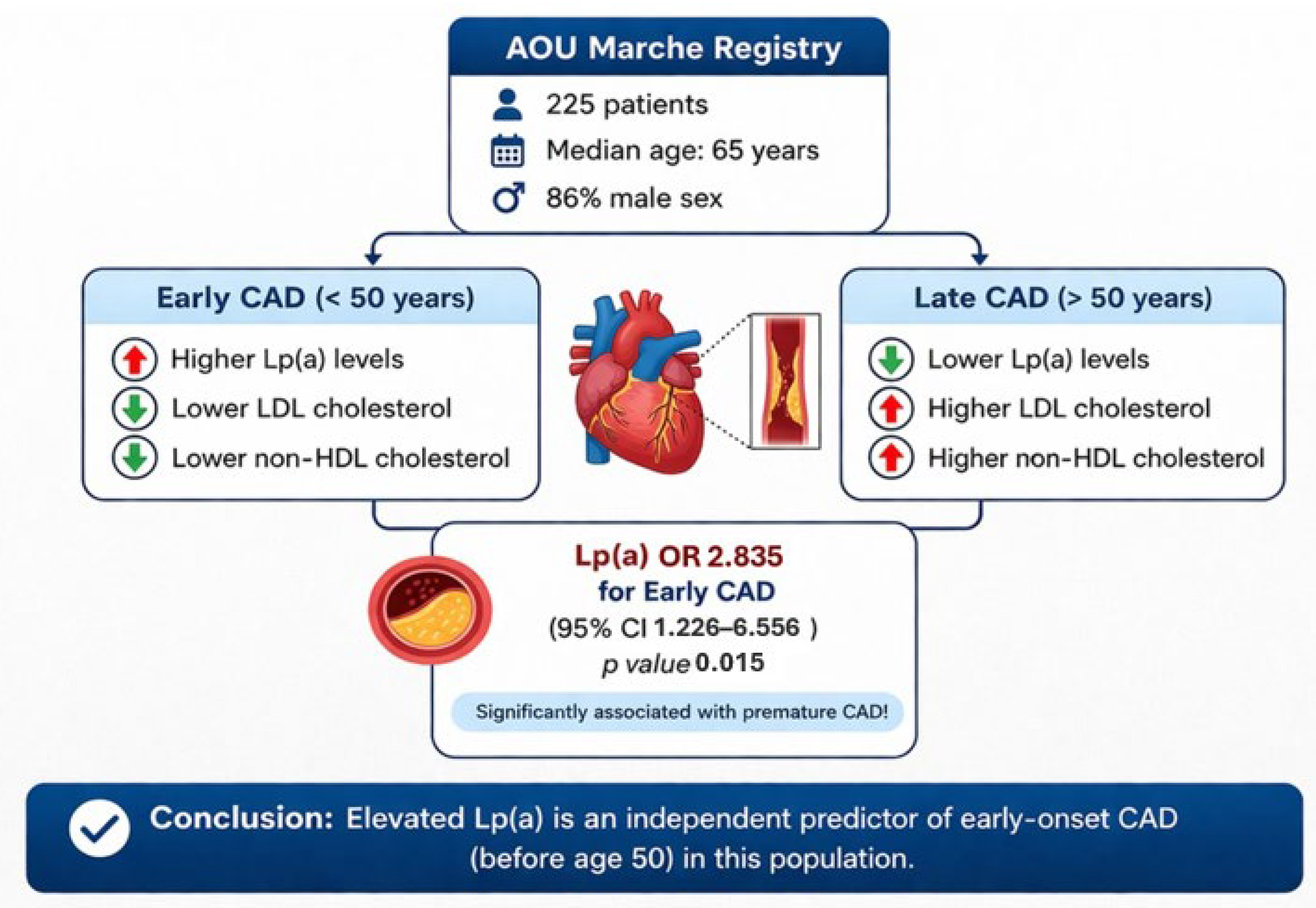
In addition, patients with early events displayed significantly lower LDL and non-HDL cholesterol levels, along with a higher prevalence of high-intensity statin therapy. This implies that younger individuals at higher cardiovascular risk are often optimally treated yet continue to exhibit a higher residual risk of CAD, likely driven by elevated Lp(a) levels. (See central figure).
The higher use of high-intensity statins, ezetimibe, and novel lipid-lowering agents in younger patients likely reflects a more aggressive secondary prevention strategy in subjects perceived as high risk due to early disease manifestation. However, despite intensified therapy, these patients continued to exhibit a higher burden of Lp(a), highlighting a persistent unmet therapeutic need.
This apparent paradox further emphasizes the dissociation between Lp(a) and conventional lipid fractions, confirming that optimal LDL control does not mitigate the risk conferred by elevated Lp(a). Moreover, the lack of correlation between high-intensity statin therapy and Lp(a) levels that we found in our analysis is consistent with previous studies and reinforces the concept that standard lipid-lowering therapies do not adequately address Lp(a) levels [14,15].
Nevertheless, smoking emerged as the only traditional risk factor independently associated with early-onset CAD alongside Lp(a). But still, higher Lp(a) levels remained independently associated with early CAD even after adjustment for smoking, reinforcing its role as a non-modifiable but clinically relevant risk marker. This relationship of smoking and Lp(a) as risk factors for early onset of CAD is interesting: as has already been suggested, tobacco smoking alters lipid composition by lowering HDL cholesterol and is associated with lower levels of apolipoproteins [16,17,18]. This suggests that this two agents may have a synergistic effect on cardiovascular risk, that should be further investigated with dedicated studies.
In contrast to age-based stratification, Lp(a) levels did not differ significantly across revascularization subgroups (first PCI, CABG, and in-stent restenosis). This suggests that Lp(a) may be more closely linked to the timing of disease onset rather than to disease extent in patients with CAD.
From a diagnostic perspective, Lp(a) demonstrated modest discriminatory ability for early-onset CAD, with an AUC of 0.619. While this performance is insufficient for use as a standalone predictive marker, the high negative predictive value observed at the identified cut-off suggests that low Lp(a) levels may help exclude a genetically driven predisposition to premature CAD in selected patients. These findings support current guideline recommendations advocating at least one lifetime measurement of Lp(a) [19], particularly in younger individuals with premature coronary disease or a family history of cardiovascular events, and is consistent with other similar findings in literature [20,21].
The clinical relevance of identifying elevated Lp(a) is expected to increase substantially with the advent of Lp(a)-targeted therapies, including antisense oligonucleotides and siRNA-based agents. Our findings reinforce the importance of early identification of patients with elevated Lp(a), who may derive the greatest benefit from these novel treatments once outcome data become available. In this context, Lp(a) measurement should be considered an integral component of cardiovascular risk stratification, especially in patients presenting with premature coronary events despite adequate control of traditional risk factors.
5. Conclusions
In a real-world cohort of patients with established coronary artery disease, elevated Lp(a) levels were independently associated with premature onset of coronary events, particularly in individuals under 50 years of age. This association persisted despite lower LDL and non–HDL cholesterol levels and more intensive lipid-lowering therapy, underscoring the role of Lp(a) as a genetically determined and largely untreated driver of residual cardiovascular risk. Routine assessment of Lp(a) may improve risk stratification in younger patients with CAD and help identify candidates for emerging Lp(a)-lowering therapies.
6. Limitations
Given the observational, retrospective, single-center design of the study, the results should be interpreted with caution. The retrospective nature limits control over potential confounding factors, while the relatively small sample size and the inclusion of patients with established coronary artery disease may affect the generalizability of the findings.
Central Figure.
Association between Lipoprotein(a) and early-onset coronary artery disease (CAD). This visual abstract illustrates the findings from the AOU Marche Registry involving 225 patients regarding the impact of lipid biomarkers on the timing of CAD onset. Patients with early-onset CAD (occurring before age 50) exhibited significantly higher levels of Lp(a) despite presenting with lower LDL and non-HDL cholesterol concentrations compared to the late-onset group (onset after age 50). Statistical analysis identifies elevated Lp(a) as a robust independent predictor for premature CAD, with an OR of 2.835 (95% CI 1.226–6.556; p = 0.0015), concluding that elevated Lp(a) levels are a primary driver of early cardiovascular disease in this population regardless of traditional lipid metrics.
Central Figure.
Association between Lipoprotein(a) and early-onset coronary artery disease (CAD). This visual abstract illustrates the findings from the AOU Marche Registry involving 225 patients regarding the impact of lipid biomarkers on the timing of CAD onset. Patients with early-onset CAD (occurring before age 50) exhibited significantly higher levels of Lp(a) despite presenting with lower LDL and non-HDL cholesterol concentrations compared to the late-onset group (onset after age 50). Statistical analysis identifies elevated Lp(a) as a robust independent predictor for premature CAD, with an OR of 2.835 (95% CI 1.226–6.556; p = 0.0015), concluding that elevated Lp(a) levels are a primary driver of early cardiovascular disease in this population regardless of traditional lipid metrics.
Author Contributions
Conceptualization, E.P.; methodology, E.P., F.C.; formal analysis, F.C.; investigation, M.T., L.P., C.C., E.S., writing—original draft preparation, M.T., F.C.; writing—review and editing, E.P., M.M.; supervision, M.M. All authors have read and agreed to the published version of the manuscript.
Funding
The APC was funded by Novartis S.p.a.
Institutional Review Board Statement
Ethical review and approval were waived for this study due to its retrospective design and the use of fully anonymized data, in accordance with institutional policies.
Informed Consent Statement
Informed consent was obtained from all subjects involved in the study.
Data Availability Statement
No new data were created.
Conflicts: of Interest The authors declare no conflicts of interest.
Abbreviations
The following abbreviations are used in this manuscript:
| ACS — Acute Coronary Syndrome |
| ASO — Antisense Oligonucleotide |
| AUC — Area Under the Curve |
| CABG — Coronary Artery Bypass Grafting |
| CAD — Coronary Artery Disease |
| CCS — Chronic Coronary Syndrome |
| CI — Confidence Interval |
| CVD — Cardiovascular Disease |
| HDL — High-Density Lipoprotein |
| IQR — Interquartile Range |
| ISR — In-Stent Restenosis |
| LDL — Low-Density Lipoprotein |
| Lp(a) — Lipoprotein(a) |
| NPV — Negative Predictive Value |
| OR — Odds Ratio |
| PCI — Percutaneous Coronary Intervention |
| PCSK9 — Proprotein Convertase Subtilisin/Kexin Type 9 |
| PPV — Positive Predictive Value |
| ROC — Receiver Operating Characteristic |
| siRNA — Small Interfering Ribonucleic Acid |
| SPSS — Statistical Package for the Social Sciences |
References
- Schmidt, K.; Noureen, A.; Kronenberg, F.; Utermann, G. Structure, function, and genetics of lipoprotein (a). J Lipid Res 2016, 57, 1339–1359. [Google Scholar] [CrossRef]
- Mack, S.; et al. A genome-wide association meta-analysis on lipoprotein (a) concentrations adjusted for apolipoprotein (a) isoforms. J Lipid Res 2017, 58, 1834–1844. [Google Scholar] [CrossRef] [PubMed]
- Patel, A. P.; et al. Lp(a) (Lipoprotein[a]) Concentrations and Incident Atherosclerotic Cardiovascular Disease: New Insights From a Large National Biobank. Arterioscler Thromb Vasc Biol 2021, 41, 465–474. [Google Scholar] [CrossRef] [PubMed]
- Tsimikas, S.; Marcovina, S. M. Ancestry, Lipoprotein(a), and Cardiovascular Risk Thresholds: JACC Review Topic of the Week. J Am Coll Cardiol 2022, 80, 934–946. [Google Scholar] [CrossRef] [PubMed]
- Dzobo, K. E.; Kraaijenhof, J. M.; Stroes, E. S. G.; Nurmohamed, N. S.; Kroon, J. Lipoprotein(a): An underestimated inflammatory mastermind. Atherosclerosis 2022, 349, 101–109. [Google Scholar] [CrossRef]
- Greco, A.; et al. Lipoprotein(a) as a Pharmacological Target: Premises, Promises, and Prospects. Circulation 2025, 151, 400–415. [Google Scholar] [CrossRef]
- Wong, N. D.; et al. Lipoprotein(a) and Long-Term Cardiovascular Risk in a Multi-Ethnic Pooled Prospective Cohort. J Am Coll Cardiol 2024, 83, 1511–1525. [Google Scholar] [CrossRef]
- Madsen, C. M.; Kamstrup, P. R.; Langsted, A.; Varbo, A.; Nordestgaard, B. G. Lipoprotein(a)-Lowering by 50 mg/dL (105 nmol/L) May Be Needed to Reduce Cardiovascular Disease 20% in Secondary Prevention: A Population-Based Study. ATVB 2020, 40, 255–266. [Google Scholar] [CrossRef]
- Viney, N. J.; et al. Antisense oligonucleotides targeting apolipoprotein(a) in people with raised lipoprotein(a): two randomised, double-blind, placebo-controlled, dose-ranging trials. Lancet 2016, 388, 2239–2253. [Google Scholar] [CrossRef]
- Cho, L.; et al. Design and Rationale of Lp(a)HORIZON Trial: Assessing the Effect of Lipoprotein(a) Lowering With Pelacarsen on Major Cardiovascular Events in Patients With CVD and Elevated Lp(a). Am Heart J 2025, 287, 1–9. [Google Scholar] [CrossRef]
- O’Donoghue, M. L.; et al. The Off-Treatment Effects of Olpasiran on Lipoprotein(a) Lowering: OCEAN(a)-DOSE Extension Period Results. J Am Coll Cardiol 2024, 84, 790–797. [Google Scholar] [CrossRef]
- O’Donoghue, M. L.; et al. Small Interfering RNA to Reduce Lipoprotein(a) in Cardiovascular Disease. N Engl J Med 2022, 387, 1855–1864. [Google Scholar] [CrossRef]
- Nicholls, S. J.; et al. Oral Muvalaplin for Lowering of Lipoprotein(a): A Randomized Clinical Trial. JAMA 2025, 333, 222–231. [Google Scholar] [CrossRef]
- de Boer, L. M.; et al. Statin therapy and lipoprotein(a) levels: a systematic review and meta-analysis. Eur. J. Prev. Cardiol. 2022, 29, 779–792. [Google Scholar] [CrossRef]
- Khera, A. V.; et al. Lipoprotein(a) concentrations, rosuvastatin therapy, and residual vascular risk: an analysis from the JUPITER Trial (Justification for the Use of Statins in Prevention: an Intervention Trial Evaluating Rosuvastatin). Circulation 2014, 129, 635–642. [Google Scholar] [CrossRef] [PubMed]
- Serrano, M.; De Irala, J.; Palacios, M. Lipoprotein(a), tobacco use, and risk of coronary heart disease. International Journal of Cardiology 2000, 74, 233–234. [Google Scholar] [CrossRef] [PubMed]
- Gossett, L. K.; et al. Smoking Intensity and Lipoprotein Abnormalities in Active Smokers. J Clin Lipidol 2009, 3, 372–378. [Google Scholar] [CrossRef]
- Kauss, A. R.; et al. Smoking and apolipoprotein levels: A meta-analysis of published data. Toxicol Rep 2022, 9, 1150–1171. [Google Scholar] [CrossRef]
- Vrints, C.; et al. 2024 ESC Guidelines for the management of chronic coronary syndromes. European Heart Journal 2024, 45, 3415–3537. [Google Scholar] [CrossRef] [PubMed]
- Tian, X.; et al. Association between lipoprotein(a) and premature atherosclerotic cardiovascular disease: a systematic review and meta-analysis. Eur Heart J Open 2024, 4, oeae031. [Google Scholar] [CrossRef]
- Cesaro, A.; et al. Role of LipoprotEin(a) in CardiovascuLar diseases and premature acute coronary syndromes (RELACS study): Impact of Lipoprotein(a) levels on the premature coronary event and the severity of coronary artery disease. Nutr Metab Cardiovasc Dis 2025, 35, 103843. [Google Scholar] [CrossRef] [PubMed]
Figure 1.
ROC curve.
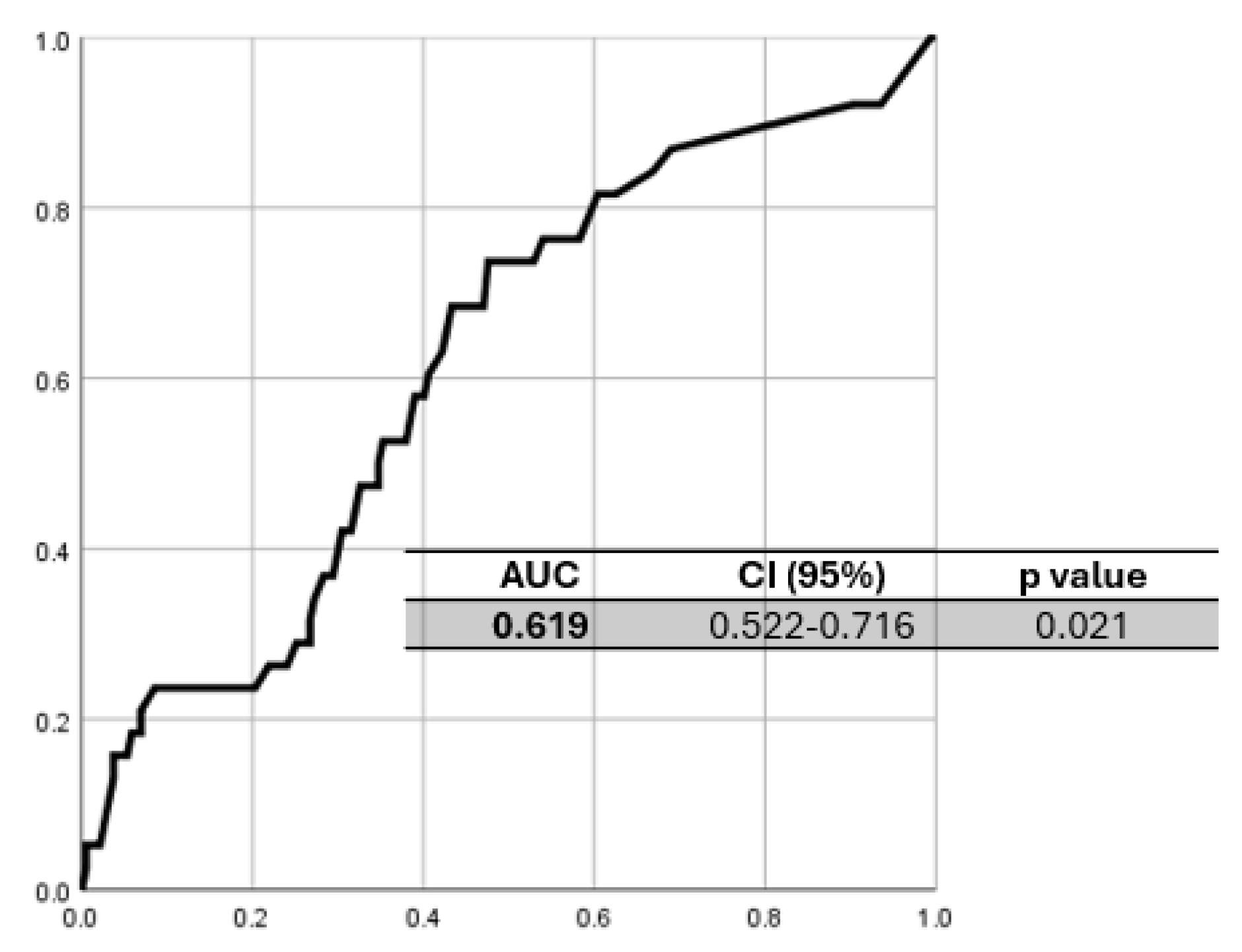

Table 1.
Baseline clinical and biochemical characteristics of the study population.
| Table 1 | Total (n = 225) |
First PCI (n = 181) |
CABG (n = 13) |
In-stent restenosis (n = 31) |
p value |
|---|---|---|---|---|---|
| Age, years | 65 (55–74) | 62 (55–73)* | 73 (69–79) | 70 (63–73)* | 0.010 |
| Lp(a), mg/dL | 24 (10–67) | 21 (10–69) | 43 (19–70) | 29 (10–58) | 0.689 |
| Non–HDL cholesterol, mg/dL | 99 (69–132) | 107 (75–141) *° | 70 (58–108) * | 66 (54–79) ° | <0.001 |
| Triglycerides, mg/dL | 109 (87–144) | 110 (90–148) | 108 (71–148) | 99 (72–149) | 0.369 |
| LDL cholesterol, mg/dL | 71 (49–106) | 82 (55–108) * | 54 (39–76) | 50 (34–76) * | <0.001 |
| ACS at admission, n (%) | 96 (43) | 82 (45) * | 1 (8) *° | 13 (42) ° | 0.030 |
| High-intensity statin therapy, n (%) | 82 (37) | 57 (32) * | 6 (50) | 19 (66) * | 0.002 |
| Ezetimibe therapy, n (%) | 83 (38) | 59 (33) * | 6 (50) | 18 (60) * | 0.013 |
| PCSK9 inhibitors, n (%) | 4 (2) | 3 (2) | 0 (0) | 1 (3) | 0.731 |
| Bempedoic acid, n (%) | 3 (1) | 3 (2) | 0 (0) | 0 (0) | 0.697 |
| Inclisiran, n (%) | 1 (0) | 0 (0) * | 0 (0) ° | 1 (3) *° | 0.043 |
| Smoking history, n (%) | 136 (61) | 108 (60) | 8 (67) | 20 (65) | 0.799 |
| Hypertension, n (%) | 161 (72) | 123 (68) * | 9 (70) ° | 29 (94) *° | 0.014 |
| Diabetes mellitus, n (%) | 57 (25) | 40 (22) | 4 (31) | 13 (42) | 0.057 |
| ACS: acute coronary syndrome; HDL:high density lipoprotein; LDL: low density lipoprotein; PCSK9: Proprotein Convertase Subtilisin/Kexin type 9 | |||||
Table 2.
Clinical and biochemical characteristics according to age at first cardiovascular event.
| Table 2 | <50 years (n = 38) | ≥50 years (n = 187) | p value |
|---|---|---|---|
| Lp(a), mg/dL | 42 (19–75) | 21 (10–66) | 0.020 |
| Non–HDL cholesterol, mg/dL | 84 (60–115) | 106 (74–136) | 0.010 |
| Triglycerides, mg/dL | 108 (83–152) | 111 (88–143) | 0.578 |
| LDL cholesterol, mg/dL | 61 (41–82) | 78 (53–107) | 0.012 |
| ACS at presentation, n (%) | 15 (40) | 81 (43) | 0.662 |
| High-intensity statin therapy, n (%) | 23 (60) | 59 (33) | 0.001 |
| Ezetimibe therapy, n (%) | 19 (50) | 64 (35) | 0.086 |
| PCSK9 inhibitors, n (%) | 2 (5) | 2 (1) | 0.081 |
| Bempedoic acid, n (%) | 3 (8) | 0 (0) | <0.001 |
| Inclisiran, n (%) | 0 (0) | 1 (1) | 0.651 |
| Smoking history, n (%) | 29 (76) | 107 (58) | 0.031 |
| Hypertension, n (%) | 21 (55) | 140 (75) | 0.015 |
| Diabetes mellitus, n (%) | 5 (13) | 52 (29) | 0.058 |
| ACS: acute coronary syndrome; HDL:high density lipoprotein; LDL: low density lipoprotein; PCSK9: Proprotein Convertase Subtilisin/Kexin type 9 | |||
Table 3.
Univariate logistic regression for early CAD.
| Table 3 | |||
|---|---|---|---|
| Variable | OR | 95% CI | p value |
| Lp(a), mg/dl | 2.671 | 1.160-6.149 | 0.021 |
| Non-HDL, mg/dl | 0.991 | 0.981–1.000 | 0.046 |
| TG, mg/dl | 0.999 | 0.994–1.004 | 0.688 |
| LDL, mg/dl | 0.990 | 0.980–1.000 | 0.047 |
| ACS, % | 0.853 | 0.419–1.739 | 0.663 |
| High-intensity statin, % | 3.171 | 1.542–6.520 | 0.002 |
| Smoking, % | 2.379 | 1.066–5.307 | 0.034 |
| Hypertension, % | 0.416 | 0.202–0.852 | 0.017 |
| Diabetes, % | 0.393 | 0.146–1.062 | 0.066 |
| ACS: acute coronary syndrome; LDL: low density lipoprotein; TG: triglycerides | |||
Table 4.
Multivariate logistic regression for early CAD.
| Table 4 | |||
|---|---|---|---|
| Variable | OR | 95% CI | p value |
| Lp(a), mg/dl | 2.835 | 1.226–6.556 | 0.015 |
| Smoking, % | 2.516 | 1.116–5.673 | 0.026 |
Table 5.
Correlations between high intensity statin therapy and lipoprotein value.
| Table 5 | Lipoprotein | Coefficient | p value |
|---|---|---|---|
| High intensity statin | LDL | -0.322 | 0.000 |
| Non-HDL | -0.342 | 0.000 | |
| Lp (a) | 0.044 | 0.510 |
Table 6.
Diagnostics performances of Lp (a) cut off of 23 mg/dl.
| Table 6 | |
| Sensibilità | 74% |
| Specificità | 52% |
| PPV | 24% |
| NPV | 91% |
| NPV: negative predictive value; PPV: positive predictive value | |
Disclaimer/Publisher’s Note: The statements, opinions and data contained in all publications are solely those of the individual author(s) and contributor(s) and not of MDPI and/or the editor(s). MDPI and/or the editor(s) disclaim responsibility for any injury to people or property resulting from any ideas, methods, instructions or products referred to in the content. |
© 2026 by the authors. Licensee MDPI, Basel, Switzerland. This article is an open access article distributed under the terms and conditions of the Creative Commons Attribution (CC BY) license.
Copyright: This open access article is published under a Creative Commons CC BY 4.0 license, which permit the free download, distribution, and reuse, provided that the author and preprint are cited in any reuse.


