
Submitted:
18 April 2026
Posted:
21 April 2026
You are already at the latest version
Abstract
Nicotinamide adenine dinucleotide (NAD+/NADH) metabolism holds a central position in both tumor pathogenesis and cellular aging processes. Current therapeutic strategies pursue apparently contradictory objectives: oncology aims to deplete NAD+ in cancer cells, while anti-aging medicine administers NAD+ intravenously to restore levels that decline with age. This work proposes a paradigm shift: the pulsed administration of exogenous reducing equivalents — with NADH (the reduced form of the coenzyme) as the primary but not exclusive vehicle — as an integrated anti-cancer and anti-aging strategy. The rationale is based on intrinsic metabolic selectivity: cancer cells, characterized by mitochondrial dysfunction and dependence on fermentative glycolysis (Warburg effect), are unable to dispose of an acute excess of NADH through the electron transport chain, thereby suffering selectively lethal reductive stress. Healthy cells, endowed with functional mitochondria, can manage the reductive overload by oxidizing excess NADH in the respiratory chain, with respiratory control mechanisms regulating the flux. A protocol of brief, intense pulses (redox press-pulse) followed by recovery phases is proposed, in synergistic combination with glucose restriction (ketogenic diet/fasting) and optimization of intracellular magnesium. This triad — reducing substrate, enzymatic structure, and environment — aims to restore respiratory chain efficiency in healthy cells and selectively destabilize cancer cell metabolism. The convergence between anti-cancer and anti-aging mechanisms mediated by cyclic reductive impulses is also discussed. A speculative appendix explores the implications of quantum biology for understanding the efficiency of mitochondrial electron transfer.
Keywords:
NADH
; reductive stress
; Warburg effect
; redox impulses
; cancer metabolic therapy
; anti-aging
; mitochondrial respiratory chain
; NAD+/NADH
; press-pulse
; autophagy
; quantum biology
; reducing equivalents
1. Introduction
Cancer and aging share deep metabolic roots that converge on mitochondrial metabolism and cellular redox homeostasis. Despite decades of research, these two conditions have been addressed as separate entities, with therapeutic strategies often in mutual contradiction. Metabolic oncology, inspired by the pioneering work of Otto Warburg [1] and recently revisited by Thomas Seyfried [2], identifies mitochondrial dysfunction as the fundamental characteristic of cancer cells. Molecular gerontology, on the other hand, recognizes the decline in mitochondrial function and NAD+ depletion as two central hallmarks of aging [3,4].
This work proposes a unifying theoretical framework based on pulsed manipulation of the NAD+/NADH redox state as a simultaneously anti-cancer and anti-aging strategy. Unlike current practices—which predominantly administer NAD+ (oxidized form) intravenously in anti-aging clinics [5], or aim to deplete NAD+ in cancer cells through NAMPT inhibitors in oncology [6]—the administration of exogenous reducing equivalents, with NADH (reduced form) as the primary vehicle, in brief and intense cyclic pulses is proposed here.
NADH is not the only possible modality for exogenous electronic delivery. As discussed in Section 6.2, other sources of reducing equivalents—including ubiquinol (reduced coenzyme Q10), molecular hydrogen (H₂), and catalytic systems based on metalloporphyrins—represent complementary or alternative routes to achieve the same objective: pulsed perturbation of the intracellular redox state. NADH is proposed as first-line because it is the native substrate of the respiratory chain, has already been used in clinical settings [7,8], and its intravenous administration is technically established.
The rationale rests on three pillars: (i) the intrinsic metabolic selectivity of exogenous reducing equivalents, which exploits the difference in mitochondrial competence between healthy and cancer cells; (ii) the pulse logic (redox press-pulse), derived from Seyfried’s therapeutic strategy [9] and the physiology of radiation fractionation; (iii) the convergence between the mechanisms activated by cyclic reductive impulses (autophagy, mitophagy, inflammation reduction, mitochondrial turnover) and the well-known anti-aging pathways (sirtuins, AMPK, mTOR).
It is important to emphasize that, although some clinics already use NADH infusions—notably the Hyperthermia Centre Hannover in the oncological setting [8] and Birkmayer’s clinical studies for Parkinson’s disease [7], as well as the IntraVita protocol in the United Kingdom for anti-aging—none of these precedents has articulated the metabolic selectivity rationale proposed here, the press-pulse logic applied to redox state, the synergistic combination with glucose restriction, or the unifying anti-cancer/anti-aging framework.
2. The Warburg Effect and Tumor Metabolism: The Central Role of NAD+/NADH
2.1. Glycolytic Dependence of Cancer Cells
In 1924, Otto Warburg observed that cancer cells prefer glycolysis followed by lactic fermentation even in the presence of sufficient oxygen for oxidative phosphorylation—a phenomenon known as aerobic glycolysis or the Warburg effect [1]. This observation, initially interpreted as a simple metabolic adaptation, has been reinterpreted by Seyfried as evidence of a primary mitochondrial dysfunction that forces the cell to depend on fermentation for ATP production [2].
In this context, NAD+ plays a critical and dual role. On one hand, glycolysis requires NAD+ as a cofactor in the reaction catalyzed by glyceraldehyde-3-phosphate dehydrogenase (GAPDH). To maintain glycolytic flux, the cancer cell must constantly regenerate NAD+ from NADH, primarily through the conversion of pyruvate to lactate by lactate dehydrogenase (LDH) [10]. On the other hand, NAD+ serves as a substrate for enzymes critical to tumor survival, including PARP (DNA repair), sirtuins (gene expression regulation), and CD38/CD157 (signaling) [11].
Recent work has revealed a third, previously underappreciated source of ATP in cancer cells: mitochondrial substrate level phosphorylation (mSLP) through the glutaminolysis pathway [12,13]. Cancer cells can produce significant ATP at the succinyl-CoA ligase reaction, using glutamine as fuel via the sequence glutamine → glutamate → alpha-ketoglutarate → succinyl-CoA → succinate + ATP/GTP. Succinate and lactate, as end-products of glutamine and glucose fermentation respectively, together acidify the tumor microenvironment [12]. Importantly, neither oxygen consumption nor lactate production are accurate markers for ATP production through OxPhos or glycolysis in cancer cells [12,13]. The mSLP pathway is critically relevant to the hypothesis presented here because the alpha-ketoglutarate dehydrogenase reaction—upstream of succinyl-CoA ligase—requires NAD+ as an electron acceptor, making it vulnerable to the same NAD+ depletion mechanism that blocks glycolysis.
2.2. The NAD+ Paradox in Oncology vs Anti-Aging
Recent oncological literature has clearly identified NAD metabolism as a therapeutic target, demonstrating that the enzyme NAMPT (nicotinamide phosphoribosyltransferase), rate-limiting for NAD synthesis, is frequently amplified in various cancer types [6,14]. NAMPT inhibitors such as FK866 effectively deplete NAD and suppress tumor proliferation [15].
Simultaneously, anti-aging clinics predominantly administer NAD+ intravenously with the opposite objective: to increase NAD+ levels to support sirtuin function, DNA repair, and energy metabolism [5]. This creates a paradox that has been insufficiently discussed: systemic administration of NAD+ could fuel the glycolytic metabolism of subclinical cancer cells, providing them with the essential cofactor for GAPDH and LDH.
2.3. Exogenous Reducing Equivalents vs NAD+: A Fundamental Distinction
This work proposes that the administration of reducing equivalents—primarily in the form of NADH (reduced form)—produces radically different metabolic effects from the administration of NAD+ (oxidized form). While NAD+ fuels tumor glycolysis by providing the necessary oxidizing cofactor, an acute excess of NADH creates the opposite conditions: it saturates the cellular NADH/NAD+ ratio, reducing the availability of free NAD+ and blocking glycolysis due to the lack of an electron acceptor at GAPDH (Figure 1).
The principle is not limited to NADH alone. Any delivery modality that acutely increases the intracellular load of reducing equivalents—exogenous NADH, ubiquinol, dissolved molecular hydrogen, or catalytic redox systems—could produce analogous effects, provided the perturbation is sufficiently rapid and intense to exceed the compensatory capacity of cancer cells without exceeding that of healthy cells.
3. Redox State and Tumor Microenvironment
3.1. The Oxidative-Inflammatory Environment as a Tumor Substrate
Cancer cells maintain an elevated but controlled level of reactive oxygen species (ROS), which serves as a proliferative signal through the constitutive activation of HIF-1α, NF-κB, and mTOR [16]. Chronic inflammation in the tumor microenvironment generates additional ROS through macrophages, neutrophils, and cancer-associated fibroblasts (CAFs), creating a vicious cycle: inflammation → ROS → mitochondrial damage → greater dependence on glycolysis → lactate production → microenvironment acidification → immunosuppression → further inflammation [17].
In this context, the NAD+/NADH ratio is a critical indicator of intracellular redox state. Cancer cells tend to maintain a high NAD+/NADH ratio through intense LDH activity, which regenerates NAD+ at the expense of NADH [10]. Acute perturbations of this ratio—specifically, a sudden increase in intracellular NADH—destabilize tumor metabolism at multiple levels.
3.2. The Transmembrane Redox Interface
A legitimate objection to the manipulation of extracellular redox state is that the cell membrane could isolate the intracellular compartment. However, redox state is transmitted across the membrane through at least six documented mechanisms:
- (a)
- Transplasma membrane redox systems (ECTO-NOX): membrane proteins that transfer electrons from intracellular NADH to extracellular acceptors; in a reduced external environment, these systems are blocked, causing intracellular NADH accumulation [18].
- (b)
- Cysteine/cystine system (xCT/SLC7A11): the xCT transporter imports cystine (oxidized form), which is internally reduced to cysteine for glutathione synthesis. A reductive extracellular environment alters the cysteine/cystine ratio, modifying the intracellular glutathione pool [19].
- (c)
- Redox-sensitive receptors: EGFR, IGFR, and integrins possess extracellular domains with cysteine residues whose oxidation is required for dimerization and activation. A reductive environment suppresses these proliferative signals [20].
- (d)
- Direct ROS diffusion: hydrogen peroxide (H₂O₂) crosses the cell membrane, including through aquaporins, acting as a transmembrane redox messenger [21].
- (e)
- Lactate/pH gradients: lactate transport through MCT transporters is dependent on the pH gradient; alterations in the extracellular environment modify this gradient and the metabolic shuttle between cancer cells and stroma [22].
- (f)
- Intercellular communication: gap junctions (connexins) allow the direct passage of NADH, NAD+, glutathione, and second messengers between adjacent cells [23].
3.3. Reductive Stress: A Mirror Concept to Oxidative Stress
Reductive stress—defined as an excess of reducing equivalents relative to the system’s capacity to dispose of them—is a real and documented phenomenon, although less studied than oxidative stress [24]. Under conditions of NADH excess, the respiratory chain becomes saturated and electrons “leak” from complexes I and III, reacting directly with molecular oxygen to form superoxide. Paradoxically, a reductive excess generates secondary oxidative stress [25].
However, this paradoxical response is proportional to mitochondrial competence: cells with functional mitochondria manage a moderate and transient NADH excess by increasing flux through the respiratory chain and ATP production, with minimal ROS generation. Cells with dysfunctional mitochondria—such as cancer cells—cannot compensate and suffer both glycolytic blockade (due to NAD+ shortage) and ROS generation from the saturated respiratory chain: a metabolic double hit (Figure 2).
4. Limitations of Conventional Antioxidants
4.1. Lack of Targeting
Classical exogenous antioxidants (vitamin C, vitamin E, beta-carotene) distribute uniformly in body fluids without selectively concentrating at sites of greatest oxidative stress or in the tumor microenvironment [26]. This dilution drastically limits their local efficacy.
4.2. Secondary Pro-Oxidation
An antioxidant that donates its electron itself becomes a radical. Oxidized vitamin C (ascorbyl radical/dehydroascorbic acid), in the presence of free iron—abundant in the tumor microenvironment—enters the Fenton cycle generating hydroxyl radical (OH•), the most devastating reactive species [27]. Oxidized vitamin E (tocopheryl radical) can propagate lipid peroxidation in membranes if not rapidly regenerated [28]. This paradoxical pro-oxidation mechanism at least partially explains the negative results of large clinical trials with antioxidants: the ATBC study showed increased tumors in the beta-carotene group [29], the SELECT study revealed increased prostate cancer risk with vitamin E [30].
4.3. Inadequate Compartmentalization
Critical oxidative damage occurs predominantly in the inner mitochondrial membrane, where the respiratory chain transfers electrons. Vitamin C, being water-soluble, does not penetrate lipid membranes effectively; vitamin E, being lipid-soluble, distributes in membranes but does not selectively concentrate in mitochondria [31]. Targeted mitochondrial antioxidants such as MitoQ and SkQ1, conjugated with lipophilic cations that exploit the mitochondrial membrane potential, represent an advancement but do not solve the stoichiometry problem: they are consumed after donating one electron [32].
4.4. The Advantage of Reducing Equivalents as Electron Vehicles
The administration of reducing equivalents—primarily NADH—overcomes the three limitations of conventional antioxidants: (i) it does not require artificial targeting because selectivity emerges from the difference in mitochondrial competence between healthy and cancer cells; (ii) NADH is the native substrate of the respiratory chain, not an exogenous agent; (iii) it operates at the central metabolic system level (Krebs cycle, respiratory chain) rather than as a peripheral ROS scavenger. Other forms of exogenous electronic delivery—ubiquinol, molecular H₂, catalytic metalloporphyrins—share advantage (i) while differing in site of action and specific mechanism.
5. Hypothesis: Cyclic Reductive Impulses via Exogenous Reducing Equivalents
5.1. Rationale for Intrinsic Metabolic Selectivity
The selectivity of the proposal is based on a fundamental biological asymmetry: the difference in mitochondrial competence between healthy and cancer cells.
In a healthy cell, an acute pulse of exogenous NADH is managed by the respiratory chain: NADH is oxidized to NAD+ at complex I, electrons flow through complexes III and IV to oxygen, generating a proton gradient that powers ATP synthase. However, it is essential to consider the mechanism of respiratory control: when intracellular ATP reaches high levels, the increased ATP/ADP ratio inhibits ATP synthase; the proton gradient accumulates on the inner mitochondrial membrane; the respiratory chain slows due to the inability to discharge the gradient; complex I accepts fewer electrons from NADH [33]. This physiological feedback mechanism prevents the healthy cell from oxidizing NADH indefinitely—a regulated ceiling exists. The NADH excess accumulates transiently but is subsequently cleared as ATP is consumed by cellular functions. The net result is a self-regulated cycle: transient NADH excess → chain slowdown → ATP consumption → chain restart → NADH clearance. During this process, ROS generation is contained by endogenous antioxidant systems (glutathione, thioredoxin, superoxide dismutase, catalase).
In a cancer cell with dysfunctional mitochondria, the same NADH pulse cannot be managed through this regulated mechanism. The respiratory chain is structurally compromised and respiratory control does not function properly. It is important to clarify the primary mechanism of action: intravenously administered NADH, being a charged and relatively large molecule, does not readily cross cell membranes. Its primary effect is therefore extracellular—the elevated concentration of NADH in the plasma and interstitial space creates a thermodynamic saturation that abolishes the gradients required for cancer cells to export their metabolic waste products. Specifically, the monocarboxylate transporters (MCT) that export lactate and protons, and the ECTO-NOX systems that transfer electrons to extracellular acceptors, are blocked when the extracellular environment is already saturated with reducing equivalents. The intracellular consequences follow indirectly: because the cancer cell cannot discharge its endogenously produced NADH toward the blocked extracellular environment, endogenous NADH accumulates, the NADH/NAD+ ratio shifts drastically toward the reduced state, and multiple lethal effects occur simultaneously:
- (a)
- Glycolytic blockade: NAD+ shortage arrests GAPDH, blocking glycolysis—the primary source of ATP for the cancer cell.
- (b)
- Blockade of mitochondrial substrate level phosphorylation (mSLP): the alpha-ketoglutarate dehydrogenase reaction, which converts alpha-ketoglutarate to succinyl-CoA in the glutaminolysis pathway, requires NAD+ as an electron acceptor. The depletion of NAD+ caused by NADH accumulation blocks this reaction, cutting off the substrate supply to succinyl-CoA ligase and halting mSLP-derived ATP production [12,13]. This means that the cancer cell cannot use glutamine as an alternative energy source to bypass the glycolytic blockade.
- (c)
- Metabolic congestion: NADH excess allosterically inhibits key Krebs cycle enzymes (isocitrate dehydrogenase, alpha-ketoglutarate dehydrogenase), halting intermediary metabolism.
- (d)
- Paradoxical ROS generation: excess electrons leak from the saturated and dysfunctional respiratory chain, generating superoxide that the cancer cell—already with antioxidant systems at their limit—cannot neutralize.
- (e)
- Bioenergetic collapse: without ATP from glycolysis, without functional oxidative phosphorylation, and without mSLP from glutaminolysis, the cancer cell undergoes a total energy crisis with consequent plasma membrane depolarization and activation of cell death pathways. The cancer cell is thus subjected to a simultaneous blockade of all three known ATP-generating pathways.
5.1.1. Unifying the Extracellular and Intracellular Reductive Stress Mechanisms
It is important to contextualize the selectivity mechanism proposed here in relation to the current landscape of tumor metabolism research, which remains marked by an unresolved debate on the quantitative role of oxidative phosphorylation in cancer cells. The mitochondrial metabolic theory of cancer, as consolidated by Seyfried and colleagues (2, 12, 13), holds that tumor cells are fundamentally dependent on fermentative glycolysis and glutaminolysis-driven mSLP for ATP production, with mitochondrial oxygen consumption reflecting redox processes rather than significant OxPhos-derived ATP synthesis. A parallel line of research, exemplified by Weiss-Sadan et al. (34), describes subsets of tumors — such as KEAP1-mutant cells in which NRF2-driven upregulation of ALDH3A1 depletes the NAD⁺ pool and places the respiratory chain under baseline reductive strain — that exhibit selective vulnerability to Complex I inhibition, interpreted by those authors as evidence of OxPhos dependence. The present work does not take a position on this empirical dispute; rather, it proposes a framework whose validity is independent of its resolution.
It is proposed here that a pulsed extracellular reductive impulse acts as an upstream perturbation that produces lethal consequences in tumor cells regardless of which of the above interpretations of tumor metabolism ultimately proves correct. The mechanism operates through a single thermodynamic principle. Intravenous NADH does not cross the plasma membrane, but its high extracellular concentration abolishes the gradients that cells rely upon to dispose of intracellular reducing equivalents. Three export routes are simultaneously affected: (i) ECTO-NOX-mediated transfer of electrons from intracellular NADH to extracellular acceptors is blocked at its thermodynamic source; (ii) MCT1/MCT4-mediated lactate efflux collapses as the intracellular-to-extracellular lactate gradient erodes and the obligate proton co-transport is impaired; (iii) connexin-mediated intercellular redox sharing through gap junctions is nullified. The extracellular reducing milieu thus functions as a thermodynamic cap on cellular redox discharge.
NOTE: the relative contribution of each of these three mechanisms (ECTO-NOX saturation, MCT impairment via gradient collapse, connexin-mediated redox sharing) remains to be quantified experimentally; the model does not require complete inhibition of any single pathway, but predicts that partial impairment distributed across multiple redox-disposal routes may be sufficient to exceed the compensatory capacity of transformed cells while remaining within the buffering reserve of healthy cells.
The specific downstream consequences depend on which redox-disposal strategy each tumor predominantly relies upon — an empirical question that may vary across tumor types, stages, and microenvironmental conditions. In tumors relying primarily on cytosolic LDH for NAD⁺ regeneration — consistent with the Warburg-fermentation phenotype described by Seyfried — MCT blockade causes intracellular lactate accumulation, progressive collapse of the lactate/pyruvate disequilibrium sustaining LDH activity, and consequent rise in the cytosolic NADH/NAD⁺ ratio. Glycolysis arrests at GAPDH for lack of NAD⁺; glutaminolysis-driven mSLP arrests at α-ketoglutarate dehydrogenase for the same reason; bioenergetic collapse follows. In tumors operating with elevated baseline reductive strain on the respiratory chain — consistent with the phenotype characterized by Weiss-Sadan et al. (34) — the additional load generated by blockade of accessory export routes drives the NADH/NAD⁺ ratio past its tipping point, with electron leak at Complex I and reductive stress-induced cell death. In tumors exhibiting metabolic flexibility between these configurations, partial contributions from both mechanisms converge on the same endpoint. In healthy cells, redundancy across respiratory capacity, antioxidant systems, and ECTO-NOX/shuttle activity provides sufficient buffer to tolerate the transient perturbation, with homeostasis restored during the recovery phase.
Underlying this phenotypic distinction is a principle that does not depend on the specific metabolic classification of tumor cells. All tumor cells, regardless of their preferred ATP-generating strategy or degree of mitochondrial engagement, operate within a finite redox buffering capacity — defined as the integrated capability to dispose of reducing equivalents (NADH) through cytosolic NAD⁺ regeneration via LDH, Complex I-coupled NADH oxidation (whether or not this contributes quantitatively to ATP production via OxPhos), transplasma electron transfer via ECTO-NOX, intercellular sharing via gap junctions, and accessory antioxidant systems. Any perturbation that imposes a reducing load exceeding this capacity — whether through extracellular saturation (as with intravenous NADH), through direct intracellular delivery (as with membrane-permeable reducing agents, molecular hydrogen, or future catalytic redox vehicles), or through pharmacological blockade of specific disposal routes (as with Complex I inhibitors) — will produce the same downstream consequence: a rise in the cytosolic NADH/NAD⁺ ratio beyond the compensatory capacity of the cell. The framework thus addresses tumors at the upstream level of redox-disposal capacity, and its applicability does not require "OxPhos-competent" to be established as a distinct energetic category, nor does it depend on any single delivery modality — it requires only that tumor cells operate closer to the ceiling of their redox-disposal machinery than healthy cells under baseline conditions, for which there is converging evidence across both the mitochondrial metabolic theory of cancer (under which glycolysis and glutaminolysis-driven mSLP remain the dominant ATP sources) and the reductive-stress literature (under which Complex I-dependent NAD⁺ regeneration defines a specific vulnerability in a subset of tumors).
The selectivity principle thus generalizes: rather than depending on a specific mitochondrial defect, it relies on the differential redox buffering capacity between transformed cells — which operate near the ceiling of their redox-disposal machinery under baseline conditions, regardless of whether they are glycolytic or oxidative — and healthy cells, which retain ample functional reserve. The extracellular reductive impulse proposed here thus addresses the full spectrum of tumor metabolic phenotypes through a single mechanistic framework, complementing rather than competing with intracellular strategies such as Complex I inhibition. Further synergy with dual-compartment agents capable of directly augmenting intracellular reducing load (Section 5.5) could extend and potentiate the effect, particularly in heterogeneous tumors where subpopulations with different redox-disposal configurations coexist.
NOTE: The empirical validation of this unified mechanism will require direct measurement of intracellular NADH/NAD⁺ dynamics in tumor cell lines representative of both the Warburg-fermentation phenotype and the Complex I-dependent reductive-strain phenotype exposed to extracellular NADH, with systematic comparison against pharmacological Complex I inhibition. Such experiments — outlined in Section 6.1 — represent the critical test of the hypothesis advanced here.
5.2. Press-Pulse Logic Applied to Redox State
Seyfried proposed the press-pulse strategy for metabolic cancer management, where constant metabolic “pressure” (caloric restriction, ketogenic diet) is integrated with acute “pulses” (fasting, pharmacological agents) that exploit the metabolic vulnerability of cancer cells [9]. It is proposed here to extend this logic to redox state.
The reductive impulse (infusion of reducing equivalents, primarily NADH) creates an acute perturbation of the NAD+/NADH ratio that the healthy cell tolerates—thanks to respiratory control and endogenous antioxidant systems—and the cancer cell does not. The pause between impulses allows healthy cells to fully recover redox homeostasis, while cancer cells accumulate progressive damage with each cycle—analogously to radiation fractionation, where healthy tissue repairs damage between fractions and tumor tissue does not [35].
Intermittency is likely superior to continuous administration for three reasons: (i) it prevents cancer cell adaptation to chronic reductive stress; (ii) it activates beneficial homeostatic mechanisms during the recovery phase (autophagy, mitochondrial biogenesis); (iii) it respects the physiological limits of the Na+/K+-ATPase pump and electrolyte homeostasis, which would not tolerate prolonged redox alteration.
5.3. Synergy with Glucose Restriction
Building on the unified extracellular mechanism described in Section 5.1.1, the efficacy of the reductive impulse is maximized—particularly in tumor cells with predominant glycolytic dependence for NAD⁺ regeneration—when they are simultaneously deprived of glucose. Under fasting or ketosis conditions, blood glucose is reduced and cancer cells are already metabolically stressed. The addition of a reducing equivalent pulse during this window creates a double attack: the missing glucose blocks glycolysis at the entry point, the NADH excess blocks it at the exit (at GAPDH, due to NAD+ shortage). Healthy cells, which in ketosis utilize ketone bodies as mitochondrial substrate, are less dependent on glycolysis and better tolerate the perturbation.
The extracellular blockade mechanism also disrupts the metabolic coupling between glycolytic and oxidative cancer cell subpopulations within heterogeneous tumors. It is well established that hypoxic cancer cells export lactate via MCT4, which is then imported via MCT1 by better-oxygenated cancer cells as a respiratory fuel for mitochondrial oxidation [36]. The reductive impulse blocks MCT4-mediated lactate export by abolishing the transmembrane gradient, causing intracellular lactate accumulation in the glycolytic subpopulation. As MCT4 blockade halts lactate export across the tumor, the extracellular lactate pool is no longer replenished and progressively depletes, thereby starving the MCT1-dependent oxidative subpopulation of its primary carbon source. Moreover, even if residual extracellular lactate were imported via MCT1, its intracellular oxidation to pyruvate by LDH would generate additional NADH and consume NAD+—further exacerbating the NAD+ depletion in cells already unable to regenerate NAD+ through the blocked export pathways. The reductive impulse thus simultaneously disrupts both the glycolytic and oxidative arms of intratumoral metabolic symbiosis, a mechanism that is further potentiated by glucose restriction, which eliminates the primary carbon source feeding the glycolytic arm. In cells with higher residual OxPhos capacity, the additional intracellular reductive pressure achievable through dual-compartment strategies (Section 5.5) would complete the metabolic siege by exhausting the residual redox buffering reserve.
5.4. The Therapeutic Triad: Substrate, Structure, Environment
An integrated approach with three synergistic components is proposed (Figure 3):
Substrate (exogenous reducing equivalents): provides electrons directly usable by the respiratory chain, bypassing endogenous metabolic bottlenecks (degraded enzymes, energy deficit, redox vicious cycle). NADH is the primary vehicle; ubiquinol operates directly in the inner mitochondrial membrane; molecular hydrogen acts as a selective reductant of the most toxic ROS.
Structure (magnesium): Mg²⁺ is an essential cofactor for over 600 enzymatic reactions, including stabilization of the Mg-ATP complex, maintenance of iron-sulfur cluster geometry in respiratory complexes, and correct positioning of NADH at dehydrogenase active sites [37]. Subclinical magnesium deficiency, which is epidemically widespread, compromises electron transfer efficiency independently of substrate availability.
Environment (ROS and inflammation reduction): the combination with targeted anti-inflammatory and antioxidant compounds (curcumin, EGCG, omega-3 DHA/EPA) reduces oxidative noise in the microenvironment, improving the conditions under which electron transfer occurs in healthy cells and reducing survival signals (NF-κB, HIF-1α) in cancer cells.
5.5. Dual-Compartment Rationale: Extracellular Blockade and Intracellular Stress
The mechanism described in Section 5.1.1 highlights an important distinction: intravenous NADH acts primarily as an extracellular thermodynamic blockade rather than as a direct intracellular electron donor. The NADH molecule does not need to enter cancer cells to exert its effect—its presence at high concentration in the extracellular space abolishes the gradients upon which cells depend to dispose of intracellular reducing equivalents, causing indirect but progressive accumulation of intracellular NADH through the saturation of ECTO-NOX, MCT, and gap junction-mediated export routes.
This extracellular-dominant mechanism is sufficient to perturb tumor cells across the full spectrum of metabolic configurations described in Section 5.1.1. However, the efficacy of the approach could be further enhanced by combining extracellular blockade with agents capable of directly increasing the intracellular reducing load. The principle of dual-compartment redox perturbation—simultaneous saturation of the extracellular environment (blocking disposal pathways) and of the intracellular environment (directly driving up the NADH/NAD⁺ ratio)—would create a more complete metabolic siege with two mechanistically distinct but convergent pressures on the same pool.
The intracellular arm of this dual-compartment strategy connects directly to the Complex I inhibition framework established by Weiss-Sadan et al. [34]. Pharmacological agents such as IACS-010759, which block intracellular NADH oxidation at the respiratory chain, drive up the cytosolic NADH/NAD⁺ ratio by a mechanism fully independent from the extracellular saturation proposed here. Small lipophilic reducing molecules capable of crossing the plasma membrane, ubiquinol formulations with enhanced intracellular bioavailability, and molecular hydrogen—which diffuses freely into all cellular compartments—could serve complementary roles. Catalytic redox systems capable of recycling between oxidation states without being consumed (Section 6.2) represent a particularly promising direction, as they could sustain intracellular reductive pressure throughout the pulse duration without stoichiometric depletion.
The dual-compartment approach also reinforces the synergy with glucose restriction discussed in Section 5.3. In the absence of glucose, tumor cells relying primarily on LDH for NAD⁺ regeneration lose their last efficient pathway, which requires continuous pyruvate input. When extracellular blockade (by NADH saturation) is combined with substrate deprivation (by fasting or ketosis) and, optionally, with intracellular reducing pressure (by membrane-permeable agents or Complex I inhibitors), the tumor cell is left without any viable pathway to regenerate NAD⁺ at a rate sufficient to sustain its three ATP-generating pathways (glycolysis, OxPhos, mSLP). Healthy cells, endowed with intact respiratory chain function, redundant antioxidant systems, and ample spare respiratory capacity, tolerate this combined perturbation because their redox buffering reserve substantially exceeds the imposed load.
It should be noted that the dual-compartment framework does not require simultaneous pharmacological action. Sequential application—for example, an extracellular pulse followed during the same session by a membrane-permeable reducing agent with slower onset kinetics—may be equally effective and more practical from a clinical standpoint. The identification and validation of optimal combination schedules, vehicle selection, and dose titration for each arm represents an important direction for future experimental work within this framework.
6. Proposed Experimental Protocol
6.1. Preclinical In Vitro Phase
The following experimental sequence is proposed, designed to test the unified mechanism outlined in Section 5.1.1 across the full spectrum of tumor metabolic phenotypes:
Cell line selection. To validate the framework across the full spectrum of metabolic configurations discussed in Section 5.1.1, experiments should include three categories of cell lines representative of different NAD⁺ regeneration strategies:
- Warburg-dominant tumor lines with documented glycolytic dependence and compromised OxPhos: PC-3 and LNCaP (prostate), HeLa (cervical), MCF-7 (breast). These lines test the extracellular blockade mechanism via MCT-mediated lactate export.
- OxPhos-competent tumor lines with elevated reductive stress vulnerability, as characterized by Weiss-Sadan et al. [34]: KEAP1-mutant NSCLC lines (A549, H1299) and, as a complementary model, A549 treated with the KEAP1 inhibitor KI696 to induce NRF2-driven reductive strain. These lines test whether extracellular NADH saturation recapitulates the selective vulnerability previously demonstrated only with Complex I inhibition.
- Healthy control lines to document the therapeutic window: RWPE-1 (prostate), MCF-10A (breast), BEAS-2B (bronchial epithelium).
Exposure conditions. All lines will be exposed to increasing concentrations of exogenous NADH (0.1–10 mM) for variable durations (1–8 hours), followed by recovery periods in standard medium. Dosing ranges are chosen to span the regimen from sub-effective to supraphysiological, enabling determination of the selectivity window.
Primary endpoints. The experimental readout should document the full chain of mechanistic events predicted by the unifying framework:
- Cell viability: MTT assay, trypan blue exclusion, clonogenic survival.
- Cytosolic NADH/NAD⁺ ratio: enzymatic assays and genetically encoded fluorescent reporters (SoNar, Peredox) to capture the predicted rise in intracellular NADH, which is central to the hypothesis.
- Extracellular lactate and intracellular lactate accumulation: to document MCT-mediated export blockade.
- ATP levels: total cellular ATP and compartment-specific quantification, including separate assessment of glycolytic and OxPhos contributions via selective inhibitors.
- ROS generation: DCFDA probe and mitochondrial superoxide-specific probes (MitoSOX) to detect the paradoxical ROS generation from saturated electron transport chains.
- Mitochondrial membrane potential: JC-1 or TMRM.
- Spare respiratory capacity and basal oxygen consumption: Seahorse extracellular flux analysis, as a direct measure of the redox buffering capacity hypothesized to underlie the differential tolerance between healthy and transformed cells.
Experimental groups. The following comparison structure is designed to isolate the contribution of each mechanistic component:
- Pulsed NADH (2h exposure + 22h recovery, repeated for 5 cycles).
- Continuous NADH (same total dose distributed over 120h).
- Pulsed IACS-010759 (Complex I inhibitor, as a direct test of the Weiss-Sadan mechanism).
- Combined pulsed NADH + IACS-010759 (dual-compartment strategy, Section 5.5).
- Pulsed NADH in glucose-free medium (ketosis/fasting simulation, testing the synergy with substrate restriction per Section 5.3).
- Untreated control.
The comparison between groups 1 and 2 validates the press-pulse logic. The comparison between group 1 (extracellular only) and group 3 (intracellular only) across the different metabolic categories directly tests the unifying framework: the hypothesis predicts that extracellular NADH is effective across the spectrum, while IACS-010759 is preferentially effective against lines with Complex I-dependent NAD⁺ regeneration. Group 4 tests whether combined targeting produces additive or synergistic effects. Group 5 tests the metabolic synergy with glucose deprivation.
Validation of the redox buffering capacity principle. As a direct test of the mechanistic hypothesis underlying the unified framework, baseline spare respiratory capacity and basal NADH/NAD⁺ ratio will be measured in each cell line prior to exposure, and correlated with susceptibility to the reductive impulse. The hypothesis predicts that cell lines with lower spare respiratory capacity and higher baseline NADH/NAD⁺ ratio—regardless of whether their metabolic phenotype is glycolytic or oxidative—will exhibit greater sensitivity. This measurement would provide a candidate predictive biomarker for translational application.
6.2. Modalities for Reducing Equivalent Delivery
The central principle—pulsed perturbation of intracellular redox state through exogenous reducing equivalents—can be achieved through various modalities, each with specific advantages and limitations:
Exogenous NADH: is the native substrate of the respiratory chain and the most direct vehicle. It can be administered by direct intravenous infusion, as already practiced by the Hyperthermia Centre Hannover [8], Birkmayer’s studies for Parkinson’s disease [7], and the IntraVita protocol. Advantages: clinical precedent, direct enzymatic recognition. Limitations: molecular instability, limited membrane permeability. Delivery in liposomes or nanoparticles could improve intracellular bioavailability and potentially enable tumor targeting through the EPR (enhanced permeability and retention) effect.
Ubiquinol (reduced CoQ10): operates directly in the inner mitochondrial membrane as an electron carrier between complexes I-II and complex III. Advantages: direct access to the site of action, lipid solubility, good safety profile. Limitations: does not bypass blockade at the complex I level, acts downstream in the electron pathway.
Molecular hydrogen (H₂): a selective reductant that preferentially reacts with the hydroxyl radical (OH•) without neutralizing reactive species with signaling functions (O₂•⁻, H₂O₂). Advantages: unique selectivity, small molecular dimensions that allow diffusion into every cellular compartment, clinical trials underway in Japan. Limitations: does not supply electrons to the respiratory chain, acts primarily as a selective scavenger.
Other modalities: the principle proposed here—pulsed perturbation of intracellular redox state—is not bound to a specific molecular vehicle. Any technique, molecule, or procedure capable of acutely increasing the intracellular load of reducing equivalents could be evaluated within this framework, with particular interest in systems that deliver electrons with defined quantum states optimized for functional biocompatibility (see Appendix). The future development of catalytic redox vehicles—capable of cycling between oxidation states without being consumed—would represent a significant advancement over stoichiometric vehicles such as NADH. Each of these modalities would merit independent experimental evaluation within the press-pulse framework proposed here. NADH is suggested as first-line due to its nature as an endogenous biological substrate and the existing clinical precedent.
6.3. Pulse Protocol Parameters (Preliminary Clinical Proposal)
For a potential Phase I clinical trial, the following indicative parameters are proposed:
- Pulse duration: 2–4 hours of slow intravenous infusion
- Frequency: 2–3 sessions per week during intensive cycles
- Cycle duration: 2–3 weeks
- Inter-cycle pause: 4–6 weeks
- Metabolic combination: sessions should ideally be conducted during fasting periods (≥16 hours) to maximize the metabolic vulnerability of cancer cells
- Supplementation: magnesium glycinate/citrate (400–800 mg/day), reduced CoQ10 (ubiquinol, 200–400 mg/day)
- Mandatory monitoring: plasma NAD+/NADH ratio, blood lactate, blood glucose, ketones, continuous ECG during infusion, electrolytes (Na+, K+, Mg²⁺), inflammatory markers (CRP, IL-6), complete blood count
6.4. Safety Criteria
NADH is an endogenous molecule with a favorable safety profile in available clinical experience [7,8]. However, the pulse protocol with doses potentially higher than those used for anti-aging requires specific attention to:
- Cardiac risk: acute alterations of the NAD+/NADH ratio may affect cardiomyocyte membrane potential. Continuous ECG monitoring during infusion is mandatory.
- Metabolic risk: an excessive infusion rate could cause paradoxical lactic acidosis or excessively activate respiratory control, reducing ATP production in healthy cells. Gradual dose titration is recommended.
- Electrolyte risk: reductive stress could transiently affect the Na+/K+-ATPase pump. Monitoring of electrolytes before, during, and after infusion is essential.
7. Anti-Cancer and Anti-Aging Convergence
7.1. Shared Mechanisms
Cyclic reductive impulses activate pathways that are simultaneously anti-tumoral and anti-aging:
Autophagy and mitophagy: the transient metabolic stress induced by the reductive impulse, especially in combination with fasting, activates autophagy—the process of recycling damaged cellular components [38]. Mitophagy, in particular, removes dysfunctional mitochondria and replaces them with new mitochondria through PGC-1α-mediated mitochondrial biogenesis. This process is fundamental both for eliminating potentially pro-tumoral mitochondria and for rejuvenating the cellular mitochondrial pool [39].
AMPK/mTOR axis: the metabolic impulse activates AMPK (energy scarcity sensor) and inhibits mTOR (abundance sensor). This switch activates cellular repair and recycling programs and suppresses proliferation—beneficial both in anti-tumor and anti-aging contexts [40].
Elimination of senescent cells: senescent cells—which have ceased dividing but secrete pro-inflammatory cytokines (SASP, senescence-associated secretory phenotype)—are drivers of both aging and tumorigenesis [41]. Cyclic metabolic impulses promote the selective elimination of these cells through autophagy and immune activation.
Reduction of chronic inflammation (inflammaging): beta-hydroxybutyrate, the principal ketone body produced during fasting and ketosis, directly inhibits the NLRP3 inflammasome [42], reducing the chronic low-grade inflammation that serves as a substrate for both aging and tumorigenesis.
Direct reduction of chronic oxidative burden through non-radical-generating vehicles: Beyond the hormetic activation of repair programs, the reductive impulse exerts a direct and immediate antioxidant effect through the transient saturation of extracellular electron acceptors. Chronic low-grade oxidative stress—generated continuously by mitochondrial electron leak, NADPH oxidases, inflammatory infiltrates, and age-related accumulation of oxidized macromolecules—is recognized as a central driver of aging across multiple hallmark processes: mitochondrial dysfunction via cardiolipin peroxidation and mtDNA damage, cellular senescence via oxidative DNA lesions, inflammaging via oxidized-molecule-driven NLRP3 activation, and loss of proteostasis via protein carbonylation. A pulsed reductive impulse transiently attenuates this oxidative burden, providing a window during which damaged components can be repaired or cleared without the competing pressure of ongoing oxidative insult.
This mechanism is qualitatively different from classical exogenous antioxidant strategies (vitamin C, vitamin E, glutathione), which fail in chronic administration for two distinct reasons elaborated in Section 4.2: (i) they disrupt physiologically necessary redox signaling when maintained at elevated levels, and (ii) they themselves become radical species upon electron donation, with stoichiometric consumption and—in the case of vitamin C in iron-rich environments such as the tumor microenvironment—active propagation of the Fenton cycle to generate hydroxyl radicals. NADH, by contrast, is oxidized to NAD⁺, a benign physiological product that is rapidly metabolized through established pathways without radical propagation. The vehicle-level difference therefore compounds the temporal-level difference: a pulsed intervention with a non-radical-generating vehicle operates on fundamentally different kinetic and chemical principles than chronic supplementation with radical-generating antioxidants. This distinction extends naturally to the future development of catalytic redox vehicles capable of cycling between oxidation states without stoichiometric consumption (Section 6.2), which would represent a further advancement by combining pulsed delivery, non-radical product chemistry, and catalytic persistence in a single framework.
It is important to distinguish the anti-aging mechanism proposed here from the prevailing NAD+ supplementation paradigm (NMN, NR, intravenous NAD+). While NAD+ supplementation aims to directly restore the declining intracellular NAD+ pool, the pulsed reductive approach operates through a fundamentally different mechanism: hormesis-driven cellular renewal. The transient reductive stress induced by the impulse—regardless of the specific reducing vehicle employed—activates compensatory homeostatic programs during the recovery phase, including PGC-1α-mediated mitochondrial biogenesis, AMPK-driven autophagy, and upregulation of the NAD+ salvage pathway via NAMPT. The net effect is not a passive replenishment of NAD+ from an external source, but an active regeneration of the cellular machinery responsible for NAD+ homeostasis—analogous to the well-documented benefits of intermittent fasting and exercise, which transiently stress cellular metabolism to produce lasting adaptive improvements. Notably, when NADH is used as the reducing vehicle, an additional anti-aging benefit emerges: the fraction of NADH that undergoes oxidation to NAD+ in the plasma effectively supplements the systemic NAD+ pool in healthy tissues, where low CD38 expression allows extracellular NAD+ to persist and be utilized. In tissues harboring subclinical tumors, where CD38 is overexpressed, this NAD+ is rapidly degraded, providing an intrinsic safety mechanism. Thus, NADH infusion may uniquely combine hormetic stimulation with NAD+ supplementation in a single intervention, while avoiding the oncogenic risk associated with chronic NAD+ administration (Section 2.2). The two paradigms—pulsed reductive impulses and NAD+ precursor supplementation—may ultimately prove complementary: the impulse phase would clear damaged mitochondria and senescent cells, while subsequent NAD+ precursor supplementation during the recovery phase could accelerate the restoration of optimal NAD+ levels in the renewed cellular machinery.
A further dimension of the anti-aging potential of this framework emerges from the perspective outlined in the Appendix: the progressive development of electron-delivery modalities capable of preserving quantum coherence on catalytically relevant timescales could, in principle, address not only the chemical degradation of mitochondrial function but also the hypothesized physical degradation via decoherence accumulation, providing a fundamentally novel target for mitochondrial rejuvenation beyond the molecular-vehicle approach proposed here.
Transient immune unmasking of tumor cells: cancer cells exploit chronic oxidative inflammation in the tumor microenvironment to create an immunosuppressive niche: elevated ROS inactivate infiltrating T lymphocytes and polarize tumor-associated macrophages toward the pro-tumoral M2 phenotype [17]. The reductive impulse, by transiently attenuating extracellular ROS—either through direct scavenging by membrane-permeable reducing agents or through saturation of membrane-associated ECTO-NOX systems that suppresses ROS generation—and reducing the oxidative inflammatory signals in the tumor stroma, may temporarily disrupt this immunosuppressive shield. During the recovery phase following the impulse, the immune system—functionally restored by the transient reduction of oxidative stress—could re-enter a microenvironment where the tumor’s immunoevasion mechanisms have not yet been fully re-established, facilitating immune recognition and attack. This potential immunometabolic synergy between reductive impulses and anti-tumor immunity warrants specific experimental investigation.
This immunometabolic mechanism acquires additional significance in light of the recent discovery that cancer cells can hijack mitochondria from infiltrating CD8+ T cells and natural killer (NK) cells via intercellular nanotubes [43]. This mitochondrial theft simultaneously strengthens the cancer cell—by providing functional mitochondria for ROS scavenging, ATP production, and treatment resistance—and weakens the immune cell, accelerating its functional exhaustion. The reductive impulse may disrupt this parasitic interaction at multiple levels: (i) by depleting the cancer cell’s ATP, it impairs the energy-dependent formation and maintenance of intercellular nanotubes; (ii) by neutralizing extracellular ROS and reducing microenvironmental acidosis, it attenuates the signals that drive T cell exhaustion and PD-1 overexpression, thereby preserving immune cell metabolic competence; (iii) by transiently disrupting the immunosuppressive polarization of tumor-associated macrophages (TAM) from the pro-tumoral M2 phenotype toward the anti-tumoral M1 phenotype [17], it removes a key source of T cell suppression. The net result is a transient inversion of the immunometabolic balance in the tumor microenvironment: during the recovery phase following the impulse, metabolically compromised cancer cells face a functionally restored immune system in a microenvironment where the immunosuppressive shield has not yet been re-established.
An important consideration is whether the partial oxidation of exogenous NADH to NAD+ in the plasma might exacerbate the immunosuppressive NAD+ depletion imposed by tumor-overexpressed CD38 on infiltrating T lymphocytes. Three observations suggest this is not the case. First, the reductive impulse does not worsen the pre-existing immunosuppressive state: CD38-mediated NAD+ depletion in the tumor microenvironment is already maximal at baseline, and the impulse does not upregulate CD38 activity. Second, the immune-restorative mechanism of the reductive impulse operates primarily through the neutralization of extracellular ROS—which drive T cell mitochondrial damage, PD-1 overexpression, and M2 macrophage polarization—rather than through extracellular NAD+ availability. Third, the NADH-rich extracellular environment may directly support immune cell bioenergetics: T lymphocytes with functional mitochondria can potentially utilize extracellular reducing equivalents through membrane redox systems, whereas cancer cells with dysfunctional mitochondria cannot benefit from the same substrates. This differential mirrors the core selectivity principle of the hypothesis.
7.2. The Nocturnal Window as a Physiological Reductive Impulse
The natural circadian cycle features a nocturnal window characterized by: maximal melatonin production (a potent endogenous antioxidant), cortisol nadir (anti-inflammatory), parasympathetic nervous system activation, and, under post-prandial fasting conditions, progressive activation of mild ketosis. This window represents a physiological reductive impulse that can be deliberately enhanced and extended through: extended overnight fasting (14–16 hours), complete environmental darkness, curcumin and EGCG supplementation in the evening window, and avoidance of alcohol (whose hepatic metabolism overloads the NAD+/NADH system and generates pro-oxidant acetaldehyde).
7.3. Integrated Preventive Protocol
A stratified approach at two levels is proposed:
Baseline level (daily): enhanced nocturnal reductive window (8–10 hours) through intermittent fasting, magnesium supplementation, evening antioxidants, sleep in complete darkness.
Intensive level (cyclic): cycles of 10–14 days every 2–3 months, with strict ketosis, prolonged fasting (48–72 hours), and potentially pulsed reducing equivalent infusions, followed by refeeding and recovery phases.
8. Limitations and Future Directions
8.1. Limitations of the Present Hypothesis
The proposal has several limitations that are openly acknowledged:
- (a)
- Absence of specific clinical data: no clinical trials exist that test pulsed NADH administration with the metabolic selectivity rationale described here. The experiences of the Hyperthermia Centre Hannover [8] and Birkmayer [7] use NADH in a different therapeutic framework (general support) without press-pulse logic.
- (b)
- Pharmacokinetics of exogenous NADH: the intracellular bioavailability of intravenously administered NADH is not fully characterized. NADH could be metabolized in plasma before reaching target cells. Dedicated pharmacokinetic studies are necessary. It should be noted, however, that even the fraction of exogenous NADH that undergoes oxidation to NAD+ in the plasma does not represent a significant risk of fueling tumor glycolysis. Extracellular NAD+ is rapidly hydrolyzed by ectonucleotidases, principally CD38 and CD157, to nicotinamide and ADP-ribose, with a plasma half-life on the order of minutes [44]. Importantly, CD38 is overexpressed in the tumor microenvironment, particularly on immunosuppressive myeloid cells, meaning that NAD+ is degraded even more rapidly in the peritumoral space than in the systemic circulation. The degradation products—nicotinamide and ADP-ribose—do not directly fuel glycolysis and require slow intracellular resynthesis via NAMPT to regenerate NAD+, a process too slow to compensate for the acute NAD+ depletion induced by the reductive impulse.
- (c)
- Tumor heterogeneity: not all tumors exhibit the same degree of mitochondrial dysfunction. Tumors with partially preserved oxidative phosphorylation might better tolerate the reductive impulse. Patient selection based on metabolic imaging (FDG-PET, as an indicator of the Warburg effect) could improve selectivity.
- (d)
- Therapeutic window: the distance between the dose effective against cancer cells and the dose toxic to healthy cells—considering the respiratory control mechanism that also limits the clearance capacity of healthy cells—could be narrow. Only preclinical experimentation can define this window.
- (e)
- Interaction with conventional therapies: the effect of the reductive impulse on cells treated with chemotherapy, radiotherapy, or immunotherapy is unknown and requires specific study. Of particular interest would be the combination with PARP inhibitors (e.g., olaparib), which deplete intracellular NAD+ through a complementary mechanism.
- (f)
- Need for structural turnover: the administration of exogenous reducing equivalents does not repair damaged respiratory complexes. Its effect is to bypass metabolic bottlenecks and, through cyclic impulses, to stimulate the mitophagy and mitochondrial biogenesis that replace structurally compromised components.
8.2. Future Directions
- (a)
- Preclinical in vitro studies with the protocol described in Section 6.1 to validate the selectivity of the reductive impulse, with specific measurement of the simultaneous blockade of glycolysis, OxPhos, and mSLP.
- (b)
- Development of NADH formulations in liposomes or nanoparticles to improve intracellular delivery.
- (c)
- Combined study of pulsed NADH + fasting + PARP inhibitors to maximize NAD+ depletion in cancer cells through complementary mechanisms.
- (d)
- Experimental validation of the dual-compartment redox blockade concept: systematic comparison of extracellular-only perturbation (NADH) versus combined extracellular + intracellular perturbation using agents with different membrane permeability profiles, to determine whether dual-compartment approaches enhance selectivity and efficacy.
- (e)
- Quantum biology studies (see Appendix) to characterize the quantum states of electrons in exogenous vs endogenous NADH and their functional relevance.
- (f)
- Development of predictive response biomarkers based on tumor metabolic profile (NAD+/NADH ratio, complex I expression, LDH activity, succinate export as indicator of mSLP dependence).
- (g)
- Comparative evaluation of different modalities for exogenous reducing equivalent delivery (NADH, ubiquinol, H₂, and future catalytic redox vehicles) within the press-pulse protocol, with attention to the coherence of the quantum states of the delivered electrons.
- (h)
- Investigation of the potential immunometabolic effects of reductive impulses on tumor-associated macrophage polarization and T lymphocyte function in the tumor microenvironment.
- (i)
- Investigation of the combination of pulsed reducing equivalent infusions with CD38 inhibitors (e.g., daratumumab, already approved for multiple myeloma). CD38 overexpression in the tumor microenvironment depletes extracellular NAD+, contributing to T cell exhaustion. Inhibition of CD38 during the reductive impulse could simultaneously preserve extracellular NAD+ for immune cell function while the NADH-mediated thermodynamic blockade disrupts tumor metabolism—creating a three-pronged attack combining metabolic blockade, immune restoration via CD38 inhibition, and immune unmasking via ROS neutralization.
- (j)
- Exploration of non-molecular electron delivery methods capable of simultaneously achieving both extracellular and intracellular redox perturbation, bypassing the membrane permeability and metabolic byproduct limitations inherent to molecular reducing vehicles. Such approaches could represent a significant advancement over carrier-based strategies by providing direct reducing equivalents to all cellular compartments without the constraints of enzymatic recognition or transmembrane transport.
9. Conclusions
This work proposes a paradigm shift in the manipulation of NAD⁺/NADH metabolism in cancer and aging. Rather than the administration of NAD⁺ (oxidized form, prevailing practice in anti-aging clinics) or the pharmacological depletion of NAD⁺ (prevailing strategy in oncology), this work proposes the pulsed administration of exogenous reducing equivalents—primarily NADH—with a rationale that unifies these apparently contradictory goals under a single mechanistic framework.
The central theoretical contribution of this work is the reframing of selectivity in reductive stress-based cancer therapy. Prior efforts — notably those targeting KEAP1-mutant tumors with elevated reductive strain through Complex I inhibition (Weiss-Sadan et al., 2023) — have demonstrated the therapeutic potential of intracellular NADH accumulation in a specific subset of tumors. The approach proposed here extends this principle to the full spectrum of tumor metabolic phenotypes through a distinct upstream mechanism: extracellular thermodynamic saturation that abolishes the gradients cancer cells depend upon to dispose of intracellular reducing equivalents (ECTO-NOX electron export, MCT-mediated lactate efflux, gap junction-mediated redox sharing). The consequences diverge according to tumor phenotype but converge on the same lethal endpoint—collapse of glycolysis, mitochondrial substrate-level phosphorylation, and OxPhos through a rise in the cytosolic NADH/NAD⁺ ratio—while healthy cells tolerate the perturbation by virtue of their intact redox buffering reserve.
This reframing carries three implications. First, the selectivity principle generalizes: it relies on differential redox buffering capacity between transformed and healthy cells rather than on a specific mitochondrial defect, making the framework applicable to glycolytic, oxidative, and metabolically heterogeneous tumors. Second, the extracellular and intracellular mechanisms are complementary rather than competing: dual-compartment strategies combining extracellular NADH with membrane-permeable reducing agents or Complex I inhibitors could extend efficacy across phenotypically mixed tumor populations. Third, the press-pulse logic applied to redox state—with cyclic alternation between perturbation and recovery—distinguishes this approach from chronic NAD⁺ supplementation and positions it within the broader paradigm of hormesis-driven metabolic interventions, converging with the well-documented benefits of intermittent fasting and cyclic caloric restriction.
The framework also proposes a reconciliation of the long-standing oncology/anti-aging contradiction surrounding NAD⁺ metabolism. When NADH is employed as the reducing vehicle, the fraction undergoing plasma oxidation to NAD⁺ is rapidly degraded by CD38—particularly overexpressed in the tumor microenvironment—providing an intrinsic safety mechanism against tumor glycolytic fueling, while the hormetic activation of mitophagy, mitochondrial biogenesis, and NAD⁺ salvage pathway during the recovery phase accomplishes the anti-aging objective through active regeneration of cellular redox homeostasis rather than passive replenishment.
NADH is proposed as the first-line reducing vehicle due to its nature as the native substrate of the respiratory chain and the existence of prior clinical experience with intravenous administration. However, the core innovation of this work resides in the principle of pulsed redox perturbation, not in any specific molecular vehicle. The identification of optimal reducing agents—potentially superior to NADH in terms of plasma stability, membrane permeability profile, and metabolic byproduct spectrum—and the development of catalytic redox vehicles capable of recycling between oxidation states without stoichiometric consumption represent critical directions for translational development.
Several limitations have been openly acknowledged (Section 8.1): the absence of direct clinical data with the specific protocol proposed, incomplete pharmacokinetic characterization of intravenous NADH, the need to define the therapeutic window, and tumor heterogeneity in redox buffering capacity. The proposal is experimentally testable with currently available technologies, and the preclinical validation program outlined in Section 6.1 is designed to provide direct tests of the unifying mechanism, including falsifiable predictions regarding the relative efficacy of extracellular versus intracellular reductive pressure across the full range of metabolic configurations addressed by the framework.
If validated, this strategy could establish a new class of metabolic interventions—targeted redox impulses—operating at the upstream level of cellular redox thermodynamics rather than at individual molecular targets. The convergence with anti-aging mechanisms through shared activation of mitochondrial turnover and homeostatic adaptation suggests applications extending from oncology to preventive medicine and longevity. More broadly, the framework proposed here reframes the therapeutic manipulation of NAD⁺/NADH metabolism as a problem of redox flux control rather than pool concentration management, opening a new dimension in metabolic therapy.
Funding
This work received no external funding.
Use of Artificial Intelligence
The author used Claude (Anthropic) as an AI-assisted writing tool for literature synthesis, text drafting, translation and figure preparation. All scientific hypotheses, conceptual framework, and critical analysis are the original intellectual contribution of the author. The author takes full responsibility for the content of the manuscript.
Acknowledgments
The author thanks the scientific community for the foundational work on the metabolic theory of cancer, NAD+ biology, and quantum biology that made the formulation of the hypotheses presented here possible. In particular the author is grateful to Prof. Thomas N. Seyfried (Boston College) for valuable feedback on mitochondrial substrate level phosphorylation and the role of glutaminolysis in cancer cell ATP production, which strengthened the manuscript.
Conflicts of Interest
The author declares no conflicts of interest.
Appendix A. Quantum Biology Perspectives
Appendix A.1. Preamble
This appendix explores speculative hypotheses at the frontier between biochemistry and quantum physics. The proposals advanced here are not supported by direct experimental evidence in the specific context of exogenous reducing equivalents and are presented as future research directions. However, they are grounded in well-documented quantum biology phenomena in other biological systems. It should be clarified at the outset that this appendix does not claim that NADH itself exhibits preserved quantum coherence in biological media—indeed, as a flexible solvated cofactor with multiple degrees of freedom, NADH is expected to undergo rapid electronic decoherence and is likely the least favourable vehicle from this perspective. The purpose of the appendix is rather to examine whether alternative electron-delivery modalities—including engineered redox systems with rigid coordination environments—may be designed to preserve electronic states on timescales relevant to catalytic transfer to the respiratory chain, thereby potentially surpassing NADH in functional efficiency. NADH remains proposed as first-line for clinical application due to its endogenous nature and clinical precedent (Section 6.2), but the long-term research horizon outlined here concerns the broader class of reducing-equivalent vehicles.
Appendix A.2. Quantum Tunneling in the Respiratory Chain
Electron transfer in the mitochondrial respiratory chain occurs through quantum tunneling between redox centers (iron-sulfur clusters, heme groups, coenzyme Q) separated by distances of 7–14 Å [45]. The tunneling probability decays exponentially with distance according to the Marcus-Moser-Dutton relationship, and is sensitive to site geometry, energy barrier, and dielectric environment [46].
Appendix A.3. Quantum Coherence in Biological Systems
The demonstration of quantum coherence in energy transfer in photosynthetic complexes at room temperature [47] has opened the possibility that analogous phenomena operate in the respiratory chain, which is structurally related to photosynthetic complexes. If quantum coherence contributes to the efficiency of mitochondrial electron transfer, its degradation (decoherence)—caused by structural damage to proteins, perturbation of membrane lipids, and paramagnetic noise from ROS—could contribute to the decline in mitochondrial function associated with aging and tumorigenesis.
Appendix A.4. Quantum States of Electrons in Exogenous vs Endogenous Reducing Equivalents
Although all electrons are identical fundamental particles, their quantum state—defined by orbital energy, symmetry, spin, and wave function phase—is determined by the molecular and environmental context. A NADH synthesized ex vivo under controlled conditions presents reducing electrons in a quantum state defined by the molecular electronic configuration in the ground state, unperturbed by interactions with the aged biological microenvironment.
It is hypothesized that this “freshness” of quantum states may have functional relevance: a NADH produced metabolically in a cellular environment with high paramagnetic noise (ROS), oxidized proteins, and free iron could exhibit shorter decoherence times (T2) compared to synthetic NADH, with consequent reduction in the efficiency of quantum tunneling at complex I.
More importantly, NADH is likely not the most favourable vehicle for delivering electrons in preserved quantum states, given its molecular flexibility and solvent exposure. Alternative reducing equivalents synthesized or engineered under controlled conditions—coordinated metallic redox systems with protective ligand fields, shell-protected catalytic complexes, quantum-dot-based electron donors, or bioelectronic interfaces bypassing molecular carriers altogether—may offer substantially longer electronic coherence times by virtue of their structural rigidity and isolation from the vibrational bath. The research horizon of this framework is therefore the identification of delivery modalities in which the quantum state of the transferred electrons is preserved long enough to reach the catalytic site of Complex I, analogously to how photosynthetic scaffolds protect excitonic states in light-harvesting complexes (see Section A.3). Whether this preservation translates into measurable functional advantages at the catalytic site is the empirical question that the experiments proposed in Section A.6 are designed to address.
Appendix A.5. Decoherence as a Component of Aging
It is proposed, speculatively, that mitochondrial aging is not only a chemical phenomenon (protein oxidation, lipid peroxidation, mtDNA mutations) but also a physical phenomenon of progressive decoherence. A “young” mitochondrion with intact proteins, non-peroxidized lipids, and low paramagnetic noise would maintain conditions favorable to quantum coherence in electron transfer, resulting in high efficiency and low ROS production. An “old” mitochondrion with degraded structure would lose these conditions, with consequent lower tunneling efficiency, greater electron leakage, and greater ROS production—independently of substrate availability.
Appendix A.6. Experimental Verification
Verification of these hypotheses is technically feasible with currently available instruments:
- (a)
- Pulsed EPR spectroscopy and ENDOR: to compare the spin states and relaxation times (T1, T2) of electrons in fresh synthetic NADH vs NADH extracted from young tissues vs NADH extracted from aged tissues.
- (b)
- High-resolution oximetry (Oroboros O2k): to measure respiratory chain efficiency in mitochondria isolated from young vs aged tissues, before and after incubation with exogenous NADH.
- (c)
- Time-resolved fluorescence spectroscopy: to characterize the dynamics of enzyme-bound NADH in different age and pathology contexts.
- (d)
- Comparative measurement of electronic coherence in alternative vehicles: pulsed EPR T1/T2 characterization of candidate non-NADH electron donors (coordinated metal complexes, protected catalytic systems, biocompatible quantum dots) in aqueous and lipid-mimetic media, correlated with functional electron-transfer efficiency to isolated Complex I or submitochondrial particles. This would establish whether vehicles with longer intrinsic coherence times yield measurably greater transfer efficiency, directly testing the central prediction of this appendix.
If decoherence times (T2) prove to be significantly longer in synthetic NADH compared to biologically aged NADH, this would provide indirect evidence that the quantum states of electrons are functionally relevant in the context of mitochondrial transfer.
References
- Warburg O. On the origin of cancer cells. Science. 1956;123(3191):309-314. [CrossRef]
- Seyfried TN. Cancer as a Metabolic Disease: On the Origin, Management, and Prevention of Cancer. Hoboken, NJ: Wiley; 2012.
- López-Otín C, Blasco MA, Partridge L, Serrano M, Kroemer G. Hallmarks of aging: an expanding universe. Cell. 2023;186(2):243-278. [CrossRef]
- Massudi H, Grant R, Braidy N, Guest J, Farnsworth B, Guillemin GJ. Age-associated changes in oxidative stress and NAD+ metabolism in human tissue. PLoS One. 2012;7(7):e42357. [CrossRef]
- Grant R, Berg J, Mestayer R, Braidy N, Bennett J, Broom S, Watson J. A pilot study investigating changes in the human plasma and urine NAD+ metabolome during a 6 hour intravenous infusion of NAD+. Front Aging Neurosci. 2019;11:257. [CrossRef]
- Yaku K, Okabe K, Hikosaka K, Nakagawa T. NAD metabolism in cancer therapeutics. Front Oncol. 2018;8:622. [CrossRef]
- Birkmayer JGD, Vrecko C, Volc D, Birkmayer W. Nicotinamide adenine dinucleotide (NADH)—a new therapeutic approach to Parkinson’s disease. Comparison of oral and parenteral application. Acta Neurol Scand Suppl. 1993;146:32-35. [CrossRef]
- Hyperthermia Centre Hannover. NADH infusions in oncology. Available at: https://www.hyperthermia-centre-hannover.com. Accessed April 2026.
- Seyfried TN, Yu G, Maroon JC, D’Agostino DP. Press-pulse: a novel therapeutic strategy for the metabolic management of cancer. Nutr Metab (Lond). 2017;14:19. [CrossRef]
- Vander Heiden MG, Cantley LC, Thompson CB. Understanding the Warburg effect: the metabolic requirements of cell proliferation. Science. 2009;324(5930):1029-1033. [CrossRef]
- Verdin E. NAD+ in aging, metabolism, and neurodegeneration. Science. 2015;350(6265):1208-1213. [CrossRef]
- Seyfried TN, Lee DC, Duraj T, Ta NL, Mukherjee P, Kiebish M, Arismendi-Morillo G, Chinopoulos C. The Warburg hypothesis and the emergence of the mitochondrial metabolic theory of cancer. J Bioenerg Biomembr. 2025;57(2-3):57-83. [CrossRef]
- Lee DC, Ta L, Mukherjee P, Duraj T, Domin M, Greenwood B, Karmacharya S, Narain NR, Kiebish M, Chinopoulos C, Seyfried TN. Amino acid and glucose fermentation maintain ATP content in mouse and human malignant glioma cells. ASN Neuro. 2024;16(1):2422268. [CrossRef]
- Lucena-Cacace A, Otero-Albiol D, Jimenez-Garcia MP, Muñoz-Galvan S, Carnero A. NAMPT overexpression induces cancer stemness and defines a novel tumor signature for glioma prognosis. Oncotarget. 2017;8(59):99514-99530. [CrossRef]
- Hasmann M, Schemainda I. FK866, a highly specific noncompetitive inhibitor of nicotinamide phosphoribosyltransferase, represents a novel mechanism for induction of tumor cell apoptosis. Cancer Res. 2003;63(21):7436-7442.
- Sabharwal SS, Schumacker PT. Mitochondrial ROS in cancer: initiators, amplifiers or an Achilles’ heel? Nat Rev Cancer. 2014;14(11):709-721. [CrossRef]
- Mantovani A, Allavena P, Sica A, Balkwill F. Cancer-related inflammation. Nature. 2008;454(7203):436-444. [CrossRef]
- Morré DJ, Morré DM. ECTO-NOX Proteins: Growth, Cancer, and Aging. New York: Springer; 2013.
- Lewerenz J, Hewett SJ, Huang Y, Lambros M, Gout PW, Kalivas PW, Massie A, Smolders I, Methner A, Pergande M, Smith SB, Ganapathy V, Maher P. The cystine/glutamate antiporter system xc- in health and disease. Antioxid Redox Signal. 2013;18(5):522-555. [CrossRef]
- Paulsen CE, Carroll KS. Cysteine-mediated redox signaling: chemistry, biology, and tools for discovery. Chem Rev. 2013;113(7):4633-4679. [CrossRef]
- Bienert GP, Schjoerring JK, Jahn TP. Membrane transport of hydrogen peroxide. Biochim Biophys Acta. 2006;1758(8):994-1003. [CrossRef]
- Halestrap AP, Wilson MC. The monocarboxylate transporter family—role and regulation. IUBMB Life. 2012;64(2):109-119. [CrossRef]
- Aasen T, Mesnil M, Naus CC, Lampe PD, Laird DW. Gap junctions and cancer: communicating for 50 years. Nat Rev Cancer. 2016;16(14):775-788. [CrossRef]
- Xiao W, Loscalzo J. Metabolic responses to reductive stress. Antioxid Redox Signal. 2020;32(20):1330-1347. [CrossRef]
- Aon MA, Cortassa S, O’Rourke B. Redox-optimized ROS balance: a unifying hypothesis. Biochim Biophys Acta. 2010;1797(6-7):865-877. [CrossRef]
- Halliwell B. The antioxidant paradox: less paradoxical now? Br J Clin Pharmacol. 2013;75(3):637-644. [CrossRef]
- Carr AC, Frei B. Toward a new recommended dietary allowance for vitamin C based on antioxidant and health effects in humans. Am J Clin Nutr. 1999;69(6):1086-1107. [CrossRef]
- Traber MG, Atkinson J. Vitamin E, antioxidant and nothing more. Free Radic Biol Med. 2007;43(1):4-15. [CrossRef]
- The Alpha-Tocopherol, Beta Carotene Cancer Prevention Study Group. The effect of vitamin E and beta carotene on the incidence of lung cancer and other cancers in male smokers. N Engl J Med. 1994;330(17):1029-1035. [CrossRef]
- Klein EA, Thompson IM Jr, Tangen CM, Crowley JJ, Lucia MS, Goodman PJ, Minasian LM, Ford LG, Parnes HL, Gaziano JM, Karp DD, Lieber MM, Walther PJ, Klotz L, Parsons JK, Chin JL, Darke AK, Lippman SM, Goodman GE, Meyskens FL Jr, Baker LH. Vitamin E and the risk of prostate cancer: the Selenium and Vitamin E Cancer Prevention Trial (SELECT). JAMA. 2011;306(16):1549-1556. [CrossRef]
- Murphy MP, Smith RAJ. Targeting antioxidants to mitochondria by conjugation to lipophilic cations. Annu Rev Pharmacol Toxicol. 2007;47:629-656. [CrossRef]
- Skulachev VP. An attempt to prevent senescence: a mitochondrial approach. Biochim Biophys Acta. 2009;1787(5):437-461. [CrossRef]
- Chance B, Williams GR. Respiratory enzymes in oxidative phosphorylation. III. The steady state. J Biol Chem. 1955;217(1):409-427.
- Weiss-Sadan T, Ge M, Hayashi M, Gohar M, Yao CH, de Groot A, Harry S, Carlin A, Fischer H, Shi L, Wei TY, Adelmann CH, Wolf K, Vornbäumen T, Dürr BR, Takahashi M, Richter M, Zhang J, Yang TY, Vijay V, Fisher DE, Hata AN, Haigis MC, Mostoslavsky R, Bardeesy N, Papagiannakopoulos T, Bar-Peled L. NRF2 activation induces NADH-reductive stress, providing a metabolic vulnerability in lung cancer. Cell Metab. 2023;35(3):487-503.e7. [CrossRef]
- Joiner MC, van der Kogel AJ, eds. Basic Clinical Radiobiology. 5th ed. Boca Raton: CRC Press; 2018.
- Sonveaux P, Végran F, Schroeder T, Wergin MC, Verrax J, Rabbani ZN, De Saedeleer CJ, Kennedy KM, Diepart C, Jordan BF, Kelley MJ, Gallez B, Wahl ML, Feron O, Dewhirst MW. Targeting lactate-fueled respiration selectively kills hypoxic tumor cells in mice. J Clin Invest. 2008;118(12):3930-3942. [CrossRef]
- de Baaij JHF, Hoenderop JGJ, Bindels RJM. Magnesium in man: implications for health and disease. Physiol Rev. 2015;95(1):1-46. [CrossRef]
- Ohsumi Y. Historical landmarks of autophagy research. Cell Res. 2014;24(1):9-23. [CrossRef]
- Youle RJ, Narendra DP. Mechanisms of mitophagy. Nat Rev Mol Cell Biol. 2011;12(1):9-14. [CrossRef]
- Hardie DG, Ross FA, Hawley SA. AMPK: a nutrient and energy sensor that maintains energy homeostasis. Nat Rev Mol Cell Biol. 2012;13(4):251-262. [CrossRef]
- Campisi J. Aging, cellular senescence, and cancer. Annu Rev Physiol. 2013;75:685-705. [CrossRef]
- Youm YH, Nguyen KY, Grant RW, Goldberg EL, Bodogai M, Kim D, D’Agostino D, Planavsky N, Lupfer C, Kanneganti TD, Kang S, Horvath TL, Fahmy TM, Crawford PA, Biragyn A, Alnemri E, Dixit VD. The ketone metabolite β-hydroxybutyrate blocks NLRP3 inflammasome-mediated inflammatory disease. Nat Med. 2015;21(3):263-269. [CrossRef]
- Saha T, Dash C, Jayabalan R, Khiste S, Kulkarni A, Kurmi K, Mondal J, Majumder PK, Bardia A, Jang HL, Sengupta S. Intercellular nanotubes mediate mitochondrial trafficking between cancer and immune cells. Nat Nanotechnol. 2022;17(1):98-106. [CrossRef]
- Camacho-Pereira J, Tarragó MG, Chini CCS, Nin V, Escande C, Warner GM, Puranik AS, Schoon RA, Reid JM, Galina A, Chini EN. CD38 dictates age-related NAD decline and mitochondrial dysfunction through an SIRT3-dependent mechanism. Cell Metab. 2016;23(6):1127-1139. [CrossRef]
- Moser CC, Keske JM, Warncke K, Farid RS, Dutton PL. Nature of biological electron transfer. Nature. 1992;355(6363):796-802. [CrossRef]
- Marcus RA, Sutin N. Electron transfers in chemistry and biology. Biochim Biophys Acta. 1985;811(3):265-322. [CrossRef]
- Engel GS, Calhoun TR, Read EL, Ahn TK, Mančal T, Cheng YC, Blankenship RE, Fleming GR. Evidence for wavelike energy transfer through quantum coherence in photosynthetic systems. Nature. 2007;446(7137):782-786. [CrossRef]
Figure 1.
Differential metabolic effects of NAD+ vs NADH administration
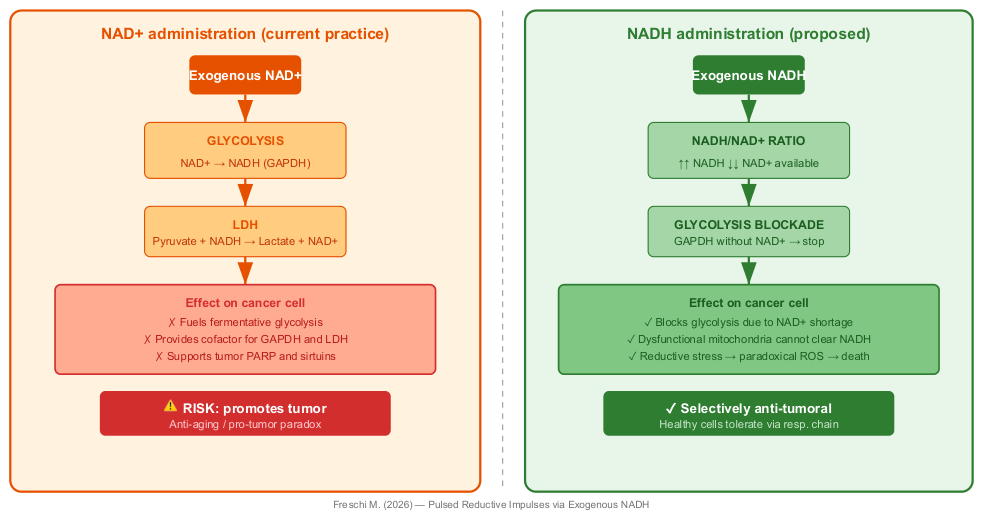
Figure 2.
Cyclic reductive impulse: differential response healthy vs cancer cell
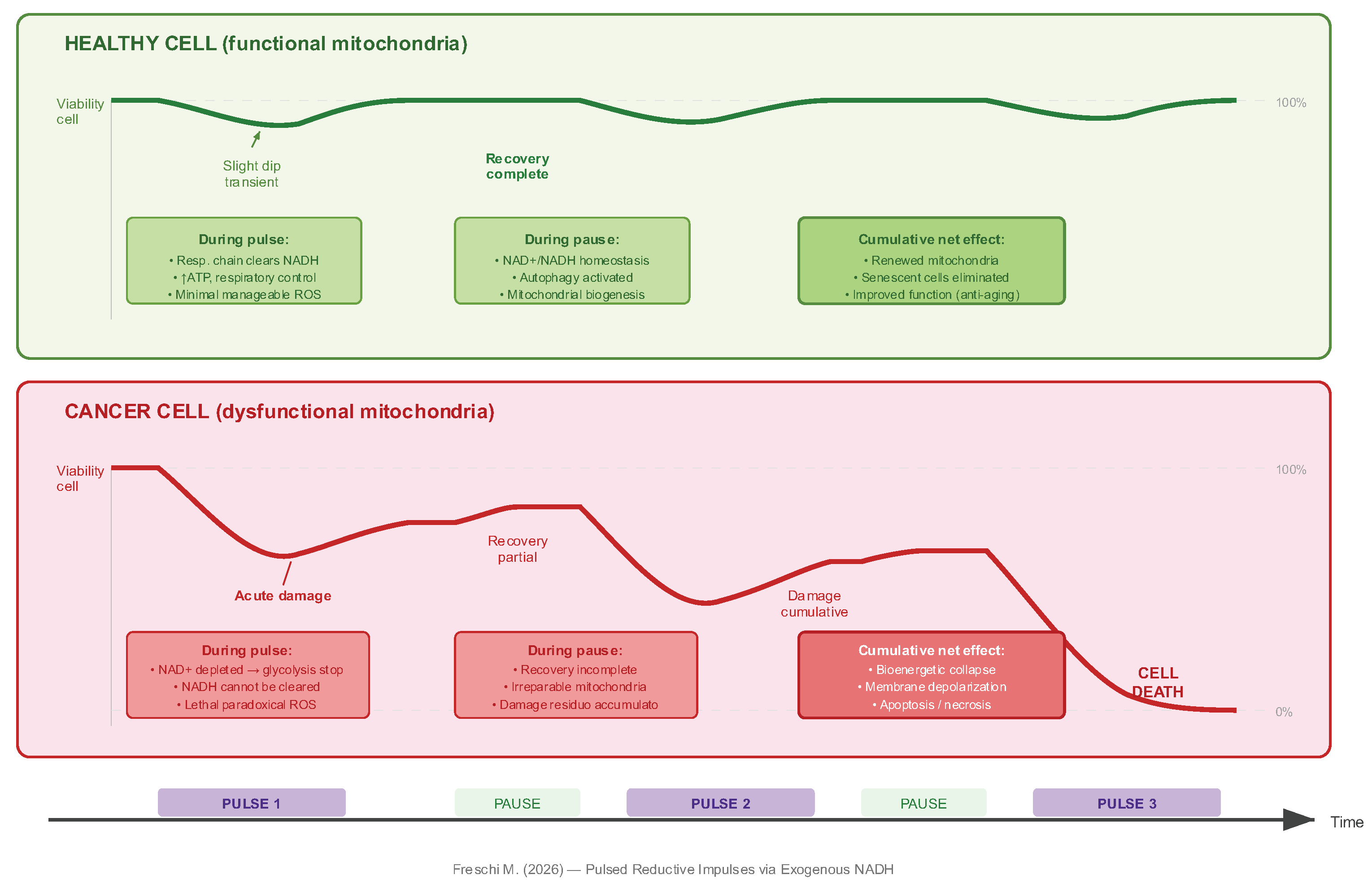
Figure 3.
The therapeutic triad: substrate, structure, environment
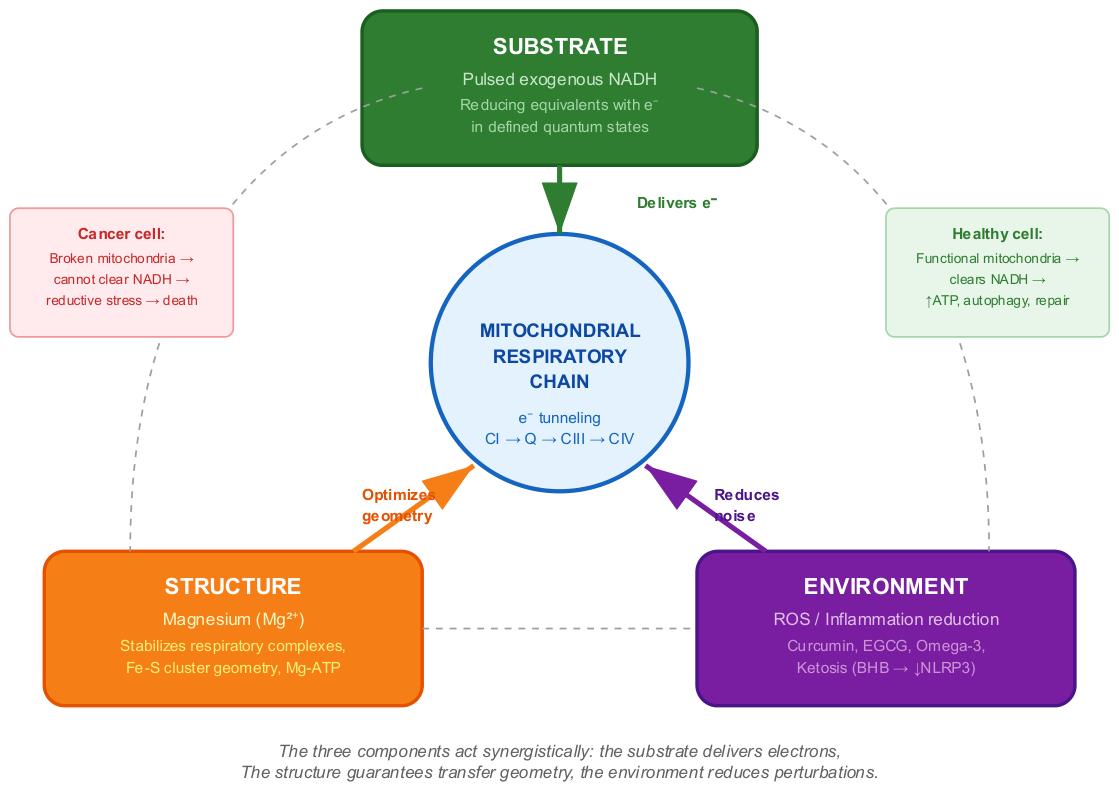
Disclaimer/Publisher’s Note: The statements, opinions and data contained in all publications are solely those of the individual author(s) and contributor(s) and not of MDPI and/or the editor(s). MDPI and/or the editor(s) disclaim responsibility for any injury to people or property resulting from any ideas, methods, instructions or products referred to in the content. |
© 2026 by the authors. Licensee MDPI, Basel, Switzerland. This article is an open access article distributed under the terms and conditions of the Creative Commons Attribution (CC BY) license (http://creativecommons.org/licenses/by/4.0/).
Copyright: This open access article is published under a Creative Commons CC BY 4.0 license, which permit the free download, distribution, and reuse, provided that the author and preprint are cited in any reuse.


