

Submitted:
02 April 2026
Posted:
20 April 2026
You are already at the latest version
Abstract
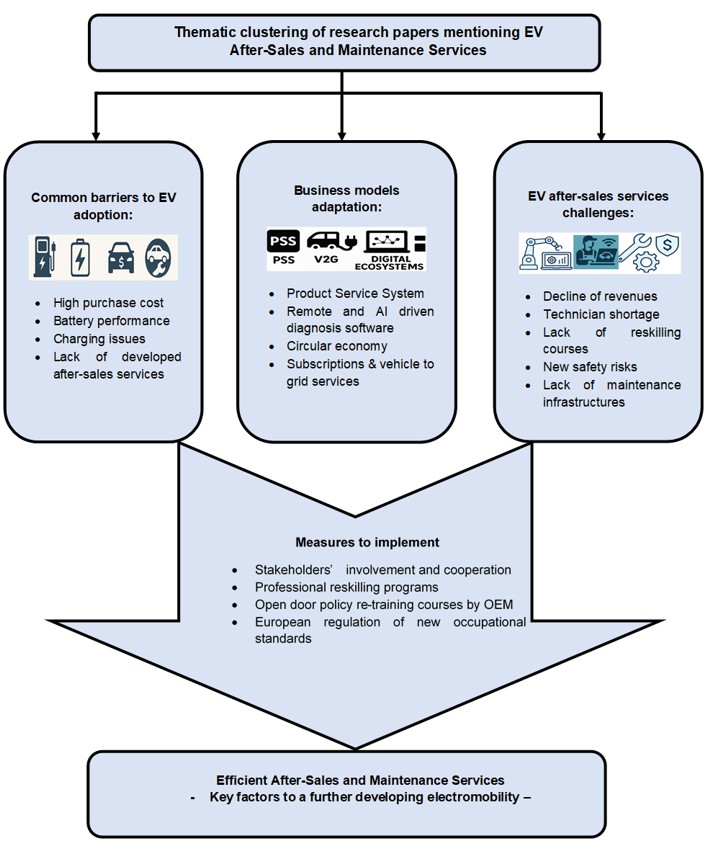
This paper examines the state of academic literature on the development of after-sales and maintenance services for electric vehicles (EVs), highlighting their critical yet underexplored role in the transition to electrified mobility. Against the backdrop of rising EV sales, the study investigates how service ecosystems influence long-term adoption. A systematic review was conducted to identify recurring themes, barriers, and proposed solutions related to EV maintenance and after-sales systems. The findings indicate that, despite lower mechanical complexity compared to internal combustion vehicles, EVs generate new service demands due to their reliance on electronics, software, and high-voltage systems. Key barriers to EV adoption include high purchase costs, limited charging infrastructure, and shortages of skilled technicians, which collectively affect consumer confidence beyond the point of acquisition. The analysis shows that after-sales services constitute both a technical and economic bottleneck in large-scale EV diffusion. Existing literature predominantly emphasizes theoretical solutions, such as digitalized maintenance and data-driven business models, with limited focus on practical implementation strategies. The paper concludes that sustainable EV adoption depends not only on technological and infrastructural progress but also on workforce adaptation, proposing a transitional management framework to support independent workshops in shifting toward fully electric service operations.
Keywords:
electric vehicles
; after-sales services
; dual maintenance providers
; workforce adaptation
; electrification transition
Copyright: This open access article is published under a Creative Commons CC BY 4.0 license, which permit the free download, distribution, and reuse, provided that the author and preprint are cited in any reuse.


