Submitted:
02 April 2026
Posted:
03 April 2026
You are already at the latest version
Abstract
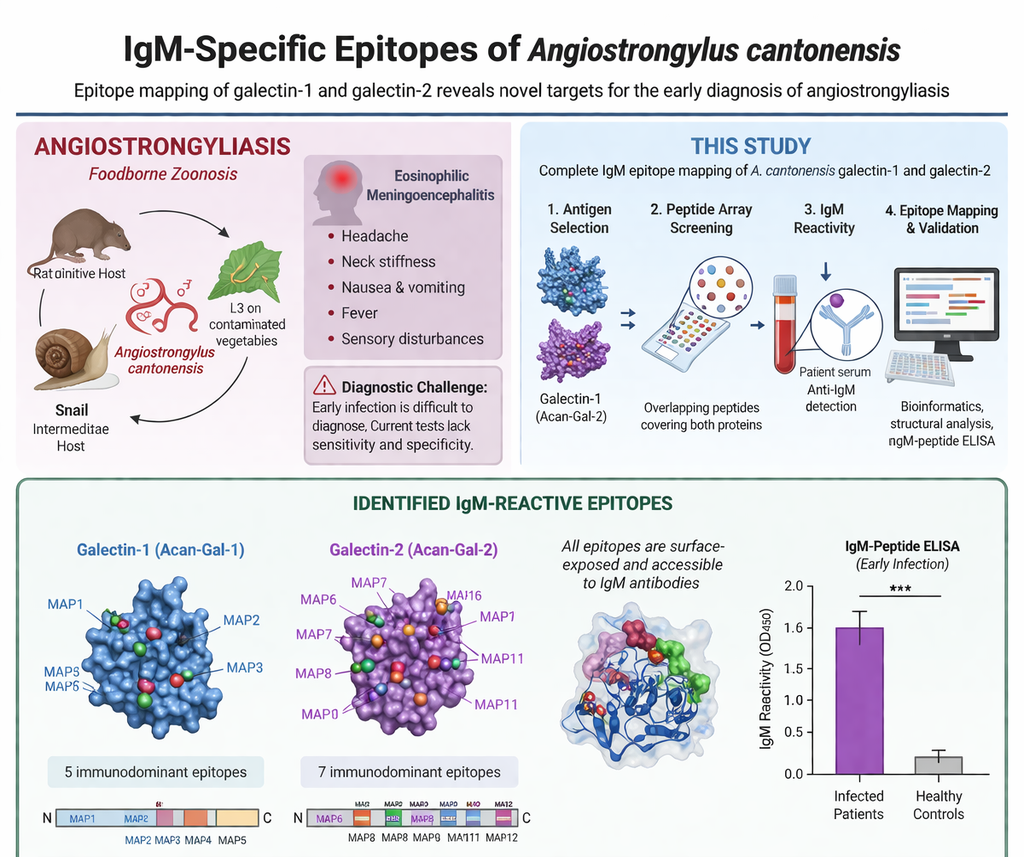
Angiostrongyliasis, the primary cause of eosinophilic meningitis, represents an emerging disease caused by Angiostrongylus cantonensis larvae, inadvertently transmitted to humans. The diagnosis of human angiostrongyliasis relies on epidemiological features, clinical symptoms, medical history, and laboratory findings, notably hyper eosinophilia in blood and cerebrospinal fluid. Consequently, accurate diagnosis is challenging and prone to confusion with other parasitic diseases. The quest for an early, rapid, and specific diagnostic test for angiostrongyliasis persists, driven by the imperative for enhanced test specificity. Material and Methods: This study focused on the mapping of IgM epitopes within galectin-1 (Gal-1) and galectin-2 (Gal-2) proteins derived from A. cantonensis. The specificity of the epitopes was assessed using database homology analysis. After selecting specific epitopes, researchers chemically synthesized 12 individual MAPs4 peptides and one chimeric polypeptide that is 58 amino acids long. The effectiveness of these synthesized peptides was subsequently evaluated using ELISA. Results: A total of twelve unique IgM epitopes were discovered; four were linked to Gal-1, while eight linked to Gal-2. An ELISA-peptide method confirmed the twelve epitopes, and then the chimeric polypeptide was employed as an antigen to coat ELISA plates. This setup was evaluated with patients' sera to diagnose strongyloidiasis in vitro. Conclusions: This study provides a comprehensive representation of the IgM epitopes of Gal-1 and Gal-2 from A. cantonensis. ELISA data utilizing chimeric the polypeptide demonstrate that the selected sequences hold promise for the development of a specific immunological assay tailored for the acute diagnosis of angiostrongyliasis infections.