

Submitted:
01 April 2026
Posted:
03 April 2026
You are already at the latest version
Abstract
Background: Serum concentrations of 25-hydroxyvitamin D [25(OH)D] are associated with the risk of several chronic and acute diseases. However, updated data on vitamin D status in Mediterranean countries, including Italy, remain limited, hindering effective public health strategies. Objective: To assess serum 25(OH)D levels and their seasonal variation in healthy blood donors aged 18–65 years living in Northern Italy and not taking vitamin D supplements. Given the latitude and high levels of environmental pollution, cutaneous vitamin D synthesis may be impaired in this population. Recent Italian guidelines on supplementation highlight the need for updated data on hypovitaminosis D prevalence and seasonal synthesis capacity. Methods: In this exploratory cross-sectional study, 534 blood donors (268 men and 266 women) attending the Transfusion Medicine Unit of Verona University Hospital were enrolled between April 2016 and May 2018. Serum 25(OH)D concentrations were analysed according to season. Clinical, lifestyle, pharmacological and dietary characteristics were also collected. Results: Among healthy, normal-weight individuals, the prevalence of vitamin D insufficiency (25(OH)D<50 nmol/L) was low and limited to one-two months per year. Overweight and obesity significantly reduced the likelihood of achieving adequate 25(OH)D levels through cutaneous synthesis for several months. Mean 25(OH)D concentrations were higher than those previously reported in the same area, while seasonal variation remained preserved. Conclusions: Despite persistent environmental pollution, seasonal vitamin D synthesis is not impaired in this Northern Italy population. Updated data show higher 25(OH)D levels compared to past studies, supporting current recommendations against routine supplementation in healthy normal-weight individuals under 70 years
Keywords:
vitamin D
; serum sample
; seasonality
; air pollution
; Italy
1. Introduction
Vitamin D plays a relevant role in maintaining a healthy mineralized skeleton and in preventing rickets and osteomalacia [1]. Humans obtain vitamin D, either as vitamin D₂ (ergocalciferol) or vitamin D₃ (cholecalciferol), primarily through exposure to sunlight and, to a lesser extent, from dietary sources. After entering the circulation, vitamin D undergoes hepatic hydroxylation to 25-hydroxyvitamin D [25(OH)D], followed by a second hydroxylation step that generates 1,25-dihydroxyvitamin D [1,25(OH)₂D], the biologically active hormone [2].
The measurement of serum 25(OH)D, which includes 25(OH)D2 and 25(OH)D3 forms, is used in clinical practice to assess the so-called vitamin D status and is interpreted as an expression of the body “vitamin D reserve”. In fact, the 25(OH)D form is relatively stable in serum with a half-life of 2–3 weeks, while its activated form, 1,25(OH)2D, has a half-life of about 15 hours [3]. Vitamin D status may decrease with age due to impaired biosynthesis (reduced biosynthesis capacity, lower sun exposure), low dairy and fish consumption, and increased weight, although the decrease is most marked above age 75 years. Population-based data from the United States (NHANES study) indicate that 24% of 3.377 adults aged 40–59 years and 22% of 3.602 adults aged ≥60 years had serum 25(OH)D concentrations below 50nmol/L; furthermore, 5.9% and 5.7% of individuals in these age groups, respectively, had 25(OH)D concentrations below 25 nmol/L, with similar values observed in women and men [4]. Population-based data from Europe (ODIN study) in children and adults of all ages showed a higher prevalence of low vitamin D status, with 40% having values below 50 nmol/L and 13% having values lower than 30 nmol/L, with similar rates in women and men [5]. In Italy, a prevalence of about 35% of adults with 25(OH)D lower than 50 nmol/L and about 13% with 25(OH)D lower than 25 nmol/L was reported [6]. In the early 2000s, Adami et al. [7] reported that among individuals aged 50–80 years the mean winter serum 25(OH)D concentration was 38 nmol/L. Similarly, Isaia et al. [8] found that, during the same season, mean 25(OH)D levels were approximately 25 nmol/L, and that 76% of the study population had 25(OH)D concentrations below 30 nmol/L. In premenopausal women in Northern Italy between August and December a mean 25(OH)D levels of 69.0 ± 27.8 nmol/L were found, therefore with a significant prevalence of young women with relatively low vitamin D levels although in a favourable season [9]. These epidemiological data have led to widespread supplementation and increased laboratory testing for 25(OH)D levels in the general population. In the United States, the prevalence of supplemental vitamin D use of 1000 IU (25 μg) or more per day increased from 0.3% in the 1999-2000 National Health and Nutrition Examination Survey (NHANES) to 18.2% in the 2013-2014 NHANES [10]. The use of 25(OH)D testing in clinical practice has also been increasing; however, the cost-effectiveness of widespread testing has been questioned, especially given the uncertainty about the optimal 25(OH)D level required to prevent disease. In 2022, the Italian Society for Osteoporosis, Mineral Metabolism and Skeletal Diseases (SIOMMMS) defined, for the general healthy population, serum 25(OH)D levels <25 nmol/L as deficiency, levels <50 nmol/L as insufficiency, and levels >50 nmol/L as sufficient [11]. Consistently, recent Endocrine Society guidelines no longer recommend maintaining a target 25(OH)D levels >75 nmol/L [12,13] as the threshold for sufficiency in the elderly population [14].
The widespread use of cholecalciferol supplementation across all age groups in the general population in many countries, originally driven by the concept of a pandemic vitamin D deficiency,- particularly in the Mediterranean countries- based on data published between 2000 and 2005, now makes it difficult to reassess the true current prevalence of hypovitaminosis D compared with the estimates reported in those earlier studies [7,8,9,15,16]. This situation has made it challenging to evaluate the contribution of cutaneous synthesis related to solar exposure—an important physiological determinant of circulating 25(OH)D levels—and therefore to investigate its seasonal variability, also in light of evidence regarding the impact of air pollution, particularly the presence in the atmosphere of high concentrations of particulate matter (PM10, PM2.5) and nitrogen dioxide (NO₂). Elevated concentrations of fine particulate matter have been shown to act as a filter for ultraviolet radiation, significantly reducing the potential for cutaneous synthesis of 25(OH)D [17,18,19].
For these reasons, it was of particular interest to update vitamin D levels in an Italian urban population from Northern Italy that does not receive vitamin D supplementation, and to evaluate the impact of intense atmospheric pollution on the physiological seasonal pattern of 25(OH)D synthesis. The data described here were obtained from a population living in Verona, a city located in the Region of Veneto, part of the Po Valley area of Northern Italy, one of the most polluted regions in Europe over the least 20 years according to the European Environment Agency, with persistently high concentrations of PM10 , PM2.5 and NO2 throughout all seasons [20,21].
It is reasonable to hypothesize that the scenario emerging from this analysis may represent the nadir of vitamin D status in Italy across the different seasons. On this basis, it is also of interest to verify, in a real-life setting, the applicability of the recommendations from the recent national guidelines of the SIOMMMS [11].
2. Materials and Methods
Ethical Standards
The study was approved by the Ethical Committee of Verona University Hospital (VIT-9612CROSS, Prog.779CESC). Eligible subjects were informed about the objectives and procedures of the study. All participants provided written informed consent before enrolment. The procedures used were in accordance with the ethical standards of the responsible institutional or regional committee on human experimentation, or with the Helsinki Declaration of 1975, as revised in 1983.
Study Design and Participants
Study design has already been reported elsewhere [22,23], for this study, having the original intent of evaluating levels of folate, being one major determinant of dietary role for major disease risk. Briefly, from April 2016 to May 2018, 551 healthy blood donors, consecutively attending the Transfusion Medicine Unit of the Verona University Hospital (Italy) were considered for inclusion in this cross-sectional study, 538 of whom (97.6%) agreed to participate. The only exclusion criteria were vitamins supplementation during the last two months before the blood sample withdrawal and the interview: two subjects were therefore excluded due to ongoing vitamin D supplementation and two patients were excluded due to pre-analytical problems, for a final population of 534 patients (268 men and 266 women, of whom 154 of childbearing age, between 18-44 years) included in the study. During the medical visit focused on blood donation enrolment, each eligible subject, after a detailed explanation of the study, was invited to participate. After giving written informed consent, each participant was interviewed about her/his general characteristics, medical history, and current therapy. Lifestyle and education, as recognized parameters of lifestyle and dietary habits, including alcohol and smoking habits, were also recorded.
Seasonality was defined according to the conventional equinoxes and solstices at our latitude, and parameters were analyzed according to each month of the year, i.e., from January to December.
Laboratory Parameters
Venous whole blood samples were collected after overnight fasting into Vacutainer® tubes either without anticoagulant to obtain serum or containing either ethylenediaminetetraacetic acid (EDTA) or lithium/heparin as anticoagulants to measure the other biochemical variables. After centrifugation at 1.500g for 10 minutes at room temperature, serum was separated, stored in aliquots and kept frozen at -70 °C until measurement.
Serum concentrations of 25-hydroxyvitamin D [25(OH)D] were measured using the LIAISON Analyzer with the LIAISON 25 OH Vitamin D TOTAL Assay (DiaSorin S.p.A., Saluggia, Italy). This assay is a direct competitive chemiluminescent immunoassay (CLIA) designed for the quantitative determination of total 25(OH)D, including both 25(OH)D₂ and 25(OH)D₃, in human serum. The samples were analyzed according to the manufacturer’s instructions.
Statistical Analysis
Data were collected in a specific database after a review for completeness, consistency, and plausibility. This study included 534 subjects. The original sample size was computed considering, as the primary objective of the study, the frequency of adequate plasma folate concentrations (>15 nmol/L) [22,23]. Considering the endpoint of the present analysis (i.e., the prevalence of adequate vitamin D status) based on a post-hoc computation, we were able to determine estimates of adequate serum vitamin D concentrations with a narrow 95% confidence interval (CI). Continuous variables were reported by mean values and standard error. Categorical variables were presented by calculating absolute frequency and percentage. The 95% CI of the mean and proportion were provided to assess the precision of estimates. All continuous variables were compared between subgroups using the analysis of variance (ANOVA) or the Kruskal–Wallis test when appropriate. The analysis of covariance (ANCOVA) was used to adjust the values for age, gender and BMI. To discriminate among the means, Fisher’s least significant difference (LSD) procedure was used. Odds Ratios (ORs) for inadequate status of vitamin D according to sociodemographic and general characteristics were computed. Chi-square tests were used for categorical data. Associations between continuous variables were examined using Pearson correlation coefficients. Differences were considered significant at p < 0.05. All statistical procedures were carried out using a computer program (Statgraphic Centurion v19, by Statgraphics Technologies, Inc. USA).
3. Results
The population of this study was selected from the participants in the study from Bortolus R. et al. [22]. The demographic and anthropometric characteristics of this study population are reported in Table 1. The study population had a mean age of 42 years (95% CI: 40.9-43.0). Females represented 49.8% of the study population (266/534) and were younger than males (mean age 38.0 years; 95% CI: 37.0–39.0 vs 46.0 years; 95% CI: 45.0-46.9, respectively; p = 0.001). Females also had a significantly lower BMI than males (BMI 22.6; 95% CI: 22.3-22.9 vs 25.2; 95% CI: 25.0-25.5, respectively; p = 0.001).
The mean serum 25(OH)D concentration from January to December was 57.0 nmol/L (95% CI: 55.0-65.8). No significant differences were observed for gender (female: 57.5 nmol/L, 95% CI: 55.5-59.5 vs male: 56.7 nmol/L, 95% CI: 54.5-58.6; p = 0.622). No significant changes were observed adjusting 25(OH)D levels for age and BMI (Table 1).
Analysis of the distribution of 25(OH)D levels in the overall population showed that 7.1% (38/534) of subjects had levels <25 nmol/L, 31.1% had levels between 25 and 49 nmol/L (166/534) and 61.8% (330/534) had 25(OH)D ≥ 50 nmol/L, i.e., in the sufficiency range, with no differences between sexes (Chi-square 0.399; Table 1). We did not find any risk factors for low vitamin D (25(OH)D < 50 nmol/L) exploring lifestyle, eating habits and socio-cultural aspects (Table 2).
No correlation was found between age and 25(OH)D levels in the overall population (R² = 0.04; p = 0.603), nor when the analysis was stratified by sex (data not shown).
When comparing the annual mean 25(OH)D concentrations across age quartiles, no significant difference was observed between the youngest quartile (138 subjects aged <35 years; mean 57.5 nmol/L; 95% CI: 54.8-60.5) and the oldest quartile (141 subjects aged >51
years; mean 57.9 nmol/L; 95% CI: 55.2-60.5; p = 0.84 between groups). Similarly, when 25(OH)D levels were compared across age quartiles at nadir reached in February, no significant differences were detected with mean values of 39.5 nmol/L (95% CI: 30.5-48.3) in the <35 years quartile and 43.8 nmol/L (95% CI: 36.0-51.5) in the >51 years quartile (p = 0.392).
BMI showed a negative correlation with 25(OH)D levels in the overall population (R² = 3%; p = 0.001) (Figure 1), with a similar correlation observed in males and females (data not shown).
Stratifying the 25(OH)D levels by seasons we found that there was a clear effect of seasonality with a nadir in Winter (48.3 nmol/L, 95% CI 45.5-51.0), with values significantly lower than those found in Summer and Autumn, and a peak in Autumn (70 nmol/L; 95% CI: 66.3-73.5), even after adjustment for age and BMI. This was also evident after stratifying by sex, with a non-significant trend toward lower levels in Winter and slightly higher levels in autumn for males vs females (Table 1).
However, a more detailed analysis of distribution of 25(OH)D levels by months, after adjustment for age and BMI, across the years showed the nadir in February (43.7 nmol/L; 95% CI: 38.5-48.7) and the peak values between August and September (83.0 nmol/L; 95% CI: 72.3-93.3) (p = 0.0014). In February, approximately 41.5% of the overall population had levels ≥ 50 nmol/L, and only 27.7% of subjects had 25(OH)D levels <25 nmol/L, while 30.8% had values between 25 and 49 nmol/L (Table 3). There were no significant differences in absolute values of 25(OH)D by sex across the year but slight differences in the timing of nadir.
The nadir of 25(OH)D in females, adjusted for age and BMI, occurred in February (44.3 nmol/L; 95% CI: 37.0-51.5). Mean 25(OH)D levels in January, February and March were significantly lower than those observed in July, August, September, and October (p = 0.002; Figure 2A). At the nadir 40.6% of female had 25(OH)D ≥ 50 nmol/L, 37.5% between 25 and 49 nmol/L, and only 21.9% of females had levels <25 nmol/L (Table 3). The values of vitamin D peaked in September (82.0 nmol/L; 95% CI: 71.0-93.0; Figure 2A).
In males, the nadir of 25(OH)D adjusted for age and BMI, occurred in March (42.3 nmol/L; 95% CI: 35.3-48.5). Mean 25(OH)D levels in January, February, March and April resulted significantly lower than those observed from May to December (p = 0.001); mean 25(OH)D concentrations in May also resulted significantly lower than those observed in August (p = 0.001; Figure 2B). Nevertheless, in males during the period of nadir 42.4% of subjects had 25(OH)D levels above 50 nmol/L, 24% between 25 and 50 nmol/L, and finally 33.3% of subjects had levels <25 nmol/L (Table 3). The 25(OH)D peaked in August (90.3 nmol/L; 95% CI: 75.8-104.7; Figure 2B).
The monthly changes in vitamin D across the year, stratifying by BMI level (normal weight and overweight/obese) were quite different between normal-weight subjects and overweight/obese subjects. The demographic data are reported in Table 4. In normal weight subjects, the nadir occurred in February (mean 25(OH)D 42.5 nmol/L; 95% CI: 40.0-44.8), and the peak value was observed in September (78.0 nmol/L; 95% CI: 74.0-91.8). From March to January, the mean 25(OH)D levels were >50 nmol/L (p = 0.001; Figure 3A).
In the overweight/obese subgroup, the mean BMI was 28.0 (95% CI: 27.7-28.2) kg/m2. The overweight subjects were 79.3% (130/164), and the obese were 20.6% (34/164). Overweight/obese subjects were significantly older than their normal weight counterparts (44.1 years; 95% CI: 42.8-45.4 vs 41.0 years 95% CI: 40.2-41-9; p = 0.002) and showed significantly lower serum 25(OH)D concentrations (52.0 nmol/L 95% CI: 49.5-54.5 vs 59.3 nmol/L 95% CI: 57.7-61.0; p = 0.002). In the overweight/obese subgroup the prevalence of subjects with 25(OH)D insufficiency (10.3%, 17/164) and deficiency (36.6%, 60/164) was slightly but not significantly higher compared with the normal weight subgroup (insufficiency 7.3% (27/370) and deficiency 29.2% (108/370) (Chi-square 0.052). When evaluating 25(OH)D levels at nadir, a non-significant lower prevalence of patients with sufficient values was observed in the overweight/obese subgroup compared with normal weight subjects (42.5% (17/40) vs 62.0% (44/71) respectively; Chi-square 0.08); Table 4). In overweight/obese subjects, the mean 25(OH)D levels remained <50 nmol/L from January to April in almost all individuals (36.3 nmol/L; 95% CI: 33.8-39.5 and 38.3 nmol/L 95% CI: 34.8-41.3, respectively; p = 0.001). Approximately 45% of these subjects still had levels <50 nmol/L from May to July (mean values ranging respectively from 54.5 nmol/L 95%; CI: 46.8-62.3 to 56.0 nmol/L; 95% CI: 45.2-66.5). The highest 25(OH)D concentrations were observed in August (88.5 nmol/L; 95% CI: 75.8-101.3; Figure 3B).
4. Discussion
Our data provide the first evidence in more than 20 years on serum vitamin D concentrations and their seasonal variation in a large population of healthy adults from Northern Italy not receiving vitamin D supplementation, thus reflecting endogenous synthesis, which is known to depend almost entirely on sun exposure. This is particularly relevant in Italy, where fortification of foods with vitamin D is not widespread and is rarely taken due to its high cost. Our findings confirm the persistence of the “physiological” seasonal rhythm in serum 25(OH)D synthesis in healthy adults of both sexes, at least in the age group analysed (range 18-65 years). While this may seem a rather trivial information, the interest in updating the epidemiological information about 25(OH)D levels and exploring the persistence of physiological synthesis of vitamin D in Northern Italy arises from the data supporting an impact of air pollutants on the penetration of solar ultraviolet B (UVB) to the Earth’s surface, therefore linking the occurrence of vitamin D deficiency to air pollution [19]. Secondly, the recently published recommendations from SIOMMMS, consistent with the 2024 Endocrine Society guidelines, indicate a value of 25(OH)D equal to or greater than 50 nmol/L to be considered sufficient in the general population, deeming unnecessary a universal supplementation with cholecalciferol in the healthy general population [11,12]. Therefore, it was of interest to verify in real life how consistent the recommendations from the Italian and International guidelines are with vitamin D status in the Italian healthy adult population.
The subjects included in the present study were recruited, and the samples for the analysis of serum 25(OH)D were collected between April 2016 and May 2018, thus covering all four seasons. People recruited lived in the urban area of Verona, in Northeastern Italy (45°26′19″N, 10°59′34″E), about 59 meters above sea level. The city covers an area of 198.92 km² and is densely populated (1,283.42 inhabitants/km2). Noteworthy, Verona is located in the Po Valley, a geographical area burdened by some of the highest levels, not only in Italy but also in Europe, of fine particulate air pollution across all seasons [20,21].
In the Autumn/Winter season, pollution is mostly represented by PM10 and PM2.5 and in Spring/Summer by Ozone (O3), benzo(a)pyrene and NOx. For all these pollutants, there is evidence for blocking UVB on the Earth surface and subsequently preventing the cutaneous synthesis of vitamin D [17,18,19]. Surprisingly, in our study, atmospheric pollution did not appear to meaningfully compromise the endogenous vitamin D synthesis throughout the year, and the 25(OH)D seasonal variations are well preserved and perfectly comply with what is expected from the literature [24]. In our study, serum 25(OH)D levels were lower during Winter, reaching a nadir of approximately 45 nmol/L in February–March, and progressively increased during Spring and Summer, peaking between August and September at about 82.5 nmol/L. Previous studies conducted in areas of Italy at different latitudes have similarly documented a clear seasonal pattern in serum 25(OH)D concentrations, with lower values in Winter and higher values during Summer [15,16]. A comparable seasonal trend has also been reported in European countries at different latitudes, including Finland, the United Kingdom, Germany, Spain and Turkey [24,25,26].
When compared with epidemiological studies on hypovitaminosis D conducted in Italy in the early 2000s [8,27,28,29], serum 25(OH)D concentrations appear to be significantly higher in the present cohort, with a marked reduction in the overall prevalence of hypovitaminosis D. The difference is particularly evident when considering the prevalence of vitamin D deficiency (25(OH)D < 25 nmol/L) and insufficiency (25(OH)D < 50 nmol/L). Manios Y. et al. found in Italy a prevalence of about 35% of adults with 25(OH)D lower than 50 nmol/L and about 13% with 25(OH)D lower than 25 nmol/L[6]. It should be highlighted that those data were collected in the central/southern area of Italy and represented a mean yearly value[6]. In the early 2000s, Adami S. et al. [7] reported that among individuals aged 50-80 years the mean 25(OH)D concentration in Winter was 38 nmol/L. Isaia et al. [8] observed, in the same season, mean 25(OH)D levels of about 25 nmol/L, with a prevalence of 25(OH)D < 30 nmol/L of 76% in the population studied. In Northern Italy in premenopausal women (28-44 years old) between September and December 2006, mean 25(OH)D levels of 69.0+27.8 nmol/L were documented, therefore showing a significant prevalence of young women with relatively low vitamin D levels in a favourable season for UVB exposure [9]. These data induced the promotion, in Italy, of a widespread supplementation with cholecalciferol in the general population [30]. In the present study we found that about 60% of females and males have sufficient (above 50 nmol/L) 25(OH)D concentrations in all the seasons, only 8.2% of the subjects had 25(OH)D levels lower than 25 nmol/L and 31.5% had 25(OH)D levels between 25 and 50 nmol/L. In particular, females in our study have the nadir levels of vitamin D in February. Anyway, in the worst month of the year for 25(OH)D skin synthesis, 40.6% of the females had 25(OH)D above 50 nmol/L. In males, the nadir occurred in March with 42.4% of subjects having vitamin D levels above 50 nmol/L. Because the well-known negative impact of adiposity on 25(OH)D levels [31,32,33,34,35,36] when overweight and obese subjects were excluded from the analysis, the nadir occurred in February (mean 25(OH)D 42.5 nmol/L (95% CI: 40.0-44.8), whereas from March to January almost all subjects had 25(OH)D levels above 50 nmol/L. A likely explanation for this apparent improvement in vitamin D status among individuals living in the same geographic area where previous studies were conducted approximately 10 years later may be the progressive and substantial reduction in environmental pollution that started around 2014 in the region, separating the earlier studies from the present investigation [7,8]. The 2020 local environmental reports highlighted a 46% reduction in PM10 concentration and 38% reduction in NO2 levels between 2005 and 2019 in Verona, with a similar trend also for PM2.5. Noteworthy, mean levels of these pollutants dropped below the recommended thresholds, giving a possible explanation for the absent influence of pollution on 25(OH)D concentrations observed in the present study (data from ARPAV as per license CC BY 3.0, Figure 4) [37]. It is possible that other factors, i.e., higher scholarity, lifestyle, social behavioural changes over the past decades may have played a role. In our study, none of these factors was associated with vitamin D deficiency, unlike what has been reported in previous studies [7,8,9].
It should be emphasized that the study population had been carefully selected from individuals not taking nutritional supplements or any form of vitamin D supplementation.
The findings of our study seem to support the recommendations expressed by SIOMMMS and the guidelines of the Endocrine Society, which defined as sufficient a level of vitamin D as above 50 nmol/L and advises against empirical vitamin D supplementation in healthy individuals under 70 years of age [8,9]. As described above, when overweight and obese subjects were excluded, the nadir of 25(OH)D levels in the normal-weight population occurred in February, and the 25(OH)levels were very low. Furthermore, this was the only month in which the majority of subjects had 25(OH)D levels <50 nmol/L. From March to January, almost all subjects had 25(OH)D levels >50 nmol/L. It is unlikely that only one month with 25(OH)D levels <50 nmol/L may significantly affect bone and mineral metabolism or other potential extra skeletal health outcomes. Our data therefore support the choice not to empirically supplement healthy normal-weight individuals aged ≤70 years and not to perform universal screening for serum 25(OH)D levels [11,12,30].
We also did not find any association of vitamin D levels and age both in males and females.
When comparing the annual mean 25(OH)D concentrations across age quartiles, no significant difference was observed between the youngest and the oldest age quartiles (<35 years vs >51 years), and no differences were observed in the nadir values in February. There is evidence that the synthesis of vitamin D declines progressively with aging, and previous studies reported an inverse correlation between age and serum 25(OH)D concentration, with lower levels observed in older individuals [27,28]. Our results may be explained by a limited number of participants aged between 60 and 65 years, whereas previous studies demonstrating lower vitamin D levels in older individuals included a substantially higher number of subjects of older age [7,8].
Furthermore, as is well known, vitamin D levels are negatively influenced by BMI, and we found that the seasonal pattern of 25(OH)D levels is also affected by BMI [31,32,33,34,35,36]. When stratifying the population according to BMI, in overweight/obese subjects, 25(OH)D levels remained <50 nmol/L from January to April in almost all subjects and approximately 45% of those subjects maintained levels <50 nmol/L between May and July without gender differences. It is noteworthy that in the overweight/obese group, overweight subjects are quite prevalent among obese subjects (130/164 vs 34/164 respectively) and the mean BMI was in the range of overweight BMI classification. In other words, it is likely that in a cohort of exclusively obese subjects, the vitamin D seasonal changes should be worse.
The need for supplementation and practical issues of obtaining adequate serum levels in overweight/obese people are widely debated in the literature [31,34,38,39]. Our data seem to support the recommendations of the Italian guidelines, which include obesity among the conditions at high risk for hypovitaminosis D requiring an empirical supplementation [11].
Weaknesses of the present study include the cross-sectional nature of the study. Another possible limitation is the age range (18-65 years), which prevents us from exploring the ability to synthesize vitamin D in elderly subjects. On the other end this limitation excludes bias due to low mobility, comorbidity and polypharmacy. Another limitation could be the population selected among blood donors who likely have better health and a better lifestyle than the general population.
A strength of this study is represented by the selection of healthy, free-living subjects who were not taking any vitamin D supplements, which is difficult to find today, hampering epidemiological studies on vitamin D synthesis. It is also to be remarked that the relatively homogeneous distribution of the sampling of serum 25(OH)D across the year, allowed the creation of a curve showing the monthly mean levels of 25(OH)D, a kind of data quite rare in the recent literature. Another strength is that the study is carried out in a region geographically and ecologically disadvantaged for the synthesis of vitamin D, so it seems reasonable that other regions of Italy may have better vitamin D status. This finding is indeed of importance in terms of public health intervention policies related to vitamin D.
5. Conclusions
In conclusion, our data demonstrated that atmosphere pollution, although intense and long-lasting all year round in this area of Northern Italy, does not affect seasonal variation in synthesis of vitamin D and that, surprisingly the mean levels of 25(OH)D are significantly higher across the year than those found in an epidemiological study in 2000s in the same geographical area. Moreover, among healthy, normal weight female and male subjects the prevalence of insufficient vitamin D levels (25(OH)D < 50 nmol/L) is very low and limited at one-two month of the year. Overweight and obesity significantly preclude the achievement of adequate serum 25(OH)D values with the sole cutaneous synthesis for many months in the year. These data corroborate the SIOMMMS recommendation to not perform indiscriminately 25(OH)D assay, to not empirically supplement healthy normal-weight people younger than 70 years and to supplement with vitamin D empirically overweight/obese subjects [11].
Author Contributions
Conceptualization, F.B., R.B., F.P., S.F.; methodology, F.B., R.B., F.P., S.F.; software, F.B..; validation, F.B., R.B., F.P., S.F.; formal analysis, F.B.; investigation, F.F., S.U., M.R., R.M., G.G., M.L., S.M., S.D.M; resources, M.M., G.L.; data curation, F.B., F.C., F.P., N.M., F.P.; writing—original draft preparation, F.B., R.B., M.L., S.F.; writing—review and editing, F.B., R.B., M.L., S.F.; visualization, F.B., M.L.; supervision, F.B., R.B., S.F.; project administration, F.B., R.B., S.F.; funding acquisition, R.B. All authors have read and agreed to the published version of the manuscript.
Funding
this work was supported by unconditional grant from Bayer S.p.A. The funder had no role in study design, data collection, analysis, interpretation, or writing manuscript.
Institutional Review Board Statement
The study was approved by the Ethical Committee of the Verona University Hospital (VIT-9612CROSS, Prog.779CESC). Eligible subjects were informed about the objectives and procedures of the study. The procedures used were in accordance with the ethical standards of the responsible institutional or regional committee on human experimentation or in accordance with the Helsinki Declaration of 1975 as revised in 1983.
Informed Consent Statement
All participants provided written informed consent before enrollment.
Data Availability Statement
Acknowledgments
this work was performed in part in the LURM Research Center, University of Verona (Italy).
Conflicts of Interest
The authors declare no conflicts of interest. The funders had no role in the design of the study; in the collection, analyses, or interpretation of data; in the writing of the manuscript; or in the decision to publish the results.
Abbreviations
The following abbreviations are used in this manuscript:
| 25(OH)D | 25-hydroxyvitamin D |
| BMI | Body Mass Index |
| CI | Confidence Interval |
| EDTA | Ethylenediaminetetraacetic Acid |
| NHANES | National Health and Nutrition Examination Survey |
| OR | Odds Ratio |
| SIOMMMS | Italian Society for Osteoporosis, Mineral Metabolism and Skeletal Diseases |
References
- Holick, M.F. Resurrection of Vitamin D Deficiency and Rickets. Journal of Clinical Investigation 2006, 116, 2062–2072. [Google Scholar] [CrossRef]
- Adams, J.S.; Rafison, B.; Witzel, S.; Reyes, R.E.; Shieh, A.; Chun, R.; Zavala, K.; Hewison, M.; Liu, P.T. Regulation of the Extrarenal CYP27B1-Hydroxylase. The Journal of Steroid Biochemistry and Molecular Biology 2014, 144, 22–27. [Google Scholar] [CrossRef]
- Tuckey, R.C.; Cheng, C.Y.S.; Slominski, A.T. The Serum Vitamin D Metabolome: What We Know and What Is Still to Discover. The Journal of Steroid Biochemistry and Molecular Biology 2019, 186, 4–21. [Google Scholar] [CrossRef]
- Schleicher, R.L.; Sternberg, M.R.; Lacher, D.A.; Sempos, C.T.; Looker, A.C.; Durazo-Arvizu, R.A.; Yetley, E.A.; Chaudhary-Webb, M.; Maw, K.L.; Pfeiffer, C.M.; et al. The Vitamin D Status of the US Population from 1988 to 2010 Using Standardized Serum Concentrations of 25-Hydroxyvitamin D Shows Recent Modest Increases. The American Journal of Clinical Nutrition 2016, 104, 454–461. [Google Scholar] [CrossRef]
- Cashman, K.D.; Dowling, K.G.; Škrabáková, Z.; Gonzalez-Gross, M.; Valtueña, J.; De Henauw, S.; Moreno, L.; Damsgaard, C.T.; Michaelsen, K.F.; Mølgaard, C.; et al. Vitamin D Deficiency in Europe: Pandemic? The American Journal of Clinical Nutrition 2016, 103, 1033–1044. [Google Scholar] [CrossRef] [PubMed]
- Manios, Y.; Moschonis, G.; Lambrinou, C.-P.; Tsoutsoulopoulou, K.; Binou, P.; Karachaliou, A.; Breidenassel, C.; Gonzalez-Gross, M.; Kiely, M.; Cashman, K.D. A Systematic Review of Vitamin D Status in Southern European Countries. Eur J Nutr 2018, 57, 2001–2036. [Google Scholar] [CrossRef]
- Adami, S.; Viapiana, O.; Gatti, D.; Idolazzi, L.; Rossini, M. Relationship between Serum Parathyroid Hormone, Vitamin D Sufficiency, Age, and Calcium Intake. Bone 2008, 42, 267–270. [Google Scholar] [CrossRef]
- Isaia, G.; Giorgino, R.; Rini, G.B.; Bevilacqua, M.; Maugeri, D.; Adami, S. Prevalence of Hypovitaminosis D in Elderly Women in Italy: Clinical Consequences and Risk Factors. Osteoporosis International 2003, 14, 577–582. [Google Scholar] [CrossRef] [PubMed]
- Adami, S.; Bertoldo, F.; Braga, V.; Fracassi, E.; Gatti, D.; Gandolini, G.; Minisola, S.; Battista Rini, G. 25-Hydroxy Vitamin D Levels in Healthy Premenopausal Women: Association with Bone Turnover Markers and Bone Mineral Density. Bone 2009, 45, 423–426. [Google Scholar] [CrossRef]
- Rooney, M.R.; Harnack, L.; Michos, E.D.; Ogilvie, R.P.; Sempos, C.T.; Lutsey, P.L. Trends in Use of High-Dose Vitamin D Supplements Exceeding 1000 or 4000 International Units Daily, 1999-2014. JAMA 2017, 317, 2448. [Google Scholar] [CrossRef] [PubMed]
- Bertoldo, F.; Cianferotti, L.; Di Monaco, M.; Falchetti, A.; Fassio, A.; Gatti, D.; Gennari, L.; Giannini, S.; Girasole, G.; Gonnelli, S.; et al. Definition, Assessment, and Management of Vitamin D Inadequacy: Suggestions, Recommendations, and Warnings from the Italian Society for Osteoporosis, Mineral Metabolism and Bone Diseases (SIOMMMS). Nutrients 2022, 14, 4148. [Google Scholar] [CrossRef]
- Demay, M.B.; Pittas, A.G.; Bikle, D.D.; Diab, D.L.; Kiely, M.E.; Lazaretti-Castro, M.; Lips, P.; Mitchell, D.M.; Murad, M.H.; Powers, S.; et al. Vitamin D for the Prevention of Disease: An Endocrine Society Clinical Practice Guideline. The Journal of Clinical Endocrinology & Metabolism 2024, 109, 1907–1947. [Google Scholar] [CrossRef] [PubMed]
- Holick, M.F.; Binkley, N.C.; Bischoff-Ferrari, H.A.; Gordon, C.M.; Hanley, D.A.; Heaney, R.P.; Murad, M.H.; Weaver, C.M. Evaluation, Treatment, and Prevention of Vitamin D Deficiency: An Endocrine Society Clinical Practice Guideline. The Journal of Clinical Endocrinology & Metabolism 2011, 96, 1911–1930. [Google Scholar] [CrossRef]
- Dawson-Hughes, B.; Mithal, A.; Bonjour, J.-P.; Boonen, S.; Burckhardt, P.; Fuleihan, G.E.-H.; Josse, R.G.; Lips, P.; Morales-Torres, J.; Yoshimura, N. IOF Position Statement: Vitamin D Recommendations for Older Adults. Osteoporos Int 2010, 21, 1151–1154. [Google Scholar] [CrossRef] [PubMed]
- Barchetta, I.; Baroni, M.G.; Leonetti, F.; De Bernardinis, M.; Bertoccini, L.; Fontana, M.; Mazzei, E.; Fraioli, A.; Cavallo, M.G. TSH Levels Are Associated with Vitamin D Status and Seasonality in an Adult Population of Euthyroid Adults. Clin Exp Med 2015, 15, 389–396. [Google Scholar] [CrossRef]
- Vignali, E.; Macchia, E.; Cetani, F.; Reggiardo, G.; Cianferotti, L.; Saponaro, F.; Marcocci, C. Development of an Algorithm to Predict Serum Vitamin D Levels Using a Simple Questionnaire Based on Sunlight Exposure. Endocrine 2017, 55, 85–92. [Google Scholar] [CrossRef] [PubMed]
- Yang, C.; Li, D.; Tian, Y.; Wang, P. Ambient Air Pollutions Are Associated with Vitamin D Status. IJERPH 2021, 18, 6887. [Google Scholar] [CrossRef]
- Kim, B.; Hwang, J.; Lee, H.; Chae, G.M.; Kim, S.; Kim, H.-S.; Park, B.; Kim, H.-J. Associations between Ambient Air Pollution, Obesity, and Serum Vitamin D Status in the General Population of Korean Adults. BMC Public Health 2022, 22, 1766. [Google Scholar] [CrossRef]
- Golastani, B.; Poursafa, P.; Zarean, M.; Yazdi, M.; Heidari-Beni, M.; Kelishadi, R. Relationship between Air Pollution and Serum Vitamin D Levels: A Systematic Review and Meta-Analysis. Adv Biomed Res 2024, 13, 96. [Google Scholar] [CrossRef]
- Bigi, A.; Ghermandi, G. Trends and Variability of Atmospheric PM2.5 and PM10–2.5 Concentration in the Po Valley, Italy. Atmos. Chem. Phys. 2016, 16, 15777–15788. [Google Scholar] [CrossRef]
- Horàlek, J.; Vlasàkovà, L.; Schreiberovà, M.; Benesovà, N.; Schneider, P.; Kurfurst, P.; Tognet, F.; Schovànkovà, J.; Vlcek, O.; Garcia Vivanco, M.; et al. Air Quality Maps of EEA Members and Cooperating Countries for 2021; European Topic Centre on Human Health and the Environment, 2024. [Google Scholar]
- Bortolus, R.; Filippini, F.; Udali, S.; Rinaldi, M.; Genesini, S.; Gandini, G.; Montagnana, M.; Chiaffarino, F.; Lippi, G.; Pattini, P.; et al. B Vitamin Blood Concentrations and One-Carbon Metabolism Polymorphisms in a Sample of Italian Women and Men Attending a Unit of Transfusion Medicine: A Cross-Sectional Study. Eur J Nutr 2021, 60, 2643–2654. [Google Scholar] [CrossRef]
- Bortolus, R.; Filippini, F.; Chiaffarino, F.; Udali, S.; Rinaldi, M.; Gandini, G.; Montagnana, M.; Lippi, G.; Olivieri, O.; Parazzini, F.; et al. Lifestyle and Dietary Factors, Iron Status and One-Carbon Metabolism Polymorphisms in a Sample of Italian Women and Men Attending a Transfusion Medicine Unit: A Cross-Sectional Study. Br J Nutr 2023, 130, 65–70. [Google Scholar] [CrossRef]
- Oskarsson, V.; Eliasson, M.; Salomaa, V.; Reinikainen, J.; Männistö, S.; Palmieri, L.; Donfrancesco, C.; Sans, S.; Costanzo, S.; De Gaetano, G.; et al. Influence of Geographical Latitude on Vitamin D Status: Cross-Sectional Results from the BiomarCaRE Consortium. Br J Nutr 2022, 128, 2208–2218. [Google Scholar] [CrossRef]
- Hyppönen, E.; Power, C. Hypovitaminosis D in British Adults at Age 45 y: Nationwide Cohort Study of Dietary and Lifestyle Predictors. The American Journal of Clinical Nutrition 2007, 85, 860–868. [Google Scholar] [CrossRef] [PubMed]
- Karacan, M.; Usta, A.; Biçer, S.; Baktir, G.; İpek Gündogan, G.; Sancakli Usta, C.; Akinci, G. Serum Vitamin D Levels in Healthy Urban Population at Reproductive Age: Effects of Age, Gender and Season. Cent Eur J Public Health 2020, 28, 306–312. [Google Scholar] [CrossRef] [PubMed]
- Maggio, D.; Cherubini, A.; Lauretani, F.; Russo, R.C.; Bartali, B.; Pierandrei, M.; Ruggiero, C.; Macchiarulo, M.C.; Giorgino, R.; Minisola, S.; et al. 25(OH)D Serum Levels Decline With Age Earlier in Women Than in Men and Less Efficiently Prevent Compensatory Hyperparathyroidism in Older Adults. The Journals of Gerontology Series A: Biological Sciences and Medical Sciences 2005, 60, 1414–1419. [Google Scholar] [CrossRef] [PubMed]
- Basile, M.; Ciardi, L.; Crespi, I.; Saliva, E.; Bellomo, G.; Vidali, M. ASSESSING SERUM CONCENTRATIONS OF 25-HYDROXY-VITAMIN D IN NORTH-WESTERN ITALY. J Frailty Aging 2013, 1–5. [Google Scholar] [CrossRef]
- Bettica, P.; Bevilacqua, M.; Vago, T.; Norbiato, G. High Prevalence of Hypovitaminosis D among Free-Living Postmenopausal Women Referred to an Osteoporosis Outpatient Clinic in Northern Italy for Initial Screening. Osteoporosis International 1999, 9, 226–229. [Google Scholar] [CrossRef]
- Rossini, M.; Alberti, V.; Flor, L.; Masiero, L.; Giannini, S.; Gatti, D.; Adami, S. Effect of Oral Vitamin D2 Yearly Bolus on Hip Fracture Risk in Elderly Women: A Community Primary Prevention Study. Aging Clin Exp Res 2004, 16, 432–436. [Google Scholar] [CrossRef]
- Samuel, L.; Borrell, L.N. The Effect of Body Mass Index on Adequacy of Serum 25-Hydroxyvitamin D Levels in US Adults: The National Health and Nutrition Examination Survey 2001 to 2006. Annals of Epidemiology 2014, 24, 781–784. [Google Scholar] [CrossRef]
- Pereira-Santos, M.; Costa, P.R.F.; Assis, A.M.O.; Santos, C.A.S.T.; Santos, D.B. Obesity and Vitamin D Deficiency: A Systematic Review and Meta-analysis. Obesity Reviews 2015, 16, 341–349. [Google Scholar] [CrossRef]
- Marzban, M.; Kalantarhormozi, M.; Mahmudpour, M.; Ostovar, A.; Keshmiri, S.; Darabi, A.H.; Khajeian, A.; Bolkheir, A.; Amini, A.; Nabipour, I. Prevalence of Vitamin D Deficiency and Its Associated Risk Factors among Rural Population of the Northern Part of the Persian Gulf. BMC Endocr Disord 2021, 21, 219. [Google Scholar] [CrossRef]
- Saliba, W.; Barnett-Griness, O.; Rennert, G. The Relationship between Obesity and the Increase in Serum 25(OH)D Levels in Response to Vitamin D Supplementation. Osteoporos Int 2013, 24, 1447–1454. [Google Scholar] [CrossRef] [PubMed]
- Capuano, R.; Marchese, F.; Sica, R.; Capuano, E.; Manilia, M.; Iannone, A.G.; D’Ambrosio, A.; Bisecco, A.; Tedeschi, G.; Gallo, A.; et al. Epidemiologic Data of Vitamin D Deficiency and Its Implication in Cardio-Cerebrovascular Risk in a Southern Italian Population. Journal of Nutrition and Metabolism 2021, 2021, 1–8. [Google Scholar] [CrossRef]
- Gammone, M.; Danese, A.; D’Orazio, N. Prevalence of 25(OH)D Insufficiency and Overweight/Obesity in an Adult Population from the Central Italy. LA CLINICA TERAPEUTICA 2022, 334–341. [Google Scholar] [CrossRef]
- Agenzia Regionale per la Prevenzione e Protezione Regionale del Veneto Rapporto sullo stato dell’ambiente del Veneto - Anno 2020. 2020. Available online: https://pfas.land/wp-content/uploads/2021/01/rapporto_stato_ambiente_veneto_2020.pdf (accessed on 4th March 2026).
- Saneei, P.; Salehi-Abargouei, A.; Esmaillzadeh, A. Serum 25-hydroxy Vitamin D Levels in Relation to Body Mass Index: A Systematic Review and Meta-analysis. Obesity Reviews 2013, 14, 393–404. [Google Scholar] [CrossRef] [PubMed]
- Dawson-Hughes, B.; Konieczynski, E.M.; Ceglia, L. Obesity May Extend the Time Required to Reach a Steady-State 25(OH)D Level after Initiating Vitamin D Supplementation. JBMR Plus 2025, 9, ziaf030. [Google Scholar] [CrossRef]
Figure 1.
Relationship between serum 25(OH)D (nmol/L) and BMI (kg/m2) (p = 0.001).
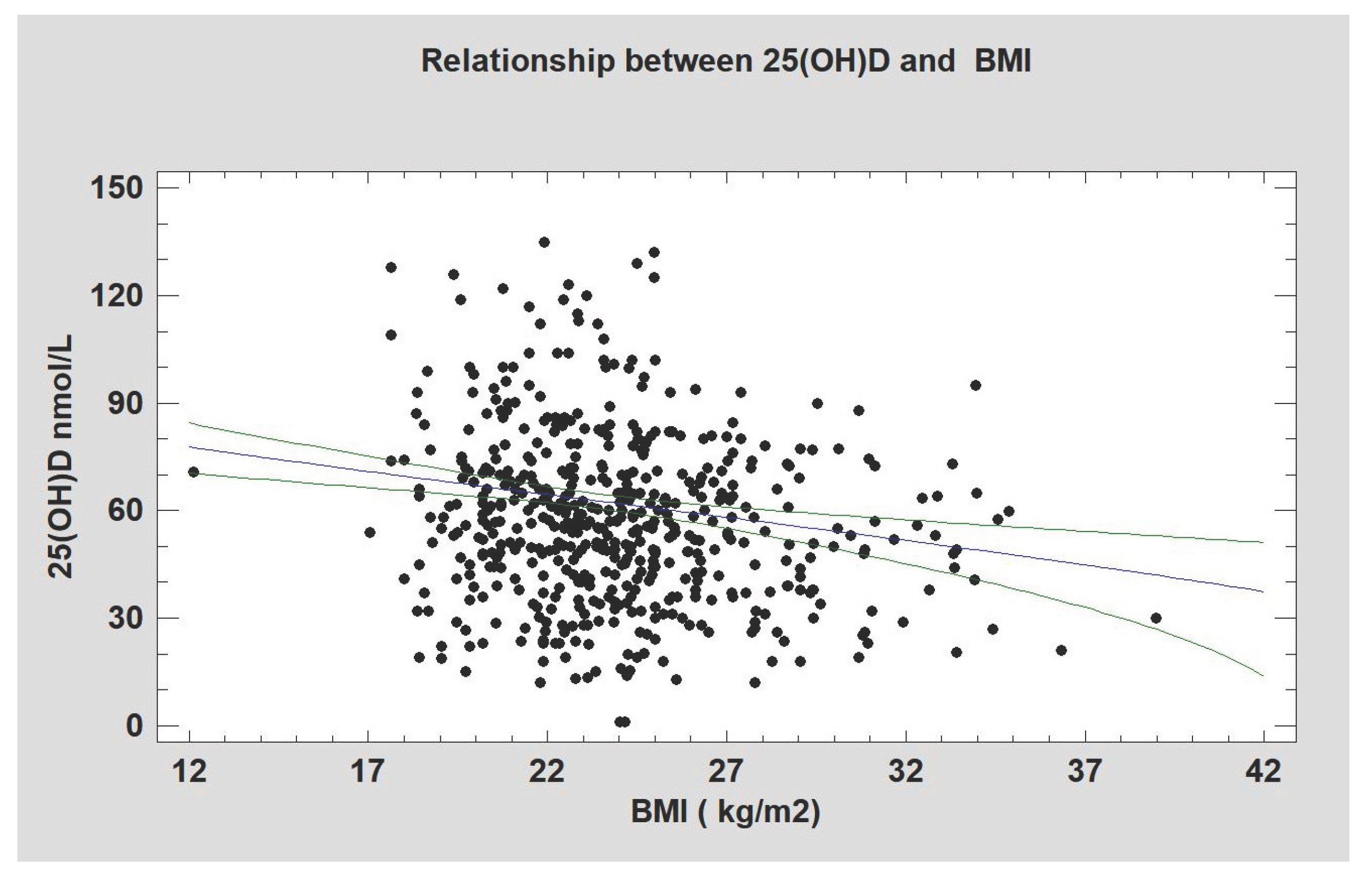
Figure 2.
A: Serum 25(OH)D concentrations (nmol/L) by month in the female subgroup (mean and 95% CI) adjusted for age and BMI. *p = 0.002 vs months from July to October. B: Serum 25(OH)D concentrations (nmol/L) by month in the male subgroup (mean and 95% CI) adjusted for age and BMI. *p = 0.001 vs months from May to December.
Figure 2.
A: Serum 25(OH)D concentrations (nmol/L) by month in the female subgroup (mean and 95% CI) adjusted for age and BMI. *p = 0.002 vs months from July to October. B: Serum 25(OH)D concentrations (nmol/L) by month in the male subgroup (mean and 95% CI) adjusted for age and BMI. *p = 0.001 vs months from May to December.
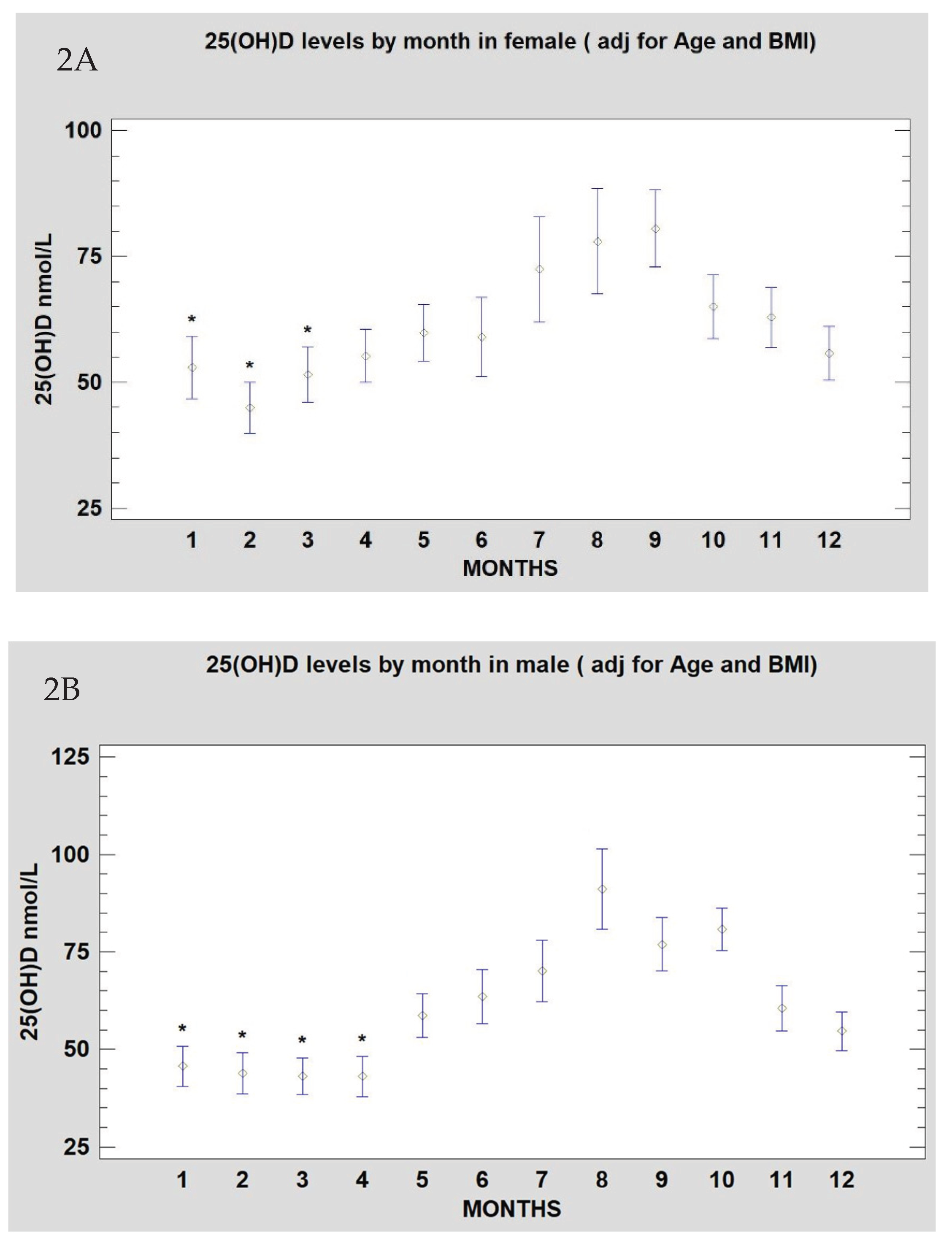
Figure 3.
A: Serum 25(OH)D concentrations (nmol/L) by month in the normal weight subgroup (mean and 95% CI). *p = 0.001 in January vs months from July to November and in February and March vs months from April to December. B: Serum 25(OH)D concentrations (nmol/L) by month in the overweight/obese subgroup (mean and 95% CI). *p = 0.001 vs months from August to December.
Figure 3.
A: Serum 25(OH)D concentrations (nmol/L) by month in the normal weight subgroup (mean and 95% CI). *p = 0.001 in January vs months from July to November and in February and March vs months from April to December. B: Serum 25(OH)D concentrations (nmol/L) by month in the overweight/obese subgroup (mean and 95% CI). *p = 0.001 vs months from August to December.
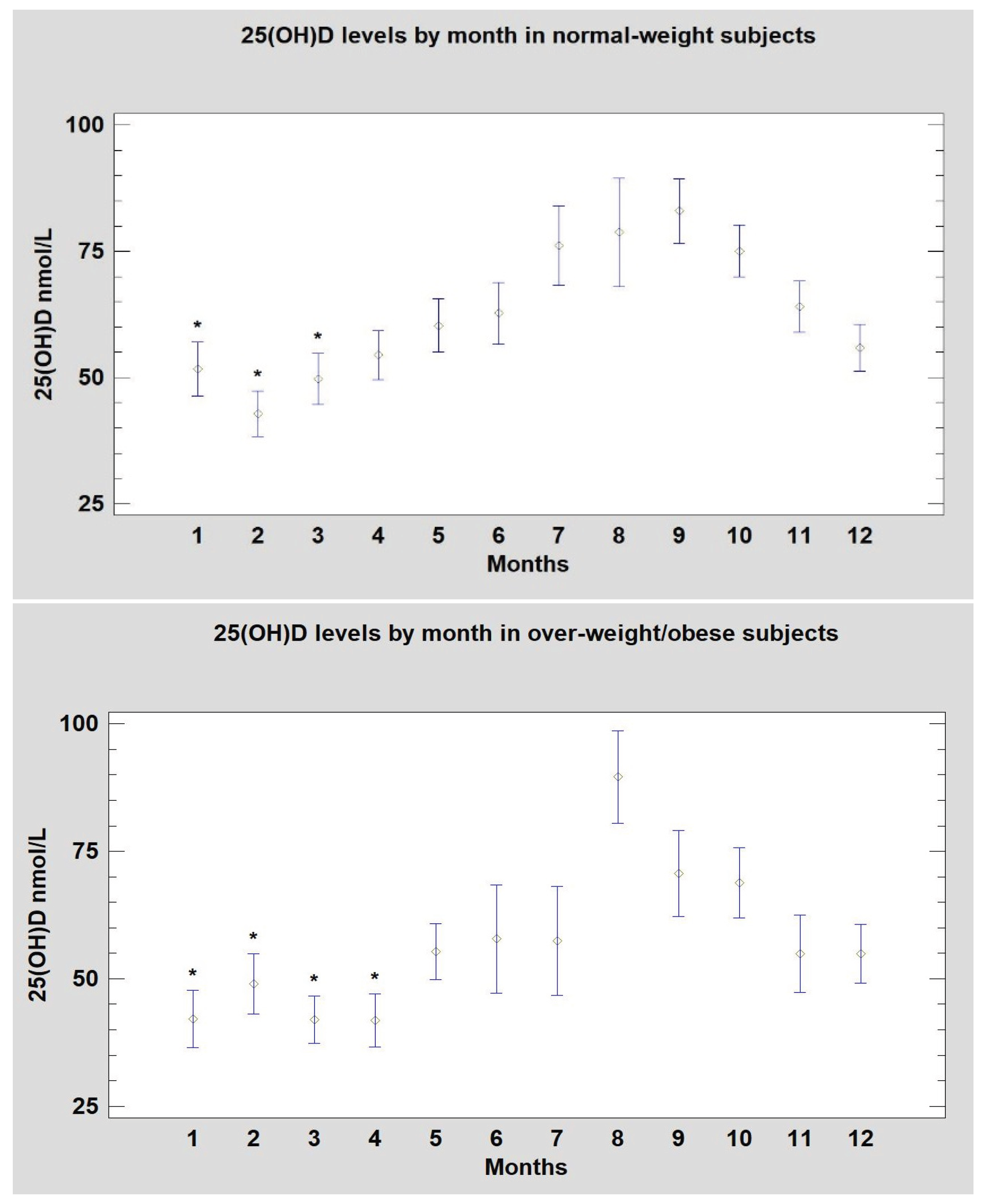
Figure 4.
Mean PM10 (ug/m3) concentrations in the air per year as revealed by industrial (black line) and background (blue line) monitoring stations of the Region of Veneto. The red line indicate the threshold values defined by Law (data from ARPAV as per license CC BY 3.0) [37].
Figure 4.
Mean PM10 (ug/m3) concentrations in the air per year as revealed by industrial (black line) and background (blue line) monitoring stations of the Region of Veneto. The red line indicate the threshold values defined by Law (data from ARPAV as per license CC BY 3.0) [37].
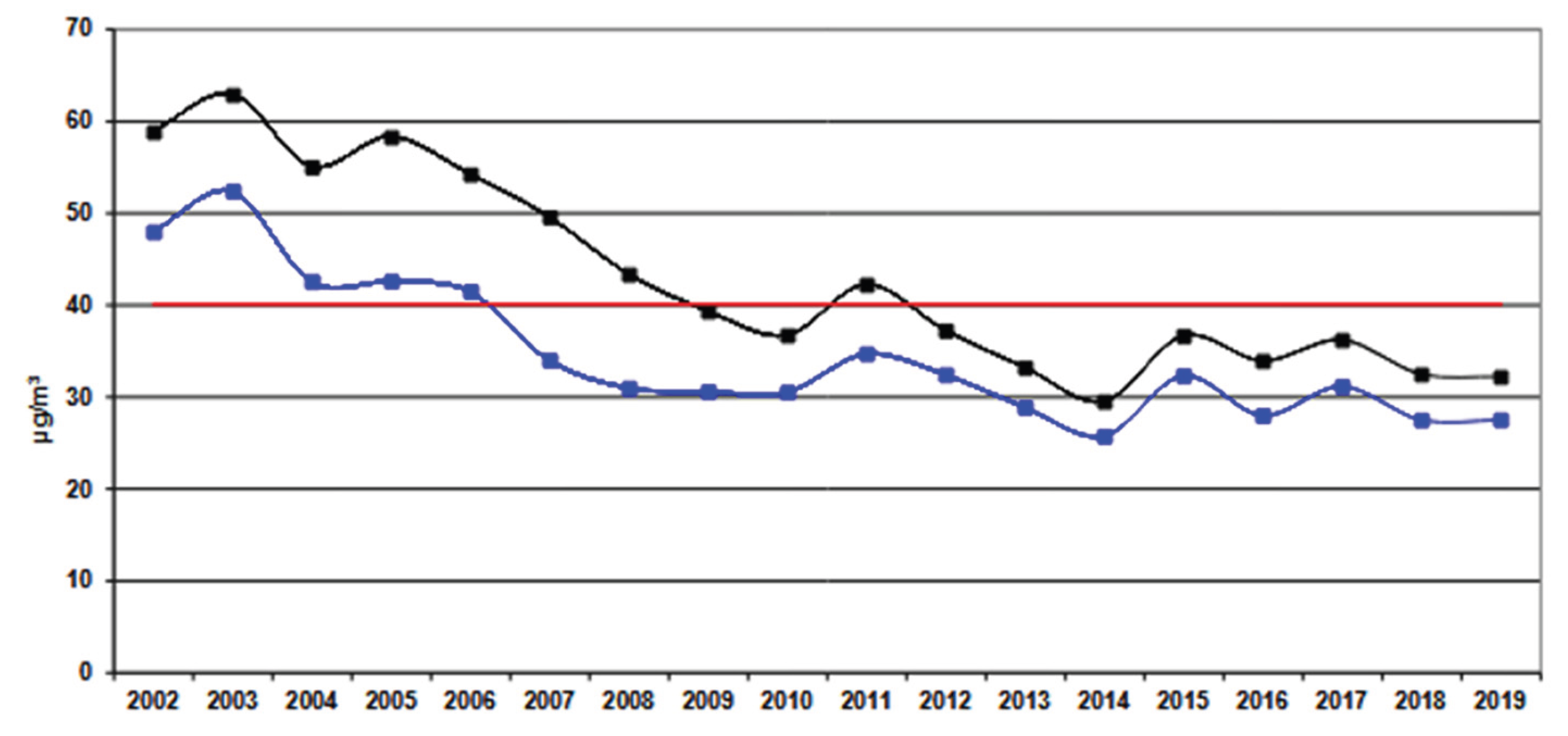

Table 1.
Demographic characteristic of subjects and 25(OH)D levels across the seasons (data are expressed as mean and CI 95%).
Table 1.
Demographic characteristic of subjects and 25(OH)D levels across the seasons (data are expressed as mean and CI 95%).
| All | Female | Male | ANOVA p value Between genders |
|
| n | 534 | 266 | 268 | |
| Age | 42.0 (40.9-43.0) | 38.0 (37.0-39.0) | 46.0 (45.0-46.9) | 0.001 |
| BMI | 23.9 (23.6-24.2) | 22.6 (22.3-22.9) | 25.2 (25.0-25.5) | 0.001 |
| 25(OH)D nmol/L | 57.0 (55.0-65.8) | 57.5 (55.5-59.5) | 56.7 (54.5-58.6) | 0.622 |
| 25(OH)D nmol/L # | 56.8 (54.8-60.3) | 56.0 (53.0-58.8) | 58.3 (55.3-61.0) | 0.456 |
| Spring # | 54.5 (50.8-58.3) | 56.8 (51.5-62.3)* | 52.0 (46.5-58.0)a | 0.446 |
| Summer # | 68.8 (63.5-74.0) | 66.8 (58.5-73.0)** | 70.3 (63.5-77.0) b | 0.919 |
| Autumn # | 70.0 (66.3-73.5) | 67.5 (62.0-73.0)** | 72.3 (67.3-77.3)b | 0.190 |
| Winter # | 48.3 (45.5-51.0) | 50.3 (46.5-54.3) | 46.3 (42.5-49.8) | 0.284 |
| 25(OH)D status^ | Chi-square | |||
| Insufficiency (<25 nmol/L) |
7.1% (38) | 6.8% (18) | 9.7% (26) | |
| Deficiency (25-49 nmol/L) |
31.1% (166) | 33.1% (88) | 29.9% (80) | 0.399 |
| Sufficiency (≥ 50 nmol/L) |
61.8% (330) | 60.1% (160) | 60.4% (162) |
# 25(OH)D levels (nmol/L) adjusted for age and BMI; ^ According to 2022 SIOMMMS guidelines [11]. Chi-squared 0.399, Comparison of prevalence of different 25(OH)D levels between female and male; * p=0.0001, 25(OH)D in Spring vs Summer and Autumn.; ** p=0.001, 25(OH)D in Summer and Autumn vs Winter; a) p=0.002, 25(OH)D in Spring vs Summer and Autumn; b) p=0.001, 25(OH)D in Summer and Autumn vs Winter.
Table 2.
Educational attainment and lifestyle characteristics in the overall cohort and in subjects with vitamin D deficiency (25(OH)D <50 nmol/L).
Table 2.
Educational attainment and lifestyle characteristics in the overall cohort and in subjects with vitamin D deficiency (25(OH)D <50 nmol/L).
| 25(OH)D <50 nmol/L |
|||
|---|---|---|---|
| N TOT | N (%) | OR (95% CI) | |
| Education (y) | |||
| < 8 | 82 | 37 (18.1) | 1+ |
| 9-15 | 325 | 120 (58.8) | 0.9 (0.55-1.62) |
| > 16 | 127 | 47 (23.1) | 0.9 (0.50-1.81) |
| Current smoker | |||
| No | 459 | 173 (84.8) | 1+ |
| Yes | 75 | 31 (15.2) | 1.2 (0.69-1.96) |
| Alcohol drinking | |||
| No | 167 | 60 (29.4) | 1+ |
| Yes | 370 | 144 (70.6) | 0.7 (0.44-1.11) |
| Fruit and Vegetable | |||
| 1 portion/day | 57 | 28 (13.7) | 1+ |
| 2 portions/day | 396 | 154 (75.5) | 1.0 (0.68-1.62) |
| 3 portions/day | 81 | 22 (10.8) | 0.8 (0.44-1.31) |
| Physical activity | |||
| < 2 hours/week | 215 | 101 (49.5) | 1+ |
| 2-5 hours/week | 213 | 67 (32.8) | 0.6 (0.39-0.91) |
| > 5 hours/week | 106 | 36 (17.7) | 0.6 (0.35-1.00) |
OR: odds ratio * multivariate estimates including in turn term education (years of studies), smoking, alcohol drinking, fruits and vegetables intake, physical activity. + Reference category.
Table 3.
Subjects with vitamin D insufficiency (<25 nmol/L), deficiency (25-49 nmol/L) and sufficiency (> 50 nmol/L) according to SIOMMMS criteria [11] among those with values at nadir (February/March).
Table 3.
Subjects with vitamin D insufficiency (<25 nmol/L), deficiency (25-49 nmol/L) and sufficiency (> 50 nmol/L) according to SIOMMMS criteria [11] among those with values at nadir (February/March).
| 25(OH)D levels at NADIR | All (65) | FEMALE (32) | MALE (33) |
|---|---|---|---|
| Insufficiency % (n) | 27.7 (18) | 21.9 (7) | 33.3 (11) |
| Deficiency % (n) | 30.8 (20) | 37.5 (12) | 24.3 (8) |
| Sufficiency % (n) | 41.5 (27) | 40.6 (13) | 42.4 (14) |
Chi-squared 0.908, Comparison of the prevalence of different 25(OH)D levels at nadir between females and males.
Table 4.
Demographic characteristics and 25(OH)D levels by SIOMMMS guidelines criteria [11] in the participants of the study stratified by BMI (normal weight or overweight/obese).
Table 4.
Demographic characteristics and 25(OH)D levels by SIOMMMS guidelines criteria [11] in the participants of the study stratified by BMI (normal weight or overweight/obese).
| Normal weight (370) | Overweight/Obese (164) |
p value | |
|---|---|---|---|
| F/M | 213/157, F 57.6% | 53/111, F 32.3% | |
| Age | 41.0 (40.2-41-9) | 44.1 (42.8-45.4) | 0.002 |
| BMI kg/m2 | 22.2 (22.0-22.3) | 28.0 (27.7-28-2) | 0.001 |
| 25(OH)D nmol/L | 59.3 (57.7-61.0) | 52.0 (49.5-54.5) | 0.002 |
| Insufficiency % (n) | 7.3 (27) | 10.3 (17)a | |
| Deficiency % (n) | 29.2 (108) | 36.6 (60)a | |
| Sufficiency % (n) | 63.5 (235) | 53.0 (87)a | |
| Nadir 25(OH)D (nmol/L) | 42.5 (40.0-44.8) | 41.3 (35.0-47.5) | 0.337 |
| Insufficiency (% at nadir) | 4.2 (3/71) | 10.0 (4/40) b | |
| Deficiency (% at nadir) | 33.8 (24/71) | 47.5 (19/40)b | |
| Sufficiency (% at nadir) | 62.0 (44/71) | 42.5 (17/40)b |
Data expressed as mean (95% CI); F: female, M: male, a Chi-squared 0.052, comparison of prevalence of different 25(OH)D levels in normal weight vs overweight/obese b Chi-squared 0.08, comparison of prevalence of different 25(OH)D levels at nadir between normal weight and overweight/obese.
Disclaimer/Publisher’s Note: The statements, opinions and data contained in all publications are solely those of the individual author(s) and contributor(s) and not of MDPI and/or the editor(s). MDPI and/or the editor(s) disclaim responsibility for any injury to people or property resulting from any ideas, methods, instructions or products referred to in the content. |
© 2026 by the authors. Licensee MDPI, Basel, Switzerland. This article is an open access article distributed under the terms and conditions of the Creative Commons Attribution (CC BY) license (http://creativecommons.org/licenses/by/4.0/).
Copyright: This open access article is published under a Creative Commons CC BY 4.0 license, which permit the free download, distribution, and reuse, provided that the author and preprint are cited in any reuse.


