
Submitted:
01 April 2026
Posted:
02 April 2026
You are already at the latest version
Abstract
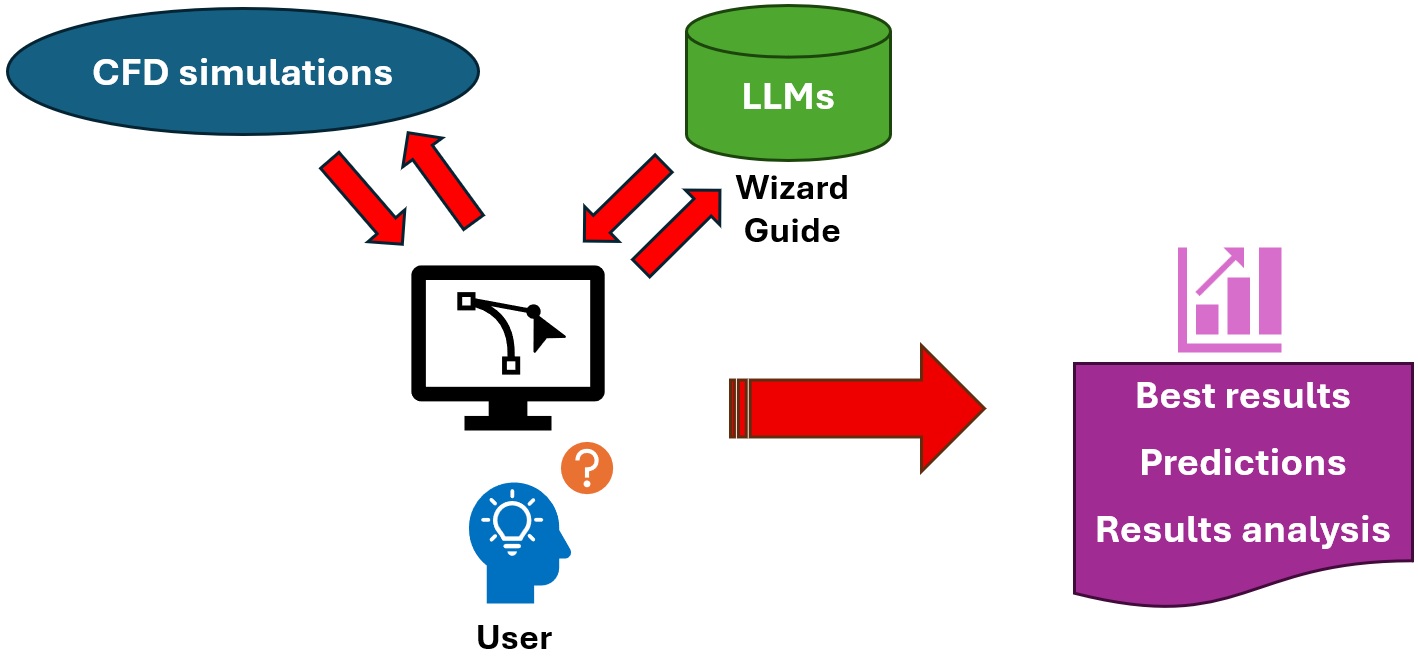
Currently, the applications of Large Language Models (LLMs) have expanded to diverse areas, from code generation to the medical diagnosis of various pathologies. This work aims to explore what LLMs can achieve using information from CFD simulations of turbulent flow in a manifold, and to determine whether users or students can employ them as a guide for conducting this type of analysis. Through a case study, it is intend to investigate the following aspects of LLMs: 1) the type of information they handle regarding the behavior of turbulent flow within a manifold, 2) whether they identify the boundary conditions necessary to perform a CFD simulation in a manifold, 3) their capacity to provide recommendations for improving CFD simulations based on the results obtained, 4) whether they can predict the results of CFD simulations based on previous results, and 5) whether users or students can use them as a guiding tool for performing CFD simulations. Among the findings, it was discovered that the LLM used has sufficient information on turbulent flows within a manifold and can make recommendations to improve the results of CFD simulations. It was also identified that LLMs offer a user-friendly environment and that it is possible to predict CFD simulation results by varying the manifold boundary conditions.
Keywords:
artificial intelligence
; large language model
; prompt engineering
; CFD simulations
; CAD model
Copyright: This open access article is published under a Creative Commons CC BY 4.0 license, which permit the free download, distribution, and reuse, provided that the author and preprint are cited in any reuse.


