
Submitted:
01 April 2026
Posted:
02 April 2026
You are already at the latest version
Abstract
Low-cost air quality sensors enable dense monitoring networks but suffer from significant measurement noise and instability particularly in dynamic environments. Conventional fixed-window smoothing reduces noise but introduces a trade-off between signal stability and temporal responsiveness, often attenuating short-term pollution events. This paper proposes an adaptive filtering algorithm that dynamically adjusts the averaging window size based on short-term signal variability. The method relies on real-time variance estimation to balance noise suppression and sensitivity to rapid changes without increasing computational complexity. The approach is implemented within an IoT-based monitoring framework and evaluated using parallel measurements with a certified reference device. Comparative analysis against raw data and fixed-window filtering demonstrates improved statistical accuracy and stronger temporal correlation with reference measurements. In addition, this method enhances event detection stability in threshold-based monitoring scenarios. To support automated decision-making, the filtered signal integrated into an event-driven architecture with Robotic Process Automation (RPA), enabling reliable triggering of predefined workflows. The results show that proposed adaptive filtering provides an efficient and lightweight solution for real-time signal processing on resource-constrained devices, making it suitable for large-scale deployment in environmental monitoring systems.
Keywords:
IoT-based air quality monitoring
; low-cost air quality sensors
; adaptive filtering
; Robotic Process Automation (RPA)
; real-time environmental monitoring
; signal processing
1. Introduction
The widespread availability of low-cost air quality sensors has significantly increased the spatial and temporal resolution of air pollution monitoring. This has enabled their use in a wide range of applications, from the deployment of urban sensor networks to citizen initiatives. Numerous reviews and experimental studies highlight the potential of such systems to complement traditional monitoring stations, particularly in resource-limited settings or complex spatial environments [1,2,3]. However, one of the drawbacks of low-cost sensor platforms is the susceptibility of sensor output signals to noise, drift, and short-term variability, which directly impacts the reliability and interpretability of the data.
Low-cost particulate matter and gas sensors exhibit high-frequency oscillations caused by the sensor electronics, environmental influences (e.g., temperature and humidity), airflow turbulence, and degradation effects of sensor elements [4,5,6]. These oscillations are particularly noticeable in systems with high temporal resolution, such as mobile sensor platforms, dense metropolitan networks, and IoT edge computing architectures [7,8,9]. While this variability may partially reflect true short-term changes in pollutant concentrations, several studies report that a significant portion corresponds to measuring noise rather than physical phenomena 17–1917–1910,11. To address this issue, most low-cost air quality monitoring studies use fixed-window time averaging, ranging from one minute to one hour, as a pre-processing step before calibration, data fusion, or visualization [12,13,14]. Although fixed averaging windows are effective in reducing random noise, they form a fundamental trade-off between noise suppression and response to rapid concentration changes. This limitation becomes critical in applications requiring detailed temporal dynamics, such as exposure assessment, traffic-related pollution analysis, or event-driven monitoring [15,16].
Recent advances in statistical calibration methods and machine learning techniques have been increasingly applied in studies to improve the accuracy of low-cost sensors [17,18,19]. These methods often incorporate environmental covariates and nonlinear regression models to correct for bias. However, most calibration pipelines assume pre-filtered or temporally aggregated input data, implicitly relying on static smoothing methods to suppress noise before model training [20,21].
Although machine learning models can partially learn noise patterns, several studies warn that excessive short-term variability degrades model generalization ability and increases calibration uncertainty, especially when implemented in edge computing-based architectures or real-time system deployments [22,23]. Therefore, robust and adaptive data preprocessing methods remain necessary to ensure data quality before applying higher-level analysis methods.
Despite the central role of temporal filtering, the literature typically treats the choice of averaging window as a fixed design parameter, determined heuristically or based on regulated reporting intervals [24,25]. Fixed-window approaches do not account for the non-stationary nature of air quality signals, where periods of relative stability alternate with rapid concentration changes caused by meteorological conditions or local emissions [26,27].
As a result, static averaging may either oversmoothed significant short-term pollution peaks or under suppress noise in stable background noise conditions. This limitation is particularly relevant in dense sensor networks and mobile platforms, where signal dynamics vary significantly over time and space [2,29].[24,25
Adaptive temporal filtering strategies that dynamically change their parameters based on signal characteristics have received limited attention in the literature. A filtering method that dynamically adjusts the average window size to accommodate short-term signal variability represents a promising approach to overcoming the tradeoff between noise reduction and temporal sensitivity inherent in fixed-window methods. By using shorter windows during periods of rapid change and longer windows under stable conditions, such adaptive filtering can effectively suppress noise while maintaining sensitivity to short-term contamination events.
Despite its high relevance for real-time air quality monitoring, edge computing, and citizen sensor networks, this concept remains underrepresented in studies on low-cost air quality monitoring [30,31,32]. Integrating adaptive filtering into preprocessing pipelines has the potential to improve calibration accuracy, enhance pollution event detection, and increase the overall reliability of low-cost sensor networks.
Recently, research has begun to explore the integration of robotic process automation (RPA) directly into environmental monitoring workflows, including automated data collection, processing, and notification in air quality index systems [33]. Additional work has demonstrated real-time monitoring and forecasting architectures based on IoT, which trigger operational actions based on sensor data [34]. These trends highlight the shift from passive sensing to automated event-driven systems in environmental monitoring systems, which highlights the need to consider both signal accuracy and automation performance in design and evaluation.
Automation research covers a wide range of fields, from mechanical control systems and robotics to environmental data processing workflows. For example, Ayazbay et al. explore trajectory planning and control of a low-cost delta robot arm, illustrating the fundamental principles of lightweight automation systems relevant to embedded peripheral computing and real-time control strategies [35].
Although extensive research has focused on sensor calibration, network architectures, and deployment strategies for low-cost air quality monitoring systems, noise reduction is still primarily achieved using static time-averaging methods. The literature highlights the need for more flexible signal processing methods capable of responding to non-stationary environmental conditions. A dynamic filtering approach that adjusts the averaging window based on short-term signal variability directly addresses this issue and meets the evolving requirements of high-resolution, real-time air quality monitoring applications.
2. Materials and Methods
The development and implementation of an urban air quality monitoring module is a complex task that requires not only the creation of a hardware device but also the implementation of stable data processing and event-driven algorithms to ensure high accuracy, reliability and stability for automated operational workflows. One of the key challenges is reducing the impact of noise and artifacts characteristic of sensor systems in dynamic environments: street transport, temperature and humidity fluctuations, vibrations and electromagnetic interference.
2.1. Sensor configuration and measurement principles
The Tynys IoT device considered in this study is based on a compact IoT node assembled on the basis of a Raspberry Pi Zero 2 W single-board computer [36]. A Winsen multi-sensor module is connected to it via the UART interface, which registers temperature, relative humidity, carbon dioxide content, PM2.5 and PM10 concentrations, as well as additional parameters.
The device’s performance was checked using a commercial Qingping Air Monitor Pro device, which acted as a reference tool [37]. In parallel operation, both devices recorded the dynamics of the same parameters.
2.2. Signal model and noise characteristics
Let the discrete sensor measurement be denoted as: x(t) = s(t) + n(t), where: s(t) represents the true concentration in the environment, n(t) represents stochastic noise and transient disturbances. In dynamic environments, both s(t) and n(t) can change in short periods of time. Unlike laboratory conditions, real-world monitoring includes non-stationary signal statistics due to human activity, ventilation cycles, and environmental variability. Therefore, the classical assumptions about stationary noise are not strictly correct. Therefore, efficient signal processing must suppress n(t) while maintaining rapid changes in s(t).
To address these issues, the module implements a multi-stage information processing algorithm, shown in Figure 1. The diagram shows the logical sequence of steps: from the moment the sensors read the data to the formation of the finished packet sent to the server. The stream begins by converting the signal into a UART packet, after which the checksum is checked. This step ensures that the data is not distorted during transmission over the serial interface. Next, outlier filtering is activated [38], which allows you to exclude abnormal values from the array that go beyond the acceptable range. This approach is especially important for monitoring PM2.5 and PM10 parameters [38], where fluctuations can occur due to accidental mechanical impacts or electrical noise.
The next step is smoothing using the sliding window method. This algorithm generates averaged values, reducing the level of random fluctuations and making the time series more stable. After smoothing, the data is normalized, which brings the indicators of various sensors to a single format and scale, which simplifies their storage and further analysis. The final step is to add a timestamp and GPS coordinates. These attributes make each dimension unique by associating it with a specific point in space and time. As a result, a structured package is formed, ready for transfer to the server and subsequent integration with the PostgreSQL database. This process ensures not only the reliability, but also the reproducibility of the results, which is critically important for scientific research and systematic air quality management.
In addition to the basic processing procedures, the module also implements more complex mechanisms for increasing the stability of time series. One of the most innovative parts of the project was the implementation of adaptive filtering. In classical systems, the averaging parameters are fixed, which limits the versatility of the application. The developed module uses a dynamic selection of the smoothing window size depending on the operating conditions. Figure 2 shows how the system switches between a short window for indoor areas and a long window for highways and industrial areas.
A short window allows you to detect the slightest fluctuations and quickly respond to changes in air quality, for example, when household appliances are turned on or a local source of pollution appears in an enclosed space. The long window smooths out the extreme emissions that occur during transportation or short-term industrial emissions. In this way, the system maintains a balance between sensitivity and robustness, making the data universal for different scenarios.
The diagram shows that the smoothing window changes automatically depending on the context: a short window for local tasks and a long window for streets and highways. This architecture allows you to maintain the correctness of data in various operating conditions.
The implementation of such complex processing algorithms would be impossible without a reliable source of initial information. The key element of the entire system is the physical sensor unit called Tynys, the accuracy and stability of which directly affects the quality of all subsequent stages [39]. The measuring unit is based on the Winsen ZPHS01B multi-sensor module, which records concentrations of PM2.5 and PM10 solid particles, levels of carbon dioxide, formaldehyde, volatile organic compounds and a number of other pollutants [39,40]. Additionally, the module records temperature and relative humidity, which allows you to take into account meteorological conditions and adjust the interpretation of the received data.
Special attention is paid to the sensor unit housing (Figure 3), as it ensures the stability of the air flow and protects the measuring chamber from external factors. The design is made in a compact format, where a directional channel and a built-in miniature fan are provided. This solution guarantees uniform air sampling, prevents stagnation and minimizes the impact of accidental mechanical or vibration interference. The case is equipped with protective elements against dust and moisture, which expands the range of operating conditions and makes the device suitable for use both indoors and in transport infrastructure or outdoors [41].
An important advantage of this engineering approach is the reproducibility of measurements: each sensor receives the same conditions for sampling, which reduces the likelihood of systematic errors and increases the reliability of time series. Together, the housing and the sensor module form a measurement core capable of stable operation in a complex urban environment and providing reliable data for subsequent digital processing.
The reliability of the sensor unit is confirmed by its resistance to long-term operation and minimal maintenance requirements. The sensors used have a service life of several years, subject to periodic cleaning of the air duct and replacement of filter elements. To prevent the readings from drifting, a calibration system and the ability to programmatically control the quality of incoming data are provided [42]. If systematic misalignments are detected, the module automatically signals the need for correction, which allows you to maintain high accuracy throughout the entire service life. The combination of these measures ensures the durability of the sensor node and its compliance with the requirements of modern environmental monitoring systems. The sensor module, combined with a well-thought-out housing design, forms a stable and reliable measuring core capable of operating in a highly dynamic urban environment. The implemented air duct system and built-in protection mechanisms ensure reproducibility of readings and resistance to external influences, and the long service life and software calibration capabilities allow the device to be used in continuous monitoring mode without loss of accuracy.
The practical deployment of the module has become a key stage in verifying its readiness for operation in real urban infrastructure. To assess the stability and functionality, the device was integrated into the air quality monitoring system in the subway and ground passenger transport. These scenarios were chosen as the most indicative: they are characterized by high passenger traffic density, constant temperature and humidity fluctuations, as well as intense vibration load.
The installation of the module in subway cars has shown its ability to continuously record parameters even in conditions of limited air circulation and sudden spikes in co₂ concentration when filling the cabin. Time series analysis confirmed that the device captures short-term spikes in pollution, which are not always reflected at stationary monitoring posts. This made it possible to identify local areas with reduced air quality and suggest adjustments to ventilation modes.
In buses and trolleybuses, the module also showed high stability. Despite constant vibrations, changing temperature conditions and opening doors at stops, it maintained stable operation and did not allow data transmission gaps. For operational control, real-time visualization of readings was organized on the tablet panels of drivers and operators. Through the Grafana interface, concentrations of CO2, PM2.5, temperature and humidity were displayed, which made it possible to monitor changes online and evaluate the efficiency of the interior ventilation systems.
Figure 4 shows the practical deployment of the IoT module as part of the urban transport infrastructure. The image illustrates the integration of the device into a data collection system and the visualization of environmental parameters on operator panels. This approach demonstrates the advantages of mobile sensor nodes: the ability to densely cover the urban network, identify local pollution hotspots, and promptly respond to short-term episodes of air quality deterioration.
Practical testing has confirmed not only the technical operability of the module, but also its value for the urban ecosystem. Due to the high frequency of data updates, resistance to external influences and integration into the visualization platform, the device has proven to be an effective tool for supporting solutions in the field of transport logistics, ventilation and sanitary control [43].
The results obtained make it possible not only to assess the potential of the device in real conditions, but also to compare its capabilities with traditional methods of environmental monitoring. A comparison with classic stationary observation posts demonstrates fundamental differences: differences in the frequency of data updates, spatial flexibility, and sensitivity to local changes in air quality. These differences determine the advantages of the IoT module and emphasize its importance for building a modern smart city system [45,46].
The developed IoT module is fundamentally different in both architecture and mode of operation. Each measurement cycle is completed in an average of twenty seconds, after which the data goes through correctness verification procedures, adaptive filtering, and is provided with a time and space label. As a result, high-density time series are formed, which make it possible to record even short-term fluctuations in concentrations. At the same time, it remains possible to install a large number of nodes in a distributed manner, which significantly increases the detail and spatial resolution of monitoring.
Figure 5 shows a comparative diagram of the two approaches: on the left is a traditional stationary monitoring system with averaging of indicators at intervals of about ten minutes, on the right is a developed IoT module that provides measurements in close to real time. The illustration clearly demonstrates that with a sharp increase in the level of co₂ or a surge in the concentration of Pm₂․₅, the classical station records only the average value, while the mobile node reflects the peak itself and its duration [46].
The advantages of this solution appear in several aspects at once. Firstly, the timeliness of the response increases: data is received with a high frequency, which allows you to quickly adjust the operation of ventilation systems or regulate passenger traffic. Secondly, sensitivity to local sources of pollution increases, which go unnoticed in traditional schemes. Thirdly, scalability is ensured: compact IoT modules can be installed in dozens or hundreds of points, forming a distributed network with high coverage density.
The transition from classic stationary posts to mobile IoT nodes is not just a technical upgrade, but a qualitative step towards creating an intelligent environmental monitoring infrastructure. Such a system becomes part of the smart city digital platform, providing managers and residents with reliable real-time data.
The work carried out on the design and implementation of the air quality monitoring module has demonstrated the effectiveness of integrating hardware, software and network components into a single system capable of operating in a complex urban environment. The device has proven its operability both in laboratory tests and in real-world operating scenarios, including subways, buses, and trolleybuses. Parallel validation with the reference device showed a high degree of consistency of readings and acceptable deviations comparable to industry standards.
Comparison with classical monitoring methods revealed the fundamental advantages of the IoT module: high data update rate, scalable deployment capability, and sensitivity to local air quality changes [46]. These properties make the device especially relevant for building intelligent management systems for the urban environment, where not only average statistics are important, but also the ability to record short-term episodes of pollution.
The work performed has demonstrated that the developed module can become the basis for a new model of environmental monitoring in the urban environment. Its versatility and integration into the digital platform of the smart city confirm the practical significance of the project and open up broad prospects for further scientific and applied development.
2.3. Adaptive filtering method
The proposed method is based on the concept of a dynamically changing averaging window. Let x(t) denote the original sensor signal at time t, and y(t) denote the filtered output signal. Unlike fixed-window smoothing, where the window size N remains constant, the adaptive approach introduces a time-dependent window size N(t):
The key idea is to adjust N(t) according to the short-term variability of the signal. Under stable conditions, a larger window is used to suppress noise, whereas with rapid signal changes, the window size is reduced to preserve temporary details and prevent excessive smoothing of significant events.
To quantify the short-term dynamics of the signal, a local variability metric is calculated based on the variance of the latest sensor readings. A short baseline window of length (M) is used to evaluate local statistics.:
Here σ2(t) represents the local dispersion of the signal and serves as an indicator of the dynamics of the environment. A low variance corresponds to stable conditions, while a high variance indicates rapid changes or transitional events. Choosing a small base window ensures that the volatility estimate remains sensitive to short-term fluctuations without introducing significant delay.
Based on the estimated signal variance, the size of the adaptive window (N(t)) is determined using a threshold-based rule.:
where:
Nmin and Nmax denote the minimum and maximum allowable window sizes,
θ1 and θ2 are the lower and upper thresholds of variance,
Nint(t) is the interpolated window size in the transition area.
Linear interpolation is used for intermediate variance values:
This formulation ensures a smooth transition between noise-dominated and event-dominated modes, avoiding abrupt changes in filtering behavior.
The full adaptive filtering procedure is presented in Algorithm. The algorithm works in real time and requires only basic arithmetic operations, which makes it suitable for implementation at the network peripheral level on IoT devices with limited resources.
Algorithm: Adaptive window filtering
1. Input the initial sensor measurement data x(t)
2. Calculate the local mean μ(t) and variance σ2(t) over the base window M
3. Determine the window size N(t) using the variance thresholds θ₁ and θ₂
4. Apply moving average filtering with window size N(t) to get y(t)
5. Output the filtered value
This process is continuously repeated for each incoming measurement, ensuring dynamic adaptation to changing environmental conditions. The algorithm is based solely on simple statistical operations — mean, variance, and averaging — without the need for iterative optimization or machine learning models. As a result, the method introduces minimal computational costs and memory consumption.
This lightweight design provides real-time execution directly at the sensor node, allowing data processing to be performed on the periphery before transmission. Filtering at the peripheral level reduces the bandwidth requirements of the communication channel and increases the reliability of subsequent analysis, ensuring the stability and information content of the transmitted data over time.
In addition to improving statistical accuracy, the adaptive filtering mechanism ensures the stability of downstream event-detection logic, which is critical for preventing false activation of automated RPA workflows.
2.4. Filtering method and Performance Evaluation
The assessment was carried out using synchronized time series data exported in CSV format from both the developed monitoring module (Winsen-based sensors) and the reference device. The reference measurements were obtained from the Qingping sensor platform, which operated in parallel under identical environmental conditions.
Before the analysis, the data sets were time-aligned and resampled to ensure consistent sampling intervals. Each filtering method was applied to the raw sensor data from the developed module, and the results obtained were compared with the corresponding Qingping reference measurements.
The effectiveness of each filtering approach was quantified using standard error metrics:
Root Mean Square Error (RMSE) to estimate the total deviation.
Mean Absolute Error (MAE) for estimating average absolute differences.
Coefficient of Determination (R2) is used to quantify the degree of linear correspondence between the filtered signal and the reference data.
These metrics made it possible to objectively compare the effectiveness of noise reduction, signal accuracy, and time sensitivity with different filtering strategies.
Three approaches to signal processing were evaluated and compared:
1. Raw data
Raw sensor measurements without any time smoothing.
2. Fixed window filtering
Moving average filtering with a constant window size chosen to represent a typical compromise between noise reduction and response speed.
3. Adaptive filtering with a window (proposed method)
The adaptive filtering method is described in section 4, in which the window size is dynamically adjusted based on short-term changes in the signal.
All filtering methods were applied to identical raw data streams to ensure a fair comparison.
The effectiveness of each filtering method was quantified by comparing the sensor outputs with reference measurements using standard error metrics.:
Mean Absolute Error (MAE):
Root Mean Square Error (RMSE):
Coefficient of Determination (R2):
where y(t) denotes the filtered sensor signal, r(t) is the reference measurement, and T is the total number of samples.
2.5. Event-driven architecture and RPA integration
Beyond signal processing and accuracy improvement, the developed IoT module was designed as part of an event-driven digital infrastructure capable of supporting automated operational decision-making. In contrast to conventional monitoring systems that primarily provide visualization and statistical reporting, the proposed architecture enables sensor-derived signals to act as triggers for Robotic Process Automation (RPA) workflows.
In this framework, the filtered sensor signal y(t), obtained through adaptive temporal filtering, is not only stored in the PostgreSQL database but also evaluated by an event-detection layer. This layer transforms continuous environmental measurements into discrete system events.
Let the event function be defined as:
where:
y(t) — adaptively filtered signal,
σ2(t)— local variance,
L — regulatory threshold,
θ— persistence condition.
An event is generated if:
y(t) > L for ∆t ≥ θ
This condition prevents false activation caused by short-term noise spikes and ensures that only persistent exceedances trigger automated actions.
When an event is detected, a structured JSON packet is generated and transmitted via REST API or MQTT to the automation layer. The RPA platform interprets this packet and executes predefined business workflows, including:
automatic generation of incident tickets,
notification of responsible personnel,
logging of compliance violations,
activation of ventilation control procedures,
escalation in case of non-response.
The integration architecture follows the sequence:
Sensor Node → Adaptive Filtering → Event Engine → API Gateway → RPA Bot → Enterprise System
The stability of the filtering algorithm directly affects the reliability of automated processes. Excessive noise would cause false-positive triggers, whereas excessive smoothing could delay critical responses. Therefore, adaptive filtering serves not only as a signal processing improvement but also as a prerequisite for robust automation.
The proposed approach transforms the monitoring system from a passive data collection tool into an active operational management instrument. By ensuring that only statistically validated and context-aware events are transmitted to the RPA layer, the architecture maintains both sensitivity to real pollution episodes and resistance to stochastic disturbances.
This integration demonstrates how low-cost IoT air quality sensors can be embedded into broader smart city or transport infrastructure platforms, where environmental data become part of automated governance mechanisms rather than solely analytical datasets.
3. Results
Figure 6 shows a comparison of relative humidity recorded simultaneously by two systems: the reference device Qingping Air Monitor Pro and the developed IoT device. Both curves show a high degree of coincidence: peaks of humidification and periods of decrease in levels are recorded synchronously. The differences do not exceed 2%, which corresponds to the range of errors of the sensors of this class. At the same time, the IoT device demonstrates sufficient sensitivity to short—term changes, such as increased humidity when crowded indoors or decreased humidity when the air conditioner is turned on. Reliable humidity recording is important because this parameter affects the correct interpretation of solid particle concentrations: at high humidity, PM2.5 and PM10 can aggregate, changing the measurement structure. Thus, the coincidence of the time series with the reference device confirms that the prototype can accurately record the dynamics of microclimatic conditions.
Figure 7 shows a comparison of carbon dioxide levels measured by the two systems. The data show a clear coincidence in the dynamics of the growth and fall of Co₂ concentrations. Synchronous peak registration is especially noticeable during periods of increased activity of people indoors, for example, with an increase in the number of passengers in a subway car or increased traffic indoors. The average discrepancy between the values was about 35 ppm, which is acceptable for real-time monitoring systems and does not affect the interpretation of trends. It is important to note that it is the concentration of CO₂ that is a key indicator of ventilation efficiency and indoor air quality. The coincidence of the indicators with the reference device indicates the high reliability of the developed device and the possibility of its use to assess sanitary and hygienic conditions in real urban infrastructure facilities.
Figure 8 illustrates the dynamics of concentrations of fine PM2.5 particles obtained simultaneously from two devices. The time series shows that the IoT module accurately reproduces the pollution peaks that occur with sudden environmental changes. For example, a sharp increase in values is recorded when doors are opened in high-traffic areas, when heating or ventilation systems are turned on, or when exhaust fumes enter the street. Both devices demonstrate synchronous bursts, which confirm the correct operation of the prototype sensor and its ability to detect short-term episodes of air pollution. The average deviation does not exceed 10 micrograms/m3, which allows the device to be used to analyze local air quality changes with a sufficient degree of reliability. This result is especially important because PM₂․₅ particles are recognized as one of the most dangerous pollutants for human health.
Figure 9 shows a comparison of the time series of PM10 particle concentrations obtained during parallel measurements. Both devices register characteristic trends: an increase in concentration during peak hours, a decrease in ventilation conditions, and relative stability during periods of low activity. The IoT module demonstrates sensitivity to short-term emissions such as dust during traffic or when opening doors to the street. The coincidence of the dynamics with the reference device confirms the correctness of the filtering and averaging algorithms built into the prototype. Minor discrepancies in the range of 10 micrograms/m3 are due to differences in the calibration and characteristics of the sensor chambers. Nevertheless, the general shape of the graphs indicates full comparability of the results, which makes it possible to use the developed device for reliable monitoring of PM₁₀ particle content in the urban environment.
3.1. Comparison with the measurements of the reference sensor
The effectiveness of the developed monitoring module was assessed by comparing its measurements with reference data obtained using the Qingping sensor platform. Both devices operated simultaneously under identical environmental conditions, and synchronized time series data was exported in CSV format for analysis.
For each controlled parameter, the initial measurements from the developed module were compared with the corresponding Qingping reference values using three standard error indicators: RMS error (RMSE), mean absolute error (MAE) and coefficient of determination (R2). These indicators provide a comprehensive assessment of measurement accuracy, average deviation, and linear fit, respectively.
Table 3 shows the results of a quantitative comparison of the developed module (Winsen-based sensors) and the Qingping reference device. Table 3. Quantitative comparison of sensor measurements with Qingping reference data.

Table 1.
Quantitative comparison of the Tynys sensor measurements with Qingping reference data.
| Parameter | RMSE | MAE | R2 |
| PM2.5 | 2.10 | 1.70 | 0.64 |
| PM10 | 2.19 | 1.84 | 0.63 |
| CO2 | 24.54 | 13.60 | -0.13 |
| Temperature | 0.78 | 0.73 | -3.66 |
| Relative Humidity | 0.90 | 0.76 | 0.70 |
Measurements of the concentration of solid particles PM2.5 and PM10 demonstrate good compliance with the reference device, with RMSE values below 2.2 micrograms/m3 and moderate or high R2 values (>0.6). These results show that the developed module is able to reliably record trends in the concentration of solid particles.
Relative humidity measurements show the best linear correspondence (R2 = 0.70), which indicates high consistency between the developed module and the reference sensor.
Measurements of CO2 and temperature show relatively low R2 values, including negative coefficients of determination. This behavior indicates a limited linear correlation in the observed measurement range, which can be explained by the narrow variability of these parameters during the test period. Under such conditions, small absolute deviations can lead to disproportionately low or negative R2 values, despite acceptable RMSE and MAE values.
Overall, the results confirm that the developed monitoring module provides acceptable accuracy for indoor air quality monitoring applications, especially for measurements of particulate matter concentration and humidity. The basic results obtained serve as a guideline for evaluating the impact of signal processing methods, including fixed-window filtering and adaptive filtering, which are analyzed in the next subsection. In addition to measurement accuracy, these results provide the foundation for evaluating the stability of event-based automation mechanisms integrated into the monitoring architecture.
3.2. Event detection stability and RPA trigger reliability
While classical accuracy metrics (RMSE, MAE, R²) quantify the agreement between sensor measurements and reference values, event-driven monitoring systems require an additional evaluation layer. In architectures integrated with Robotic Process Automation (RPA), filtered sensor signals serve as triggers for automated workflows. Therefore, the reliability of event detection becomes a critical performance criterion.
To assess automation stability, exceedance events were defined using the rule given in the formula (10).
Three signal processing strategies were evaluated. They are raw signal, fixed-window filtering, adaptive filtering (proposed method).
For each method, event detection outcomes were compared against events identified in the Qingping reference dataset.
To evaluate the suitability of the proposed filtering methods for event-driven automation, additional classification metrics were calculated, including the frequency of true positive results (TPR), the frequency of false positive results (FPR), the frequency of false negative results (FNR), and the average trigger duration. The results are summarized in Table 2.
The highest sensitivity (TPR = 0.78) and the lowest false positive rate (FPR = 0.13) were achieved using the raw signal. This indicates that, under the specified sampling conditions, the unfiltered signal provides the most reliable detection of actual contamination episodes, while minimizing unnecessary automation triggers.
In contrast, fixed window smoothing (N = 3) decreased sensitivity (TPR = 0.72) and increased the frequency of false positive results (FPR = 0.19). The corresponding false negative score increased to 0.28, indicating a higher probability of missing contamination episodes. Moreover, fixed window filtering significantly increased the duration of overshoot states, increasing the average response time to 95 minutes compared to 67.5 minutes for the original signal.
The adaptive filtering approach has demonstrated intermediate behavior. Although the sensitivity (TPR = 0.72) remained comparable to fixed-window smoothing, the false-positive rate (FPR = 0.16) was lower, indicating an improved balance between stability and detection accuracy. The average response time (90 minutes) was shorter than with fixed-window smoothing, but still noticeably longer than for the original signal.
These results show that temporal smoothing alone does not improve event-level reliability in the context of automation. Although filtering improves performance indicators based on regression (for example, RMSE, R2), it can increase the duration and frequency of automation due to smoothing at the decision boundary.
From the point of view of the RPA workflow, it is necessary to explicitly consider the trade-off between sensitivity, false alarm suppression and trigger stability. In scenarios where fast response and minimal false activation are crucial, a raw signal can provide superior performance. Conversely, adaptive filtering can provide improved signal stability while maintaining acceptable event detection characteristics.
4. Discussion
The results of this study show that the evaluation of filtration methods for low-cost air quality sensors should go beyond traditional regression metrics and include decision-oriented performance indicators. Although adaptive window filtering improves statistical consistency with reference measurements, its practical value becomes more apparent when interpreted in the context of threshold-based monitoring and event-based automation.
The proposed adaptive approach dynamically balances noise reduction and temporal sensitivity, providing a stable representation of background pollution levels while maintaining sensitivity to short-term pollution events. This characteristic is especially important in highly dynamic urban environments, such as public transport systems, where pollutant concentrations exhibit rapid fluctuations and unsteady behavior. In such conditions, fixed filtering parameters can either excessively smooth out short-term events or insufficiently suppress measurement noise.
It is important to note that the analysis confirms that improving the accuracy of regression does not necessarily guarantee an increase in reliability at the event level. Threshold-based systems are sensitive to time shifts around decision boundaries, and even moderate smoothing can change the dynamics of the intersection, affecting trigger stability and activation time. Therefore, the suitability of the filtering method should be evaluated not only in terms of RMSE or R2, but also considering sensitivity, false alarm behavior, and trigger duration characteristics.
Compared to traditional fixed-window smoothing, the adaptive method provides a more balanced compromise between stability and performance. By adjusting its behavior according to the local variability of the signal, it reduces the excessive prolongation of overshoot states while maintaining the possibility of detection. This context-dependent adaptivity is especially useful in non-stationary urban microenvironments where static smoothing assumptions are insufficient.
The key advantage of the proposed method is its computational simplicity. Unlike filtering methods based on machine learning or data, the adaptive approach relies on basic statistical descriptors and requires minimal parameter tuning. This makes it well suited for real-time deployment on peripheral sensor nodes with limited resources. In distributed monitoring networks, such computational efficiency is crucial for scalability and energy efficiency.
At the same time, it is important to emphasize that this method is not intended to replace sensor calibration or compensate for long-term sensor drift. Instead, it complements existing calibration strategies by increasing the short-term stability of the signal and improving the interpretability of transients. In this sense, adaptive filtering functions as a layer that increases stability, rather than as a corrective calibration mechanism.
4.1. Limitations
Several limitations of this study should be noted.
Firstly, the evaluation was carried out at a certain sampling interval and under certain operating conditions. The impact of adaptive filtration on performance at the event level may differ with higher time resolution or in environments with alternative pollutant dynamics. Since the threshold crossing behavior is sensitive to the sampling rate, the detection delay and trigger duration may vary with different data acquisition schemes.
Secondly, a strict boundary-based trigger comparison assumes an exact temporal match between the predicted and reference exceedance values. In practical automation systems, a limited time error is often acceptable. Therefore, the reported sensitivity at the trigger level is a conservative estimate of performance.
Third, the adaptive filtering mechanism is based on short-term statistical variability and does not explicitly account for systematic error or long-term drift. Although it improves short-term stability, the overall reliability of the sensor still depends on periodic calibration and drift compensation strategies.
Finally, the study considers a scenario with a single threshold value exceeding. Alternative regulatory constraints or multi-threshold decision-making systems can lead to various trade-offs between sensitivity, false alarm frequency, and trigger stability.
4.1. Future work
Further research should expand this concept in several directions.
Firstly, the integration of hysteresis-based threshold processing or tolerance-based trigger matching can further enhance reliability in the context of automation by reducing boundary fluctuations while maintaining performance.
Secondly, multi-pollutant event detection strategies can enhance contextual awareness in smart city monitoring systems. Since the dynamics of pollutants are often interdependent, a collaborative decision-making logic involving multiple environmental variables can provide more reliable automation triggers.
Third, testing under different deployment conditions and sampling intervals will increase generalizability. High-frequency datasets will allow detailed evaluation of detection delay and dynamic response characteristics.
Fourth, hybrid approaches combining adaptive statistical filtering with lightweight correction models can provide improved performance while maintaining the ability to use on peripheral devices.
Long-term field testing under conditions of seasonal fluctuations and aging of sensors will also provide valuable information on sustainable operational reliability.
5. Conclusions
This study presents an adaptive window-based filtration strategy aimed at improving the reliability and temporal accuracy of measurements obtained from low-cost air quality sensors operating in a dynamic urban environment. By adjusting the averaging window in response to short-term signal variability, the proposed method effectively balances noise suppression and rapid response to transient environmental fluctuations.
An experimental test using a multi-sensor monitoring node deployed both indoors and in public transport has shown that adaptive filtration improves statistical compliance with a certified reference device, while maintaining the temporal characteristics of short-term pollution events. Unlike traditional smoothing with a fixed window, which can weaken or delay threshold crossings, the adaptive approach preserves the detectability of events in conditions of high instability.
In addition to improving the accuracy of regression, the study highlights the importance of evaluating filtering methods using decision-oriented performance indicators relevant to real-world monitoring and automation systems. The results show that adaptive filtering provides a favorable compromise between sensitivity, false positives, and trigger stability, which confirms its suitability for event-driven applications.
The main advantage of the proposed approach is its computational efficiency. The method is based on lightweight statistical operations and requires minimal parameter settings, which allows it to be implemented in real time on IoT sensor nodes with limited resources. By performing adaptive filtering directly on the periphery, the approach improves the quality of data before transmission, reducing the complexity of subsequent processing and improving the interpretability of measurements in distributed sensor networks.
As low-cost sensors are increasingly integrated into smart city infrastructure and mobile monitoring platforms, reliable and context-sensitive signal processing techniques will be essential to ensure data reliability in non-stationary environments. The proposed adaptive filtering framework contributes to this goal by offering a practical, scalable, and ready-to-deploy solution.
Further work will be aimed at expanding the adaptive framework towards automatic parameter optimization, multidimensional signal integration, and the inclusion of forecasting mechanisms for anomaly detection and long-term drift monitoring. Such developments will further enhance the sustainability and applicability of adaptive filtering in large-scale urban monitoring systems.
Author Contributions
For research articles with several authors, a short paragraph specifying their individual contributions must be provided. The following statements should be used “Conceptualization, A.M., R.U. and Z.K.; methodology, A.M., N.T. and B.A.; software, N.T.; validation, N.T., B.A. and Y.A.; formal analysis, N.T.; investigation, B.A.; resources, N.T.; data curation, B.A.; writing—original draft preparation, A.M.; writing—review and editing, Y.A.; visualization, N.T.; supervision, A.M.; project administration, Z.K.; funding acquisition, Z.K. All authors have read and agreed to the published version of the manuscript.”.
Funding
This research was funded by the Committee of Science of the Ministry of Science and Higher Education of the Republic of Kazakhstan under Grant No. BR24993051 “Development of an intelligent city system based on IoT and data analysis”.
Data Availability Statement
All data related to this paper is available on request.
Conflicts of Interest
The authors declare no conflicts of interest.:
Abbreviations
The following abbreviations are used in this manuscript:
| IoT | Internet of Things |
| RPA | Robotic Process Automation |
| UART | Universal Asynchronous Receiver/Transmitter |
| PM2.5 | Particulate Matter with diameter ≤ 2.5 μm |
| PM10 | Particulate Matter with diameter ≤ 10 μm |
| CO2 | Carbon Dioxide |
| IAQ | Indoor Air Quality |
| CSV | Comma Separated Value |
| MAE | Mean Absolute Error |
| RMSE | Root Mean Square Error |
| REST | Representational State Transfer |
| API | Application Programming Interface |
| JSON | JavaScript Object Notation |
| MQTT | Message Queuing Telemetry Transport |
| TPR | True Positive Rate |
| FPR | False Positive Rate |
| FNR | False Negative Rate |
References
- Zhang, H.; Srinivasan, R. A Systematic Review of Air Quality Sensors, Guidelines, and Measurement Studies for Indoor Air Quality Management. Sustainability 2020, 12, 9045. [CrossRef]
- Karagulian, F.; Barbiere, M.; Kotsev, A.; Spinelle, L.; Gerboles, M.; Lagler, F.; Redon, N.; Crunaire, S.; Borowiak, A. Review of the Performance of Low-Cost Sensors for Air Quality Monitoring. Atmosphere 2019, 10, 506. [CrossRef]
- Narayana, M.V.; Jalihal, D.; Nagendra, S.M.S. Establishing A Sustainable Low-Cost Air Quality Monitoring Setup: A Survey of the State-of-the-Art. Sensors 2022, 22, 394. [CrossRef]
- Cavaliere, A.; Carotenuto, F.; Di Gennaro, F.; Gioli, B.; Gualtieri, G.; Martelli, F.; Matese, A.; Toscano, P.; Vagnoli, C.; Zaldei, A. Development of Low-Cost Air Quality Stations for Next Generation Monitoring Networks: Calibration and Validation of PM2.5 and PM10 Sensors. Sensors 2018, 18, 2843. [CrossRef]
- Liu, H.-Y.; Schneider, P.; Haugen, R.; Vogt, M. Performance Assessment of a Low-Cost PM2.5 Sensor for a near Four-Month Period in Oslo, Norway. Atmosphere 2019, 10, 41. [CrossRef]
- Stavroulas, I.; Grivas, G.; Michalopoulos, P.; Liakakou, E.; Bougiatioti, A.; Kalkavouras, P.; Fameli, K.M.; Hatzianastassiou, N.; Mihalopoulos, N.; Gerasopoulos, E. Field Evaluation of Low-Cost PM Sensors (Purple Air PA-II) Under Variable Urban Air Quality Conditions, in Greece. Atmosphere 2020, 11, 926. [CrossRef]
- Velasco, A.; Ferrero, R.; Gandino, F.; Montrucchio, B.; Rebaudengo, M. A Mobile and Low-Cost System for Environmental Monitoring: A Case Study. Sensors 2016, 16, 710. [CrossRef]
- Correia, C.; Martins, V.; Matroca, B.; Santana, P.; Mariano, P.; Almeida, A.; Almeida, S.M. A Low-Cost Sensor System Installed in Buses to Monitor Air Quality in Cities. Int. J. Environ. Res. Public Health 2023, 20, 4073. [CrossRef]
- Popović, I.; Radovanovic, I.; Vajs, I.; Drajic, D.; Gligorić, N. Building Low-Cost Sensing Infrastructure for Air Quality Monitoring in Urban Areas Based on Fog Computing. Sensors 2022, 22, 1026. [CrossRef]
- Schilt, U.; Barahona, B.; Buck, R.; Meyer, P.; Kappani, P.; Möckli, Y.; Meyer, M.; Schuetz, P. Low-Cost Sensor Node for Air Quality Monitoring: Field Tests and Validation of Particulate Matter Measurements. Sensors2023, 23, 794. [CrossRef]
- Schneider, P.; Vogt, M.; Haugen, R.; Hassani, A.; Castell, N.; Dauge, F.R.; Bartonova, A. Deployment and Evaluation of a Network of Open Low-Cost Air Quality Sensor Systems. Atmosphere 2023, 14, 540. [CrossRef]
- Clements, A.L.; Griswold, W.G.; RS, A.; Johnston, J.E.; Herting, M.M.; Thorson, J.; Collier-Oxandale, A.; Hannigan, M. Low-Cost Air Quality Monitoring Tools: From Research to Practice (A Workshop Summary). Sensors 2017, 17, 2478. [CrossRef]
- Johnston, S.J.; Basford, P.J.; Bulot, F.M.J.; Apetroaie-Cristea, M.; Easton, N.H.C.; Davenport, C.; Foster, G.L.; Loxham, M.; Morris, A.K.R.; Cox, S.J. City Scale Particulate Matter Monitoring Using LoRaWAN Based Air Quality IoT Devices. Sensors 2019, 19, 209. [CrossRef]
- Penza, M.; Suriano, D.; Pfister, V.; Dipinto, S.; Prato, M.; Cassano, G. Networked Low-Cost Sensor Systems for Urban Air Quality Monitoring: A Long-Term Use-Case in Bari (Italy). Chemosensors 2025, 13, 380. [CrossRef]
- Ahangar, F.E.; Freedman, F.R.; Venkatram, A. Using Low-Cost Air Quality Sensor Networks to Improve the Spatial and Temporal Resolution of Concentration Maps. Int. J. Environ. Res. Public Health 2019, 16, 1252. [CrossRef]
- Tanzer, R.; Malings, C.; Hauryliuk, A.; Subramanian, R.; Presto, A.A. Demonstration of a Low-Cost Multi-Pollutant Network to Quantify Intra-Urban Spatial Variations in Air Pollutant Source Impacts and to Evaluate Environmental Justice. Int. J. Environ. Res. Public Health 2019, 16, 2523. [CrossRef]
- Han, P.; Mei, H.; Liu, D.; Zeng, N.; Tang, X.; Wang, Y.; Pan, Y. Calibrations of Low-Cost Air Pollution Monitoring Sensors for CO, NO2, O3, and SO2. Sensors 2021, 21, 256. [CrossRef]
- Venkatraman Jagatha, J.; Klausnitzer, A.; Chacón-Mateos, M.; Laquai, B.; Nieuwkoop, E.; van der Mark, P.; Vogt, U.; Schneider, C. Calibration Method for Particulate Matter Low-Cost Sensors Used in Ambient Air Quality Monitoring and Research. Sensors 2021, 21, 3960. [CrossRef]
- Taştan, M. Machine Learning–Based Calibration and Performance Evaluation of Low-Cost Internet of Things Air Quality Sensors. Sensors 2025, 25, 3183. [CrossRef]
- De Vito, S.; Esposito, E.; Massera, E.; Formisano, F.; Fattoruso, G.; Ferlito, S.; Del Giudice, A.; D’Elia, G.; Salvato, M.; Polichetti, T.; et al. Crowdsensing IoT Architecture for Pervasive Air Quality and Exposome Monitoring: Design, Development, Calibration, and Long-Term Validation. Sensors 2021, 21, 5219. [CrossRef]
- Vajs, I.; Drajic, D.; Cica, Z. Data-Driven Machine Learning Calibration Propagation in A Hybrid Sensor Network for Air Quality Monitoring. Sensors 2023, 23, 2815. [CrossRef]
- Idrees, Z.; Zou, Z.; Zheng, L. Edge Computing Based IoT Architecture for Low Cost Air Pollution Monitoring Systems: A Comprehensive System Analysis, Design Considerations & Development. Sensors 2018, 18, 3021. [CrossRef]
- Samad, A.; Kieser, J.; Chourdakis, I.; Vogt, U. Developing a Cloud-Based Air Quality Monitoring Platform Using Low-Cost Sensors. Sensors 2024, 24, 945. [CrossRef]
- Broday, D.M.; The Citi-Sense Project Collaborators. Wireless Distributed Environmental Sensor Networks for Air Pollution Measurement—The Promise and the Current Reality. Sensors 2017, 17, 2263. [CrossRef]
- Wesseling, J.; de Ruiter, H.; Blokhuis, C.; Drukker, D.; Weijers, E.; Volten, H.; Vonk, J.; Gast, L.; Voogt, M.; Zandveld, P.; et al. Development and Implementation of a Platform for Public Information on Air Quality, Sensor Measurements, and Citizen Science. Atmosphere 2019, 10, 445. [CrossRef]
- Kosmopoulos, G.; Salamalikis, V.; Matrali, A.; Pandis, S.N.; Kazantzidis, A. Insights about the Sources of PM2.5 in an Urban Area from Measurements of a Low-Cost Sensor Network. Atmosphere 2022, 13, 440. [CrossRef]
- Rodríguez-Trejo, A.; Böhnel, H.N.; Ibarra-Ortega, H.E.; Salcedo, D.; González-Guzmán, R.; Castañeda-Miranda, A.G.; Sánchez-Ramos, L.E.; Chaparro, M.A.E.; Chaparro, M.A.E. Air Quality Monitoring with Low-Cost Sensors: A Record of the Increase of PM2.5 during Christmas and New Year’s Eve Celebrations in the City of Queretaro, Mexico. Atmosphere 2024, 15, 879. [CrossRef]
- Qin, X.; Do, T.H.; Hofman, J.; Bonet, E.R.; La Manna, V.P.; Deligiannis, N.; Philips, W. Fine-Grained Urban Air Quality Mapping from Sparse Mobile Air Pollution Measurements and Dense Traffic Density. Remote Sens.2022, 14, 2613. [CrossRef]
- Guo, R.; Qi, Y.; Zhao, B.; Pei, Z.; Wen, F.; Wu, S.; Zhang, Q. High-Resolution Urban Air Quality Mapping for Multiple Pollutants Based on Dense Monitoring Data and Machine Learning. Int. J. Environ. Res. Public Health 2022, 19, 8005. [CrossRef]
- Felici-Castell, S.; Segura-Garcia, J.; Perez-Solano, J.J.; Fayos-Jordan, R.; Soriano-Asensi, A.; Alcaraz-Calero, J.M. AI-IoT Low-Cost Pollution-Monitoring Sensor Network to Assist Citizens with Respiratory Problems. Sensors 2023, 23, 9585. [CrossRef]
- Bainomugisha, E.; Ssematimba, J.; Okure, D. Design Considerations for a Distributed Low-Cost Air Quality Sensing System for Urban Environments in Low-Resource Settings. Atmosphere 2023, 14, 354. [CrossRef]
- Mahajan, S.; Gabrys, J.; Armitage, J. AirKit: A Citizen-Sensing Toolkit for Monitoring Air Quality. Sensors2021, 21, 4044. [CrossRef]
- Tseng, W.-C.; Chang, W.-T. A Study on the Application of Robotic Process Automation: Air Quality Index Monitoring Using UiPath. In Proceedings of the 2025 IEEE International Conference on Consumer Electronics–Taiwan (ICCE-Taiwan), Kaohsiung, Taiwan, 2025; pp. 303–304. [CrossRef]
- Ramadan, M. N. A., Ali, M. A. H., Khoo, S. Y., Alkhedher, M., & Alherbawi, M. (2024). Real-time IoT-powered AI system for monitoring and forecasting of air pollution in industrial environment. Ecotoxicology and Environmental Safety, 283, 116856. [CrossRef]
- Ayazbay, A.; Balbayev, G.; Orazaliyeva, S.; Gromaszek, K.; Zhauyt, A. Trajectory Planning, Kinematics, and Experimental Validation of a 3D-Printed Delta Robot Manipulator. Int. J. Mech. Eng. Robot. Res. 2024, 13, 113–125.
- Tasmurzayev, N.; Amangeldy, B.; Smagulova, G.; Baigarayeva, Z.; Imash, A. A Low-Cost IoT Sensor and Preliminary Machine-Learning Feasibility Study for Monitoring In-Cabin Air Quality: A Pilot Case from Almaty. Sensors 2025, 25, 4521. [CrossRef]
- Wang, Q.; Ao, R.; Chen, H.; Li, J.; Wei, L.; Wang, Z. Characteristics of PM2.5 and CO2 Concentrations in Typical Functional Areas of a University Campus in Beijing Based on Low-Cost Sensor Monitoring. Atmosphere 2024, 15, 1044. [CrossRef]
- Moreno T., Reche C., Rivas I., Minguillón M.C., Martins V., Vargas C., Buonanno G., Parga J., Pandolfi M., Brines M., Ealo M., Fonseca A.S., Amato F., Sosa G., Capdevila M., de Miguel E., Querol X., Gibbons W. Urban air quality comparison for bus, tram, subway and pedestrian commutes in Barcelona // Environmental Research.—2015.—Vol.142.—C.495–510. [CrossRef]
- Shahid S., Brown D.J., Wright P., Khasawneh A.M., Taylor B., Kaiwartya O. Innovations in Air Quality Monitoring: Sensors, IoT and Future Research // Sensors.—2025.—Vol.25, N 7.—C.2070. [CrossRef]
- Marques G., Pitarma R. A Cost-Effective Air Quality Supervision Solution for Enhanced Living Environments through the Internet of Things // Electronics.—2019.—Vol.8, N 2.—C.170. [CrossRef]
- Lee J.J., Hwang H., Hong S.C., Lee J.Y. Effect of Air Purification Systems on Particulate Matter and Airborne Bacteria in Public Buses // Atmosphere.—2022.—Vol.13, N 1.—C.55. [CrossRef]
- Casanova-Chafer J., Romero A., Vilanova X., Mitrovics J., Llo1 Meneses-Albala E., Montalban-Faet G., Felici-Castell S., Perez-Solano J.J., Fayos-Jordan R. Assessment of a Multisensor ZPHS01B-Based Low-Cost Air Quality Monitoring System: Case Study // Electronics.—2025.—Vol.14, N 8.—C.1531. [CrossRef]
- Caselles Nuñez J.G., Contreras Negrette O.A., de Jesús Beleño Sáenz K., Díaz Sáenz C.G. Design and Implementation of an Indoor and Outdoor Air Quality Measurement Device for the Detection and Monitoring of Gases with Hazardous Health Effects // Eng. Proc.—2025.—Vol.83.—C.13.
- Papp E., Angyal A., Furu E., Szoboszlai Z., Török Z., Kertész Z. Case Studies of Aerosol Pollution in Different Public Transport Vehicles in Hungarian Cities // Atmosphere.—2022.—Vol.13, N 5.—C.692. [CrossRef]
- Concas F., Mineraud J., Lagerspetz E., Varjonen S., Liu X., Puolamäki K., Nurmi P., Tarkoma S. Low-Cost Outdoor Air Quality Monitoring and Sensor Calibration: A Survey and Critical Analysis // ACM Transactions on Sensor Networks.—2021.—Vol.17, N 2.—C.1–44. [CrossRef]
- Toma C., Alexandru A., Popa M., Zamfiroiu A. IoT Solution for Smart Cities’ Pollution Monitoring and the Security Challenges // Sensors.—2019.—Vol.19, N 15.—C.3401. [CrossRef]
Figure 1.
Data processing algorithm in the air monitoring module.
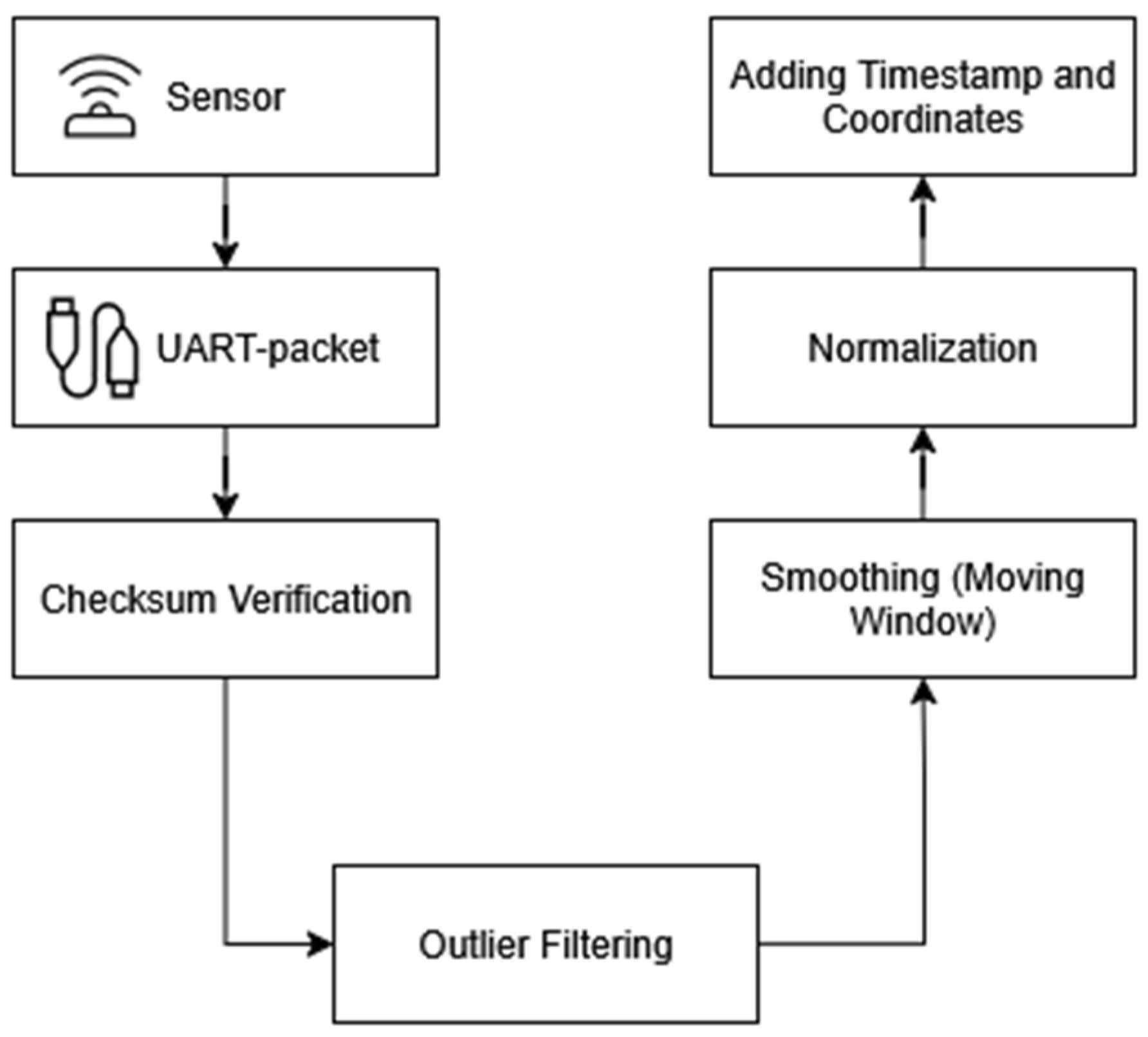
Figure 2.
Architecture of adaptive PM2.5 data filtering.
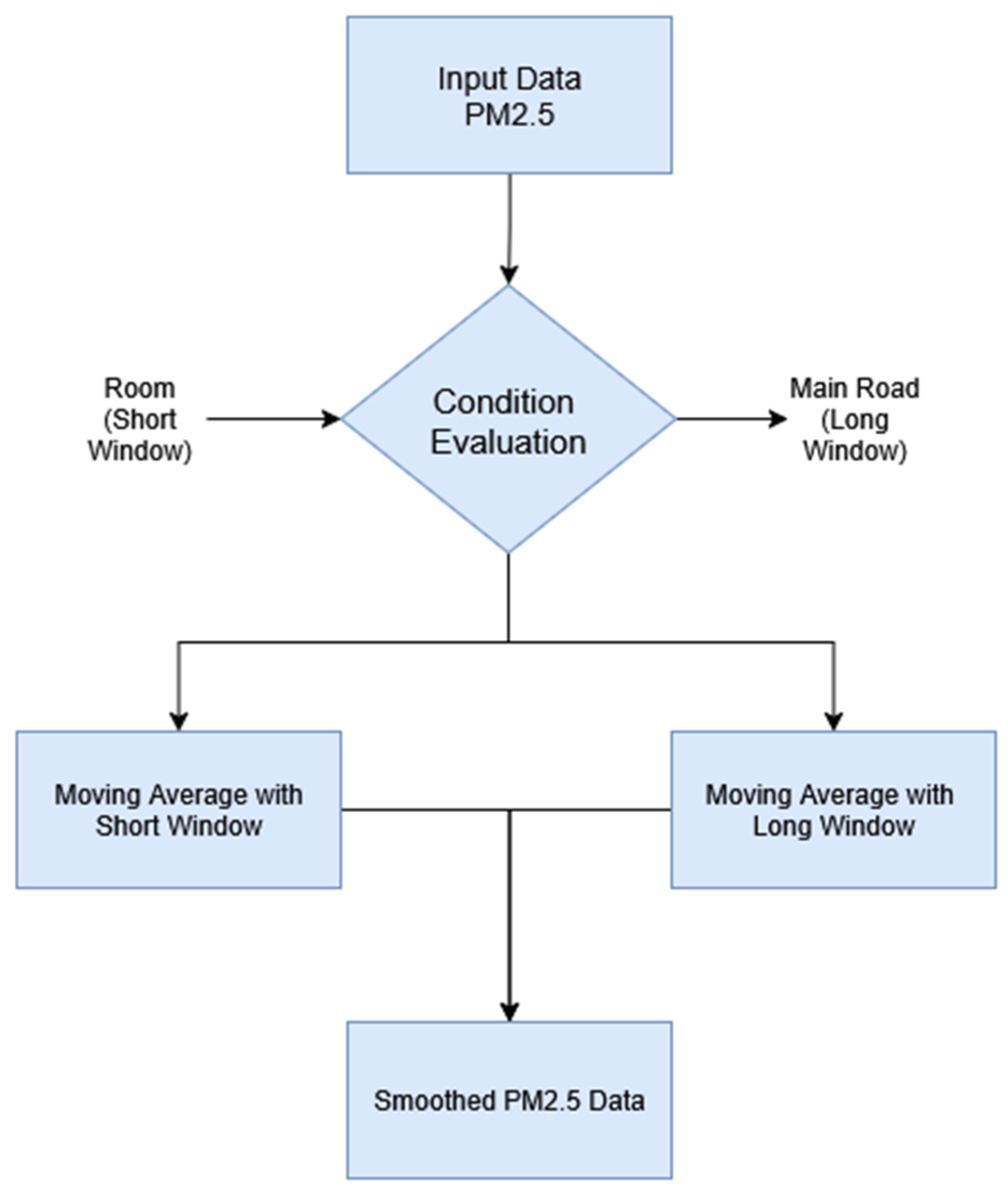
Figure 3.
Internal layout of the sensor module with housing and air duct [36].
Figure 3.
Internal layout of the sensor module with housing and air duct [36].
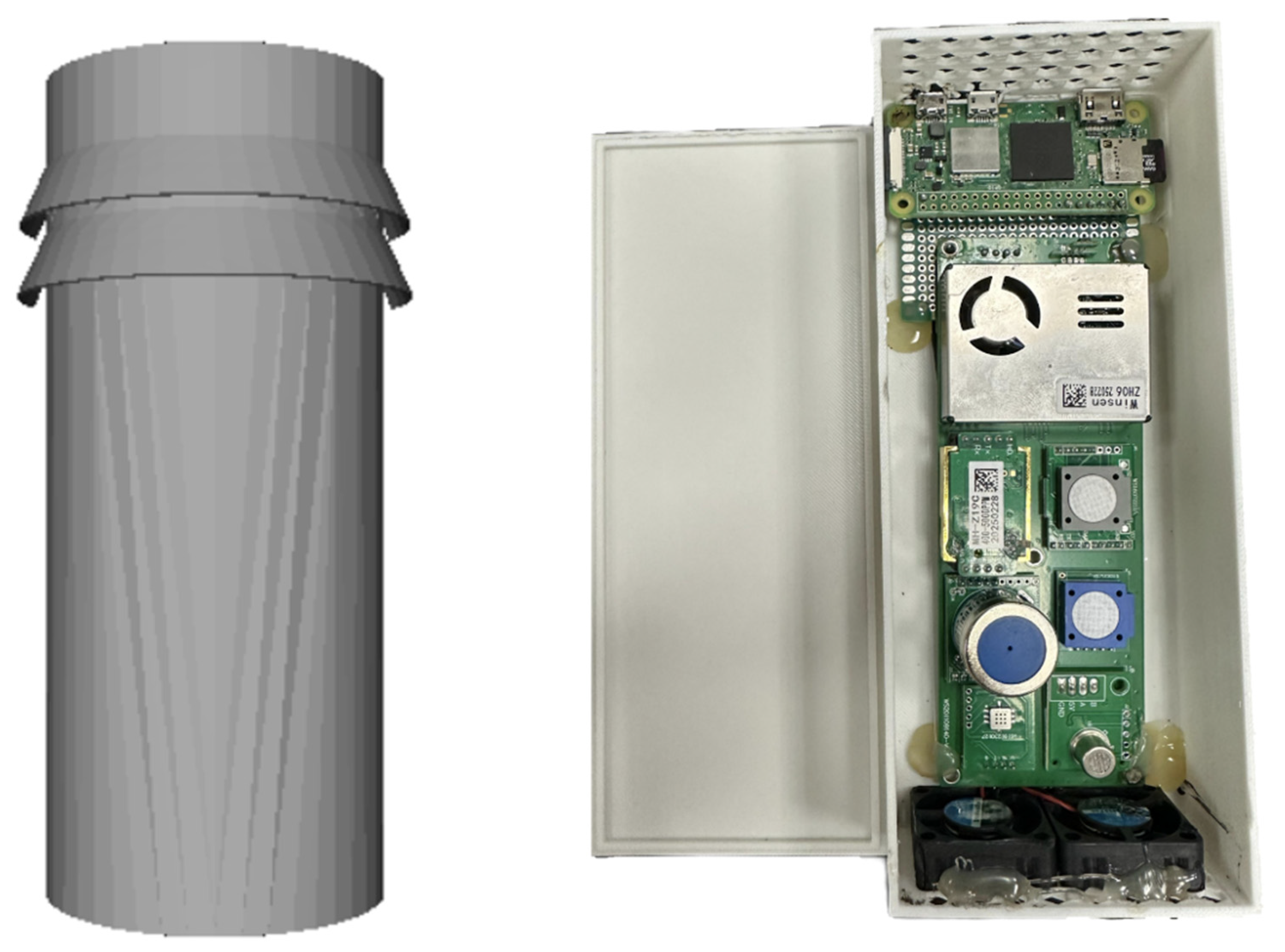
Figure 4.
Deployment of Tynys IoT device with real-time visualization of IAQ data in urban environments [36].
Figure 4.
Deployment of Tynys IoT device with real-time visualization of IAQ data in urban environments [36].
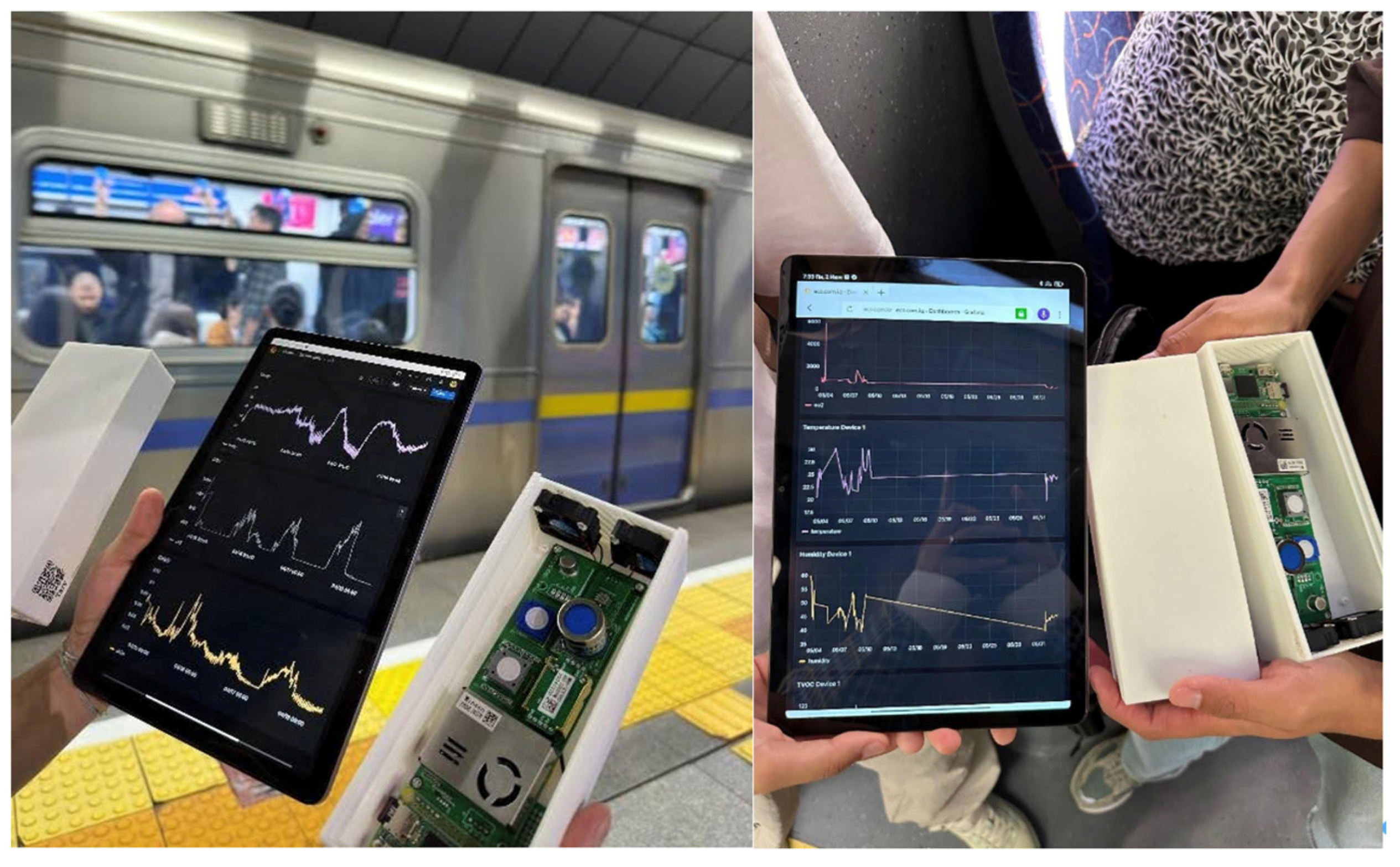
Figure 5.
Comparison of the architecture of traditional monitoring and the proposed IoT module.
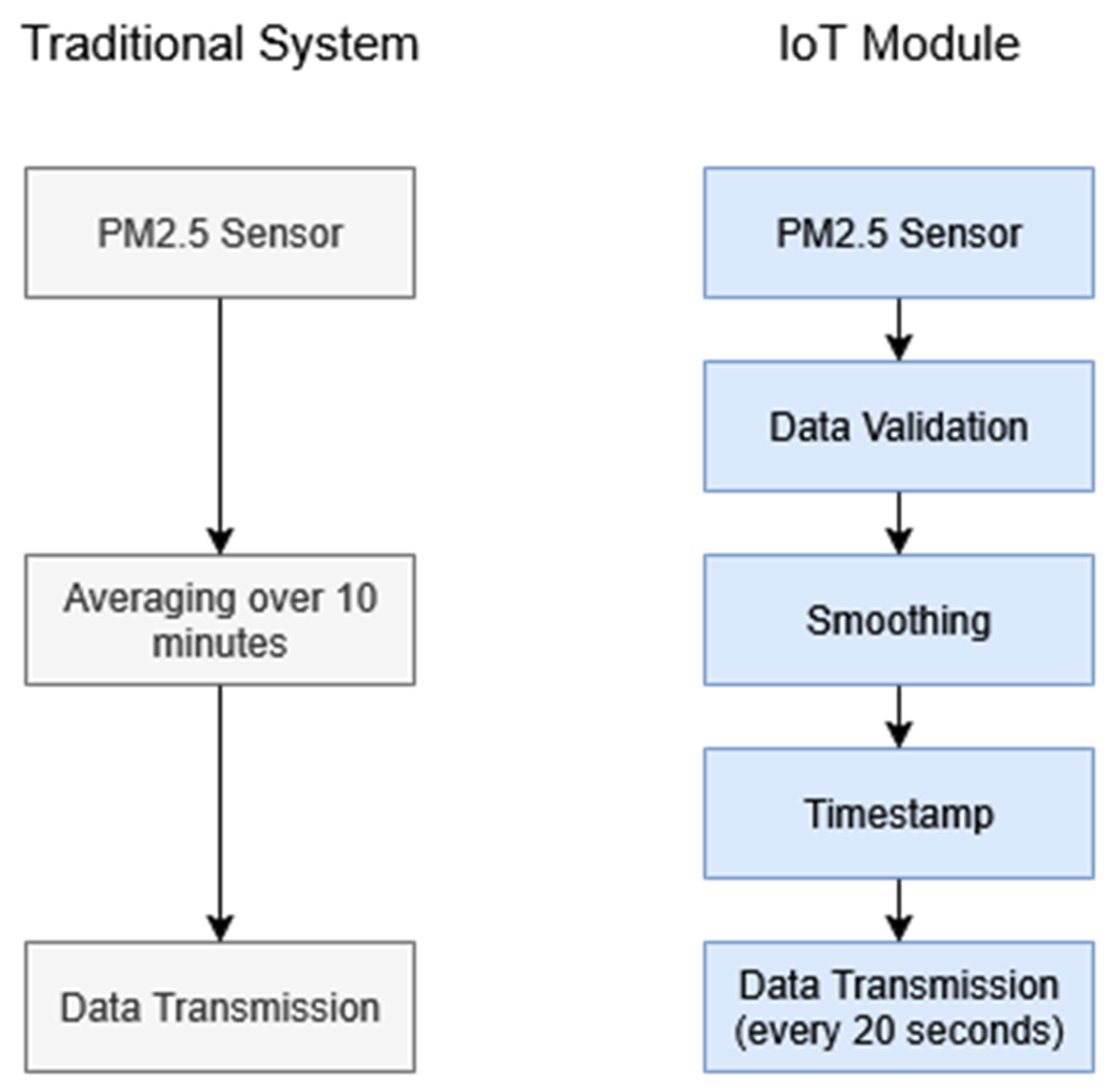
Figure 6.
Comparison of humidity time series (Qingping vs IoT device).
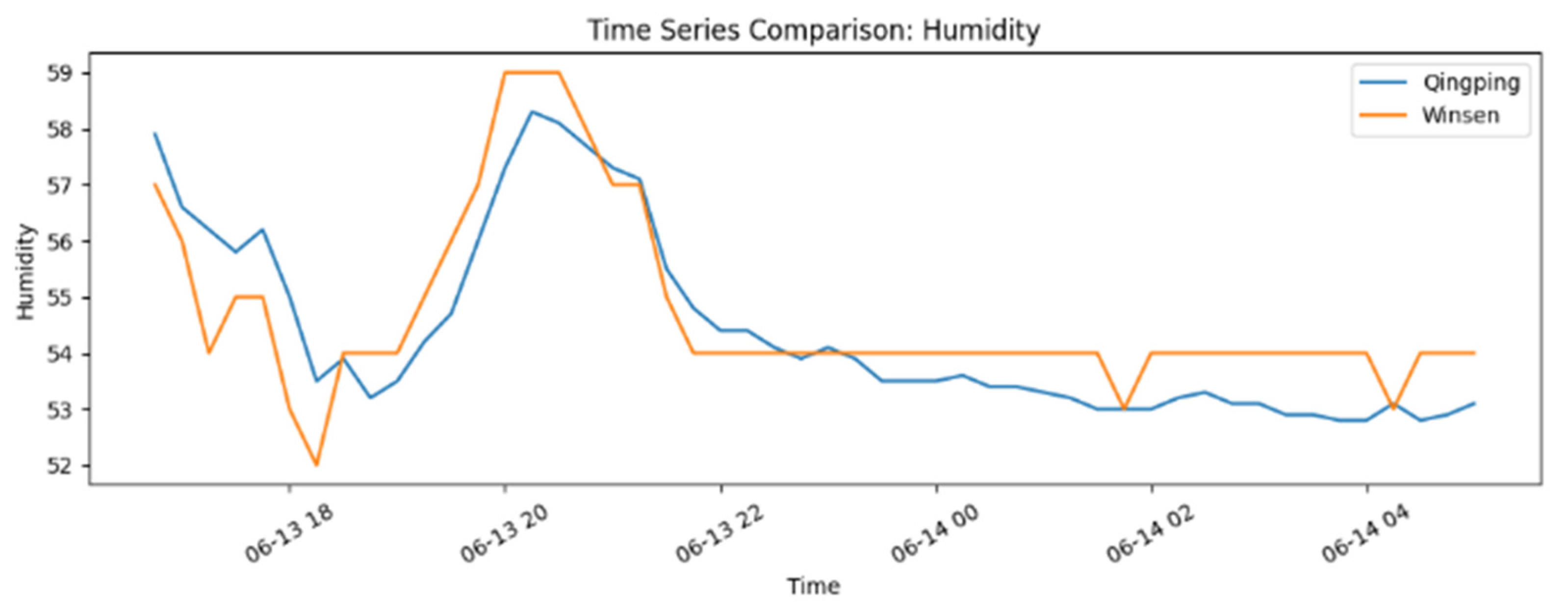
Figure 7.
CO₂ time series comparison (Qingping vs IoT device).
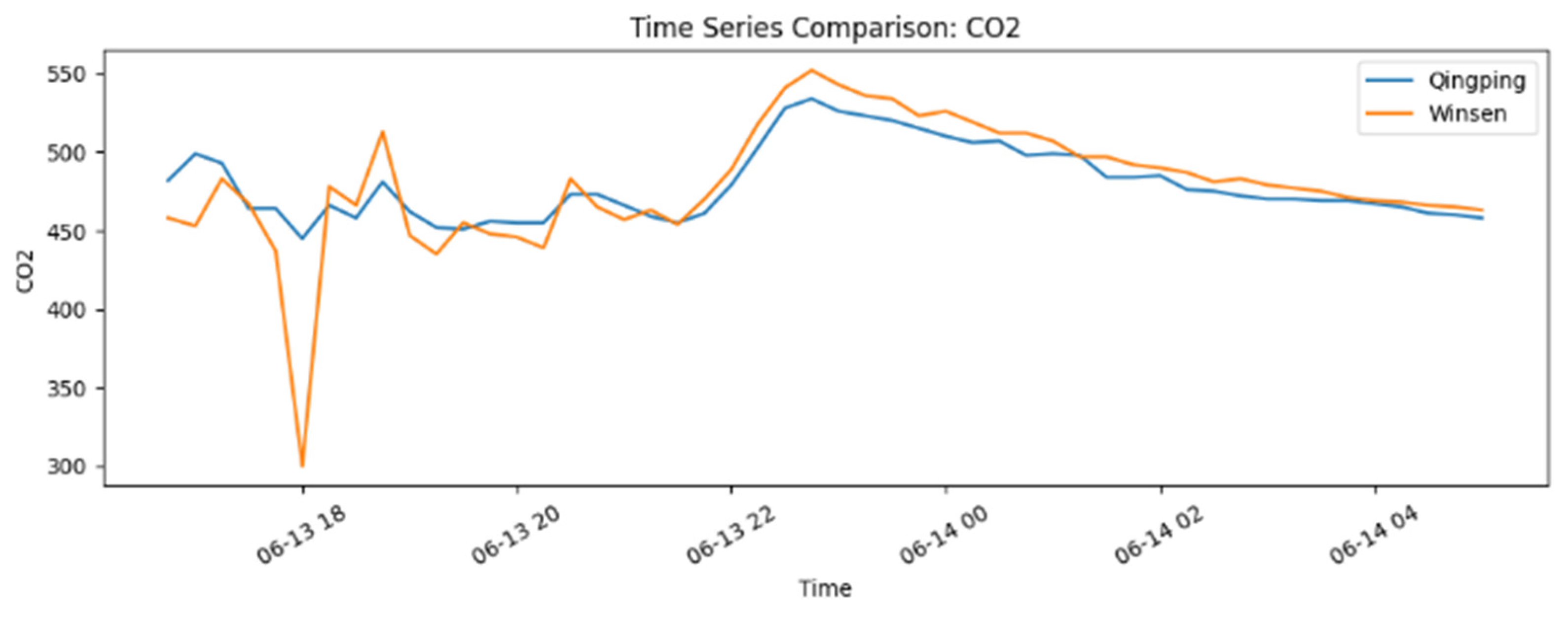
Figure 8.
Comparison of time series of PM2.5 concentration (Qingping device and IoT).
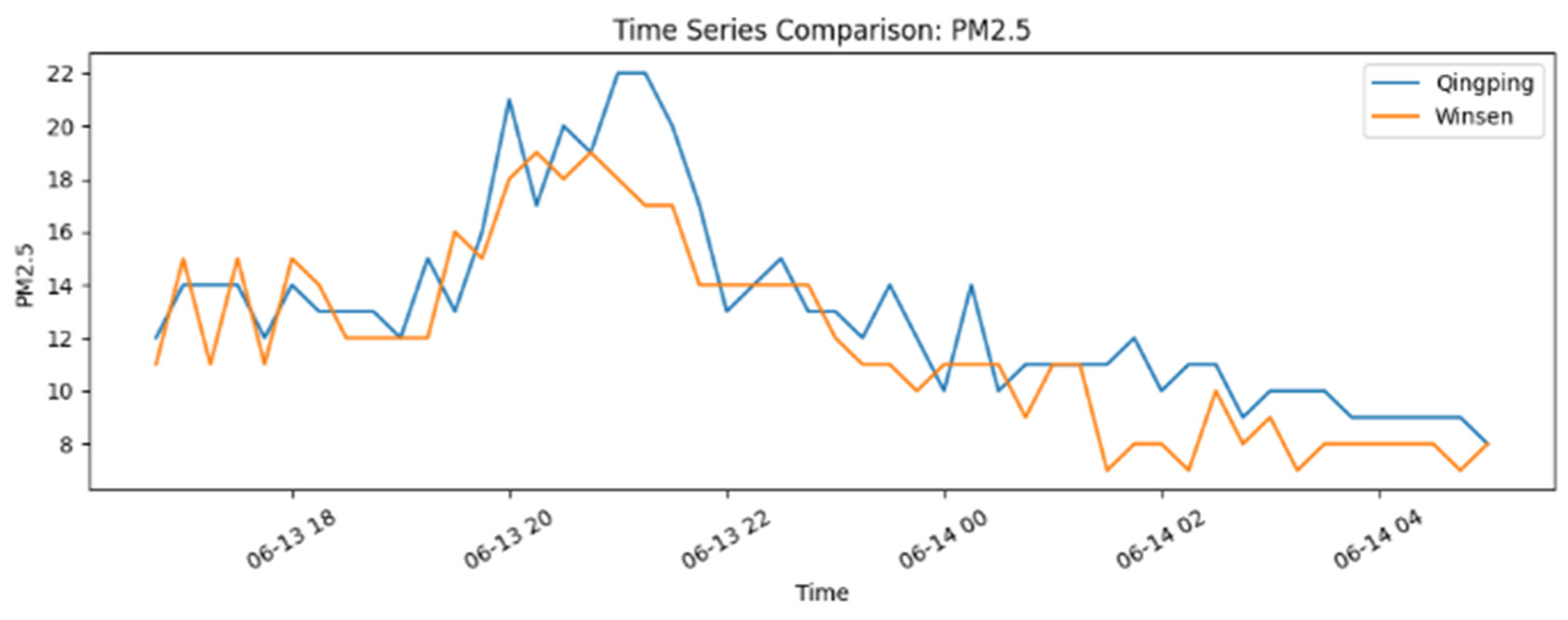
Figure 9.
Comparison of time series of PM10 concentration (Qingping device and IoT).
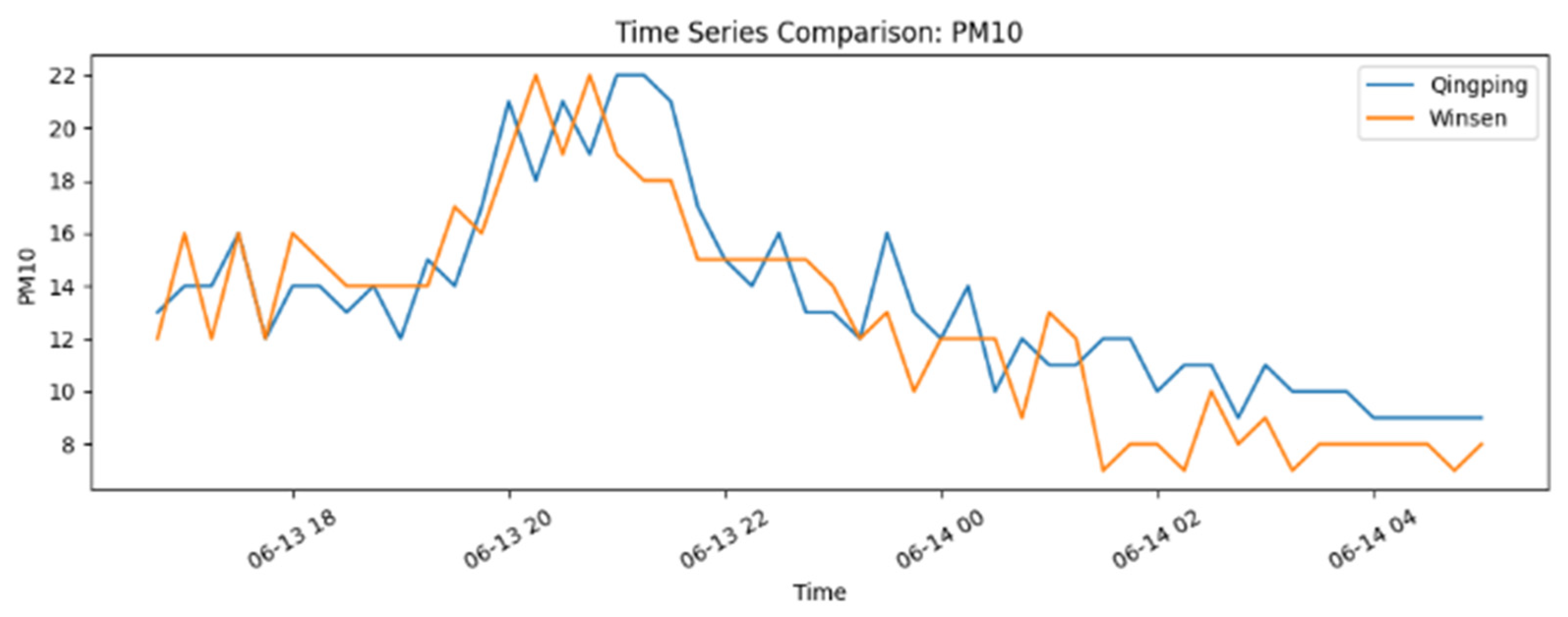
Table 2.
Performance indicators at the event level for detecting excess Pm₂․₅ concentration (threshold value = 13 micrograms/m3, sampling interval ≈ 15 min).
Table 2.
Performance indicators at the event level for detecting excess Pm₂․₅ concentration (threshold value = 13 micrograms/m3, sampling interval ≈ 15 min).
| Method | TPR | FPR | FNR | Trigger duration (min) |
| Raw | 0.778 | 0.125 | 0.222 | 67.5 |
| Fixed window | 0.722 | 0.188 | 0.278 | 95.0 |
| Adaptive filtering | 0.722 | 0.156 | 0.278 | 90.0 |
Disclaimer/Publisher’s Note: The statements, opinions and data contained in all publications are solely those of the individual author(s) and contributor(s) and not of MDPI and/or the editor(s). MDPI and/or the editor(s) disclaim responsibility for any injury to people or property resulting from any ideas, methods, instructions or products referred to in the content. |
© 2026 by the authors. Licensee MDPI, Basel, Switzerland. This article is an open access article distributed under the terms and conditions of the Creative Commons Attribution (CC BY) license (http://creativecommons.org/licenses/by/4.0/).
Copyright: This open access article is published under a Creative Commons CC BY 4.0 license, which permit the free download, distribution, and reuse, provided that the author and preprint are cited in any reuse.


