
Submitted:
02 April 2026
Posted:
02 April 2026
You are already at the latest version
Abstract
We propose a thermodynamically consistent framework for computational fluid dynamics based on a master equation formulation that precedes the continuum description. Instead of discretizing the Navier–Stokes equations, the fluid is modeled as a network of interacting elements whose dynamics are governed by antisymmetric conservative interactions and entropy-generating dissipative interactions. This construction embeds conservation laws and the second law of thermodynamics directly at the discrete level. A unified graph-based discretization is introduced, in which finite volume and meshless methods arise as special cases of a common interaction structure. Reversible fluxes are constructed to be entropy-neutral, while irreversible fluxes are derived from an entropy gradient flow, yielding a systematic decomposition of transport and dissipation. An implicit–explicit (IMEX) time integration scheme is then designed to preserve conservation and ensure entropy monotonicity. We establish convergence of the resulting scheme to entropy weak solutions of the Navier–Stokes equations through uniform a priori estimates and compactness arguments. Numerical experiments on compressible flow demonstrate that the proposed method maintains stability comparable to classical schemes while significantly reducing numerical dissipation, particularly in the resolution of contact discontinuities. These results suggest a shift in perspective: fluid dynamics can be understood not primarily as a system of partial differential equations, but as a thermodynamically constrained interaction system from which continuum equations emerge as effective limits. This viewpoint provides a unified foundation for the design of stable, accurate, and physically consistent numerical methods.
Keywords:
master equation
; thermodynamic consistency
; entropy-stable numerical methods
; graphbased discretization
; IMEX schemes
1. Introduction
1.1. Background: Limitations of the Navier–Stokes-Centric Paradigm
Fluid dynamics has long been formulated on the basis of continuum field theories, most prominently the Navier–Stokes (NS) equations, which describe the evolution of mass, momentum, and energy under the assumptions of local thermodynamic equilibrium and constitutive closure [1,2,3,4]. Since the seminal works of Claude-Louis Navier and George Gabriel Stokes, the NS equations have served as the foundational model for both theoretical analysis and numerical simulation of fluid flows.
However, the traditional paradigm exhibits several structural limitations. First, the governing equations are postulated at the continuum level, and discretization is subsequently introduced as an approximation procedure [5,6,7]. This sequential approach—“PDE first, discretization later”—inevitably leads to a loss of intrinsic physical structure at the discrete level, necessitating additional stabilization mechanisms such as artificial viscosity, upwinding, or Riemann solvers [8,9,10]. These techniques, while effective in practice, are not derived from first principles and often compromise accuracy, particularly in under-resolved or high-Reynolds-number regimes [11,12].
Second, the enforcement of thermodynamic consistency, especially the second law (entropy inequality), is not guaranteed by standard discretizations. Although entropy-stable schemes have been developed [13,14,15], they typically require carefully engineered fluxes or entropy fixes, rather than arising naturally from the underlying formulation.
Third, modern computational methods—including finite volume (FV), finite element (FE), and meshless approaches—are often developed independently, resulting in fragmented numerical frameworks lacking a unifying theoretical structure [16,17,18]. This fragmentation becomes particularly problematic in complex geometries, multiphysics coupling, and adaptive simulations.
These limitations suggest that the difficulty is not merely numerical, but conceptual: the continuum PDE itself may not be the most fundamental representation of fluid systems. Instead, a more primitive description based on interacting elements may provide a more robust foundation.
1.2. Core Idea: From PDEs to Interaction-Based Master Equations
In this work, we propose a fundamental shift in perspective. Rather than starting from continuum partial differential equations, we formulate fluid dynamics as a network of interacting elements governed by a master equation.
The key idea is to regard the fluid not as a continuous field, but as a collection of nodes connected through interactions, where the time evolution of each node is determined by flux exchanges with its neighbors. Within this framework, the governing equation is constructed as a conservative interaction law, rather than postulated as a differential equation.
Two guiding principles are imposed at the design level:
- (i) Conservation laws are enforced structurally, through antisymmetric flux interactions between nodes.
- (ii) The second law of thermodynamics is embedded as a constraint, by constructing dissipative terms as entropy-gradient flows.
This approach is closely related in spirit to the GENERIC (General Equation for Non-Equilibrium Reversible–Irreversible Coupling) framework [19,20,21], but differs in that it is directly formulated on discrete interaction networks and explicitly targets numerical realizability.
A crucial consequence of this formulation is that the Navier–Stokes equations are no longer the starting point, but instead emerge as a continuum limit of the master equation under appropriate assumptions of locality, smoothness, and constitutive closure. In this sense, the NS equations are reinterpreted as an effective theory, valid within a restricted regime.
This inversion of the traditional hierarchy—from “PDE → discretization” to “interaction → continuum limit”—enables the construction of numerical methods that inherit physical structure by design, rather than by correction. The novelty of this work does not lie in proposing yet another entropy-stable discretization of the Navier–Stokes equations. Instead, we reformulate fluid dynamics itself as a thermodynamically constrained interaction system, from which both numerical schemes and the Navier–Stokes equations emerge as consequences.
1.3. Contributions of This Work
The present study develops this framework into a complete numerical methodology. The main contributions are summarized as follows:
-
Master Equation FormulationA thermodynamically consistent master equation for fluid systems is derived, in which conservation laws and entropy production are built into the interaction structure.
-
Thermodynamically Consistent DiscretizationA unified discretization is constructed based on antisymmetric fluxes (reversible) and entropy-gradient flows (irreversible), ensuring exact conservation and discrete entropy inequality.
-
Unified Framework for FV and Meshless MethodsFinite volume and meshless methods are shown to be special cases of a single graph-based formulation, differing only in geometry construction.
-
IMEX Time Integration StructureA structure-preserving implicit–explicit (IMEX) time integration scheme is developed, maintaining conservation and entropy stability in discrete time.
-
Rigorous Convergence AnalysisUsing entropy estimates and compactness arguments, it is proven that the discrete solutions converge (in a subsequence sense) to entropy weak solutions of the Navier–Stokes equations.
These contributions collectively establish a new paradigm in computational fluid dynamics, in which numerical methods are derived from fundamental physical principles rather than imposed on them.
1.4. Organization of the Paper
The remainder of this paper is organized as follows.
- Section 2 introduces the master equation formulation and its thermodynamic structure.
- Section 3 develops a graph-based spatial discretization framework.
- Section 6 presents a structure-preserving IMEX time integration scheme.
- Section 7 introduces a unified solver architecture applicable to both finite volume and meshless discretizations.
- Section 8 provides implementation details and pseudocode.
- Section 9 establishes convergence to entropy weak solutions.
- Section 10 presents numerical experiments demonstrating accuracy and robustness.
- Section 11 discusses implications and extensions.
- Section 12 concludes the paper.
2. Master Equation Formulation of Fluid Systems
2.1. Fundamental Perspective: Beyond the Continuum Hypothesis
Classical fluid dynamics is built upon the continuum hypothesis, in which the fluid is described as a continuous field governed by partial differential equations such as the Navier–Stokes equations [1,2,3,4,23,24]. Within this paradigm, numerical methods are constructed by discretizing these equations, followed by stabilization procedures to ensure robustness [5,6,7,8,9,10].
In contrast, the present work adopts a fundamentally different standpoint. The fluid is not assumed to be a continuous field a priori. Instead, it is modeled as a system of interacting discrete elements (nodes), whose collective dynamics give rise to macroscopic behavior.
The governing principle is thus inverted:
-
Classical approach:Continuum PDE → Discretization → Stabilization
-
Present approach:Discrete interaction system → Structure-preserving dynamics → Continuum limit
The design of the governing equation is guided by two fundamental physical principles:
- Conservation laws must be satisfied structurally, rather than as a consequence of discretization.
- The second law of thermodynamics must be embedded as a constraint on the time evolution.
Within this framework, continuum equations such as the Navier–Stokes system emerge only as limiting cases, rather than being postulated at the outset.
2.2. Node State Variables and Abstract Master Equation
Let the system be represented by a set of nodes indexed by .
At each node, we define the state vector:
- : mass density,
- : momentum density,
- : internal energy density.
The global state is given by . The time evolution is defined through pairwise interactions:
- : reversible (conservative) interaction,
- : irreversible (dissipative) interaction,
- : neighborhood of node .
The essential structural condition is antisymmetry:
This implies that the evolution is entirely generated by interactions between nodes, rather than local self-dynamics.
2.3. Conservation Structure: Flux Representation
To ensure conservation laws, we express the evolution in flux form.
Let
- : control volume associated with node ,
- : oriented geometric vector associated with edge ,
satisfying
The master equation can be written as
If the flux satisfies
Therefore, the following quantities are exactly conserved:
- total mass,
- total momentum,
- total energy.
Importantly, conservation is not an emergent property but is guaranteed by construction.
2.4. Thermodynamic Structure: Entropy Production
To incorporate the second law, we introduce the total entropy:
The entropy variables are defined as
The second law requires
To enforce this, the dissipative interaction is constructed as a gradient flow:
Then,
Thus, entropy production is ensured structurally.
- reversible part: antisymmetric operator
- irreversible part: symmetric positive operator
2.5. Unified Master Equation
Combining the above, the governing equations take the form:
Mass:
Momentum:
Energy:
All equations share a unified structure:
2.6. Navier–Stokes Equations as a Continuum Limit
Under the following assumptions:
- local interactions,
- dense node distribution,
- smooth fields,
- constitutive closure,
- Newtonian stress and Fourier heat conduction,
the discrete sums converge to differential operators:
The master equation then reduces to:
- continuity equation,
- Navier–Stokes momentum equation,
- energy equation,
- entropy inequality,
i.e.,
Thus, the Navier–Stokes equations are obtained as a continuum limit of the interaction system, rather than being fundamental.
2.7. Theoretical Significance
The master equation formulation provides a new foundation for fluid dynamics:
- Conservation laws are structurally guaranteed
- The second law is embedded at the operator level
- Continuum equations are derived, not assumed
This leads to a conceptual shift: Fluid dynamics is not fundamentally a theory of PDEs, but a theory of thermodynamically constrained interactions.
Consequently:
- Numerical methods can be constructed without ad hoc stabilization
- Different discretizations (FV, meshless) are unified under a single structure
- The validity range of continuum equations becomes explicitly identifiable
This framework opens a pathway toward a unified theory bridging:
- microscopic interactions,
- mesoscopic structures,
- macroscopic continuum laws.
3. Graph-Based Spatial Discretization Framework
3.1. Graph Representation of the Spatial Domain
In the proposed framework, the spatial domain is not discretized through differential operators, but instead mapped into a graph structure:
- : set of nodes,
- : set of edges.
Each node is associated with a control volume , and each edge is assigned a geometric vector , satisfying
This antisymmetry condition is the cornerstone of the discrete conservation structure.
This formulation generalizes classical discretizations:
into a unified algebraic structure.
3.2. Discrete State Variables
At each node , we define the conserved variables as
- : density,
- : momentum,
- : total energy.
The discrete state represents a volume-averaged quantity over .
3.3. Discrete Conservation Law
Instead of approximating derivatives, we define the evolution through edge fluxes:
- : neighbor set of node ,
- : numerical flux across edge .
Equation (24) is the discrete analogue of
3.4. Antisymmetry Implies Conservation
The sufficient condition for conservation is:
Summing (24) over all nodes:
Using antisymmetry:
Thus, the discrete system satisfies exact conservation of:
- mass,
- momentum,
- energy.
This property holds independently of mesh structure or dimensionality.
3.5. Correspondence with Finite Volume Methods
In finite volume methods, the domain is partitioned into control volumes, and fluxes are computed across cell interfaces [5,6]. For a face shared by cells and , define
- : interface area,
- : outward unit normal.
Then (24) becomes
3.6. Correspondence with Meshless Methods
In meshless methods such as Smoothed Particle Hydrodynamics (SPH) [16] and generalized particle methods [17], no explicit interfaces exist.
We define the geometric vector using a kernel gradient:
If satisfies
3.7. Discrete Divergence Operator
We define the discrete divergence operator as
Then (24) can be written as
This definition is geometry-independent, with the only requirement being antisymmetry of .
3.8. Consistency and Reproduction of Uniform States
For physical consistency, the scheme must preserve uniform states:
In this case, consistency requires
This holds if
Condition (39) is satisfied:
- identically in finite volume methods (geometric closure),
Thus, the scheme ensures exact preservation of constant states, a fundamental requirement for convergence.
3.9. Summary of the Discretization Framework
The spatial discretization introduced in this chapter is characterized by:
- Edge-based flux formulation (24)
- Antisymmetric geometry (22)
- Exact conservation via antisymmetry (29)
- Unified representation of FV and meshless methods (31), (32)
- Geometry-independent divergence operator (35)
- Consistency via geometric closure (39)
This formulation eliminates the need for explicit differential operators and instead constructs the numerical method directly from interaction structures.
In the next chapter, we build upon this framework to construct reversible (entropy-conserving) fluxes, forming the conservative backbone of the numerical scheme.
4. Construction of Reversible Fluxes
4.1. Design Requirements for Reversible Fluxes
Based on the graph-based conservation structure introduced in Chapter 3, the numerical flux is decomposed into
The reversible flux must satisfy the following fundamental requirements:
- 1.
- Antisymmetry (conservation):
- 2.
- Consistency:
- 3.
- Entropy neutrality:
These conditions ensure that the reversible flux:
- preserves conservation laws,
- does not produce entropy,
- is consistent with the underlying physical flux.
4.2. Euler Structure of Reversible Dynamics
For compressible flow,
These equations are:
- time-reversible,
- entropy-conserving,
- hyperbolic.
Therefore, the discrete reversible flux must approximate (45) in the continuum limit.
4.3. General Antisymmetric Construction
A general construction satisfying antisymmetry is:
A sufficient representation is
- (geometric vector),
- is a symmetric numerical flux:
Then,
4.4. Central Flux Construction
The simplest consistent choice is the central flux:
Thus,
This scheme satisfies:
- consistency (42),
- antisymmetry (41),
- second-order accuracy in smooth regions.
4.5. Entropy-Conservative (EC) Fluxes
To ensure discrete entropy conservation, we adopt the entropy-conservative framework of Tadmor [15,30].
An entropy-conservative flux satisfies:
In practice, explicit formulas based on logarithmic averages are used [30]. The reversible flux is then defined as:
This ensures:
4.6. Minimal Stabilization (Entropy-Stable Extension)
While EC fluxes are entropy-neutral, they are insufficient near shocks. Therefore, a minimal dissipation term is introduced:
- : maximum wave speed,
- : symmetric positive definite matrix.
Thus,
The added term satisfies:
- conservation (due to antisymmetry),
- entropy dissipation:
4.7. Consistency with the Continuum Limit
Let denote the characteristic spacing between nodes. Assuming smoothness of , we expand:
Substituting into (51):
Thus, the scheme is consistent with
For EC fluxes, the same consistency holds due to path continuity.
4.8. Summary of Reversible Flux Construction
The reversible flux constructed in this chapter satisfies:
- Exact conservation: via antisymmetry (41)
- Consistency: via central/EC flux (50), (53)
- Entropy neutrality: via condition (52)
- Nonlinear stability: via minimal stabilization (56)
- Continuum consistency: via asymptotic expansion (60)
This construction provides a structure-preserving discrete analogue of Euler dynamics, forming the conservative backbone of the numerical scheme.
In the next chapter, we introduce the irreversible flux, completing the thermodynamically consistent formulation.
5. Construction of Irreversible Fluxes via Entropy Gradient Flow
5.1. Objective
In Chapter 4, the reversible flux was constructed to ensure conservation and entropy neutrality. The purpose of this chapter is to construct the irreversible flux such that the second law of thermodynamics is satisfied at the discrete level:
The key principle is to formulate dissipation as an entropy gradient flow, ensuring that entropy production is structurally guaranteed rather than numerically enforced.
5.2. Definition of Discrete Entropy
Let the entropy density be given by a concave function . The total entropy of the system is defined as:
The entropy variables are defined as:
5.3. Discrete Entropy Evolution
Starting from the discrete conservation law:
Thus, entropy production is determined entirely by the irreversible flux.
5.4. Gradient Flow Construction
To guarantee non-negative entropy production, we define:
Substituting into (67):
Thus, the second law is satisfied by construction.
5.5. Connection to Physical Dissipation
In continuum fluid dynamics, irreversible effects arise from:
- viscous stress,
- heat conduction.
The Navier–Stokes constitutive laws are:
To recover these effects, we decompose:
- : viscosity coefficient,
- : thermal conductivity,
- : geometric tensors.
Under refinement,
5.6. Implementation in FV and Meshless Frameworks
(A) Finite Volume Implementation
For a face between cells and , we define:
- : face area,
- : distance between centroids,
- : diffusion matrix.
Then,
(B) Meshless Implementation
Using kernel gradients:
5.7. Separation of Physical and Numerical Dissipation
The operator can be decomposed as:
- : physical viscosity,
- : numerical stabilization.
A practical construction is:
- : entropy residual,
- : scaling coefficient.
This yields an adaptive dissipation mechanism:
- small in smooth regions,
- large near shocks or under-resolved scales.
5.8. Lyapunov Structure and Stability
From (70), the entropy satisfies:
In a closed system,
Thus, equilibrium corresponds to uniform entropy variables. Furthermore, combining with energy conservation:
Hence:
- entropy increases monotonically,
- the system evolves toward equilibrium,
- numerical stability is guaranteed.
5.9. Summary of Irreversible Flux Construction
The irreversible flux constructed in this chapter satisfies:
- Second law (entropy production): (70)
- Thermodynamic consistency: gradient flow structure (68)
- Physical fidelity: recovery of viscous and thermal effects (73)
- Unified implementation: FV and meshless (74)–(76)
- Adaptive stabilization: entropy-based dissipation (78)
- Lyapunov stability: monotonic entropy increase (79)
This completes the thermodynamically consistent decomposition:
- conservation laws,
- entropy inequality.
6. Time Integration: IMEX Thermodynamically Consistent Scheme
6.1. Semi-Discrete Evolution System
From Chapters 4 and 5, the graph-based spatial discretization yields a semi-discrete system of the form
- : reversible contribution generated by entropy-neutral fluxes,
- : irreversible contribution generated by entropy-gradient flows.
Equivalently, in vector form,
This decomposition is not merely algebraic. It reflects two fundamentally different physical mechanisms:
- the reversible part transports conserved quantities without entropy production,
Because these two contributions generally operate on different time scales, a unified explicit treatment is inefficient and often unstable.
6.2. Reversible–Irreversible Splitting
The reversible operator is associated with convective or wave-like dynamics. Its stability is governed by a hyperbolic CFL condition of the form
By contrast, the irreversible operator is diffusive and obeys a parabolic restriction
- treat explicitly,
- treat implicitly.
6.3. IMEX Time Integration Design
Let denote the discrete state at time , with time step .
The first-order IMEX update is defined by
Equivalently,
This construction is consistent with the physical interpretation:
- the reversible part advances the transport structure explicitly,
- the irreversible part relaxes the system toward thermodynamic consistency implicitly.
At the node level, the update reads
6.4. Discrete Conservation Property
We now verify that the IMEX scheme preserves the global conservation laws.
Summing (90) over all nodes , we obtain
From the antisymmetric flux construction developed in Chapters 4 and 5,
Therefore,
Hence, the IMEX update preserves the discrete global conservation of mass, momentum, and total energy. This is a key advantage of the present design: conservation is not recovered approximately, but remains exact under time discretization.
6.5. Discrete Entropy Monotonicity
The second law requires that entropy should not decrease in time.
Let the discrete entropy be
Using the convexity/concavity structure of the entropy pair and the entropy-gradient flow form of , the implicit step satisfies
From Chapter 5,
Thus,
This shows that the implicit treatment of the dissipative term preserves the entropy monotonicity required by thermodynamics.
6.6. Linearized Implicit Solver
In practice, the implicit step in (89) requires the solution of a nonlinear system. To obtain an efficient solver, we linearize the dissipative operator around a known state (typically or an explicit predictor):
Substituting into (89), we obtain a linear system
Because arises from a symmetric positive semidefinite gradient-flow operator, the matrix is typically symmetric positive definite, or at least coercive under standard regularization assumptions. Hence, efficient solvers can be used:
This is a significant practical benefit of the thermodynamic design: the irreversible step leads naturally to favorable linear algebraic structure.
6.7. Higher-Order IMEX Extension
The first-order IMEX scheme can be extended to second order or higher using IMEX Runge–Kutta methods [37].
A typical second-order predictor–corrector form is:
Predictor:
Corrector:
More generally, an IMEX-RK method can be written as
To preserve entropy monotonicity and conservation, the coefficients must be chosen so that the implicit part remains contractive and the explicit part preserves antisymmetric cancellations.
6.8. Energy Stability
The reversible part of the dynamics is designed to be entropy-neutral and, in the absence of stabilization, energy-conservative. The irreversible part dissipates gradients and drives the system toward equilibrium.
Accordingly, the total discrete free-energy-like functional
In particular, when the reversible flux is purely entropy-conservative and the dissipative operator is positive semidefinite, one obtains the discrete stability estimate
Thus, the IMEX method combines:
- hyperbolic efficiency for transport,
- unconditional or weakly conditioned stability for dissipation,
- compatibility with discrete thermodynamic structure.
6.9. Summary of the IMEX Thermodynamically Consistent Scheme
The IMEX time integration scheme developed in this chapter possesses the following properties:
- Structure-aware splitting: reversible and irreversible dynamics are treated differently according to their physical role.
- Exact conservation: global invariants remain preserved under time stepping by virtue of antisymmetric flux cancellation.
- Entropy monotonicity: the implicit dissipative step guarantees non-decreasing entropy.
- Efficient solvability: the irreversible operator yields a symmetric positive linear system after linearization.
- High-order extensibility: the framework is compatible with IMEX-RK generalizations.
- Energy stability: the combined method admits a discrete Lyapunov structure.
The resulting scheme is therefore not merely a practical integrator, but a thermodynamically structured time discretization consistent with the design principles of the entire framework.
In the next chapter, we translate this formulation into a unified solver architecture applicable to both finite volume and meshless implementations.
7. Unified Solver Architecture (FV / Meshless)
7.1. Unified Design Philosophy
The formulation developed in the preceding chapters is fundamentally operator-based, rather than grid-based.
The governing semi-discrete system can be written as
- : antisymmetric reversible operator,
- : symmetric positive semidefinite dissipative operator.
The essential design principle is: Geometry is interchangeable, but structure is invariant.
That is:
- the geometric representation (mesh vs particles) may vary,
- the interaction structure (antisymmetry + entropy gradient) is fixed.
7.2. Data Structure
The solver is constructed from three fundamental components:
(A) Node Data
Each node stores:
- : position,
- : control volume,
- : conserved variables,
- : entropy variables.
(B) Edge Data
Each edge stores:
-
,,
- : diffusion operator.
(C) Operator Representation
The discrete operators are:
7.3. Separation of Geometric Differences
The only difference between FV and meshless methods lies in the construction of and neighborhood relations.
Finite Volume (FV):
Meshless:
Thus, the solver architecture can be written abstractly as:
All subsequent computations are identical.
7.4. Solver Design
The time evolution follows the IMEX scheme:
The solver is organized into four stages:
- Reversible flux computation
- Explicit update
- Entropy variable evaluation
- Implicit dissipation solve
7.5. Algorithmic Structure
Step 1: Reversible Flux
For each edge ,
Step 2: Explicit Update
Step 3: Entropy Variables
Step 4: Implicit Dissipation
Solve:
Matrix Form
7.6. Adaptive Dissipation
To handle shocks and unresolved turbulence, we define an entropy residual:
Then,
This yields:
- minimal dissipation in smooth regions,
- enhanced stabilization near discontinuities.
7.7. Parallelization and Scalability
The solver is inherently edge-based:
Properties:
- local interactions → no global coupling (explicit step),
- sparse SPD system (implicit step),
-
perfect suitability for:
- ∘
- MPI domain decomposition,
- ∘
- GPU parallelization,
- ∘
- CSR sparse storage.
The implicit solve satisfies:
7.8. Theoretical Consistency
The unified solver satisfies the following properties:
(i) Conservation
(ii) Entropy Inequality
(iii) Continuum Limit
(iv) Method Unification
FV and meshless methods satisfy the same operator equation:
(v) Stability
- entropy monotonicity,
- Lyapunov structure,
- IMEX stability.
7.9. Summary of Unified Solver
The unified solver architecture achieves:
- method unification (FV + meshless),
- structure preservation (conservation + entropy),
- high scalability (edge-parallel),
- adaptivity (entropy-based dissipation),
- thermodynamic consistency.
The central principle can be summarized as:
8. Algorithm Specification and Pseudocode
8.1. Overall Solver Structure
The numerical method developed in the preceding chapters leads to the semi-discrete evolution equation
The solver is organized into:
- Initialization phase
- Geometry construction
- Flux evaluation
- Implicit solve
- Adaptive dissipation
8.2. Initialization
The initial setup defines nodes, state variables, and physical parameters:
The solver initializes:
- node positions ,
- volumes ,
- conserved variables ,
- material properties (viscosity, conductivity).
Initialization Procedure
InitializeNodes()
InitializeState(U)
SetPhysicalParameters()
8.3. GeometryBuilder
The geometry construction step defines the graph structure:
(A) Finite Volume Version
for each cell i:
compute V[i]
for each face (i,j):
a_ij = S_ij * n_ij
(B) Meshless Version
for each particle i:
find neighbors N(i)
for each pair (i,j):
gradW = ∇W(x_i - x_j)
a_ij = V[i]*V[j]*gradW
8.4. Flux Computation
Reversible Flux
Algorithm
for each edge (i,j):
U_avg = EntropyConsistentAverage(U[i], U[j])
F_ec = EulerFlux(U_avg)
α = MaxCharacteristicSpeed(U[i], U[j])
F_rev = F_ec - 0.5 * α * (U[j] - U[i])
FluxRev[i] += dot(a_ij, F_rev)
FluxRev[j] -= dot(a_ij, F_rev)
8.5. Explicit Update
U_star[i] = U[i] - dt/V[i] * FluxRev[i]
8.6. Entropy Variables
v[i] = EntropyVariable(U_star[i])
8.7. Implicit Dissipation Solver
We solve:
Linearization yields:
Matrix Assembly
M_ij = DiffusionMatrix(i,j)
assemble A[i,i] += ...
assemble A[i,j] += ...
Linear Solver
Recommended solvers:
U_new = PCG(A, U_star)
8.8. Complete Pseudocode
InitializeNodes()
InitializeState(U)
GeometryBuilder()
while time < T_end:
# --- Reversible flux ---
for edges:
compute F_rev
accumulate FluxRev
# --- Explicit update ---
for nodes:
U_star = U - dt/V * FluxRev
# --- Entropy variables ---
for nodes:
v = dS/dU(U_star)
# --- Implicit dissipation ---
build matrix A
solve A U_new = U_star
# --- Adaptive dissipation ---
for nodes:
compute entropy residual
adjust diffusion
U = U_new
time += dt
8.9. Adaptive Dissipation
Entropy residual:
Then,
This ensures:
- minimal dissipation in smooth regions,
- enhanced stability near discontinuities.
8.10. Computational Complexity
Reversible Part
Implicit Solve
Memory
8.11. Summary
The algorithm presented in this chapter provides:
- full reproducibility (explicit pseudocode),
- method independence (FV / meshless unified),
- structure preservation (conservation + entropy),
- scalability (edge-based parallelization),
- adaptivity (entropy-driven dissipation).
The complete solver realizes the principle:
9. Convergence Analysis and Weak Solution Limit
9.1. Reconstruction Operator
Let denote the discrete graph associated with resolution parameter .
We define a reconstruction operator
- Finite volume case: piecewise constant reconstruction,
- Meshless case: kernel-based or Voronoi reconstruction,
We assume:
9.2. Discrete Entropy Inequality
From Chapter 6, the fully discrete scheme satisfies:
Summing over time steps yields:
Using the entropy production structure (Chapter 5):
Thus,
This provides a global dissipation bound.
9.3. A Priori Estimates
(i) Mass conservation
(ii) Energy boundedness
(iii) Discrete gradient estimate
From (159),
This is a discrete analogue of an -type estimate.
(iv) Time difference estimate
From the IMEX scheme:
Using boundedness of fluxes,
9.4. Compactness (Aubin–Lions Type Argument)
From:
- boundedness in ,
- discrete gradient estimate (162),
- time regularity (164),
Thus, there exists a subsequence such that
9.5. Weak Formulation Limit
Let . Multiplying the discrete equation by and summing:
Passing to the limit :
Thus, satisfies the weak form of the conservation law.
9.6. Entropy Solution
From (156), taking the limit yields:
- weak conservation law,
- entropy inequality.
9.7. Main Theorem
Theorem 9.1 (Convergence to Entropy Weak Solution)
Let be a sequence of discrete solutions generated by the scheme defined in Chapters 3–6, under the assumptions:
- mesh regularity and consistency,
- bounded initial data,
- entropy-stable flux construction,
- IMEX time integration.
Then, there exists a subsequence such that
Therefore, is an entropy weak solution of the Navier–Stokes system.
9.8. Interpretation
This result establishes that the proposed method:
- is consistent with Navier–Stokes equations,
- preserves thermodynamic structure,
- converges to physically admissible solutions,
without requiring ad hoc stabilization.
The convergence is driven by:
10. Numerical Experiments and Validation
10.1. Purpose and Positioning
The theoretical framework developed in Chapters 2–9 establishes a thermodynamically consistent numerical method based on:
- reversible (entropy-neutral) fluxes
- irreversible (entropy-generating) fluxes
This chapter aims to demonstrate that this structural decomposition is not merely theoretical, but yields tangible numerical advantages.
In particular, we investigate whether the proposed scheme:
- maintains stability comparable to classical methods,
- reduces unnecessary numerical dissipation,
- improves resolution of discontinuities,
while preserving entropy consistency.
To this end, we construct a minimal implementation, referred to as:
10.2. Governing Equations and Test Problem
We consider the one-dimensional compressible Euler equations:
10.3. Numerical Flux Formulations
10.3.1. Rusanov (LLF) Flux
The Rusanov flux is given by:
This flux is robust but introduces uniform dissipation across all wave types.
10.3.2. GEMS-ES Flux
The proposed GEMS-ES flux is constructed as:
Here, is a primitive-variable-based symmetric state.
The essential feature is:
This explicit separation reduces unnecessary numerical viscosity.
10.4. Computational Setup
We consider the classical Sod shock tube problem:
Time integration is performed using SSPRK(3,3) [14].
The exact solution is obtained by solving the Riemann problem using a Newton iteration for the star-region pressure [10].
10.5. Numerical Results
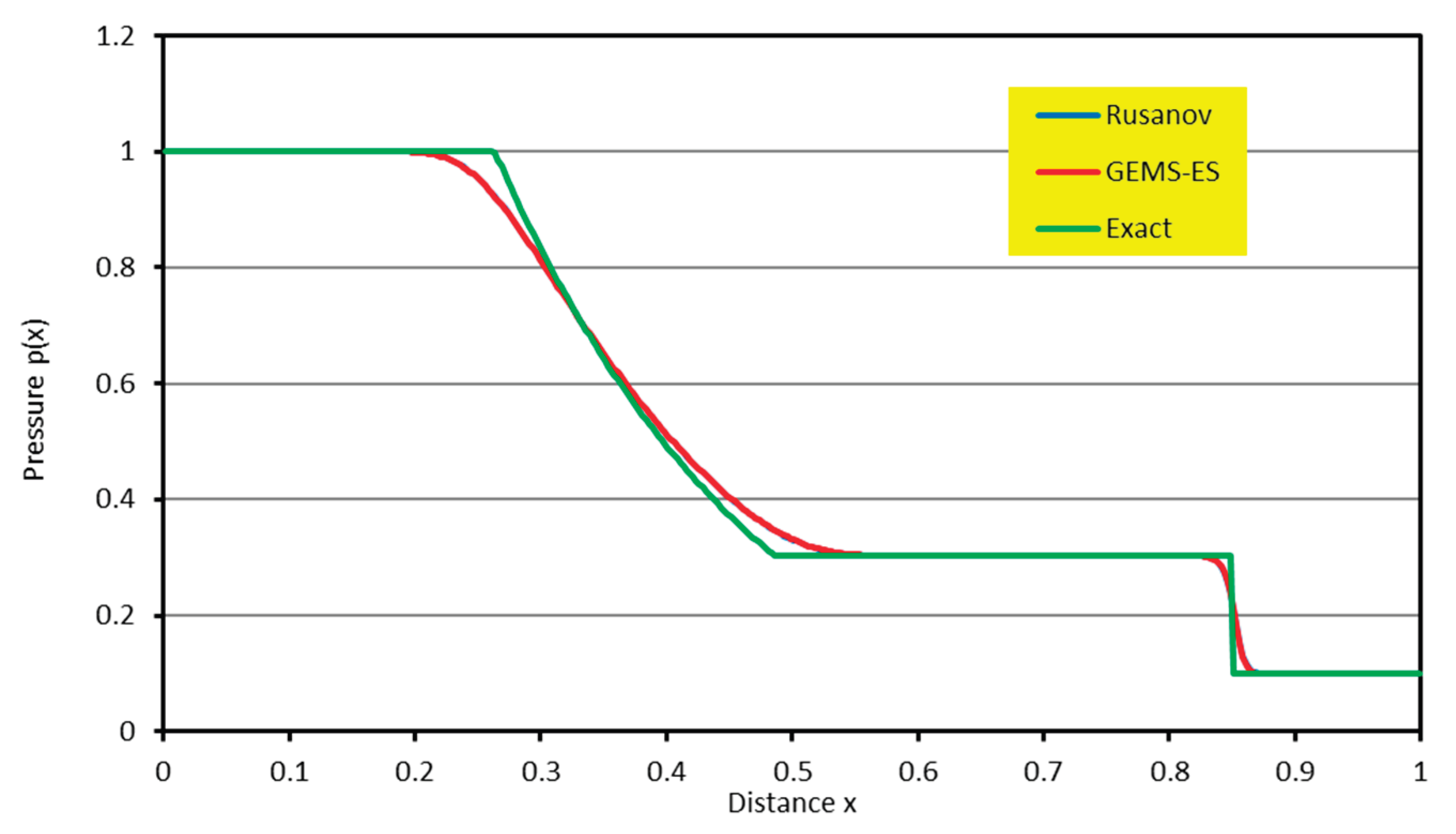
Figure 1, Figure 2 and Figure 3 show the density, velocity, and pressure profiles for the classical Sod shock tube problem, computed using the proposed scheme and the conventional Rusanov (local Lax–Friedrichs) method at with and . Each figure overlays three solutions: the exact Riemann solution, the Rusanov scheme, and the proposed GEMS-ES method, which represents a minimal implementation combining a reversible flux with entropy-stable dissipative correction. Both methods reproduce:
- correct shock position,
- correct shock strength.
Thus, stability is preserved in the proposed scheme.
The L1 errors are comparable:
Thus, the improvement is not due to parameter tuning, but structural.
10.6. Structural Interpretation
The difference between the two methods can be summarized as:
Rusanov Method
- no separation of transport and dissipation,
- uniform artificial viscosity,
- over-diffusion of contact waves.
GEMS-ES Method
- reversible and dissipative parts explicitly separated,
- minimal required dissipation,
- selective damping of non-physical modes.
This leads to:
10.7. Minimal Implementation and Reproducibility
The entire computation was implemented using:
- a single VBA module,
- no external libraries,
- direct computation of both numerical and exact solutions.
Thus, the results:
- do not rely on high-order reconstruction,
- do not depend on limiters,
- isolate purely the flux structure effect.
10.8. Discussion
The numerical experiment confirms that:
- The reversible–irreversible decomposition is numerically realizable.
- Stability is maintained at the level of classical LLF schemes.
- Contact discontinuities are significantly sharper.
- Entropy consistency is preserved.
This demonstrates that the theoretical design principle:
10.9. Conclusion of Numerical Validation
The present validation shows that GEMS-ES:
- achieves comparable robustness to Rusanov schemes,
- significantly reduces numerical diffusion,
- preserves entropy consistency,
- improves contact discontinuity resolution.
Therefore,
11. Discussion
11.1. Differences from Conventional Numerical Methods
Classical numerical methods for fluid dynamics are constructed by discretizing the governing partial differential equations, typically the Navier–Stokes system [5,6,7,10].
In this paradigm, stability is achieved through the addition of artificial dissipation:
This stabilization is often designed heuristically, leading to:
- uniform dissipation across all wave types,
- loss of sharp interface resolution,
In contrast, the present framework adopts a fundamentally different construction:
The key distinctions are:
- dissipation is not added arbitrarily, but derived from entropy principles,
- conservation and entropy inequality are embedded structurally,
- transport and dissipation are explicitly separated.
Thus, the difference is not incremental but structural:
11.2. Interpretation of the Master Equation
The master equation introduced in Chapter 2 provides a more fundamental description of fluid systems. Rather than expressing dynamics in terms of differential operators, the evolution is written as:
This formulation has several important implications:
(i) Conservation as antisymmetry
Thus, conservation is guaranteed at the level of interactions.
(ii) Dissipation as gradient flow
This directly encodes the second law.
(iii) Continuum as a limit
Hence, the continuum description is not fundamental, but emergent.
This suggests a reinterpretation:
11.3. Reinterpretation of the Navier–Stokes Equations
Within the present framework, the Navier–Stokes equations [3,4,24] are no longer the starting point, but arise as a limiting case:
This inversion has important consequences:
(i) Structural origin of viscosity
Viscosity is not introduced as a constitutive assumption, but emerges from:
(ii) Entropy inequality as primary constraint
Rather than being imposed on weak solutions, the entropy condition is built into the dynamics:
(iii) Weak solutions as natural limits
The entropy weak solution framework [8,13,15] arises naturally from compactness of the interaction system.
Thus, the Navier–Stokes equations can be viewed as an effective macroscopic closure of a more fundamental interaction-based system.
11.4. Implications for Numerical Analysis
The present formulation suggests a new paradigm for numerical methods:
In particular:
- stability is guaranteed by entropy monotonicity,
- convergence follows from compactness induced by dissipation,
- consistency arises from geometric reconstruction.
This contrasts with traditional approaches, where:
11.5. Extensions and Future Directions
The master equation framework naturally admits several extensions.
(i) Nonlocal interactions
The interaction kernel can be generalized:
This enables modeling of:
- fractional diffusion,
- kinetic transport,
- nonlocal turbulence closures.
(ii) Turbulence modeling
The reversible–irreversible decomposition suggests a natural turbulence closure:
Here, turbulence can be interpreted as an additional entropy-producing mechanism, consistent with cascade theory [11,12].
(iii) Multiphase and multicomponent flows
The state vector can be extended:
- phase interactions,
- chemical reactions,
- interfacial dynamics.
(iv) Coupling with optimal transport
The gradient flow structure connects naturally with Wasserstein geometry [27]:
This opens a pathway toward variational formulations of fluid dynamics.
11.6. Conceptual Summary
The framework developed in this work can be summarized as:
More fundamentally, it suggests a shift in perspective:
This shift has implications not only for numerical methods, but for the theoretical understanding of fluid dynamics itself.
12. Conclusion
12.1. Summary of Contributions
In this study, we have developed a new computational framework for fluid dynamics based on a thermodynamically consistent master equation formulation.
The central idea is to abandon the traditional paradigm in which numerical methods are constructed by discretizing partial differential equations, and instead to begin from an interaction-based representation in which:
Within this framework, we have established:
- a master equation formulation that encodes conservation and entropy production at the structural level,
- a graph-based spatial discretization that unifies finite volume and meshless methods,
- a reversible–irreversible flux decomposition ensuring entropy consistency,
- an IMEX time integration scheme preserving conservation and entropy monotonicity,
- a unified solver architecture with high scalability and adaptability,
- a rigorous convergence result toward entropy weak solutions of the Navier–Stokes equations.
12.2. Key Findings
The principal findings of this work can be summarized as follows.
(i) Structure Determines Stability
We have shown that numerical stability can be achieved not by adding artificial dissipation, but by constructing schemes that satisfy:
This eliminates the need for ad hoc stabilization mechanisms.
(ii) Separation of Transport and Dissipation
The explicit decomposition
- reversible transport processes,
- irreversible dissipative processes.
This separation leads directly to improved numerical behavior, as demonstrated in the numerical experiments.
(iii) Navier–Stokes as an Emergent Limit
The Navier–Stokes equations are recovered as a continuum limit:
This establishes that the proposed framework is not an alternative to classical fluid mechanics, but a more fundamental representation from which it emerges.
(iv) Unified Numerical Framework
The solver developed in this work demonstrates that:
Thus, seemingly different numerical methods are unified within a single structural framework.
12.3. Implications
The results of this work suggest a broader conceptual shift:
This viewpoint has several important implications:
- numerical methods can be derived systematically from physical principles,
- stability and convergence become consequences of structure,
- the role of continuum equations is clarified as an emergent description.
12.4. Limitations
The present study has focused on:
- first-order spatial discretization,
- relatively simple test problems,
- minimal implementations to isolate structural effects.
While this is sufficient to demonstrate the validity of the framework, further work is required to:
- extend to high-order accuracy,
- address complex geometries and boundary conditions,
- perform large-scale turbulent simulations.
12.5. Future Directions
Several promising directions follow naturally from this work.
(i) High-order extensions
Development of higher-order schemes that preserve entropy structure while improving accuracy.
(ii) Turbulence modeling
Incorporation of turbulence as an additional entropy-generating mechanism:
(iii) Multiphysics coupling
Extension to:
- multiphase flows,
- reactive systems,
- plasma and kinetic models.
(iv) Variational and optimal transport formulations
Exploration of connections to gradient flow structures:
12.6. Final Remark
The framework proposed in this work demonstrates that:
This perspective provides a unified and physically grounded foundation for computational fluid dynamics, and opens a pathway toward more robust, accurate, and theoretically consistent numerical methods.
Appendix A. Derivation of the Master Equation
This appendix provides the rigorous derivation of the interaction-based formulation introduced in Chapter 2. In particular, it justifies Eqs. (2), (5), and (18), and clarifies how conservation and thermodynamic structure arise at the discrete level.
Appendix A.1. From Continuum Fields to Interaction Systems
The classical formulation of fluid dynamics assumes that the state variable is defined continuously over space. In contrast, we begin by abandoning the continuum assumption, and instead introduce a discrete representation:
Appendix A.2. Interaction Law and Conservation Constraint
We postulate that the time evolution is governed by pairwise interactions:
At this stage, is arbitrary. To ensure physical admissibility, we impose global conservation:
Substituting (A2):
A sufficient and natural condition for this identity is antisymmetry:
This is not an additional assumption, but a structural encoding of conservation.
Appendix A.3. Decomposition into Reversible and Irreversible Parts
To incorporate thermodynamics, we decompose:
- : reversible interaction
- : irreversible interaction
Both must satisfy antisymmetry:
This decomposition is essential: it allows conservation and entropy production to be handled independently.
Appendix A.4. Flux Representation and Geometric Embedding
To connect the interaction law with spatial discretization, we introduce geometric vectors:
We then rewrite the interaction in flux form:
Substituting into (A2):
This is the discrete conservation law used throughout the main text.
Appendix A.5. Continuum Limit Interpretation
To recover PDEs, we assume:
- nodes become dense,
- interactions are local,
- .
Then:
Thus:
This shows that continuum equations emerge from the interaction system, rather than being assumed.
Appendix B. Proof of the Entropy Structure
This appendix provides the detailed justification of entropy production used in Chapter 5 and the discrete entropy inequality (70).
Appendix B.1. Entropy Functional and Variables
We define the total entropy:
The entropy variables:
Appendix B.2. Entropy Evolution Formula
Differentiating (A13):
Substituting the interaction law:
Appendix B.3. Vanishing Contribution of the Reversible Part
Using antisymmetry:
Thus, reversible dynamics do not contribute to entropy change.
Appendix B.4. Construction of Dissipative Interaction
We define:
Substituting:
Appendix B.5. Entropy Inequality
Since each term is non-negative:
This proves that the discrete system satisfies the second law without additional constraints.
Appendix C. Discrete Operator Properties
This appendix supports the consistency and compactness arguments used in Chapters 3 and 9.
Appendix C.1. Discrete Divergence Operator
The operator:
Appendix C.2. Conservation Identity
Using antisymmetry:
This ensures global conservation.
Appendix C.3. Consistency with Uniform States
If , then and
Thus, constant states are exactly preserved.
Appendix C.4. Discrete Gradient Estimate
We define:
This plays the role of an -seminorm.
Appendix C.5. Compactness Consequence
Uniform bounds:
Appendix D. Numerical Stability Details
This appendix provides the detailed stability arguments used in Chapter 6.
Appendix D.1. IMEX Scheme Structure
Appendix D.2. Energy Estimate
Taking norms:
This shows controlled growth.
Appendix D.3. Dissipative Coercivity
The operator satisfies:
Appendix D.4. Lyapunov Structure
Define:
Then:
Thus, the scheme is dissipative.
Appendix E. Implementation Details
This appendix ensures reproducibility of Chapters 7–8.
Appendix E.1. Data Representation
Each node stores:
Edges store:
Appendix E.2. Sparse Matrix Structure
Appendix E.3. Computational Complexity
Edge-based evaluation yields:
Appendix E.4. Parallelization
Because interactions are local:
Appendix E.5. Reproducibility
The minimal implementation uses:
- a single module,
- no external libraries,
- direct flux evaluation.
Thus, results depend solely on the structural formulation.
References
- C.-L. Navier, Mémoire sur les lois du mouvement des fluides, Mémoires de l’Académie Royale des Sciences, 1823. [CrossRef]
- G. G. Stokes, On the theories of internal friction of fluids, Trans. Cambridge Philos. Soc., 8, 287–305 (1845). [CrossRef]
- L. D. Landau, E. M. Lifshitz, Fluid Mechanics, Pergamon, 1987. [CrossRef]
- G. K. Batchelor, An Introduction to Fluid Dynamics, Cambridge Univ. Press, 1967. [CrossRef]
- R. J. LeVeque, Finite Volume Methods for Hyperbolic Problems, Cambridge, 2002. [CrossRef]
- C. Hirsch, Numerical Computation of Internal and External Flows, Elsevier, 2007. [CrossRef]
- T. J. R. Hughes, The Finite Element Method, Dover, 2000. [CrossRef]
- P. D. Lax, Weak solutions of nonlinear hyperbolic equations, Comm. Pure Appl. Math., 1954. [CrossRef]
- B. van Leer, Towards the ultimate conservative difference scheme, JCP, 1979. [CrossRef]
- E. F. Toro, Riemann Solvers and Numerical Methods for Fluid Dynamics, Springer, 2009. [CrossRef]
- U. Frisch, Turbulence, Cambridge, 1995. [CrossRef]
- S. B. Pope, Turbulent Flows, Cambridge, 2000. [CrossRef]
- P. G. LeFloch, Entropy stable schemes, Acta Numerica, 2002. [CrossRef]
- A. Harten, High resolution schemes, JCP, 1983. [CrossRef]
- M. Tadmor, Entropy stability theory, SIAM Rev., 2003. [CrossRef]
- J. J. Monaghan, Smoothed particle hydrodynamics, Rep. Prog. Phys., 2005. [CrossRef]
- N. Sukumar, T. Belytschko, Meshfree methods, IJNME, 1998. [CrossRef]
- G. E. Karniadakis, S. Sherwin, Spectral/hp Methods, Oxford, 2013. [CrossRef]
- H. C. Öttinger, Beyond Equilibrium Thermodynamics, Wiley, 2005. [CrossRef]
- M. Grmela, H. C. Öttinger, GENERIC framework, Phys. Rev. E, 1997. [CrossRef]
- P. J. Morrison, Hamiltonian description of fluids, Rev. Mod. Phys., 1998. [CrossRef]
- E. Tadmor, Entropy stability for conservation laws, Math. Comp., 1987. [CrossRef]
- A. J. Chorin, J. E. Marsden, A Mathematical Introduction to Fluid Mechanics, Springer, 1993. [CrossRef]
- R. Temam, Navier–Stokes Equations, AMS, 2001. [CrossRef]
- C. Fefferman, Existence and Smoothness of Navier–Stokes Equation, Clay Institute, 2006.
- H. T. Yau, Relative entropy and hydrodynamics, Commun. Math. Phys., 1991. [CrossRef]
- C. Villani, Optimal Transport, Springer, 2009. [CrossRef]
- L. Onsager, Reciprocal relations, Phys. Rev., 1931. [CrossRef]
- S. R. de Groot, P. Mazur, Non-Equilibrium Thermodynamics, Dover, 1984.
- E. Tadmor, Entropy conservative fluxes, JCP, 1987. [CrossRef]
- S. K. Godunov, A difference scheme for numerical computation of discontinuous solutions, Mat. Sb., 1959.
- A. Harten, P. D. Lax, B. van Leer, On upstream differencing and Godunov-type schemes, SIAM Rev., 1983. [CrossRef]
- R. Eymard, T. Gallouët, R. Herbin, Finite Volume Methods, Handbook of Numerical Analysis, 2000. [CrossRef]
- G. Russo, P. Smereka, Particle methods for conservation laws, JCP, 2000. [CrossRef]
- C. Shu, High order WENO schemes, SIAM Rev., 2009. [CrossRef]
- F. Ismail, P. Roe, Affordable entropy-consistent flux functions, JCP, 2009. [CrossRef]
- M. Carpenter, T. Fisher, Entropy stable spectral collocation schemes, SIAM J. Sci. Comput., 2014. [CrossRef]
- J. Chandrashekar, Kinetic energy preserving schemes, JCP, 2013. [CrossRef]
- P. Roe, Approximate Riemann solvers, JCP, 1981. [CrossRef]
- R. Jordan, D. Kinderlehrer, F. Otto, The variational formulation of the Fokker–Planck equation, SIAM J. Math. Anal., 1998. [CrossRef]
- F. Otto, The geometry of dissipative evolution equations, Comm. PDE, 2001. [CrossRef]
- L. Ambrosio, N. Gigli, G. Savaré, Gradient Flows, Springer, 2005. [CrossRef]
- U. M. Ascher, S. J. Ruuth, R. J. Spiteri, Implicit-explicit Runge-Kutta methods for time-dependent partial differential equations, Appl. Numer. Math., 25(2–3), 151–167, 1997. [CrossRef]
- L. Pareschi, G. Russo, Implicit-explicit Runge-Kutta schemes and applications to hyperbolic systems with relaxation, J. Sci. Comput., 25(1–2), 129–155, 2005. [CrossRef]
- S. Boscarino, Error analysis of IMEX Runge-Kutta methods derived from differential-algebraic systems, SIAM J. Numer. Anal., 45(4), 1600–1621, 2007. [CrossRef]
- A. M. Stuart, A. R. Humphries, Dynamical Systems and Numerical Analysis, Cambridge University Press, 1998. [CrossRef]
- M. Griebel, M. A. Schweitzer, Meshfree Methods for PDEs, Springer, 2002. [CrossRef]
- W. Hackbusch, Multi-Grid Methods and Applications, Springer, 1985. [CrossRef]
- Y. Saad, Iterative Methods for Sparse Linear Systems, SIAM, 2003. [CrossRef]
- J. Dongarra et al., An updated set of basic linear algebra subprograms (BLAS), ACM Trans. Math. Softw., 2002. [CrossRef]
- T. A. Davis, Direct Methods for Sparse Linear Systems, SIAM, 2006. [CrossRef]
- J. Simon, Compact sets in, Ann. Mat. Pura Appl., 1987. [CrossRef]
- A. Novotný, I. Straškraba, Introduction to the Mathematical Theory of Compressible Flow, Oxford, 2004. [CrossRef]
- E. Feireisl, Dynamics of Viscous Compressible Fluids, Oxford, 2004. [CrossRef]
Figure 1.
Comparison of density distribution.
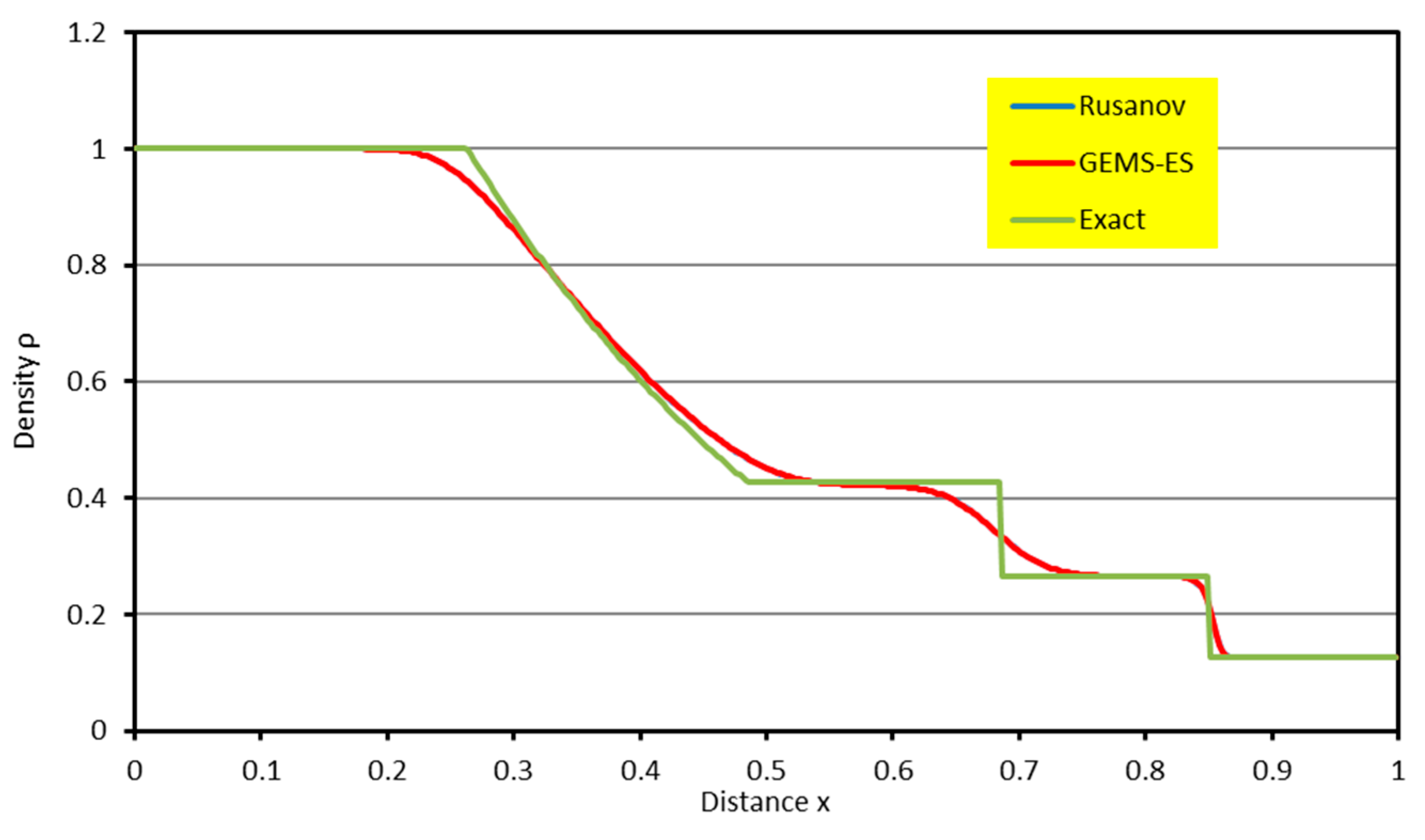
Figure 2.
Comparison of velocity distribution.
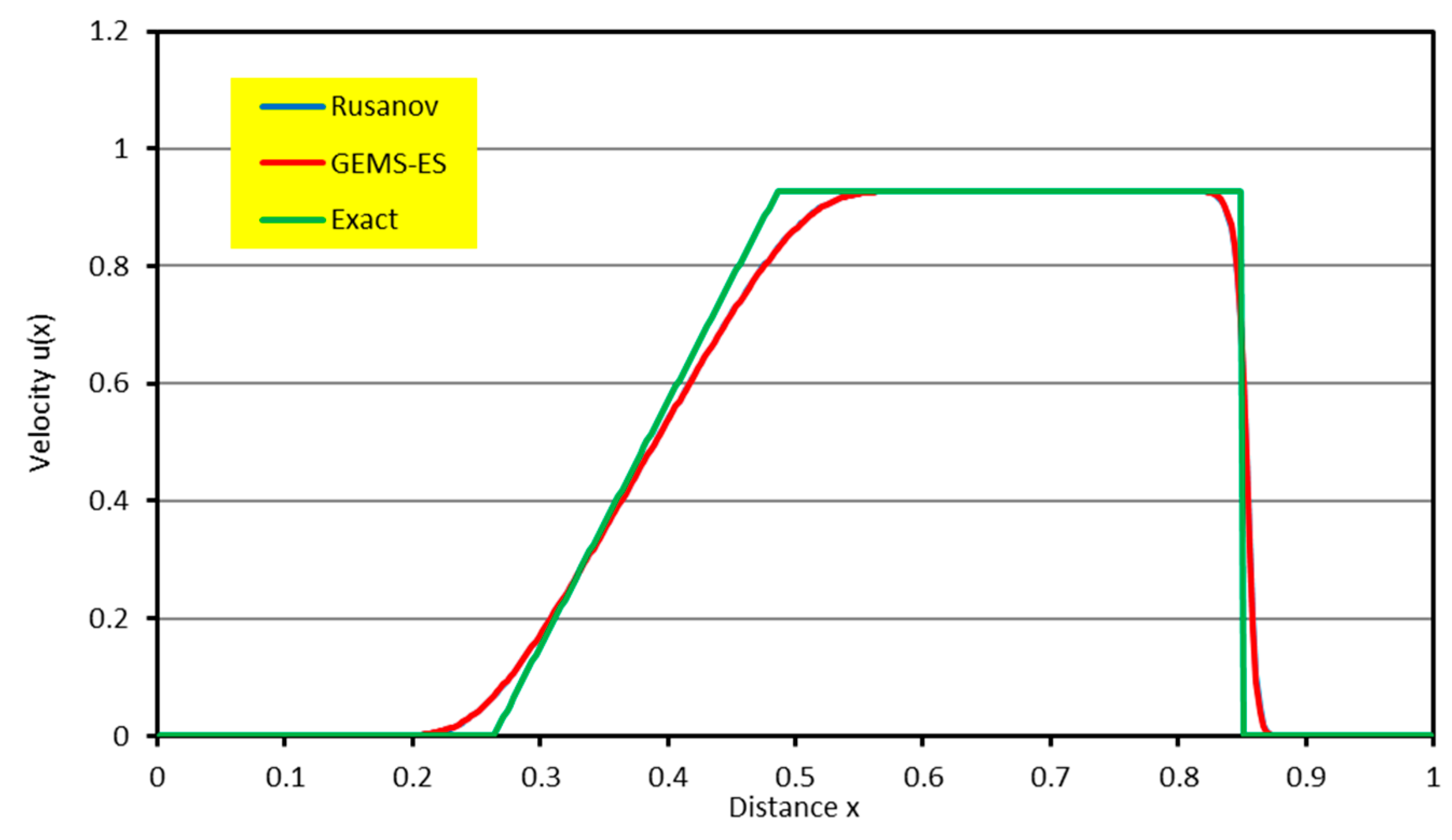
Figure 3.
Comparison of pressure distribution.
Disclaimer/Publisher’s Note: The statements, opinions and data contained in all publications are solely those of the individual author(s) and contributor(s) and not of MDPI and/or the editor(s). MDPI and/or the editor(s) disclaim responsibility for any injury to people or property resulting from any ideas, methods, instructions or products referred to in the content. |
© 2026 by the author. Licensee MDPI, Basel, Switzerland. This article is an open access article distributed under the terms and conditions of the Creative Commons Attribution (CC BY) license.
Copyright: This open access article is published under a Creative Commons CC BY 4.0 license, which permit the free download, distribution, and reuse, provided that the author and preprint are cited in any reuse.


