
Submitted:
01 April 2026
Posted:
02 April 2026
You are already at the latest version
Abstract
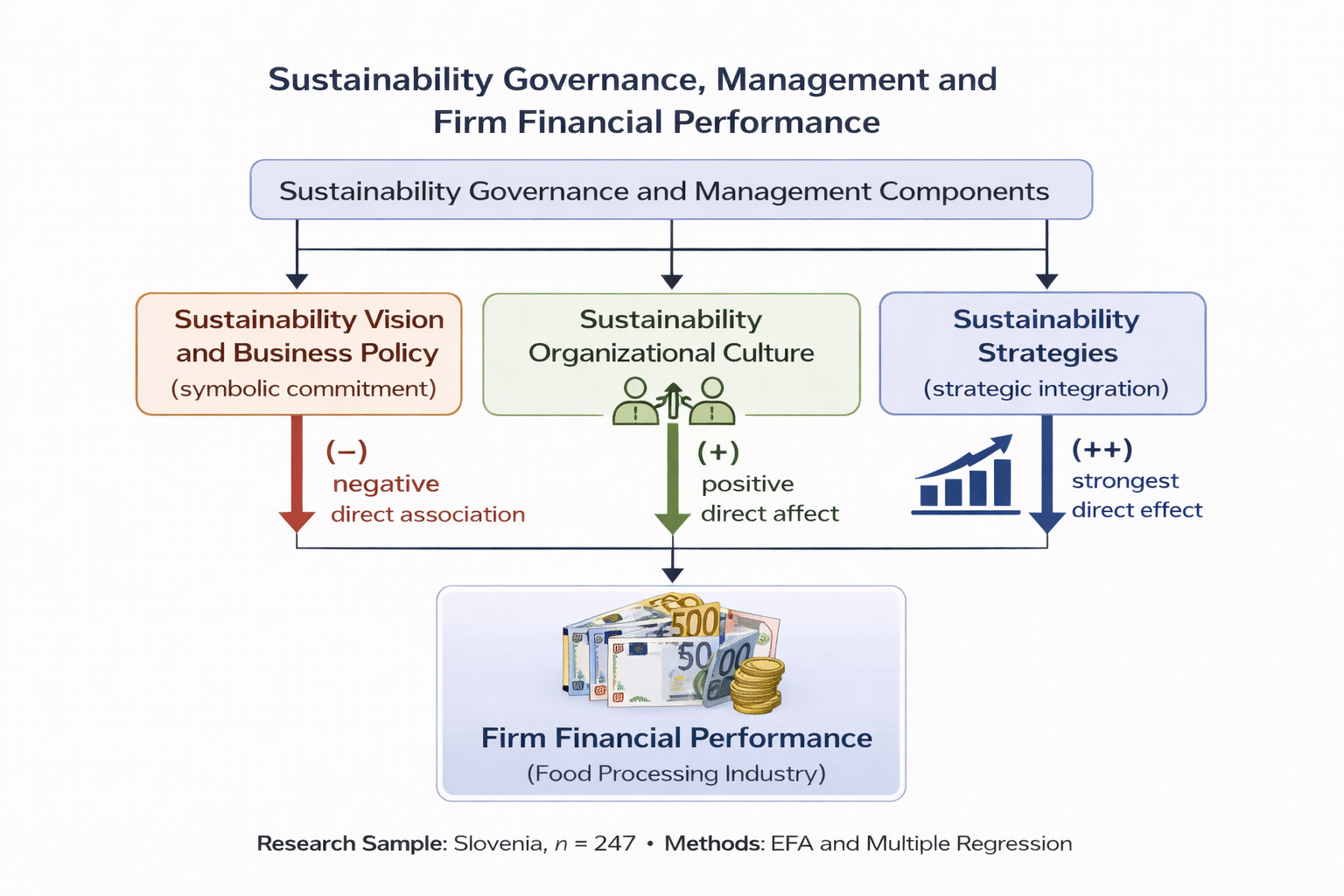
Sustainability has become a crucial strategic priority for firms operating in re-source-intensive industries such as food processing, where long-term competitiveness depends on responsible governance, strategic orientation, resource management and or-ganizational resilience. While prior research has established a general link between sus-tainability and organizational performance, less is known about how specific internal sustainability governance and management components contribute to firm financial per-formance. Drawing on the Resource-Based View and institutional theory, this study ex-amines the direct effects of a sustainability-oriented vision, business policy, organization-al culture, and strategies on firm financial performance. The study is based on survey data collected from 247 food processing firms operating in Slovenia, an EU member state. Ex-ploratory factor analysis and multiple regression analysis were used to test the proposed relationships. The results show that sustainability strategies have the strongest direct, sta-tistically significant positive effect on firm financial performance, followed by sustainabil-ity-oriented organizational culture. In contrast, sustainability vision and business policy exhibit a statistically significant, but negative, direct association, suggesting that formal sustainability commitments alone may not yield financial benefits without effective cul-tural support and strategic integration. These findings indicate that firm financial perfor-mance is directly driven primarily by sustainability strategies that are via practices opera-tionally embedded and supported by organizational capabilities such as organizational culture, rather than by normative symbolic commitments alone. This opens up possibili-ties for further research, based on the probability that the sustainable development vision and business policy serve as a catalyst for defining sustainable development strategies and implementing sustainable development practices, and that the normative commit-ments, in particular, indirectly influence financial performance. The study contributes to the sustainability governance and management literature by distinguishing the norma-tive, cultural, and strategic dimensions of sustainability and demonstrating their distinct direct implications for financial performance. The findings also provide practical insights for owners/governors and managers by highlighting the importance of integrating sus-tainability into organizational culture and core strategic processes to achieve long-term financial value.
Keywords:
sustainability governance
; sustainability management
; vision
; business policy
; organizational culture
; strategies
; financial performance
; food processing industry
Copyright: This open access article is published under a Creative Commons CC BY 4.0 license, which permit the free download, distribution, and reuse, provided that the author and preprint are cited in any reuse.


