

Submitted:
31 March 2026
Posted:
02 April 2026
You are already at the latest version
Abstract
Rapid advancements in large language models with code generation abilities have enabled new paradigms in automated software development, positioning AI both as a coding assistant and an active actor within complex software ecosystems. Traditional code generation pipelines, mostly relying on tool calling via ReAct approach, require a complete code snippet to be generated and followed by validation and correction, often leading to significant latency and resource overhead due to sequential inference and execution processes. This research introduces a novel asynchronous inference algorithm that integrates context-free grammar parsing with real-time REPL-based execution, enabling early detection of syntax, semantic, and runtime errors without completing entire code snippets. We formally define the suitability criteria for LLMs in a target programming language, establish parse-tree-based identification of top-level statements, and present an incremental buffer-parsing mechanism that triggers execution upon recognition of complete statements. Implemented for Python 3 using the Lark parser and evaluated on a modified MBPP split ($N{=}113$ tasks; dataset and prompts in the Appendix) across six models---CodeAct--Mistral, GPT-OSS~20B, Gemma~3, Llama~3.2, Phi~4, and Qwen3-Coder~30B---our method is compared to a synchronous baseline using paired Wilcoxon tests with Bonferroni correction. Empirical results show significantly faster time-to-first-output for every model, large reductions in total latency where top-level script execution dominates (up to roughly an order of magnitude for CodeAct--Mistral), and no material change in pass or correctness rates, indicating that incremental execution improves responsiveness without altering task outcomes. With special prompting or finetuning, the method shows up to 4x reduction in latency for valid code generation. The benchmark results confirm that synchronous inference constraints can be alleviated through grammar-guided incremental execution, allowing more efficient and responsive agent-driven code execution workflows. Future research will explore predictive parsing techniques, deeper integration with agentic system architectures, security constraints, and formulating runtime requirements for scalable deployment of LLM-generated code execution environments.
Keywords:
Large Language Models
; code generation
; context-free grammar augmentation
; incremental parsing
; real-time code execution
; early error detection
1. Introduction
Recent advances in Large Language Models (LLMs) have made agentic control over software systems increasingly feasible. In the area of code generation, the field has evolved from one-pass synthesis toward multi-stage and agentic workflows. Code-oriented pretrained models such as StarCoder demonstrated strong general-purpose program synthesis capabilities [1], while later systems such as MapCoder introduced explicit planning, generation, and debugging stages into the inference pipeline [2]. Execution-aware approaches, including LDB, further extended this paradigm by using runtime information to support step-by-step debugging and correction [3]. More broadly, these developments reflect a shift from viewing LLMs merely as code autocompletion tools toward treating them as active components of larger software systems. This perspective is aligned with the ideas of AI OS [4] and Software 3.0 [5], where AI models are expected to participate directly in software execution and control loops.
Despite this progress, most existing approaches still preserve a sequential generate–then–validate workflow. Even when planning, debugging, or self-correction mechanisms are added, code is typically analyzed only after a complete or nearly complete fragment has already been produced. As a result, syntax, semantic, and runtime errors are often detected late, which increases latency and may require multiple correction iterations. This limitation is especially important in agentic execution settings, where delayed feedback from the environment directly reduces system responsiveness and efficiency. Related studies also show that LLM-based code generation remains vulnerable to ambiguous task descriptions, repetition, and broader reliability issues [6,7], which makes earlier and more fine-grained validation increasingly important.
Another line of research addresses code correctness directly during decoding. For example, SynCode incorporates context-free grammar constraints into the generation process to ensure syntactic validity of partial outputs [8]. Such approaches reduce parser-level errors and improve structural consistency, but syntax-level constraints alone do not resolve semantic inconsistencies, contextual errors, or runtime failures. These types of failures can only be exposed through execution or through deeper incremental analysis of the generated program. Therefore, although constrained decoding improves one important aspect of code generation, it does not remove the need for mechanisms that can validate and execute code earlier in the inference process.
In this paper, we focus on the agentic use case in which an AI system generates and executes programs in an external control environment. Unlike conventional pipelines that wait for full program generation before validation and execution, we study an inference-time algorithm based on incremental parsing and early execution. The main idea is to identify executable top-level statements as soon as they are formed and to run them immediately, thereby obtaining earlier feedback about syntax, semantic, and runtime errors. In this way, the proposed approach addresses a limitation shared by many existing methods: although they improve the quality of generated code, they still largely postpone executable validation until after substantial generation has already occurred.
The object of the research is LLM inference algorithms. The aim and objectives of the research are to describe an effective algorithm for LLM-based code generation that will:
- detect syntax errors without the need to complete the code generation;
- execute generated code as soon as possible;
- detect semantic and runtime errors without the need to complete the code generation.
2. Materials and Methods
The main ideas on which the proposed algorithm is built are:
- Context-free grammar inference performed alongside LLM inference can detect syntax errors early [8].
- REPL can be used to execute code line-by-line as it is generated.
- LLM inference should be stopped once an error occurs.
To describe a theoretical background for the algorithm, we introduce some definitions and constraints.
First, we need to narrow the list of applicable LLMs and programming languages.
Definition 1.
Let
- be the vocabulary of tokens produced by the LLM,
- be the set of all finite sequences of tokens (“words”),
- be the set of all finite sequences of lexemes of the lexer of programming language p.
We say that the LLM issuitable for code generationin the target programming language p if
Second, the target programming language should have a REPL interface, which can execute top-level statements in a target programming language. Formally, we define a top-level statement as follows.
Definition 2.
Let be a context-free grammar with start symbol S. Aparse treeT for G is a finite, ordered, labelled tree satisfying:
- is labelled S.
- If a node v is labelled and has children , then there is a production
- The leaves of T are labelled by tokens in . Reading the leaf labels from left to right gives theyieldof T.
Define Suppose is the non-terminal for a single statement. Then a token string is atop-level statementof G exactly when
where denotes the subtree of T rooted at node v.
Third, we need to identify when top-level statements from the token stream can be executed. As we work with a partial sequence of lexemes on each step of inference and not the complete program, we should execute the top-level statement only once we have an assurance that the statement is complete and a new top-level statement has been started.
The initial version of the inference algorithm is described in Algorithm 1.
| Algorithm 1:RunCodeFromStream |
|
We refer to this grammar-guided incremental execution strategy as JitGen (just-in-time generation) throughout the remainder of this paper.
3. Results
In this paper, we evaluate a simplified idea based on using only the parser without a parallel lexer executing a DFA. Thus, on each token generation, we perform buffer parsing instead of storing a previous state of grammar inference.
We implemented a script that targets the Python 3 programming language.
Hypothesis. We compare two algorithms.
- The first (so-called “sync”) executes the code only after the LLM has finished the generation of the code snippet.
- The second (so-called “async”) parses and executes the code on each line of inference.
In both cases, the code snippet is generated and executed only once. Execution (and LLM inference) is halted once we get a syntax or runtime error.
By performing the benchmark, we check two hypotheses:
- If the generated code contains errors, the async algorithm will halt on error earlier than the sync algorithm.
- If the generated code is correct, the async algorithm will execute the code earlier (first-output time).
Evaluation Setup. We use the modified Appendix A.1 MBPP [9] dataset as a source of coding problems in the Python language and run both sync and async code execution approaches on CodeAct–Mistral, GPT-OSS 20B, Gemma 3, Llama 3.2, Phi 4, and Qwen3-Coder 30B. Models were executed on the same set of prompts Appendix A.4 with the same hyperparameters (seed, temperature, max tokens, etc.) for both algorithms. Execution time has been measured on an AMD Ryzen 7 7700X 8-core CPU with NVIDIA GeForce RTX 4090. As a parser implementation, we used the Python 3 grammar from the Lark package.
To assess whether the differences in execution time and time to first output between the async (JitGen) and sync (sequential) strategies were statistically significant, we employed the Wilcoxon signed-rank test [10], a non-parametric paired-difference test that does not assume normality of the underlying distributions. For each model and metric (total execution time and time to first output), we computed the paired differences across all matched task instances. Zero differences were excluded prior to testing, as the Wilcoxon signed-rank test is undefined for tied pairs at zero [11]. Tests were conducted as two-sided, and pairs with fewer than 10 non-zero differences were excluded from analysis to ensure sufficient statistical power. To control the family-wise error rate across the k hypothesis tests performed (two metrics × number of models), we applied the Bonferroni correction [12], adjusting each p-value as , with a significance threshold of . As a measure of effect size, we computed the rank-biserial correlation [13], defined as , where W is the Wilcoxon test statistic and n is the number of non-zero paired differences. This effect size indicates the proportion of favorable versus unfavorable pair rankings, with values near or indicating strong directional effects.
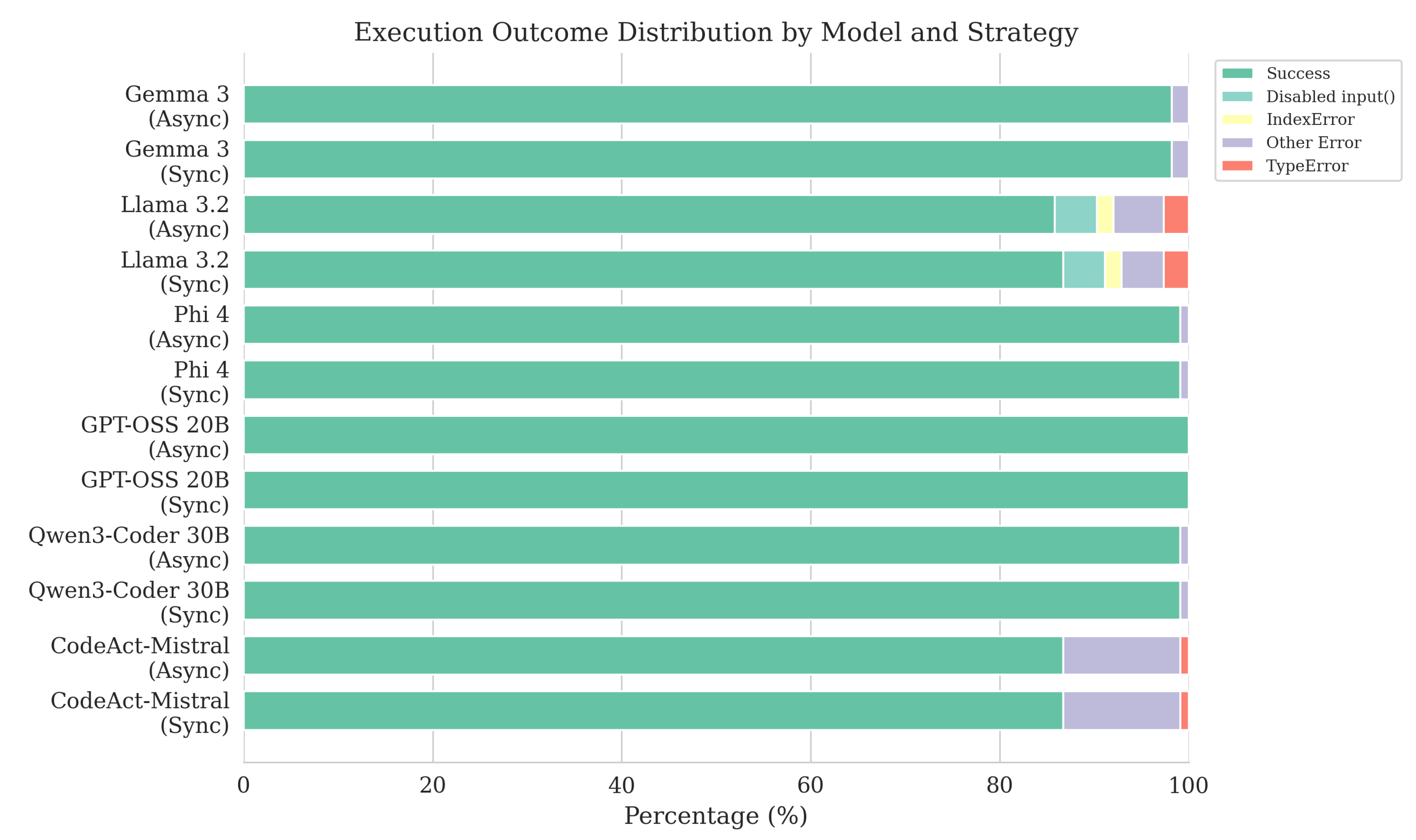
Supplementary Materials provide figures not shown in the main text (model-wise overview heatmap, ECDF and paired-difference views of time to first output, speedup ratios, correctness, and error-type counts) and additional tables: Wilcoxon tests (Table A1), pass and correctness rates (Table A2), and per-category outcome counts (Table A3); see Figure A1–Figure A6.
The benchmark results in Figure 1 and Figure 2, with descriptive medians and means in Table 1 and supplementary tests in Table A1, support the following:
- 1.
- Time to first output is substantially lower under async (JitGen) for every model; paired Wilcoxon tests remain significant after Bonferroni correction (Table A1).
- 2.
- Total execution time shows the largest async advantage for CodeAct–Mistral (roughly an order of magnitude at the median), consistent with more top-level, line-by-line executable script structure [14]. For GPT-OSS 20B and Qwen3-Coder 30B, median total times are nearly unchanged between strategies, and differences are not significant after correction—whereas first-output gains remain clear, matching a setting where much of the stream is shared reasoning before runnable code appears [15,16].
- 3.
- Gemma 3 and Phi 4 exhibit significant paired differences for total execution time in our tests (Table A1); Llama 3.2 does not for total time after correction, despite faster first output under async.
- 4.
- Correctness and timeout rates match between async and sync for each model; pass rates match for five of six models, with Llama 3.2 differing by less than one percentage point (85.84% vs 86.73%; Table A2).
Overall, async (JitGen) execution reduces time-to-first-output everywhere in our benchmark, reduces total latency most clearly when models emit runnable top-level code early (e.g., CodeAct–Mistral), and leaves correctness and timeouts unchanged, with only a small pass-rate discrepancy on Llama 3.2.
4. Conclusions
In this paper, we proposed a novel LLM inference algorithm for code generation and analyzed the benchmarks for a partial implementation. The benchmark results show that the proposed algorithm allows a significant decrease in the error detection time in LLM-generated code and allows code snippets to be executed in parallel with LLM inference.
Further studies will be dedicated to algorithm performance improvements, application of predictive parsing, agentic systems integration, and formulation of the requirements for a runtime for LLM-generated code execution.
Author Contributions
Conceptualization, A.S; methodology, A.S.; analysis of sources A.S. and Y.T.; algorithm, A.S.; benchmark script implementation, A.S.; writing—original draft preparation, A.S.; writing—review and editing, Y.T. All authors have read and agreed to the published version of the manuscript.
Funding
This research received no external funding.
Institutional Review Board Statement
Not applicable.
Informed Consent Statement
Not applicable.
Data Availability Statement
The datasets used in this study, including MBPP, are publicly available. The implementation of the benchmark script is available from the corresponding author on reasonable request.
Acknowledgments
All authors contributed to the conception, design, implementation, and writing of this work. All materials and resources used in this study were prepared by the authors.All authors thanks Taras Shevchenko National University of Kyiv for support.
Conflicts of Interest
The authors declares no conflicts of interest.
Abbreviations
The following abbreviations are used in this manuscript:
| DFA | Deterministic Finite Automaton |
| LLM | Large Language Model |
| REPL | Read-Eval-Print Loop |
Appendix A.
This supplement provides a model-wise overview heatmap, plots complementary to the main-text latency figures (ECDF and paired differences in time to first output, speedup ratios, correctness, and error-type counts), and tabulated outcome rates, error breakdowns, and paired Wilcoxon tests for the benchmark in the Results section (descriptive time statistics appear as Table 1 in the main text). The MBPP variant used for evaluation is public; implementation details are available from the corresponding author on reasonable request.
Appendix A.1. Dataset
Modified MBPP dataset which is used for evaluation is available at https://huggingface.co/datasets/AntonSvystunov/mbpp-jitgen-validation.
Appendix A.2. Extended Benchmark Figures
Figure A1.
Overview heatmap of benchmark metrics across models and algorithms (supplementary material).
Figure A1.
Overview heatmap of benchmark metrics across models and algorithms (supplementary material).
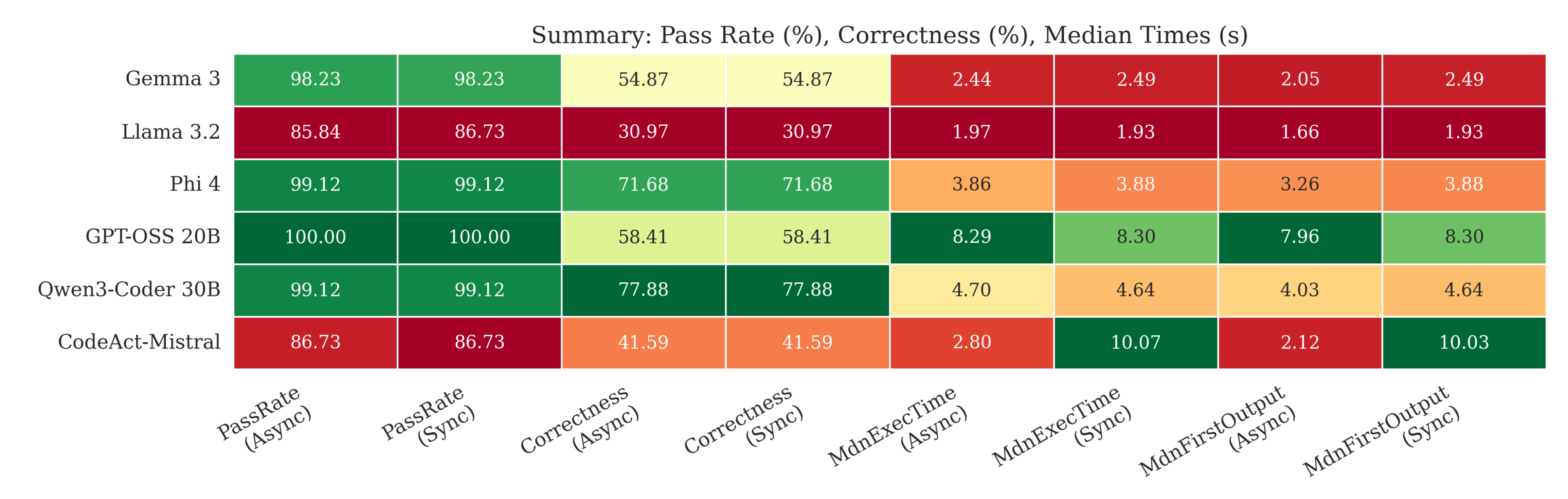
Figure A2.
Empirical cumulative distribution of time to first output across tasks.
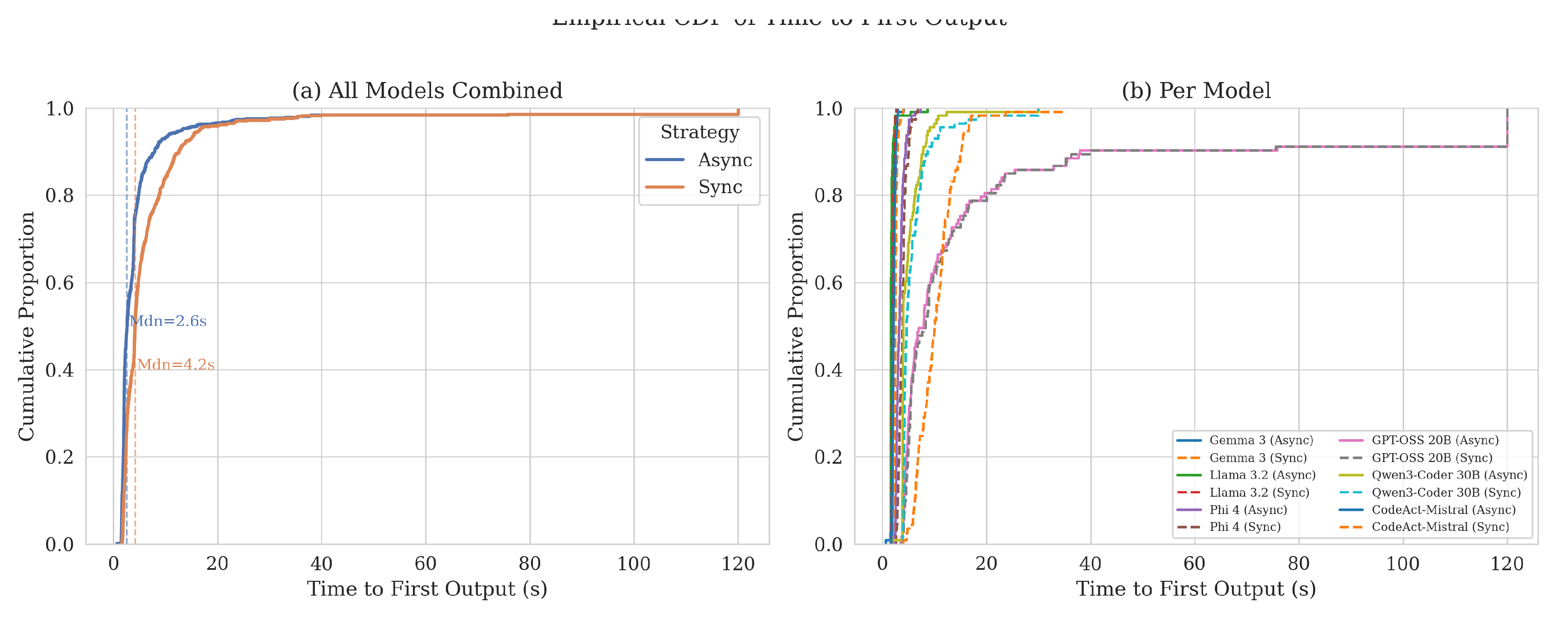
Figure A3.
Paired differences in time to first output (, seconds) per task.
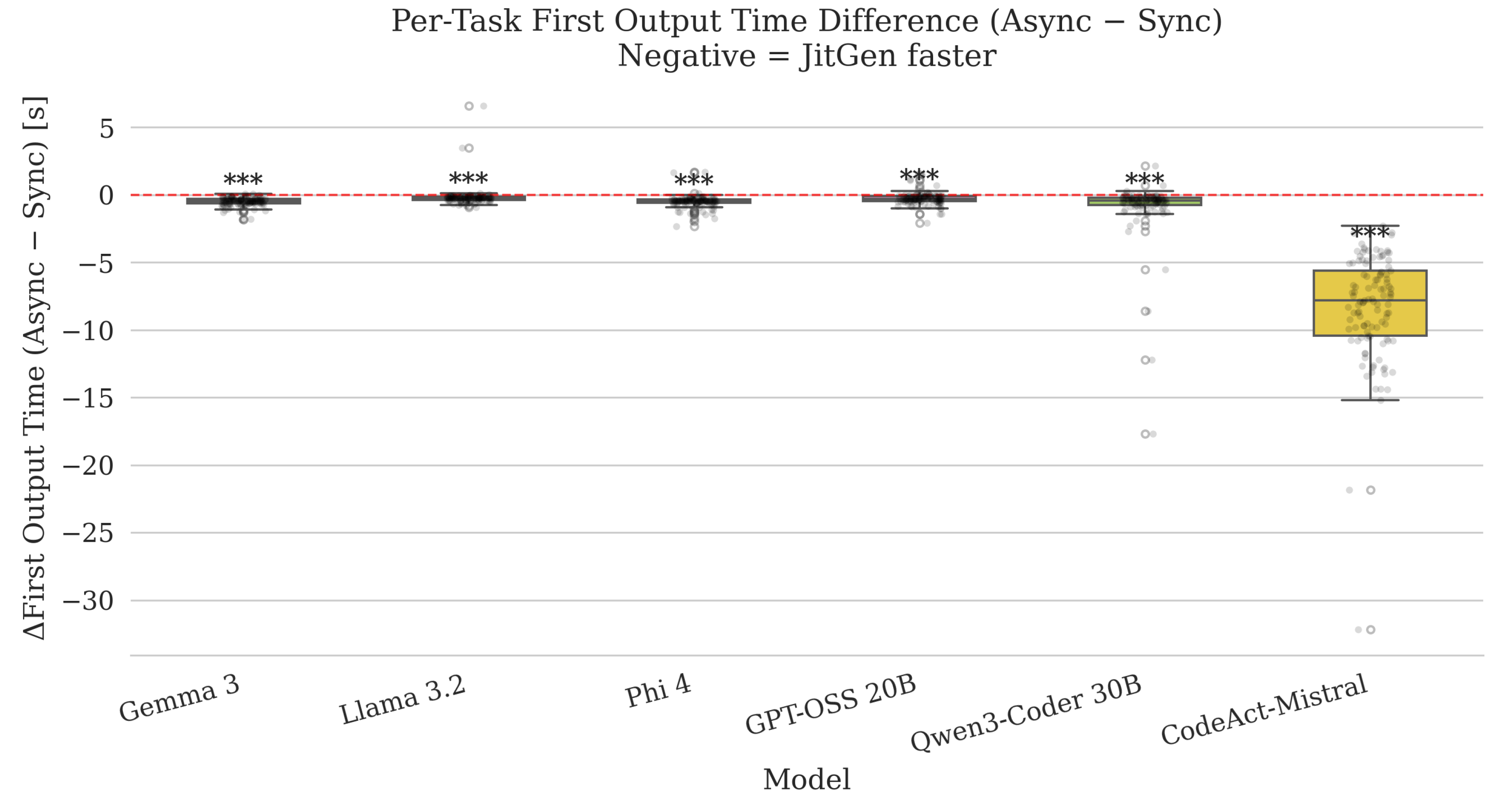
Figure A4.
Speedup ratio comparing async (JitGen) and synchronous execution across models.
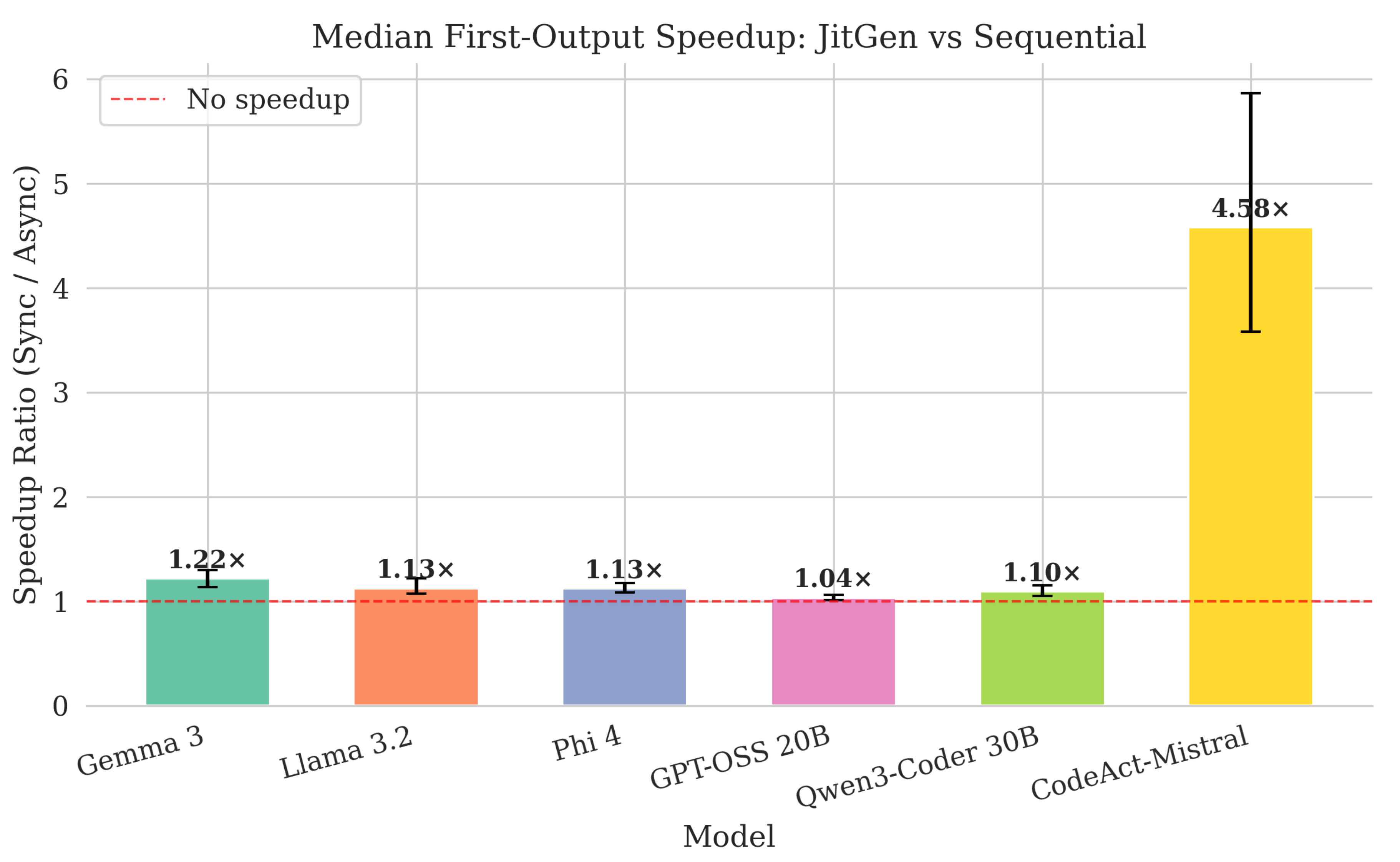
Figure A5.
Pass and correctness rates by model and algorithm.
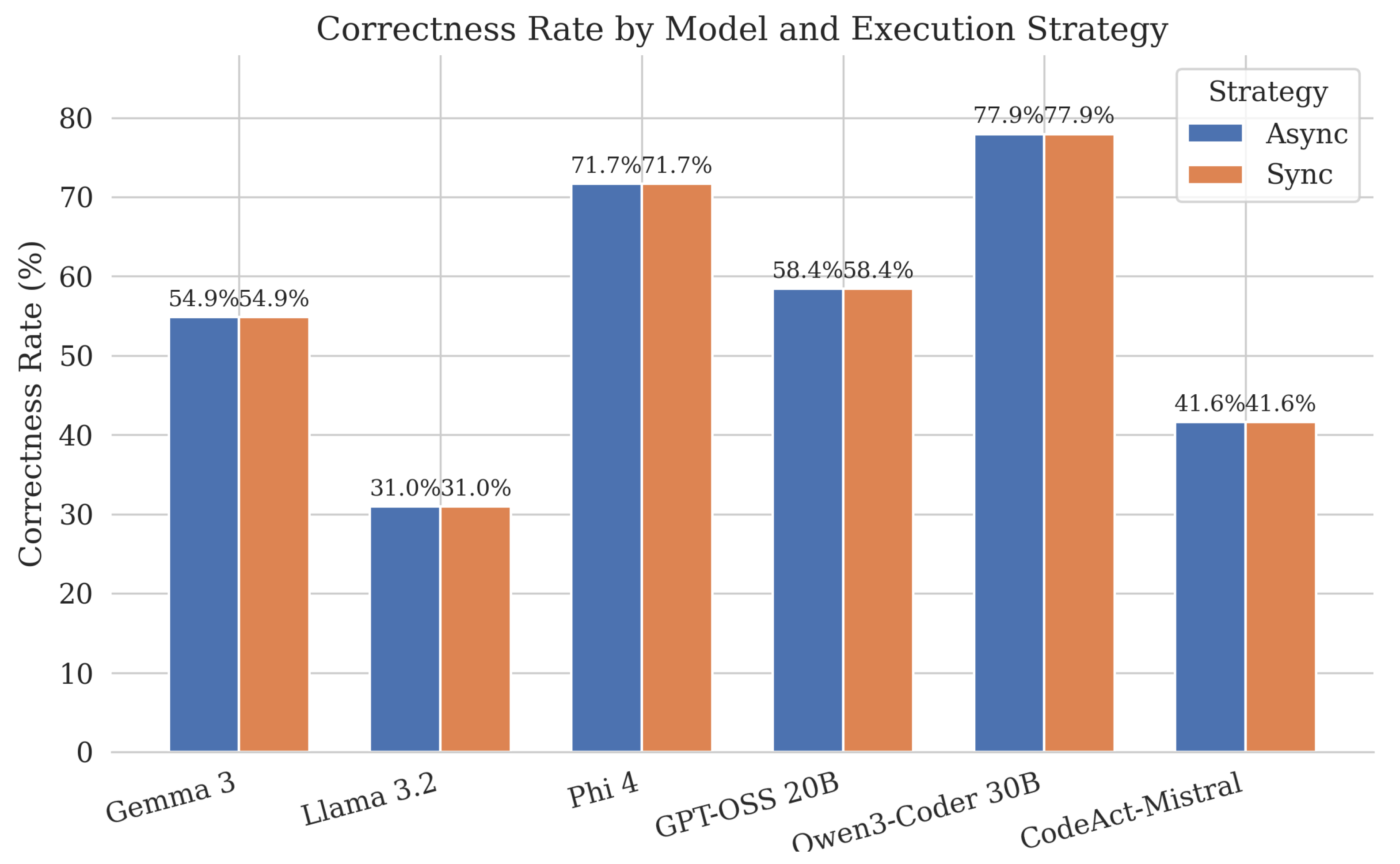
Figure A6.
Counts of run outcomes by error category (same generated code; execution strategy differs only in timing).
Figure A6.
Counts of run outcomes by error category (same generated code; execution strategy differs only in timing).
Appendix A.3. Supplementary Tables
All paired tests use on matched tasks; negative mean or median for time metrics indicates faster async. Significance uses two-sided Wilcoxon signed-rank tests with Bonferroni correction across tests as in the main text.

Table A1.
Paired Wilcoxon signed-rank tests: execution time and time to first output.
| Model | Metric | N | Mean | Med. | W | p | r | Sig. | |
|---|---|---|---|---|---|---|---|---|---|
| Gemma 3 | Exec. time | 113 | 803 | 0.751 | Yes | ||||
| Gemma 3 | First output | 113 | 8 | 0.9975 | Yes | ||||
| Llama 3.2 | Exec. time | 113 | 2222 | 0.00423 | 0.0507 | 0.310 | No | ||
| Llama 3.2 | First output | 113 | 248 | 0.923 | Yes | ||||
| Phi 4 | Exec. time | 113 | 1715 | 0.468 | Yes | ||||
| Phi 4 | First output | 113 | 221 | 0.931 | Yes | ||||
| GPT-OSS 20B | Exec. time | 113 | 2763 | 0.190 | 1.000 | 0.142 | No | ||
| GPT-OSS 20B | First output | 113 | 653 | 0.797 | Yes | ||||
| Qwen3-Coder 30B | Exec. time | 113 | 2792 | 0.220 | 1.000 | 0.133 | No | ||
| Qwen3-Coder 30B | First output | 113 | 225 | 0.930 | Yes | ||||
| CodeAct-Mistral | Exec. time | 113 | 0 | 1.000 | Yes | ||||
| CodeAct-Mistral | First output | 113 | 0 | 1.000 | Yes |
Table A2.
Pass rate, correctness rate, and timeout rate (%) by model and algorithm.
| Model | Algo. | N | Pass | Correct | Timeout |
|---|---|---|---|---|---|
| CodeAct-Mistral | Async | 113 | 86.73 | 41.59 | 0.0 |
| CodeAct-Mistral | Sync | 113 | 86.73 | 41.59 | 0.0 |
| GPT-OSS 20B | Async | 113 | 100.00 | 58.41 | 0.0 |
| GPT-OSS 20B | Sync | 113 | 100.00 | 58.41 | 0.0 |
| Gemma 3 | Async | 113 | 98.23 | 54.87 | 0.0 |
| Gemma 3 | Sync | 113 | 98.23 | 54.87 | 0.0 |
| Llama 3.2 | Async | 113 | 85.84 | 30.97 | 0.0 |
| Llama 3.2 | Sync | 113 | 86.73 | 30.97 | 0.0 |
| Phi 4 | Async | 113 | 99.12 | 71.68 | 0.0 |
| Phi 4 | Sync | 113 | 99.12 | 71.68 | 0.0 |
| Qwen3-Coder 30B | Async | 113 | 99.12 | 77.88 | 0.0 |
| Qwen3-Coder 30B | Sync | 113 | 99.12 | 77.88 | 0.0 |
Table A3.
Task counts by outcome category (totals over tasks per model and algorithm).
| Model | Algo. | No input() |
Index err. |
Other err. |
Success | Type err. |
|---|---|---|---|---|---|---|
| CodeAct-Mistral | Async | 0 | 0 | 14 | 98 | 1 |
| CodeAct-Mistral | Sync | 0 | 0 | 14 | 98 | 1 |
| GPT-OSS 20B | Async | 0 | 0 | 0 | 113 | 0 |
| GPT-OSS 20B | Sync | 0 | 0 | 0 | 113 | 0 |
| Gemma 3 | Async | 0 | 0 | 2 | 111 | 0 |
| Gemma 3 | Sync | 0 | 0 | 2 | 111 | 0 |
| Llama 3.2 | Async | 5 | 2 | 6 | 97 | 3 |
| Llama 3.2 | Sync | 5 | 2 | 5 | 98 | 3 |
| Phi 4 | Async | 0 | 0 | 1 | 112 | 0 |
| Phi 4 | Sync | 0 | 0 | 1 | 112 | 0 |
| Qwen3-Coder 30B | Async | 0 | 0 | 1 | 112 | 0 |
| Qwen3-Coder 30B | Sync | 0 | 0 | 1 | 112 | 0 |
Appendix A.4. Benchmark Prompts
System Prompt
You generate Python scripts to be executed line-by-line.
IMPORTANT OUTPUT RULE:
- Your final answer must be ONLY Python code wrapped in a ```python code block.
- Format: ```python
<code>
```
Your job:
- Given a problem statement and one test case, write a script that computes the answer
for that test case.
- Infer variables from the test case and define them as local variables near the top.
- Print the result using print(...) exactly as required.
Non-negotiable constraints:
- DO NOT use input() (or any interactive blocking call).
- Do not read stdin.
- No imports / no external libraries.
- No eval/exec/compile.
- No infinite loops; every loop must have a clear termination condition.
- Script must run top-to-bottom without errors.
- Define functions only if absolutely necessary, but the main logic should be in the
global scope.
*Structure* your code in following order:
1. Helper functions (if needed)
2. Variable definitions inferred from the test input
3. Main logic to solve the task
4. Final print statement with the answer
Separate your code into logical section with comments to match the above structure.
Internal self-check (do this silently before finalizing):
- [ ] All required values are defined as local variables from the test input
- [ ] No input() usage
- [ ] No imports
- [ ] Output matches the required format exactly
- [ ] Script runs top-to-bottom
- [ ] All utility code is defined before it’s used
- [ ] Code structure follows the specified order
If ambiguous, choose the simplest interpretation consistent with the test case and
required output format.
If impossible, print a clear error message.
Human Prompt
TASK:
Write a Python code to find the sum of maximum increasing subsequence of the
given array.
TASK INPUT (infer local variables from this):
[3, 4, 5, 10], 4
EXPECTED OUTPUT FORMAT EXAMPLE:
106
Write a Python script that:
1) Defines local variables from the test input
2) Solves the task
3) Prints the result in the specified format
Remember: no input(), no imports, stdout only via print(...).
CRITICAL: Wrap your entire code in a ```python code block.
References
- Li, R.; Allal, L.B.; Zi, Y.; Muennighoff, N.; Kocetkov, D.; Mou, C.; Marone, M.; Akiki, C.; Li, J.; Chim, J.; et al. StarCoder: may the source be with you! arXiv 2023, arXiv:2305.06161. [Google Scholar] [CrossRef]
- Islam, M.A.; Ali, M.E.; Parvez, M.R. MapCoder: Multi-Agent Code Generation for Competitive Problem Solving. arXiv 2024, arXiv:cs.CL/2405.11403. [Google Scholar]
- Zhong, L.; Wang, Z.; Shang, J. Debug like a Human: A Large Language Model Debugger via Verifying Runtime Execution Step-by-step. arXiv 2024, arXiv:cs.SE/2402.16906. [Google Scholar]
- Xu, S.; Li, Z.; Mei, K.; Zhang, Y. AIOS Compiler: LLM as Interpreter for Natural Language Programming and Flow Programming of AI Agents. arXiv 2024, arXiv:cs.CL/2405.06907. [Google Scholar]
- Hassan, A.E.; Oliva, G.A.; Lin, D.; Chen, B.; Jiang, Z.M. Towards AI-Native Software Engineering (SE 3.0): A Vision and a Challenge Roadmap. arXiv 2024, arXiv:2410.06107. [Google Scholar] [CrossRef]
- Larbi, M.; Akli, A.; Papadakis, M.; Bouyousfi, R.; Cordy, M.; Sarro, F.; Traon, Y.L. When Prompts Go Wrong: Evaluating Code Model Robustness to Ambiguous, Contradictory, and Incomplete Task Descriptions. arXiv 2025, arXiv:2507.20439. [Google Scholar] [CrossRef]
- Dong, Y.; Liu, Y.; Jiang, X.; Gu, B.; Jin, Z.; Li, G. Rethinking Repetition Problems of LLMs in Code Generation. In Proceedings of the Proceedings of the 63rd Annual Meeting of the Association for Computational Linguistics; Che, W., Nabende, J., Shutova, E., Pilehvar, M.T., Eds.; Vienna, Austria, 2025; Volume 1, pp. 965–985. [Google Scholar] [CrossRef]
- Ugare, S.; Suresh, T.; Kang, H.; Misailovic, S.; Singh, G. SynCode: LLM Generation with Grammar Augmentation, 2024. arXiv arXiv:cs.LG/2403.01632.
- Austin, J.; Odena, A.; Nye, M.; Bosma, M.; Michalewski, H.; Dohan, D.; Jiang, E.; Cai, C.; Terry, M.; Le, Q.; et al. Program Synthesis with Large Language Models. arXiv arXiv:2108.07732. [PubMed]
- Wilcoxon, F. Individual Comparisons by Ranking Methods. Biometrics Bulletin 1945, 1, 80–83. [Google Scholar] [CrossRef]
- Pratt, J.W. Remarks on Zeros and Ties in the Wilcoxon Signed Rank Procedures. Journal of the American Statistical Association 1959, 54, 655–667. [Google Scholar] [CrossRef]
- Bonferroni, C. Teoria statistica delle classi e calcolo delle probabilità. Pubblicazioni del R Istituto Superiore di Scienze Economiche e Commerciali di Firenze 1936, 8, 3–62. [Google Scholar]
- Kerby, D.S. The Simple Difference Formula: An Approach to Teaching Nonparametric Correlation. Comprehensive Psychology 2014, 3, 11.IT.3.1. [Google Scholar] [CrossRef]
- Wang, X.; Chen, Y.; Yuan, L.; Zhang, Y.; Li, Y.; Peng, H.; Ji, H. Executable Code Actions Elicit Better LLM Agents. arXiv 2024, arXiv:2402.01030. [Google Scholar] [CrossRef]
- Agarwal, S.; Ahmad, L.; Ai, J.; Altman, S.; Applebaum, A.; Arbus, E.; Arora, R.K.; Bai, Y.; et al.; OpenAI; : gpt-oss-120b & gpt-oss-20b Model Card. arXiv 2025, arXiv:cs.CL/2508.10925. [Google Scholar]
- Yang, A.; Li, A.; Yang, B.; Zhang, B.; Hui, B.; Zheng, B.; Yu, B.; Gao, C.; Huang, C.; Lv, C.; et al. Qwen3 Technical Report. arXiv 2025, arXiv:2505.09388. [Google Scholar] [CrossRef]
Figure 1.
Distribution of total execution time (seconds) by model and algorithm ( tasks per series; same generated programs).
Figure 1.
Distribution of total execution time (seconds) by model and algorithm ( tasks per series; same generated programs).
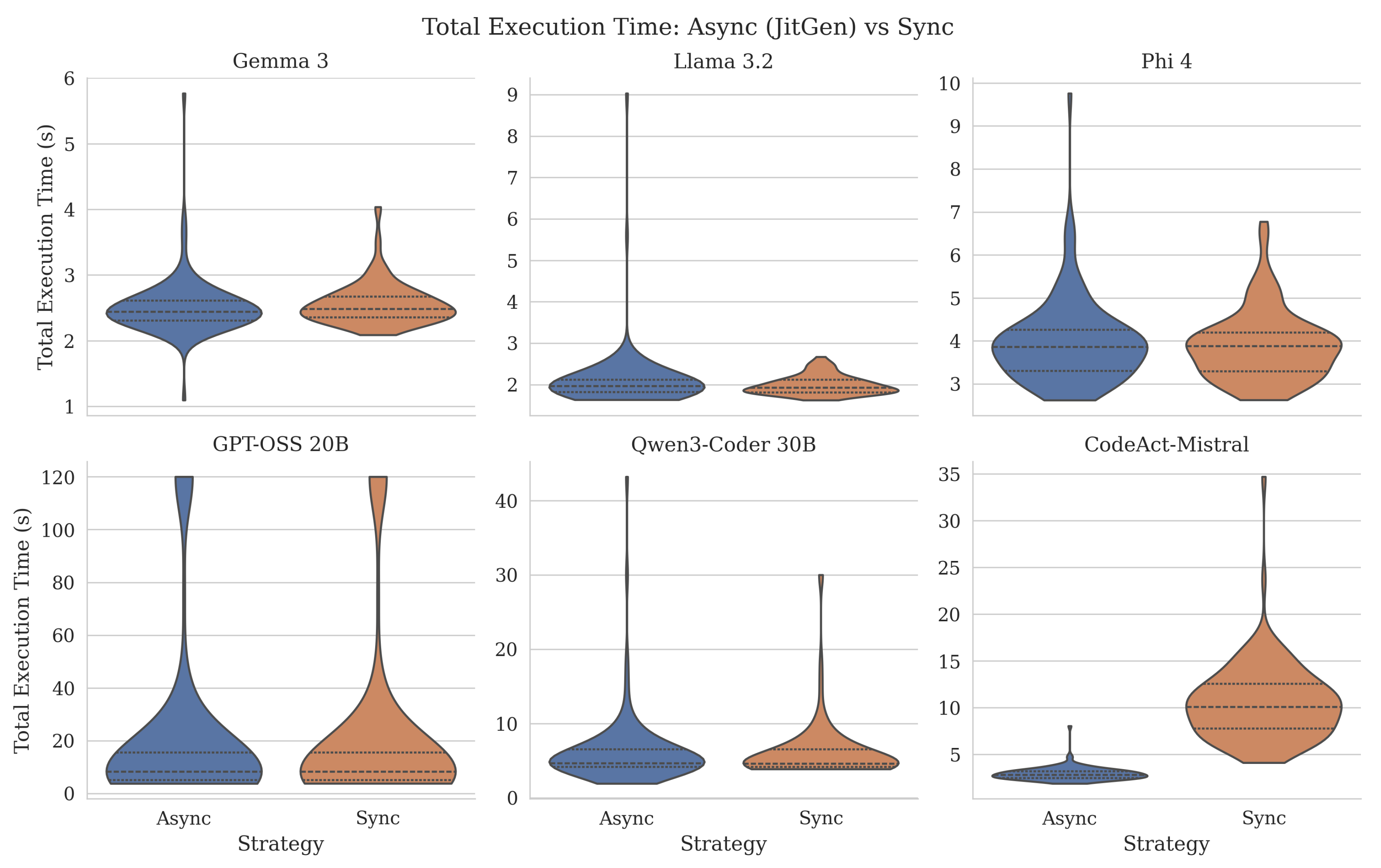
Figure 2.
Distribution of time to first output (seconds) by model and algorithm ( tasks per series).
Figure 2.
Distribution of time to first output (seconds) by model and algorithm ( tasks per series).
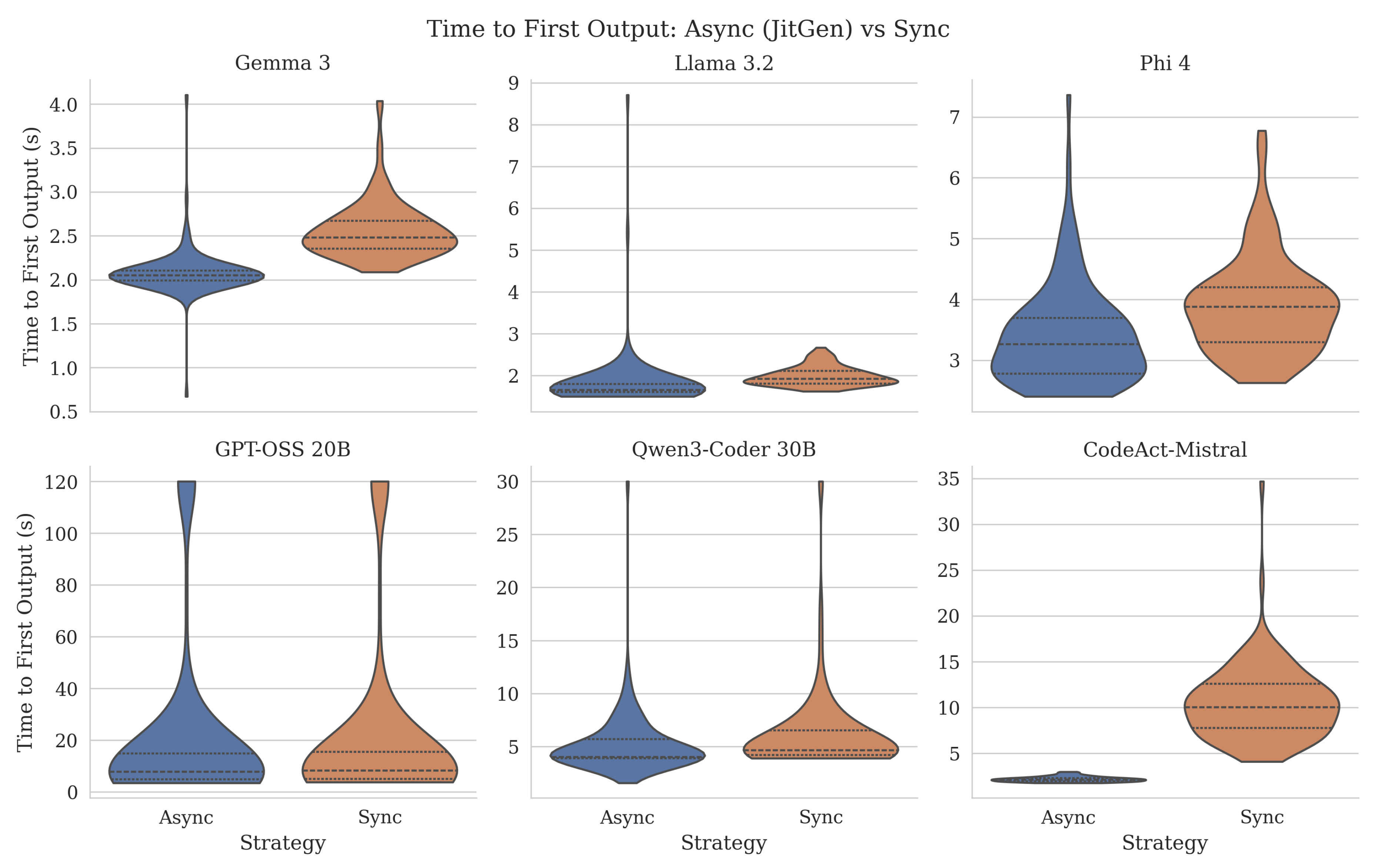
Table 1.
Descriptive statistics for execution time and time to first output (seconds).
| Model | Algo. | N | Exec. time | First output | ||||
|---|---|---|---|---|---|---|---|---|
| Mean | Med. | Std | Mean | Med. | Std | |||
| CodeAct-Mistral | Async | 113 | 2.926 | 2.802 | 0.719 | 2.163 | 2.117 | 0.286 |
| CodeAct-Mistral | Sync | 113 | 10.490 | 10.074 | 4.084 | 10.466 | 10.027 | 4.085 |
| GPT-OSS 20B | Async | 113 | 20.523 | 8.295 | 32.635 | 20.179 | 7.958 | 32.730 |
| GPT-OSS 20B | Sync | 113 | 20.464 | 8.301 | 32.636 | 20.464 | 8.300 | 32.636 |
| Gemma 3 | Async | 113 | 2.516 | 2.442 | 0.444 | 2.081 | 2.055 | 0.273 |
| Gemma 3 | Sync | 113 | 2.565 | 2.486 | 0.327 | 2.565 | 2.485 | 0.327 |
| Llama 3.2 | Async | 113 | 2.101 | 1.969 | 0.778 | 1.821 | 1.659 | 0.765 |
| Llama 3.2 | Sync | 113 | 1.992 | 1.930 | 0.231 | 1.992 | 1.930 | 0.231 |
| Phi 4 | Async | 113 | 3.969 | 3.864 | 0.983 | 3.395 | 3.263 | 0.823 |
| Phi 4 | Sync | 113 | 3.886 | 3.884 | 0.805 | 3.886 | 3.884 | 0.805 |
| Qwen3-Coder 30B | Async | 113 | 6.232 | 4.696 | 4.852 | 5.232 | 4.027 | 2.967 |
| Qwen3-Coder 30B | Sync | 113 | 6.100 | 4.642 | 4.019 | 6.100 | 4.642 | 4.019 |
Disclaimer/Publisher’s Note: The statements, opinions and data contained in all publications are solely those of the individual author(s) and contributor(s) and not of MDPI and/or the editor(s). MDPI and/or the editor(s) disclaim responsibility for any injury to people or property resulting from any ideas, methods, instructions or products referred to in the content. |
© 2026 by the authors. Licensee MDPI, Basel, Switzerland. This article is an open access article distributed under the terms and conditions of the Creative Commons Attribution (CC BY) license (http://creativecommons.org/licenses/by/4.0/).
Copyright: This open access article is published under a Creative Commons CC BY 4.0 license, which permit the free download, distribution, and reuse, provided that the author and preprint are cited in any reuse.


