
Submitted:
01 April 2026
Posted:
02 April 2026
You are already at the latest version
Abstract
Background: Prostate cancer remains a major cause of cancer morbidity and mortality among men in the United States. Differences in diagnosis and survival across racial and socioeconomic groups continue to raise concern in clinical and public health research. Population based datasets provide an opportunity to examine patterns of advanced disease and survival outcomes across diverse demographic groups. Objective: This study evaluated racial and socioeconomic disparities in cancer-specific survival among patients with metastatic prostate cancer using a national population-based dataset. Methods: A retrospective population-based study was conducted using data from the Surveillance, Epidemiology, and End Results program. Patients diagnosed with malignant prostate cancer between 2004 and 2020 with distant stage disease were included. The final analytic sample consisted of 54,062 patients. Variables included race and ethnicity, age group, metastatic sites at diagnosis, treatment variables, and median household income. Descriptive analyses compared characteristics by cancer specific death using chi square tests for categorical variables and t tests for continuous variables. Survival patterns were examined using Kaplan Meier methods and log rank tests. Multivariable Cox proportional hazards model was used to estimate adjusted hazard ratios for factors associated with cancer specific mortality. Results: Cancer specific mortality differed across racial and socioeconomic groups. Higher mortality was observed among non-Hispanic Black patients(aHR=1.15,95% CI: 1.00 to 1.31, p =0.046) and non-Hispanic American Indian or Alaska Native patients(aHR=1.15, 95% CI :1.10 to 1.20, p < 0.001) compared with non-Hispanic White patients, while Hispanic and non-Hispanic Asian or Pacific Islander patients showed lower mortality risk. Older age groups demonstrated higher mortality. Liver, lung, and brain metastases were associated with increased risk of prostate cancer death. Patients in higher income groups showed lower mortality compared with patients in lower income groups (aHR=0.83, 95% CI : 0.80 to 0.87, p < 0.001). Conclusion: This study highlights persistent racial and socioeconomic differences in cancer specific survival among patients with advanced prostate cancer in the United States. These findings support continued efforts to address disparities in early detection, access to care, and treatment pathways. Future research should further explore clinical and structural factors that influence survival differences across population groups.
Keywords:
prostate cancer
; racial disparities
; socioeconomic status
; cancer specific survival
; SEER database
; metastatic prostate cancer
1. Introduction
Prostate cancer is the most frequently diagnosed malignancy among men in the United States and remains a major contributor to cancer-related mortality [1]. Advances in screening, early detection, and treatment have improved outcomes over recent decades; however, a substantial proportion of patients continue to present with advanced or metastatic disease, which is associated with significantly poor survival outcomes. Early detection through prostate-specific antigen (PSA) screening has been shown to reduce prostate cancer–specific mortality and the incidence of metastatic disease at diagnosis [2]. Despite these advances, prostate cancer continues to represent an important public health challenge due to persistent differences in disease burden and outcomes across population groups.
Racial disparities in prostate cancer outcomes are well documented in the United States. Numerous studies have demonstrated that Black men experience higher incidence rates, are more likely to present with aggressive disease, and have higher prostate cancer–specific mortality compared with other racial groups [7,8,9]. These differences are believed to arise from a complex interaction between biological variation, environmental exposures, structural determinants of health, and differences in access to screening, diagnosis, and treatment [10]. Social determinants of health; including income, education level, insurance coverage, and access to preventive health services, play an important role in influencing cancer outcomes across populations [11,12].
Socioeconomic status has also been identified as an important factor affecting prostate cancer detection and survival. Individuals with lower socioeconomic status often face barriers to early diagnosis and optimal treatment, including reduced access to screening services, delays in specialist referral, financial limitations, and limited access to high-quality cancer care [13,14,15]. These barriers may contribute to later stages at diagnosis and poorer survival outcomes among disadvantaged populations [16]. Previous research has documented disparities in prostate cancer incidence, screening patterns, and treatment utilization across racial and socioeconomic groups [17]. However, many prior studies have focused primarily on localized disease or treatment patterns, and fewer investigations have examined survival differences among patients presenting with advanced or metastatic prostate cancer at diagnosis [18]. Additionally, some existing studies are limited to single institutions or regional cohorts, which may not fully capture national trends in disparities [19]. Population-based cancer registries provide an important opportunity to evaluate disparities in cancer outcomes at a national level. The Surveillance, Epidemiology, and End Results (SEER) program is a comprehensive cancer registry that collects detailed information on cancer incidence, patient demographics, tumor characteristics, treatment, and survival across multiple geographic regions in the United States [20]. The large sample size and population-based design of SEER make it a valuable resource for examining demographic and socioeconomic differences in cancer outcomes.
The objective of this study was to evaluate racial and socioeconomic disparities in cancer-specific survival among patients diagnosed with metastatic prostate cancer using data from the SEER program. We hypothesized that patients from racial minority groups and those residing in lower socioeconomic areas would experience higher prostate cancer–specific mortality compared with non-Hispanic White patients and individuals from higher-income areas.
2. Methodology
2.1. Study Design and Data Source
This study used a retrospective population-based design to examine disparities in stage at diagnosis and cancer specific survival among patients with advanced prostate cancer in the United States. Data were obtained from the Surveillance, Epidemiology, and End Results program [21].This is a population-based cancer registry that collects information on cancer incidence, patient demographics, tumor characteristics, treatment, and survival from multiple geographic regions across the United States. The SEER program provides standardized data that are widely used for epidemiologic and clinical research on cancer outcomes.
2.2. Study Population
The study population included patients diagnosed with primary prostate cancer identified using the International Classification of Diseases for Oncology site code C61.9. Only malignant tumors were included. Patients diagnosed between 2004 and 2020 were selected to allow sufficient follow up and consistent reporting of clinical variables. The analysis focused on patients with advanced disease defined as distant stage at diagnosis based on the SEER combined summary stage classification. After applying these criteria and excluding records with incomplete survival information, the final analytic sample included 54,062 patients with advanced prostate cancer.
2.3. Variables and Measures
The primary outcome was cancer specific death. This outcome was derived from the SEER cause specific death classification variable and categorized as death attributable to prostate cancer or alive or dead from another cause. Survival time was measured in months from the date of diagnosis to the date of death or last follow up. The main explanatory variables included race and ethnicity, age group at diagnosis, metastatic sites at diagnosis, treatment variables, and median household income. Race and ethnicity were categorized as non-Hispanic White, non-Hispanic Black, non-Hispanic Asian or Pacific Islander, non-Hispanic American Indian or Alaska Native, Hispanic, and non-Hispanic unknown. Age was grouped into ten-year categories beginning with 40–44 years and extending to 90 years and older. Metastatic sites at diagnosis included bone metastasis, liver metastasis, lung metastasis, and brain metastasis. Each metastatic variable was categorized as present or absent. Treatment variables included receipt of radiation therapy and chemotherapy. Socioeconomic status was represented by median household income grouped into four categories, low income (<$60k), lower middle income ($60k–79k), upper middle income ($80k–99k), and high income (≥$100k).
2.4. Missing Data
The proportion of missing data was minimal for most variables included in the analysis. Radiotherapy had a small proportion of missing observations, representing 2.9 percent of the dataset. These observations were excluded from analyses involving radiotherapy to maintain consistency in statistical comparisons.
2.5. Statistical Analysis
Descriptive statistics were used to summarize demographic, clinical, and socioeconomic characteristics of the study population. Categorical variables were reported as counts and percentages, while continuous variables were summarized using mean and standard deviation. Group comparisons by cancer specific mortality were conducted using chi square tests for categorical variables and independent sample t tests for continuous variables. Survival analyses were performed using Kaplan Meier methods to estimate cancer specific survival across race and income groups. Differences between survival curves were evaluated using the log rank test. Multivariable Cox proportional hazards regression model was used to estimate adjusted hazard ratios and corresponding confidence intervals for factors associated with cancer specific mortality. The model included demographic characteristics, metastatic sites, treatment variables, and median household income categories. All statistical analyses were conducted using Stata version 18.
2.6. Ethical Considerations
This study used publicly available, deidentified data from the SEER program. Because the dataset does not contain identifiable personal information, the analysis did not involve direct contact with human subjects. Research using SEER data is considered exempt from institutional review board oversight according to federal guidelines for studies involving deidentified public datasets.
3. Results
Table 1 below presents the baseline characteristics of patients with advanced prostate cancer according to cancer specific death status.
The study included 54,062 patients with advanced prostate cancer. Among these patients, 21,544 patients were classified as alive or died from other causes, while 32,518 patients died from prostate cancer.
Age distribution differed significantly between the outcome groups (χ² =241.34, p<0.001). The largest proportion of patients was observed in the age groups 65 to 69 years and 70 to 74 years. For example, among patients aged 65 to 69 years, 3,628 (43.31%) patients were alive or died from other causes and 4,748(56.69%) patients, died from prostate cancer. Among patients aged 80 to 84 years, 2,676(37.36%) patients, were alive or died from other causes and 4,486(62.64%) patients died from prostate cancer.
Race and ethnicity also differed significantly between the outcome groups (χ²=245.70, p <0.001). Among non-Hispanic White patients, 2,810(43.52%) patients were alive or died from other causes whereas 3,647(56.48%) patients died from prostate cancer. Among non-Hispanic Black patients, 133(35.95%) patients were alive or died from other causes and 237(64.05%) patients died from prostate cancer. Hispanic patients showed a higher proportion of patients classified as alive or dead from other causes 114(78.08%) patients compared with prostate cancer deaths 32(21.92%) patients.
Median household income inflation was significantly associated with cancer specific death status (χ² =339.79,p<0.001). Patients residing in low-income level, defined as<$60k had 2,613(35.94%) patients alive or dead from other causes and 4,658(64.06%) patients who died from prostate cancer. In contrast, patients residing in high income level, defined as ≥$100k reported 5,302(45.34%) patients alive or dead from other causes and 6,392(54.66%) patients who died from prostate cancer.
Metastatic disease at diagnosis showed significant differences by outcome. Bone metastasis was present in 35,118 patients and was significantly associated with outcome, (χ²=199.07, p<0.001). Among patients with bone metastasis, 14,761(42.03%) patients were alive or died from other causes and 20,357(57.97%) patients died from prostate cancer. Liver metastasis was present in 1,703 patients and showed a large difference in outcome (χ²=193.60, p<0.001). Among patients with liver metastasis, 402(23.61%) patients were alive or died from other causes and 1,301(76.39%) patients died from prostate cancer. Lung metastasis was also associated with outcome (χ²=4.62, p=0.032). Brain metastasis was present in 425 patients and was significantly associated with outcome, χ²=15.33, p <0.001.
Treatment variables also differed by outcome. Radiation therapy was recorded for 11,828 patients and showed a significant difference between groups (χ²=19.06, p<0.001). Chemotherapy was administered in 6,896 patients and was also associated with outcome, χ²=17.55, p<0.001.
Lastly, survival time differed significantly between the groups(t=73.76,p<0.001). Patients who were alive or died from other causes had a mean survival time of 49.88(41.17) months, whereas patients who died from prostate cancer had a mean survival time of 28.30(26.81%) months.
Table 2 below presents multivariable cox proportional hazards model for cancer-specific mortality in advanced prostate cancer
After adjustment for demographic, socioeconomic, clinical, and treatment variables, several factors remained significantly associated with cancer specific mortality.
Race and ethnicity were associated with survival. Compared with non-Hispanic White patients, non-Hispanic Black patients had a higher risk of prostate cancer specific death (aHR=1.15,95% CI: 1.00 to 1.31, p =0.046). Non-Hispanic Asian or Pacific Islander patients had a lower risk of death (aHR=0.84,95% CI: 0.79 to 0.89, p<0.001). Non-Hispanic American Indian or Alaska Native patients had a higher risk of death, (aHR=1.15, 95% CI :1.10 to 1.20, p <0.001). Hispanic patients had a lower risk of death compared with non-Hispanic White patients(aHR=0.32, 95% CI: 0.22 to 0.46, p<0.001).
Age was also associated with mortality. Patients aged 80 to 84 years had a higher risk of death compared with those aged 40 to 44 years (aHR=1.25, 95% CI: 1.04 to 1.51, p= 0.019). The risk was further increased among patients aged 85 to 89 years( aHR=1.55, 95% CI: 1.29 to 1.87, p<0.001) and among patients aged 90 years or older (aHR=2.05, 95% CI: 1.69 to 2.48, p<0.001).
Metastatic sites at diagnosis showed important differences. Liver metastasis was associated with a substantially higher risk of death(aHR=2.15, 95% CI :2.03 to 2.28, p<0.001). Brain metastasis was also associated with increased risk (aHR=1.60, 95% CI :1.42 to 1.80, p<0.001). Lung metastasis showed a modest increase in risk (aHR=1.10, 95% CI :1.05 to 1.15, p<0.001). Bone metastasis was not significantly associated with mortality (aHR=0.98, 95% CI : 0.96 to 1.01, p=0.132).
Treatment variables showed mixed associations. Radiation therapy was not significantly associated with mortality (aHR=0.98, 95% CI :0.95 to 1.01, p=0.126). Chemotherapy was associated with a higher risk of death (aHR=1.11, 95% CI : 1.07 to 1.15, p<0.001).
Median household income inflation showed a gradient in survival. Compared with patients residing in low-income level, those living in upper middle-income level had a lower risk of death (aHR=0.90, 95% CI : 0.87 to 0.94, p<0.001). Patients residing in high income counties also had a lower risk of death (aHR=0.83, 95% CI : 0.80 to 0.87, p <0.001).
Figure 1 illustrates cancer specific survival according to median household income inflation.
The survival curves show differences in cancer specific survival across income groups over time. Patients residing in high income level demonstrated higher survival probabilities throughout follow up compared with patients residing in lower income level. Patients in the low income and lower middle-income groups showed lower survival probabilities during the early and later periods of follow up. The separation between survival curves became more apparent after approximately two years of follow up and remained visible through the later months of observation.
4. Discussion
This study examined racial and socioeconomic disparities in stage at diagnosis and cancer specific survival among patients with advanced prostate cancer using a large population-based dataset. Several important patterns were observed. Differences in cancer specific death were identified across racial and ethnic groups, with higher mortality observed among non-Hispanic Black patients and non-Hispanic American Indian or Alaska Native patients, while Hispanic and non-Hispanic Asian or Pacific Islander patients showed lower mortality compared with non-Hispanic White patients. Age was also associated with survival, with higher mortality observed among older patients, particularly those aged 80 years and above. Metastatic disease at diagnosis showed substantial differences, especially for liver and brain metastases, which were associated with higher mortality risk. Socioeconomic status, represented by median household income, demonstrated a gradient in survival, where patients in higher income groups had lower mortality compared with those in lower income groups. These findings suggest that structural determinants of health, including differential access to early detection, timely systemic therapy, and high-volume oncology centers, may contribute to persistent survival disparities in metastatic prostate cancer [7,11].
The substantially lower mortality among Hispanic patients (aHR=0.32) is consistent with the well-described 'Hispanic paradox' in cancer epidemiology, wherein Hispanic populations demonstrate better health outcomes despite lower socioeconomic status and reduced healthcare access [23]. Several mechanisms may underlie this finding, including selective migration of healthier individuals ('healthy immigrant effect'), protective health behaviors such as healthier diets and lower smoking rates among foreign-born Hispanic individuals, and incomplete death ascertainment due to return migration after diagnosis, which may artificially inflate survival estimates [24]. However, our small Hispanic sample (n=146) limits the precision of this estimate and may not capture the heterogeneity within Hispanic populations, which comprise diverse ethnic groups with varying cancer risks and outcomes [25]. Given these considerations, the magnitude of the observed survival advantage (68% risk reduction) should be interpreted cautiously
Prior research has reported persistent disparities in prostate cancer outcomes across racial groups. Studies have shown that Black men experience higher mortality from prostate cancer despite advances in diagnosis and treatment [8]. Reviews of racial disparities suggest that these differences reflect a complex interaction between social determinants, health care access, and biological variation rather than a single explanatory factor [10,17]. Socioeconomic status also plays an important role in prostate cancer outcomes. Lower income populations often experience delays in diagnosis, reduced access to specialized care, and barriers to treatment initiation, which may contribute to worse outcomes [11,13]. Evidence from population studies has shown that socioeconomic disadvantage is associated with later stage diagnosis and poorer survival [16]. These observations are consistent with the findings of this study, where lower income groups showed higher proportions of prostate cancer death compared with patients living in higher income areas. Disparities in metastatic disease at diagnosis have also been documented. Previous studies have reported that patients with limited access to health care services are more likely to present with advanced or metastatic disease, which is associated with poorer survival outcomes [4,19].
Current clinical recommendations in the United States emphasize early detection and risk-based management of prostate cancer. Screening strategies involving prostate specific antigen testing and shared decision making are intended to identify disease at earlier stages and reduce mortality risk [1]. Management recommendations also highlight individualized treatment strategies based on disease stage, patient age, and comorbid conditions. Options such as active surveillance are recommended for selected patients with lower risk disease to reduce unnecessary treatment while maintaining careful monitoring [2]. The presence of metastatic disease requires more intensive treatment strategies, including systemic therapy and other targeted interventions. These recommendations emphasize the importance of early detection and timely access to appropriate care, factors that may influence the disparities observed in this study. Variations in access to screening, diagnostic services, and treatment pathways may contribute to differences in stage at diagnosis and survival outcomes among different racial and socioeconomic groups [11,18].
Several clinical and biological mechanisms may contribute to the associations observed in this analysis. Differences in metastatic patterns may reflect variations in tumor biology, disease aggressiveness, and the timing of diagnosis. Metastatic spread to organs such as the liver or brain is often associated with more aggressive disease behavior and reduced survival [4]. Older age may also influence outcomes through the presence of comorbid conditions, reduced tolerance to intensive treatment, or delayed diagnosis. Socioeconomic differences may influence health seeking behavior, access to specialized oncology care, and continuity of treatment. Racial differences in survival may also reflect variation in tumor characteristics, environmental exposures, and structural factors within health systems that affect care delivery [7,17]. These mechanisms may interact with each other and contribute to the differences in survival patterns observed across population groups.
5. Strengths and Limitations of the Study
This study has several strengths. The analysis used a large population-based dataset that captures diverse demographic and clinical characteristics across the United States. The large sample size allowed examination of multiple racial and socioeconomic groups and provided sufficient statistical power to evaluate survival differences. The use of cancer specific survival also allowed a focused evaluation of prostate cancer related mortality. Several limitations should also be considered. The analysis relied on registry-based data and did not include detailed clinical variables such as comorbid conditions, treatment adherence, or lifestyle factors that may influence survival outcomes. Some variables related to metastatic disease had missing values, which may introduce uncertainty in the estimates. Socioeconomic status was measured using area level income rather than individual income, which may not fully capture personal socioeconomic conditions. The observational design of the dataset also limits the ability to assess causal relationships. Future research should explore additional clinical and social variables, including treatment patterns, health care access, and biological markers, to better understand the mechanisms underlying disparities in advanced prostate cancer outcomes.
6. Conclusion
This study highlights persistent differences in cancer specific survival among patients with advanced prostate cancer across racial and socioeconomic groups in the United States. Patients from lower income groups and certain racial populations experienced less favorable survival patterns, while higher income groups and some racial groups showed relatively better outcomes. Differences in metastatic disease and age at diagnosis were also associated with variation in survival. These findings emphasize the importance of addressing social and structural factors that influence cancer outcomes. Improved access to early detection, equitable treatment pathways, and supportive care may help reduce disparities in advanced prostate cancer. Future research should further examine biological, clinical, and health system factors that contribute to differences in survival across population groups.
References
- Kratzer, T.B.; Mazzitelli, N.; Star, J.; Dahut, W.L.; Jemal, A.; Siegel, R.L. Prostate cancer statistics. CA Cancer J Clin. 2025, 75(6), 485–497. [Google Scholar] [CrossRef]
- de Vos, I.I.; Luiting, H.B.; Roobol, M.J. Active surveillance for prostate cancer: past, current, and future trends. J Pers Med. 2023, 13(4), 629. [Google Scholar] [CrossRef] [PubMed]
- Wang, F.; Fan, Y.; Yin, X.; Qi, L.W.; Ma, G.; Yuan, Q. Prognostic comparison between radical prostatectomy and radiotherapy in prostate cancer patients at different stages and ages. Aging (Albany NY) 2021, 13(12), 16773–16785. [Google Scholar] [CrossRef]
- Liadi, Y.; Campbell, T.; Dike, P.; Harlemon, M.; Elliott, B.; Odero-Marah, V. Prostate cancer metastasis and health disparities: a systematic review. Prostate Cancer Prostatic Dis. 2024, 27(2), 183–191. [Google Scholar] [CrossRef] [PubMed]
- de Pablos-Rodríguez, P.; Del Pino-Sedeño, T.; Infante-Ventura, D.; de Armas-Castellano, A.; Ramírez Backhaus, M.; Ferrer, J.F.L.; de Pablos-Velasco, P. Prognostic impact of sarcopenia in patients with advanced prostate carcinoma: a systematic review. J Clin Med. 2022, 12(1), 57. [Google Scholar] [CrossRef]
- Wen, W.; Luckenbaugh, A.N.; Bayley, C.E.; Penson, D.F.; Shu, X.O. Racial disparities in mortality for patients with prostate cancer after radical prostatectomy. Cancer 2021, 127(9), 1517–1528. [Google Scholar] [CrossRef]
- Mahal, B.A.; Gerke, T.; Awasthi, S.; Soule, H.R.; Simons, J.W.; Miyahira, A.; Halabi, S. Prostate cancer racial disparities: a systematic review by the prostate cancer foundation panel. Eur Urol Oncol 2022, 5(1), 18–29. [Google Scholar] [CrossRef] [PubMed]
- Chowdhury-Paulino, I.M.; Ericsson, C.; Vince, R., Jr.; Spratt, D.E.; George, D.J.; Mucci, L.A. Racial disparities in prostate cancer among black men: epidemiology and outcomes. Prostate Cancer Prostatic Dis. 2022, 25(3), 397–402. [Google Scholar] [CrossRef]
- Murphy, A.; Cottrell-Daniels, C.C.; Awasthi, S.; Katende, E.; Park, J.Y.; Denis, J.; Green, B.L. Understanding and addressing prostate cancer disparities in diagnosis, treatment, and outcomes among black men. Cancer Control 2024, 31, 10732748241275389. [Google Scholar] [CrossRef] [PubMed]
- Cobbs, C., 4th; Chesnut, G.T.; Shafi, A.A. Understanding racial disparities in prostate cancer: a multifaceted approach. Cancer Med 2025, 14(11), e70979. [Google Scholar] [CrossRef]
- Coughlin, S.S. A review of social determinants of prostate cancer risk, stage, and survival. Prostate Int. 2020, 8(2), 49–54. [Google Scholar] [CrossRef]
- El Khoury, C.J.; Clouston, S.A.P. Racial/ethnic disparities in prostate cancer 5-year survival: the role of health-care access and disease severity. Cancers (Basel) 2023, 15(17), 4284. [Google Scholar] [CrossRef]
- Chu, D.I.; Freedland, S.J. Prostate cancer. Socioeconomic status and disparities in treatment patterns. Nat Rev Urol 2010, 7(9), 480–1. [Google Scholar] [CrossRef]
- Bourgeois, A.; Horrill, T.; Mollison, A.; Stringer, E.; Lambert, L.K.; Stajduhar, K. Barriers to cancer treatment for people experiencing socioeconomic disadvantage in high-income countries: a scoping review. BMC Health Serv Res. 2024, 24(1), 670. [Google Scholar] [CrossRef]
- Scott, E.C.S.; Hoskin, P.J. Health inequalities in cancer care: a literature review of pathways to diagnosis in the United Kingdom. EClinicalMedicine 2024, 76, 102864. [Google Scholar] [CrossRef]
- Yurdakul, O.; Tuncel, A.; Hassler, M.R.; Oberneder, K.; Gamez, D.V.; Remzi, M. A retrospective cross-sectional study on district-based socioeconomic status and prostate cancer diagnosis. Wien Klin Wochenschr 2025, 137(7-8), 225–230. [Google Scholar] [CrossRef] [PubMed]
- Lowder, D.; Rizwan, K.; McColl, C.; Paparella, A.; Ittmann, M.; Mitsiades, N.; Kaochar, S. Racial disparities in prostate cancer: A complex interplay between socioeconomic inequities and genomics. Cancer Lett. 2022, 531, 71–82. [Google Scholar] [CrossRef] [PubMed]
- Thakker, PU; Perry, AG; Hemal, AK; Bercu, CH; Petrou, SP; Pak, RW; Broderick, GA. Racial, ethnic, and socioeconomic disparities in rates of stage IV prostate cancer after USPSTF category "D" recommendation against prostate-specific antigen screening: a retrospective cohort study. Transl Androl Urol. 2024, 13(7), 1093–1103. [Google Scholar] [CrossRef] [PubMed]
- Iyengar, S.; Hall, I.J.; Sabatino, S.A. Racial/ethnic disparities in prostate cancer incidence, distant stage diagnosis, and mortality by U.S census region and age group, 2012-2015. Cancer Epidemiol Biomarkers Prev. 2020, 29(7), 1357–1364. [Google Scholar] [CrossRef]
- Zeng, C.; Wen, W.; Morgans, A.K.; Pao, W.; Shu, X.O.; Zheng, W. Disparities by race, age, and sex in the improvement of survival for major cancers: results from the National Cancer Institute Surveillance, Epidemiology, and End Results (SEER) Program in the United States, 1990 to 2010. JAMA Oncol. 2015, 1(1), 88–96. [Google Scholar] [CrossRef] [PubMed]
- Surveillance, Epidemiology, and End Results (SEER) Program SEER*Stat Database: Incidence - SEER Research Data, 17 Registries, Nov 2024 Sub (2000-2022). Available online: https://seer.cancer.gov/data-software/documentation/seerstat/nov2024/.
- 22. StataCorp. 2025. Stata Statistical Software: Release 18. College Station, TX: StataCorp LLC. Available online: https://www.stata.com/support/faqs/resources/.
- Pinheiro, P. S.; Williams, M.; Miller, E. A.; Easterday, S.; Moonie, S.; Trapido, E. J. Cancer survival among Latinos and the Hispanic Paradox. Cancer Causes & Control 2011, 22(4), 553–561. [Google Scholar] [CrossRef] [PubMed]
- American Cancer Society. Cancer Facts and Figures for Hispanics/Latinos people 2024-2026; American Cancer Society: Atlanta, 2024. [Google Scholar]
- Marrero-Gonzalez, A. R.; Nanu, D. P.; Nguyen, S. A.; Brennan, E. A.; Albergotti, W. G.; Chera, B. S.; Harper, J. L.; Kaczmar, J. M.; Kejner, A. E.; Newman, J. G.; Skoner, J. M.; Graboyes, E. M. Disparities in Survival of Head and Neck Cancer in the Hispanic Population: Systematic-Review and Meta-analysis. Otolaryngology 2025. [Google Scholar] [CrossRef] [PubMed]
Figure 1.
Cancer Specific Survival by Median Household Income inflation.Kaplan Meier survival curves were used to estimate cancer specific survival across median household income inflation groups. Survival time is presented in months since diagnosis. Income categories represent median household income inflation. Differences between survival curves were evaluated using the log rank test. Survival probability represents the proportion of patients who remained free from prostate cancer specific death during follow up. The figure was generated by authors using Stata version 18 [22].
Figure 1.
Cancer Specific Survival by Median Household Income inflation.Kaplan Meier survival curves were used to estimate cancer specific survival across median household income inflation groups. Survival time is presented in months since diagnosis. Income categories represent median household income inflation. Differences between survival curves were evaluated using the log rank test. Survival probability represents the proportion of patients who remained free from prostate cancer specific death during follow up. The figure was generated by authors using Stata version 18 [22].
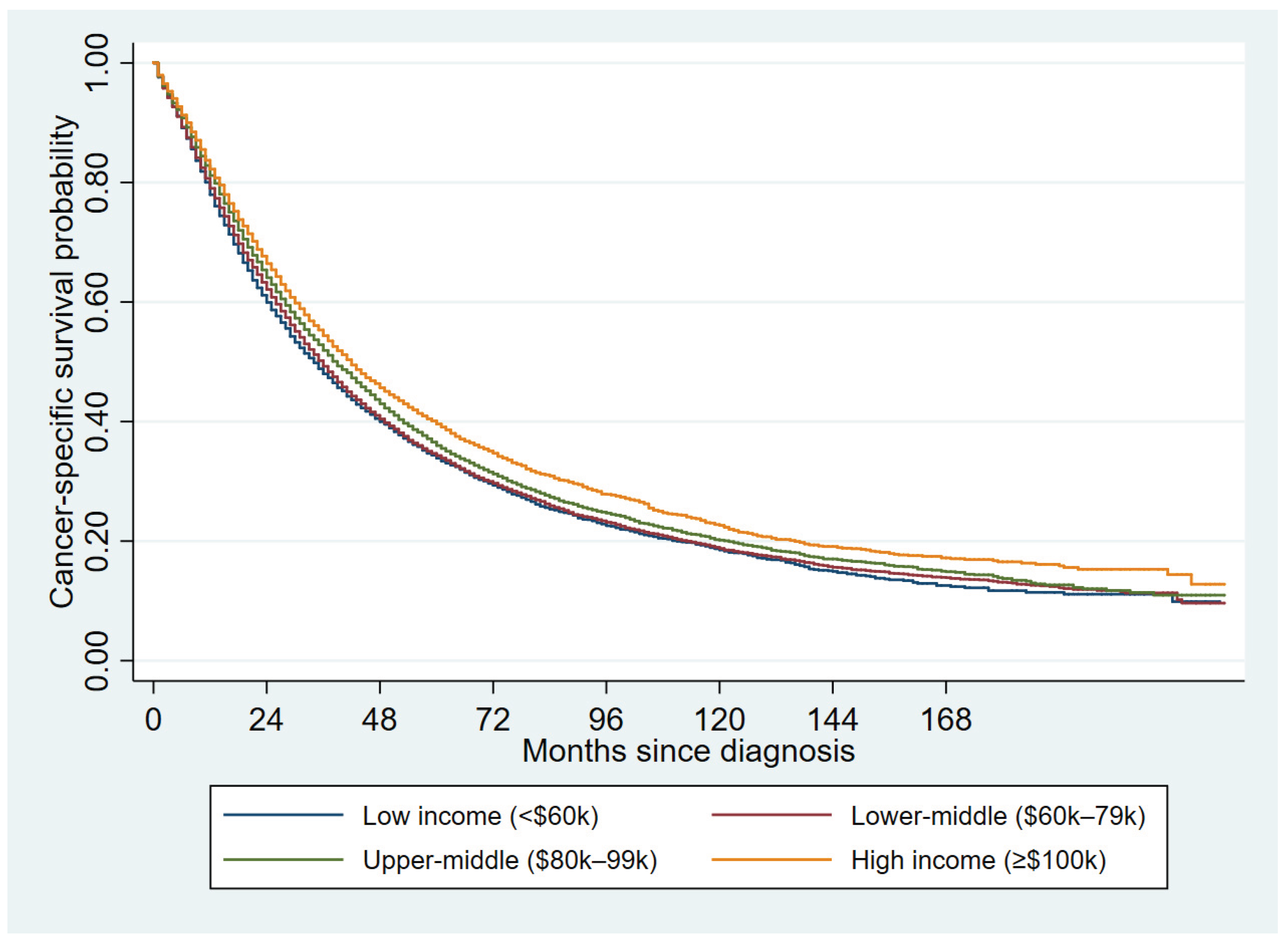

Table 1.
Baseline Characteristics of Patients with Advanced Prostate Cancer by Cancer-Specific Death Status (n= 54,062).
Table 1.
Baseline Characteristics of Patients with Advanced Prostate Cancer by Cancer-Specific Death Status (n= 54,062).
| Characteristic | Alive/died from Other Cause (n = 21,544) | Prostate Cancer Death (n = 32,518) | Test Statistic | p-value |
|---|---|---|---|---|
| Age group, n (%) | χ² = 241.34 | <0.001 | ||
| 40–44 years | 45 (27.78%) | 117 (72.22%) | – | – |
| 45–49 years | 243 (32.27%) | 510 (67.73%) | – | – |
| 50–54 years | 761 (35.18%) | 1,402 (64.82%) | – | – |
| 55–59 years | 1,799 (39.40%) | 2,767 (60.60%) | – | – |
| 60–64 years | 2,968 (41.64%) | 4,159 (58.36%) | – | – |
| 65–69 years | 3,628 (43.31%) | 4,748 (56.69%) | – | – |
| 70–74 years | 3,471 (42.91%) | 4,618 (57.09%) | – | – |
| 75–79 years | 3,169 (41.25%) | 4,513 (58.75%) | – | – |
| 80–84 years | 2,676 (37.36%) | 4,486 (62.64%) | – | – |
| 85–89 years | 1,917 (35.56%) | 3,474 (64.44%) | – | – |
| ≥90 years | 867 (33.46%) | 1,724 (66.54%) | – | – |
| Race/Ethnicity, n (%) | χ² = 245.70 | <0.001 | ||
| Non-Hispanic White | 2,810 (43.52%) | 3,647 (56.48%) | – | – |
| Non-Hispanic Black | 133 (35.95%) | 237 (64.05%) | – | – |
| Non-Hispanic Asian/Pacific Islander | 1,604 (47.85%) | 1,748 (52.15%) | – | – |
| Non-Hispanic American Indian/Alaska Native | 3,386 (38.71%) | 5,361 (61.29%) | – | – |
| Hispanic (All Races) | 114 (78.08%) | 32 (21.92%) | – | – |
| Non-Hispanic Unknown | 13,497 (38.57%) | 21,493 (61.43%) | – | – |
| Median household income inflation, n (%) | – | – | χ² = 339.79 | <0.001 |
| Low income (<$60k) | 2,613 (35.94%) | 4,658 (64.06%) | – | – |
| Lower-middle ($60k–79k) | 6,711 (36.02%) | 11,921 (63.98%) | – | – |
| Upper-middle ($80k–99k) | 6,918 (42.02%) | 9,547 (57.98%) | – | – |
| High income (≥$100k) | 5,302 (45.34%) | 6,392 (54.66%) | – | – |
| Bone metastasis, n (%) | – | – | χ² = 199.07 | <0.001 |
| No | 6,783 (35.81%) | 12,161 (64.19%) | – | – |
| Yes | 14,761 (42.03%) | 20,357 (57.97%) | – | – |
| Liver metastasis, n (%) | – | – | χ² = 193.60 | <0.001 |
| No | 21,142 (40.38%) | 31,217 (59.62%) | – | – |
| Yes | 402 (23.61%) | 1,301 (76.39%) | – | – |
| Lung metastasis, n (%) | – | – | χ² = 4.62 | 0.032 |
| No | 20,236 (39.97%) | 30,394 (60.03%) | – | – |
| Yes | 1,308 (38.11%) | 2,124 (61.89%) | – | – |
| Brain metastasis, n (%) | – | – | χ² = 15.33 | <0.001 |
| No | 21,414 (39.92%) | 32,223 (60.08%) | – | – |
| Yes | 130 (30.59%) | 295 (69.41%) | – | – |
| Radiation therapy, n (%) | – | – | χ² = 19.06 | <0.001 |
| No | 15,915 (39.14%) | 24,750 (60.86%) | – | – |
| Yes | 4,893 (41.37%) | 6,935 (58.63%) | – | – |
| Chemotherapy, n (%) | – | – | χ² = 17.55 | <0.001 |
| No | 18,955 (40.19%) | 28,211 (59.81%) | – | – |
| Yes | 2,589 (37.54%) | 4,307 (62.46%) | – | – |
| Survival months, mean (SD) | 49.88 (41.17) | 28.30 (26.81) | t = 73.76 | <0.001 |
Values are presented as n(percent) for categorical variables and mean(SD) for continuous variables. Group comparisons were performed using chi square tests for categorical variables and independent sample t tests for continuous variables. Cancer death indicates death attributable to prostate cancer. Metastatic variables represent presence of metastasis at diagnosis. SD indicates standard deviation. Percentages are row percentages within each category. The table was generated by authors using Stata version 18 [22].
Table 2.
Multivariable Cox Proportional Hazards Model for Cancer-Specific Mortality in Advanced Prostate Cancer.
Table 2.
Multivariable Cox Proportional Hazards Model for Cancer-Specific Mortality in Advanced Prostate Cancer.
| Variable | Adjusted HR | 95% CI | p-value |
|---|---|---|---|
| Race/Ethnicity | – | – | – |
| Non-Hispanic Black vs Non-Hispanic White | 1.15 | 1.00–1.31 | 0.046 |
| Non-Hispanic Asian/Pacific Islander vs Non-Hispanic White | 0.84 | 0.79–0.89 | <0.001 |
| Non-Hispanic American Indian/Alaska Native vs Non-Hispanic White | 1.15 | 1.10–1.20 | <0.001 |
| Hispanic (All Races) vs Non-Hispanic White | 0.32 | 0.22–0.46 | <0.001 |
| Non-Hispanic Unknown vs Non-Hispanic White | 1.07 | 1.03–1.11 | <0.001 |
| Age group at diagnosis | |||
| 45–49 years vs 40–44 years | 0.86 | 0.70–1.06 | 0.150 |
| 50–54 years vs 40–44 years | 0.84 | 0.70–1.02 | 0.079 |
| 55–59 years vs 40–44 years | 0.80 | 0.66–0.96 | 0.018 |
| 60–64 years vs 40–44 years | 0.80 | 0.67–0.97 | 0.020 |
| 65–69 years vs 40–44 years | 0.80 | 0.67–0.97 | 0.020 |
| 70–74 years vs 40–44 years | 0.87 | 0.72–1.05 | 0.139 |
| 75–79 years vs 40–44 years | 0.99 | 0.82–1.19 | 0.905 |
| 80–84 years vs 40–44 years | 1.25 | 1.04–1.51 | 0.019 |
| 85–89 years vs 40–44 years | 1.55 | 1.29–1.87 | <0.001 |
| ≥90 years vs 40–44 years | 2.05 | 1.69–2.48 | <0.001 |
| Bone metastasis (Yes vs No) | 0.98 | 0.96–1.01 | 0.132 |
| Liver metastasis (Yes vs No) | 2.15 | 2.03–2.28 | <0.001 |
| Lung metastasis (Yes vs No) | 1.10 | 1.05–1.15 | <0.001 |
| Brain metastasis (Yes vs No) | 1.60 | 1.42–1.80 | <0.001 |
| Radiation therapy (Yes vs No) | 0.98 | 0.95–1.01 | 0.126 |
| Chemotherapy (Yes vs No) | 1.11 | 1.07–1.15 | <0.001 |
| Median household income inflation | – | – | – |
| Lower-middle ($60k–79k) vs Low income (<$60k) | 0.97 | 0.94–1.01 | 0.116 |
| Upper-middle ($80k–99k) vs Low income (<$60k) | 0.90 | 0.87–0.94 | <0.001 |
| High income (≥$100k) vs Low income (<$60k) | 0.83 | 0.80–0.87 | <0.001 |
Adjusted hazard ratios were estimated using a Cox proportional hazards regression model. The model included race and ethnicity, age group, metastatic sites at diagnosis, treatment variables, and median household income inflation. Hazard ratios represent the relative risk of prostate cancer specific death. CI indicates confidence interval. The table was generated by authors using Stata version 18 [22].
Disclaimer/Publisher’s Note: The statements, opinions and data contained in all publications are solely those of the individual author(s) and contributor(s) and not of MDPI and/or the editor(s). MDPI and/or the editor(s) disclaim responsibility for any injury to people or property resulting from any ideas, methods, instructions or products referred to in the content. |
© 2026 by the authors. Licensee MDPI, Basel, Switzerland. This article is an open access article distributed under the terms and conditions of the Creative Commons Attribution (CC BY) license (http://creativecommons.org/licenses/by/4.0/).
Copyright: This open access article is published under a Creative Commons CC BY 4.0 license, which permit the free download, distribution, and reuse, provided that the author and preprint are cited in any reuse.


